Saturday, December 27, 2025
Home Blog Page 3508

Iran Leader Urges “Swift, Just” Prosecution of Those Involved in Economic Corruption

Ayatollah Seyed Ali Khamenei wrote, “Punishment of convicts of economic corruption must be carried on urgently and justly; and appropriate meticulousness must be given to the designation of sentences by courts,” Khamenei.ir website reported on Saturday.

In a letter addressed to the supreme leader of the Islamic Revolution, the head of the judiciary branch referred to the enemies’ economic war against the Iranian nation and committers of economic corruption in the present situation, working in line with the goals of the enemies. Ayatollah Amoli then requested permission for taking special measures in order to urgently and assertively confront these crimes, within the framework of the penalty laws set for the economic system. In this letter, it is suggested to prohibit any probation or commutation for economic disruptors and corruptors. The leader of the Islamic Revolution agreed with this suggestion and stated: “Punishment of convicts of economic corruption must be carried on urgently and justly; and appropriate meticulousness must be given to the designation of sentences by courts.”

The following is the full text of the letter by the Head of the Judiciary branch:

In the Name of Allah, the Beneficent, the Merciful

Dear Ayatollah Khamenei, the Supreme Leader of the Islamic Revolution,

Greetings,

Considering the present critical economic situation which is regarded as an economic war—as unfortunately, some of the economic disruptors and committers of economic corruption work in line with the goals of the enemies and help the enemies achieve their goals by committing crimes— it is necessary that instant and assertive confrontation be carried out. Theryby, if you deem it proper, please allow the head of the Judicial Branch to act within the framework of the penalty laws for the economic system of the country enacted on December 10, 1990 with later reforms and attachments, and the article 286 of the Islamic penalty laws enacted in 2013, while respecting the following facts:

1. Based on the contents of Act 6 of Article 2 of the aforementioned law, some branches of the revolution’s courts be formed with the presence of three judges (a president and 2 advisors). The court will have a quorum with the presence of two of the members.

2. These branches are located in Tehran, and all the related cases are referred to these branches by the first deputy of the Judicial Branch.

3. According to the discernment of the President of the Court, the sessions are public and can be broadcast by the media.

4. All the observable legal deadlines present in the criminal procedure, such as the notice and protestation are set with a maximum of five days.

5. Contents of the note of article 68 of the criminal laws regarding lawyers will be also applicable in the court.

6. When during proceedings, investigation flaws are revealed in the court, the court can primarily proceed with completion of the investigation.

7. All the charges applied to individuals and legal as well as military entities associated with the referred case, including the principle, partners and deputies are proceeded in one branch.

8. Any probation or commutation for convicts of economic corruption and disruptions is prohibited.

9. In all the cases of procedure for the aforementioned crimes, on the condition of the presence of enough reasons to discernment of the judge of the public prosecutor’s office or the court, as agreed, temporary arrest, ending proceedings, and issuing the final sentence are done. The conclusion cannot be protested in other courts, any change in the final conclusion is applied by the court that previously proceeded the case.

10. Sentences issued by this court—except for capital punishment—are binding and irrevocable. Sentences of capital punishment, with a deadline of 10 days, can ask for reconsideration in the Supreme court.

11. Implementation regulations of this act is prepared and approved by the head of the Judicial Branch.

12. This act is valid for two years following the date of approval.

The verdict is upon you and May God’s peace and mercy be upon you

Sadegh Amoli Larijani

The following is the full text of the response by Ayatollah Khamenei:

In the Name of God

The proposal is hereby approved. The goal is that the punishment of convicts of economic corruptions be carried out urgently and justly. Please advise the courts to observe necessary meticulousness regarding designation of sentences.

God’s peace and mercy be upon you.

Sayyed Ali Khamenei

August 11, 2018

France’s Peugeot Urged to Pay Penalty for Leaving Iran

In an interview with Tasnim, Iranian Deputy Industry Minister Mohsen Salehinia pointed to Peugeot’s refusal to work with Iran under a new wave of US sanctions, saying the French company must pay penalty for cancelling its contract with Iran.

Peugeot must also fulfill its commitment to supplying Iran with the Peugeot 2008 components and providing after-sale services, since the vehicles have been presold in Iran, he added.

According to Salehinia, the French auto-manufacturer has said it will suspend, not terminate, cooperation with Iran in the hope that partnership will resume in future.

Even if the French company intends to provide Iran with a series of car components, the other countries manufacturing various auto parts would refuse to work with Iran, the deputy minister explained.

Back in June, French automaker PSA Peugeot Citroen announced plans to pull out of two joint ventures to sell its cars in Iran in order to avoid the risk of US sanctions.

The retreat followed similar moves by French energy companies Total SA and Engie SA in the wake of US President Donald Trump’s move to pull his country out of the 2015 Iran nuclear deal and re-impose sanctions on Tehran.

In July, the US administration rejected France’s demands for a waiver or exemption for companies seeking to do business in Iran.

Even companies with no business ties to the US find it difficult to operate in Iran because banks are reluctant to finance Iranian operations.

After achievement of the Joint Comprehensive Plan of Action (JCPOA) between Iran and the Group 5+1 (Russia, China, the US, Britain, France and Germany) in July 2015, PSA Peugeot Citroen signed a deal with an Iranian company to make cars in the Islamic Republic.

Iran Ready to Assist Turkey amid US Pressure: Spokesman

In an interview with IRIB on Saturday, Iranian Foreign Ministry Spokesman Bahram Qassemi slammed a new wave of US sanctions against Turkey, saying such approaches would prove ineffective.

“We hope that the Turkish government and people will manage these conditions and pressure imposed from outside Turkey’s borders and … they will definitely do that because others cannot change the willpower of nations through coercion and threats,” Qassemi said.

He also expressed hope that wisdom would prevail in the world and relations among countries would be expanded based on prudence and goodwill.

Relations between Ankara and Washington have sunk to their lowest point in decades over a number of issues, including the detention of American pastor Andrew Brunson on terror-related charges, and the depreciation of the Turkish lira to hit record lows against the dollar.

US President Donald Trump wrote on Twitter late last month that his country “will impose large sanctions on Turkey for their long time detainment of Pastor Andrew Brunson.”

Turkish President Recep Tayyip Erdogan responded by announcing to freeze the assets in Turkey of US ministers of “justice and interior,” in tit-for-tat response to US sanctions.

On Friday, the US president announced to double steel and aluminum tariffs on Turkey, saying relations between Washington and Ankara are “not good.”

“I have just authorized a doubling of Tariffs on Steel and Aluminum with respect to Turkey as their currency, the Turkish Lira, slides rapidly downward against our very strong Dollar!” Trump said on Twitter.

“Aluminum will now be 20 percent and Steel 50 percent. Our relations with Turkey are not good at this time!” he added.

A day after Trump’s announcement, the Turkish president warned that his country’s partnership with the US might be in “jeopardy.”

“Unless the United States starts respecting Turkey’s sovereignty and proves that it understands the dangers that our nation faces, our partnership could be in jeopardy,” Erdogan said in an op-end published in The New York Times.

Elsewhere in his interview, Qassemi said both Iran and Turkey, as two neighboring countries, must respect mutual rights in order to help promote stability, security and peace in the region.

He added that Tehran and Ankara have always had “good” relations and expressed confidence that the two sides can help each other under the current circumstances.

Abadi’s Decision on US Sanctions Not to Impact Iran-Iraq Ties: Envoy

saMasjedi underlined on Saturday that Iran and Iraq will keep their good relations as they did in the past without any problems.

“The Iraqi prime minister has made a statement without any intention to implement them. Meanwhile, the economic relations between Iran and Iraq are so extensive and close that cannot be hampered by such remarks,” Masjedi told ILNA.

He said most Iraqi parties and political factions have rejected the remarks and stressed that Iraq will stand by the Islamic Republic by continuing its cooperation.

The Iranian diplomat went on to say that Abadi made the remarks as the Iraqi prime minister rather as an analyst, saying he has the executive power to implement his decision.

“However, as you saw, he has faced strong opposition from the inside. Meanwhile, I’ve not yet heard of any group or side supporting his remarks,” he added.

In response to a question whether or not Abadi has the authority to translate his remarks into reality, Masjedi said so far about 20 Iraqi officials with high executive posts have rejected his remarks.

The ambassador noted that despite the remarks, Iran’s exports to Iraq have doubled over the past days.

On the possible effect of US sanctions on Iran-Iraq banking ties, the ambassador said Iraqi banks have never worked with their Iranian counterparts based on the US dollar.

“This means that the new sanctions will not hamper our banking ties,” he added.

He underlined that Iran and Iraq have been working with each other based on other foreign currencies like euro, dinar and many others.

In response to a question on the reactions by some Iranian and Iraqi officials to Abadi’s remarks and their possible impacts on the two sides’ relations, Masjedi said the official stances of the two sides are based on continuing their friendship and cooperation.

He underlined that so far no changes have been made to relations between Tehran and Baghdad.

Asked whether or not Abadi has made the remarks to appease some internal factions, he said it is not clear yet and this is Abadi who must answer this question.

He said Iran and Iraq are implementing their earlier contracts without any problems and added most of the high-ranking Iraqi officials are against the US sanctions on Iran.

Back on Wednesday, Abadi said his country is opposed to US sanctions on Tehran, but would reluctantly abide by them.

“As a matter of principle we are against sanctions in the region… Blockade and sanctions destroy societies and weaken regimes,” Abadi said at a press conference.

He said the US sanctions on Tehran are a “strategic mistake” but Iraq “will abide by them.”

His statement immediately sparked harsh reactions by Iranian people and officials in the social media with many Iranian users blasting the remarks as insulting and shocking.

Reformist lawmaker Mahmoud Sadeqi said in a post in his Twitter account, “The Iraqi government, according to the Article 6 of UN Security Council Resolution 598 [which ended the Iran-Iraq war], owes the Iranian government 1.1 trillion dollars in reparations for the imposed war.”

“The Iranian government, given the restrictions on the people of Iraq, had postponed its demands on these reparations. Now, the prime minister of Iraq, instead of paying up, has decided to cooperate with oppressive sanctions against the people of Iran,” he regretted.

Iranian Vice-President for Women Affairs Massoumeh Ebtekar, who previously served as the head of Iran’s Environment Department, also quoted Sadeqi’s criticism and said the environmental damages caused by the former Iraqi regime to Iran must also be compensated.

A number of domestic Iranian media outlets also covered the Iraqi parties’ criticism of Abadi’s decision to cooperate with US sanctions.

Female Artisans More Principled than Male Counterparts in Iran

Experts maintain that men and women are equal when it comes to production and industrial development but many say women are more principled compared with men in a specific area. Though official figures put the number of female entrepreneurs in Iran’s industrial towns at 700, there is not yet any accurate figure on their presence in various industrial areas of the country.

Today, Iranian women have gone beyond their traditional roles and careers like housekeeping, carpet-weaving and making other types of handicrafts, and have opened their way into new areas like knowledge-based firms.

A huge number of female entrepreneurs are currently involved in Iranian knowledge-based firms. Equipped with the latest know-how and capabilities, they are competing with foreign brands. Meanwhile, public and private sectors as well as non-governmental organizations and media have put their weight behind the industrial and economic projects implemented by women. Allocating abandoned buildings to women entrepreneurs in the industrial towns are among the mechanisms devised by governmental organizations to support them.

Today, the huge community of educated women in Iran is looking for jobs with some of them paving their way into industrial towns and production units.

Female Artisans More Principled than Male Counterparts in IranIn an interview with Gostaresh-e San’at daily newspaper, Iranian entrepreneur Shabnam Esmaeilzadeh has noted that there is no discrimination between men and women in Iran’s Constitution as well as the government’s supportive plans for expanding industrial units.

“When women begin their career as an entrepreneur, they remain committed to a set of values which men usually care less about,” she said.

Esmaeilzadeh went on to say that in her own industrial complex, she provides men and women staff with equal working opportunities.

Vahideh Amiri, the production manager of a factory in an industrial town, has elaborated on the different works done by men and women and said one of the main differences between men and women is in men’s holistic and women’s integrated approaches towards their works.

“Women have a more accurate and appropriate working plan compared with men,” she said.

Female Artisans More Principled than Male Counterparts in IranTouching on her own experiences in the industrial area, Amiri told the paper that she has been repeatedly praised by industrial managers who visited her factory over its principled and accurate planning. “Women are better than men in making decisions during critical times.”

She underlined that her factory has not yet faced any serious problem other than the common problems which all industrial entrepreneurs are grappling with. “There has been no case which would make me think such a problem could be avoided if I were a man.”

Some industrial experts maintain that men and women are different when it comes to industrial activities; but on the other hand, there are many others who believe that there is no difference between them. They go further saying women are completely capable of getting involved in various industrial sectors.

Farshad Moqimi, the Deputy Head of Iran’s Small Industries and Industrial Parks Organization (ISIPO), says educated women are these days looking for job opportunities and some of them have managed to enter industrial towns and production units.

Therefore, he added, it is crucial to support their activities in order to promote job opportunities and production in the country.

Female Artisans More Principled than Male Counterparts in Iran

Envoy Says Iran Totally Opposed to Space Militarization

Speaking at a meeting with Director of the United Nations Office for Outer Space Affairs (UNOOSA) Simonetta Di Pippo in Vienna, Gharibabadi expounded on the Islamic Republic’s principled policy on space activities and described the space as “the common heritage of humanity”.

“Space should be used solely for exploration and peaceful purposes by the UN member states,” the diplomat stated.

“The Islamic Republic of Iran is seriously and basically opposed to any arms race in space or the deployment of any weapons, including conventional weapons or weapons of mass destruction, to space or militarization of space,” he added.

The remarks came after US President Donald Trump’s plans for a “Space Force” were announced on Thursday, a typically theatrical term from the former celebrity businessman for what will be America’s sixth branch of military.

US Vice President Mike Pence confirmed overnight plans to create the “Space Force”, repeating comments from Trump, who had said that “American dominance in space” was imperative.

Earlier this year, Trump had said, “Space is a war-fighting domain, just like the land, air and sea.”

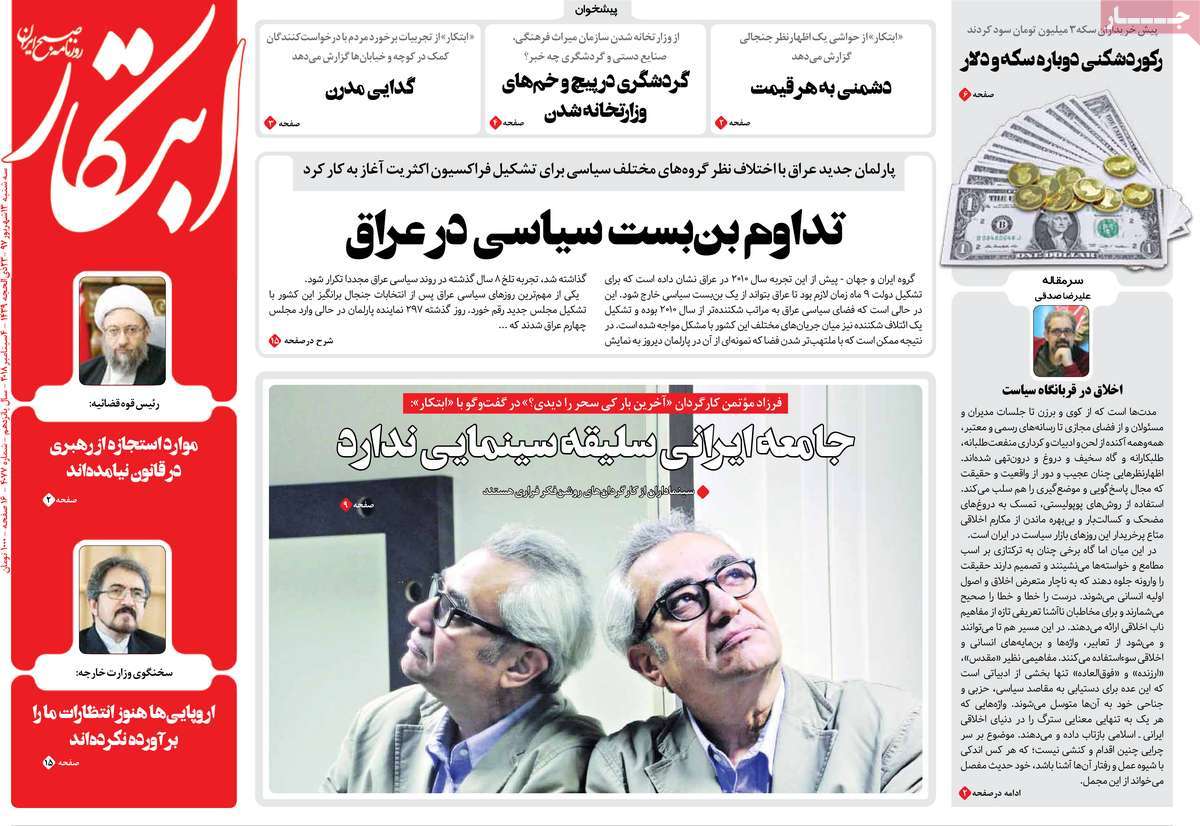
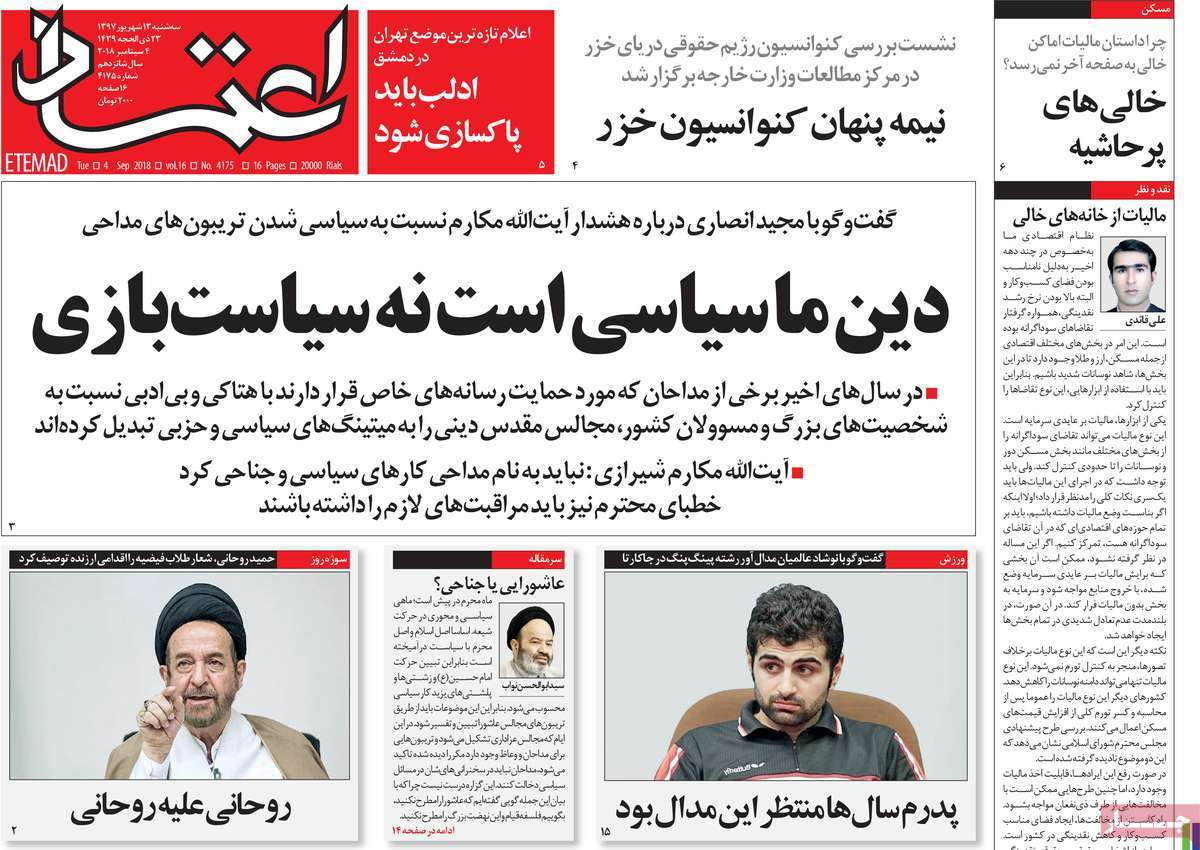
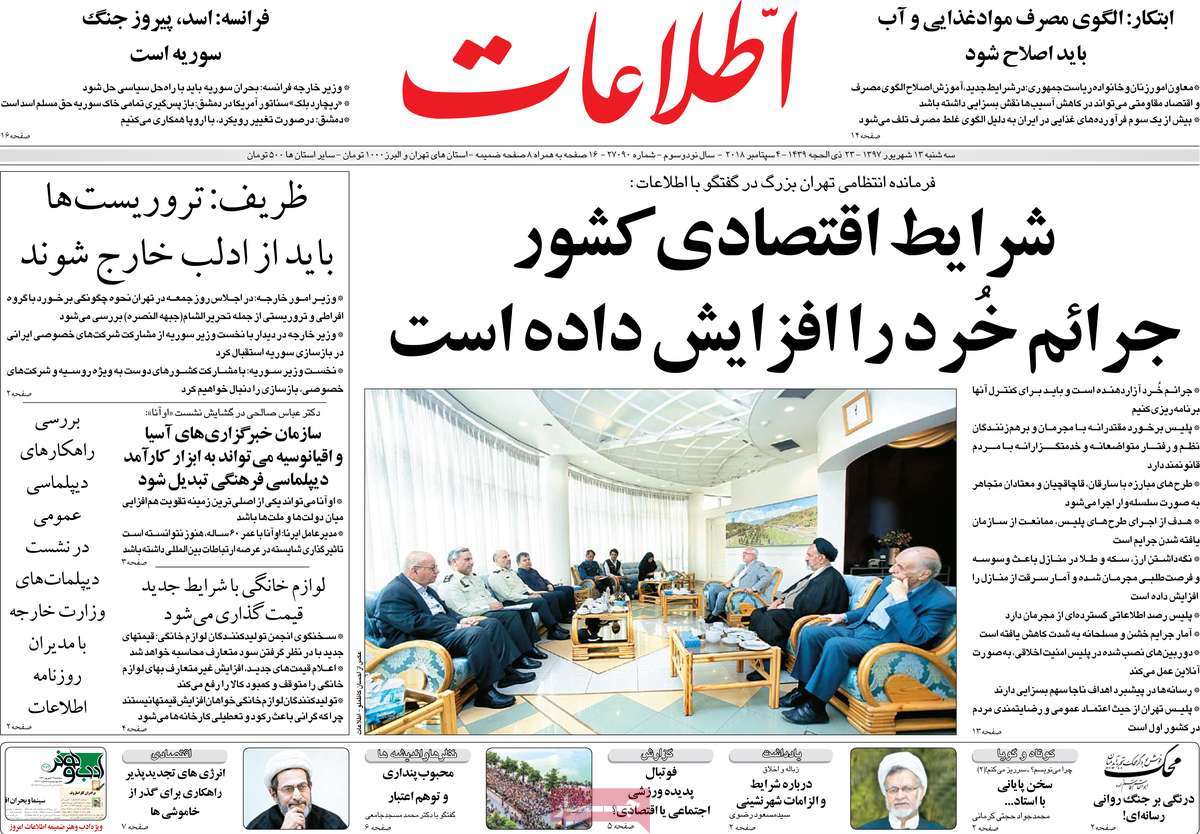
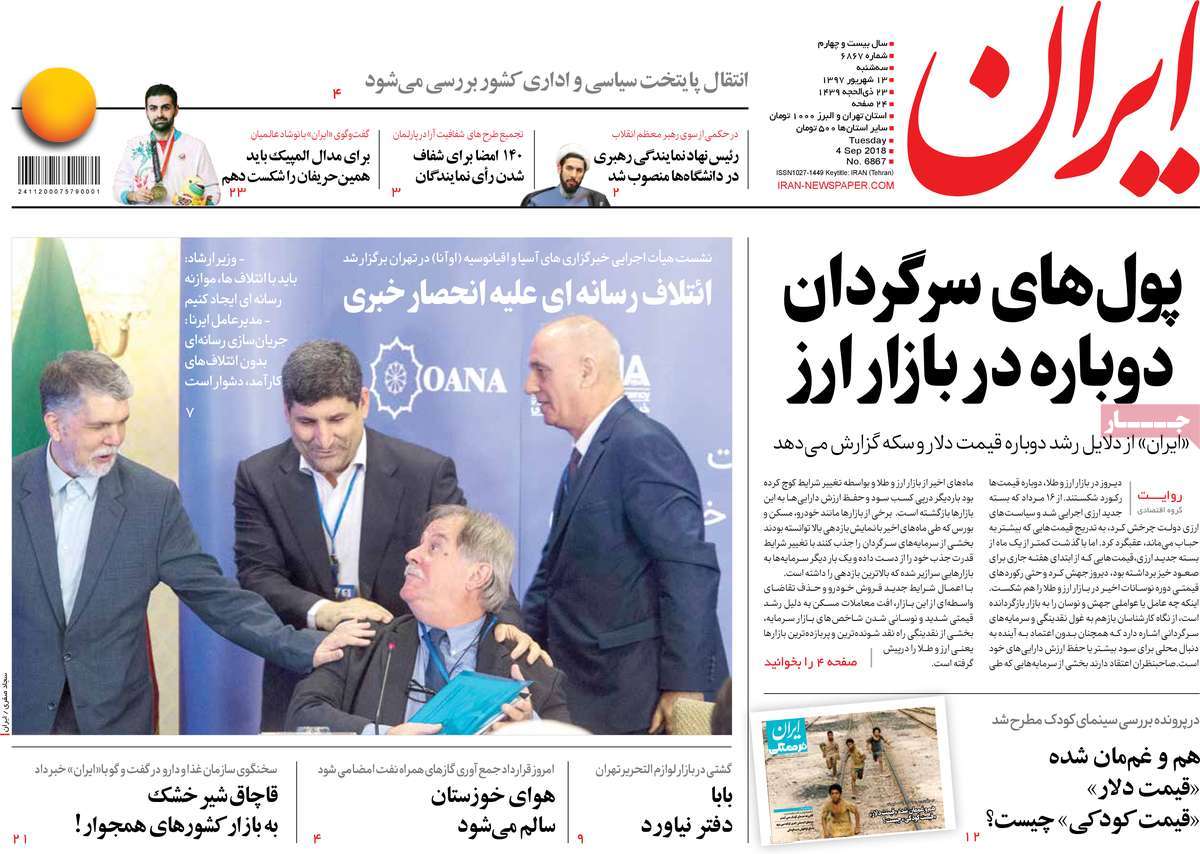
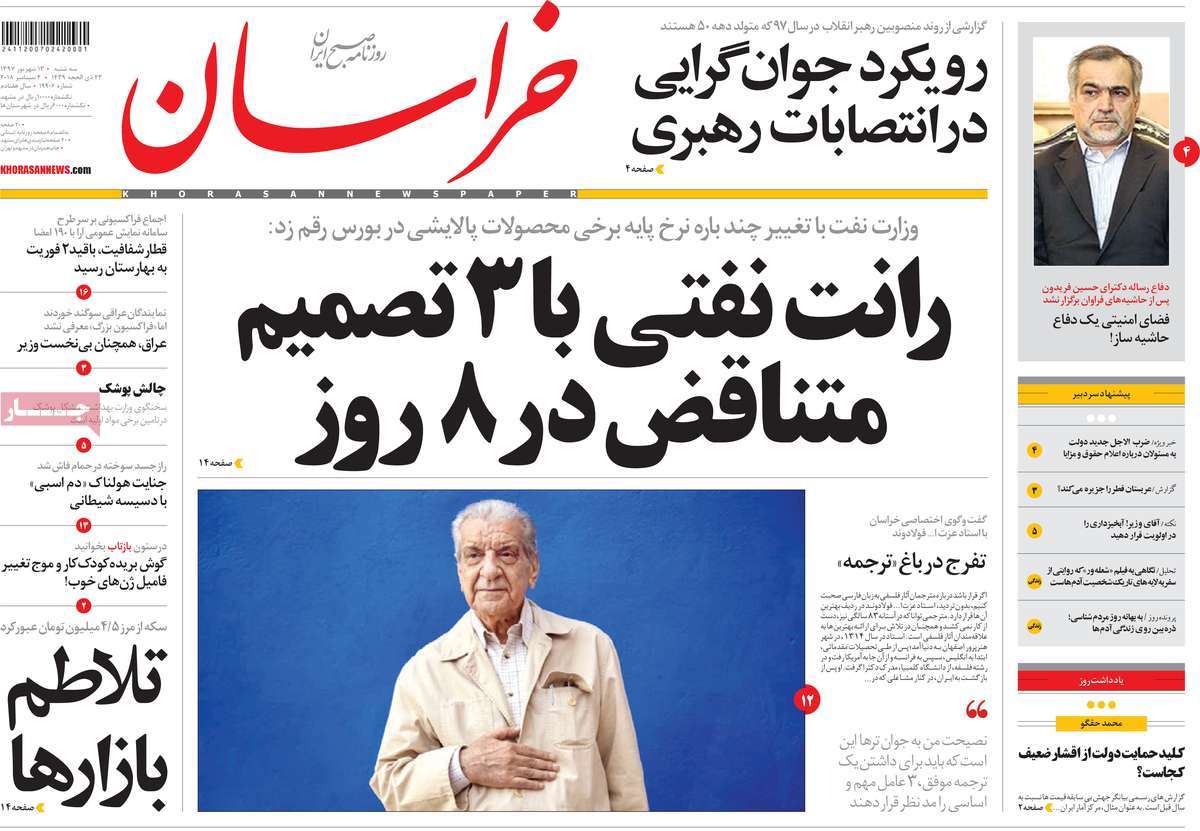
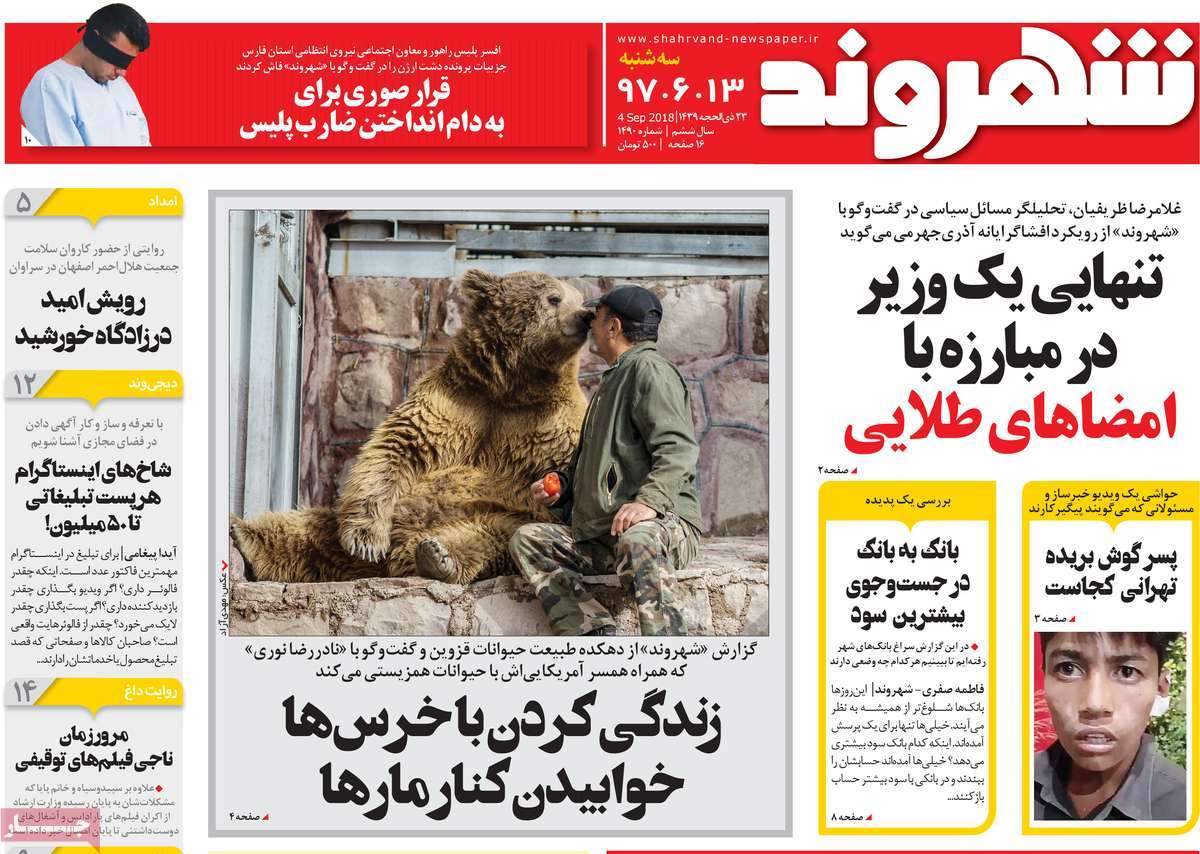
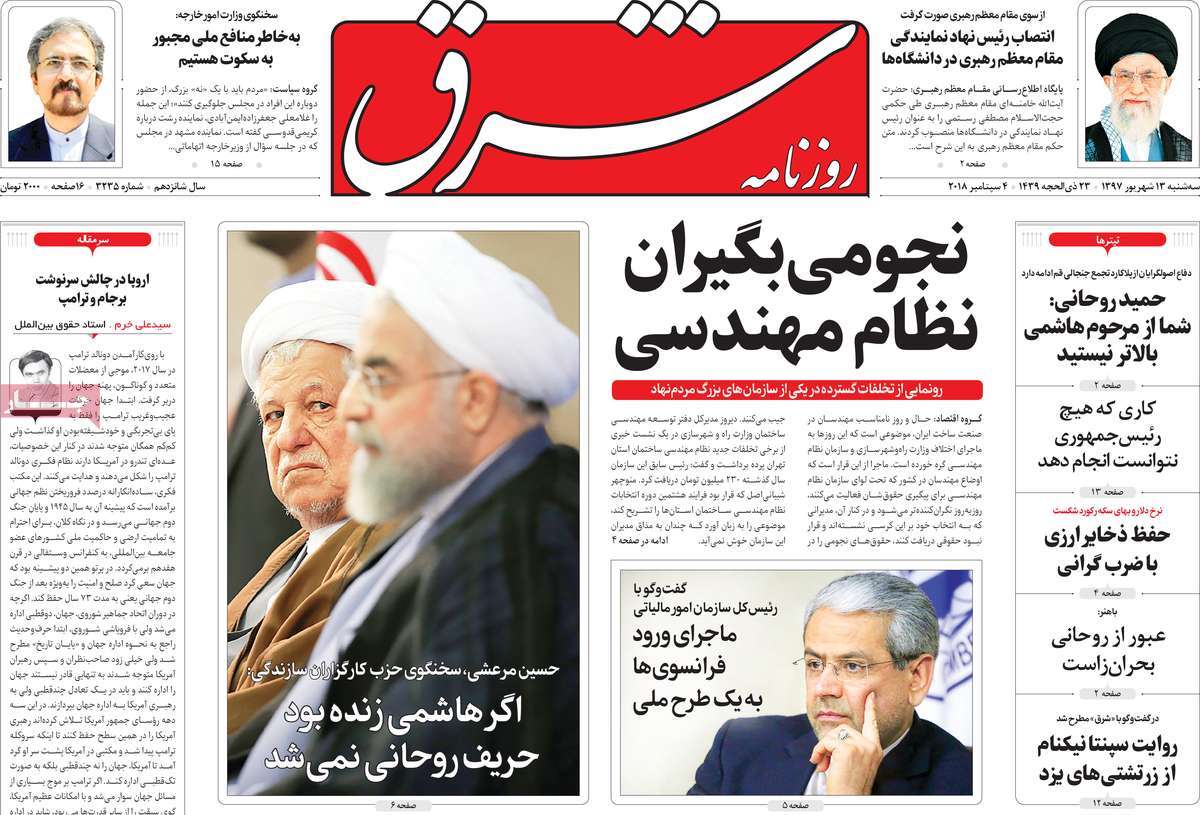
A Look at Iranian Newspaper Front Pages on August 11

A Look at Iranian Newspaper Front Pages on November 19

Several papers today covered the remarks made by the Leader of Iran’s Islamic Revolution Ayatollah Seyyed Ali Khamenei about the future of the country’s Islamic Revolution. The Leader has stressed that the enemies cannot do a damn thing, and people should not be worried.

Also a top story was Tehran’s reaction to Iraqi Prime Minister Haider al-Abadi’s announcement that his country will have to follows US sanctions on Iran. Iranian people and officials, within the past couple of days, have strongly blasted the Iraqi government for the decision, noting that Iraq is making such anti-Iran moves despite the fact that it owes billions of dollars to the Islamic Republic over war compensation, as per the UN Security Council Resolution 598.

The above issues, as well as many more, are highlighted in the following headlines and top stories:


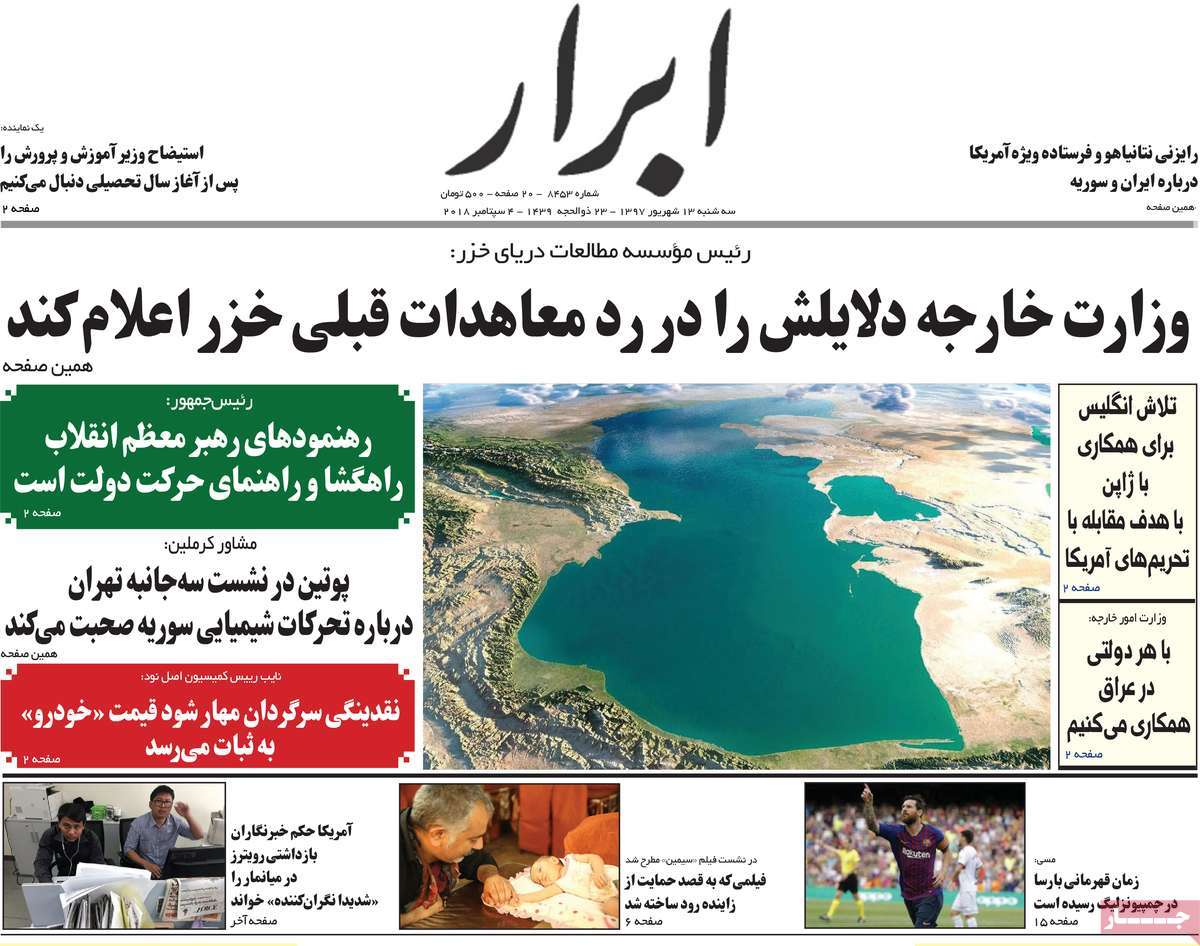
Abrar:

1- Iran Leader in Reaction to Concerns about Future of Revolution: No One Can Do a Damn Thing

2- Erdogan Underlines Expansion of Iran-Turkey Relations

A Look at Iranian Newspaper Front Pages on August 11


Afkar:

1- Tehran Friday Prayers Leader: We Won’t Hold Talks with US

A Look at Iranian Newspaper Front Pages on August 11


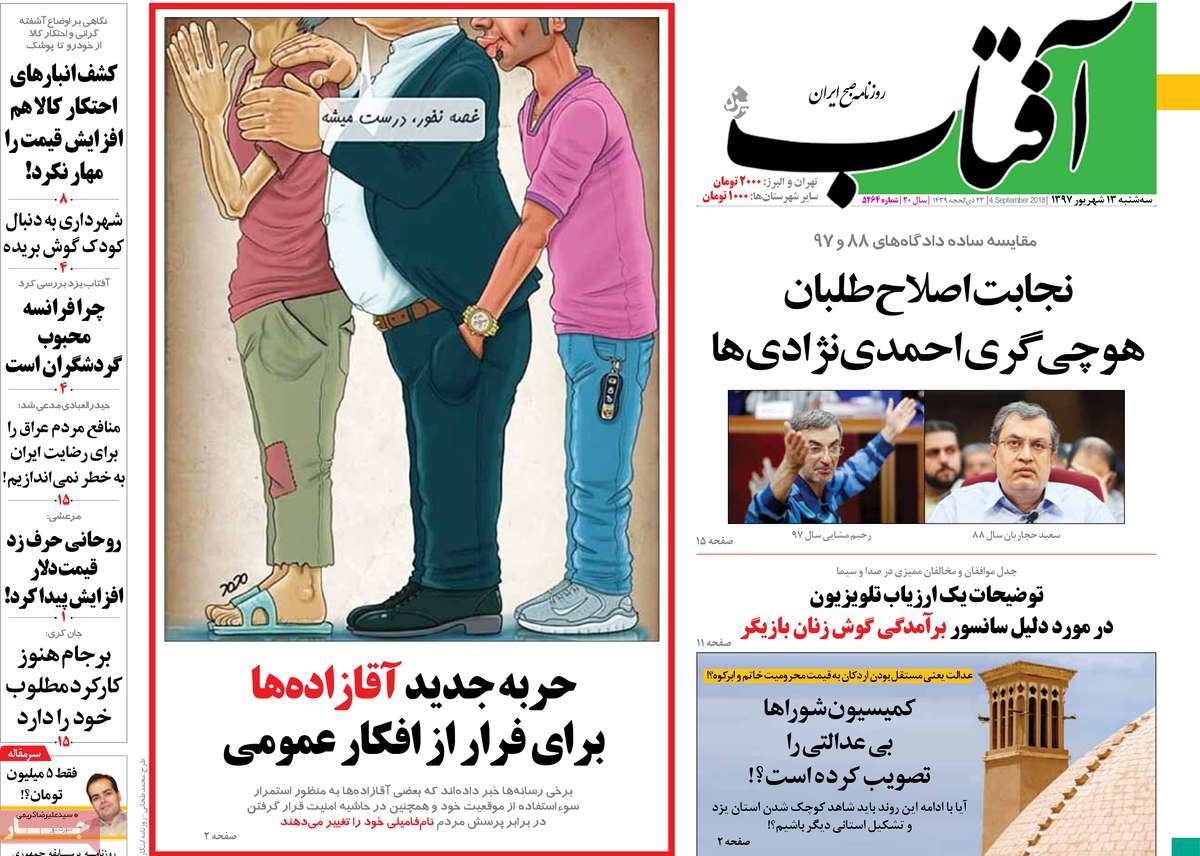
Aftab-e Yazd:

1- We Must Receive Compensation from Iraq

  • Observes Urge Iran Gov’t to React to Baghdad’s Support for US Sanctions

A Look at Iranian Newspaper Front Pages on August 11


Asrar:

1- Rouhani’s Chief of Staff: Iran, Turkey Eye $30 Billion Trade

2- IAE Warns: Iran Sanctions to Disrupt Global Oil Market

A Look at Iranian Newspaper Front Pages on August 11


Besharat-e Now:

1- Iran Alone in the Region: Iran’s Neighbours Cautiously Obeying US Sanctions

A Look at Iranian Newspaper Front Pages on August 11


Donya-ye Eqtesad:

1- Historic Devaluation of Turkish Lira: 50% Decrease in One Year

A Look at Iranian Newspaper Front Pages on August 11


Ebtekar:

1- Don’t Be Waiting for Rouhani-Trump Meeting in New York: Official

A Look at Iranian Newspaper Front Pages on August 11


Etemad:

1- Madness, Revenge and Yemeni Children [Editorial]

A Look at Iranian Newspaper Front Pages on August 11


Ettela’at:

1- Switzerland, Germany, Japan, Turkey Oppose US Sanctions on Iran

2- Saudi Attack on Bus Carrying Yemeni Children Leaves 50 Dead

A Look at Iranian Newspaper Front Pages on August 11


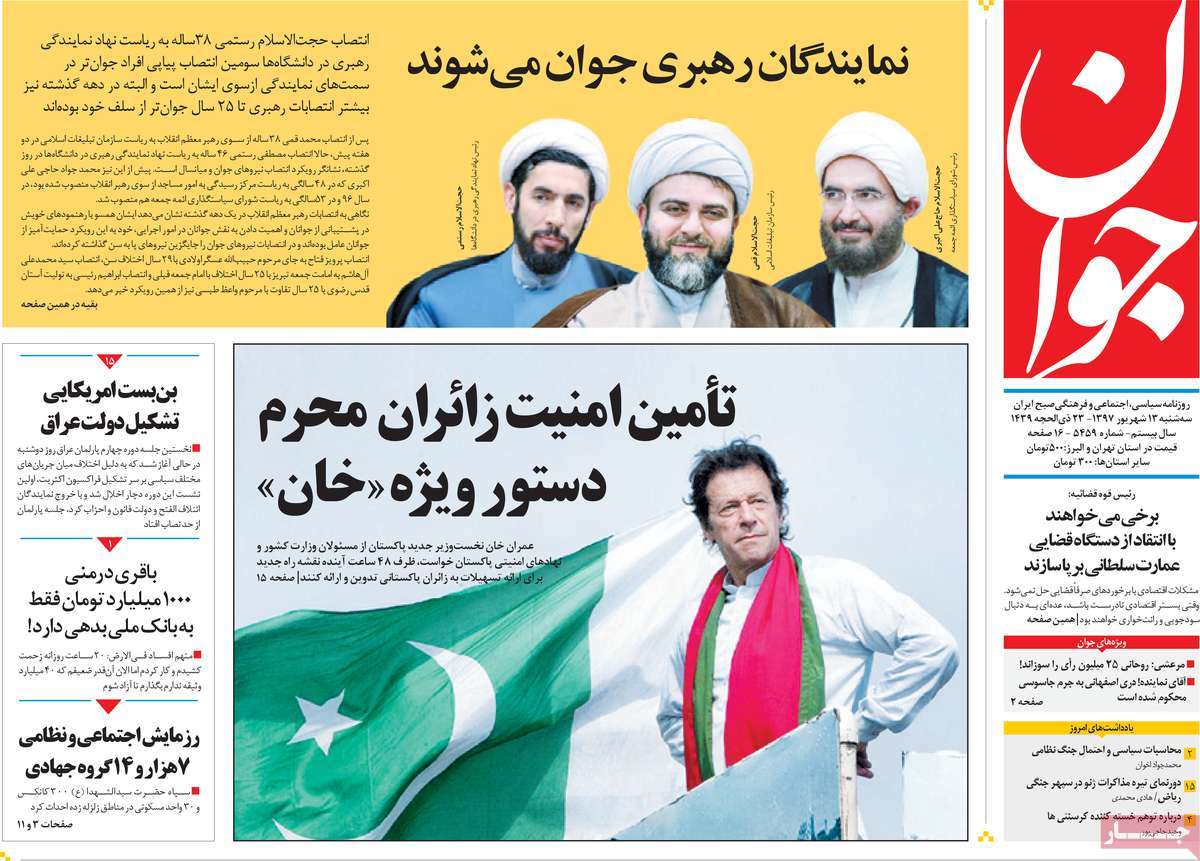
Javan:

1- Entire Iraq against Mr Prime Minister

A Look at Iranian Newspaper Front Pages on August 11


Ka’enat:

1- Interior Minister: US Must Officially Apologize to Iran Nation

A Look at Iranian Newspaper Front Pages on August 11


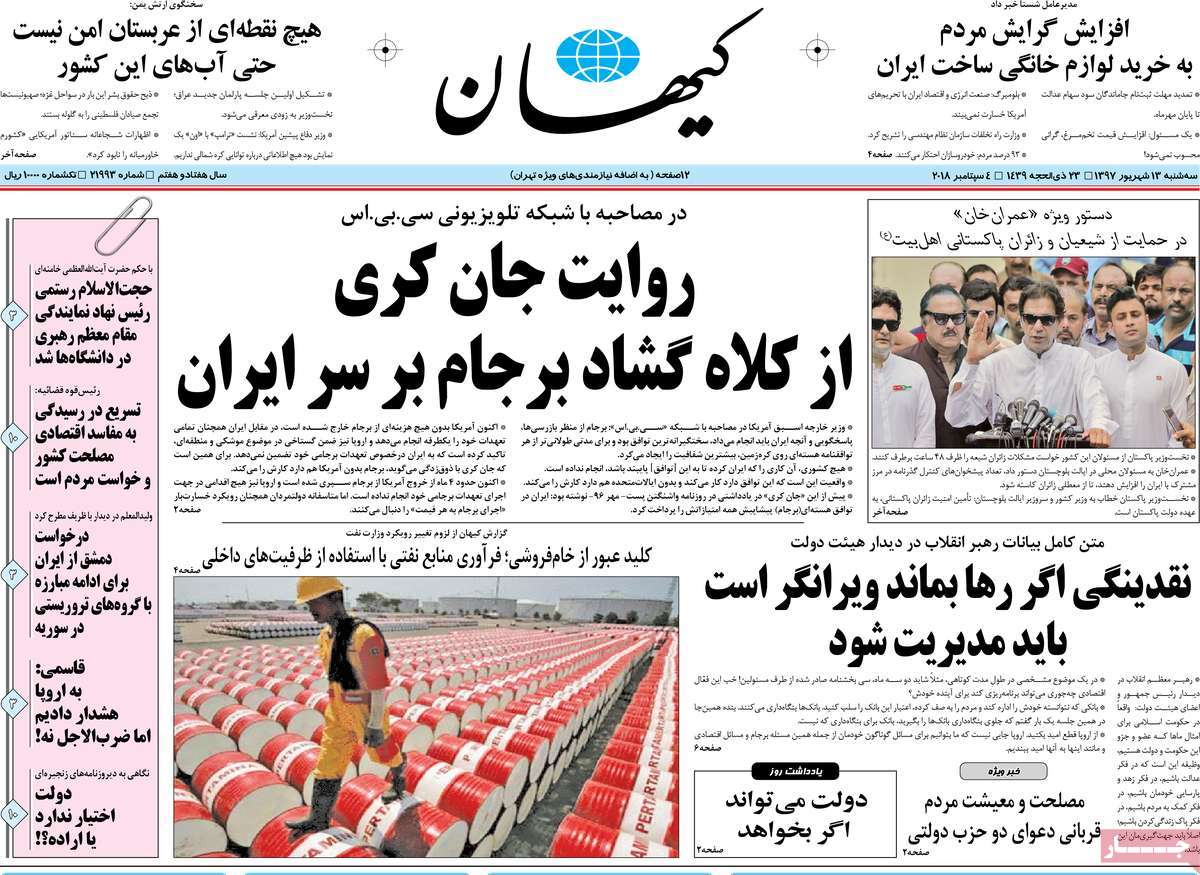
Kayhan:

1- Hamas Fires 220 Rockets at 50 Zionist Towns in Decisive Response to Israel Attacks

A Look at Iranian Newspaper Front Pages on August 11


Khorasan:

1- Several Companies, Banks Belonging to Military Organizations to Be Privatized

A Look at Iranian Newspaper Front Pages on August 11


Payam-e Zaman:

1- Iran’s Oil Has No Alternative; Oil Discount for Asian, European Clients

A Look at Iranian Newspaper Front Pages on August 11


Quds:

1- Iran to Become World’s 15th Biggest Economy in 2021 despite Sanctions: IMF

A Look at Iranian Newspaper Front Pages on August 11


Resalat:

1- Senior Lawmaker: Iran, US Have No Strategy for Talks

A Look at Iranian Newspaper Front Pages on August 11


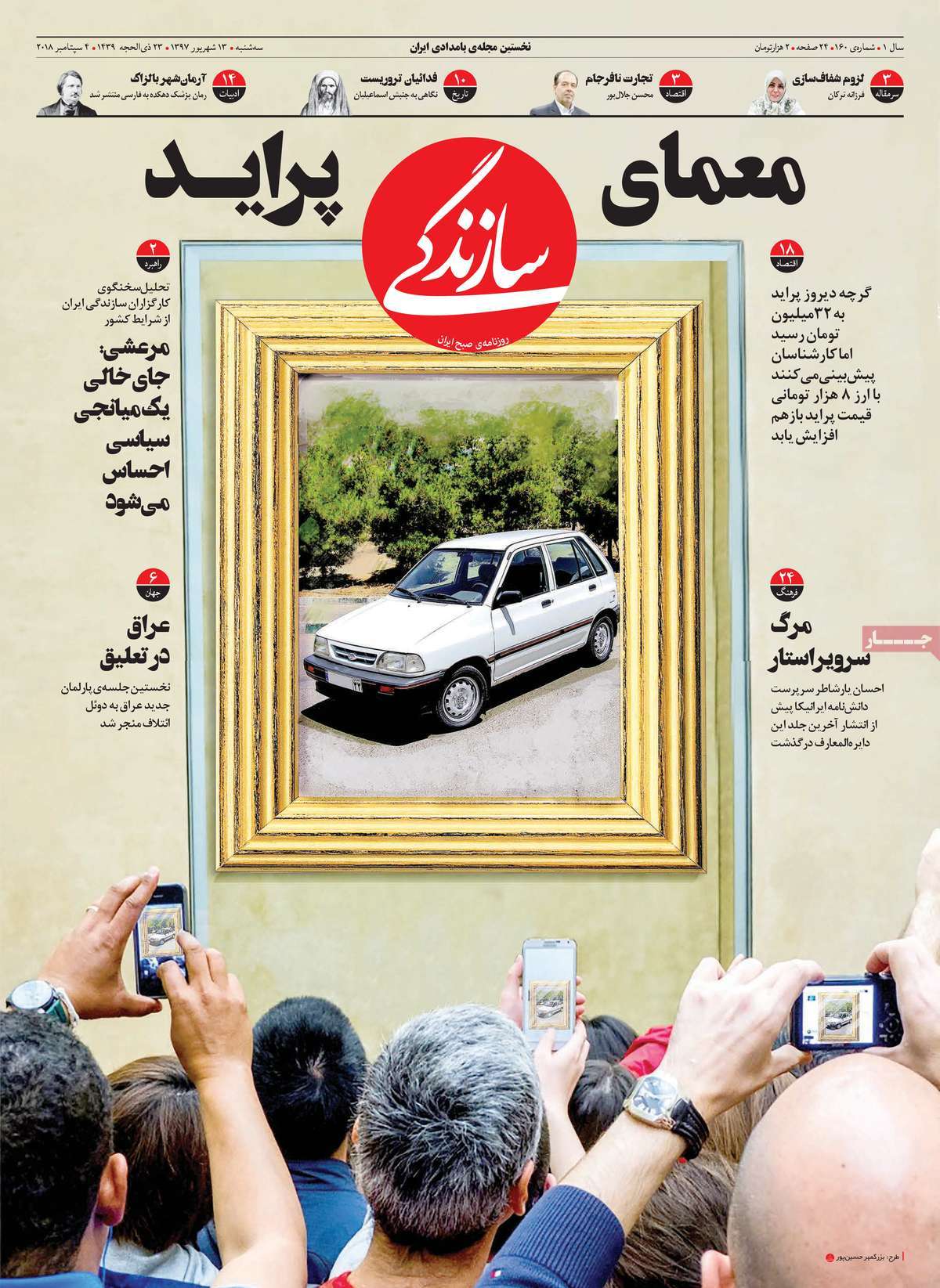
Sazandegi:

1- Mystery of Ahmadinejad’s Immunity

  • Former President Urges Rouhani to Resign

A Look at Iranian Newspaper Front Pages on August 11


Shargh:

1- Reactions to Iraq’s Support for US Sanctions on Iran

A Look at Iranian Newspaper Front Pages on August 11


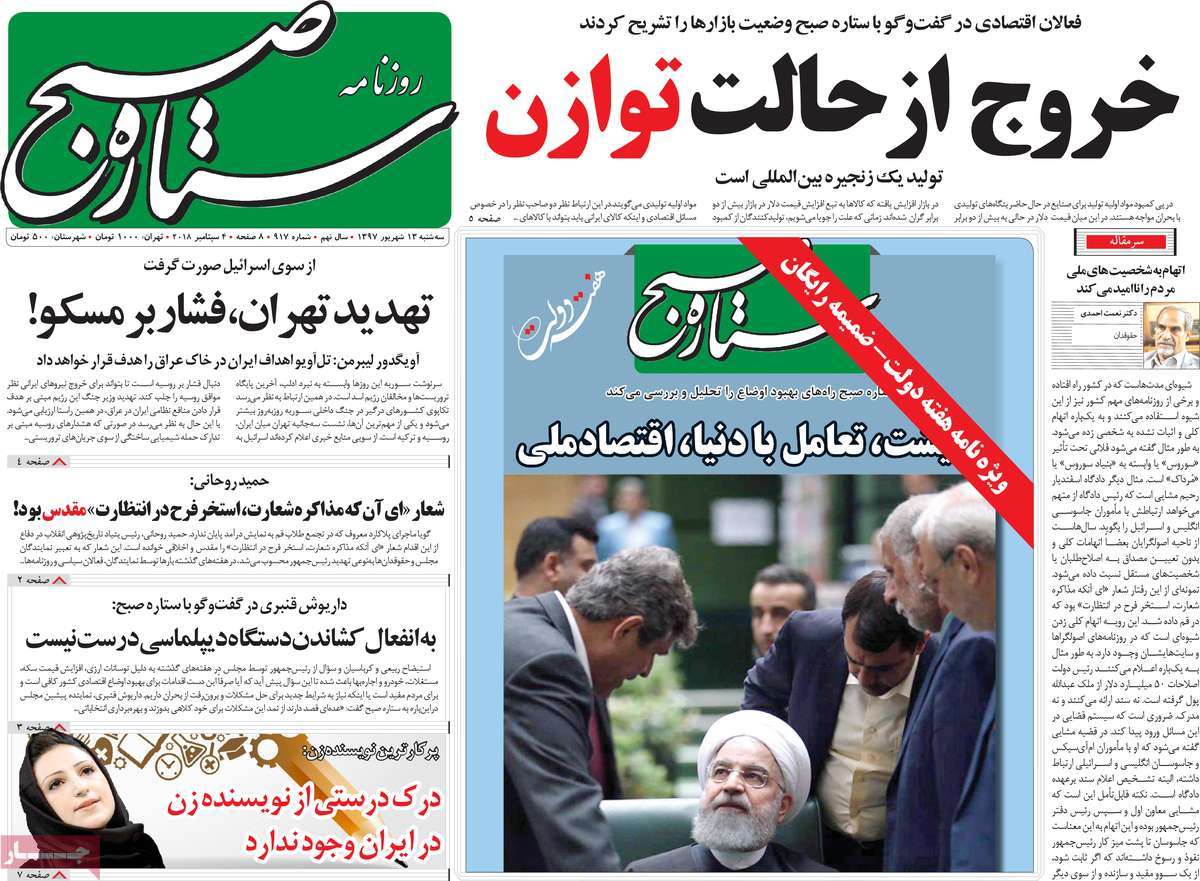
Sobh-e Now:

1- Killing Saudi Children in Yemen

  • UN Calls Saudi Bombing of Yemen ‘War Crime’

A Look at Iranian Newspaper Front Pages on August 11

Iran Kills 10 Terrorists on Northwestern Border

Iran Kills 10 Terrorists on Northwestern Border

Ground forces of the Islamic Revolution Guards Corps (IRGC) broke up the terror cell “affiliated with foreign spy services” on Saturday.

The terrorists intended to infiltrate into Iran through a northwestern border to provoke insecurity and commit acts of sabotage in the country, IRNA reported.
However, they were ambushed by IRGC forces. At least 10 terrorists were killed and several wounded in fierce fighting between the two sides.

A large amount of weaponry, ammunition and communication devices were also seized from the terrorists.

Iran Legislation Watchdog Ratifies Parliamentary Amendment to CTF Law

Iran Legislation Watchdog Ratifies Parliamentary Amendment to CTF Law

“The legislation was found not to be in violation of the Constitution,” said Abbas-Ali Kadkhodaei, speaking in a regular presser on Saturday.

The parliamentary legislation amends Iran’s law in accordance with standards set by the global anti-money laundering body, Financial Action Task Force (FATF).

The amendment was meant to allow Iran to meet one of the requirements for getting out of FATF’s black list.

This is while Kadkhodaei had announced last month the council members had rejected the parliamentary amendments, sending the legislation back to the parliament.

Kadkhodaei said the council members had argued that introducing such amendments are not within the area of responsibility of the parliaments and they should instead be presented by the Judiciary.

Iran has for many years found itself in a blacklist of countries not doing enough to combat money laundering and terrorism financing by the G7-created FATF.

The Islamic Republic entered into talks with the FATF to get out of the body’s blacklist following the January 2016 implementation of the JCPOA.

But Iran’s accession to FATF has slowed down in recent months, over concerns among some officials that the move could endanger the country’s national security interests.

In its last meeting held on June 29, the FATF lamented Iran’s failure to amend its law, and gave the country until October to implement necessary reforms.

This is while Iran’s Leader Ayatollah Seyyed Ali Khamenei recently suggested that Iran did not have to join international conventions such as FATF when the consequences are not clear.

Speaking on June 20, the Leader said the parliament should pass legislation to combat money laundering according to its own criteria.

Trump’s Jubilation at Exerting Pressure on Turkish People ‘Shameful’: Iran

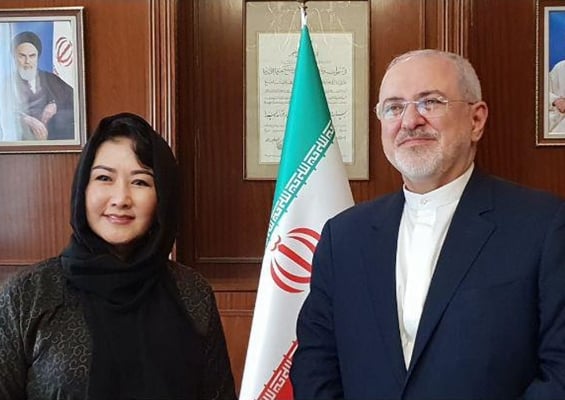
“Trump’s jubilation in inflicting economic hardship on its NATO ally Turkey is shameful,” Zarif tweeted on Saturday.

“The US has to rehabilitate its addiction to sanctions & bullying or entire world will unite—beyond verbal condemnations—to force it to,” he wrote.

“We’ve stood with neighbours before, and will [do so] again now,” Zarif said.
Zarif had earlier offered support for Turkey following the imposition of the US sanctions.
Trump announced his plans to hike tariffs on Turkish steel and aluminium to 50 percent and 20 percent, acknowledging that “our relations with Turkey are not good at this time.”

In a tweet Friday, the president also said he would levy tariffs as “their currency, the Turkish Lira, slides rapidly downward against our very strong Dollar!”

The already-reeling currency plunged even more Friday, dropping 20 percent after Trump’s tweet.

The moves stem from Trump’s frustration over a detained American pastor held by Turkey on what US officials say are bogus charges, two informed sources told CNN.

Earlier this month, the US imposed sanctions on two Turkish ministers over the case of the American pastor detained in Turkey over suspicions of plotting against the Turkish government.