Monday, December 22, 2025
Home Blog Page 3441

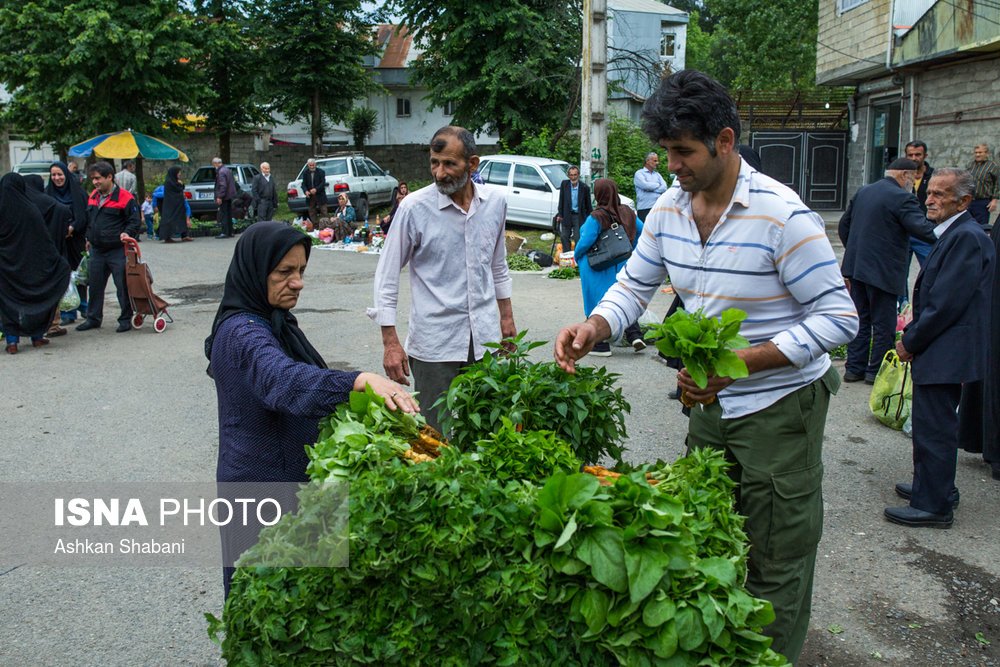
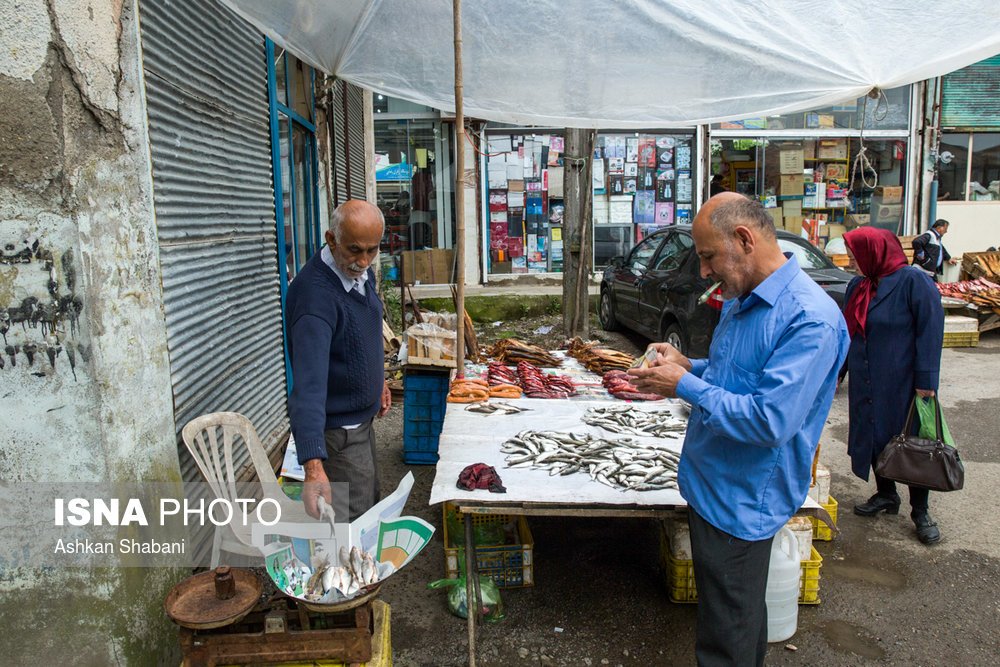
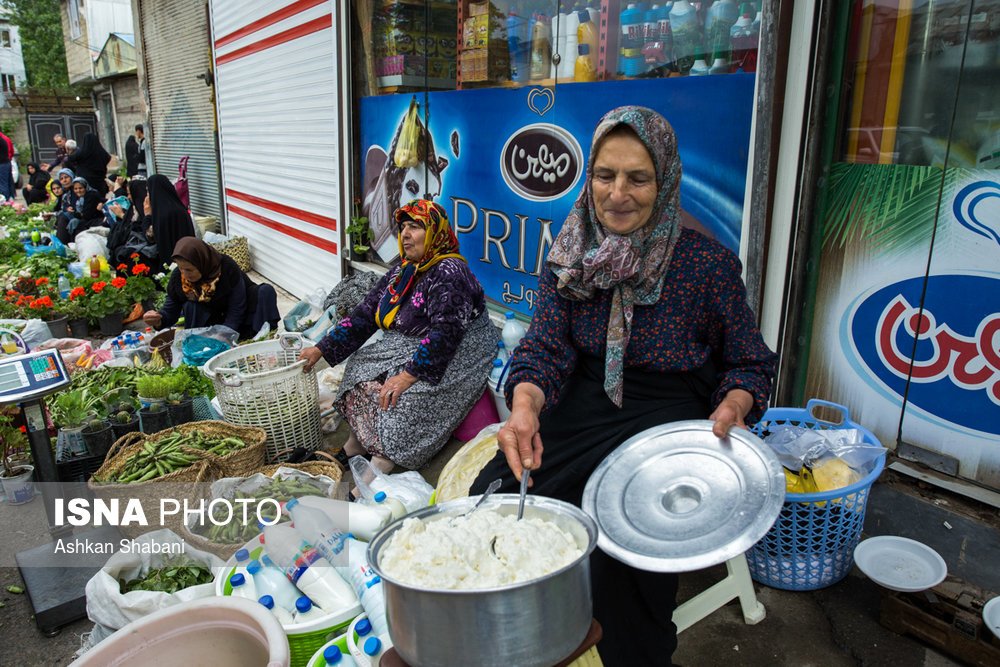
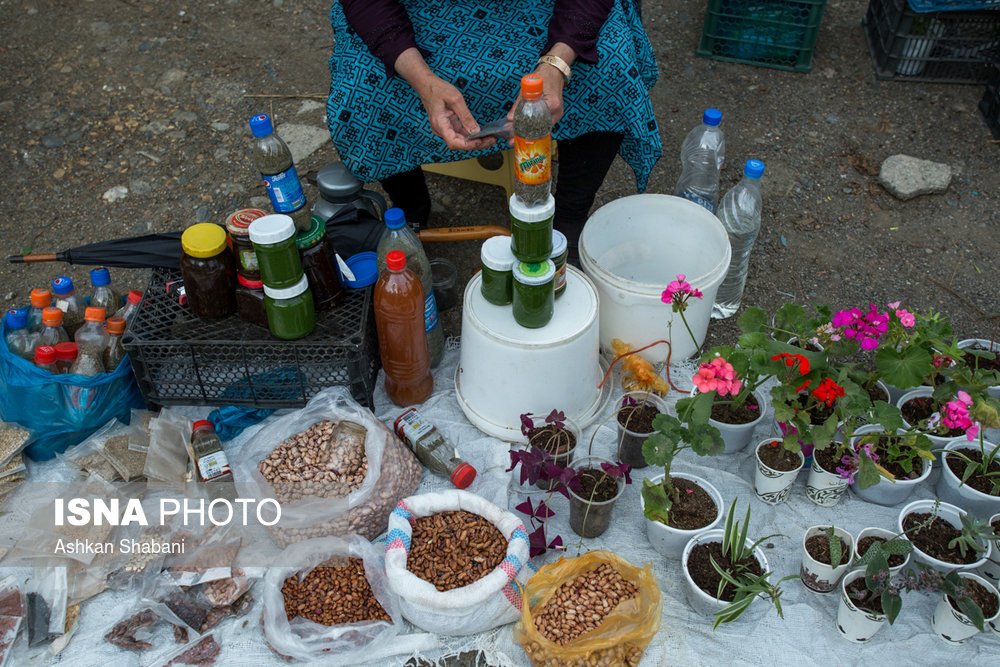
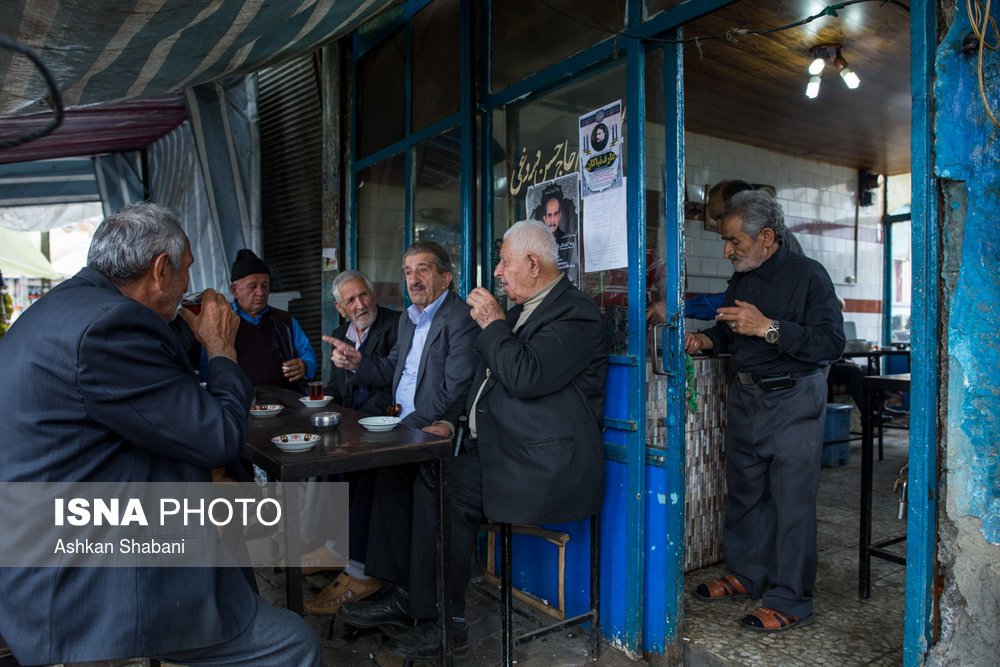
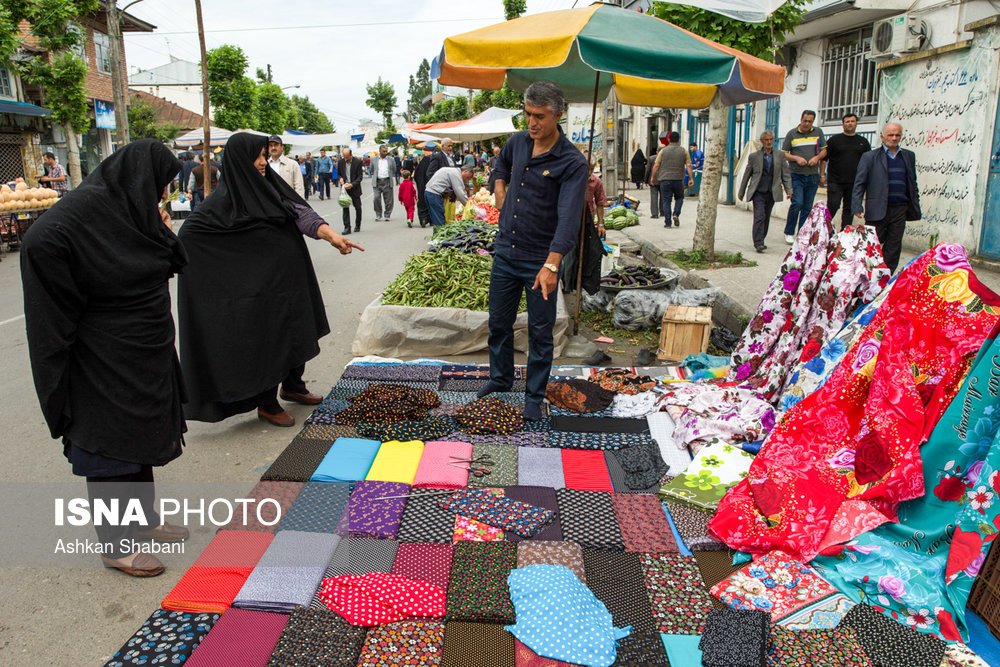
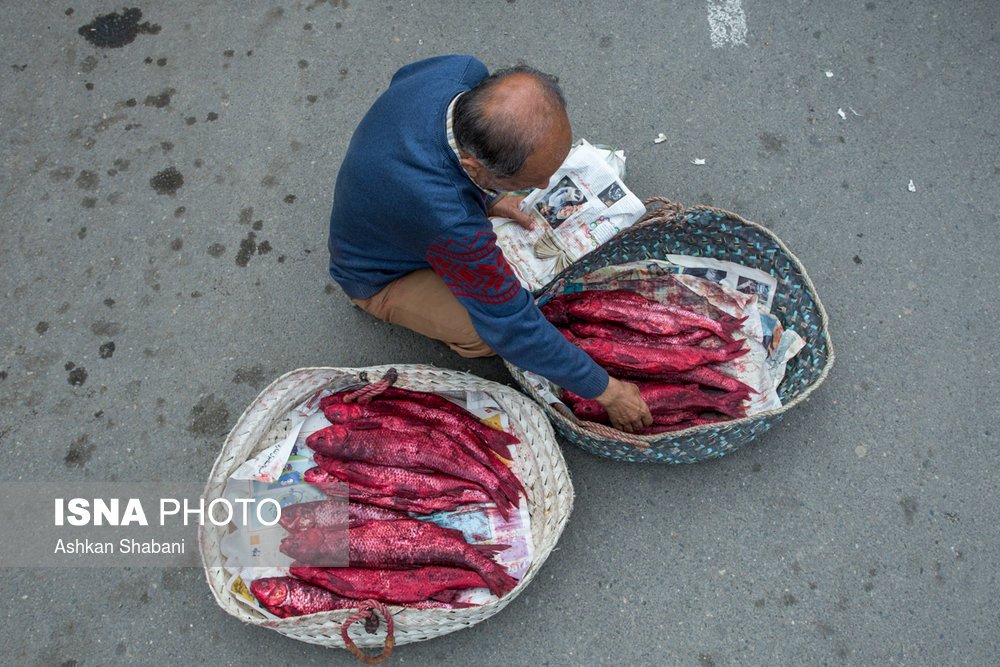
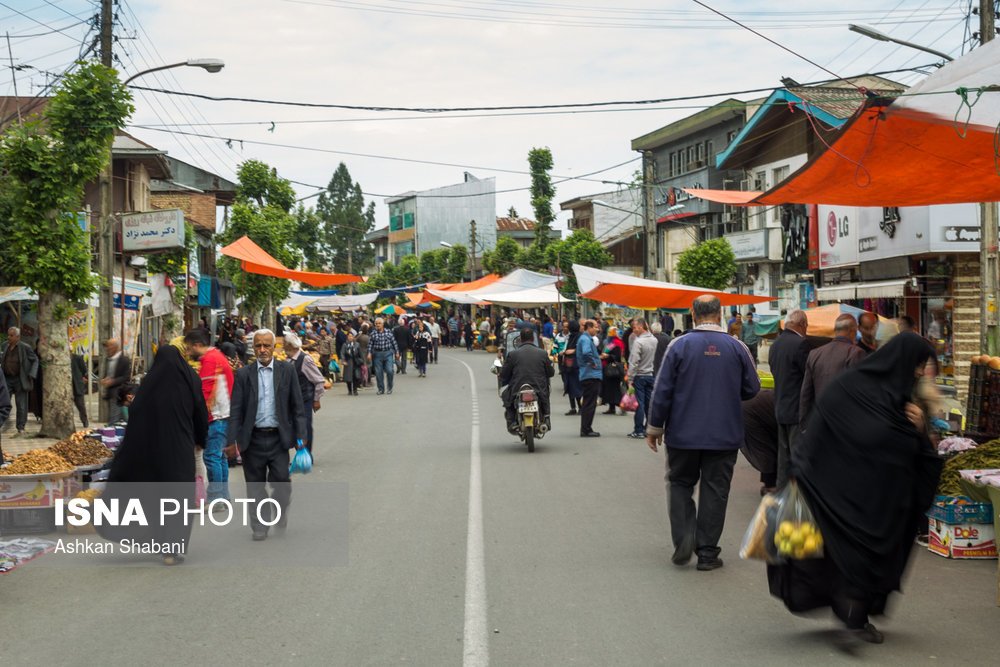
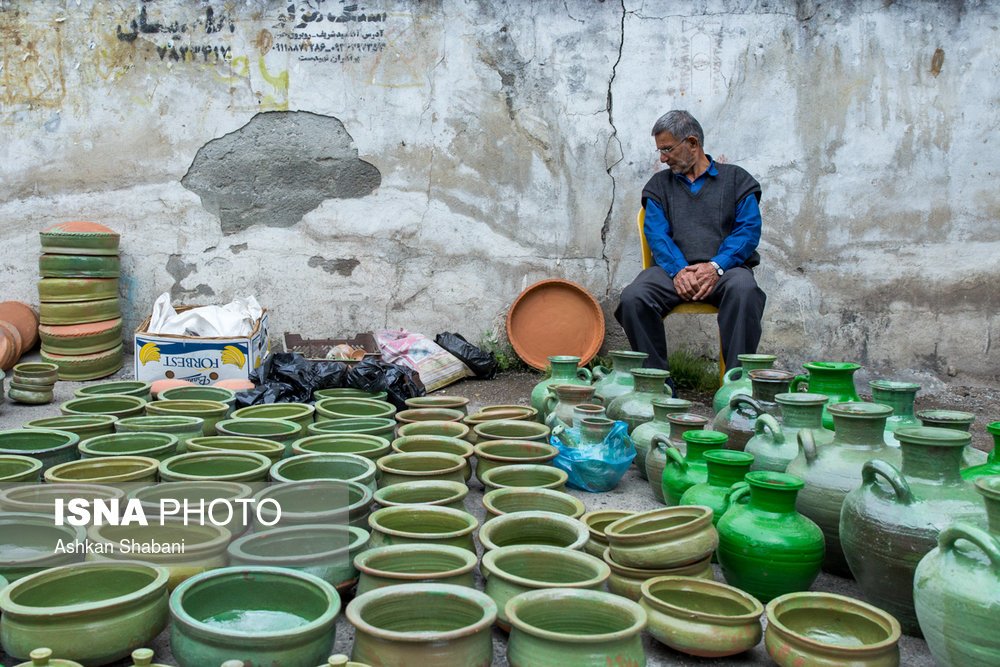
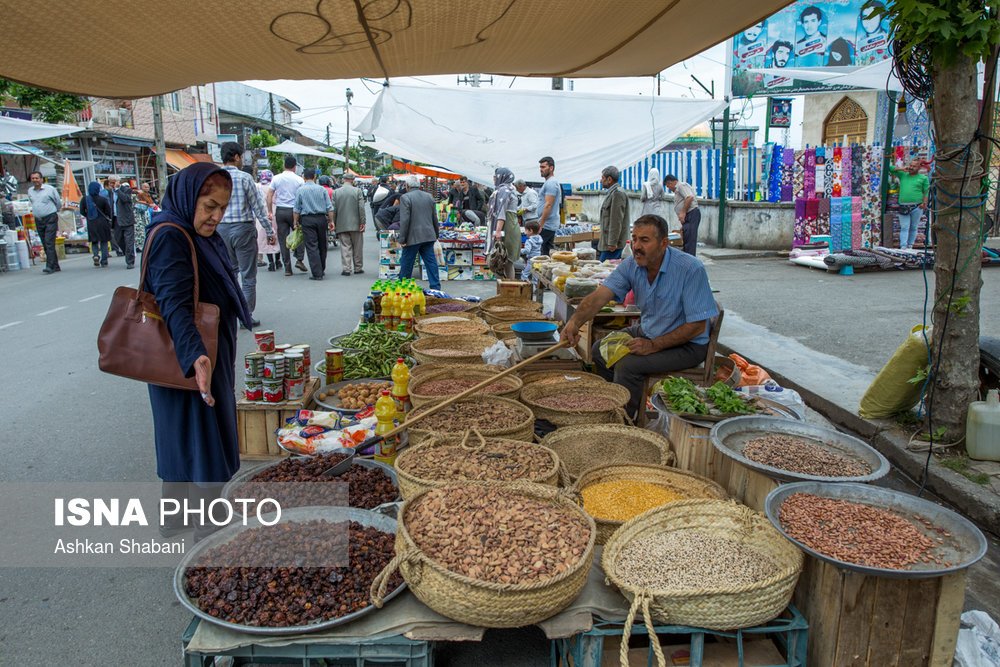
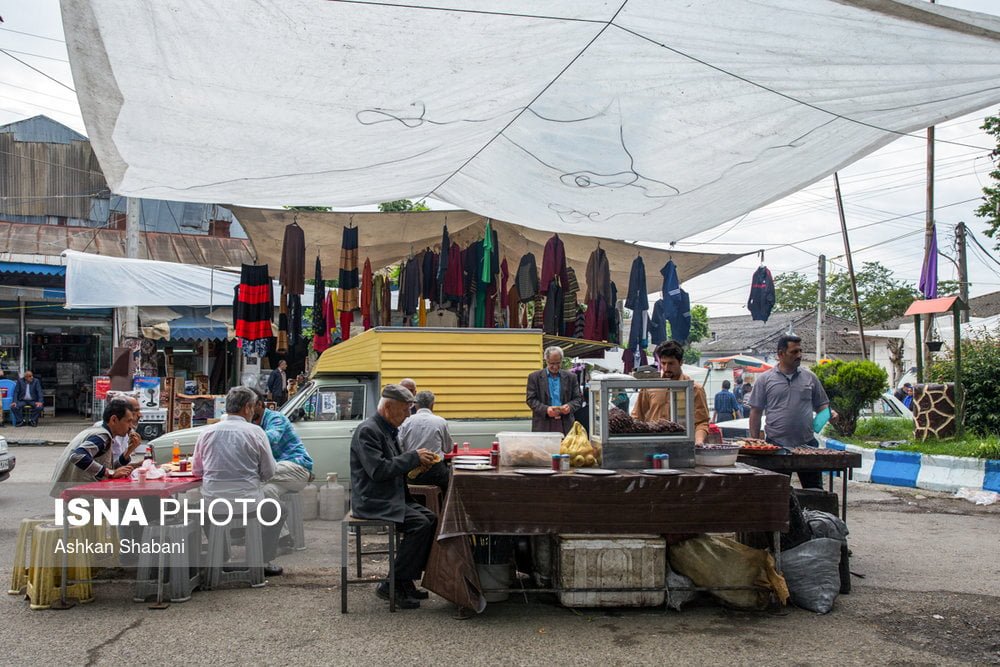
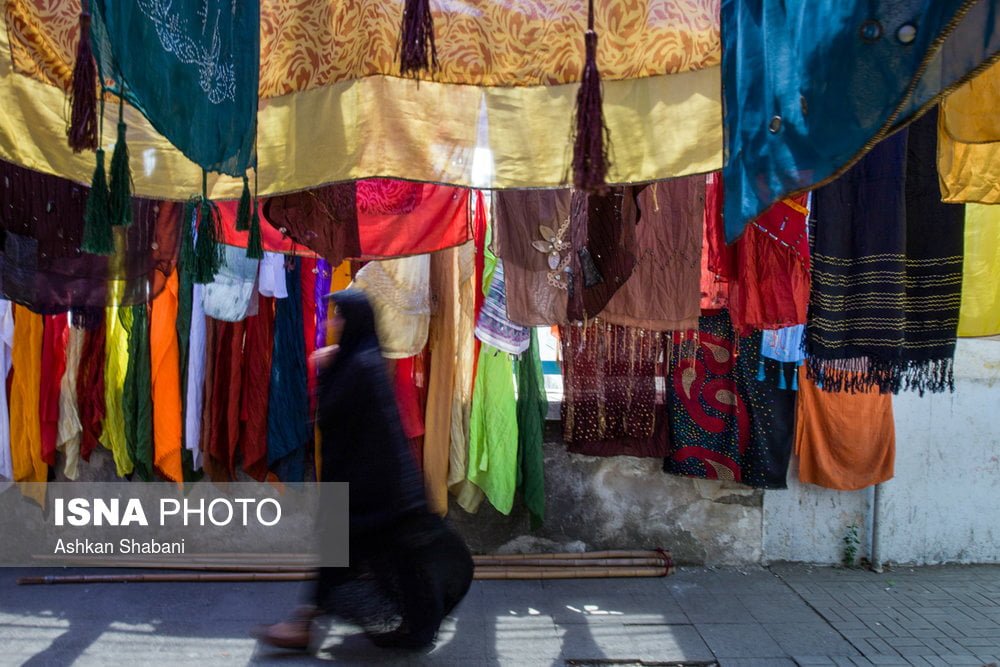
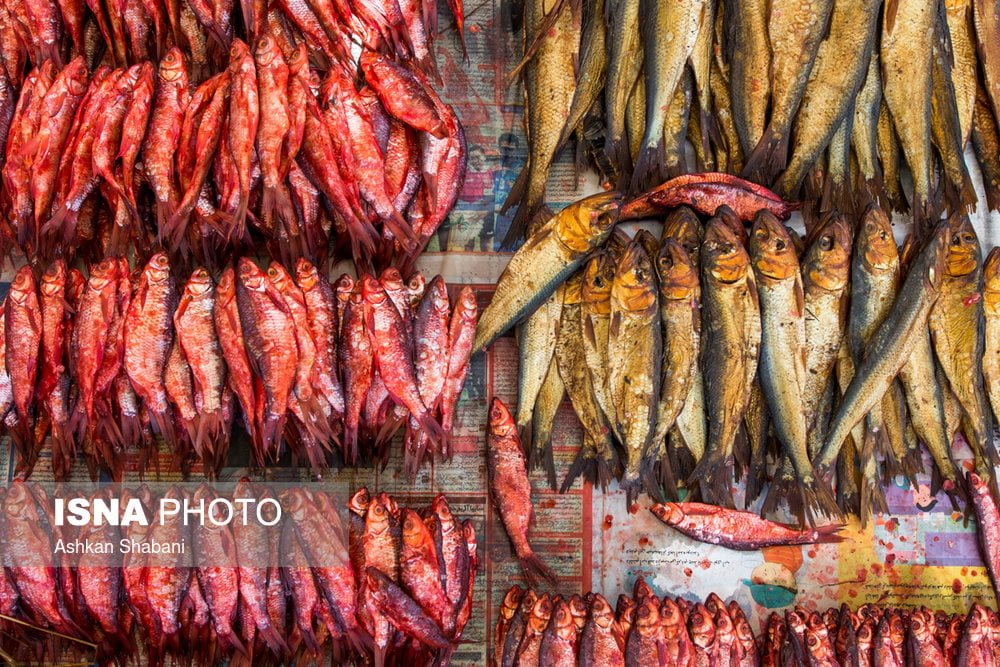
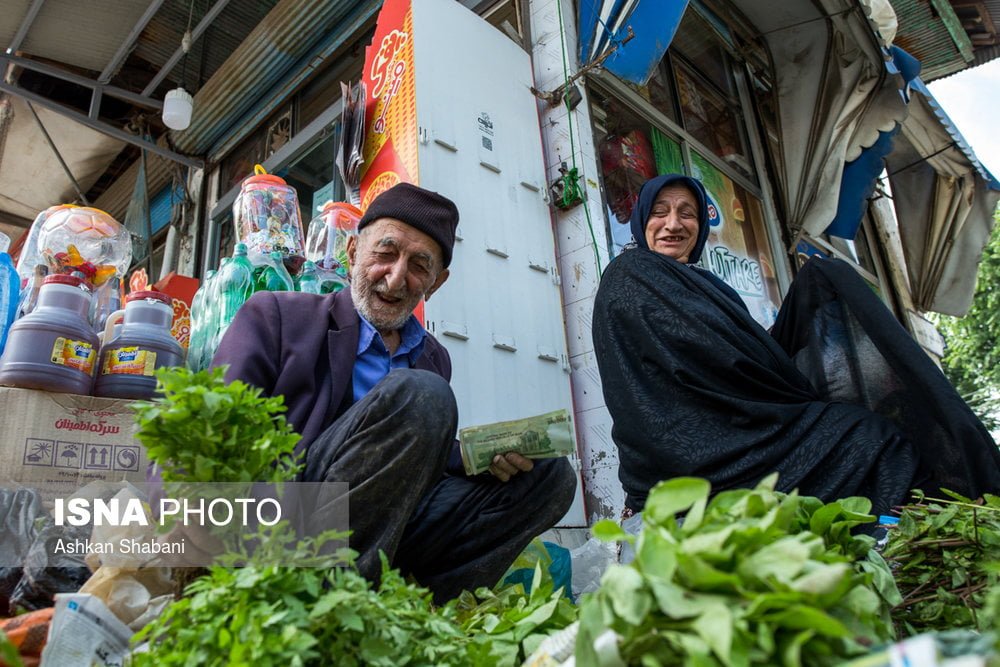
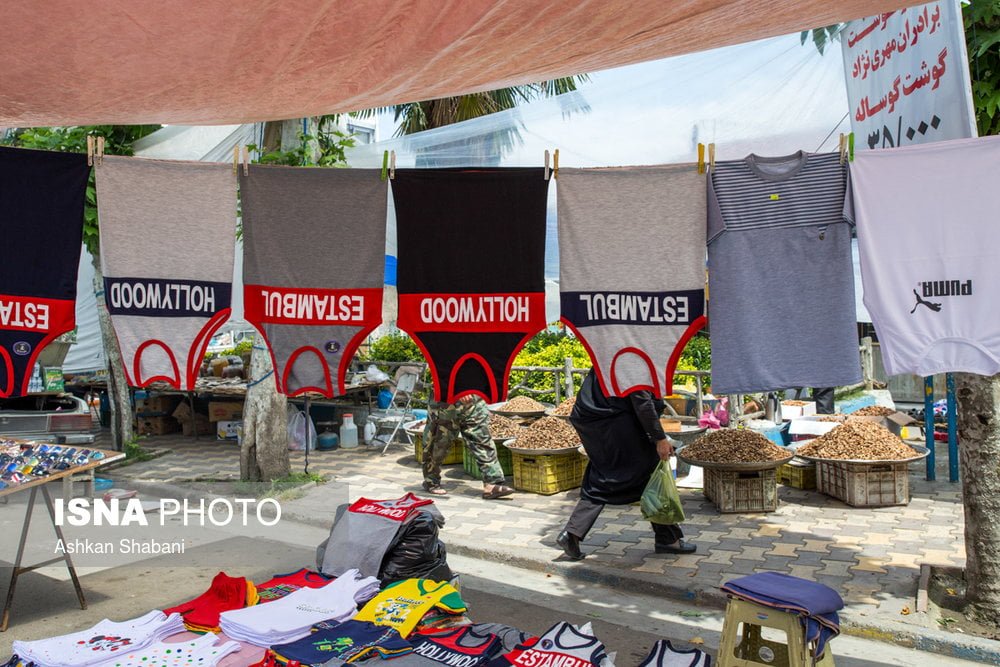
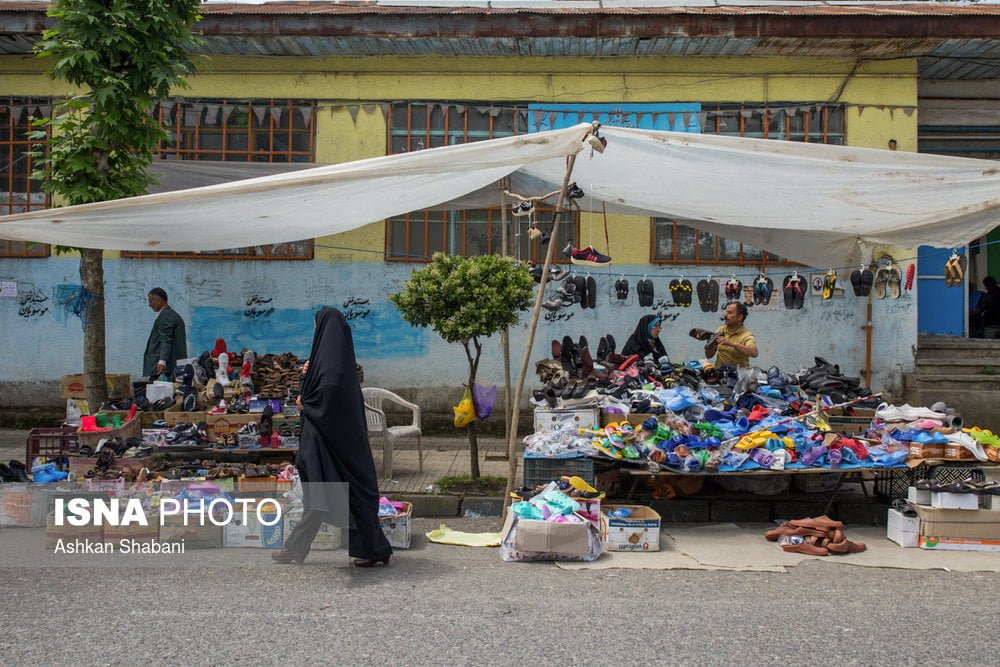
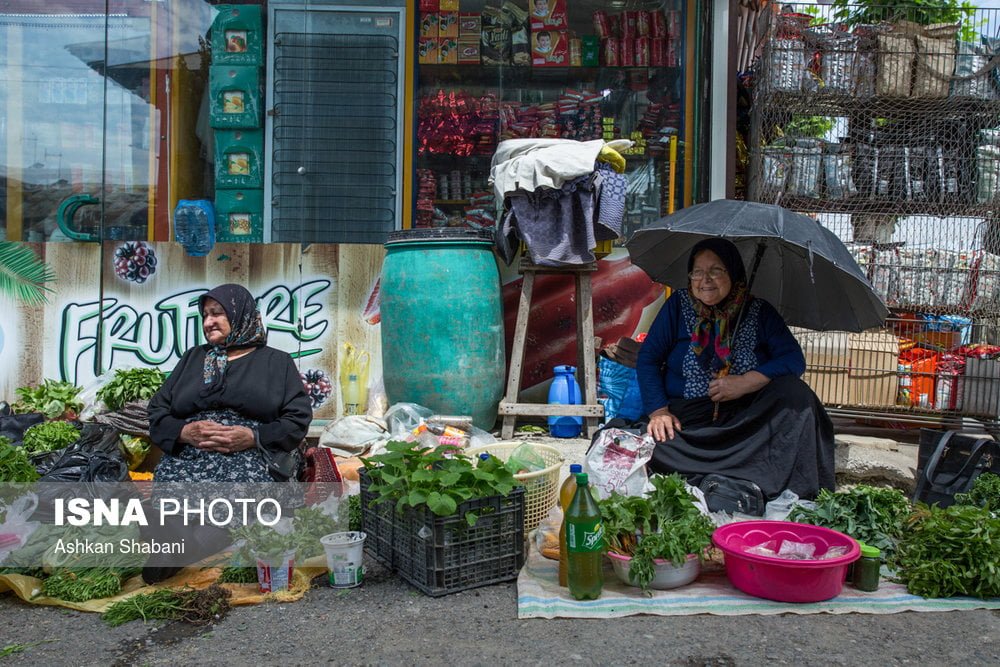
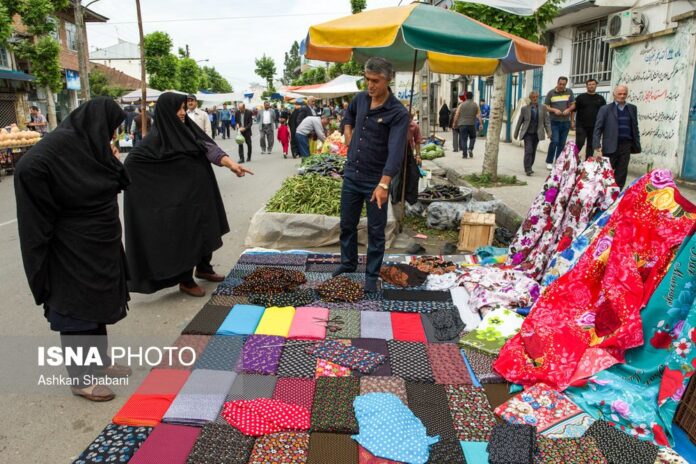
Iran’s Beauties in Photos: Gilan Weekly Markets

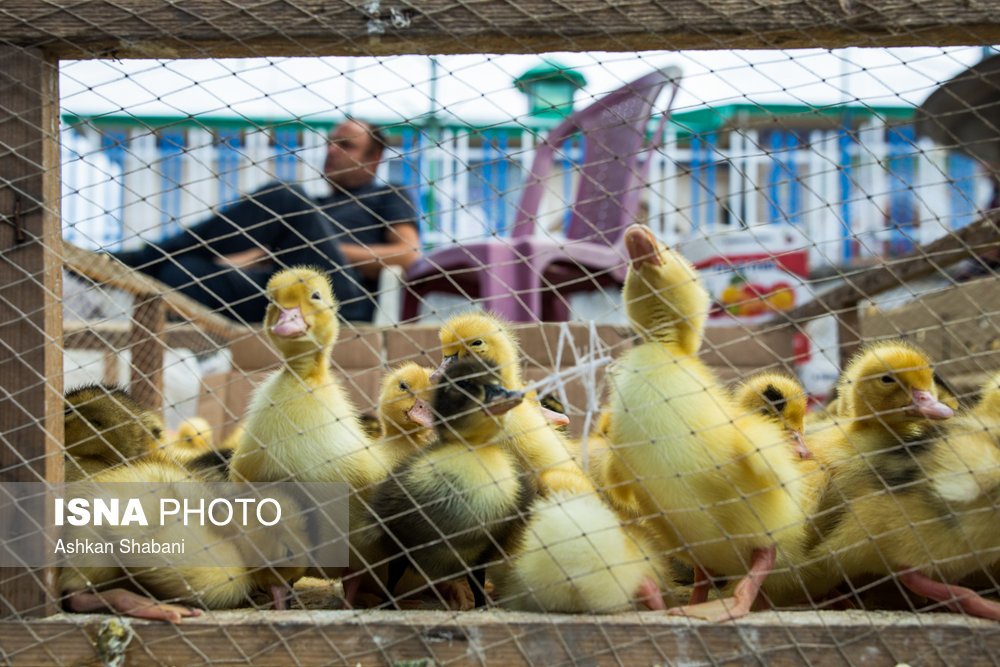
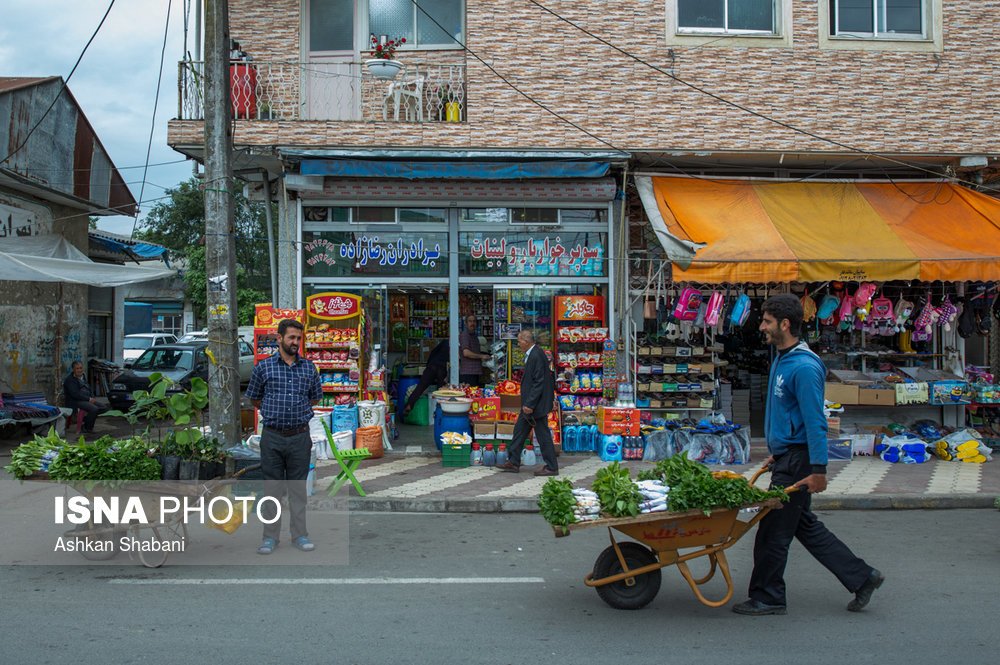
The weekly markets of Gilan have long been considered as a major destination for both Iranian and non-Iranian tourists travelling to the region.

Despite the expansion of communication networks, weekly markets are still popular among Iranian people and are annually visited by millions of travellers.

In the past, when the villagers’ commute was not like today, markets were more important. However today, given the development of roads and the increase in number of vehicles, villagers do not need much to visit these markets to buy what the need. Nevertheless, the markets are still attractive.

The first settlements in Gilan province have come into existence based on weekly markets. There are still villages called “Friday Market” or “Monday Market”.

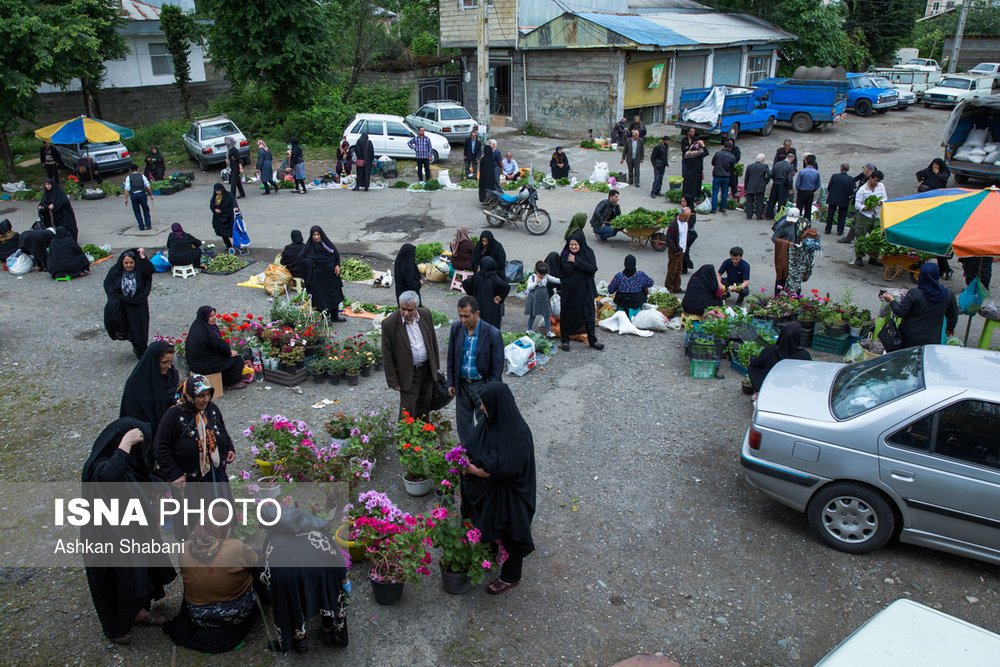
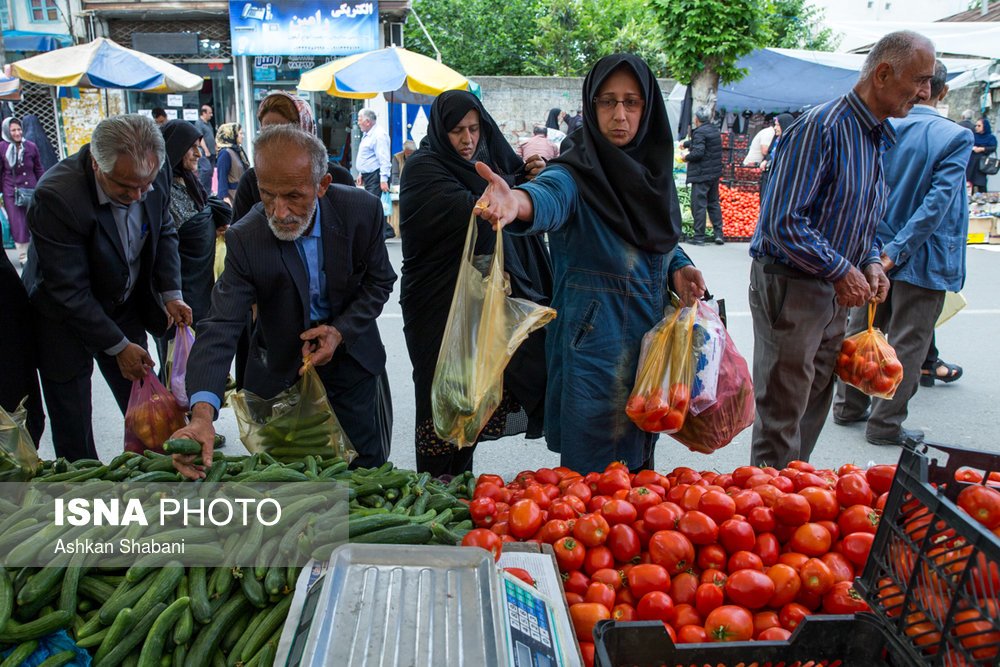
These local markets are places for exchanging goods, selling rural products and handicrafts and purchasing the goods one needs.

Villagers regularly come to these markets once or twice a week and sell their crops, livestock products and crafts to locals and tourists.

Shaft County in Foumanat region has had a weekly market since a long time ago.

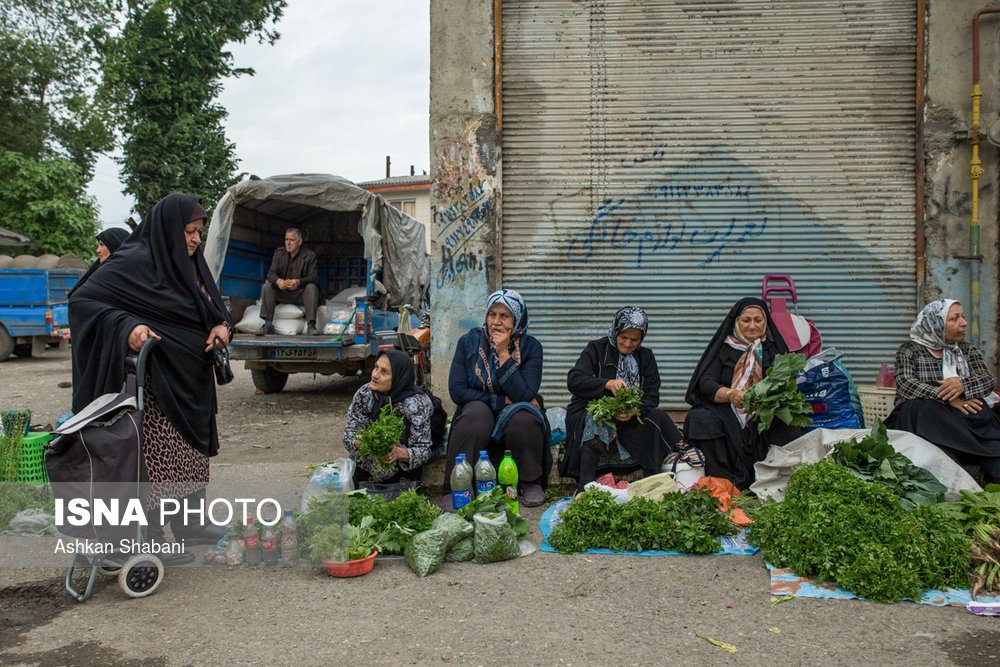
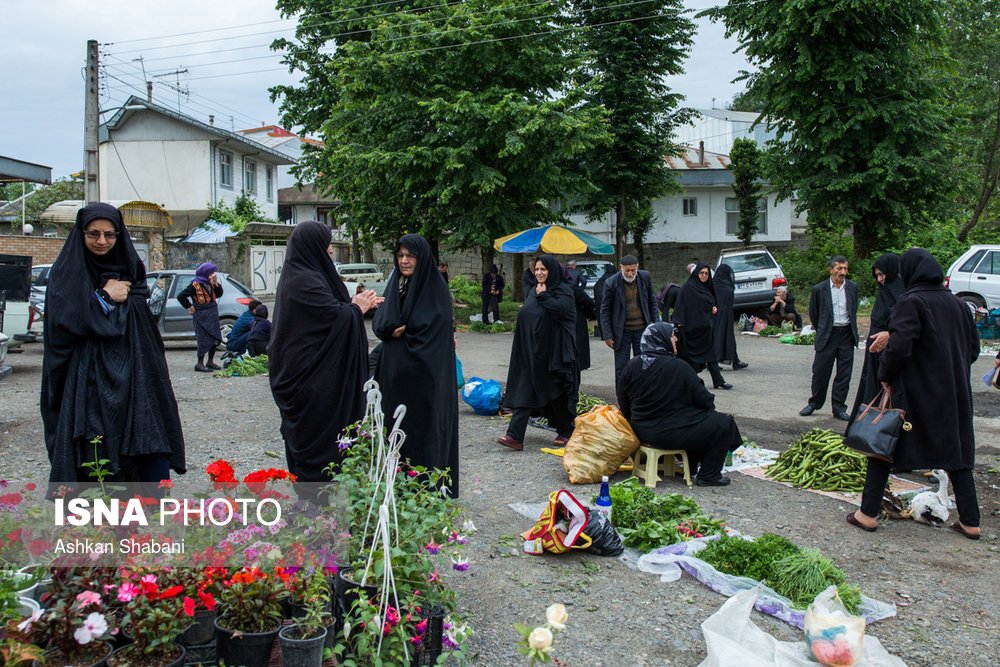
The Monday Market of Shaft, 25 km from the capital city of Rasht, supplies goods including livestock products, rice and local women’s products.

The market also has a side part known as the “Women’s Market”. Here, women sell their products as female sellers are not allowed to work in the main street.

Here are photos of the market retrieved from ISNA:

Iran Finishes Third at Jakarta 2018 Asian Para Games

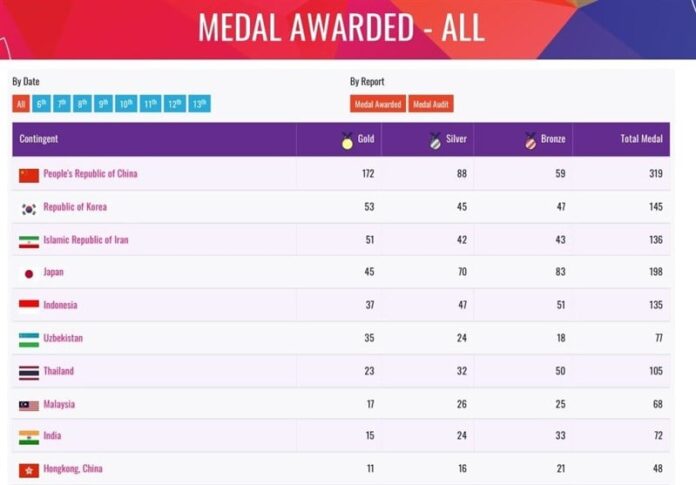
The Iranian athletes claimed 51 gold, 42 silver and 43 bronze medals in the Games.

The Iranian para athletes won 27 gold, 25 silver and 29 bronze medals.

Para swimmer Shahin Izadyar claimed six gold medals and one silver while Mohammad Hossein Karimi won a bronze.

The chess players grabbed four gold, six silver and four bronze medals.

Iran won four gold, four silver and two bronze medals in powerlifting.

Para shooters snatched three gold medals and one silver.

Judokas seized two gold, two silver and three bronze medals.

Para archers took two gold, two silver and one bronze.

Iranian men and women sitting volleyball team came first and second respectively.

Goalball men and women sides finished in first and third places respectively.

Iran men’s wheelchair basketball team won gold medal while Iran seized one bronze in table tennis and one bronze in cycling.

Continental giant China was at the top of the pecking order with 172 gold, 88 silver and 59 bronze followed by South Korea (53 gold, 25 silver and 47 bronze).

Iran participated in the Games with 209 athletes, 136 men and 73 women competed in 13 disciplines.

Iran finished in fourth place in the past two editions in Guangzhou (2010) and Incheon (2014).

The 2018 Asian Para Games were held from October 6th to 13th at the Bung Karno Sports Complex in the capital city of Jakarta.

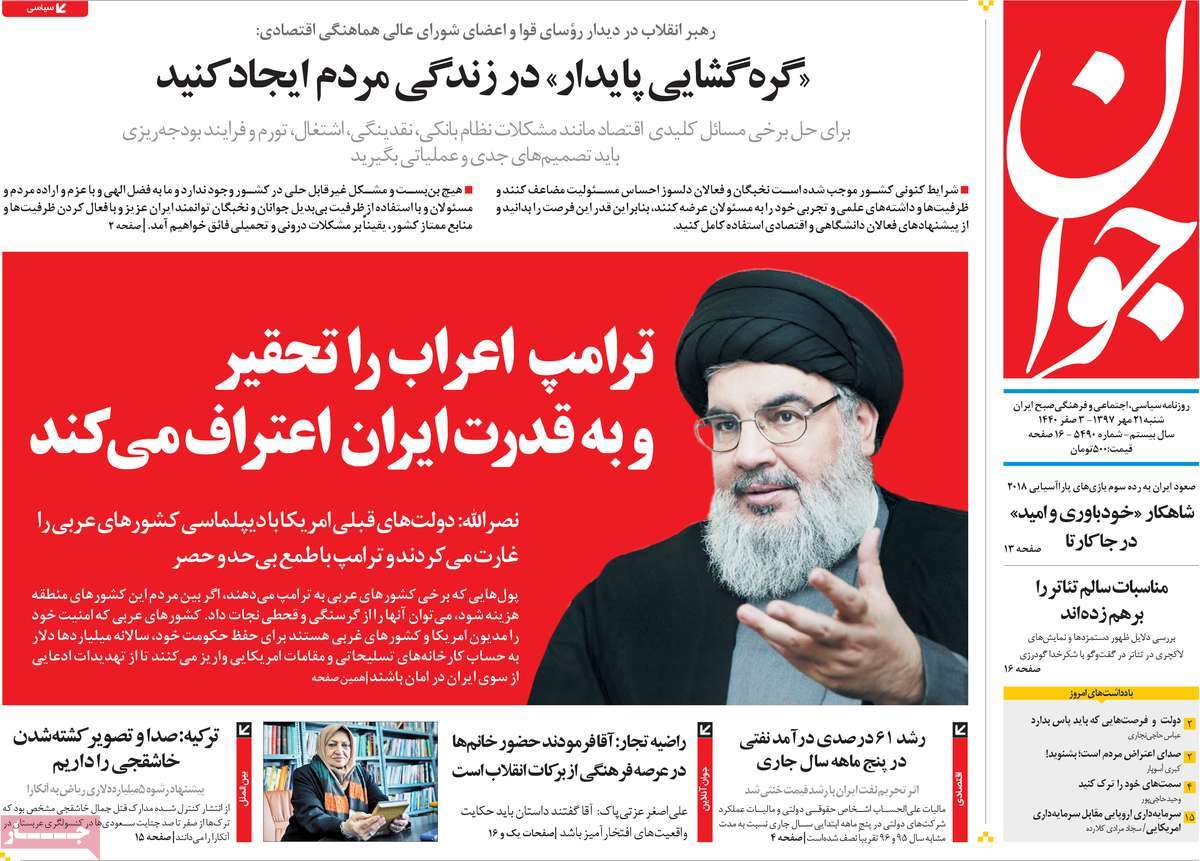
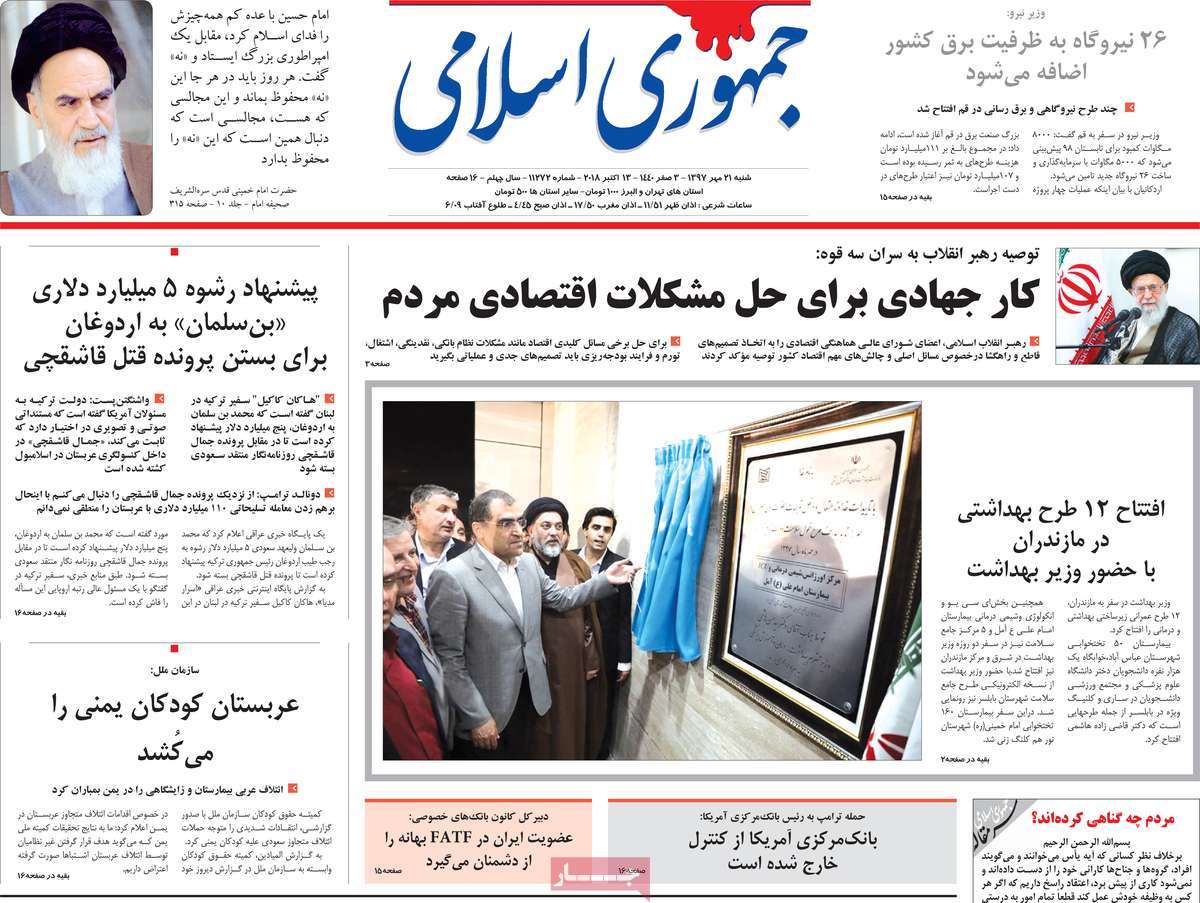
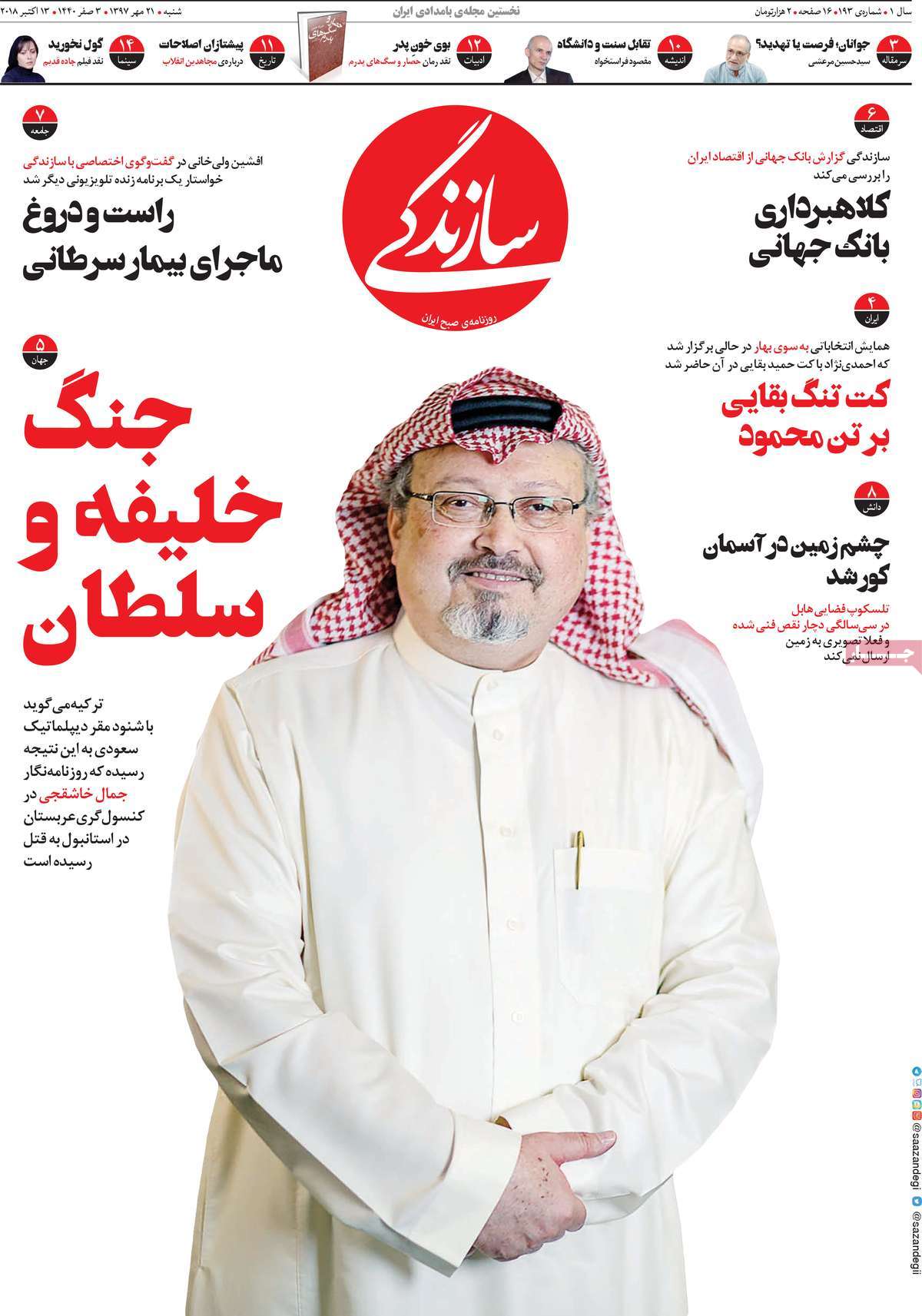
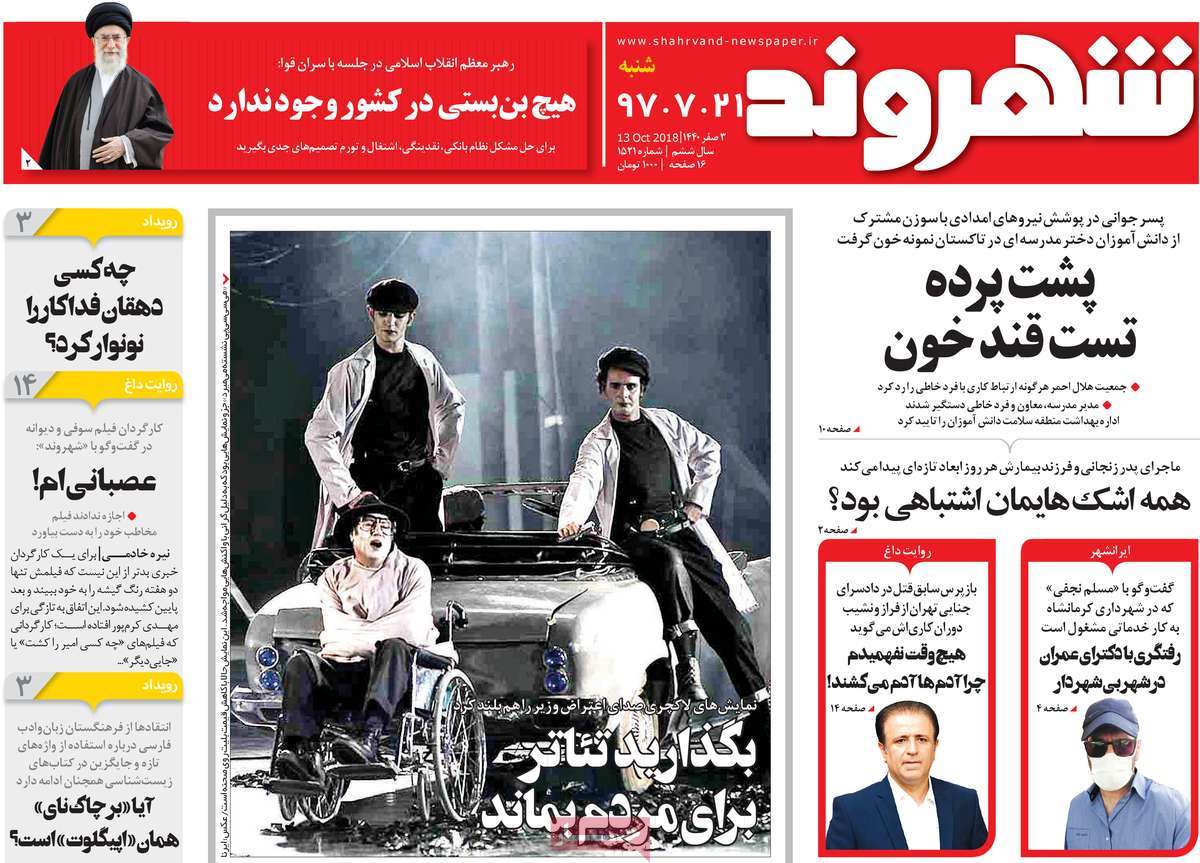
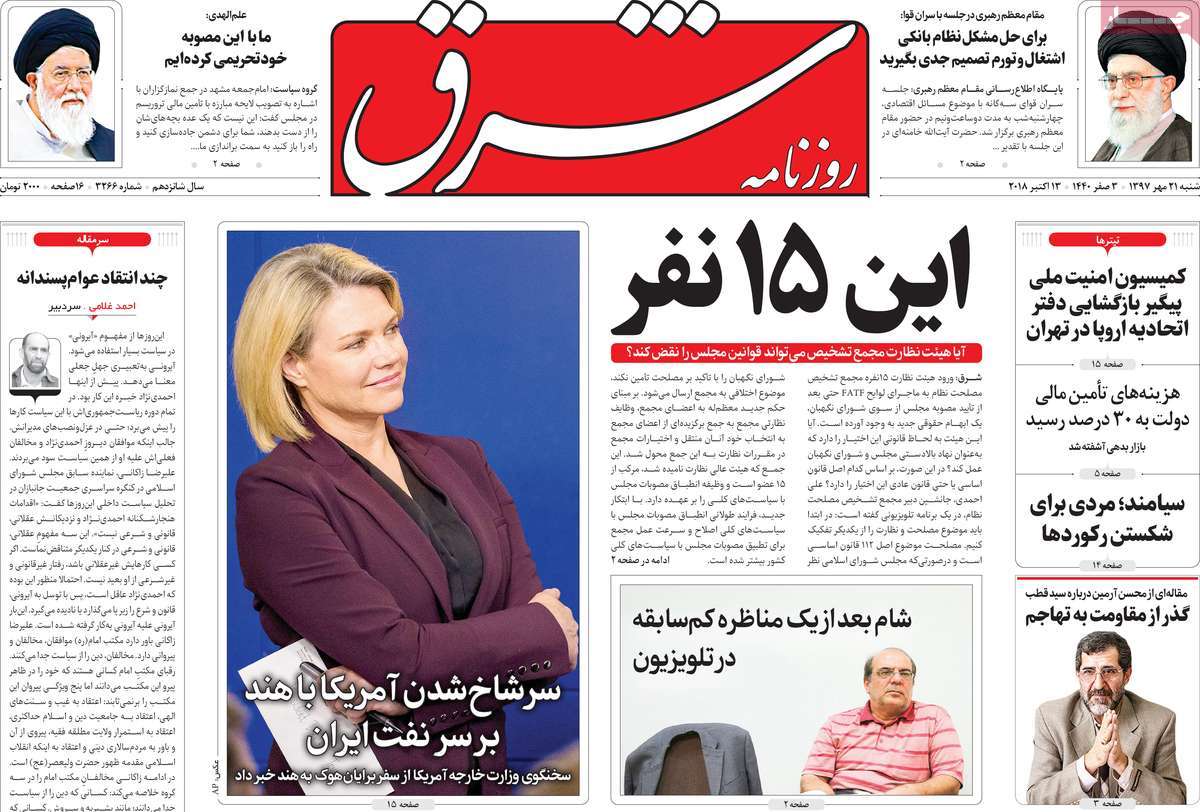
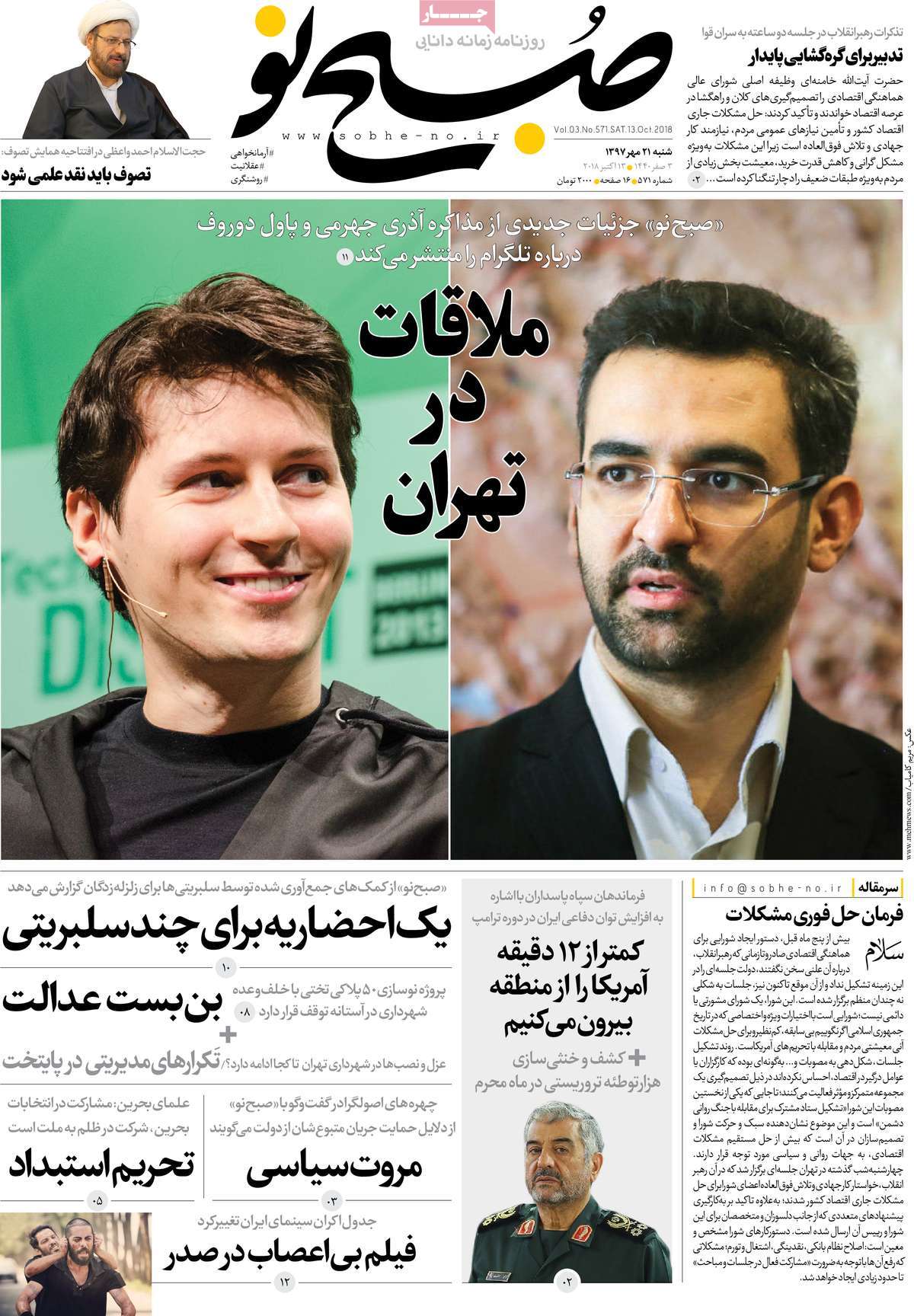
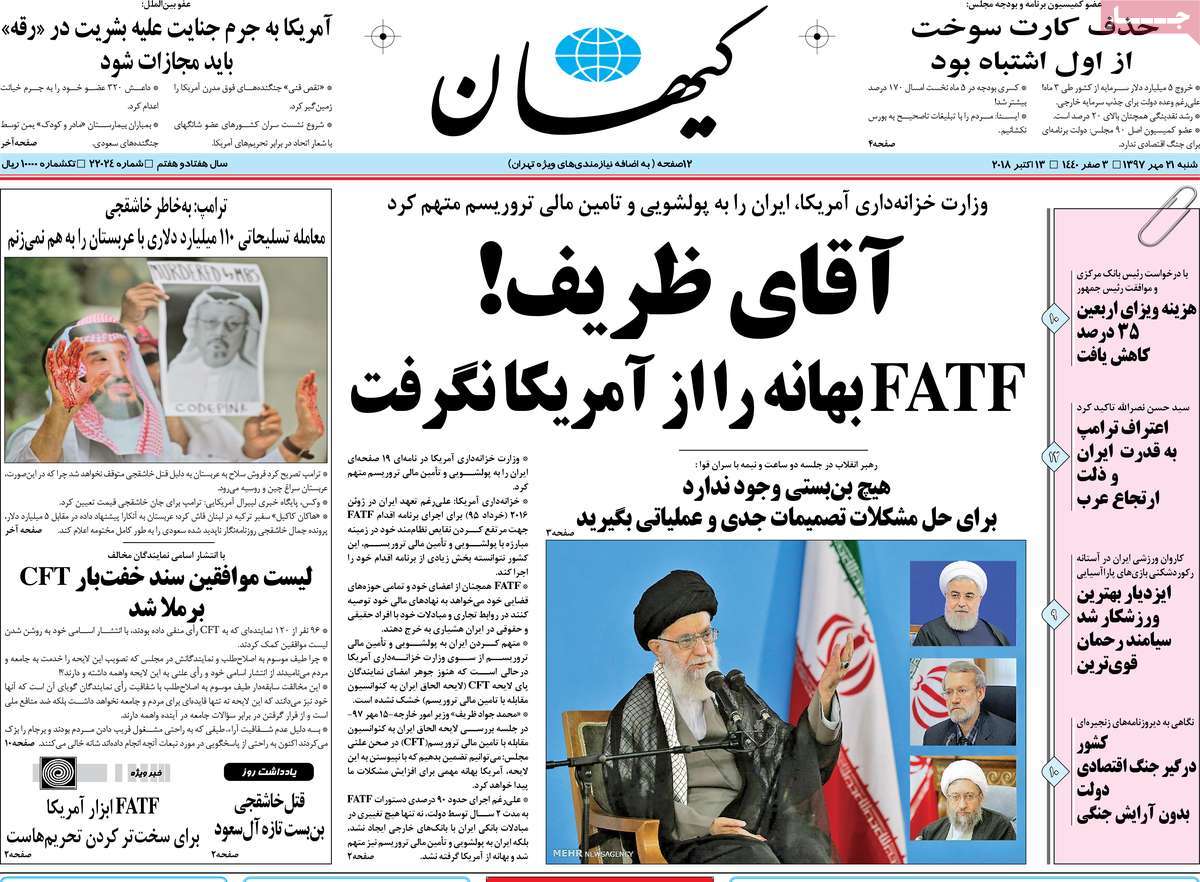
A Look at Iranian Newspaper Front Pages on October 13

A Look at Iranian Newspaper Front Pages on November 19

Several newspapers today covered the comments made by the Leader of Iran’s Islamic Revolution Ayatollah Seyyed Ali Khamenei on the need to quickly resolve the country’s economic woes in a meeting with President Hassan Rouhani, Judiciary Chief Ayatollah Sadeq Amoli Larijani, and Parliament Speaker Ali Larijani.

The top story in all papers today was the alleged murder of Saudi journalist Jamal Khashoggi in the Saudi Arabian consulate in Istanbul, Turkey.

Headlines today particularly covered US President Donald Trump’s reaction to the alleged murder which is blamed on the Saudi government, and his remarks that US cannot jeopardize its arms deal with Riyadh over the assassination.

The above issues, as well as many more, are highlighted in the following headlines and top stories:


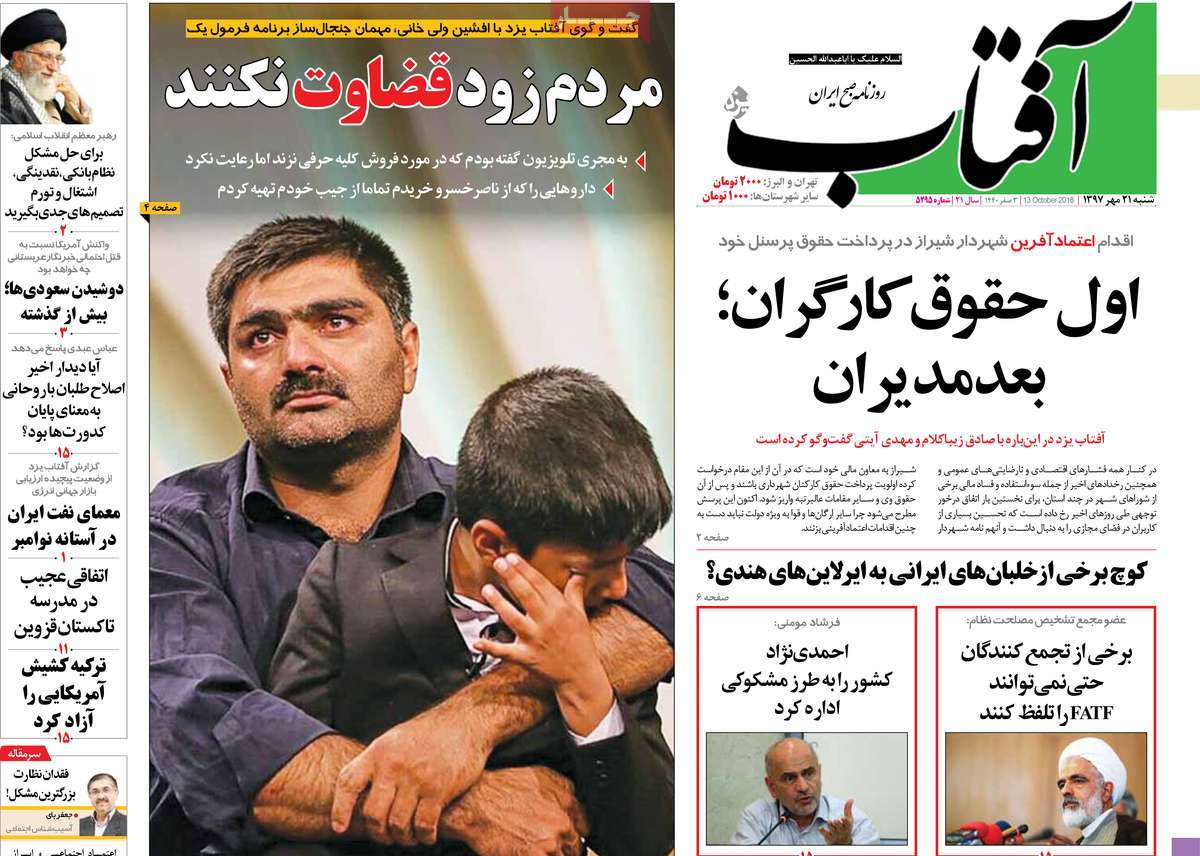
Aftab-e Yazd:

1- Mystery of Iran’s Oil ahead of November Sanctions

2- Milking Saudis More than Ever: How Would US React to Possible Murder of Khashoggi

A Look at Iranian Newspaper Front Pages on October 13


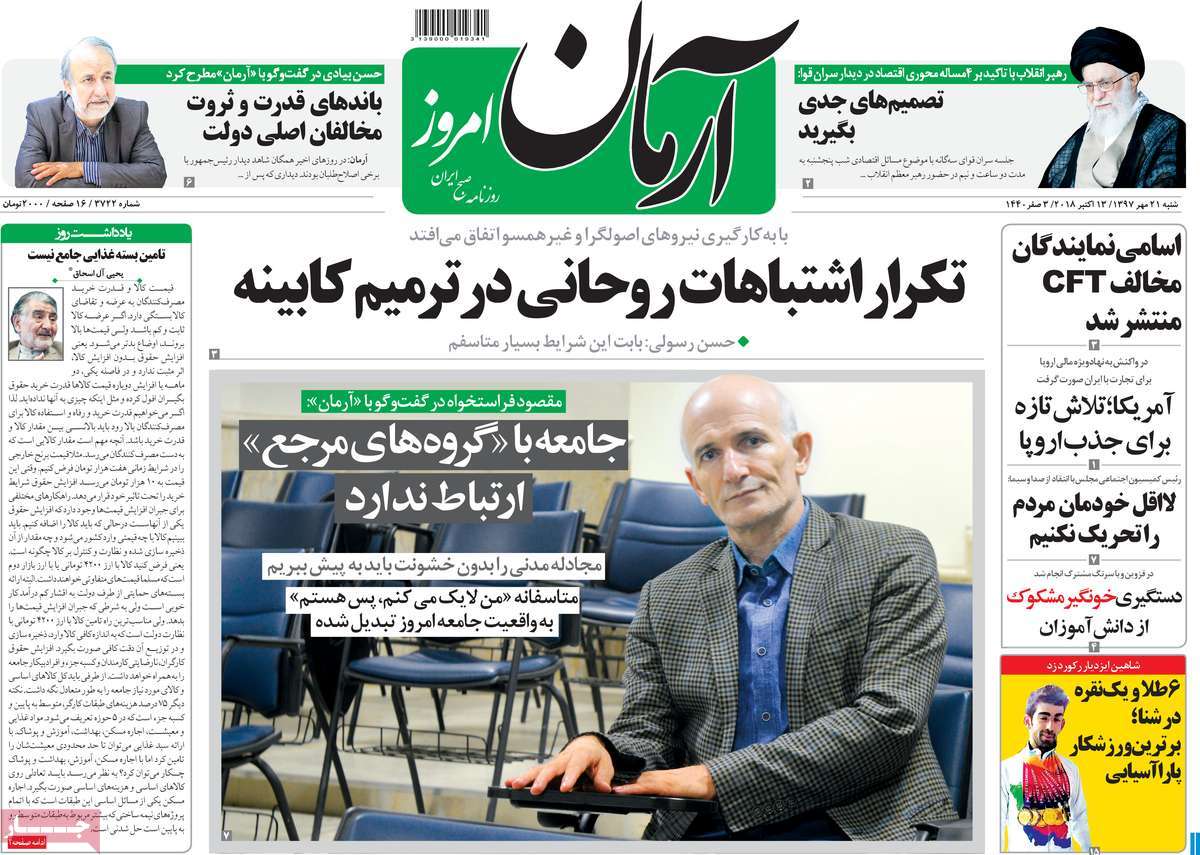
Arman-e Emrooz:

1- US Making New Attempt to Attract Europe in Reaction to SPV Initiative

A Look at Iranian Newspaper Front Pages on October 13


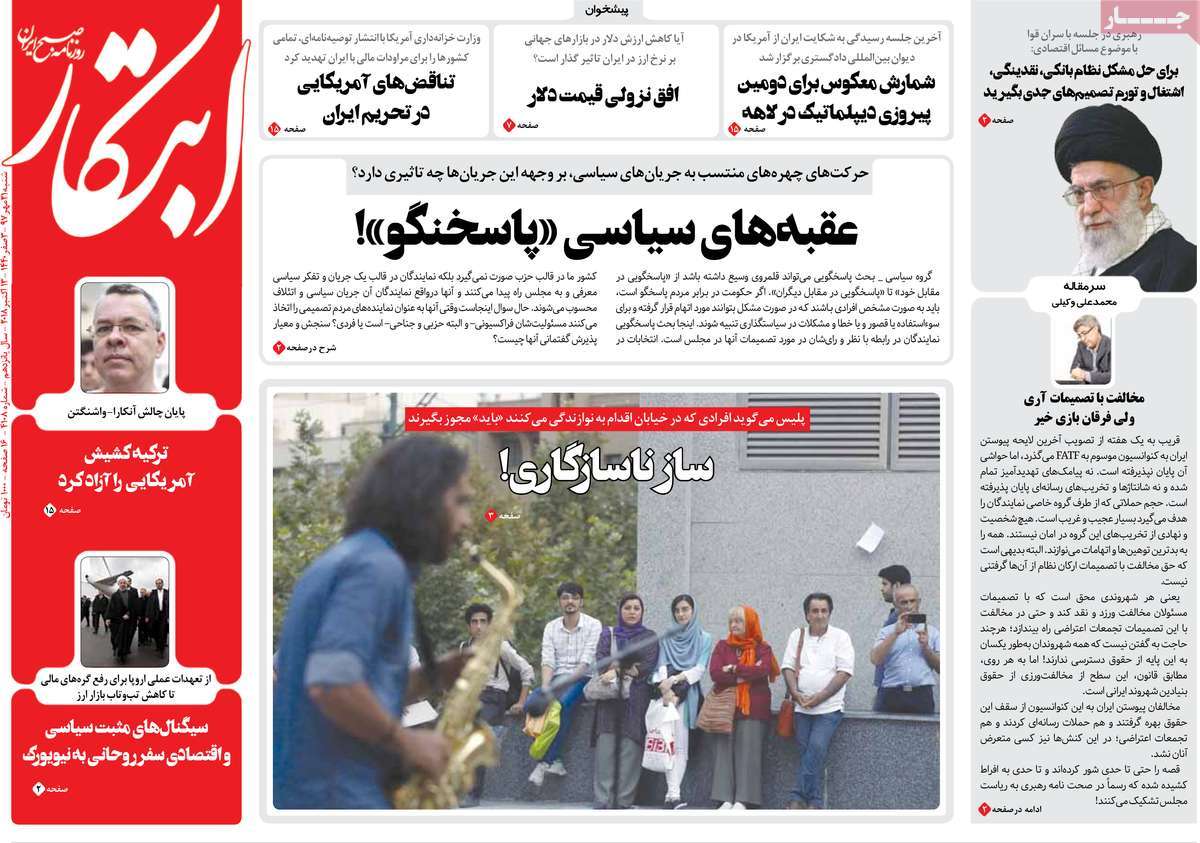
Ebtekar:

1- Police Says Those Playing Music in Streets Must Obtain Licence

2- Countdown for Second Diplomatic Victory at The Hague

3- US’ Paradoxes in Iran Sanctions

  • US Treasury Threatens All Countries to Avoid Doing Business with Iran

A Look at Iranian Newspaper Front Pages on October 13


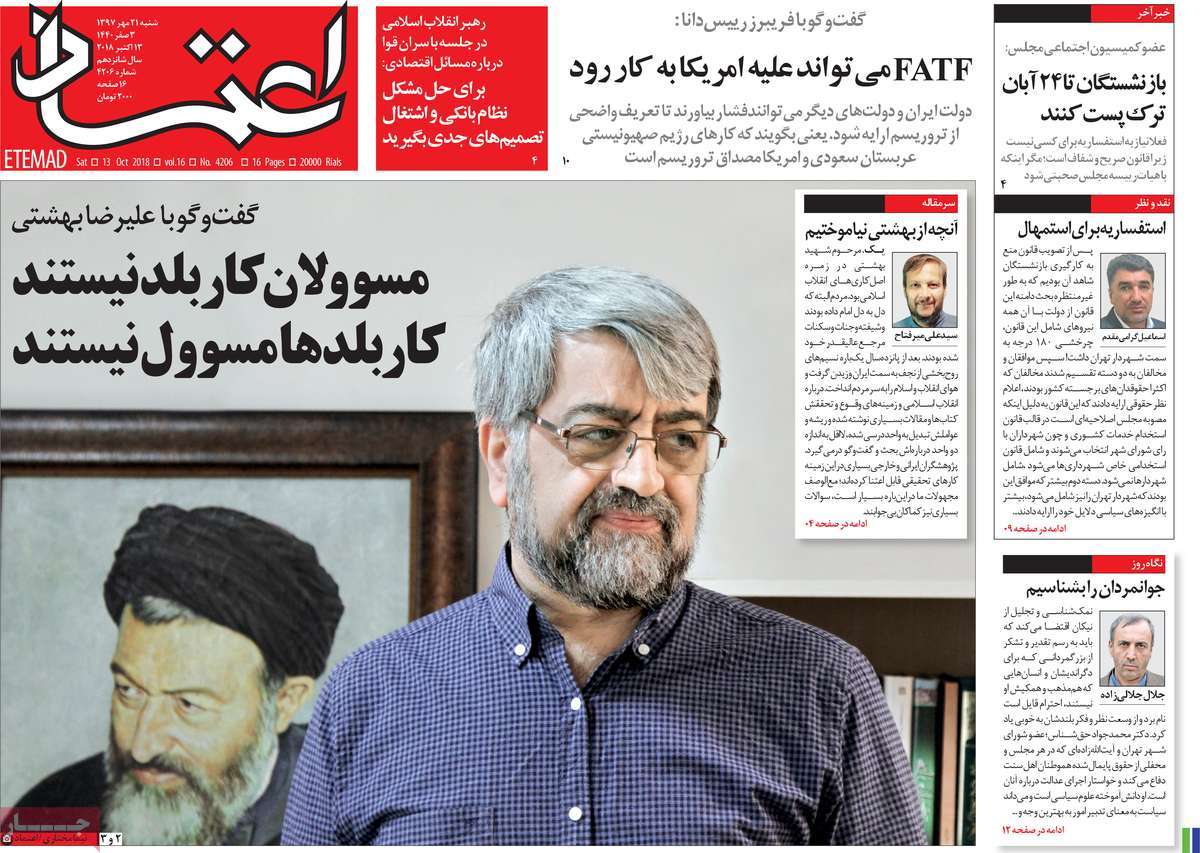
Etemad:

1- FATF Can Be Used against US: Analyst

2- Iran Leader: Make Decisive Decisions to Resolve Banking, Unemployment Problems

A Look at Iranian Newspaper Front Pages on October 13


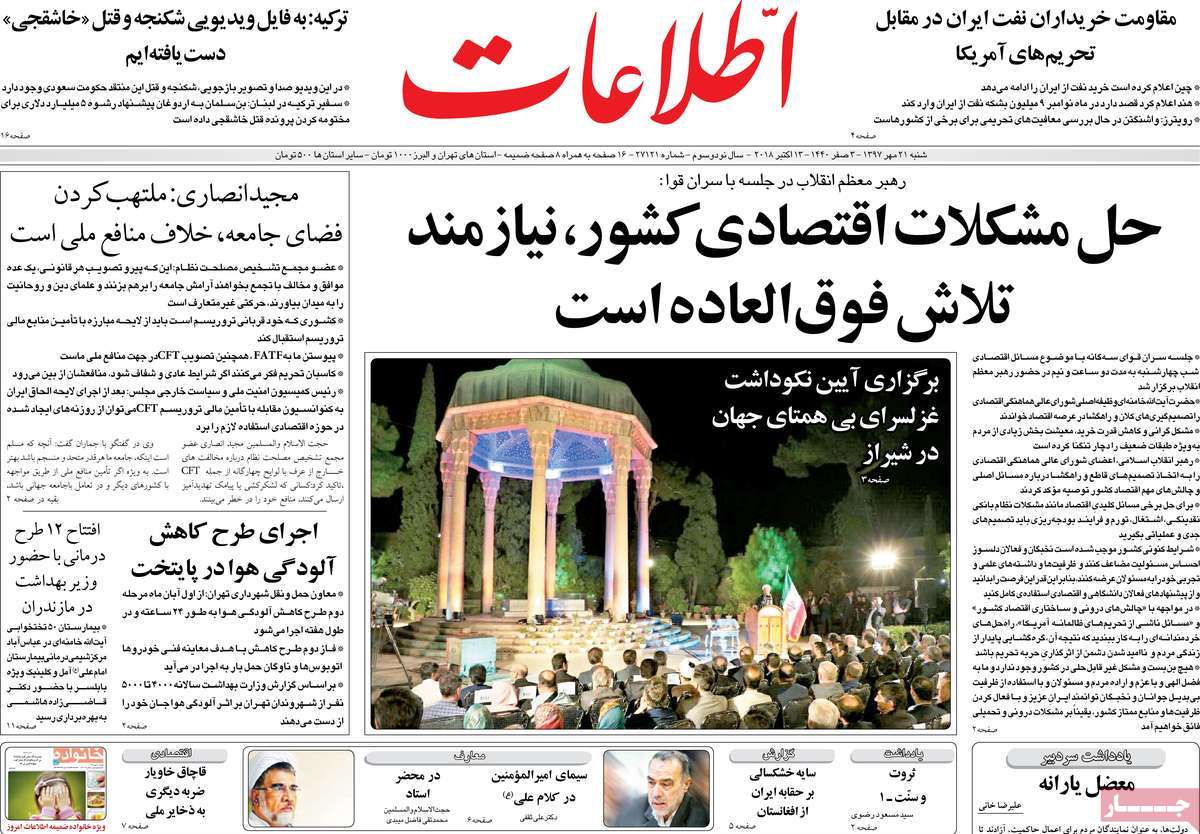
Ettela’at:

1- Iran Leader: Extraordinary Effort Needed to Resolve Economic Woes

2- Purchasers of Iran’s Oil Showing Resistance against US Sanctions

3- Special Plan Implemented in Tehran to Control Air Pollution

A Look at Iranian Newspaper Front Pages on October 13


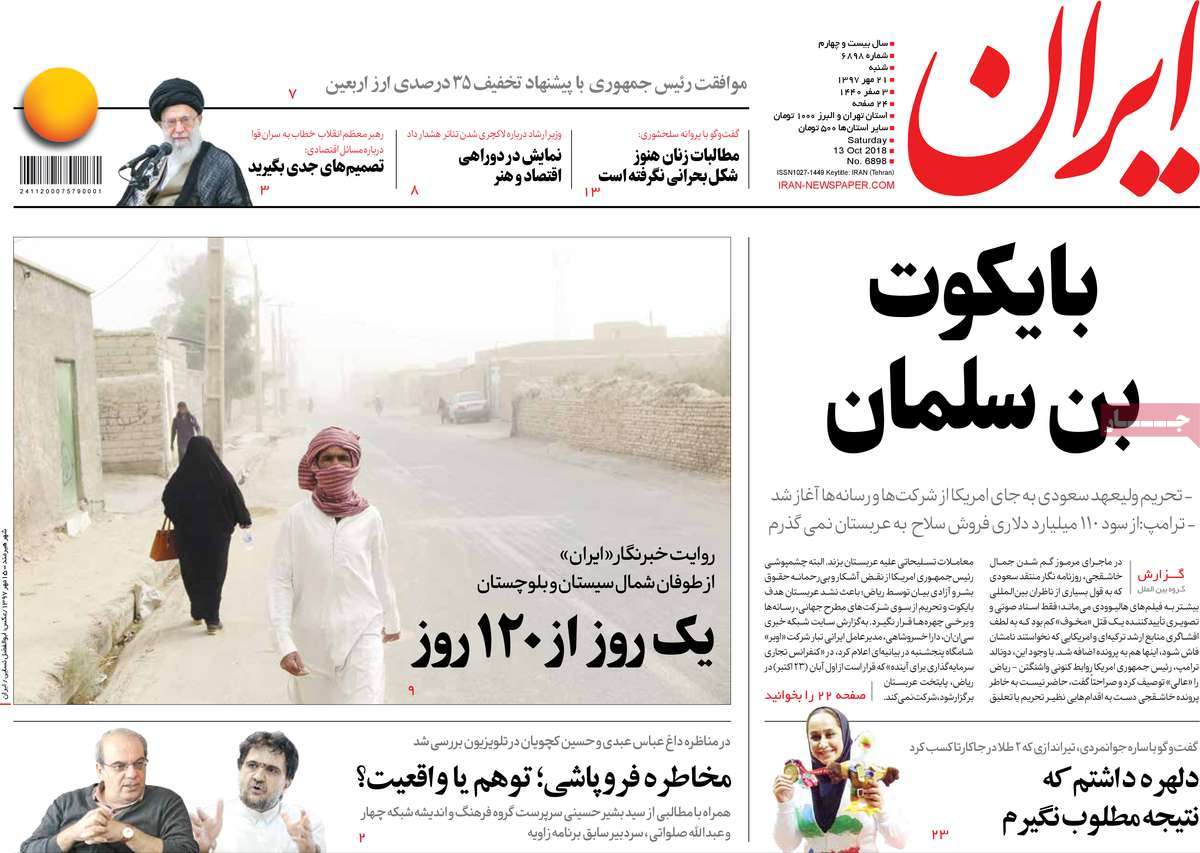
Iran:

1- Boycotting Bin Salman: World Media, Corporations Start Boycotting Saudi Crown Prince

2- Heavy Storms Start in North of Sistan and Baluchestan Province

A Look at Iranian Newspaper Front Pages on October 13


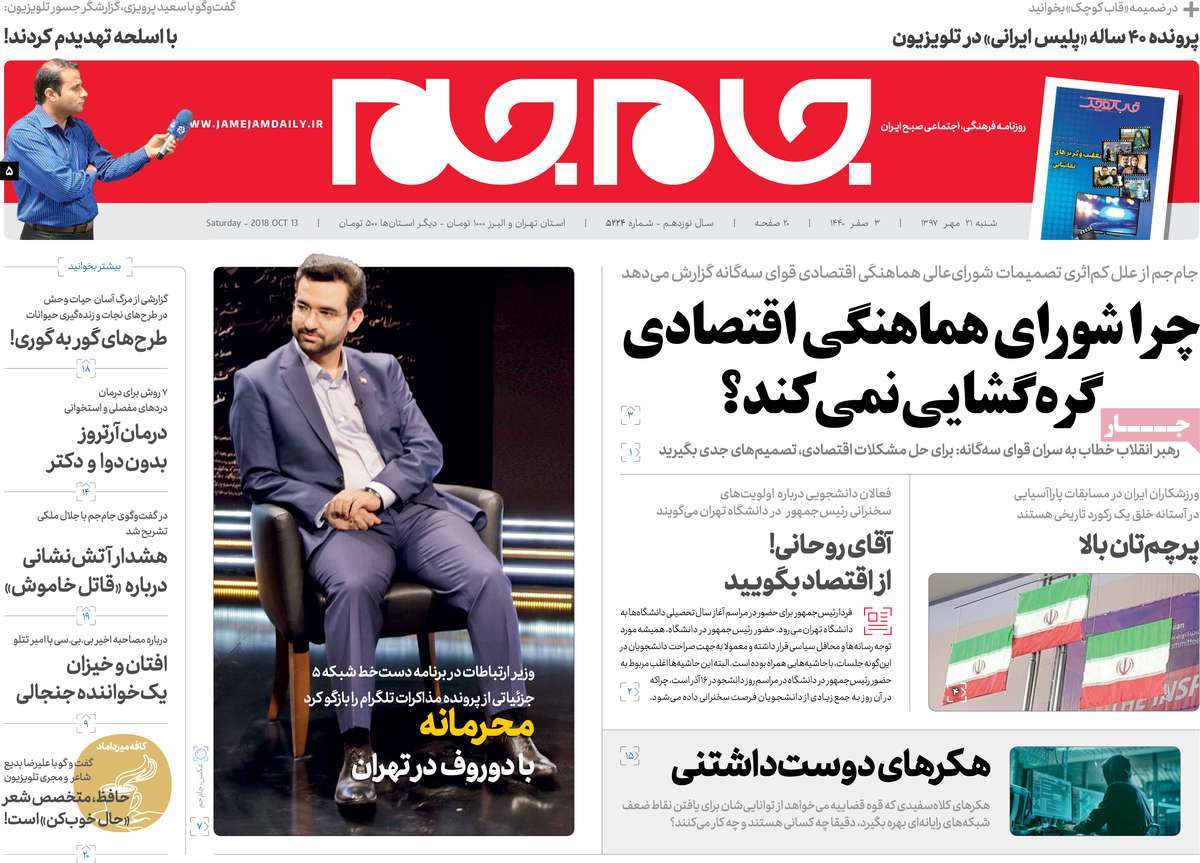
Jame Jam:

1- Confidential Meeting with Durov in Tehran

  • ICT Minister Reveals Details of Negotiations with Telegram

A Look at Iranian Newspaper Front Pages on October 13


Javan:

1- Nasrallah: Trump Humiliates Arabs, Confesses to Iran’s Power

2- Turkey: We Have Audio, Video of Khashoggi’s Murder

A Look at Iranian Newspaper Front Pages on October 13


Jomhouri Eslami:

1- Bin Salman Offers $5 Billion Bribe to Erdogan to Close Khashoggi’s Case

2- UN: Saudi Arabia Slaughtering Yemeni Children

A Look at Iranian Newspaper Front Pages on October 13


Kayhan:

1- Mr Zarif! FATF Didn’t Stop US from Accusing Iran

  • US Treasury Accuses Iran of Money Laundering, Financing of Terror

2- US Must Be Prosecuted for Crime against Humanity in Raqqa

3- Trump: I Won’t Break Up $110 Billion Arms Deal with Saudis for Khashoggi’s Case

A Look at Iranian Newspaper Front Pages on October 13


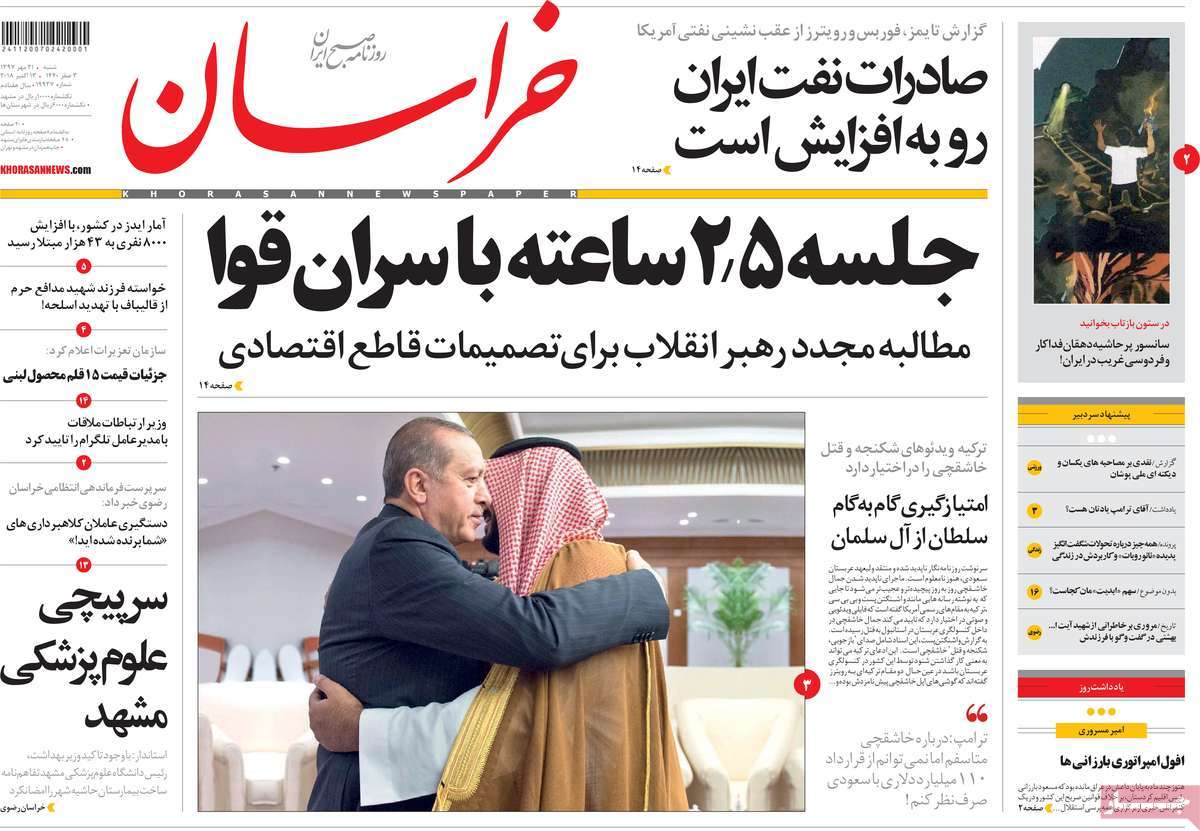
Khorasan:

1- Iran Leader Holds 2.5-Hour Meeting with Rouhani, Larijani, Amoli Larijani

  • Ayatollah Khamenei Once Again Calls for Decisive Economic Decisions

2- Iran’s Exports Rising

A Look at Iranian Newspaper Front Pages on October 13


Sazandegi:

1- War of Caliph [Erdogan] and Sultan [King Salman]

2- Fraud of World Bank: A Review of World Bank’s Report on Iranian Economy

A Look at Iranian Newspaper Front Pages on October 13


Shahrvand:

1- Iran Leader: No Deadlock in Iran

2- Secrets behind a Blood Sugar Test of Schoolgirls

  • Young man, wearing Red Crescent uniform, uses one syringe to take blood sugar test from numerous schoolgirls in Iran’s Takestan
  • School Dean, Master, Young Man Arrested
  • Health Ministry Says Schoolgirls Safe

3- I Never Understood Why People Kill Each Other: Former Interrogator

A Look at Iranian Newspaper Front Pages on October 13


Shargh:

1- US, India Divided over Iran’s Oil

2- Iranian Parliament’s Foreign Policy Commission Pursuing Opening of EU Office in Tehran

A Look at Iranian Newspaper Front Pages on October 13


Sobh-e Now:

1- IRGC Chief-Commander: We’ll Kick US Out of Region in Less than 12 Minutes

A Look at Iranian Newspaper Front Pages on October 13

“Iran Must Start Dialogue with Anti-Trump Americans”

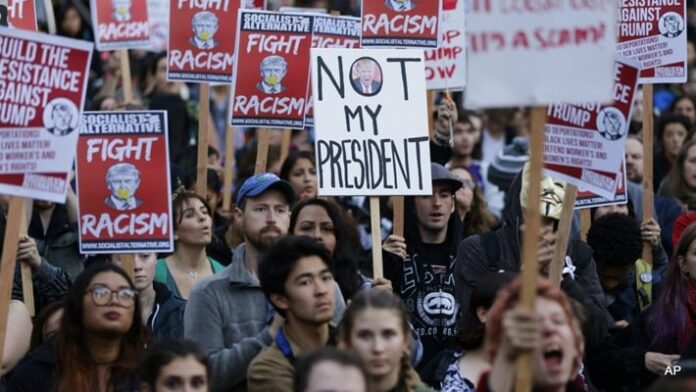
American protesters holding anti-Trump placards in a rally in Seattle / Photo by AP

“We should not shut the door on diplomacy with the US, as America is not just Trump,” said Heshmatollah Falahatpisheh, the head of the Iranian Parliament’s National Security and Foreign Policy Commission.

Speaking to IRNA, Falahatpisheh said figures inside the US have been showing opposition with Trump’s maximum pressure policy on Iran, demonstrated by August announcements by J.P. Morgan and Citibank, two top American financial institutions, that they will not commit to cutting Iranian access to international markets.

Falahatpisheh said Iran should start making efforts to de-escalate tensions with the US and work in line with Americans who believe Trump is pushing the US towards isolation or seek to prevent further deterioration of US-Iran ties.

“We should talk with politicians, officials and others who can prevent the imposition of broad sanctions against Iran,” he said.

Trump, who has been hardening the line on Iran since coming to power in January, withdrew the US from the 2015 nuclear deal early May.

Afterwards, Trump reinstated parts of anti-Iran sanctions suspended under the nuclear accord weeks ago and he is set to restore sanctions on oil and transactions with the central bank of Iran in November.

Washington is also pushing the world to cut trade with Iran and stop purchasing the country’s oil.

This is while other signatories to the nuclear deal and other countries have censured the US exit from the JCPOA and are working to salvage the accord.


Iran’s JCPOA Strategy Worked

Falahatpisheh said JCPOA-related developments following the US withdrawal from the nuclear deal shows the world is not just America.

The lawmaker said exemptions from anti-Iran sanctions given to certain countries, including the US administration’s green light to a gas field partly owned by Iran in the North Sea to keep operating, shows the US government has been disappointed with the maximum pressure policy.

Falahatpisheh said Europe’s anti-US position regarding the JCPOA testifies that Iran’s soft line on the US and its cooperative stance on JCPOA have worked and Tehran should strengthen this policy.

The lawmaker said a verdict by the International Court of Justice earlier this month demanding the US not to take certain moves against Iran and the International Atomic Energy Agency’s repeated confirmation of the peaceful nature of Iran’s nuclear program further shows the current US holds not much leverage on global bodies.

The EU announced last month it will work to create a special mechanism the EU to facilitate trade with Iran known as Special Purpose Vehicle (SPV).

European officials have announced the mechanism could also be used by other countries, protecting Iran from efforts by the US to hamper its Asia and Europe trade.

CFT Bill Ratified by Parliament Thanks to Larijani’s Prudence: Reformist

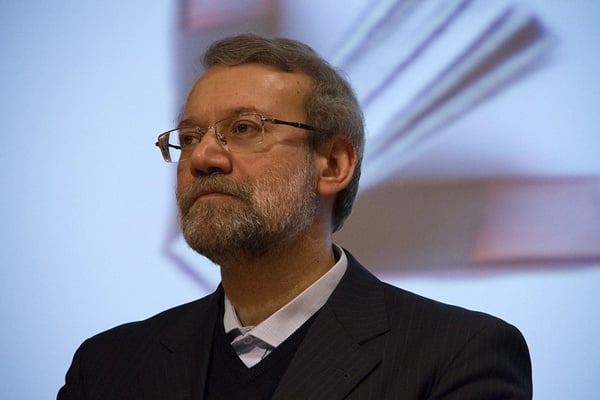
Larijani

Iranian reformist politician Mohammad Atrianfar has, in an interview with Khabar Online, weighed in on the recent ratification of the CFT bill in the Iranian Parliament.

Atrianfar says the “prudence” of moderate speaker Ali Larijani helped reformists and moderate lawmakers defeat the hardliners who were strongly opposed to Iran’s accession to the Financial Action Task Force (FATF).

The reformist figure says the ratification, which is key to decreasing the impact of US sanctions, was not possible without the formerly conservative Larijani.

The full text of the interview follows:

Khabar Online: Before the joint meeting of reformists and President [Hassan Rouhani], there was word that the reformist current was distancing itself from Mr Rouhani. Can the meeting be a sign that the coalition of reformists as well as moderation have remained in place?

Atrianfar: It is not a right assumption that a rift has emerged between reformists and the president. Reformists criticize the Rouhani administration over the economic problems in the country. In fact, ill-wishers imposed sanctions on Iran that affected people’s economic situation and livelihood. Under such circumstances, reformists believe the government should get out of inaction, roll up its sleeves and redeem the situation. However, it was not right to say a rift had emerged between reformists and Mr Rouhani. Of course, the speculation was made by some reformist folks who had somehow gone to extremes. Nevertheless, what they said was their personal viewpoint.

Khabar Online: Did reformists’ meeting with Mr Rouhani show that the radical extremists who believe they should distance themselves from Rouhani are in the minority?

Atrianfar: Yes. In fact, the meeting showed that the key reformist current still maintain their position, i.e. approving of the government while criticizing its performance. In other words, they endorse the government, but at the same time express their criticisms in a friendly manner aimed at reforming the situation. The specific symbol of us reformists is Mr Khatami, who also approves of the government. Mr Rouhani made a comment at the meeting which I think was very illuminating. He said, :”Reformists are not only my supporters, but they are my partners in the administration and in executive affairs.” This was a very prudent, delicate and determining point, which meant that Mr Rouhani had never forgotten his relationship with reformists and that he had openly expressed his opinion. On the whole, the meeting was more of an opportunity to give the president a clearer picture of what was going on in society than simply being a chance to convey some criticisms to the president. The outcome of the session also showed that the bonds between reformists and moderation (the slogan of President Rouhani’s administration) remain in place. These were the two main objectives of the meeting.

Generally speaking, extremism and radicalism, and reforms, are mutually exclusive. Folks which adopt an extremist stance are practically breaching their position of reforms one way or another. In fact, they are sitting at the top while striking at the root. I do not care much about this dimension of the reformist current because it does not have much weight. The reformist current is a growing self-correcting trend. Generally speaking, reformism and radicalism are mutually exclusive. So, this has always been a clear position, and as I said before, if a few individuals make some comments, they are just their personal views; therefore, we cannot generalize their opinions to the whole reformist camp. Radicalism cannot emerge within the reformist current. Some single voices may be heard, which can be tackled with just a little dialogue.

Khabar Online: One of the signs of the alliance between reformists and the Rouhani administration was the passage of the bill on Countering the Financing of Terrorism (CFT) in Parliament, which showed the solicitous (a terms used to refer to those concerned about national interests and about the appropriateness of certain measures) and conservatives are still in the minority. What’s your take on that?

Atrianfar: The story of the CFT, which is part of the FATF (Financial Action Task Force), needed to have been reviewed in Parliament. Parliament Speaker Ali Larijani managed the parliament sessions very prudently and with national zeal, and did not allow the ballyhoo raised on parliament floor and the conservatives, whose symbol is the so-called Resistance Front party, hijack the hectic atmosphere there. The parliament speaker rendered ineffective the seven scenarios orchestrated by the opposition with regards to the CFT.

The first scenario was to keep Parliament from reaching a majority and, hence, keep an open session from being held. In other words, they wanted to obstruct the process, but failed to. The second scenario was that radicals tried to derail the parliament’s normal trend by kicking up a fuss and showing behaviour which was beneath the parliament’s dignity. The third scenario was that radicals organized a current from outside. It is customary that sometimes some radicals do not follow the normal course and disrupt the social atmosphere a little bit to achieve their objective. On the day the bill on CFT was being reviewed, they assembled a number of young people outside the parliament building to create a hectic atmosphere. However, this scenario failed as well. The fourth scenario was to make the CFT bill go through two readings. However, this was out of the question as details of the bill had already been discussed. The fifth scenario was that they gave warnings to disrupt the atmosphere in parliament, which failed as well. The sixth scenario was to make efforts to create the impression that the Leader [of the Islamic Revolution Ayatollah Seyyed Ali Khamenei] was against the CFT bill. In fact, the radicals attributed their own viewpoint to the Leader and said the Leader was against the bill. However, if the Leader is opposed to an issue, Mr Larijani, as Speaker, pays attention to it more than anybody else.

Fortunately, Mr Larijani had adopted the necessary preventive measures beforehand and by reading a letter from the Leader’s office announced that Ayatollah Khamenei was not opposed to the bill being reviewed on parliament floor. I think this move was very important. In fact, one of the radicals’ major scenarios in parliament was tackled through Mr Larijani’s prudence. The seventh scenario was to put pressure on two thirds of the MPs. As this group represents people from deprived areas and small towns, some of which have only one representative in parliament, they have a very limited choice in voting.

The radicals insisted that the votes cast in parliament needed to be open votes, which would give them the chance to stir up sentiments among the MPs in favour of the bill. However, their proposal for holding an open vote was rejected. On the whole, every measure adopted by those against the bill failed on that day. What happened in parliament was a positive development for the country’s national interests and was, in fact, a victory for government and reformists.

Khabar Online: Can we say that those opposed to the government are still on the defensive?

Atrianfar: I believe the government is facing a major obstacle part of which is due to the inaction and weakness of some of the executive arms of the government. The most important reason behind this is rooted in issues outside the government. It contains the problems imposed on us via the imposition of sanctions on our political system. People see these issues and know that the government is not to blame. If fact, the people know that the government has no intention of remaining inactive and turning a blind eye to the people. With this in mind, I believe those opposing the government do not have the upper hand on the country’s political scene.

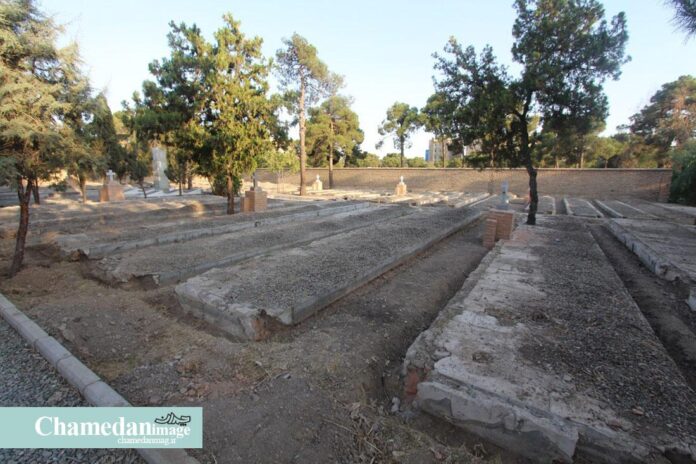
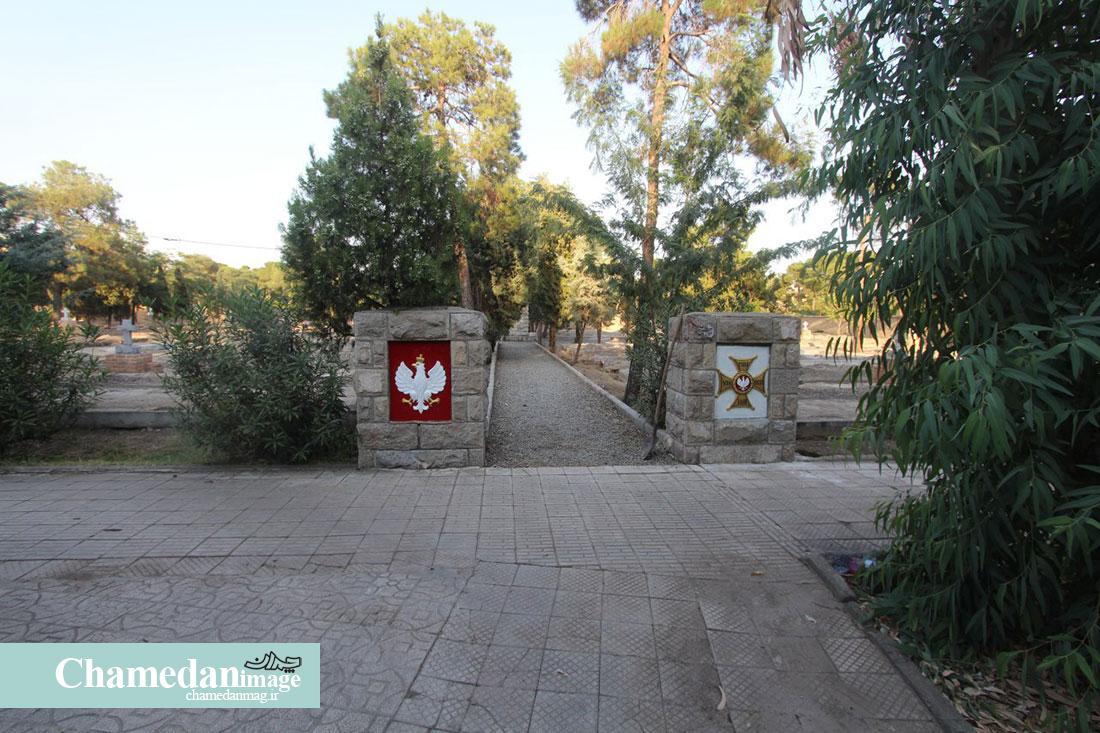
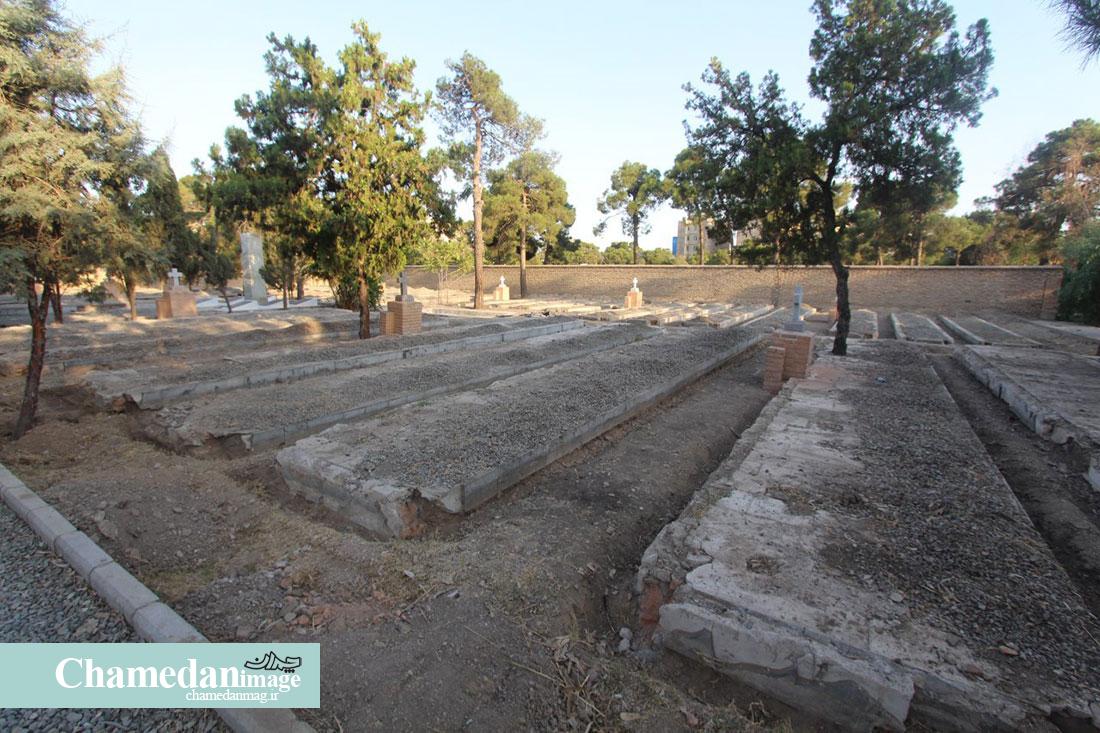
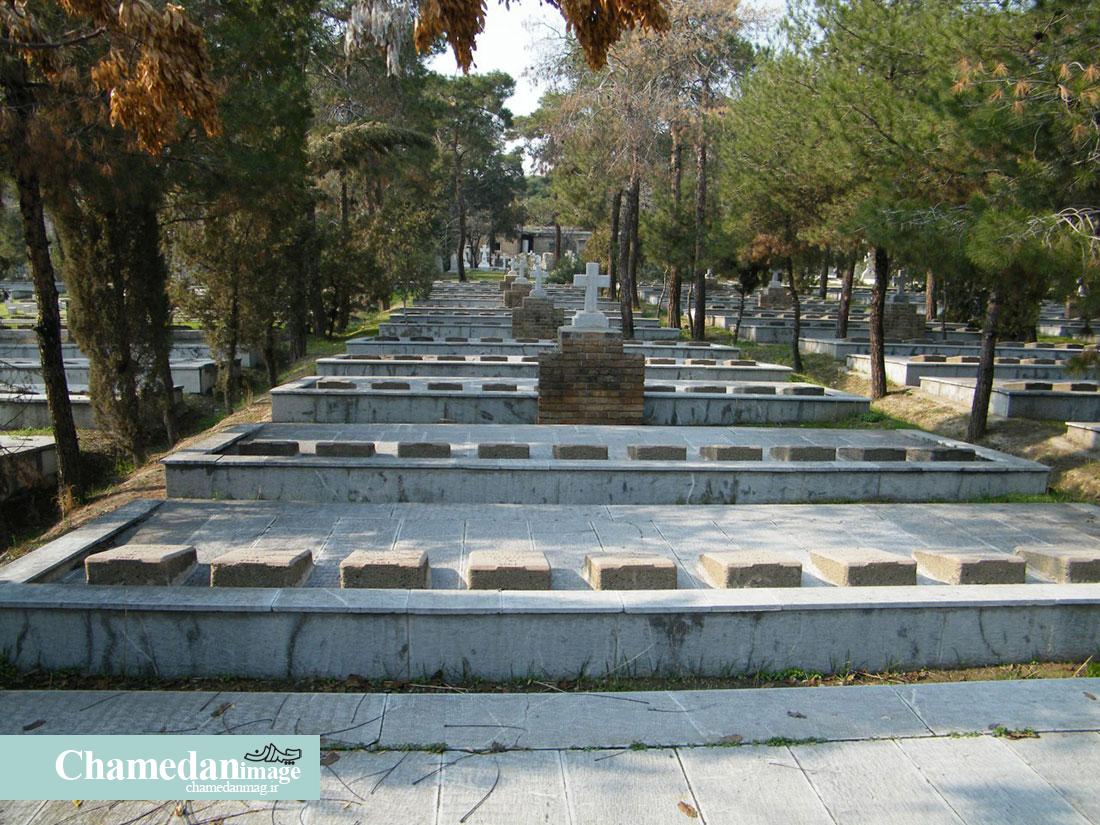
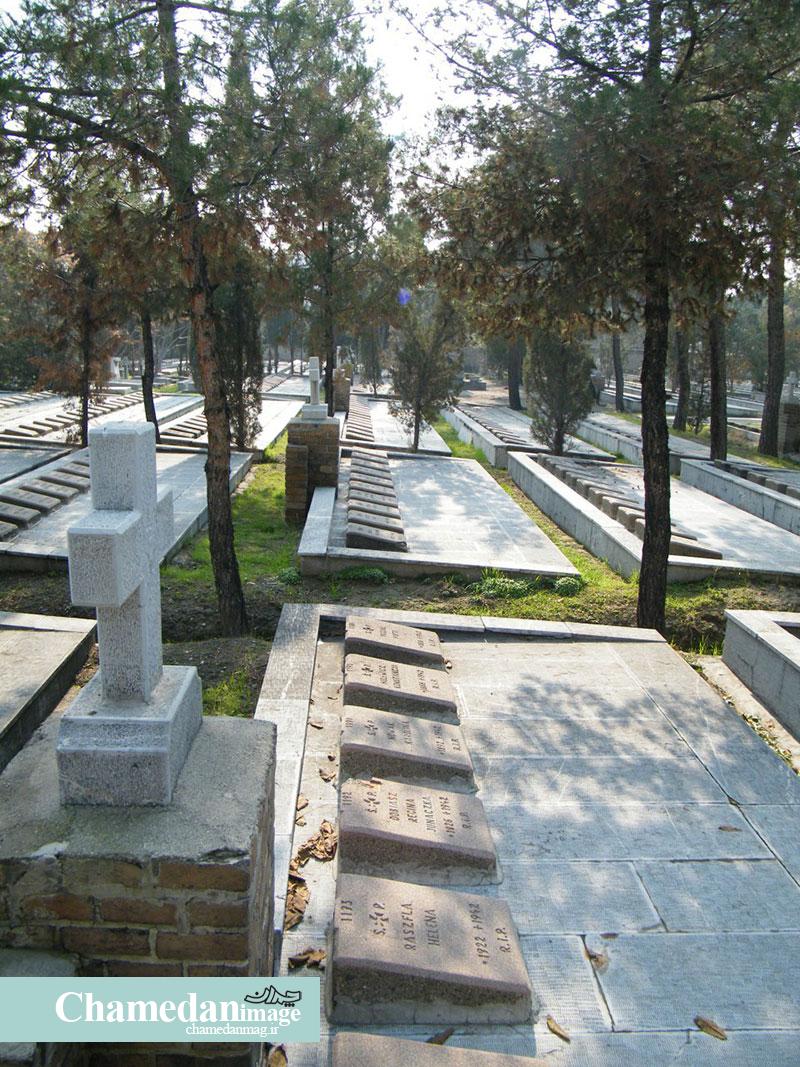
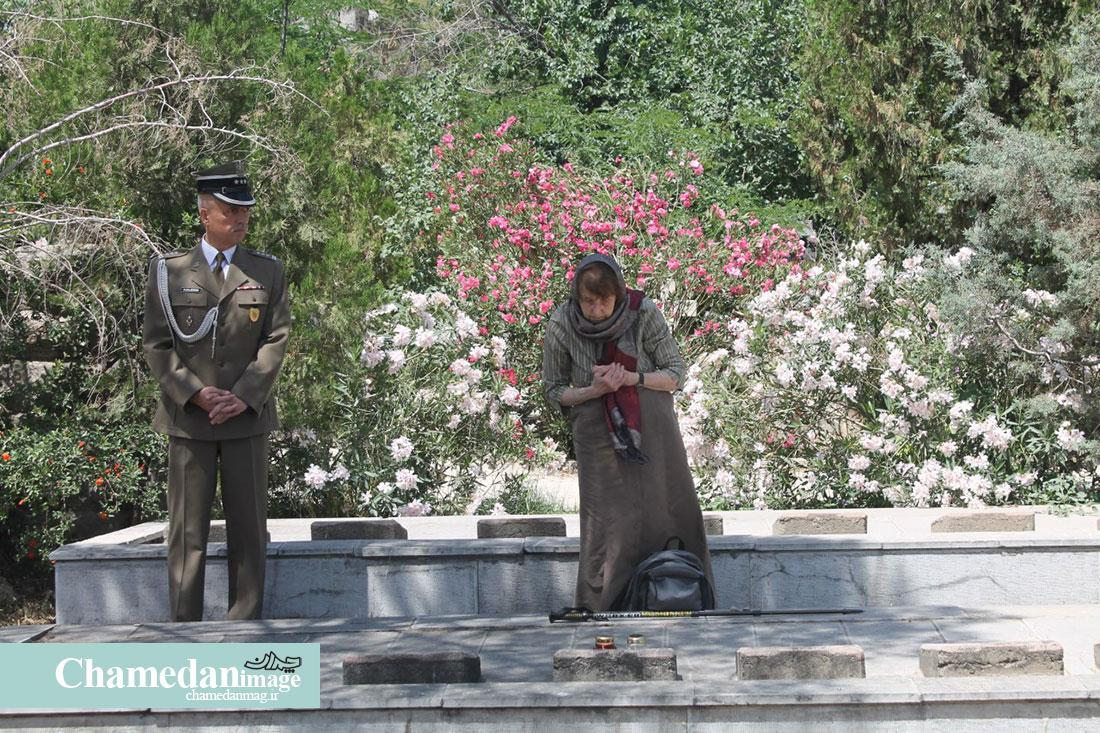
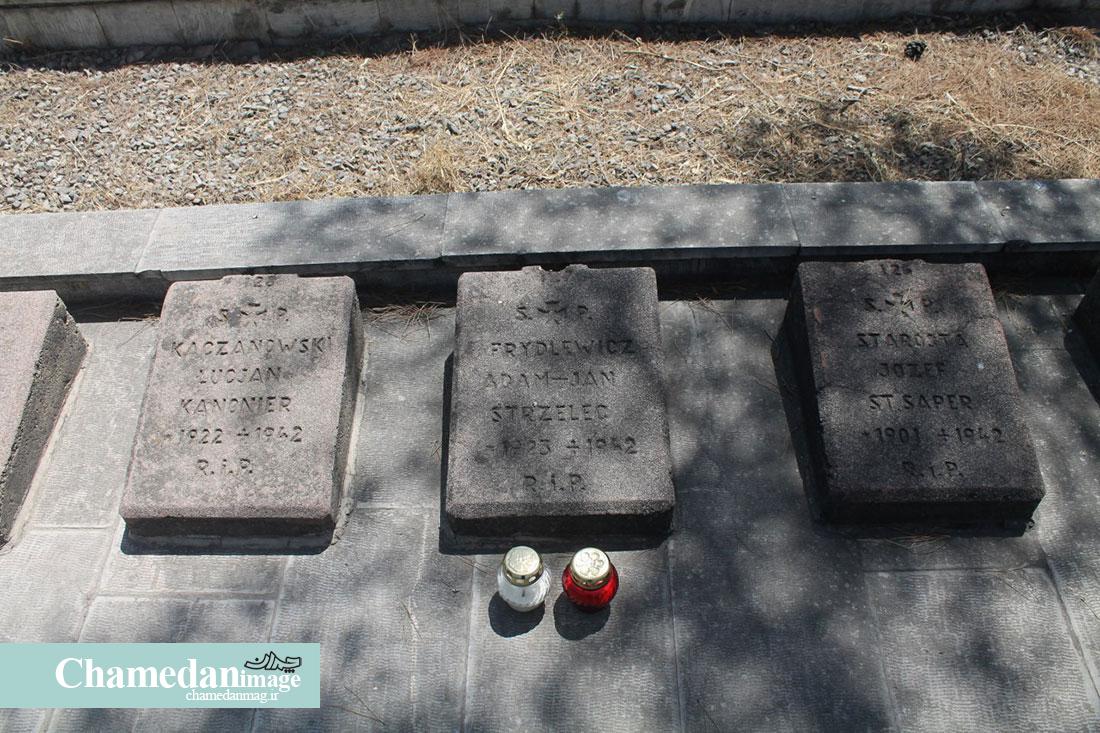
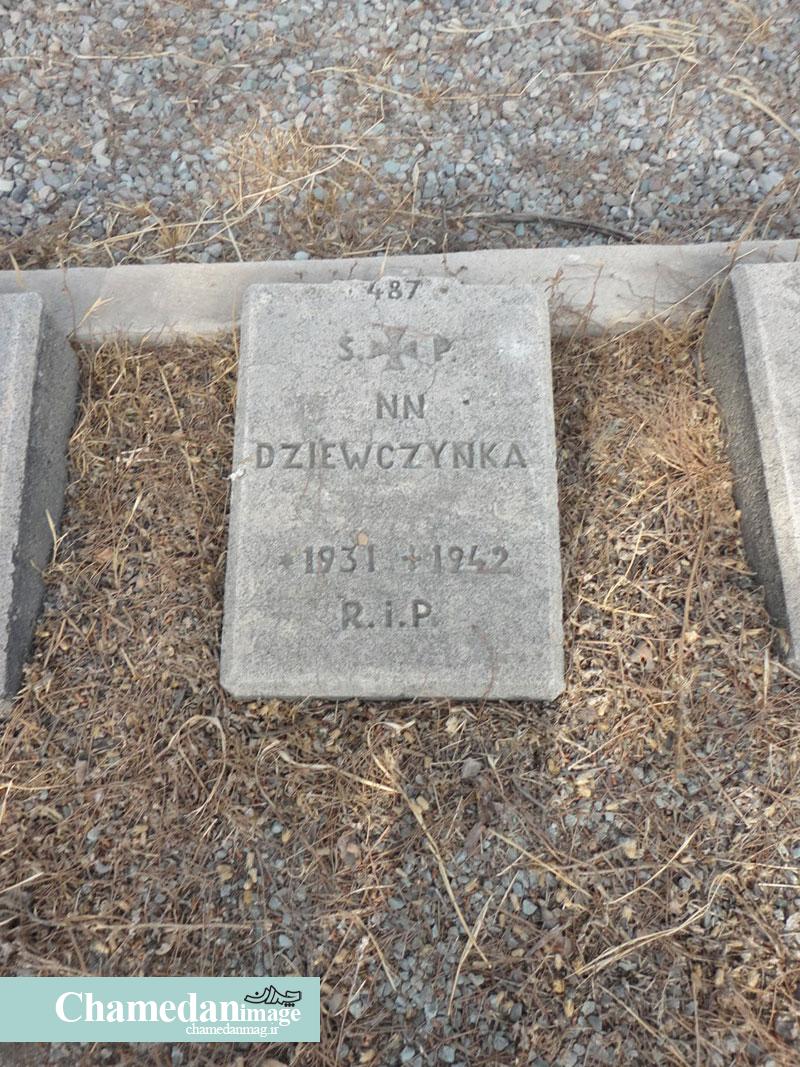
Historical Tombstones of Poles Removed to Be Smuggled out of Iran

The story of the presence of Poles in Iran goes back to World War II. It was in early 1942 when Allied Forces announced they intended to take Polish troops along with women, children and the elderly to the Iranian port city of Anzali and pass them through Iran. Nevertheless, harsh winter closed in on them coupled with a shortage of foodstuffs in Iran at the time.
Still, Iran housed around 3,000 of them in several areas in the capital, Tehran. Despite Iranians’ hospitality, around 1937 Poles passed away due to cold, a shortage of medicines, typhus and cholera, and were laid to rest at Doolab cemetery in west Tehran. Of them, 409 were soldiers and the rest were civilians.
Eight-hundred of them were buried in Mashhad, Anzali Port, Khorramshahr, Ahvaz, Isfahan and Qazvin, 10 were laid to rest at the British Embassy’s cemetery and 56 were taken to their final resting places at the Jews’ cemetery in Tehran. The Doolab cemetery, which contains the cemeteries of Armenians, Poles, the French, Russians, Georgians, Assyrians and the Greek, was registered on the country’s list of national heritage sites on June 6, 2000.

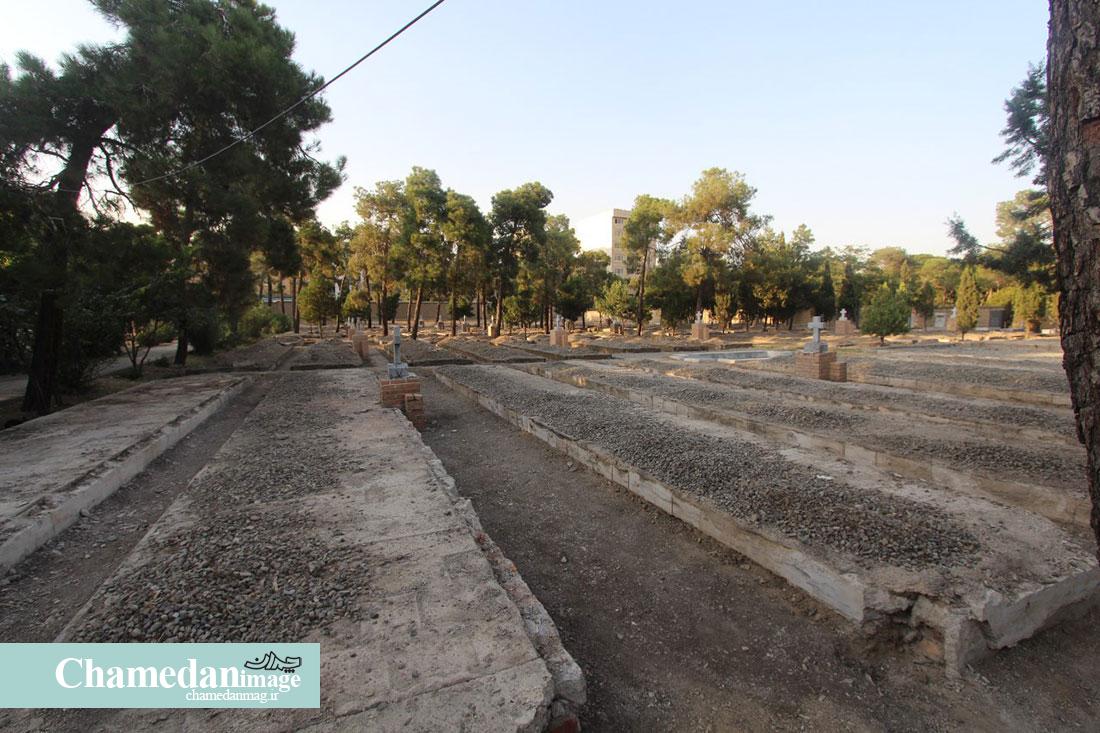
It was October 2017 when news spread that the tombstones of Poles at Doolab cemetery, which is a nationally registered historical site, had been destroyed and removed for renovation.

It came to light that some 2000 old gravestones had been removed during a plan to renovate and restore them, and it was not clear whether the tombstones had been destroyed or kept in a safe place. Comments by senior cultural heritage officials showed the renovation plan had been implemented without receiving the necessary permit from relevant authorities. That begged the question of who was responsible for pursuing the matter if the tombstones were intact and if there was a possibility of taking them out the country by the relevant embassy or some other individuals.

At the end, the Supreme Audit Court intervened in early 2018 and called on cultural heritage officials to take necessary action to keep the tombstones from being taken out of the country.

Customs officials were also notified, so that they would stop the historical gravestones from being taken out of the country.

Officials say the tombstones have apparently not been taken out of the country, yet. Some reports also suggest the historical gravestones have probably been returned to Tehran and are being renovated. Still, there has been no clear answer from authorities on the matter.

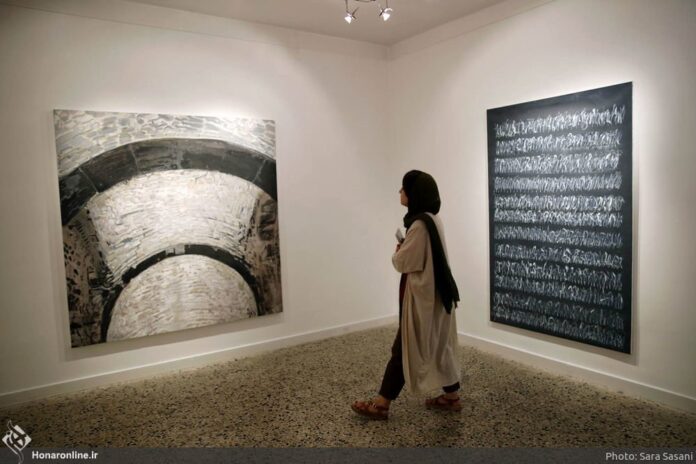
Iranian-Armenian Painter Combines Western Art, Eastern Mysticism

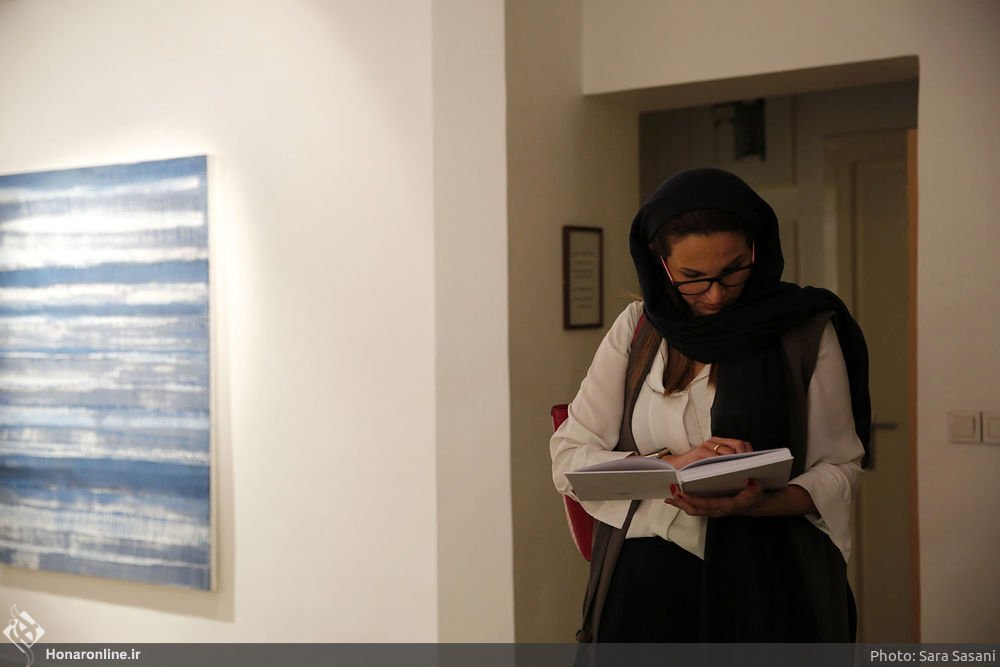
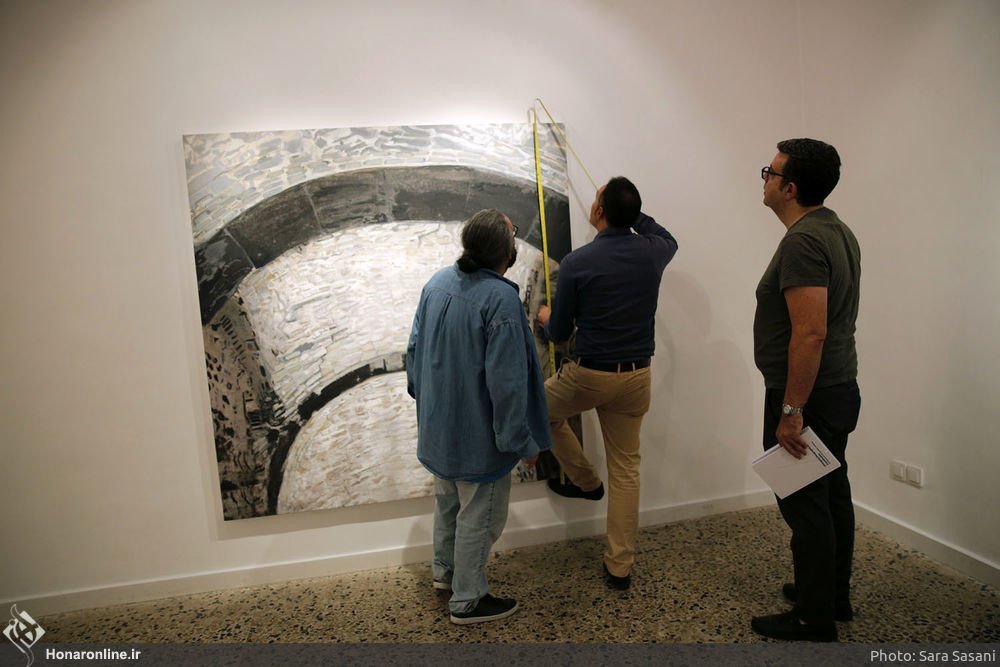
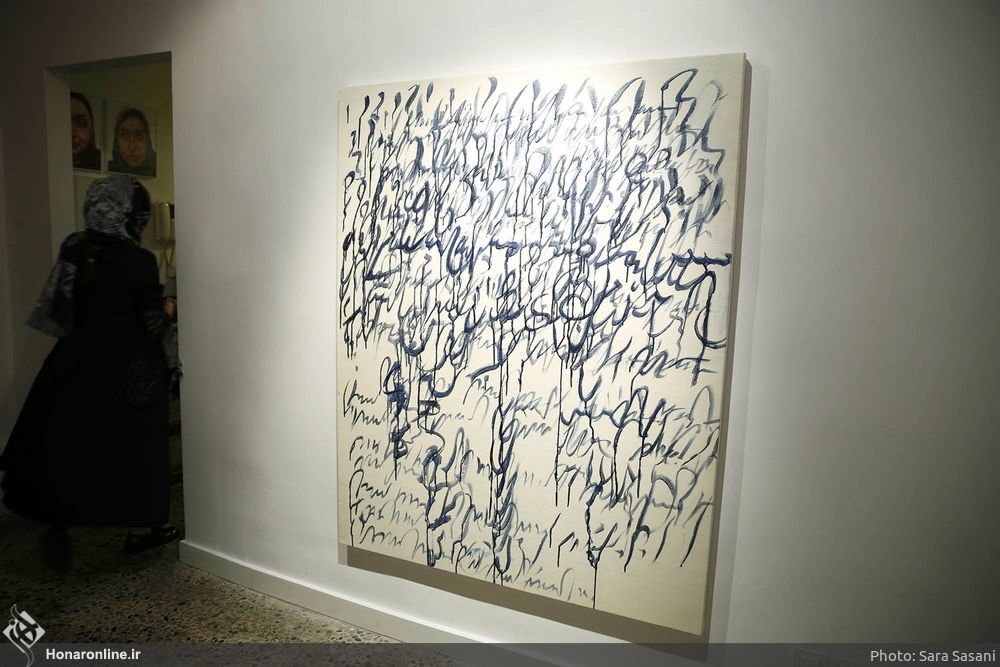
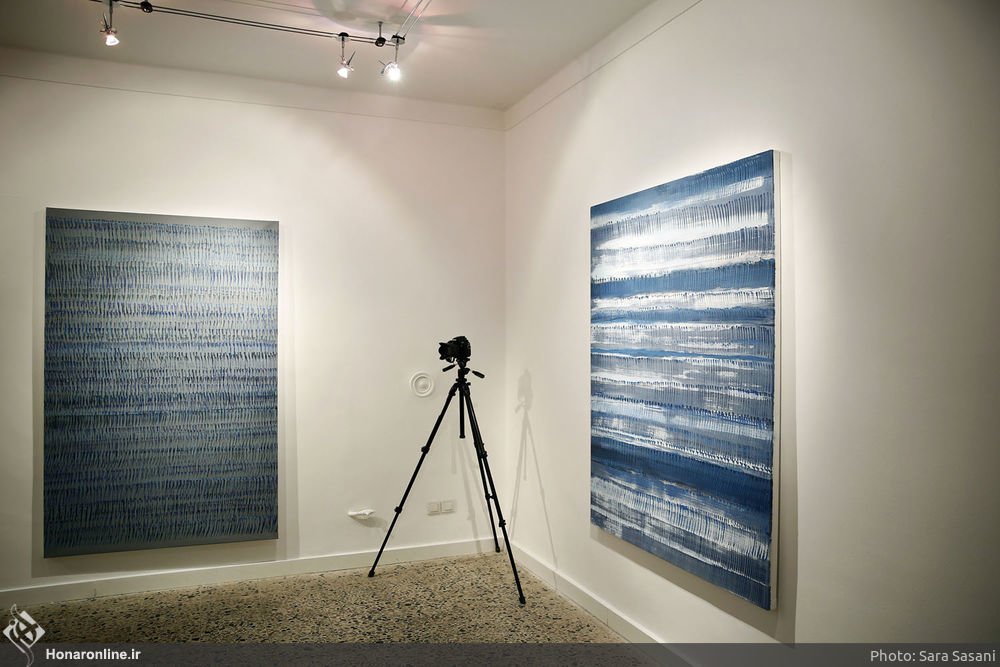
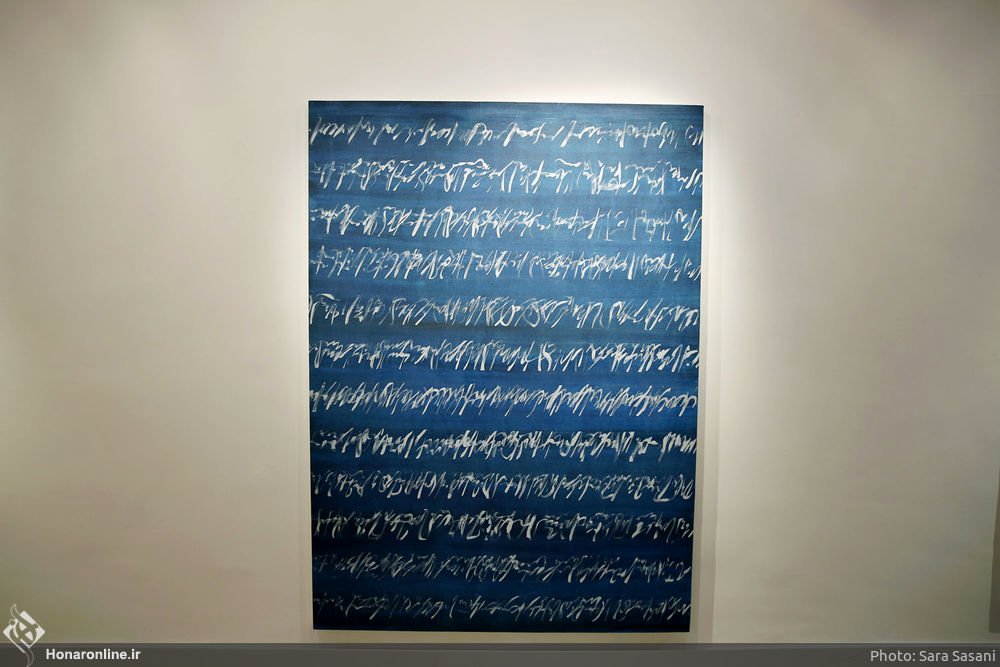
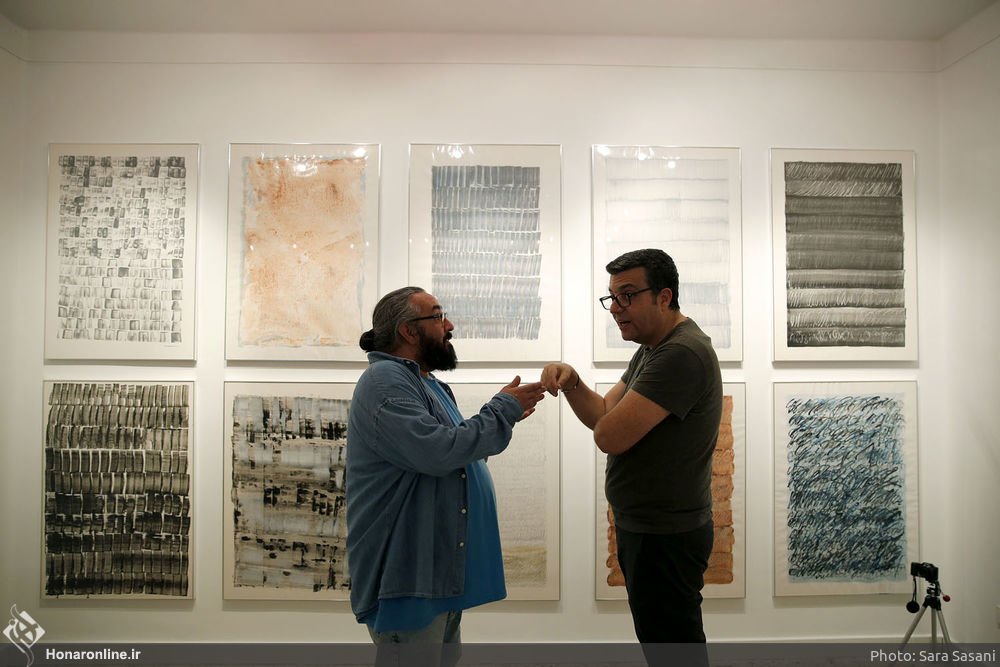
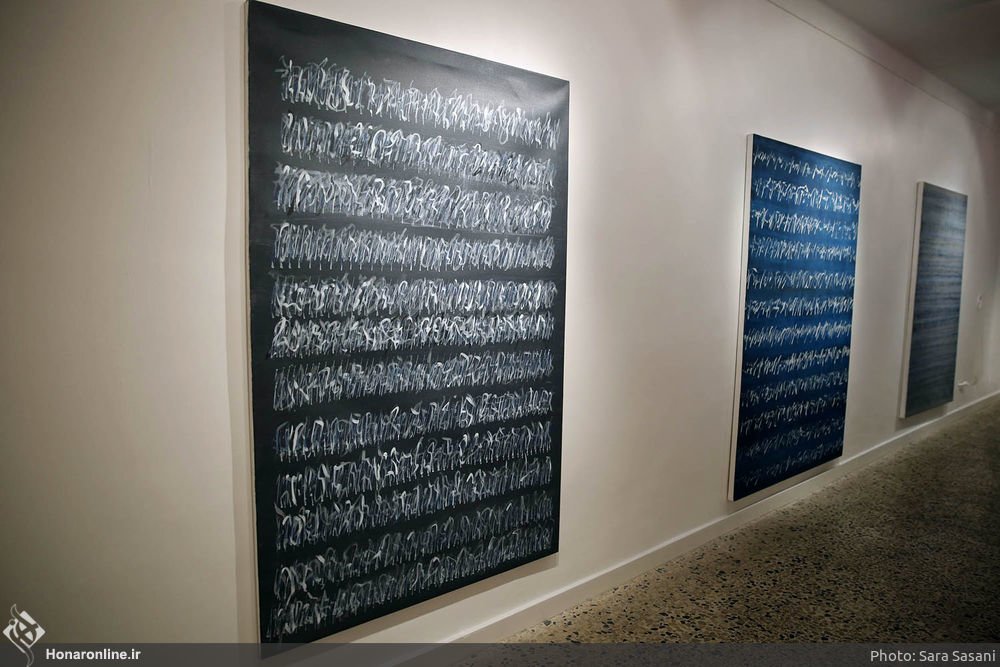
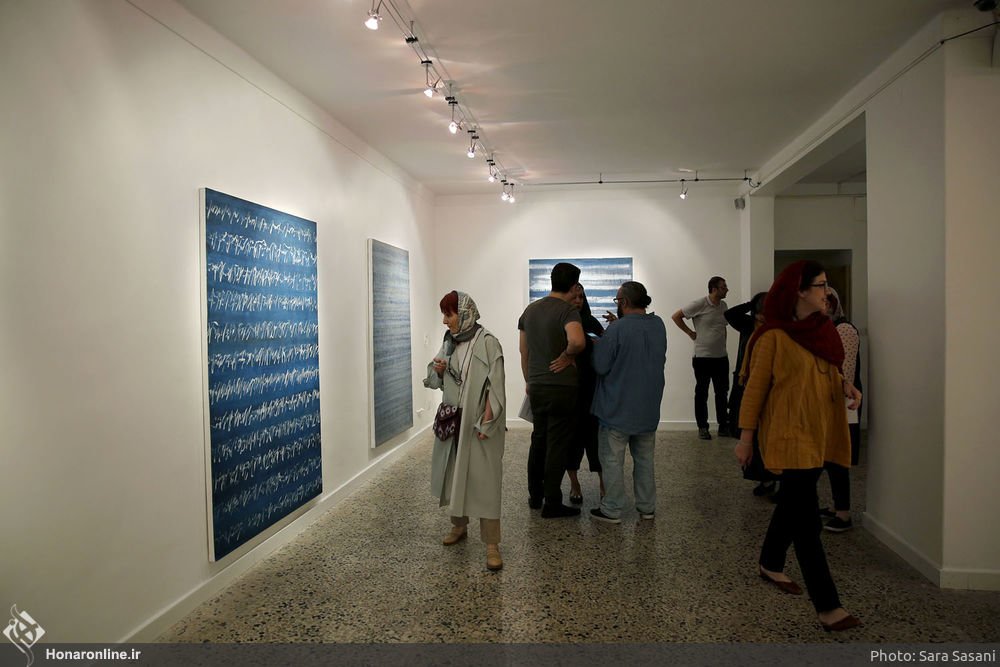
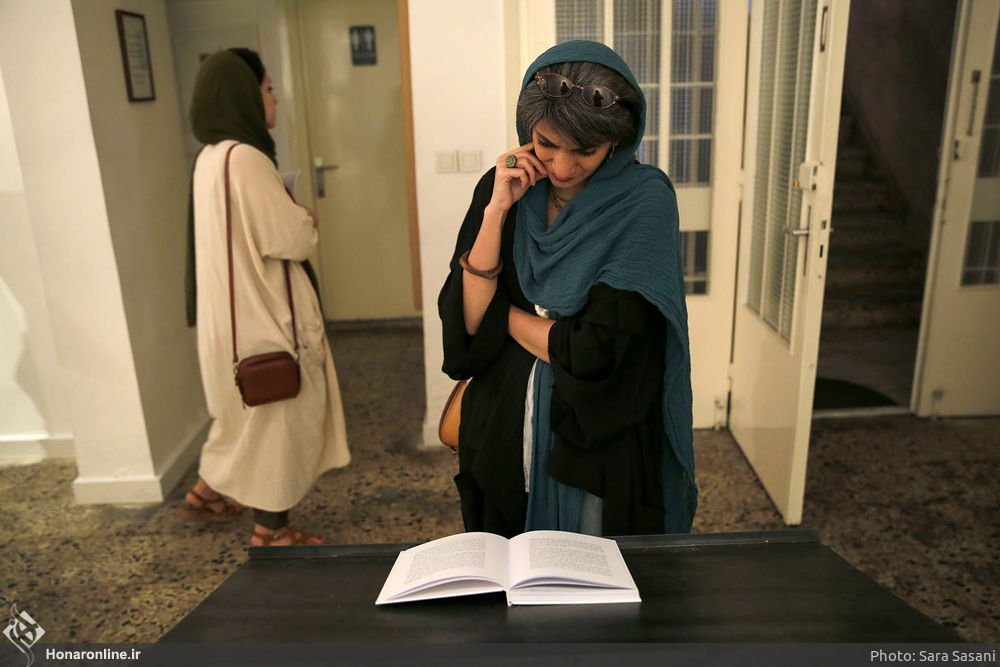
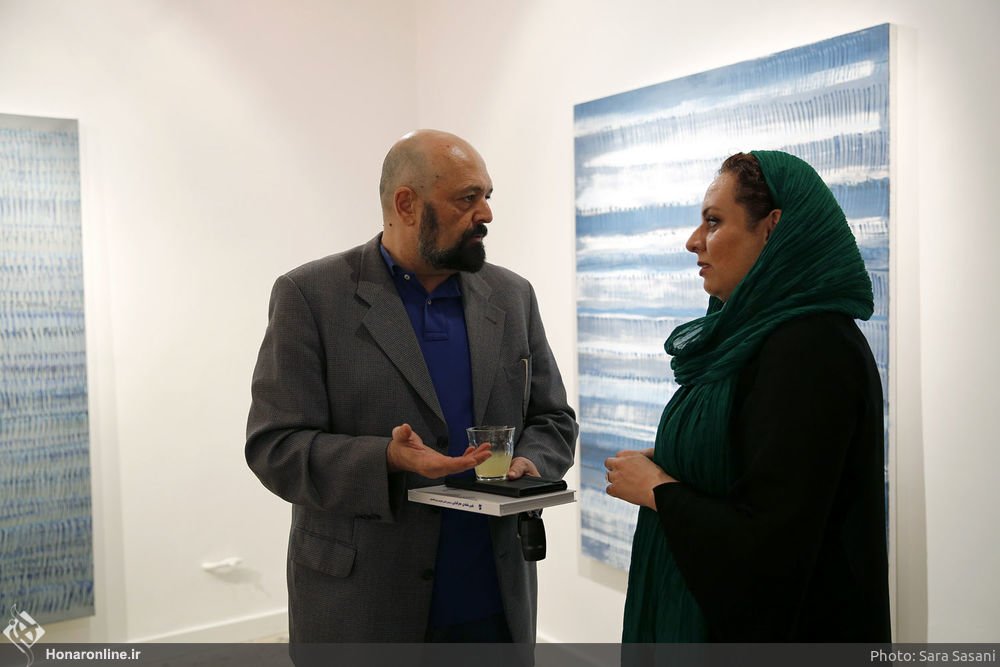
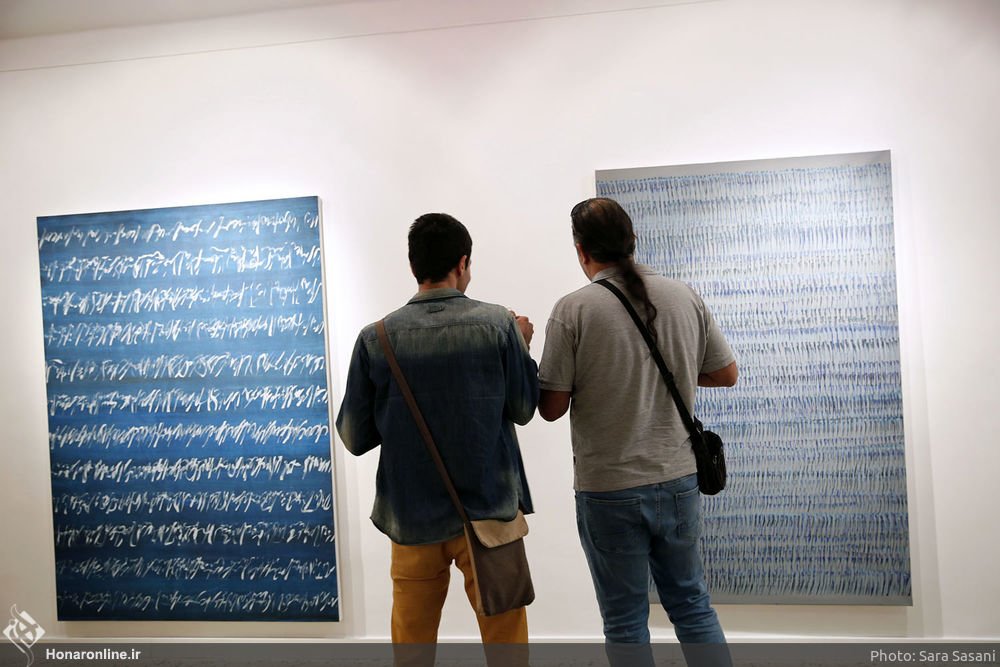
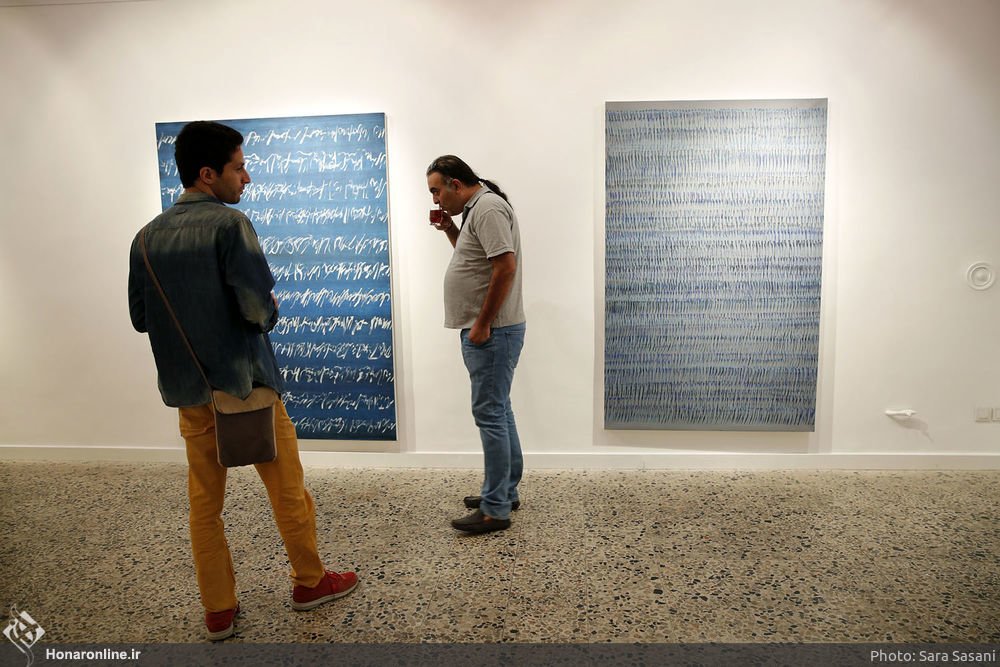
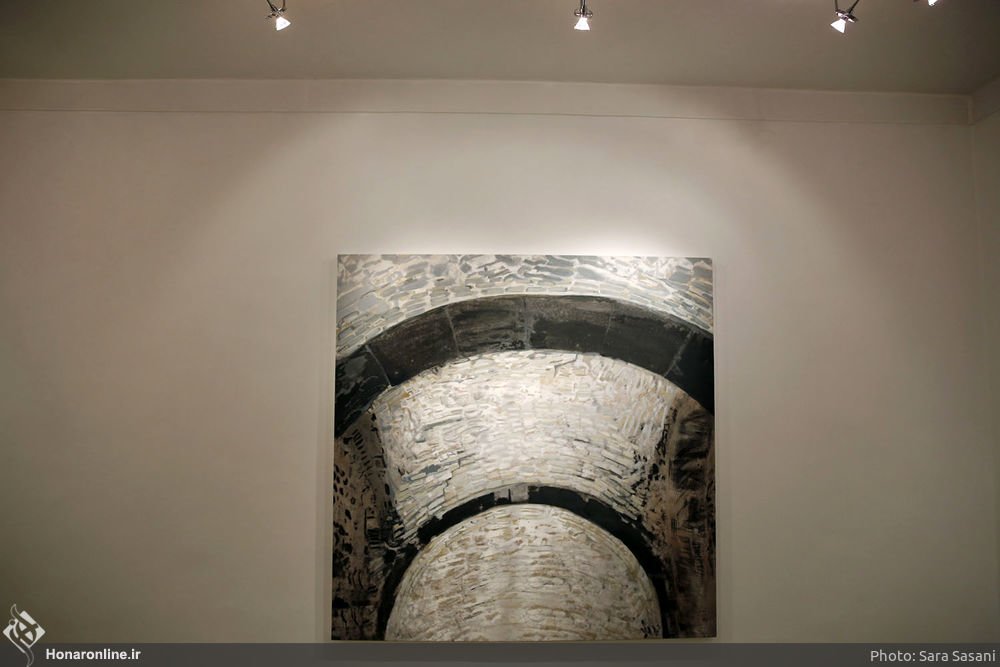
These days, Homa Gallery in Tehran is hosting a warmly-received exhibition of Sonia’s paintings, which is a combination of poetry and geometrics.

Inspired by the oriental culture, Sonia creates artworks with western themes. The artist’s exhibition displays a collection of works from the different stages of her artistic development.

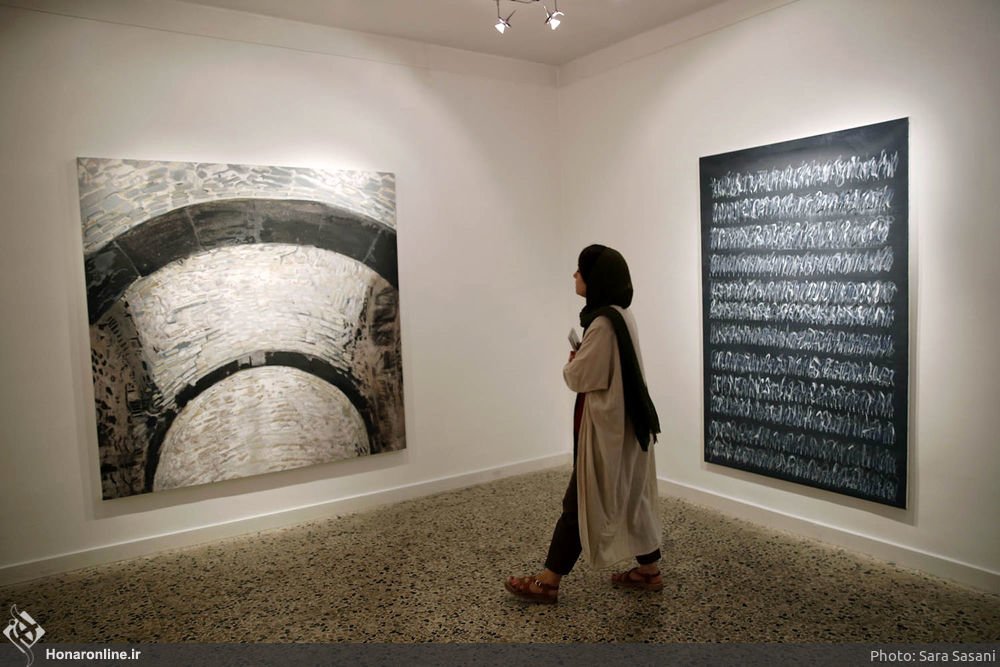
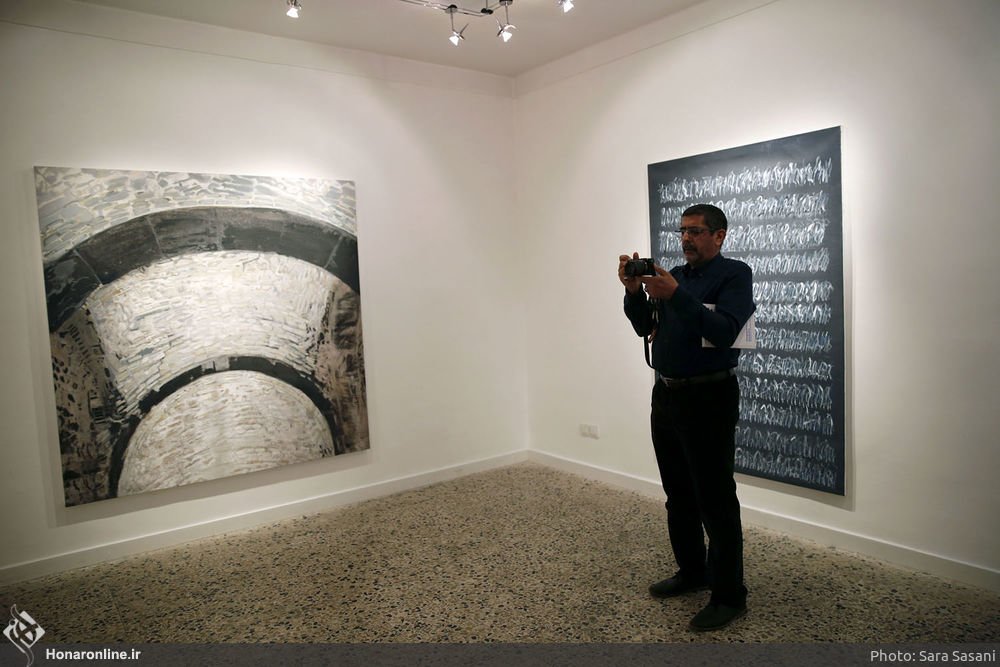
Some of Sonia’s paintings include some irregularly interconnected lines resembling some repeated words. This gives the audience a sense of facing a piece of writing. The artist has used only cold and dark colours to convey the special themes in her mind.

In some of her works on display in Homa Gallery, the artist deals with some architectural elements from the east and uses geometric forms, fabrics and layouts as main themes of her abstract paintings. For example, in one piece, she has used white bricks within a barrel vault to portray the image of Iranian markets.

In her minimalist pieces, Sonia uses a combination of ochre color with blue, grey and white reminding the audience of the classic Persian architecture.

She takes advantages of her homeland’s art to recreate the monotonous rhythm of brick buildings in an innovative form.

Sonia is an Iranian-Armenian artist who left Iran in 1965 for New York, and has since been living there. She holds a BFA from the joint program of Pennsylvania Academy of Fine Arts and the University of Pennsylvania, as well as an MFA from Pratt Institute in Brooklyn, New York. She is also an alumnus of the Whitney Museum Independent Study Program. Her numerous works have been exhibited internationally.

Sonia has won several prestigious awards from Philadelphia and New York’s museums and universities.  Her works are now held in Tehran Museum of Contemporary Arts, Armenia’s Contemporary Arts Center and personal collections in various parts of the world. They have also been put up for auction at Christie’s and Tehran auctions, among others.

She is one of the most influential artists in Iran’s modern art, and has created some leading artworks.

Sonia’s works will be on display in Homa Gallery until October 16.

What follows are photos of her works retrieved from Honar Online:

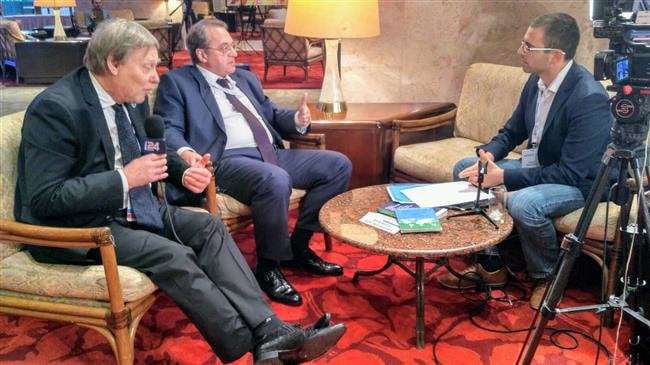
Iran’s Syria Presence None of Israel’s Business: Russia

“Syria is a member of the United Nations,” Russian Deputy Foreign Minister Mikhail Bogdanov said, adding that the Arab country “has equal rights” over its self-determination with Russia, the US and any other member of the UN.

“This is a sovereign country led by a legitimate government. It can agree on cooperation with any other country, including Iran, Russia, Israel,” he noted in an interview with the Israeli TV channel i24NEWS released Thursday night.

“That’s Syria’s sovereign right, and it’s not the business of a third party to intervene in these subjects of politics or policy of a sovereign country,” said Bogdanov, who is also President Vladimir Putin’s special envoy for the Middle East.

He went on to say that Moscow had already explained to Israel and the US that “this is a sovereign decision for Syria who should be on their territory.”

“They asked us and the Iranians to be there. The Iranians have said repeatedly on many levels that Syria asked them to help them in the fight against terrorists, and when Mr. Assad tells them that their mission is accomplished and they are no longer needed, they will leave Syria, just like us.”

Iran has been offering military advisory support to Syria at the request of the Damascus government, enabling its army to speed up its gains on various fronts against terror outfits.

However, over the past few years, Israel has frequently attacked military targets inside Syria in an attempt to prop up terrorist groups that have been suffering defeats at the hands of Syrian government forces.

Iran's Syria Presence None of Israel's Business: Russia

In the latest Israeli airstrikes on Syria a few weeks ago, a Russian Il-20 plane was mistakenly shot down by Syrian air defenses in Latakia Province, northwestern Syria. The Syrian S-200 missile defense system was responding to a wave of strikes by four Israeli warplanes.

Moscow blamed Tel Aviv for the incident, which killed all 15 people on board, saying the Israeli warplanes had deliberately “created a dangerous situation” that led to the crash.

Shortly after the attack, Russia delivered a modern version of its S-300 missile defense system to Syria in a bid to prevent similar incidents in the future.

Plane crash changed rules of the game

In his interview with i24NEWSBogdanov underlined that the Israeli pilots’ fault in that incident totally changed the rules of the game.

“The rules of the game were violated when Israeli pilots used a Russian aircraft for cover, knowing how it threatened the Russian crew,” he noted.

“You can imagine what would have happened if 15 Israeli officers had been killed through our fault,” he said.

Iran's Syria Presence None of Israel's Business: Russia

Netanyahu’s UN theatricals on Iran nuclear site

Elsewhere in his remarks, Bogdanov mocked Israeli Prime Minister Benjamin Netanyahu’s theatrical performance at the United Nations, in which he used placards with satellite pictures to make claims about a secret atomic warehouse in Tehran.

“It’s naive to think that only one country and only one secret service knows something that nobody else knows,” Bogdanov told i24NEWS, refuting allegations leveled by the Israeli PM about an atomic warehouse in Turquzabad, a village close to Tehran.

“It’s the work of the International Atomic Energy Agency (IAEA), which is supposed to check this. It is a professional and serious organisation. It has authority and legitimacy,” he said, adding that the IAEA can inspect any site at any time under the agreement it has with Iran.

“To tell the whole world they have something, and show pictures, maybe some people like this and it helps him, maybe it’s intended to score points and for internal consumption,” Bogdanov noted.

“Speaking seriously… Israel should have taken a different approach and not worked with journalists and with what we call ‘megaphone diplomacy’,” he noted.

Appearance of Hands May Give Clues about Diseases

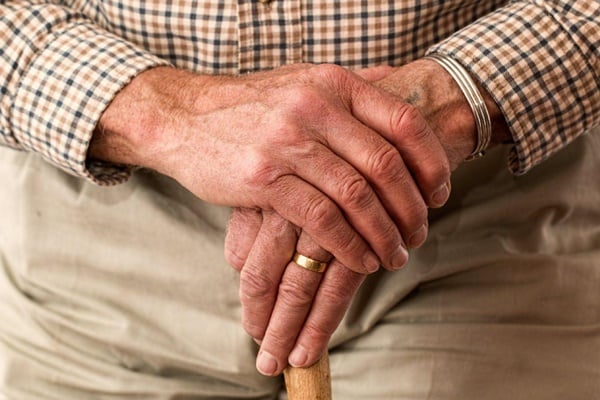
The appearance of hands can give you clues about the status of your general health, so that you will be able to spot health problems in your body, says a report released by the Iranian Ministry of Health and Medical Education.

These are the conditions the symptoms of which may first appear on hands:

Hands are always cold: The constant coldness of hands coupled with a change of the skin colour is a sign of problems with the circulatory or nervous system, and one should see a doctor immediately for diagnosis.

Trembling fingers:This may be caused by carrying heavy loads. However, the symptom sometimes appears without any reason, which is due to a deficiency of vitamins B12, B6, B1 and E.

Pain in the index finger and thumb: This kind of pain coupled with a burning sensation or feeling pins and needles could be a symptom of the Carpal tunnel syndrome (CTS). The syndrome leads to the inflammation of the wrist and puts pressure on nerves, resulting in a very unpleasant sensation. The CTS is common among musicians and computer users.

Wounds that heal slowly: Bruises and slow-healing wounds on hands are symptoms of diabetes. If you suffer from such wounds along with hunger, constant thirst and feeling pins and needles in your hands and feet, see a doctor immediately for a diabetes checkup.

Change of finger’s skin colour: This symptom can be caused due to several reasons, including stress or lifting heavy loads. Still, a change of finger colour coupled with an itch, pain, feelings of pins and needles and numbness could be a sign of a spinal disease or cardiovascular problems.

Sweating profusely: unusually heavy sweat on your hands could be a symptom of hyperhidrosis.

Brittle nails: If you find out that your nails break easily, it could be due to the use of detergents and a whole range of improper methods of taking care of your nails. Still, this symptom along with fatigue, tiredness and joint pain could be a sign of thyroid disorder as well.

Inflammation of hands:This could be the result of heat or eating too much salt. Still, long-time inflammation could be a symptom of vascular diseases.

Change of nail colour: If you see that the colour of your skin has changed, it may be because you suffer from anemia where the amount of hemoglobin in your blood has decreased.

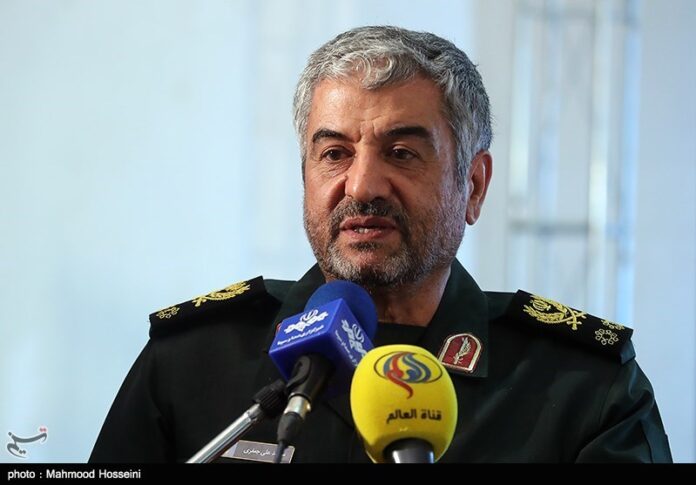
“IRGC Strong Enough to Defend Mideast in Less than 12 Minutes”

general-mohammad-ali-jafari

General Jafari on Friday underlined that Trump was wrong when he speculated that the Islamic Republic’s power has decreased since he took office.

“If in the past we could defend the Middle East, not to impose our hegemony on the whole region, within 12 minutes [as mentioned by Trump], today the time is even lower than that,” he said in an interview with Yemeni TV channel Almasirah.

The IRGC chief commander also said the nature of the Islamic Revolution and Iran shows that the more the country is involved in wars, the more its strength grows.

He underlined that Iran will never avoid giving decisive responses outside its borders if its security is endangered.

The top commander also underlined that the resistance front has become stronger after the war in Iraq and Syria, adding there is no concern at all today about the condition of the movement.

On the US sanctions against the Islamic Republic, Major General Jafari said the Iranian nation is accustomed to the US unilateral sanctions. “Despite sanctions, we have managed to achieve self-sufficiency and strengthen our national solidarity which will grow further even after the sanctions.”

He also referred to the Zionist regime’s aggression against the Palestinians and added the IRGC will stand firm against the Zionist regime until the “cancerous tumour” is eradicated. “We have already got closer to the time of its eradication.”

In an address to his supporters on Tuesday, Trump said Iran planned to take control of the Middle East, in just “12 minutes.”

“Look at Iran, before I got there (to the White House), Iran was going to take (control) the Middle East in about 12 minutes, right?” Trump said in the city of Council Bluffs in the state of Iowa.

He once again urged the Saudi Crown Prince Mohammed bin Salman to pay the US in return for its own security in the region and said if he hadn’t come to power the Arab World couldn’t stand against Iran’s “threat” for even 12 minutes.

He also claimed that since the beginning of his administration, the Iranian authorities “are trying to survive”, while there are “riots” in each of their cities.