Monday, December 29, 2025
Home Blog Page 3425

Robot Developed to Help Patients with Spinal Cord Injuries

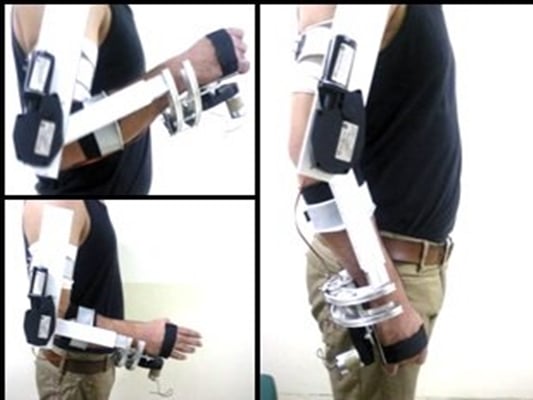
Scientists at Sharif University of Technology say this wearable robot, equipped with a motion-detection system, allows patients to move their hands with damage to the function of their upper limb.

Esmaeil Mohammadi, a graduate of biomechanics at Sharif University of Technology, who is the initiator of this project, says they have succeeded in implementing this project with the support of the Electronic Industries Fund.

He says the robot could be used for patients who for various reasons have been unable to move their elbow and wrist joints or have a limited range of motion.

“The robot detects the course of movement after it is worn by the patient. When the patient wants to move, the robot will continue to move. It can help patients with wrist injury (fracture, inflammatory lesions, nerve damage, joint stiffness, etc.), patients with stroke and spinal cord injury, and patients with cerebral palsy,” added Mohammadi.

The designer of the robot emphasised that it will stimulate the nerves, prevent the involved muscles from becoming lazy and, over time, increase the movement range of elbows and wrists.

For a brief review of Iran’s achievements in various fields of science and technology, check the book “Science and Technology in Iran: A Brief Review

He also mentioned that the product will be available in both “wearable” and “desktop” models.

“This product is available for research and scientific inquiries in all universities, research centres, rehabilitation centres (occupational therapy and physiotherapy), and for exercises, especially those which increase range of motion, strength, and accelerate recovery.”

The researcher further noted that he has designed the robot in two forms: “Exo Passive and Active” for wrists and elbows, and “two-channel biofeedback” devices.

“Two-channel biofeedback is a device that distinguishes skeletal muscle from the muscles which begin to contract, and shows them to the user at high speed and precision. In addition to being small and portable, this biofeedback device will also help the therapist in the diagnosis and treatment.”

Mohammadi referred to the benefits of the product saying that centres and hospitals are looking for a device that, in addition to performing passive movements, can be portable and handle active movements of the patient so that more patients can use it.

“The patient can also take the robot to his home or workplace, if needed, and can continue his/her practice consistently.”

He argued that existing foreign devices incur a very high cost for both purchase and maintenance.

“With the production of these devices, in addition to creating jobs and preventing foreign currency from leaving the country, it would be possible to compensate for the shortage of these equipment in the rehabilitation centres and provide a suitable replacement for the imported samples.”

Mohammadi said a semi-industrial sample of this product has been produced.

Physiotherapy and rehabilitation centres, hospitals, veterans and the disabled, people with cervical spinal cord injuries, and people who have suffered strokes, accident and fracture are the main customers of this product, he added.
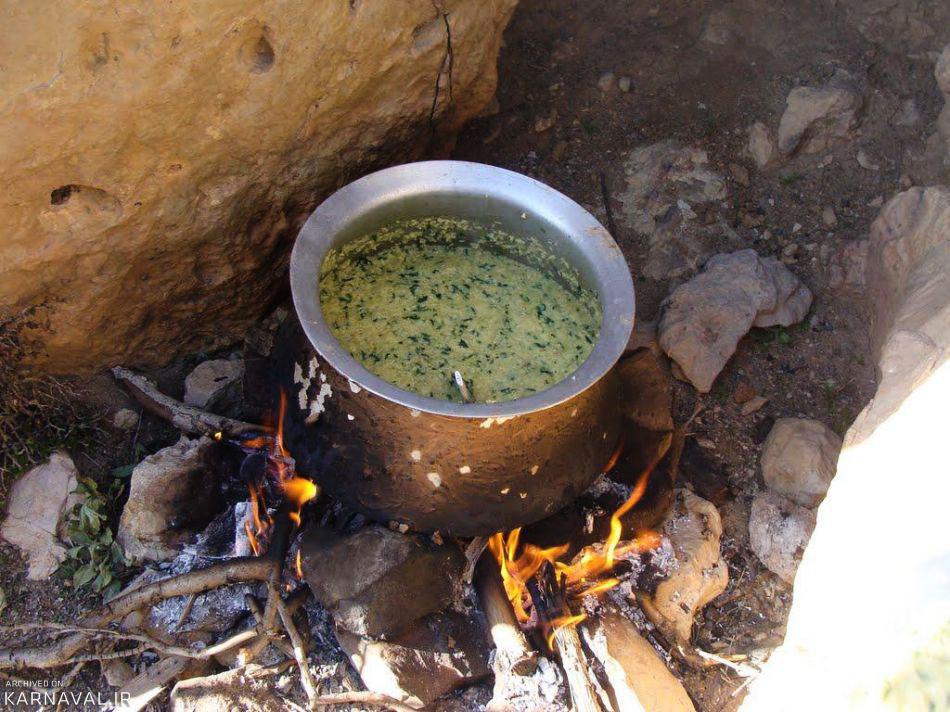
Ash-e Doogh; Delicious Soup Popular in Iran’s Ardabil

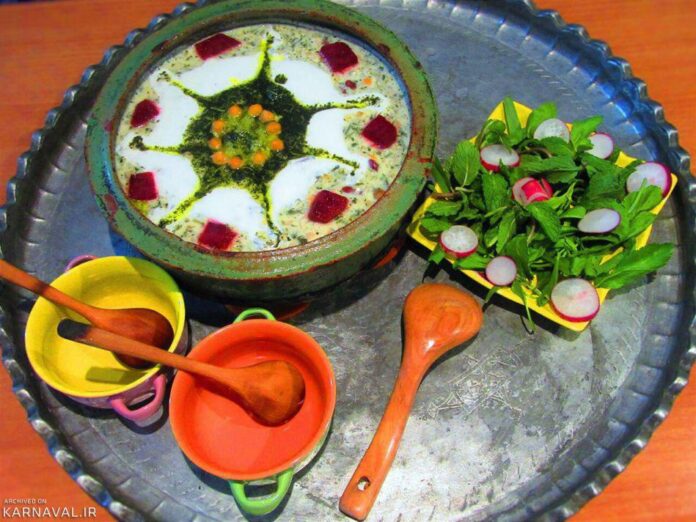
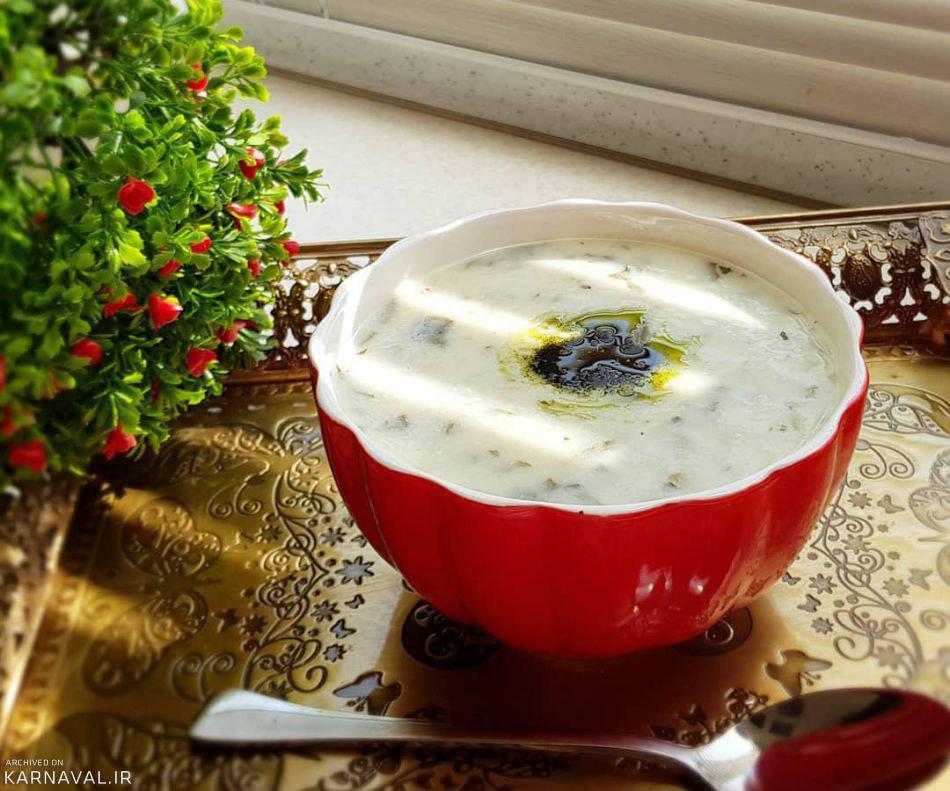
The soup is the most famous in Ardabil and has many fans in the Azari region of the Islamic Republic. Its main ingredients are peas, rice, homemade doogh (yogurt drink), yogurt, vegetables including chives, coriander and fresh garlic leaves, etc. Some people also add meat balls to the white soup.

It is often served in cold winter days and at family gatherings at nights. It is interesting to know that many cities and villages in Iran have their own forms of Ash-e Doogh.

Ash-e Doogh; Delicious Soup Popular in Iran’s Ardabil

Ingredients:

Peas: 250 gr.

Vegetables: 700 gr.

Rice: 1 cup

Doogh: 2 litres

Salt, Pepper, Fresh chopped garlic: As much as needed


Recipe:

Put the peas in water the night before and change the water a few times. Soak the rice the night before with water and some salt.

Cook the peas in a suitable container filled with 6 cups of water. After the peas are almost cooked, add the rice and wait until it is cooked well. Be careful not to have too much water and leave space for doogh as well.

Add chopped veggies to the soup and leave the container half-open so that the vegetables do not get a dark colour. 15 minutes before the soup gets ready, add the doogh and stir constantly.

When you add the doogh, the container should be completely open so that the doogh does not undergo chemical changes. After about 15 minutes, add salt and pepper.

When serving, add fresh chopped garlic to it. In the end, pour the soup into a dish and decorate it with sautéed mint.

Ash-e Doogh; Delicious Soup Popular in Iran’s Ardabil

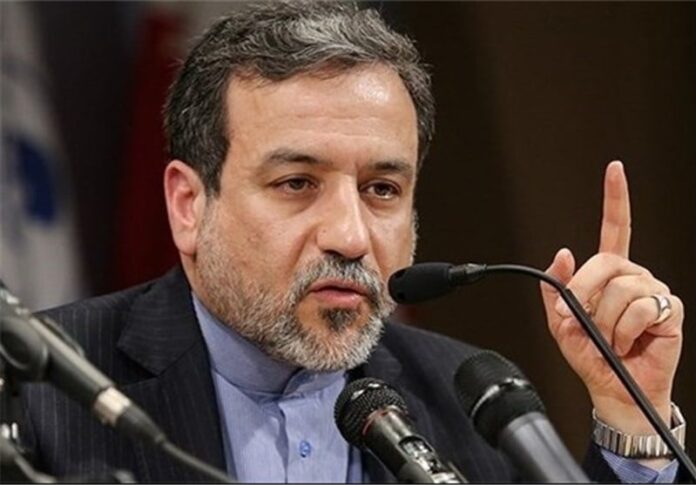
Europe’s Efforts to Save JCPOA Useless after November 4: Iran

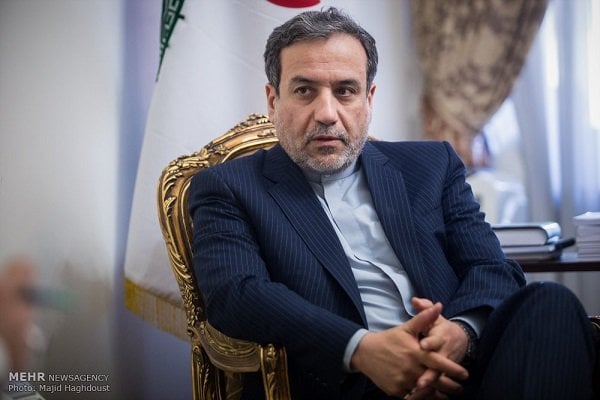
“We have clearly announced to the Europeans that if our main interests in the JCPOA, (namely) the issue of oil sales…, are not served, staying in the deal will not benefit us anymore,” Araqchi told the Islamic Republic of Iran Broadcasting (IRIB) on Tuesday night.

They have a deadline of November 4 and from then on, any action by them would be useless, he added.
“As long as we can sell our oil, it will be in our interest to stay in the JCPOA, and even if after the November 4, when the US sanctions are officially re-imposed, we could sell our oil, we might consider continuing the work with the JCPOA,” Araqchi said.

The European Union has vowed to counter US President Donald Trump’s renewed sanctions on Iran, including by means of a new law to shield European companies from punitive measures.

On May 8, the US president pulled his country out of the JCPOA, which was achieved in Vienna in 2015 after years of negotiations among Iran and the Group 5+1 (Russia, China, the US, Britain, France and Germany).

Following the US exit, Iran and the remaining parties launched talks to save the accord.

Trump on August 6 signed an executive order re-imposing many sanctions on Iran, three months after pulling out of the Iran nuclear deal.

He said the US policy is to levy “maximum economic pressure” on the country.

Trump also restated his opinion that the 2015 Iran nuclear deal was a “horrible, one-sided deal”.

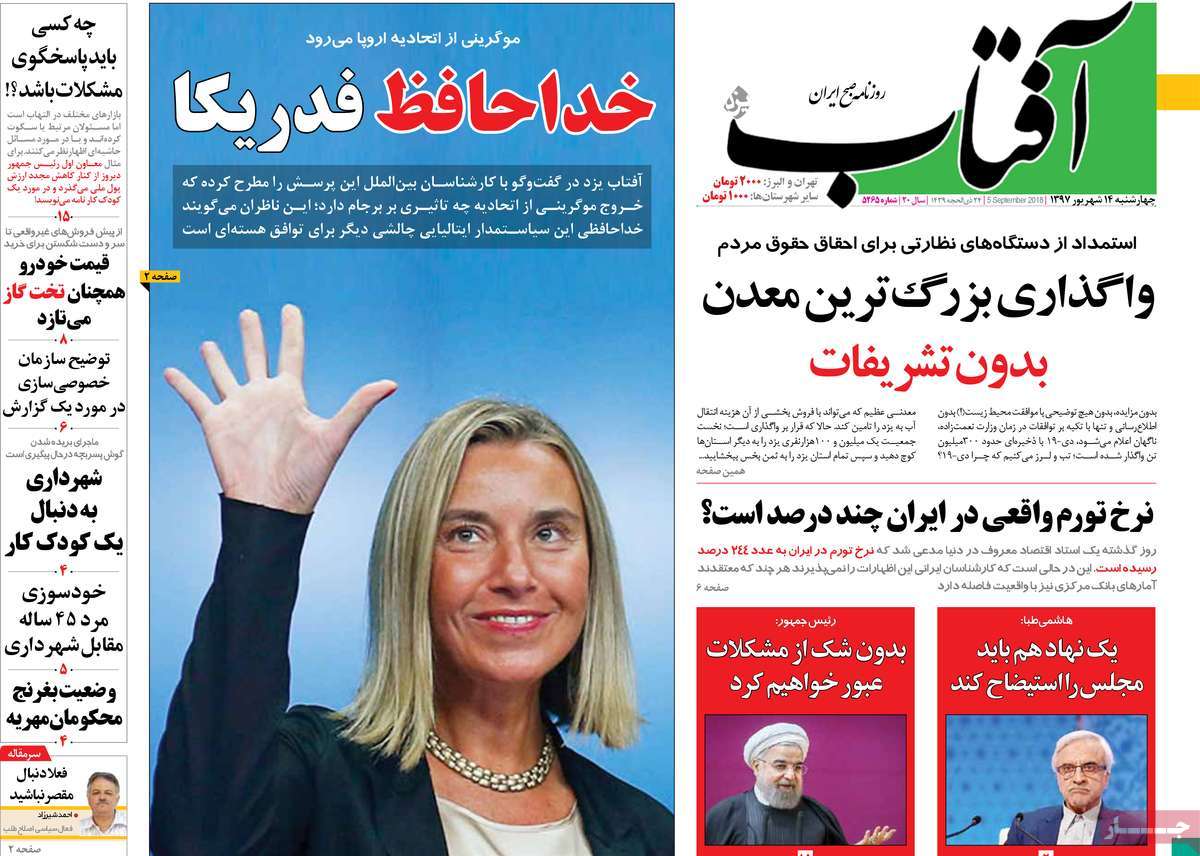
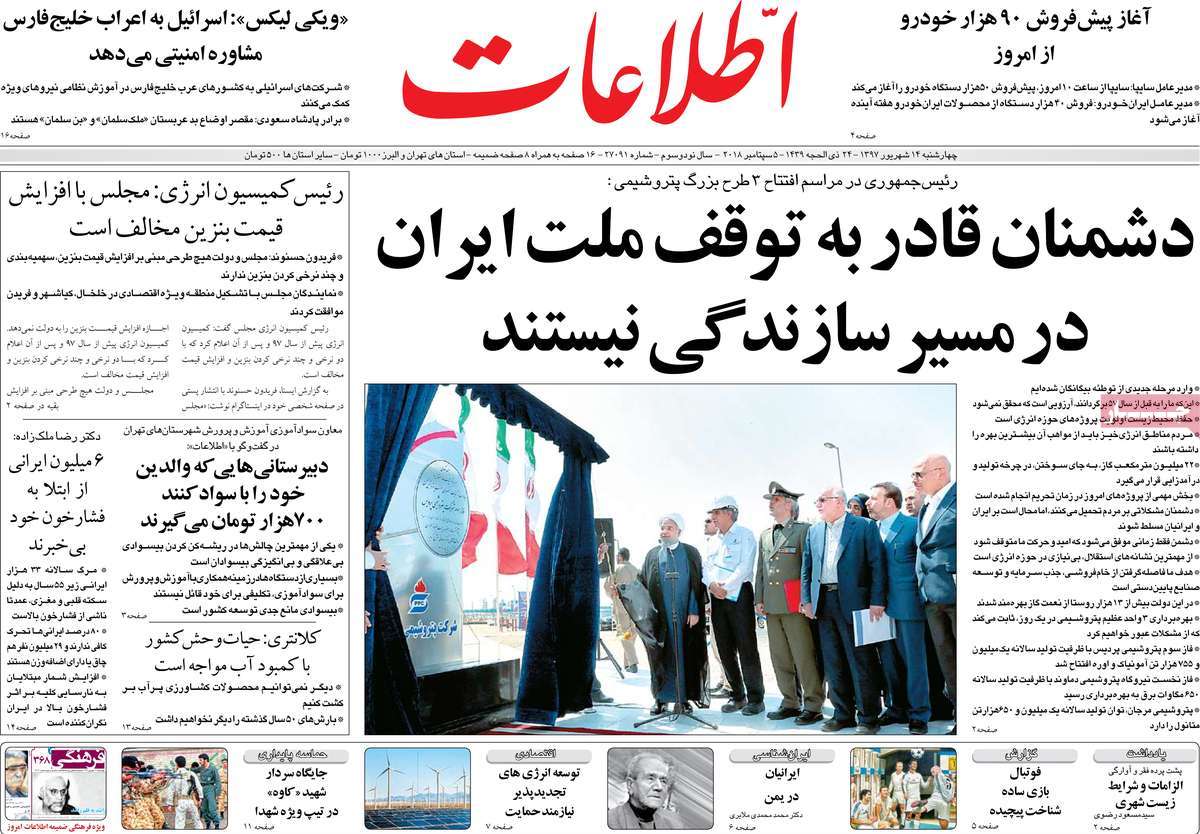
A Look at Iranian Newspaper Front Pages on September 5

A Look at Iranian Newspaper Front Pages on November 19

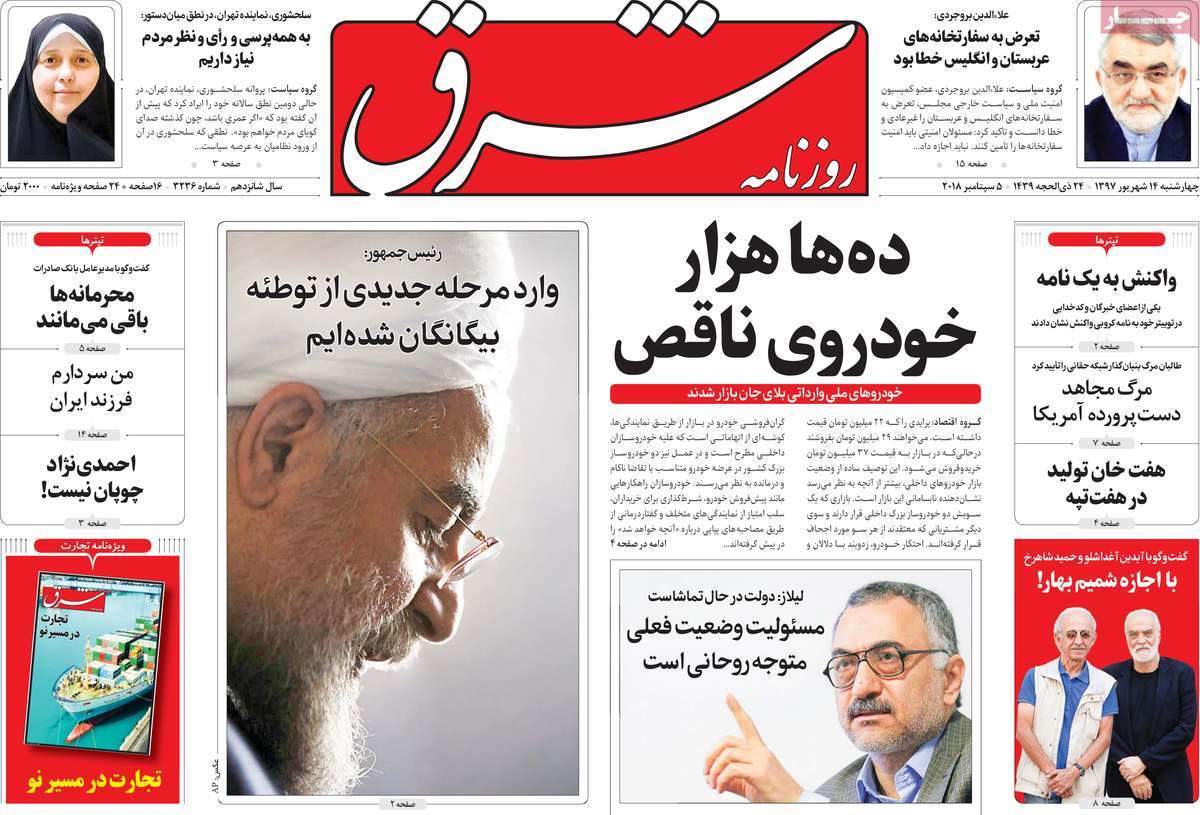
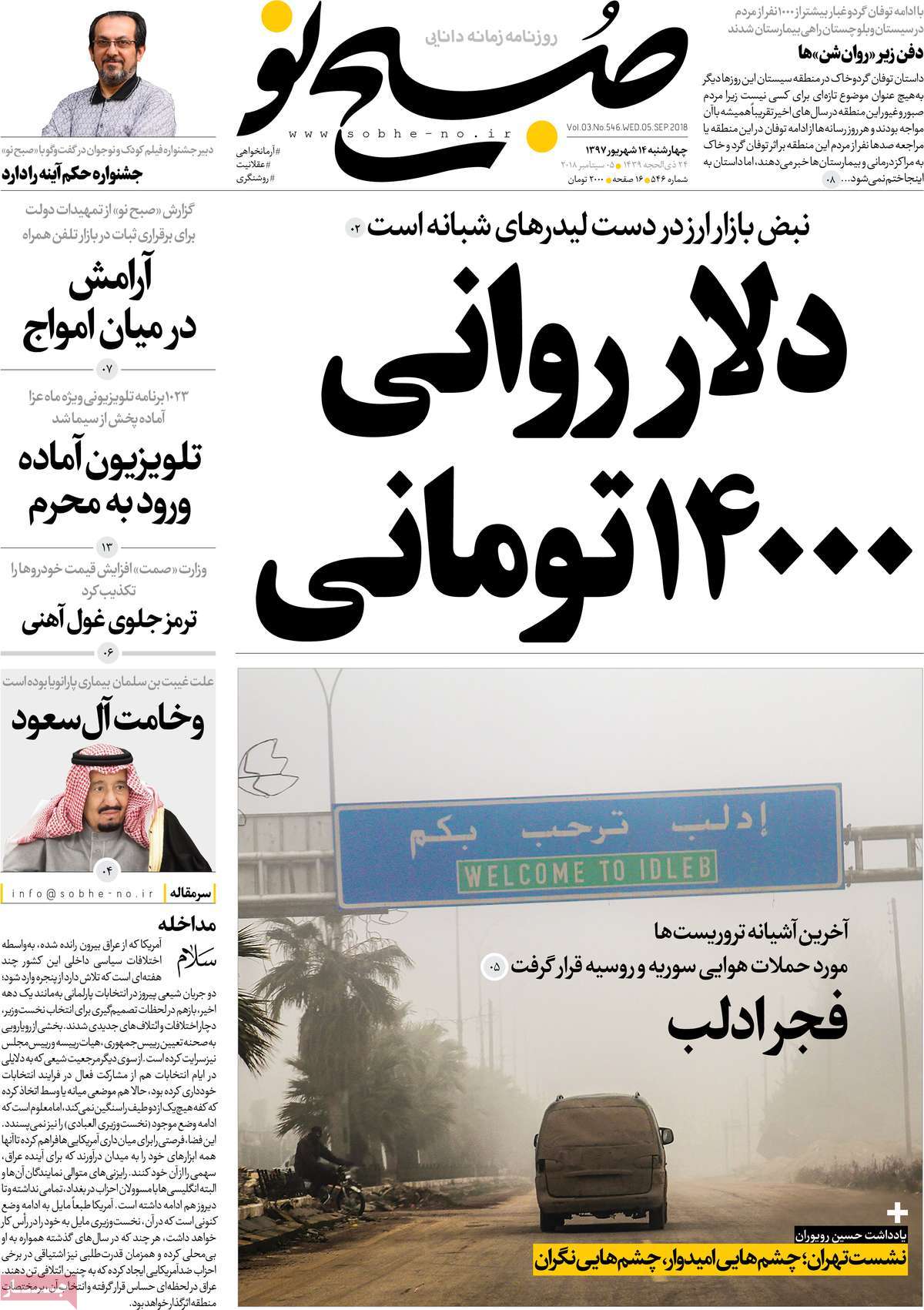
The top story in all papers today was the fresh round of hikes in forex and gold coin rates, and the historic devaluation of the Iranian currency.

Several papers also covered the Syrian and Russian airstrikes against terrorists’ positions in Syria’s Idlib, the last militant-held stronghold, which is to be retaken in an upcoming offensive by the Syrian army.

The above issues, as well as many more, are highlighted in the following headlines and top stories:


Aftab-e Yazd:

1- Goodbye Federica: Mogherini to Leave EU

  • Experts Discuss Impact of Mogherini’s Decision on JCPOA

2- Reformist Politician Hashemitaba: Parliament Itself Must Be Impeached by another Body

3- Rouhani: We’ll Definitely Overcome Problems

A Look at Iranian Newspaper Front Pages on September 5


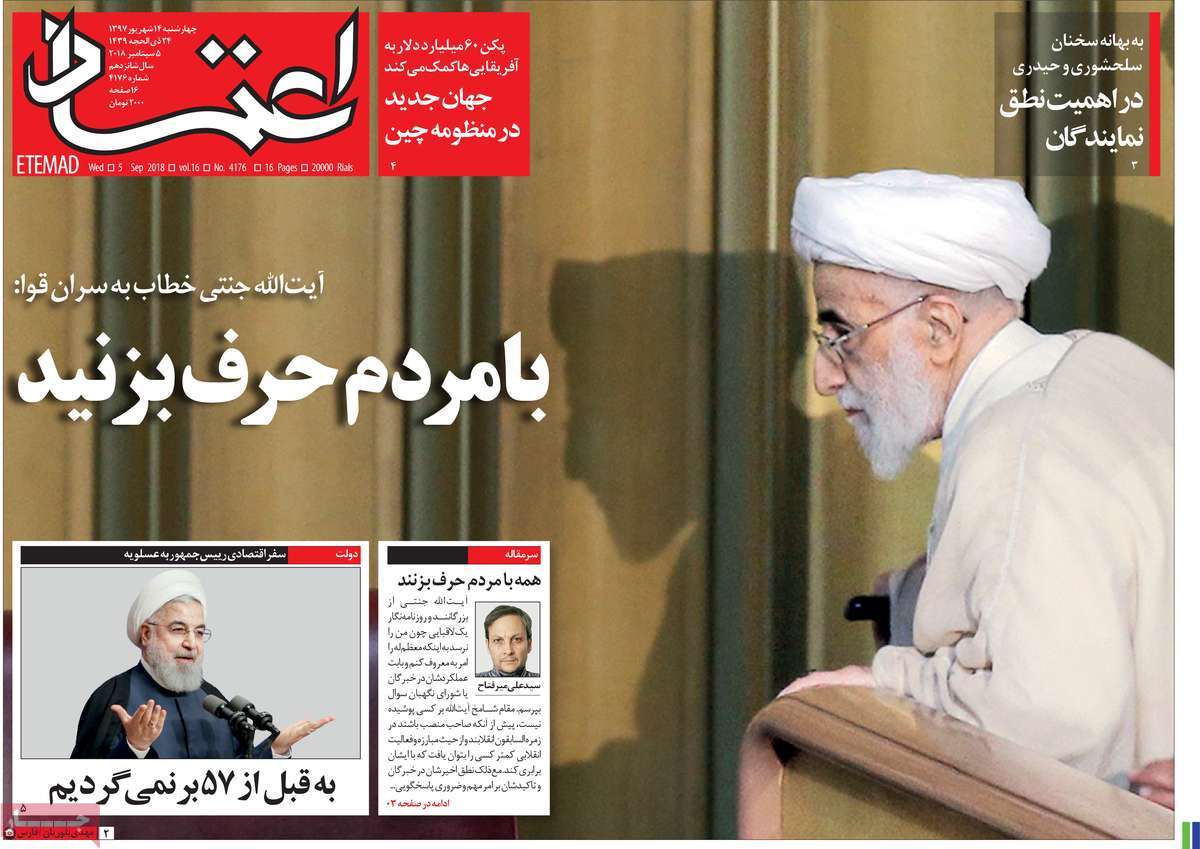
Etemad:

1- Ayatollah Jannati to Top Officials: Talk to People

A Look at Iranian Newspaper Front Pages on September 5


Ettela’at:

1- Enemies Cannot Stop Iranian Nation in Path of Construction: Rouhani

2- Iran Khodro, Saipa to Start Pre-Sale of 90,000 New Cars Wednesday

3- WikiLeaks: Israel Giving Security Advice to Persian Gulf Arabs

4- Six Million Iranians Unaware of Their Blood Pressure Problem

A Look at Iranian Newspaper Front Pages on September 5


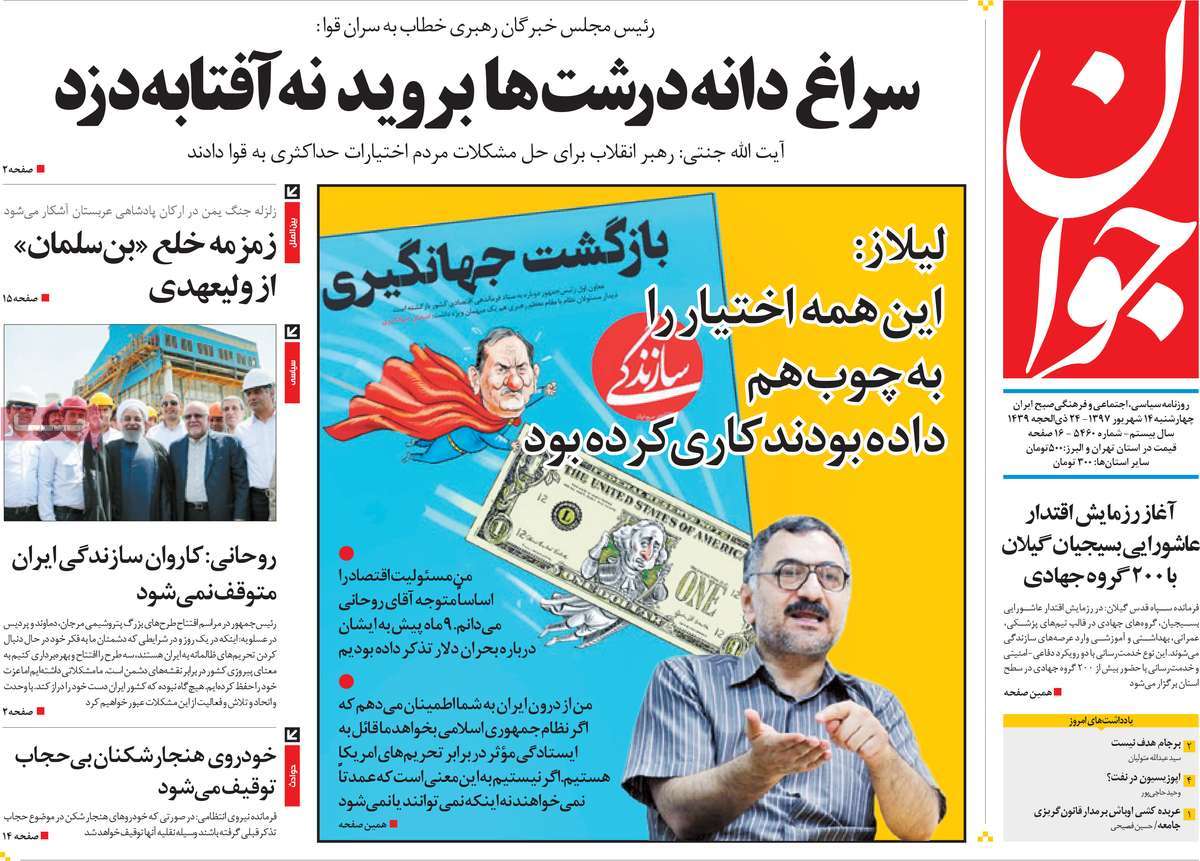
Javan:

1- Ayatollah Jannati: Prosecute Those Involved in Massive Corruption, Not Minor Ones

2- Economic Analyst: Even a Piece of Wood Could Do Better than Rouhani

3- Cars of Those Removing Their Hijab to Be Confiscated

A Look at Iranian Newspaper Front Pages on September 5


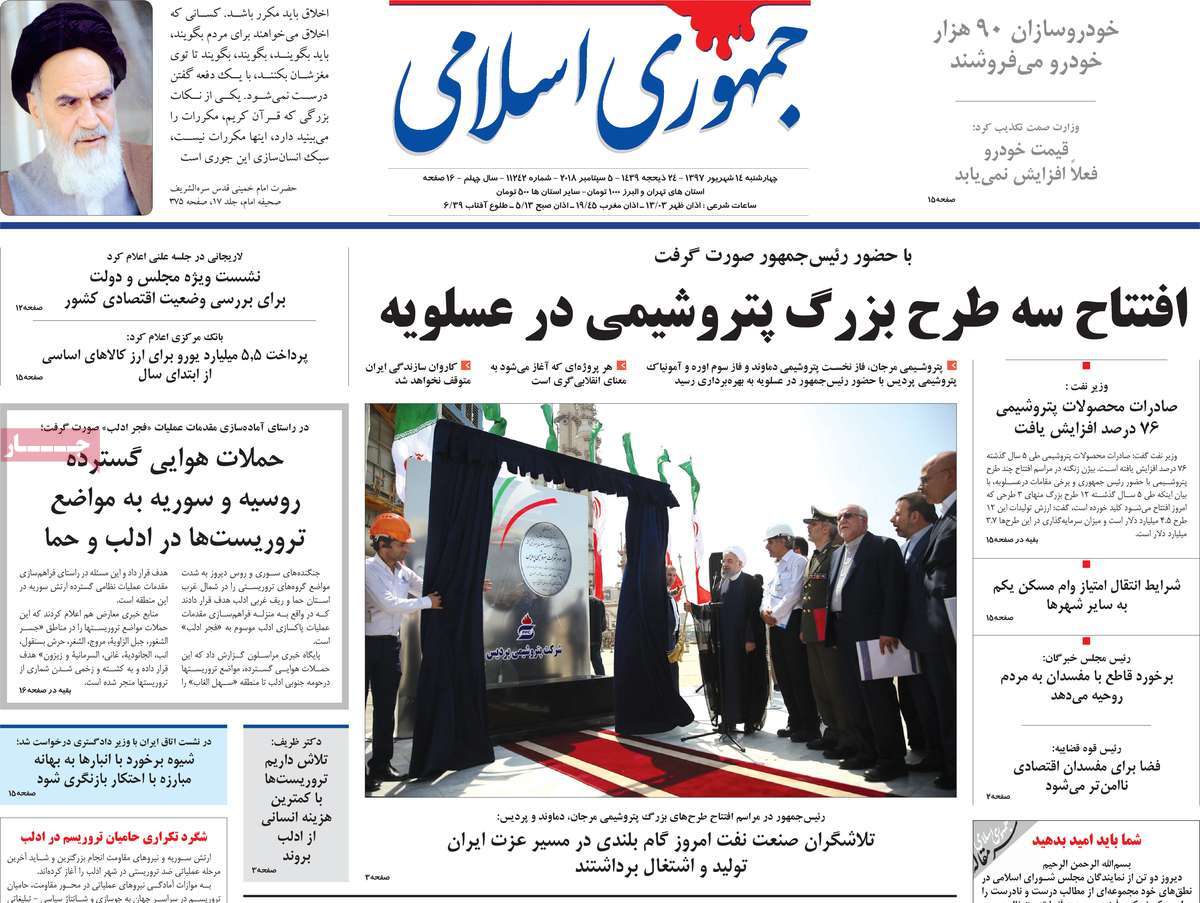
Jomhouri Eslami:

1- Three Major Petchem Projects Inaugurated in Asaluyeh

2- Russia, Syria Launch Massive Airstrikes against Terrorists’ Positions in Idlib, Hama

A Look at Iranian Newspaper Front Pages on September 5


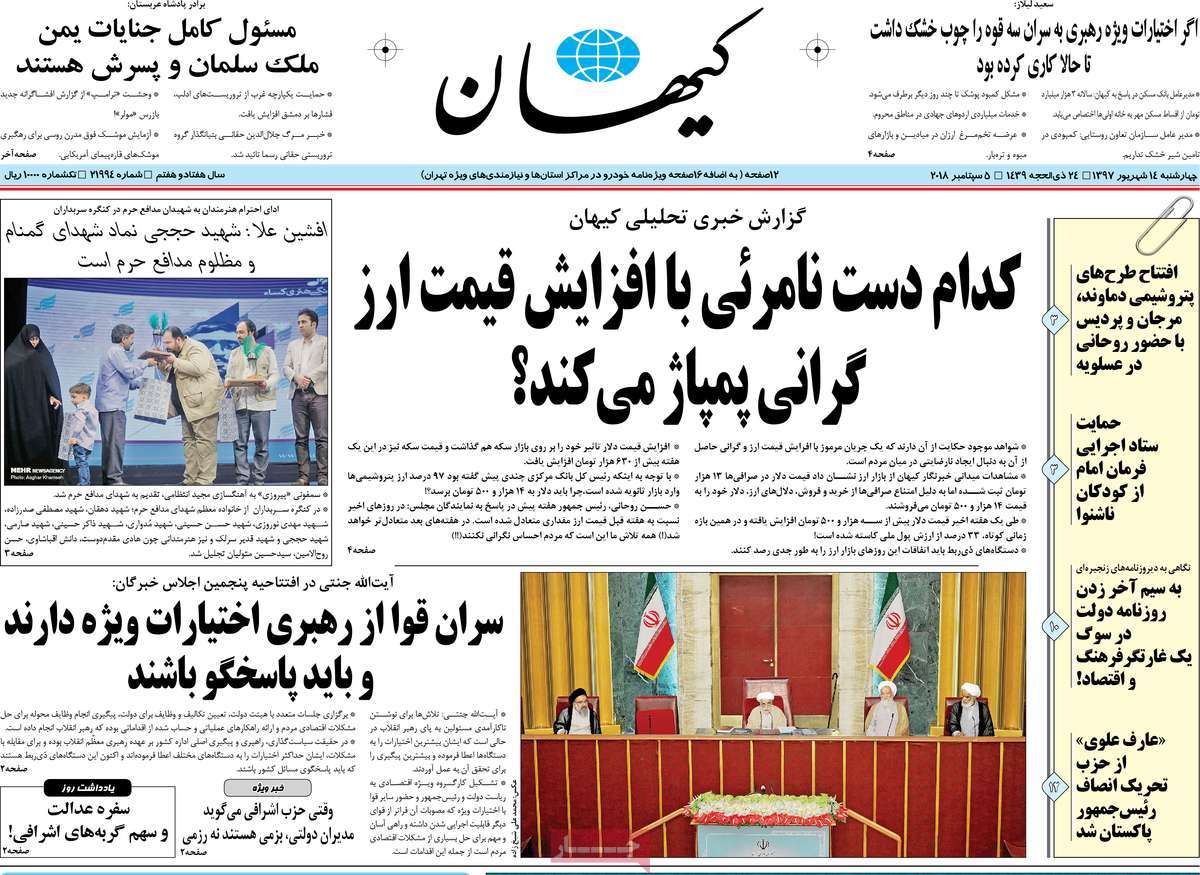
Kayhan:

1- Even a Piece of Wood Could Have Done Better than Top Executive Officials in Iran

2- Which Hidden Hands Are Increasing Prices amid Forex Rate Hikes?

A Look at Iranian Newspaper Front Pages on September 5


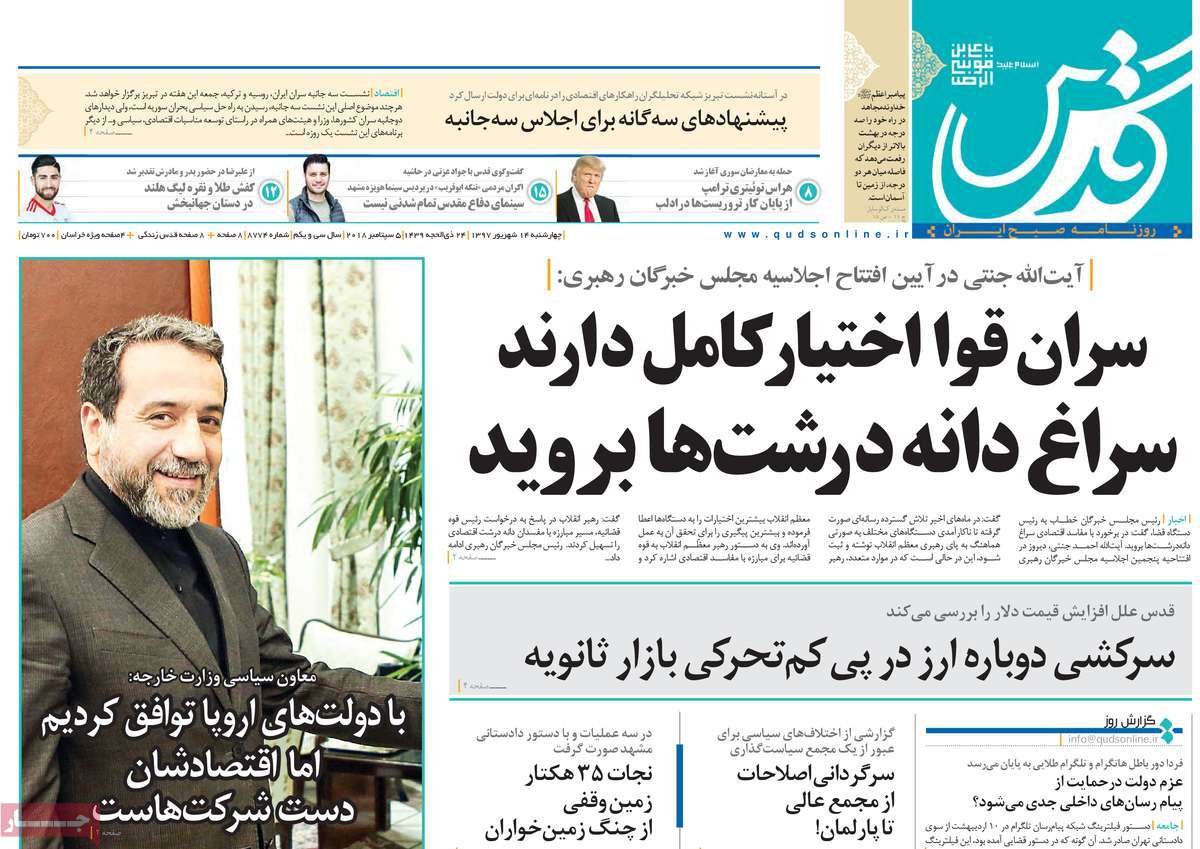
Quds:

1- Trump in Twitter Shows He’s Afraid of Purging Idlib from Terrorists

2- We Reached Deal with European Governments, but Their Economies Are Run by Private Firms

A Look at Iranian Newspaper Front Pages on September 5


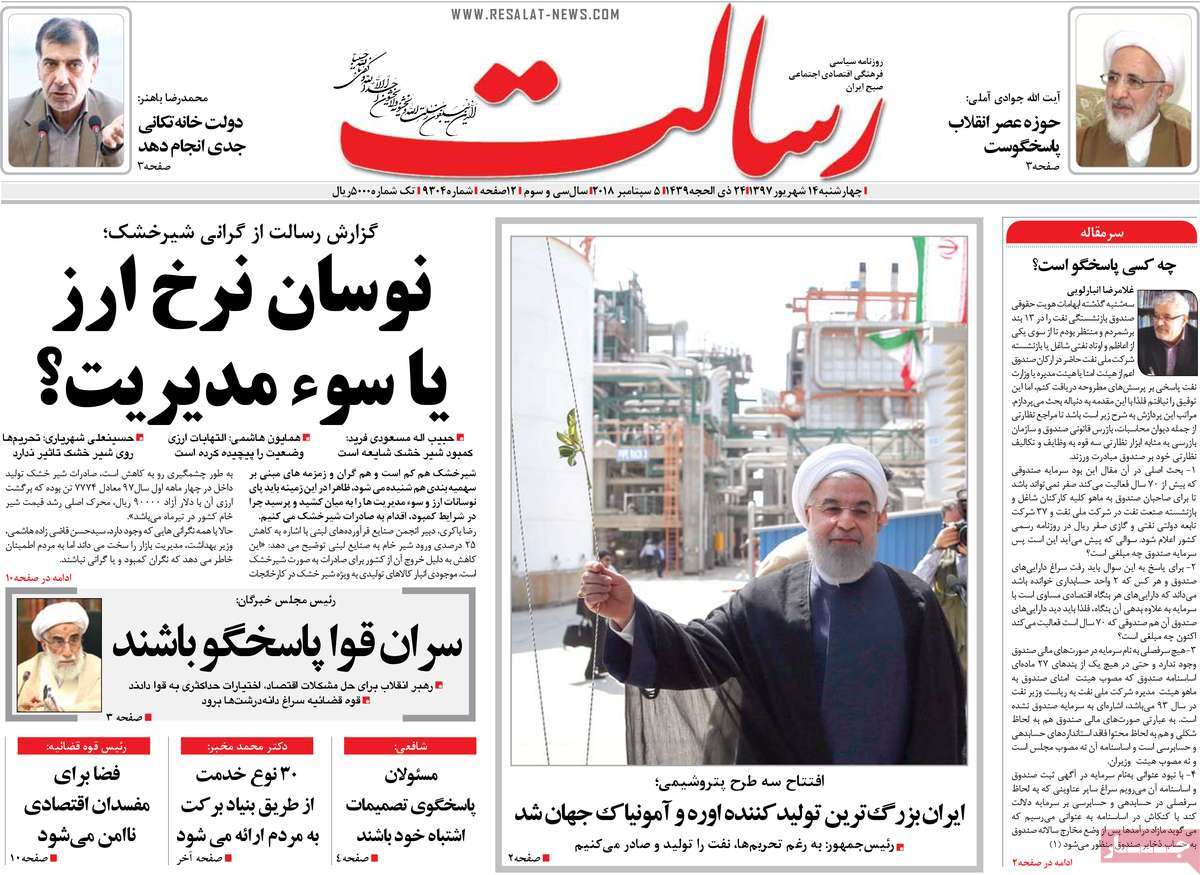
Resalat:

1- Forex Market Fluctuation or Mismanagement?

2- Government Must Do Serious Cabinet Reshuffle: Conservative Figure

3- Iran Biggest Producer of Urea and Ammonia

A Look at Iranian Newspaper Front Pages on September 5


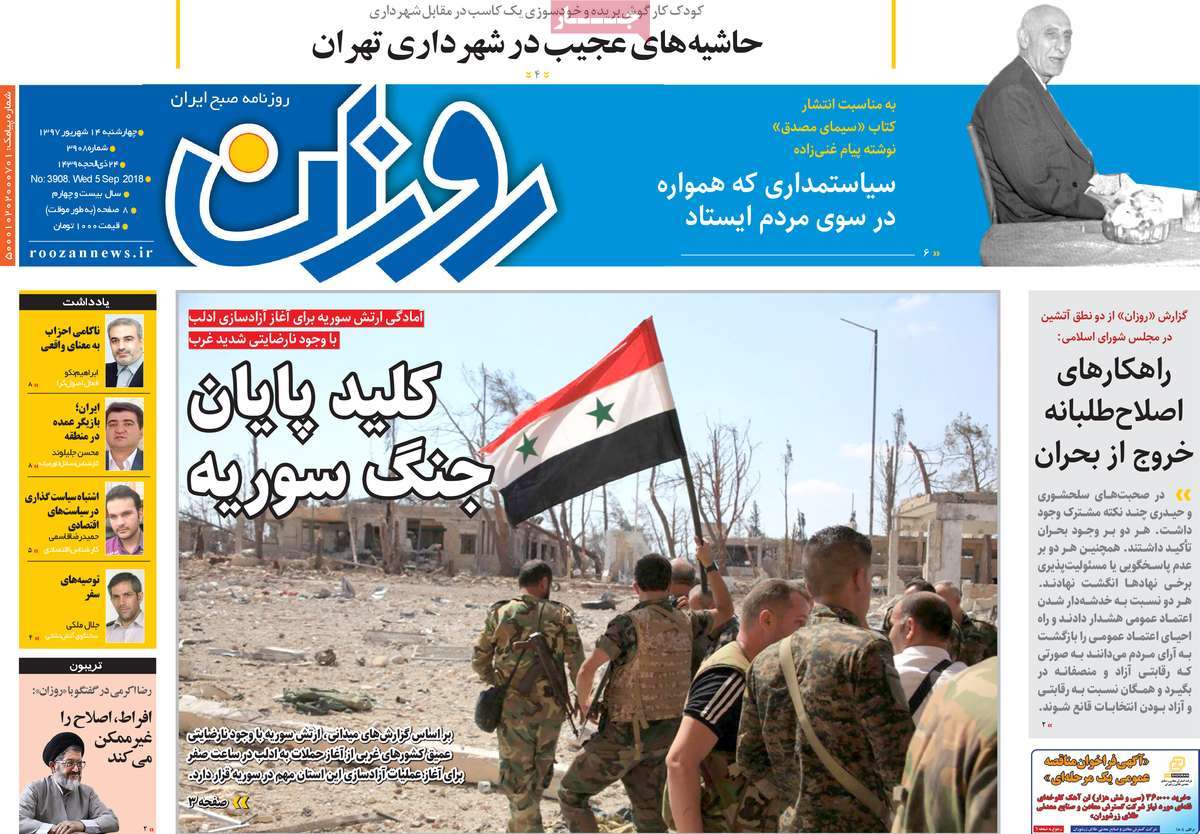
Roozan:

1- Key to End of Syria War

  • Syrian Army Ready to Start Retaking Idlib despite West’s Stiff Opposition

A Look at Iranian Newspaper Front Pages on September 5


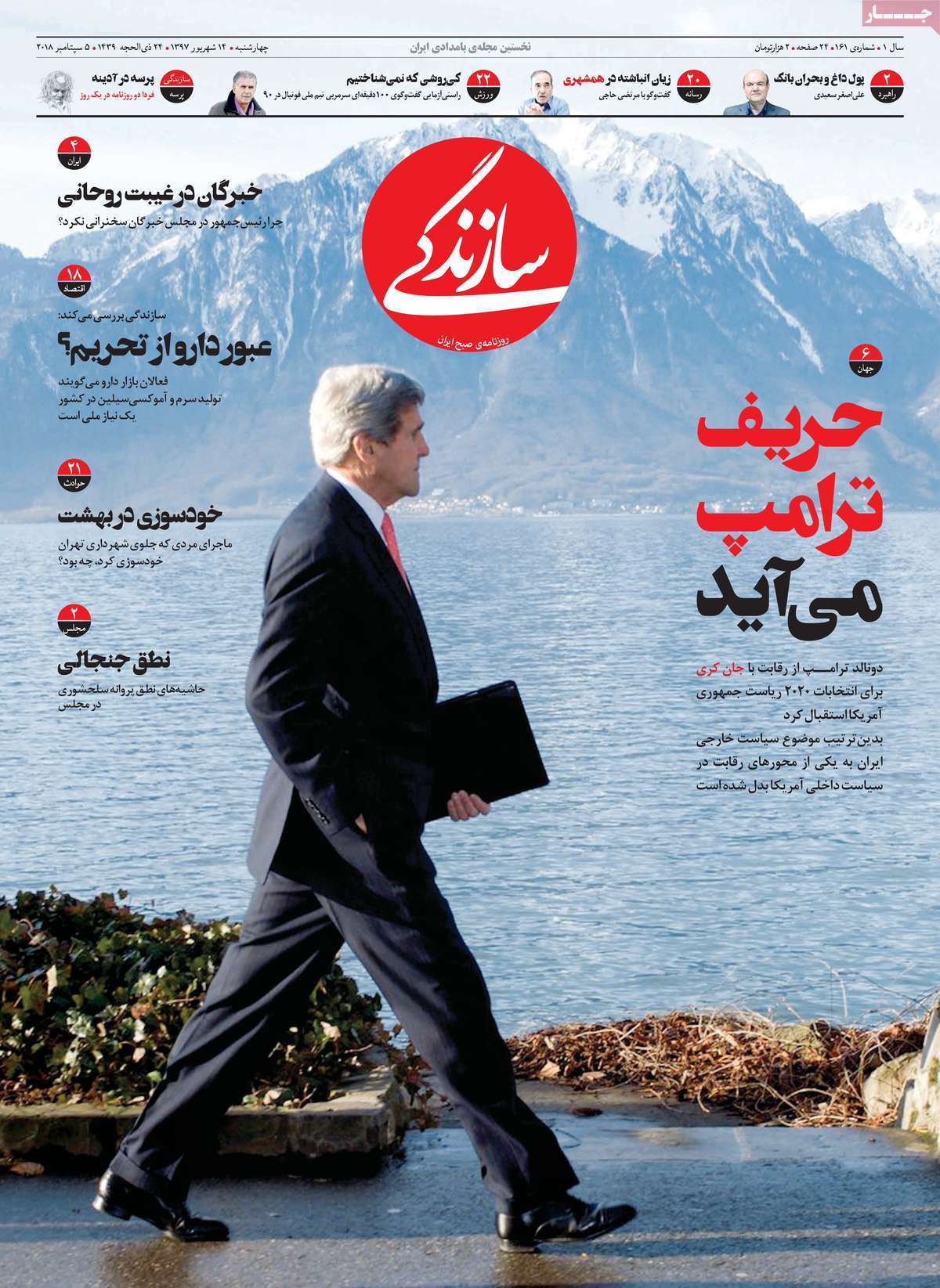
Sazandegi:

1- Kerry to Run for President in 2020 US Elections

  • Issue of Iran to Become Key Focus of Trump-Kerry Competition

A Look at Iranian Newspaper Front Pages on September 5


Shargh:

1- Rouhani: We’re in New Phase of Enemy Plots

2- Storming Embassies of Saudi Arabia, UK Was Mistake: Senior Lawmaker

3- Economic Analyst: Rouhani to Blame for Current Situation

A Look at Iranian Newspaper Front Pages on September 5


Sobh-e Now:

1- Psychological Reasons Increase US Dollar Rate to IRR 140,000

2- Bin Salman Suffering from Paranoia

3- Dawn of Idlib: Russia, Syria Attack Last Militant Stronghold

A Look at Iranian Newspaper Front Pages on September 5

Iran Says Full Coordination Needed in Fight against Terrorists in Syria

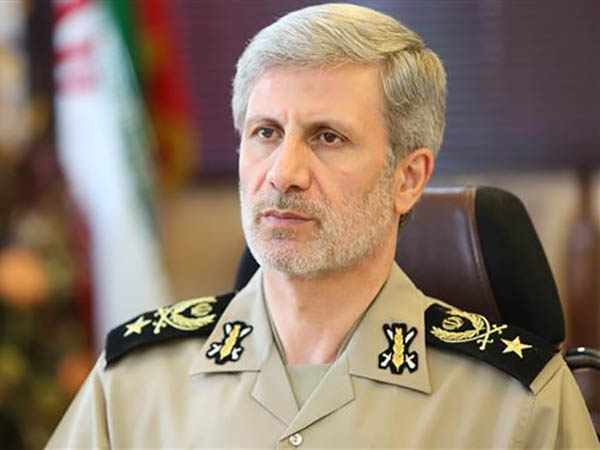
Iran’s DM Vows Firm Response to Enemy’s Moves

Brigadier General Amir Hatami made the remarks after the Syrian and Russian jet fighters on Tuesday conducted airstrikes on a number of positions in Idlib and Hama provinces. This comes as the Syrian army is preparing to start a full-scale offensive to retake the militant-held Idlib province.

Speaking in a Wednesday meeting with the Russian Army commander, the Iranian defence chief appreciated the efforts and performance of different troops, including Russian forces as well as the Syrian army and forces of the resistance front, in operations against terrorists in Syria.

General Hatami said the recent gains against terrorists were the result of cooperation, coordination and rapport by the governments of the countries sending troops as well as the troops themselves.

The Iranian defence chief elaborated on what was going on in Syria during the ISIS terrorist group’s occupation of the country.

“What the operating troops did in countering terrorists in Syria was an invaluable move that could thwart a major plot hatched against regional security,” the senior Iranian commander noted.

He described the recent victories in Syria as very important.

“Not only Syrian people, but also people of the region and the whole world have benefitted from the achievements of these triumphs, so we take the opportunity to thank all operational troops in Syria,” he said.
The top general said the experience gained from cooperation and coordination in Syria could serve as a model for the establishment of peace and stability in the region and in other arenas.
Hatami also noted that the plots hatched by hegemonic powers in Syria could have plunged the country into “institutionalized insecurity” for a long time.

The top Russian commander, in turn, presented a report on the field developments in the war against terrorists and said close coordination among commanders and other troops was the key contributor to the victories.

Russia commenced an anti-terror campaign, mainly through airstrikes, in militancy-infested Syria in September 2015, upon an official request from Syrian President Bashar Assad. Its assistance to the Syrian military in eliminating terrorists has significantly helped Damascus in retaking militant-held areas and cities across the Arab country.

Iran has also been helping Damascus in its fight against various factions of terrorists on its soil through providing government troops with advisory assistance upon the Syrian government’s request since foreign-backed militancy broke out in the country in March 2011.

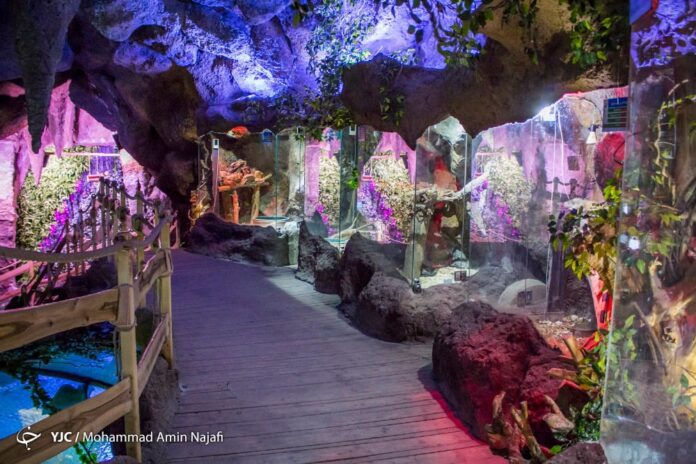
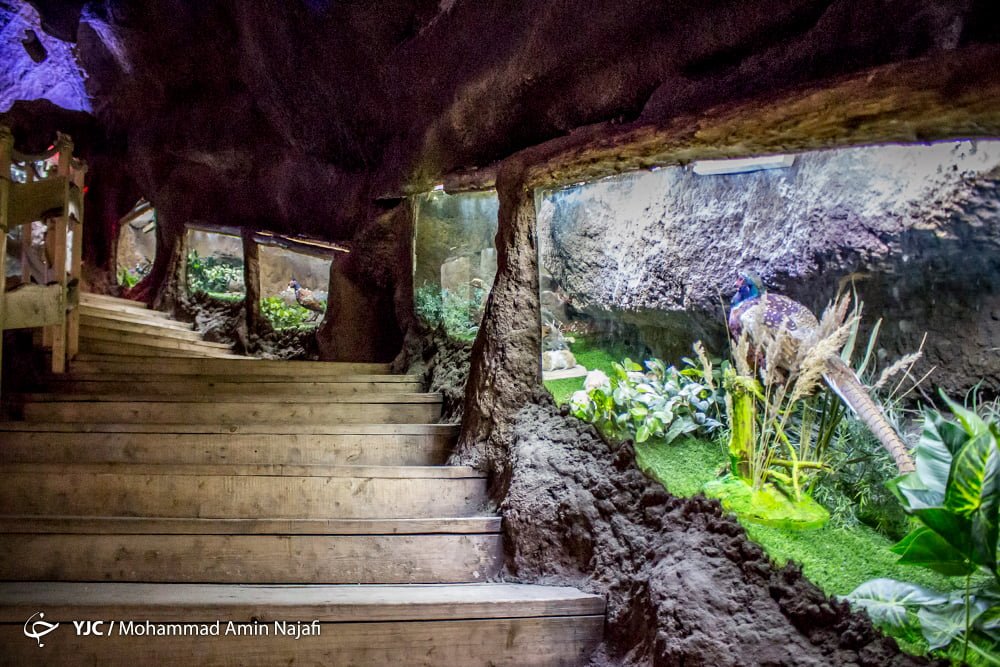
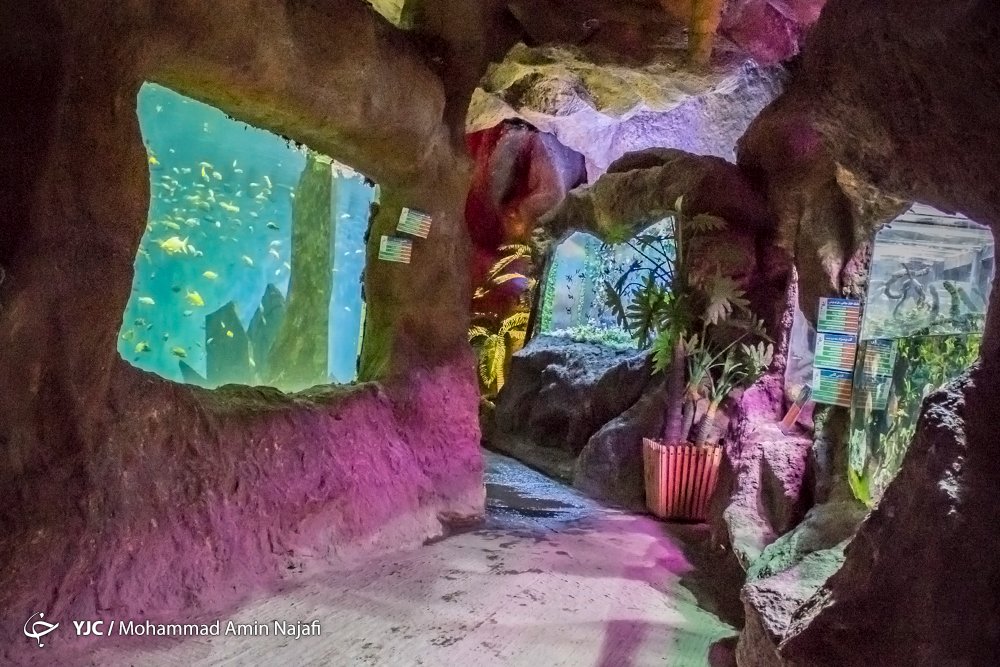
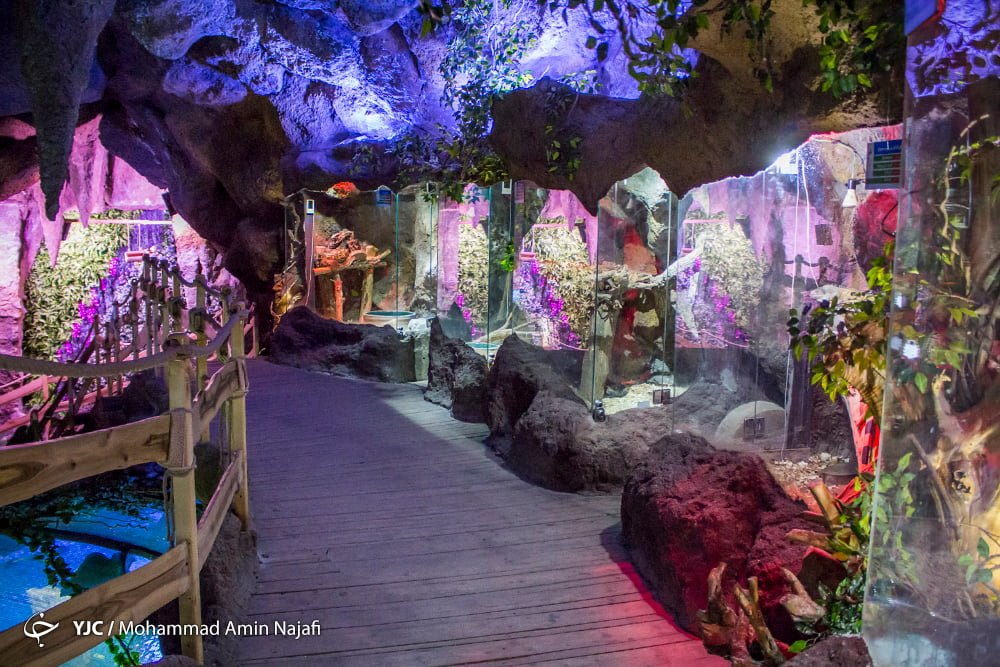
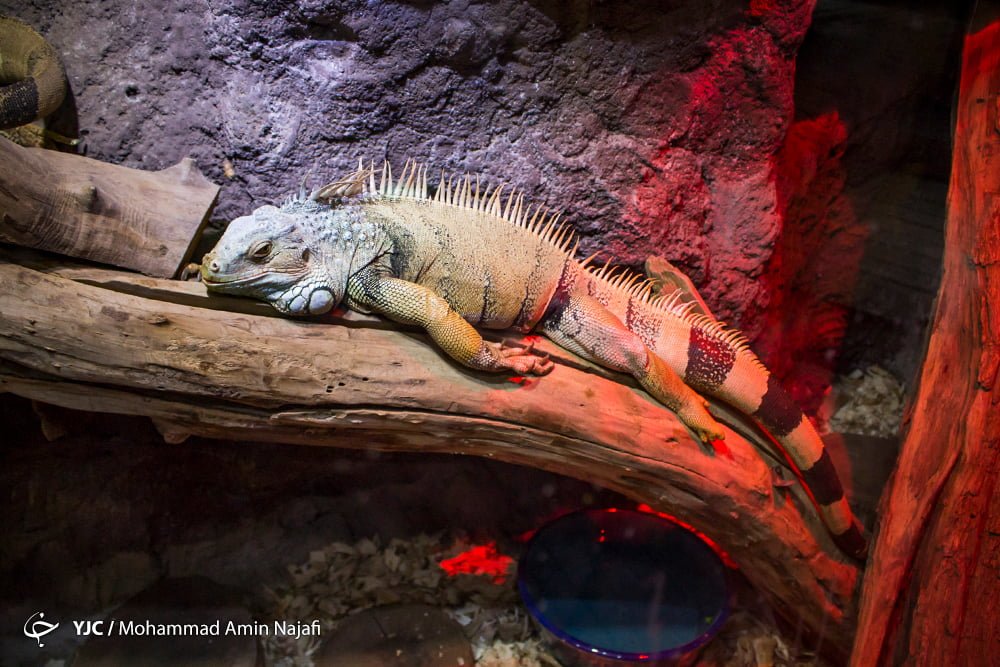
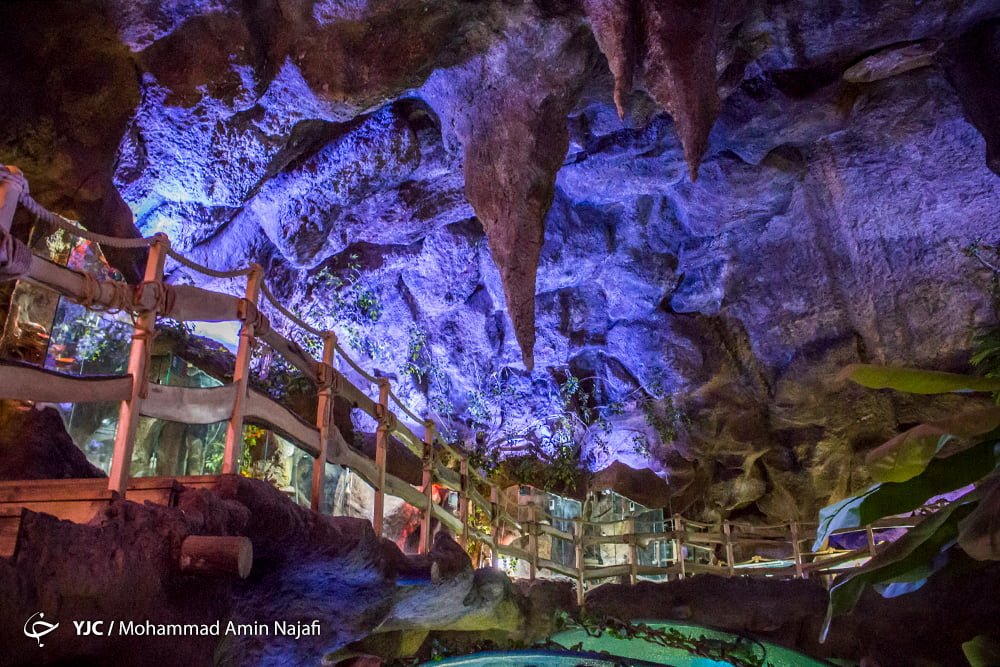
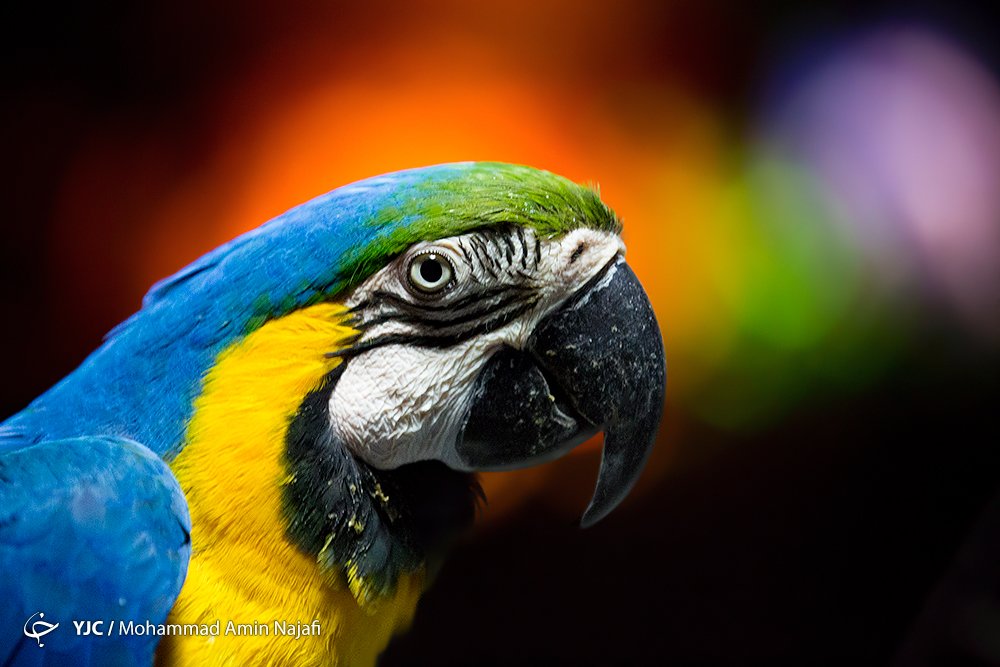
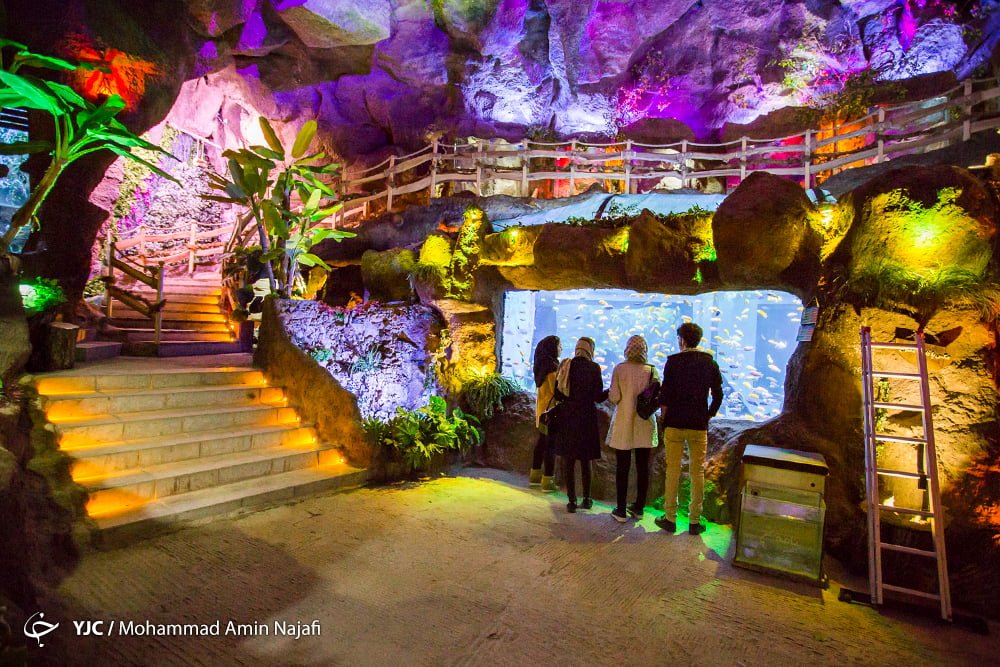
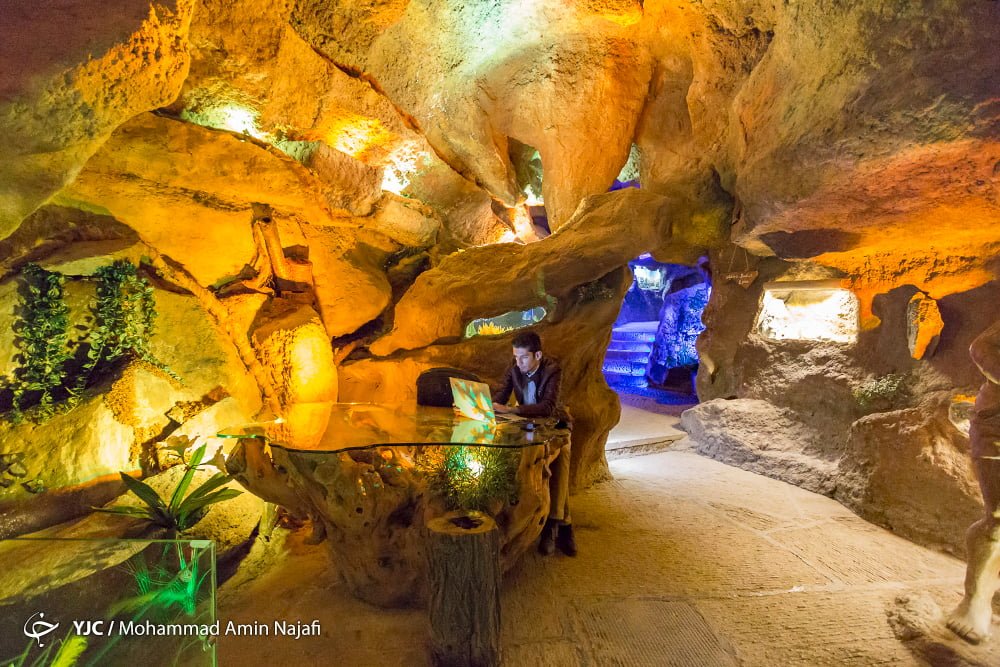
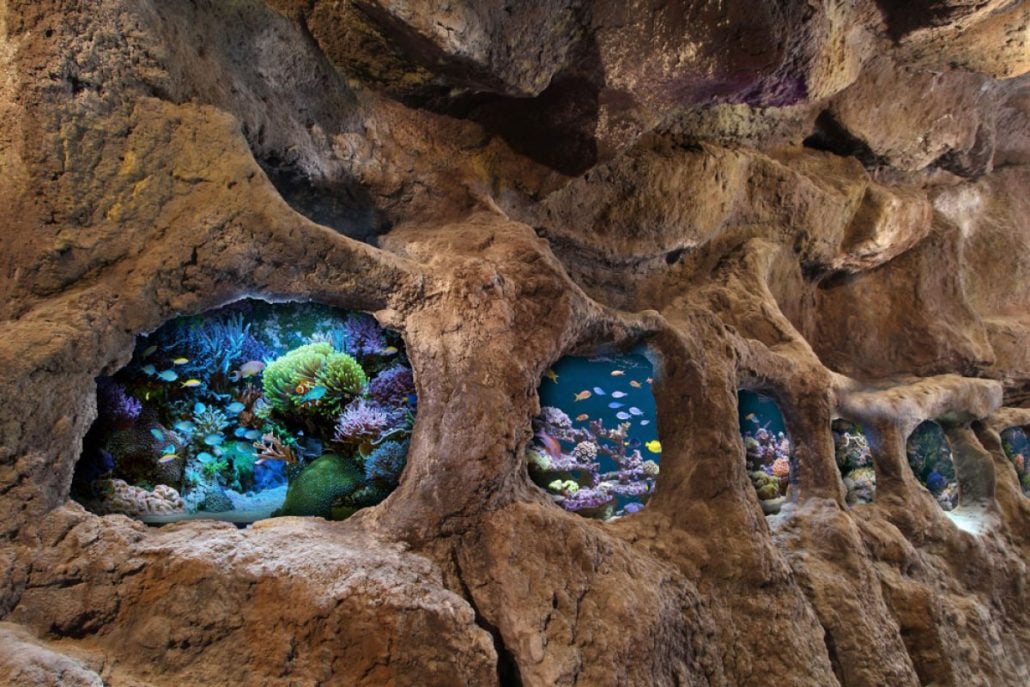
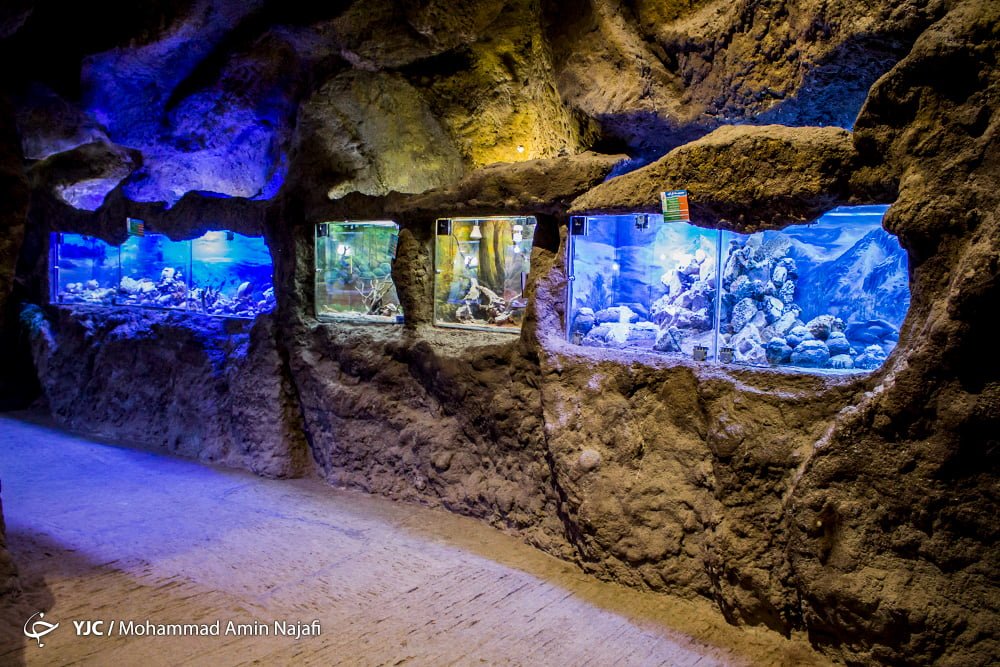
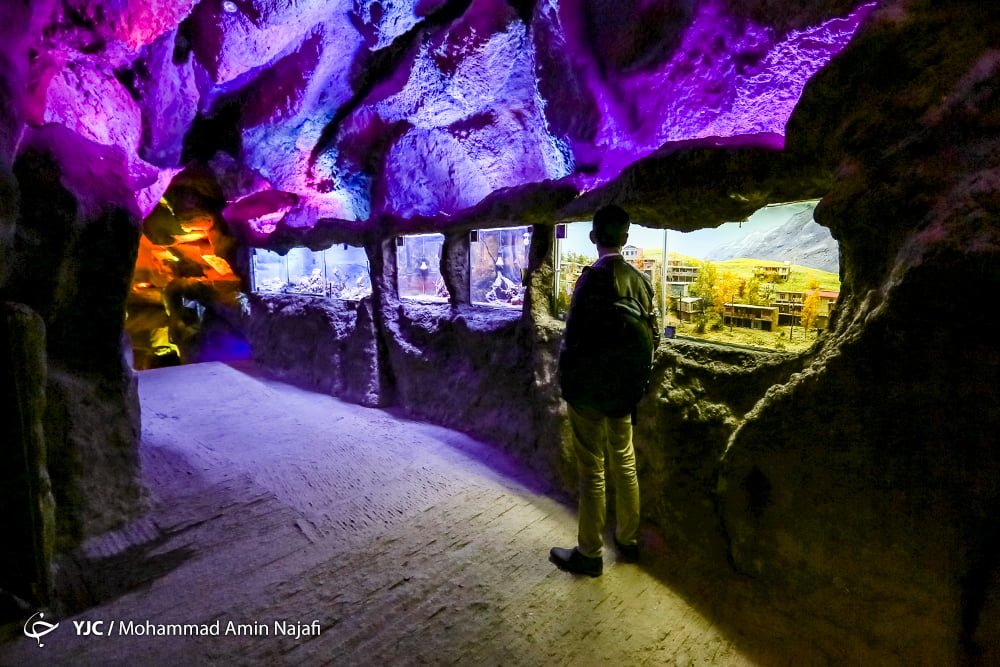
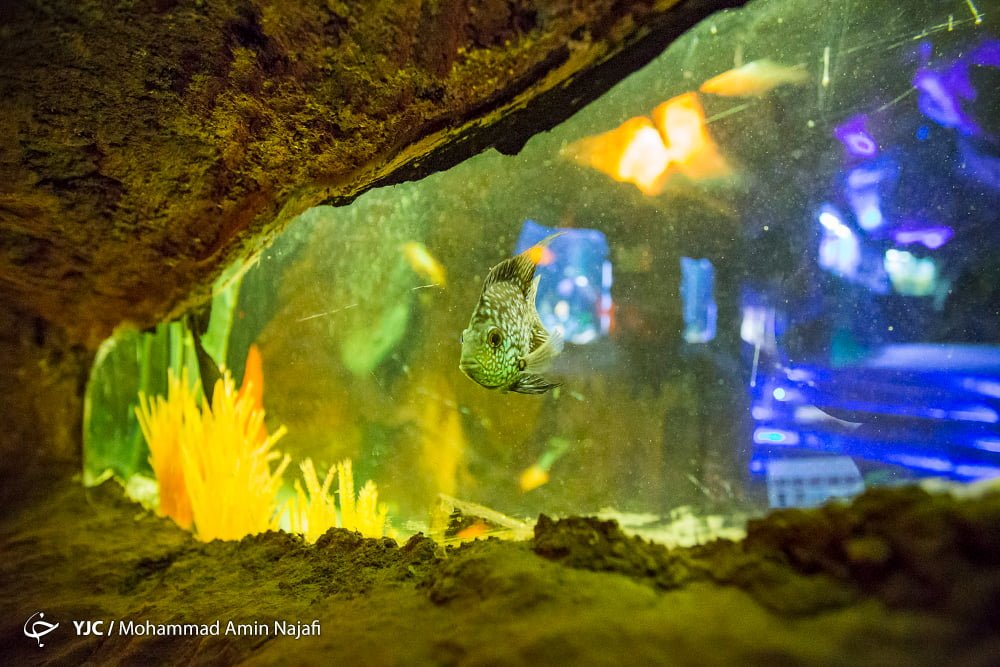
Ganjnameh Cave Aquarium; Marvelous Complex in Western Iran

The complex is home to the best equipment and the most modern recreational facilities in the heart of Alvand Mountains next to the Ganjnameh waterfall and inscription.

The complex includes the magnificent beauty of Alvand Mountains, Meidan-e-Mishan, Nader Throne, the waterfall, ropeway, sledge, bungee jumping, cave aquarium, funfair, and rock climbing.

The Ganjnameh Cave Aquarium project was designed in 2011 by a group of Iranian and foreign engineers and contractors with the aim of creating a different environment to attract more tourists to the mountainous region.

Its idea was inspired by Hamadan’s Ali Sadr Cave which is the world’s largest water cave.

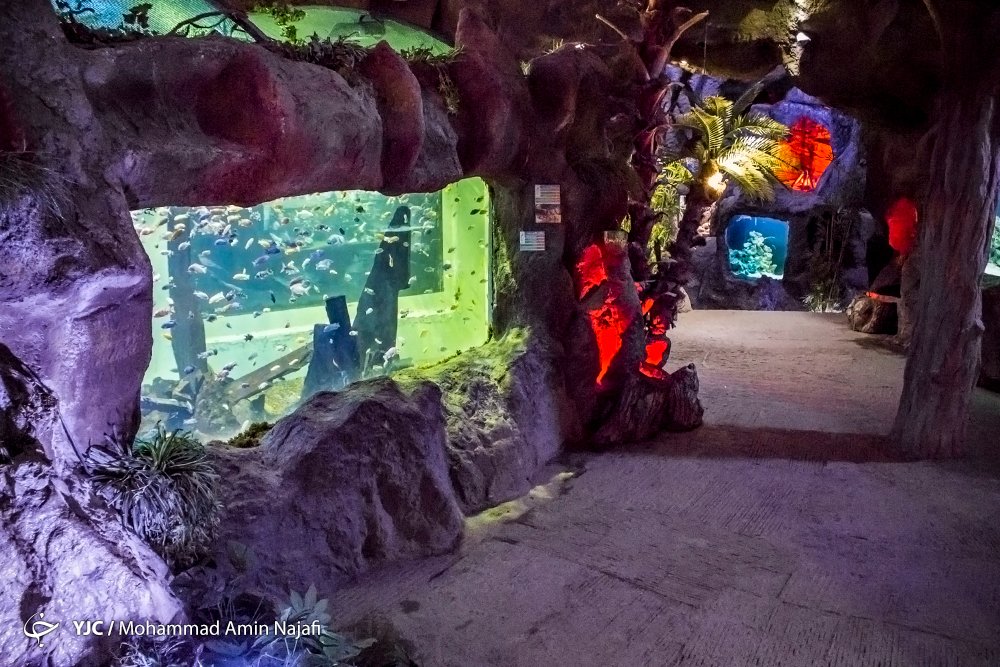
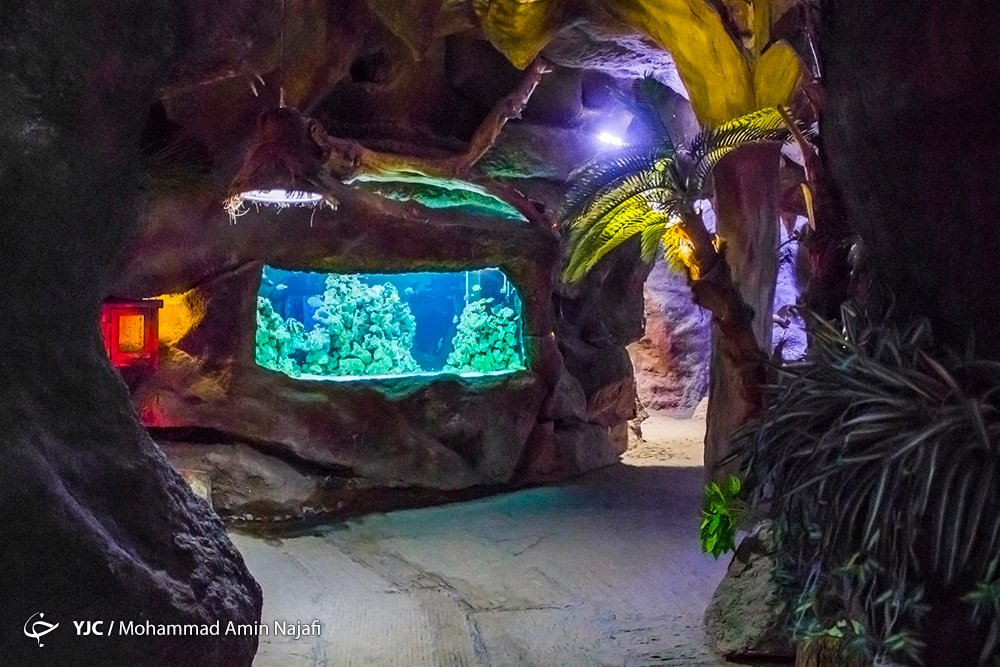
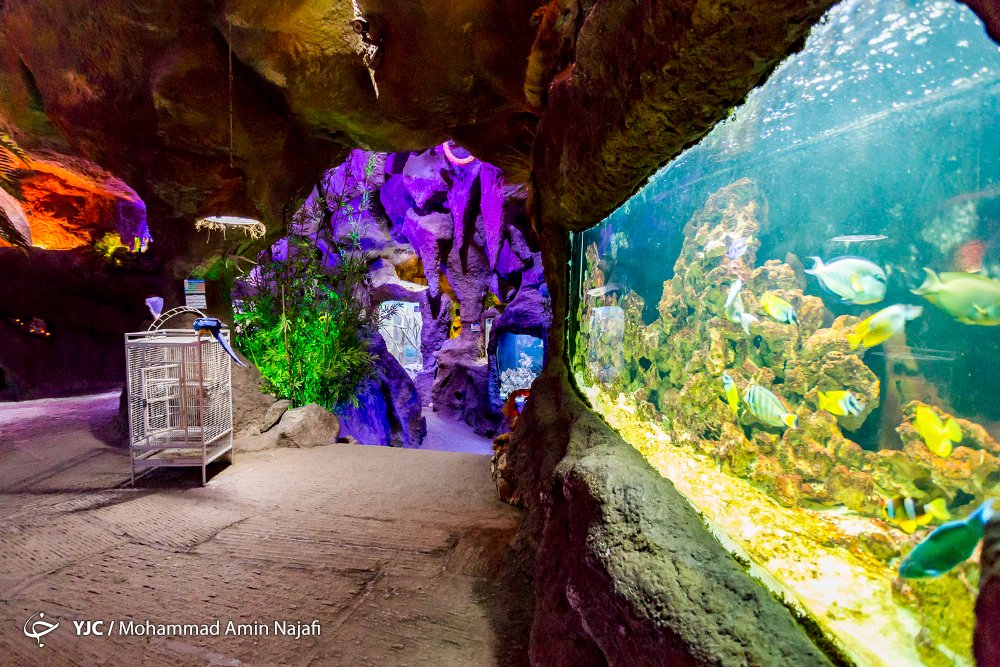
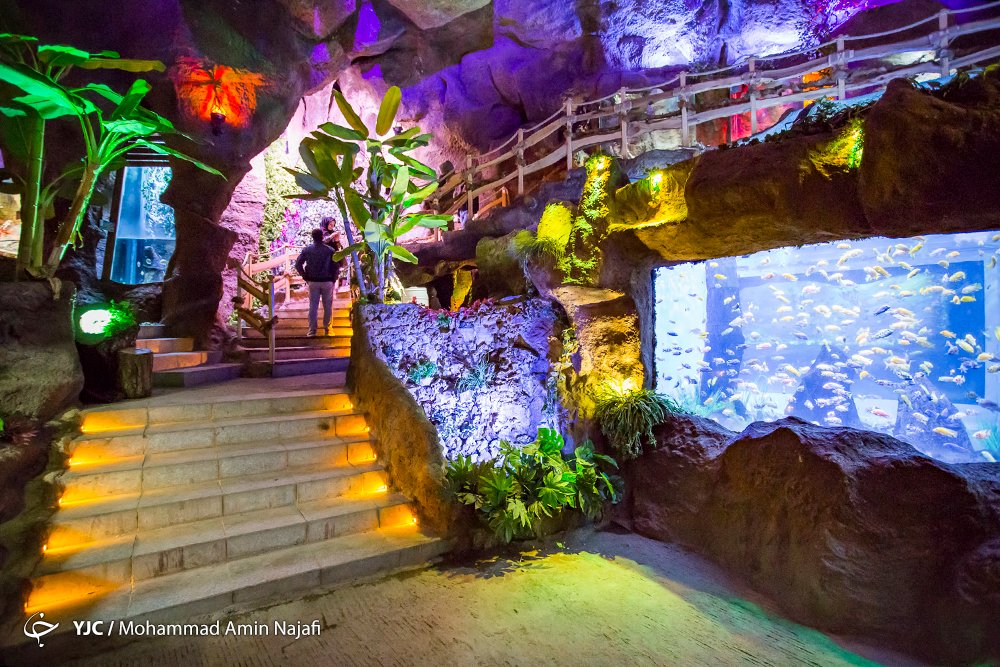
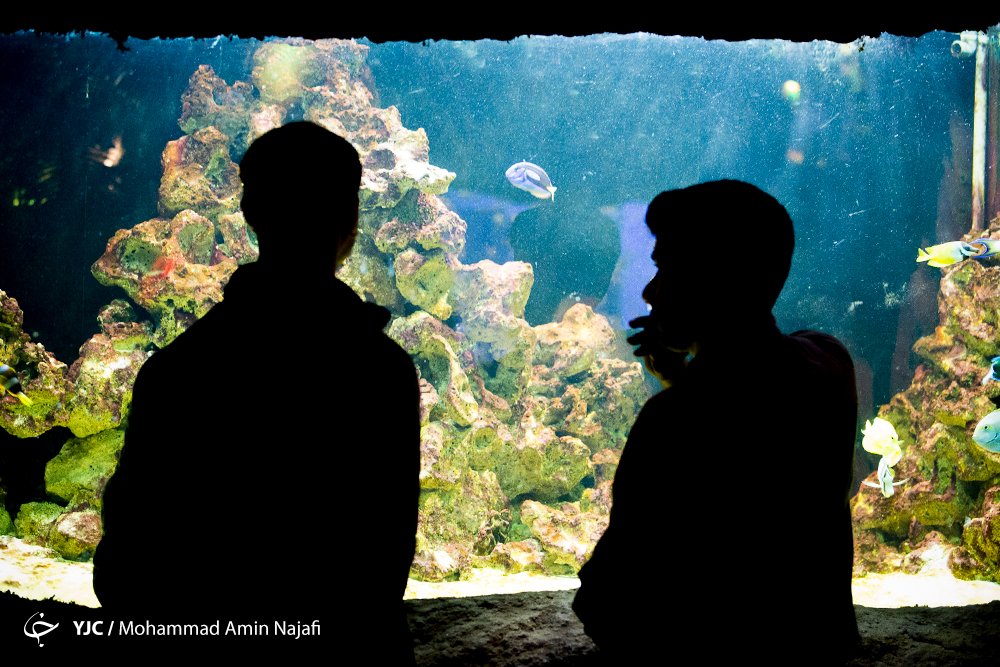
The complex has an area of over 1,000 square metres and variable height of 2.5 to 15 metres. It has a capacity of 85,000 litres in the main hall with 21 sweet and sour water aquariums with dimensions of 1×1 to 2×2 metres.

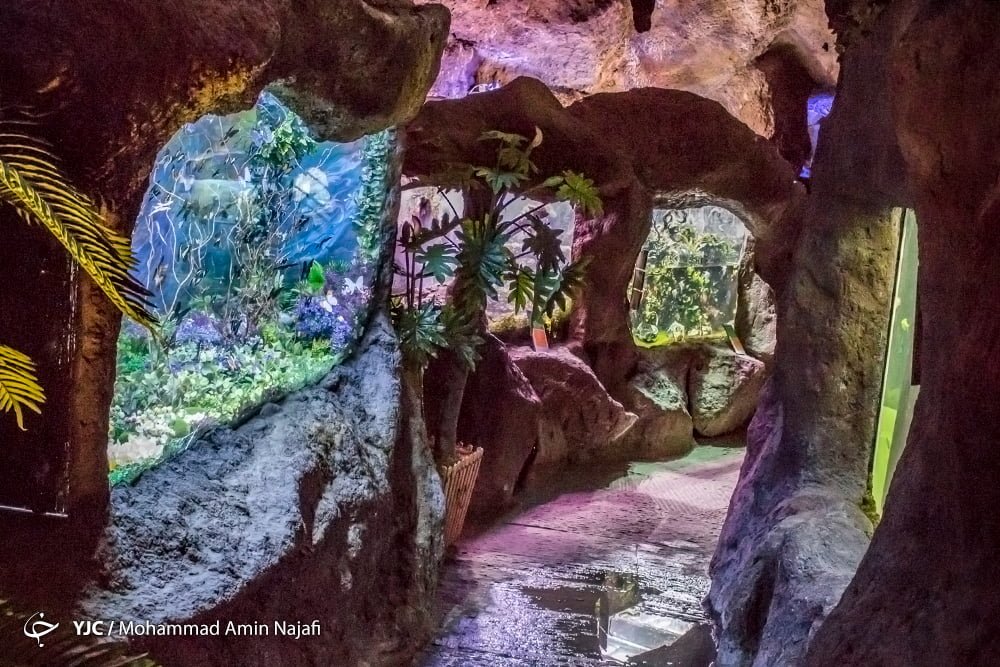
The aquarium also includes fish and starfish, as well as a 2×3 plant aquarium which is unique in its kind.

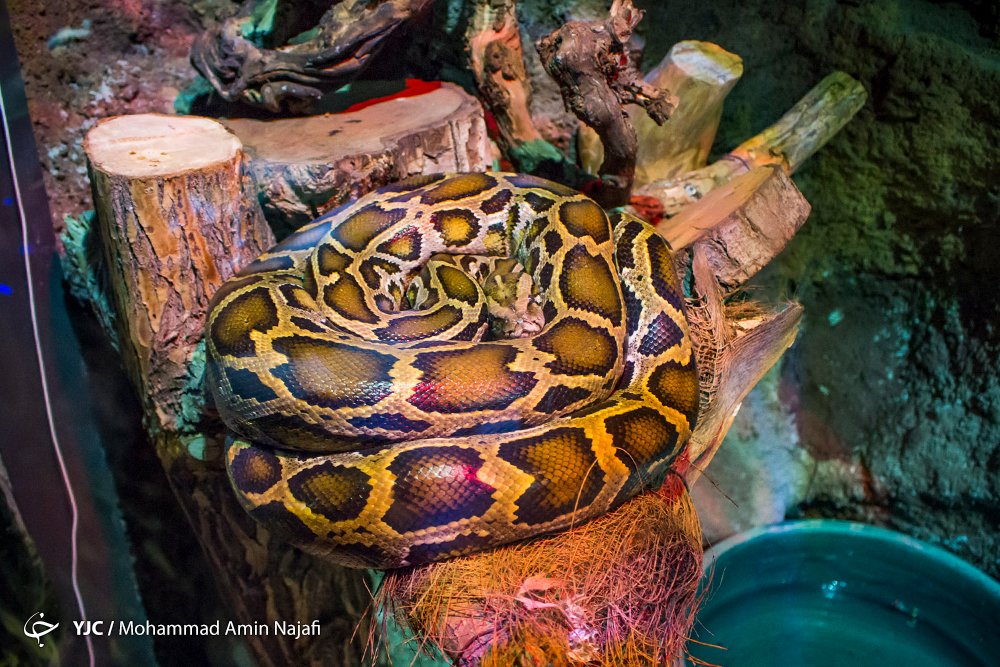
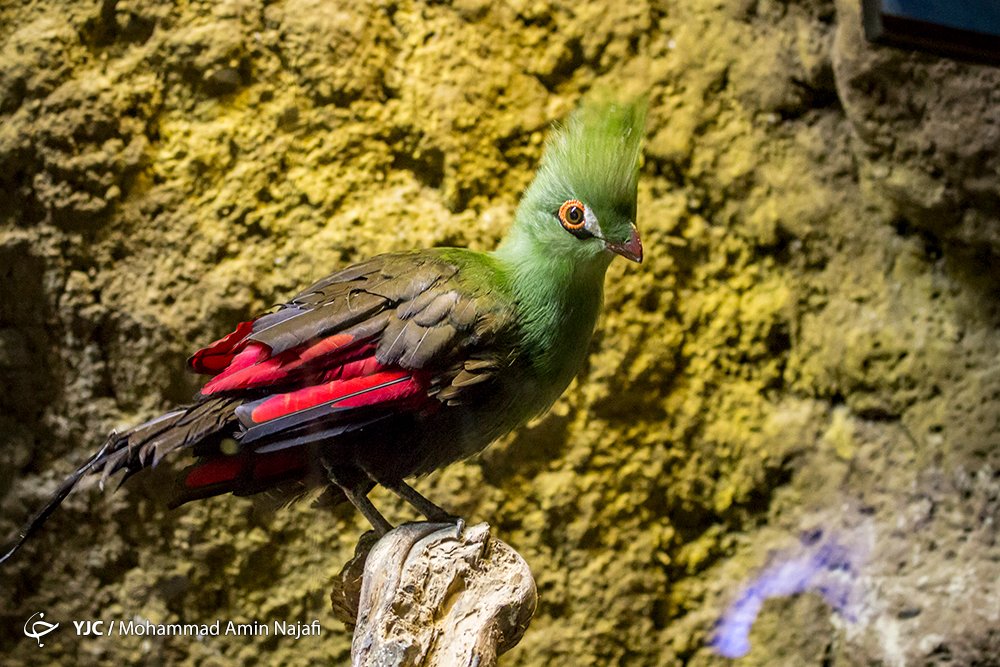
On the second floor of the cave, there is an area in which a collection of the finest examples of ecological creatures and reptiles from around the world are gathered.

The entire path to the cave passes through three main halls with corridors of rainbows and artificial aromas that provide the visitors with a completely different atmosphere.

Ganjnameh, which literally means ‘Book of Treasure’, is an ancient inscription south-west of Hamadan in western Iran. The inscriptions were carved in granite in two sections. One of them was ordered by Darius the Great and the other one ordered by Xerxes the Great.

What follows are photos of the beautiful complex:

US Gives Iran Back $1.2m Ancient Bas-Relief

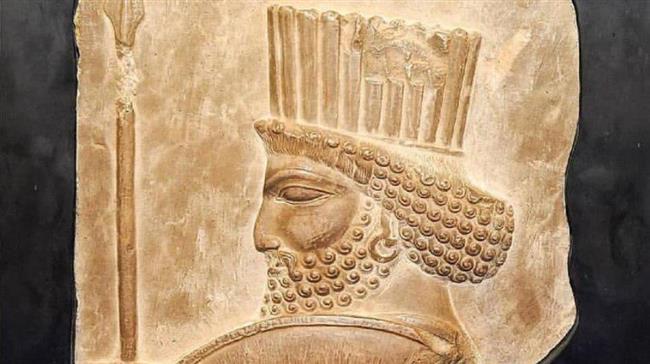
Iran’s Ambassador to the United Nations Gholam-Ali Khoshrou said Tuesday that the limestone sculpture, which dates back to around 500 B.C., had been delivered to him.

“I’m very pleased that today, a very important cultural item that was smuggled from Iran was delivered to me by the District Attorney of New York County. This object belongs to about 2,500 years ago, and it is a Persian guard’s relief of the Achaemenid era,” Khoshrou told Press TV.

He said the artifact — which depicts a Persian imperial guard holding a spear —  would be transferred to Iran “soon,” according to IRNA.

The relief had initially been in 1936 stolen from the ruins of Persepolis, the ceremonial capital of the Achaemenid Empire, situated 60 kilometers northeast of the city of Shiraz in Iran’s Fars Province. The ruins were declared by UNESCO a World Heritage Site in 1979.

The Iranian ambassador further said the masterpiece had been discovered last year at an auction house in New York.

According to The New York Times, the Manhattan district attorney’s office had seized the eight-inch relief from the booth of London antiquities dealer Rupert Wace during the fair in October 2017.

Iran then presented documents pointing to the Iranian ownership of the work to the office, which stopped its sale, said Khoshrou, adding that it took the investigators 11 months to disprove the ownership allegations by the artifact’s self-proclaimed owners.

The ruling on the Persian bas-relief was issued in late July. In court papers, the district attorney’s office argued that no one can be a good-faith purchaser of a stolen work, according to The New York Times.

The Iranian diplomat further expressed gratitude towards both the judge and the district attorney for their cooperation leading to the repatriation of the artifact.

“The humanity’s general heritage is comprised of these very cultural and historical works. There should be vast cooperation on the international scale to confront smuggling of cultural artifacts and items, and the institutions active in the endeavor should be reinforced,” Khoshrou asserted.

Iran Downplays Western Media’s Fuss about Idlib Operation

Speaking in an interview with the state TV on Tuesday, Araqchi said the situation is very sensitive in Syria’s Idlib, as hundreds of thousands of anti-government and Takfiri terrorists as well as civilians have gathered in the province.

Due to the large population of these regions, the terrorist groups have gathered there and are using people as human shields, he went on to say.

“Such a complicated situation needed to be considered at the highest level in the Astana Talks on Syria. Two previous meetings were held in Turkey and Russia, and then the Tehran meeting was scheduled,” he said, referring to an upcoming meeting of the presidents of Iran, Turkey, and Russia in Tehran on Friday.

“FM Mohammad Javad Zarif travelled to Syria on Monday to review the latest developments, with concrete plans and ideas that will hopefully end the fight against terrorism. God willing, we will be able to bring the political process, reconstruction and return of the refugees to a conclusion in Syria,” he noted.

Since the beginning of the Syrian crisis, he said, Westerners, especially the US, had a dubious and controversial attitude and helped the terrorists in many conflicts.

“Regarding the use of chemical weapons, which is an ambiguous issue, the prevailing view is that the terrorist groups did it, but we saw the West’s involvement as well.”

He said there are reports that chemicals were taken to Idlib by terrorists and could lead to a catastrophe; therefore, there was a need for consultations between the leaders of the three countries.

The senior diplomat also noted the fuss being made about Idlib at the moment is very much similar to the one we faced on Aleppo and Eastern Ghouta.

Araqchi was referring to accusations raised by Western countries and media that the Syrian army used chemical weapons in its operations to retake Aleppo Province and Eastern Ghouta.

Currently the Syrian army is preparing itself for a major offensive to retake the last terrorist stronghold, but it is facing the threat of being hit by the US and its allies if a chemical attack takes place in the province.

Russia and Syria say staging a false flag chemical attack has been in the works for some time by militants and British “special forces” in order to give the US a pretext to launch a new airstrike on the government.


Efforts to Minimize Humanitarian Costs

Iranian Foreign Minister Mohammad Javad Zarif says efforts are underway to drive terrorists out of Idlib with the least humanitarian cost.

He made the remarks on Tuesday after holding “very good” talks with senior Syrian authorities in Damascus.

The Iranian oficials’ statements came as on Tuesday night the Syrian and Russian fighter jets strongly targeted the positions of terrorist groups in the northwest of the Hama province and the western Idlib.

These attacks were in fact a preparation to wipe out the terrorists in the region.

Syria’s Moraseloun website reported that the massive airstrikes targeted the terrorist positions in the southern regions of Idlib.

Opposition media sources also reported that the Russian raids targeted dozens of sites in the countryside of Idlib and Al-Ghab plain, especially in Jisr al-Shughur, Jabal al-Zawiya, Mrouj, Al-Shagar, Harsh, and Sinjul, killing and injuring many terrorists.

The Russian Defence Ministry released a statement on Monday saying that three Syrian soldiers have been killed in the Idlib countryside, indicating that the start of Tuesday airstrikes was a reaction to this issue.

Earlier, US President Donald Trump said on his Twitter account that the military attack on Idlib would be “a grave humanitarian mistake” in which hundreds of thousands of people could be killed.

Iran’s Interior Minister in Iraq to Discuss Border Issues, Arba’een

Arbaeen-2016
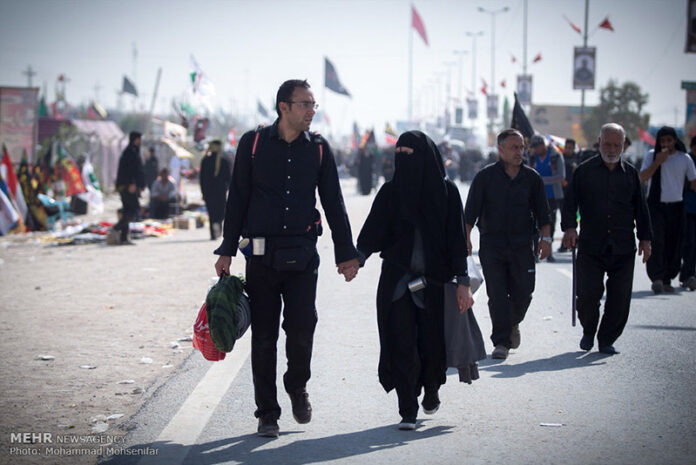
A group of Shiite pilgrims heading to the Iraqi city of Karbala on foot to attend the massive Arba'een religious gathering.

Rahmani Fazli entered the Iraqi capital at the head of a high-ranking political-security delegation Wednesday morning.

During his stay, the interior minister is to meet his Iraqi counterpart Qasim al-Araji, IRNA reported.

The two officials are to coordinate preparations for holding this year’s Arba’een pilgrimage.

Shiite pilgrims from Iran, Iraq and other Muslim countries converge on the Iraqi city of Karbala each year to commemorate and mourn Arba’een, the 40th day after for the martyrdom of Imam Hussein, a grandson of Prophet Mohammad, in the 7th century AD.

The ceremony has gained traction in recent years, with the number of pilgrims in last year’s ceremony estimated at 20 million.

Iran Rejects Claim of Transferring Arms Components to Lebanon

Qassemi made the remarks in reaction to the anti-Iran claims raised in a report by Fox News, saying that the publication of these types of false news has become commonplace in recent days and weeks.

In an interview with Al Alam News channel on Tuesday, he said such reports indicate an escalation of the psychological warfare against Iran by anti-Iran centres.

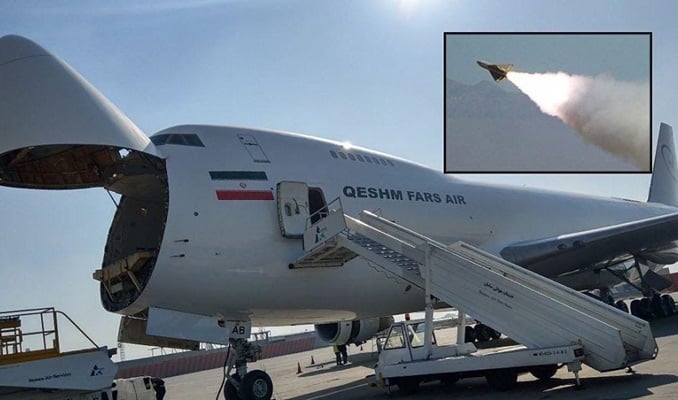
The report by Fox News claimed that sources have uncovered an Iranian civil aviation company is suspected of smuggling arms into Lebanon in order to support Hezbollah movement and Iranian weapons factories there.

Fox News claimed its sources have identified two unusual Qeshm Fars Air flights from Tehran to the international airport in Beirut during the past two months alleging that they carried components for manufacturing weapons inside Lebanon.