Wednesday, April 8, 2026
Home Blog Page 3386

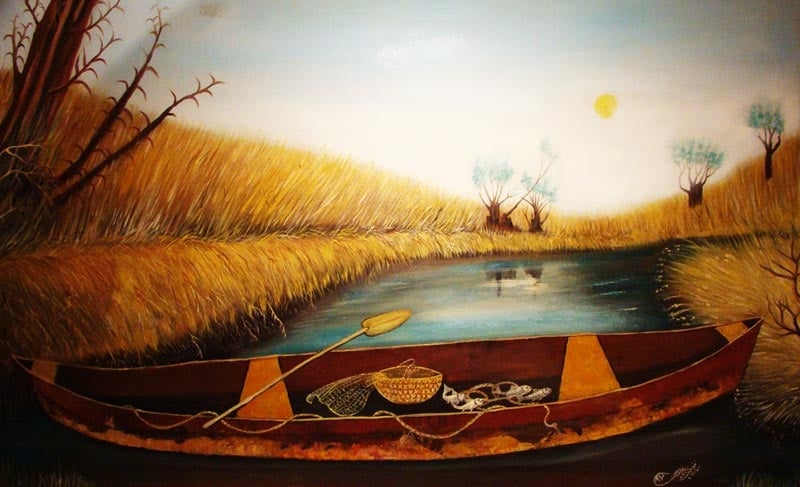
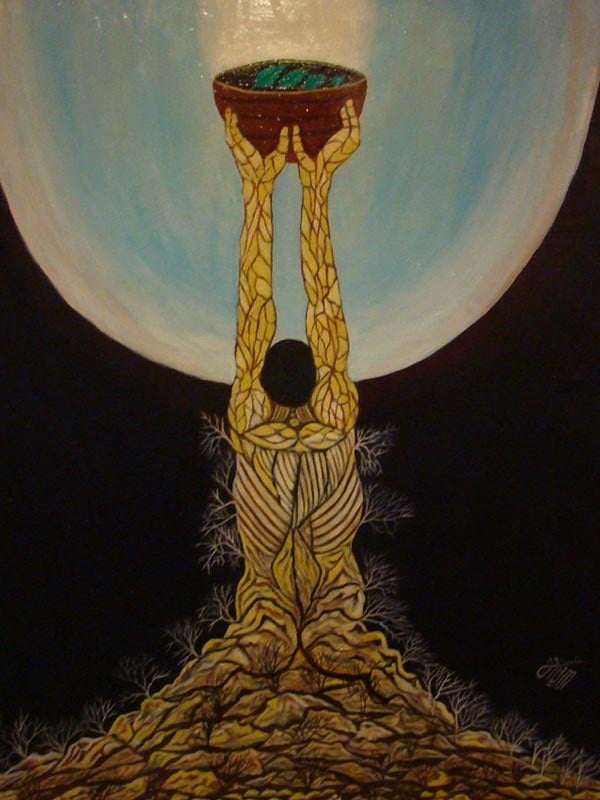
Iranian Painter Creates Works in Iranian-style Expressionism

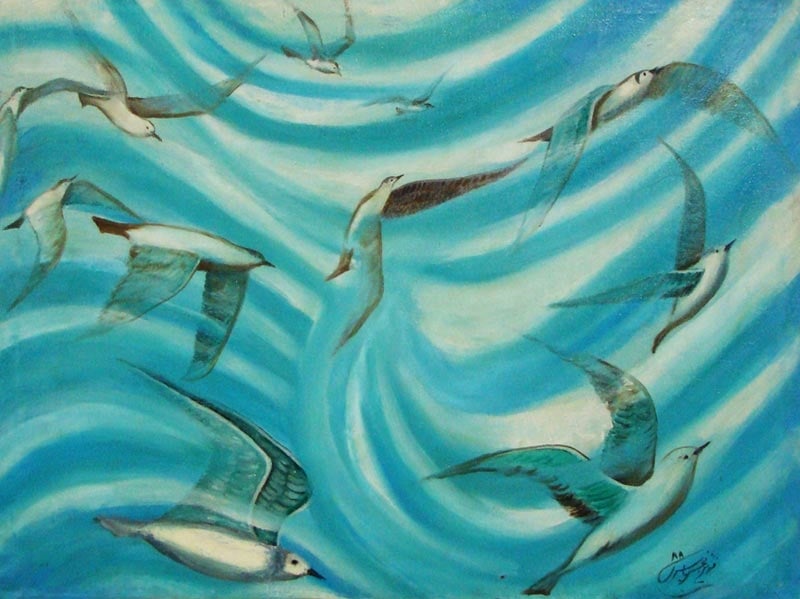
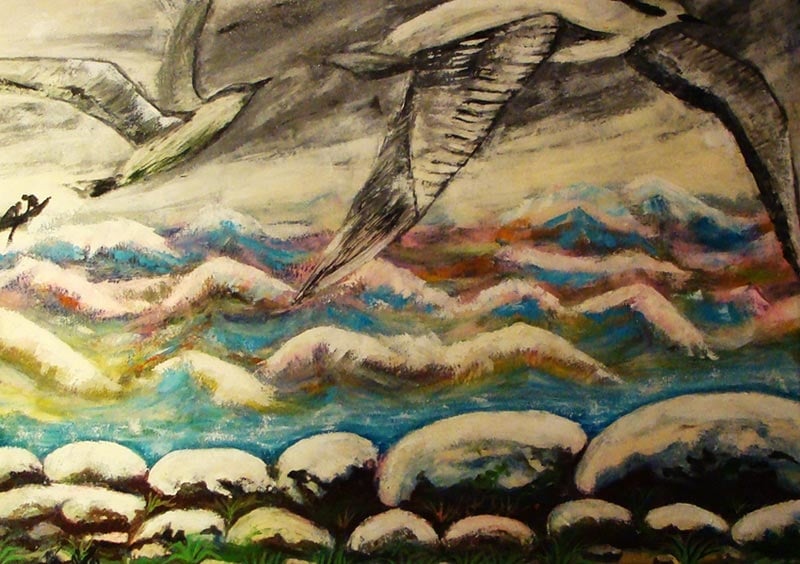
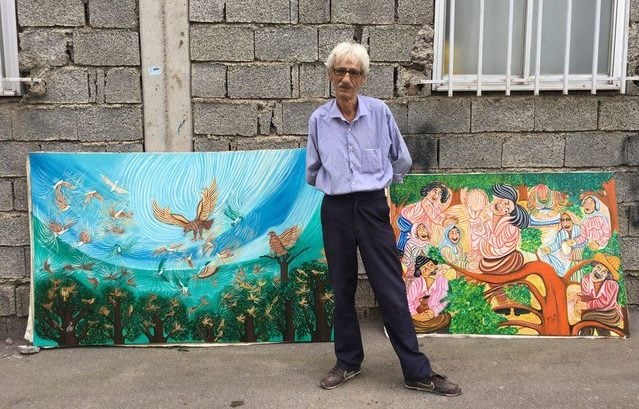
“I am a painter with the spirit of flying birds. I want to create modernism in an Iranian style; Expressionism in an Iranian style,” he says about himself. He is a painter that in his teens was the son of a great and famous landowner. After the land reforms in 1963, his family went broke and he grew up in poverty. For years, he painted and wrote on his own. His latest novel is the story of many people from the north of Iran.

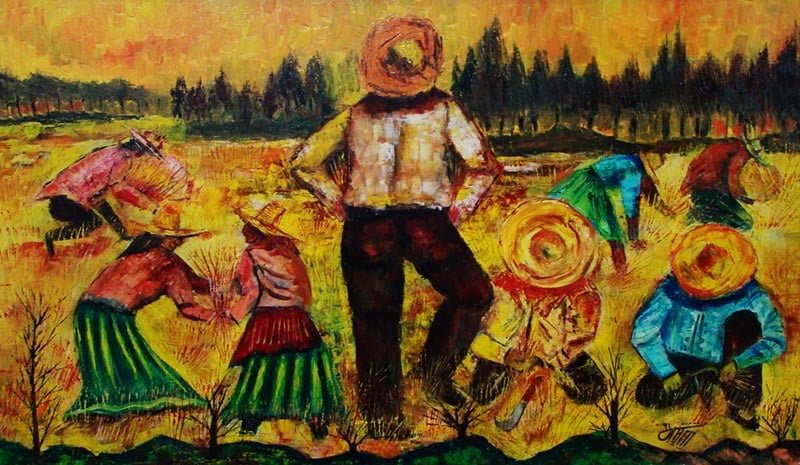
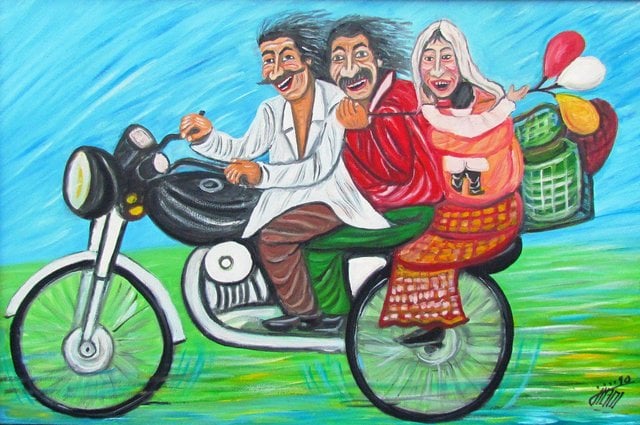
Having concerns of many generations and in the pursuit of happiness, in his paintings, he draws happiness out of people’s hard work.

In the works of Fakhri Yaseri, one can see the everyday life of the people of Gilan. He held his first solo exhibition in 1983. And then he held other exhibitions.

The following is a summary of his interview with ISNA edited by IFP:
Iranian Painter Creates Works in Iranian-style Expressionism

Q: Your childhood was a special one. When did you find yourself interested in art and painting?

A: I was 15. After finishing high school, I went to do my military service. I learned designing under the supervision of a teacher for three months, but then I was sent to Hamedan in west of Iran. Later, I only worked on books and live models. I kept practicing on my own copying from nature. After my service, I was accepted at the Art University in 1977. However, due to financial problems I could not enter university. I brought university to my home instead, and I continued to work on drawing, painting and fiction by reading Iranian and foreign novels. During the days, I was working and in the evenings I was studying and practicing.
Iranian Painter Creates Works in Iranian-style Expressionism

Q: What is your style of painting? How did you come to this style of painting?

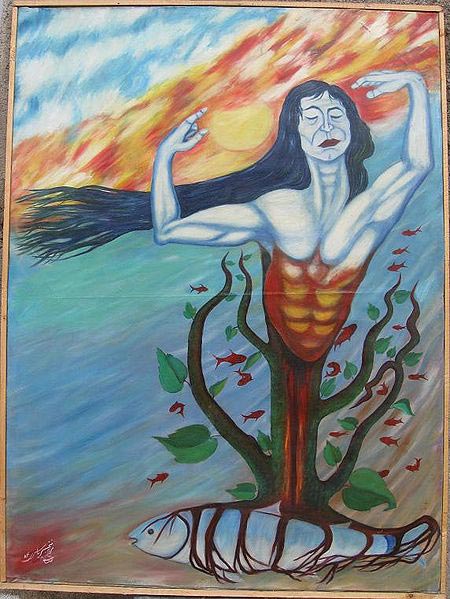
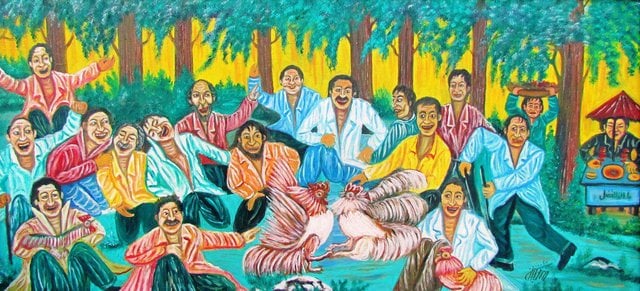
A: For five years, I just copied the great works of realist artists. After that, I painted nature. I worked in the heart of nature and life. At first, I was experiencing different styles and was looking for my personal style. But since late 90s, my painting style has been Expressionism in an Iranian form. My goal is to show the hidden and daily happiness of the Iranian people. I paint the joys in the form of humor, abstraction, and expressionism. According to the professors of Gilan, there are signs of Fauvism in my works, but I keep up with Expressionism in an Iranian style to show the Iranian culture and ordinary people’s lives. I have gone through many hardships in this way. Despite failure in my marital life and financial poverty I never stopped creating literary and artistic works. After about fifty years of continuous and tireless activity, I continue to work like an energetic artist.

Q: Do you paint with your own personal look?
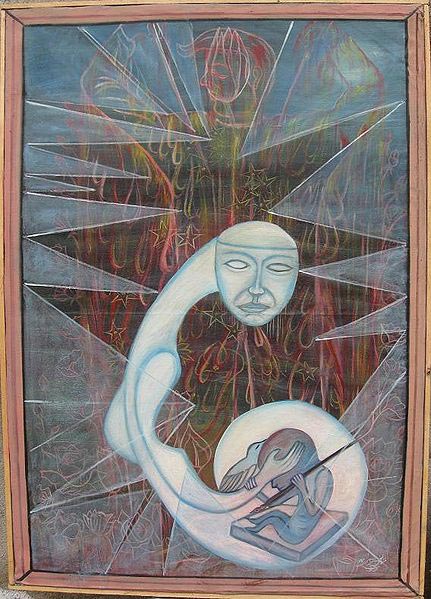
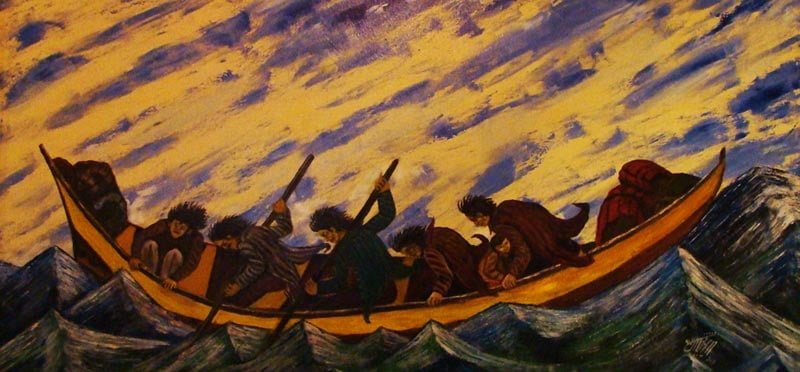
Iranian Painter Creates Works in Iranian-style ExpressionismA: Not at all. I have never worked for myself because the people’s wishes have always been important to me. The painters in Gilan know me as the painter of ugly aspects of life because I paint beautiful things in an ugly way and ugly things in a beautiful form. These things happen automatically in my works. Every now and then I create designs nervously, and scratch lines and colours without any form. Therefore, they sometimes laugh at me, and sometimes they offend me and say I am insane. One of my professors at one of my exhibitions in Marlik Gallery of Rasht told me “You use colours and lines in your paintings in a crazy style.” And another music professor admitted that he feels the colours of music in my works. “You talk about the colours of music,” he said. Another master of mine said “You show modernism in the form of Iranian culture and traditions.” But my only answer was “I am a painter with the spirit of flying birds and I want to create modernism with the style of Iranian painters. Expressionism in an Iranian style!”

Majority of Iranians Will Vote in Favour of Hijab: MP

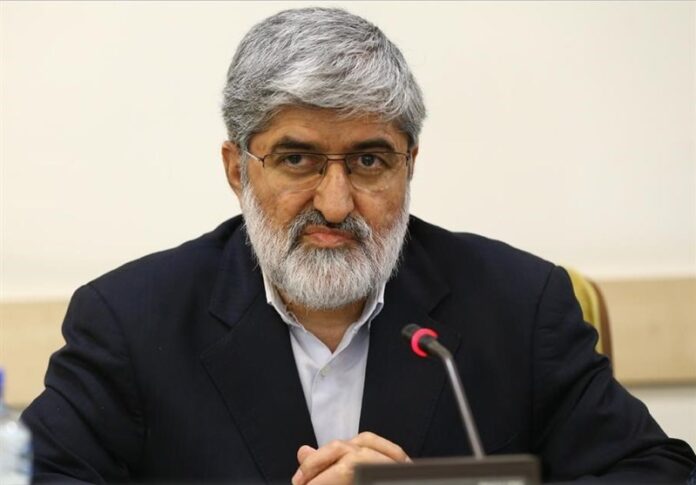
In an address on Hijab on Monday, Ali Motahari said based on his understanding of the Iranian society, majority of Iranians will say yes to Hijab if a referendum is held today on the issue.

“Though no one holds referendum on ideological and subjective issues like Hijab, those Iranian women who don not wear Hijab or wear it improperly will vote in its favour if a referendum is held today because they are closely familiar with the fallouts of its absence in the society,” he was quoted as saying in a report by ISNA.

He denied reports on compulsory Hijab in Iran and added the Islamic Republic has never forced any woman to wear a special Hijab like Burqa or Chador.

“We don’t exert such a pressure on women. We deem coverage of all parts of body except for face and palms as Hijab,” he said.

The Iranian lawmaker went on to say that there is no strict measure against improper hijab anymore in the Islamic Republic and said Hijab is not a merely individual choice.

“Lack of Hijab could hurt the whole society. Hijab is worn to prevent from sexual stimulation in the society,” he noted.

Motahari blames the western culture for its objectification of women in the modern history and said unlike the west, Islam attaches significance to the statues of women in the society.

According to the lawmaker, Hijab contributes to family bonds and the Islamic Republic is seeking to prevent any types of extremism when it comes to the social status of women.

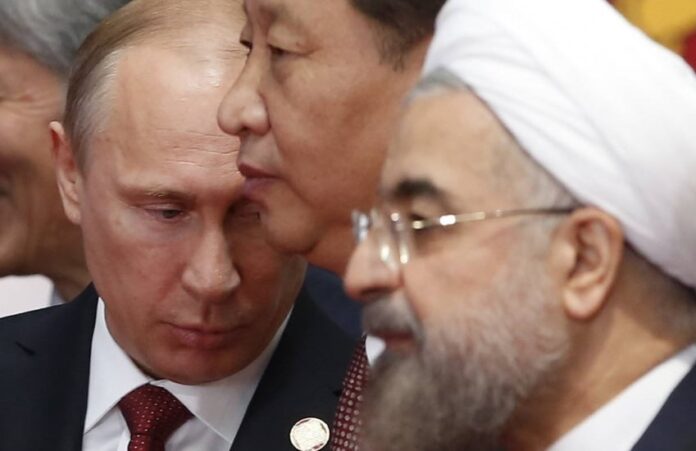
‘Iran Expects Russia, China Not to Remain Passive Over JCPOA’

china-russia-iran

In an analytical piece published in Iranian Diplomacy website, the analyst said Russia and China sat idle in the last months of 2018 watching their firms leave Iran after the US pullout of the JCPOA and its re-imposition of sanctions.

“The Islamic Republic of Iran began 2019 while the fate of many political and legal cases of the country remains unclear. So, developing new strategies and a priority list as well addressing the main problems facing the country is among the main challenges of the diplomatic apparatus of Iran in the New Year,” the piece reads.

Mazaheri cited the US animosity and unilateral sanctions re-imposed in the 2018 as the main crisis which continued into the New Year and said the crisis should be addressed immediately with a new approach.

“One of the main measures to be adopted in this area is launching new round of talks with the remaining signatories of the Iran nuclear deal particularly the European states to bypass the US sanctions,” he noted.

“In 2018, the Europeans promised to create a financial mechanism known as the Special Purpose Vehicle (SPV). Their promise went beyond lip services and during the past months they launched some practical measures to implement it. They kept working on the plan even after the US threatened to sanction any states involved in the SPV. Some European states like France and Germany jointly expressed their readiness to implement the plan despite the US pressure,” he underlined.

According to the analyst, the SPV was expected to become operational by the end of 2018. So, he said, the main priority of Iran’s Foreign Ministry this year should be seriously following up the issue to set a deadline for the Europeans to fulfil their promises.

He also advised Iranian diplomats not to pin all their hope on the European states.

“In 2018, China, Russia and the UN as other parties to the Iran nuclear deal failed to adopt practical measures to safeguard the nuclear accord. Russia and China even sat idle watching their firms leave Iran following the re-imposition of the US sanctions. This comes as the two states have turned into strong players in the world politics over the past years,” the piece said.

According to the International Monetary Fund, Mazaheri wrote, China ranked the second largest economy in 2018 with a $14 trillion economy after the US with $20.4 trillion.

“So, when the first economy in the world resorts to repressive measures and violates the international law, the second economy is expected to step into the fray and do whatever in power to stop the trend. But China didn’t take any special step.”

Mazaheri said unlike European states’ economy, China’s economy is governmentally centralised. “This has given the Chinese government an upper hand in various political and economic areas. So, the country’s shortage when it comes to Iran is more rooted in its self-interest protectionism rather than its economic incapability.”

He then referred to Russia and especially its growing role in Syria over the past years saying that Russia has already turned into a leading regional player and established itself as a leading rival for the US. “Iran naturally expects Russia to leave behind its passive stances towards the JCPOA and speak out against the pressure exerted by the US on Tehran.”

Mazaheri then elaborated on the UN shortcomings towards Iran and said the world body along with China and Russia fell short of taking serious steps to safeguard the JCPOA. “The UN has the capacity to seriously address issues like this to prevent from having its image tarnished in the world.”

According to the analyst, the shortcomings of the remaining signatories of the Iran nuclear deal requires Iran’s diplomatic apparatus to develop serious plans in 2019 to cope with the US unfair pressure.

Mazaheri said if the remaining sides of the JCPOA wants Iran to continue its trust-making measures, they need to prevent from making any wrong decision by following up the footsteps of the US about Iran’s missile program and put whatever in their power to help Iran which has remained committed to all its pledges under the JCPOA.


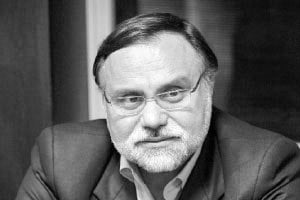
‘Iran Expects Russia, China Not to Remain Passive Over JCPOA’*Dr. Mohammad Mahdi Mazaheri is a university professor and serves as the chairman of ECO Cultural Institute (ECI). He is also a member of the Board of Trustees of Research Center of Culture, Art and Communication. Mazaheri has majored in management and philosophy and received several post-doctoral degrees from a number of foreign universities due to his vast studies in various areas. He is also active in diplomatic field.
Arab States Set Condition for Assad’s Presence in AL Summit

Arab States Set Condition for Assad’s Presence in AL Summit

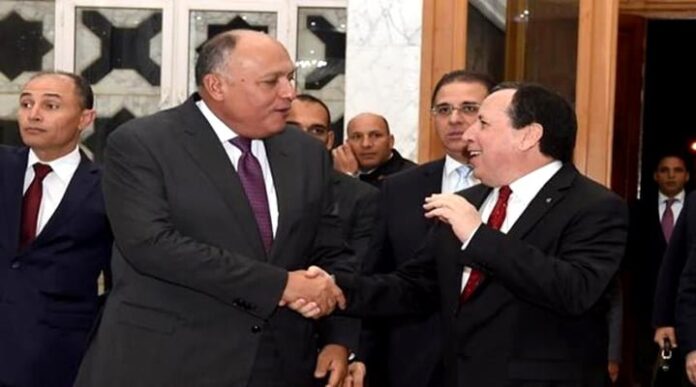
Tunisian Foreign Minister Khemaies Jhinaoui has visited Cairo for talks with his Egyptian counterpart, and the country’s president and security head on the possible participation of Assad in the summit.

“The visit had been made upon Egypt’s official invitation to make a final decision on the possible presence of Assad in the 30th AL summit in Tunisia,” the diplomatic sources was quoted as saying in a report by Entekhab website.

Sources at the diplomatic meetings between Egypt, the UAE, Saudi Arabia and Bahrain said Assad’s participation in the upcoming summit hinges on his stance towards Iran’s military presence in his country.

According to the sources, the states have vowed to re-stablish their diplomatic ties with Syria if Assad meets their demands regarding Iran.


Proposal to Deploy Arab Forces to Northern Syria

Egypt and a number of Arab states are reportedly working on US proposals to deploy Arab forces to the Kurdish-populated areas in northern Syria to replace US forces after their withdrawal from the war-ravaged country.

“Dispatching Syrian forces to the areas after making coordination with the Kurds is among the proposals which are being discussed,” the diplomatic sources added.
According to these sources, final decision on the proposals depends on Syria’s response to the Arab states’ demands to revise its relations with the Islamic Republic.
The Arab League suspended Syria’s membership in November 2011 under pressure by the Arab states.

Iran Reliable Supplier of Oil for India: FM Zarif

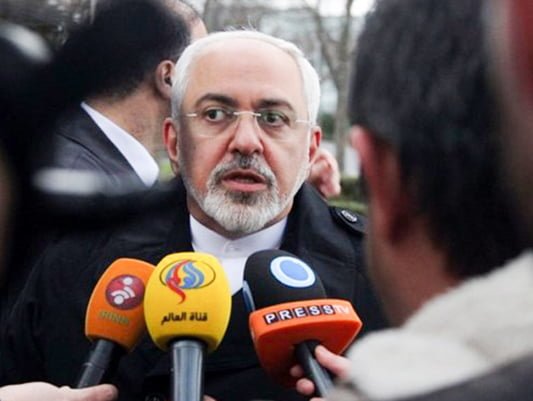
Mohammad Javad Zarif made the comment while talking to reporters in the Indian capital, New Delhi.

Zarif left for New Delhi on Monday, January 7, 2019, heading a political-economic delegation. He is to hold talks with Indian authorities during his three-day trip, reported Fars News Agency.

The foreign minister was asked by journalists whether or not he would discuss a drop in India’s oil imports from Iran.

“The Indian foreign minister and I are heads of the two countries’ Joint Economic Commission. In a meeting with the Indian oil minister, there will be an opportunity to discuss the matter that Iran has always been, will remain a reliable supplier of petroleum for India,” Zarif replied.

Zarif also elaborated on the objectives of his visit to India.

“The trip comes to attend a research conference which I have been invited to, and I will deliver a special speech at this gathering on Wednesday (January 9) evening. We decided to seize this opportunity and have meetings with different Indian officials, too, along with [individuals from] the private sector and a political-economic delegation,” said Iran’s diplomacy chief.

Good Iran-India Banking Relations

Zarif went on to say that Iran and India have maintained cordial relations even after US sanctions were imposed on Iran, and that Tehran and New Delhi continue to have economic ties.

“We have a good banking agreement with India signed this autumn after the [imposition of US] sanctions, and it enables the country to maintain exports and imports and meet other financial needs as well,” said the foreign minister.

Zarif also talked about the delegation accompanying him during his trip.

“The very strong presence of the private sector in this trip shows our private sector’s interest in seizing this opportunity to promote our relations at a time when unfair sanctions have been imposed on us,” Zarif added.

He said there are a whole variety of fields in which bilateral relations can be expanded, namely the Chabahar port and the Indians’ interest to be present in Chabahar and participate in the development of the infrastructure for the transport of goods in Iran.

He said the two countries also have economic cooperation in other areas, namely in the energy sector.

Zarif said a delegation of knowledge-based companies is also accompanying him during his trip to India.

“We are happy to see that knowledge-based economy is expanding in Iran,” added the Iranian

diplomacy chief.

Zarif said he will attend two research gatherings on Tuesday and Wednesday (January 8 and 9, 2019) and deliver speeches there, adding an economic forum will be held as well.

“I will also have meetings with a number of ministers, namely the ministers of foreign affairs and transportation, and I hope this trip will pave the way for mutual cooperation, especially between the private sectors,” said Zarif.

The Iranian foreign minister’s trip follows his previous visit to India in mid-2018.

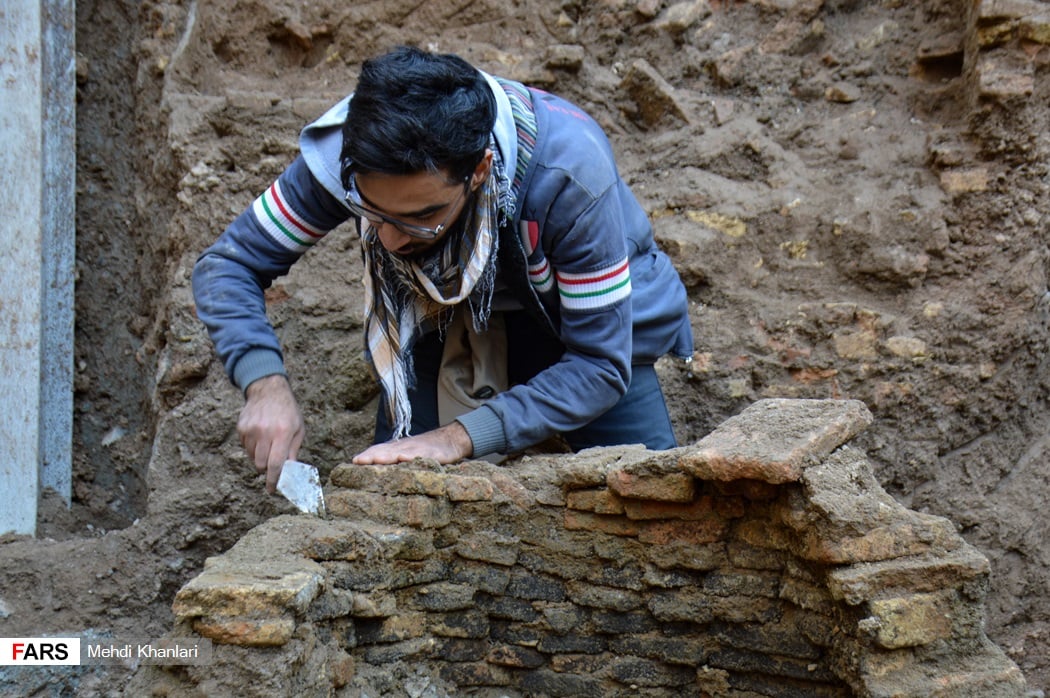
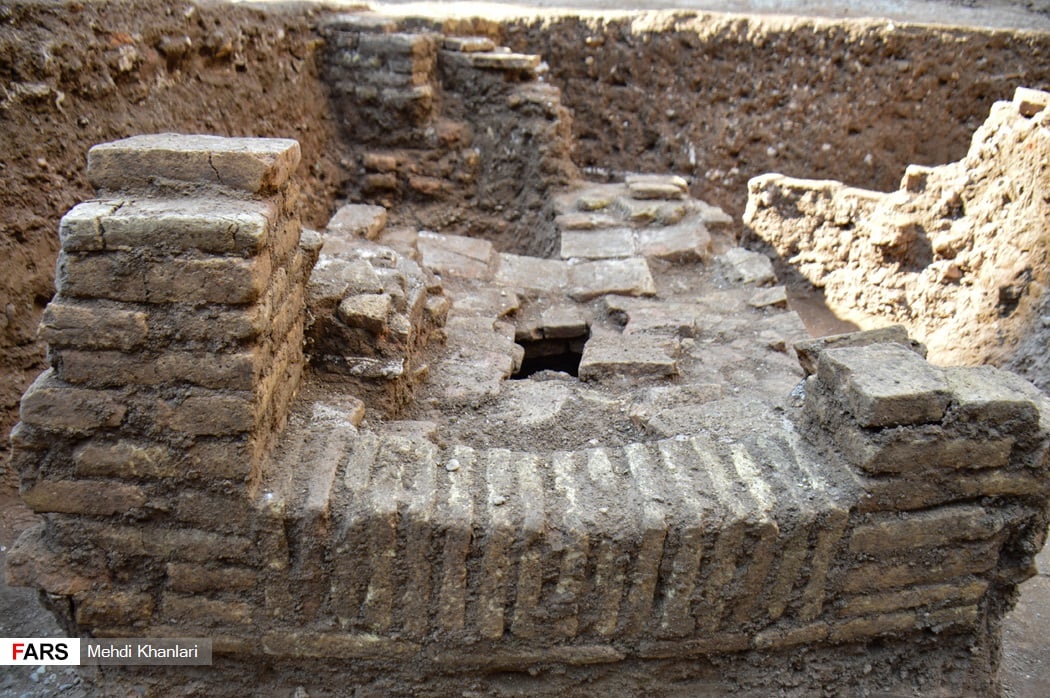
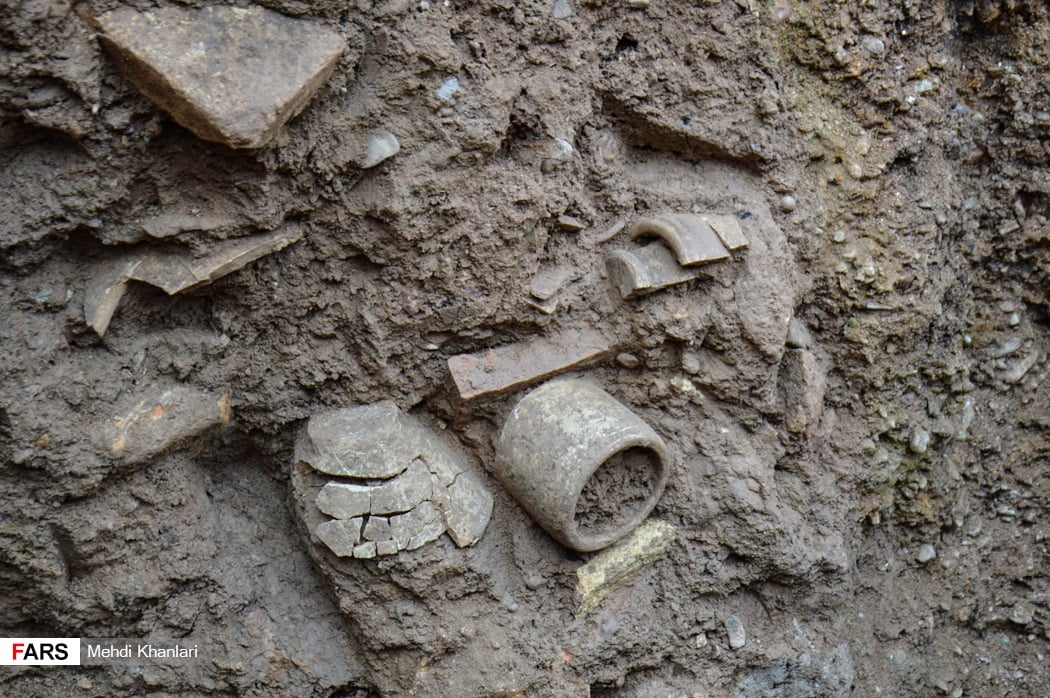
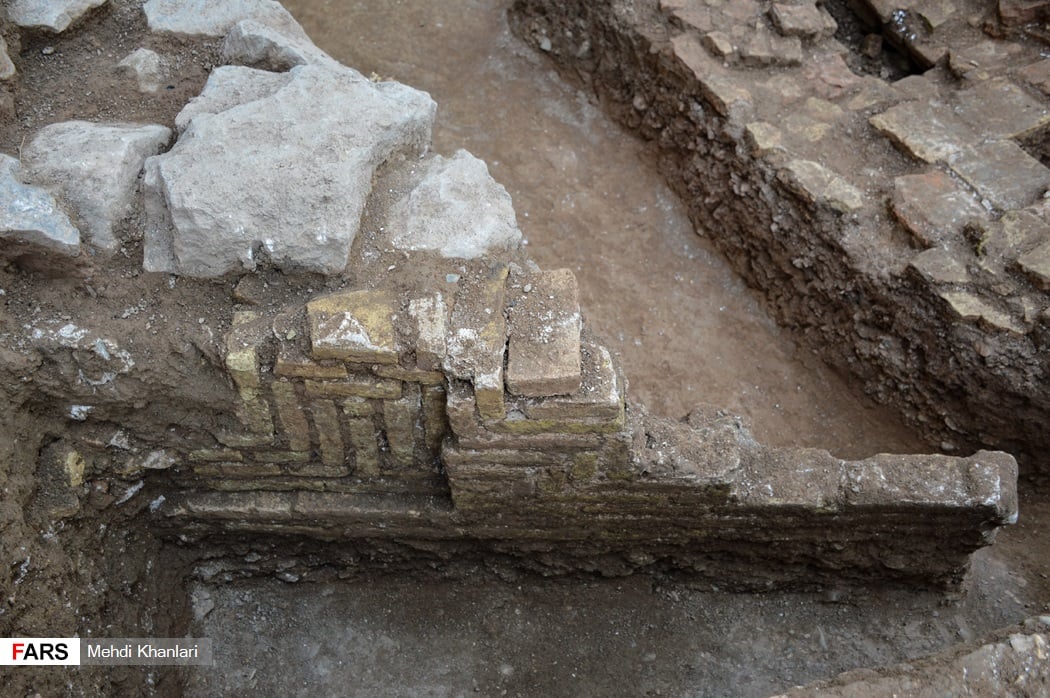
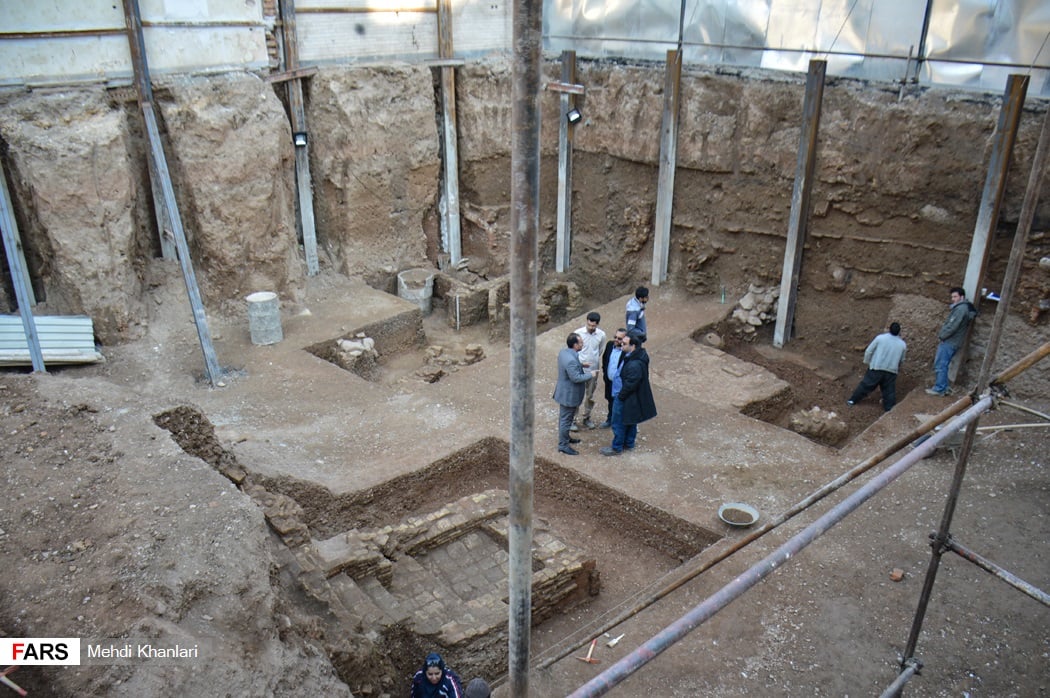
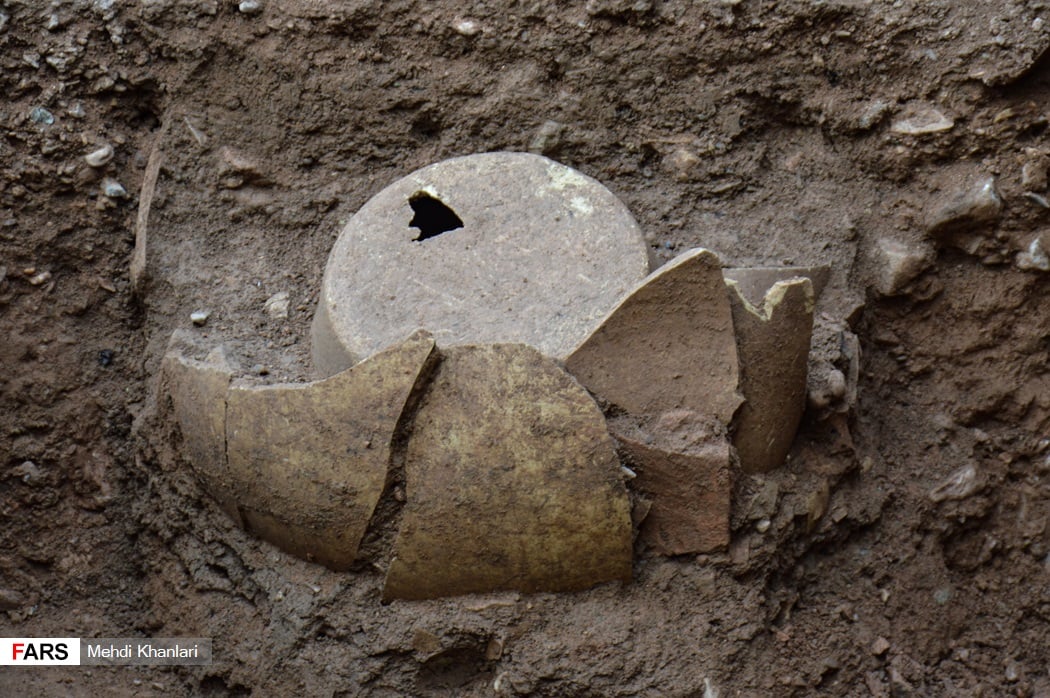
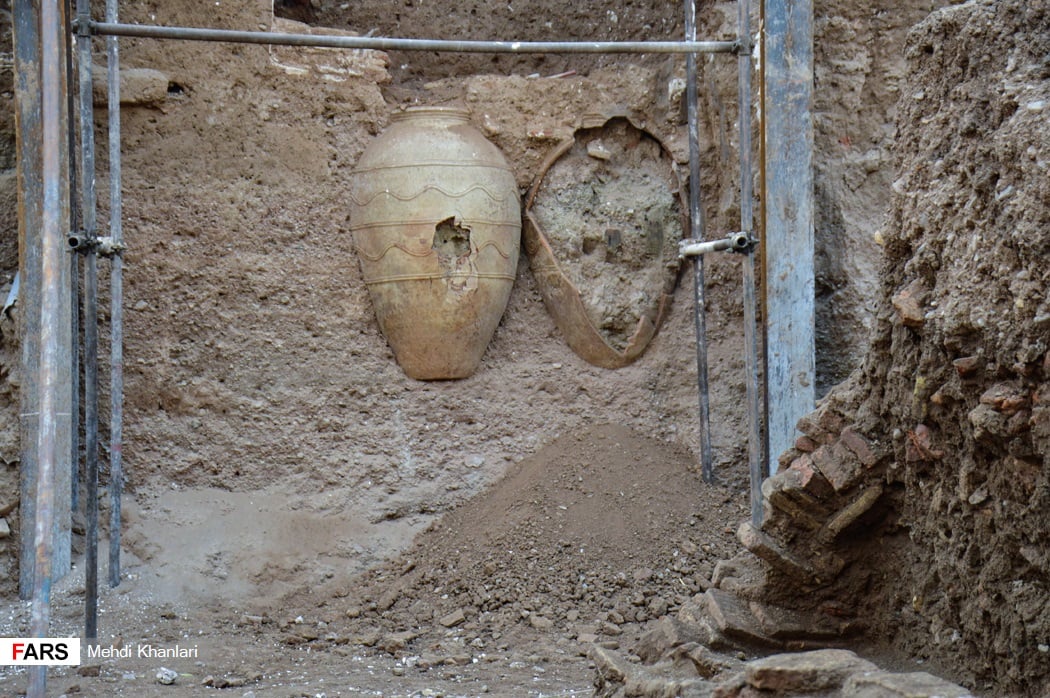
Two Possibly Ancient Jars Discovered in Iran

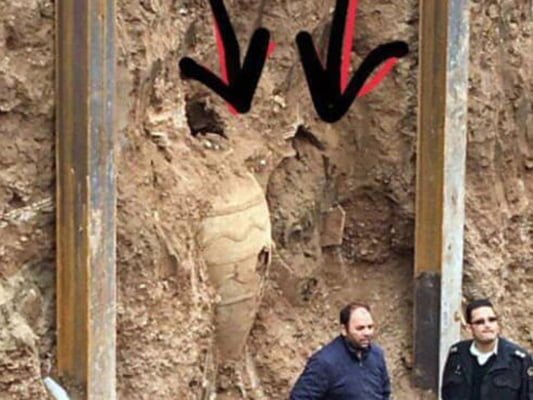
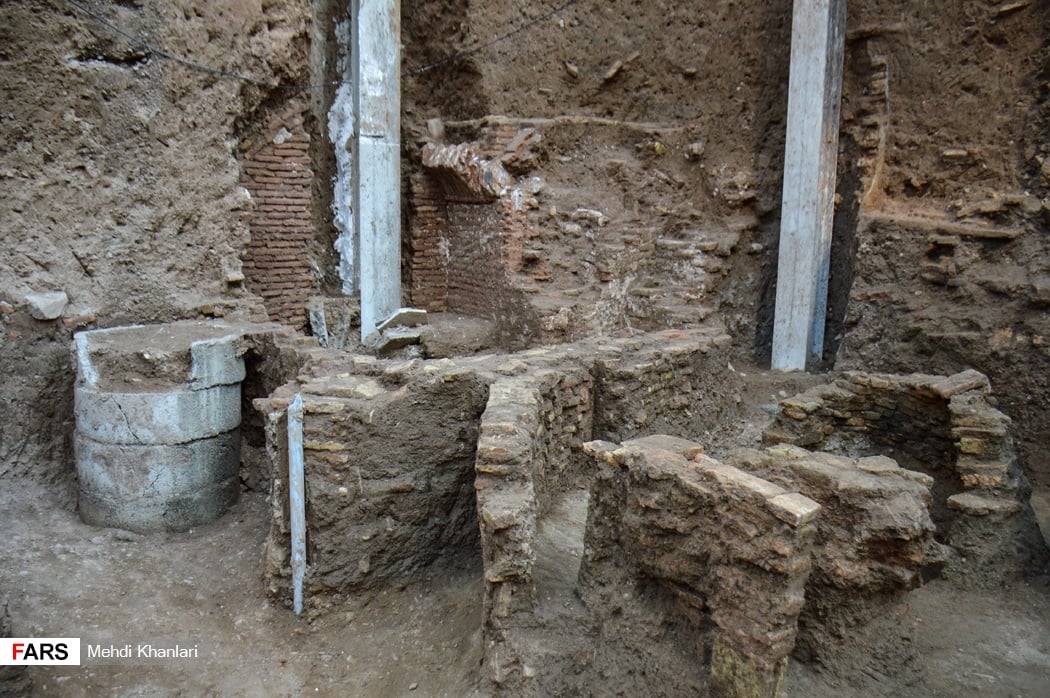
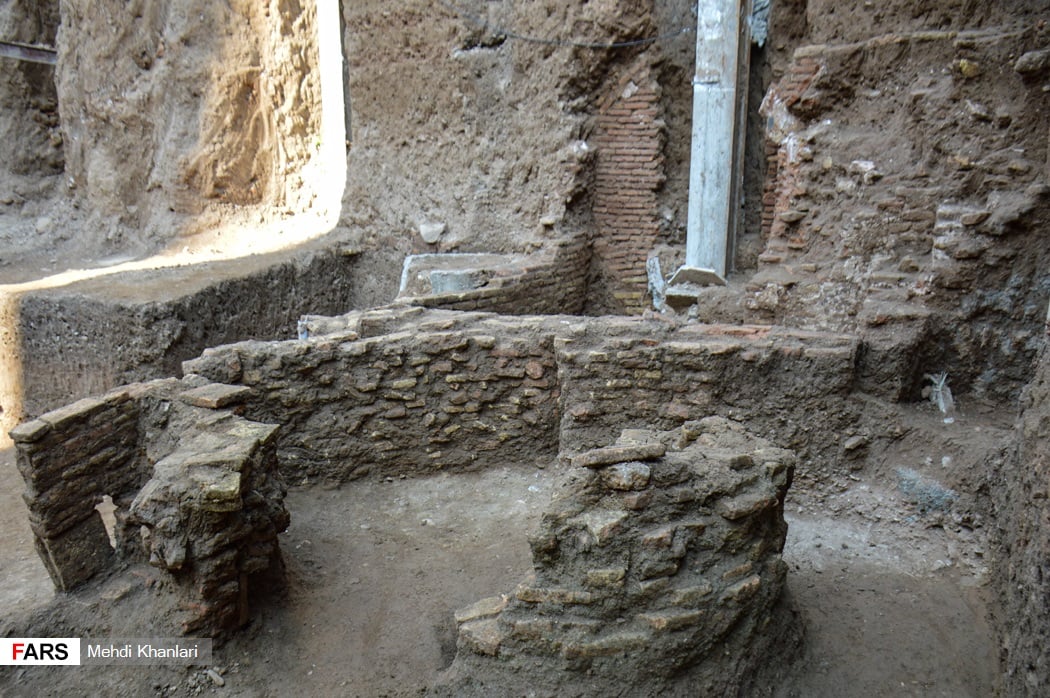
The construction work has been halted there until the result of investigations into the case are announced.

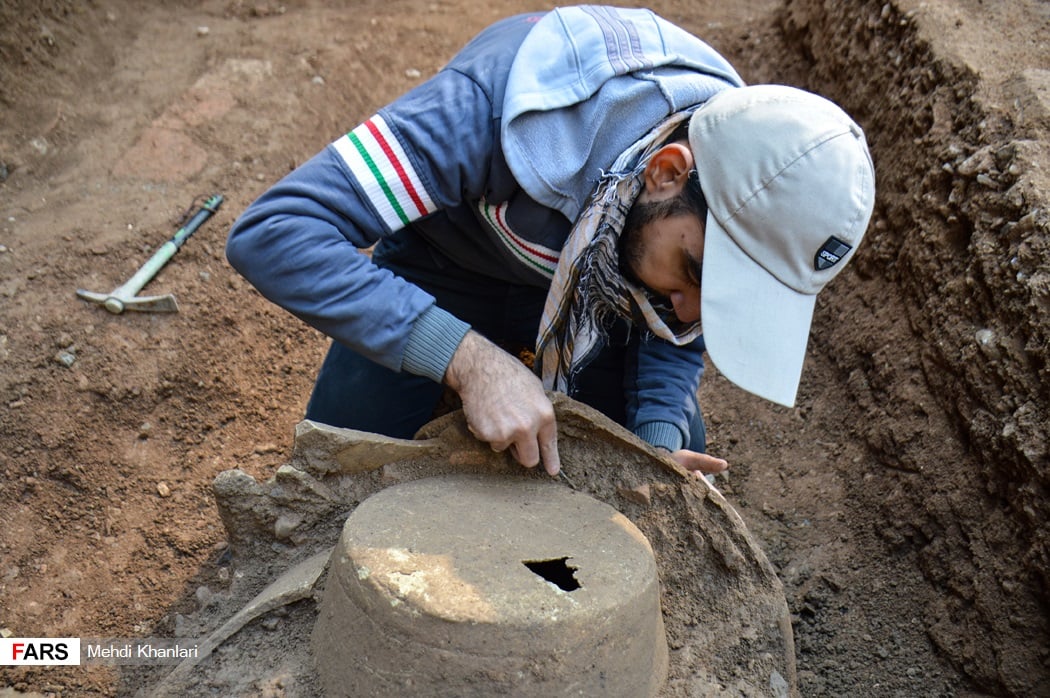
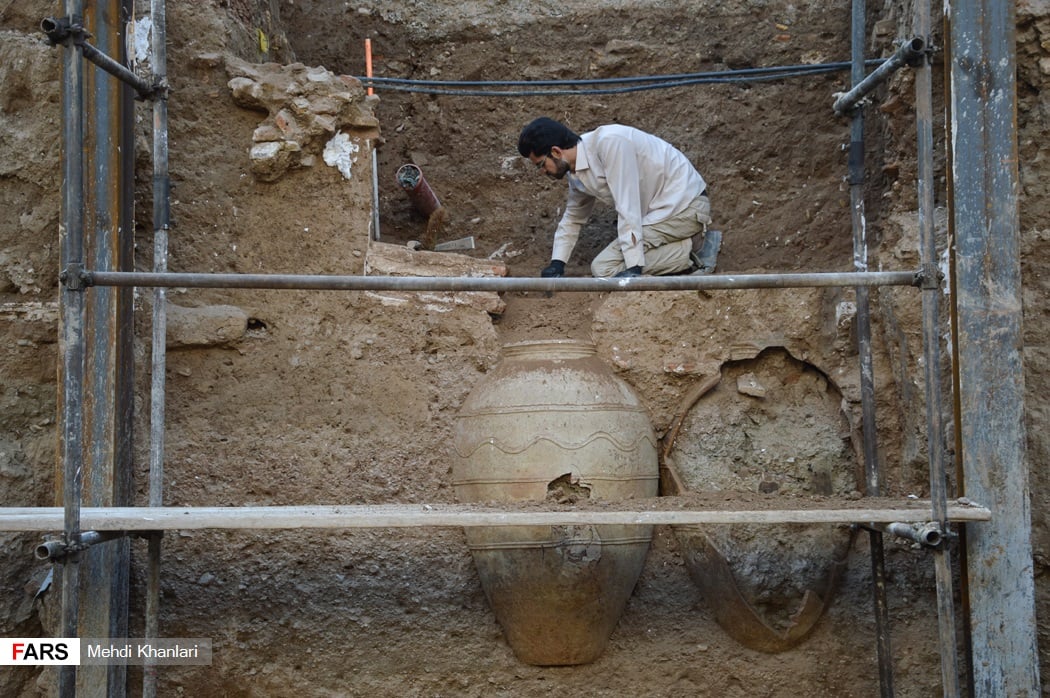
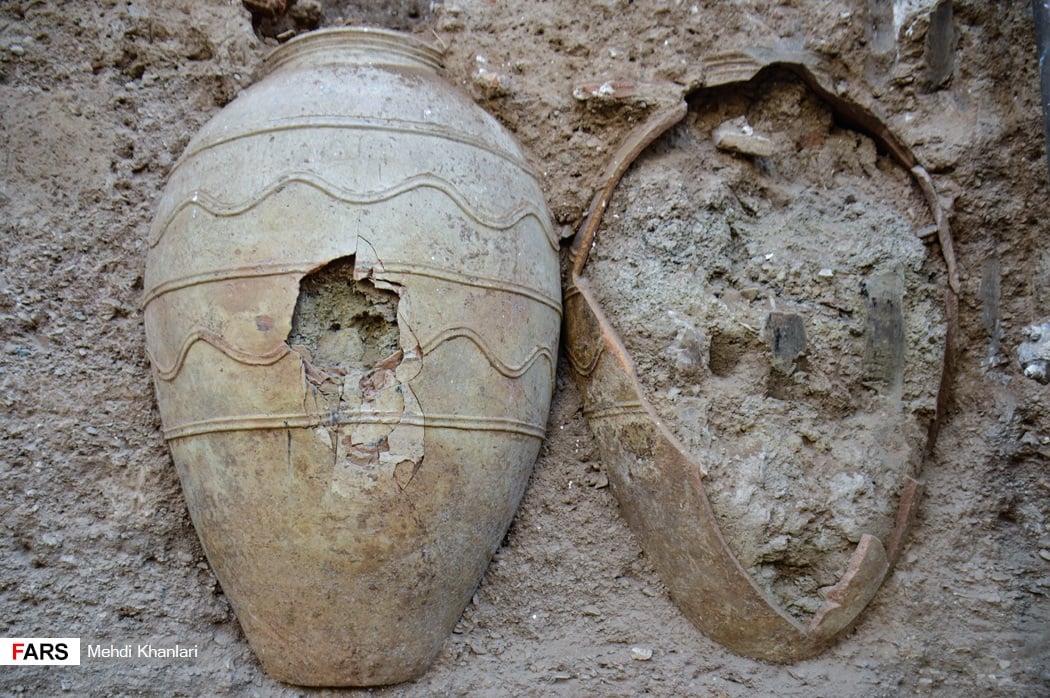
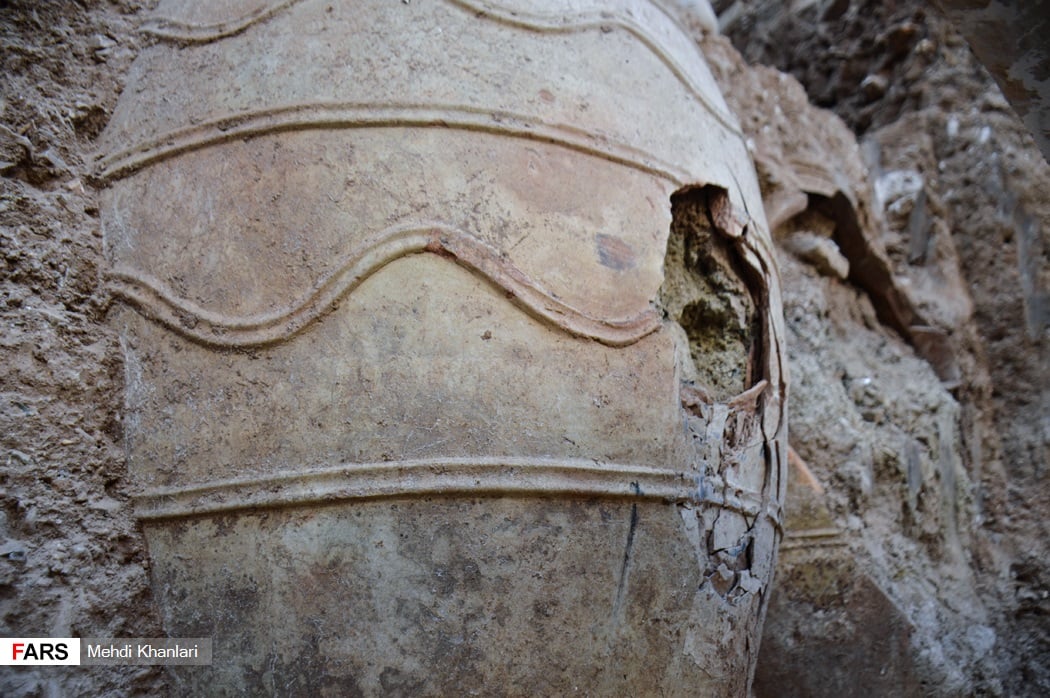
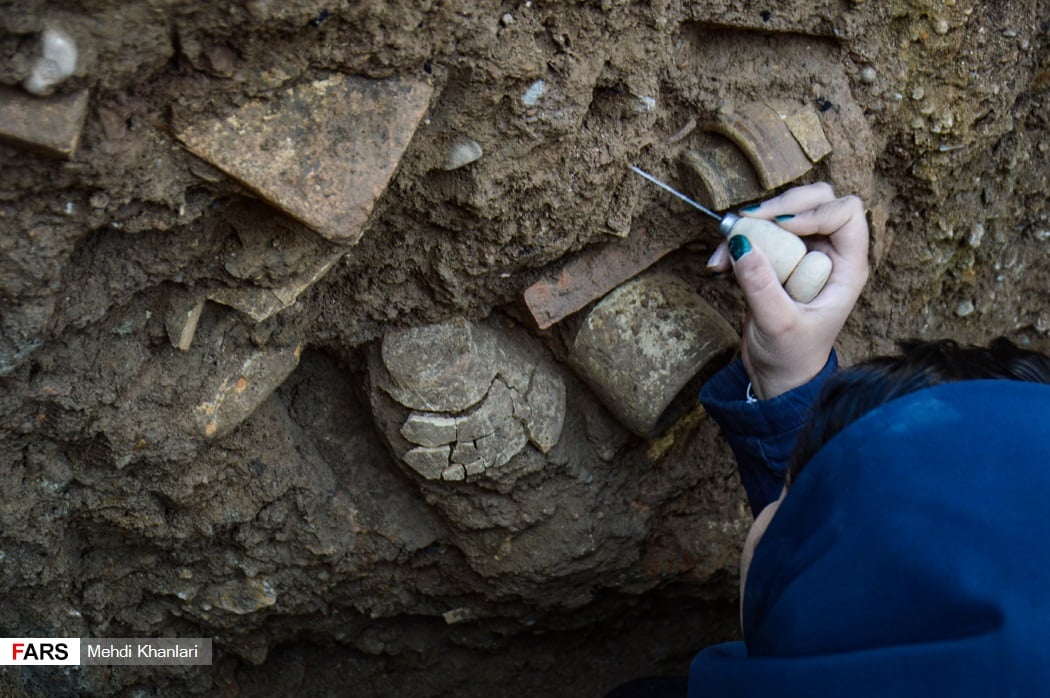
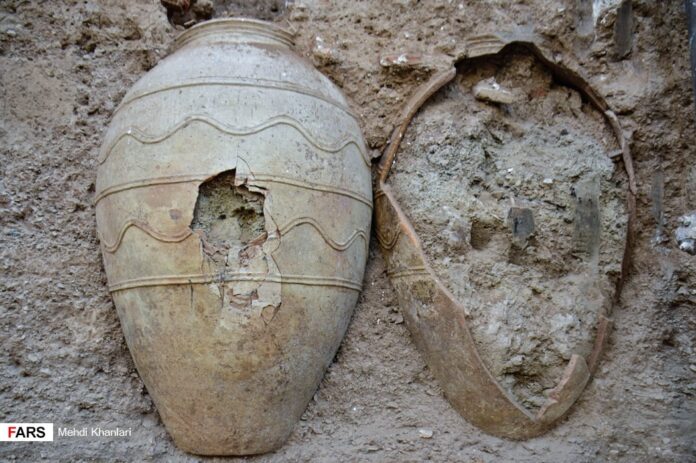
Two Possibly Ancient Jars Discovered in Iran“The two earthenware jars discovered are still inside a wall and seem to be empty,” said Amir Mosayebzadeh, the head of the Cultural Heritage Department of Ray where the discovery was made.

“But given the size and bulk of the jars, it seems they were used to store food, and it is almost impossible to believe that there might be coins and gold inside them,” he added.

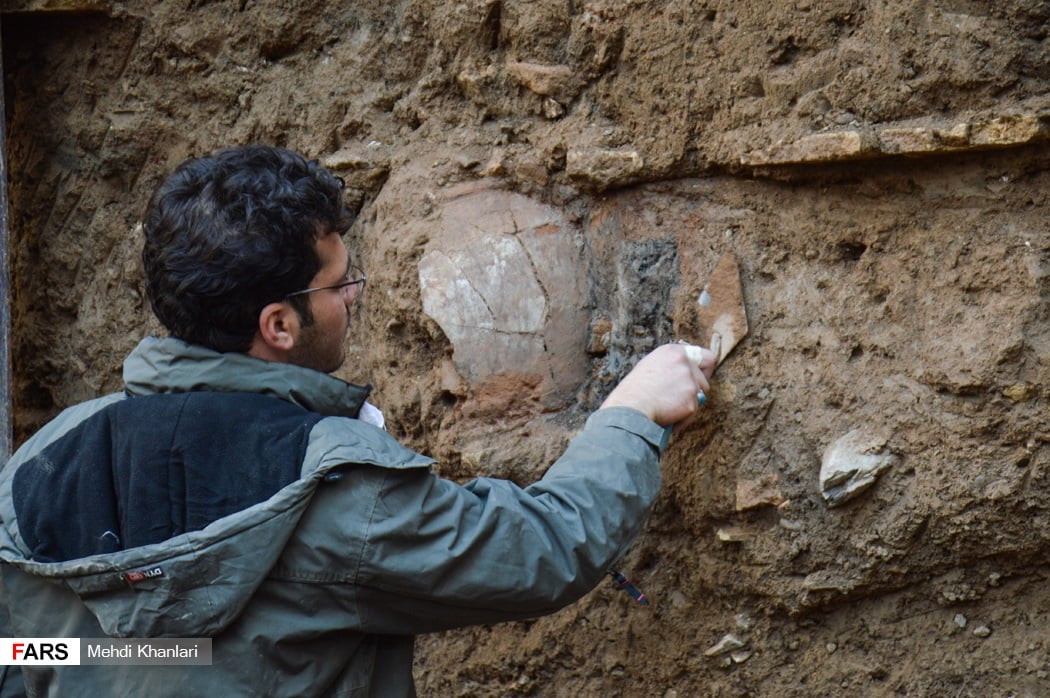
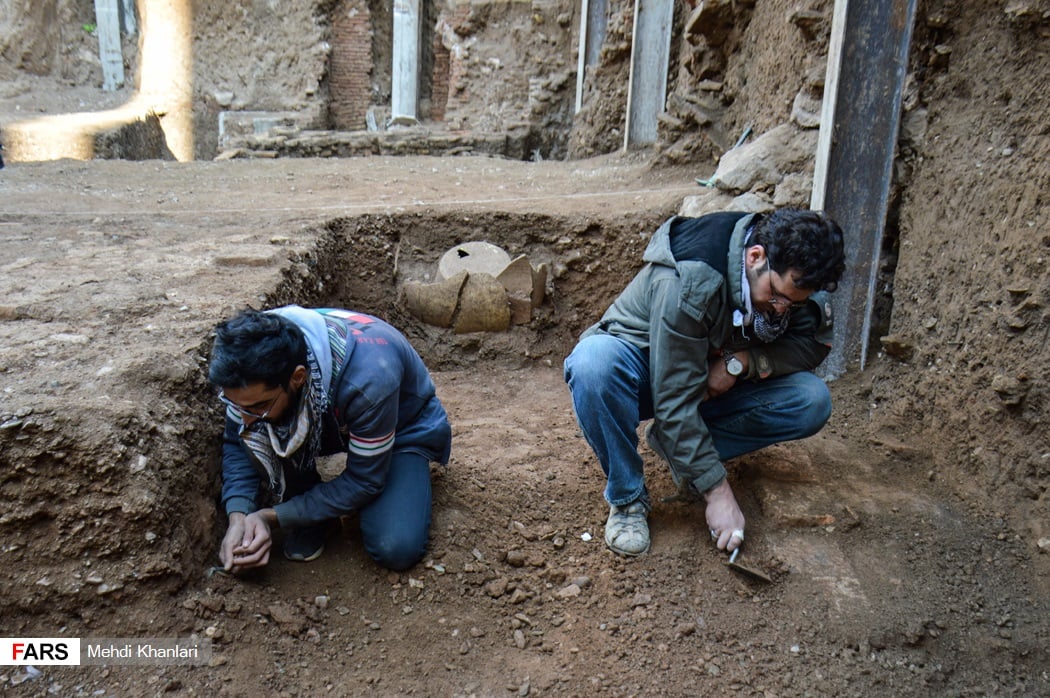
The official said no specific comment can be made until archaeologists complete their examination of the findings.

“The site does not seem to be a historical one. It was a personal property where the jars were discovered during construction operations; so, no remarks would be acceptable in that regard until archaeological surveys are over,” he said.

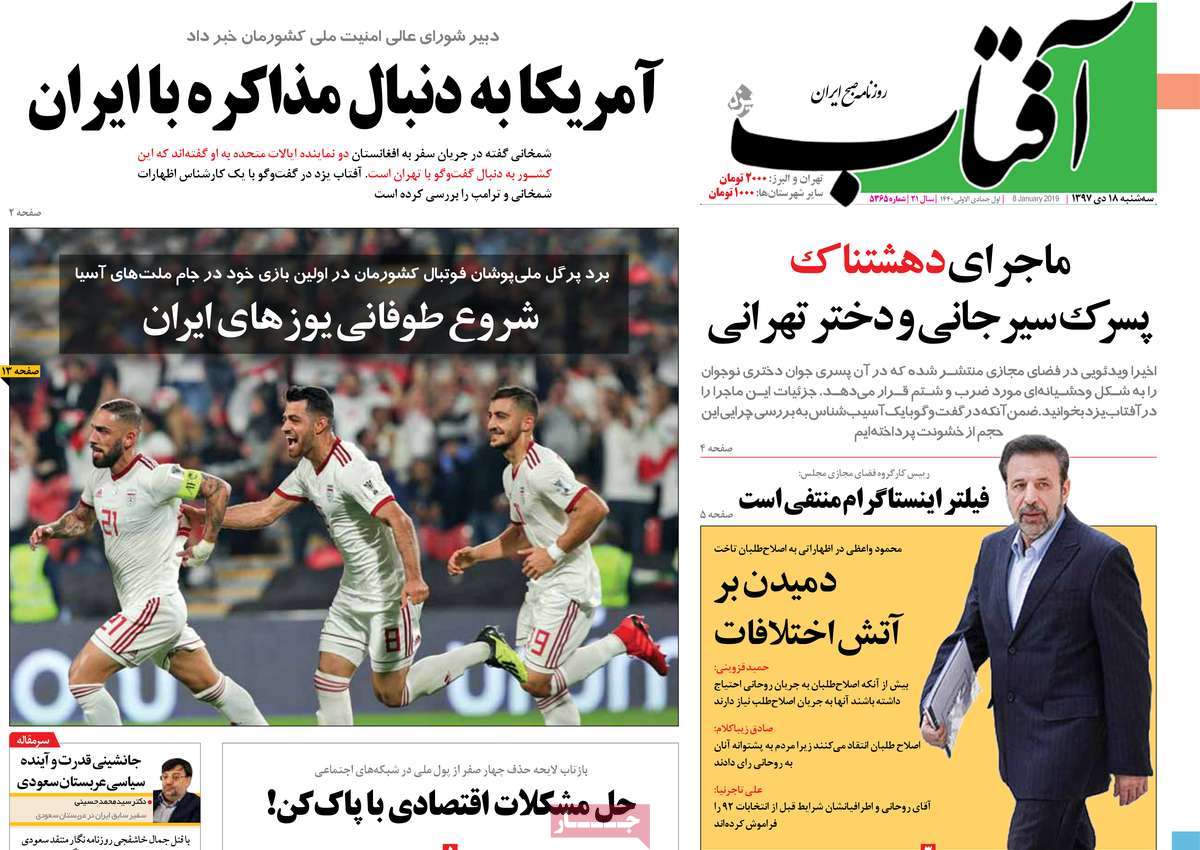
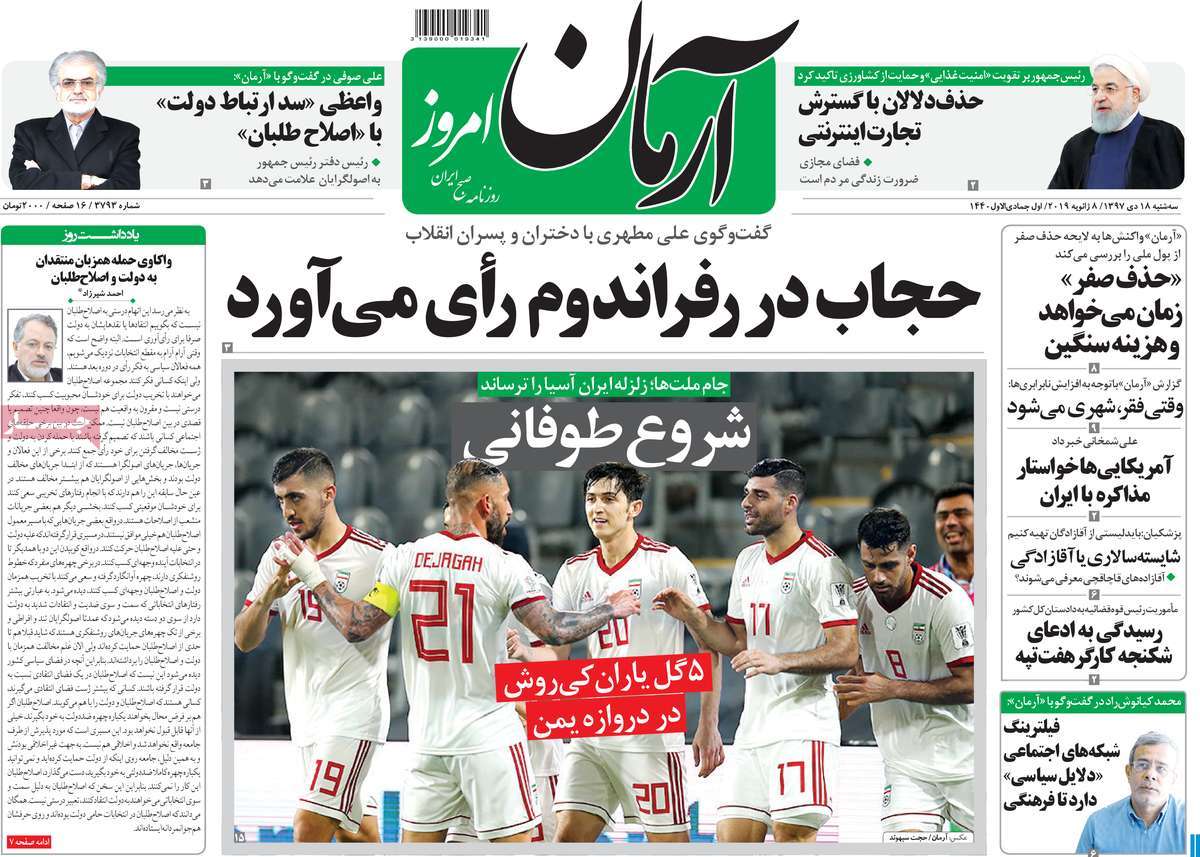
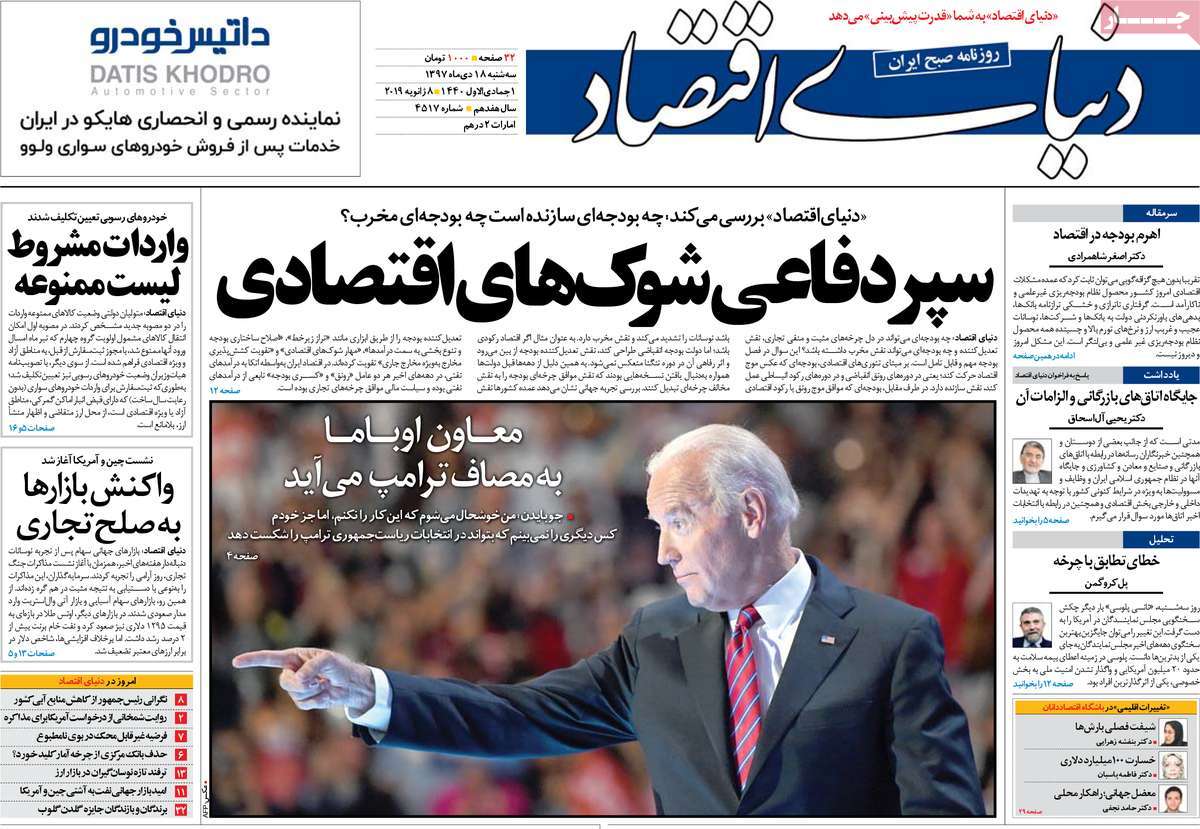
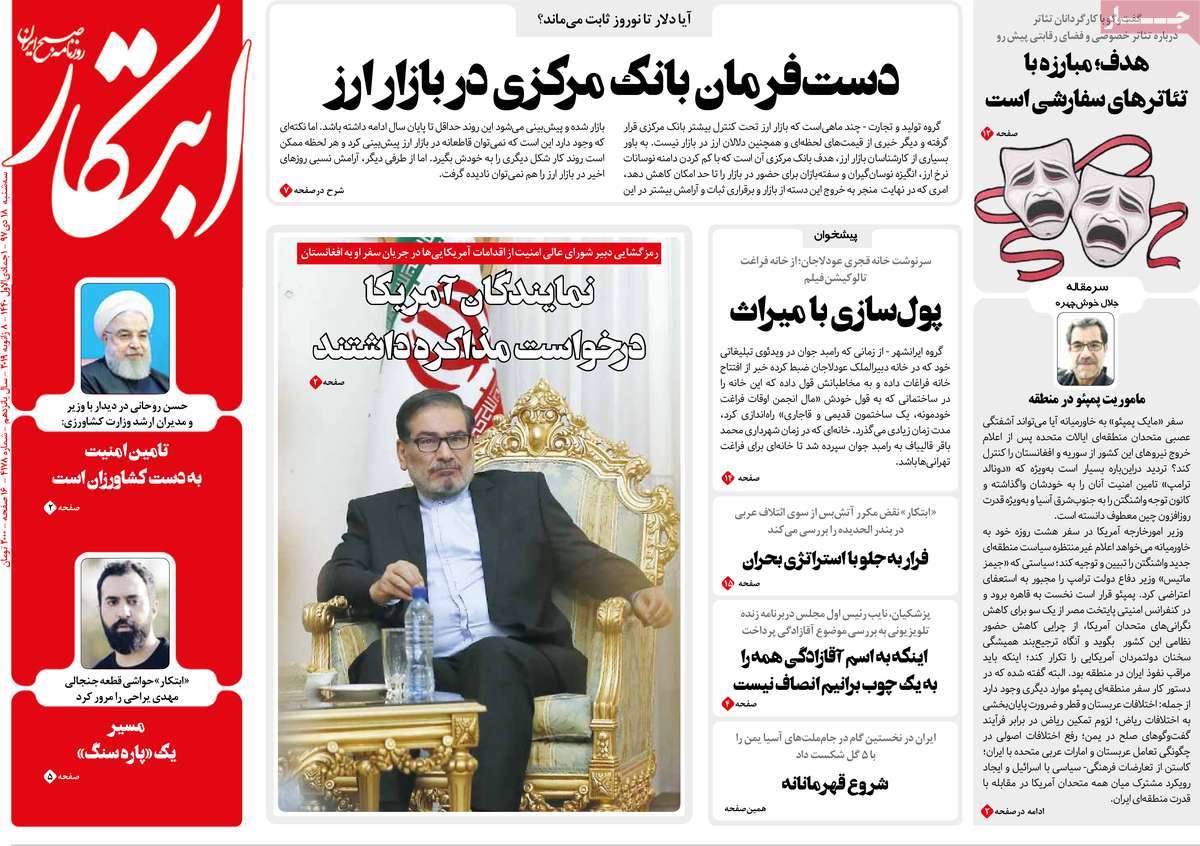
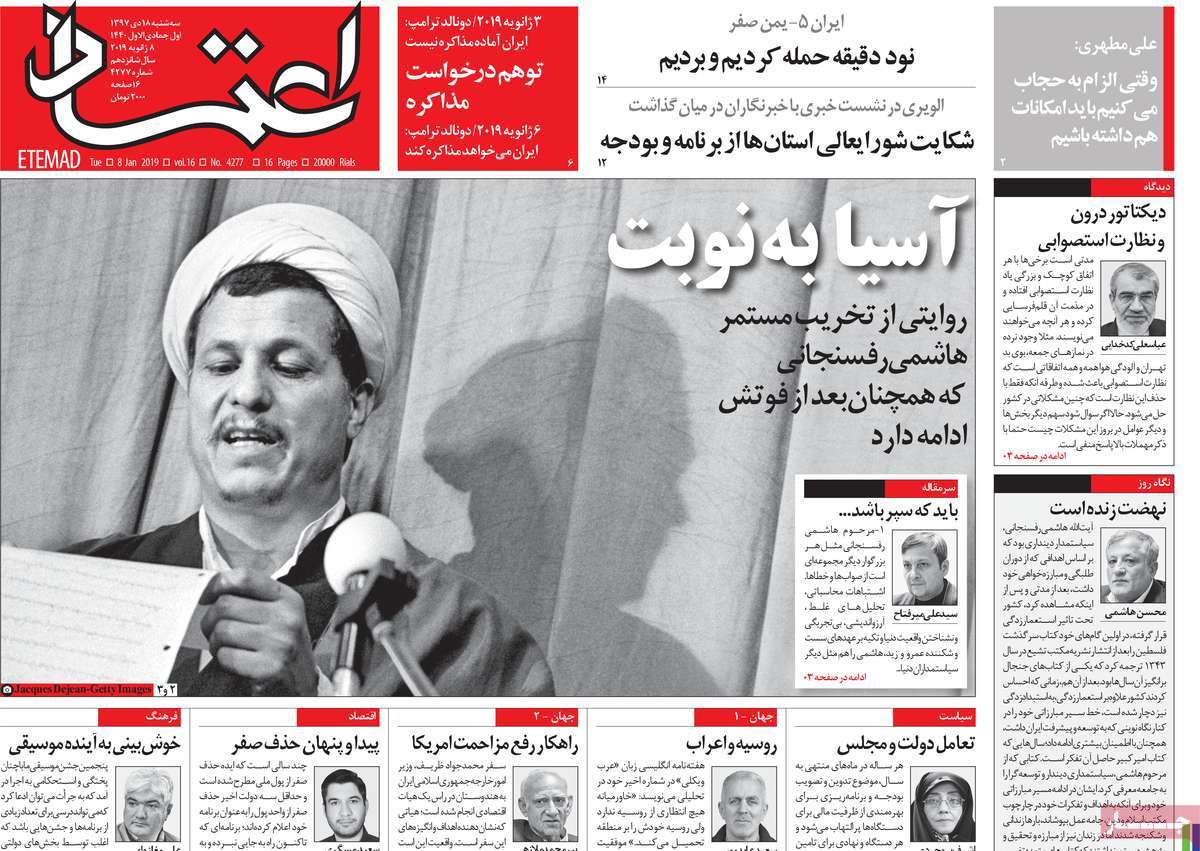
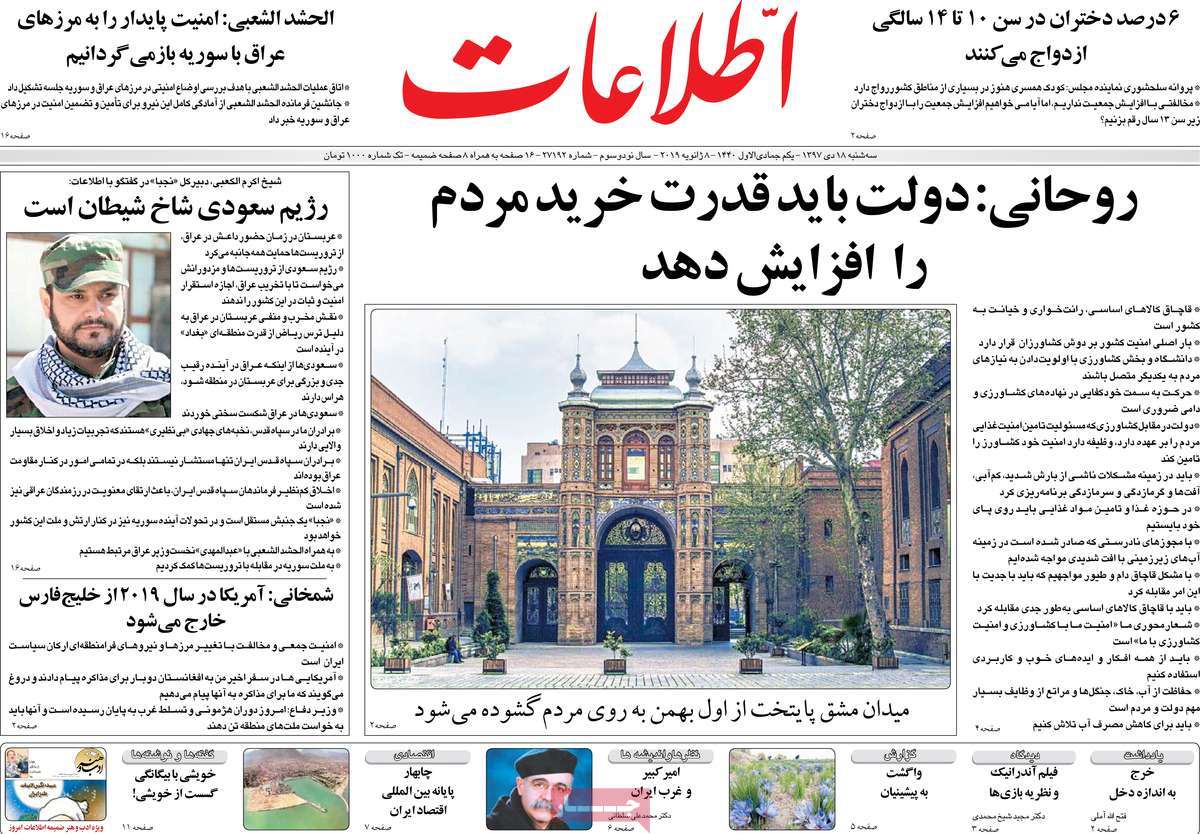
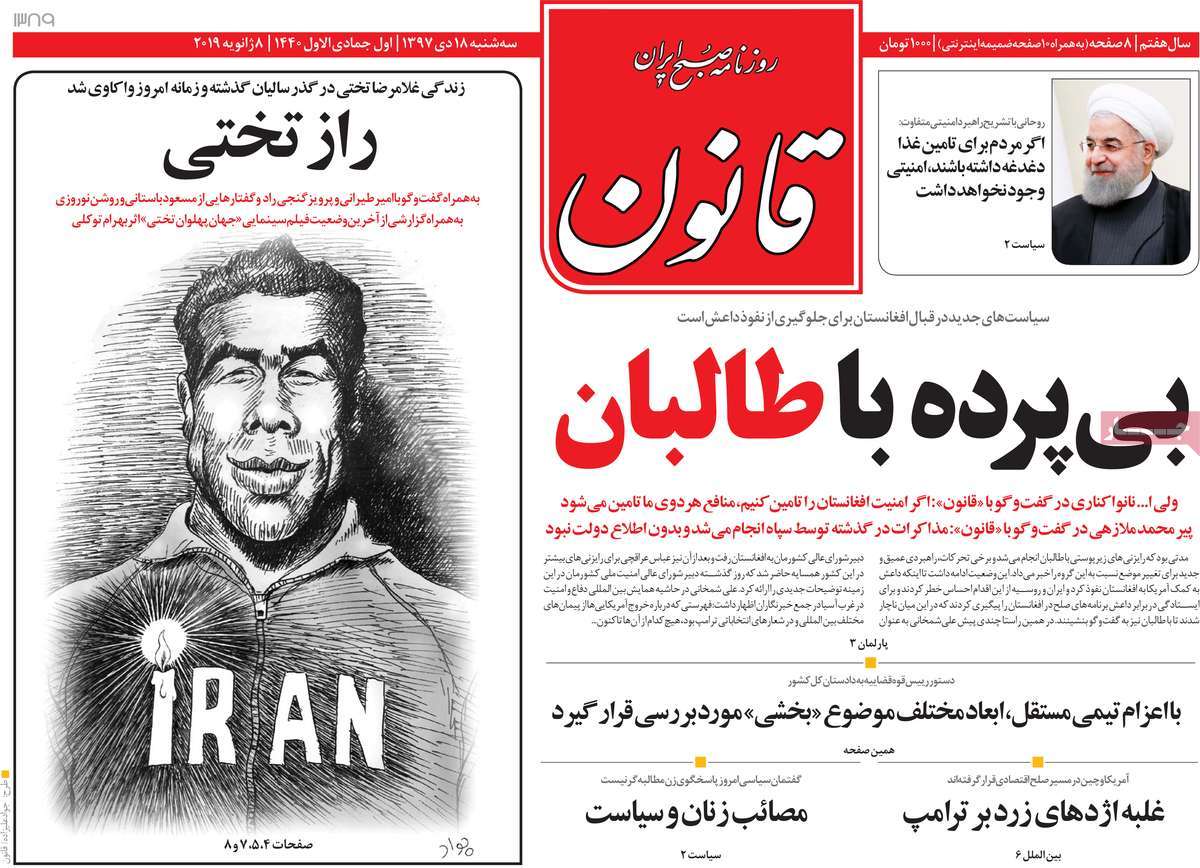
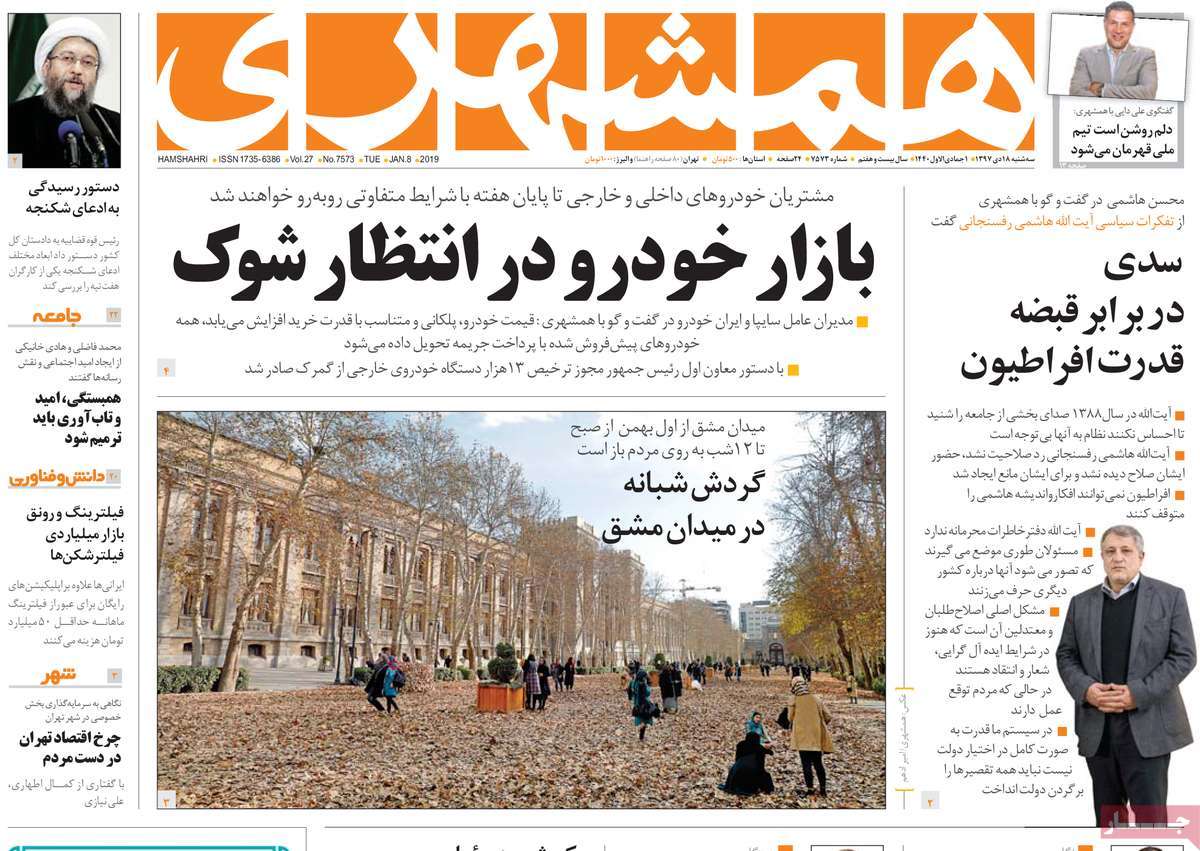
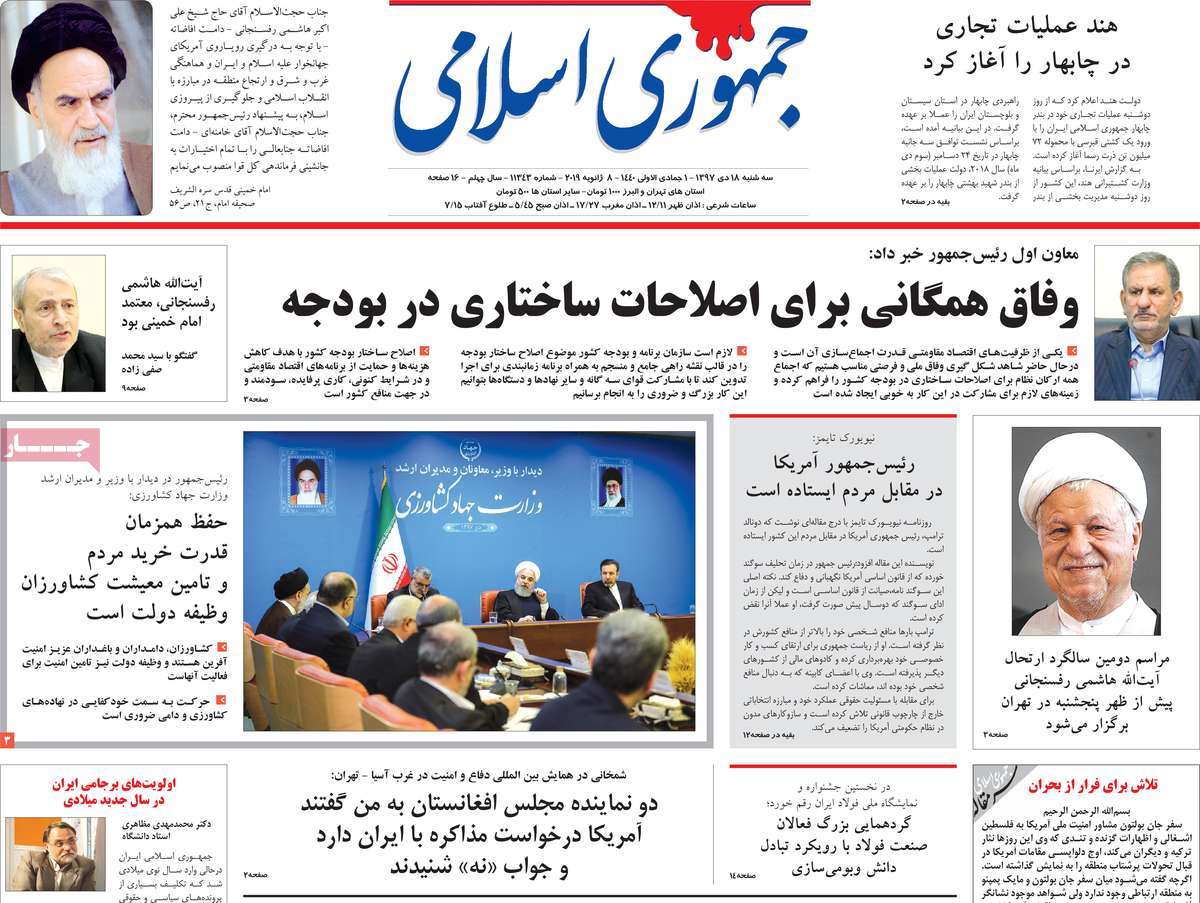
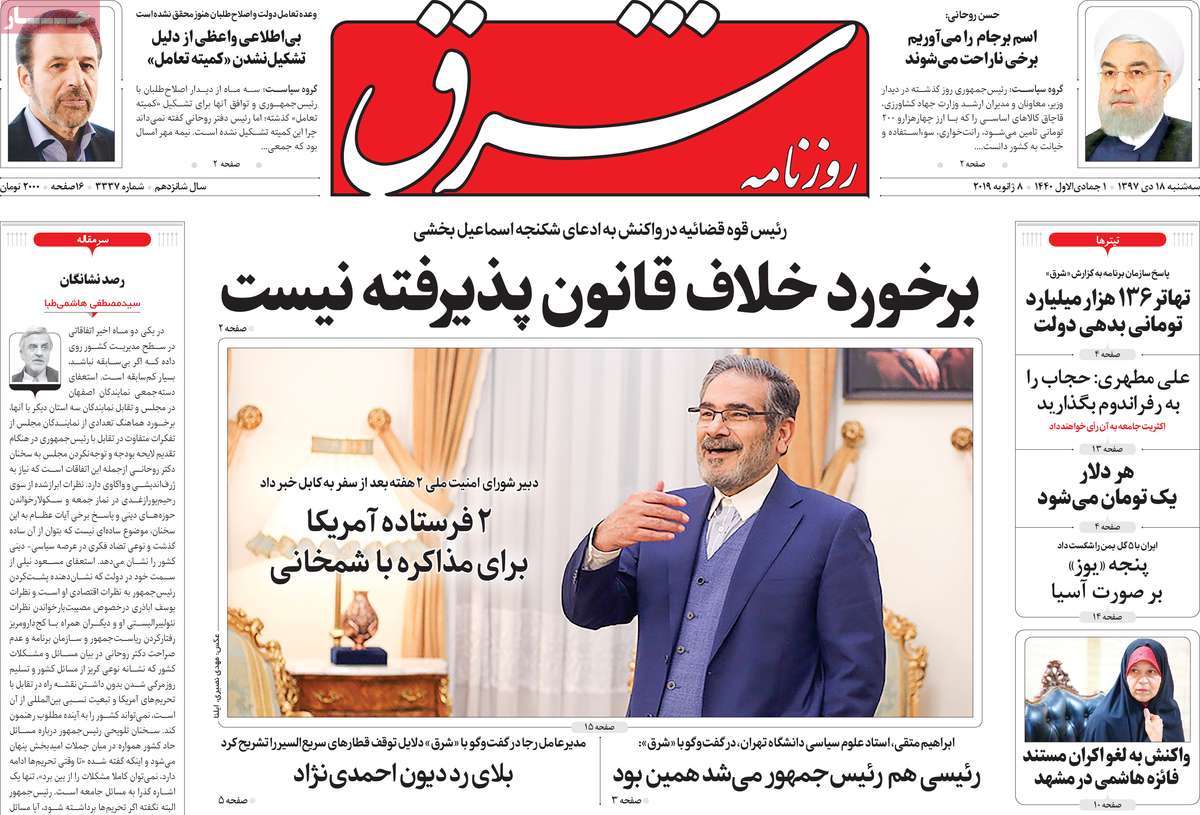
A Look at Iranian Newspaper Front Pages on January 8

A Look at Iranian Newspaper Front Pages on November 19

The top story in all papers today was comments by Secretary of Iran’s Supreme National Security Council Ali Shamkhani, who revealed the US has called for talks with him during his recent visit to Kabul.

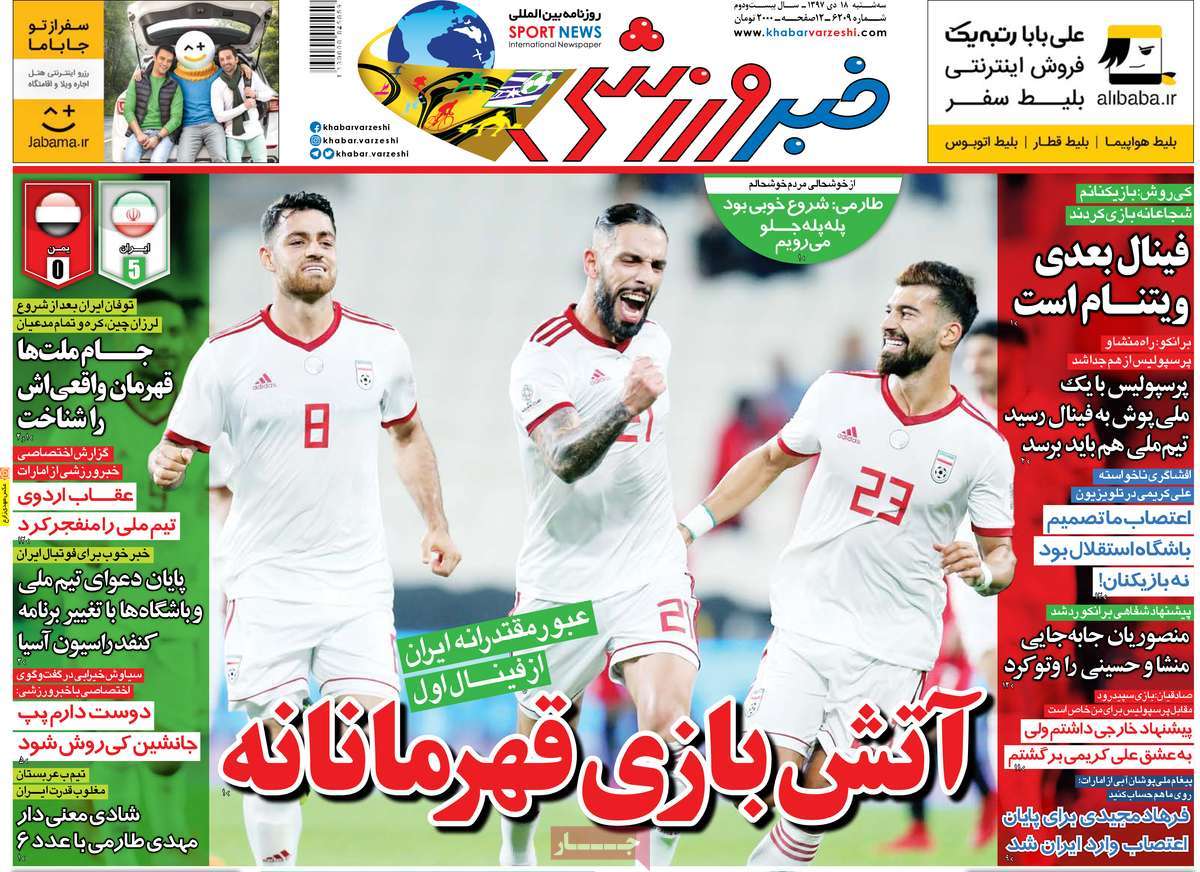
Also a top story was the Iranian national football team’s 5-0 win against Yemen in the first match of the group stage of Asian Cup 2019 in the UAE.

Several papers highlighted an order by Judiciary Chief Ayatollah Sadeq Amoli Larijani to probe into the allegation that labour rights activist Esmaeil Bakhshi has been tortured in prison.

A call by Vice-Speaker of Iran’s Parliament Ali Motahari for a referendum on the issue of Hijab, and the US-China talks on ending their trade war also received great coverage.

The above issues, as well as many more, are highlighted in the following headlines and top stories:


Aftab-e Yazd:

1- Instagram Not to Be Blocked: Official

2- US Seeks to Hold Talks with Iran

3- Horrible Viral Story of Boy from Sirjan Who Brutally Beat Girl from Tehran

A Look at Iranian Newspaper Front Pages on January 8


Arman-e Emrooz:

1- Iranians to Vote for Hijab in Possible Referendum: MP

2- Asia Intimidated by Iran Earthquake: Team Melli Defeats Yemen 5-0

3- US Calls for Talks with Iran, Says Top Security Official Shamkhani

A Look at Iranian Newspaper Front Pages on January 8


Donya-ye Eqtesad:

1- Market Reactions to US-China Business Peace

2- Obama’s Deputy to Compete with Trump

* Biden: I’m Only One Who Can Defeat Trump

A Look at Iranian Newspaper Front Pages on January 8


Ebtekar:

1- Pompeo’s Mission in Middle East [Editorial]

2- Will Central Bank Manage to Keep US Dollar Rate Stable until Nowruz?

A Look at Iranian Newspaper Front Pages on January 8


Etemad:

1- A Report on Continued Attacks against Hashemi Rafsanjani Even after His Death

2- Illusion of Calling for Talks

* Trump on January 3: Iran Not Ready for Talks

* Trump on January 6: Iran Wants to Hold Talks with US

A Look at Iranian Newspaper Front Pages on January 8


Ettela’at:

1- Government Must Increase People’s Purchasing Power: Rouhani

2- Saudi Regime Is Satan’s Horn: Iraqi Cleric

3- Six Percent of Girls in Iran Get Married at Ages of 10 to 14

4- US to Withdraw from Persian Gulf in 2019: Iran’s Top Security Official

A Look at Iranian Newspaper Front Pages on January 8


Ghanoon:

1- Judiciary Chief Tasks Independent Team with Investigating Torture Claims

2- China Defeats Trump: Washington-Beijing Peace on Trade

3- Talks with Taliban Aimed at Preventing ISIS from Making Inroads

A Look at Iranian Newspaper Front Pages on January 8


Hamshahri:

1- Iran’s Car Market Waiting for a Shock

2- Hashemi Rafsanjani Was Barrier to Power of Radicals

A Look at Iranian Newspaper Front Pages on January 8


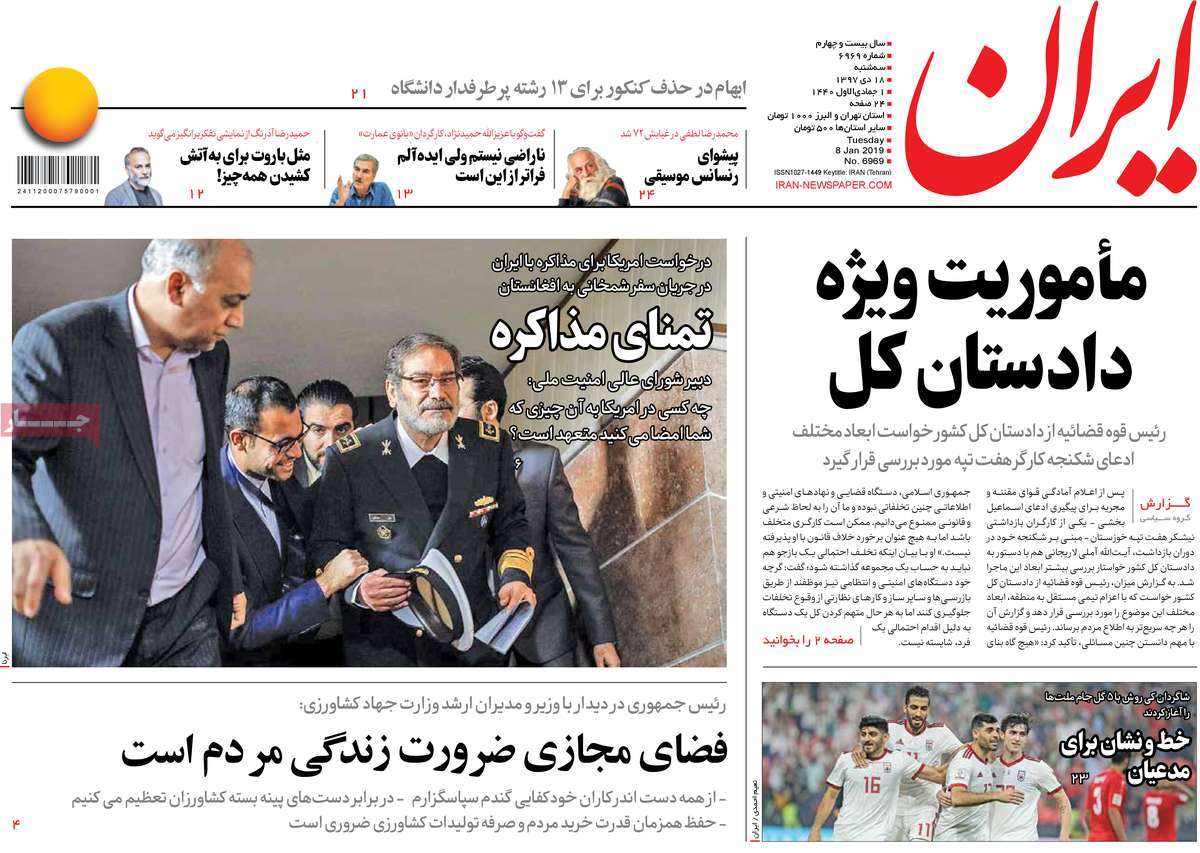
Iran:

1- Prosecutor-General Tasked with Probing into Alleged Torture of Labour Activist

2- US Begs for Talks with Iran

3- Cyberspace Necessary Part of People’s Lives: Rouhani

A Look at Iranian Newspaper Front Pages on January 8


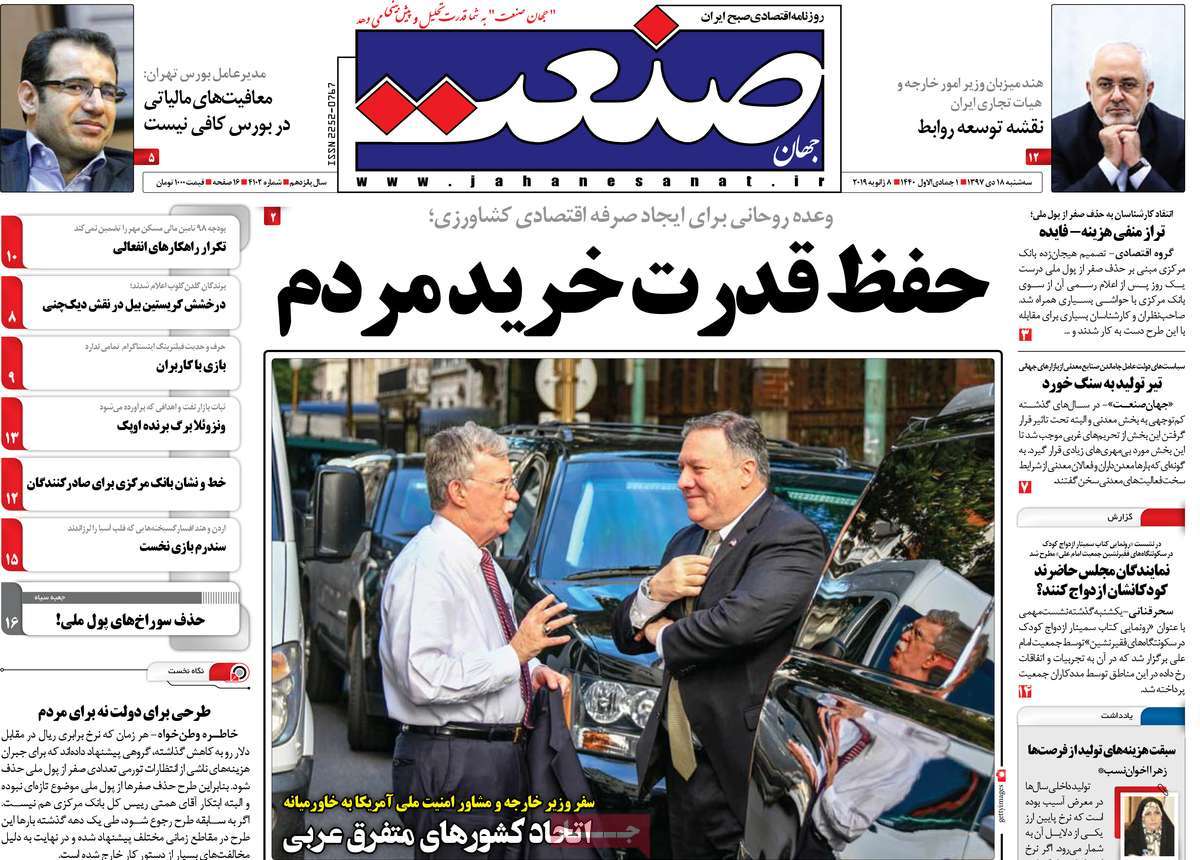
Jahan-e San’at:

1- Pompeo in Mideast to Unite Divided Arab Countries

2- India Hosting Iran FM, Business Delegation Accompanying Him

A Look at Iranian Newspaper Front Pages on January 8


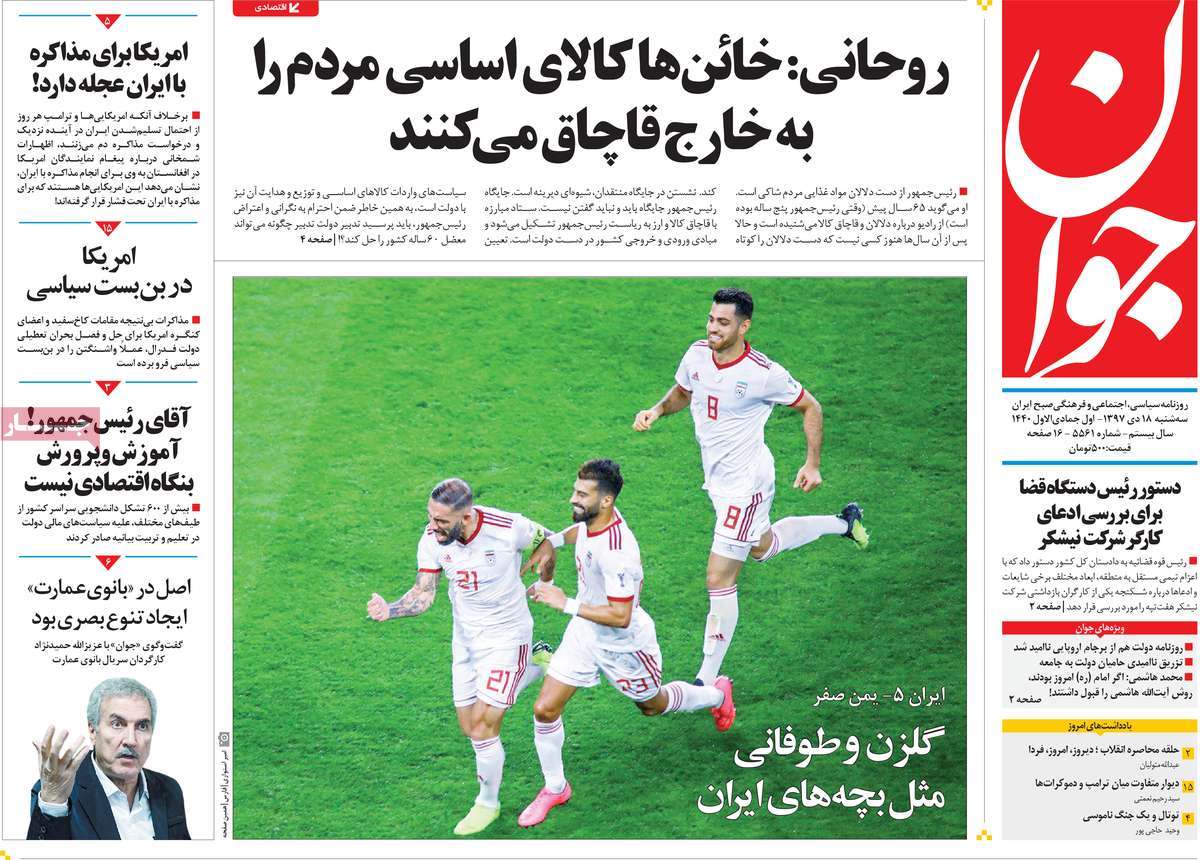
Javan:

1- US Rushing to Hold Talks with Iran!

2- Brilliant Performance by Team Melli

3- Judiciary Chief Calls for Probe into Labour Activist’s Torture Claim

A Look at Iranian Newspaper Front Pages on January 8


Jomhouri Eslami:

1- India Starts Business Operation in Iran’s Chabahar

2- US President Standing against People: New York Times

A Look at Iranian Newspaper Front Pages on January 8


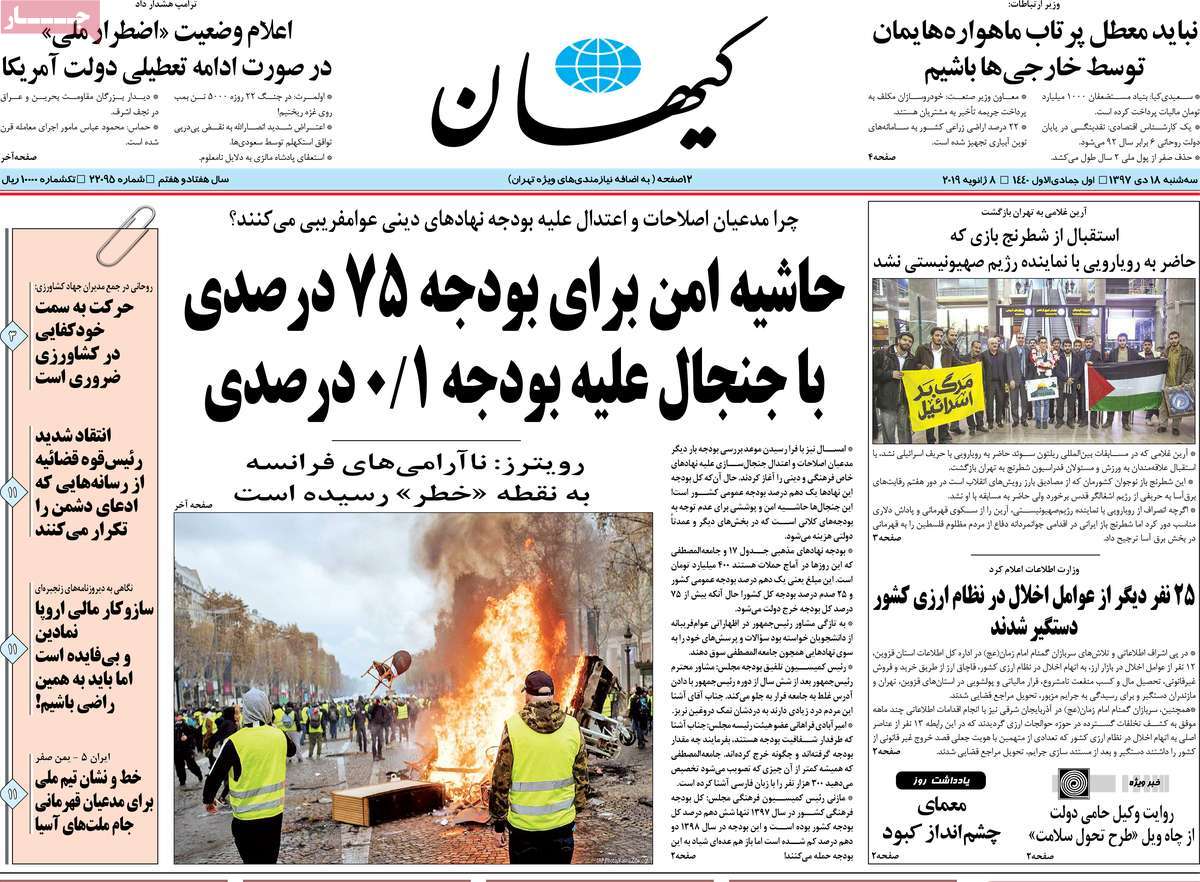
Kayhan:

1- Reuters: France Unrest at “Dangerous” Level

2- Iranian Chess Player Warmly Welcomed in Tehran after Refusing to Play against Israel

3- We Shouldn’t Wait for Foreigners to Send Our Satellites into Orbit

4- National Emergency to Be Declared in US If Gov’t Shut Down Goes on

A Look at Iranian Newspaper Front Pages on January 8


Khabar Varzeshi:

1- Heroic Performance: Iran Strongly Passes First Part of Asian Cup 2019

2- Vietnam Is Next Final Match for Iran

A Look at Iranian Newspaper Front Pages on January 8


Shargh:

1- US Sends Two Envoys for Talks with Shamkhani in Kabul

2- Vice-Speaker of Iran Parliament Calls for Referendum on Hijab

A Look at Iranian Newspaper Front Pages on January 8

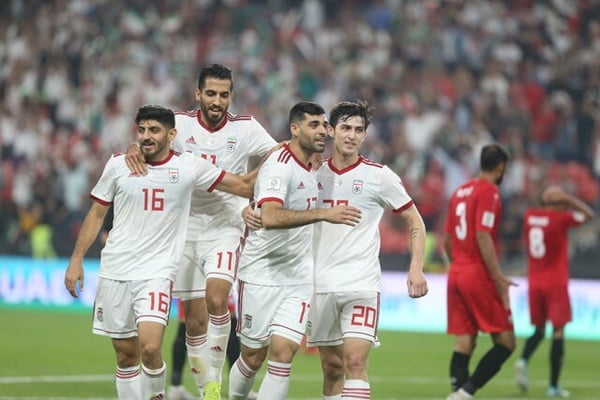
Iran Thrash Yemen in Asian Cup Opener

The Iranian team coached by Carlos Queiroz managed to establish the best start of the tournament by a team after taking the lead at the 12th minute of the match by striker Mehdi Taremi.

Team Melli finished the first half of the match with two other goals by Ashkan Dejagah at minute 23 (which was later named an own goal) and Taremi at 25.

In the second half, Iran continued to dominate and scored three other goals, one by Taremi, another by Sardar Azmoon, and a last one by Saman Ghoddos.

Iran had the upper hand throughout the match with Yemeni team failing to make a serious threat against its rival.

Iran along with Japan, South Korea, Australia and Saudi Arabia make up the main contenders at this year’s AFC Asian cup.

Now with the crushing victory, Team Melli is set to face Vietnam for its second match on January 12 in al-Nahyan stadium in Abu Dhabi. It then will face Iraq on January 16 in Al Maktoum Stadium in Dubai.

The 2019 men’s AFC Asian Cup started on Saturday with a kick off between the United Arab Emirates and Bahrain.

The final match will be held on February 1 in Abu Dhabi’s Sheikh Zayed Stadium. The cup is held from January 5 to February 1.

24 teams including Iran are competing with each other during the tournament in Abu Dhabi, Dubai, al-Ain and Sharjah cities.

The UAE was announced as the host for the tournament on 9 March 2015, with Iran being the only remaining bidder for the right to host the 2019 finals. It is the second time that the United Arab Emirates hosts the tournament after the 1996 finals.

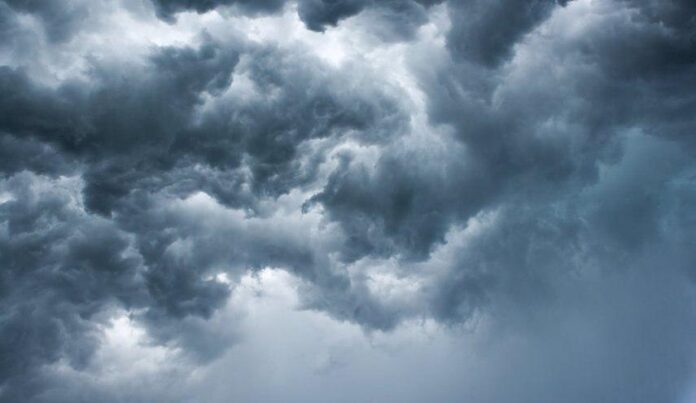
Iranian Scientists Seed Clouds Using Nanoparticles

According to Dr Mohammad Joghataie, a faculty member of physics department at Yazd University, the nanomaterials synthesised and tested at Yazd University are low-cost nanoscale materials that are produced with domestic materials and create the same effect as ice crystals.

These materials do not have adverse environmental effects when used in seeding of the clouds. Materials used in clouds seeding and defogging have the same structure.

“Many of our airports, such as Mashhad, Ardabil, Tabriz, Hamedan, etc., are facing cold fog problem. we can use this material to launch defogging at an effective distance from the airport. We also have more than 285 mountain passes in Iran that are foggy and we can use this technology there,” added Joghataie.

So far, such a project has not been carried out inside the country and graphene particles have not been used for cloud seeding and defogging, he noted.

These days, many countries in the world are involved with drought and lack of water resources, and in order to resolve the problem, they have gone through various technologies to have more rainfall and have access to new water resources.

Reports say one-third of the global population live under conditions of severe water scarcity at least 1 month of the year. Half a billion people in the world face severe water scarcity all year round. Half of the world’s largest cities also experience water scarcity.

Iran Ranks First in Nanotechnology in Western Asia

Based on this ranking conducted by Scimago, Iran has ranked first in the field of nanotechnology in West Asia.

In the picture below, you can see Iran’s first rank in nanotechnology:

It shows that Iran ranks first with 735 articles and Saudi Arabia ranks second with 631 papers. Egypt, the Zionist regime, Turkey, Iraq, the United Arab Emirates, Qatar, Jordan, Oman, Lebanon, Kuwait, the occupied territories, Yemen, Bahrain and the United Arab Emirates are respectively positioned after Iran and Saudi Arabia.

The United Arab Emirates, as the last country in Western Asia, has just published one article in 2017 on nanotechnology.

In a more general survey of 155 countries, Chinese scholars are the world’s leading scientists with 13,555 papers on nano, out of which 13,317 are citable.

The United States has the second position with 6,000 articles less than China. American scientists have produced 7,791 papers on nanoscience, of which 7,640 were cited.

The Scimago ranking system is conducted by a research group of the same name at the University of Granada in Spain. Scimago Journal Rank (SJR indicator) is a measure of scientific influence of scholarly journals that accounts for both the number of citations received by a journal and the importance or prestige of the journals where such citations come from.

A journal’s SJR is a numeric value indicating the average number of weighted citations received during a selected year per document published in that journal during the previous three years. Higher SJR values are meant to indicate greater journal prestige.