Sunday, January 18, 2026
Home Blog Page 3364

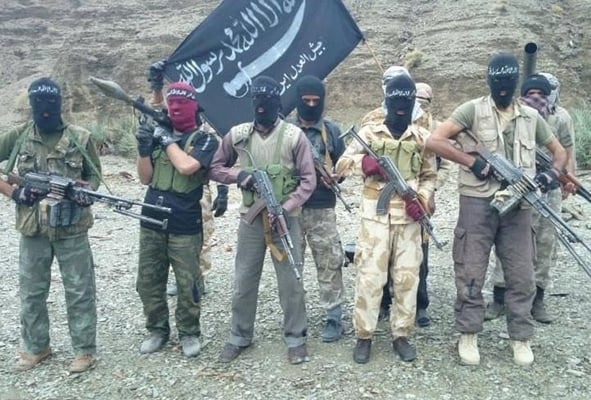
Several IRGC Forces Killed, Wounded by Terrorists in SE Iran

The attack, carried out by the Jaish al-Adl terrorist group on Saturday, targeted the morning parade of IRGC forces in the city of Nikshahr, Sistan and Baluchestan province.

According to local prosecutor Mohammadi, Morteza Ali-Ahmadi has been martyred in the attack, and five others have been wounded, two of whom are in severe conditions.

The wounded have been transferred to a local hospital in Nikshahr, and efforts are underway to arrest the terrorists.

Iran Starts Ten-Day Celebrations of 40th Revolution Anniversary

An apparent air of triumph and perspicacity hangs in every corner, especially after hawkish US national security adviser John Bolton said in 2017 that “the Ayatollah Khomeini’s 1979 revolution will not last until its 40th birthday.”

“The outcome of the president’s policy review should be to determine that the Ayatollah Khomeini’s 1979 revolution will not last until its 40th birthday. And that’s why, before 2019, we here will celebrate in Tehran!” he told a terrorist MKO convention in Paris.

Iranians, however, are facing a dramatic rise in US pressures through tough sanctions imposed last May, which prompted Leader of the Islamic Republic Ayatollah Seyyed Ali Khamenei to warn of bigger subversive American plots for 2019.

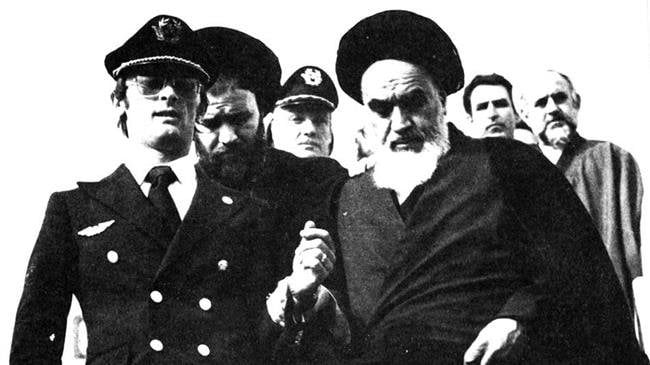
The nationwide ceremonies kicked off at 9:33 a.m. local time (0603 GMT), the time when the late founder of the Islamic Republic Imam Khomeini returned to the Iranian capital on February 1, 1979 after a 15-year exile in Paris.

A special ceremony is being held at Imam Khomeini’s mausoleum south of Tehran, with a host of senior state and military officials as well as thousands of people from all walks of life in attendance.

Another ceremony is held at Behesht-e Zahra cemetery south of the capital, where Imam Khomeini delivered his first speech after the exile, in an address to five million people.

Similar ceremonies are held across Iran and in other parts of the world to mark the first day of the Ten-Day Dawn period.

On Wednesday, Ayatollah Khamenei paid respect to Imam Khomeini and Iranian martyrs in the lead-up to the Ten-Day Dawn period.

Ayatollah Khamenei visited Imam Khomeini’s mausoleum in southern Tehran, where he offered his prayers and recited verses from the Holy Qur’an.

The Leader then visited the burial ground of martyrs, where he prayed for the souls of the people who lost their lives either during the popular uprising that led to the Revolution or in the course of their struggle to uphold revolutionary values afterwards.

Ayatollah Khamenei also paid tribute to those martyred on June 28, 1981, during a bomb attack staged by the notorious US-backed Mujahedin Khalq Organization (MKO) terror group in Tehran.

The Leader further offered prayers at the tombstones of those who lost their lives during the 1980-88 Iraq war against the Islamic Republic.

Imam Khomeini spent more than 14 years in exile, mostly in the Iraqi holy city of Najaf. He also spent some time in Turkey and France before his return to Iran.

Millions of people converged on the capital from across the country on the day of his return. His arrival gave considerable momentum to popular protests against the US-backed Pahlavi regime, which eventually led to its overthrow ten days later.

The 10-Day Dawn festivities will culminate in nationwide rallies on February 10 this year, the anniversary of the Islamic Revolution.

The period witnessed last-ditch efforts by the Washington-backed regime of Iran’s former monarch to hold onto power by unleashing deadly force against pro-Revolution protesters.

The entire struggle resulting in the Revolution was led by Imam Khomeini, who successfully united the people against Pahlavi oppression and dependence on the US.

Iran Congratulates Qatar on Claiming AFC Asian Cup Title

In his statement, Qassemi wished greater success for the meritorious players and coaches of the Qatari national football team.

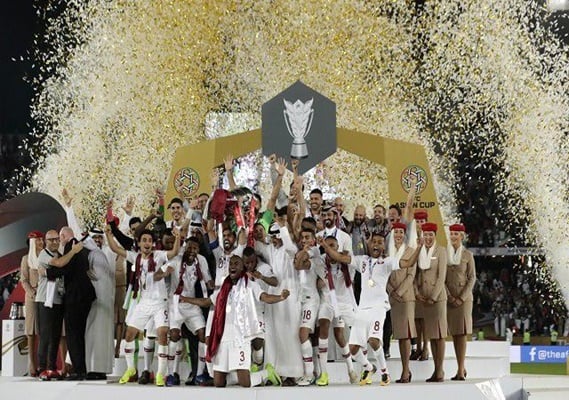
In a match on Friday night, Qatar defeated the four-time champion Japan with a stunning 3-1 to win its first Asian title.

The pair both found the net brilliantly in an inspirational first half for Qatar, while, despite a spirited second-half display from Japan, Akram Afif added a late penalty to secure the West Asian nation’s first-ever Continental crown in spectacular fashion.

On a historic night for the Qataris, Felix Sanchez’s talented charges recorded their seventh successive victory, while Ali’s ninth strike of the competition saw him break Ali Daei’s record for the most goals by a player in a single edition of Asia’s premier event.

While there was unbridled joy for Qatar, the defeat ended Japanese hopes of claiming what would have been a record-extending fifth title.

Japan, who had Tsukasa Shiotani replacing Wataru Endo, were quick to take the game to Qatar as Yuya Osako sent a fourth minute effort wide of the target.

However, it was to be their opponents who took the lead just eight minutes later through a moment of brilliance from Ali.

The young striker received the ball from Afif before juggling the ball twice and sending a spectacular overhead kick beyond the reach of Japan goalkeeper Shuichi Gonda to etch himself into the record books and further underline his burgeoning reputation.
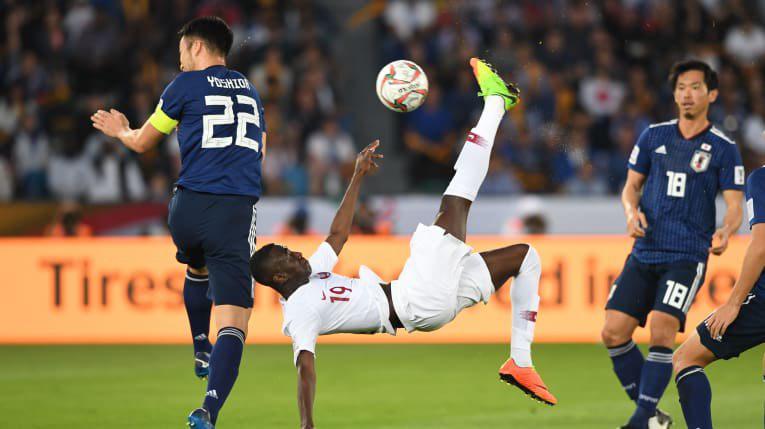
Iran Congratulates Qatar on Claiming AFC Asian Cup TitleAfter their early setback, Japan looked for a quick response, but continually failed to find a way through a resolute Qatari defence that had not conceded a single goal en route to the title showdown.

With their frontline failing to shine, worse was to come for Japan on 27 minutes when yet another Akram Afif assist – his 10th of the competition – found the back from suspension Abdelaziz Hatim who curled a delightful effort into the bottom corner to double Qatar’s advantage.

Two nearly became three for Qatar shortly after, as captain Hassan Al Haydos hit the outside of a post with an angled shot following Pedro Correia’s deflected cross.

To their credit, Japan refused to buckle, and they came close to reducing the deficit on the stroke of half-time, Osako narrowly failing to apply a finishing touch to a Yuto Nagatomo cross when well-placed.

In need of a response, Japan once again started brightly, with Maya Yoshida heading over from a corner inside the first five minutes of the second period.

With the game’s pace showing no sign of relenting, Almoez Ali then skied a chance from close-range, while, at the other end, substitute Yoshinori Muto and Yoshida both flashed headers off target as the Samurai Blue continued to press.

Their persistence duly paid off on 69 minutes as Takumi Minamino reduced the deficit courtesy of a wonderful dinked finish over Qatar custodian Saad Al Sheeb after being set up by Osako.

It mattered little however, as, with eight minutes remaining, referee Ravshan Irmatov pointed to the spot following Yoshida’s handball and a subsequent VAR review. Akram Afif converted the resulting penalty with aplomb to confirm Qatar’s title.
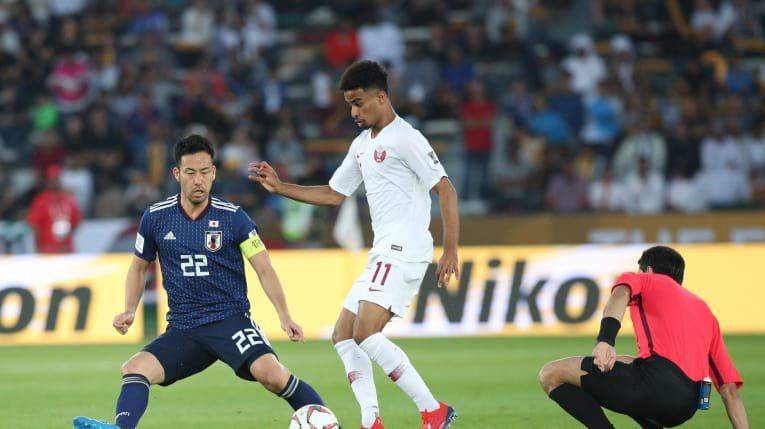

Iran Congratulates Qatar on Claiming AFC Asian Cup Title

Iran Hails Formation of New Lebanese Gov’t

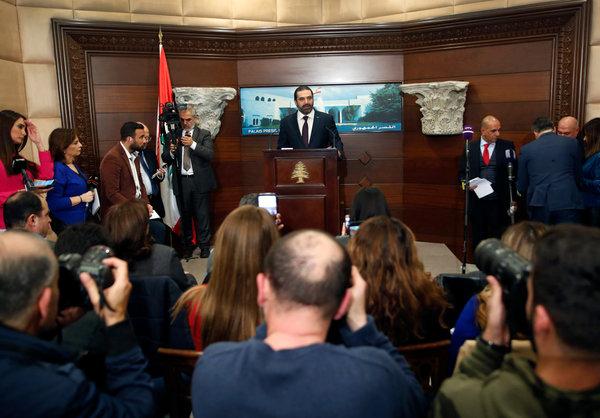
Prime Minister Saad Hariri of Lebanon, centre, speaking to journalists at the presidential palace east of Beirut on Jan. 31, 2019. / Photo by AP

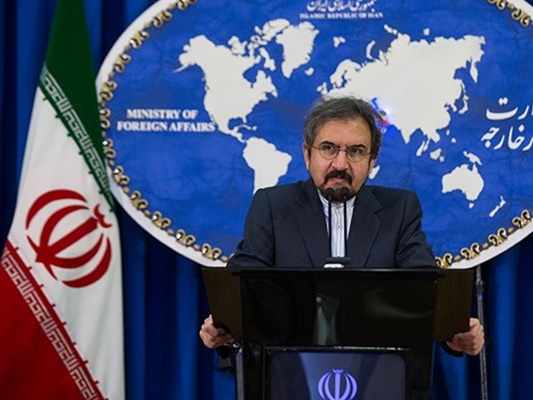
“The Islamic Republic of Iran congratulates the Lebanese government and nation on the formation of the new government, which was an outcome of sympathy and understanding among all Lebanese groups and clans,” Bahram Qassemi said Thursday.

“This success is not limited to the formation of the government, and indeedshows the will of a nation and its leaders to shape their future within the framework of independence and without any foreign pressure and with unity, agreement and sympathy,” he said.

The spokesman stressed the continuation of Iran’s support for stability and security of Lebanon, expressing hope that the formation of the Lebanese government would open a new chapter in the country’s history and improve relations between political groups and prepare the ground for further development of Lebanon.

Lebanon’s presidency on Thursday announced the formation of a new national unity government, putting an end to a nine-month stalemate on the political stage, which fueled the Arab country’s economic woes.

The new cabinet was unveiled during a press conference at the presidential palace in the capital, Beirut, after rival political factions managed to hammer out their differences over the government line-up.

The new government — headed by Prime Minister Saad Hariri — includes 30 ministers from most Lebanese political factions, which have been in talks after the country held in May 2018 its first parliamentary elections in nine years.

According to a statement by Lebanon’s presidency, Finance Minister Ali Hassan Khalil from Parliament Speaker Nabih Berri’s Amal party, and Foreign Minister Gebran Bassil, who leads President Michel Aoun’s Free Patriotic Movement, have retained their positions in the new cabinet.

Lebanon’s Hezbollah resistance movement has chosen Jamil Jabak as the new health minister, despite the fact that he is not a member of the movement.

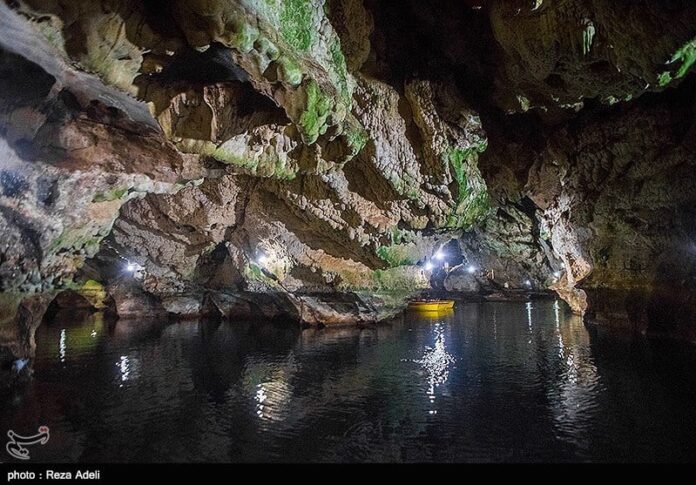
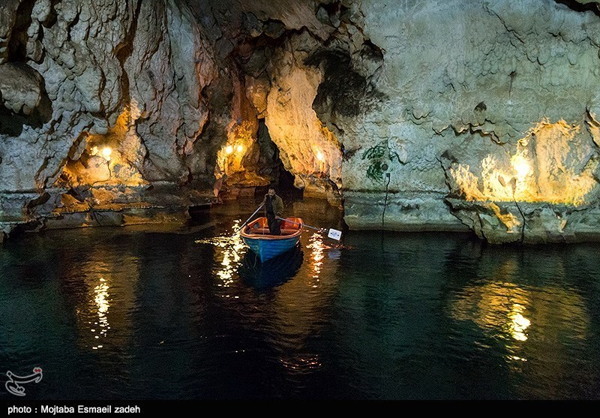
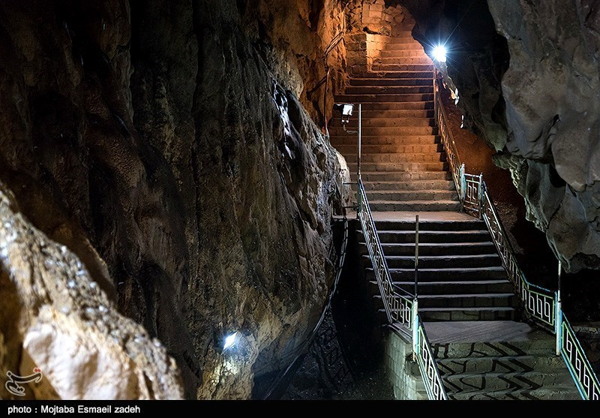
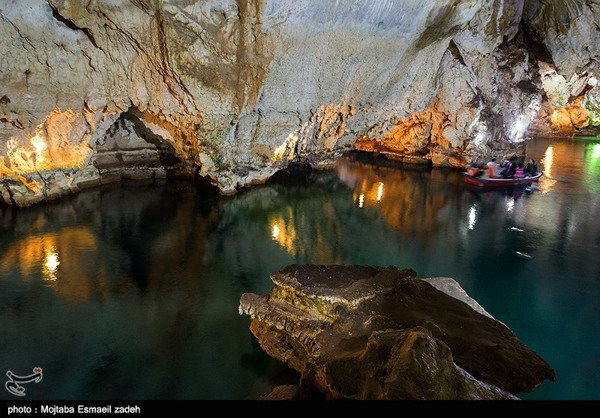
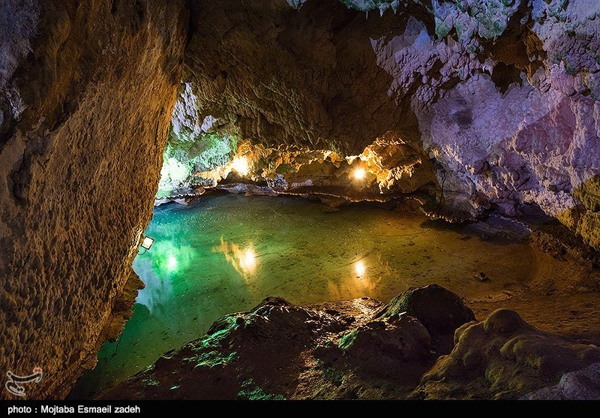
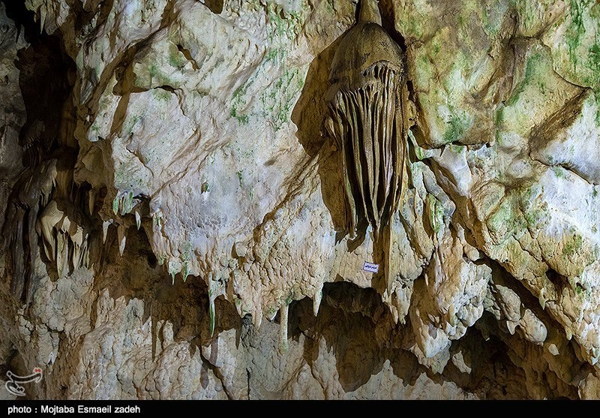
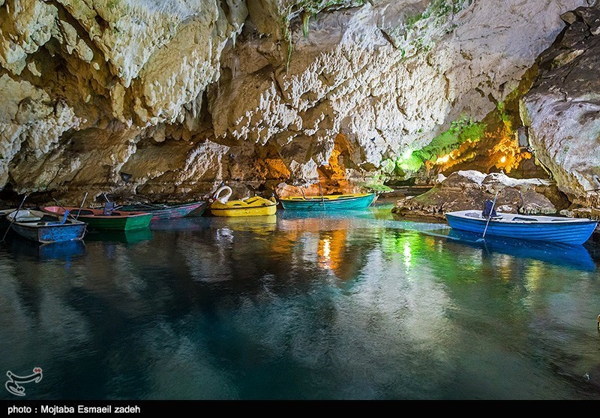
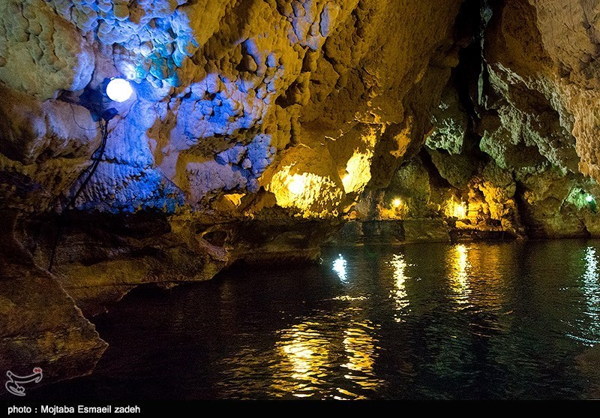
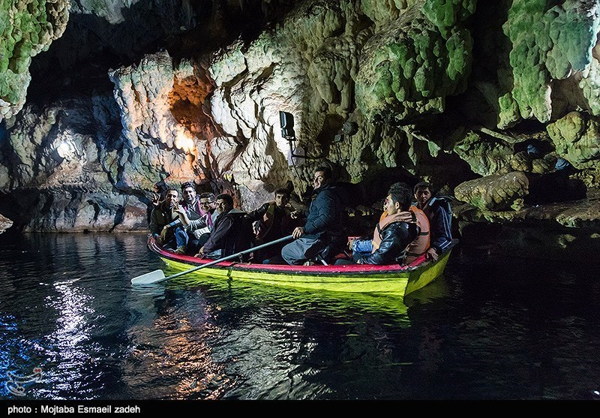
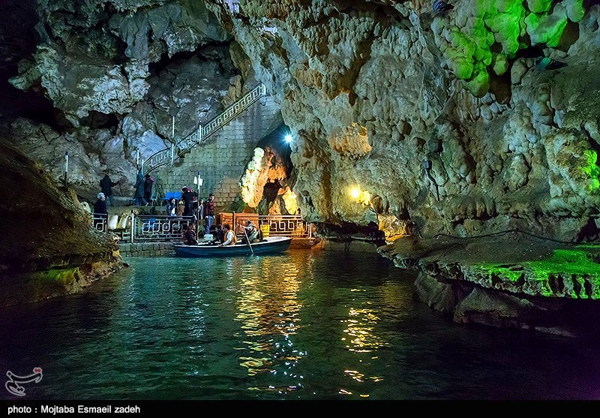
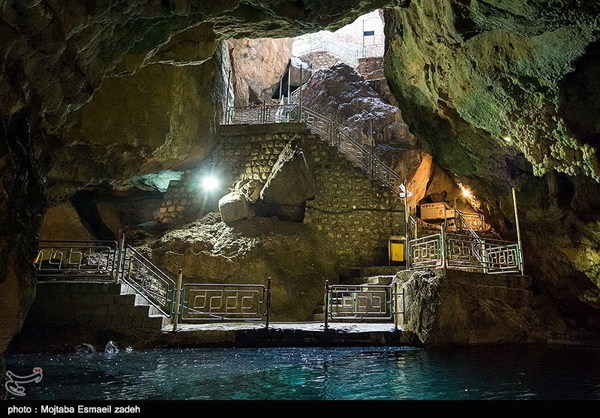
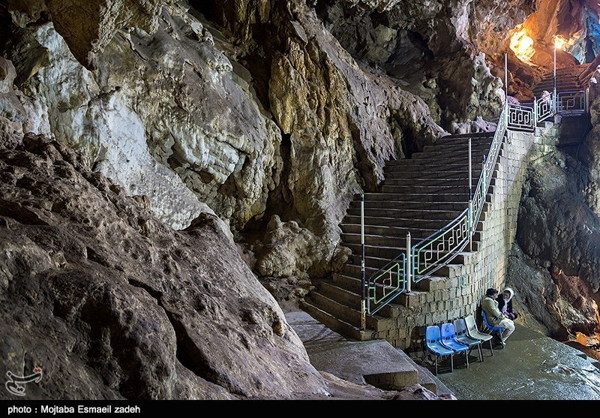
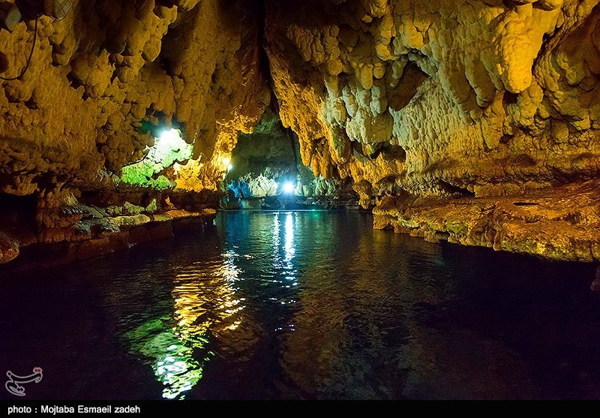
Iran’s Saholan Cave; A Mecca for Nature Lovers

Iran’s Saholan Cave

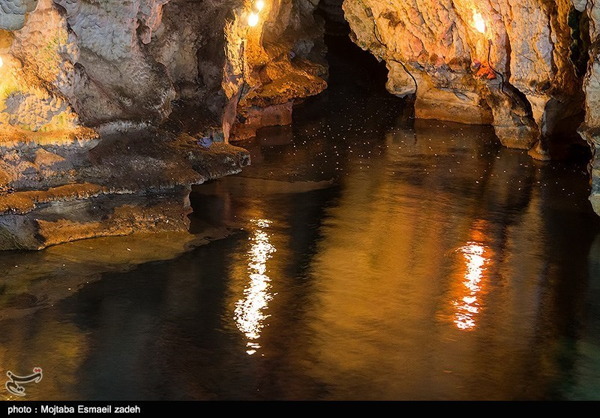
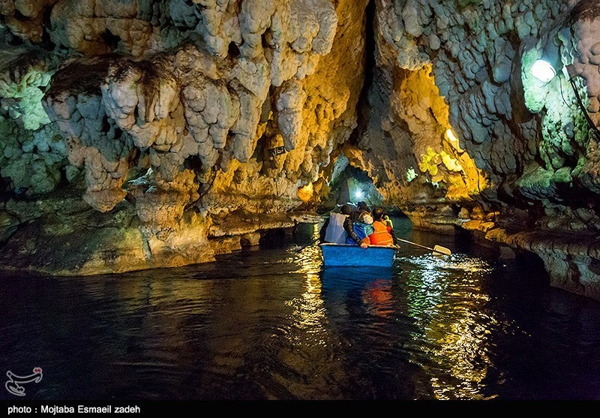
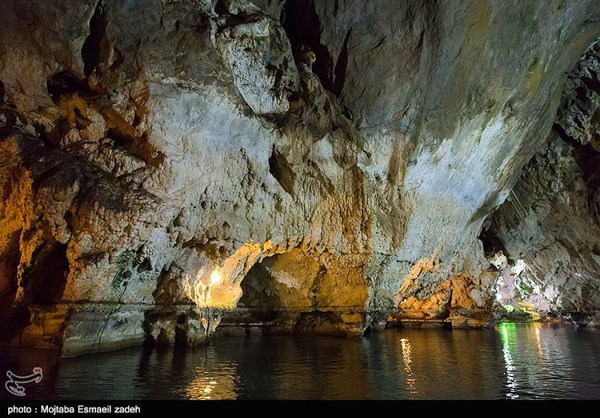
Saholan is a beautiful water cave in Iran, second only to the Ali Sadr Cave, which is the world’s largest. The cave’s scenic view makes it a mecca for nature lovers and eco-tourists alike.

The Saholan cave is located near a namesake village, 43 km to the east of Mahabad, in West Azerbaijan Province. The cave, which sits on a small hill of limestone, has two entrances and has been created by the corrosive effect of water.

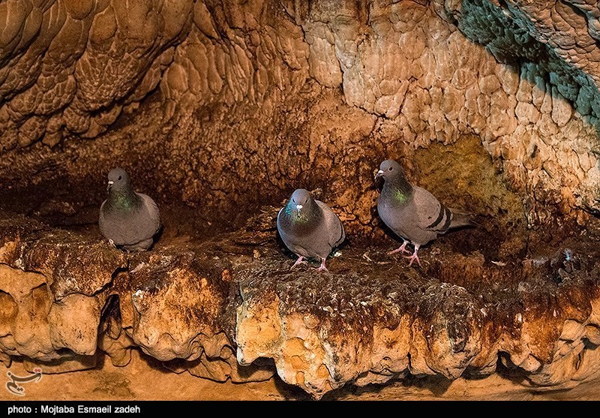
Geomorphological evidence collected from within the cave suggests that it has been formed under phreatic conditions by still water and not running water. Throughout the cave there are horizontal ledges of calcite deposits along the walls that are indicative of higher water levels in the past.

What follows are Tasnim News Agency’s photos of the cave:

Iran Welcomes Implementation of Europe’s Financial Mechanism

“The Islamic Republic of Iran believes the recent move by the European Union to register and announce its special financial mechanism [for trade] with Iran is Europe’s first step in fulfilling its obligations towards Iran as per a May 2018 statement by the foreign ministers of Iran and the three European countries,” Qassemi said in a Thursday statement.

He said Tehran welcomes the move, but at the same time calls for full implementation of all EU obligations in the shortest time possible.
“Following the US withdrawal from JCPOA, despite political positions held by the EU about protecting the deal and the need for Iran to gain economic benefits and the limited moves by the EU such as updating its blocking statute, unfortunately we have not seen tangible results and practical moves to Iran’s benefit,” he said.

“The EU’s move to create the special financial mechanism was carried out too late and the E3 and the EU must ensure that the move will compensate part of illegal US sanctions,” he said.

“The Islamic Republic of Iran is ready for continuing constructive engagement with the European Union and its member states based on and mutual interests and respect,” he said.

“Meanwhile, considering the limited, incomplete and long overdue fulfilment of EU obligations outlined in the May 2018 statement, Iran believes the bloc must accelerate [the implementation of] this move and the fulfilment of its other obligations to let the Iranian nation reap the economic benefits of JCPOA,” he said.

The European Union announced a long overdue special mechanism, called INSTEX (Instrument for Supporting Trade Exchanges), aimed at facilitating trade with the Islamic Republic of Iran in the face of the US sanctions.

INSTEX, which is the Special Purpose Vehicle (SPV) the EU had long promised to create, “will support legitimate European trade with Iran, focusing initially on the sectors most essential to the Iranian population – such as pharmaceutical, medical devices and agri-food goods.”

“INSTEX aims in the long term to be open to economic operators from third countries who wish to trade with Iran and the E3 continue to explore how to achieve this objective,” reads a joint statement by the E3 Foreign Ministers Jean-Yves Le Drian (France), Heiko Maas (Germany), and Jeremy Hunt (United Kingdom) who announced the mechanism on Thursday.

EU Announces Special Mechanism for Trade with Iran

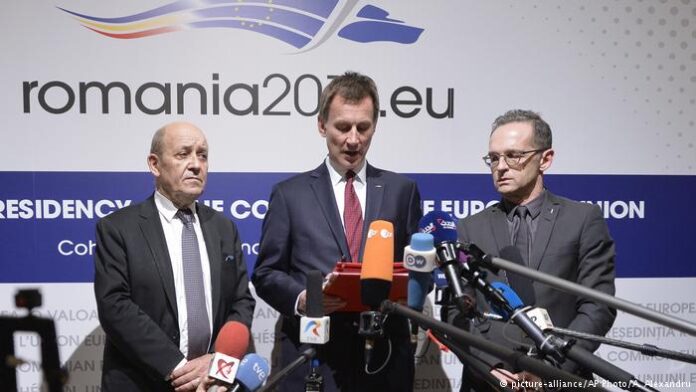
German Foreign Minister Heiko Maas, right, French Foreign Minister Jean-Yves Le Drian, left, and Jeremy Hunt United Kingdom's Secretary of State for Foreign and Commonwealth Affairs announce the EU's special mechanism for trade with Iran on January 31, 2019 / Photo by AP

INSTEX, which is the Special Purpose Vehicle (SPV) the EU had long promised to create, “will support legitimate European trade with Iran, focusing initially on the sectors most essential to the Iranian population – such as pharmaceutical, medical devices and agri-food goods.”

“INSTEX aims in the long term to be open to economic operators from third countries who wish to trade with Iran and the E3 continue to explore how to achieve this objective,” reads a joint statement by the E3 Foreign Ministers Jean-Yves Le Drian (France), Heiko Maas (Germany), and Jeremy Hunt (United Kingdom) who announced the mechanism on Thursday.

What follows is the full text of the statement:

France, Germany and the United Kingdom, in accordance with their resolute commitment and continued efforts to preserve the Joint Comprehensive Plan of Action (JCPOA) endorsed by United Nations Security Council resolution 2231, announce the creation of INSTEX SAS (Instrument for Supporting Trade Exchanges), a Special Purpose Vehicle aimed at facilitating legitimate trade between European economic operators and Iran.

The E3 reaffirm that their efforts to preserve the economic provisions of the JCPOA are conditioned upon Iran’s full implementation of its nuclear-related commitments, including full and timely cooperation with the IAEA.

INSTEX will support legitimate European trade with Iran, focusing initially on the sectors most essential to the Iranian population – such as pharmaceutical, medical devices and agri-food goods. INSTEX aims in the long term to be open to economic operators from third countries who wish to trade with Iran and the E3 continue to explore how to achieve this objective.
The creation of INSTEX is a major first step taken by E3 countries today. The operationalisation of INSTEX will follow a step-by-step approach:
The E3 together with INSTEX will continue to work on concrete and operational details to define the way the company will operate.

The E3 will also work with Iran to create an effective and transparent corresponding entity that is required to be able to operationalise INSTEX.

INSTEX will function under the highest international standards with regards to anti-money laundering, combating the financing of terrorism (AML/CFT) and EU and UN sanctions compliance. In this respect, the E3 expect Iran to swiftly implement all elements of its FATF action plan.

The E3 underline their commitment to pursue the further development of INSTEX with interested European countries to make this instrument in support of trade exchanges with Iran operational by following the steps set out above.

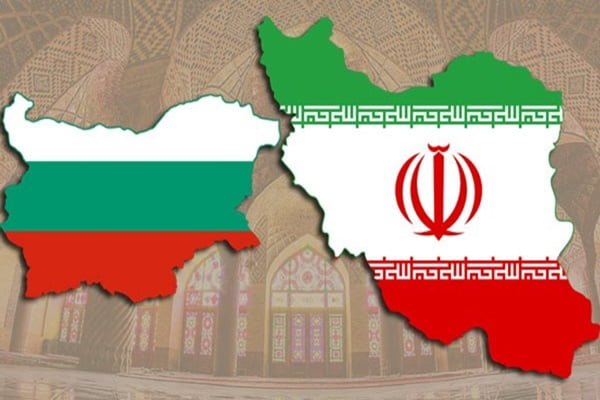
Sofia Seeks to Promote All-Out Cooperation with Tehran

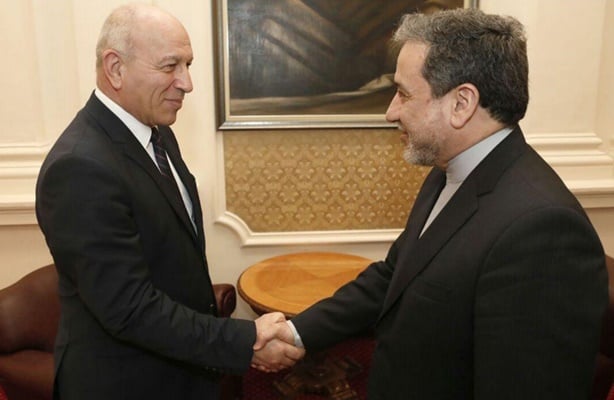
He made the remarks in a Thursday meeting with Iranian Deputy Foreign Minister for Political Affairs Seyyed Abbas Araqchi held in the Bulgarian capital.

Arnaudov expressed hope that political consultations between the two countries would lead to development of political, economic and cultural relations.

“Bulgaria attaches great importance to development of ties with a country that plays an important role in the Middle East in terms of culture and civilization,” he said.

Describing the Iran nuclear deal as a key element for peace and non-proliferation in the Middle East, Arnaudov reiterated Bulgaria’s support for the pact.

Araqchi, who is in Sofia for political consultations, had earlier held separate talks with Bulgarian Foreign Minister and Deputy Prime Minister Ekaterina Zakharieva, Deputy Foreign Minister Georgi Georgiev, Deputy Parliament Speaker Emil Hristov and members of the two countries’ friendship group, and the country’s representative in the EU parliament Angel Dzhambazki.

A Look at Iranian Newspaper Front Pages on January 31

A Look at Iranian Newspaper Front Pages on November 19

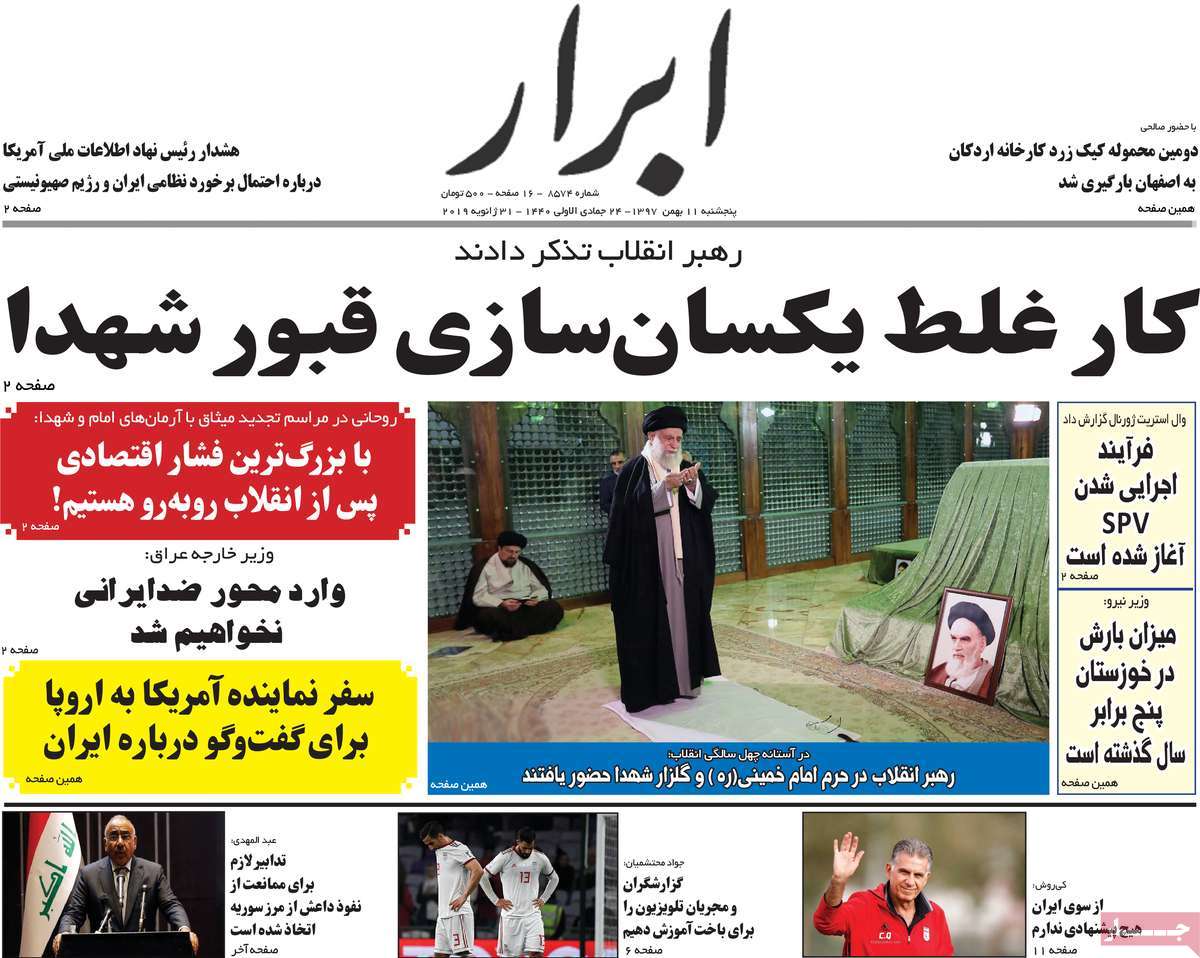
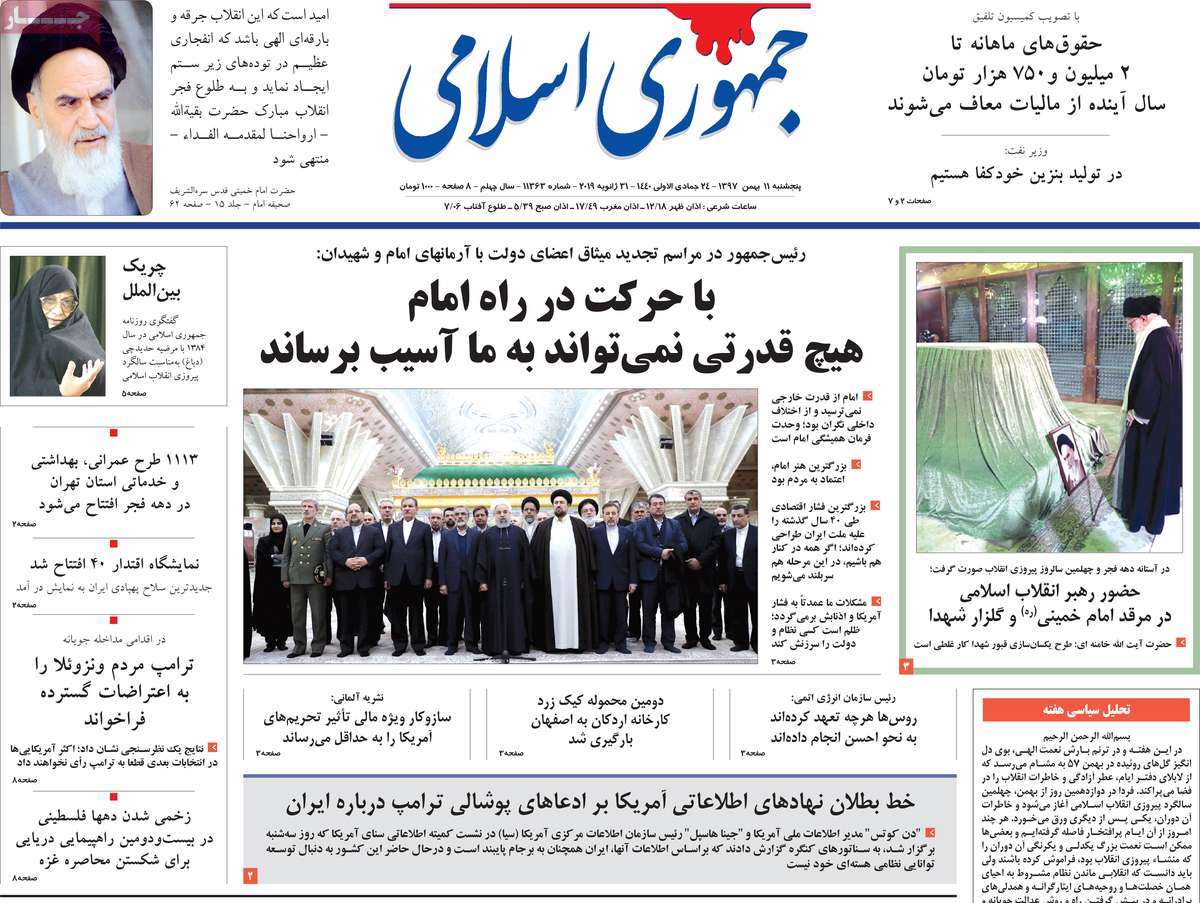
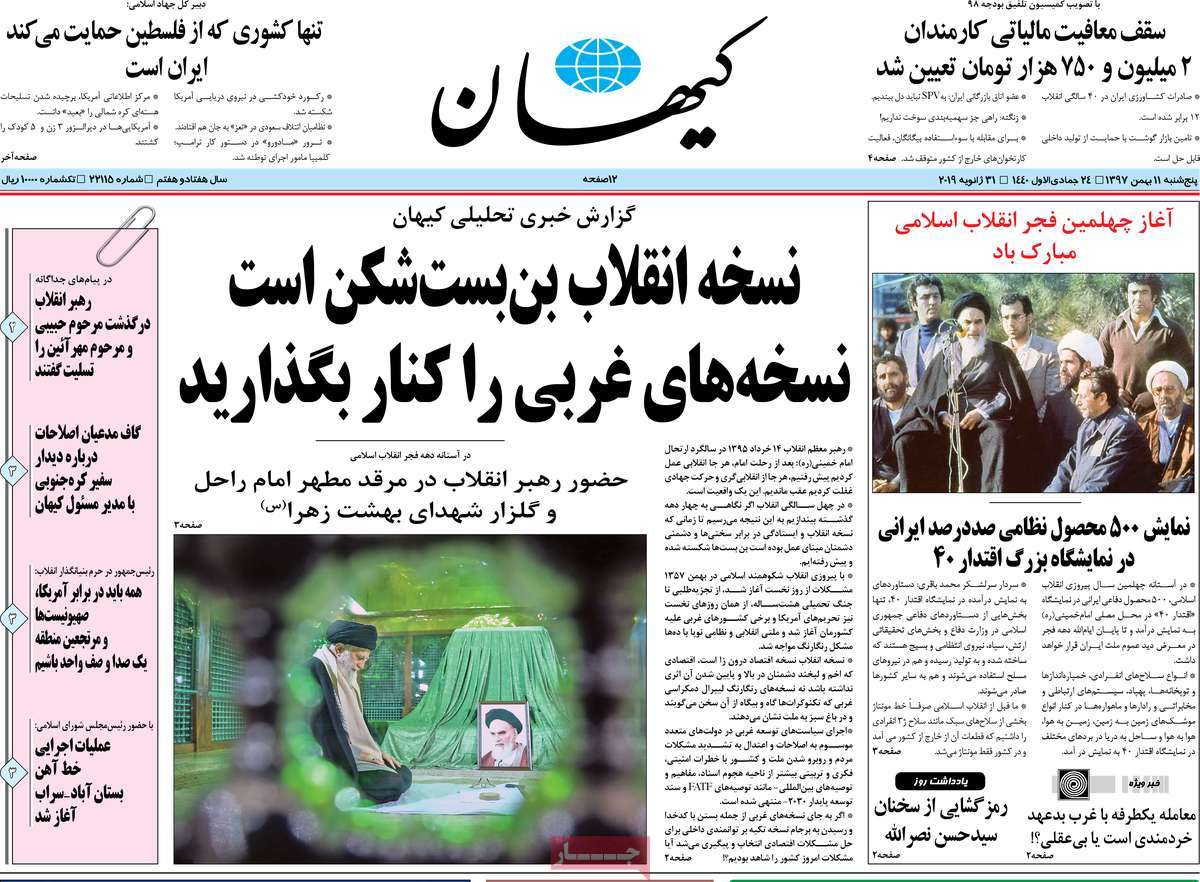
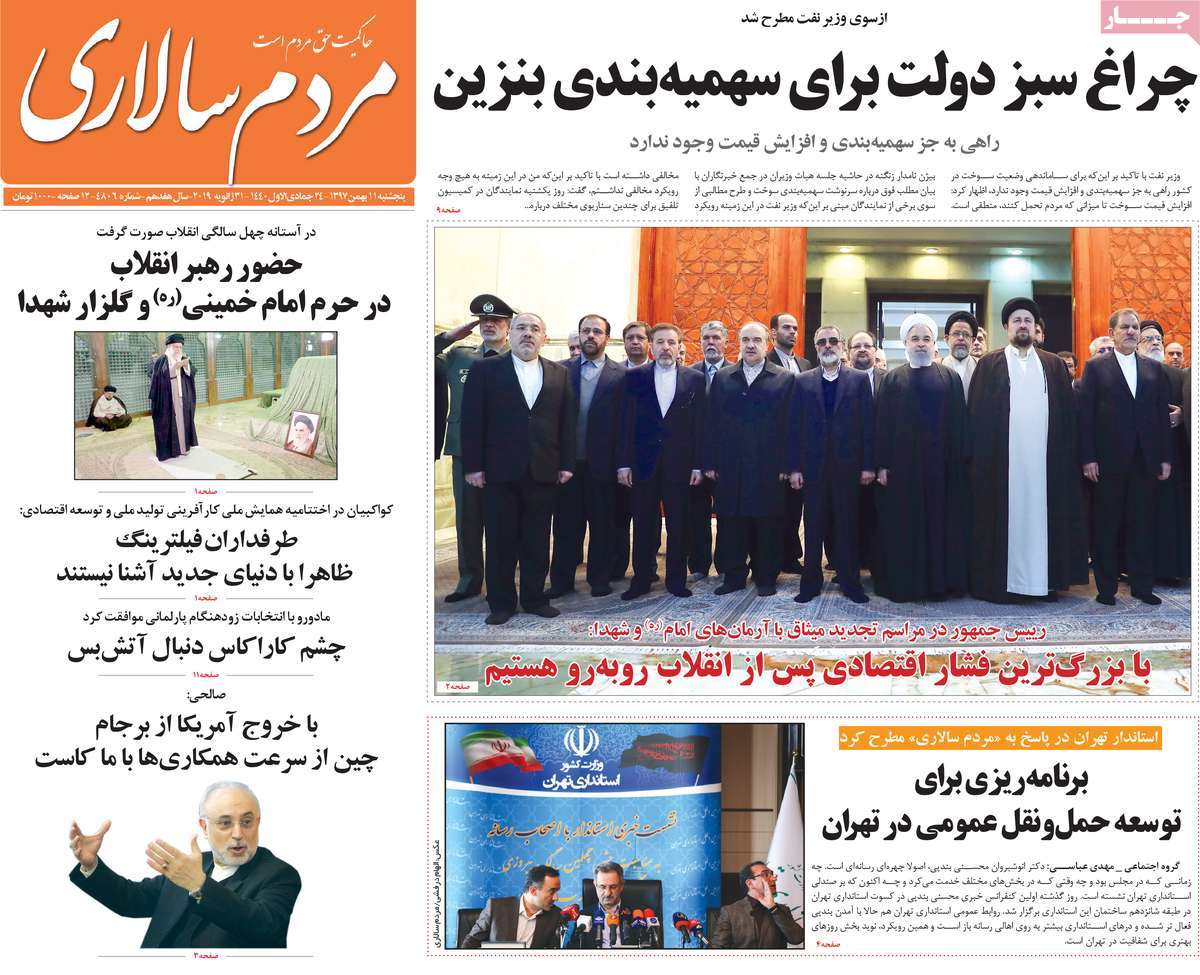
Remarks by Iranian President Hassan Rouhani in Imam Khomeini Mausoleum on Wednesday were widely covered by Iranian papers today, with many of them highlighting his statement that Iran will overcome the US Pressure.

Moreover, a report by US intelligence agencies downplaying Iran’s threat to the US caught significant attention.

The view offered by the report contradicted President Donald Trump’s view on Iran, pushing the incumbent president to accuse US agencies of being “naive”.

The above issues, as well as many more, are highlighted in the following headlines and top stories:


Abrar:

  • Official Warns about Possibility of Armed Conflict between Iran, Israel
  • US Representative Goes to Europe to Discuss Iran
  • Implementation of SPV Starts
  • Necessary Measures Taken to Prevent Infiltration of ISIS [to Iraq] from Syria Border: Iraqi PM

A Look at Iranian Newspaper Front Pages on January 31


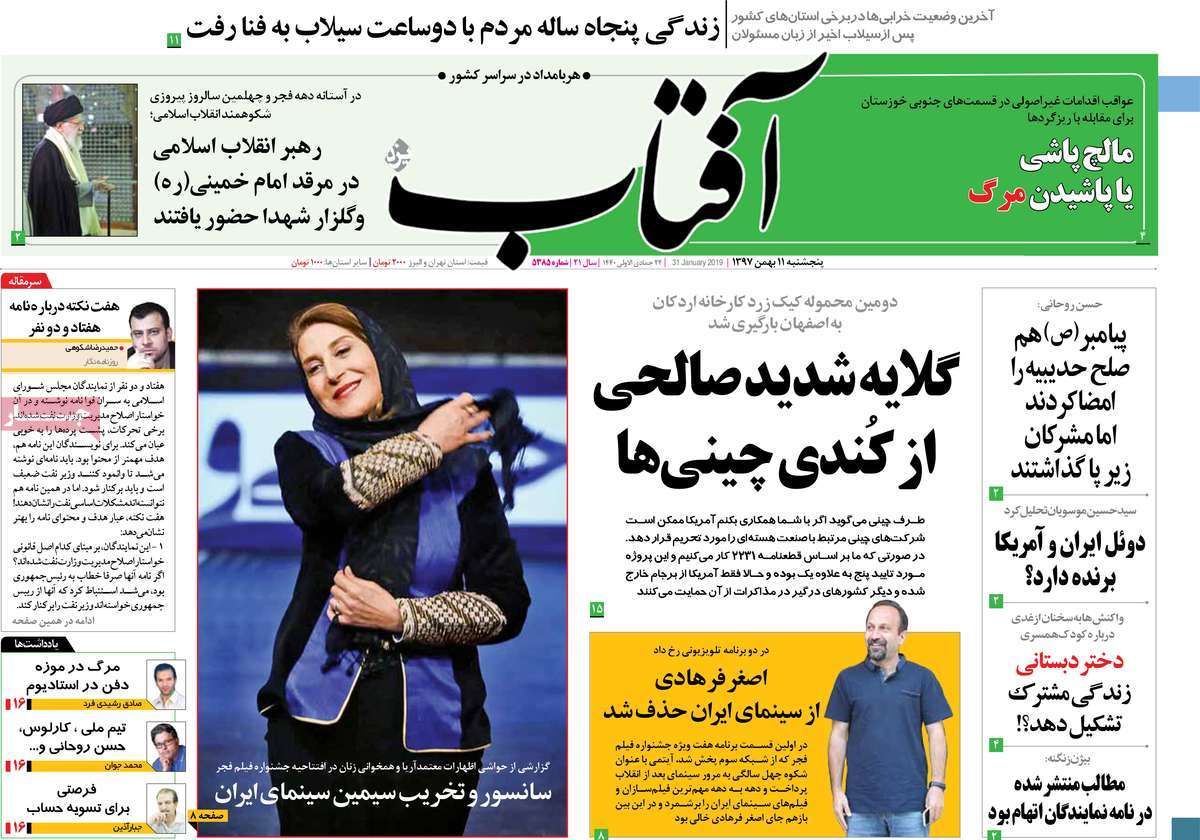
Aftab-e Yazd:

  • AEOI Chief Laments China’s Slow Progress in Implementing Iran Nuclear Project
  • Iran Leader Visits Imam Khomeini Mausoleum, Martyrs’ Tombs

A Look at Iranian Newspaper Front Pages on January 31


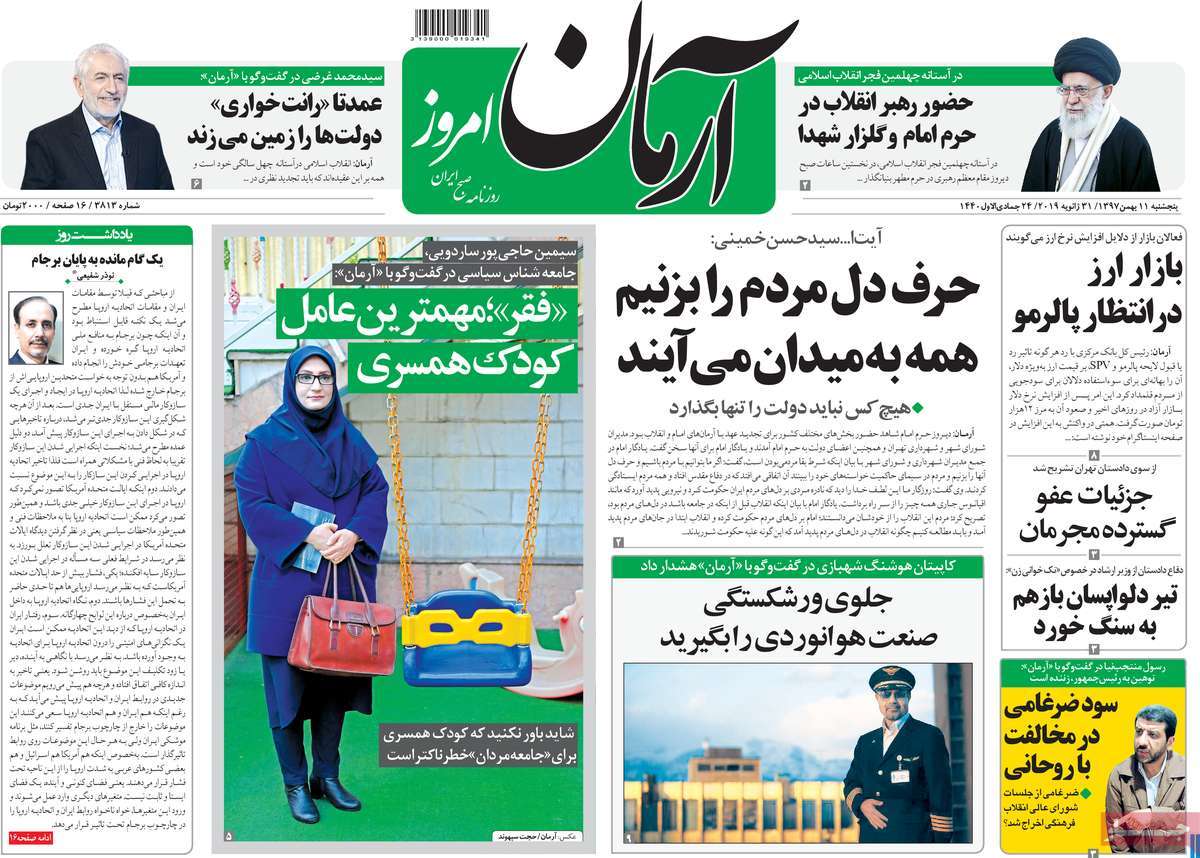
Arman-e Emrouz:

  • Currency Market Waiting for [Adoption of] Palermo Convention
  • No One Should Leave Gov’t Alone: Hassan Khomeini

A Look at Iranian Newspaper Front Pages on January 31


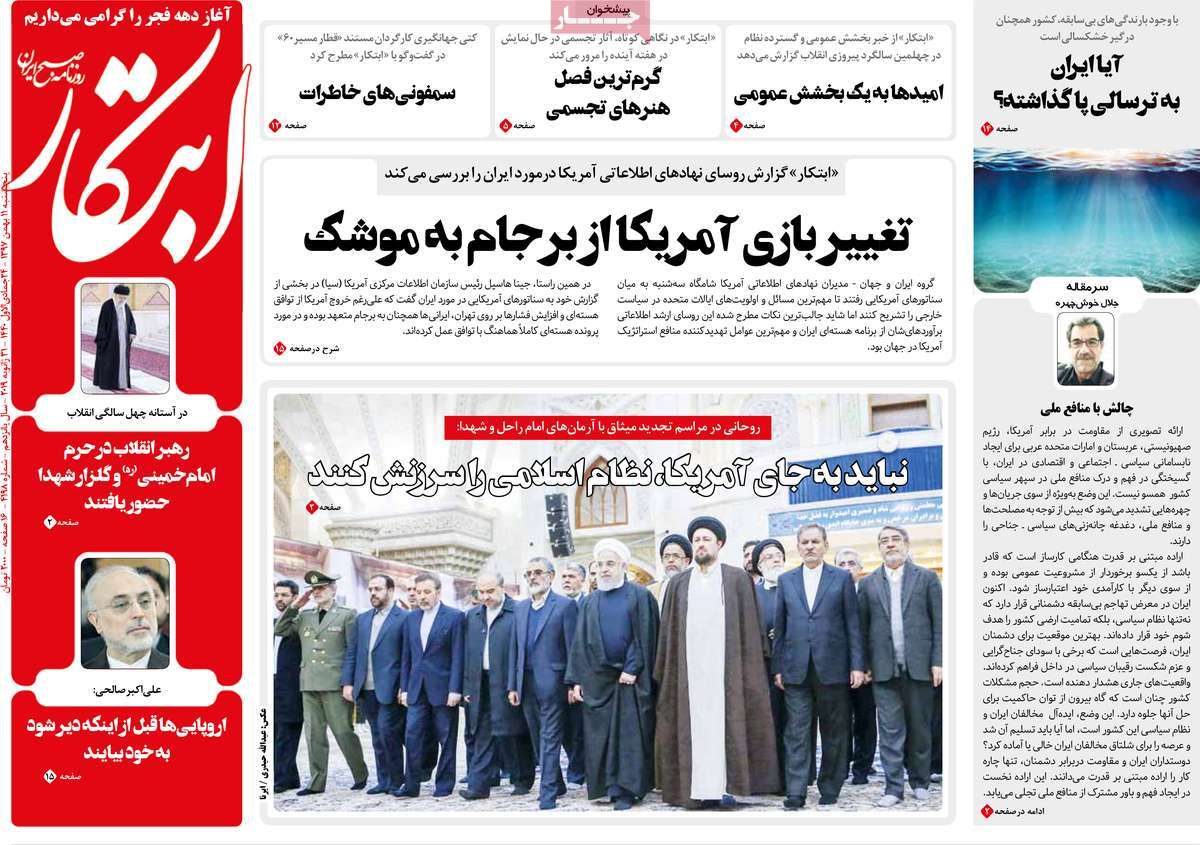
Ebtekar:

  • US Intelligence Report on Iran Reviewed: US Shifts Focus from JCPOA to Iran’s Missile Activities
  • They Should Not Blame Islamic System Instead of US: Rouhani
  • Salehi: Europeans Ought to Come to Themselves Before Its Too Late

A Look at Iranian Newspaper Front Pages on January 31


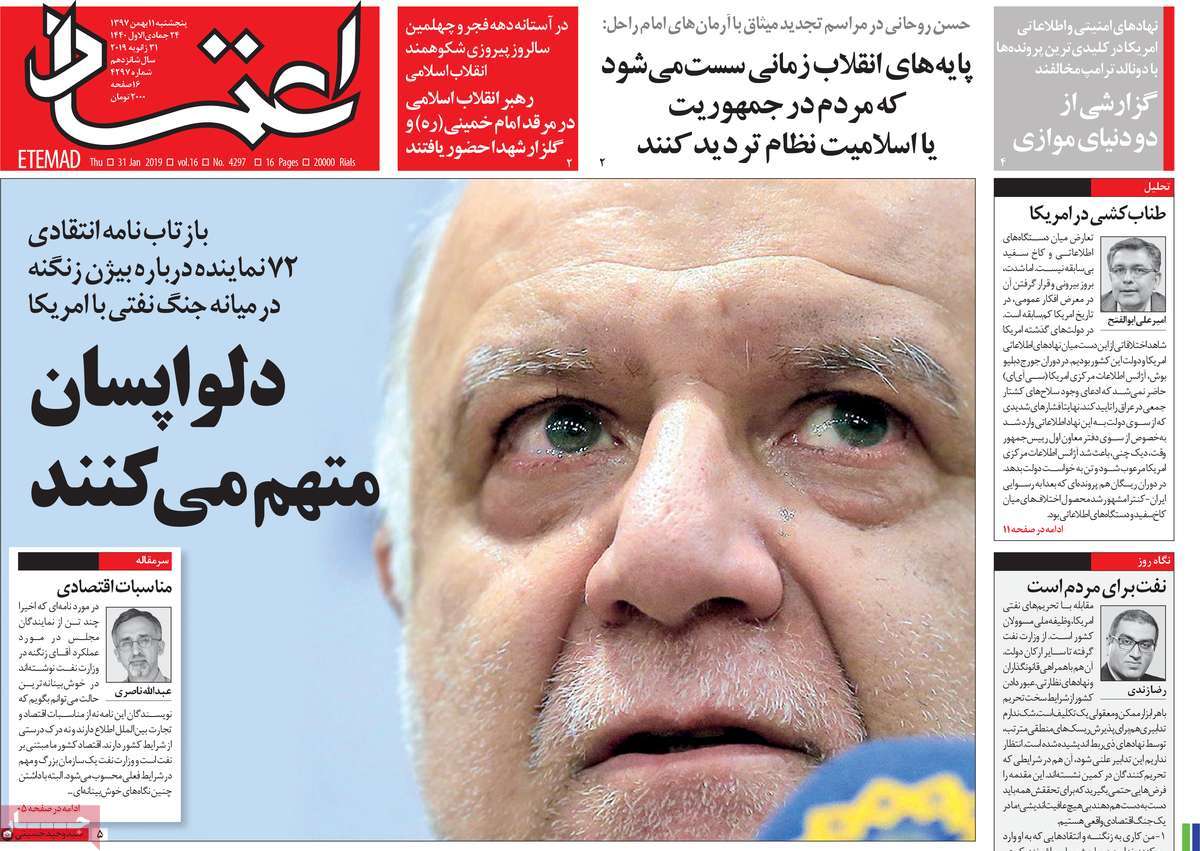
Etemad:

  • Rouhani: Revolution Threatened When People Doubt Republicanism or Islamism of System
  • Report from Two Parallel Worlds: US Security, Intelligence Agencies Oppose Trump on Key Dossiers
  • Leader Pays Visit to Imam Khomeini Mausoleum On Eve of 40th Anniversary of Victory of Islamic Revolution

A Look at Iranian Newspaper Front Pages on January 31


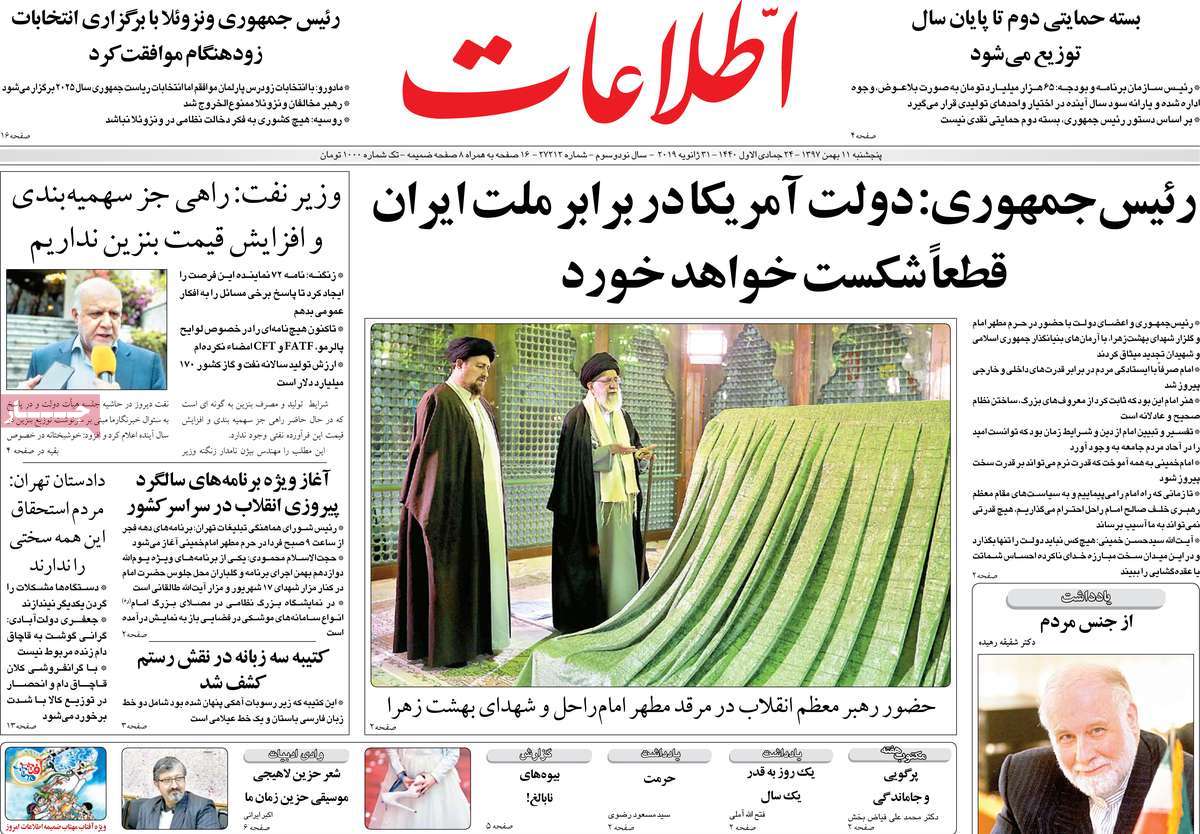
Ettela’at:

  • Venezuelan President Accepts to Hold Early Elections
  • US Government Would Be Definitely Defeated by Iranian Nation: Rouhani

A Look at Iranian Newspaper Front Pages on January 31


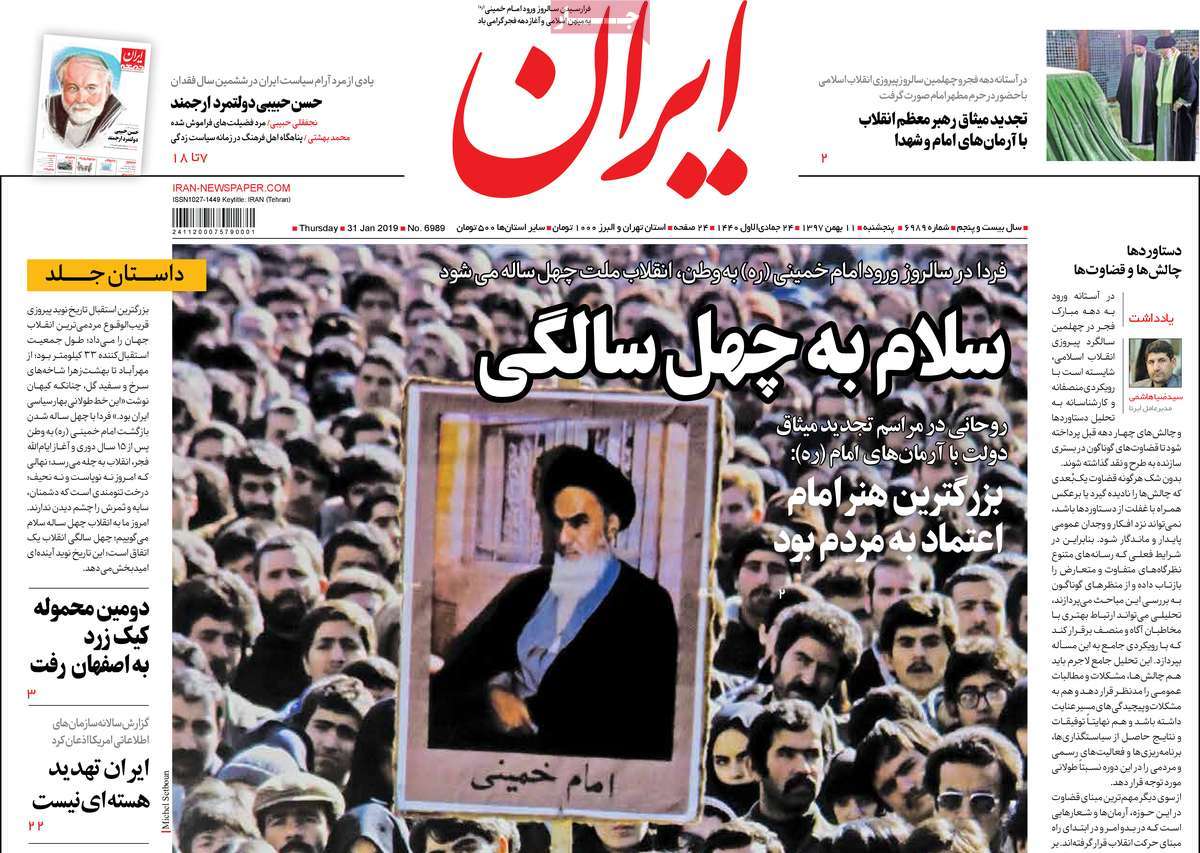
Iran:

  • Second Yellow Cake Shipment Arrives in Isfahan
  • Iran No Nuclear Threat: US Intelligence Community’s Annual Report

A Look at Iranian Newspaper Front Pages on January 31


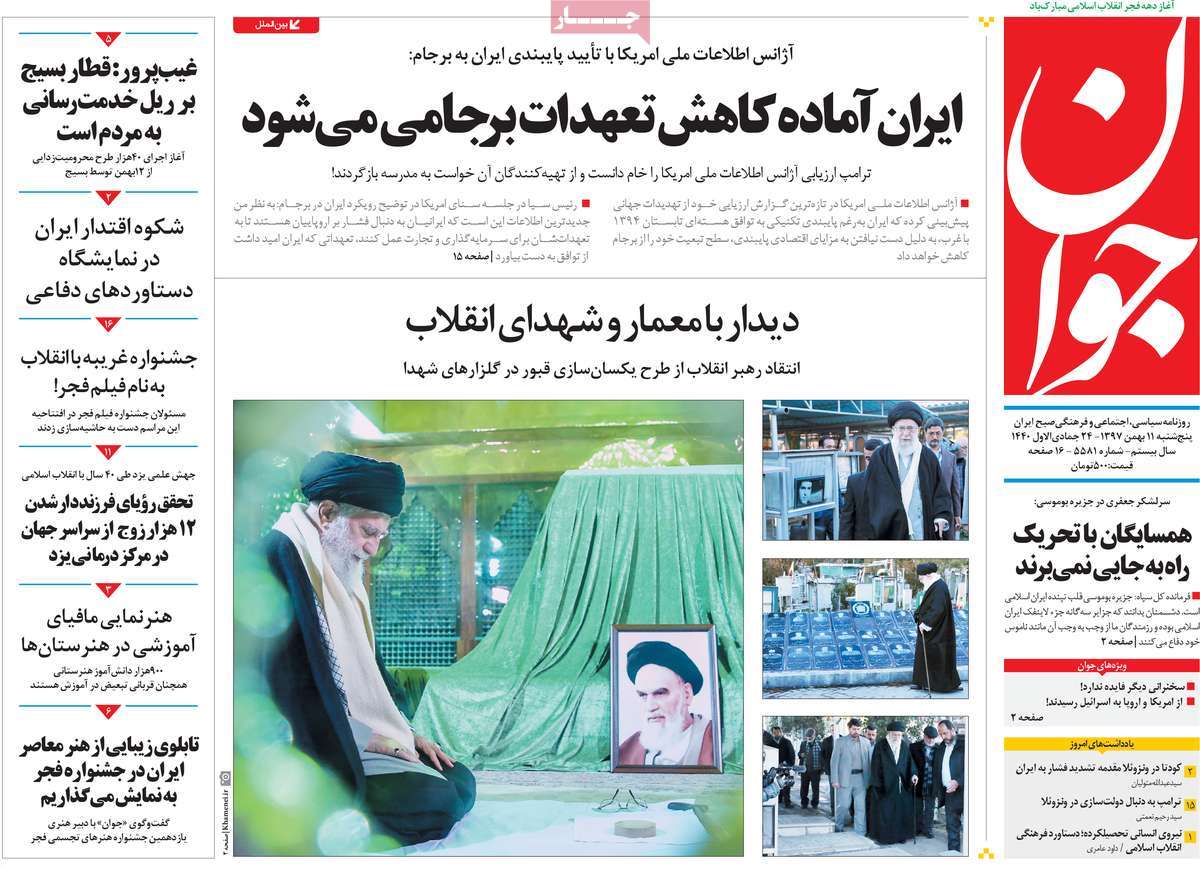
Javan:

  • America’s DNI: Iran Becoming Ready to Decrease JCPOA Commitments
  • IRGC Chief: Neighbours’ Provocative Moves to Lead Nowhere

A Look at Iranian Newspaper Front Pages on January 31


Jomhouri Eslami:

  • Rouhani: No Power Could Hurt Us If We Walk Imam Khomeini’s Path
  • Iran Self-Sufficient in Petrol Production: Oil Minister
  • Trump Urges Venezuelan People to Hold Mass Protests
  • US Intelligence Agencies Reject Trump’s Empty Claims about Iran
  • Dozens of Palestinians Injured in 22nd Rally to Break Gaza Siege

A Look at Iranian Newspaper Front Pages on January 31


Kayhan:

  • Over 500 Fully Homegrown Military Products to Be Displayed in New Exhibition
  • We Should Unite Against US, Zionists, Reactionary Regimes in Region: Rouhani
  • Iran Only Country that Supports Palestine: Islamic Jihad Chief

A Look at Iranian Newspaper Front Pages on January 31


Mardom Salari:

  • Rouhani: Iran Faces Biggest Economic Pressure after 1979 Revolution
  • AEOI Chief: China Slowed Down Iran Cooperation Following US Withdrawal from JCPOA

A Look at Iranian Newspaper Front Pages on January 31


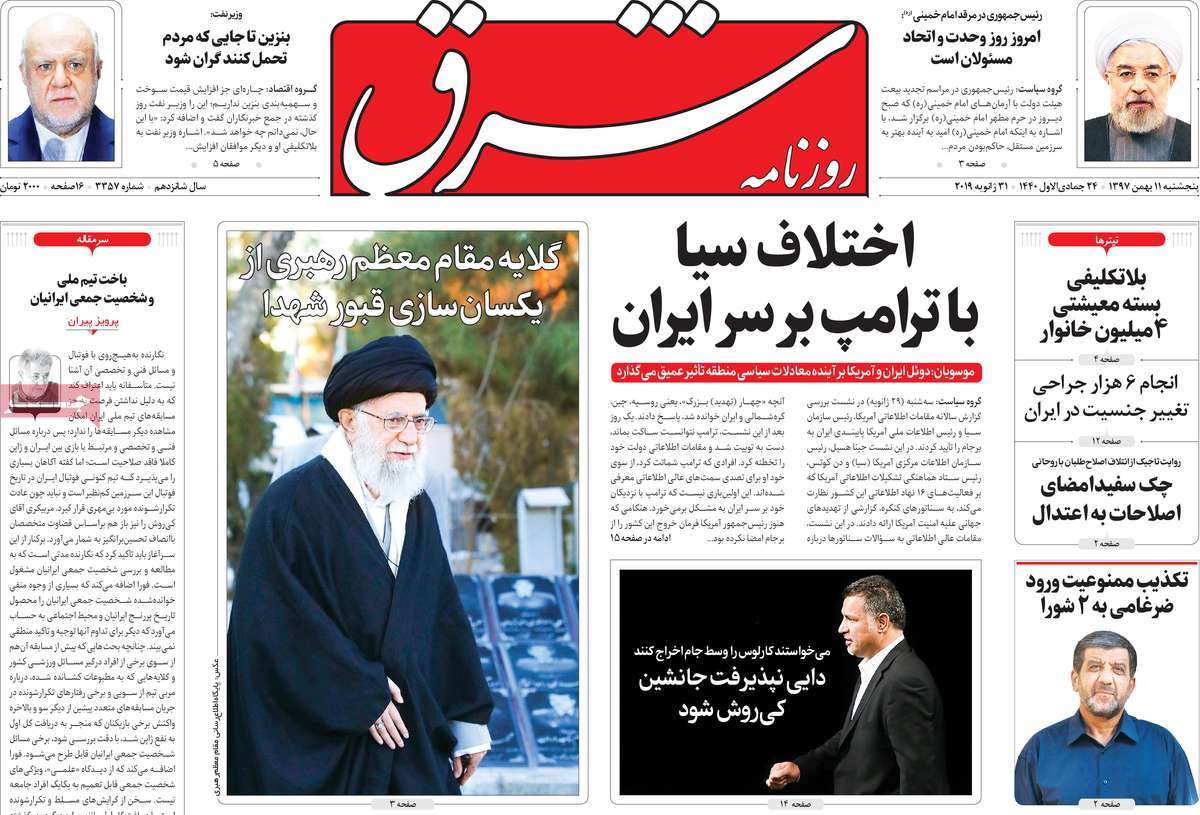
Shargh:

  • Rouhani: Time for Unity among Officials
  • CIA Has Differences with Trump on Iran

A Look at Iranian Newspaper Front Pages on January 31

Iran, Bulgaria Stress Expanding Political, Economic Ties

Speaking at a meeting with Bulgaria’s deputy parliament speaker and members of the two countries’ friendship group, Araqchi gave the greetings of Parliament Speaker Ali Larijani to the Bulgarian parliament speaker, pointing to continuation of parliamentary consultations between the two countries and stressing the need for expanding political and economic cooperation between the two countries.

In turn, Deputy Speaker for Bulgarian Parliament Emil Hristov stressed the parliament’s full support for continuation of political and parliamentary consultations between the two countries and development of ties particularly in economic and trade sectors and support for JCPOA.

Hristov said the two governments should maximally use the existing economic capacities in the two countries’ relations, particularly in economic, transport and agricultural and other sectors, stressing the readiness of the Bulgarian parliament to facilitate cooperation between the two countries.

In the meeting, a number of Bulgarian lawmakers pointed to shared cultural and civilizational interests, highlighting their readiness to expand and deepen bilateral relations in all fields.

They also described Tehran a haven of peace and security in the Middle East.

Later on, the Iranian senior diplomat held talks with the country’s representative in the EU parliament, Angel Dzhambazki.

Speaking at the meeting, Araqchi said, “The JCPOA is in danger due to the US policies. We support the political position of Europe in supporting the JCPOA, but we need practical moves by Europe. According to the {international Atomic Energy] Agency, we have fulfiled all our obligations in this regard,” he added.

On the Warsaw conference, Araqchi said, “The US could not achieve its goals on Iran in the United Nations and it is trying to form a coalition against Iran outside the UN, and European countries should be vigilant on this.”

The Bulgarian side said, “The EU’s interests requires defending the nuclear deal. Iran is a stable country in the region and the support for the nuclear deal must be continued.”

Iran’s Deputy Foreign Minister Seyyed Abbas Araqchi also held meetings with Bulgarian Foreign Minister and Deputy Prime Minister Ekaterina Zakharieva as well as Deputy Foreign Minister Georgi Georgiev in Sofia.

In the meetings, Araqchi pointed to the frequent visits of officials of the two countries in recent years, stressing the eagerness and political will between the two countries to expand bilateral cooperation in various fields.

Araqchi said political consultations between the two countries are a chance to exchange views on important bilateral, regional and international issues.

The Bulgarian officials pointed to last year’s visit paid to Sofia by FM Zarif, during which he exchanged views on regional and international issues, saying political visits between the two countries have been increased in recent years.

They said the Bulgarian government supports JCPOA and like other European countries believe that JCPOA benefits security and stability in the region.

On the EU financial mechanism, the Bulgarian foreign minister said “creation of the mechanism could strengthen economic and commercial cooperation between the two countries and Bulgaria supports it.”