Monday, January 12, 2026
Home Blog Page 3238

Iran Describes Persian Gulf Security as Integrated Concept

Iran Says Concerted Global Effort Needed to Fight Coronavirus

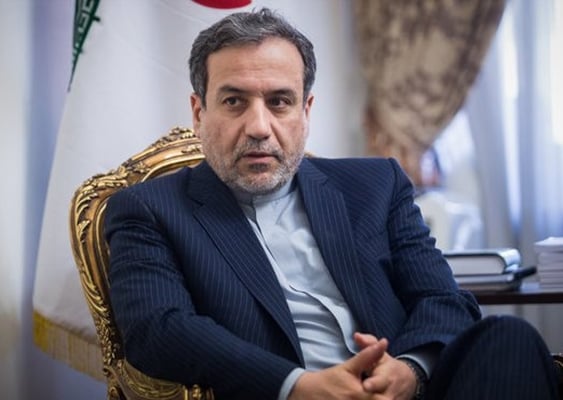
He made the remarks during a Tuesday meeting with Zainul Abidin bin Mohamed Rasheed, the Singaporean foreign minister’s special envoy for the Middle East.

Araqchi also touched upon the latest developments pertaining to the Iran nuclear deal known as the Joint Comprehensive Plan of Action (JCPOA) and Tehran’s efforts to preserve the agreement.

“The only issue in the Middle East which was settled through negotiations and diplomacy, leading to an agreement, is the Iran nuclear deal which the US withdrew from for illogical and unintelligible reasons,” said Araqchi.

Araqchi also referred to Washington’s economic pressure on Iran, and said, “The United States has engaged in an economic war with Iran now, which is the root cause of growing tensions in the Middle East.”

“US economic sanctions have, in fact, targeted the security of the whole region. So, one cannot expect tranquility and security [to take hold] in the region without a ceasefire in the economic war,” said Araqchi.

The Singaporean official, in turn, noted that many countries are under the pressure of sanctions. He stressed his country’s support for the JCPOA and expressed hope tensions in the Middle East would abate.

Iran Expresses Condolences over Demise of Top Afghan Cleric

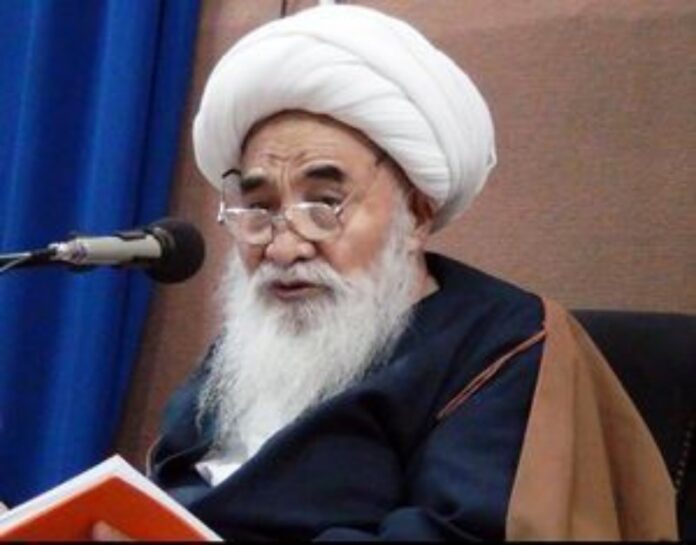
“I express my deep commiserations over the death of the great scholar, the jurisprudent and the grand Marja, Ayatollah Hajj Sheikh Qorbanali Mohaqiq Kabuli (RA) to the honourable people of Afghanistan, the seminaries, scholars, disciples and lovers of this salient figure,” Zarif said in a Tuesday message.

The Iranian top diplomat described the top cleric as “one of the most important assets of Iranian and Afghan seminaries.”

“I ask God to give great blessings to Ayatollah Mohaqiq. May God give patience to his family [to bear this loss],” said FM Zarif.

The senior cleric, who resided in Iran’s holy city of Qom, died on Tuesday morning.

He was born in 1928 into a religious family in Parwan province, near the Afghan capital of Kabul.

At the age of 7, he started learning the holy Quran and Persian reading and then Islamic teachings and Arabic literature.

Ayatollah Kabuli continued his religious education in Kabul and then left for the holy city of Najaf, Iraq, to study at the prestigious seminary there.

He wrote various books on religious studies, including on Fiqh (Islamic jurisprudence).

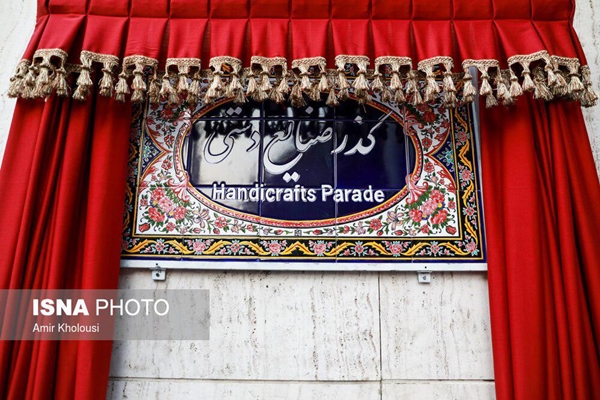
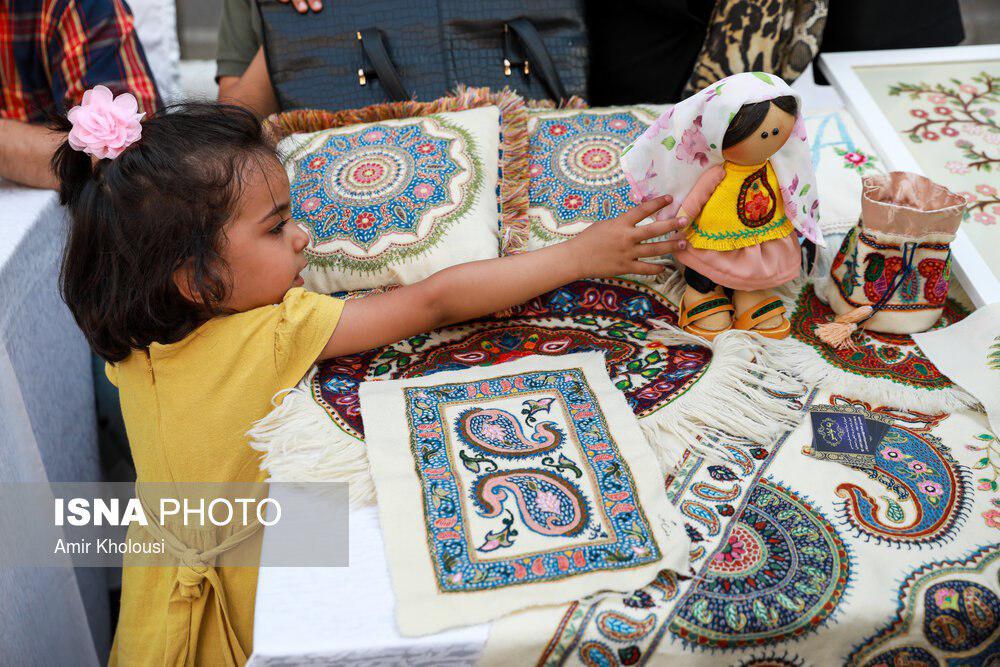
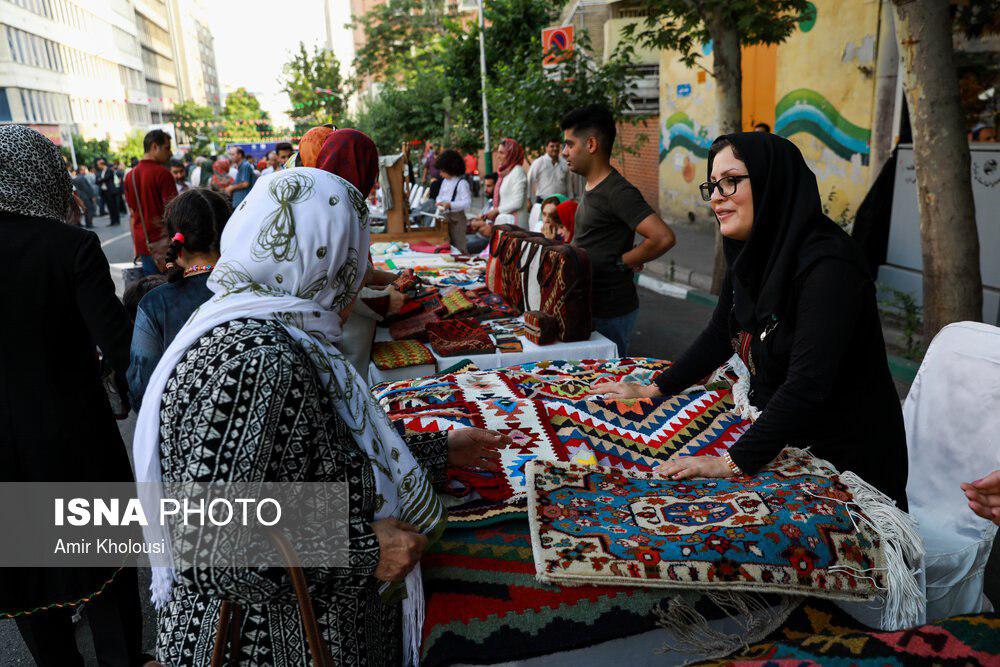
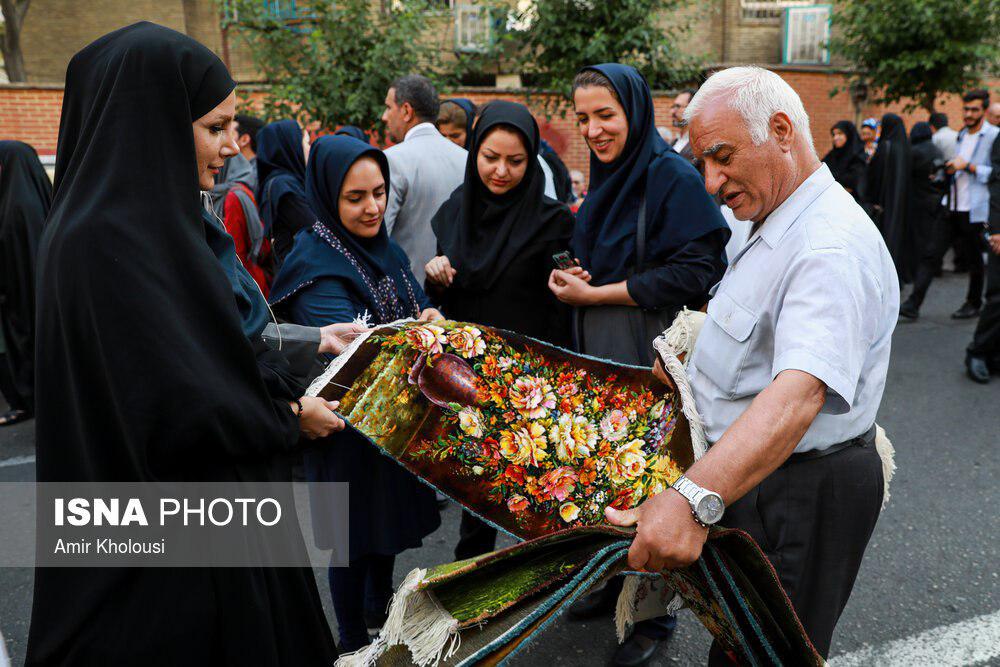
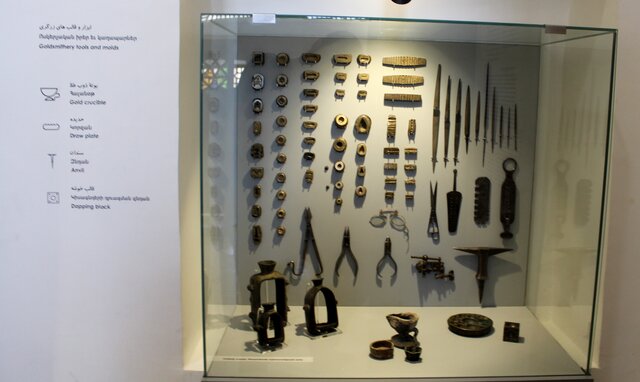
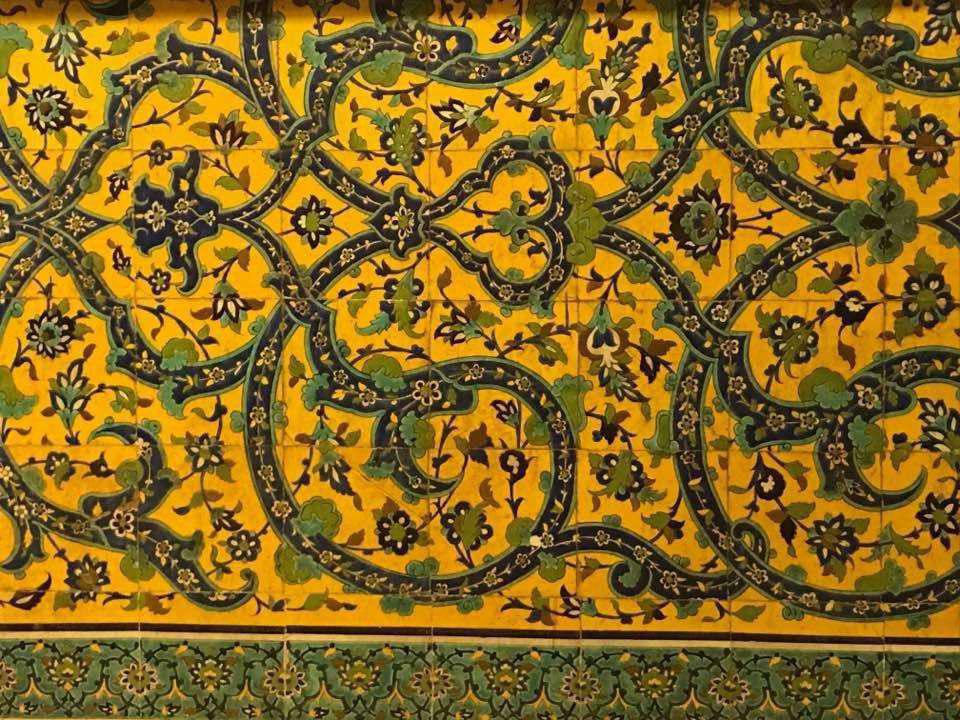
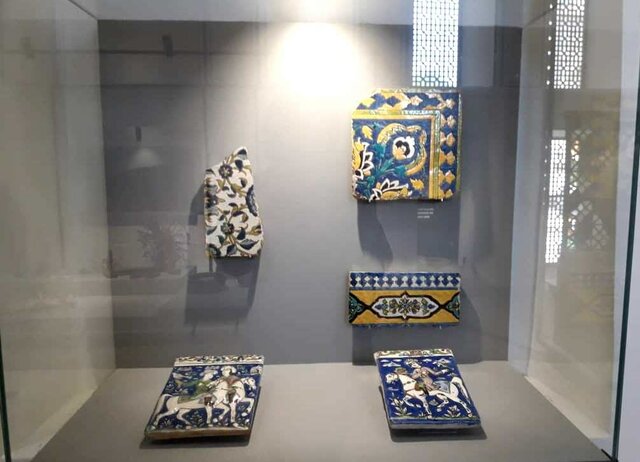
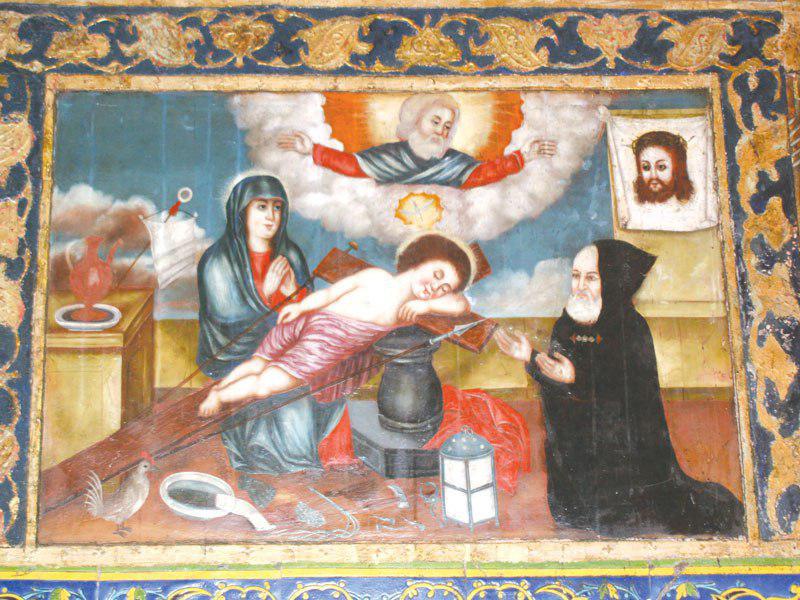
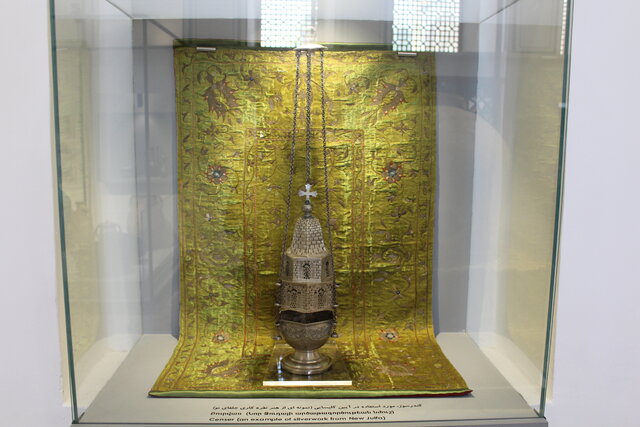
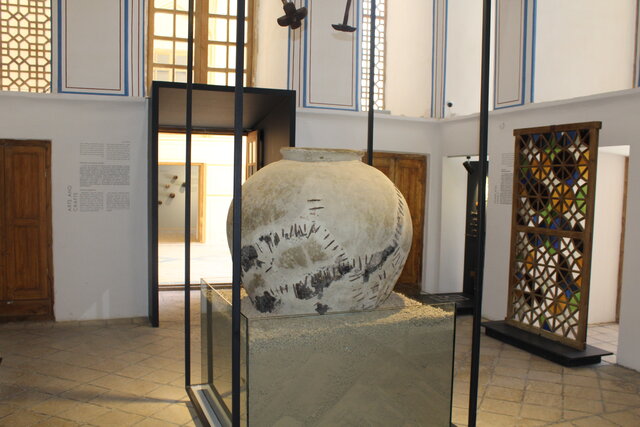
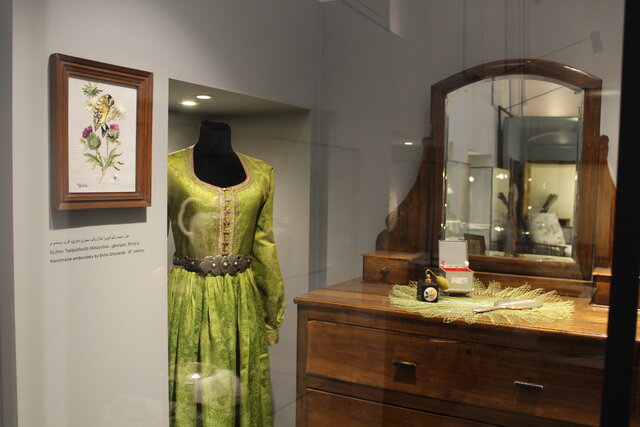
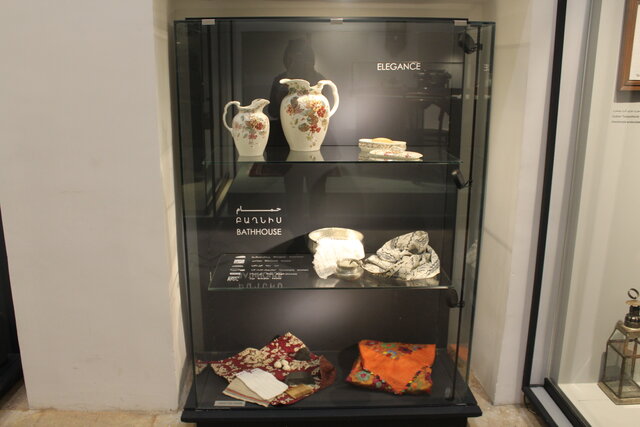
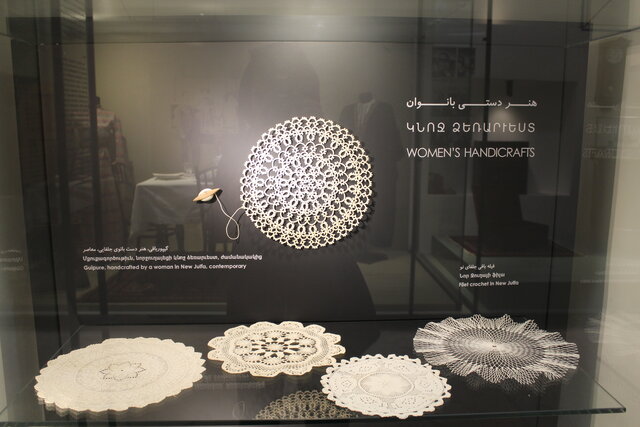
Handicrafts of Isfahan’s Jolfa: Epitome of Iranian-Armenian Art

Vank church

Those arts were produced in line with models of medieval Armenian art and in conformity with Ancient Iranian arts.

June 10th marks World Handicraft Day. Some 600 handicrafts have been registered on the list of the United Nations Educational, Scientific and Cultural Organization (UNESCO). Of that figure, 450 belong to Iran. Interestingly, 287 handicrafts out of 450 belong to Isfahan.

Around 300 years ago during King Abbas Safavid, Armenians migrated from the banks of the Aras river to the banks of Zayandehrood in Isfahan to remain immune to the mass killing of Armenians. After the threat was removed, they stayed there.

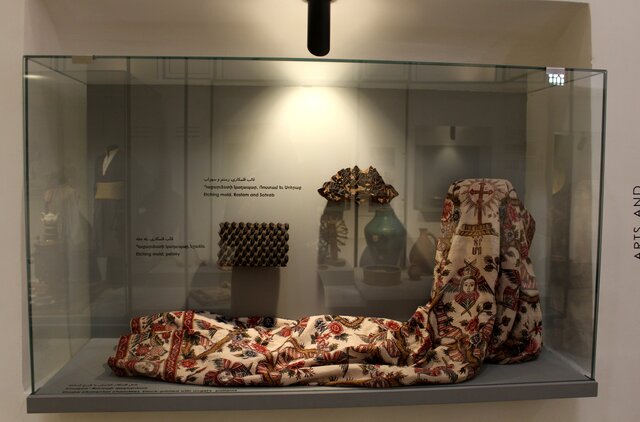
Little by little, Armenians in Isfahan managed to spread their traditional and native arts and produced works of art using gold and tile as well as works of miniature and Qalamkari, part of which is on show at Isfahan’s Vank church.

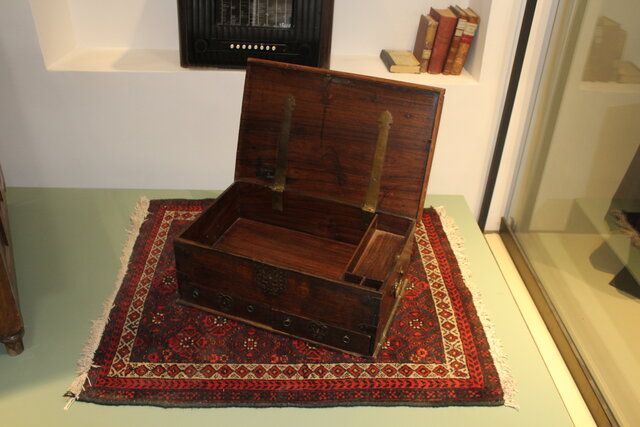
The following are images of handicrafts produced in Isfahan and its Jolfa neighbourhood.

* After the second World War, handicrafts with an artistic and cultural touch drew the attention of many countries. On that day, the first international conference was held in New York, bringing together university professors, artists and industrialists from more than 40 countries. The day when the conference was held was named as International Handicraft Day.

US Seeks to Kill INSTEX by Imposing New Sanctions

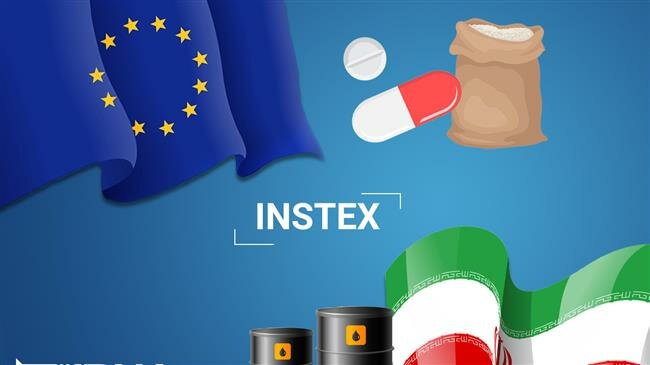
The financial news provider quoted a senior administration official as saying that the latest measures will target the Special Trade and Finance Institute, which Iran set up to correspond to Europe’s INSTEX in bypassing sanctions.

INSTEX is purported as the European fig leaf to Iran to persuade the country to remain in the 2015 nuclear agreement which the United States unilaterally left last year.

The news came as German Foreign Minister Heiko Maas visited Tehran on Monday to announce that the long-overdue mechanism would be ready soon.

The US government is targeting Iran’s Special Trade and Finance Institute (STFI) on the ground that the country has not implemented global safeguards against money laundering and terrorism financing, Bloomberg cited the unnamed official as saying.

It said punishing STFI could doom INSTEX because it raises the possibility of sanctions risk to anyone who is part of the European mechanism.

The initiative, it said, drives home a letter sent by the US Treasury Department in early May to Per Fischer, the president of INSTEX, arguing that the financial body could face sanctions.

“If they are looking at sanctioning STFI, you’re essentially trying to kill INSTEX through the back door,” said Ellie Geranmayeh, a senior policy fellow at the European Council on Foreign Relations.

The Europeans say INSTEX will support legitimate trade with Iran, applying initially only to non-sanctionable essential goods, such as humanitarian, medical, and farm products.

They have said it will function under the highest international standards with regards to anti-money laundering mechanisms, combating the financing of terrorism as well as EU and UN sanctions compliance.

US authorities are reportedly worried that other nations, including America’s adversaries, could use INSTEX as a model in the future and avoid the US financial system entirely.

“The development of INSTEX is really worrying for US sanction policy in the long run,” Emma Ashford, a research fellow at the Cato Institute in Washington, told Bloomberg. “INSTEX sets up a framework other countries can use in the future.”

According to Suzanne Maloney, deputy director of the foreign policy program at the Brookings Institution, Washington’s bid to crush INSTEX “does call into question what the long-term strategy here is” with the US sanctions.

“If there’s no room for humanitarian aid for Iran, literally no viable mechanisms for facilitating those transactions, then clearly this is purely a punitive strategy and one that is intended to wreak maximum havoc on the Iranian population.”

The trade of humanitarian goods, such as food, medicine and medical devices, is theoretically allowed by the US, but European companies refuse to do business with Iran, fearing secondary American sanctions.

Washington claims the sanctions target the government, but ordinary Iranians are the ones who suffer the most.

US President Donald Trump triumphantly tweeted a photograph of himself in the style of an advertisement for the Game of Thrones fantasy TV series, with the tagline: “Sanctions Are Coming, November 5.”

In an interview with BBC Persian in November, US Secretary of State Mike Pompeo brazenly said Iranian officials must listen to Washington “if they want their people to eat.”

Hawkish US National Security Adviser John Bolton then used vulgar language to stress that his country wanted to “squeeze” Iran. “It is our intention to squeeze them very hard. As the British say: ‘Squeeze them until the pips squeak’.”

For months, European powers have been tinkering with the much-hyped special trade vehicle, raising suspicions in Iran that they might be dragging their feet on operationalizing it in deference to the US government.

“We haven’t put much hope in INSTEX,” Iran’s Foreign Ministry spokesman Abbas Mousavi said on Monday. “If INSTEX was going to help us, it would have done so already.”

A stern-faced Iranian Foreign Minister also warned the US that it “cannot expect to stay safe” after launching an economic war against Tehran.

“Mr. Trump himself has announced that the US has launched an economic war against Iran,” Zarif said during a joint news conference with Maas. “The only solution for reducing tensions in this region is stopping that economic war.”

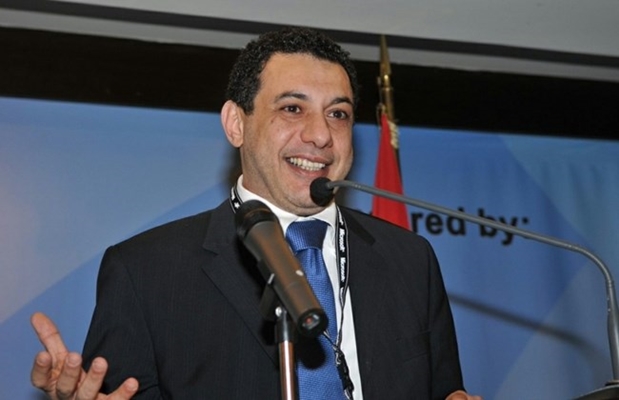
Iran Frees Zakka at Aoun’s Request, Nasrallah’s Mediation

That was announced on Tuesday by Keyvan Khosravi, the spokesman for Iran’s Supreme National Security Council, in an interview with Lebanon’s Al-Ahd.

No third party played any role in the freedom of Zakka and Iran released him only based on the request of Lebanese President Aoun and the mediation of Nasrallah, Khosravi said.

According to Khosravi, Iran gave a positive response to Aoun’s request given the significant and efficient support he had shown for Lebanon’s resistance movement.

“During his detention in Tehran, Zakka was treated within all legal procedures and judicial principles of dealing with the convicts. Iran even provided him with certain facilities and services beyond those given to other prisoners,” he noted.

Khosravi went on to say based on documents provided by Iran’s security apparatus, Zakka had been involved in cooperation with the American intelligence services against the Islamic Republic.

“Zakka was released on bail after passing four years of his ten-year sentence,” he concluded.

Zakka was arrested during a trip to Iran in 2015 on charge of having “deep links” to US intelligence services.

A source familiar with the case had told The Daily Star Saturday that Zakka would arrive in Beirut within 48 hours.

The Lebanese Foreign Ministry announced earlier this week that Iran had agreed to free Zakka after President Michel Aoun and Foreign Minister Gebran Bassil asked that he be released as a good-willed gesture for the Muslim holy month of Ramadan.

Who’s to Blame for Middle East Instability?

“Who is behind the current instability in this region? Was it Iran that armed Saddam Hussein? Was it Iran that supported Al-Qaeda? Was it Iran that jailed the Lebanese prime minister? Is it Iran that is bombarding Yemeni civilians on a daily basis? Did WE support ISIS and Nusra Front in Syria or it was the US-made weapons that were given to them by Saudi Arabia? Have WE gifted the occupied territories of other countries – the holy al-Quds and the Golan Heights – to a third party?” Zarif asked.

“If we are talking about tension-creating measures in this region, it is others who must be held accountable,” he added.

“We are also different from others in one more term: We’ve been living in this region for the past 7,000 years; where have THEY come from?” the Iranian top diplomat asked.

A Look at Iranian Newspaper Front Pages on June 11

A Look at Iranian Newspaper Front Pages on November 19

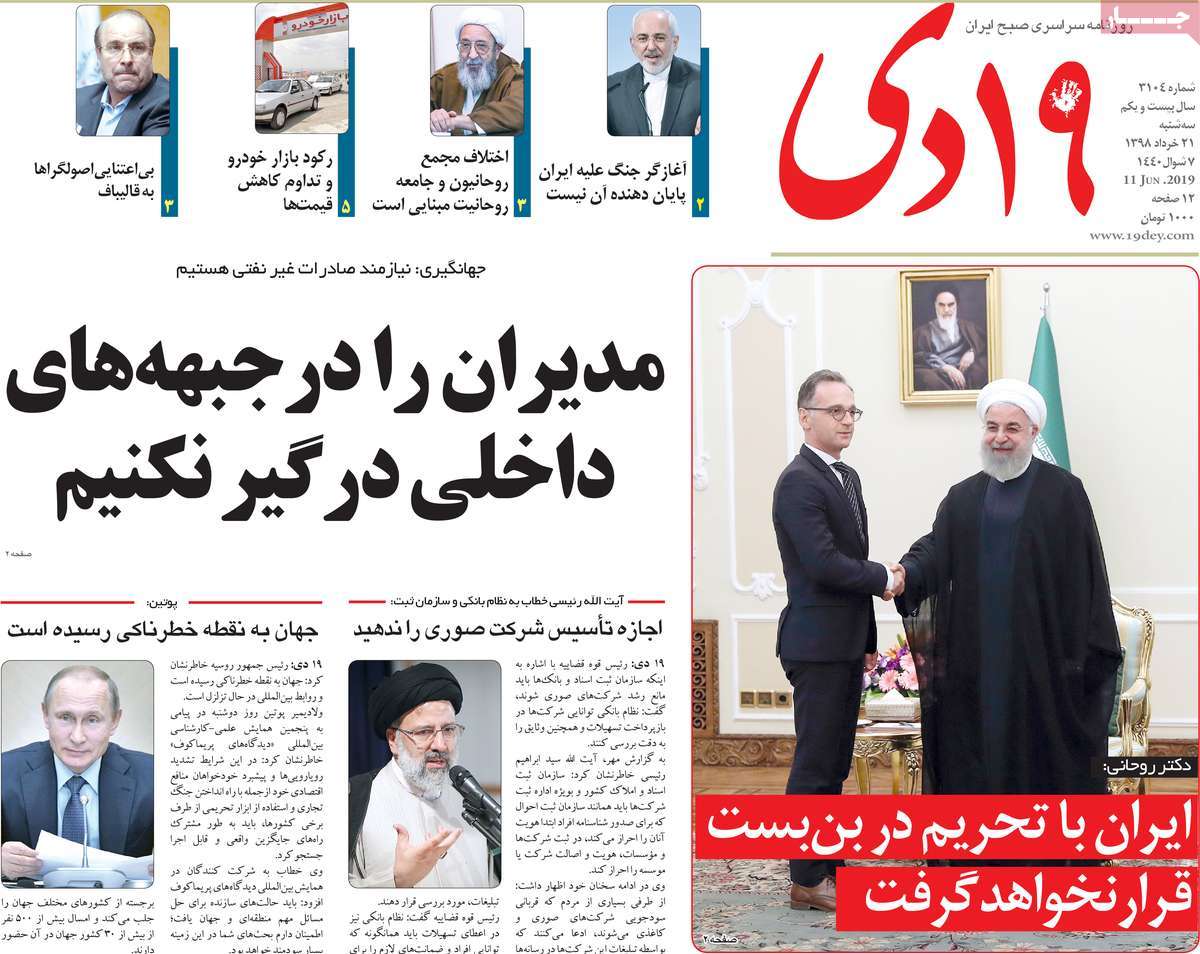
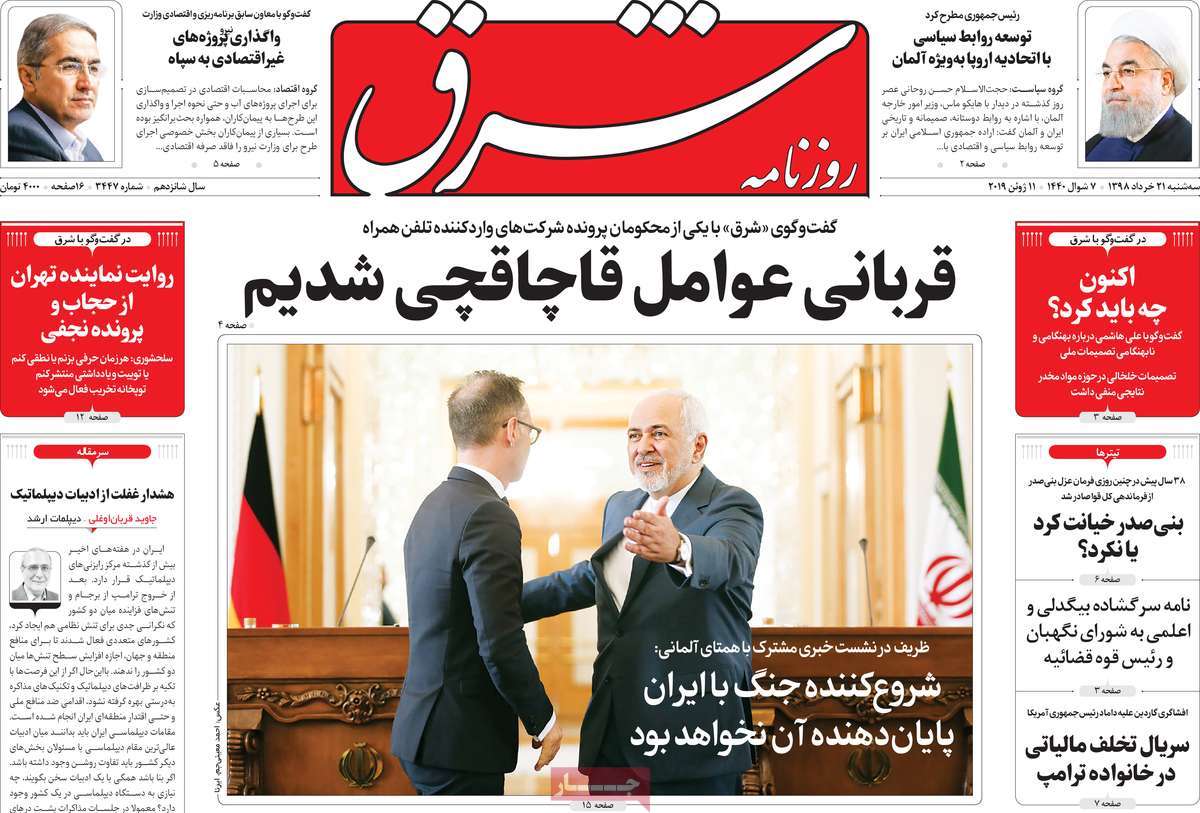
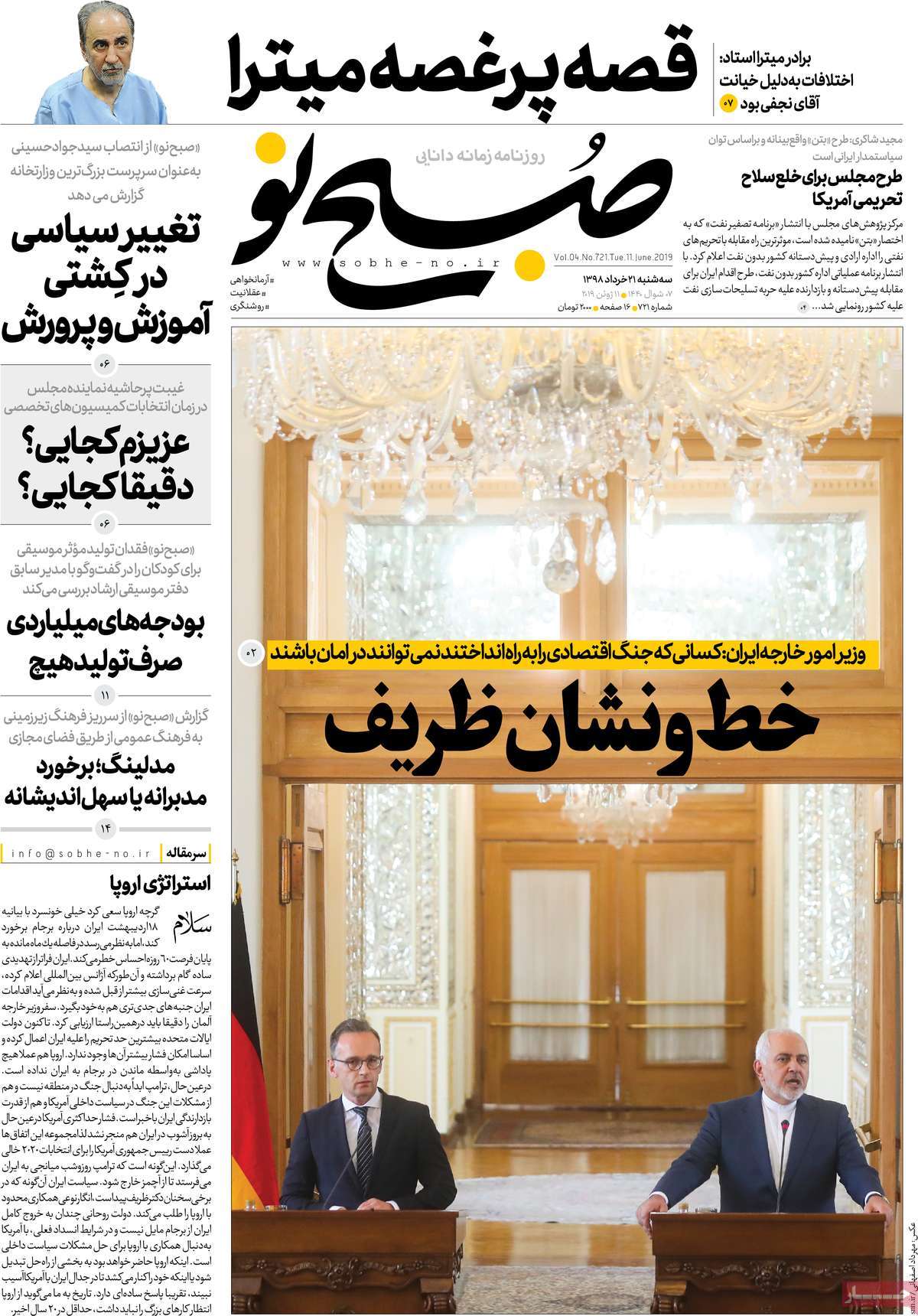
Germany’s Foreign Minister Heiko Maas’s visit to Tehran and his talks with his Iranian counterpart and President Rouhani has grabbed the headlines of most of the Iranian newspapers. Foreign Minister Zarif issued warning over economic war being conducted against Islamic Republic through US sanctions. He said the only solution for reducing tensions in this region is stopping that economic war. For his part, German Foreign Minister Maas said that Germany, France and Britain were doing their utmost to prevent the failure of the JCPOA.

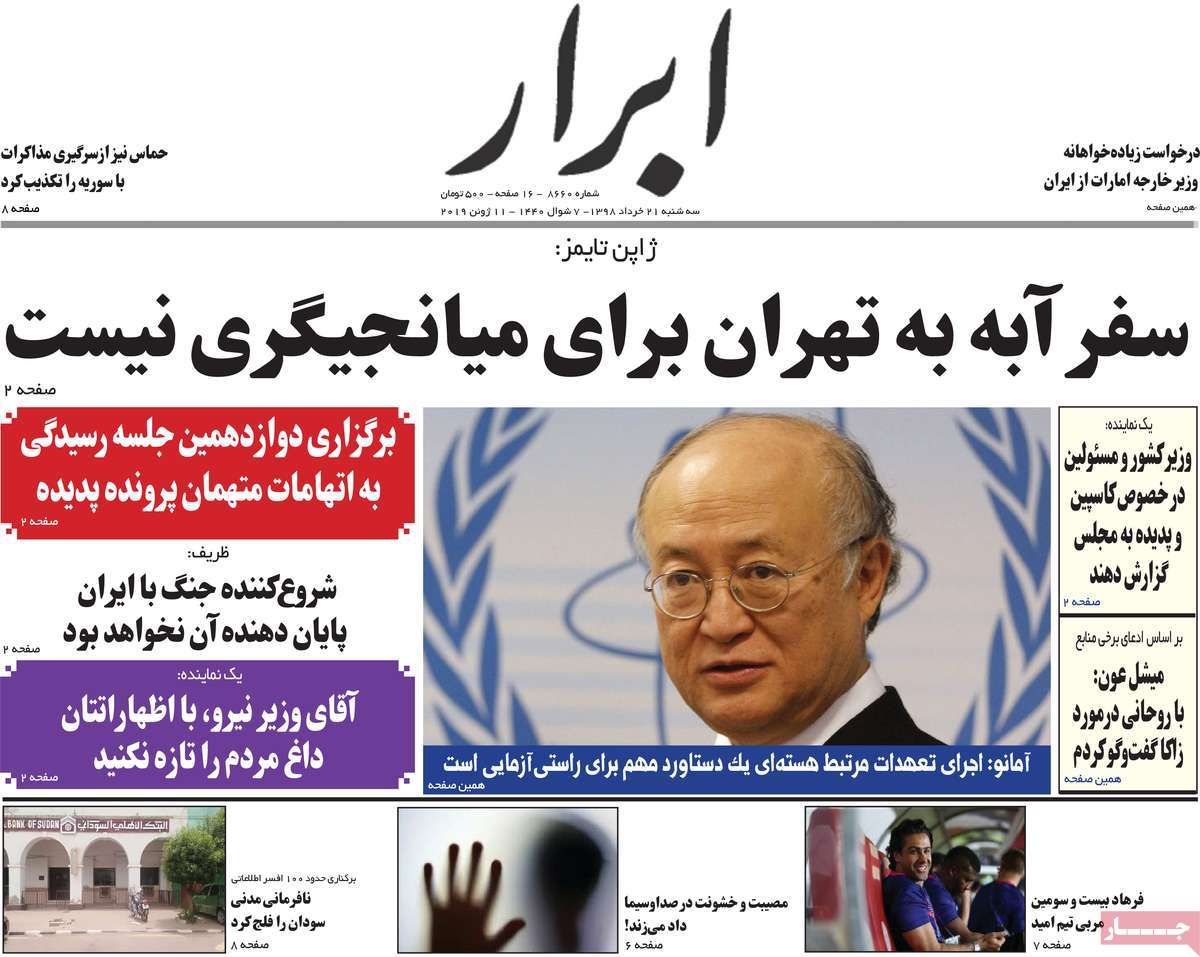
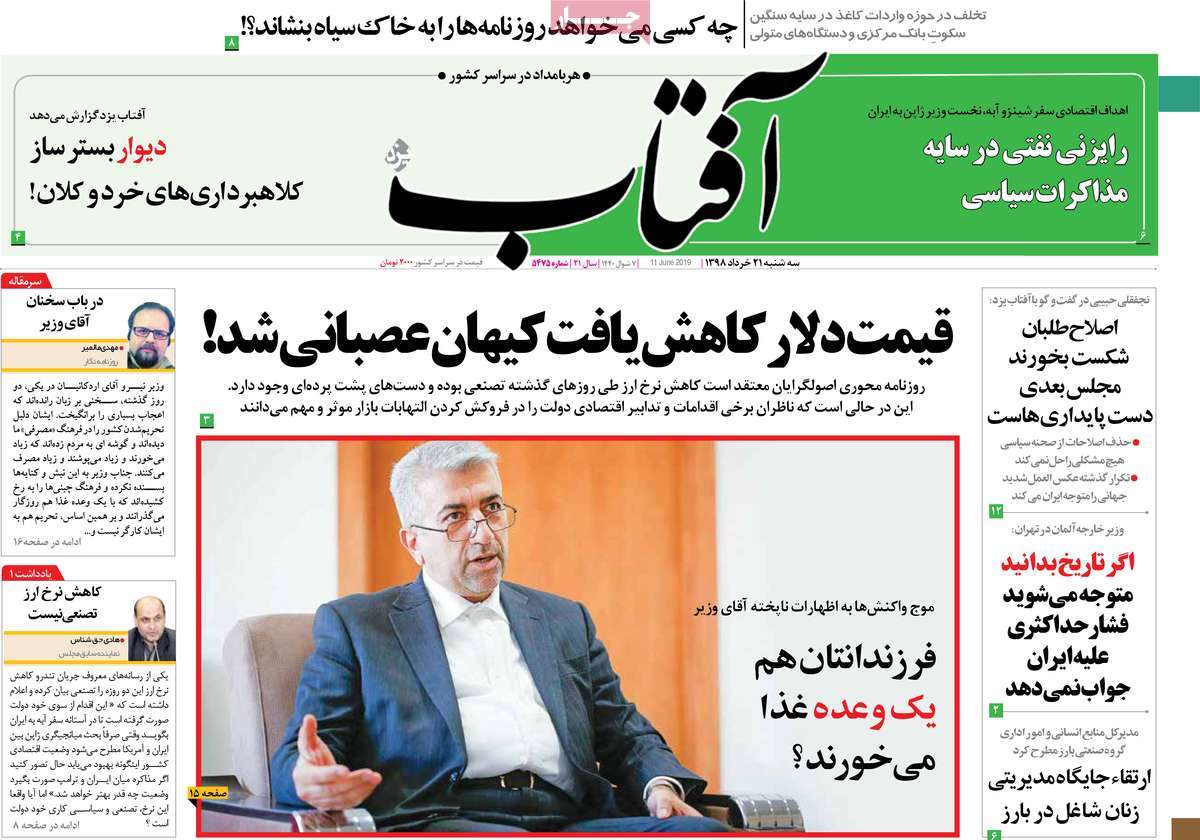
Once again a top story today was the Japanese prime minister’s visit to Iran.  Prime Minister Shinzo Abe is set to start his two-day visit to Tehran on Wednesday amid rising military tensions in the Persian Gulf. Japanese Foreign Ministry officials say the primary purpose of his visit is to ease tensions and prevent the status quo from deteriorating further. They also noted that Abe will not be in Tehran as a mediator or messenger.

The above issues, as well as many more, are highlighted in the following headlines and top stories:

Dey 19:

  • Iran will not be in a deadlock by sanctions: Rouhani
  • World Has Reached Dangerous Point: Putin


A Look at Iranian Newspaper Front Pages on June 11


Abrar:

  • Abe’s Trip to Tehran Not for Mediation: Japan Times
  • Implementing Nuclear-related Commitments An Important Achievement for Verification: Amano
  • Initiator of War with Iran Will Not End It Itself: Zarif

A Look at Iranian Newspaper Front Pages on June 11


Aftab-e-Yazd:

  • If You Know History, You Realise Maximum Pressure on Iran Does Not Work: German Foreign Minister
  • Oil Consultations in Political Talks Disguise/ Shinzo Abe’s Economic Objectives of Visiting Iran

A Look at Iranian Newspaper Front Pages on June 11


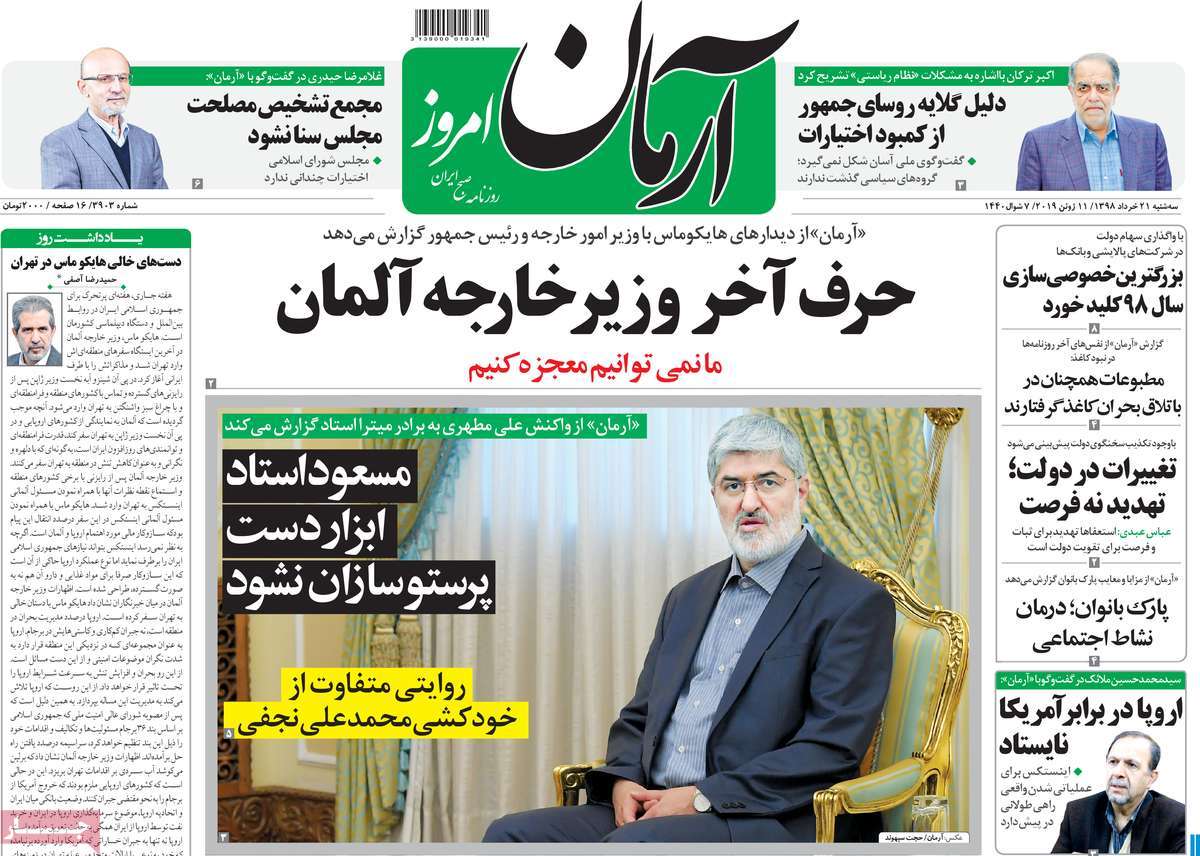
Arman-e Emrouz:

  • We Cannot Do Magic: German Foreign Minister
  • Heiko Maas Empty-handed in Tehran
  • Europe Did Not Stand Against US: Expert

A Look at Iranian Newspaper Front Pages on June 11


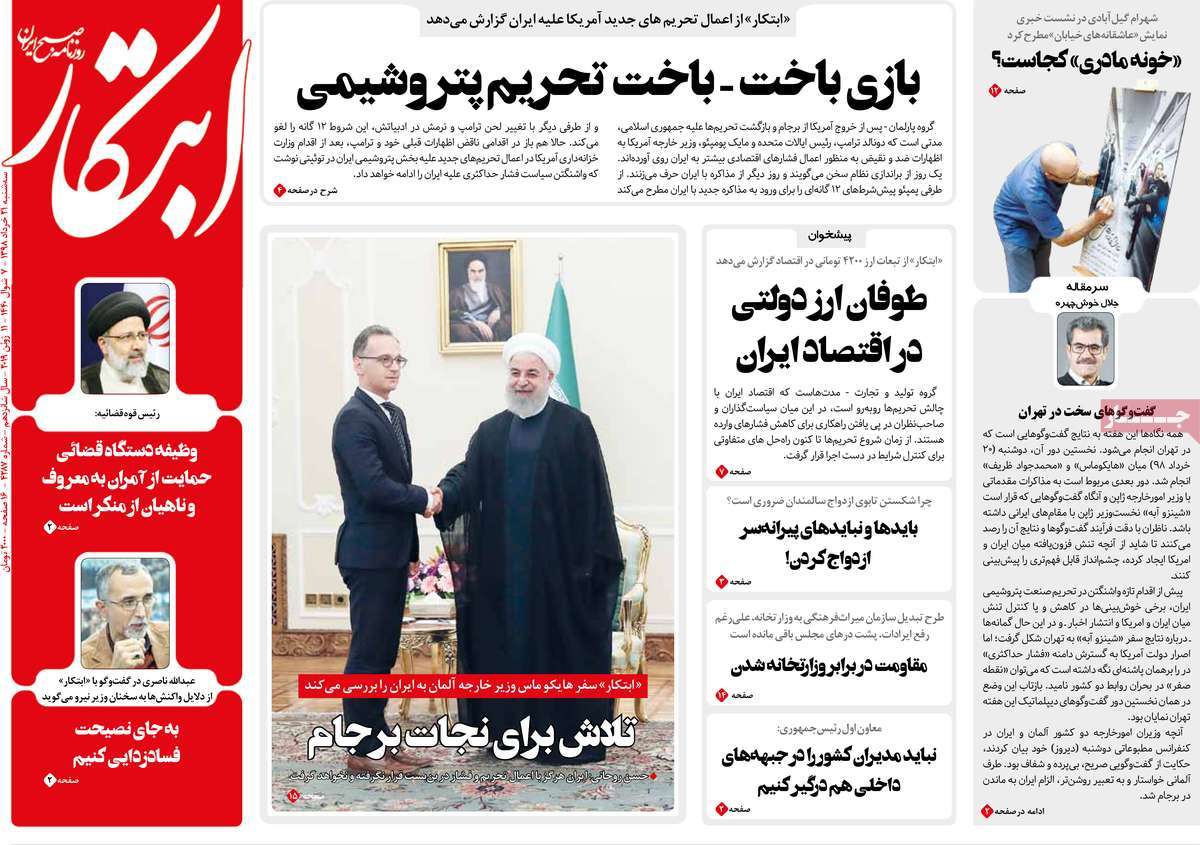
Ebtekar:

  • Attempts to Save JCPOA: A Look At German FM’s Visit to Iran
  • No-win Game of Petrochemical Sanctions

A Look at Iranian Newspaper Front Pages on June 11


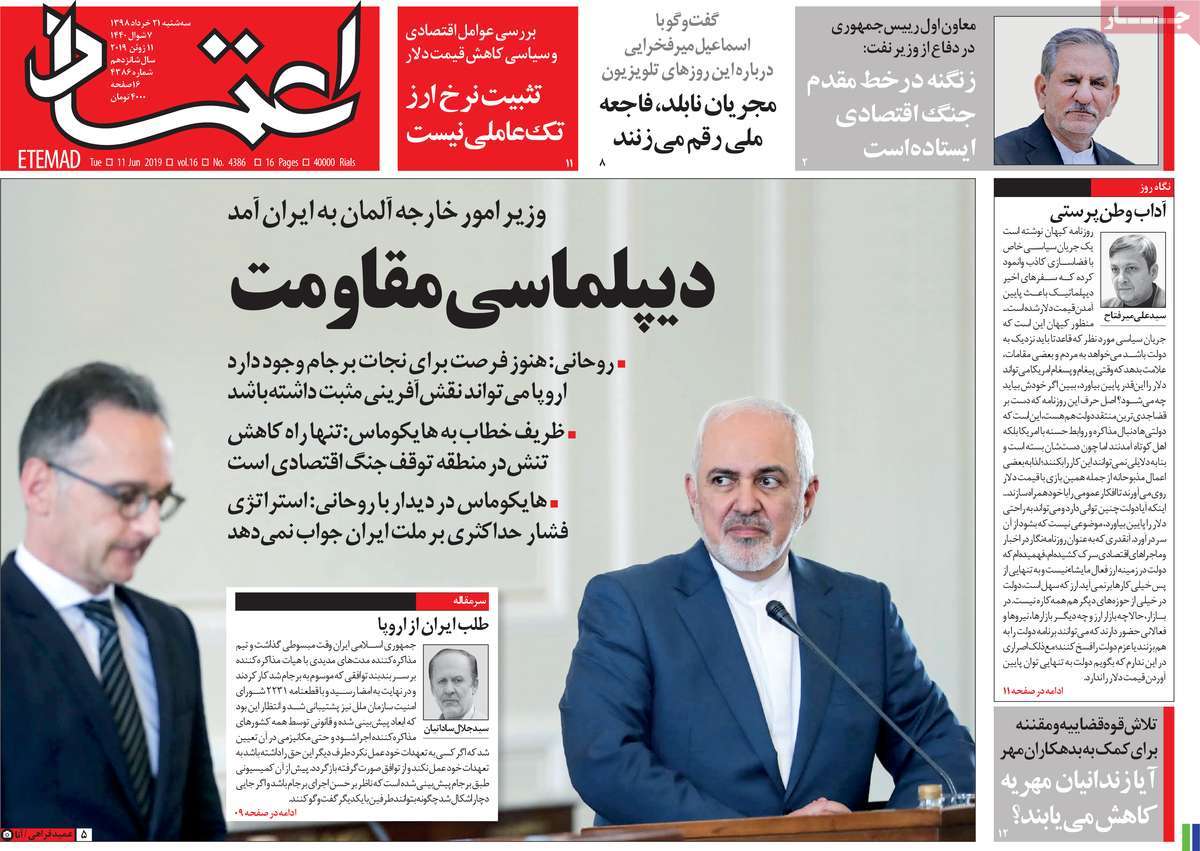
E’temad:

  • Diplomacy of Resistance
  • There is Still Chance to Salvage JCPOA; Europe Can Play Positive Role
  • Iran’s Demands from Europe

A Look at Iranian Newspaper Front Pages on June 11


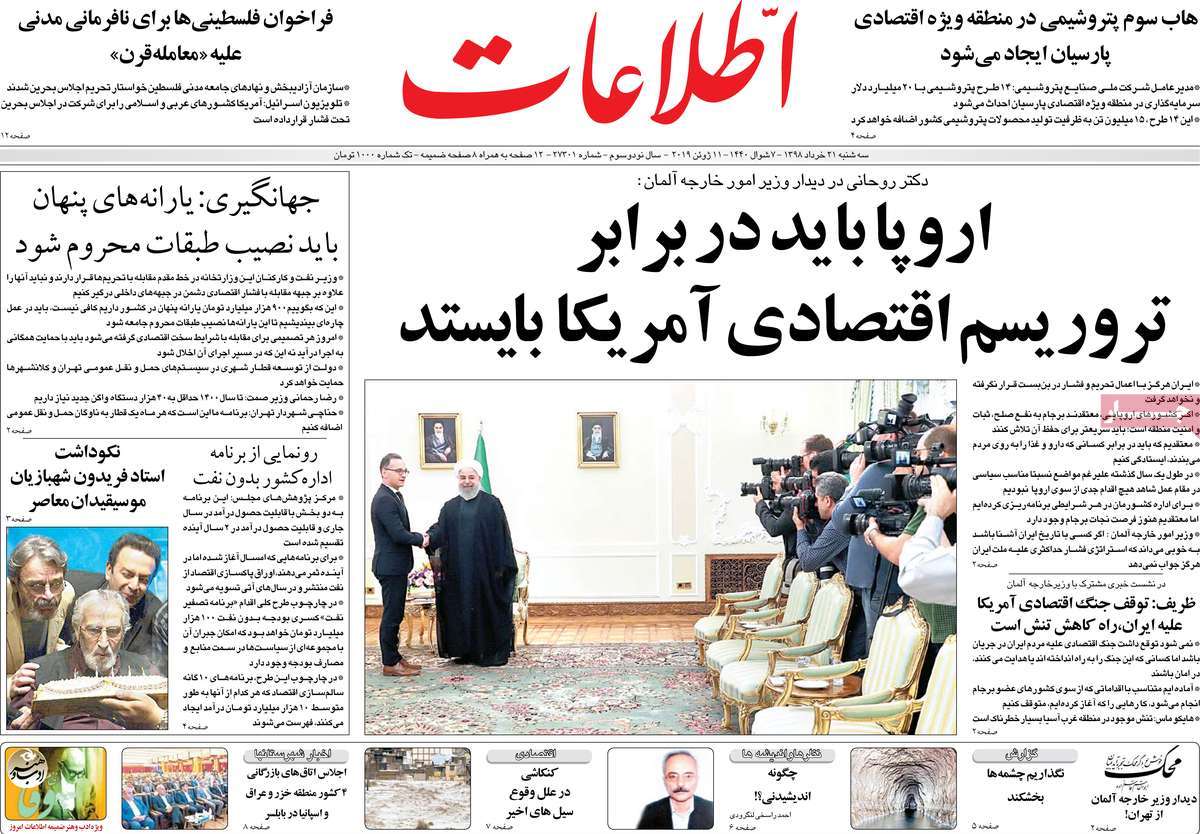
Etela’at:

  • Europe Must Stand Against US Economic Terrorism: Rouhani
  • Stopping US Economic War Only Way to Reduce Tension: Zarif

A Look at Iranian Newspaper Front Pages on June 11


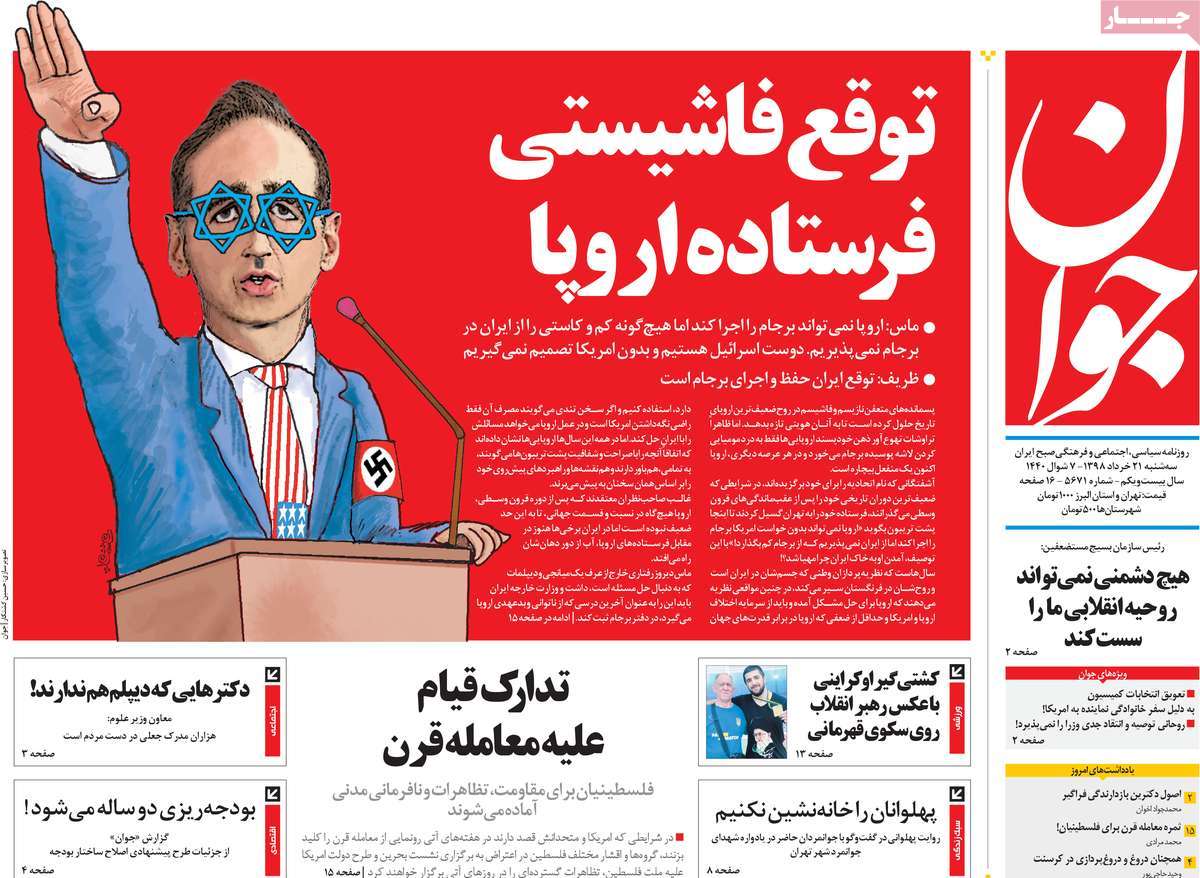
Javan:

  • Fascist Expectations of the European Envoy
  • “Europe Cannot Implement JCPOA, but We Will Not Accept Any Shortcomings from Iran”
  • “We Are Friend of Israel, We Do Not Decide Without US”

A Look at Iranian Newspaper Front Pages on June 11


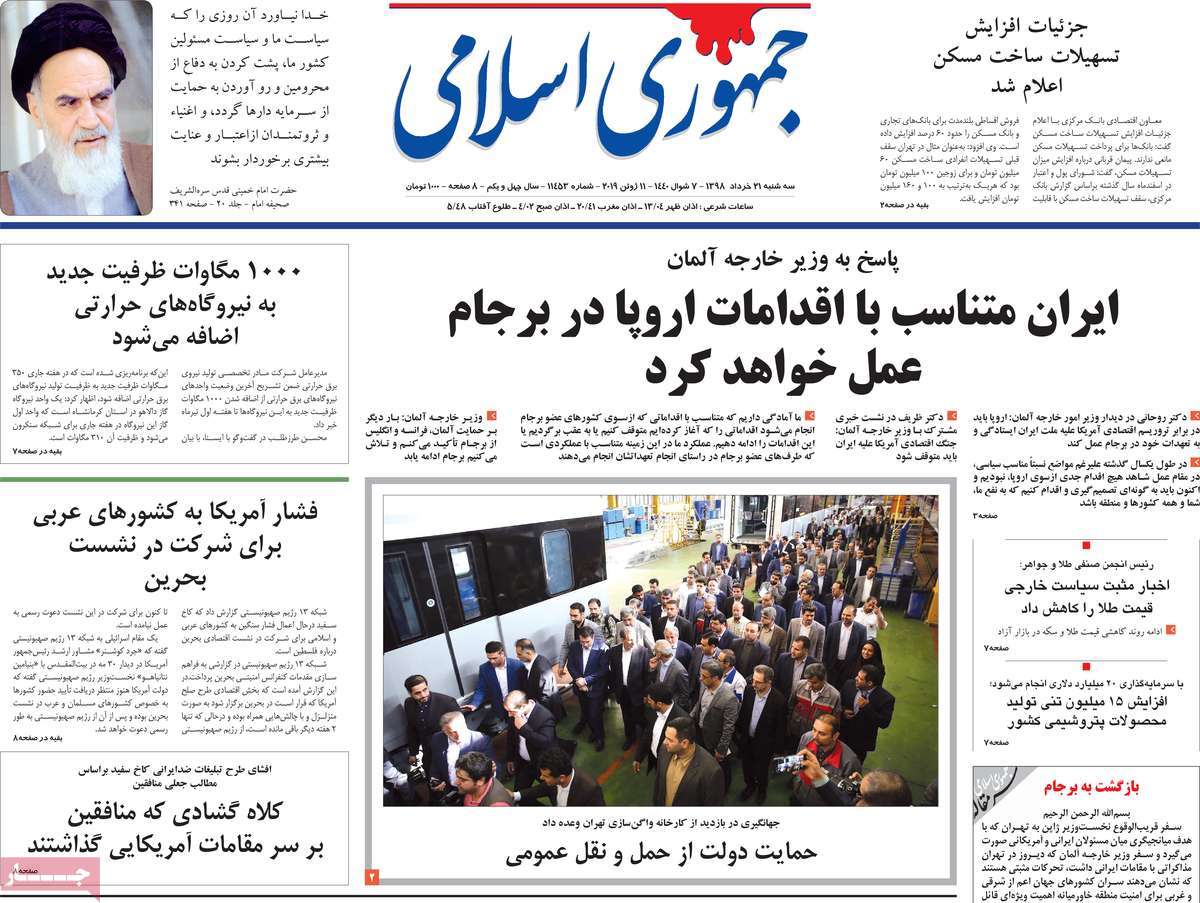
Jomhouri-e Eslami:

  • Iran Will Act in Accordance with EU’s Actions: Iran’s Response to German FM
  • US Pressure on Arab Countries to Attend Bahrain Conference
  • MKO Cheat US Officials

A Look at Iranian Newspaper Front Pages on June 11


Kayhan:

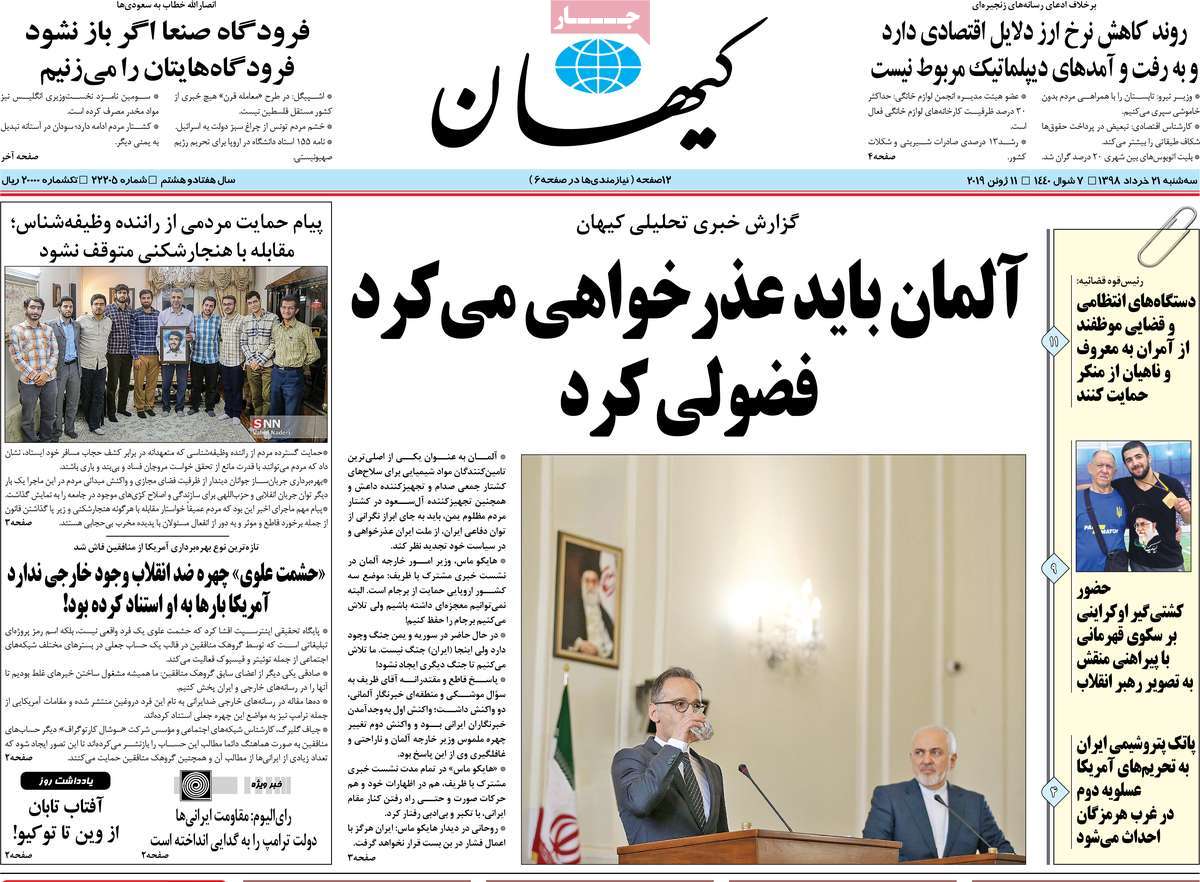
  • Germany Has to Apologise, but Interferes

A Look at Iranian Newspaper Front Pages on June 11


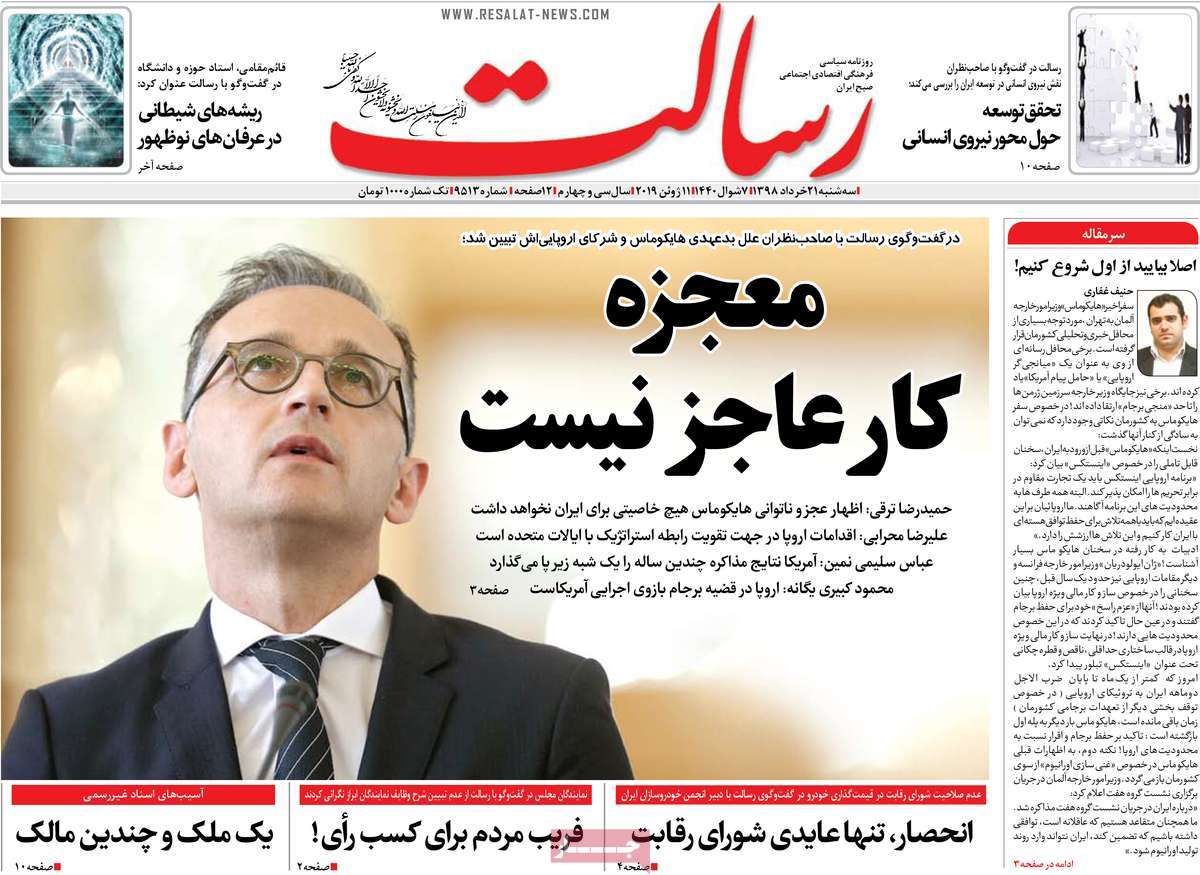
Resalat:

  • “Mass’s Declaring Helplessness Does Not Have Any Benefit for Iran”
  • “US Ignores Many Years of Talks Overnight”
  • “EU’s Moves Are in Line with Strengthening Strategic Ties with US”

A Look at Iranian Newspaper Front Pages on June 11


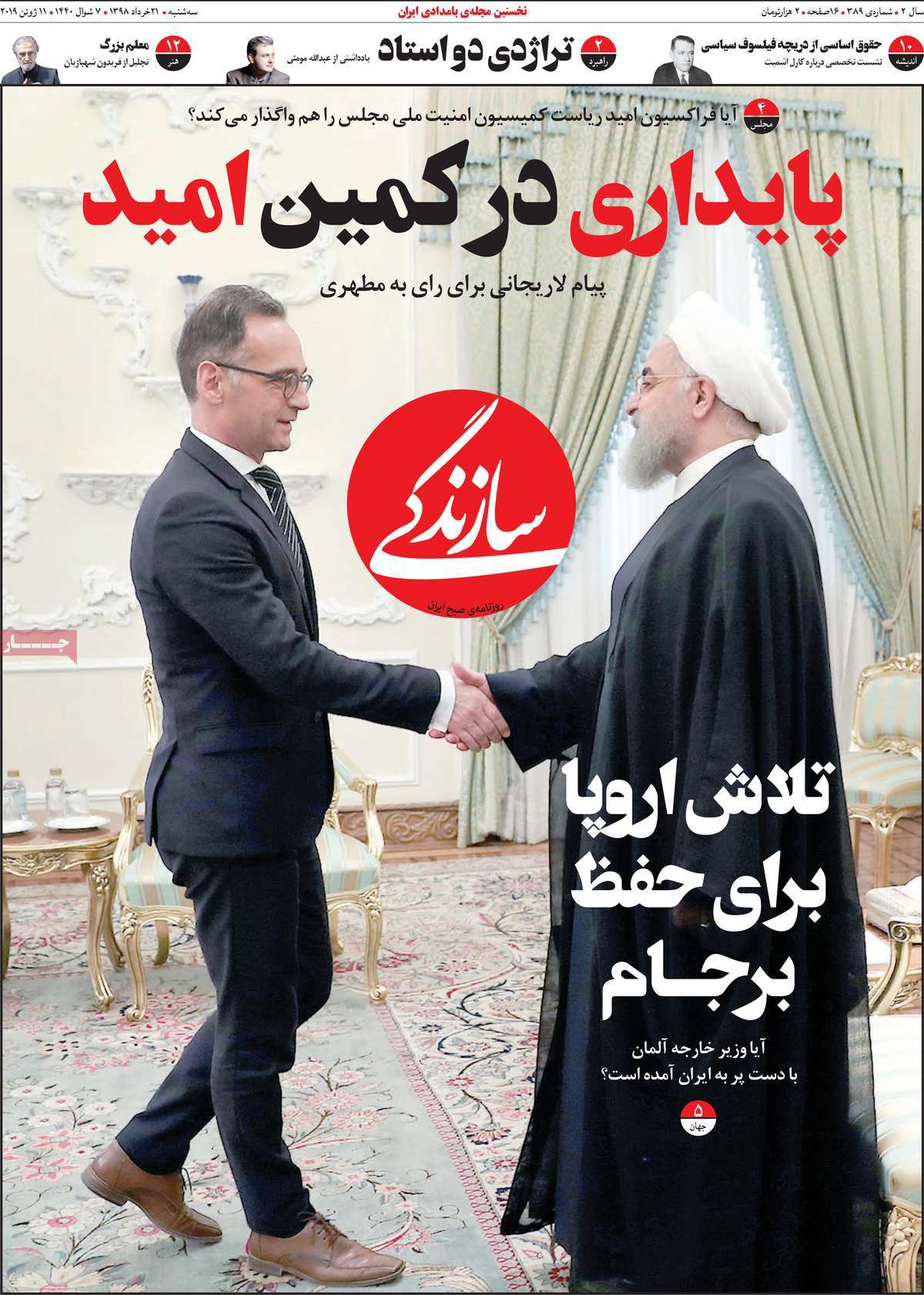
Sazandegi:

  • Europe’s Attempts to Save JCPOA

A Look at Iranian Newspaper Front Pages on June 11


Sharq:

  • Iran to Develop Political Relations with EU, Especially Germany: Rouhani
  • Series of Financial Corruptions in Trump’s Family
  • Whistle-blowing Against Trump’s Son-in-Law

A Look at Iranian Newspaper Front Pages on June 11


Sobh-e Now:

  • Those Behind Economic Wars Cannot Expect to Stay Safe: Zarif

A Look at Iranian Newspaper Front Pages on June 11

Iran FM, UN ESCAP Chief Meet in Tehran

In their Tuesday meeting, the two sides talked about the most important issues and developments in regional and international affairs.

Armida Salsiah Alisjahbana is in Tehran to attend the first Asia Pacific Innovation Forum (APIF) which is underway in the Iranian capital.

The Forum is jointly organised by the ESCAP and the Government of the Islamic Republic of Iran’s Vice Presidency for Science and Technology.

Iranian Startups Eyeing Regional Markets: VP

Iranian Vice-President for Science and Technology Sorena Sattari speaks at the First Asia-Pacific Innovation Forum (APIF) held in Tehran on June 11, 2019

Vice President for Scientific and Technological Affairs Sorena Sattari said three new scientific waves have emerged in Iran.

“Maybe everybody knows Iran by its oil and gas, but three important waves took shape in Iran in recent years, namely the wave of universities, the establishment of knowledge-based companies and the development of these companies,” said Sattari at the inaugural of the 1st Asia-Pacific Innovation Forum also attended by foreign guests.

“Iran has a very fast-moving scientific progress and ranks 15th in the world when it comes to the production of science,” he said.

“Start-ups in Iran have turned into capable companies,” he noted.

The official said Iran has made progress in different scientific domains, adding more than 4,000 knowledge-based companies have been supported.

He said the resources and potentialities distributed in the country should be utilized and attention should be paid to less-privileged classes of society.

He also underlined the necessity of creating a network as well as legal frameworks to preserve the rights of consumers, not to mention the need for training manpower.

“Private institutions and agencies which have close relations with start-ups can contribute to the activities of the network.

He noted Iran has played a role in major regional forums.

He said the holding of the Asia-Pacific Forum is one of the instances of Iran’s contribution.

The 1st Asia-Pacific Innovation Forum opened in Tehran, bringing together a host of local and foreign dignitaries. It is organized by the Science and Technology Department of the Presidential Office.

The event has been held as Iran is home to 4,400 knowledge-based companies, 364 innovative firms and 80 innovation centres, making it one of the most influential countries in the world in the field of nanotechnology. The existence of 45 sci-tech parks, 190 development centres, 80 innovation centres and 30 risk funds has turned Iran into a role model for other countries in the region and across the world.

Iranian Daily Raps Maas’s Visit: Berlin Is Washington’s Flunkey

In a front page article, Kayhan wrote that German authorities have argued their goal of traveling to Tehran is to mediate and ease tensions between Iran and the US and help salvage the JCPOA. This comes as Germany is a country known for being America’s servitor.

“How can Germany protect the rights of Iran while it always serves the US, and without Washington’s permission cannot even provide the Iranian foreign minister’s jet with fuel on its soil?” reads an article by Kayhan.

The visit of the German foreign minister to Tehran as a mediator between Iran and the United States comes in a situation that the German foreign ministry said in an outrageous statement a few days ago that the full implementation of the JCPOA by Iran is a key factor for stability in the region!

Germany has never referred to its own and other European parties’ (France, Britain) inaction in the fulfilment of their commitments. In a situation that Germany owes much to Iran, it tries to show itself as a demanding party claiming that Iran should fulfil its obligations unilaterally!

More than a month has passed from Iran’s 60-day deadline to Europe. In the current situation, Germany has to answer what steps have been taken to comply with this deadline. Now, it cannot blame Iran which has complied with all its obligations according to the IAEA’s 15 reports.

Kayhan goes on to say that in October 2017, in an insincere attempt the German embassy in Tehran put up a poster on its wall reading “Aye to the JCPOA”, at the same time, however, the country’s foreign minister in an irresponsible comment said that Berlin was prepared to increase diplomatic pressure on Iran along with the United States.

At that time, the German embassy in Tehran published some photos in cyberspace. In these photographs, the German ambassador was shown standing next to the posters in talks with the citizens of Tehran. The posters featured comments by former German Foreign Minister Sigmar Gabriel and the country’s ambassadors to Iran and the United States. The posters read “We do not like to endanger the nuclear deal with Iran, let alone end it, not today or in the future.”

This hypocritical act by the German embassy and a ridiculous gesture of standing next to the Iranian nation came in a situation that Germany did not support the Iranian people after the signing of the deal – exactly like before the JCPOA.

Germany has never fulfiled its obligations after the JCPOA. For example, in March 2017, it refused to provide fuel to the airplane carrying our country’s Foreign Minister, Mohammad Javad Zarif.

In July 2018, Germany arrested Iranian diplomat Asadollah Asadi, in an unlawful and inappropriate move.

In the summer of 2018, after the unilateral withdrawal of the United States from the nuclear deal, European companies, including several German ones rushed to leave Iran without paying attention to their commitments.

In September 2018, German Foreign Minister Heiko Maas said “We are pursuing common goals with the US regarding Iran. Just the paths we are taking are different from each other.”
In December 2018, when the EU was claiming to open a financial channel with Iran, the German telecommunications company cut off the Iranian banks’ internet service and landlines in a rude move.

Kayhan says these are only part of Germany’s inaction in fulfiling its obligations. German authorities have claimed that their goal of traveling to Tehran is to mediate to salvage the JCPOA and reduce tensions between Iran and the United States, while Germany is a country known as the US servitor.

Saying that Germany has been one of the countries that provided Saddam Hussein with weapons during the imposed war on Iran, Kayhan concludes that German foreign minister’s visit to Tehran can never protect the rights of the Islamic Republic.

This Iranian daily also refers to the fall of US dollar exchange rate in Tehran at the time of German official’s visit to Tehran claiming that it is a psychological move by a domestic movement to instill that this is only the beginning and if Tehran starts negotiations with the US the exchange rate would fall more and more!