Tuesday, December 23, 2025
Home Blog Page 3234

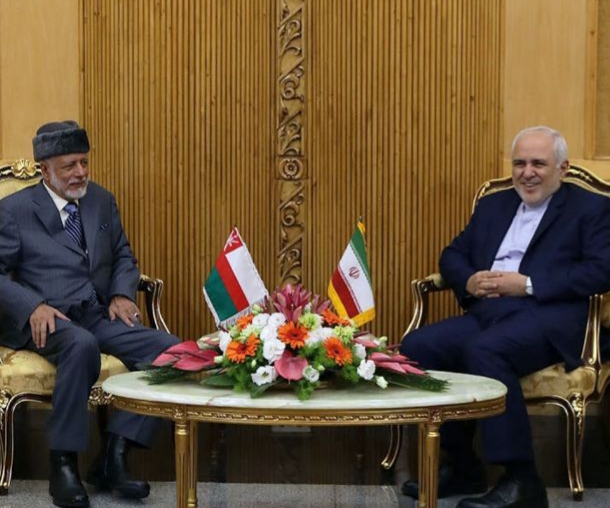
Omani FM in Tehran as Iran-US Tension Escalates

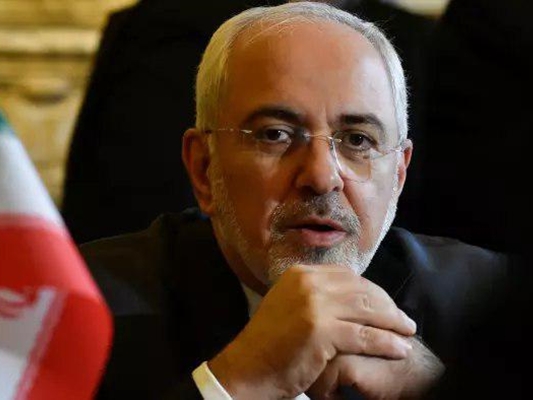
During the visit, the Omani top diplomat held talks with Iranian Foreign Minister Mohammad Javad Zarif on bilateral relations and the most important regional and international issues.

His visit comes a few days after Oman announced it is ready to mediate between Iran and the US to resolve the tensions.

Muscat’s ambassador to Washington said on May 11 that Oman is one of the few countries in the region that has close ties with both Iran and the United States.

“Earlier, we brokered the release of US climbers who were jailed in Iran. Now, we can do this about Iran’s oil sanctions,” said the Omani envoy.

Oman also played a significant role in the initial talks between Iran and the US that led to the nuclear talks and the Joint Comprehensive Plan of Action (JCPOA), the 2015 nuclear deal.

Bin Alawi’s meeting with Zarif also comes ahead of an emergency meeting of Arab countries, led by Saudi Arabia, in Mecca, which is expected to be focused on Iran and its tension with the US.

A Look at Iranian Newspaper Front Pages on May 20

A Look at Iranian Newspaper Front Pages on November 19

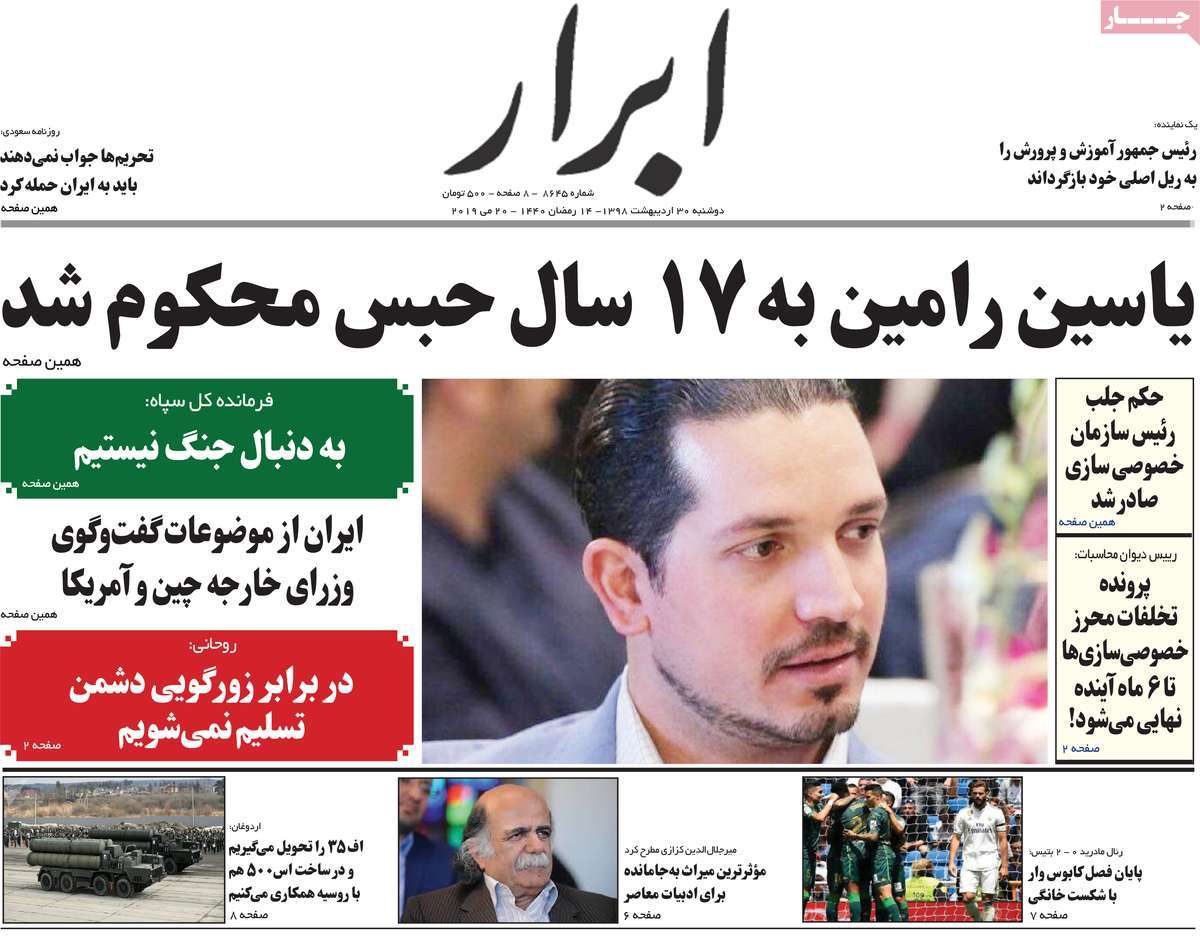
Abrar:
1- Saudi Paper: Sanctions Don’t Work, Iran Must Be Attacked
2- IRGC Chief: We’re Not after War

A Look at Iranian Newspaper Front Pages on May 20


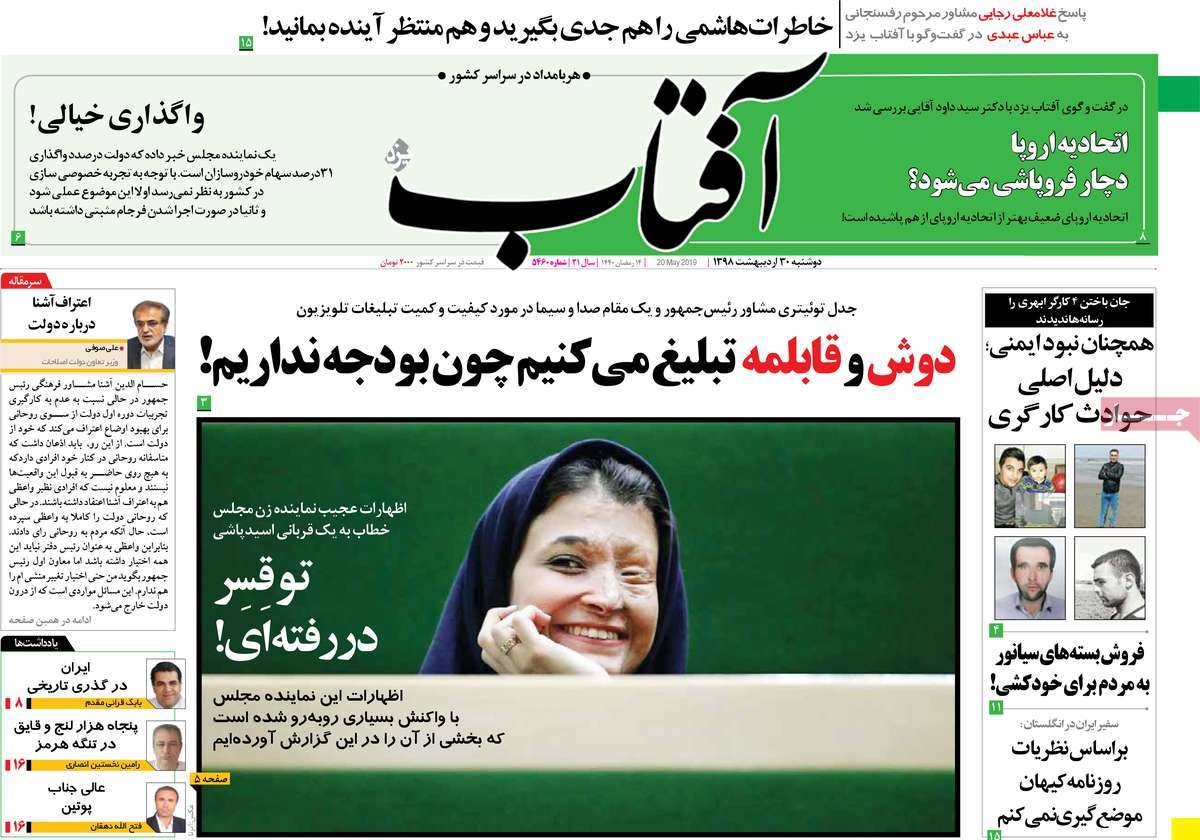
Aftab-e Yazd:
1- Will EU Collapse? Analyst Says Weak EU Better than No EU!

A Look at Iranian Newspaper Front Pages on May 20


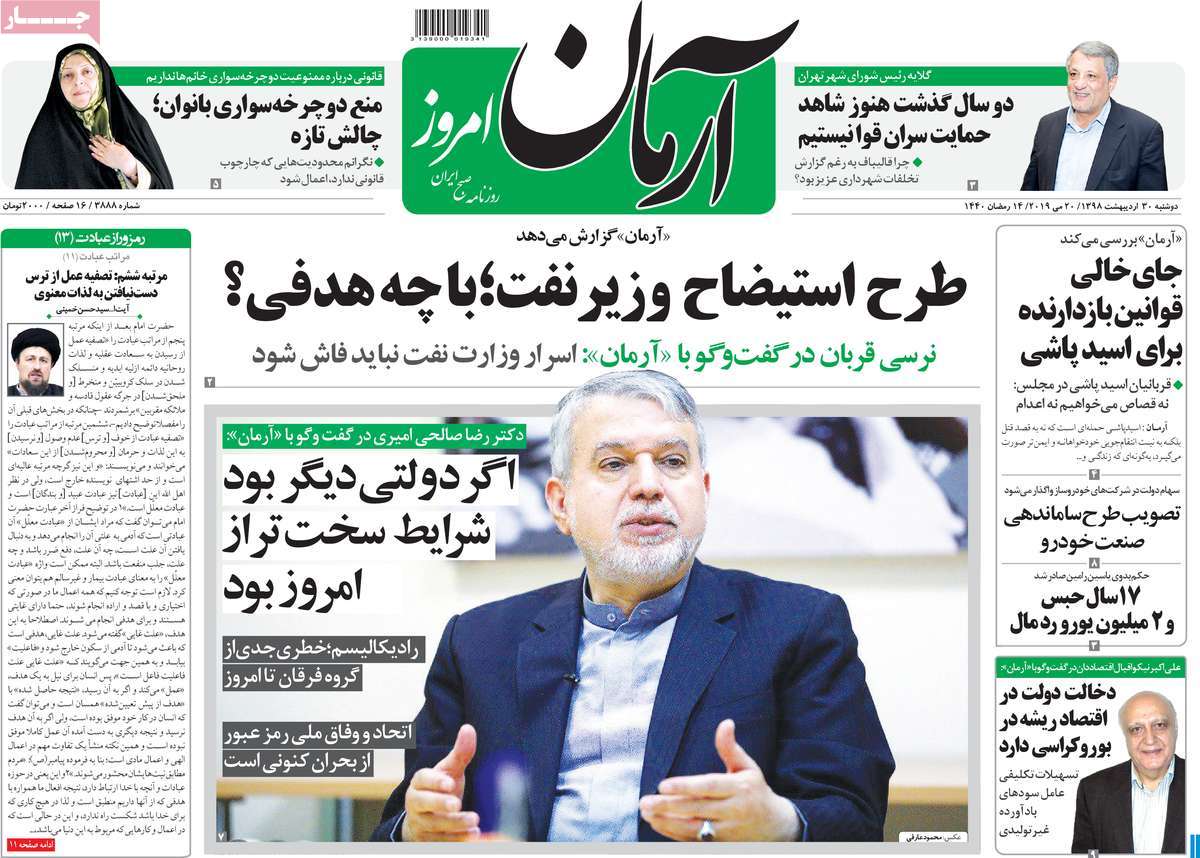
Arman-e Emrooz:
1- Gap of Deterrent Laws against Acid Attack
* Acid Victims in Parliament: We Don’t Want Attackers Be Executed
2- Conditions Could Be More Difficult If Another President Was in Office

A Look at Iranian Newspaper Front Pages on May 20


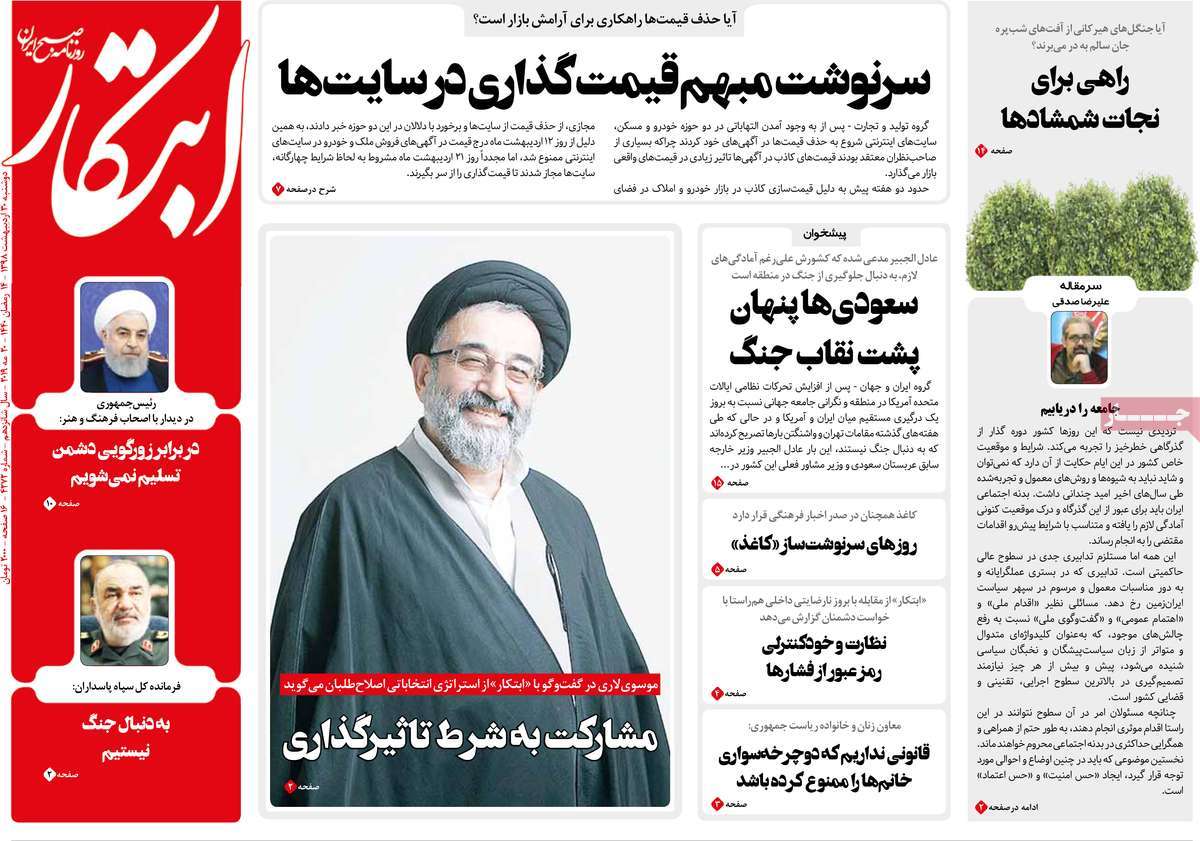
Ebtekar:
1- Rouhani: We Won’t Give in to Enemy’s Bullying
2- Al-Jubeir: Saudi Ready for War, but Trying to Avoid It

A Look at Iranian Newspaper Front Pages on May 20


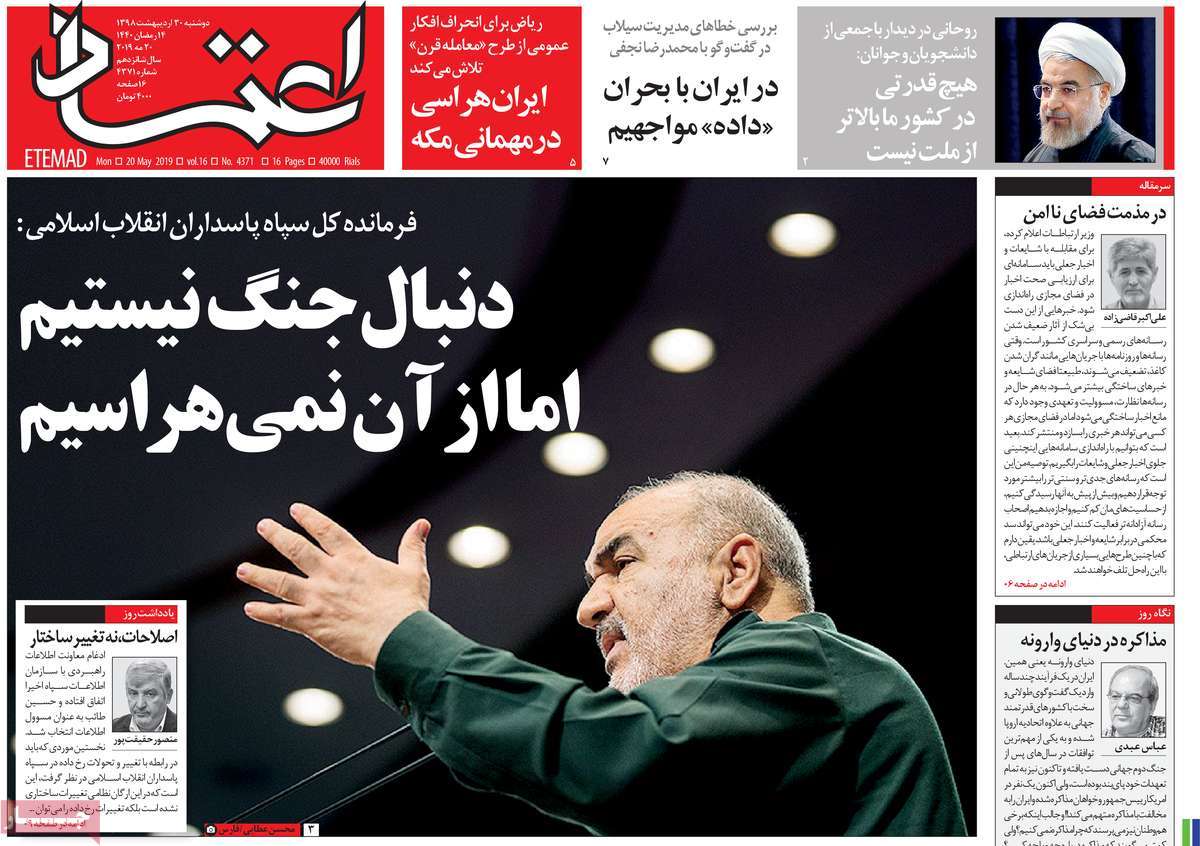
Etemad:
1- IRGC Chief: We’re Not after War, but Not Afraid of It
2- Iranophobia in Mecca Feast: Riyadh Trying to Divert World’s Attention Away from Deal of Century

A Look at Iranian Newspaper Front Pages on May 20


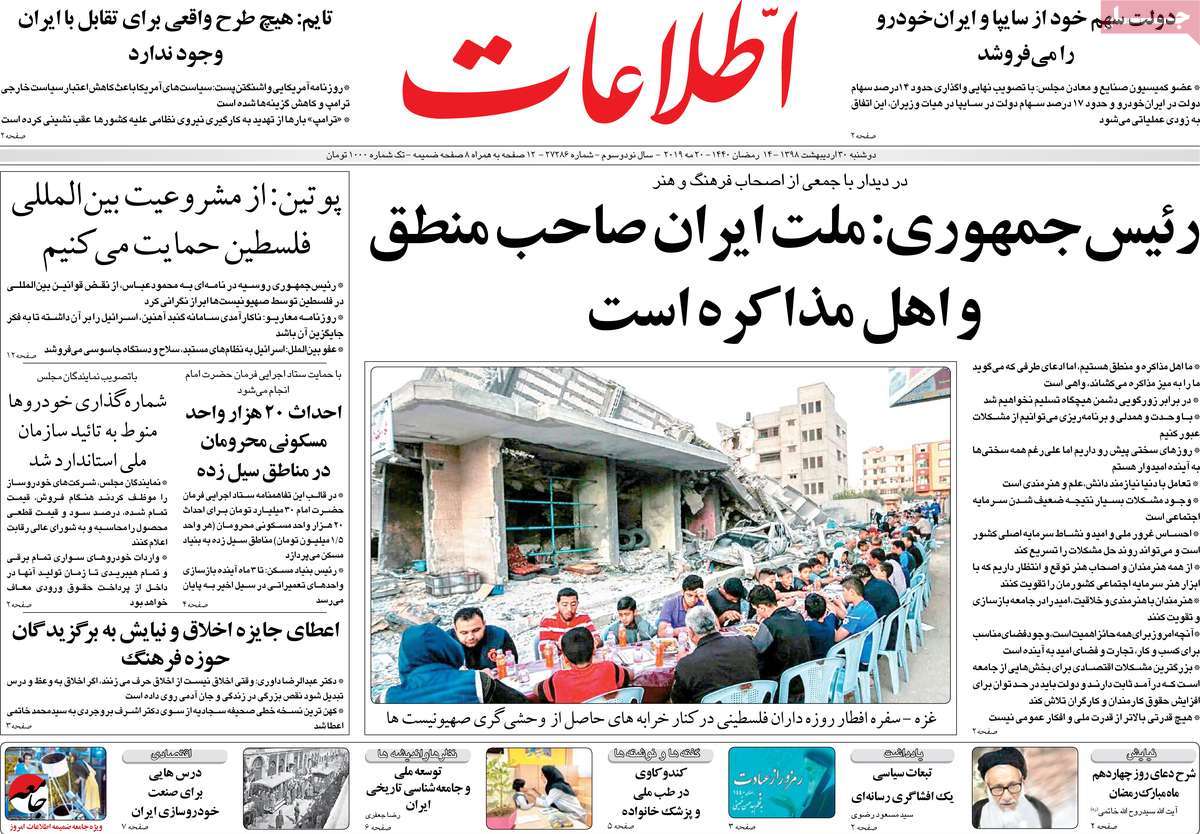
Ettela’at:
1- Rouhani: Iranian Nation Pro Logic, Negotiation
2- Putin: We Support Palestine’s Int’l Legitimacy

A Look at Iranian Newspaper Front Pages on May 20


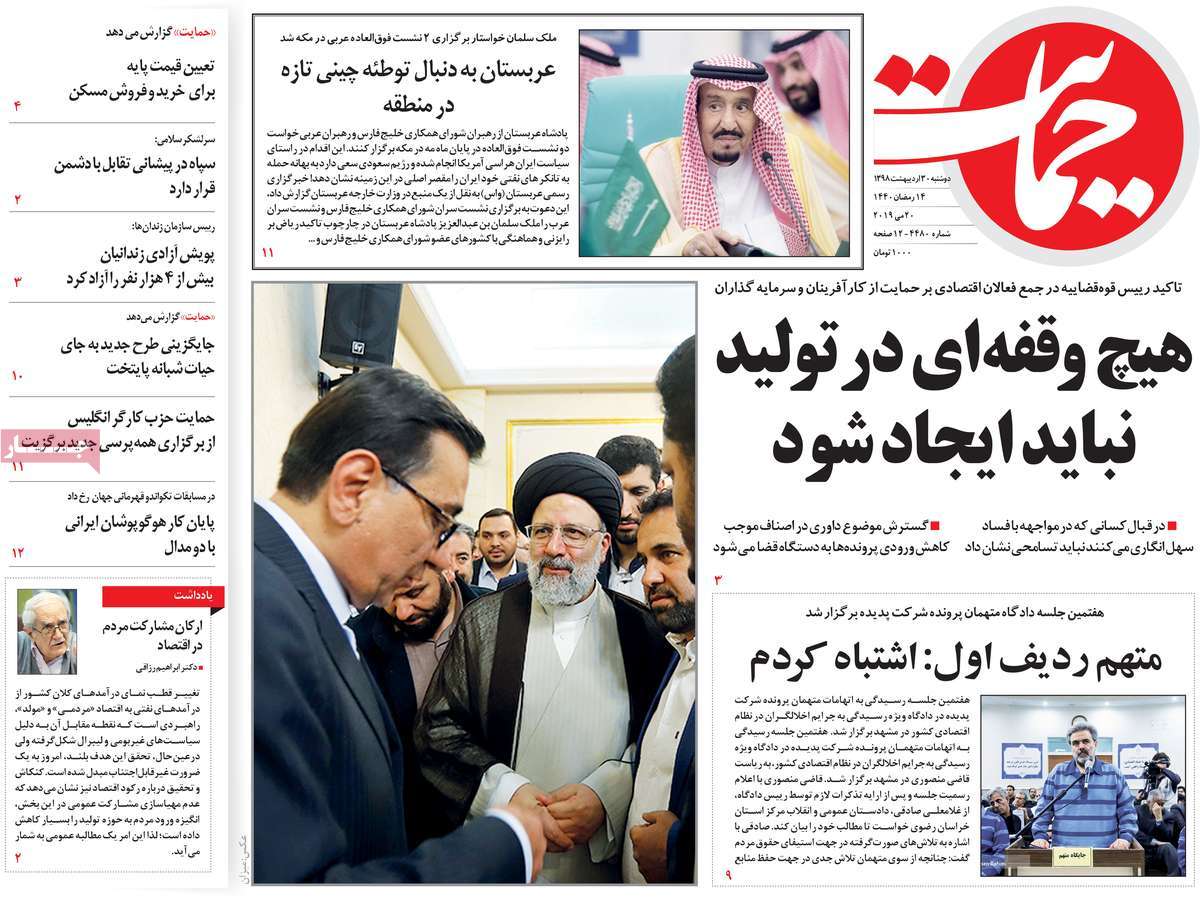
Hemayat:
1- Saudi Arabia after New Plots in Region
* King Salman Calls for Two Emergency Arab Meetings in Mecca
2- Over 4,000 Prisoners Released Thanks to Popular Campaign


A Look at Iranian Newspaper Front Pages on May 20


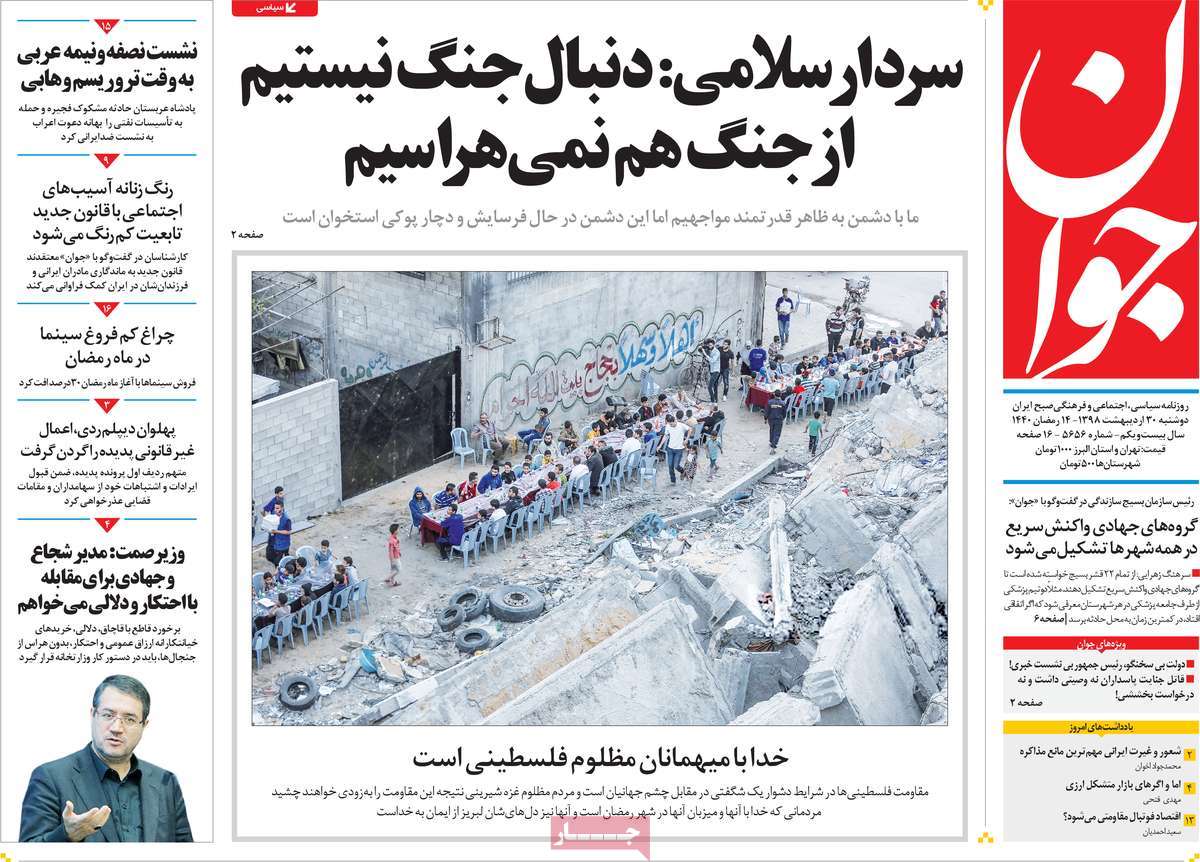
Javan:
1- IRGC Chief: Our Enemy Apparently Powerful, but Weak from Inside

A Look at Iranian Newspaper Front Pages on May 20


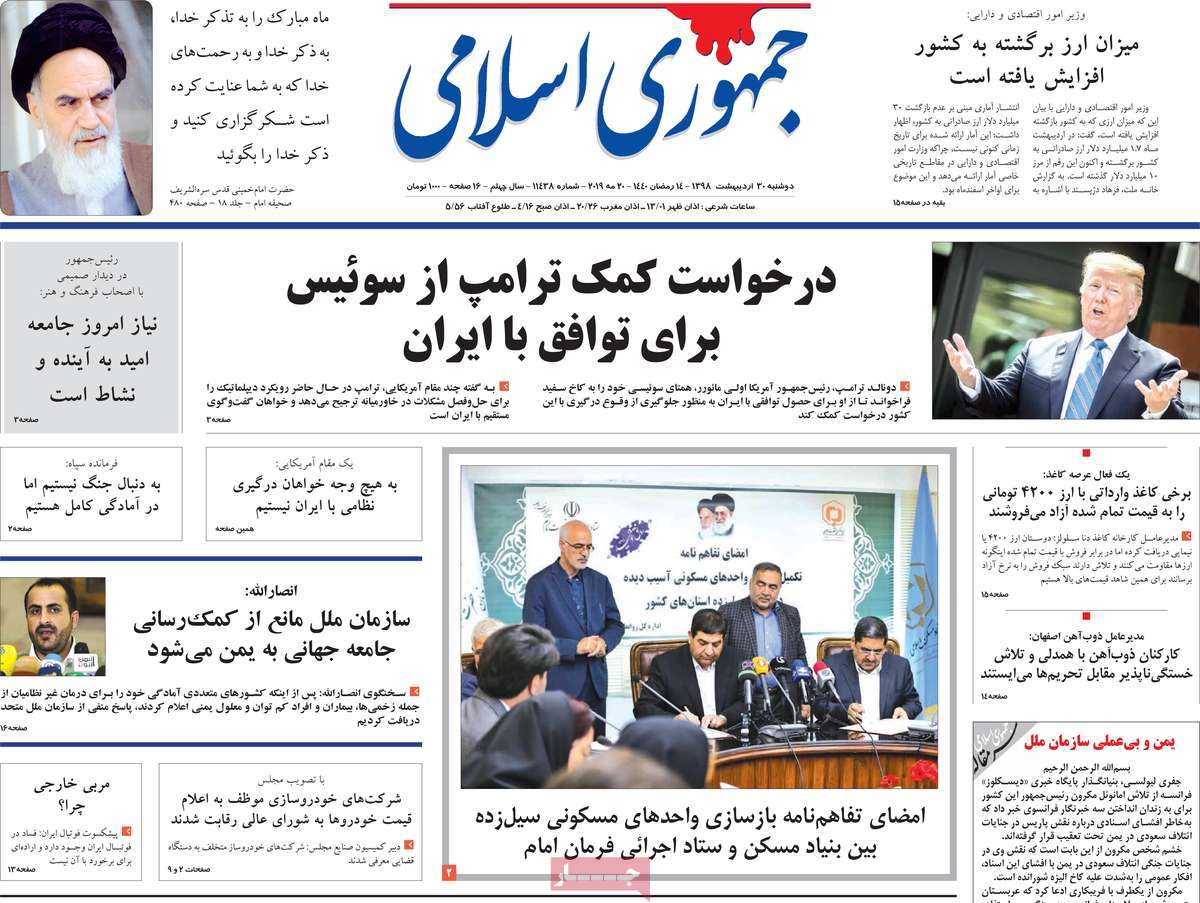
Jomhouri Eslami:
1- Trump Asks for Switzerland’s Help for Deal with Iran
2- American Official: We’re Not at All after Military Confrontation with Iran

A Look at Iranian Newspaper Front Pages on May 20


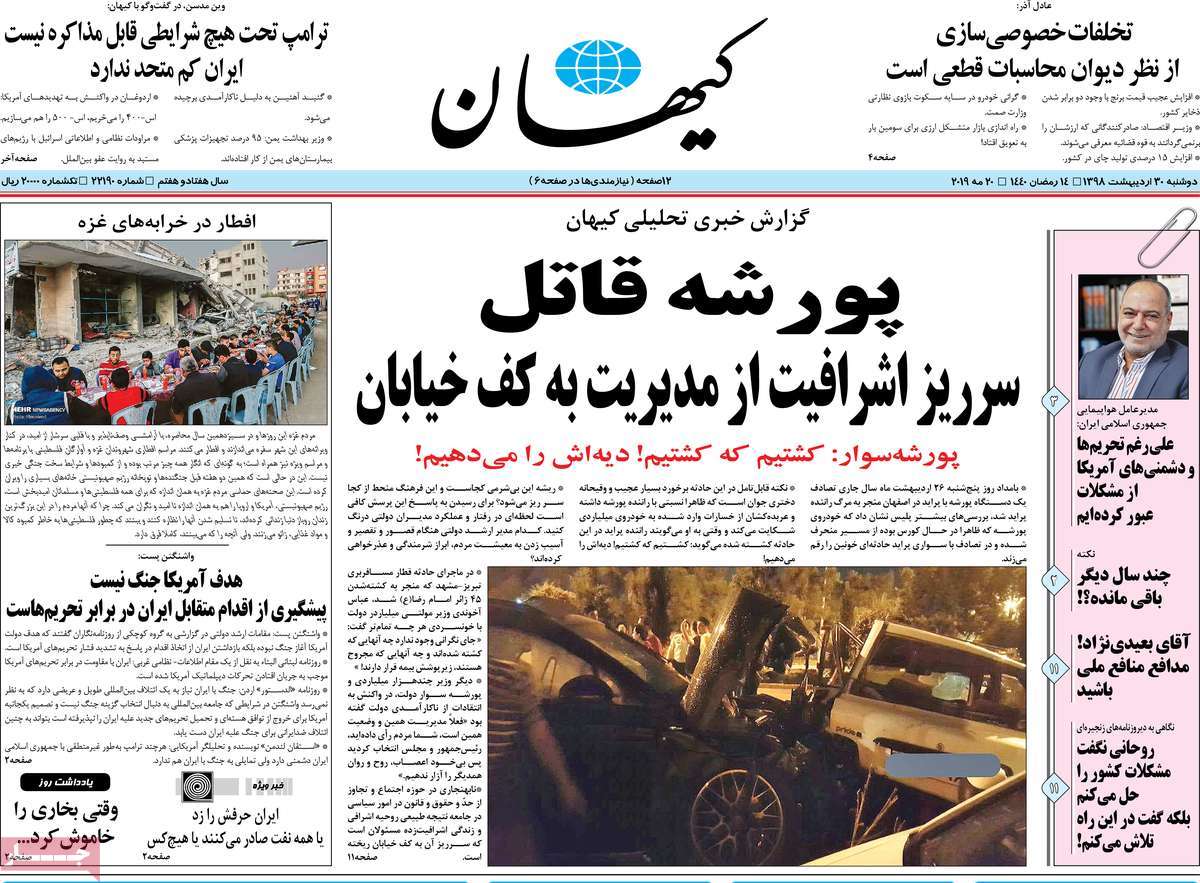
Kayhan:
1- Trump Not Negotiable in Any Way; Iran Has Many Allies
2- Washington Post: US’ Goal Not War with Iran, It Seeks to Prevent Iran’s Reciprocal Action
3- Iran Air: We’ve Overcome Problems Despite US Bans

A Look at Iranian Newspaper Front Pages on May 20


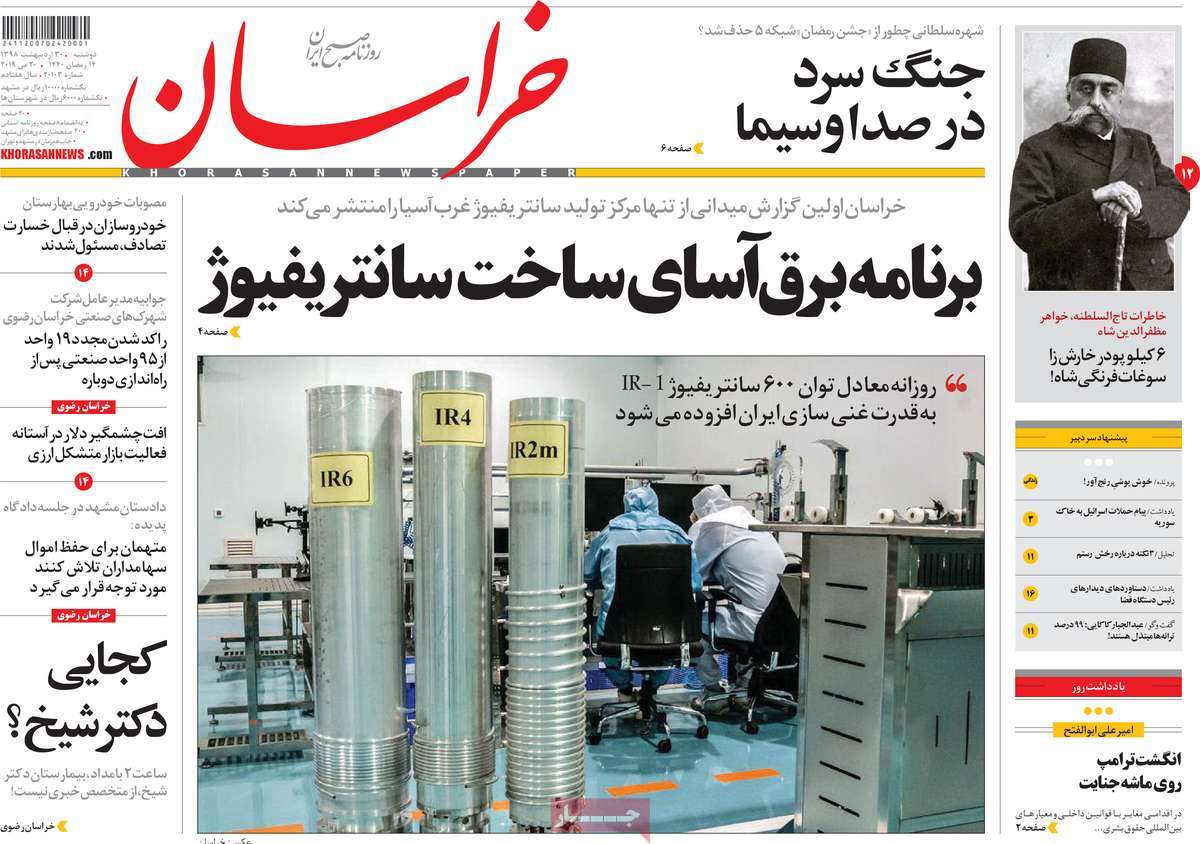
Khorasan:
1- Iran to Increase Its Uranium Enrichment Power

A Look at Iranian Newspaper Front Pages on May 20


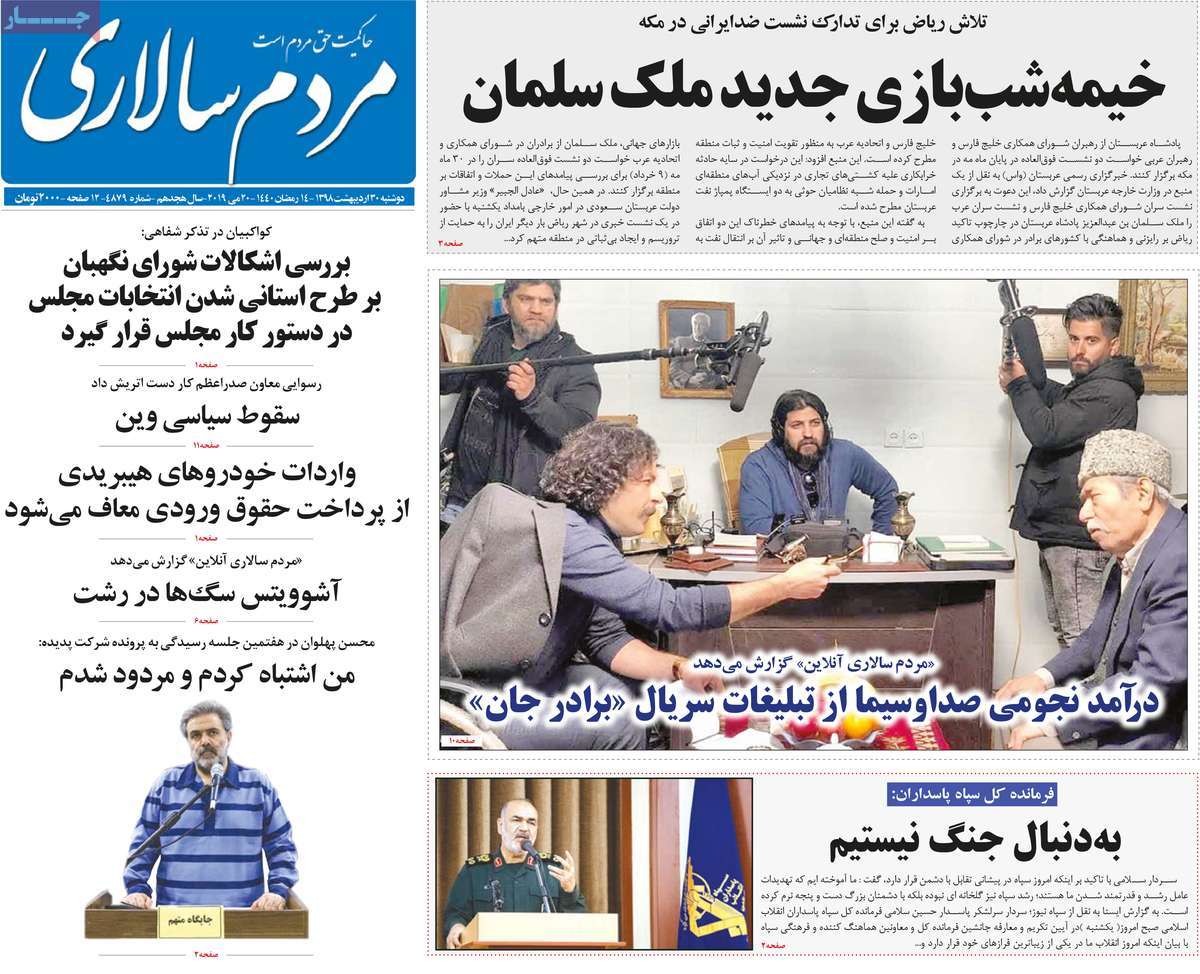
Mardom Salari:
1- King Salman’s New Puppet Show
* Riyadh Trying to Hold Anti-Iran Summit in Mecca

A Look at Iranian Newspaper Front Pages on May 20


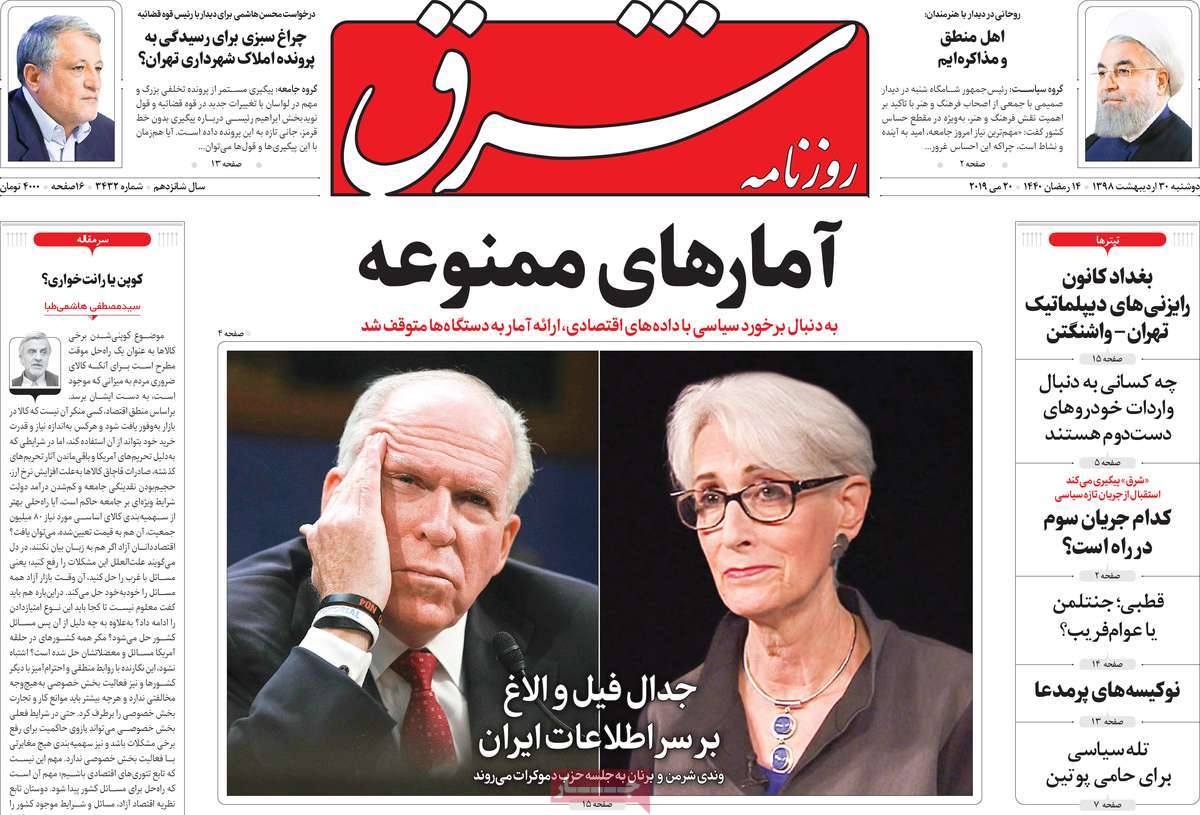
Shargh:
1- Elephant, Donkey Clash over Iran Intelligence
* Sherman, Brennan to Attend Democrats’ Meeting
2- Baghdad Centre of Tehran-Washington Diplomatic Talks

A Look at Iranian Newspaper Front Pages on May 20

Zarif to Trump: Try Respect, It Works!

Zarif made the remarks on Monday, in reaction to an earlier tweet by Trump who said, “If Iran wants to fight, that will be the official end of Iran. Never threaten the United States again!”

“Goaded by B-Team, Trump hopes to achieve what Alexander, Genghis and other aggressors failed to do,” Zarif said in his tweet.

“Iranians have stood tall for millennia while aggressors all gone. Economic Terrorism and genocidal taunts won’t ‘end Iran’,” he went on to say.

He also warned Trump against threatening Iranian people, and advised him to try respecting the country.

“Never Threaten an Iranian. Try respect, it works!”

The war of words came amid heightened tensions between Iran and the US. The two sides say they are not after a war, but there are concerns that accidental clashes could escalate the tension.

US Says Its Arab Allies Start Patrols in Persian Gulf

US Says Its Arab Allies Start Patrols in Persian Gulf

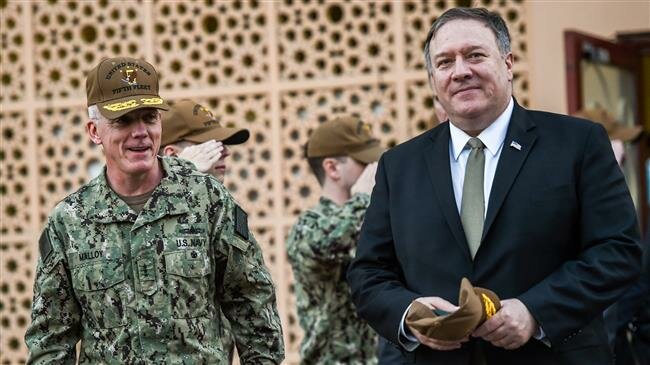
The “enhanced security patrols” began on Saturday, said the Bahrain-based 5th fleet of the US naval forces central command in a statement on Facebook Sunday.

It added that the operations were aimed at “specifically increasing communication and coordination with each other in support of regional naval cooperation and maritime security operations.”

“As agreed to last week in a meeting at US 5th Fleet headquarters in Manama, Bahrain, ships of the GCC – both navies and coast guards – are working in tight coordination with each other and the United States Navy.”

Trump and his hawkish foreign policy advisers such as John Bolton and Secretary of State Mike Pompeo have been stepping up pressure against Iranians in the wake of Trump’s withdrawal from the Iran nuclear deal.

Trump has also tightened economic sanctions against Tehran and blacklisted the Islamic Revolution Guards Corps (IRGC).

In a post earlier in the day, the 5th fleet released the latest updates on the US military presence in the Persian Gulf in the wake of US President Donald Trump’s anti-Iran policies.

“The USS Abraham Lincoln (CVN 72) Carrier Strike Group and the Kearsarge Amphibious Ready Group, with the embarked 22nd Marine Expeditionary Unit, conducted joint operations May 17-18,” read the statement. “The operations highlight the ability of the US Navy to quickly mobilize assets and aggregate different platforms with a variety of operational capabilities.”

Iran has time and again asserted that it is not seeking war but is ready to defend its interests in the region.

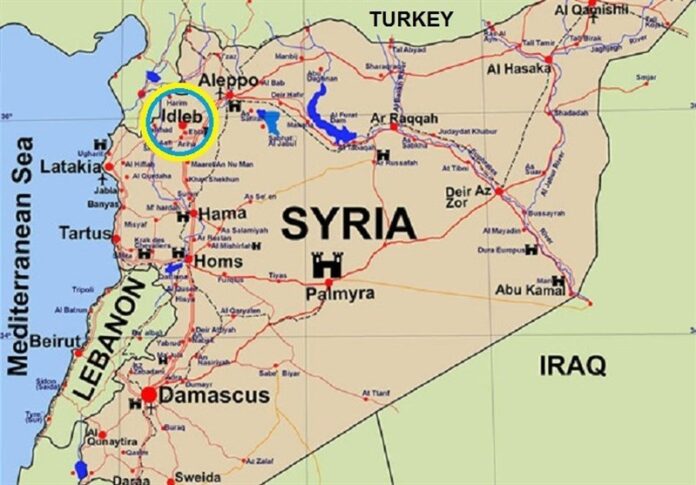
Damascus Announces Unilateral Truce in Idlib: Russia

In a brief statement on Sunday, the Russian Defense Ministry’s Center for Reconciliation of the Warring Sides in Syria said Syrian forces had ceased firing as of midnight, Al Jazeera reported.

It described the move as unilateral but did not give any further details.

Fighting erupted in northwestern Syria last month and shattered a truce negotiated by Russia and Turkey late last year.

Syrian forces intensified their attacks on Idlib late in April after the terrorists operating in the northern city violated the agreement hundreds of times by attempting to target Syrian military posts there.

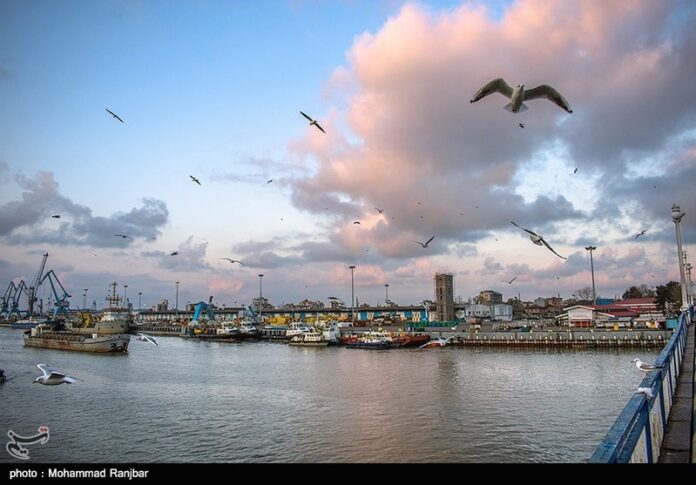
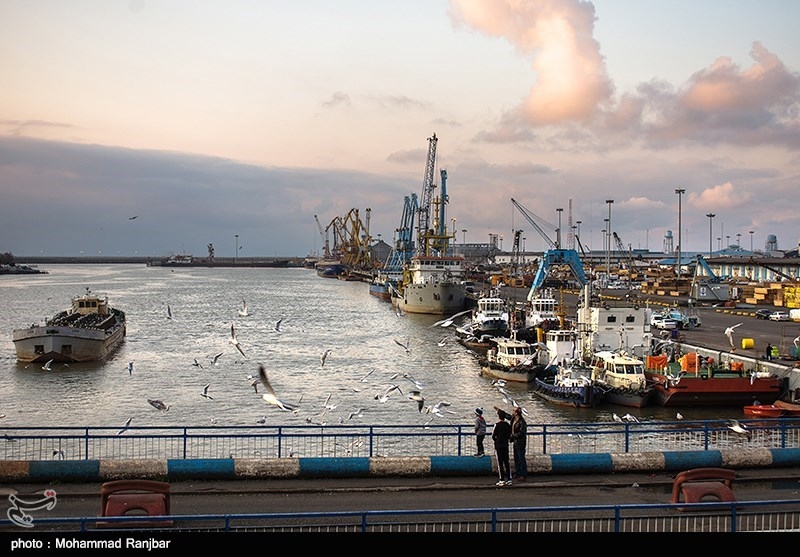
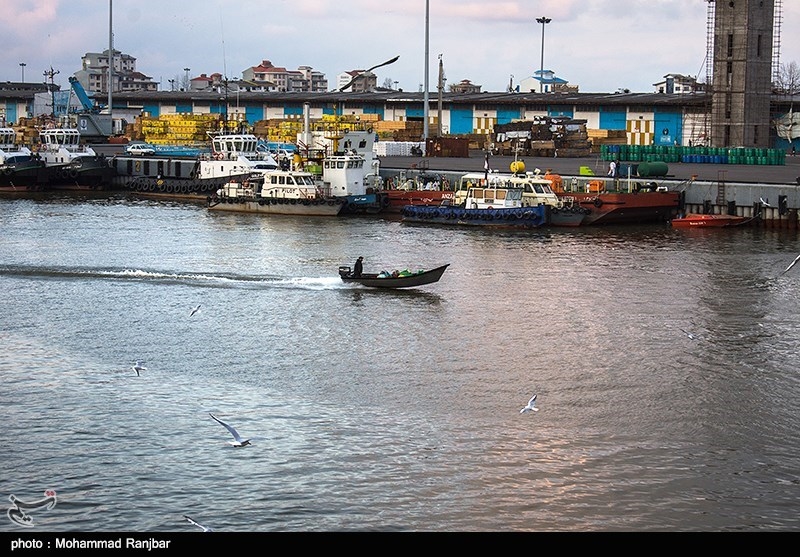
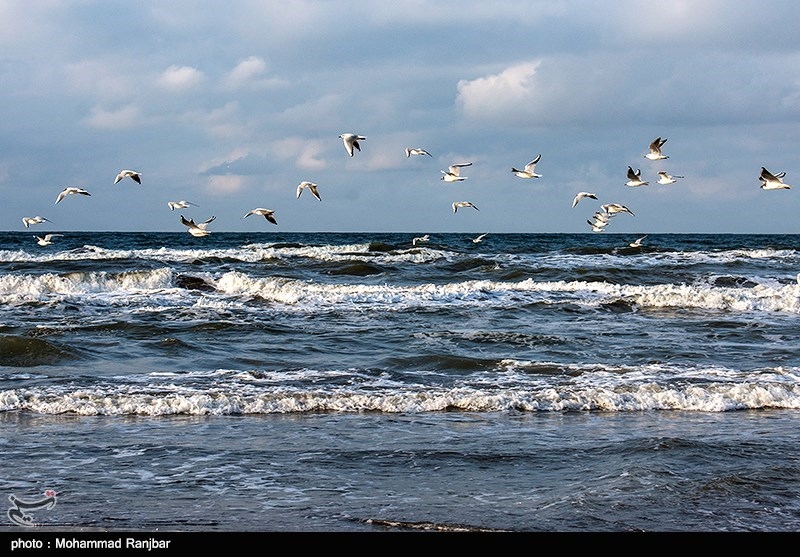
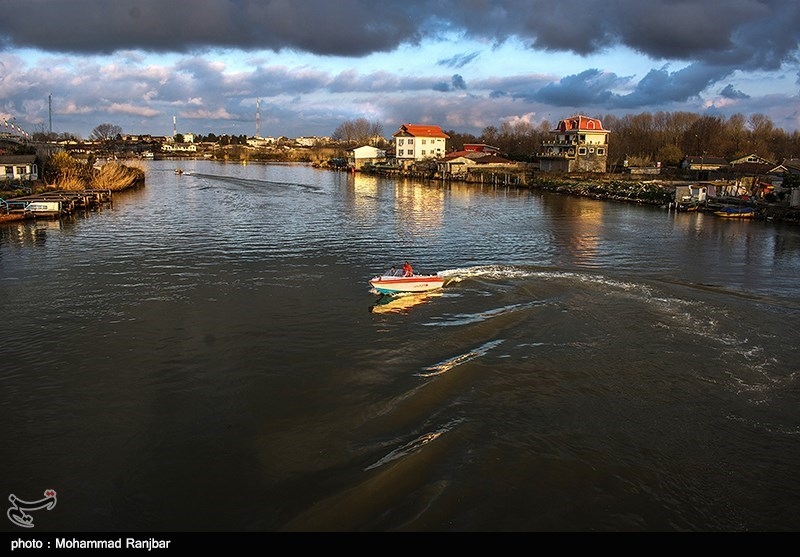
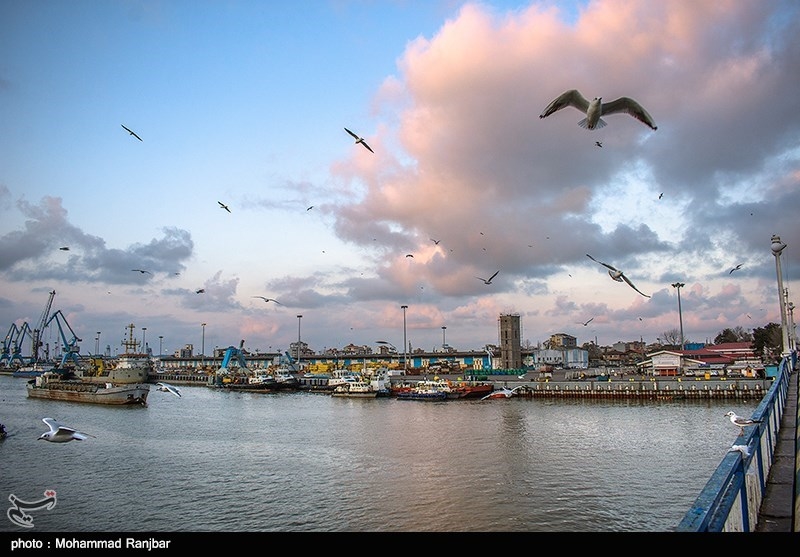
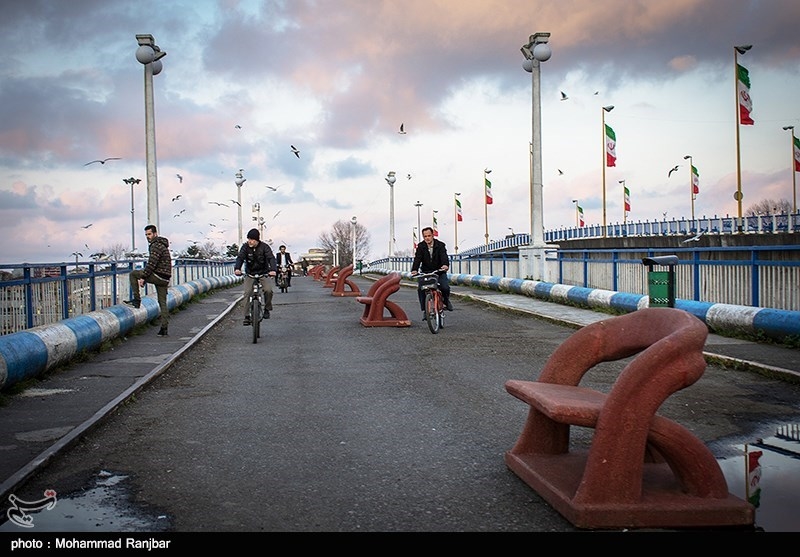
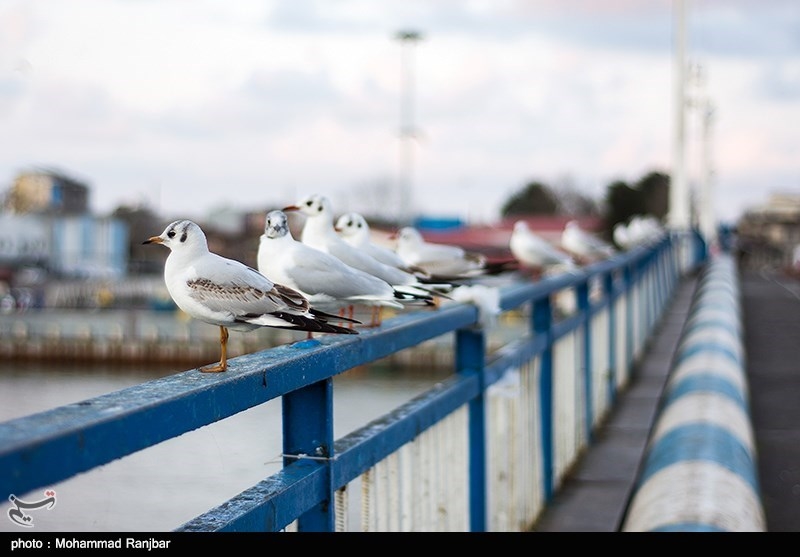
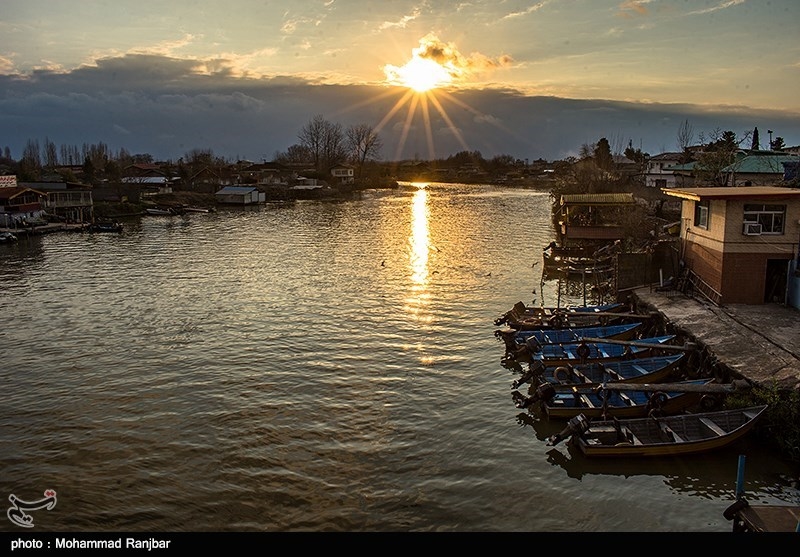
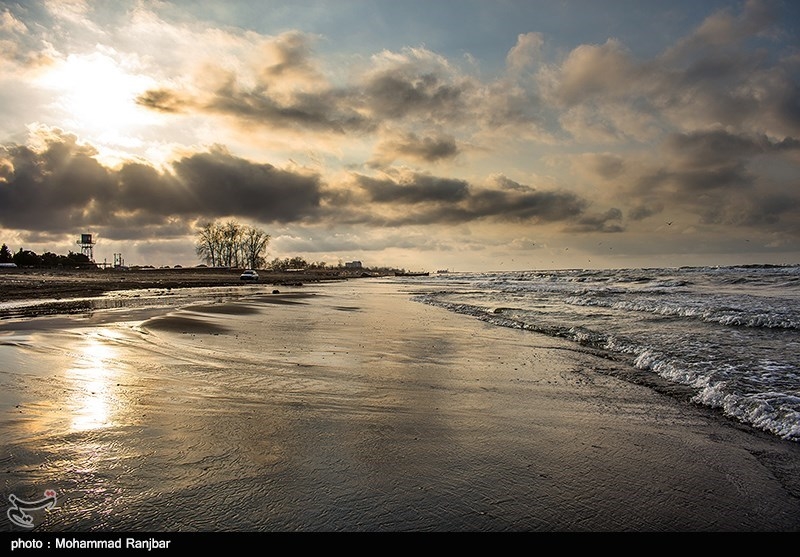
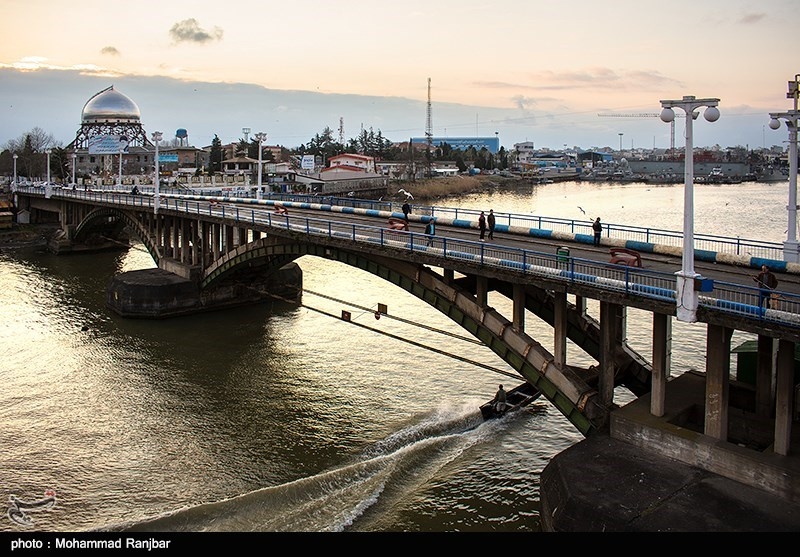
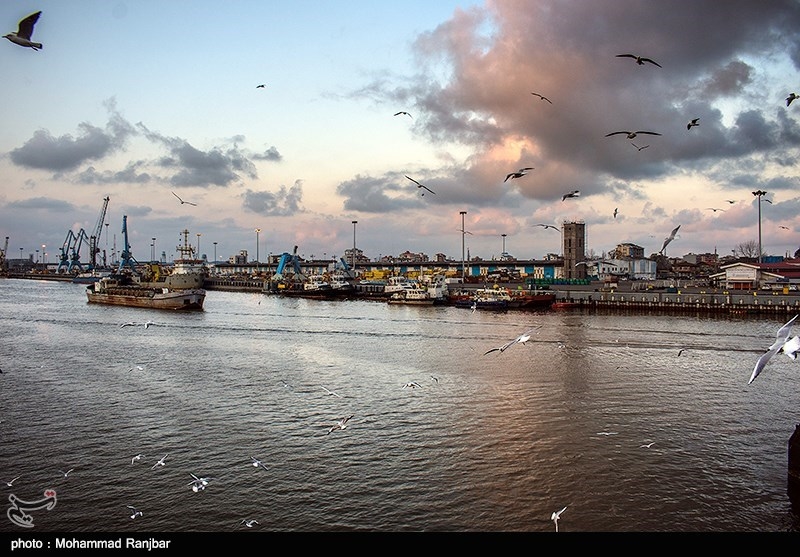
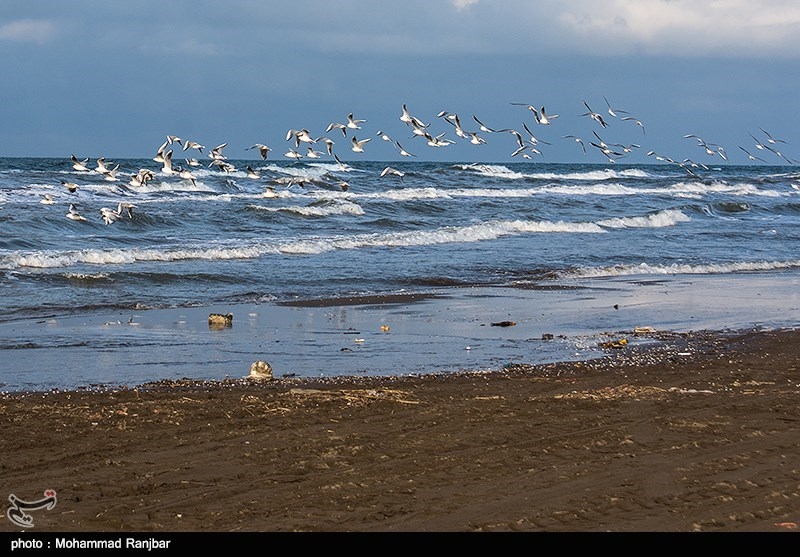
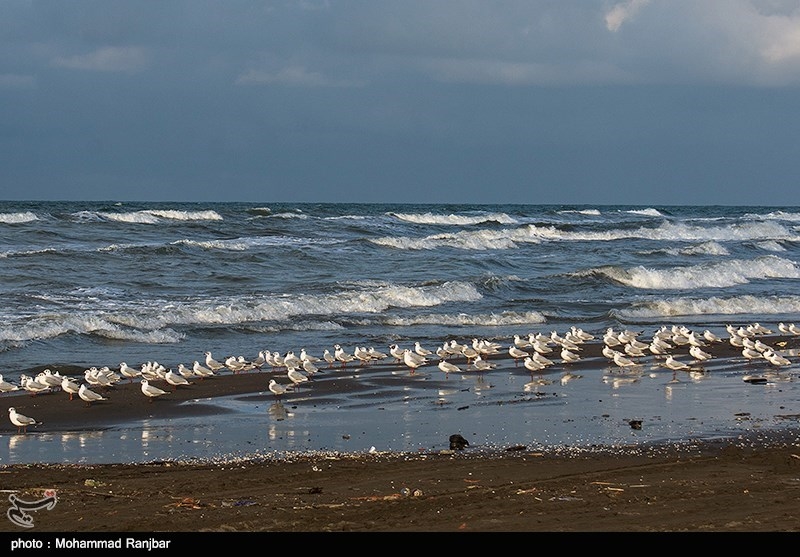
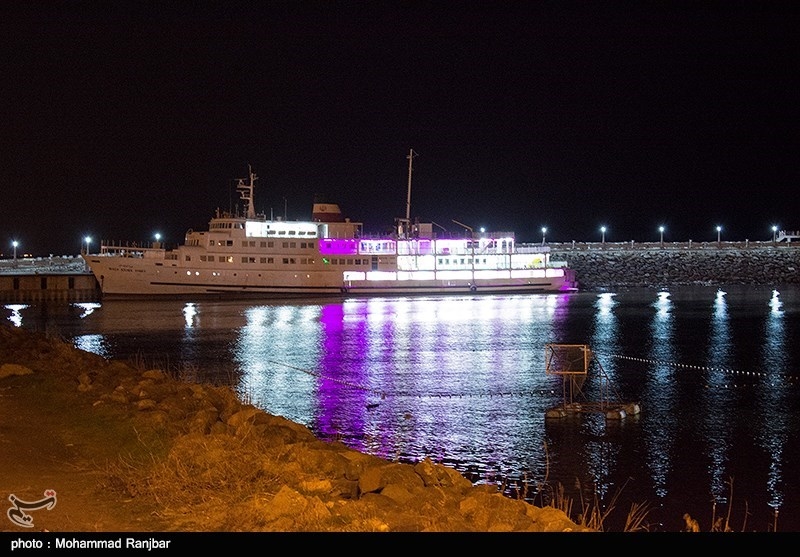
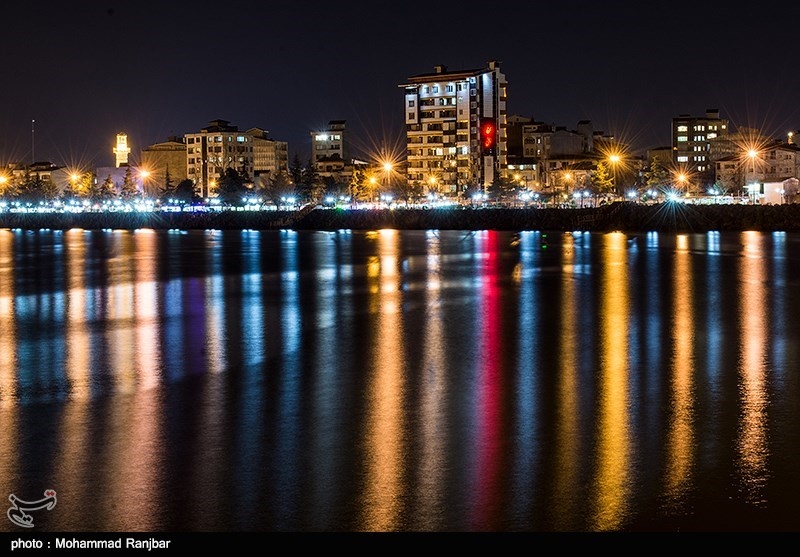
Iran’s Beauties in Photos: Anzali Port

Anzali is humid, and is considered one of the rainiest cities of Iran.

Here you can see Tasnim News Agency’s photos of the beautiful port city:

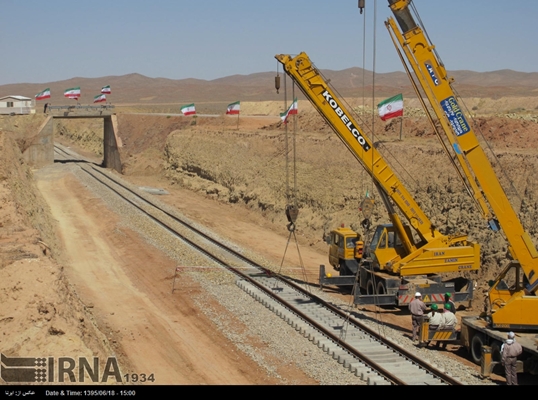
Iran Strongly Condemns Herat Railway Mine Blast

Iran Strongly Condemns Herat Railway Mine Blast

In a Monday statement, Mousavi expressed sympathy with the families of Iranian and Afghan nationals martyred or wounded in the incident.

A probe was launched into the aspects of the incident, and efforts to help the recovery of the wounded were started immediately after the blast, Mousavi added.

The mine blast in Ghurian in Herat province killed an Iranian national and an Afghan soldier.

A spokesman for the governor of Herat said the Iranian national worked on the railway project, and was attacked when he was heading to Ghurian in a car belonging to Afghan security forces.

The 139-kilometre-long Khaf-Herat Railway is part of Iran-Afghanistan rail corridor. The project, started in the fiscal year of 2007-2008, connects Iran’s eastern city of Khaf to Afghanistan’s western city of Ghurian.

More than 2.96 trillion rials have gone into its construction so far.

The railway is of great economic and transportation importance and once completed and exploited, Afghanistan could connect through Iran’s railway to southern borders of Iran and Turkey railway network.

Trump’s Policy Towards Iran Dangerous: German Analyst

Trump's Policy Towards Iran Dangerous: German Analyst

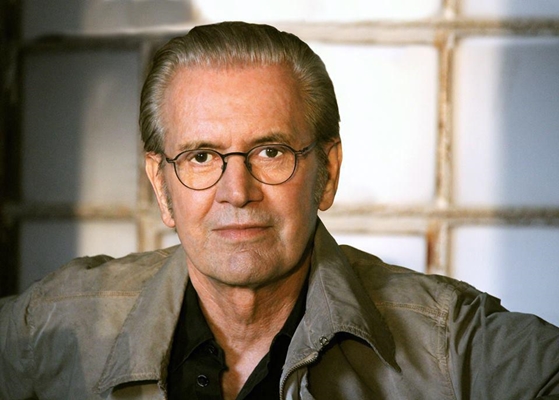
Former German politician and journalist Jürgen Todenhöfer in an interview with Austrian daily, Kurier, has talked about the Middle East tensions and the role Germany can play.

He believes Trump‘s policy towards Iran is very dangerous. Iran is a gracious country, and its people are supporting the leadership. They do not want to be maltreated by the Americans, he noted.

He said the policy of the West in the Middle East has never been to protect freedom and human rights.

“We have a constitution in Germany that tells us exactly when we are allowed to wage wars. And that’s why we did not participate in the 2003 war on Iraq. That was an act of aggression and that is prohibited under German law.”

“However, it is said that in Afghanistan the freedom of Germany is being defended and we fight for freedom, democracy, and human rights – but that is not true. In Afghanistan, it was never revealed that the war was launched for the geostrategic interests of the Americans. From Afghanistan, the US could control China and dominate the entire East. Instead we said we want to help Afghan schoolgirls so that they can go back to school. If you ask a western politician today, what happened to the Afghan schoolgirls, they do not know what to say because they are not interested in this issue. That was peer hypocrisy.

Elsewhere in his remarks, Todenhöfer said he has been involved in most the wars waged by Washington warning that right now “there is a great danger in US aggressive foreign policy.”

He also mentioned that Syrian President Bashar Al-Assad asked German Chancellor Angela Merkel in December 2015 to mediate with a peace plan.

“We talked for a long time about who is standing in the way of a peace plan. In a letter to Merkel Assad emphasised that he cannot step down and announced he wants peace. I assume that Merkel’s security advisor talked to Obama’s security advisor at that time. The Americans, however, prevented any peace process in Syria. The West’s goal is to exert influence there through supporting militants, and unfortunately the terrorist groups. There is also a recorded statement by the former US Secretary of State John Kerry that the US deliberately made the ISIS strong to weaken Assad.”

In response to a question regarding Donald Trump’s claim that the ISIS is beaten, he strongly rejected the US President’s claim.

“ISIS is an ideology and ideologies cannot be shot. This horrific ISIS ideology, like all terrorist ideologies, was created by actual injustices. You must defeat a terrorist group with rigor, wisdom, and justice. There were 15,000 ISIS members in Syria and Iraq, of which 3,000 have been killed and the rest are disappeared and can reappear under a different name.”

In another part of the interview, he spoke about Iran and the US claim that Tehran supports the terrorists stressing that the Americans now call every opponent “terrorists”.

“Hezbollah is a group that actually has not attacked other countries. If you accuse every opponent of terrorism, you cannot hold talks with anyone.”

“I cannot tell you how many wars started after 9/11. A large part of the governments we are complaining about now, have been set up by the West. The politicians and kings, who have lost their prestige in the West, get money from America.”

Jürgen Todenhöfer (born 12 November 1940) is a German author, journalist, politician, and executive. He became a member of the Christian Democratic Union of Germany (CDU) in 1970 and was a member of the Bundestag from 1972 to 1990. He also acted as party spokesman for development policy and arms control. He was vice chairman of the executive board of German media company Hubert Burda Media until 2008.

Since young age, Todenhöfer was traveling in war zones. Todenhöfer is one of the most prominent German critics of the US-led wars against Afghanistan and against Iraq in 2001 and 2003, respectively. He believes that during the war in Iraq the Bush administration was deceiving the public and that the US war in Iraq has killed several hundred thousand Iraqi civilians.

In 2016, Todenhöfer filmed an interview with an alleged Syrian militant commander near Aleppo. The commander, said to be with the al-Qaeda affiliated group the Al-Nusra Front and said to have US support adding that his group opposed humanitarian aid to civilians.

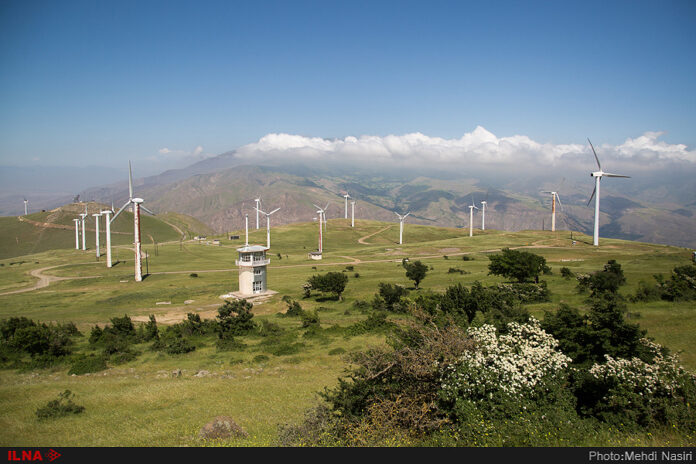
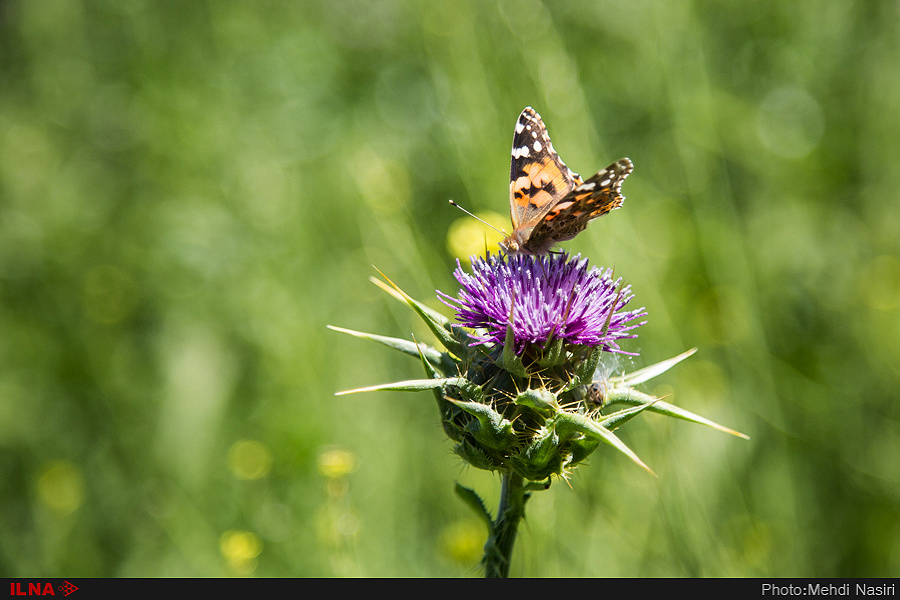
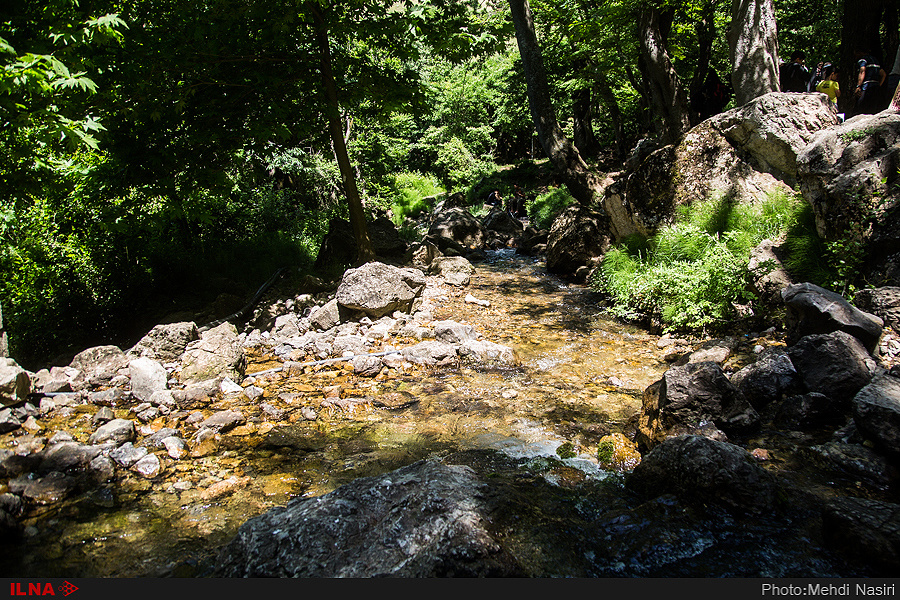
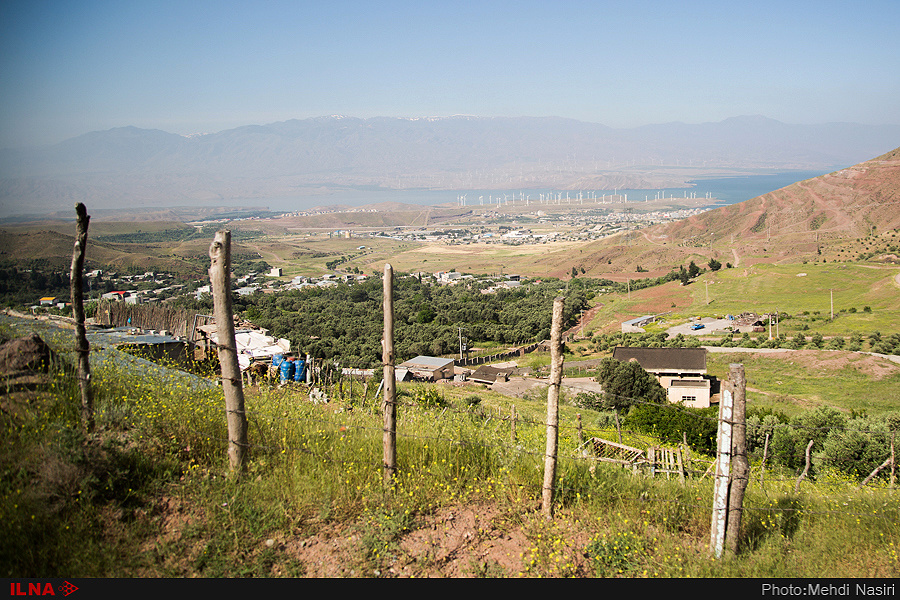
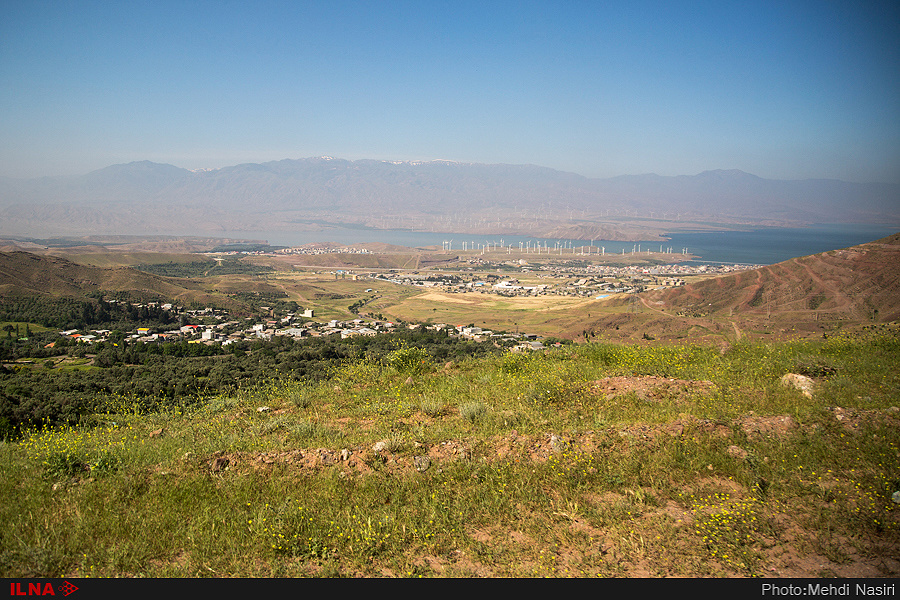
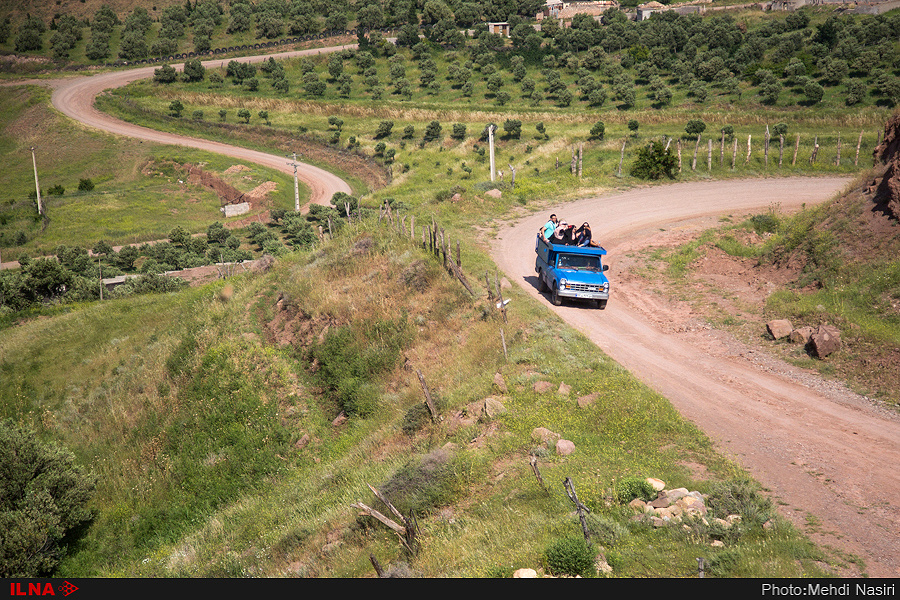
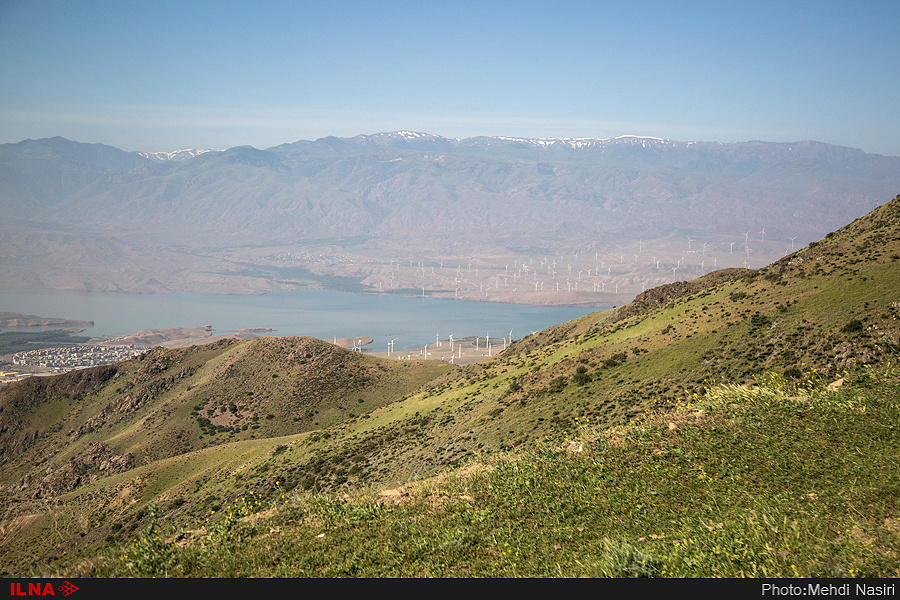
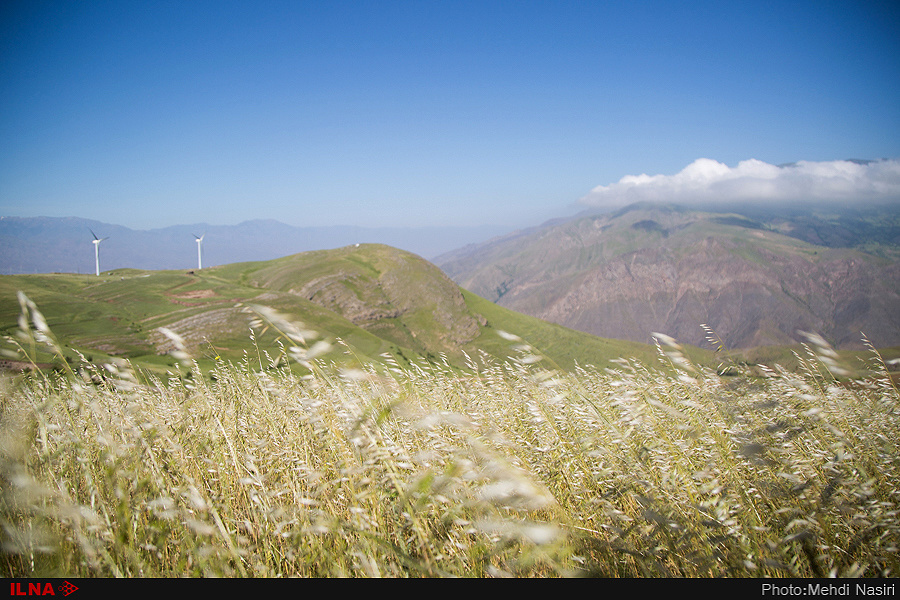
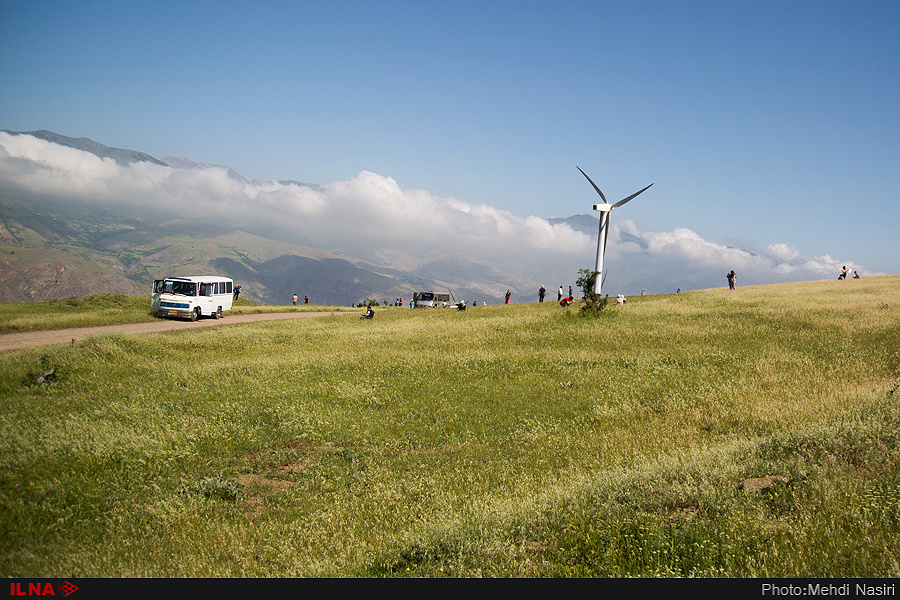
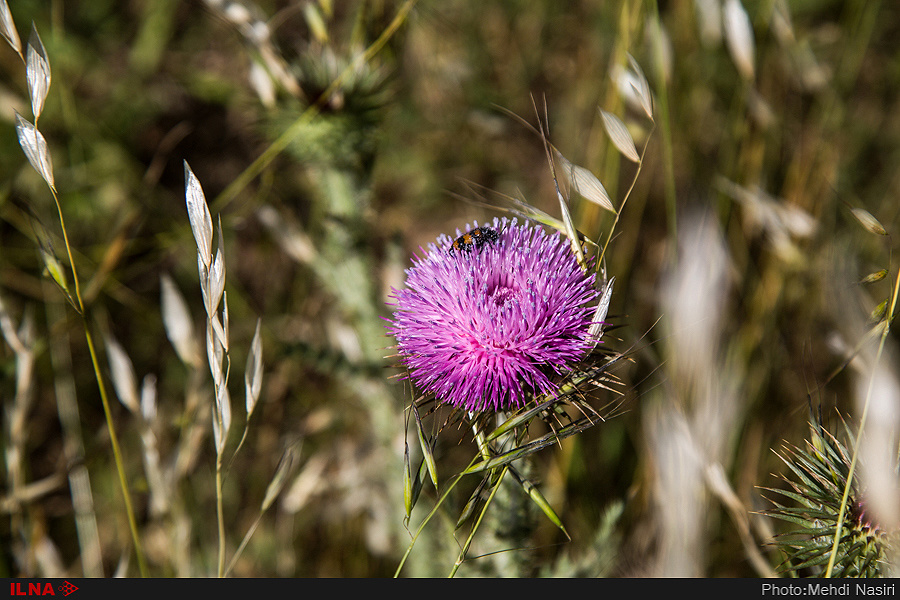
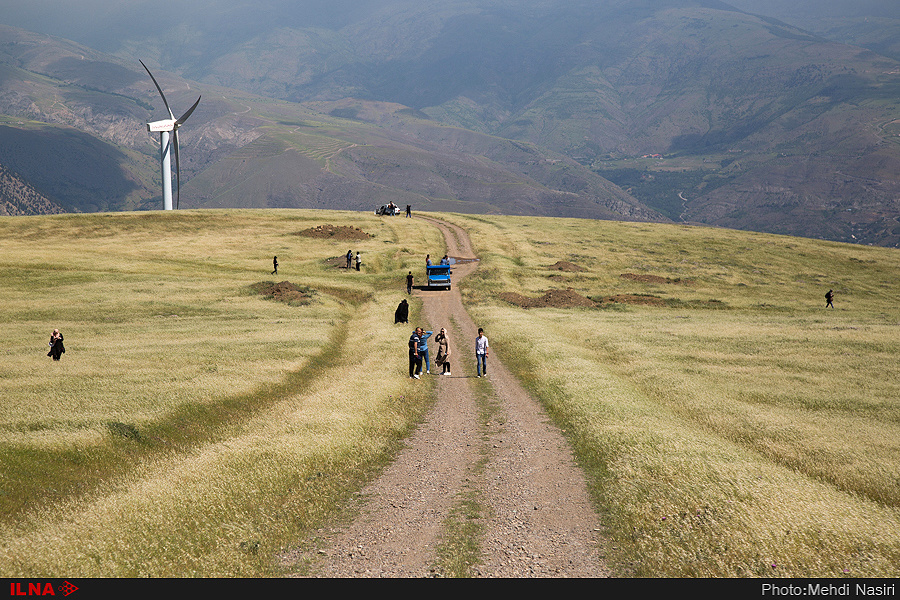
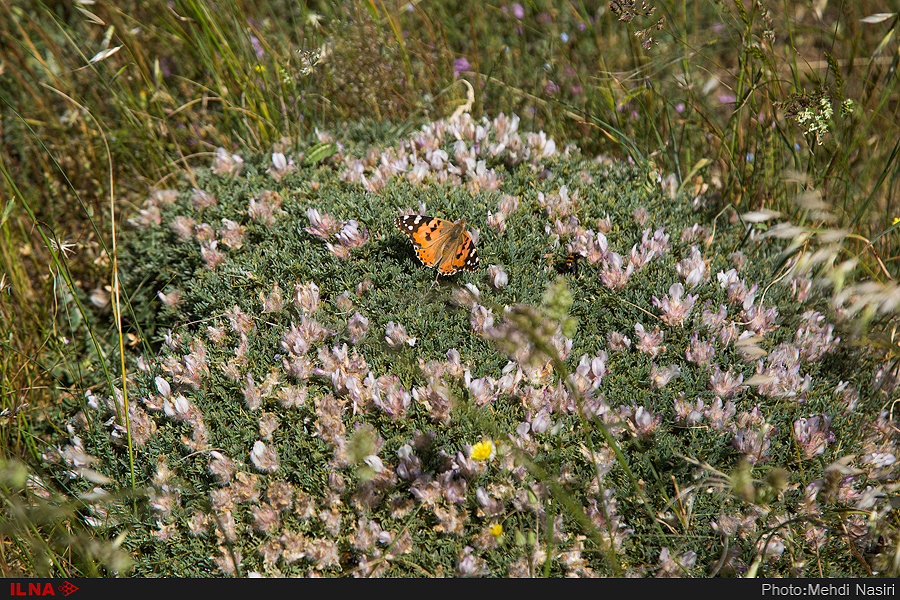
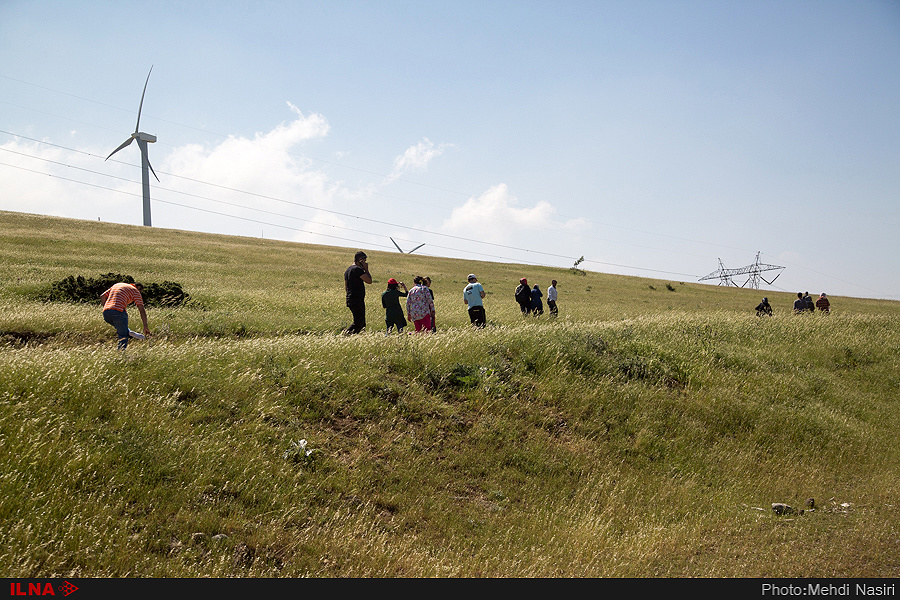
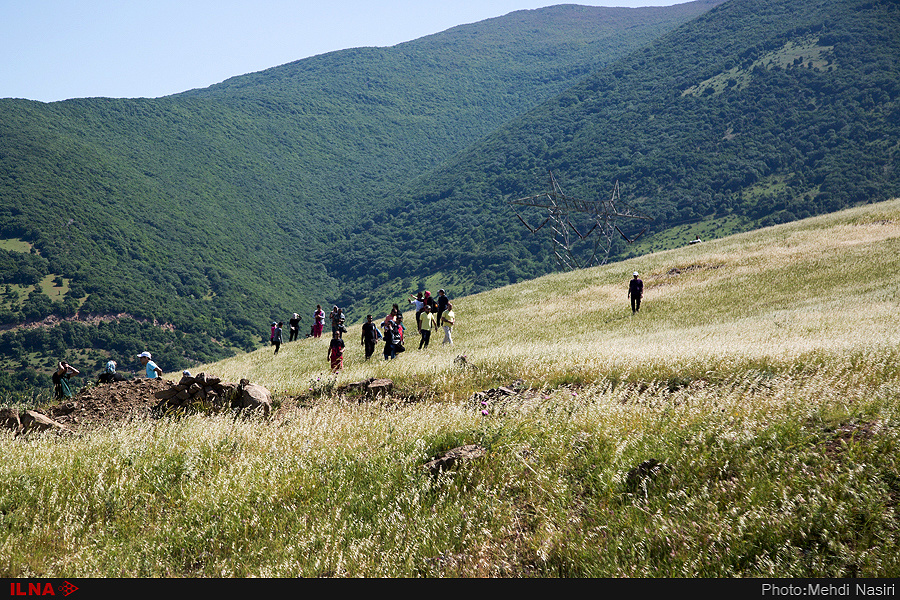
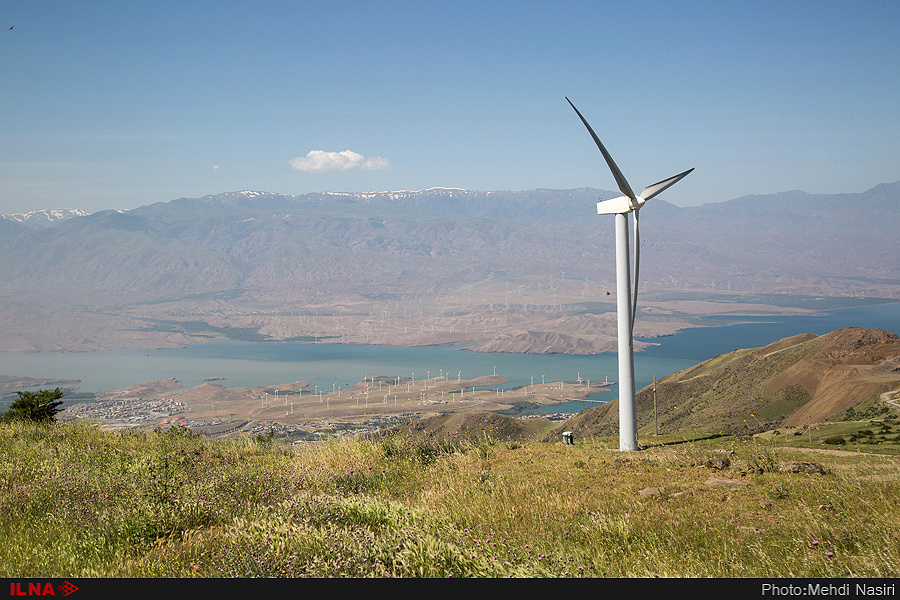
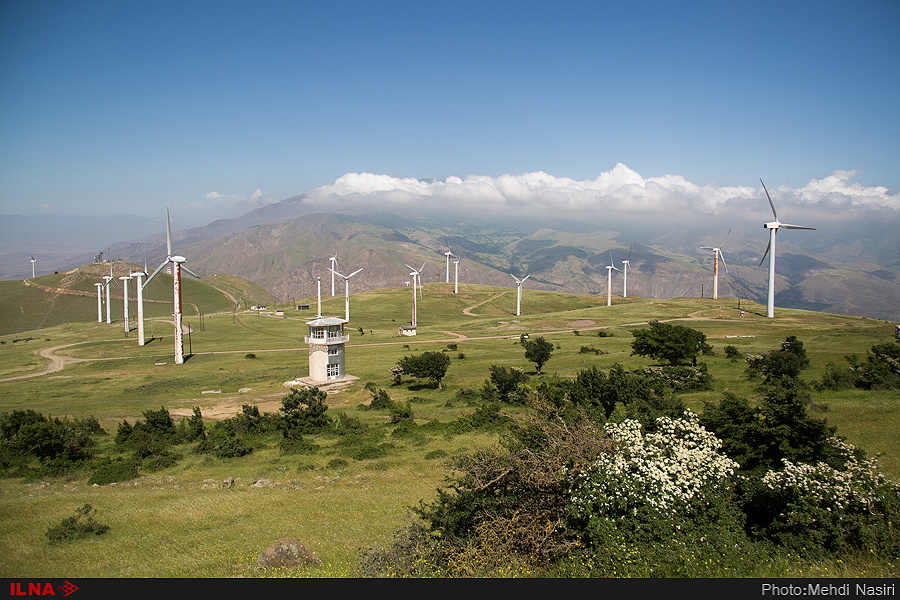
Wind Turbines of Manjil; Beautiful Kalashtar

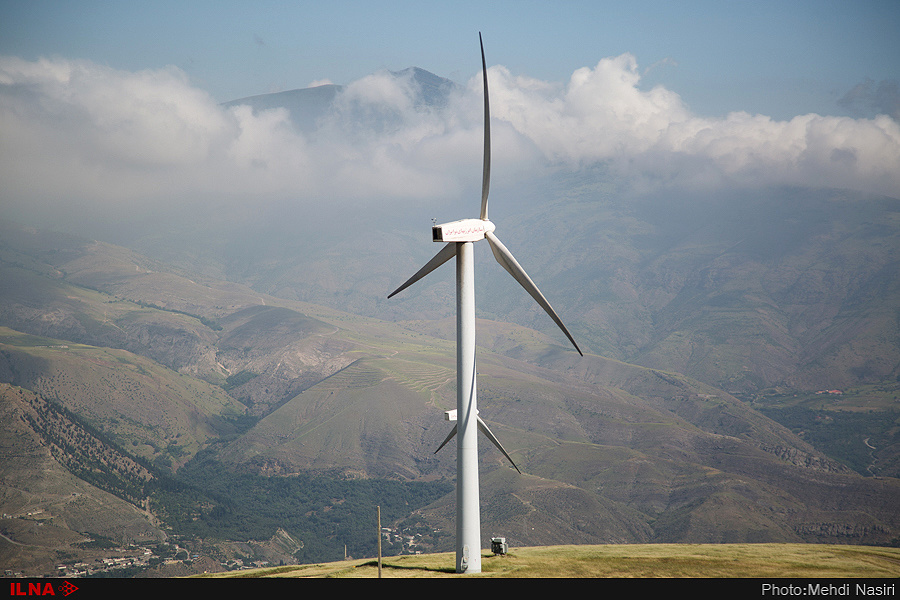
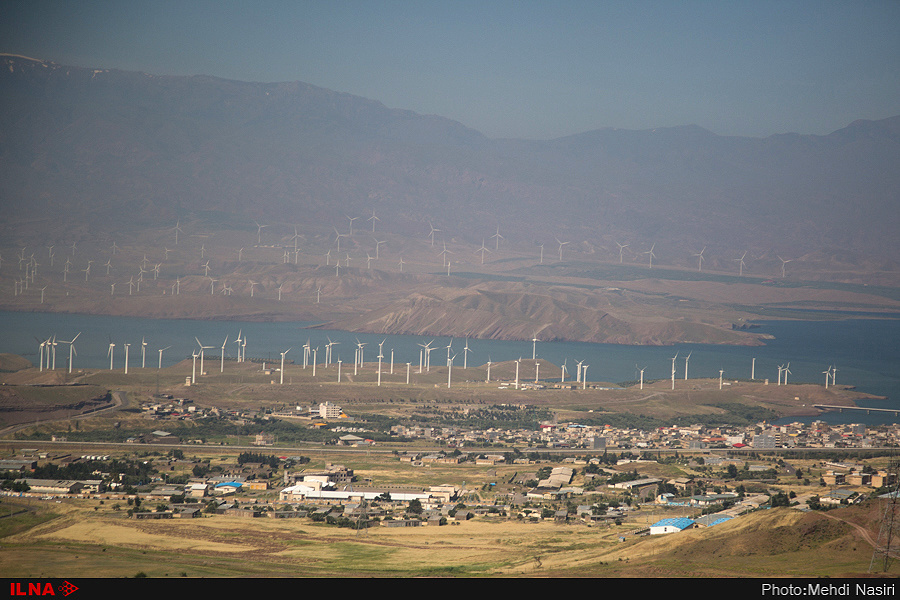
Wind Turbines of Manjil

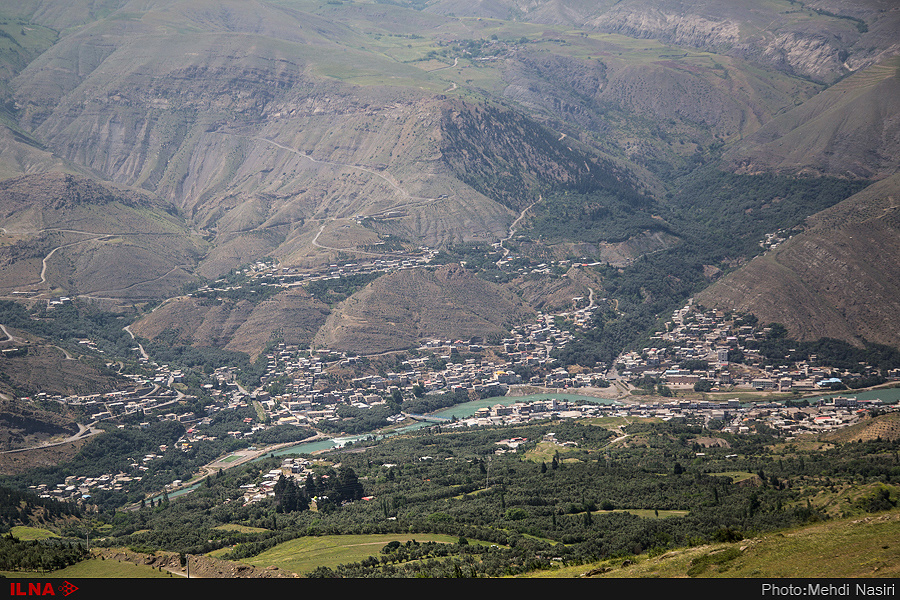
Kalashtar is located three kilometres from Rudbar in the foothills of the western Alborz. It is about 550 metres above sea level. Other than Manjil Wind Turbines, the region is known for its pleasant weather; affected by its temperate and semi-Mediterranean climate.

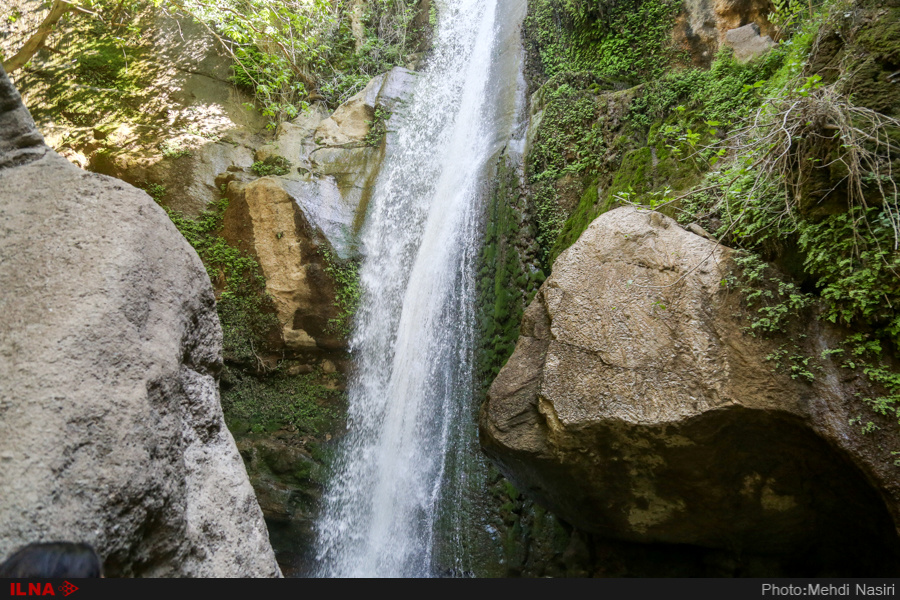
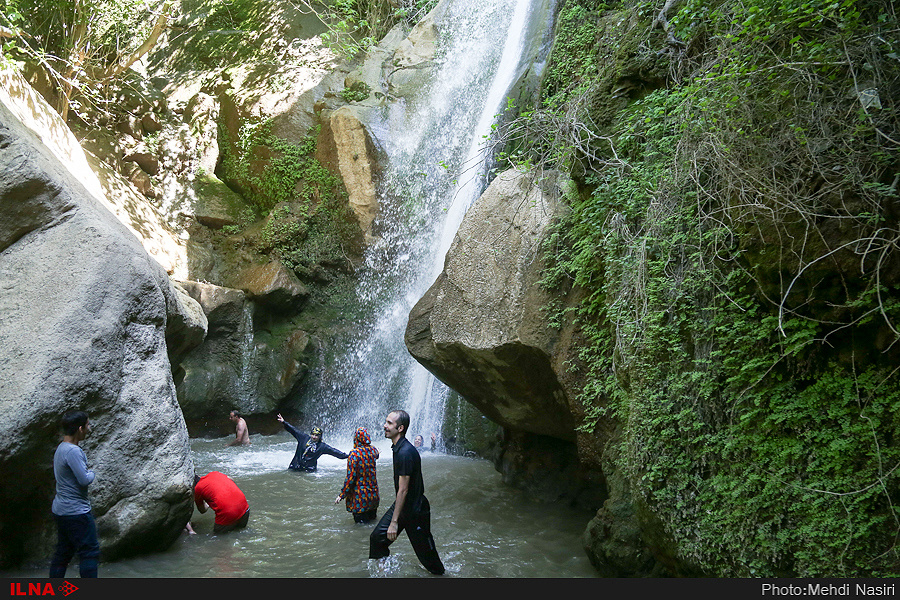
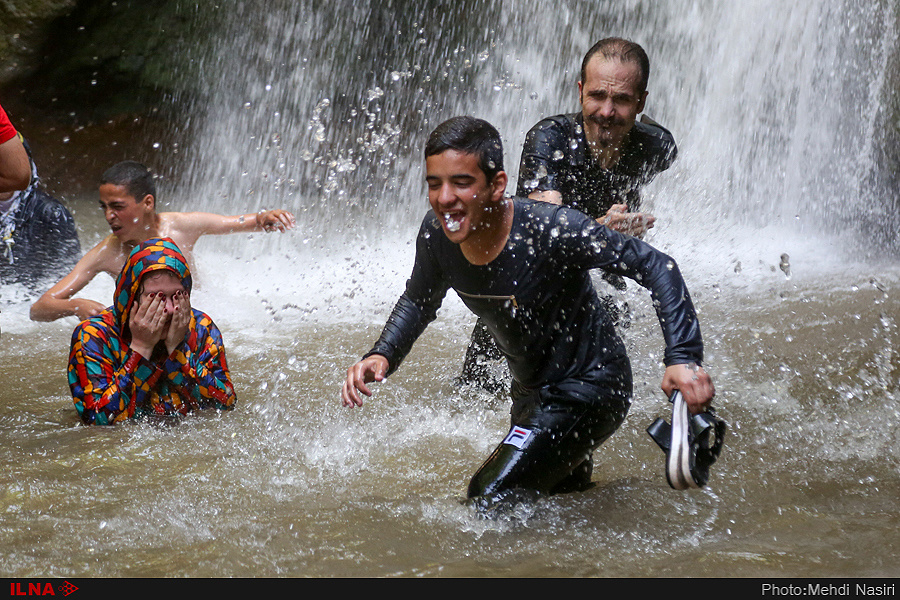
The village enjoys a very  Products grown in this village are pomegranates, figs, walnuts, cherries and oranges. Kalashtar waterfall is also one of the attractions of Rudbar that has a beautiful and spectacular landscape.

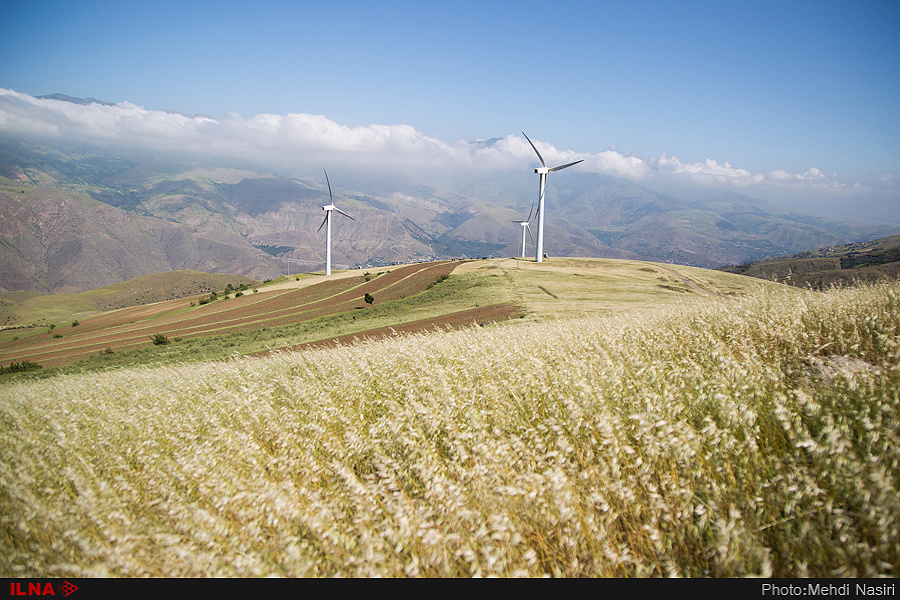
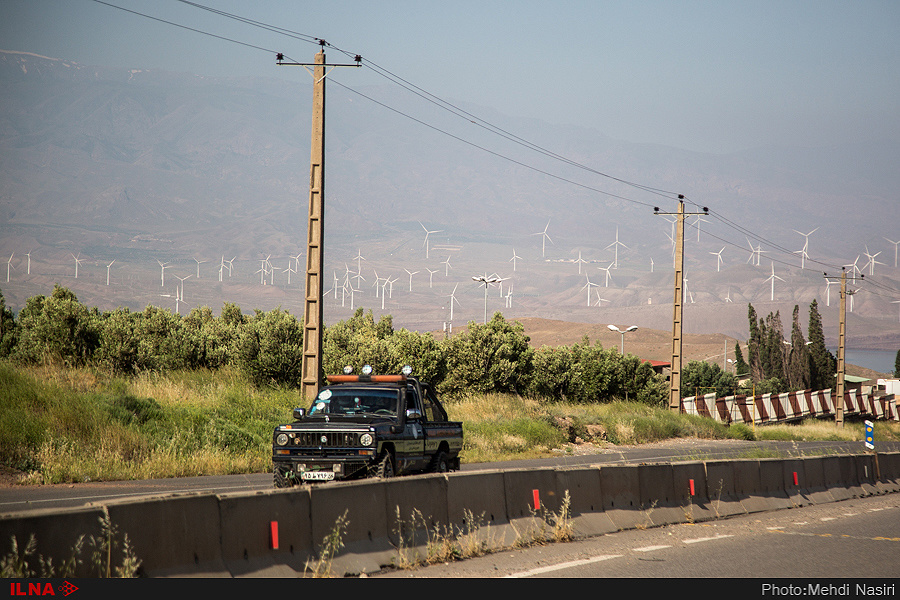
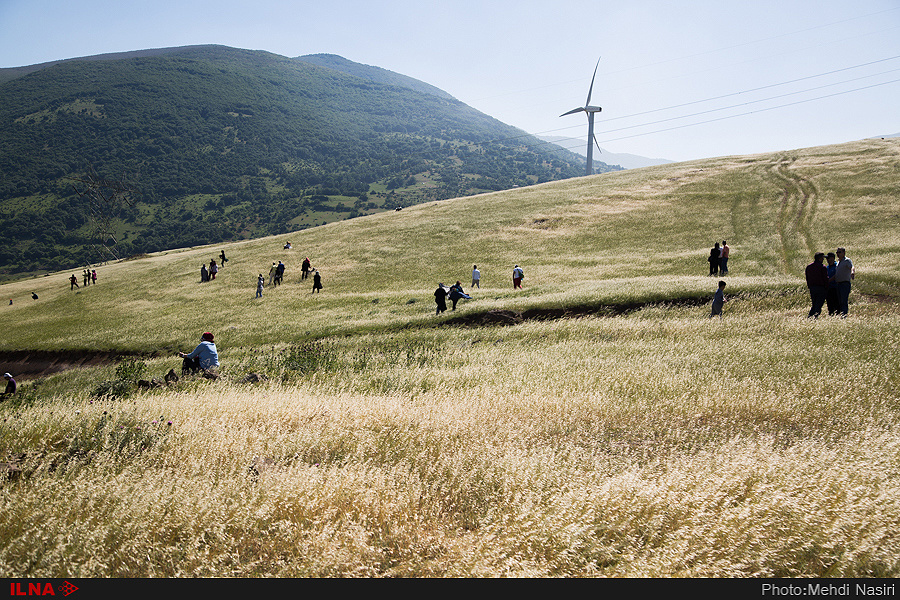
Another attraction is the Manjil Wind Turbines. Theses turbines are not only one of the largest sources of clean energy production, but also have created a unique beauty. Turbines are power plants that convert wind energy into electrical energy.

Due to the existence of these turbines, as well as the Sepidrud Dam, it is known as the commercial centre of the city of Rudbar and Gilan province.

Manjil wind is an important factor that made the city famous, but also a good place to build turbines. This wind is stronger in spring and summer and less intense in autumn and winter. It is a well-known old wind known as ‘Seven Winds of Manjil’. It is so high that bends the olive trees over to one side.

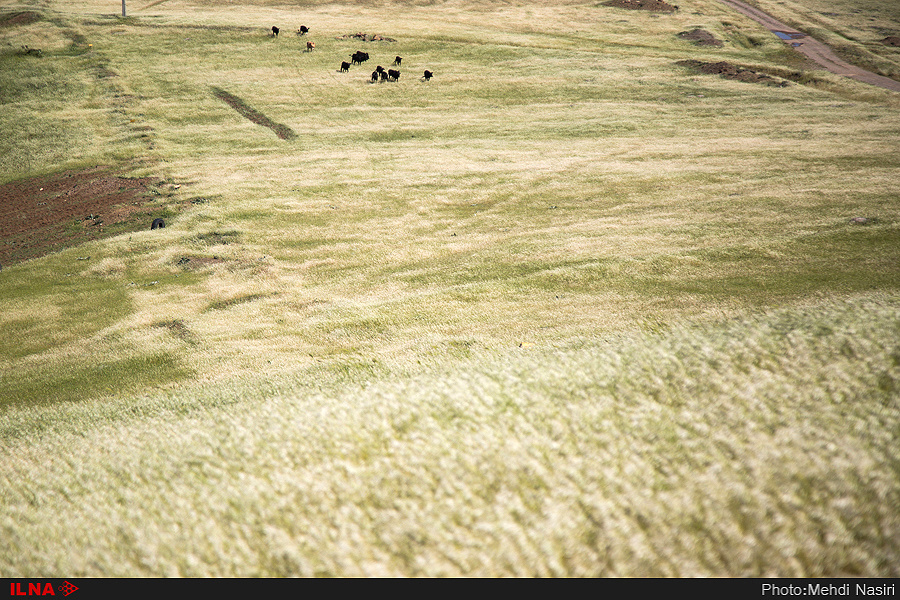
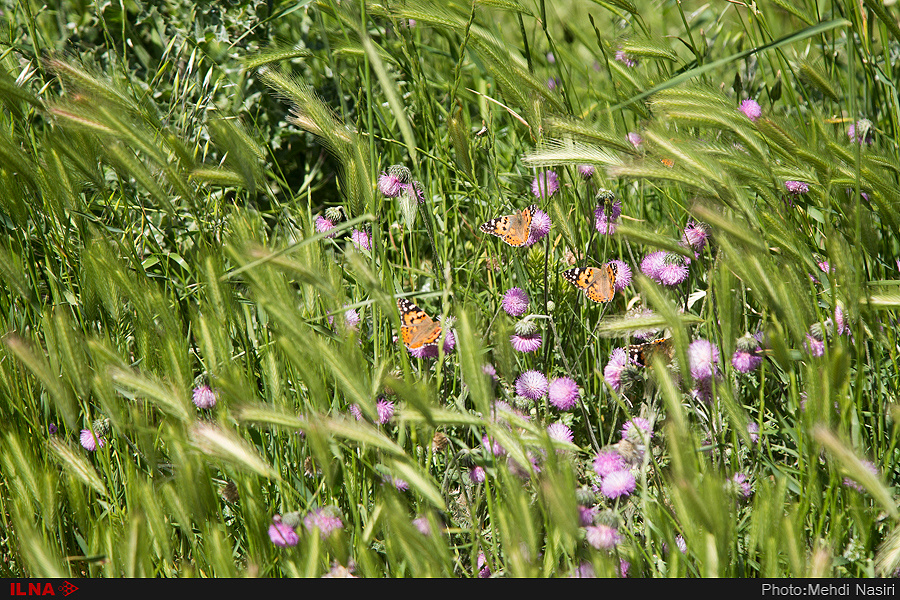
What follows are photos of Kalashtar village and Manjil Turbines retrieved from ILNA:

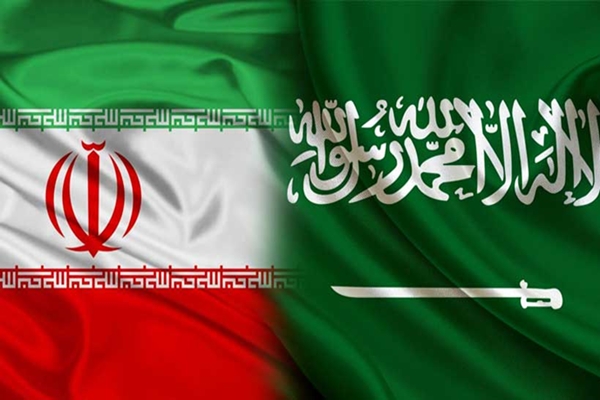
Time Ripe for Talks between Tehran, Riyadh: Analysts

Tehran Still Ready to Mend Ties with Riyadh Despite ‘Foolish’ Moves

“We write as citizens and foreign policy veterans of two countries that most Americans presume are locked in a mortal combat: Iran and Saudi Arabia. In fact, after decades of proxy conflict and frozen ties between our countries, we believe now is the time to explore a new foundation for a lasting peace in our region,” reads their piece published by The New York Times.

These two thinkers wrote that neither of them is a starry-eyed idealist, but both are hardened realists with distrust for one another, and that mistrust is shared at the top levels of their respective governments.

“At the same time, we have seen the destructive consequences of crises in which our countries side with one or another government or movement involved in a competition for power — for example in Yemen, Syria, Lebanon, Bahrain or Iraq. While we each blame the other side for this pattern, we agree that the net result has been costly, has eroded the confidence of the people our governments serve, and has wasted incalculable resources and countless lives that should have been used to build a new Middle East, rather than tear it down.”

They maintain that now is the time for dialogue because the situations in the historic conflict zones are ripe for diplomacy.

These two prominent figures have quoted five reasons for this:

  • In Iraq, both the Islamic Republic and Saudi Arabia have embraced a new government in Baghdad led by a prime minister and a president who are pragmatic and have good ties to both countries. This is an important opening Tehran and Riyadh must seize.
  • The war in Syria has reached a point near an ending, with less violence and the defeat of the ISIS there. Both of the countries believe Syria’s territorial integrity must be maintained. Iran and Saudi Arabia call for respect of the principle of noninterference in Syria’s internal affairs, and respect for the Syrian people’s right to determine their own fate.
  • In Yemen, there is disagreement about the root causes of the conflict, but both sides agree that it has ushered in a humanitarian disaster. Both of countries should support the process being led by the United Nations to end the conflict in the coming months.
  • Lebanon is now led by a new government and Tehran and Riyadh agree that it is up to the people of Lebanon to sort out their affairs on their own.
  • Finally, in Bahrain, the Islamic Republic and the Arab Kingdom support the tiny country’s sovereignty, integrity, democratic aspirations, and stability based on the will of its people.

“The bottom line is that these five conflict zones, long sources of contests and misery, appear to be settling into a relatively stable status quo from which we can begin to restore a lasting peace in our region. Although we each accuse the other side of being the source of instability in the region, we know through our own difficult dialogue over many months that the conditions exist for direct and continuous discussions with open channels between our capitals and our citizens. We do not need to agree on everything before agreeing on some things and taking the first, most difficult, steps of dialogue,” reads the article.
These two analysts say “our citizens should be first and foremost in our minds, and the world’s. Iran and Saudi Arabia have a combined population of 115 million, nearly a third of whom are under the age of 25. The future is upon us, and our youth will be interconnected whether we like it or not.”
According to Mousavian and Sager, sustainable peace and security require good bilateral relations and regional cooperation between Tehran and Riyadh. Iran and Saudi Arabia have significant differences, but they share common interests in many critical issues, such as energy security, nuclear nonproliferation, and Middle East stability.

“We hope that instead of widening the [Persian] Gulf between our two countries, our leaders will build on the common ground between our nations, which represent the two main pillars of the Muslim world,” they concluded.