Sunday, April 12, 2026
Home Blog Page 3231

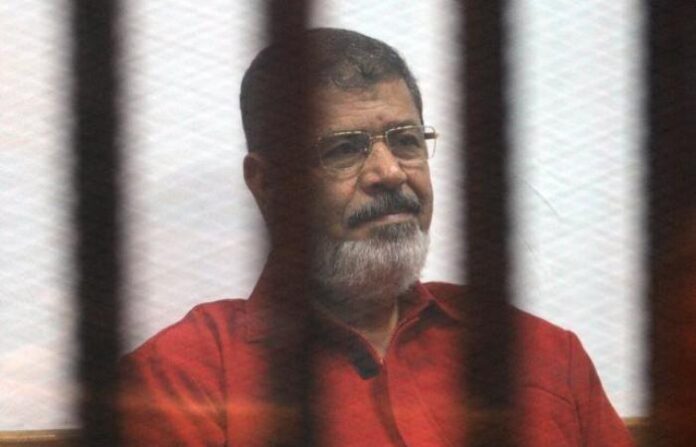
Former Egyptian President Mohamed Mursi Dies in Court

Mohamed Mursi

Egypt’s state TV said Mursi had fainted after a court session and died afterwards.

Mursi was democratically elected in 2012 after the 2011 wave of revolutions in the Arab world saw the end of President Hosni Mubarak’s 30-year rule in Egypt.

He was then toppled following mass protests and a military coup in July 2013.

The deceased served just one year of a four-year presidential term, while the organization to which he belonged, the Muslim Brotherhood, has since been outlawed.

Mursi had received at least one lifetime prison sentence and had been added to Egypt’s official list of “terrorists”.

In 2015, he received a death sentence for escaping from prison during Egypt’s 2011 popular uprising.

In the same year, he was convicted of “spying” for Palestinian resistance movement Hamas, for which he was sentenced to life.

French Nationals Advised to Travel to ‘Iran, Land of Kebabs’

The number of French tourists decreased following the withdrawal of the United States from the JCPOA and the conservative policies of France as well as the suspension of direct Air France flights to Tehran.

In spite of this, the Liberation has published a report on lesser-known aspects of Tehran; a city that has developed with avant-garde architecture. By describing an atmosphere that is less known to the French people, it has encouraged the French to have a different experience in Iran.

In its article, the French daily has argued that making a trip to Iran would be relatively inexpensive for the French.

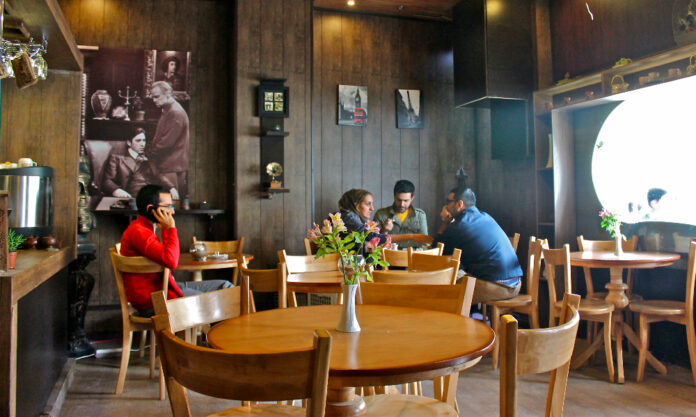
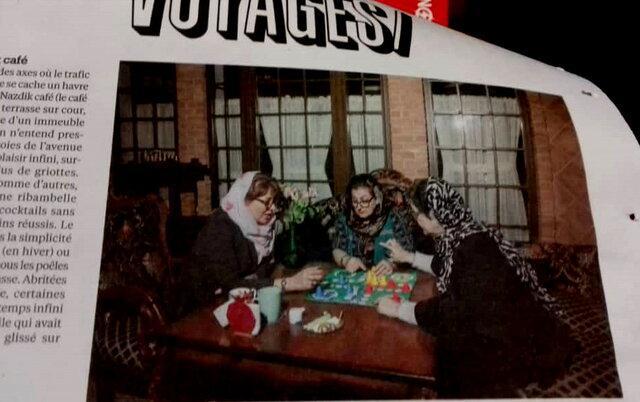
French Nationals Advised to Travel to ‘Iran, Land of Kebabs’Liberation, whose average circulation is over 97,000 printed copies and 9,900 digital ones, has focused on cafes in downtown Tehran.
With a focus on students’ hangouts and the places where literary and artistic circles are formed, the French daily has compared them with identical or similar places in the advanced Western countries.

“These places are somewhat different from the traditional Iranian places and their oriental decorations. They serve vegetarian dishes or other non-grilled but traditional foods such as “Barberry-Pilau and Chicken” and various types of stews.”

A few famous cafes in the heart of the capital with their decorations, the people who go there, and their popular dishes along with the prices have been suggested to make it easier for the French café-lovers to select a place.

The French author of Liberation noted that there are dozens or even hundreds of such places in Tehran.

French Nationals Advised to Travel to ‘Iran, Land of Kebabs’
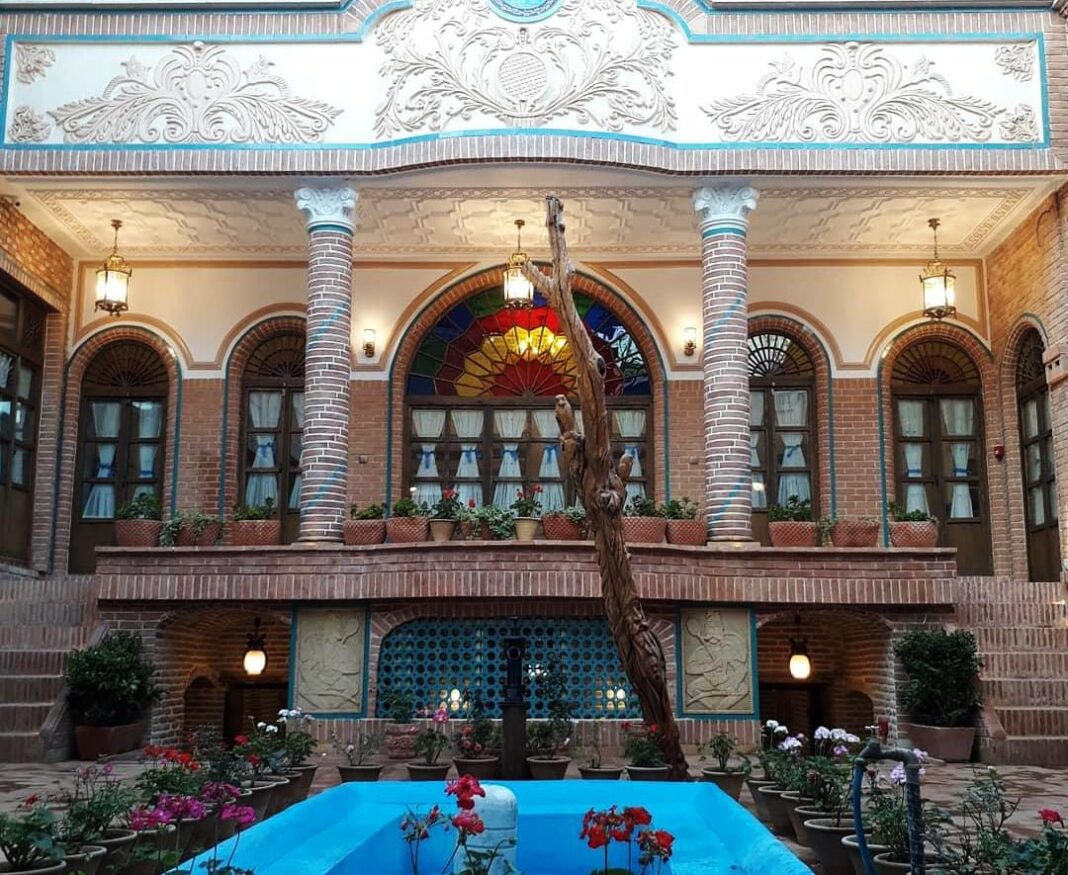
Historical House in Tehran Converted into Hostel for Tourists

The report has refrained from introducing the luxury and inexpensive hotels of Tehran, and instead has introduced the hostels which are a new phenomenon in the city.

The rent of a bed in one of these hostels in the centre of Tehran for people who want to travel with low costs is 10 euros and the cost of a private room is 35 euros.

Liberation’s recommended places to visit are not the same usual ones such as Golestan Palace, National Museum or Sa’dabad Complex. Instead, it has offered Laleh Park with its elderly chess-players and the volleyball-playing youths there.

Tehran Museum of Contemporary Art, the Carpet Museum, the Nature Bridge, whose designer is an Iranian young lady, and the Holy Defence Museum have been introduced to better understand the similar versions in Paris.

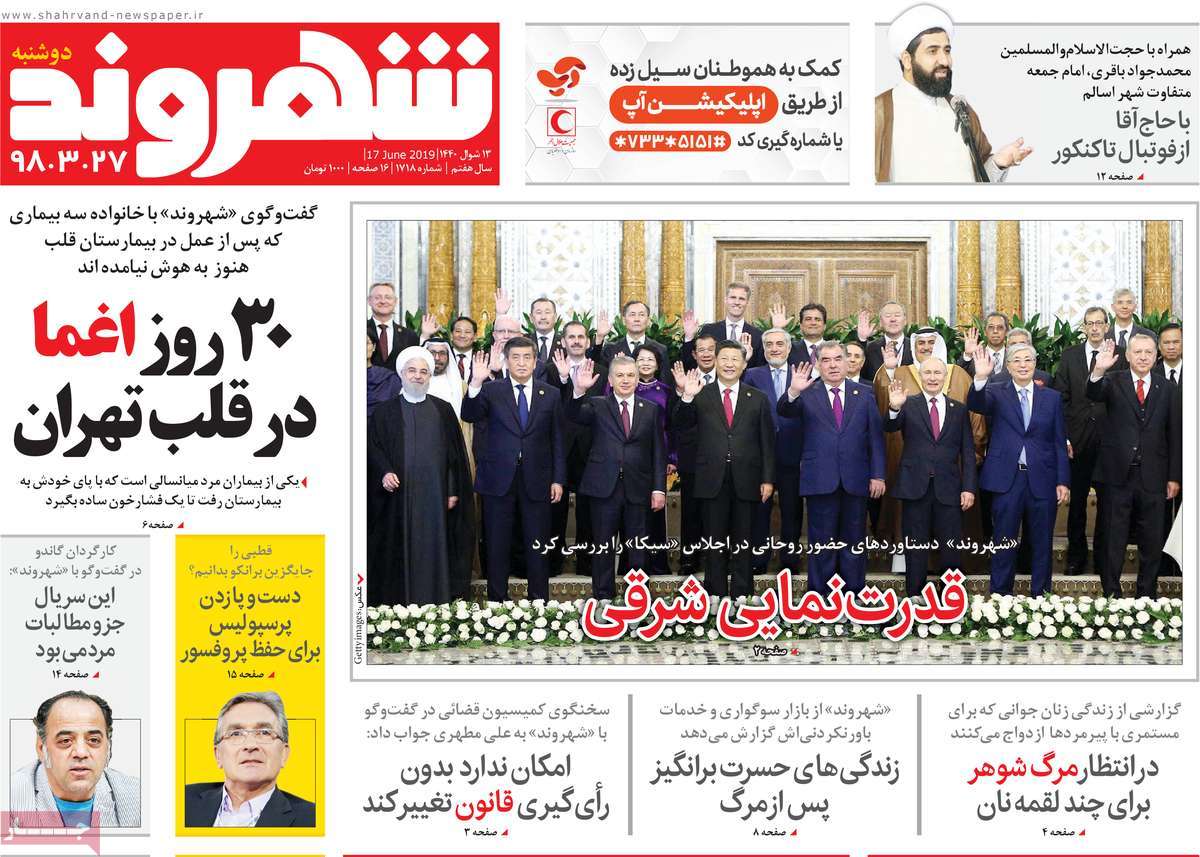
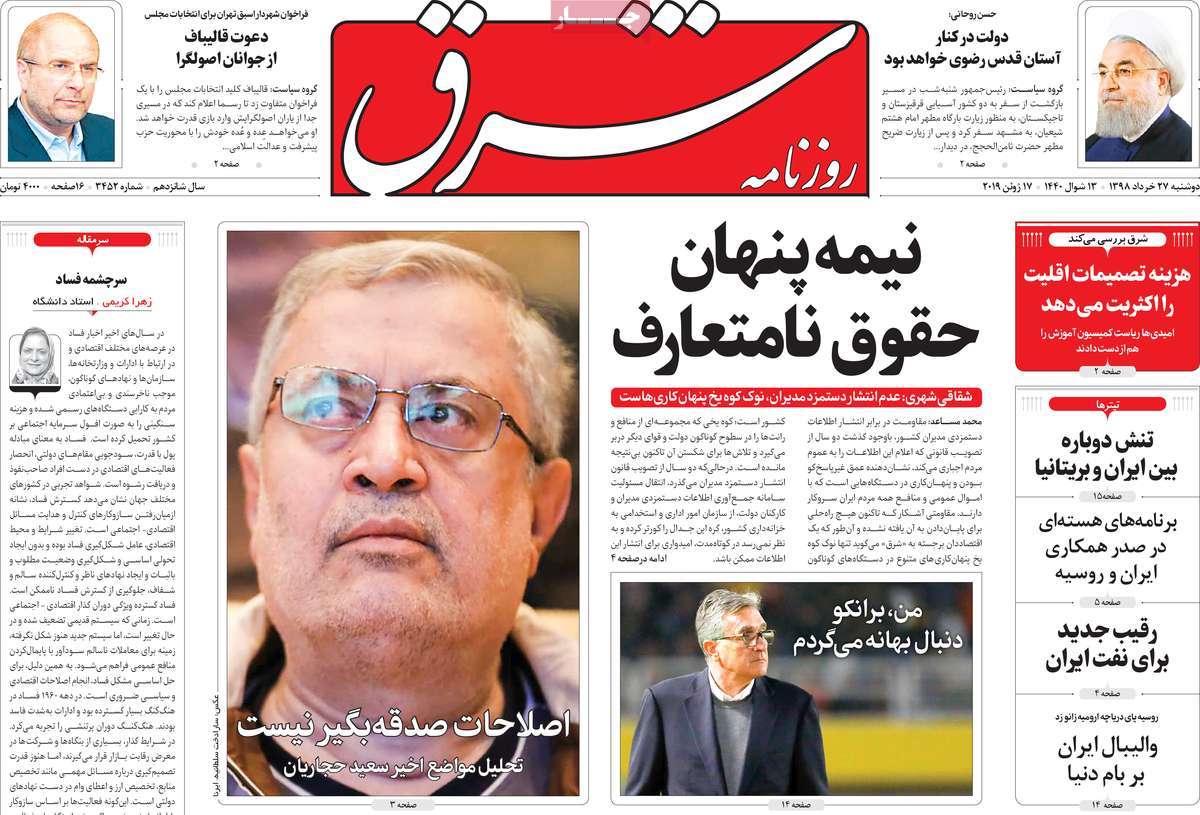
A Look at Iranian Newspaper Front Pages on June 17

A Look at Iranian Newspaper Front Pages on November 19

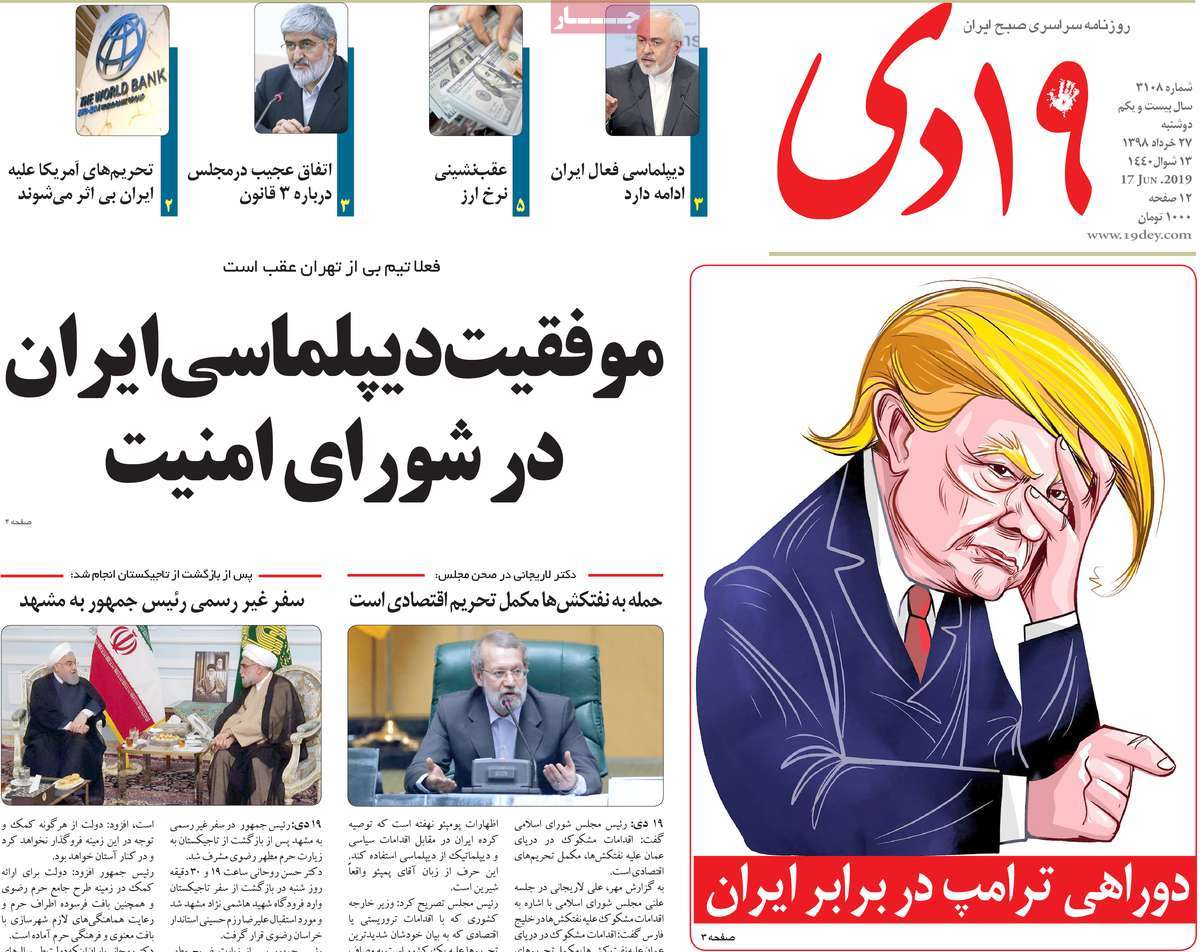
Dey 19:
1- Trump’s Dilemma Regarding Iran
2- Success of Iran’s Diplomacy in UN Security Council
A Look at Iranian Newspaper Front Pages on June 17


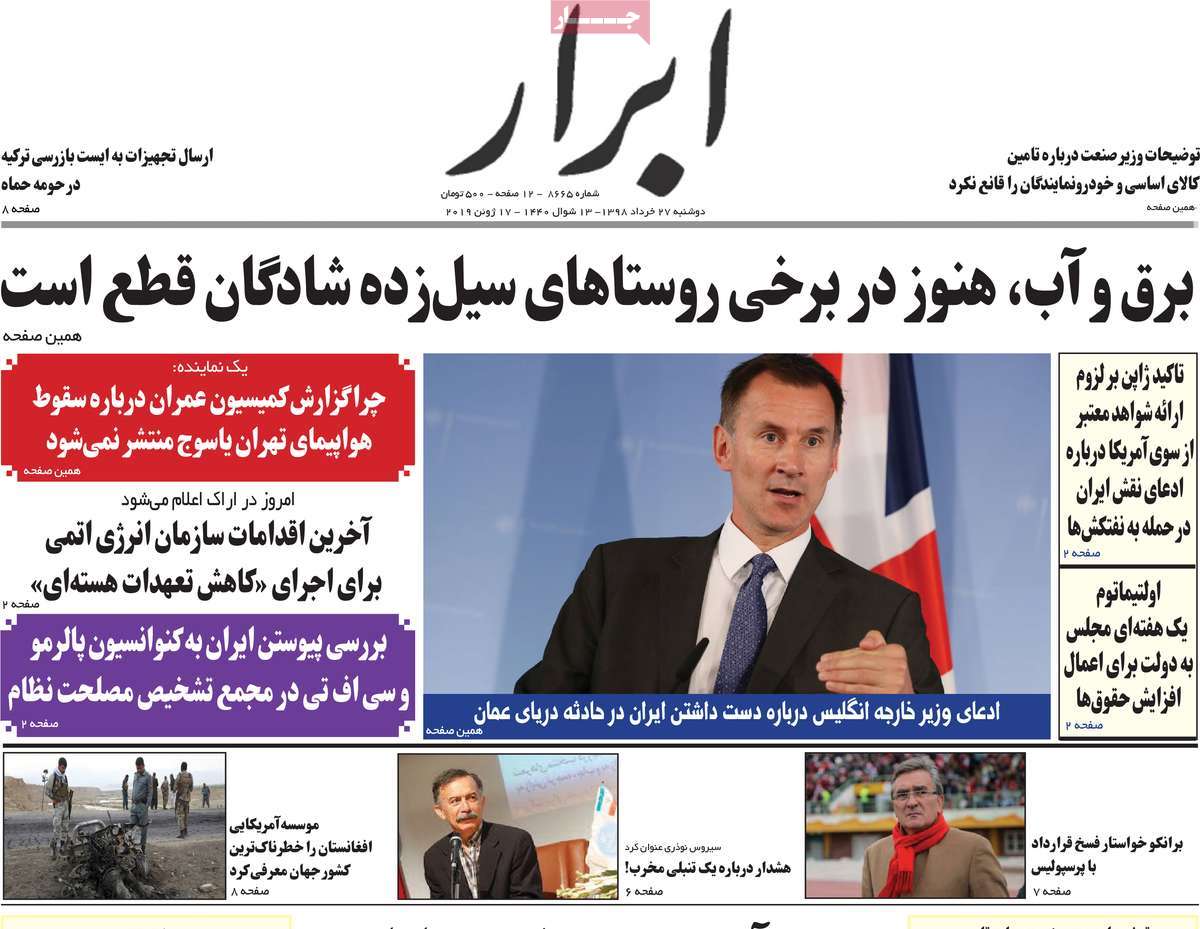
Abrar:
1- British Foreign Secretary’s Claims of Iran’s Involvement in the Sea of Oman Events
2- Japan’s Stresses that US Needs to Provide Credible Evidence about Allegations of Iran’s Role in Attack on Tankers
A Look at Iranian Newspaper Front Pages on June 17


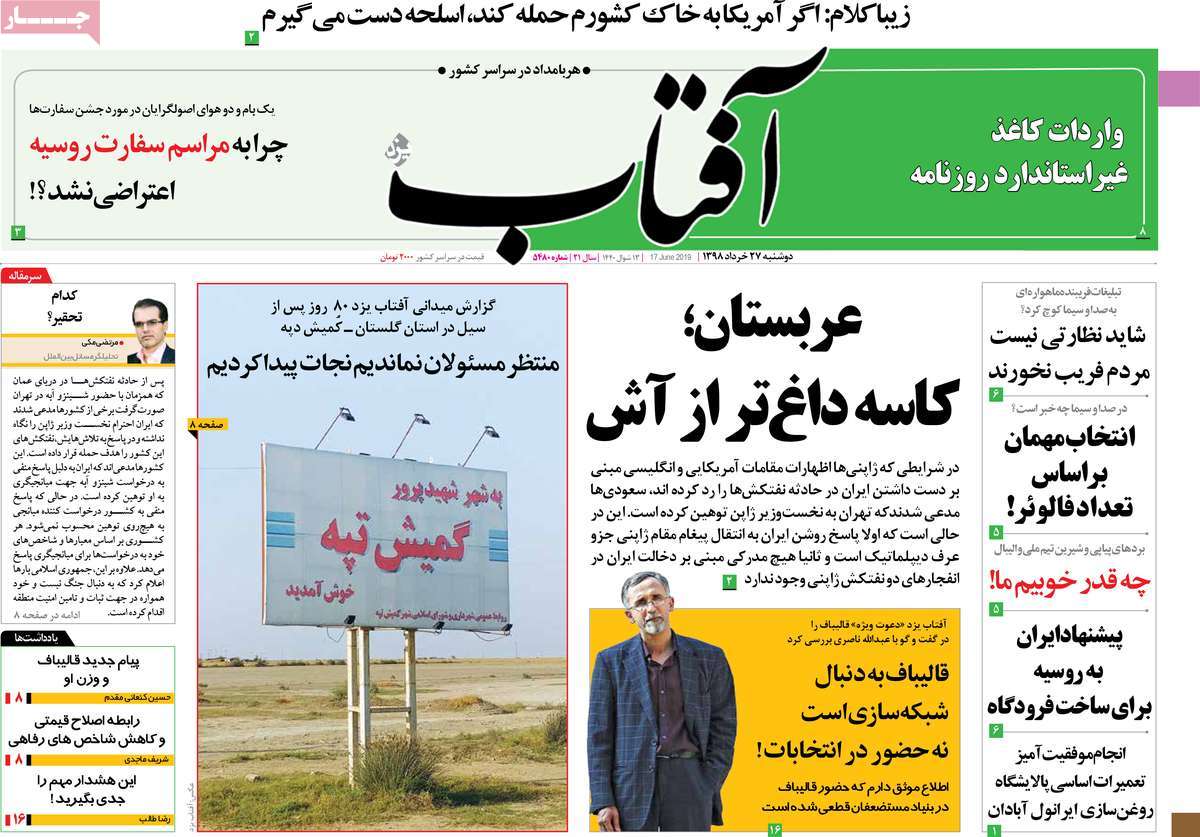
Aftab-e Yazd:
1- If US Attacks, I will US Gun: Zibakalam
2- Iran’s Bid for Russia to Build Airport
3- Iran’s Volleyball Teams Keeps Shining

A Look at Iranian Newspaper Front Pages on June 17


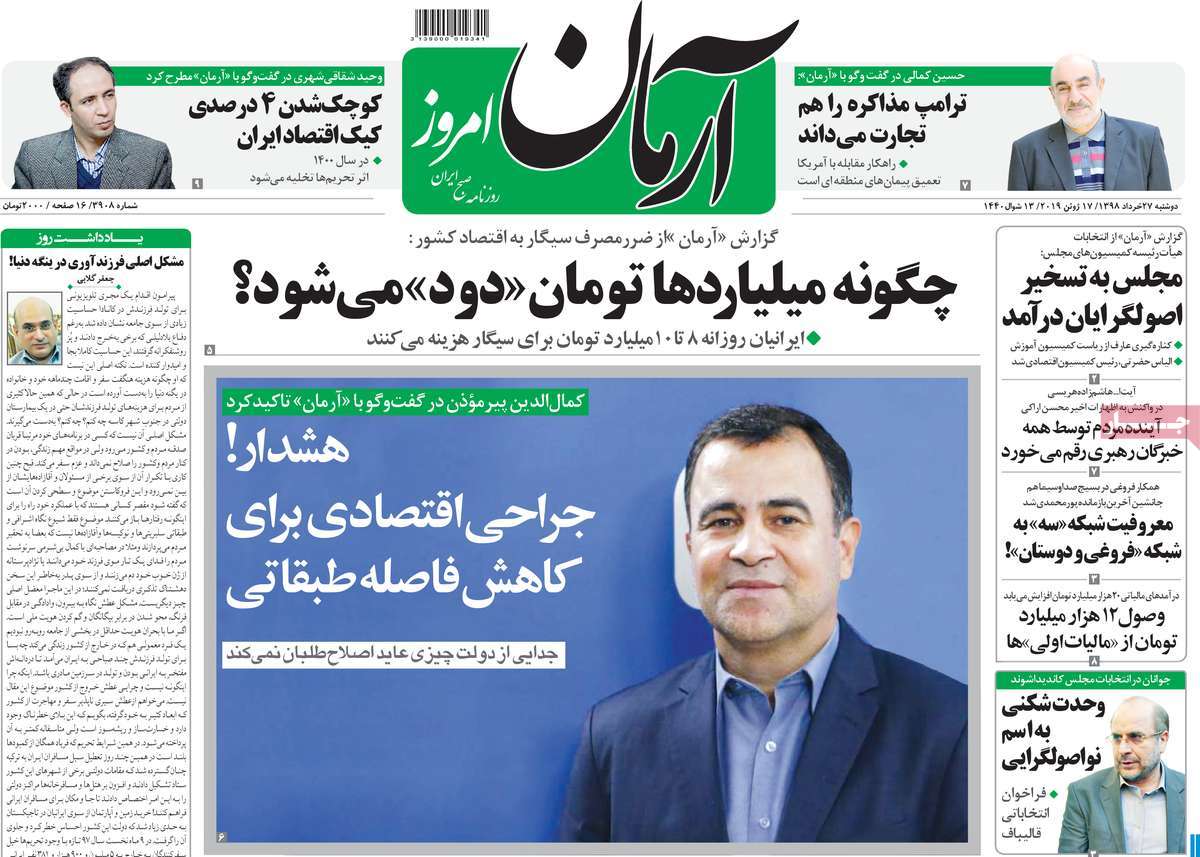
Arman-e Emrouz:
1- Trump Thinks Negotiations Are Like Doing Business: Expert
2- Iranians Spend about $600-700m USD Per Day on Cigarettes

A Look at Iranian Newspaper Front Pages on June 17


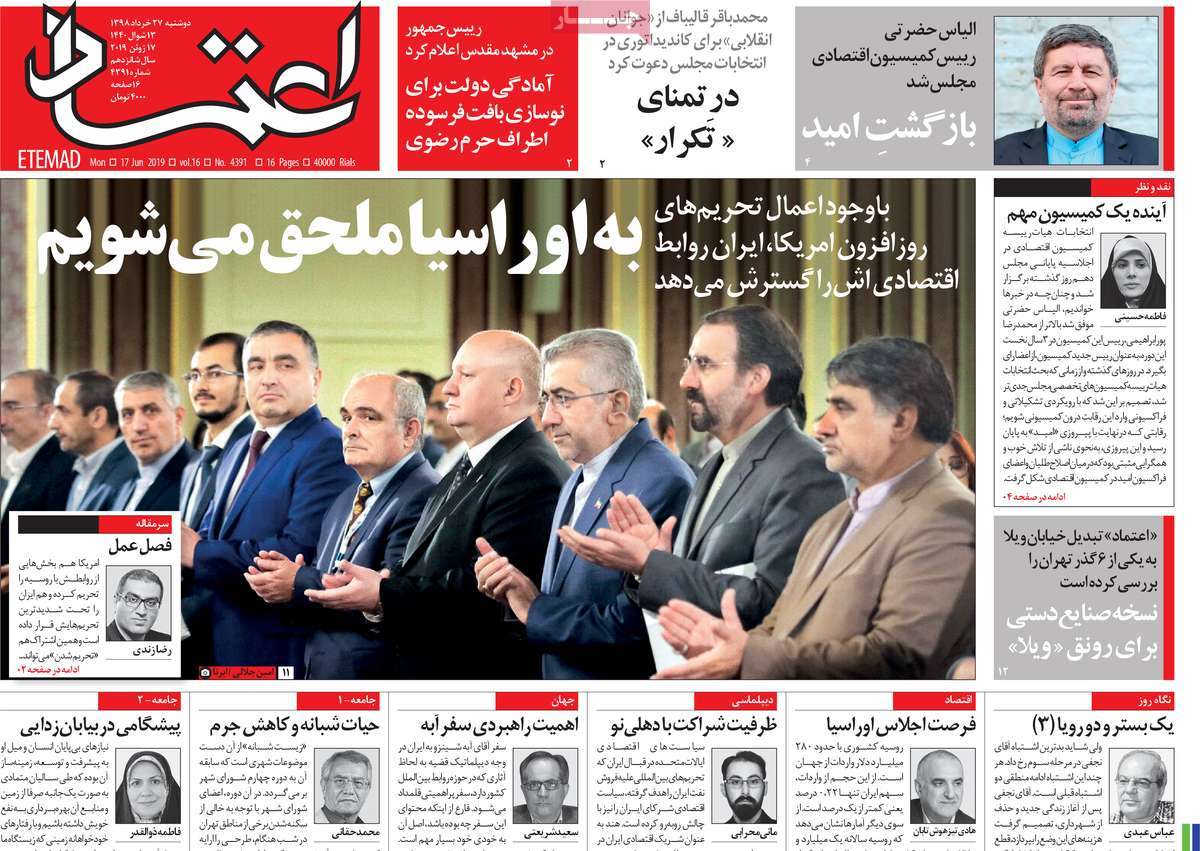
Etemad:
1- Iran Joins Eurasia
• Despite Increasing US Sanctions, Iran Expands Economic Ties

A Look at Iranian Newspaper Front Pages on June 17


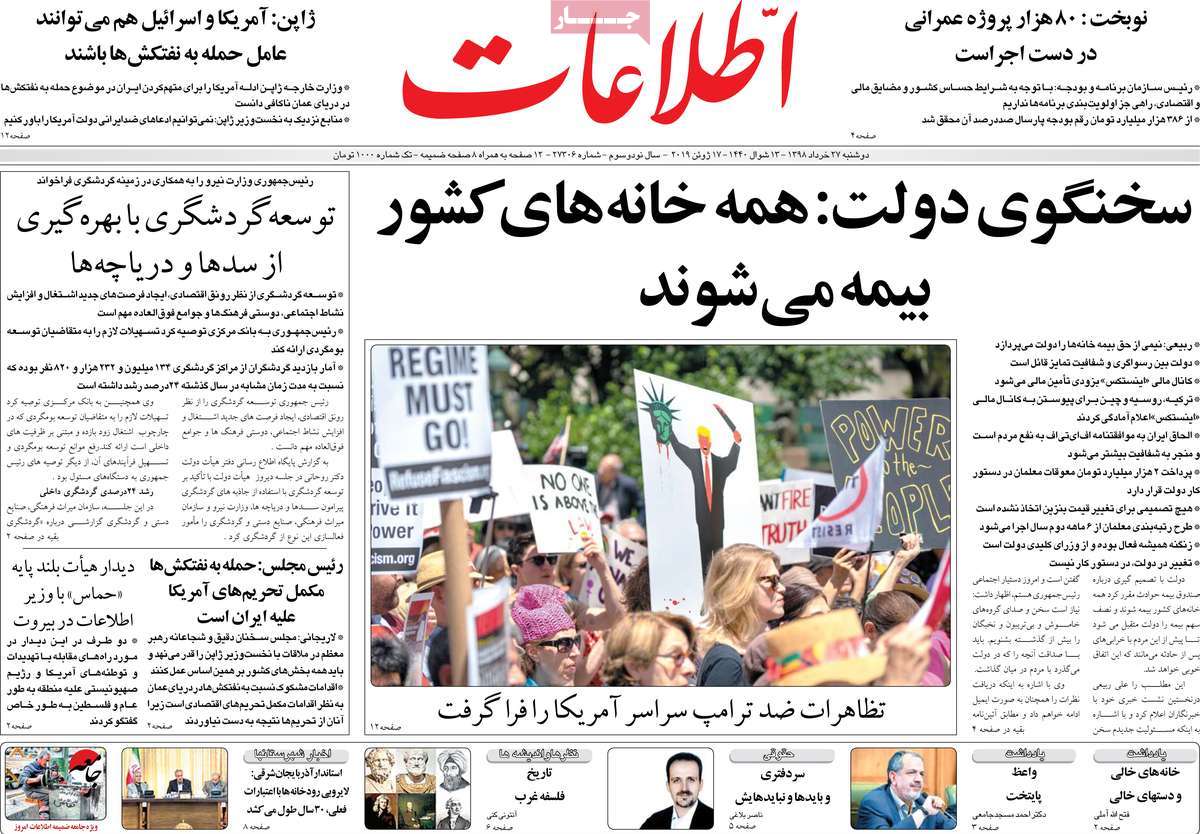
Etela’at:
1- US, Israel Can Also Be Behind Attacks on Tankers: Japan
2- Anti-Trump Protests Staged Across US
3- Attack on Tankers Completes US Sanctions against Iran: Larijani

A Look at Iranian Newspaper Front Pages on June 17


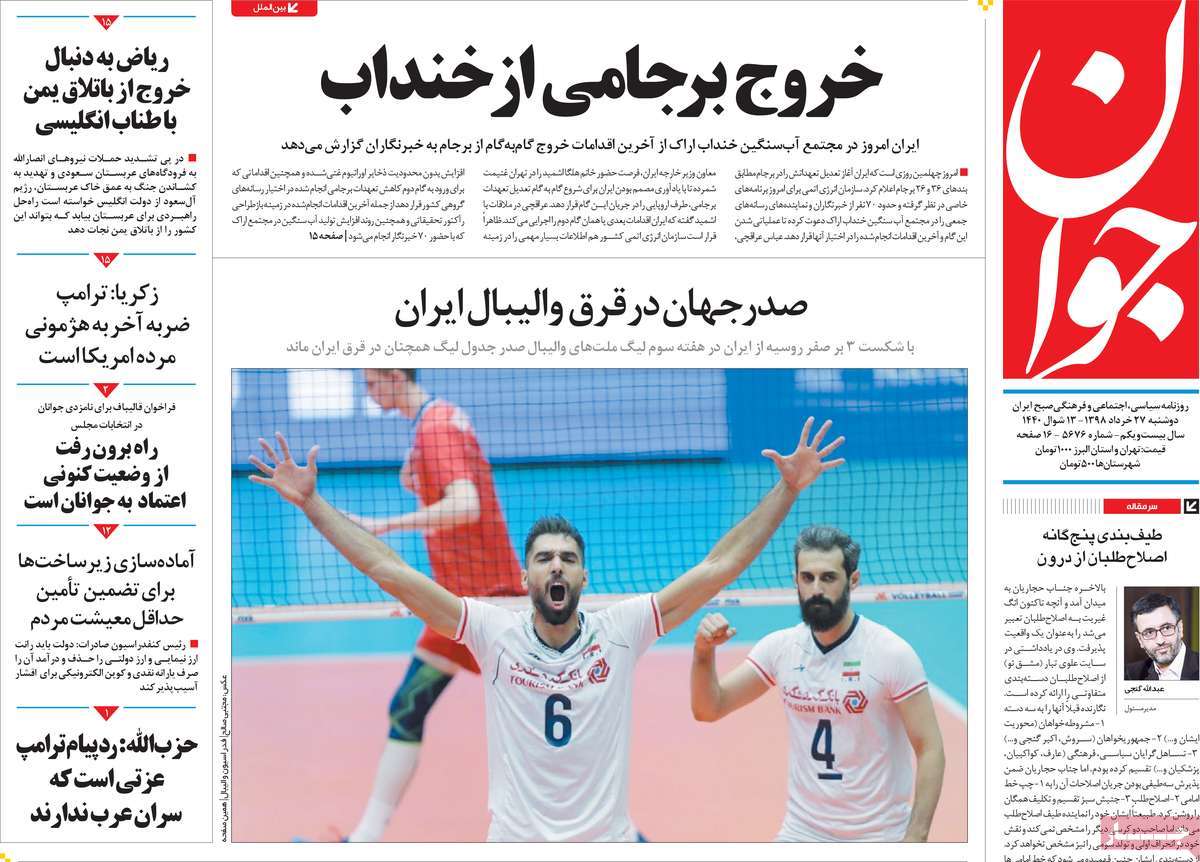
Javan:
1- Withdrawal from JCPOA in Arak’s Khandab
• Iran Reports on Second Phase of Scaling Down Nuclear Deal Commitments
2- Iran’s Volleyball Team Top on World Nation’s League Table
3- Trump; Last Nail in Coffin of US Dead Hegemony: Zakaria
4- Rejecting Trump’s Message; A Glory that Arabs Are Deprived of : Hezbollah

A Look at Iranian Newspaper Front Pages on June 17


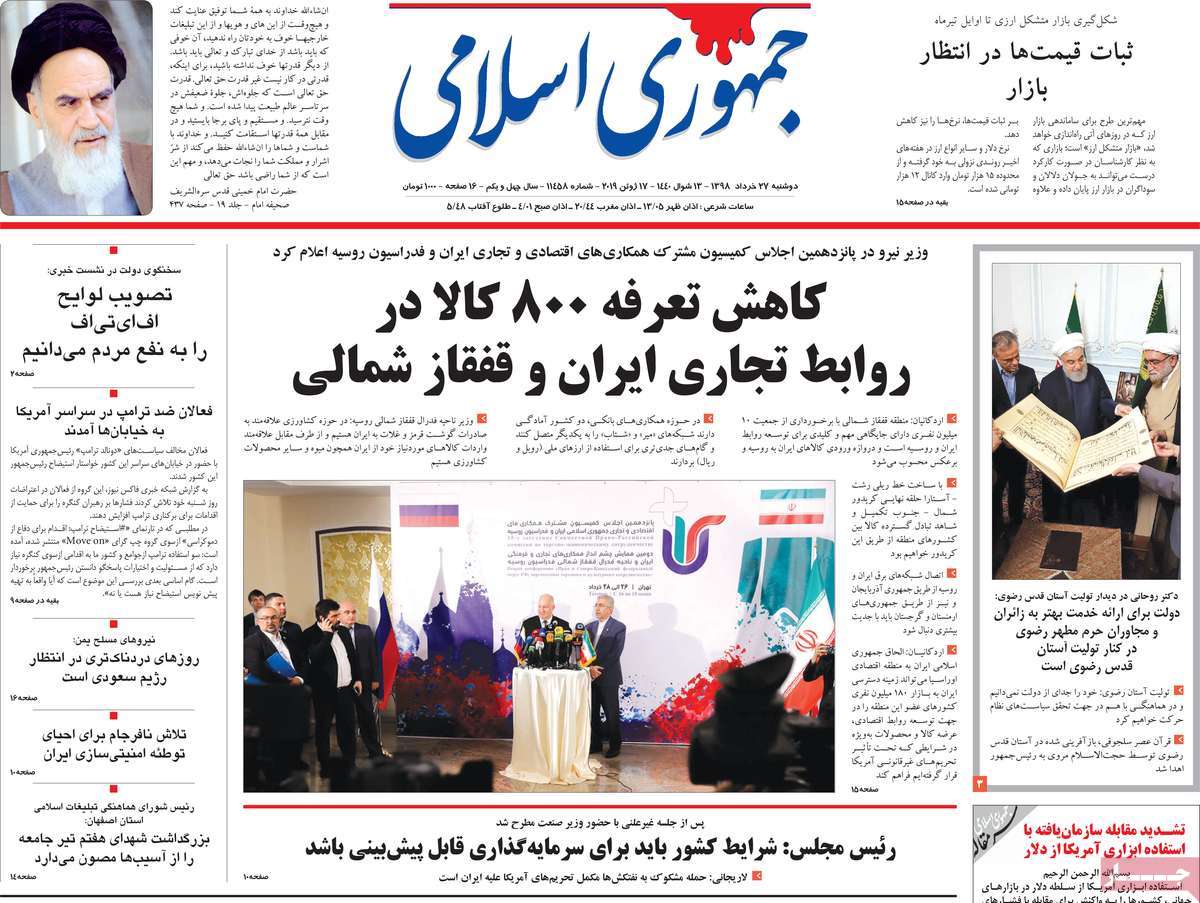
Jomhouri Eslami:
1- We Believe Adoption of FATF Bills Are to Benefit of People: Government Spokesman
2- Anti-Trump Activists Take to Streets Across US
A Look at Iranian Newspaper Front Pages on June 17


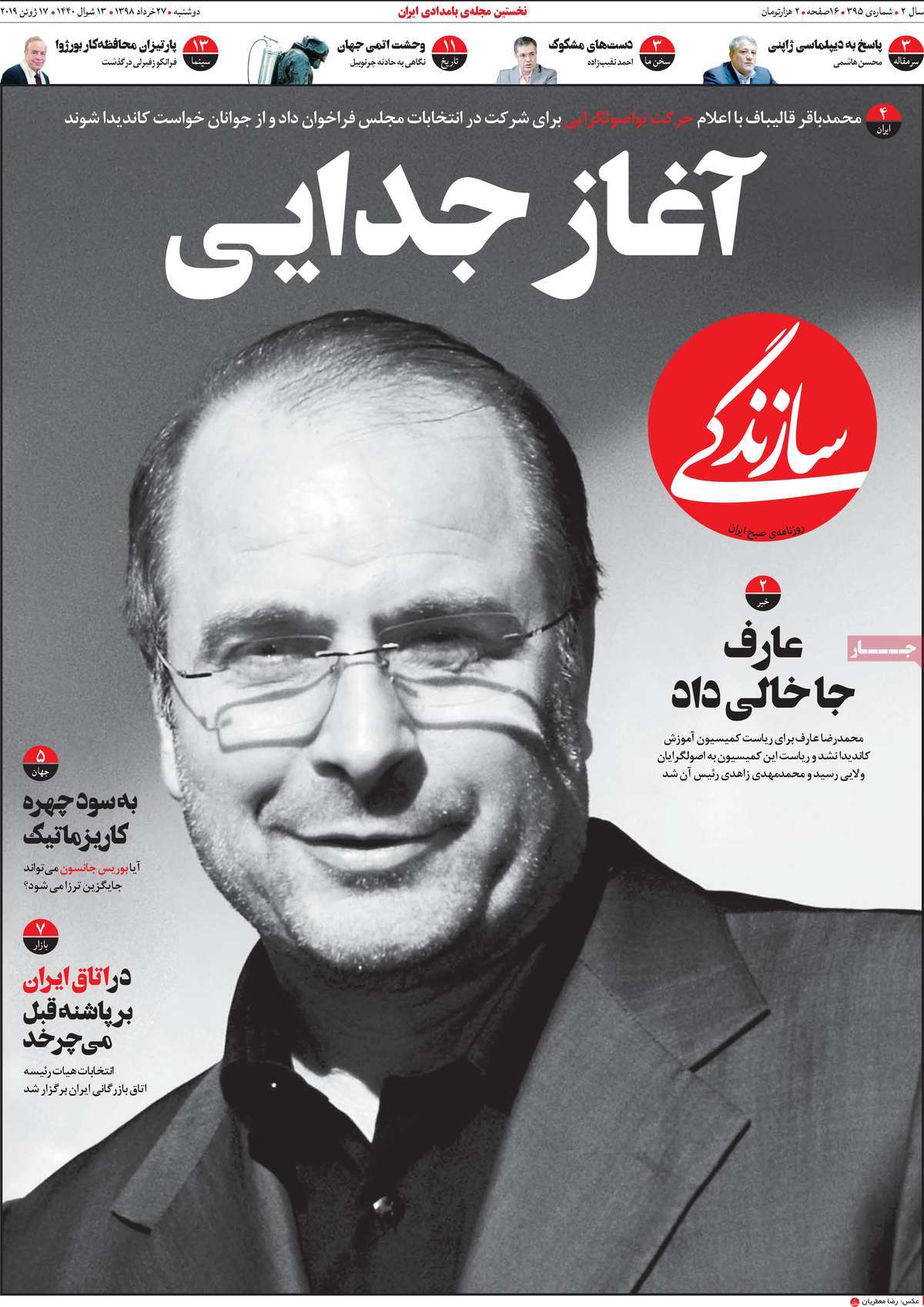
Sazandegi:
1- Can Boris Johnson Replace Theresa May?
A Look at Iranian Newspaper Front Pages on June 17


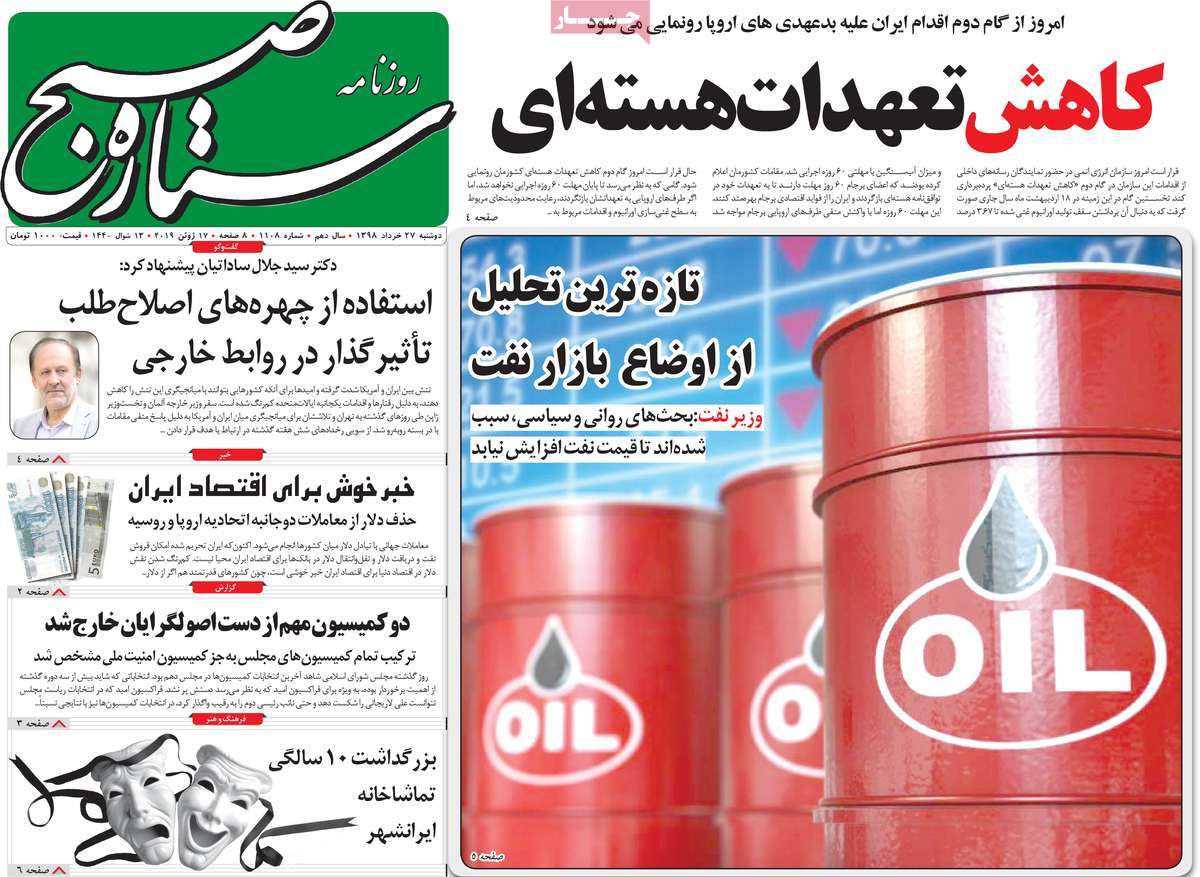
Setareh Sobh:
1- Scaling Down of Nuclear Commitments
2- Good News for Iran’s Economy
• US Dollar to be Ditched in EU-Russia Trades

A Look at Iranian Newspaper Front Pages on June 17


Shahrvand:
1- Achievements of Rouhani’s Attendance at CICA Summit

A Look at Iranian Newspaper Front Pages on June 17


Sharq:
1- Tension Heighten Between Iran, UK Again
2- Nuclear Programs Top on Iran-Russia Cooperation’s Agenda
A Look at Iranian Newspaper Front Pages on June 17

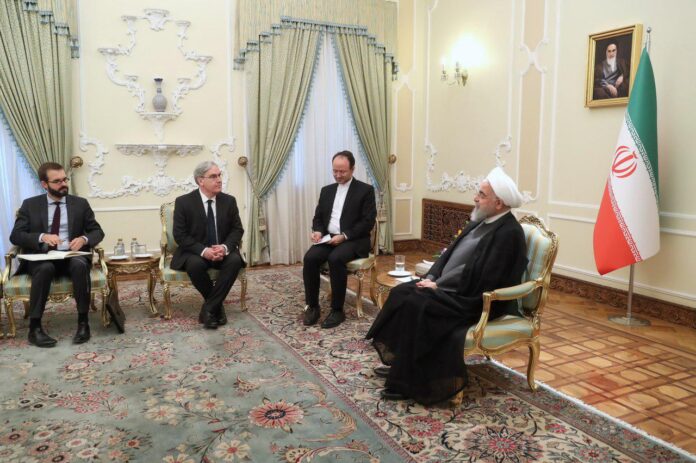
Europe Has Limited Time to Compensate: Iran President

“The current situation is very critical and France and the other parties to the JCPOA still have a very limited opportunity to play their historic role for saving the deal,” Rouhani said.

He made the remarks in a Monday meeting with the new Ambassador of France to Tehran.

“There is no doubt that the collapse of the JCPOA will not be beneficial for Iran, France, the region and the world,” said Rouhani.

Europe Has Limited Time to Compensate: Iran President
Iran’s Enriched Uranium Stockpiles to Surpass 300kg Limit

The President of the Islamic Republic of Iran also said, “Tehran is determined to develop its relations with Paris, fulfilment of its commitments under the JCPOA, and active cooperation to strengthen stability and security in the region, especially fighting terrorism.”

Rouhani also emphasised that some issues, including the import of medicine and medical equipment, spare parts for airliners, food trade or parts of some factories affecting people’s basic needs and employment, are beyond JCPOA and even bilateral relations.

The sanctions on such goods by the United States are completely inhumane, and reflect the widespread economic war that the United States has begun against every Iranian individual.

The French envoy Philippe Thiébaud, in turn, presented his letter of credence to Rouhani and said, “France is determined to develop its relations with Iran in all fields of mutual interest.”

The government of France will spare no effort in deepening economic cooperation with Tehran, he said, adding, “Tehran has lived up to all its commitments under the JCPOA and France is trying to protect his agreement, which is supported by the international community.”

Stating that his country is concerned about the tensions in the region, the French Ambassador said, “Paris is ready to discuss regional security and stability with Iran”.

Soundtrack Album of ‘The Warden’ to Be Released Globally

Kousha has already composed music for 40 American films and series, including “Radio Flash”, “A Day like a Week” and “5th Passenger”. Since a while ago, he has been working with young filmmakers in Iran.

His most recent work is the music of “The Warden” that is currently in theatres across the country, and is among the best-selling movies.

Kousha has elaborated on the details of the soundtrack in various parts of the film. “Maybe Nima Javidi (the film director) cannot speak with the language of music and its techniques, but he knows well what he wants from a scene created in the script.”

“He always explained to me the result of this process and helped me choose the right musical space and arrangement,” added Kousha.

“In coordination with Nima, we’re going to publish the Warden’s soundtrack album in a month,” he said.

He went on to say that he is “in talks with some internationally-acclaimed companies to bring the work to the final stage. Therefore, we are currently busy separating various pieces of the film, and hopefully we will see the release of this work as soon as possible.”

The use of percussion and string instruments is notable in the music of this film.

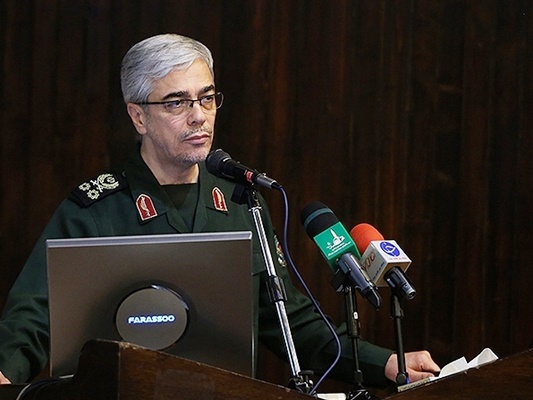
‘Iran Would’ve Bravely Admitted If It Were Behind Tanker Attacks’

bagheri

Major General Mohammad Baqeri, the Chief of Staff of the Iranian Armed Forces, made the remarks on Monday in reaction to recent anti-Iran accusations.

General Baqeri stressed that Iran is brave enough to accept responsibility for its actions.
He then blamed the “enemy” for the recent attacks on the oil tankers.

“The enemy makes any worthless move to divert the resistance [front] from its path,” said general Baqeri, the chairman of the General Staff of the Iranian Armed Forces.

“The ridiculous and worthless actions against the oil tankers in the Sea of Oman and the Indian Ocean are but some of such actions. They want to lead the people in the region and across the world to believe that Iran is carrying out its threats” he said.

The top commander reiterated that if Iran decides to block the Strait of Hormuz, no single vessel or oil tanker will be able to cross the waterway.

The top general said as long as no one creates problems for the Strait of Hormuz, Iran will ensure its security, adding, “As long as the Islamic Republic of Iran’s oil is exported, others can also export their petroleum with security.”

“The Islamic Republic of Iran ensures security in the Strait of Hormuz and the Sea of Oman, and we have announced, time and again, that the security of the Strait of Hormuz and the Persian Gulf is as important as the country’s domestic security,” he said.

The top commander underlined that Iran’s Armed Forces have control over the Persian Gulf and Strait of Hormuz, and, hence, are able to ensure security in those regions.

“Last month, some suspicious incidents happened in the south of the Sea of Oman. The US and the Zionist regime [of Israel] and a few of their reactionary supporters in the region attributed those events to the Islamic Republic of Iran,” the top commander noted.

He further said Iran is capable of blocking the Strait of Hormuz.

“We are able to block the Strait of Hormuz if we want to, and our move will be in such a way that not even a single drop of oil will cross the strait,” he said.

Elsewhere in his remarks, the top general touched upon Washington’s withdrawal from the Iran nuclear deal known as the Joint Comprehensive Plan of Action (JCPOA). He said Tehran scaled back some of its commitments under the deal due to the US pullout from the agreement.

General Baqeri then touched upon the United States’ double standards in dealing with Iran.

“The enemy has adopted the strategy of pressure in dealing with Iranian people, but, in word, it speaks of talks and understanding,” the senior commander said.

He said no one would believe the Americans’ claim that they want to reach a compromise and understanding with Iran at a time when the White House adds to its sanctions against Iran every week.

He also referred to the power of Iran’s deterrence doctrine.

“Whatever happens, the enemy says it has no intention of waging war, which is due to the deterrence established by the Iranian nation and Armed Forces,” general Baqeri said.

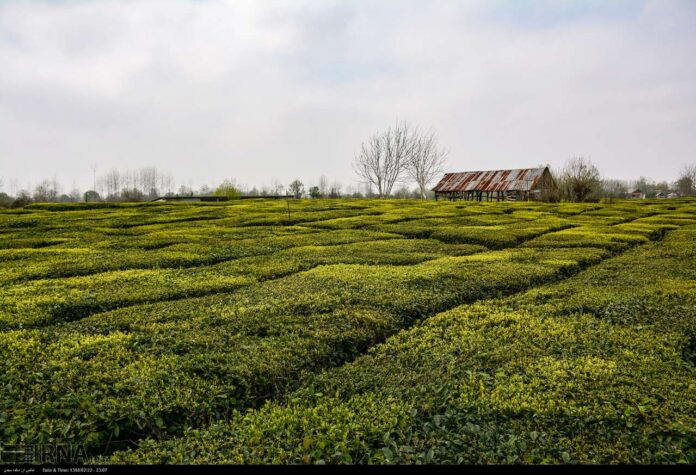
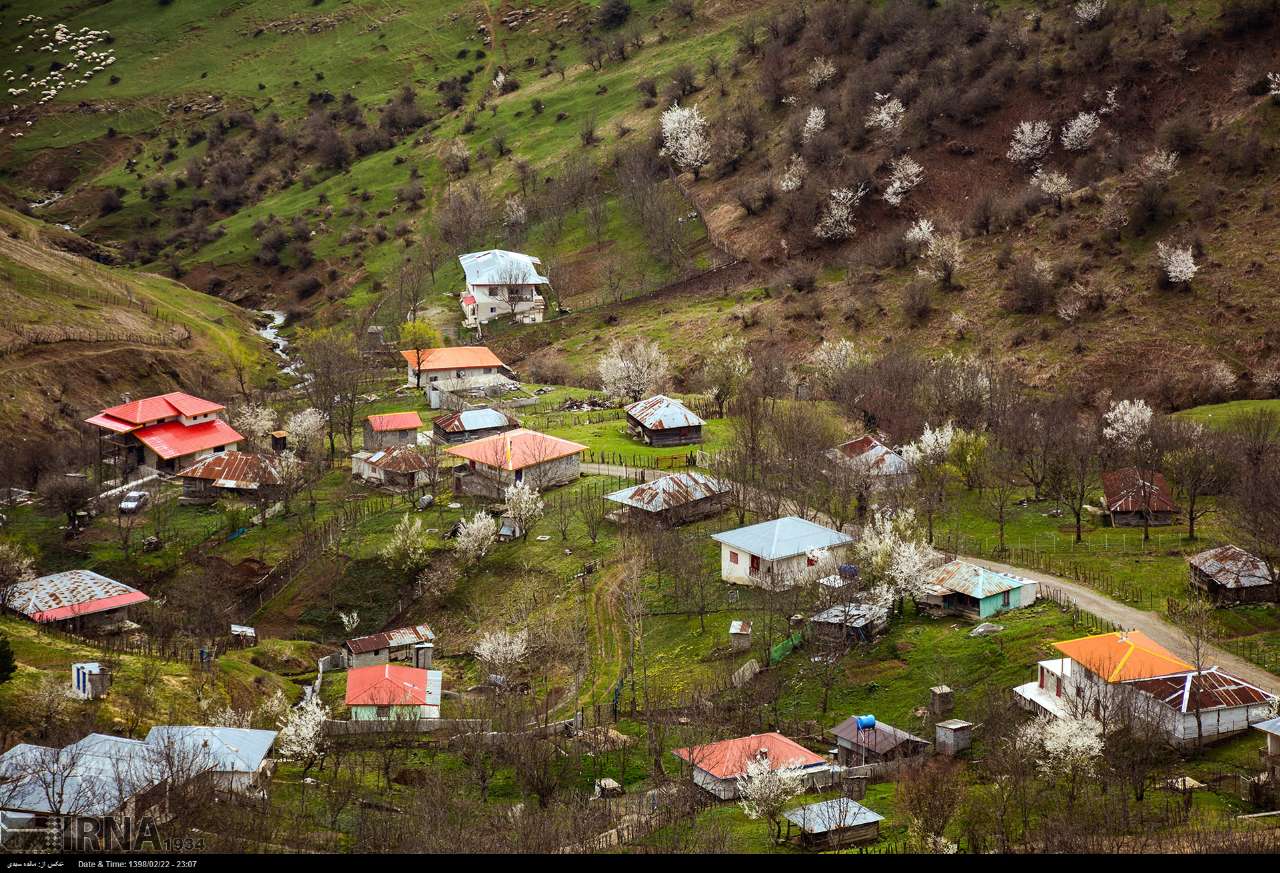
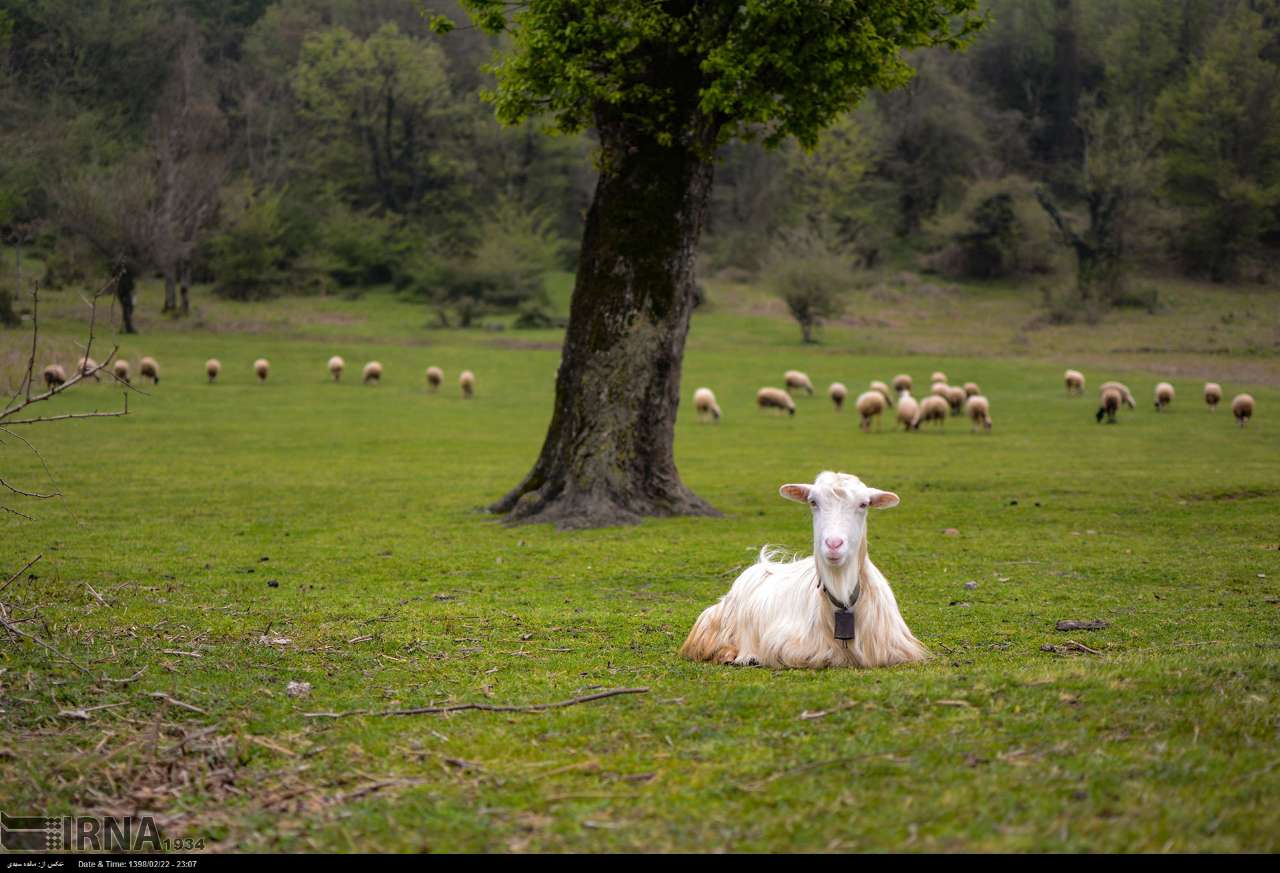
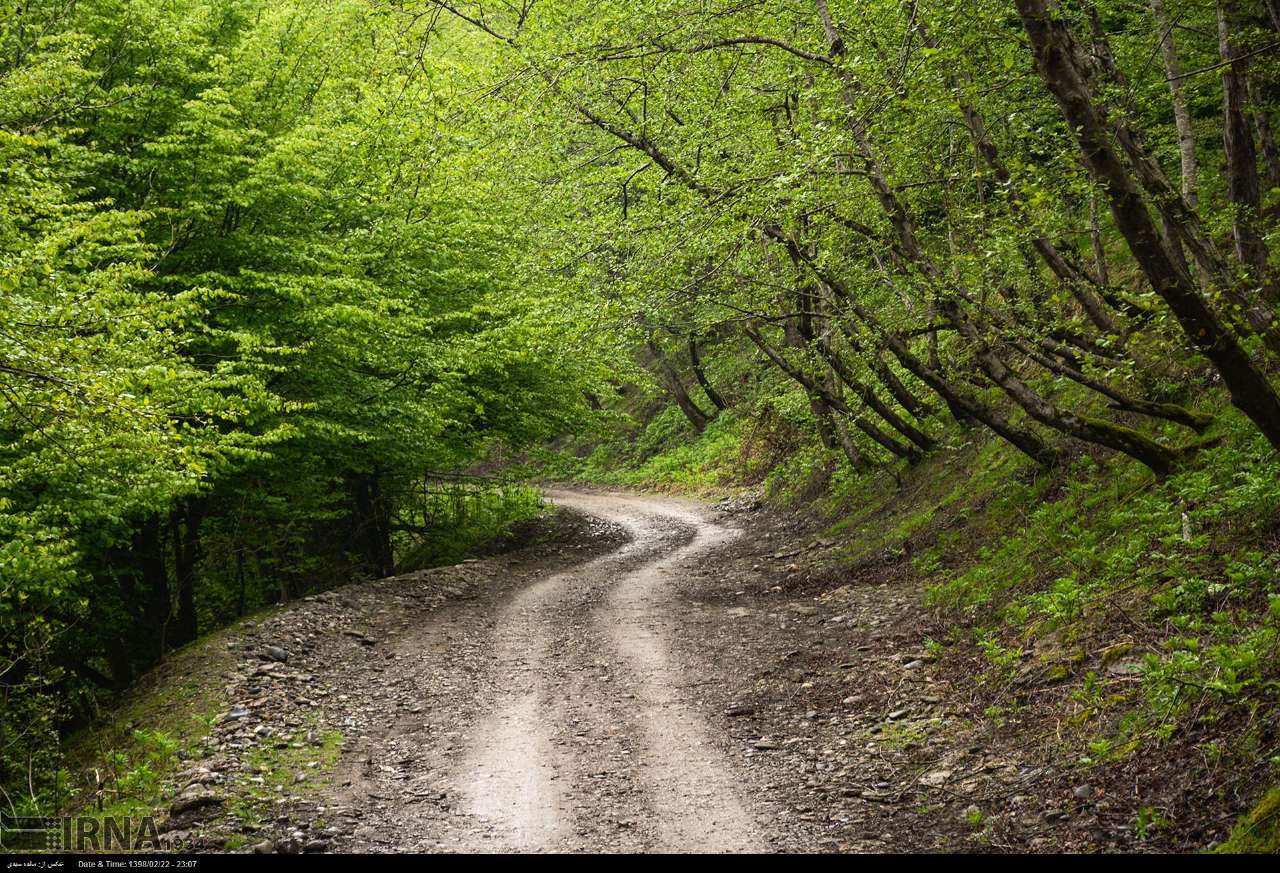
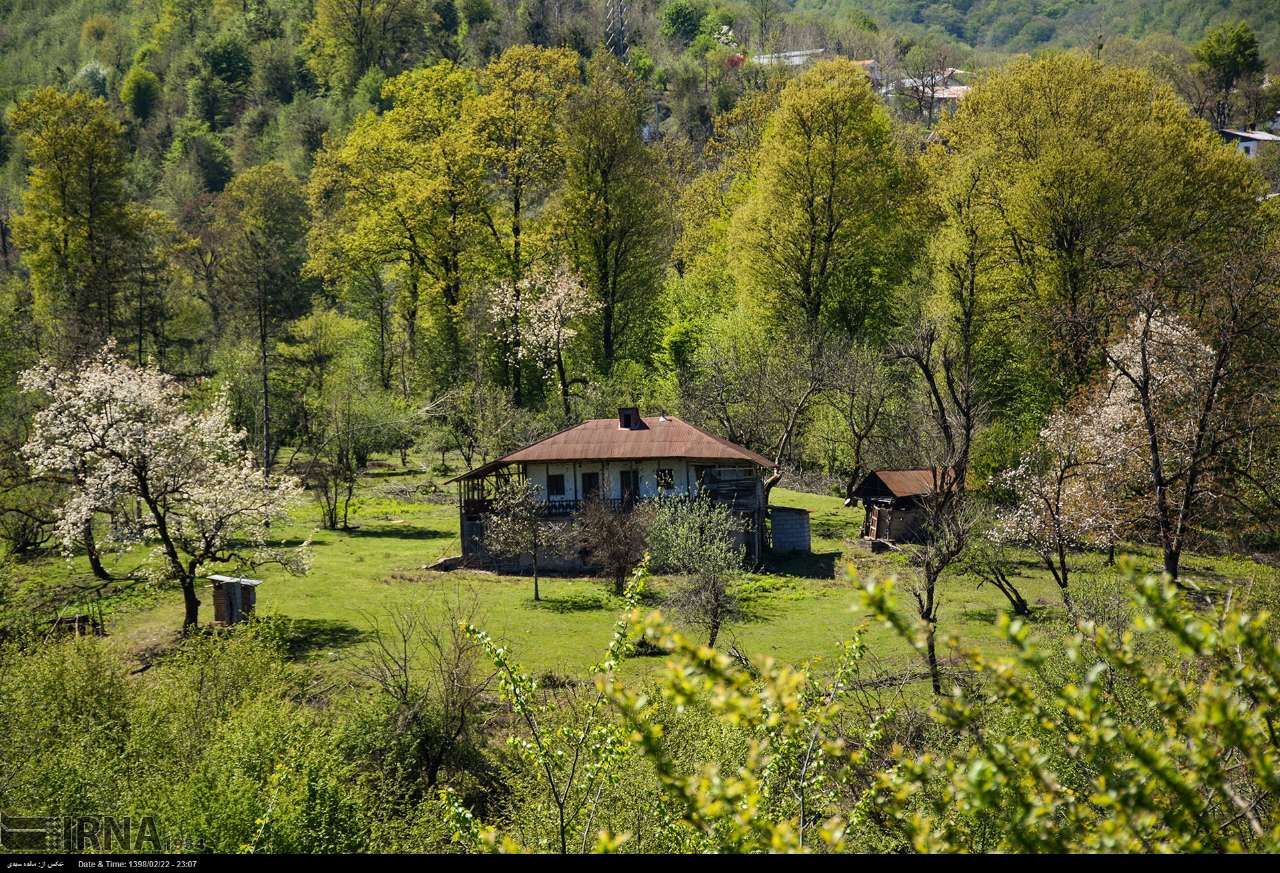
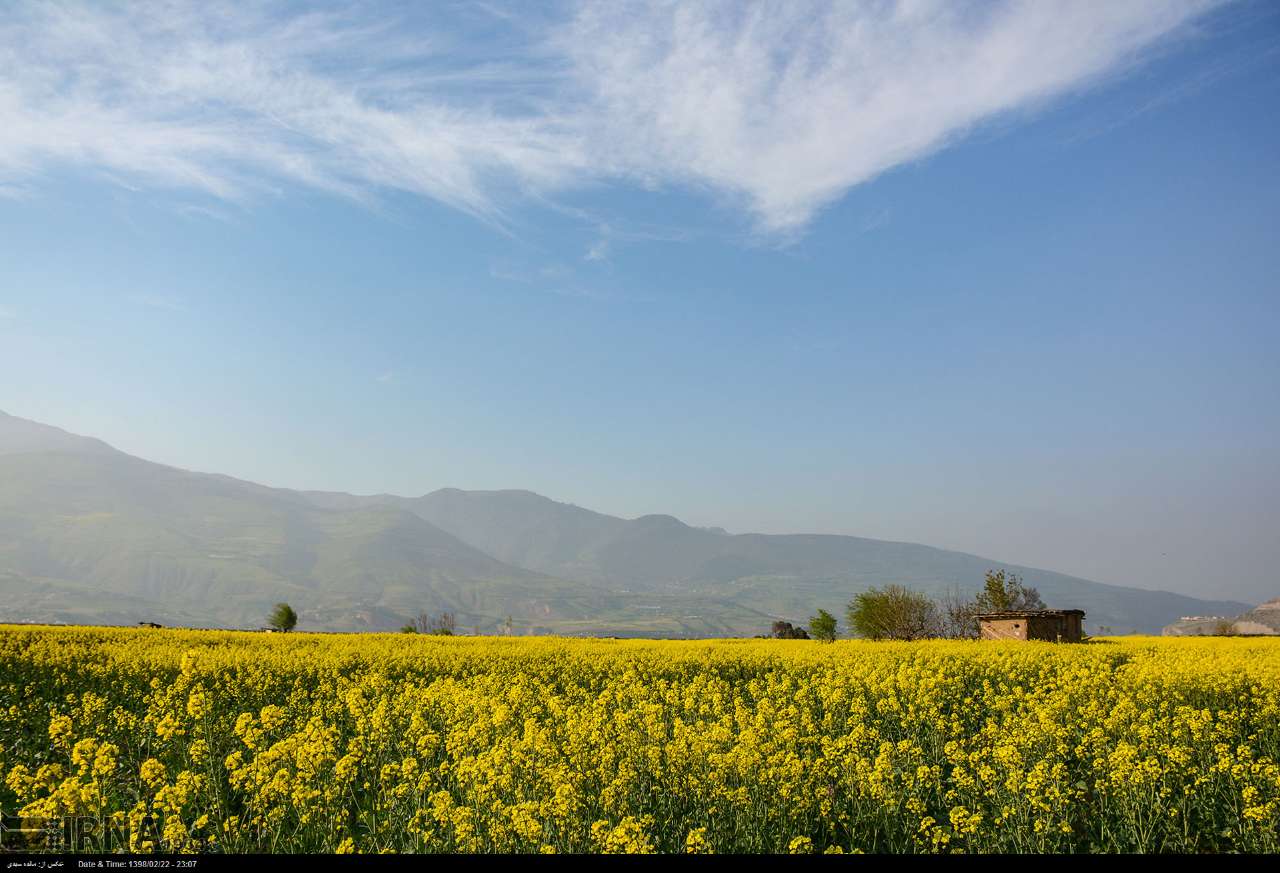
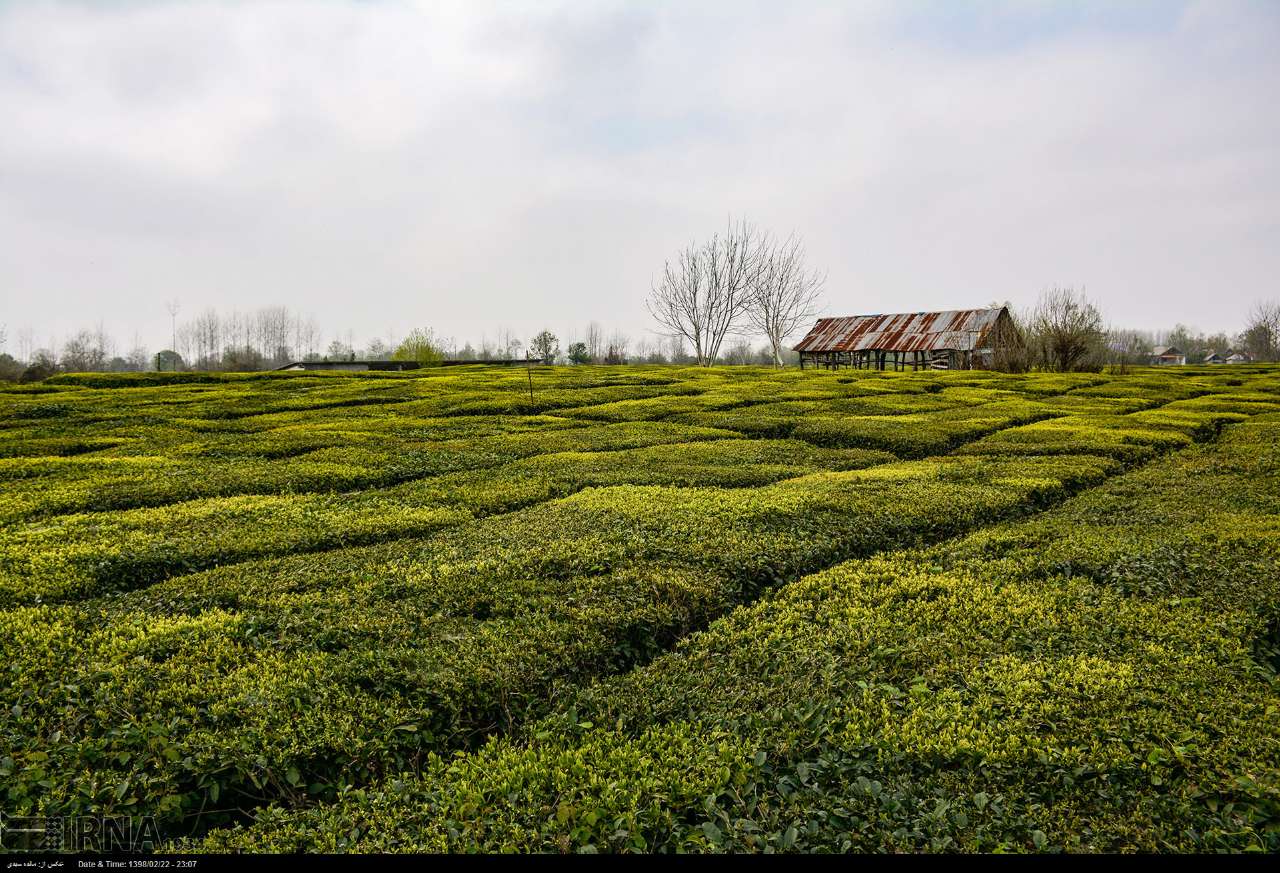
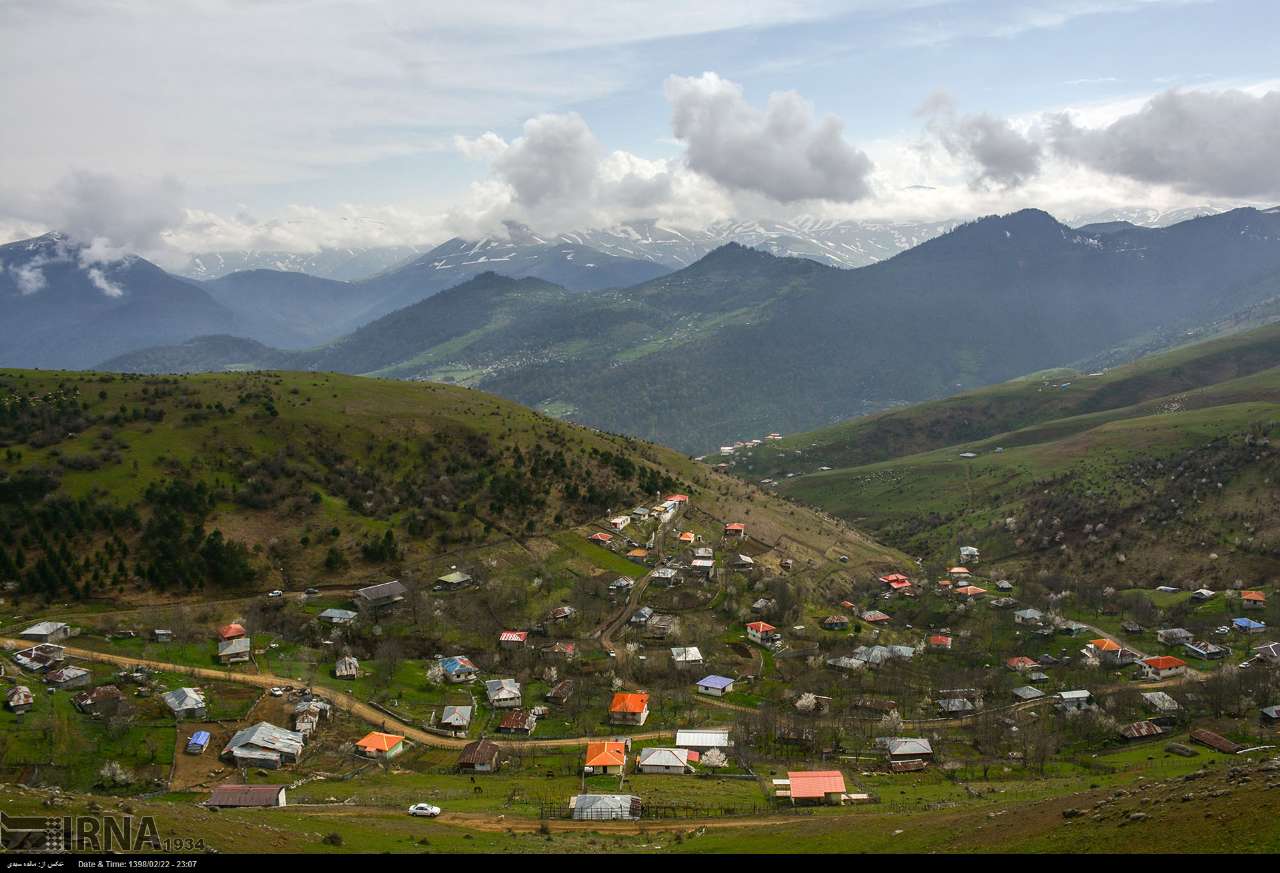
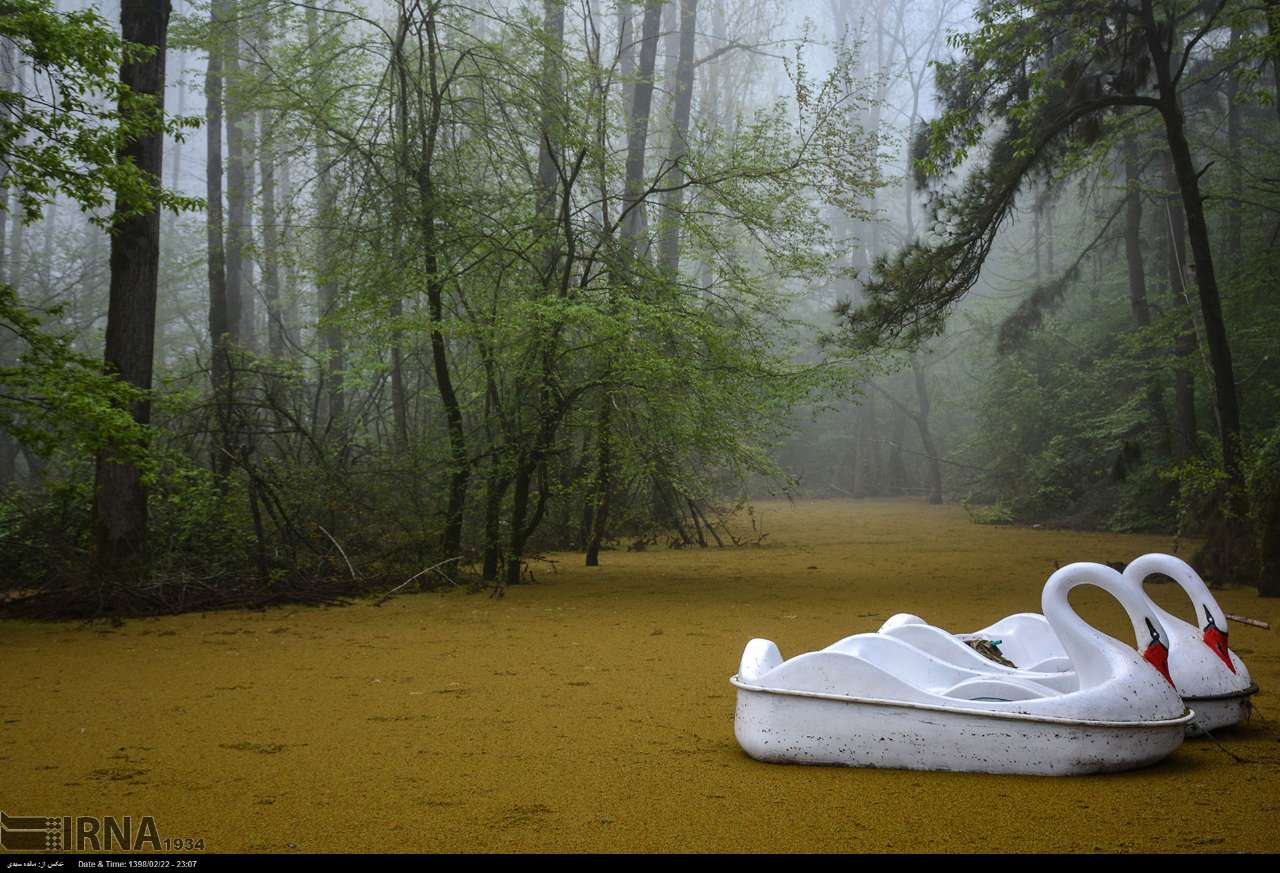
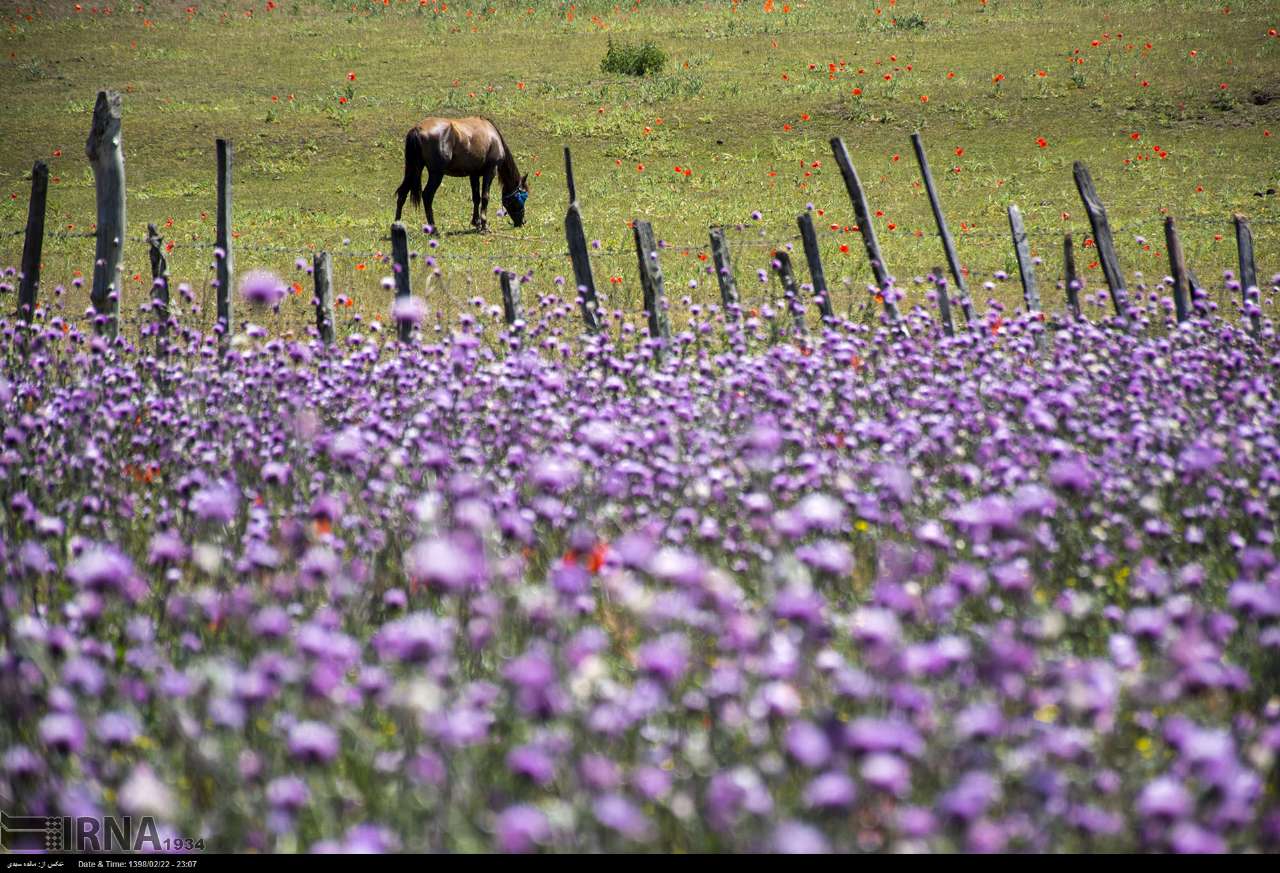
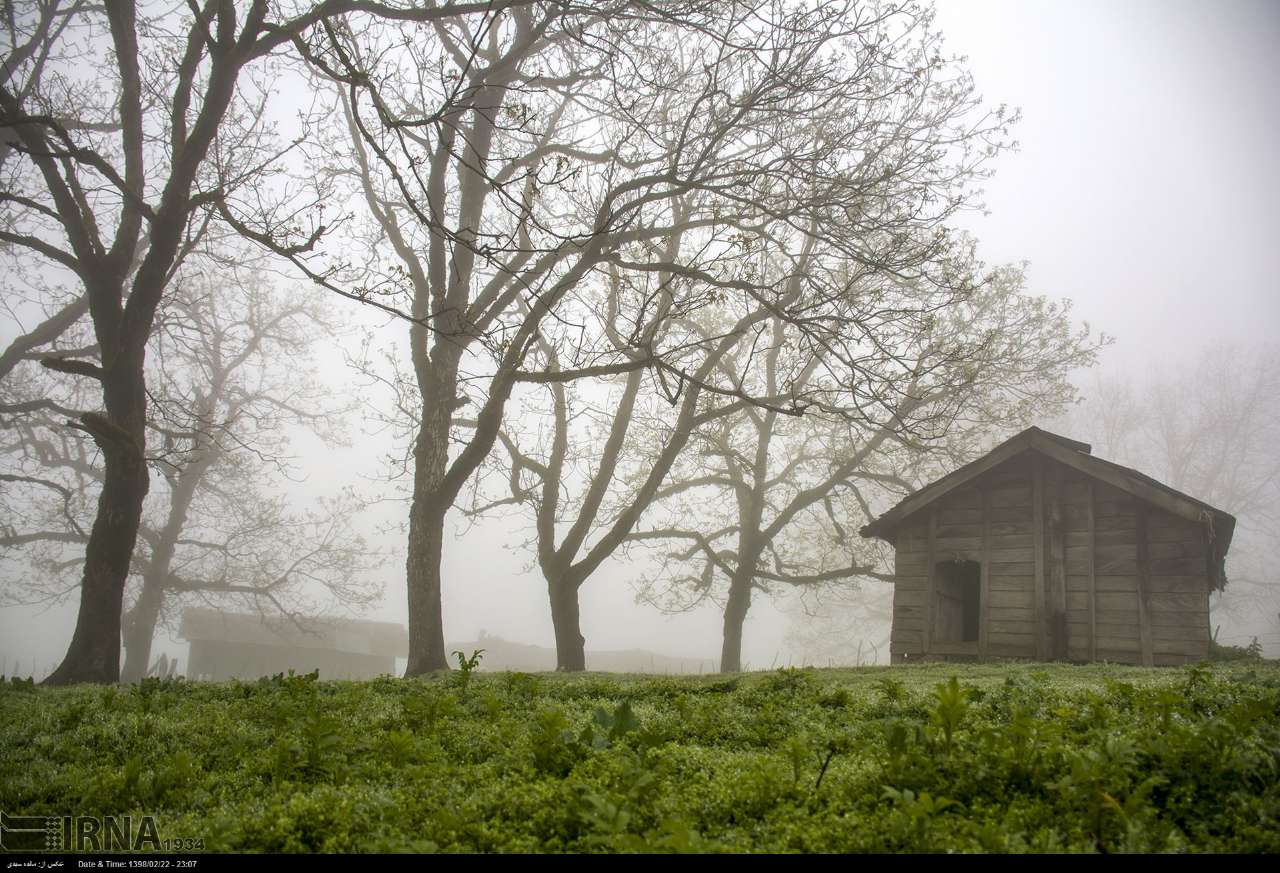
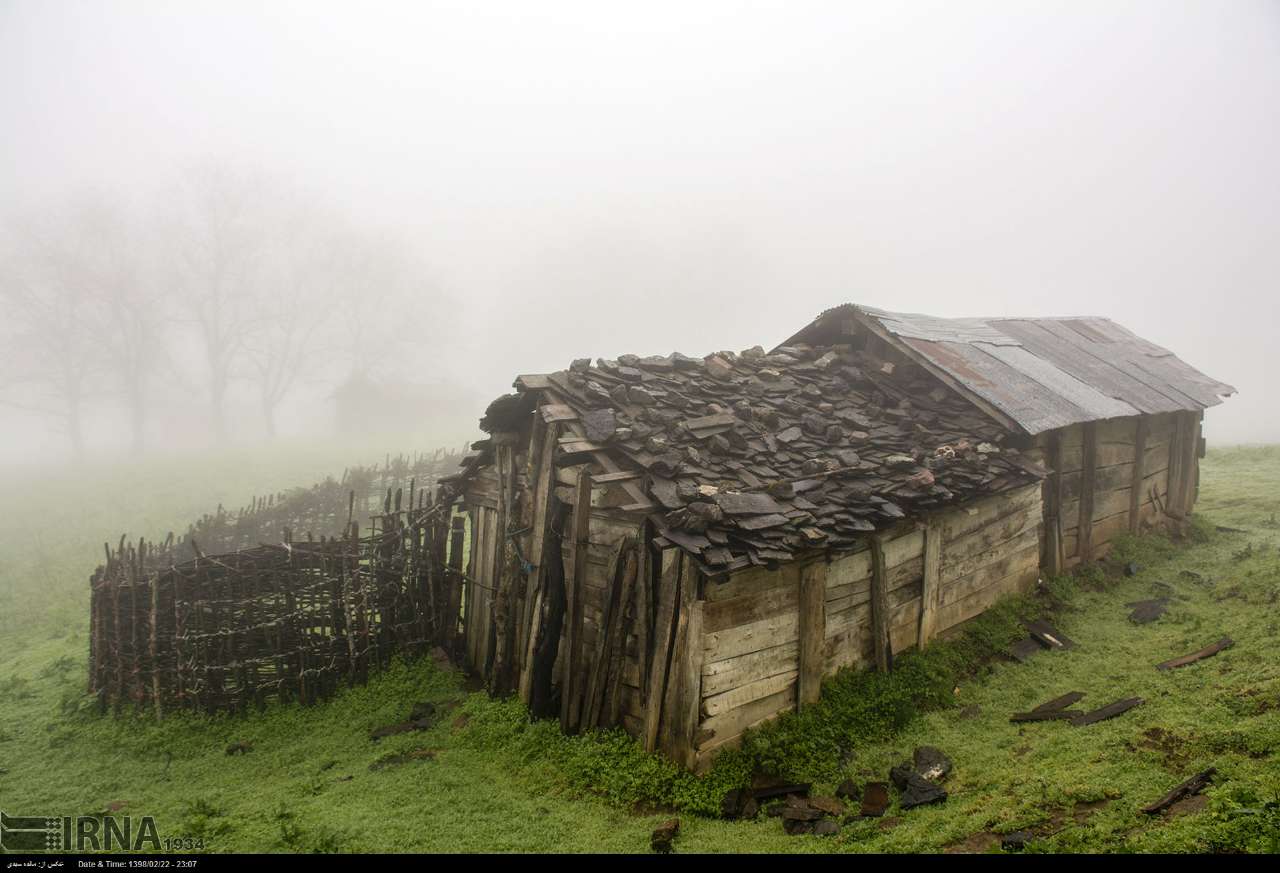
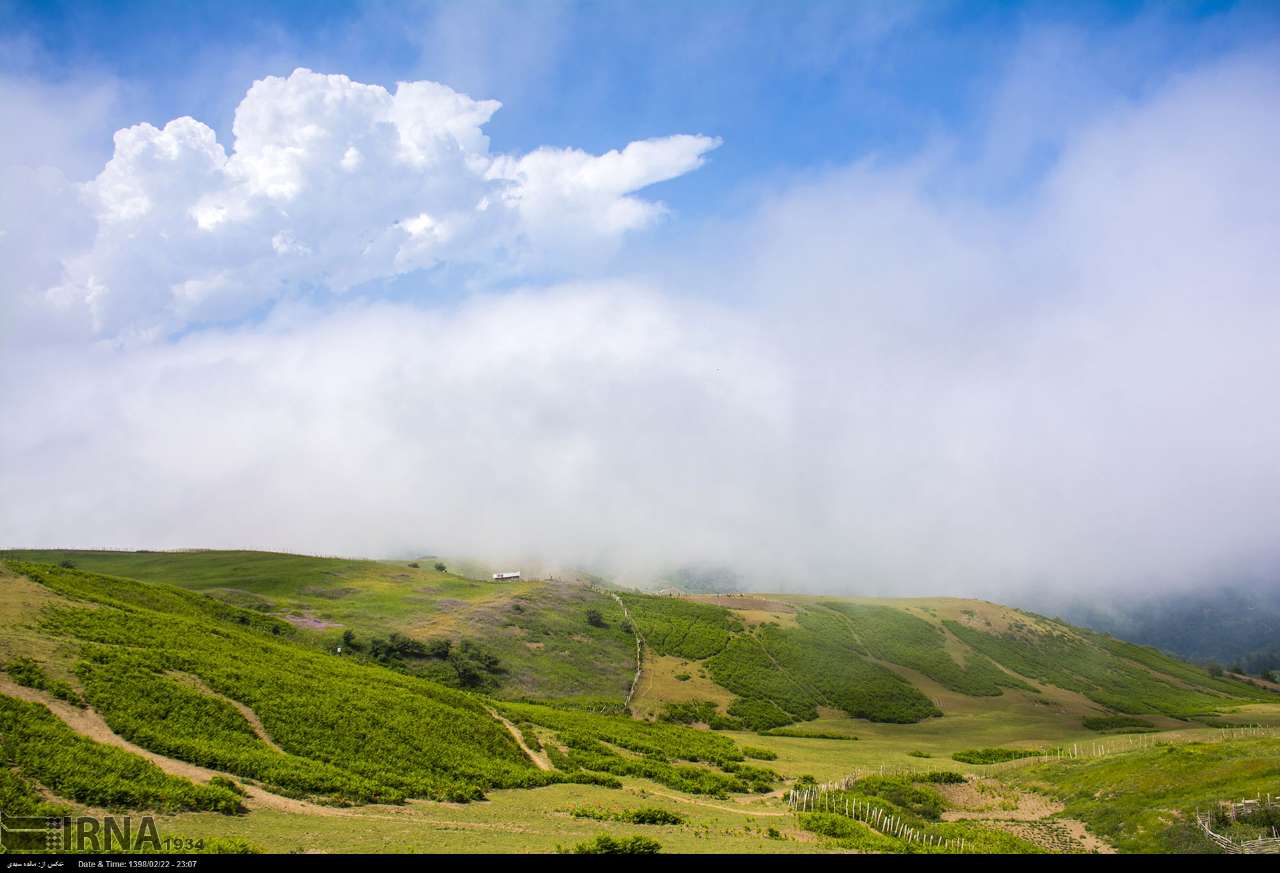
Iran’s Beauties in Photos: Spring in Gilan

With its dense forests, mild climate and beautiful sea shores, Gilan province is the most visited destination for Iranian tourists.

What follows are IRNA’s photos of Gilan’s magnificent natural sights in spring:

Newly-Developed Cream Can Remove Skin Cracks

Cracks or lines of skin usually appear on the skin due to skin lifting, thinning, etc. The colours of these lines and their shape are different from natural skin. You may feel itching or burning while touching the skin cracks.

These cracks usually occur during pregnancy or after delivery or with the increase of body weight. Skin cracks are not dangerous and often disappear over time based on age and type of skin care.

To eliminate these cracks, researchers at a knowledge-based company have produced a cream that boosts the production of collagen and fibroblasts and antagonistic effects against corticoids in the skin, and thus prevents skin cracks.

The ingredients of this cream are extracts of “Asiatic pennywort”, vitamin E and collagen. This medicine is also used to remove scars.

The Asiatica Centella has traditionally been used thousands of years ago in East Asia, India, China, Indonesia, Sri Lanka and South Africa.

Historically, the plant has been used to treat diseases such as hepatitis, stomach ulcers, brain problems, epilepsy, diarrhea, fever, and asthma.

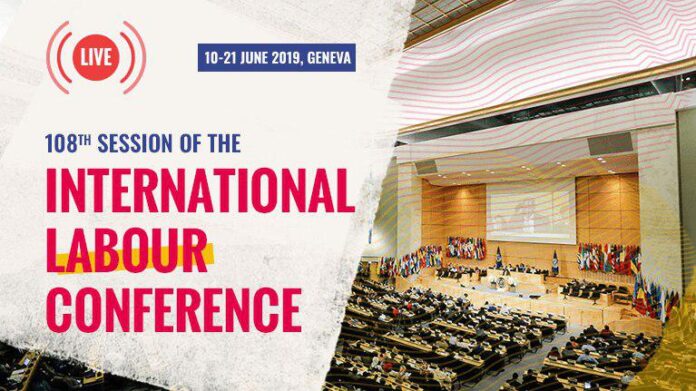
Iranian Minister in Geneva to Attend Int’l Labour Conference

The conference was kicked off on June 10 at the headquarters of the International Labour Organisation (ILO) and will run until June 21, 2019.

The government of the Islamic Republic of Iran, as one of the founding members of the organisation and a member of the board of directors, has an active role in the ILO’s policy and decision making process.

The agenda of the 108th session of the International Labour Conference will cover thematic debates and events connected to the future of work, including various centenary initiatives.

The Conference, which is often called an international parliament of labour, has several main tasks.

First, there is the crafting and adoption of international labour standards in the form of Conventions and Recommendations. Conventions are international treaties that, once adopted by the Conference, are open to ratification by member States. Ratification creates a legal obligation to apply the provisions of the Convention in question. Recommendations, on the other hand, are intended to guide national action, but are not open to ratification, and are not legally binding.

The Conference also supervises the application of Conventions and Recommendations at the national level. It examines the reports which the governments of all member States are required to submit, detailing their compliance with obligations arising out of ratified Conventions, and their law and practice in respect of Conventions and Recommendations (ratified or not) on which reports have been requested by the Governing Body of the ILO.

Since the adoption of the Declaration on Fundamental Principles and Rights at Work (1998), another important function of the Conference is to examine the Global Report prepared by the Office under the follow-up procedure required by the Declaration. Over a four-year cycle, the Conference examines in turn Global Reports covering the four fundamental rights, namely: (a) freedom of association and the effective recognition of the right to collective bargaining; (b) the elimination of all forms of forced or compulsory labour; (c) the effective abolition of child labour; and (d) the elimination of discrimination in respect of employment and occupation.

The Conference is also a forum where social and labour questions of importance to the entire world are discussed freely – sometimes passionately. Delegates explore the course of social progress in the world, but the central theme is the report presented each year by the ILO’s Director-General. In recent years, these reports have addressed: Social insurance and social protection (1993), Defending values, promoting change: Social justice in a global economy (1994), Promoting employment (1995), The ILO, standard setting and globalization (1997), Decent Work (1999), Reducing the decent work deficit: A global challenge (2001) and A fair globalization: Creating opportunities for all (2004).

The Conference also passes resolutions that provide guidelines for the ILO’s general policy and future activities.

Every two years the Conference adopts the ILO’s biennial work programme and budget, which is financed by member States.

Iran’s Enriched Uranium Stockpiles to Surpass 300kg Limit

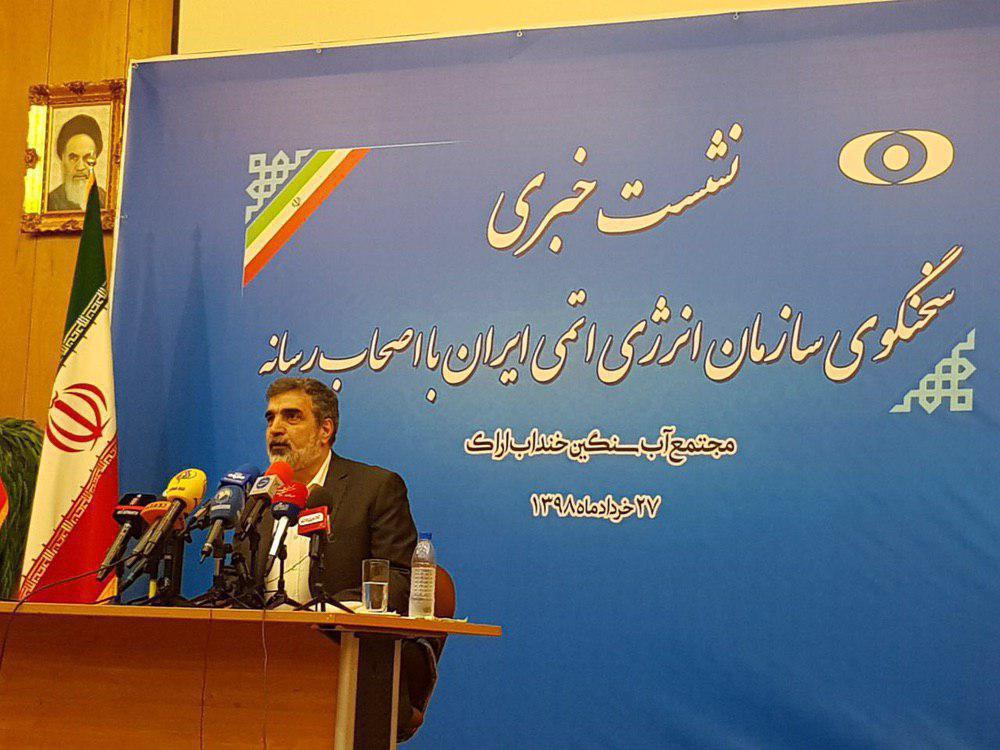
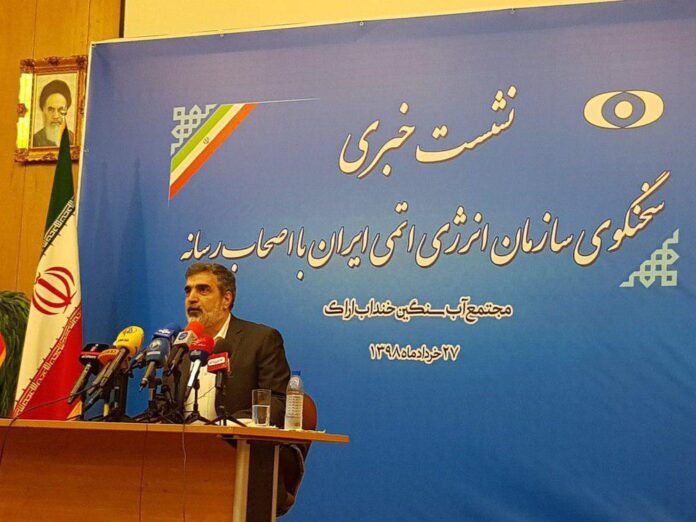
According to the Spokesman of the Atomic Energy Organization of Iran (AEOI), the move is part of Tehran’s decision to reduce some of its commitments under the 2015 nuclear deal with world powers in reaction to the other parties’ failure to live up to their commitments.

Behrouz Kamalvandi told a press conference at the site of the Arak nuclear facilities on Monday that the increase in uranium stockpiles is based on the Articles 26 and 36 of the Joint Comprehensive Plan of Action (JCPOA).

He also announced that the country’s heavy-water stockpiles will exceed the 130-tonne limit set by JCPOA within 2.5 months.

Kamalvandi said US President Donald Trump thinks Iran would shut down its facilities if no one buys its heavy-water.

However, he added, Iran has domestic use and we can also sell it in market.

He also noted that the decision is reversible in case other parties to the deal implement their commitments. “The Europeans still have time to compensate.”

The announcement came almost 40 days after Iran gave the Europeans a 60-day deadline to fulfill their commitments under the nuclear accord; otherwise, Iran has vowed to take “further measures” after the two-month period.

Iran will make decision about the level of its uranium enrichment after the 60-day deadline, Kamalvandi said Monday.

We’re waiting for the decision of the country’s top authorities, but for now we are thinking of different scenarios including an enrichment level of 3.68 percent and more, he noted.

The level can be 5 percent for Bushehr nuclear power plant, and 20 percent for Tehran research reactor, he predicted.

“With current facilities, we have a production capacity of 190,000 SWUs. In the 15th year of the JCPOA (11 years later), we will have a capacity of 272,000 SWUs. If we withdraw from the deal, the speed will be much higher.”

Iran-EU Relationship May Result in Divorce

“If it is important for them [Europeans] to preserve the nuclear deal, they have to work. Iran will no longer wait for their actions.”

The current circumstances may cause the Iran-EU relationship to result in divorce, he warned.

He further referred to the Arak reactor, and said, “Both the previous design of the Arak reactor and its redevelopment are considered. If anything happens, Iran can revive the previous reactor.”

“In the second phase of reducing its JCPOA commitments, Iran won’t any more feel obliged to not return to the previous reactor. It’s said it’d take 6 months to 1.5 years, but it can take place sooner,” he added.

He said various scenarios are available to the Iranian officials. “An overhaul is well carried out on the heavy water reactor, and its capacity can be increased.”

China Working with Iran on Heavywater

“The United States has been discouraging China [from buying Iran’s heavywater] with the perception that if Iran does not have a re-designed reactor, it does not need heavy water. Americans in the last waivers had said that nobody should buy Iran’s heavy water. Fortunately, the Chinese, whom we have been contacting for the past two weeks, are working well with us. The designing is carried out by us. We are now in the stage of supplying the equipment that Europeans can supply, and this is a good criterion if they provide the equipment. We can produce a lot of equipment, but if they give us the facilities, we will work more quickly,” he noted.

Kamalvandi also warned that if they [Europeans] want to work on technical issues politically, Iran will continue its own strategy.

Referring to the US bans, the Iranian official noted that Washington’s sanctions on radiomedics industry is an instance of “terror”.

However, he added, “fortunately, nothing serious happened because we have enough capacity to produce them.”

“We are in good condition to move forward through accelerating the development of our nuclear industry. God willing, we will make progress in all areas of the nuclear industry. Everyone is listening to the Leader and this industry will not be shut down,” he stressed.

“This is an important test for Europe. It is not in their interest if the United States assigns them what to do. There are many options [for us] in the technical field. The Islamic Republic is currently moving on a slope. If they do not take any serious action, there would be more serious options on the agenda.”

Kamalvandi also underscored that Iran is implementing the Additional Protocol voluntarily saying that as long as Tehran adheres to the NPT, it must carry out the safeguards.