Saturday, April 11, 2026
Home Blog Page 3220

Iran Can Give US Another Chance to Revisit Policies: Analyst

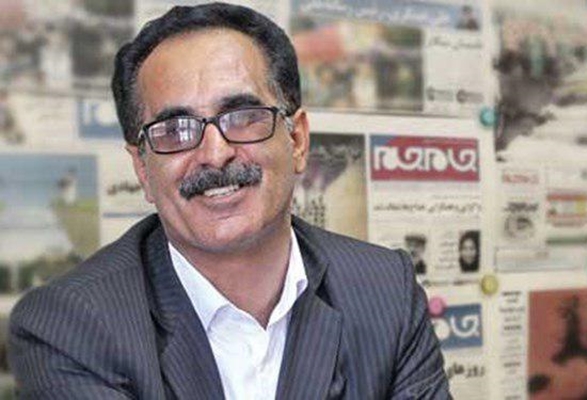
Political analyst Gholamreza Nazar-Boland has, in an article published in the reformist daily Shargh, weighed in on recent tensions between Iran and the United States. The full text of the analytical piece follows.

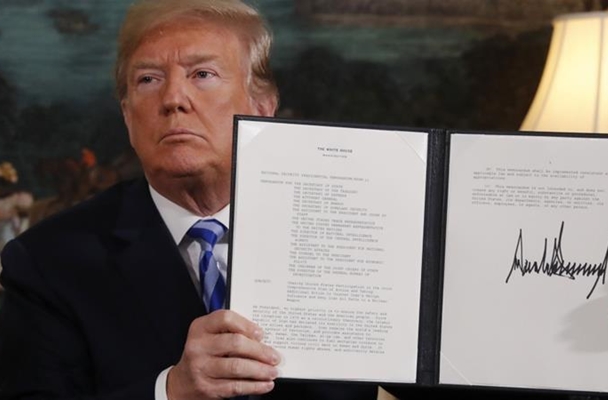
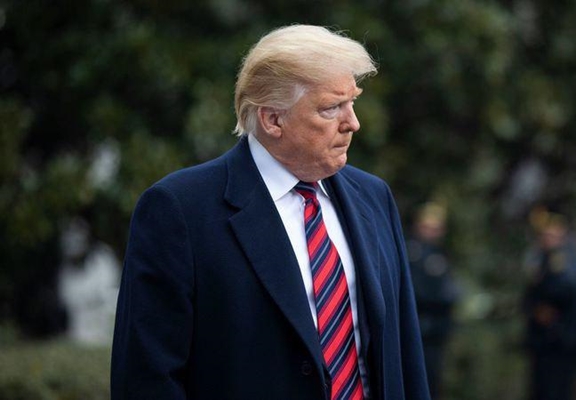
Mr Trump claims to be caring so much about the lives of human beings, namely Iranians, that he calls off a key decision arguing it would endanger people’s lives, and accordingly, exposes himself to criticism both at home by his rivals, and abroad by his allies. If he cares so much about people’s lives, then why doesn’t he take into account the proportionality principle [which says the punishment should fit the crime] when it comes to its viral sanctions against Iran which have jeopardized the lives of many innocent children as well as the elderly, and why doesn’t he generalize that principle to this case, which happens to take civilian victims?

The downing of an ultra-modern U.S. drone by the aerospace units of Iran’s Islamic Revolution Guards Corps (IRGC) in the early hours of Thursday, June 20, 2019, overshadowed all news events across the world and triggered deep concern over Washington’s possible reaction to the attack. Accordingly, Iran and the US, as the two side of the argument, had a tough and busy day and kept the international community waiting for their stances and possible future actions. Finally, Trump posted a tweet late that night, writing, ““We were cocked & loaded to retaliate last night on 3 different sights when I asked, how many will die. 150 people, sir, was the answer from a General. 10 minutes before the strike I stopped it, not proportionate to shooting down an unmanned drone.”

This tweet somehow eased tensions and normalized the situation to some extent. We are not to verify the sincerity of Trump’s words. What we want to do now is to look into the reason why he decided to stop the military attack on Iran.

In the mentioned tweet, Trump subjects his decision to what is called “the proportionality principle” in law.

Two weeks ago, the United States’ envoy on Iran Brian Hook said Iran’s missile power is unreal and just a caricature of reality. When Hook made that claim, he must have thought that he was really telling the truth, and now his words are proven false, and he should go to US officials and object to them for having told him a lie. Or, he might have made that claim as a piece of a puzzle making up a war of nerves. If that is true, he should now go think of an alternative option that stays true for, at least, more than two weeks.

The downing of the U-S drone together with its consequences and aftershocks should be regarded as a watershed in the highly tense relations between Tehran and the White House, which can result in an opportunity to ease tensions in bilateral ties. This comes as we can, for example, complain that why Trump, who claims to care so much about people’s lives, is ignoring the proportionality principle by imposing sanctions on Iranians.

That reminds us of a statement by the 19th century British politician Benjamin Disraeli, who said, “Hold a stick in your hand and speak in a low voice!”

Our stick is our proven capability in defending the country’s frontiers, even if confronted by an aircraft which belongs to the number-one army in the world. This is the same capability that American officials had derided and termed it “fake!”

And our low voice is the same grievances that we express with a soft tone at the right time. We can optimistically regard as an “expedient move” Trump’s decision to cancel the strike due to what he called “dangerous for humans’ lives.” This way, we will present the Americans with “a way forward,” so that we would listen to the Americans if they have something to say and would make the necessary decisions accordingly. There is and English saying, “Grab the opportunities.”

So, if Trump does not pull the trigger of threat, we should pull the trigger of opportunity.
Some European States in Cahoots with Drug Cartels: Iran

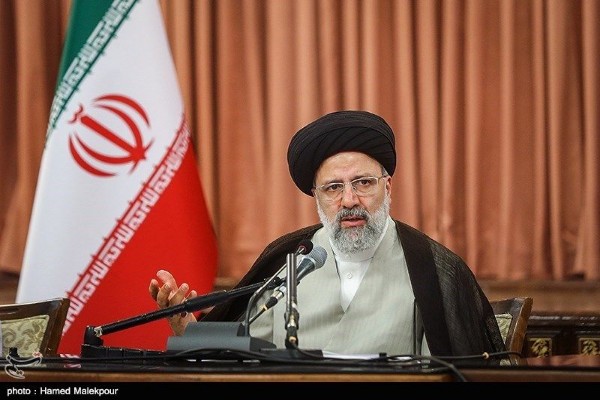
In an address to a Monday conference in Tehran marking the International Day against Drug Abuse and Illicit Trafficking, Ebrahim Raisi lashed out at the Western states for their failure to take practical action against the production of drugs.

“We believe that Europeans and the US do not fulfill their duties in the fight against drugs and do not play their role in this war, and this is provable,” he added.

The Iranian Judiciary chief also noted that the production of drugs in Afghanistan, world’s largest producer of opiates, is taking place under the supervision of the Westerners.

He then pointed to a series of international drug cartels involved in organized drug trafficking, saying it has become clear to whom they are linked.

Apart from the fact that Europe has failed to play its part in the war on drugs, Iran believes that some of the European states are involved in drug production and trafficking, Raisi added.

The Iranian official also called for efforts to let the world know that the responsibility for drug-related crimes lies with the profit-making organizations which are connected to big powers.

He further criticized the United Nations for failing to force the courtiers to share the burden of war on drugs, saying the UN must do something more than verbal gratitude and ceremonial gifts for Iran.

Iran shares a 900-kilometre border with Afghanistan and has been used as a main conduit for smuggling Afghan drugs to narcotics kingpins in Europe.

Despite high economic and human costs, the Islamic Republic has been actively fighting drug-trafficking over the past decades.

The country has spent more than $700 million on sealing its borders and preventing the transit of narcotics destined for European, Arab and Central Asian countries.

IRGC Clashes with Terrorist Cell in Northwestern Iran

In a Monday statement, the IRGC said the cell was dismantled by its ground forces at Hamzeh Sayyid al-Shohada Headquarters, in Chaldoran County of West Azarbaijan province.

In the clashes, one terrorist was killed, two others injured, and one terrorist was arrested by the IRGC forces.

In the operation, two of the forces of the IRGC’s Hamze Sayyid al-Shohada were slightly injured, the statement said.

In this conflict, significant amounts of weapons, equipment, ammunition and communication systems were discovered from the terrorists.

A Look at Iranian Newspaper Front Pages on June 24

A Look at Iranian Newspaper Front Pages on November 19

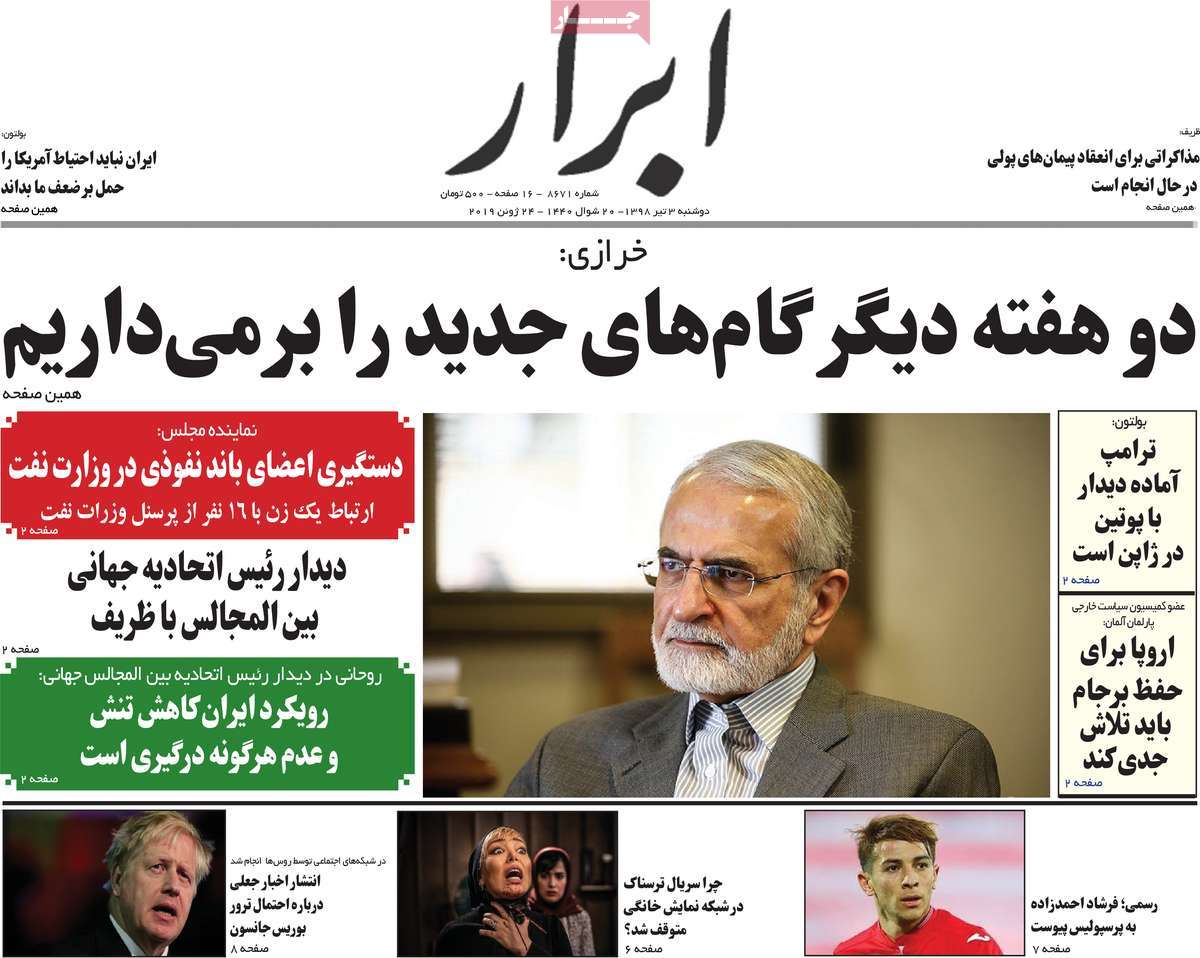
Abrar:
1- Iran to Take New Steps in Two Weeks
2- Zarif: Talks Underway to Sign Monetary Pacts
3- Bolton: Iran Shouldn’t Mistake US’ Caution with Weakness
4- IPU President Meets with FM Zarif
5- Rouhani: Iran’s Approach Based on De-Escalation

A Look at Iranian Newspaper Front Pages on June 24


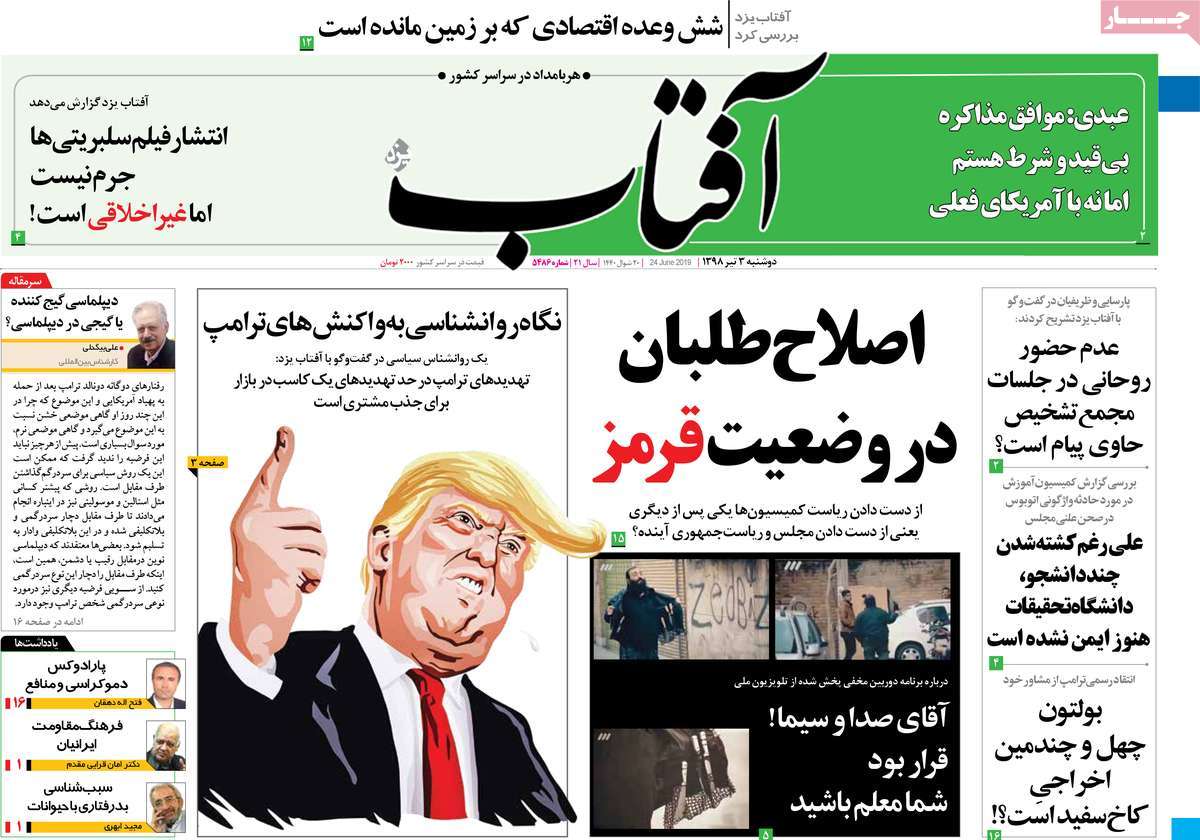
Aftab-e Yazd:
1- Reformist Figure: We Agree with Unconditional Talks but Not with This US
2- Bolton to Be Next White House Official to Be Sacked
* Trump Criticizes His Own Advisor

A Look at Iranian Newspaper Front Pages on June 24


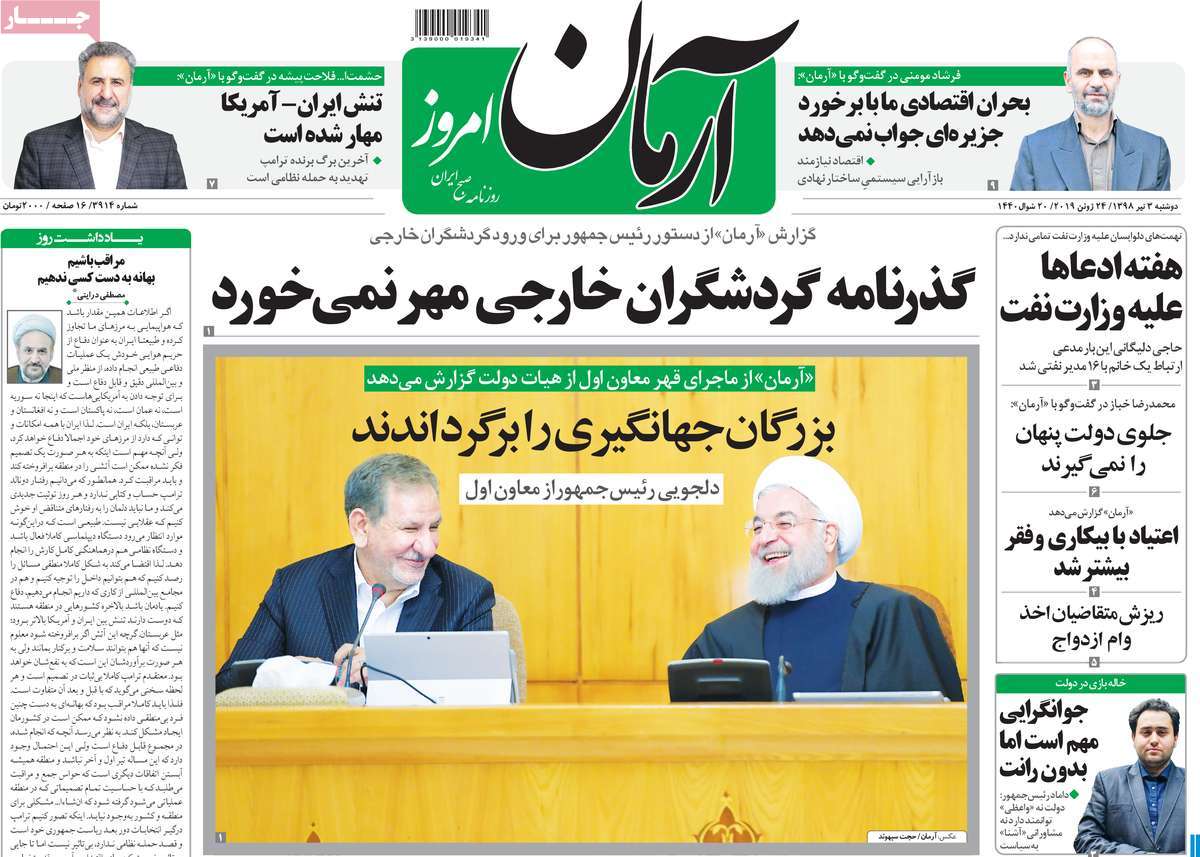
Arman-e Emrooz:
1- Iran-US Tension Controlled
* Trump’s Last Winning Card Is Threat of Military Action
2- Passports of Foreign Tourists Won’t Be Stamped in Iran

A Look at Iranian Newspaper Front Pages on June 24


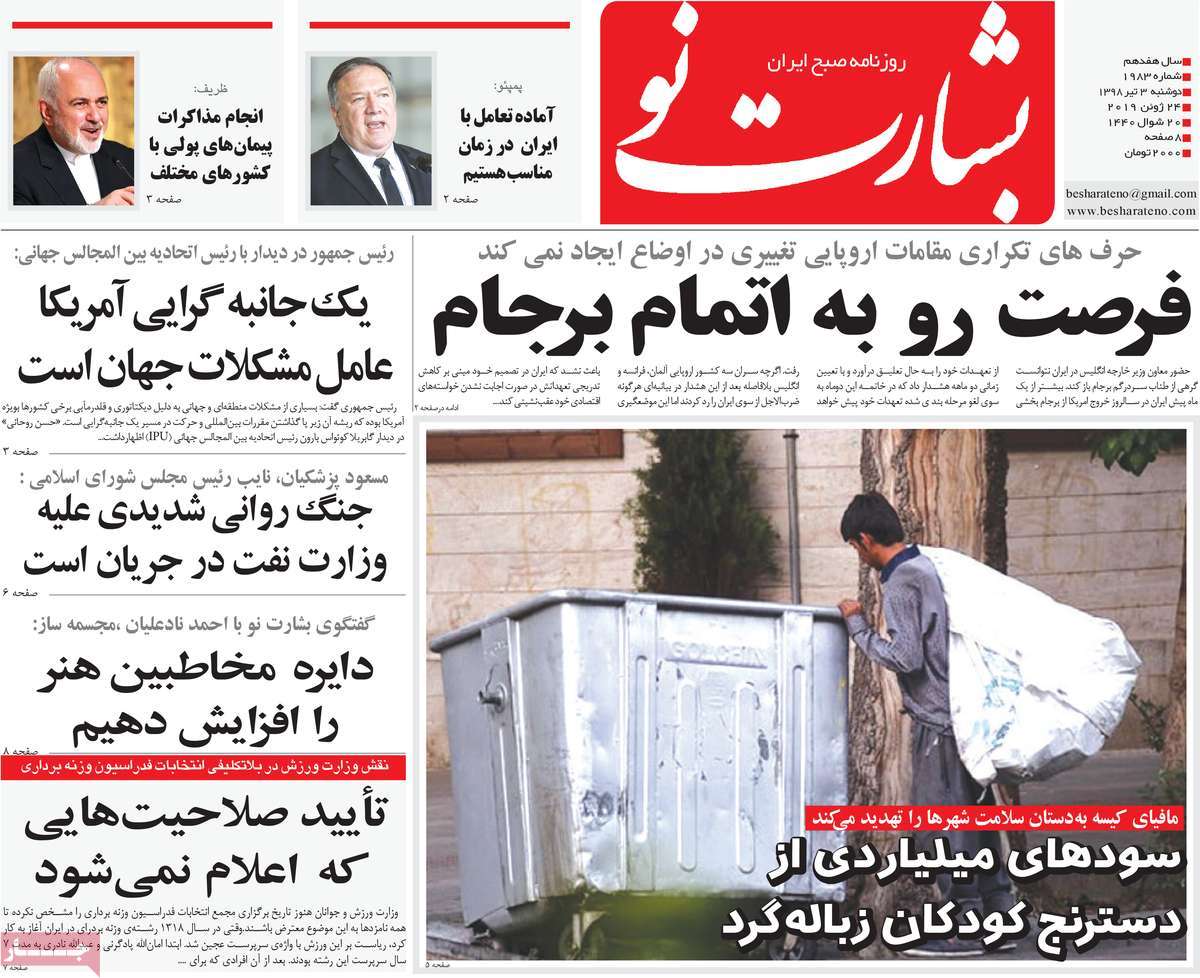
Besharat-e Now:
1- Pompeo: We’re Ready for Interaction with Iran at Right Time
2- Zarif: Iran in Talks with Various Countries for Monetary Pacts
3- JCPOA Deadline Near Its End: Europeans’ Worn-Out Remarks Not to Solve Anything

A Look at Iranian Newspaper Front Pages on June 24


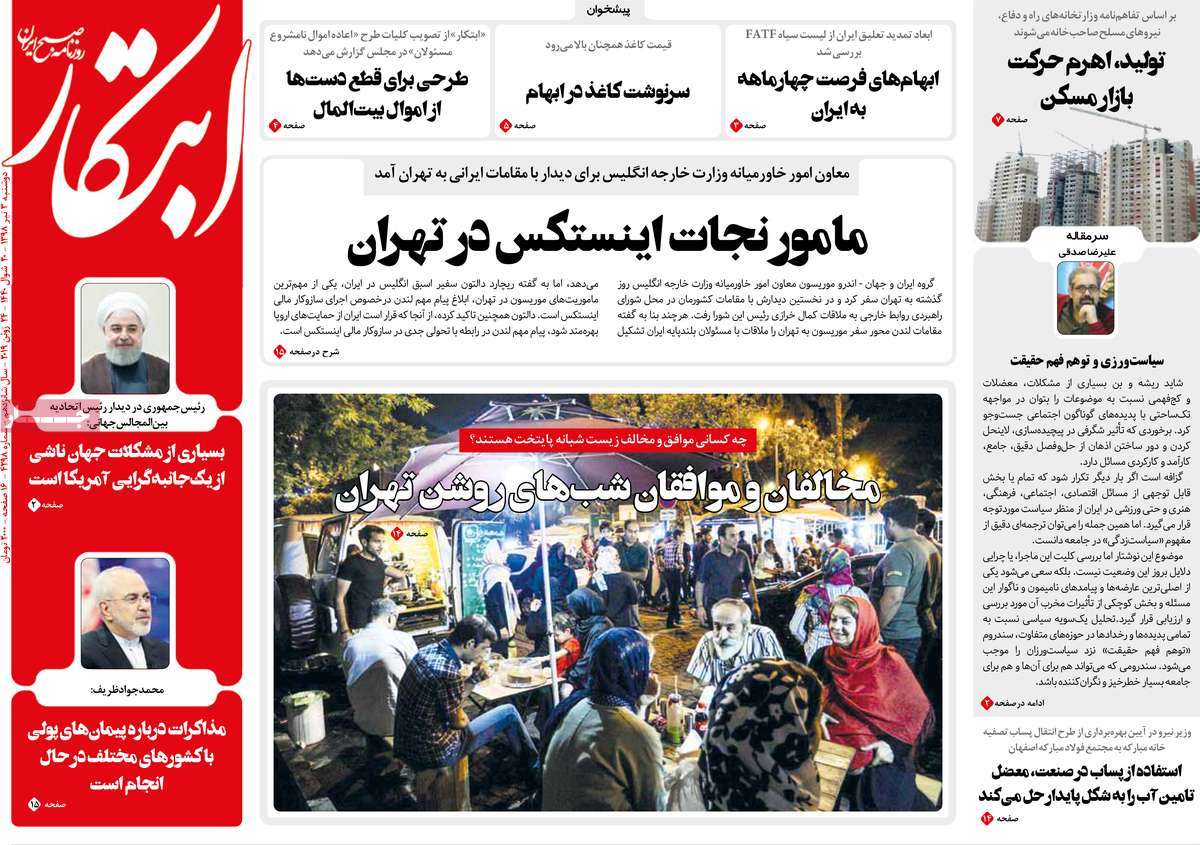
Ebtekar:
1- Rouhani: Many of World’s Problems Caused by US Unilateralism
2- UK Minister in Iran to Save INSTEX

A Look at Iranian Newspaper Front Pages on June 24


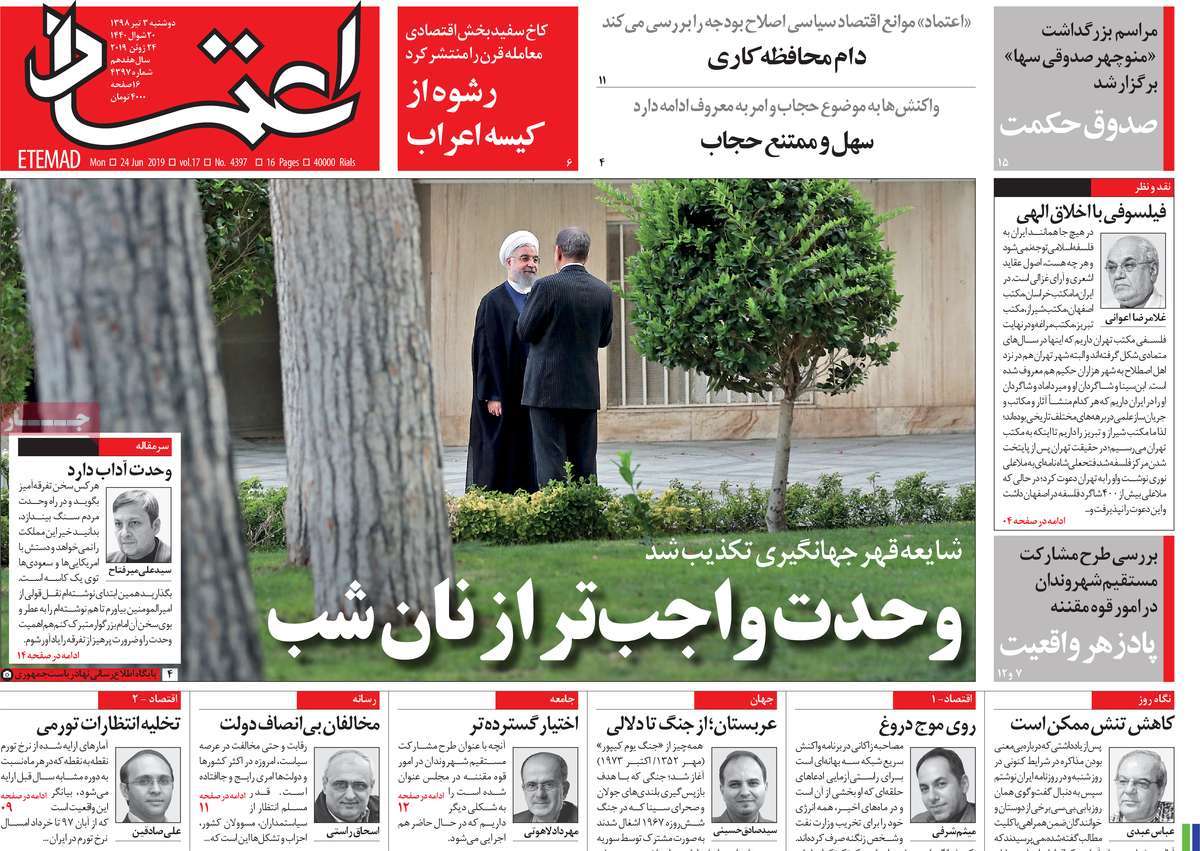
Etemad:
1- Giving Bribe from Arabs’ Pocket
• White House Releases Economic Part of ‘Deal of the Century’

A Look at Iranian Newspaper Front Pages on June 24


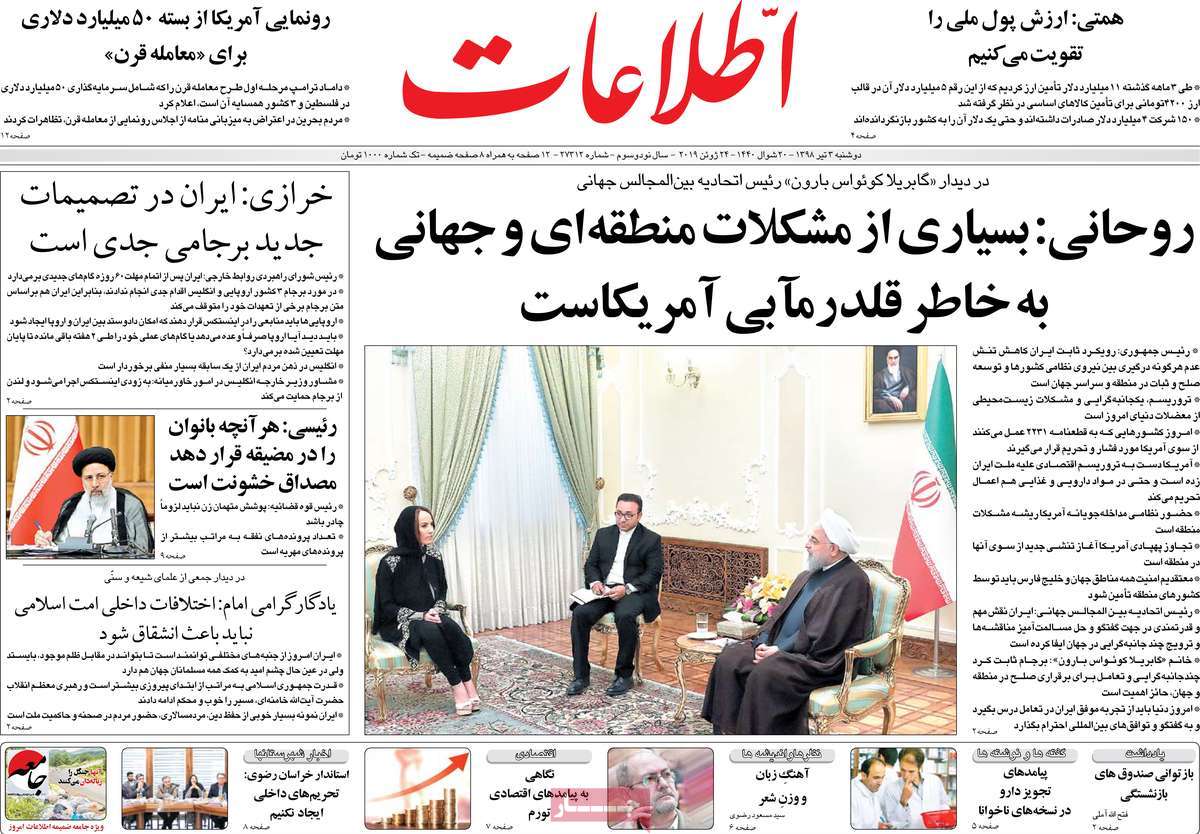
Ettela’at:
1- US Unveils $50 Billion Package for Deal of Century
2- Rouhani: US’ Bullying Root Cause of Many Global Problems
3- Kharrazi: Iran Serious in New JCPOA Decisions

A Look at Iranian Newspaper Front Pages on June 24


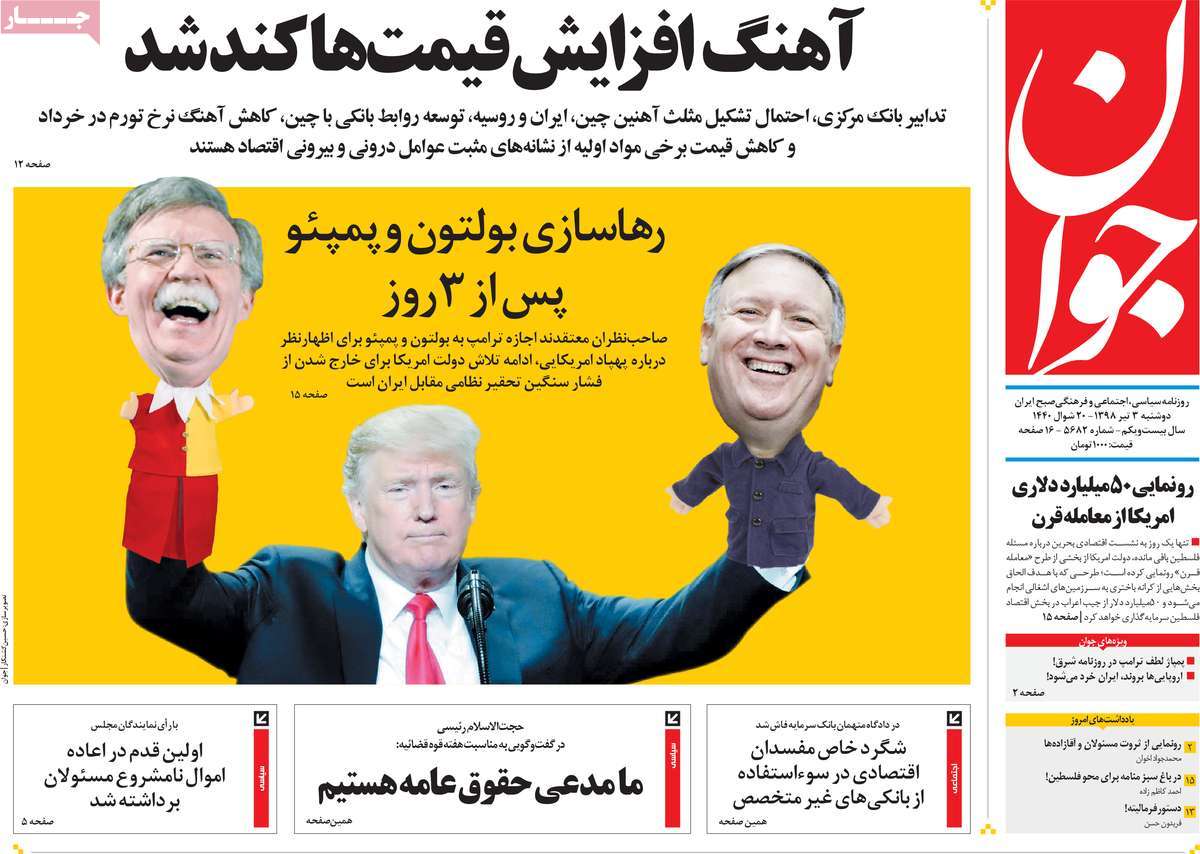
Javan:
1- Bolton, Pompeo Allowed to Comment about US Drone after 3 Days

A Look at Iranian Newspaper Front Pages on June 24


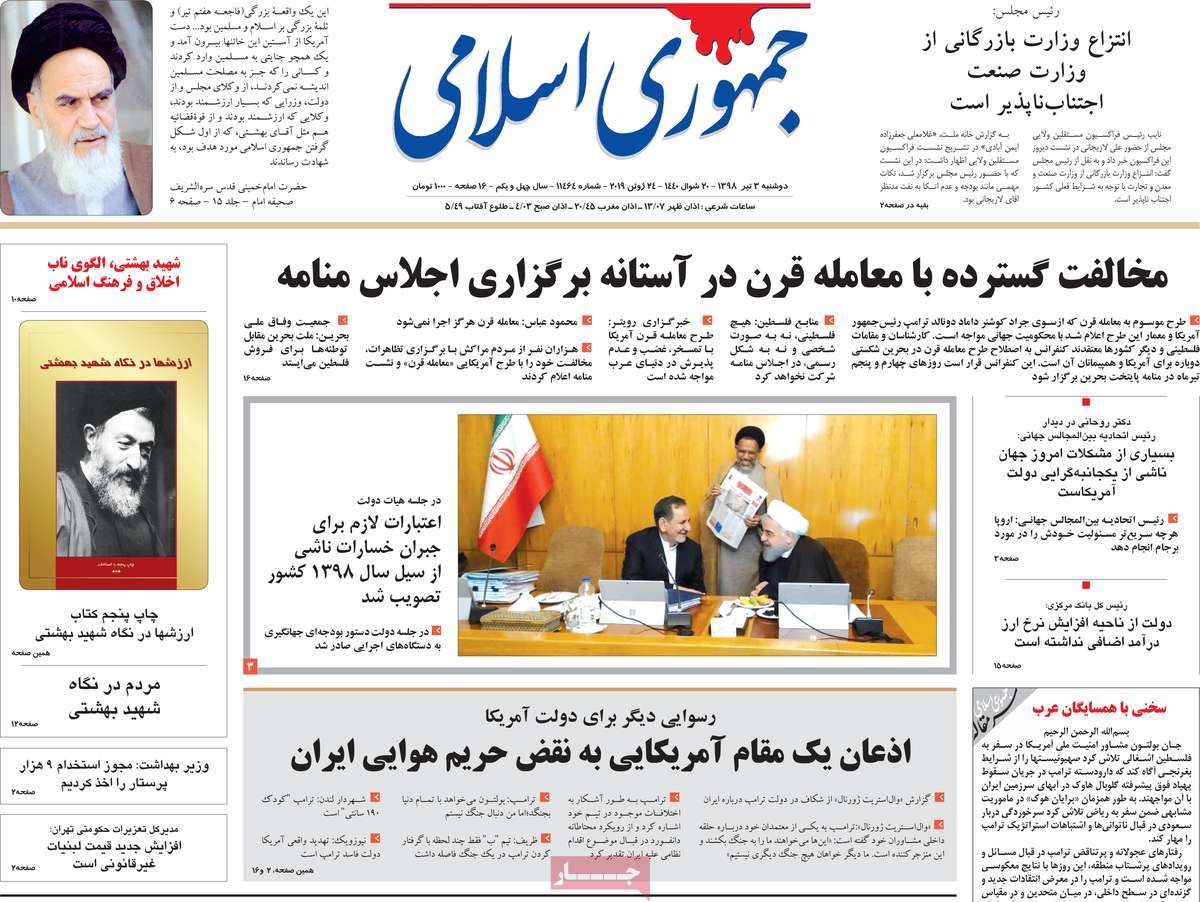
Jomhouri Eslami:
1- Widespread Opposition to Deal of Century ahead of Manama Summit
2- US Official Admits Iran’s Airspace Violated: New Scandal for US Gov’t

A Look at Iranian Newspaper Front Pages on June 24


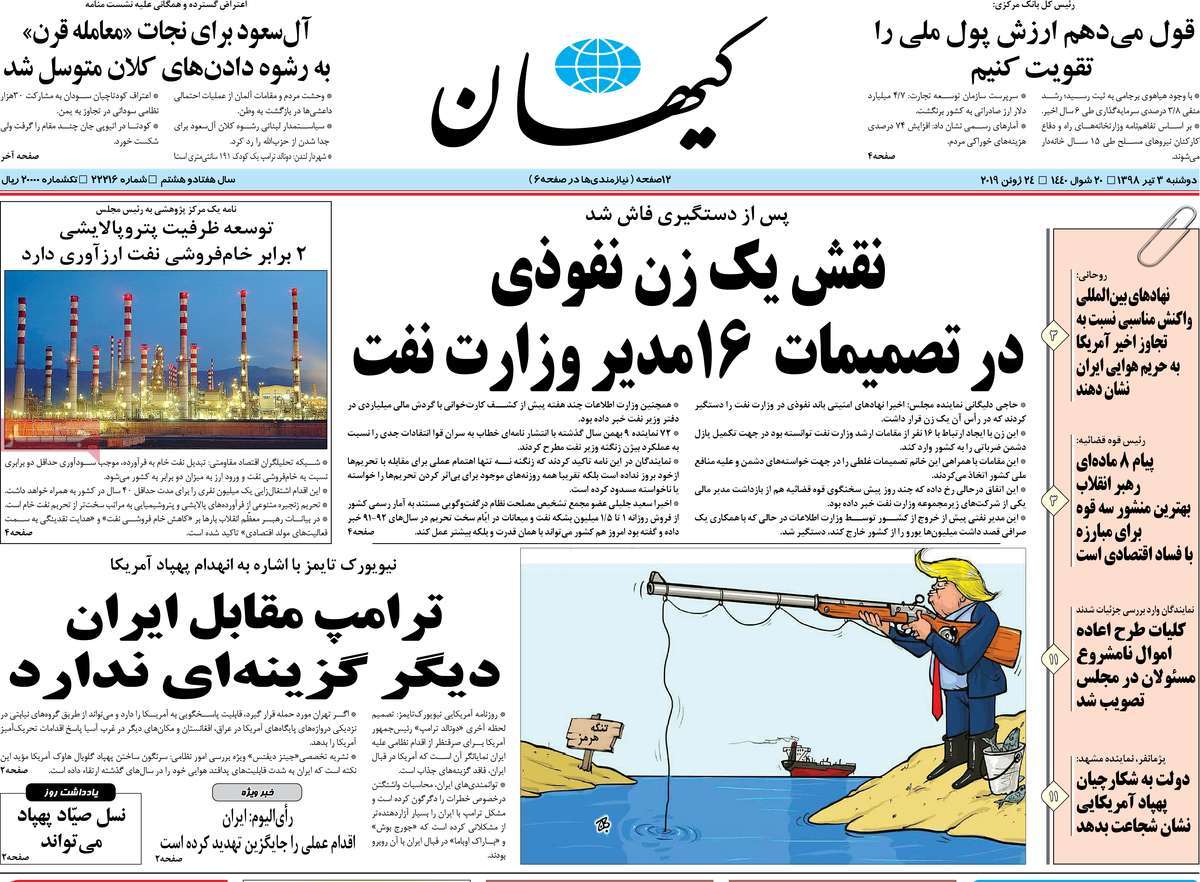
Kayhan:
1- Al Saud Giving Huge Bribes to Save Deal of Century
2- Trump Has No More Option against Iran: New York Times
3- Rouhani: World Bodies Must Show Proper Response to US Drone Invasion

A Look at Iranian Newspaper Front Pages on June 24


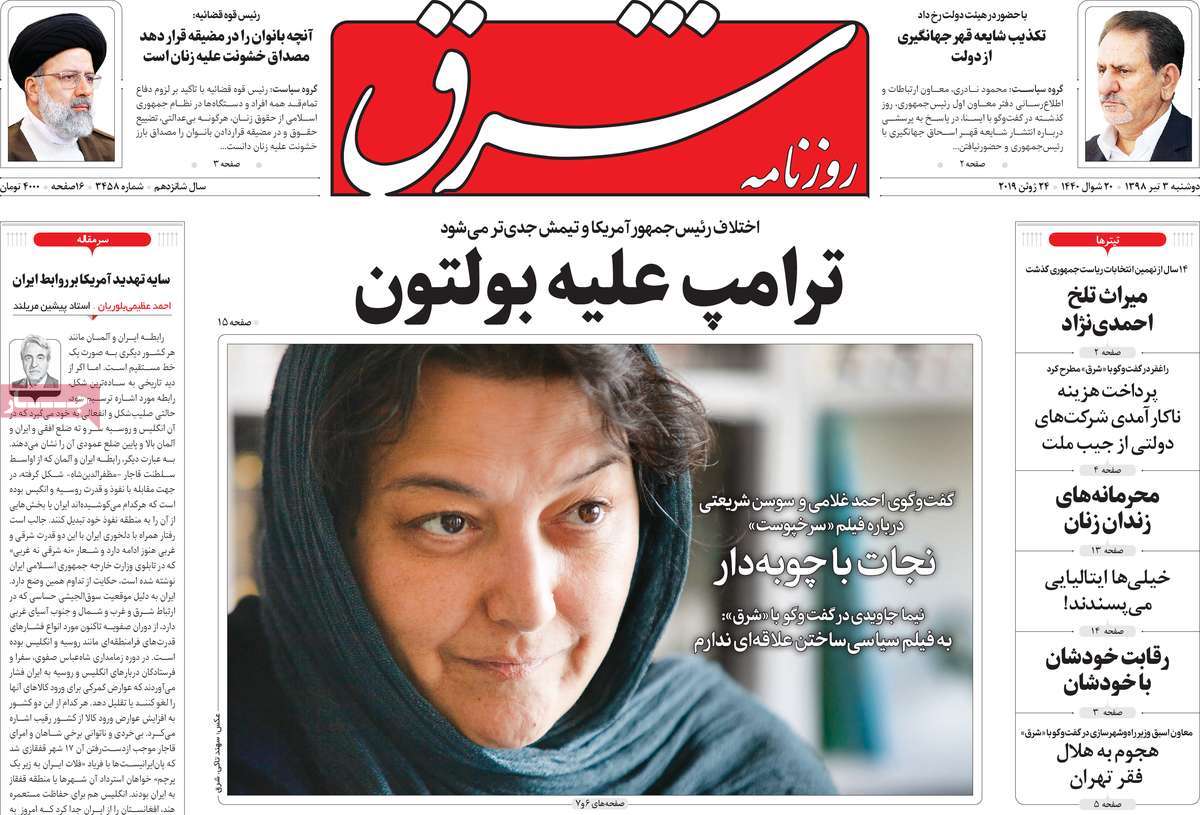
Shargh:
1- Trump vs Bolton: Differences between US President, His Team to Become More Serious
2- Spectre of US Threat on Iran Ties [Editorial]

A Look at Iranian Newspaper Front Pages on June 24


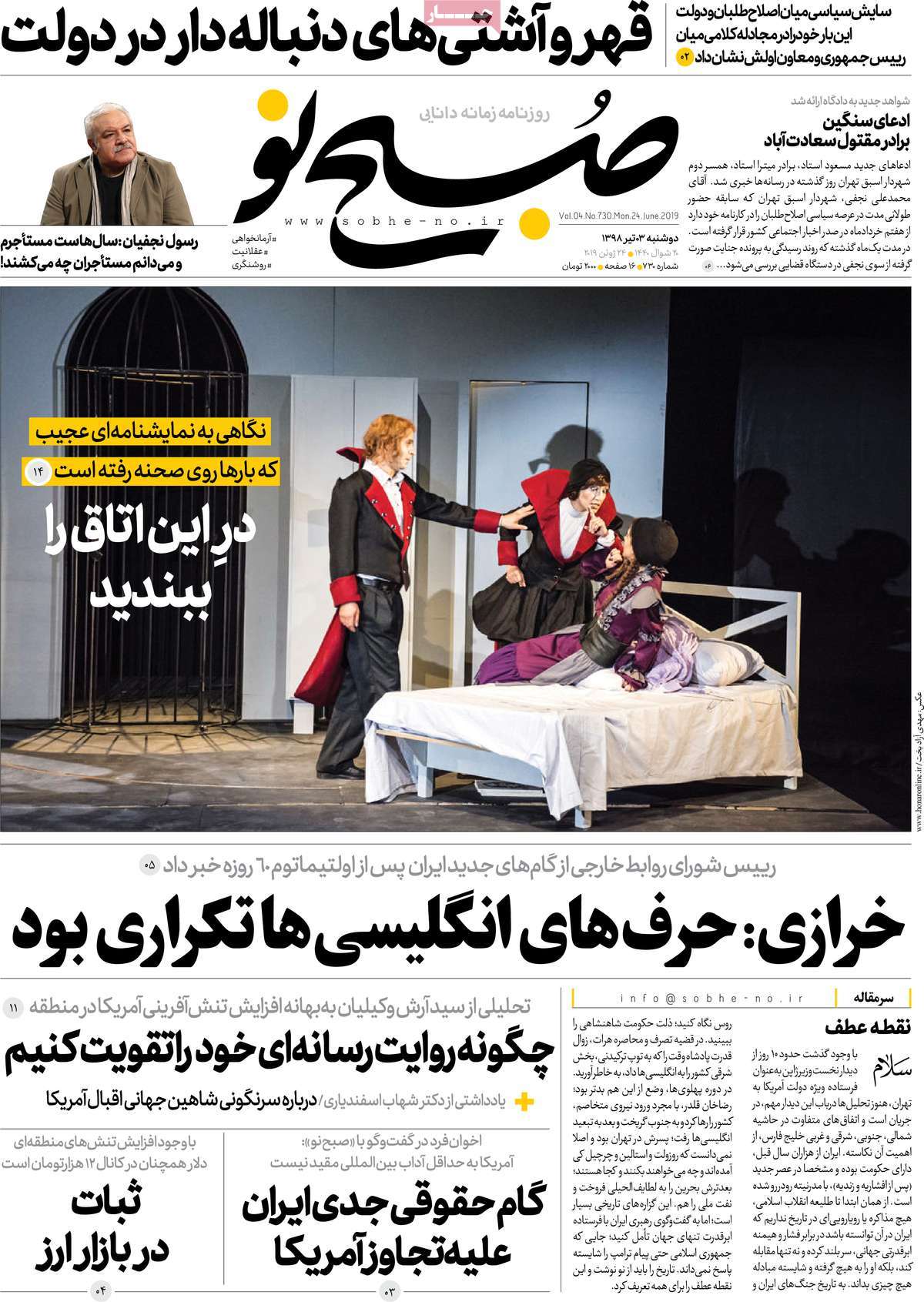
Sobh-e Now:
1- Kharrazi: Britons’ Words Hackneyed
2- Iran’s Serious Legal Step against US

A Look at Iranian Newspaper Front Pages on June 24

Iranian Teacher Selling Solar Energy to Support Poor Kids

From Rigi the Terrorist, to Rigi the Teacher

Zabol is the capital city of the deprived and underdeveloped Sistan and Baluchestan province. The recent decrease in the downpours, the rise of high winds, the sun warmth, the recent droughts at Hamun Lake and Hirmand River, the destruction of farms, etc. have all made life harder in this region.

The situation is so dire that today the province is considered the most underprivileged one in Iran, and is registered as one of the most polluted regions of the world. This is while the province is full of natural and historical wonders.

Zabol’s winds which made the area famous for its windmills only create problems for the inhabitants today. Sistan is the land of heroes in Iran’s literature. Zabol is the birthplace of Rostam of Ferdowsi’s Shahnameh [Book of Kings]. This is the only thing that has not changed in this region.

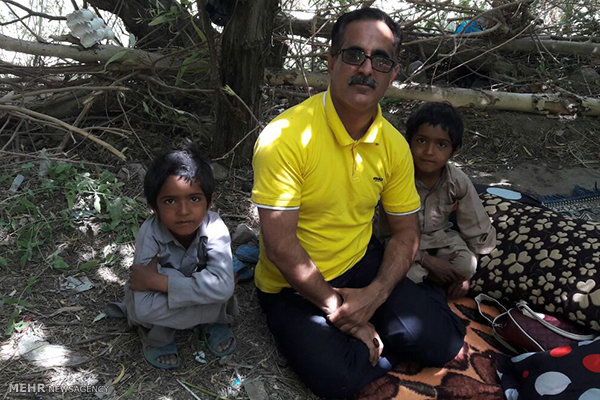
Today, in Sistan and Baluchestan, there is a hero who fights with pervasive poverty in his hometown. Ramin Rigi, a primary school teacher in the village of Zahak, is a new Rostam in southeastern Iran.

Iranian Teacher Selling Solar Energy to Support Poor Kids
From Rigi the Terrorist, to Rigi the Teacher

A Breakfast that Brought Fame

Many of the children who came to school were hungry. They were pale and powerless. Ramin Rigi, decided to make history with a loaf of bread. He bought bread for his students at school. After a while, cheese and hot meal were added to their table. Then, the breakfasts of Gholamali Shahraki school of Zahak became famous. Even from other villages, the children rushed to the school in the morning to eat bread and cheese.

Breakfast is still served at this school, but Ramin Rigi says the recent price hikes caused by the US “maximum pressure” policy has made their table smaller, and hot meal is served only on some days. In addition, the students of Gholamali Shahraki school want clothes, health services, recreation, and good future.

Rigi says the economic conditions of families are worse in the face of recent economic pressures, and the income of many has reached zero which means there is no hope for the family.

Rigi first thought about the winds of Sistan and Zabol to build windmills to reduce poverty, but the costs were so high. Therefore, he pinned his hopes on the sun.

He says every day Zabol has in average 14 hours of sunlight, which is a source of wealth if saved. So he thought about the roof of the school, to bring solar panels and generate electricity from the sun for free. He took the first step, but regulations stopped him as usual. There was no law to allow using solar panels at schools. After months of correspondence, Rigi could prove that the sun can reduce poverty and provide welfare for schoolchildren.

Finally, with the support of a private company, he could bring a solar panel that is worth about 2,000 USD. The task of this panel is to save the sun’s energy and send electricity generated from its outlet to the electricity grid and sell it to the government.

This small power plant will earn 30 to 70 USD for the school per month. This is even more than the annual income of this school.

According to the Ministry of Energy, there are more than 3,200 roof-top power plants in Iran today, and Gholamali Shahraki school is the only public Iranian school that produces electricity.

Rigi wants to achieve big goals with the money earned from electricity sales. He wants to spend it on the treatment and education of the poor children, and to support the unprotected and abandoned kids.

US Must Give More Concessions If Seeks Deal beyond JCPOA: Iran

President Rouhani’s senior advisor Hessamoddin Ashena said in a Sunday tweet that Trump should give more concessions and also guarantees that the US will remain committed to its obligations.

The Iranian advisor’s comments come as the 2015 nuclear deal had been backed by the UN Security Council Resolution 2231, and had the approval of the P5+1 group of countries – the US, China, Russia, France, Britain, and Germany.

However, Trump withdrew the US from the deal and reinstated nuclear sanctions against Iran.

“Barack Obama used to say if sanctions are stopped a war may happen, and now Donald Trump says either surrender or sanctions, and the war is also waiting for you,” Ashena said.

“Tehran is not seeking war and should not be sanctioned, but war and sanctions are two sides of the same coin,” he added.

He also rejected Washington’s claim that it is ready to hold negotiations without pre-conditions in light of threats and sanctions.

Tensions have heightened between Tehran and Washington following the intrusion of a US stratlinto Iranian territory by a drone. IRGC shot down America’s UAV on Thursday.

US Sanctions Hindering Fight against Narcotics: Iran

Zarif said the re-imposition of the United States’ anti-Iran sanctions, as well as Washington’s economic terrorism against Tehran are preventing the Islamic Republic from implementing international agreements in regard to the fight against narcotics.

The Iranian minister made the comments at a conference to mark the International Day against Drug Abuse and Illicit Trafficking.

He added that the Islamic Republic spends 300 million dollars annually in the war against drug trafficking.

“The Islamic Republic of Iran believes that to fight against narcotics it is necessary to avoid politicisation and unilateralism, and to pay attention to international cooperation as a necessary means to achieve the goals set forth to build a better future for all human beings and future generations.”

Zarif also underlined that the martyrdom of over 3,800 people and injury of more than 12,000 others are the costs that nobody can compensate for Iran in the world.

He emphasised that Iran’s geographical location in the vicinity of the largest traditional drug producer –Afghanistan – has made its actions vital not only at national level, but also at regional and international levels.

“Iran alone accounts for nearly 80 percent of the world’s total opium discoveries, and more than 800 tonnes have been seized last year alone.”

The General Assembly of the UN decided to observe June 26 as the International Day against Drug Abuse and Illicit Trafficking as an expression of its determination to strengthen action and cooperation to achieve the goal of an international society free of drug abuse.

Supported each year by individuals, communities and various organizations all over the world, this global observance aims to raise awareness of the major problem that illicit drugs represent to society.

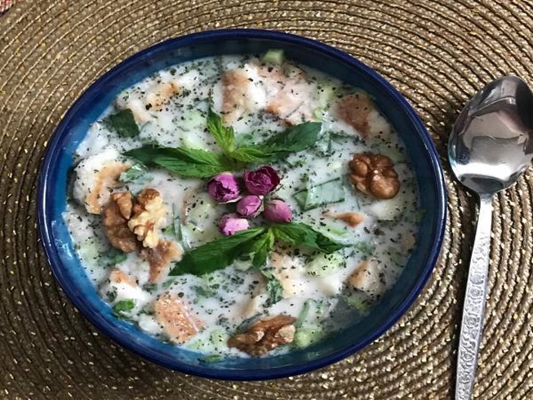
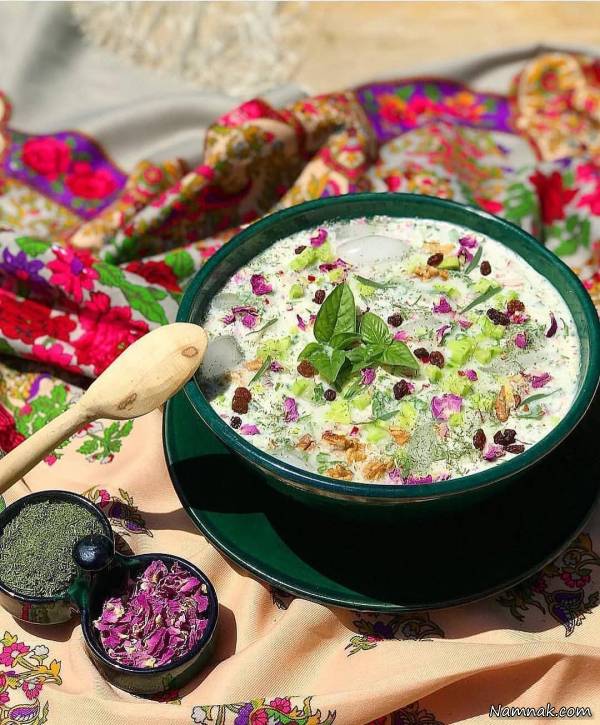
Chilled Yogurt Soup, Delicate Persian Dish for Hot Days

Chilled Yogurt Soup, Delicate Persian Dish for Hot Days

Abdoogh Khiar reduces the fatigue caused by the warmth, that’s why it’s a special summer dish.

Chilled Cucumber Yogurt Soup is an ancient food with many benefits. It cools the body and creates a feeling of vitality.

Chilled Yogurt Soup, Delicate Persian Dish for Hot DaysIngredients:

Milk 1 cup

Cream ½ cup

4 to 5 sliced radishes

10 to 12 walnuts

2 to 3 tbsp. of dried vegetables (mint, parsley, tarragon, savory, basil)

4 to 5 chopped cucumbers

2 chopped scallions

Pepper and salt

1 cup of raisins

4 cups of yogurt

Chopped green vegetables including pennyrile, basil, mint, or any other fragrant vegetable

1 litre of sour yogurt drink

Directions:

Choose a suitable container to mix the ingredients. Mix the yogurt with the cucumber, and then mix the rest of the ingredients together and add to the mixture.

It’s just better to mix the scallions when serving the soup. Keep the yogurt soup one hour outside the refrigerator to make it sourer. You should use dry bread because the fresh bread in the soup removes its good taste. Chop the dried bread and scallions before you serve it.

Scientists Generate Clean Energy Using Water Molecule

Masoud Mirzaei Shahrabi, a faculty member of Ferdowsi University of Mashhad and a leading researcher in chemistry, says today the issue of the environment is very important in the world and is a challenge in the years to come.

Therefore, he said, it’s better to focus on environmental protection. “As a result, we defined a project aimed at raising the efficiency of producing H2 gas from the water molecule,” added Mirzaei.

He further mentioned that at the moment, most researchers think of increasing the efficiency of the production of H2 gas from the water molecule. Therefore, many research projects have focused on this topic.

“Nowadays, the use of fossil fuels has created a lot of environmental and even hygienic problems for human societies. In addition, one day fossil fuels will be finished, so using clean and sustainable fuels is something inevitable.”

This Iranian researcher went on to say that the use of fossil fuels has been banned in cities such as Venice, due to the presence of statues and monuments. It shows that using fossil fuels is very harmful.

For a brief review of Iran’s achievements in various fields of science and technology, check the book “Science and Technology in Iran: A Brief Review – 2019

It is sometimes said that the cost of producing H2 gas from the water molecule is high, but it must be mentioned that in order to protect the environment, there is no choice but to pay the cost of producing this gas as the fossil fuel reserves would be over one day, he added.

He highlighted that in the coming years, the production of this gas must be done more quickly because human beings need it.

“H2 as a clean gas is full of energy and can meet many human needs. In fact, due to the existence of kinetic energy in this gas, we can use it to generate heat and electricity. Of course, the molecule itself does not have the necessary properties for generating energy, but we use the kinetic energy stored in these gas molecules to obtain other energies such as thermal and electrical energy.”

In other words, he added. the water molecule is very stable, so breaking it is a very difficult task. Therefore, we need to design a catalytic converter to break this molecule and get the energy. We have been successful in doing this.

Today, the inflowing of various contaminants into water resources has become a problem, and this also has a great impact on the process of energy production from water molecules, so the higher the pollution, the lower the efficiency of the job, underlined Shahrabi.

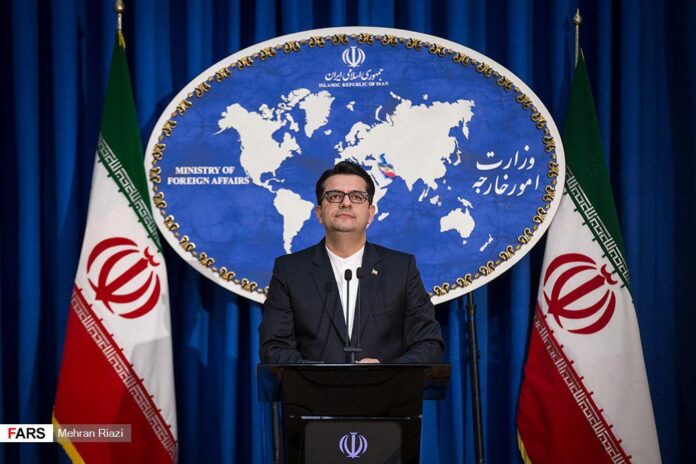
Iran Says 2nd Phase of Scaling Back JCPOA Commitments ‘More Serious’

Mousavi said during his weekly presser that if INSTEX does not become operational in the next few days, Iran will not be obliged to adhere to its other obligations.

This spokesman went on to say that Iran needs to return to the level of oil revenues it earned before the withdrawal of the United States from the nuclear deal.

“Preserving the JCPOA depends on the fulfillment of the obligations of all parties, but except for limited efforts made by some parties, the remaining signatories have not done anything effective.”

Mousavi said Tehran will not wait for the Europe any longer and it is exchanging views with some friendly countries to make banking and trade mechanisms operational.

He also noted that Tehran attaches importance to Europeans’ warnings regarding Iran’s scaling down of commitments because the Islamic Republic is acting based on its rights mentioned in the nuclear deal.

He underlined that the Islamic Republic will never bow to pressures and sanctions adding that Washington’s imposition of sanctions against Iran is merely a propaganda campaign.

Elsewhere in his remarks, Mousavi highlighted that the US and its allies will fail to form a coalition against a “powerful” country like Iran.

Regarding the recent US violation of the Iranian airspace, Mousavi emphsised Tehran will file complaint against this US aggressive move.

The Iranian spokesman further dismissed Bahrain conference on the deal of the century as a “shame” stressing that Washington and its regional allies are seeking to step on Palestinians’ rights by holding Bahrain confab.