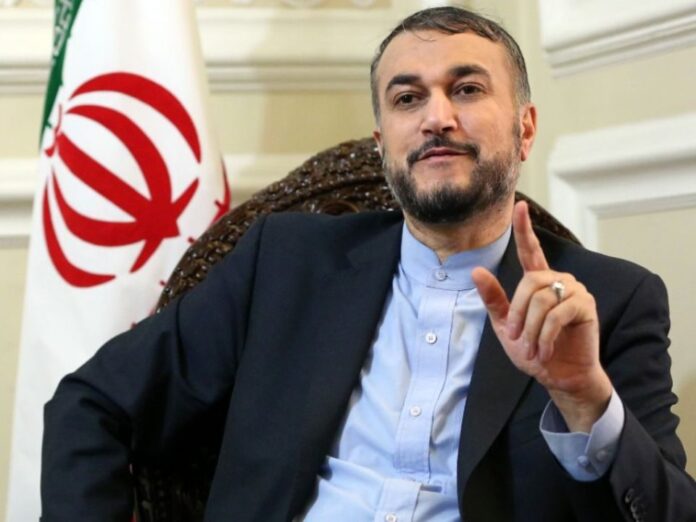
In a message on his Twitter account, Hossein Amir Abdollahian warned the Riyadh regime against a surprising response it will have to face should it continue to abet Washington in the economic war against Tehran.
“If the Saudi rulers do not stop their companionship and servility for the US in the economic war against the Islamic Republic of Iran, they must expect Tehran’s new and shocking decision,” the former deputy foreign minister noted.
“The time for the continuation of dirty Saudi-Emirati-Israeli policies is running out rapidly,” he added.
His warning came against a backdrop of Saudi Arabia’s enthusiastic support for the US sanctions against Iran.
While US President Donald Trump administration’s unilateral withdrawal from the 2015 Iran nuclear deal and its campaign of maximum economic pressure on Tehran has drawn international condemnation, the Saudi regime has reached out to customers of Iranian oil, offering them additional supplies to compensate for the lost crude as the US seeks to drive Iran’s oil exports down to zero.
Last month, a Saudi news outlet reportedly close to Saudi Crown Prince Mohammad bin Salman (MBS) urged the US to launch surgical strikes against Iran after the kingdom accused Tehran of having a role in a drone strike that closed down a Saudi oil pipeline.
In comments in April, Saudi Arabia’s foreign minister welcomed the US decision to end waivers on the sanctions for importers of Iranian oil, saying it was a necessary step to halt what it called Tehran’s “destabilizing” policy in the region.
Iraq, Afghanistan and Turkey have been among the most important export destinations of these products.
This company in total has exported more than $1.5 million worth of textiles to different countries in 2018, and this figure is projected to reach $5 million in 2019.
Mehr News Agency has quoted one of the officials of the company as saying that various samples have been sent to Italy and Sweden, and they have been approved in terms of quality.
“At the moment, we are signing contracts to export the products to Turkey, Italy and Sweden, which are themselves textile producers.”
The Iranian textile and clothing trade association has held an exhibition in the Iraqi capital Baghdad, where garment-producing companies also attended.
During the 10-day exhibition in Iraq the Nano products of this company were welcomed by customers. Therefore, it is expected that the company would have more sales in Iraq in 2019.
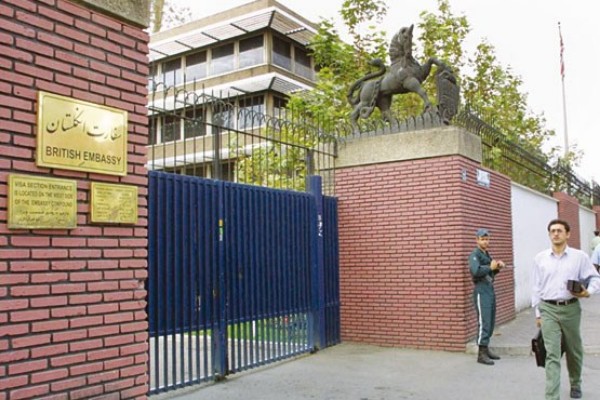
The British diplomat who was briefly arrested in a recent nighttime party in an upscale neighbourhood in Tehran is the UK embassy’s economic attache.
The British diplomat, Phoebe Evans, was arrested along with a Dutch diplomat who was a staff member of the Dutch embassy.
Moreover, alcoholic beverages and narcotics were seized at the party which was also attended by a considerable number of stars of stage and screen, reported Tasnim News Agency.
Now, the question is whether or not foreign diplomats, including the British diplomat and the UK embassy, had any role in organizing the party.
Probably the UK official was expected to be seeking an economic solution and ease trade transactions between the two countries in the sixty days that Iran has given the remaining signatories to the Iran nuclear deal to stay in the agreement.
However, information obtained by Tasnim shows the British embassy in Tehran, especially its commercial department, has not helped Iranian economic players in most domains, especially in the oil sector. It has not got involved in these areas, and has only given some promises with regards to the medicine and food area. And that move could probably be an alleged humanitarian favour that UK officials can show off in media. This comes as the UK is on board with the US when it comes to anti-Iran sanctions.
The fact that British diplomats take part in fast-breaking feasts just to show off, or participate in events such as the party mentioned above, shows they lack the determination to settle Britain’s economic problems with Iran. It shows the British embassy in Tehran has other priorities.
Following the United States’ withdrawal from the Iran nuclear deal and the Europeans’ failure to live up to their economic commitments under the agreement, Iran and its people’s key concern has been economic issues. Nevertheless, it seems that the embassies of countries such as Britain are launching charm offensives by holding ceremonies like fast-breaking feasts instead of turning to the main issue.
In reaction to criticism of the controversial fast-breaking ceremony recently held by the UK embassy in Tehran, British Ambassador to Iran Rob Macaire wrote in a tweet on May 13 that holding fast-breaking feasts is “a sign of respect for Islam.”
Now, the question is whether the presence of that female British diplomat at the Tehran party was in line with respect for Islam or not.
The British ambassador had also said in a video on April 19 that doors of embassies should be open.
This is a good and interesting sentence. But it begs the question of whether the British embassy leaves its door open only for ceremonial fast-breaking feasts and parties, and why these doors are closed to economic players. The wall that the British ambassador refers to in the same video is, in fact, a wall that they themselves have built in Tehran-London relations, namely in the economic domain.
This door and wall opens whenever the British embassy wants to draw the attention of people from the domain of politics, culture and arts, etc.,
with a ceremonial fast-breaking event or party or other methods. However, the wall becomes so high and the door turns into a concreted hurdle when it comes to serious issues.
The British embassy, which claims to have held fast-breaking reception out of respect for Islam, had also better explain why the UK’s flag carrier British Airways left Iran before the US pullout from the Iran nuclear deal despite the fact that its presence in Iran was economically viable for the airline, and why British officials are not interested to cooperate with Iran in economic domains.
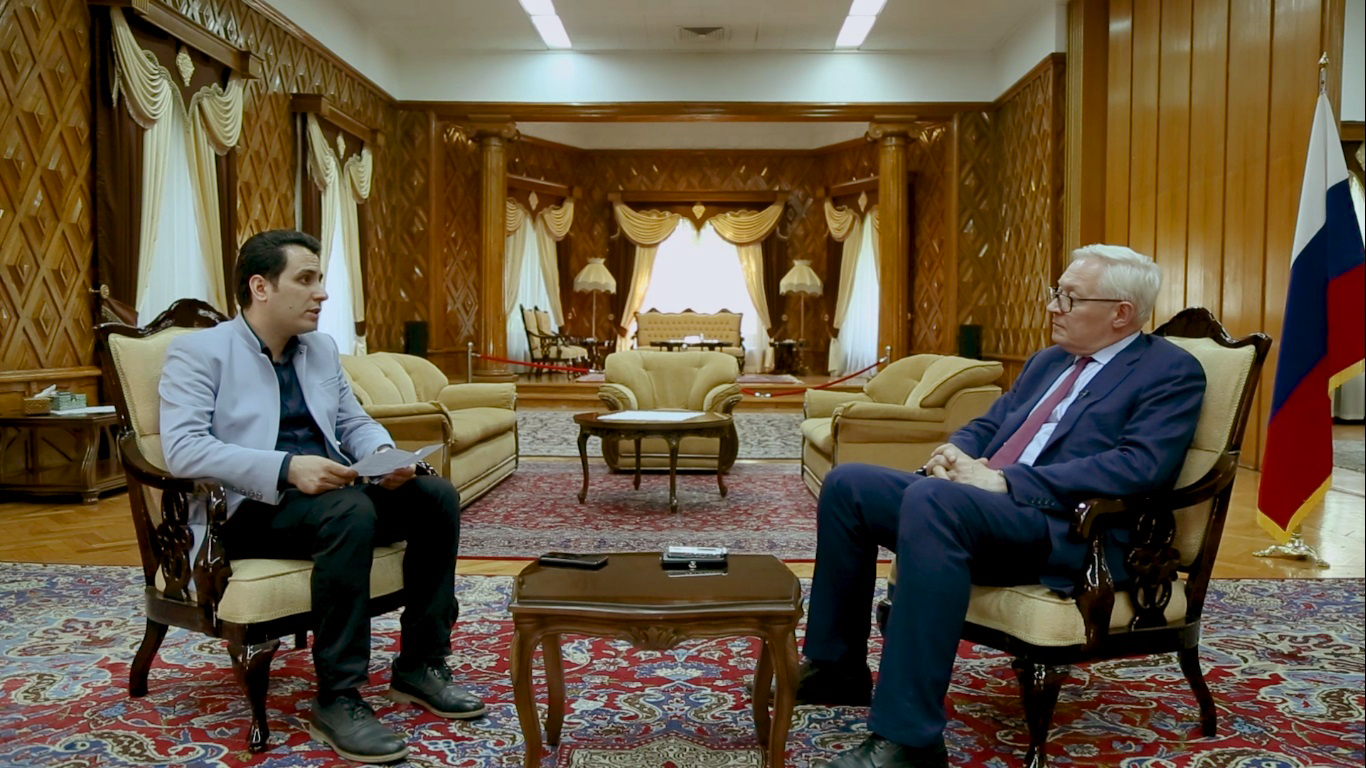
In an exclusive interview with Iran Front Page (IFP News) in Tehran, Ryabkov elaborated on Moscow’s views on the fate of the Joint Comprehensive Plan of Action (JCPOA) and the major international developments, including the US economic sanctions, the situation in Syria, the interaction between Russia and the European Union, Iran’s proposal for a regional non-aggression pact, and Russia’s military cooperation with the other countries.
The ranking Russian diplomat also highlighted the significance of joint meetings on the JCPOA and the powerful political message that such gatherings would send, proposing the idea of holding a meeting at the level of political leaders to discuss the issue, at any given venue or time.
What follows is the full text of Mr. Ryabkov’s interview with IFP News, conducted on May 29:
Russian deputy foreign minister Sergei Ryabkov (right) and IFP News journalist Abas Aslani (left)
IFP News: Thank you so much. It’s our great pleasure to have you again in Tehran. And I want to go directly to the questions. You had a meeting with Mr. Araqchi today in Tehran. How was the meeting? And for sure, one of the issues was the JCPOA, namely the nuclear deal. What did you discuss and why do you think that the JCPOA, after three or four years, is in such conditions? It was supposed to be lasting in a better quality for long years.
Ryabkov: Well. First on our rapport and chemistry with (Deputy) Minister Araqchi, we have excellent understanding with each other. We would even dare to say that we are friends. We maintain close contacts since the time when I began my own participation in the talks that preceded conclusion of the JCPOA. Now at this current moment, when things are so unsure and uncertain, at the moment of high risks because of destructive policies of some countries trying to attack Iran politically, economically, even some conceivably believing that military pressure will yield results; at this particular time, our contacts are even of greater importance at least for the Russian side. We had a very intense and focused round of discussions, where we not just compared notes but tired to be specific in our approaches and ideas, analyzed the situation, looked into different ways ahead, tried to assess risks associated with this. I benefited a lot from this exchange. I would hope that (deputy) minister Araqchi will find his way to come to Moscow sooner rather than later, because this is something that we believe is one of the central elements of our joint efforts to sustain the JCPOA. Now when you asked why so that the JCPOA is not that certain in terms of being maintained further after this very short period, I would say plainly and flatly -contrary to what you would expect from a diplomat- this is because of action of one country and this country is the United States who deliberately performed a material breach, a significant non-compliance, a significant non-performance of both the JCPOA and the UN Security Council resolution 2231 and also Article 25 of the UN charter proper. All this contains a very unusual, unique, destructive, negative act of behavior of the superpower. This is just because of this that all the aftermath which is before us is so negative.
Besides, I believe our European partners, those who concluded together with Iran and ourselves the JCPOA, underperformed during this year since the US withdrew and it preceded a very understandable decision of the Iranian government and the Iranian leadership to partially suspend the implementation of some voluntary agreed upon obligations (and) commitments by the Iranian side. We fully appreciate the reasons behind this act. We do think equally like Iran that at the moment of great challenge, one thing which the Europeans should do would be a focused effort to rebalance the JCPOA and offer Iran better incentives to be within the deal. That’s our view. And I explained this very clearly and in a detailed form to (Deputy) Minister Araqchi as I do to all others including to the Europeans and the Chinese and all of them.
IFP News: It seems that Russia is the only country demanding the joint commission session to be held. In what level will the commission be held and will the ministers meet on the issue? And do you think that a solution will be possible during this two-month period that Iran has set?
Ryabkov: Well. Now first, I want to correct you in using word “demands”. This is not a demand on our part. This is just an offer, an invitation, an idea for consideration. We truly think that convening a joint commission would be a right step to take, because we need to look into all aspects of the current, I would say, crisis situation around the JCPOA and try to at least, you know, initially present benchmarks and elements of an eventual roadmap ahead, how to move beyond this crisis in order to sustain the JCPOA. Well, others are, I would say, reluctant or skeptical. Before this meeting with (Deputy) Minister Araqchi, I was able to have some discussions with others. They are not particularly enthusiastic. Still, we believe this is the right way to go. But I also think that the political level of interaction, the level of ministers would be very appropriate for an eventual joint commission get-together in order to send a powerful political message but also to agree upon some specific arrangements on what to do with this situation. Russia is prepared to participate at this ministerial-level meeting. We have earlier said that we are prepared to be here in Tehran at this level. We are flexible in terms of place and venue. Whatever suits others, we will be there. But it is a due moment for such irresponsible level, level of leaders, of political leaders to meet and discuss and decide.
IFP News: Due to the no-compliance of the United States and the underperformance of the European parties of the nuclear deal, some are speculating on the death or gradual collapse of the nuclear deal. Do you have the same idea?
Ryabkov: Currently the JCPOA is in intensive care. It is alive but it is a big issue, a big question. Whether all of us, the Iranian side, ourselves, Europeans, (and) the Chinese would be able to sustain the deal? I don’t see an immediate risk for the JCPOA to collapse; I don’t see this. Nonetheless, I believe that currently the risk for this very destructive and unfortunate development is higher than even two or three months ago. And we need to reverse this trend and the responsibility is upon all of us. There is no one remaining party at the JCPOA to blame for this not happening, rather people need to, I would say, in first instance, to concentrate political view to an extent that is sufficient to get right tracking. And then if this political will is present, all solutions would be developed. If you have a will, a way will be found. This is a famous quote from our predecessors. I think this is a right moment to remind each other and every one of this simple logic. Russia is very decisive in terms of bearing its share and doing its part both practically in terms of implementing what needs to be done by Russia according to the JCPOA but also politically pushing for joint commission meeting, working towards ministerial meeting of the JCPOA parties to decide what to do.
IFP News: While there have been some ups and downs in the developments in the region and some tensions have been witnessed, some in the region and some elements in the United States have been trying to deliver fuel into a military conflict between Iran and maybe the United States in the region. In whose interest is a war and who will benefit a war in the region and if a war happens, what will happen and what is the Russians’ position in this regard and have you proposed for any mediation?
Ryabkov: I don’t believe it would be right for us to start speculating right now what would be a reaction of anyone if war breaks out. This is not just a worst case scenario, this is a catastrophic scenario, because aftermath of this and repercussions of this are incalculable at this particular moment. I agree with you though that there are very irresponsible elements, including at very responsible positions, who for one or another reason, believe that now is the moment when Iran should be bullied further if need be with military power. In my view this is a very very wrong perception of the current situation. And of the decisiveness of the Iranian people to defend its homeland and also to deter potential aggressors through means available. They underestimate the capabilities which Iran possesses. They equally underestimate what might be the consequences of all this for a broader, I would say, configuration or broader posturing in the region and elsewhere. I do hope that this considerations will be taken into account both in Washington but also in other places including where the Arab leaders in the next days will meet for a summit, or series of summits and from where I think some signals on the current situation will come out. Russia is very open in its approach. We have proposed different models or schemes for resolution of the situation. All of them can be summarized like an offer to stimulate the establishment of so-called collective security system in the region which would mean, among other things, a set of confidence-building measures, information sharing, establishment of channels of communications between capitals and that’s also normalizing the function of diplomacy and political interaction. Not to close all the doors, not to reject any offers, but rather engage and start thinking together what can be done towards a better standing of all the parties. It would never mean that all differences will go away, that all troubles will evaporate, but it is very wrong to believe that anything in the world, and in particular in this part of the world, can be resolved through raw military power, resort to military power or threat of force. Equally both are contrary to the international law. Nothing of this is permittable according to the UN charter. It should be reminded now and again to anyone who kind of plays with these ideas, like many people nowadays play with their gadgets.
IFP News: Well, Iran has proposed a non-aggression pact to the major Persian Gulf countries. Do you think that this can be helpful and constructive?
Ryabkov: It’s a great idea. This is an idea which goes along the same lines which I tried to describe. It’s a framework and the concept which at least prohibits arbitrary use of capabilities without reminding yourself of this, of something that is very wrong according to this pact. Of course any treaty, any pact can be reversed. We know this also from the very recent past but it’s better to have one rather than end up in a complete mess. So, the more our Iranian colleagues would be able to propagate for this idea, the better. The more it would be spread out among the Persian Gulf states but also beyond with invitation to look into it and consider, the better I think. That’s (the way) you show that you have a positive political alternative to a very destructive course that unfortunately prevails in some places.
IFP News: The United States has used the weapon of economic sanctions, or some say, have overused this in order to bring about what is calls a change in the regime behavior or the calculus of the system of different countries. Iran calls this economic terrorism. Do you think that the maximum pressure using economic sanctions against Iran will be possible, as we have been recently witnessing their efforts to zero Iranian oil exports? And will they be able to achieve their results and what will be the repercussions of such approach for the region and the world order?
Ryabkov: Whether they will succeed in this policy depends not only on them but on all of us. And at this particular moment of time, it’s so important that those who understand that this type of imperialist -in a bad sense of the word- policies that attempt to impose its own views on the world upon others could be countered only through collective action to limit the negative effects of these policies. This moment has come. And we need to work with everyone, to let everyone understand that, you know, if you do not do anything against it at this very particular moment, then it will only continue and it will further grow, it will be an endless series of attempts by one country with some like-minded ones to impose what they believe is right upon others who are not necessarily of the same view on things. And by the way, it’s so extraordinary how rejective -in a sense- the US is on the very notion of sovereign equality of states. A country where all its prosperity and all its success was built upon a very firm belief in individual freedom and in violability of rights of individual, this very country completely denounces equality of actors on international arena. Like everyone should just march behind the US, because the US believes this is right. I know it’s a matter of principle for many to show alternatives to this type of behavior. I know it’s very difficult for Iran to sustain. I know equally that there is a temptation to kind of say OK, let’s see what will happen if we go the other way around. But it would mean that you (are) just playing to the hands of the most destructive forces currently existing in international arena. We decided for ourselves in Russia never to negotiate with the US on any of the US sanctions imposed upon Russia. And we very firmly sustain the course, irrespective of what (happens), because any sign of weakness will only show to them that they should pressurize more. And this, you know, rotten argument is so widespread everywhere, even in capitals who claim to be good friends with us, with yourselves. They say: look! Pressure at the end yields results. We should show to them, who believe this, that this is not the case.
IFP News: On bilateral relations between Iran and Russia, I’ve been hearing in Iran that some are criticizing that while both countries are mostly focused on political or security areas, they are not having multi-dimensional relations, for example, benefitting from economic cooperation. Is this the maximum capacity that the both countries can work on?
Ryabkov: We are slow. We are well too slow to improve, to intensify, to make this more multifaceted. But we in Russia are committed to it fully. There are instruments and mechanisms, from intergovernmental commissions to working groups and business-to-business contacts, and mechanisms how to bypass, for instance, abuse of dollar by the US as a means of payment and so on and so forth. We grew in recent years. It’s also undeniable in terms of volume of trade and the number of projects. We can do much more, and this is one of the areas where we underperformed. We are resolved to improve. I accept the criticism to the end that we are low, in a sense, in this area. But I never accept the criticism that it will stay this way altogether, because we are just as we are. That’s not the case.
IFP News: The French foreign minister has recently made some comments about the use of chemical weapons in Syria, again. Do you think that such a thing has happened, and what is your take on that?
Ryabkov: I think it will continue, accusations of the governmental use of chemicals in combat will continue. We have gone through it many times. We have explained to the French and others who continue the same melody that: number one, the government (of Syria) has no incentive to use chemicals since it’s, you know, in control of the most part of the country and the government is not on retreat, rather, contrary to it. Number two, more substantially, we say that every single incident should be investigated for, but this investigation should be conducted appropriate(ly) according to the rules and not through interviewing some people at a distance on a few dozens kilometers from the exact place, not with the involvement of so-called White Helmets, who produce videos that simply has nothing to do with actual situation in the place they pretend they have shot it, and so on so forth. So, (there is) no credibility to the statements. And the major problem altogether between Russia and countries of the European Union or NATO for that case, is complete lack of confidence. I agree and acknowledge that it goes both ways. But, so what? We have no confidence in what the French, or the British, or the US for that case, are saying to us. So, how to go away from this situation? Only to let truly impartial and professional investigation to take place and Russia has always advocated for this, irrespective of what others will say that Russia did the reverse. Now, instead of it, they voted through completely breaching the existing convention that requires any changes to convention to be negotiated and consensually approved. They voted through simple majority a decision after which a so-called attributive mechanism will be established. It is being established now. Those countries will just maneuver this attributive mechanism. They will just dictate in the years of those whom they will appoint into this mechanism, what these people should write in their reports. And it’s the further distortion of the whole picture towards some politicized goals of a group of countries. We reject this and we are very grateful that Iran stands firm together with us and with others in explaining why it’s so wrong and why repercussions of this are so negative for the international system.
IFP News: Has Russia been watching closely the results of the EU parliamentary elections? What impacts do you think the results of that election would have on the relations between Russia and the EU?
Ryabkov: I believe this elections went, in most aspects, close to our expectations. I would say that pro-EU parties of different characters maintain a solid majority. It shows that there is no obvious signs of abrupt and rapid change of the mood of electorate of population in most of the countries. So, we believe that after this elections, the EU will be a more predictable, although not an easier partner, to Russia. We want better relationship with EU, which limited itself in terms of areas for dialogue and cooperation as an institution, as a grouping, with Russia. We are OK with this, we will develop bilateral relations with countries individually as we do and as we always have done. But also, they should also finish everything associated with Brexit one way or another. Because in itself, this uncertainty of the moment -in my personal opinion- constrains some of the opportunities of further improvement of our relationship with European Union. So, in natural, we are OK with this elections. We are not disappointed. We are not particularly encouraged. This is how life is.
IFP News: An Iraqi official made some comments regarding the purchase of S-400 from Russia and also there has been some news about the cooperation between Turkey and Russia on S-500. Do you think that these projects will go ahead?
Ryabkov: Depending on circumstances, on conditions, on real interest of partners, anything is possible. But I would tell you that in this particular area, nothing will happen with Russian participation that would be, you know, considered as a destabilizing move by anyone. We have no hidden agendas in any of our military technical cooperation with any country. We see how much of a political fuss was out by the US upon a deal on provision of S-400 to the Turkish was concluded. This is an example of complete political intolerance by the US of anything that one way or another, deviates from what they believe is the right course. But we are free people. Why should we always obey? It’s is contrary to a nature of human being. So, let’s work accordingly.
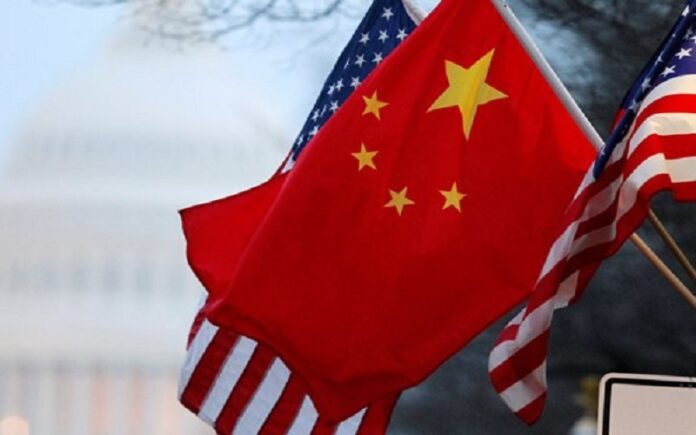
Seyyed Abbas Mousavi made the remarks on Monday while speaking to reporters about Iran’s stance towards the recent months’ trade war between Beijing and Washington.
The spokesman said the US-China trade war, which has been one of the most important international challenges in recent months, has aspects and consequences that can go beyond the bilateral relations of the two sides.
He further underlined that the war has targeted the development and welfare of the people of the world.
Mousavi described the Trump administration’s approach as one that escalates tensions and creates crises, saying that the approach has manifested itself not only in Washington’s irresponsible withdrawal from international agreements, including the Iran nuclear deal with the P5+1 (the JCPOA) and the imposition of unilateral sanctions on nations, but also in its trade war with China.
“Based on this approach, the United States is dealing with China with an acquisitive attitude and is trying to impose political considerations on economic realities,” he said.
In Iran’s opinion, he added, this is also a type of economic terrorism which is condemned.
“Statistics and analyses indicate the US government’s approach that has led to this trade war with China can reduce the world’s Gross Domestic Product (GDP) up to $600 billion within the next two years, and that means increased poverty and reduced welfare and living standards throughout the world,” he went on to say.
“Therefore, it is necessary for Washington to make a serious revision of its approach towards global trends. The US must also change the way it faces realities such as the increased power of other actors and the relative decline in the US power in the world,” Mousavi noted.
“We believe that the US efforts to maintain its previous position by imposing unconventional costs on others are doomed to failure, and are not consistent with the international pyramid of power amid the current rapid developments,” he added.
US President Donald Trump has complained about China’s trading policies since before he took office in 2016.
The US launched an investigation into Chinese trade policies in 2017. It imposed tariffs on billions of dollars’ worth of Chinese goods last year, and Beijing retaliated in kind.
After months of conflicts, both countries agreed to halt new trade tariffs in December to allow for talks.
Optimism had grown over the prospect of a deal, but that faded, and now the US has more than doubled tariffs on $200bn worth of Chinese products.
Beijing retaliated three days later with tariff hikes on $60bn of US goods.
Jalil Rahimabadi made the comment after Riyadh and Abu Dhabi set preconditions for negotiations with the Islamic Republic of Iran.
“In fact, nobody in the Middle East attaches any value to these countries, and one can obviously see they are weak at running the affairs of their countries and the Middle East,” he told ICANA.
He said these countries believe that the Middle East might face challenges; so, they try to blame Iran as the main culprit in that regard.
“On the other hand, they regard themselves as being in a position where Iran needs to talk to them,” he added.
The legislator underscored that positive and cordial ties as well as the observance of good neighbourliness are among the fundamental principles of international relations, and any country welcomes dialogue and negotiations.
“However, if a country with the status of Saudi Arabia or the UAE or the Persian Gulf littoral states wants to tell Iran what to do and what not to do, or if they want to mention points that [they believe] Iran should observe, it would be an insult to our country’s people, history, background, power and status,” the MP noted.
The legislator said Iran is a country which has military power and economic potential, and whose influence goes beyond the country’s borders.
He said Arab countries which have commonalities with Iran in religious, cultural and other areas should stick together as a “convergent and complementary” group in order to help each other in terms of ensuring security, economic growth, the development of the Muslim world, etc.
“No one from no party in Iran will contact Saudi Arabia and the UAE,” he said.
“However, Iran’s logic and bravery rule that it should hold talks, on an equal footing, with any country, as a UN member or a neighbor, that seeks good neighbourliness, in a bid to ease tensions,” the MP said.
He said Iran put forward the idea of signing a non-aggression treaty with the Persian Gulf countries in order to allay concerns, but some Arab countries buy US weapons to be used against Muslims.
Meanwhile, another lawmaker said the conditions set by Saudi Arabia and the UAE run counter to the inalienable rights of Iran.
“The issue of talks is an important issue, and we should not take a leap in the dark, and if negotiations are going to be one-sided with an outcome what would only be in the interests of the enemies, we should not enter into talks because it will have not benefits for us,” Parvaneh Manafi told ICANA with regards to the six conditions set by Saudi Arabia and the UAE for Iran in order to begin talks.
She said Riyadh and Abu Dhabi’s behaviour is a copy of Washington’s. She said they may have even been ordered by the US to show such behaviour.
She underlined that negotiations are valuable only when the interests of both sides are ensured.
“Talks should not be aimed at negating the animosity of our enemies and should not divert us from our positions,” she noted.
“They are not seeking real talks; rather, they want to deprive Iran of its inalienable rights,” she said.
Saudi Arabia and the UAE have set conditions for talks with Iran, namely including the cessation of the use of the name “The Persian Gulf,” stopping Iran’s nuclear and missile programs and putting an end to what they call the “occupation” of Emirati islands.
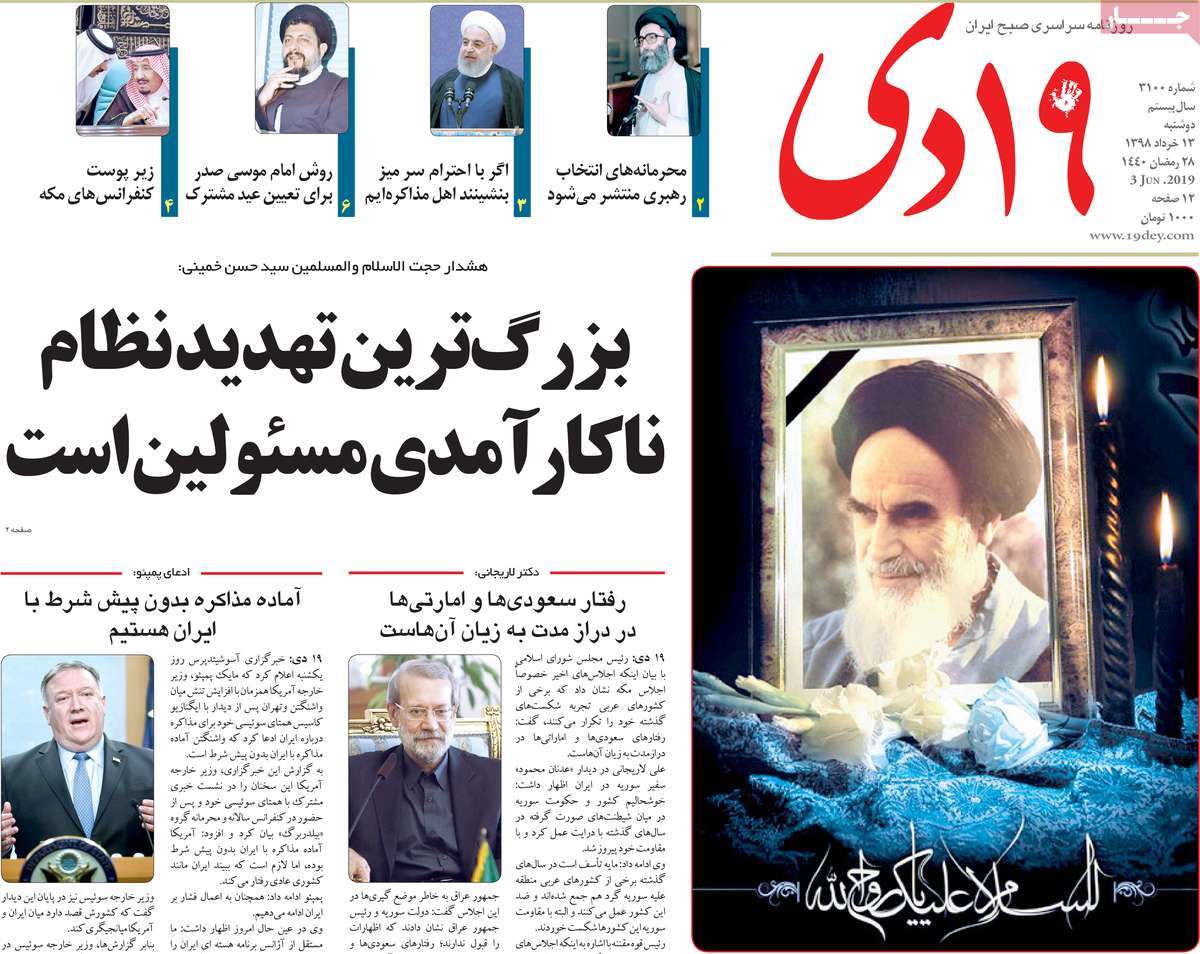
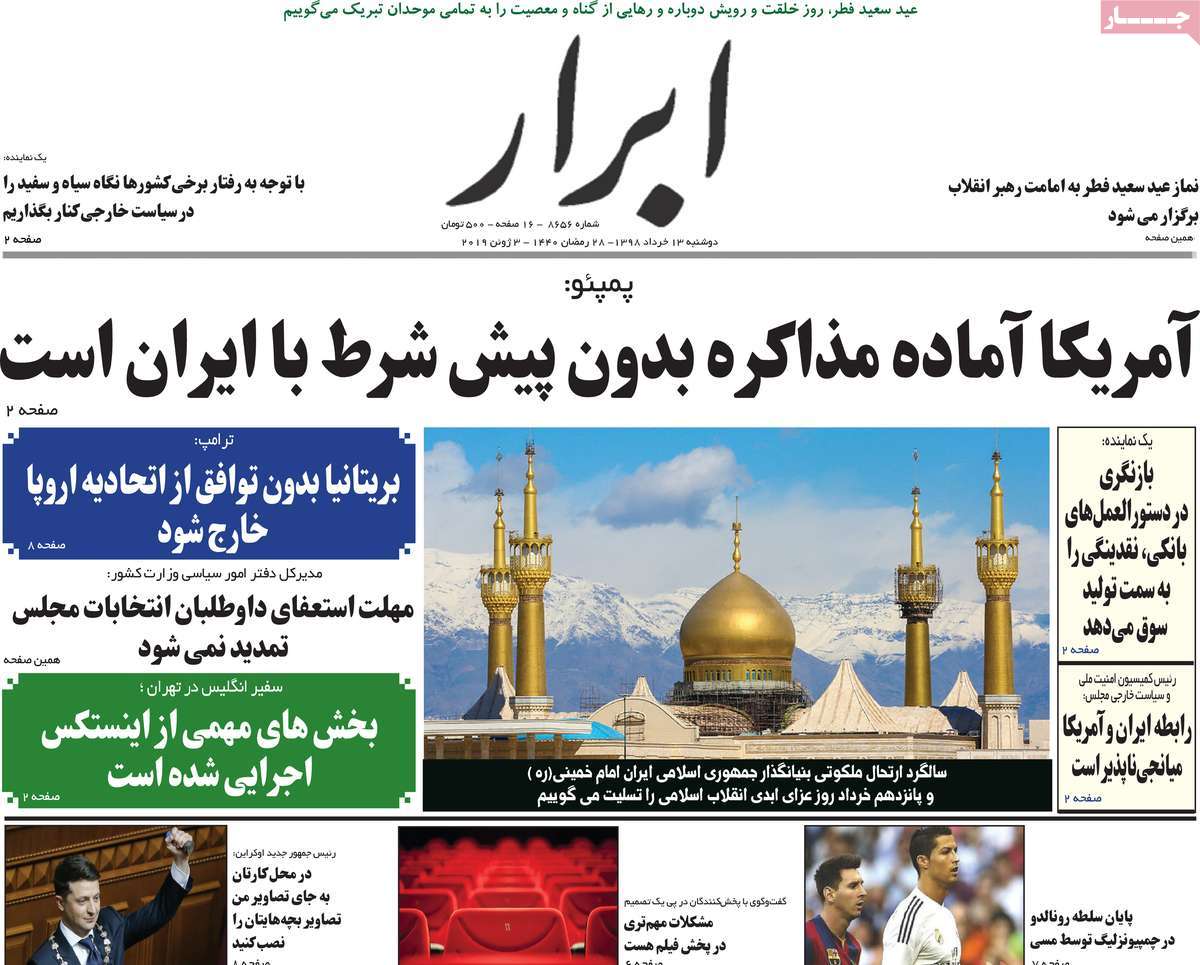
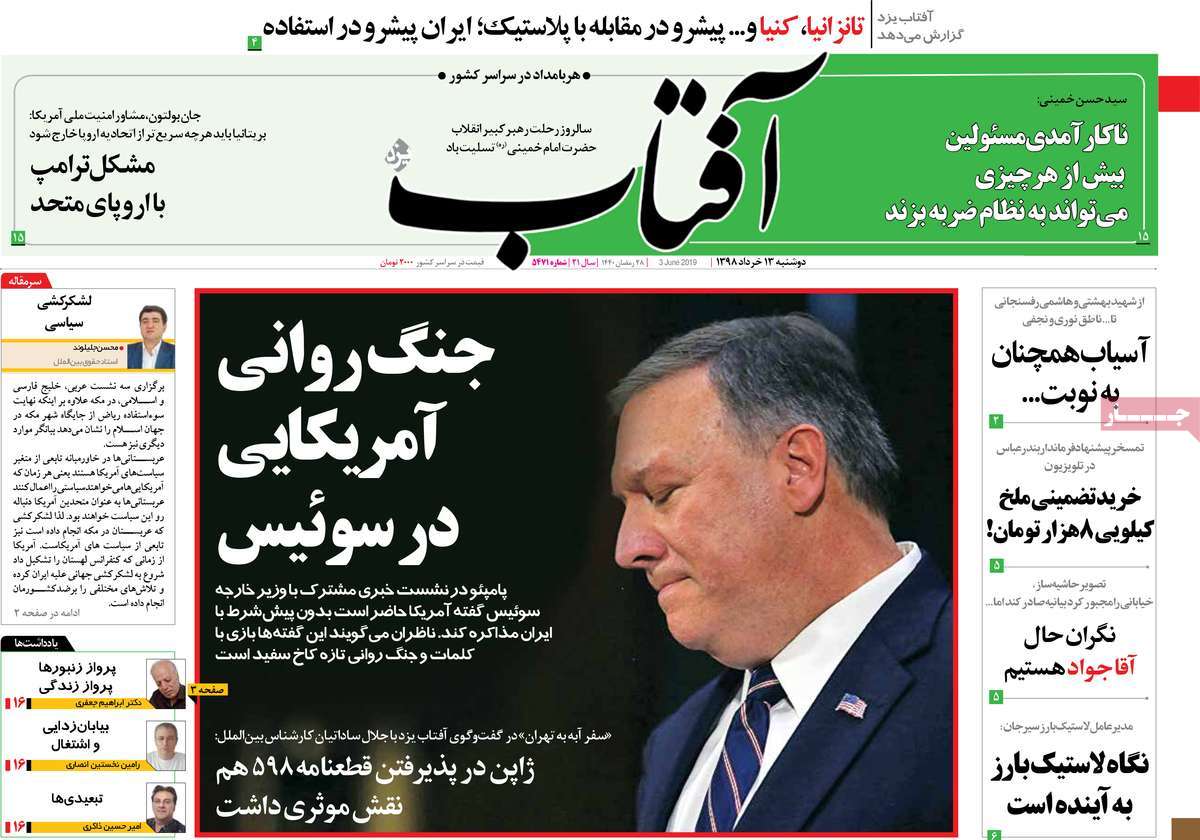
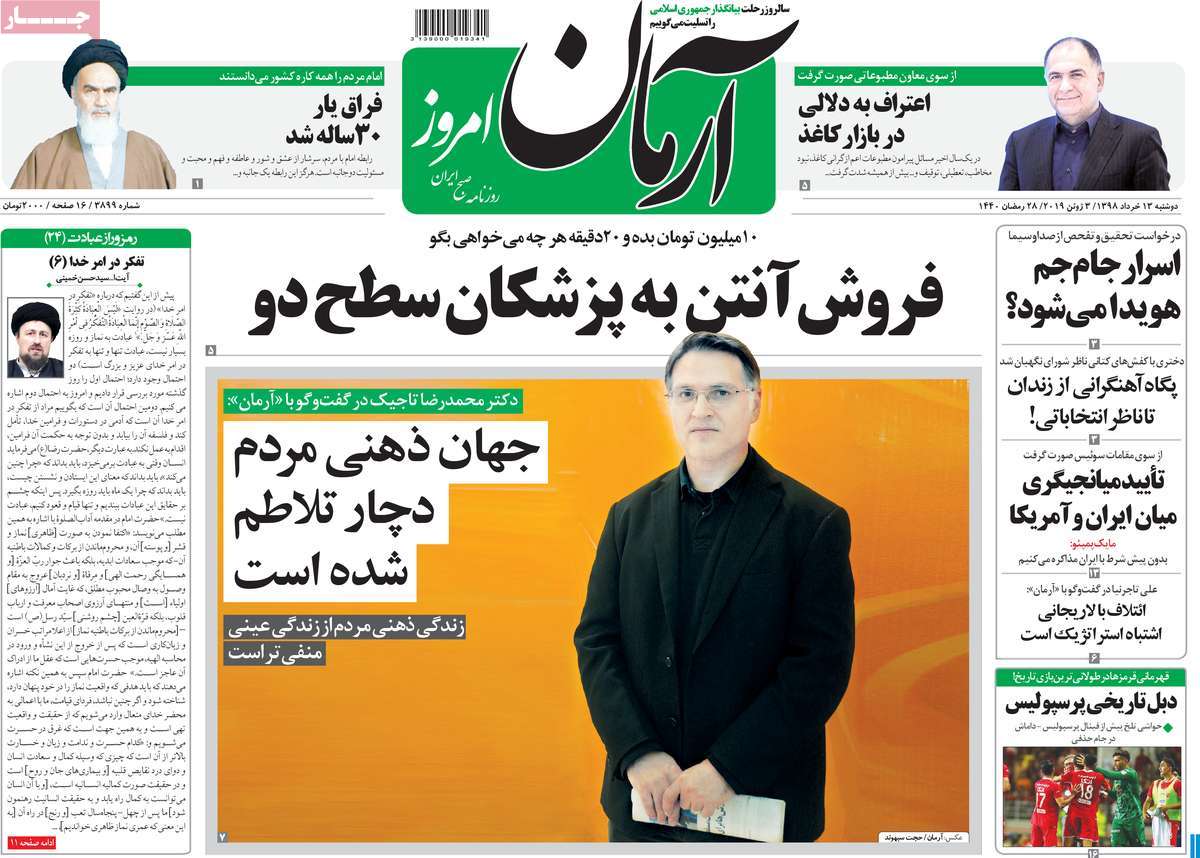
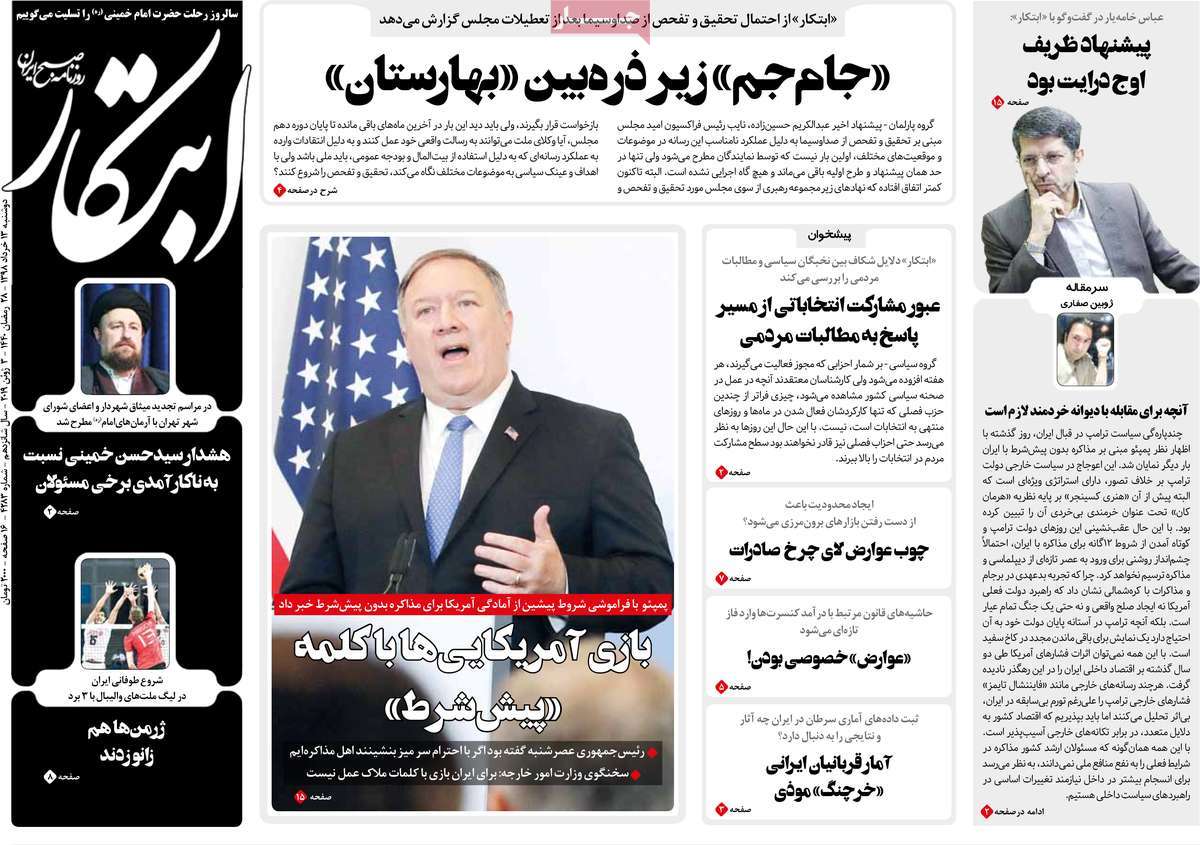
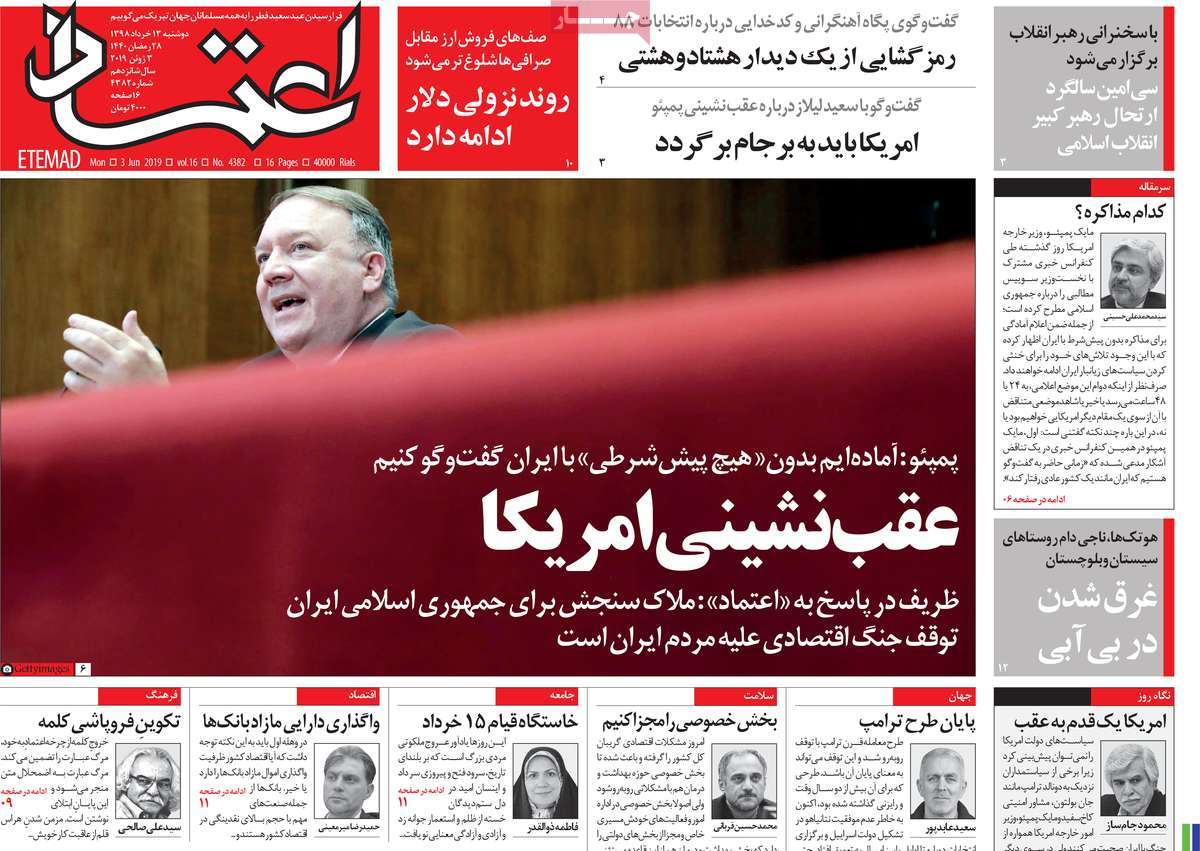
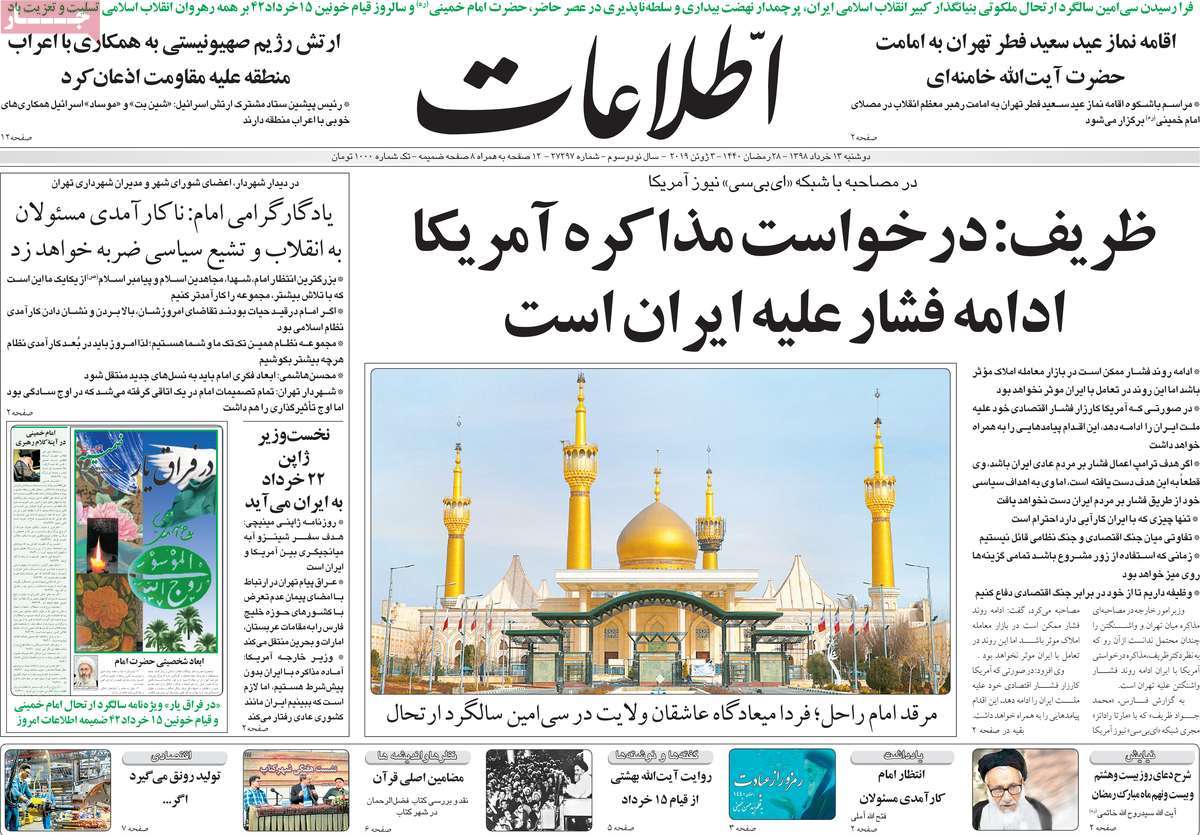
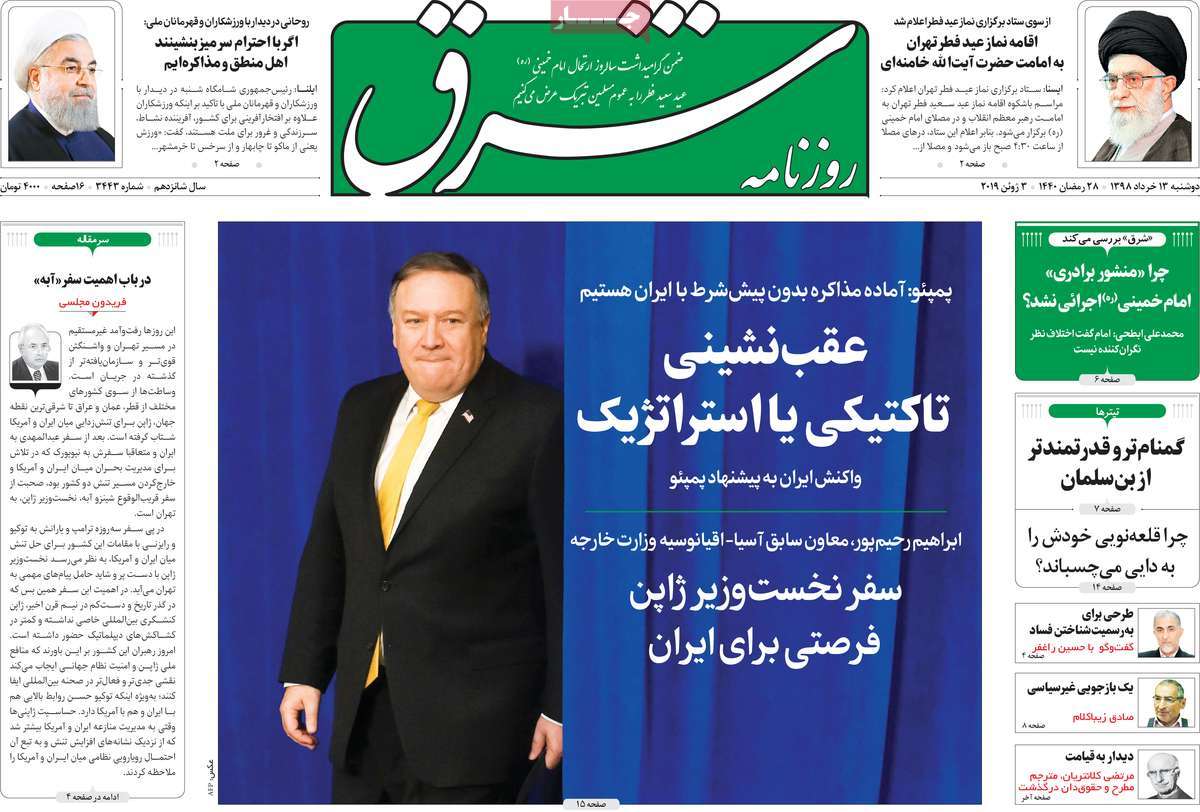
The top story in all papers today was US Secretary of State Mike Pompeo’s call for “unconditional talks” with Iran, which was rejected as a dishonest call by Iranian Foreign Ministry Spokesman Seyyed Abbas Mousavi.
The upcoming visit of Japanese Prime Minister Shinzo Abe to Tehran, which will be the first of its kind since the 1979 Revolution, also received great coverage.
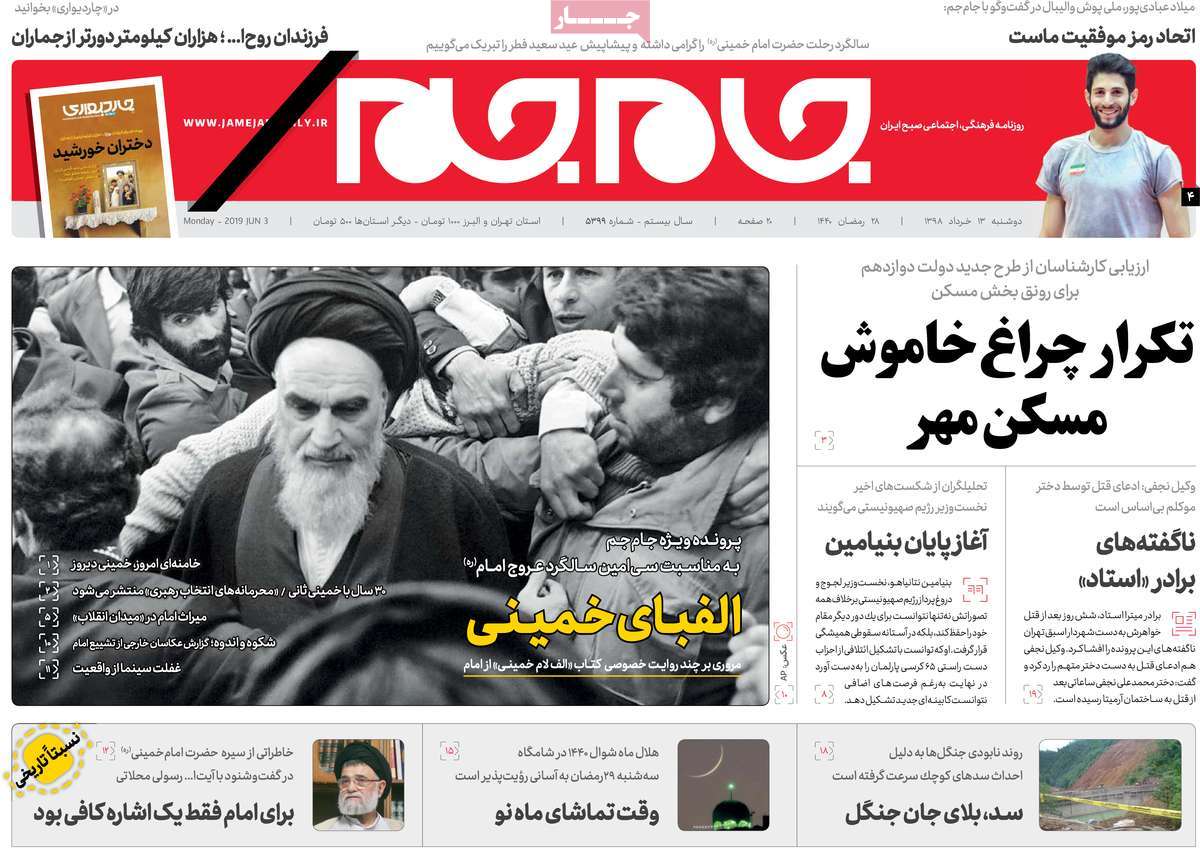
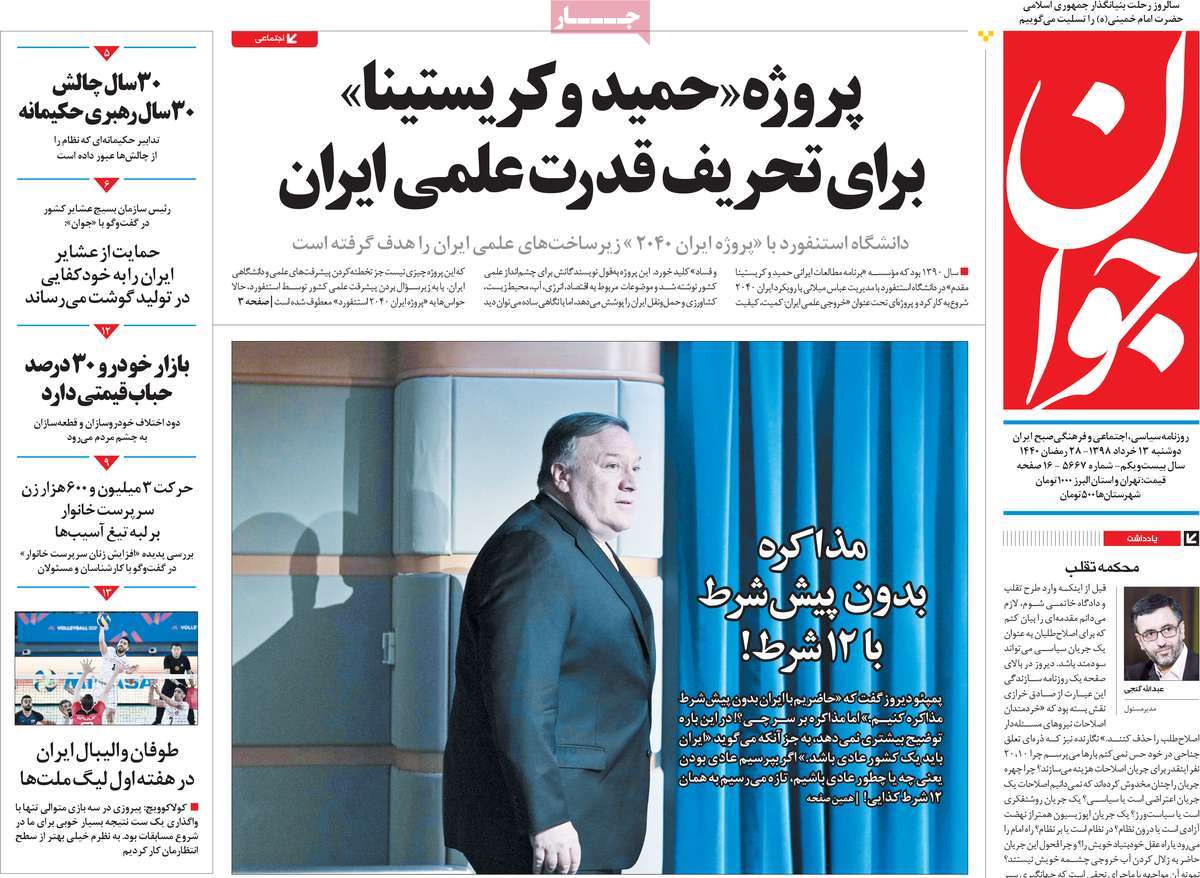
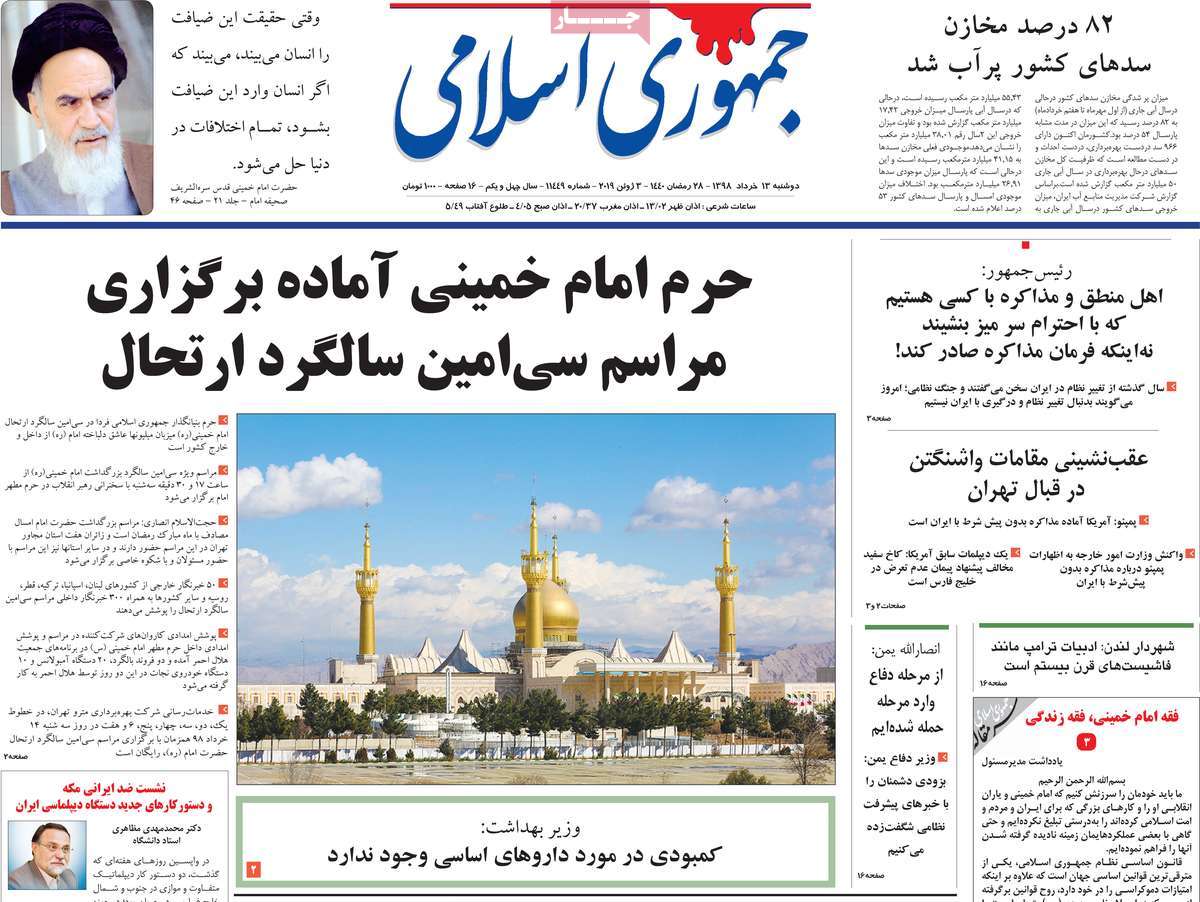
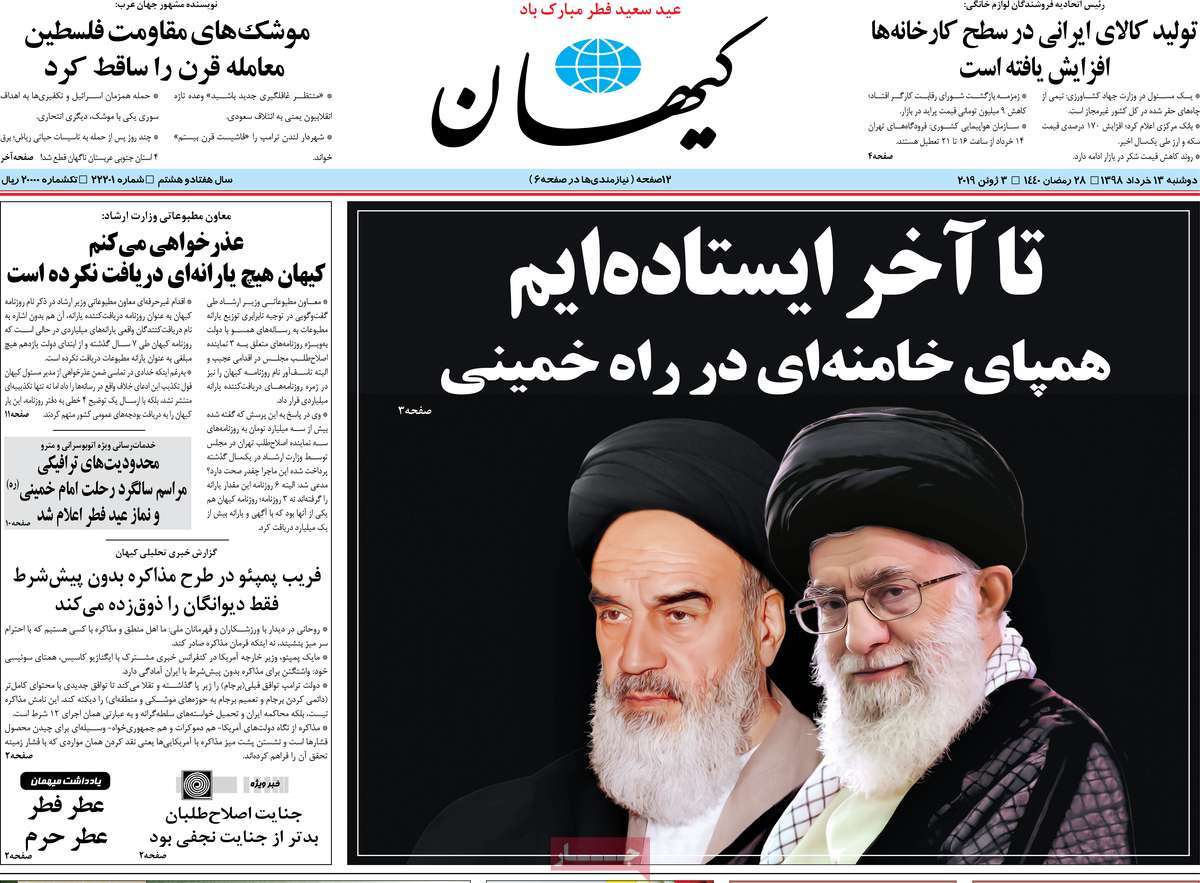
The above issues, as well as many more, are highlighted in the following headlines and top stories:
19 Dey:
1- Larijani: Saudis, Emiratis’ Behaviours Detrimental for Themselves in Long-Run
2- Pompeo Says US Ready for Unconditional Talks with Iran
Abrar:
1- Trump: Britain Must Leave EU without Deal
2- UK Ambassador to Tehran: Major Parts of INSTEX Implemented
3- Senior Lawmaker: Iran-US Ties Not Resolvable with Mediators
Aftab-e Yazd:
1- US’ Psy-War in Switzerland
2- Review of Abe’s Visit to Tehran
* Japan Played Major Role in Adoption of 598 Resolution
Arman-e Emrooz:
1- Swiss Official Confirms Mediation between Iran, US
Ebtekar:
1- Americans Playing with Word of ‘Precondition’
* Iran Pays No Attention to Word-Plays: Spokesman
2- Zarif’s Offer Showed His Prudence: Analyst
Etemad:
1- US Backs Off
* Pompeo: We’re Ready for Unconditional Talks with Iran
2- Zarif: US Must First Cease Its Economic War on Iranians
3- Analyst: US Must Return to JCPOA First
4- US Dollar Rate Decreasing in Iran Market
Ettela’at:
1- Zarif to ABC News: US’ Call for Talks Part of Its Pressure against Iran
2- Japan PM to Visit Iran on June 12
Jame Jam:
1- Alphabet of Imam Khomeini
* A Case on 30th Anniversary of Imam’s Death
Javan:
1- Stanford University Targeting Iran’s Scientific Infrastructure with Project Iran 2040
2- Unconditional Talks with 12 Preconditions!
Jomhouri Eslami:
1- Rouhani: We’d Sit for Talks with Those Who Negotiate with Respect
2- Washington Officials Back Off
Kayhan:
1- Domestic Production Increased in Factories
2- Only Crazy People Would Be Excited by Pompeo’s Deceitful Offer for Unconditional Talks
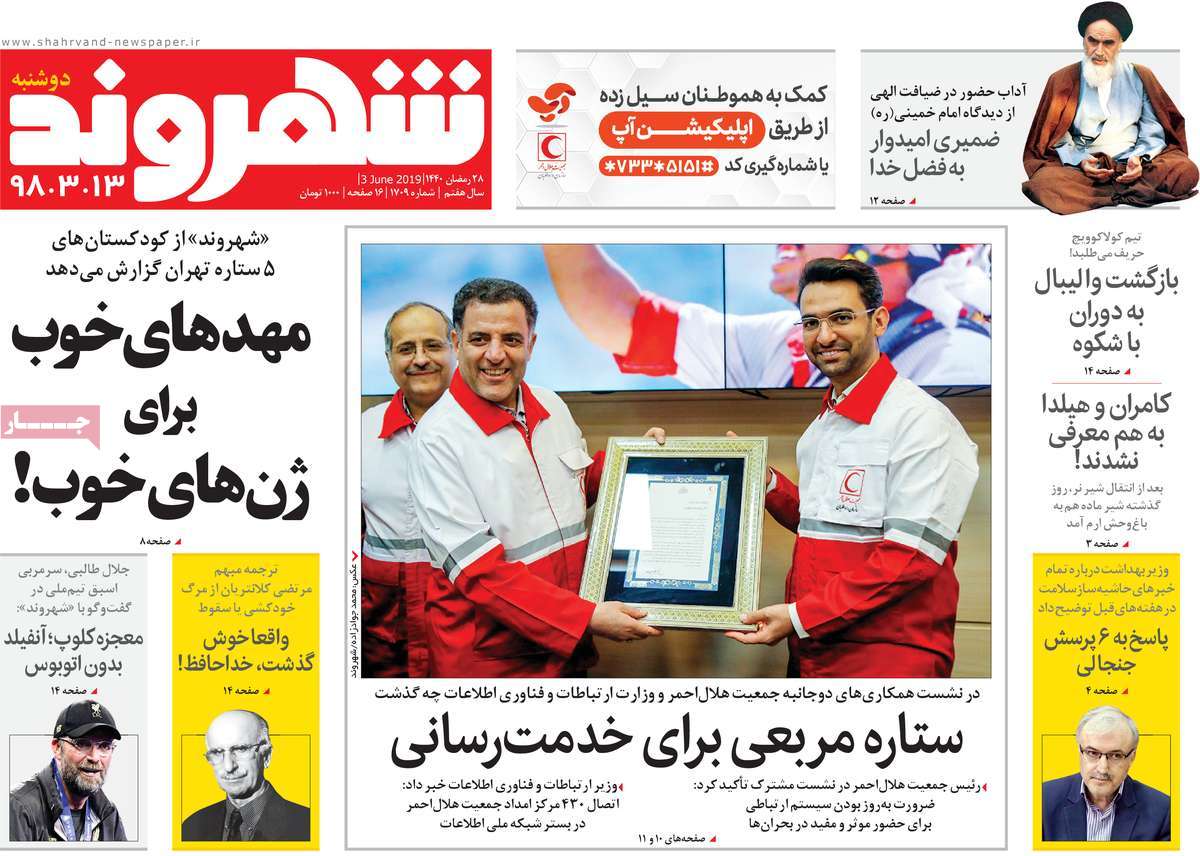
Shahrvand:
1- Persian Lioness Hilda Joins Lion Kamran in Tehran
2- Return of Iran’s Volleyball to Its Era of Glory
Shargh:
1- Tactical or Strategic Withdrawal
2- Japan PM’s Visit Opportunity for Iran: Former Foreign Ministry Official
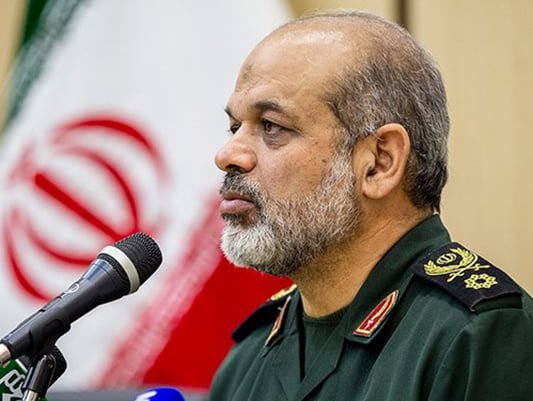
Brigadier General Ahmad Vahidi, a senior IRGC general, has ruled out the possibility of talks with the US over Iran’s defensive capabilities, saying such talks are equal to easily putting our country within the enemy’s range.
“It is clear that no one with common sense would accept such an idea, and no country in the world would negotiate over its defence power. Iran is not an exception,” he told Tasnim.
He said talks with Americans have always proved to be a wrong move.
“During the history of the Islamic Revolution, it’s been proved that even in the cases where negotiation with America has been permitted, it had no result, and the US has once again violated its commitments,” Vahidi said.
Therefore, he added, holding negotiation with the US, especially with the current administration ruling the country, is an irrational and impractical move.
He made the remarks while referring to earlier comments by Leader of the Islamic Revolution Ayatollah Seyyed Ali Khamenei who ruled out the possibility of talks between Tehran and Washington, saying such negotiations will be “fruitless”, “harmful”, and “a total loss”.
“The Islamic Republic of Iran will absolutely not sit for talks with America … because first, it bears no fruit and second, it is harmful,” the Leader said in a meeting with a number of university professors, elites and researchers in Tehran last Wednesday.
The Leader referred to negotiation as a tactic used by Americans to complement their strategy of pressure. “This is actually not negotiation; it’s rather a means for picking the fruits of pressure.”
The only way to counter this trick, he said, is to utilize the means of pressure available for use against Americans. “If they are used properly, the Americans will either stop or decrease pressures.”
However, the Leader warned against being deceived by the US plot, saying that the Islamic Republic must use the leverage at its disposal to counter the US’ pressures; otherwise, being deceived into negotiation would be a “total loss”.
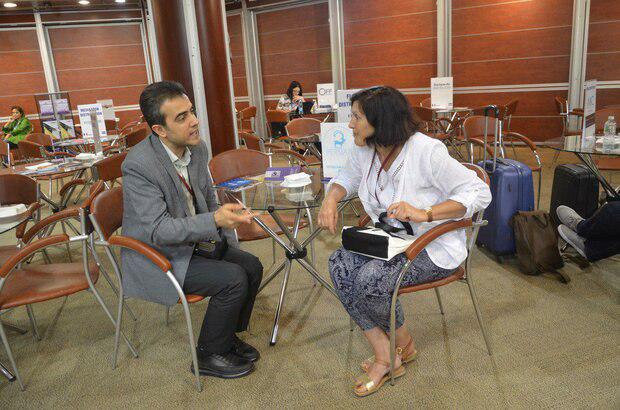
Elena Sunbeam, President and Director of the event, says “Until a year ago, nobody knew that Iran has its own animation industry and has progressed to such an extent.”
According to her, Iran’s animation industry can have a wide market presence in the future.
“This year, Iranian studios attended the event with more discipline and experience; in a way that despite the strong presence of Chinese studios with more assets and facilities, they could attract attentions to their products.”
Mehr News Agency quotes Sunbeam as saying that Iranian studios have good technique and ability, and especially because of their lower cost, they are an attractive option for many international clients.
“All of them should work more on the quality of their products. However, the content that targets a community outside the Middle East must be consistent with the cultural differences and needs of the target countries.”
“The victory of the Yemeni nation is definite,” Zarif said in a meeting of the headquarters for popular support of Yemen held in Tehran on Monday.
“Today we’re all duty-bound to support Yemen because the Yemeni people are defending the human conscience and human values,” he noted.
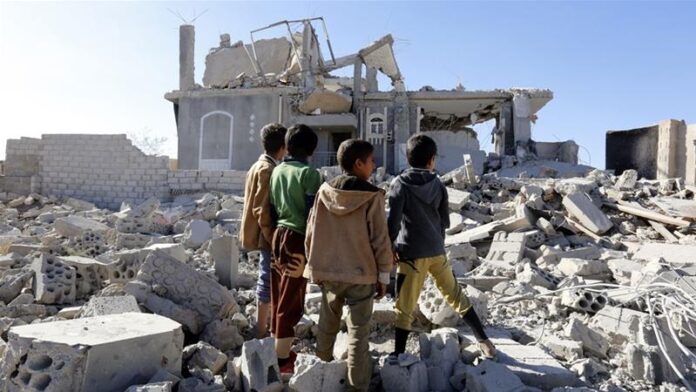
Leading a coalition of its allies, Saudi Arabia invaded Yemen in March 2015 in an attempt to reinstall Hadi, who had resigned amid popular discontent and fled to Riyadh, and to crush the Houthis, who have been significantly helping the Yemeni army against a Saudi-led aggression for the past four years.
The imposed war initially consisted of an aerial campaign, but was later coupled with a naval blockade and the deployment of ground mercenaries to Yemen. Furthermore, armed militia forces loyal to Hadi, in line with invaders, launch frequent attacks against Yemeni people in regions held by Houthis.
The aggression is estimated to have left 56,000 Yemenis dead.
In his Monday remarks, Zarif also noted that the efforts of the Al Saud regime in the region to build a coalition against Iran and Yemen during the recent summits in Mecca will not bear any fruit.
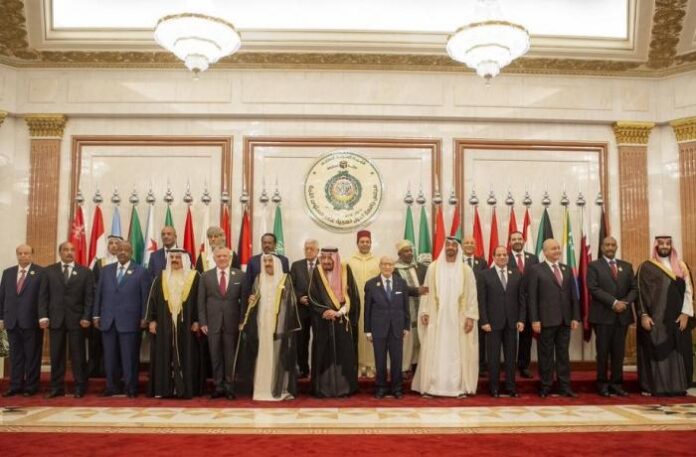
Saudi Arabia recently hosted a couple of “emergency” meetings in Mecca with the aim of building a consensus among Arab states against Iran and its regional influence.
Two statements were released after the conclusion of the talks, which mainly cited concerns about the recent sabotage attacks against several ships off the UAE.
Both Saudi and Emirati officials have blamed the mysterious “sabotage” attacks on Iran while Iran has strongly denied any involvement, and offered to sign non-aggression pacts with the Persian Gulf Arab states.
The statements were rejected by Iraqi President Barham Salih and Qatari Foreign Minister Mohammed bin Abdulrahman Al Thani, who foiled Riyadh’s plot to unite the Arab world against Iran.