Monday, December 29, 2025
Home Blog Page 3144

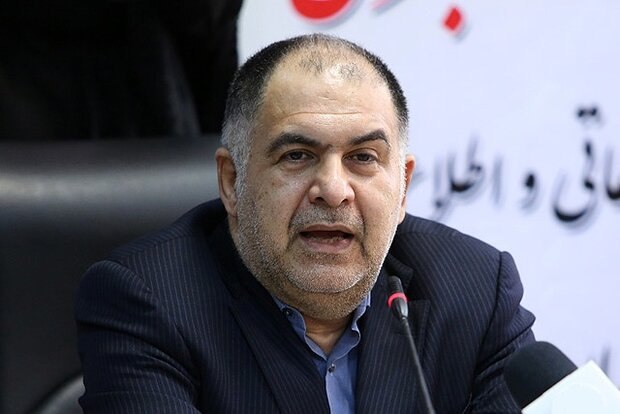
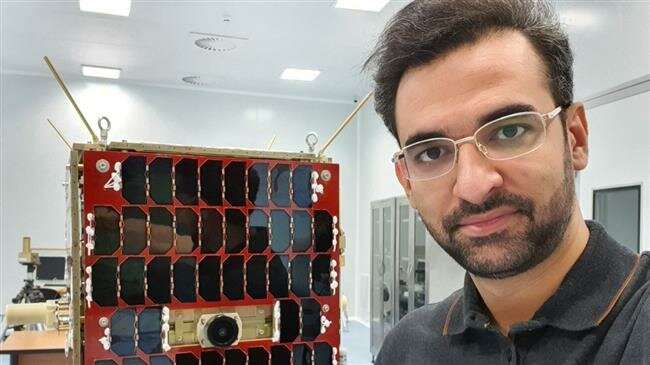
Iran VP Vows to Support Pioneering Knowledge-Based Companies

Over 5,300 Iranian Knowledge-Based Firms Opened in 6 Years: VP

He made the comments in a meeting in which most knowledge-based companies in the health sector gathered to pave the way for exchange of ideas and policymaking while discussing their needs and concerns.

Sattari said the knowledge-based companies are the strong arm of the economy that contribute to the sustainable development of the country, stressing that “these companies are the driving force behind the economy and can create a significant part of the jobs for university graduates.”

According to him, pioneering knowledge-based companies, with their high capability, can build hundreds of startups on the path to knowledge production. These companies are important as they boost marketing and sales in domestic and foreign markets.

He also stressed that the government needs to have a special support program for these companies and boost the production of these companies by relying on the export market. “The Health and Innovation Fund is cooperating with the vice presidency in this regard and I hope it will produce good results,” said Iranian VP.

“Because of Iran’s oil-based economy, the country’s general culture is import-based, and oil revenues have promoted and supported imports without efforts to localise the production. This culture needs to be reformed. Hopefully, with the transformation that knowledge-based businesses are introducing, all sectors of the country are distancing from imports.”

Despite all the burdensome rules and the laws, which are not mainly for supporting domestic producers, major developments in the field of health have been established with the help of knowledge-based companies, underlined Sattari.

For a brief review of Iran’s achievements in various fields of science and technology, check the book “Science and Technology in Iran: A Brief Review – 2019

In another part of the meeting, Saeed Nemaki, Minister of Health and Medical Education said today, there is nothing in heath sector that knowledge-based companies cannot solve.

“The ground has been prepared for knowledge-based businesses with the supports of the Vice Presidency for Science and Technology to open a new horizon to the country’s health system. Before the revolution, we had multinational companies that ran the country’s pharmaceutical industry, but today, with the help of Iranian knowledge-based companies, the country’s health care system provides 97% of the country’s pharmaceutical needs,” reiterated Namaki.

Iranian health minister also touched upon the priority of using domestic production in the health system of the country saying that the production of medicines and health items, and new approaches to service delivery require new approaches such as electronic health system that improves our interaction.

Muslim Unity Key to Ending Israeli Tyranny against Palestine: Zarif

In a tweet on Sunday, Zarif posted a photo of the Israeli forces’ latest assault on Palestinian worshippers in the al-Aqsa Mosque on Sunday morning, which coincides with the Muslims’ holiest day of Eid al-Adha (Feast of Sacrifice).

“The same terrorists are hoping to impose Humiliation of the Century on Palestinians,” Zarif said, referring to the US’ so-called peace plan for the Middle East, which Donald Trump’s administration calls “Deal of the Century”.

“We Muslims have power to end this tyranny, but only if we united,” the Iranian top diplomat added.

His comments came after the Israeli police clashed with Palestinian Muslim worshippers in the al-Aqsa Mosque compound on the start of Eid al-Adha festivities.

Violence erupted on Sunday morning after Israeli policemen fired stun grenades and tear gas at the Palestinians who had finished their Eid prayers.

The Palestinian Red Crescent said that at least 14 worshipers had been injured in the clashes inside the al-Aqsa Mosque compound, which lies in the Old City of Jerusalem al-Quds.

Lebanese TV channel al-Manar reported that Grand Mufti of Jerusalem al-Quds Sheikh Muhammad Hussein was among those injured.

Earlier, Leader of Iran’s Islamic Revolution Ayatollah Seyyed Ali Khamenei had noted that the “deal of the century” is a crime against humanity, urging “everyone” to help defeat it.

“The ploy of the ‘deal of the century’ which is being plotted by the oppressive America and its treasonous cohorts is a crime against human society, and not just the Palestinian nation,” the Leader said Saturday in his annual Hajj message.

“We are inviting everyone to actively participate in defeating the enemy’s ploy and deception and believe that with the power and strength from God, this and all other ploys of the imperialist front is doomed to failure vis-a-vis the efforts and faith of the resistance front,” he added.

The “deal of the century”, a backchannel plan to allegedly reach a peace settlement between Israel and the Palestinians, is reported to recognize Israeli occupation of Palestine in exchange for economic incentives. The plan has widely been rejected by the Palestinians.

Saudi Arabia Seriously after Negotiating with Iran: Report

Riyadh Left Alone by Arab Allies in Anti-Iran Campaign: Analyst  

The newspaper, in an op-ed by senior expert Kamal Khalaf, says this is not the only gateway to look at other cases that are no less important than water safety and maritime security. The Yemen case is at the forefront of issues that will be raised during the Iran-Saudi negotiations.

“It is clear that Saudi Arabia is preparing proper grounds for stopping the war on Yemen and seems to have been able to convey a message to Tehran via a secret channel that the end of the war should be in a way that Riyadh would not be shown as a failed party. This is the main request of Riyadh, and considers it a crucial issue for negotiating with Tehran. Apparently, the changes the UAE has made to its role in Yemen are also affecting the Saudi position, and it is reported that the discrepancy these days between Saudi Arabia and the UAE is due to the UAE’s new stance on Iran and the war in Yemen,” he is quoted as saying by Rai al-Youm.

Khalaf goes on to say what reinforces this view is the devastating battles in Aden between the UAE-backed transitional council and the Saudi-backed Mansur Hadi forces.

“While the Emirati officials are questioning the legitimacy and competence of Mansour Hadi, the Dubai police chief, Dhahi Khalfan, in his Twitter account, has directed harsh criticism at Hadi, stating that a real commander cannot, from inside the hotel room, won the victory. But in the meantime, we need to consider the depth of the relationship between Riyadh and Abu Dhabi, as well as the close personal relationship between Bin Zayed and Bin Salman, to say with certainty that Abu Dhabi is, above all, an indirect communication channel between Riyadh and Tehran and its entire move are coordinated with Riyadh.”

However, one can play a better role in this regard, and there is no one better than Russian President Vladimir Putin, who has a close relationship with Bin Salman and Iranian politicians. For this reason, if the right channel is chosen to convey the message between Riyadh and Tehran, Russia is the best option, underlines Khalaf.

Riyadh has always been one step behind Abu Dhabi in changing policies and dealing with crises and different cases, and this was clearly seen in the UAE’s move to resume diplomatic relations with Damascus, while Saudi Arabia initially hesitated. According to our assessments, Riyadh’s hesitation will end soon, and the Saudis will take a major step toward establishing ties with Damascus and negotiating with Iran, concludes Khalaf.


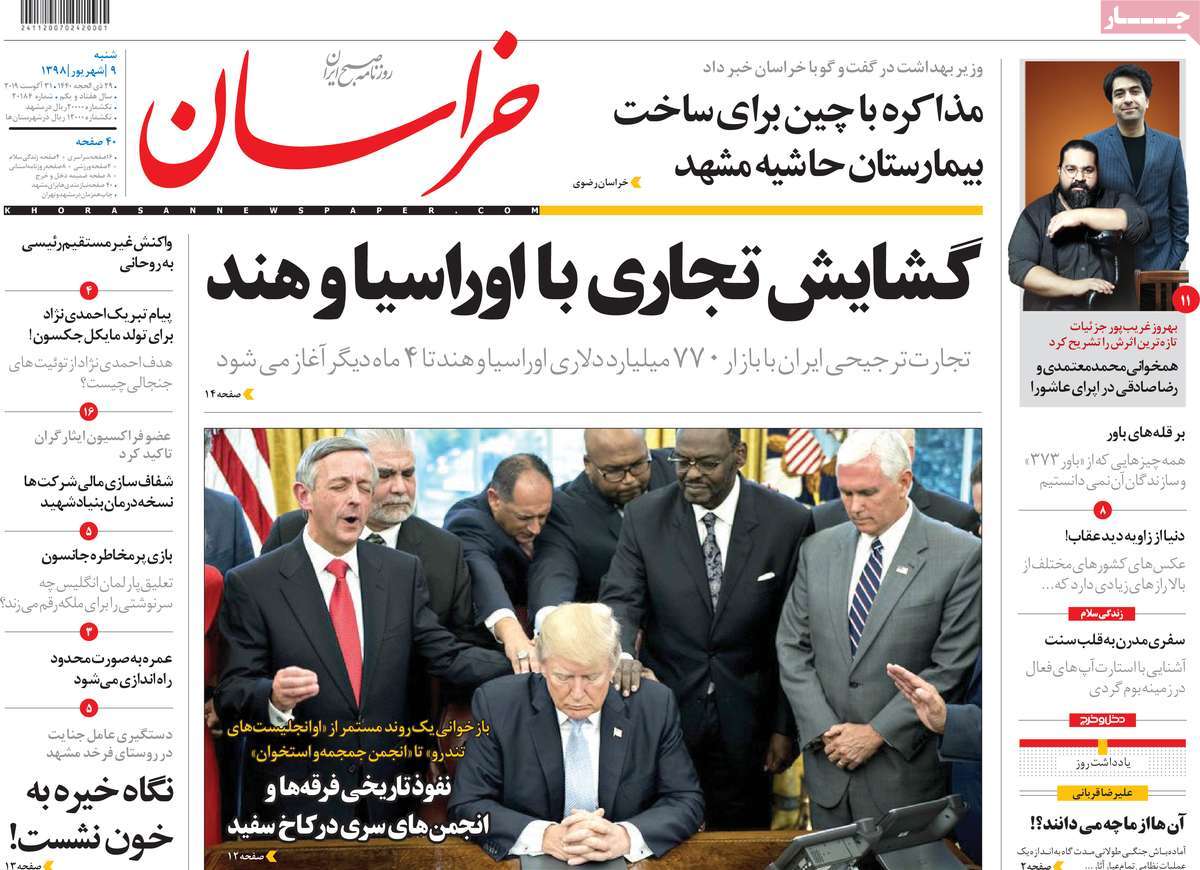
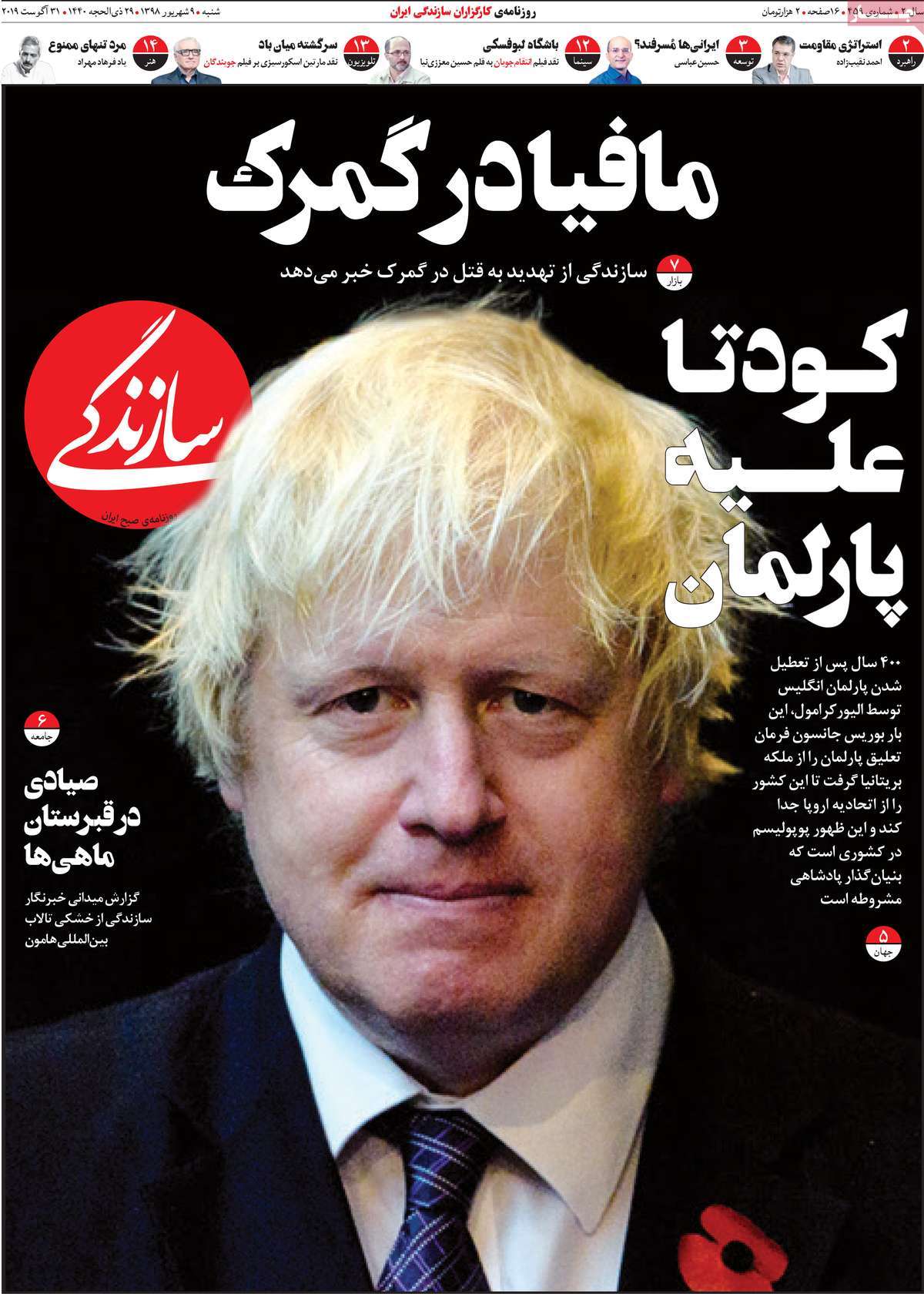
A Look at Iranian Newspaper Front Pages on August 11

A Look at Iranian Newspaper Front Pages on November 19

19 Dey:

1- Iran Leader to Hajj Pilgrims: Deal of Century Doomed to Failure

2- Zarif: US Worried about Its Defeat in Diplomacy

A Look at Iranian Newspaper Front Pages on August 11


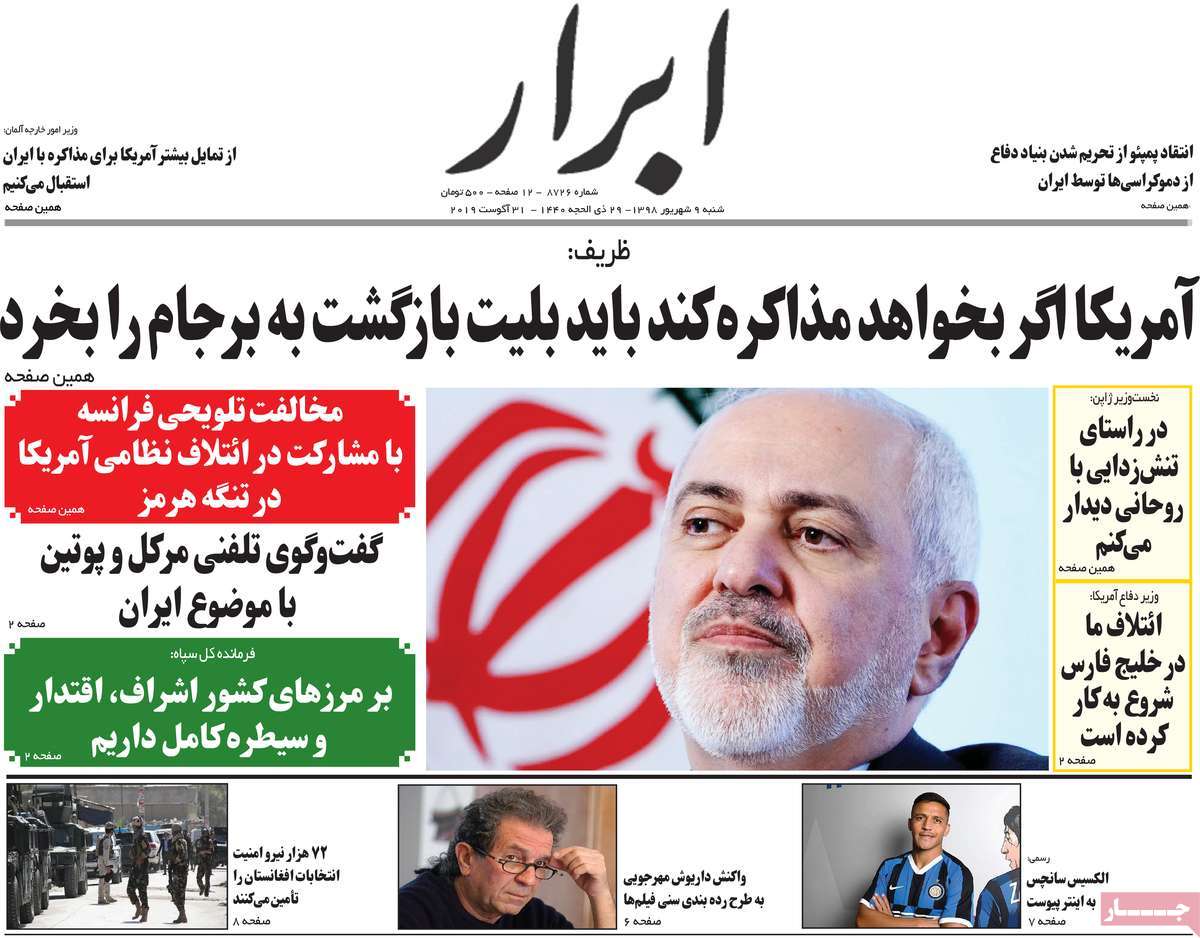
Abrar:

1- France: No Need for US Permission to Ease Tensions with Iran

2- US Asks South Korea to Send Warship to Persian Gulf Coalition

A Look at Iranian Newspaper Front Pages on August 11


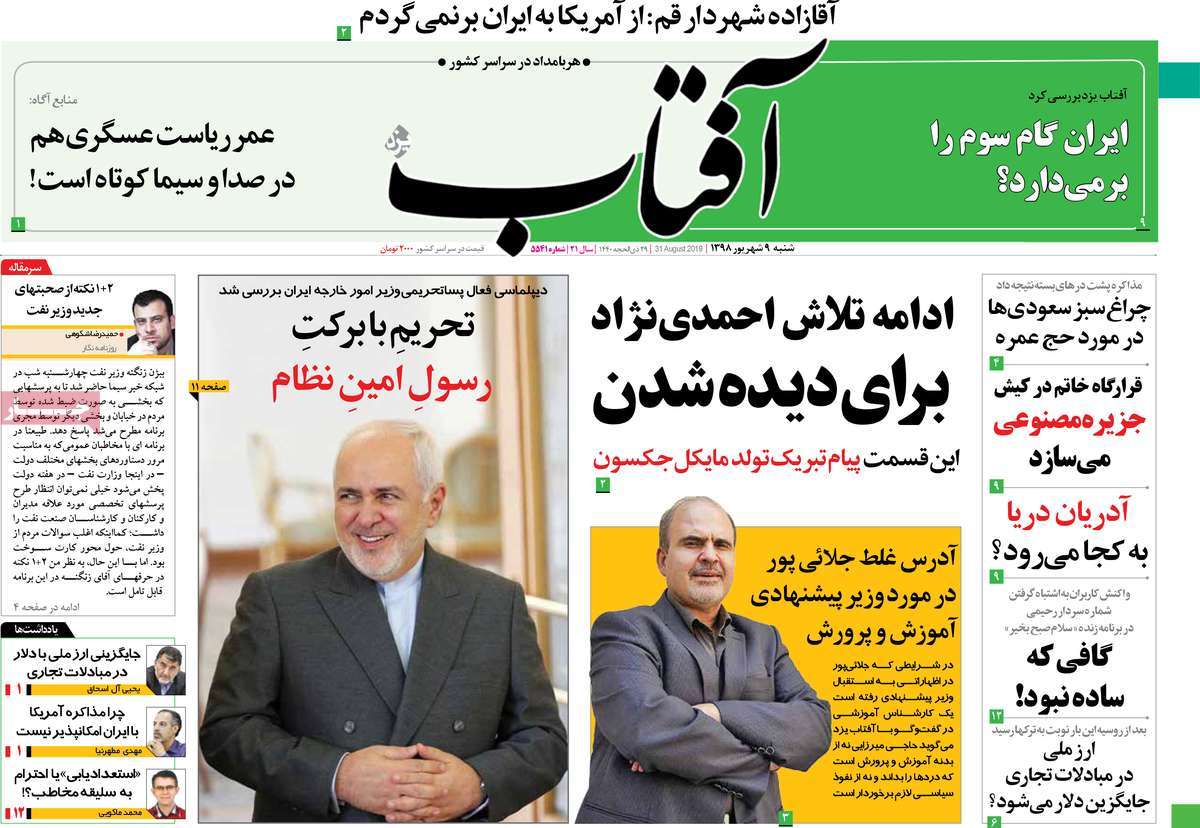
Aftab-e Yazd:

1- Press Managers, Professionals Support Zarif’s Anti-Sanction Stances

A Look at Iranian Newspaper Front Pages on August 11


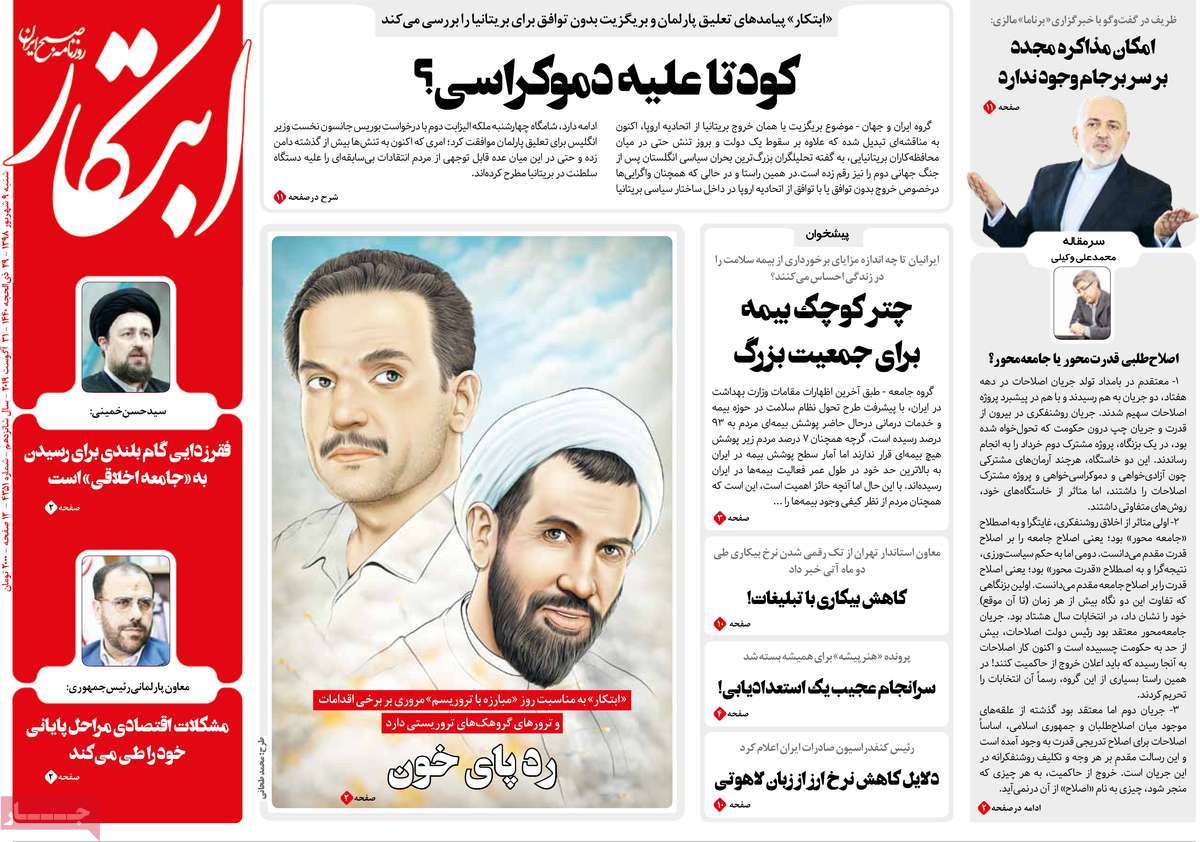
Ebtekar:

1- Reality of Detente in Tehran-Riyadh Ties

2- UAE Captures Aden

A Look at Iranian Newspaper Front Pages on August 11


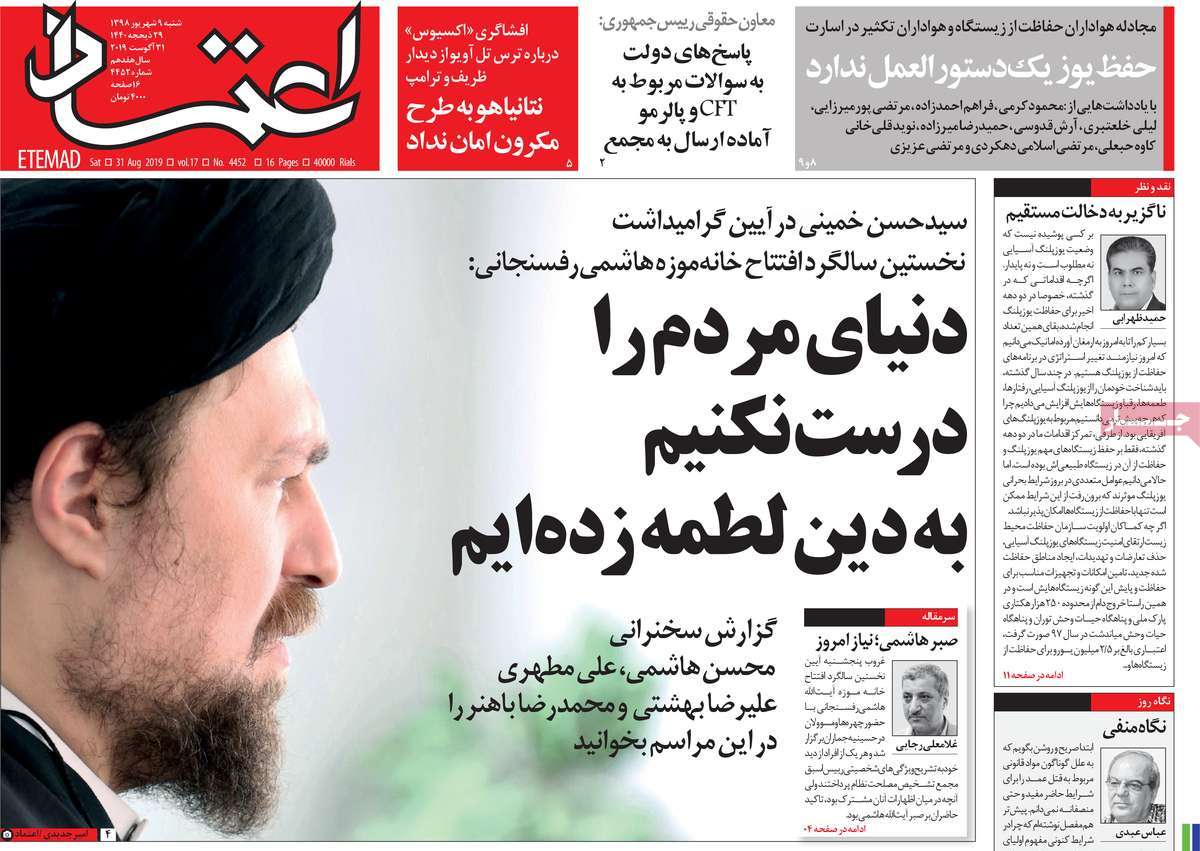
Etemad:

1- Iran Leader’s Message to Hajj Pilgrims: Denounce Killing of Innocent People, Warmongering

2- Afghan Presidential Candidate: Taliban, US Seek Short-Term Peace

A Look at Iranian Newspaper Front Pages on August 11


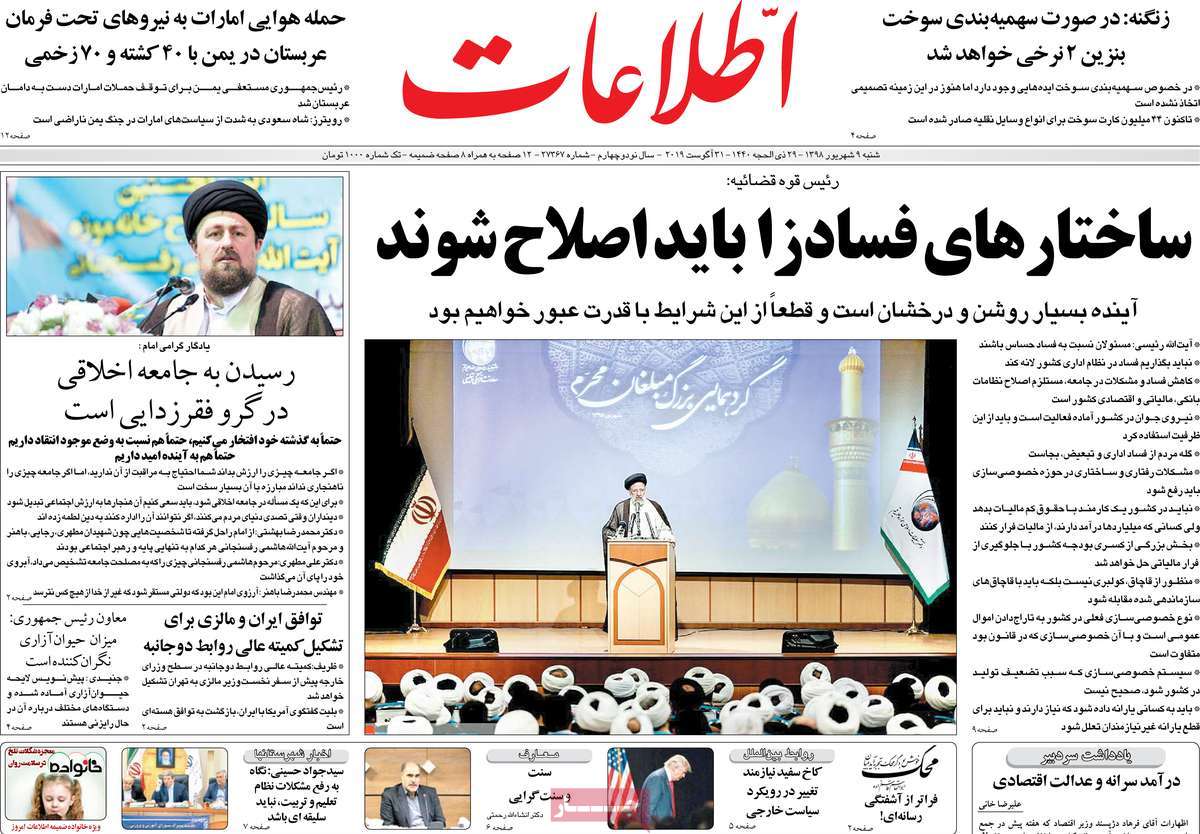
Ettela’at:

1- Iran Leader: Warmongering of US, Its Allies in Region Condemned by Hajj Pilgrims

2- Hamas Rejects Saudi Officials’ Call for Cutting Ties with Iran

3- Zarif: US Worried about Public Opinion, Defeat in Diplomacy

A Look at Iranian Newspaper Front Pages on August 11


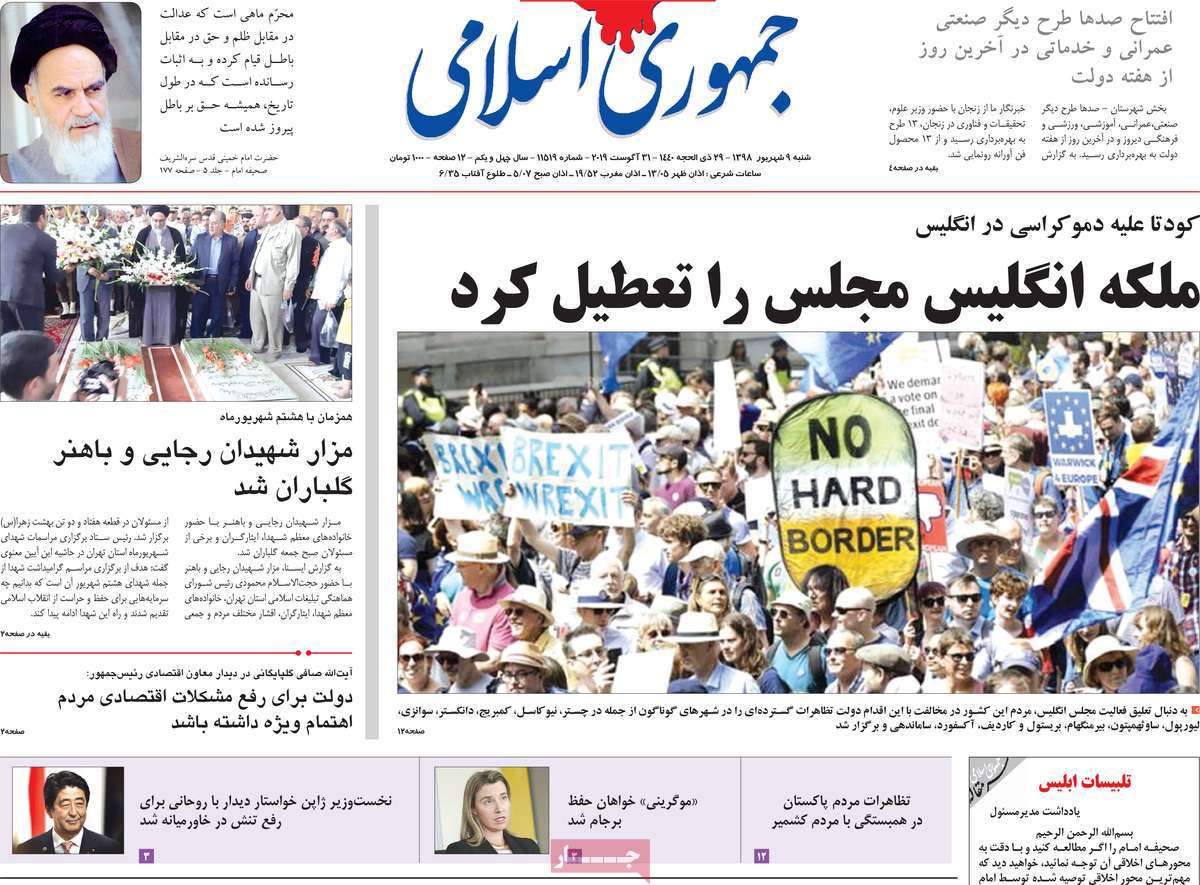
Jomhouri Eslami:

1- Iran Leader: Great Achievement of Hajj Is Accumulation of Powers to Counter Common Enemy

A Look at Iranian Newspaper Front Pages on August 11


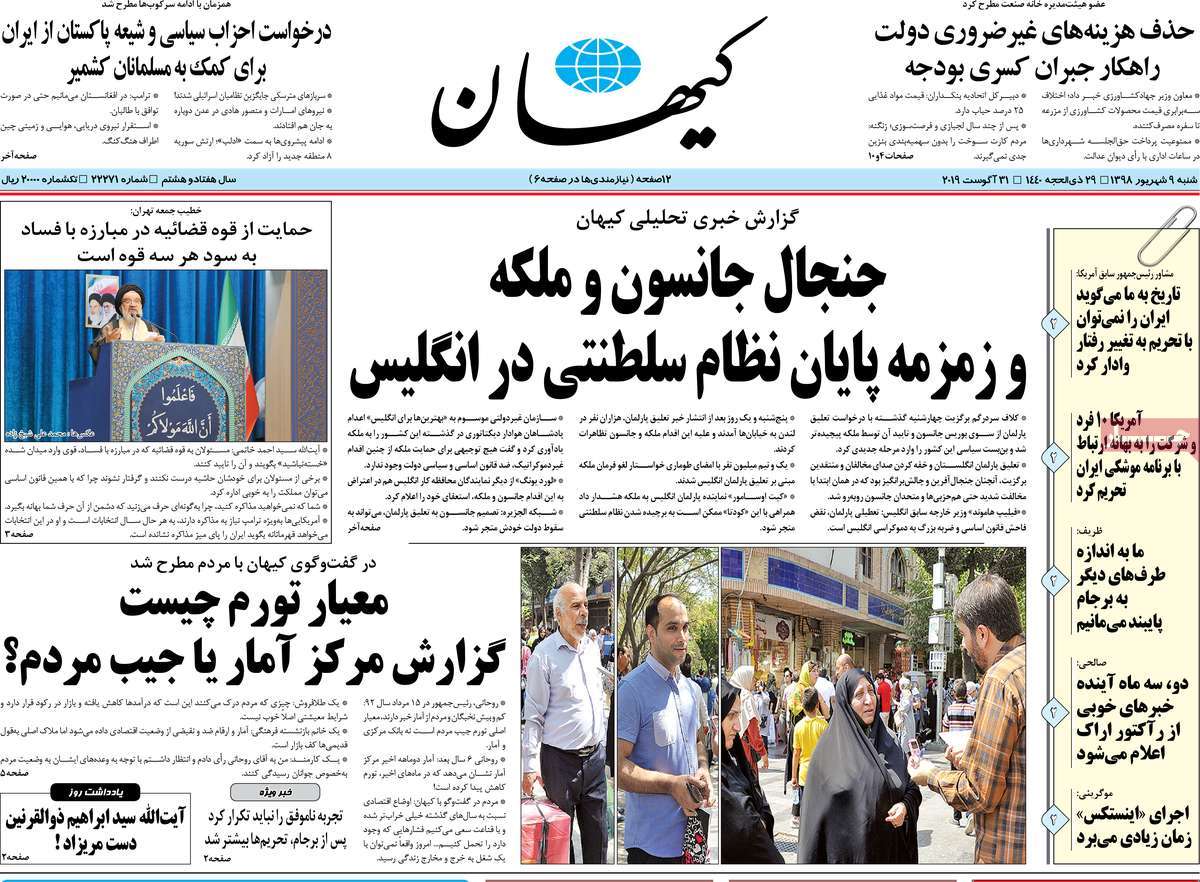
Kayhan:

1- Secret behind Mass Deployment of Hindus to Kashmir

* Is India Seeking to Change Religious Structure?

2- Iran Exporting $8 Billion Worth of Products to Iraq Annually

A Look at Iranian Newspaper Front Pages on August 11


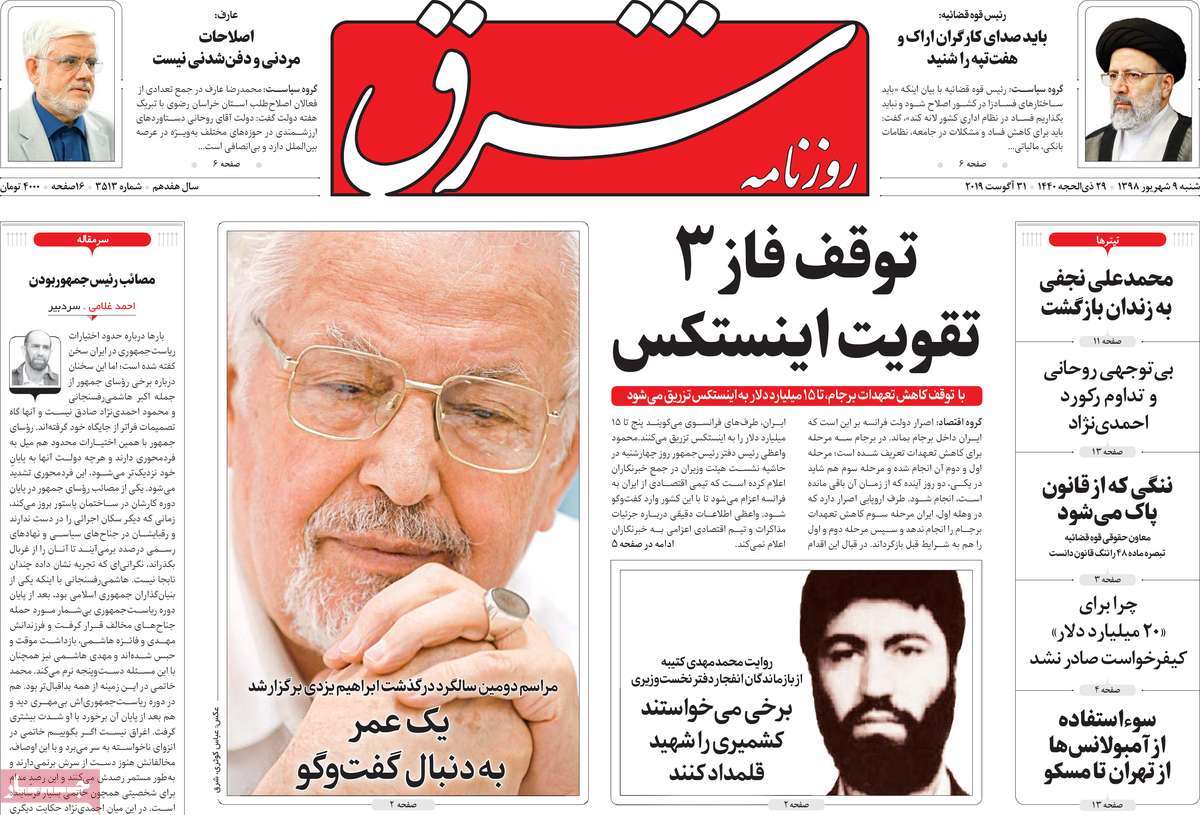
Shargh:

1- US Allows ATR to Sell Plane Parts to Iran

2- Political Factions’ Passive Stances over Election

A Look at Iranian Newspaper Front Pages on August 11

Buffalos Beat Summer Heat by Bathing in Steel Lagoon

These animals take refuge in this wetland from the overwhelming heat, sultry weather and the vermin. They graze beside the lagoon and plunge in its deeper parts to bathe and soak their bodies in the mud.

What follows are Mehr News Agency’s photos of the buffalos and cattle in Steel wetland:

Downing of US Spy Drone Proof of Iran’s Advanced Defensive Capability

Yakup Aslan, the only representative of a private Turkish television in Iran, has written in an article that “Iran has proven it can answer a direct military threat, even from a global power like the US.”

“The same can be said for the UK, whose international immunity provided by world authorities was unable to prevent its oil tanker from being detained by Iran, again showcasing the Islamic Republic’s determination and ability to take effective defensive action,” he adds.

What follows is the full text of his article published on the United World website:

The “Global Hawk” Myth Collapses

Iranian media reported that the “Global Hawk” drone was destroyed after it crossed into Iranian airspace near the Koh Mobarak region in the south. Sources say the spy drone can fly 8200 nautical miles at an altitude of 16 kilometres in a single flight.

The report published by the US Navy Central Command regarding the incident said the surveillance plane was shot down by an Iranian Land-to-Air missile in international waters near the Strait of Hormuz. Both sides accuse one another of acting without provocation.

The IRGC claims that the drone took off from an American airbase in the Persian Gulf around midnight in violation of air traffic rules, and then flew to Chabahar in stealth mode through the Strait of Hormuz. According to the report, at around 04.05 am, the plane invaded Iranian airspace and was shot down by IRGC’s anti-air defences.


Tehran’s Military Capability

The downing of the advanced American drone showed the world the power of Iran’s military and its defence capabilities. The Iranian Army has continued to gain combat experience and self-sustainability despite the Western embargo of the country’s military industries. According to Fars news agency, Iran’s military development is best indicated by its missile systems.

The American drone was destroyed by the “Sevvom Khordad” missile defence system, which was designed and built in Iran. It was developed in 2014 and has been improved with radars that can detect up to 4 targets at once. The system can also target cruise missiles, fighter jets and bombardment planes at a range of 50 km and 25 km altitude. The system is now being upgraded to reach 200 km range.

With this move, Tehran sent a clear message to the White House: any invasions of Iran’s sovereignty will be answered, and any American attack will be met with resistance.

Trump’s Confusion

With the US in a state of confusion and horror as a result of its UAV being shot down, President Trump said that Iran had made a “huge mistake” and that the whole world would be watching what happens next. Trump then seemed to backtrack on his hostile rhetoric, indicating that the drone may have been destroyed by “mistake,” and claiming to have called off a counter-attack at the last minute in favour of negotiation

Whatever Trump claims his reasons were for not retaliating, he was, in reality, unable to do so because of Iran’s military power and missile arsenal. For its part, Iran has been rather transparent and released its intelligence reports on the relevant incidents to the international media.

Worried about the possibility of yet another devastating and expensive war in the middle east, President Trump has been forced to accept the situation in partial-silence… nonetheless, tensions remain high, and what will happen next is still unclear. One thing that is certain, however, is that Iran struck a heavy blow, and has forced Washington to second guess its aggressive posturing.

Us Tries to Save Face with Fake Victories

Washington was unable to offer any real military resistance to Iran after it shot down the UAV, so it attempted to negotiate a pretend victory. Sources suggest that the US sent a message to Tehran via Qatar demanding that the Islamic Republic help them maintain their prestige by selecting two targets to be ‘shot down’ by the USA. Tehran reportedly refused to comply with this spectacle and responded that any aggressive action by the US would be answered in turn.

The Trump administration was forced to turn to their only weapon, political and economic sanctions, all while demanding unconditional negotiations. The US Treasury Department also added Iranian Foreign Minister Javad Zarif to the sanctions list.

The United Kingdom

After an Iranian tanker carrying oil to Syria was seized by the UK in the Strait of Gibraltar, Iran answered by detaining a British oil tanker in the Persian Gulf. These tit-for-tat actions have come to characterize the political tension in the Persian Gulf. There has been some indication that the seizure of the Iranian tanker by the British was actually planned by the US, in particular by Trump’s National Security Advisor John Bolton. The UK’s actions have led to what some are calling “the largest political crisis” since the Second Imperialist Partition War. With the crisis reaching its climax just after Prime Minister Theresa May’s resignation, and given the country’s about-face on the JCPOA, these recent actions have led many to believe the UK is essentially serving as a puppet to advance US interests.

The UK and the US governments have called the seizure of Iran’s tanker “legal and legitimized” whereas the Iranian response is labelled “illegal and illegitimate.” As faulting Iran for every geopolitical problem has become the order of the day, “international law” seems to now be showing its true face.

International Coalition against Iran

Holding Iran’s tanker is obviously an effort to exert pressure, but, more importantly, Foreign minister Jeremy Hunt’s statement indicated that there is also a larger program in play. Hunt stated that Iran’s actions amounted to “state piracy” and suggested that a European “naval security force” be assembled. He also indicated that this force could include the US Navy and other nations in the Persian Gulf.

After Theresa May resigned from her post, the UK’s former Foreign Minister, Boris Johnson took her place. Trump was quick to congratulate the new prime minister, a politician likely to follow his lead when it comes to foreign policy issues.

Doing Israel’s Biding

Johnson and Trump are alike in many ways, but perhaps most prominently in their love of Israel and Zionism. Johnson previously worked in a Kibbutz in Israel, the first British Prime Minister to do so. During a visit to Israel in 2015, Johnson said that “the stupidest thing to do on earth, is to boycott Israel.”

Iranian Prime Minister Mohammad Mosaddegh was the first Iranian politician to attempt to take back Iran’s oil supply from the British, who had been controlling it since the 19th century. While Mosaddegh’s effort was prevented by a coup staged by the US and UK, the British have since lost their monopoly on Iranian oil. Over time, the British lost their position as imperial overlord of the Middle East, ending up a glorified lackey of the US. As imperialist pressure on Iran increases, the UK seems once again ready to resume that role.

Nonetheless, London seemed caught off guard by Tehran’s swift and decisive retaliation, and quickly sent negotiators to try to strike a deal. Ayatollah Mohammad Mohammadi Golpayegani, head of Iranian Supreme Leader Ayatollah Khamenei’s office, noted that “the country that once appointed ministers and MP’s in Iran has come to a point where they are sending negotiators to ask us to free their oil tanker.”

Who Is the Real Puppet?

Unable to any serious damage to Iran, the US and the UK are turning to Israel. The Prime Minister of Israel Benjamin Netanyahu threatened Iran during a recent visit to an Israeli air base stocked with western supplied F-35 fighter jets: “Iran needs to remember that these planes can reach targets anywhere in the Middle East, including Iran and Syria.”

Iran Urges India, Pakistan to Prevent Killing of Civilians in Kashmir

Rouhani made the remarks in a Sunday phone conversation with Pakistani Prime Minister Imran Khan.

The Iranian president said the Islamic Republic has always endeavoured to prevent tension and unrest in the region, and believes the Muslim people of Kashmir must enjoy their legal interests and rights, living a peaceful life.

“Iran urges India and Pakistan to show self-restraint, and prevent insecurity and killing of innocent people in Kashmir,” he added.

“The issue of Kashmir has never had a military solution, and we must resolve the issues through diplomatic methods,” Rouhani noted.

Rouhani highlighted the importance of regional security, particularly in the Indian Subcontinent for Iran, saying that Tehran will spare no effort to maintain peace and security in the region and restore the rights of Muslim nations.

Imran Khan, in turn, expressed regret that tragic developments are unfolding against innocent people in the Kashmir region today, which are against the international rules.

He said Islamabad is concerned about the slaughter of innocent people and increased tensions in Kashmir, calling on Iran to help resolve the issue of Kashmir as an important country in the region and Muslim world.

Conflicts in the Indian-controlled Jammu and Kashmir region have escalated after the revocation of Article 370 of the Indian constitution.

Article 370 of the Indian constitution formed the basis of Kashmir’s accession to India and gave the state of Jammu and Kashmir its own constitution and decision-making rights, but India’s Hindu-nationalist government revoked the special status of Indian administered Kashmir on August 5.

In the lead-up to its move, India sent thousands of additional troops to the region, imposing a curfew on parts of it, shutting down telecommunications and arresting political leaders.

Both India and Pakistan claim Kashmir in full, but rule it in part. The two neighbours have fought two of their three wars over the disputed territory.

Iran Condoles with Ansarullah Chief over Brother’s Death

Ibrahim Badreddin al-Houthi

“There is no doubt that this great crime, along with other crimes committed so far in the unsuccessful war against the Yemeni nation, indicates the weakness and desperation of hawkish aggressors and mercenaries in confrontation with Yemeni forces,” Zarif said in a Saturday night message.

“The crime will not only fail to weaken the resolve and morale of the patient and resilient nation of Yemen, but will further put on show the rightfulness of this brave nation,” Zarif noted.

“I condole with you, your respected family, and the resilient and patient nation of Yemen on the martyrdom of your struggling brother Ibrahim Badreddin al-Houthi,” he said.

“I beseech merciful God to have mercy and bestow highest divine rewards on the honourable martyr, and give great patience and reward to you and your respectable family,” he added.

Yemen’s Interior Ministry announced on Friday that the “treacherous hands affiliated with the US-Israeli aggression and its tools have assassinated Ibrahim Badreddin al-Houthi.”

The statement did not provide any further details regarding al-Houthi’s assassination, who is said to have been an influential military commander among the Houthi forces.

Other Yemeni sources reported that al-Houthi’s body, along with a number of Houthi commanders, had been discovered in a house following a Saudi strike in the city of Haddeh in Yemen’s west-central province of Sana’a.

Informed Yemeni sources later said security forces have uncovered the cell behind the assassination.

The sources, requesting not to be named, told Lebanon-based Arabic-language al-Mayadeen television news network that Yemeni security forces had managed to capture 80 percent of the members of the cell, adding that they are undergoing an in-depth investigation.

The sources further noted that the detainees had confessed to having affiliation with the Saudi intelligence agency, and said they had received orders from a militia leader when former president Ali Abdullah Saleh was in power.

Saudi Arabia and a number of its regional allies launched a devastating campaign against Yemen in March 2015, with the goal of bringing the government of former president Abd Rabbuh Mansur Hadi back to power and crushing the Houthi Ansarullah movement.

Iran’s Top General Expresses Concern over Kashmir Crisis

Iran Will Definitely Change Approach to UAE: Top General

He expressed the concern in a telephone conversation with the Pakistan’s Chief of Army Staff General Qamar Javed Bajwa on Saturday.

During the talks, General Baqeri said taking military approaches in this region will make the situation more complicated.

General Baqeri further discussed the latest security situation at the joint borders, military-security relations between the Islamic Republic of Iran and the Islamic Republic of Pakistan, regional developments and especially the situation in Kashmir.

Congratulating his Pakistani counterpart on Eid-al Adha, the Iranian top general highlighted the need to remain calm to manage the events in Kashmir.

“We hope that through political efforts, we will secure the real rights of the Muslim people of the region and avoid hurting the sentiments of the Muslim nations,” he added.

He also expressed regret over the current political and security situation in Afghanistan, saying that the current situation was caused by foreign intervention, especially by Western and trans-regional powers.

He said the current situation has caused more and more abuse by the terrorist groups in Afghanistan.

Therefore, he added, Afghanistan’s neighbours should, for their part, assist the Afghan government in bringing back peace and security to the region.

Pakistan’s Chief of Army Staff also expressed his gratitude to the Islamic Republic of Iran for its care for the Muslims saying that “we will try to make the joint borders of the two countries be the borders of peace and friendship for the people of the two countries, and we will do our best in this regard.”

Pakistan reacted with fury this week after India revoked the special status for the portion of Kashmir that it controls, calling the action illegal, a claim New Delhi denies.

“The parties are expected to refrain from any hasty decision on the fate of the (Kashmir) region, without regards to the people’s will,” General Baqeri was quoted by Fars as telling Pakistan’s army chief by telephone.

Seeking to tighten its grip on the region also claimed by neighbouring Pakistan, India this week scrapped Jammu and Kashmir’s right to frame its own laws and allowed non-residents to buy property there.

Regional leaders have warned of a backlash in the area, where militants have been fighting Indian rule for nearly 30 years, leading to the deaths of more than 50,000 people.
Nuclear-armed neighbours India and Pakistan have fought two of their three wars over Kashmir and engaged in an aerial clash in February after a militant group based in Pakistan claimed responsibility for an attack on an Indian military convoy.

India has long accused Pakistan of funding and harbouring the groups. Islamabad denies this, saying it provides only diplomatic and moral support to non-violent separatists on the Indian side.
Iranian, Pakistani Speakers Discuss Kashmir Conflict

In a telephone conversation on Saturday, Iranian Parliament Speaker Ali Larijani and Speaker of the National Assembly of Pakistan Asad Qaiser talked about the situation in Kashmir, where conflicts have escalated after the revocation of Article 370 of the Indian constitution.
In a statement carried by PTV News, Qaiser’s office said the two senior parliamentarians have discussed the critical situation in Kashmir and the escalation of tensions between Pakistan and India.

Hailing Iran as a brother and friend of Pakistan, Qaiser said Pakistan regards the Islamic Republic as a major party for consultation in the hard times.

The Pakistani National Assembly speaker has also decried India’s policy towards Kashmir, calling on the international community to address the problems of people in Kashmir and contribute to a peaceful settlement of the conflicts in that region.

Qaiser also expressed hope that Iran would employ its regional and international capacities to play a role in the resolution of tensions in the subcontinent.

For his part, Larijani hailed the brotherly ties between Tehran and Islamabad, stressing that the crisis in Kashmir must be resolved peacefully.

Iran is closely monitoring the developments in Kashmir, Larijani added, stressing the need for the settlement of conflicts in the disputed region in accordance with the United Nations Security Council resolutions.

Article 370 of the Indian constitution formed the basis of Kashmir’s accession to India and gave the state of Jammu and Kashmir its own constitution and decision-making rights, but India’s Hindu-nationalist government revoked the special status of Indian administered Kashmir on August 5.

In the lead-up to its move, India sent thousands of additional troops to the region, imposing a curfew on parts of it, shutting down telecommunications and arresting political leaders.

Both India and Pakistan claim Kashmir in full, but rule it in part. The two neighbors have fought two of their three wars over the disputed territory.