Thursday, December 25, 2025
Home Blog Page 3104

Why Iran’s Leader Has Blocked Negotiation with US

Ayatollah Seyyed Ali Khamenei

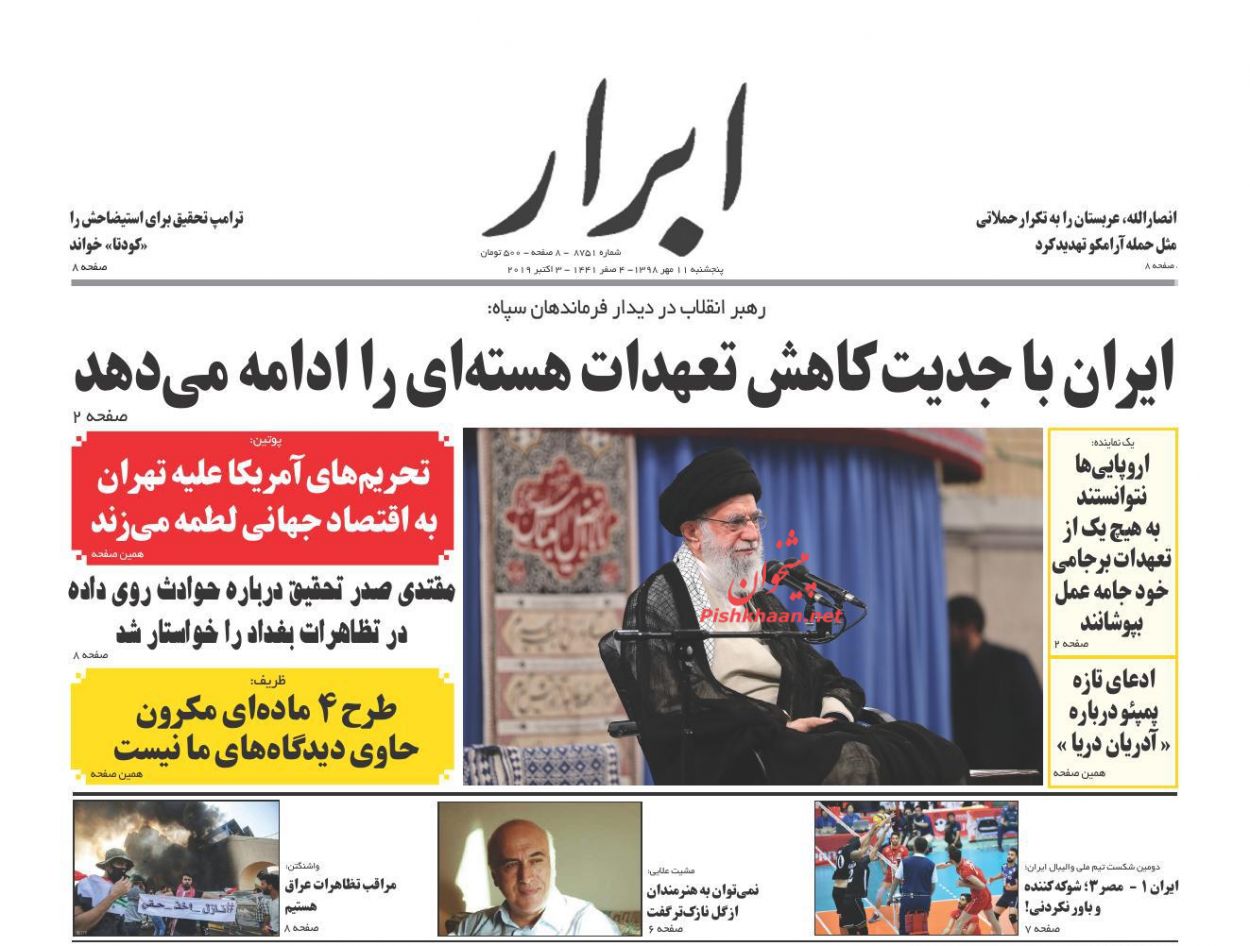
His position, in addition to showing Iran’s indomitability or resistance against President Trump’s and his favorite regional allies’ so-called “maximum pressure” policy, is aimed at unifying Iran’s foreign policy approach, as well as convincing the country’s political factions that it is futile to negotiate with the US in a time of political inequality.

Over the past year, the issue of possible negotiation with the US has been heavily debated by Iranian politicians. Proponents of negotiation depict the status of Iran-US relations as the “dilemma of either war or negotiation,” meaning that Iran should negotiate with the Trump administration on matters of regional significance—in return for a reduction in US economic pressure—lest the tensions between the two countries ultimately lead to a war, which would be detrimental to Iran’s national security and its interests.

The main argument made by opponents of this view has been that the imminence of a possible war between Iran and the US in essence relies upon a mistaken assumption. Donald Trump, they argue, is unlikely to act against his presidential campaign promises to reduce the US military footprint overseas. Trump, according to this view, understands the potential cost of a risky and unpredictable war with Iran, and realizes that it could be detrimental to his chances of being reelected.

In that framework, adopting the Leader’s position of “no war, no negotiation” achieves several aims. First, uniting Iran’s foreign policy approach can shift Iran’s domestic politics to resist Trump and those European countries that believed, at least initially, they could benefit from Trump’s hardline “maximum pressure” policy to gain further concessions from Iran on regional issues and on limiting its missile program.

Second, the “no war, no negotiation” policy shows that Iran is prepared to face a possible conflict with the US under any circumstances. Iran believes that it has the capability to defend itself against the US through both symmetric and asymmetric means, via its conventional military means and through its friendly forces in the Middle East that can, if necessary, endanger US interests.

Third and most significantly, this approach minimizes political polarization within Iran when confronting US sanctions. By connecting the issue of US economic sanctions to the more significant issue of national security and the broader threat of instability and even the possible collapse of the “state,” the Leader has been able to enhance the logic of “maximum resistance” in Iranian politics. This is made easier because, from the Iranian perspective, blame for the new wave of hostility between Iran and the US lies with the Trump administration and its withdrawal from the internationally-recognized 2015 nuclear deal (Joint Comprehensive Plan of Action or JCPOA) in order to act against Iran’s interests.

Cohesion in Iranian foreign policy sends two main messages to the remaining parties to the JCPOA—China, France, Germany, Russia, and the United Kingdom. First, it says that Iran will not reverse its strategic decision to resist Trump’s excessive demands and that it has the necessary capabilities to counter them. In this respect, Iran has incrementally reduced its nuclear commitments under the JCPOA—most recently restarting in full nuclear research & development activities that had been restricted until the agreement. These actions have been meant to send a message to European countries that have yet to fulfill their JCPOA commitments. In the end, it is Europe that has the most to lose from the possible collapse of the nuclear deal. Second and concurrently, Iran is making it clear that it will not compromise on its regional policies or missile activities, which have their own logic of deterrence and preemption in the context of national security threats.

In other words, “security” and “economy” are the two interconnected priorities in the realm of Iran’s foreign policy conduct, aimed at strengthening the “state” of Iran and its legitimacy. Contrary to some Western views, the three above-mentioned aims are fully consistent with the viewpoints of the moderate government of Iranian President Hassan Rouhani, which is frustrated and disappointed with the current Western approach, mainly for not ensuring that the Iranian people receive tangible economic benefits from the JCPOA. Now, Iranian Foreign Minister Mohammad Javad Zarif regards the implementation of the Leader’s strategy to be in the benefit of the country’s national interests.

For instance, and in the realm of preserving security, the entire Iranian political spectrum unanimously supported the June 20 shooting down of a US RQ-4A Global Hawk drone, based on the logic of preempting a broader ongoing security threat. In fact, Iran wanted to send the message that it would not tolerate any breach of its territorial borders and would react similarly if such actions are to be continued—and that it could trigger insecurity for any US regional allies who facilitate the Trump administration’s escalatory policies.

Also in the realm of economic security, the seizure of a British-flagged oil tanker by the naval forces of Iran’s Islamic Revolutionary Guard Corps (IRGC) in the Persian Gulf is indicative of Iran’s resolve to take reciprocal action, as well as preempting similar hostile moves by those countries involved in the current “zero-export-oil” economic war against it. In seizing the vessel, Iranian officials made it plain that economic insecurity for Iran is equivalent to economic insecurity for those countries that participate in the “maximum pressure” policy, which from Iran’s perspective and in Zarif’s words is a type of “economic terrorism.”

Adopting the strategy of “no war, no negotiation” is a testament to Tehran’s existing sense of strategic distrust towards the US Iran believes that the US aims to diminish the sources of power of the “state” of Iran. For decades, indeed, the focus of US Middle East policy has been to contain Iran’s emerging regional influence. But both geography and historical-religious commonalities with its neighbors will define Iran’s regional status, not US policy. These factors necessitate that Iran actively integrate with the region’s political-security and economic trends, mainly for the sake of preserving its national security and economic prosperity. From a realistic perspective, many emerging powers such as India and Turkey are pursuing a more active regional role, commensurate with their territorial and demographic size, vast economic potentials, and most importantly based on the emerging security conditions in their spheres of influence.

In this respect, it would be rather simplistic to think that the firing of John Bolton, the most anti-Iran figure in the Trump administration, will pave the way for a substantive meeting between President Rouhani and President Trump in the near future. Undoubtedly there is always the possibility of a meeting. But given the current mutual sense of strategic distrust that exists between the two sides, such an encounter would not achieve any meaningful results.

Iran’s aims are clear: strengthening its deterrent power, in order to preempt security threats from within the region and beyond, and diversifying and strategizing its economic structure, relying on the sources of its national power. One significant way to achieve these aims is to value the dynamic of regional integration and good neighborhood relations. The Trump administration is trying to block Iran’s path to achieving these aims by creating an anti-Iran political-security coalition in the region, as well as ratcheting up sanctions at the expense of Iran’s economic growth and development.

Indisputably, the Leader’s main goal is to diminish the possibility of a conflict with the US through strengthening the scale of Iran’s national power and depolarizing the nation in this time of crisis. Accordingly, Iran’s assertive reactions to perceived security and economic threats are aimed at preempting broader threats for the survival of the “state” of Iran. In abrogating US obligations under the JCPOA, President Trump has lost Iran’s public, who sincerely at one time wanted their government to interact with the US and resolve the existing strategic discrepancies in the US-Iran relationship. This development is the main reason behind the failure of Trump’s “maximum pressure” policy.

At present, the causes of Iranian distrust toward the US, which was previously institutionalized among Iranian officials, have extended to the Iranian public as well, diminishing the possible political benefits to any negotiations with the Trump administration. As a result, Iran is gradually learning to consider the West as only one part of the current multilateral world. This sense of understanding is new and is likely to completely change the Iran-West equation in the coming decade.

In the light of these considerations, meaningful negotiations between Iran and the US will only occur when the two sides manage to withdraw from the current mutual sense of strategic distrust and when concurrently the idea of such negotiations is supported amid the two countries’ domestic politics—especially on Iran’s side. In my experience, only by strengthening its position and security situation will Iran be able to return eventually to the idea of talking with the US The JCPOA was negotiated under similar conditions. Therefore, President Trump’s efforts to weaken Iran first and then initiate negotiation with the country are doomed and will only perpetuate previous, failed US policy toward Iran.

(Source: Leblog)

Bread, Grain Industry Exhibit Opens in Tehran

Industries producing bread-making and grain harvesting machines, producers of enzymes used in the food industry, silo producers and other subsidiary industries have put on display their latest achievements at the event.

The exhibit aims to build the culture and improve the pattern of grain, flour and bread consumption, boost trade activities and investment in this industry, lay the groundwork for exports to further support domestic producers, etc.

The event runs from September 13-16, 2019.

New Phase of South Pars Gas Field to Become Operational: Oil Minister

Bijan Namdar Zanganeh said part of Phase 11 is expected to enter service by September 2021.

“From now on, we plan to sign one contract and set in motion one development plan every two weeks and we will show that the development of the country’s oil industry has not stopped under sanctions,” said he minister in a ceremony where a contract was signed between the Belal Gas Field with the Iranian Petropars company.

Pars Oil and Gas Company (POGC), a subsidiary of the National Iranian Oil Company (NIOC), finalized a $440m deal with Petropars Company on Saturday for developing Belal Gas Field in the Persian Gulf.

New Phase of South Pars Gas Field to Become Operational: Oil MinisterThe buyback contract, which is to be enclosed to the integrated and master development plan of South Pars phases 11 to 24, is aimed at daily production of 500 million cubic feet (an equivalent of 14 million cubic meters per day) of rich gas in 34 months. The produced gas will be processed at the onshore refinery of South Pars Phase 12.

Based on the deal, Pars Oil and Gas Company (POGC) will serve as the employer of the contract and will carry out reservoir studies and arrange sideline licensing rounds for the purposes of the project. Accordingly, the company is required to tap the capabilities of local manufacturers and contractors.

For its part, the contractor of the project, Petropars, is required to drill 8 wells in the offshore field, launch wellhead jackets and build and install a topside with 500 mcf/d of gas production capacity as well as a seabed pipeline with an estimated length of 20 kilometers.

Belal Gas Field is located east of South Pars in the Persian Gulf and 90 km southwest of Lavan Island.


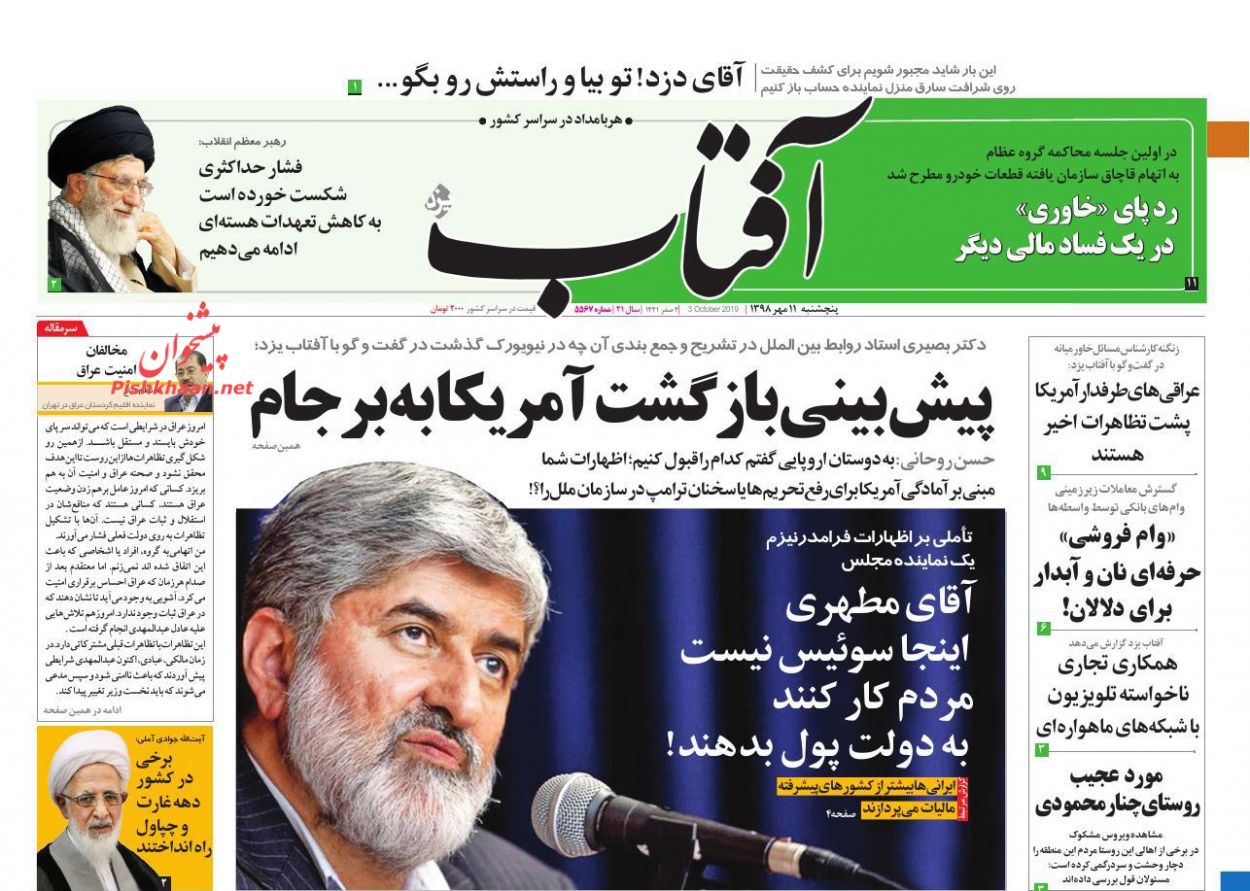
Bolton’s Dismissal No Reason for Optimism: Senior MP

In an interview with the Islamic Republic News Agency (IRNA), Falahatpisheh said Bolton had adopted a hard-line approach toward Iran, but now his removal should not lead to the adoption of an approach of optimism in Iran.

“Trump should know that diplomacy is revived only when the 915 anti-Iran sanctions are reversed,” said the former chairman of the Iranian Parliament’s National Security and Foreign Policy Commission.

“The removal of Bolton is closely related to Iran and a region where Iran is the strongest, a region part of which constitutes the Persian Gulf and the Arab Middle East, and another part makes up Afghanistan,” said Falahatpisheh.

“Based on a policy enforced by the United States, Bolton had been banned from adopting any stance on the Islamic Republic of Iran since three or four months ago; after Bolton formulated a series of hard-line policies and goals with regards to Iran, his anti-Iran stances began to fade because of the White House ban,” he added.

The lawmaker said Bolton’s anti-Iran policies growing weaker in recent months as well as his dismissal means the policy of exerting pressure on Iran has failed.

“My analysis earlier was that if Trump seeks a solution with regards to the Iran case, he has to fire Bolton,” the top legislator noted.

Pompeo My Be Sacked Too

Falahatpisheh said US Secretary of State Mike Pompeo might be fired as well following the failure of Washington’s policies.

“In line with the failure of White House policies of exerting pressure on Iran, there is a possibility of US Secretary of State Mike Pompeo being removed from office,” he explained.

“Pompeo and Bolton each had the role of a blade in the US scissors policy toward Iran,” he said.

“Bolton was pursuing a hard policy vis-à-vis Iran and Pompeo was pushing on with the soft policy and psychological warfare against the Islamic Republic of Iran,” the legislator said.

“Now, the US scissors against Iran has lost a blade, and the US secretary of state is on shaky ground, too,” the MP noted.

He described Iran’s downing of a US spy drone as a watershed in Tehran-Washington relations.

“With the downing of this drone, the Americans, for the first time, faced a regional player that has established a kind of balance in the region with its power and made the US and its allies talk with Iran based on this very balance,” said the MP.

He said Bolton’s dismissal is related to Iran, but does not mean Washington’s change of heart and return to the Iran nuclear deal.

“[However,] Bolton’s removal from his position as the White House National Security Advisor indicates the failure of those who believed a policy of pressure against Iran would be effective,” he said.

“Trump knows if he gets to understand the realities associated with [US] relations with Iran and the region, it will be problematic for him; the dismissal of Bolton can be analyzed in this context; when Bolton assumed office, Zionist circles regarded his taking power as tantamount to the irreversibility of the US war with Iran,” the legislator said.

“Bolton tried openly in terrorist and anti-Iran meetings to mobilize different terrorist groups against Iran, but now he has been sidelined,” he added.

“The policy defined for Pompeo is similar to the instruction that the White House had defined for Bolton three or four months ago, and it was related to moderating his stances toward Iran,” he said.

“The dismissal of the White House national security advisor shows Trump hasn’t got the desired result from adopting a hard policy in the world, especially toward the Islamic Republic of Iran, and if he continues pursue the same policy when the election year in the US begins, he will definitely lose the election” the legislator said.

Prominent Iranian Businessman Asgaroladi Dies at 86

Asgaroladi, who was also a member of the central council of leading conservative Islamic Coalition Party, passed away in Tehran a few days after being admitted to the hospital for brain damage.

AsgaroladiBorn in 1934 to a merchant family in downtown Tehran, Asadollah turned into a business mogul by exporting dried fruit, nuts, and cumin, and importing sugar and home appliances, especially from China.

The deceased had close business ties with China, and was believed to be one of the richest men in Iran with an estimated fortune of $8 billion, according to Fararu news website.

Asgaroladi advocated the promotion of exports and support for the private sector, and was an opponent of the economic policies of former Iranian president Mahmoud Ahmadinejad.

AsgaroladiIn an interview with Asr-e Iran news website, Asadollah had said he took pride in being a billionaire without amassing any fortune through illegal activities or collusion.

“I even avoid taking out bank loans, and I said that I’m not engaged in imports either, not because I may deem imports wrong; no, I do not deem it bad, but I have promised myself to deal with the exports. Anyway, I am not the king of Iran’s billionaires,” he had said in the interview.

Asadollah’s younger brother, Habibollah, was a renowned politician and a minister of commerce in the 1980s. Habibollah, who had played a role in the victory of Iran’s 1979 Revolution, died in November 2013.

Asadollah Asgaroladi once announced that he had begun his business career as a teenager, when he had to work hard by day and study by night. He used to attend classes in the economy and law faculties, although he had been admitted to the faculty of literature.

“I started my first bargain by buying a sack of sesame for 53 tomans from Tehran’s bazaar, and I sold that sack of sesame for 70 tomans to the bakery of our neighbourhood. This was my first profit in trading, dating back to 1948,” he once said in an interview.

Asgaroladi said he had been distributing groceries with his first car, a Volkswagen, in 1954, but decided to become a merchant in 1955.

Asgaroladi“I went to the Chamber of Commerce to get a commercial card, but I was younger than the age limit of 24. The deputy chairman of the chamber decided to test me… I recall that he asked me 20 questions about the currency of countries, shipment of goods and so on. I answered the questions entirely, and that deputy chairman called my reference and told him, ‘He must take my place’,” Asadollah said.

He later expanded his business by exporting cumin to Singapore and New York. “I worked hard and began my trips, until a day that I was dictating the price of cumin in the world and Iran.”

Asgaroladi said he was deeply impressed by a sentence he had once read below the statue of Rockefeller at the Empire State Building in his first visit to New York City, quoting the legendary US businessman as saying that he owed his success to three principles: “I was informed earlier than the others, I made decisions before the others, and when I made my mind, I closed my eyes and took action.”

“I gained everything from nothing and zero. Now that I look back, I see that efforts, reliance on God, faithfulness and reading helped me achieve the today’s success,” the deceased had said.

How to Lose Weight Quickly

While endless diets, supplements, and meal substitution plans claim to guarantee fast weight loss ( Ketogenic Diet Review ), most lack any scientific evidence. However, there are some science-backed strategies that affect weight management.

These approaches include exercising, tracking calorie consumption, fasting intermittently, and decreasing the number of carbohydrates in the diet. We consider nine efficient weight loss techniques in this article.

Scientific Ways of Losing Weight

Weight loss methods supported by science studies include:

  1. Trying to fast intermittently

Intermittent fasting (IF) is an eating pattern that includes periodic short-term fasts and eating meals during the day within a shorter period of time. Several studies have shown that short-term intermittent fasting leads to weight loss in overweight people, which is up to 24 weeks in length.

The most prevalent intermittent techniques of fasting include:

Alternate Day Fasting (ADF): Fast every other day and eat on non-fast days usually. The altered version includes eating just 25–30% of the power requirements of the body on days of fasting.

The diet of 5:2: Fast on 2 out of 7 days. Eat 500–600 calories on days of fasting.

Method 16/8: Fast for 16 hours and eat only in a window of 8 hours. The 8-hour window would be around midday to 8 p.m. for most individuals. Research on this technique discovered that eating during a limited period resulted in fewer calories being consumed by respondents and weight loss.

In non-fasting days, it is best to follow a healthy eating pattern and prevent over-eating.

  1. Tracking and exercising your diet

They should be conscious of everything they eat and drink every day if someone wishes to lose weight. The most efficient way to do this is to log in to a journal or online food tracker every item they eat. Researchers estimated that 3.7 billion health app downloads would be available by the end of the year in 2017. Among the most popular were diet applications, physical activity, and weight loss. This is not without reason, since tracking on-the-go progress in physical activity and weight loss can be an efficient way to manage weight.

  1. Eat attentively

Conscious eating is a practice in which individuals pay attention to how and where they consume food. This exercise can provide individuals with the opportunity to enjoy the food they eat and keep a good weight. As most individuals lead a busy life, on the run, in the vehicle, working at their desks, and watching TV, they often tend to eat rapidly. As a consequence, the food they eat is scarcely known to many individuals.

Sitting down to eat, preferably at a table: pay attention to the food and appreciate the experience.

Do not turn on the TV or a laptop or phone while eating.

Slowly eating: take time to chew and enjoy the food. This method helps with weight loss as it provides sufficient time for a person’s brain to acknowledge the signals they are complete, which can assist avoid over-eating.

Making considered food decisions: choose foods that are full of nutrients and foods that fulfill them for hours, not minutes.

  1. Eat breakfast protein

Protein can control the hormones of appetite to assist individuals to feel complete. This is mostly due to a decline in hunger hormone ghrelin and an increase in YY, GLP-1, and cholecystokinin satiety hormones. According to https://www.ketogenicsupplementsreview.com/ Young adult research has also shown that the hormonal impacts of eating a high-protein breakfast can last for several hours. Eggs, oats, nut and seed butter, quinoa porridge, sardines, and chia seed pudding are good options for a high-protein breakfast.

It is important to remember that there are no quick fixes when it comes to weight loss.The best way to reach and maintain a healthy weight is to eat a nutritious, balanced diet.This should include 10 portions of fruit and vegetables, good-quality protein, and whole-grains. It is also beneficial to exercise for at least 30 minutes every day.

Iran Strongly Condemns Canada’s Illegal Sale of Its Assets

US Will Fail to Extend Iran’s Arms Embargo: Spokesman

In a Friday statement, Mousavi said the government of the Islamic Republic of Iran will not compromise with any other government when it comes to protecting the rights of its citizens.

He called for the immediate return of the buildings and properties, warning that if the illegal decision is not revoked and the damages are not compensated, the Islamic Republic of Iran will take action by itself based on international regulations in order to restore its rights.

In this case, he added, the Canadian government will be responsible for all its consequences.

Global News announced on Thursday that tens of millions worth of seized Iranian properties have been sold off in Canada and the proceeds handed to victims of terrorist attacks blamed on Iran and its proxy groups.

According to a document filed in the Ontario Superior Court of Justice last month, the victims got a share of the money earned through the sale of Iran’s buildings in Ottawa and Toronto.

The properties went for more than $28-million, documents show. The recipients were victims of Hamas and Hezbollah — terrorist groups bankrolled, armed and trained by Iran.

The Ottawa property, which had been the Iranian Cultural Centre, was particularly valuable. Marketed as a “transit-oriented development opportunity on the apron of the University of Ottawa,” it sold to a Montreal developer for $26.5-million.

The Toronto property, which was owned by a company headed by an embassy official and served as the Centre for Iranian Studies, went for $1.85-million.

The claimants included the family of Marla Bennett, a US citizen killed in a 2002 bombing blamed on the Palestinian resistance group Hamas, and Edward Tracy and Joseph Cicippio, who were allegedly taken by Lebanon’s Hezbollah from 1986 to 1991.

The court sided with the victims and awarded them Iran’s assets.

In addition to the proceeds of the sale of the properties, the victims were awarded a share of some $2.6-million seized from Iran’s bank accounts. Documents also list a Toyota Camry and Mazda MPV.

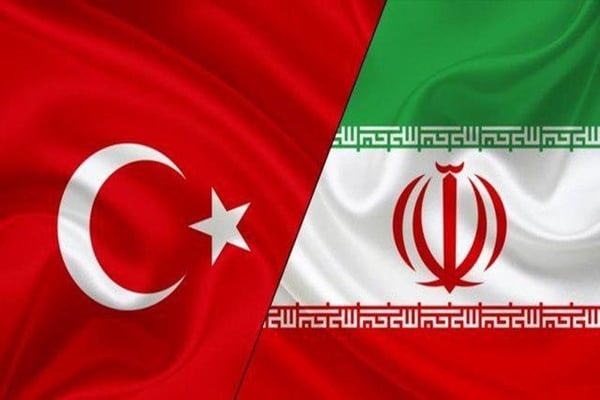
Rouhani to Join Putin, Erdogan in Ankara for Syria Talks

“President Hassan Rouhani will travel to Ankara to attend and address the fifth round of trilateral talks between Iran, Russia, and Turkey, which is to be held on Monday, September 16,” said Parviz Esmaeili, the deputy chief of the president’s office.

The meeting will be held as part of consultations between the three guarantors of the Astana Process in order to settle the Syria crisis, Esmaeili added.

“In addition to negotiations within the framework of the trilateral summit, the three leaders will also hold talks on the continuation and expansion of tripartite collaborations in various economic fields, as well as regional communications,” he noted.

The Iranian president will also hold bilateral talks with Turkish President Recep Tayyip Erdogan and Russian President Vladimir Putin on the sidelines of the summit, and confer with them the most important issues in bilateral relations, Esmaeili said.

Rouhani will be accompanied by a high-ranking political-economic delegation during the one-day visit.

Speaking after Friday prayers, Erdogan said at the trilateral summit with Russian and Iranian leaders, he would discuss recent developments in Idlib, Syria.

“We will continue to discuss developments in Idlib, including observation posts and the fight against terror organizations,” he said.

Turkey and Russia agreed last September to turn Idlib into a de-escalation zone where acts of aggression are expressly prohibited.

Under the deal, Turkey-backed militants in Idlib would remain in areas where they were already present, while Russia and Turkey would carry out joint patrols in the area to prevent a resumption of fighting.

Tehran Hosting Exhibition of Contemporary Ashura Paintings

The exhibition was kicked off on September 1, the first day of the lunar month of Muharram, at Imam Ali Museum of Religious Arts in Tehran.

What follows are Honar Online’s photos of the exhibition, which has put on display works by 27 prominent contemporary artists:

Canada Sells Two Iranian Buildings to Compensate ‘Terror Victims’

The victims have received their share of the money earned through the sale of two Iranian-owned buildings in Ottawa and Toronto, according to a document filed in the Ontario Superior Court of Justice in August.

The valuable Ottawa property, sold for $26.5 million, was used as the Iranian Cultural Center, and the Toronto building, sold for $1.85 million, served as the Center for Iranian Studies, the Global News reported.

In addition to the $28 million earned from the sale of the two properties, the victims were also awarded a share of some $2.6 million seized from Iran’s bank accounts. Documents also list a Toyota Camry and Mazda MPV.

The recipients include several American families who have filed claims in the Ontario and Nova Scotia courts, seeking a share of Iran’s assets seized by the Canadian government.

In particular, they include the family of Marla Bennett, a US citizen killed in a 2002 bombing that rocked the Hebrew University in Jerusalem al-Quds.

The attacks are mostly blamed on Palestinian and Lebanese resistance movements Hamas and Hezbollah. The families claimed that the Iranian government supported the two organizations and was therefore responsible for their actions.

The complaints were first filed in the US but the claimants turned to Canada after finding out that the Iranian government had more properties and bank accounts there.

In July 2017, a Canadian court required the Islamic Republic to pay around $1.7 billion in damages to “American victims of terrorism.”

Iran has denied any role in the attacks which the courts have based their cases to appropriate the country’s frozen assets.

Tehran had argued that the victims had to prove Iran’s role in each attack instead of just repeating the US government’s baseless allegations.

The seizure and sale of Iranian assets in Canada come as the country has turned into a center of fraud and a safe haven for embezzlers who manage to escape justice in the Islamic Republic of Iran, according to Iran’s prosecutor general Mohammad Jafar Montazeri.

Mahmoud Reza Khavari, a former Iranian banker, fled to Canada after a $2.6 billion financial fraud came to light in 2011. He was sentenced to 30 years in prison and the Interpol issued a warrant for him in December 2017.

Marjan Sheikholeslami, accused of embezzling public funds in Iran in two separate cases, has also fled to Canada. In 2010, amid the international sanctions on Iran, she founded various companies in Iran and Turkey to help Iran bypass the sanctions and sell its petrochemical products, but has reportedly refused to pay back the government’s money.