Wednesday, December 24, 2025
Home Blog Page 3100

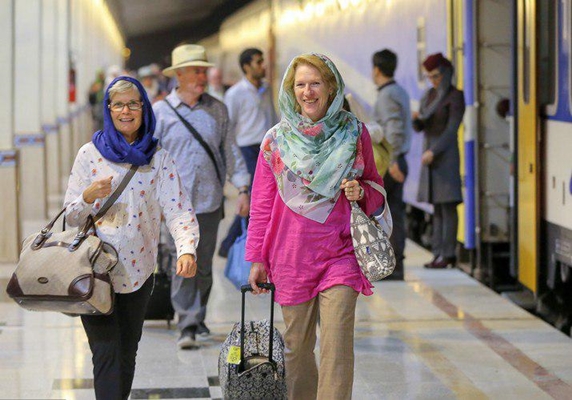
ICOMOS to Assess Iran’s Rail Corridor for Recognition as Industrial Heritage

Lorestan Railway

“These evaluators would arrive in Iran late September or early October to carry out a field research on the case for two weeks,” Mohammad Hassan Talebian, Iran’s Deputy Cultural Heritage Minister, said in an interview with Miras-e Arya.

“ICOMOS representatives will submit their reports to the UNESCO for the global registration of the Iranian Railway Corridor as the first industrial heritage case in Iran,” he added.

Talebian further noted that the evaluators will be field-researching the case, which includes stations and railways, as well as the natural and historical heritage.

The Iran Rail Corridor case is to be presented to UNESCO to be registered as the first Iranian industrial heritage in 2020.

The registration of the old rail corridor of Iran is a matter beyond the registration of a single building and will include all stations, plus the historical, cultural and social context that stretches from the south to the north of the country.

Iran, India Hold 16th Round of Political Consultations

The meeting was attended by Iranian Deputy Foreign Minister for Political Affairs Seyyed Abbas Araqchi and an Indian delegation led by the country’s Foreign Secretary Vijay Keshav Gokhale.

During the negotiations, the two diplomats exchanged views on different bilateral, regional and international issues. They also reviewed a road map for reciprocal ties over the next one year.

The two sides expressed content over the positive effects of using national currencies and the considerable rise in the volume of Iran-India trade over the past year.

They also underlined the necessity of further enhancing mutual ties, especially in key areas such as trade, transportation, science and technology, industry, communications, banking and insurance as well as investment.

Araqchi also underscored the need to settle the Kashmir issue through talks between India and Pakistan by focusing on peaceful and fair approaches.

Given historical bonds between Iranian people and Muslims in Kashmir, the top Iranian official expressed hope that the rights of Muslims in Kashmir are respected and the restrictions imposed on them are removed.

Iran Nuclear Chief Urges World to Condemn US’ Behaviour

Salehi made the remarks in an address to the 63rd General Conference of the International Atomic Energy Agency held in Vienna on Monday.

What follows is the full text of his statement:

In the Name of Allah, the Compassionate, the Merciful

Madam President,
Acting Director-General,
Excellencies,
Ladies and Gentlemen,
It is a pleasure for me to join you, here today, at the 63rd General Conference of the Agency. I would like to seize this opportunity to congratulate you, Madam President, on your election. Let me also pay tribute to the late Director General, Mr. Yukiya Amano for his prudent leadership over the past years and express our heartfelt condolences for his passing away.

Madam President,
At this critical point in time for multilateralism, this session of the General Conference is a unique opportunity to explore the challenges and locate our own places in addressing them. Considering the time-limit, I would like to confine myself to some salient issues, and draw the attention of the distinguished audience to my written statement which will be released afterwards.
The Islamic Republic of Iran holds sensible objectives for expansion of its peaceful nuclear program and application of nuclear technology in the fields of power generation, health and agriculture and has made reasonable success and progress in this regard. Based on its vast capacities, especially its young and highly talented scientists, Iran welcomes engagement with technologically interested partners.
Nuclear safety has always been one of our highest priorities. All safety measures of our nuclear facilities including Bushehr Nuclear Power Plant (BNPP) have been meticulously observed under strict supervision of Iran Nuclear Regulatory Authority. Last year, the OSART mission conducted an in-depth review of Bushehr Nuclear Power Plant with an acceptable conclusion.
The Islamic Republic of Iran believes that the responsibility of nuclear safety and security rests entirely with Member States and the measures and initiatives aimed at their strengthening must not be used as a pretext or leverage to violate, deny or restrict the inalienable rights of developing countries to research, production and use of nuclear energy for peaceful purposes without discrimination.
Iran has made progress in establishing a nuclear safety center as a technical support organization of its regulatory body that would be equipped with modern technologies and equipment through cooperation with the EU. Iran is closely monitoring and reviewing the progress in the domain of nuclear conventions and our Parliament recently ratified the accession bill to the Joint Convention on the Safety of Spent Fuel Management and on the safety of Radioactive Waste Management, which will be completed upon its final approval.
Iran puts emphasis on establishing regional networks as to enhance nuclear safety and address emergency situations and by relying on its vast experience, knowledge and capabilities, express its readiness for joint cooperation with all the regional countries.
The Islamic Republic of Iran is determined to provide optimum security for its nuclear facilities and material and recently hosted an Interregional Workshop on Introduction to Nuclear Security Detection Architecture, in cooperation with the IAEA in July 2019.

Madam President,
On the top, allow me to elaborate on the current status of the Joint Comprehensive Plan of Action (JCPOA). There is a broad agreement among the international community that the JCPOA is a real turning point in the history of multilateralism as an important international achievement.
Against lifting of nuclear related sanctions, Iran has accepted some provisional limitations on its nuclear program and provided unprecedented level of monitoring and access to the IAEA in the context of new commitments under the Additional Protocol and the JCPOA itself. In this regard, it is noteworthy that with only 3% of worldwide nuclear facilities, Iran has provided almost 20% of all Agency accesses.

At the same time, the Islamic Republic of Iran has always made it clear that acquiring, producing, stockpiling, and eventually the use of weapons of mass-destruction is neither legitimate under religious principles nor envisaged in Iran’s defense doctrine;
Amidst such an unprecedented record of verification and transparency in the history of the IAEA, and the principled position of Iran on nuclear weapons, the nuclear deal has been called by the US administration, the worst of the deals in the history of that country. It is noteworthy that the US itself has developed all categories of weapons of mass destruction, including nuclear weapons, even used it against others, and in its Nuclear Posture Review threatens specific countries with use of such weapons.
Although the deal has been praised as an outstanding achievement of years of diplomatic efforts, respective states have failed to go beyond expressing regret for the violation of the UNSC Resolution 2231 by the US administration.
The outcome of the deal for us has now turned into inhumane and illegal sanctions against our trade, economy and foreign investments in clear contradiction with the provisions of the JCPOA and the UNSC Resolution. Unfortunately, such sanctions have also affected areas such as food, medicine, radiopharmaceutical products, and even Iran’s Nuclear Regulatory Authority (INRA).
It should be emphasized that the JCPOA as a multilateral deal, encompasses rights and responsibilities for all parties, therefore, implementation of this deal by only one party is not a legitimate expectation, nor a practical possibility. I would like to ask the awakening conscience of the esteemed audience here; that having such an extensive cooperation with the Agency beyond the standard obligations under the CSA, and also having fully implemented our commitments under the nuclear deal without reaping its benefits, is it still fair for Iran to continue to implement the deal only at its own expense? what should then have been our fair and just reaction? Nevertheless, after the unilateral withdrawal of the US from the JCPOA, Iran has shown strategic patience for more than a year, to allow the remaining parties to the deal to fulfill their commitments, including compensation of the effects of this withdrawal.
While respecting all good offices made so far by several countries with a view to save the JCPOA, unfortunately, we are still far from realizing the basic objectives of the deal and meeting the legitimate demands of Iran. Hence, there was no option for Iran other than resorting to the relevant provisions of the JCPOA to cease partially its commitments in order to provide a new window for diplomacy to preserve the deal.
It should be noted that Iran’s partial cessation of its commitments is reversible in case of full and effective implementation of the JCPOA by the remaining parties to the deal.
I would like to highlight that the preservation of the JCPOA is a common responsibility of all members of the international community. If the international community fails to save the JCPOA promptly, multilateralism will lose its effectiveness, and any further peaceful resolution of the conflicts will be challenged, which will consequently serve the malign interest of war-mongers.

Madam President,
We reiterate our conviction that the only remedy for international nuclear security lies within nuclear disarmament. We call for full implementation of Article VI of NPT and express our concern that not only the nuclear weapon States stand firm on retaining their arsenals and delivery systems, but also some of them actively pursue to modernize and even threaten to use them. This environment creates a disparity between rights and obligations of non-nuclear weapon States with those of nuclear weapon States, which is against the provisions of NPT.

Establishment of the Middle East nuclear weapon-free zone is a necessity for international peace and security and is a global demand. However, the Israeli Regime and its illegal and illegitimate nuclear weapons program has been the main obstacle in this regard. We call for the IAEA to take urgent action and address this blatant violation of non-proliferation regime and the only obstacle for establishment of the Middle East nuclear weapon-free zone.

To conclude, Madam President, the act of violation of the UN-Security Council resolution, and the imposition of unilateral unlawful sanctions as well as the application of extra-territorial national laws to other countries by the US, certainly endangers the international peace and security.

To bring back order to the current chaotic situation which multilateralism is facing, our individual or collective efforts should be directed at not only accomplishing new achievements, but also preserving the old hard fought ones as well. To this end, the destructive behavior of the US administration and the economic terrorism pursued by it against other countries should be condemned and rejected by the entire international community.

I thank you Madam President.

Iran’s President: Syria Crisis Has Only Political Solution

Addressing a trilateral summit of Iran, Turkey and Russia, held in Ankara on Monday, President Rouhani said the Islamic Republic maintains that the Syrian crisis would be resolved politically, through constructive interaction, and with the Syrian people’s involvement in the peace process.

“The Islamic Republic of Iran has always emphasized on the futility of military solution for ending the crisis (in Syria),” he noted, adding, “Preserving Syria’s territorial integrity, respecting its national sovereignty and independence, and non-interference of foreigners in that country’s internal affairs –on which we have always emphasize—must be seriously observed, and all necessary grounds for the return of stability, security and calm to this country should be prepared.”

He also noted that the main topics on the agenda of the three guarantors of the Astana Peace Process include the efforts to end the Syria crisis peacefully, fight against terrorism, help form the Constitutional Committee, contribute to the return of the displaced as well as the exchange of detainees and abductees, improve the delivery of humanitarian aids, reconstruct the war-hit country, and assess the international efforts in this regard.

The Iranian president also noted that the tripartite initiative developed by Iran, Turkey and Russia has proved successful after two and a half years and has helped Syria overcome the challenges and tensions.

Iran, Russia and Turkey are guarantor countries that brokered a ceasefire in Syria in December 2016, leading to the Astana talks, which are running parallel to the Geneva peace talks.

The leaders of the three countries regularly meet for an assessment of the process which focused on Idlib and adjacent areas – the last stronghold of the rebels – and a political process which awaits the formation of a constitutional committee.

Iran, Turkey Move to Broaden Trade Ties

The meeting of high-ranking delegations, co-chaired by President Hassan Rouhani and his Turkish counterpart Recep Tayyip Erdogan, was held in Ankara on Monday evening, ahead of a trilateral summit of Iran, Russian and Turkey on Syria peace efforts.
In the gathering, the two sides discussed the approaches to the implementation of bilateral agreements between Tehran and Ankara.
Hailing the “cordial and brotherly” ties between Iran and Turkey and the alliance of the two nations in all circumstance, President Rouhani praised Turkey for its clear stances on the US’ cruel sanctions against Iran.
“Despite the problems, Iran and Turkey will maintain economic relations in all fields,” he added.
Rouhani also emphasized that using the Iranian and Turkish currencies for bilateral trade will lead to a stride in their economic ties, noting that Iran welcomes the Turkish investors and private sector companies willing to carry out joint projects.
The Iranian president then touched on the mutual cooperation in the defense industry and the suitable grounds for cooperation and sharing experiences, noting that Iran and Turkey hold common views on the war against terrorism.
“The cooperation between Iran and Turkey for ensuring the security of common border and the region has continued, and will be enhanced,” he stated.
Rouhani also proposed that the cooperation among Iran, Turkey and Russia for ensuring regional security could grow into trilateral or even multilateral economic interaction among the neighbors and contribute to regional development and stability.
Iran feels duty-bound to ensure the security of regional maritime routes and attaches great significance to the security of the Persian Gulf, the Sea of Oman and the Strait of Hormuz, he added.
“Security of the region’s maritime routes must be ensured by the littoral states alone, and the presence of American forces and the invitations from the other countries asking them (the US) to come to the region will only add to the existing problems and tensions,” President Rouhani warned.
He further slammed the war on Yemen as a result of US miscalculation, adding, “We should all try to restore stability and calm to Yemen in collaboration with the United Nations.”
Rouhani finally pointed to the improved security in Syria after the cooperation among the three guarantors of the Astana Peace Process, urging that the supports for the Syrian government in the fight against the remaining terrorists in Idlib and east of the Euphrates should continue until terrorism will be uprooted in the Arab country.
For his part, the Turkish president said Ankara is determined to keep taking big strides in the expansion of the brotherly and friendly ties with Iran.
Lauding the remarkable rise in the trade ties between the two neighbors after the use of national currencies, Erdogan said, “The US sanctions against Iran are unconstructive, and from the Turkish government’s viewpoint, saving the JCPOA as the major symbol of success of dialogue and diplomacy has fundamental importance.”
He also said the Astana Peace Process and the tripartite agreements among Turkey, Iran and Russia prevented a “human tragedy” in different parts of Syria, expressing the hope that the Monday’s summit in Ankara would help stability and security prevail in the region, particularly in Idlib.
Iran, Russia and Turkey are guarantor countries that brokered a ceasefire in Syria in December 2016, leading to the Astana talks, which are running parallel to the Geneva peace talks.
The leaders of the three countries regularly meet for an assessment of the process which focused on Idlib and adjacent areas – the last stronghold of the rebels – and a political process which awaits the formation of a constitutional committee.

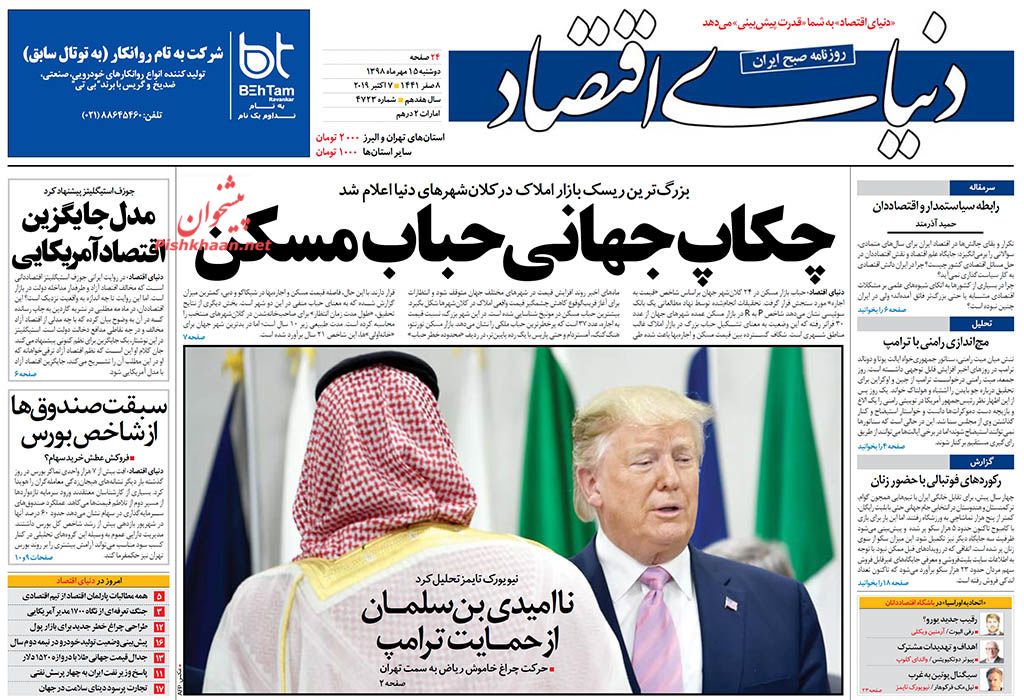
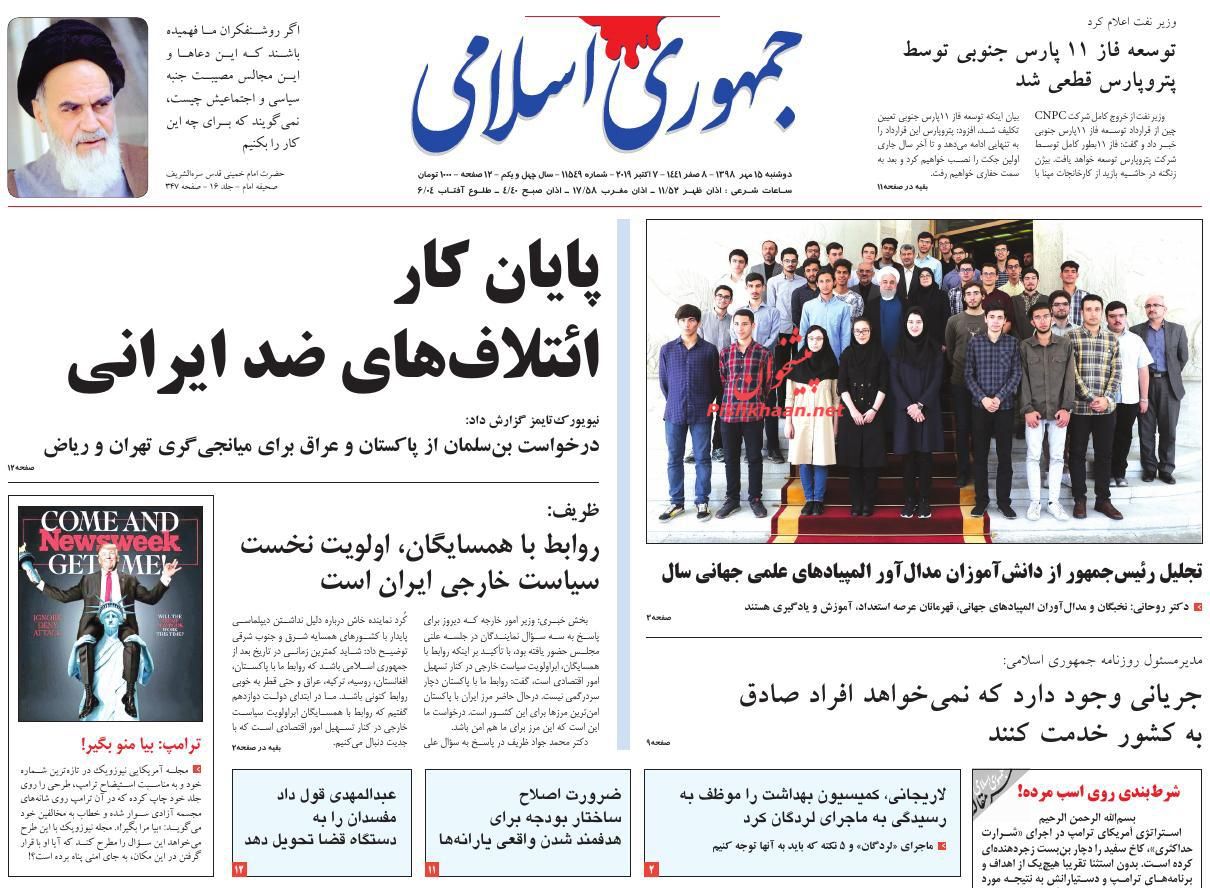
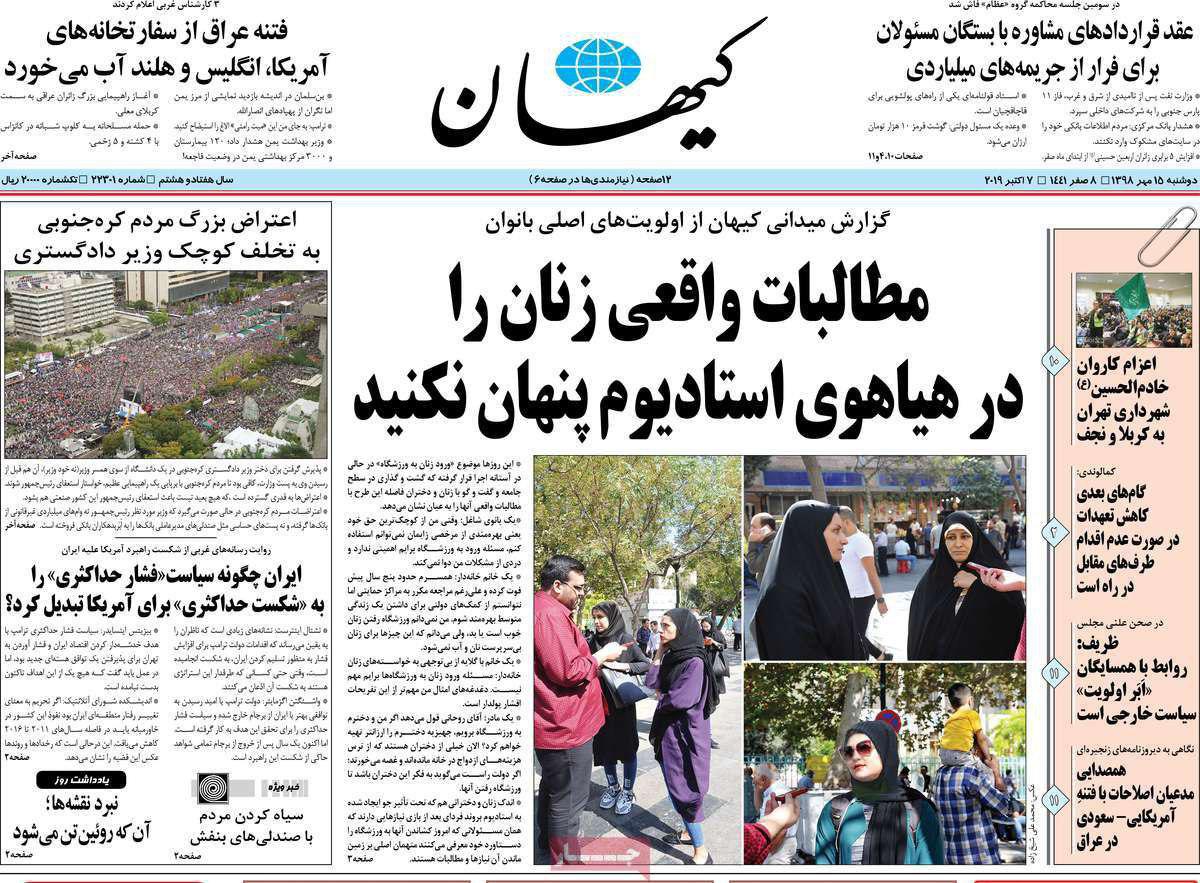
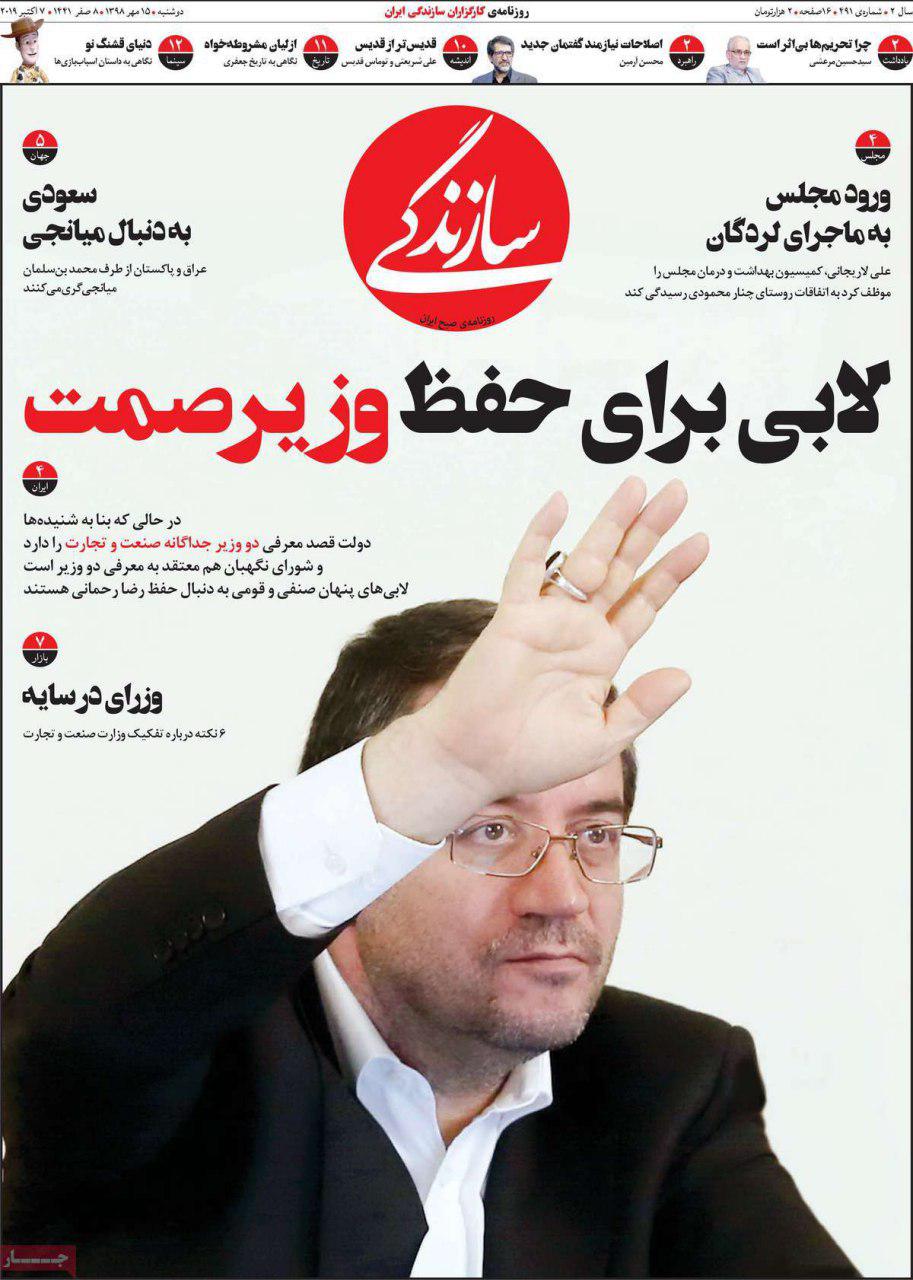
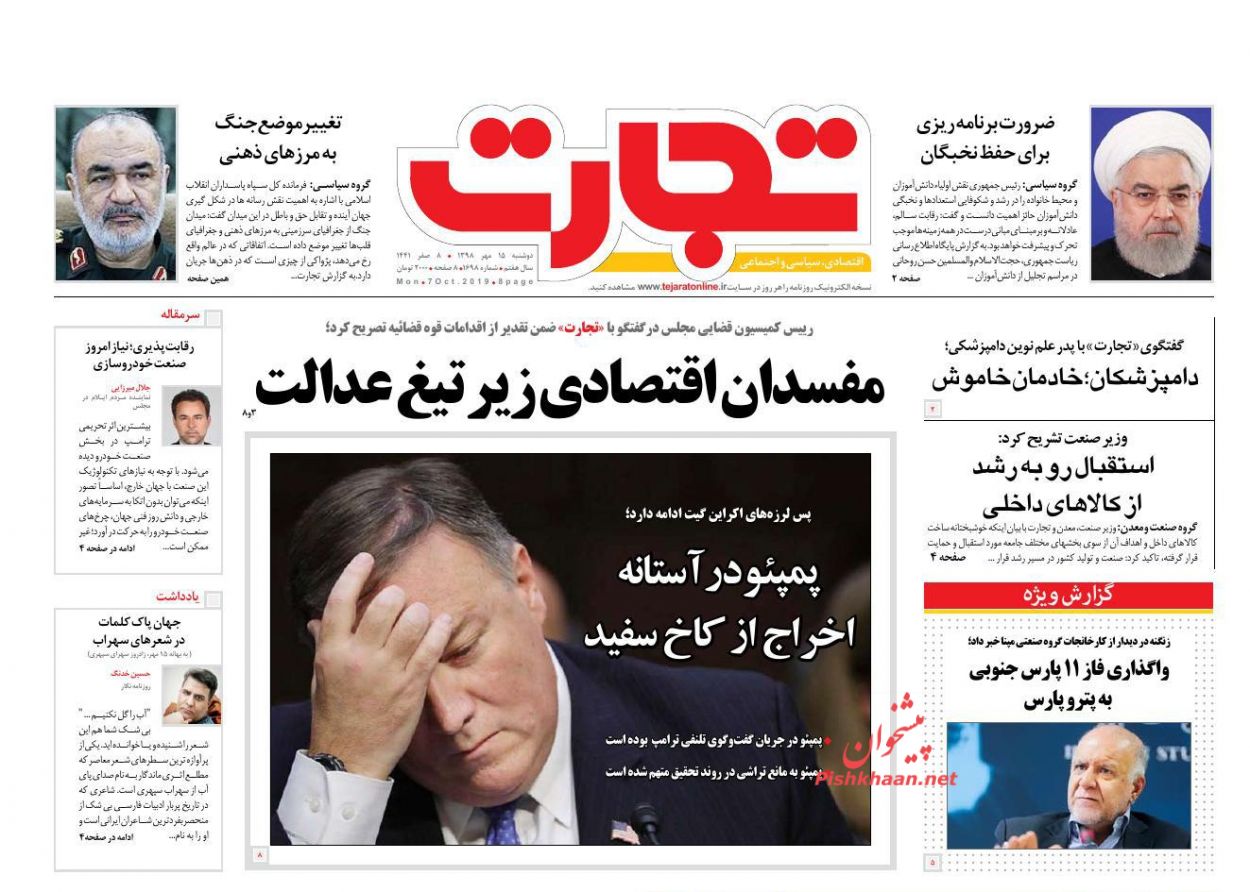
A Look at Iranian Newspaper Front Pages on September 16

A Look at Iranian Newspaper Front Pages on November 19

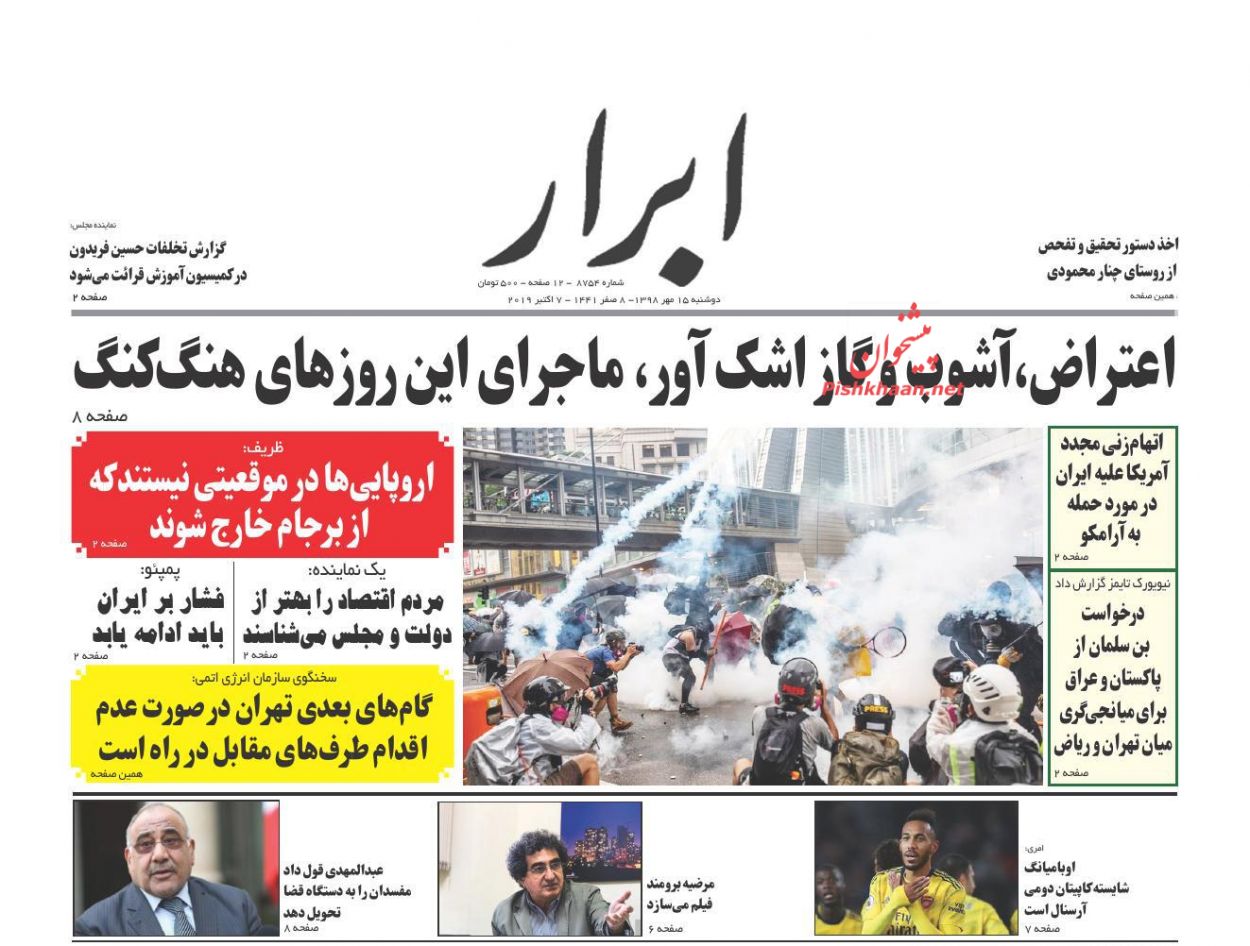
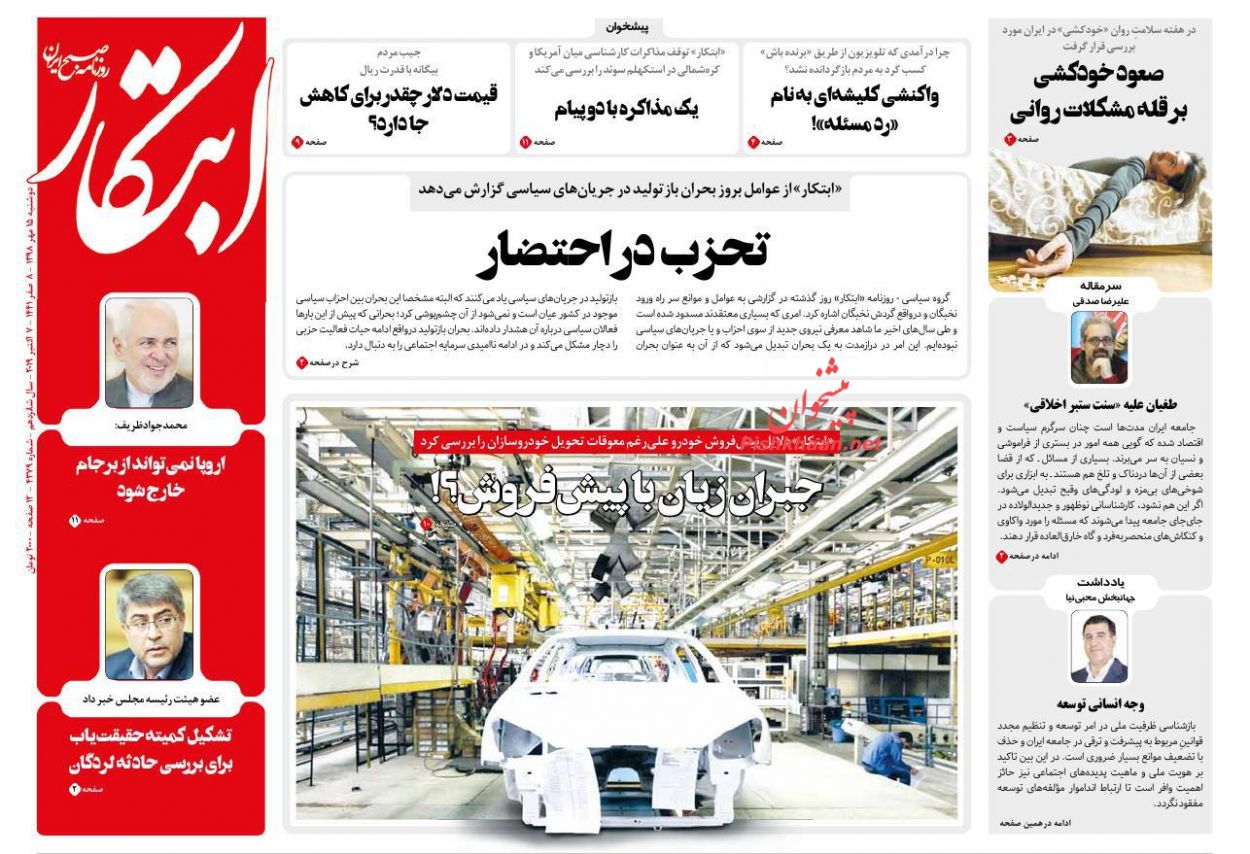
Abrar:
1- IRGC Aerospace Commander: US Drone Downed by Iranian Individual
2- Pompeo Claims Iran Was Behind Attack on Saudi Oil Facilities

A Look at Iranian Newspaper Front Pages on September 16


Aftab-e Yazd:
1- How Should Iran Counter Canadian Banditry
* Can Iran Seize Canadian Shipments in Region in Retaliation?
2- Interior Ministry to Extend Activities to Counter Loose Hijab

A Look at Iranian Newspaper Front Pages on September 16


Ebtekar:
1- Fear of Oil Crisis: Reactions to, Consequences of Ansarullah’s Attack on Aramco Oil Plants

A Look at Iranian Newspaper Front Pages on September 16


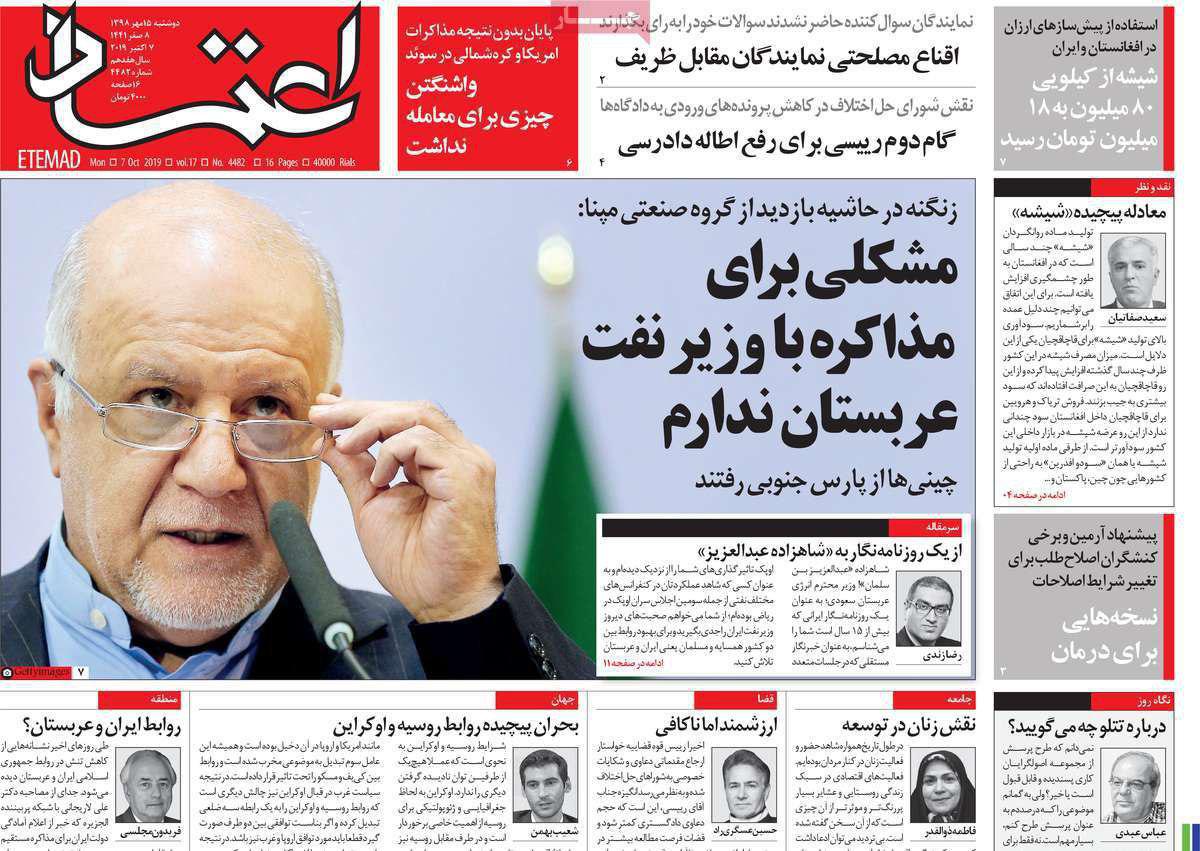
Etemad:
1- Aftershocks of Aramco’s Explosion in Oil Market
2- Oil Price May Increase by 5-10 Dollars after Saudi Refinery Attacks
3- US Will Put Lid on Defeat of Saudis

A Look at Iranian Newspaper Front Pages on September 16


Ettela’at:
1- Rouhani: Regional Security Can Be Ensured If US, Zionist Aggression Stopped
2- Euronews: Bolton Fired Because of Opposition to Suspension of Iran Bans

A Look at Iranian Newspaper Front Pages on September 16


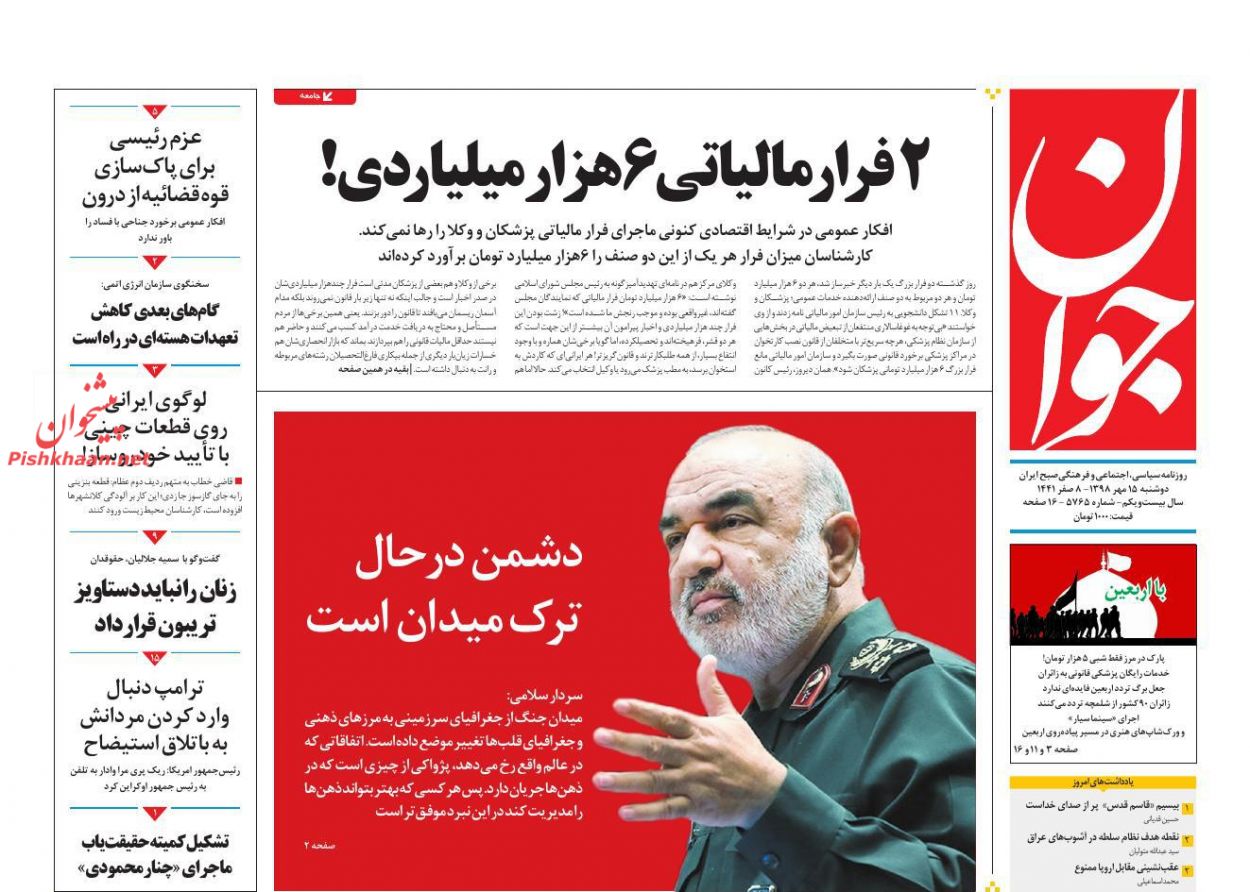
Javan:
1- White House Outraged by Aramco Explosion

A Look at Iranian Newspaper Front Pages on September 16


Jomhouri Eslami:
1- Zarif: Adopting Iran’s Proposal Would End Yemen Quagmire
2- Iran, Russia, Turkey to Meet on Syria in Ankara
3- CNN: White House Officials Mulling Over Easing Iran Sanctions

A Look at Iranian Newspaper Front Pages on September 16


Kayhan:
1- Backbone of Saudis Broken: US, Al Saud Mourning
2- Three-Fold Increase in Iran’s Pistachio Production
3- Washington Accuses Iran in Order to Mitigate Its, Saudis’ Humiliation

A Look at Iranian Newspaper Front Pages on September 16


Sazandegi:
1- Era of Iran’s Infiltration
* What Does Muqtada al-Sadr’s Trip to Tehran Mean?
* Iran Has Saved Sadr’s Life Two Times

A Look at Iranian Newspaper Front Pages on September 16


Shargh:
1- Saudis, Americans Once Again Raise Anti-Iran Accusations
2- Trump’s Limited Options in Reacting to Aramco Attack
3- Rouhani: Iran, Russia, Turkey Have Been Guarantors of Syria Ceasefire

A Look at Iranian Newspaper Front Pages on September 16

Yemen Warns Foreigners to Leave Saudi Aramco Oil Facilities

The warning came after Houthis and their allies in the Yemeni army deployed as many as 10 drones to bomb Abqaiq and Khurais oil facilities run by the Saudi state-owned oil company before dawn Saturday.

Spokesman for the Yemeni armed forces, General Yahya Sare’a, said in a tweet Monday that the attacks in the kingdom’s eastern region had been carried out by drones with normal and jet engines.

He said Saudi Arabia should stop its “aggression and blockade on Yemen,” or see the Yemeni army hit the kingdom “anywhere and anytime” it chooses.

Other Yemeni officials dismissed claims that the country is incapable of carrying out on its own the kind of attacks that targeted two plants at the heart of Saudi Arabia’s oil industry.

Mohammed al-Bukhaiti, a member of Yemen’s Supreme Political Council, pledged that Yemeni forces will continue to pound the Saudi oil industry until the kingdom ends its deadly war.

The unprecedented attack knocked out more than half of Saudi crude output, or 5% of global supply, prompting Saudi and US officials to claim without any evidence that it probably originated from Iraq or Iran.

Bukhaiti told Iran’s Tasnim news agency that blaming the attacks on other countries shows “cowardice” in facing up to the reality of Yemen’s military power.

“Saudi Arabia declared war against Yemen on the grounds that our missile inventory posed a threat to its security,” he said. “Today, we are surprised to see that when we hit Saudi oil wells, they exonerate Yemen from conducting these strikes and accuse others of doing them.”
“This is viewed as an own criminal decree of conviction. It also shows their cowardice,” Bukhaiti added.

US Secretary of State Michael Pompeo was quick to blame Iran for the brazen attacks, claiming there was no evidence the drones had originated from Yemen.

Bukhaiti mocked the proposition, saying Washington resorted to such rhetoric to hide the fact that their radars were simply incapable of tracking Yemeni drones.

“America and Saudi Arabia’s radars cannot intercept Yemeni aircraft. If they could intercept them, they would have shot them down,” he argued.

Bukhiati said the fact that Pompeo did not produce evidence to substantiate his claim showed they were “bankrupt” both politically and militarily.

Iranian Foreign Ministry spokesman Abbas Mousavi dismissed Pompeo’s allegations as “blind and fruitless remarks” that were “meaningless” in a diplomatic context.

Iranian Foreign Minister Mohammad Javad Zarif also responded to Pompeo, saying the United States had failed in its campaign of “maximum pressure” and was now “turning to ‘max deceit’.”

Bukhiati made it clear that the Houthis would only stop attacking Saudi Arabia once it abandons “serving US interests” and starts respecting the interests of its own people.

“Ending the war now is no longer a shared interest of Yemen and Saudi Arabia. Rather, it benefits Saudis more than it does Yemen because Yemen doesn’t have much to lose,” he said. “Yet we are witnessing Saudi Arabia’s stubbornness because it is the United States that decides for them.”

“These attacks will automatically stop when Saudi Arabia ends its aggression and lifts its blockade against Yemen,” he said. “These operations will only expand and target facilities that are more vital and more sensitive than oil facilities.”

Iran, Iraq not involved in Aramco attacks: Yemen air force

Yemen’s air force also issued a statement on Sunday, denying reports that Iran and even Iraq might have played a role in the attack.

“We confirm that these operations were carried out from Yemeni territories and by the Yemeni Army and Popular Committees,” said Brigadier General Abdullah al-Jefri, head of the Yemeni air forces.

“Therefore, whatever is being said about Iran’s support for us or allegations that these attacks were carried out from inside Iraq or through Lebanon’s Hezbollah are absolutely wrong,” he said.
“Such statements and blind and fruitless accusations are unfathomable and meaningless,” he added.

Iraq denies allegations on Aramco attacks

The Iraqi cabinet said Sunday that claims about its territory being used as a base for the attacks held no value, stressing that the country would never become a platform to attack other countries.
“Iraq denies what has been circulated by some media outlets and social media about the use of its territories to attack Saudi oil installations by drones, and affirms its constitutional commitment to preventing the use of its territories for aggression on its neighbors, brothers, and friends,” the Cabinet Office said in a press statement.

“The Iraqi government will deal firmly against anyone who tries to violate the Constitution. It has formed a committee of the relevant Iraqi parties to follow up information and developments,” explained the Cabinet Office.

The statement also called on warring parties to stop hostilities, expressing concern that “escalation and military solutions would complicate the humanitarian and political situation, and threaten our common security as well as regional and international security.”

Yemeni Drone Attacks Aimed at Forcing Saudis to End War: Ansarullah

Mohammed al-Bukhaiti said when Saudi Arabia stops its aggression and ends its siege against Yemen such attacks will automatically come to an end.

Regarding Saudi Arabia’s claims and charges against Iran, he told Tasnim News Agency that “Saudi Arabia has declared war on Yemen on the pretext that our stored missiles are a threat to its security, and today, when we target Saudi oil wells, it is a surprise that they accuse other countries. It proves that they are defeated and also shows their cowardice.”

Al-Bukhaiti said US and Saudi radars are unable to intercept Yemeni aircraft adding that if they could intercept these aircraft, they would shoot them down.

In addition, he added, US Secretary of State Mike Pompeo said that the planes come from Iran because there is no proof showing they come from Yemen. “Essentially, he had to provide proof for his claim. This is a military and political defeat for Saudi Arabia and the United States.”

In response to a question about Iran’s initiative to stop the war on Yemen and Saudi Arabia’s opposition to it, Bukhaiti said “Riyadh is not moving towards its own interests and its people. It just pursues the interests of the Americans.”

“Now the cessation of war has not only become a benefit for Yemen and Saudi Arabia, but beyond that it has become a more important benefit for Saudi Arabia. Because Yemen doesn’t have much to lose, yet we see the obstinacy of Saudi Arabia as the US decides for them,” underlined Bukhaiti.

Ansarullah movement used 10 drones on Saturday to target two oil facilities of Saudi Arabia’s Aramco Company, sparking a huge fire at a plant crucial to global energy supplies.

The facilities in of Aramco in Buqayq and al-Khurais were hit by the drones. The attack led to the disruption in Saudi oil production and exports.

Reports suggest that the Yemeni forces’ attacks have disrupted 5 million barrels per day of oil production. The amount is almost half of the kingdom’s current output.

Yemen’s senior military officials say attacks like this are just the tip of the iceberg in case Riyadh is to continue its war on the country.

Saudi Aramco operates the world’s largest oil processing facility and crude oil stabilisation plant, with a crude oil processing capacity of more than 7 million barrels per day.

Collision with Pickup Truck Grounds Tehran-Yazd Plane

Officials say the incident led to breakage of the turboprop of Tehran-Yazd plane, but all the passengers are safe and sound.

Director General of Yazd Airports says the passengers of the damaged aircraft were sent to Tehran with alternative flights.

The aircraft is one of the new ones purchased after the nuclear deal.

Yazd International Airport is currently the 10th largest airport in the country in terms of air traffic and passengers, with approximately 6,000 passengers annually using approximately 6,000 flights.

Iran Says Muqtada Sadr Wasn’t Carrying Any Message

Seyyed Abbas Mousavi said on Monday that Muqtada Sadr has long been making regular visits to Iran like other Iraqi friends of Iran, who have either been in Iran or commuting to the country.

“Sadr’s presence in Iran is nothing special and new,” Mousavi said in a press briefing in Tehran.

“He has been a friend of Iran and his presence is a blessing,” he noted, adding, however, that the influential cleric was not carrying any special message when he attended a recent mourning ceremony hosted by the Leader of Iran’s Islamic Revolution Ayatollah Seyyed Ali Khamenei.

In comments in April 2018, Muqtada al-Sadr expressed readiness to resolve some disputes between Iran and Saudi Arabia.

In July 2017, Sadr made a rare visit to Saudi Arabia and met the crown prince and other officials in the Red Sea port city of Jeddah.