Thursday, December 25, 2025
Home Blog Page 3091

Iran Says E3 ‘Paralyzed’, Just ‘Parroting’ Absurd US Claims

Iran Blasts Europe’s ‘Disastrous’ Subservience to US

“E3’s paralysis in fulfilling their obligations without US permission has been clear since May 2018,” Zarif said in a tweet on Tuesday, referring to Europe’s failure to fulfil its commitments under the 2015 nuclear deal after US President Donald Trump left it last year.

“Solution to this deficiency: mustering will to forge independent path—not parroting absurd US claims & requests INCONSISTENT with JCPOA,” he added, referring to the E3’s echoing of US claim that Iran was behind the recent attack on Aramco refineries.

“No new deal before compliance with current one,” Zarif stressed.

The call for a new deal was earlier raised by UK Prime Minister Boris Johnson, who talked of a new “Trump deal” with Iran after attacking the existing nuclear pact.

He said the current agreement was a “bad deal” with “many defects” and argued US Trump was the “one guy” who could renegotiate it.

Johnson made the comments at the UN General Assembly amid a ratcheting up of tensions in the Middle East.

Trump put the current Iran nuclear deal at risk when he pulled the US out last year. Other nations have pledged to keep the pact going, but relations have been put under strain.

Iran President Urges All Parties to Return to Rule of Law

The Iranian president made the remarks on Monday upon arrival in New York, where he is going to attend the 74th meeting of the UN General Assembly.

“We hope that, today in the very sensitive situation of the region, we would manage to convey the message of our regional nations, which is the message of regional peace and end of any interference in the sensitive regions of Persian Gulf and the Middle East,” President Rouhani said.

The Iranian president noted that he was also carrying the message of the great nation of Iran, “which is under the pressure of a cruel economic war.”

“Our nation is a nation of resistance and resilience, and wants all sides to return to their commitments and to the law,” he noted.

He expressed the hope that he would be able to convey the Iranian nation’s message to the international community at the UN General Assembly.

The Iranian president is to propose a new peace initiative at the UN General Assembly called Hormuz Peace Endeavour (HOPE).

“This year, we will introduce to the world a plan which underlines that the Islamic Republic of Iran can ensure security in the Persian Gulf and the Sea of Oman in cooperation with regional countries,” said the president on Sunday.

The initiative is called the Hormuz Peace Endeavour – the gist of which is love and hope – with the slogan ‘The coalition of hope”, he added.

Iranian Foreign Minister Mohammad Javad Zarif revealed on Monday that regional powers including Iran, Iraq, Saudi Arabia, Bahrain, the United Arab Emirates, Qatar, Oman, Kuwait and Yemen could join the broad regional coalition to ensure security in the Persian Gulf.

The coalition concept would act under the auspices of the United Nations, Zarif told reporters at a working breakfast with journalists on the eve of the UN General Assembly.

Iranian, French Presidents Meet in New York

In the Monday meeting, the two sides conferred on details of efforts by France and other remaining parties to the 2015 Iran nuclear deal to save the multilateral accord.

They also stressed development and deepening of bilateral, regional, and international relations between Tehran and Paris, highlighting the two countries’ resolve to promote relations and cooperation in various bilateral and international areas.

Rouhani and Macron further discussed the sensitive situation of the region, and exchanged views on the Iranian president’s new peace initiative, Hormuz Peace Endeavour (HOPE).

President Rouhani reminded other JCPOA parties, including France, of their responsibility for protecting the important international agreement after the US’ illegal and unilateral withdrawal, and slammed a Monday statement by the E3 (France, Germany, and the UK), in which the three European leaders blamed Iran for the recent attack on Saudi oil facilities.

Rouhani strongly criticized the statement, and described it as a “groundless” blame game.

Macron, in turn, welcomed Rouhani’s regional peace initiative, and elaborated on France’s efforts to help implement the JCPOA.

He also underpinned the need for Europe’s cooperation with other JCPOA parties, especially Russia and China, in this regard.

The French president also highlighted interaction and dialogue with Iran as an influential country in the region, and called for continued constructive relations between Tehran and Paris.

Iranian, UN Diplomats Discuss Syria Peace in Beirut Meeting

The UN Syria envoy and Khaji, who is also Iran’s senior negotiator in the Syrian and Yemeni affairs, met in the Islamic Republic of Iran’s Embassy in Beirut on Monday evening.

In the gathering, the two sides discussed the latest developments in Syria.

Pedersen, who has traveled to Beirut after meetings with Syrian officials in Damascus, provided a description of the negotiations and agreements with the Syrian authorities in the meeting.

The two sides also expresses satisfaction with the progress made in the formation of Syria’s Constitutional Committee, and emphasized the necessity for an ultimate resolution of the Syria crisis.

Khaji is going to visit Damascus on Tuesday for talks with the Syrian officials.

Iran is one of the three guarantor states of a ceasefire in Syria under the Astana Peace Process, and works in cooperation with the UN for the settlement of conflicts in Syria.

UN Held Captive by US: Iranian Spokesman

Speaking at a press conference on Monday, Ali Rabiee said President Hassan Rouhani has attended the United Nations General Assembly meeting to express the loud voice of resistance of Iranians and declare the Iranian nation’s demands at the global platform.

The president is planned to hold meetings with at least 13 world leaders in the UN trip, the spokesman added.

Asked about the US administration’s obstructive measures before giving the Iranian president and foreign minister visas for the UN trip, Rabiee said, “The US’ illogical behavior that was against the international law and norms caused problems for the (Iranian delegation’s) trip, but we believe that the President will be able to make there (the UNGA) resound to the voice of Iran, contrary to the American thoughts and attempts to silence that voice.”

“Although the US owns a colossal media empire, it has been attempting to restrain us from speaking on the United States of America’s territory. This is one of the reasons (for US visa problems), and the other subject is that they (Americans) resort to all instruments when they enter a war,” he added.

“It was an illegal delay, and they also diminished the (Iranian) delegation very much. The press could have given reports from the US, (but) they (the US) discharged the press, while we normally give a warm welcome to the press willing to visit Iran,” the spokesperson noted.

Rabiee stated that the US ultimately agreed to grant the Iranian delegation visa under pressure from the UN, saying Washington wanted to bar Iran from attending the General Assembly meeting, a clear sign that Iran’s presence in the US would be fruitful.

“The US has held the United Nations headquarters captive for years,” he deplored.

Asked by IRNA about a recent tweet from “Christiane Amanpour” who claims that a meeting between Iranian President Hassan Rouhani and his US counterpart Donald Trump was conditional on the lifting of the sanctions against Iran, Rabiee said, “If the US is ready to halt the sanctions and return to the nuclear deal, the road for us to make a decision will be open. One of those decisions could be dialogue. In that case, we will make the necessary and appropriate decision.”

“There are no conflicting views inside the country on this issue, and Mr. Zarif has also made comments about it,” he concluded.

Top Iranian, Japanese Diplomats Meet in NY

Iranian Foreign Minister Mohammad Javad Zarif began his tight schedule Monday with a working breakfast with a group of UN reporters, before visiting his Japanese counterpart, Toshimitsu Motegi.

In the meeting with the incoming Japanese foreign minister, Zarif praised Tokyo’s efforts to promote cooperation with Tehran, saying Iranian President Hassan Rouhani was also eager to meet the prime minister of Japan in New York.

“We believe that incidents in the region are a result of the belligerent policies. We are prepared to help end the Yemen war,” Zarif added.

The Iranian foreign minister also noted that President Rouhani was attending this year’s UN General Assembly with a regional peace plan, including an initiative for a peace coalition at the Strait of Hormuz.

The Iranian president had announced on Sunday that he would put forward a plan called “Coalition of Hope” and “Hormuz Peace Initiative” at the UN meeting.

“This year, we will introduce to the world a plan which underlines that the Islamic Republic of Iran can ensure security in the Persian Gulf and the Sea of Oman in cooperation with regional countries,” he said.

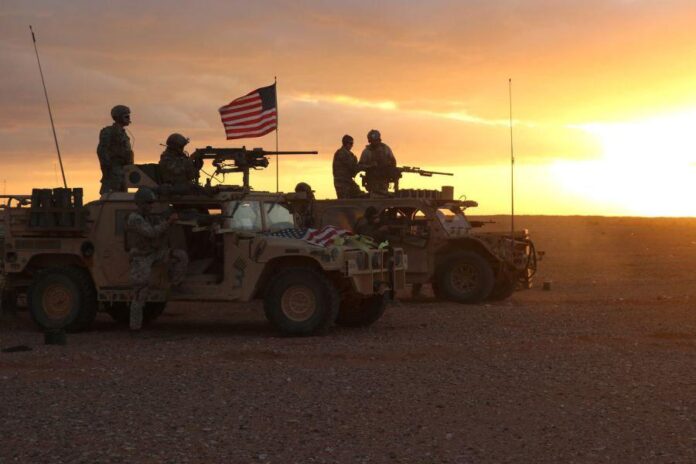
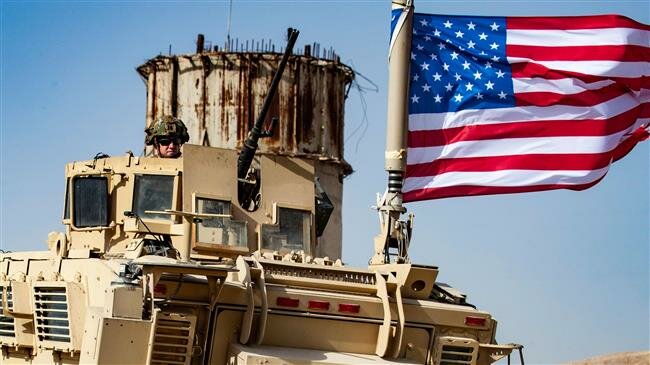
Iran Downplays New US Deployment as ‘Posturing’

US soldiers take part in the "Decisive Strike" military exercise in their camp at the Training Support Centre (TSC) Krivolak, near Skopje, June 17, 2019. / Photo by AFP

“I think it’s posturing. I think it’s all going the wrong direction in addressing this issue,” Zarif told Margaret Brennan in an interview published on September 22, 2019.

What follows is the full text of the interview conducted in New York:

Brennan: Foreign Minister, thank you for making time.

Zarif: Good to be with you, again.

Brennan: You are now personally sanctioned under US law but you’re sitting here in midtown Manhattan with a US visa. Do you read that as a sign that the US still wants to talk?

Zarif: Well not necessarily, because the United States is under obligation, being the host of the UN headquarters to issue visas to member states. So they made it very clear in a letter that they attached to my visa that I’m not eligible to get a visa, but they’re doing it on a waiver basis. So they want me to know that I’m not supposed to be here.

Brennan: But you are here. You’re here without all the staff and pomp and circumstance that normally foreign ministers are afforded. And you’re here at an incredible- an incredibly intense period of time. The US is sending what’s described as a moderate number of forces and some defensive equipment to Saudi Arabia in the wake of this attack. How does Iran interpret that?

Zarif: Well I don’t think this type of posturing helps. I think what helps would be to end the war in Yemen.

Brennan: You think it’s posturing?

Zarif: I think it’s posturing. I think it’s all going the wrong direction in addressing this issue. When the war in Yemen erupted over four years ago, we called for a ceasefire, immediate negotiations, humanitarian assistance and a formation of a broad-based government. Unfortunately, US allies- Saudi Arabia, believed that they could win this war militarily within four weeks. That’s why they didn’t accept our offer to mediate between them and the others and to bring about a negotiated solution. Now four and a half years after that, we see that all that military equipment that the United States provided to Saudi Arabia and the UAE, all the military logistical support that the United States and some other Western countries provided, did not help defeat a group of people, the Yemenis, who are basically cut off from the rest of the world.

Brennan: The United States says there’s no way this attack was launched from Yemen and that the Houthis, the Yemenis you’re talking about, don’t even have the ability to do what happened.

Zarif: Well it is difficult for the United States to explain why its state of the art equipment was not able to intercept these weapons. But the fact of the matter is that the Houthis have accepted responsibility- responsibility for that. If it were a false flag operation, if somebody else did it, then they should look for that culprit. It wasn’t Iran. And if the United States believes it wasn’t the Yemenis then they should look for who- who did it, but for–

Brennan: Who do you think did it?

Zarif: I don’t know. I think the Yemenis have announced a- declared responsibility for it. They have even shown evidence that they launched this attack. So I should take it as that. But if the United States believes that the Yemenis were not behind it, first of all why did the- why did the Saudis retaliate yesterday against the Yemenis? Why did the- they break the UN brokered ceasefire in Hudaydah and retaliate against the Yemenis? They did that because they all know where it came from, and how it should end is through an end to the killing of innocent children, women, elderly that has been going on. 100,000 people have been killed. Over two million cases of cholera in Yemen. Now everybody is concerned about an attack on an oil refinery which, based on the latest information that I have, didn’t even have a single casualty. Hundred thousand innocent human beings not enough but a refinery is an imminent threat–

Brennan: Do you accept–

Zarif: This- this is- I mean I think I think the moral compass is totally lost.

Brennan: Do you accept that these were Iranian-made weapons? The United States, Saudi Arabia, they all say that the weapons the evidence that they have and have gathered was made by Iran.

Zarif: Well they made all those claims in the past. The fact of the matter is Yemenis inherited all the weaponry that Ali Abdullah Saleh bought with Saudi money during his- his long career as president–

Brennan: But–

Zarif: –former president.

Brennan: –you know that those missiles can be reverse engineered to figure out where they were launched from.

Zarif: Well, they can do it.

Brennan: The US says it’s just a matter of time–

Zarif: Okay.

Brennan: — before other investigators–

Zarif: Well–

Brennan: –determine that these came from Iran.

Zarif: Well let- let them do it. Let them do that because it would take a miracle for them to claim that because it didn’t come from Iran. Period.

Brennan: Are the weapons from Iran?

Zarif: The weapons the Yemenis have said these are Yemeni made. I’ve heard news stories that they are different from the weapons that we produce. I believe the Yemenis. Based on what I know, the Yemenis have the technology and the knowhow–

Brennan: But what–

Zarif: –to- to increase the range of the missiles that they already had from Ali Abdullah Saleh.

Brennan: But when you talk about the range, Saudi Arabia allowed in reporters to the oil facilities to look at the damage and there is evidence the attacks came from the north, not from Yemen, from territories that would indicate Iran, possibly Iraq, but the United States says Iran.

Zarif: Well there is no evidence to that effect. The Saudis made a show but they could not prove it. Now at the end of the day they claim that the weapons were Iranian but they couldn’t show even that. They’ve been showing that- a lot of lies. You heard the other day from Secretary Tillerson that some people believe that they can lie President Trump into a war.

And they did. Now I think in the United States we need responsible national security officials who can differentiate lies and deception from reality so that others could not play with the United States, could not take American soldiers to fight their wars for them.

Brennan: You’re accusing someone of manipulating President Trump?

Zarif: I’m not accusing someone of manipulating President Trump. Secretary Tillerson did.

Brennan: Are you confident that the UN inspectors, that the French inspectors, that the other countries who are sending people on the ground to look at this equipment, that none of them will determine that Iran played a direct role here or that these were fired from Iran?

Zarif: I’m confident that Iran did not play a role. I’m confident that anybody who does- who conducts an impartial investigation will reach that conclusion. But I cannot say a priori that the people who are being sent will conduct an impartial investigation because we’ve had cases in the past where they didn’t.

Brennan: The UN?

Zarif: Or the UN too.

Brennan: So will you accept the results of the UN investigators?

Zarif: No, we will accept the results of an impartial investigation–

Brennan: Who’s impartial?

Zarif: –and we- we can create an impartial investigation team. We were not informed by the UN We were not consulted by the UN We do not know on what basis this has taken place. So we will take it up with the United Nations. We are confident that if the United Nations carries out an impartial investigation the- the outcome will be that it was not launched from Iran.

Brennan: Saudi Arabia said today that citizens from the region are being recruited by Iran to carry out attacks.

Zarif: This- this means that they are–

Brennan: What does that mean?

Zarif: –it- it means that they are backtracking from the initial allegation that it’s coming from Iran. They are saying that it may come- have come from somewhere else but it was based on citizens being recruited by Iran to do this. So a lie falls apart sooner or later.

Brennan: Can you say that these weren’t Iranian backed attacks in any way shape or form?

Zarif: They were not Iranian-backed attacks.

Brennan: Launched–

Zarif:  We support the Yemenis and you see Iran- Iran —

Brennan: But you also support militias in Iraq and elsewhere.

Zarif: No, we support the government of Iraq. These militias that you talk about are part of the Iraqi government. The Israelis are attacking parts of Iraqi military, official military. What these–

Brennan: Can you say these weren’t launched from Iraq by an Iranian backed group?

Zarif: No, they were not launched from Iraq by an Iranian-backed group or by any group.

Brennan: President Trump has said he’d be willing to meet with Iran without preconditions and there has been talk among the Western powers about trying to give some financial lifeline to Iran to stay in the nuclear deal. All of that was happening and then this attack seemed to blow it all up.

Zarif: No, all of that was not happening because–

Brennan: You didn’t take the offer of talks as real?

Zarif: We have been talking to the French. I spoke to the French president twice in three days at length and we discussed it with him. The president- our president has been talking to the French president. The United States has been reluctant to engage in what is required. Let me give you an example that President Trump would easily understand in transactional terms- in real estate terms. I buy a building from you and somebody inherits your company from you next year and he comes and tells me, “I didn’t sell that building to you. I need a higher price and a worse building.” Would you buy it? Would anybody in, to use President Trump’s word, in any history buy this building? Do you have any example in any history, again to use his word, of anybody doing this? He is asking us- we didn’t have a revolution in the United States. President Trump inherited a government from another administration that was legally elected as a United States government. And this agreement has been endorsed by the Security Council. This agreement is in a Security Council resolution. Now last I heard, the United States sits in the Security Council as a permanent member.  It has not withdrawn. It withdrew from Human Rights Council. It withdrew from UNESCO but hasn’t withdrawn from the Security Council–

Brennan: But you–

Zarif: At least not as of yet.

Brennan: You- you said yourself that you were invited into the Oval Office to meet with President Trump.

Zarif: Yeah but to meet him for what? For a photo opportunity? Or to meet him for some substance?

Brennan: So when the president says he’s willing–

Zarif: We did not–

Brennan: to meet and talk–

Zarif: Yeah yeah–

Brennan: You’re not taking it seriously at all?

Zarif: We’re ready to talk. We’re ready to talk but talk in terms of something that is not going to be valid only for the next one and a half year or five and a half years. We need to talk about something that is permanent. That would last. We already have a- an agreement. We talked. I have talked to what was a United States secretary of state and the United States secretary of energy for hours upon hours of painful negotiations. You were there in Vienna. You remember. These were difficult negotiations. It wasn’t just a two-page document that we signed so that we could do another two-page document.

Brennan: So you’re saying you will not meet or talk or consider diplomatic negotiations with the United States unless the acceptance of that old deal, the JCPOA–

Zarif: It’s not an old deal.

Brennan: -is agreed to?

Zarif: It’s- it’s a deal that exists now. There is a negotiating room. There is a negotiating table. Wednesday at 8:30 in the morning. There will be six- four plus one plus one- six foreign ministers and one high representative of the European Union.

Brennan: You will not meet with Secretary Pompeo outside of that?

Zarif: No.

Brennan: Why?

Zarif: Because there’s no reason to.

Brennan: There’s no reason to talk to the United States–

Zarif: And basically Secretary Pompeo is prevented by law from meeting me because he designates me.

Brennan: US officials told CBS News though that the supreme leader himself approved these attacks on Saudi Arabia but that they needed to be deniable.  Well this is just a hypocritical, hypothetical, allegation. I mean no, no reality whatsoever.

Brennan: The supreme leader didn’t approve these attacks?

Zarif: These attacks did not take place from Iran for the supreme leader to approve them. Had they taken place from Iran then he would have had to approve them. But it didn’t take place from Iran.

Brennan: Do you think US officials are lying when they say that? That Saudi Arabia is lying?

Zarif: I’m certainly- I’m certain that they’re being lied to, whether they want to accept that lie. I think the work of us diplomats- I think myself and my counterpart, the US secretary of state, we need to try to push diplomacy, as Senator Sanders has recently said, not to push war.

Brennan: Senator Sanders. Do you think President Trump’s going to win re-election?

Zarif: I don’t know. I have my guess, but it’s up to the American people.

Brennan: The last time we spoke, you discussed letters that Robert O’Brien sent to you. He was the hostage negotiator and now he’s the national security adviser of the president of the United States. Do you regret not opening up that channel of communication?

Zarif: We did open that channel of communication. We provided an offer of exchanging of prisoners. That offer was made last September when I was here for the last General Assembly.

Brennan: But at least five Americans, including Baquer Namazi, Xiyue Wang- they are still in Iranian custody.

Zarif: Yeah. At least they are accused of something. There are Iranians in the United States who have been held in captivity for nine months without even charges–

Brennan: But you’re–

Zarif:  –being filed against them. We have a professor–

Brennan: But you’re at this moment of intense pressure right now in the wake of these attacks. The entire global community is about to meet this week and they’re going to be talking about Iran. Wouldn’t it be a goodwill gesture to release a few Americans?

Zarif: Wouldn’t be- wouldn’t it be a good gesture for the United States to release a professor, whose mother just died and he has been there without charge and without any ability to leave the country, just because- he was issued a visa. Then his visa was revoked as he was flying into the United States. This is a professor. He is not a professor of military studies. He’s a professor of biology. He was working on recreative genes if I’m- if I’m correct, and he is a world-renowned scientist. He’s been in jail since last November or December, if I know correctly- if I remember correctly.  Why don’t they release him as a sign of good gesture? So at least he can go to the grave of his mother and visit the grave of his mother.

Brennan: I’m being told we’re out of time but I just want to button this up and make clear here. Do you believe- are you confident that you can avoid a war?

Zarif: No. No, I’m not confident that we can avoid a war. We- I’m confident that we will not start one but I’m confident that whoever starts one will not be the one who finishes it.

Brennan: What does that mean?

Zarif: That means that there won’t be a limited war.

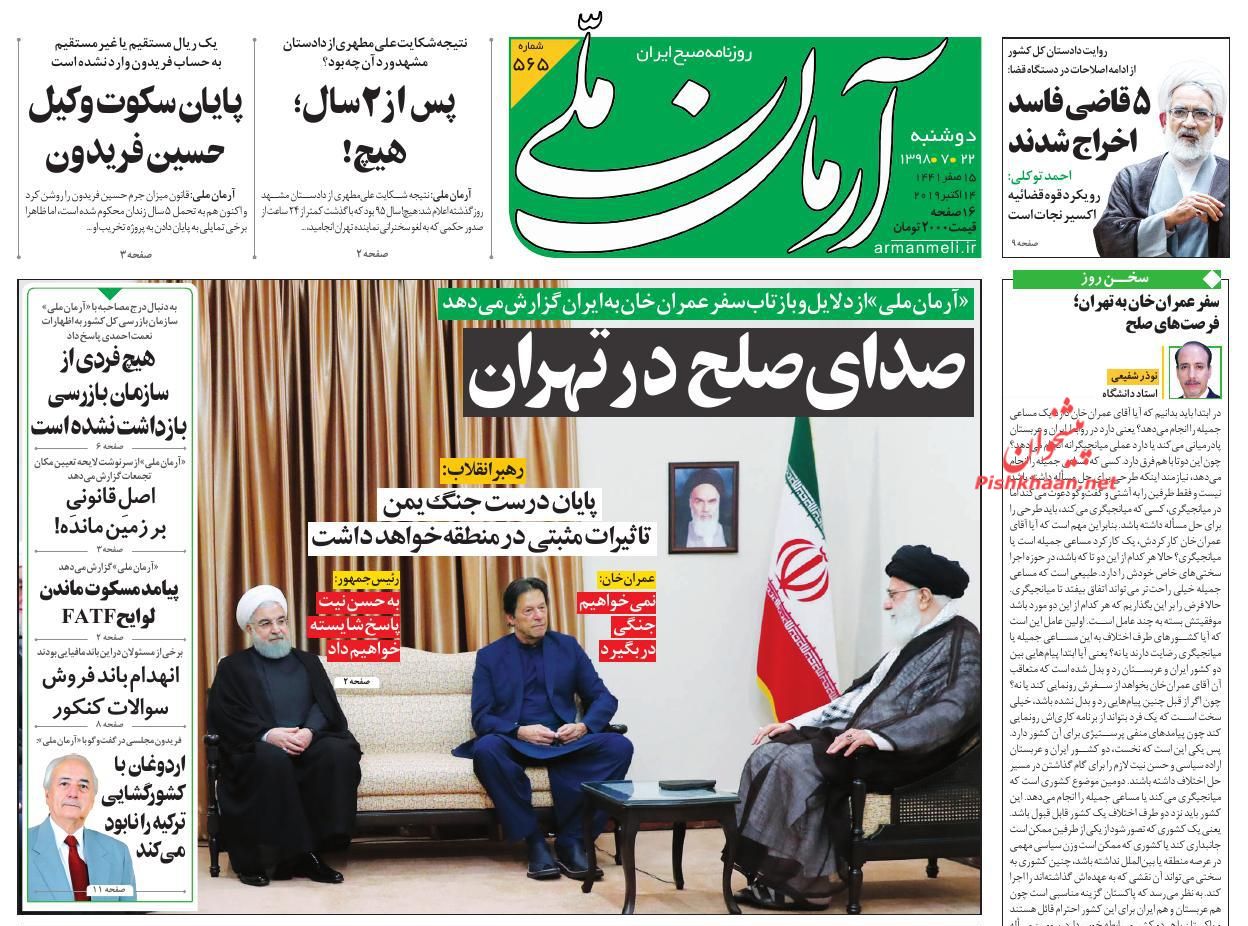
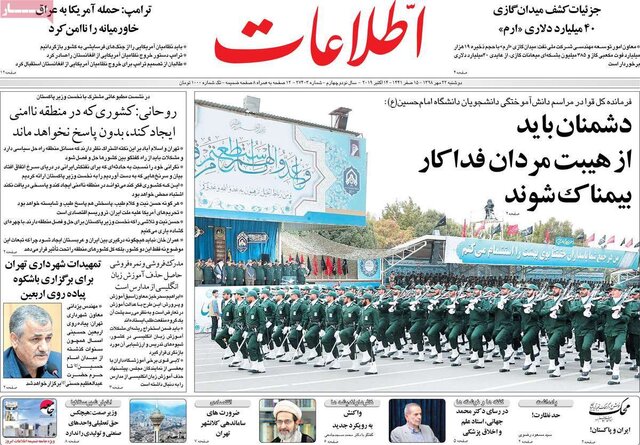
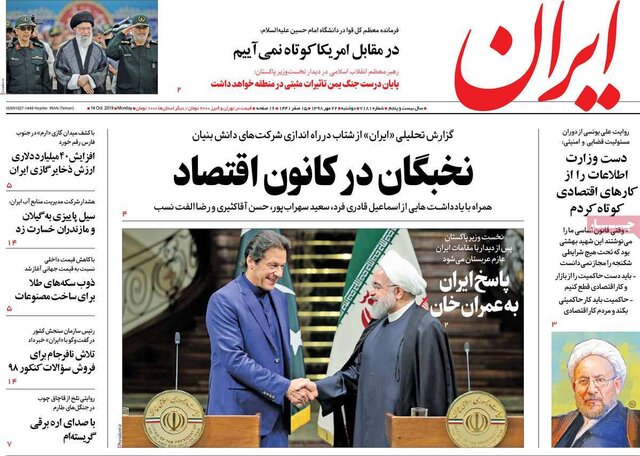
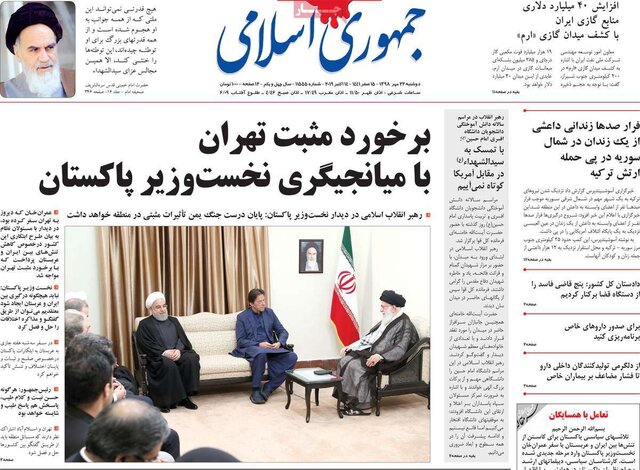
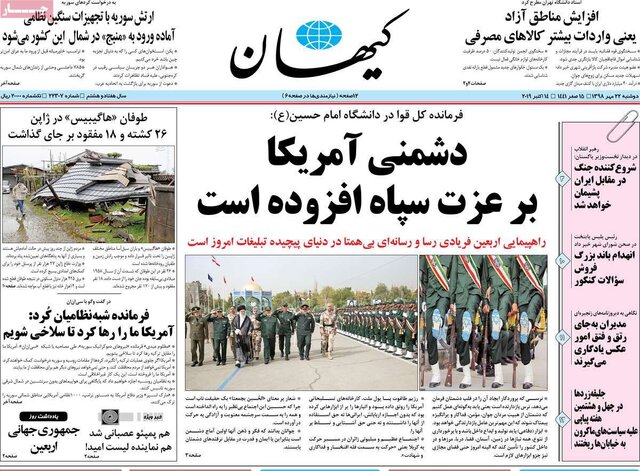
A Look at Iranian Newspaper Front Pages on September 23

A Look at Iranian Newspaper Front Pages on November 19

Abrar:
1- Australia PM: We Won’t Get into Military Tension with Iran
2- Army, IRGC Vessels Parade in Persian Gulf
3- Persepolis Wins 90th Tehran Derby

A Look at Iranian Newspaper Front Pages on September 23


Aftab-e Yazd:
1- Houthis Want to Negotiate from Highest Position
* New Message of Yemen’s Ansarullah
2- Oil Minister: 93 Billion Dollars’ Worth of Investment in Petchem Industry

A Look at Iranian Newspaper Front Pages on September 23


Ebtekar:
1- Zarif: Iran Won’t Initiate Any War
2- Trump’s Record in International Community [Editorial]
3- Rouhani: We’re Ready to Forget Past Mistakes of Neighbours

A Look at Iranian Newspaper Front Pages on September 23


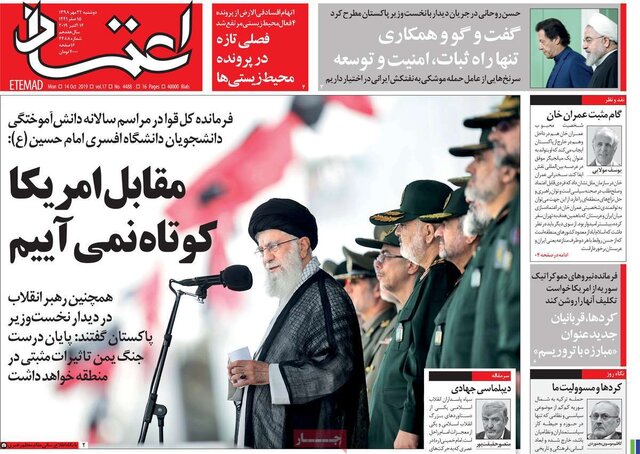
Etemad:
1- Plan B for B-Team
* Jubeir’s Slip of the Tongue Reveals Saudis’ Covert Plans for Iran


A Look at Iranian Newspaper Front Pages on September 23


Iran:
1- Rouhani: Peace & Hope Is Iran’s Message for the World

A Look at Iranian Newspaper Front Pages on September 23


Javan:
1- Zarif: War Not to Remain Confined to This Region
* The One Who Starts the War Won’t Be the One Who Ends It: Zarif
2- US Treasury Secretary: Iran Sanctions at Maximum Level

A Look at Iranian Newspaper Front Pages on September 23


Jomhouri Eslami:

1- New School Year Begins for 14.5 Million Students

2- Nasrallah: Saudi Regime at Its Final Days

3- Rouhani: Friendship with Neighbours, Forgiving Their Mistakes

A Look at Iranian Newspaper Front Pages on September 23


Kayhan:

1- US Dollar Rate Decreases after Sanctions against Iran’s Central Bank

* Market’s Interesting Reaction to Trump’s Decision

2- Europe Wants to Not Buy Iran’s Oil but Make Iran Indebted

3- Iranian Wrestler Yazdani Claims World Title in Nur Sultan

A Look at Iranian Newspaper Front Pages on September 23


Mardom Salari:

1- Zarif: We Want to Turn Anniversary of Iraqi War into Day of Peace

2- Portal Launched to Register Assets of Officials in Iran

A Look at Iranian Newspaper Front Pages on September 23


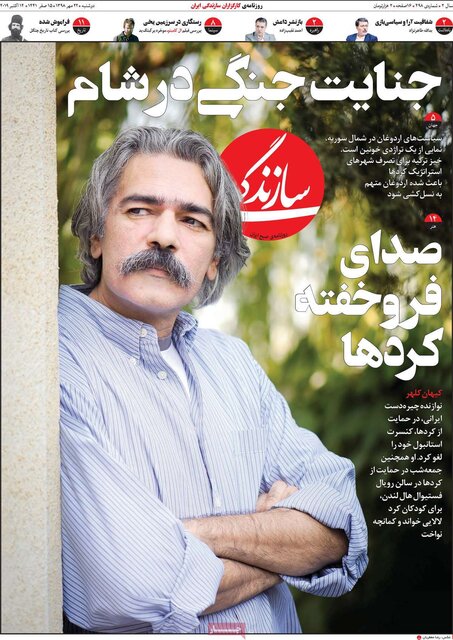
Sazandegi:

1- Biden Victim of Biden

* Economic Activities of Joe Biden’s Son to End Up in His Detriment?

A Look at Iranian Newspaper Front Pages on September 23


Setareh Sobh:

1- Petchem Industry at Forefront of Economic War

A Look at Iranian Newspaper Front Pages on September 23


Shahrvand:

1- End of Mohammad Sharif’s Nightmare

* Another Hostage Released from Somali Pirates’ Captivity after 4 Years

A Look at Iranian Newspaper Front Pages on September 23


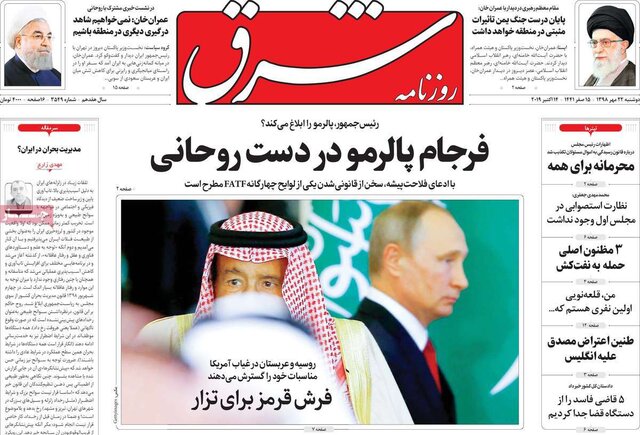
Shargh:

1- Zarif Underlines Iran’s Proposal for Peace in Hormuz

2- Why Trump Changed His Tone on Iran? [Editorial]


A Look at Iranian Newspaper Front Pages on September 23

Exclusive: UK Mission to US Will Hold Session on Iran

Photo of the UK Embassy in Washington DC

The British mission will host the event on Thursday, September 26, over the situation of human rights in Iran.

The Iran Front Page has learnt that the United Nations Special Rapporteur on human rights situation in Iran, Javaid Rehman, has also been invited to the event.

The session, with the pretext of addressing the situation of human rights in Iran, will have a major focus on the issue of releasing British-Iranian dual nationals detained in the country, in particular Nazanin Zaghari.

Zaghari was arrested at Tehran’s Imam Khomeini International Airport in April 2016 as she was on her way back to London. She was subsequently put on trial and handed a five-year jail term after being found guilty of spying for the United Kingdom government.

British media had claimed that she worked for the Thomson Reuters Foundation and was on vacation in Iran when she was arrested. However, Boris Johnson said in a statement to a parliamentary committee in 2017 – when he was a foreign secretary – that Zaghari had been “simply teaching people journalism.”

Johnson’s remarks amounted to an accidental confession that Zaghari was plotting against the Iranian government, but British authorities described them as a gaffe.

As the 74th session of United Nations General Assembly is underway in New York, the British government seems to be pressuring Iran on releasing the Iranians or British-Iranians who have been convicted of espionage for London.

While holding a session on human rights in Iran, the UK government has so far been criticized for serious breaches of human rights at home and abroad. ‘CIA Torture Unredacted’ report, released in 2019, revealed the British complicity in a secret torture program in “black sites” (secret prison) established by CIA between 2001 and 2009.

The British arms sales to Saudi Arabia and the killing of thousands of innocent civilians in Yemen have been questioned by human rights activists in the West, blaming the UK for violating the humanitarian law.

“Instead of making futile attempts against the Islamic Republic of Iran, the UK government should stop selling lethal weapons to Saudi Arabia – which is demanded by many people in the world – and rid itself of the charge of committing war crime against the people of Yemen,” said Iranian Foreign Ministry Spokesman Seyyed Abbas Mousavi today in reaction to UK Prime Minister Johnson’s claim that Iran might be to blame for the recent attacks on Saudi oil refineries.

On the issue of detaining British-Iranians for espionage, an Iranian source, on the condition of anonymity, said that the UK sends spies to Iran without considering the consequences. He said “if the UK is worried about those arrested in Iran for espionage, they had better stop dispatching spies to Iran.”

“How come many other European citizens travel to Iran and nothing happens to them? That’s because the UK government is using humanitarian cover for its security measures and is victimizing people for meeting its own political interests, while ignoring the repercussions for those involved in espionage,” the source added.

Iran Denies Johnson’s Claim about Its Role in Aramco Attacks

Yemen's Ansarullah Hits Saudi Oil Facility in Missile Attack: Spokesman

“Instead of making futile attempts against the Islamic Republic of Iran, the UK government should stop selling lethal weapons to Saudi Arabia – which is demanded by many people in the world – and rid itself of the charge of committing war crime against the people of Yemen,” Mousavi said on Monday.

His comments came after Johnson said the UK now believes Iran was responsible for a major attack earlier this month on Saudi Arabian oil facilities in Abqaiq and Khurais.

Speaking to reporters on his plane en route to the UN general assembly (UNGA) in New York, the prime minister claimed there was “a very high degree of probability” that Iran was behind the drone and missile attacks against two major oil installation on 14 September, which was claimed by Yemen’s Houthi Ansarullah movement.

“I can tell you that the UK is attributing responsibility with a very high degree of probability to Iran for the Aramco attacks. We think it very likely indeed that Iran was indeed responsible, using both drones and cruise missiles,” he added.

“Clearly, the difficulty is how do we organise a global response, what is the way forward. We’ll be working with our American friends and our European friends to construct a response that tries to de-escalate tensions in the [Persian] Gulf region.”

Johnson went on, “On what kind of action we can take, you’ll have seen that the Americans are proposing to do more to help to defend Saudi Arabia, and we will be following that closely.”

He also raised the possibility that the British military could become involved in helping secure the Saudis against future aggression.

“And clearly, if we are asked, either by the Saudis or by the Americans, to have a role then we will consider what way we could be useful.”