Wednesday, December 24, 2025
Home Blog Page 3087

Iranian Woman Released after 27 Months in US Jail

Negar Ghodskani, 40, was pregnant when Australian Federal Police arrested her on behalf of US authorities in 2017 over what Washington claimed was flouting US sanctions on Iran by purchasing US electronics components and products.

She gave birth to a boy in custody in Adelaide, South Australia, while fighting extradition to the US.

In July 2019, she stopped resisting extradition and finally arrived in the US.

On Tuesday, US District Court Judge Joan Ericksen in the state of Minnesota ruled that the Iranian mother, extradited to Minneapolis, had spent enough time in prison.

The judge agreed with Ghodskani’s lawyer Robert Richman that the 27 months she had already spent in custody in Australia and the US was enough.

“It went very well,” Richman said, adding, “We are expecting she will be deported back to Iran in the next few weeks.”

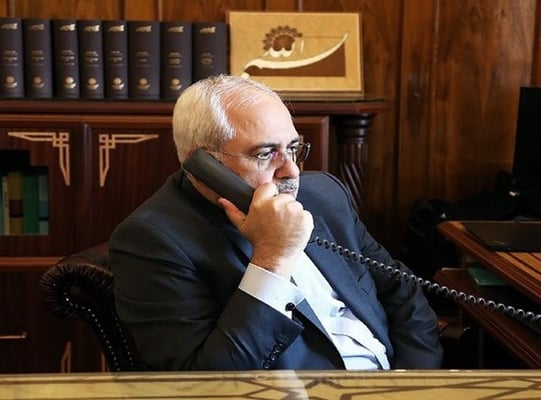
In April, Iran’s Foreign Minister Mohammad Javad Zarif publicly expressed Tehran’s preparedness for a prisoner swap with the US.

He called on Washington to swap all Iranians jailed in the US and on extradition requests from the US, mostly for alleged violations of US export restrictions and sanctions violations, with those imprisoned in Iran.

“We believe their charges are phony. The United States believes charges against these people in Iran are phony. Fine, let’s not discuss that. Let’s have an exchange. I am ready to do it and I have the authority to do it,” he noted.

In his remarks, Zarif particularly referred to Negar Ghodskani and called for her release as part of the swap deal he sought to negotiate with the US.

Iran Must Stop Pinning Hope on ‘Untrustworthy’ Europe: Leader

Leader of Iran’s Islamic Revolution Ayatollah Seyyed Ali Khamenei

Addressing a meeting with members of the Assembly of Experts on Thursday, the Leader said despite all the lip service, the Europeans complied to the US’ secondary sanctions and did nothing.

“I don’t think they [Europeans] would do anything for the Islamic Republic. We must totally cut our hope on them,” Ayatollah Khamenei said.

He said there is no problem with interaction, exchanging visits, and signing contracts with Europeans, but they can never be trusted, as they have violated all their commitments.

“Our ministers have confirmed the Europeans have failed to live up to any of their commitments under the nuclear deal. This is what the ones who negotiated and signed the deal say.”

He said following the 2015 nuclear deal, some of the European presidents visited Iran and met him. “At that time, I told some of them that the visits are of no use. You should act, if you’re honest about your interest in cooperating with the Islamic Republic.”

However, he said, they did not act, and everyone saw that.

Former French President Jacques Chirac Dies at 86

The death was confirmed by the former president’s son-in-law, Reuters reports.

He was in office between 1995 and 2007, having earlier served as Prime Minister for two spells, and Mayor of Paris between 1977 and 1995.

Chirac took his country into the single European currency. One of his major political reforms was to cut the presidential term of office from seven to five years.

In December 2011, he was given a two year suspended prison sentence for diverting public funds and abusing public confidence.

Rouhani’s UNGA Speech Makes Headlines in Iran

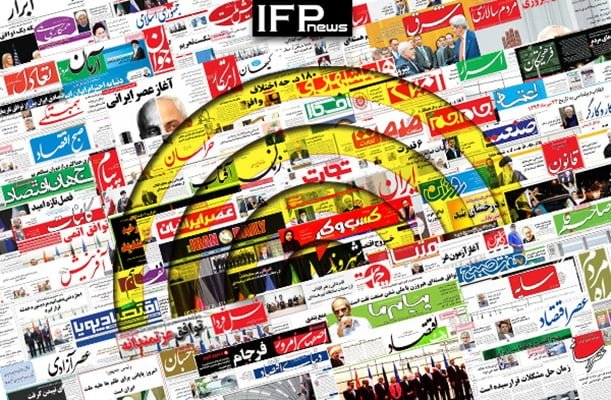
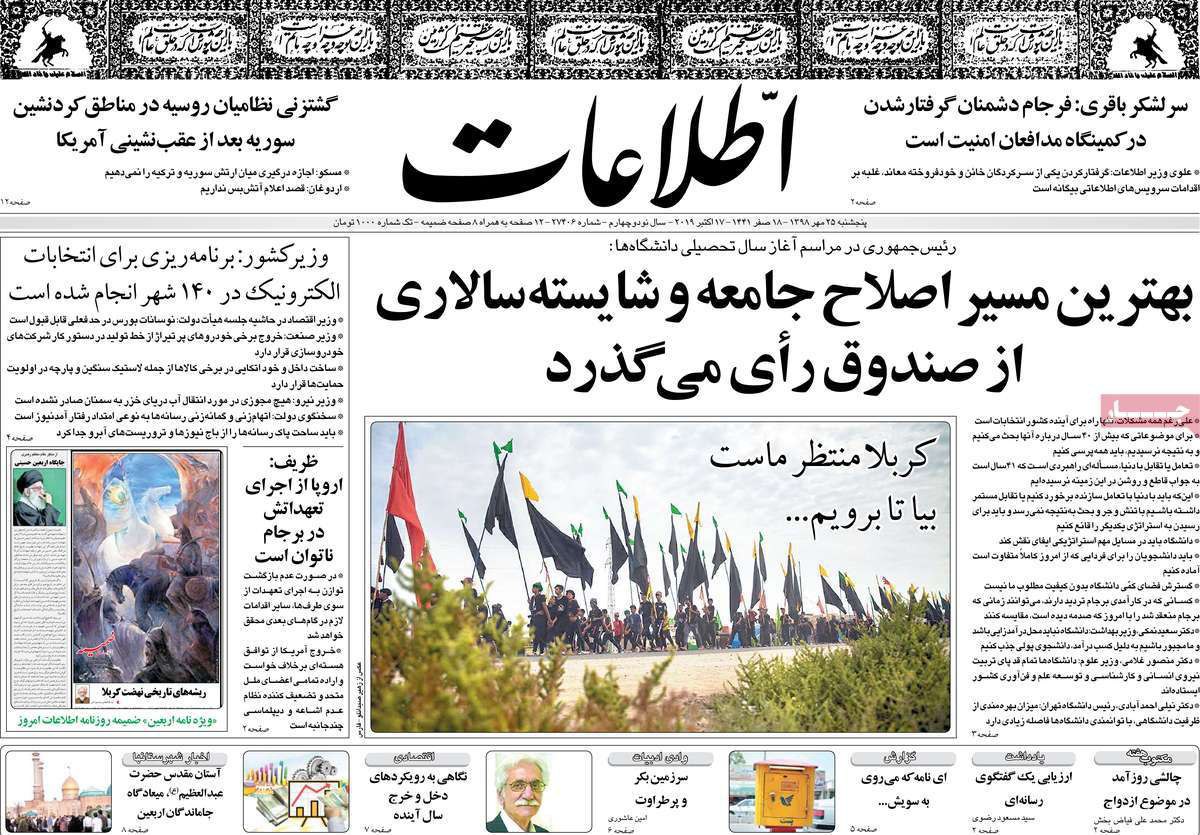
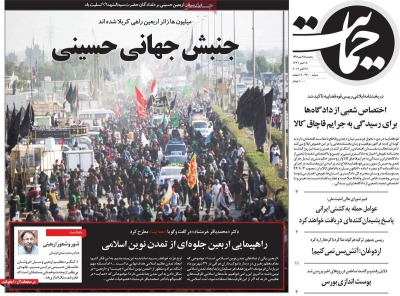
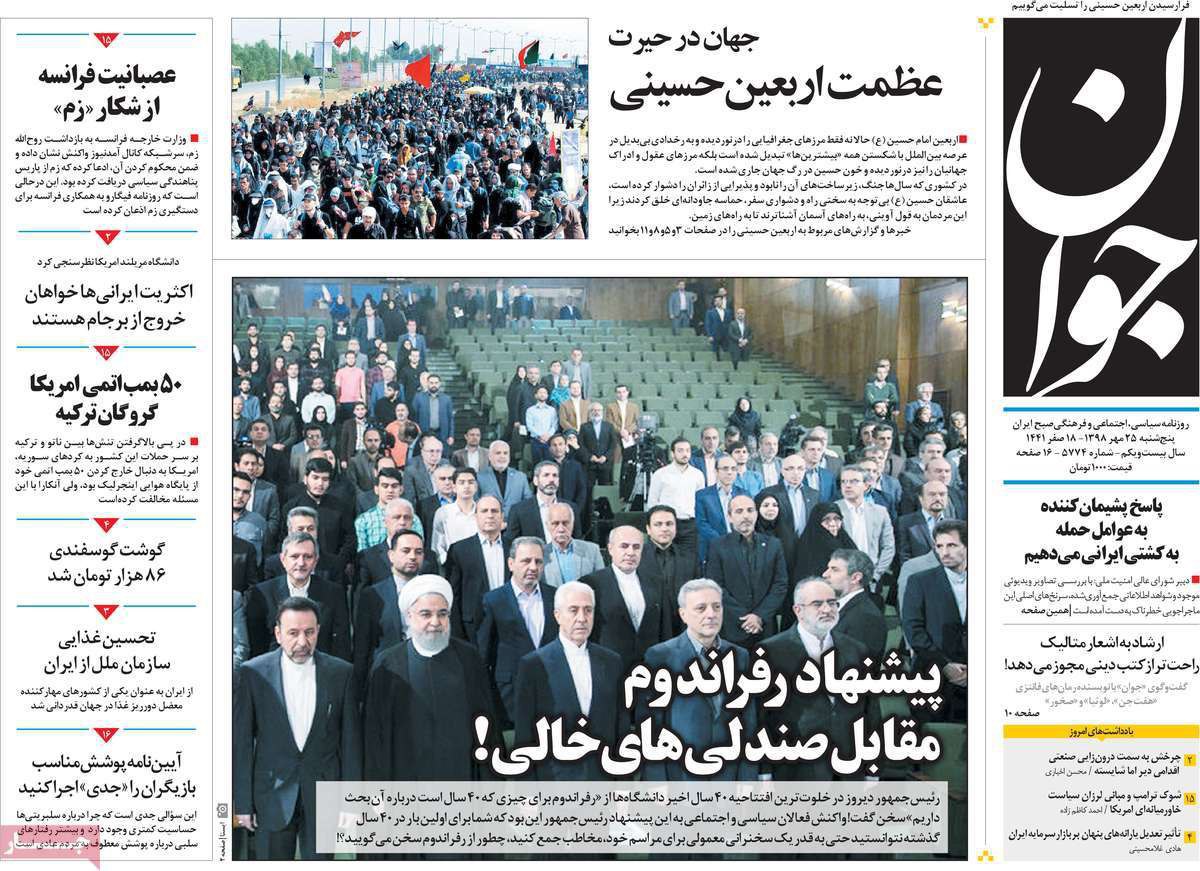
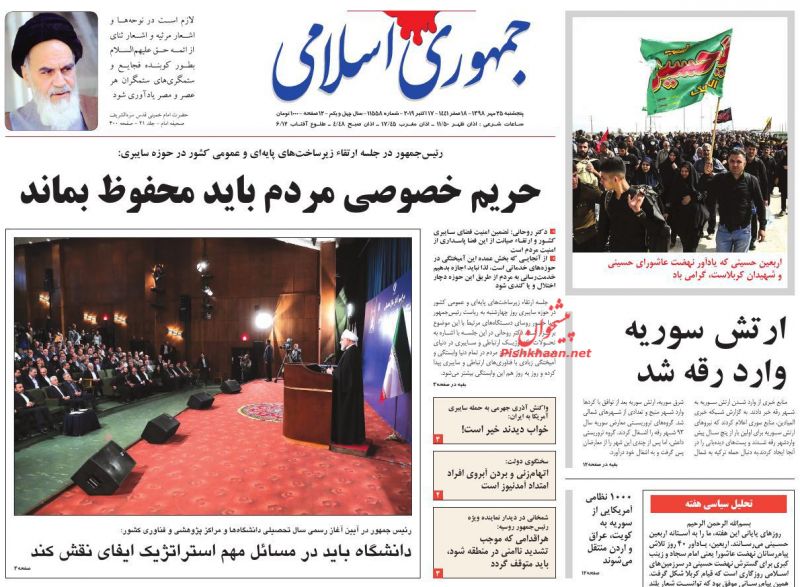
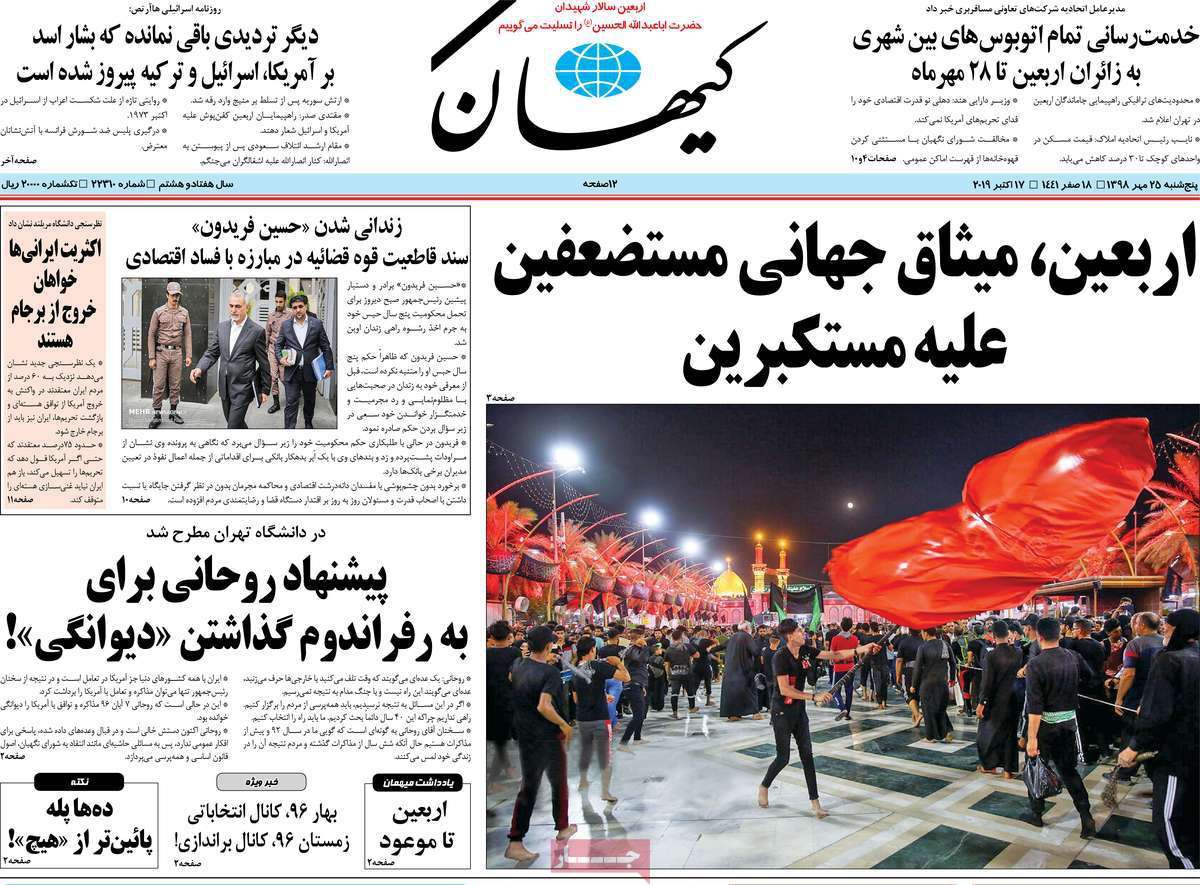
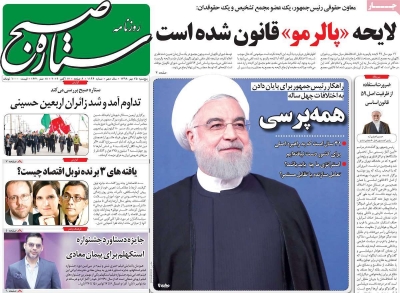
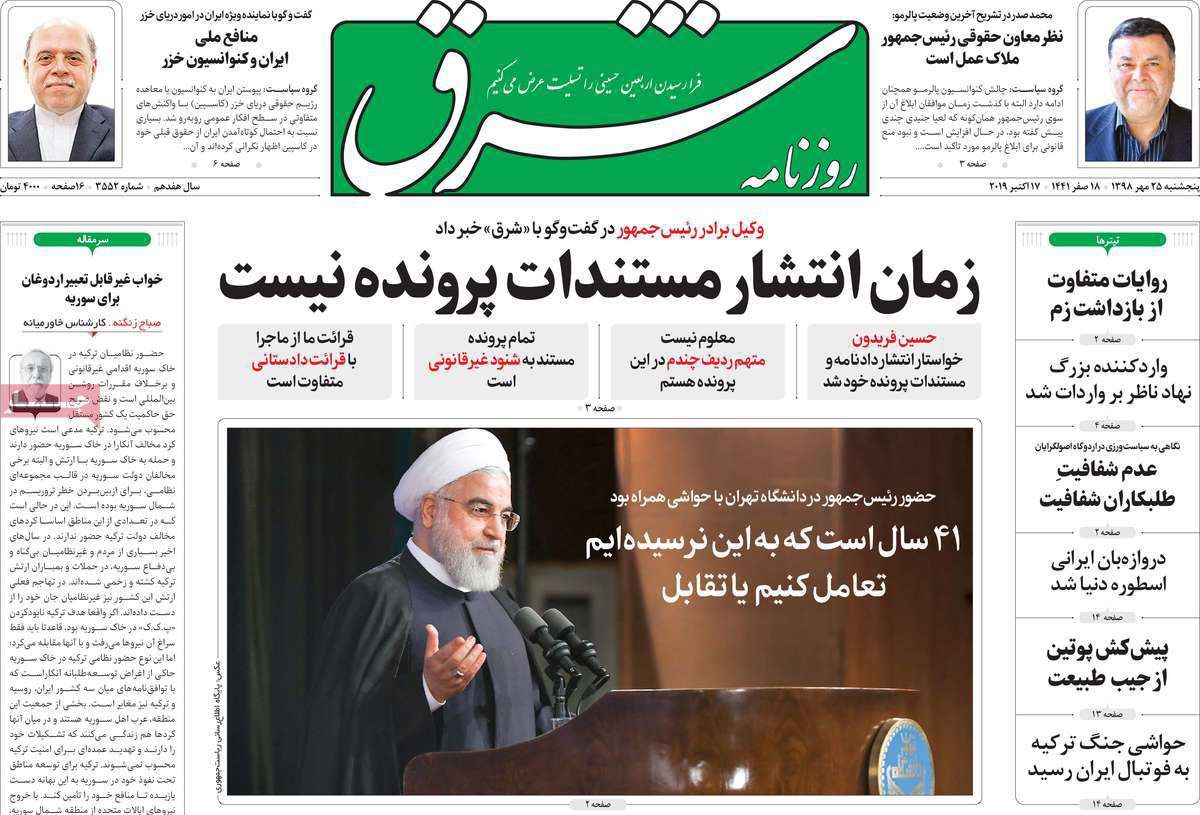
A Look at Iranian Newspaper Front Pages on November 19

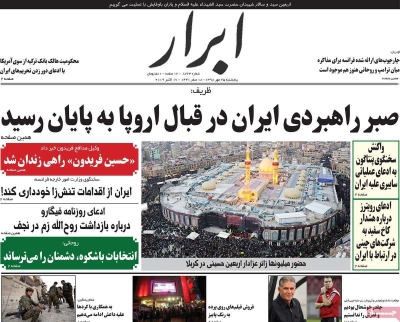
Abrar:
1- Netanyahu’s Claim about Iran’s Role in Aramco Attack
2- Rouhani at UN: Our Response to Negotiation under Sanctions Is No
3- Jubeir: We’ll Consider All Options for Responding to Iran
4- Iraqi PM Visits Saudi to Mediate between Tehran, Riyadh
5- Mogherini: We Urge All Sides to Implement JCPOA in Full

Rouhani’s UNGA Speech Makes Headlines in Iran


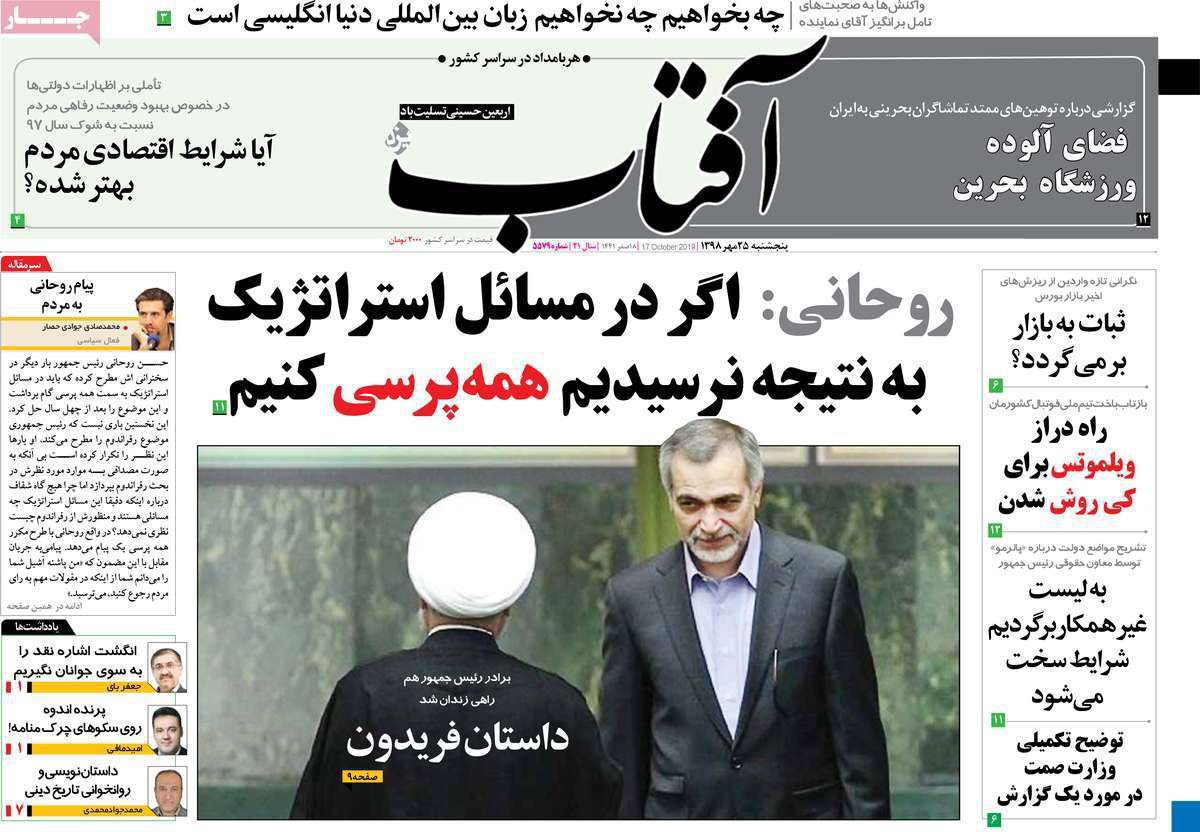
Aftab-e Yazd:
1- Failure of Strategy
* Macron, Johnson Fail to Force Rouhani into Holding Unconditional Talks with Trump
2- Final Solution: Democracy Inside, Diplomacy Outside

Rouhani’s UNGA Speech Makes Headlines in Iran


Arman-e Melli:
1- Rouhani: Why France Measures Stopped?
2- Strong Defence: Iran’s Response to Talks under Sanctions Is No

Rouhani’s UNGA Speech Makes Headlines in Iran


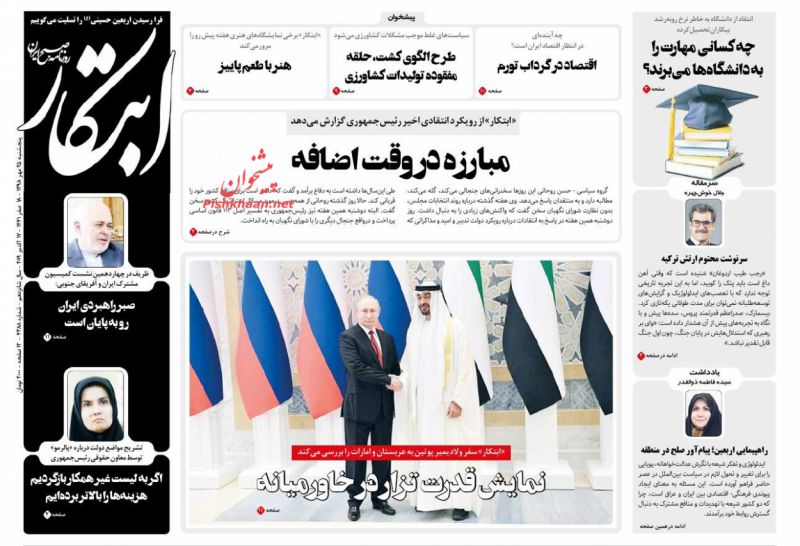
Ebtekar:
1- Trump’s Impeachment Process Officially Begins
2- Return to Reality of Negotiation instead of Show of Talks: Rouhani
3- Mediation Is New Trend

Rouhani’s UNGA Speech Makes Headlines in Iran


Jomhouri Eslami:
1- Zarif: I’m Hopeful about Diplomacy
2- US Dollar Removed from Iran’s Financial Transactions with Russia, Turkey

Rouhani’s UNGA Speech Makes Headlines in Iran


Kayhan:
1- No to Negotiation under Sanctions; US Is International Bandit
* Rouhani’s Speech Full of Honour
2- Confused Johnson Lost His Way at UN after End of His Speech to Empty Seats
3- War Simulated in US, Iran Won: Fox News
4- Mr Rouhani! Bravo [Editorial]

Rouhani’s UNGA Speech Makes Headlines in Iran


Mardom Salari:
1- Invitation to Hormuz Peace: Let’s Invest in Better Future instead of Investment in War

Rouhani’s UNGA Speech Makes Headlines in Iran


Shargh:
1- Mogherini: It’s Difficult to Save JCPOA
2- Will Rouhani’s Speech Save JCPOA?

Rouhani’s UNGA Speech Makes Headlines in Iran

Iranian Economy Adapting Itself to US Sanctions: Rouhani

“The more these sanctions go on, the more the hatred of the people increases toward the United States of America, and internal unity becomes more and more solid. Yes, our people are under pressure,” Rouhani told ABC News in an exclusive interview on Wednesday.

“But the Iranian economy is adapting itself in such a way to the new sanctions of the United States of America that…in the past three months, we have been put on a trajectory of economic growth, even though, prior to this, we were experiencing a negative economic growth,” he told ABC News anchor David Muir in New York.

Rouhani said US sanctions “cannot continue” and were “against the international laws and against [the] UN Security Council resolution.”

“According to the [International Atomic Energy Agency] … Iran has lived up to every single one of our commitments, and US sanctions are against the international laws and against [the] UN Security Council resolution,” Rouhani told Muir, the anchor of “World News Tonight.”

Rouhani told Muir that the government and administration in Iran were not at fault for the sanctions and that US actions were to the detriment of Americans and other countries.

He called the sanctions “an economic form of terrorism” against Iranians and said they have been “extremely destructive and extremely hurtful.”

“What America thought that it could accomplish with sanctions, that it would provoke our people against the administration, against the government, after a year-and-a-half, it has become very clear that our people, with extreme awareness and understanding, know that the main culprit is the United States of America’s government,” Rouhani said through a translator on Wednesday.

Tehran, Dublin Discuss Promotion of Ties in New York

During the Wednesday meeting, Rouhani said Iran is determined to deepen its relations and cooperation with European countries, including Ireland.

“We welcome development of political, cultural and scientific relations with Dublin,” he said.

The Iranian president further pointed to the Iran nuclear deal, officially known as JCPOA, as an international agreement endorsed by the United Nations Security Council, reminding the European Union, including Ireland, of their commitment to fully implement the accord and operationalise the INSTEX mechanism.

Rouhani also referred to his Hormuz Peace Endeavour (HOPE) initiative, and said, “The goal of the HOPE Coalition is to promote peace, stability and welfare and progress for all the peoples living in the Hormuz region.”

“This initiative encompasses many fields for cooperation, including energy security, freedom of navigation and free transport of oil and other resources for the countries of the region and beyond,” he said.

The Irish president, in turn, stated that his country is determined to develop relations with the Islamic Republic of Iran in all fields of mutual interest.

Higgins also emphasized that all parties to the JCPOA must be committed to the multilateral deal, which is beneficial for global peace.

In his Wednesday address to the UN General Assembly in New York, Rouhani invited all Persian Gulf countries to join the Coalition of HOPE (Hormuz Peace Endeavour), which he said is based on mutual respect, dialogue, respect for territorial integrity, peaceful resolution of all issues, and non-interference in each other’s internal affairs.

Bin Salman Finally Accepts Responsibility for Khashoggi Murder

“It happened under my watch. I get all the responsibility, because it happened under my watch,” he told PBS’ Martin Smith, according to a preview of a documentary, “The Crown Prince of Saudi Arabia,” set to air on Oct. 1, ahead of the one-year anniversary of Khashoggi’s death.

Asked how the killing could happen without him knowing about it, Smith quotes Prince Mohammed as saying, “We have 20 million people. We have 3 million government employees.”

Smith asked whether the killers could have taken private government jets, to which the crown prince responded, “I have officials, ministers to follow things, and they’re responsible. They have the authority to do that.” Smith describes the December exchange, which apparently took place off camera, in the preview of the documentary.

Bin Salman, the kingdom’s de facto ruler, has not spoken publicly about the killing inside the Saudi consulate in Istanbul. The CIA and some Western governments have said he ordered it, but Saudi officials say he had no role.

The death sparked a global uproar, tarnishing the crown prince’s image and imperiling ambitious plans to diversify the economy of the world’s top oil exporter and open up cloistered Saudi society.

He has not since visited the United States or Europe.

After initial denials, the official Saudi narrative blamed the murder on rogue operatives. The public prosecutor said the then-deputy intelligence chief ordered the repatriation of Khashoggi, a royal insider who became an outspoken critic, but the lead negotiator ordered him killed after discussions for his return failed.

Khashoggi, a Washington Post columnist, was last seen at the Saudi consulate in Istanbul on Oct. 2, where he was to receive papers ahead of his wedding. His body was reportedly dismembered and removed from the building, and his remains have not been found.

Iran Plans to Produce 135 Medicines Domestically

Iran’s Vice President for Science and Technology Sorena Sattari said on Tuesday that the local knowledge-based businesses and start-ups have made such great advances in the biopharmaceuticals and recombinant pharmaceuticals industry that have obviated the need for the import of many strategic products.

Addressing the opening of Iran Pharma exhibition in Tehran, Sattari said the domestic knowledge-based companies and start-ups have begun producing the pharmaceutical products that have been subject to foreign sanctions.

For a brief review of Iran’s achievements in various fields of science and technology, check the book “Science and Technology in Iran: A Brief Review – 2019”

The vice president also noted that 27 biological medicines, 50 chemical drugs, and 58 drug precursors whose imports would cost the country around $570 million are going to be “made in Iran.”

Sattari said the pharmaceutical products made by the domestic knowledge-based companies and start-ups are worth $1.2 billion.

He also stated that more than half of the total exports of pharmaceuticals were the technological items produced by Iranian knowledge-based firms.

In remarks earlier this month, secretary of Biotechnology Development Headquarter at the Iranian Vice-Presidency for Science and Technology said the Islamic Republic was exporting biopharmaceuticals to major customers like Russia, Iraq, Syria, Pakistan, Malaysia, and Turkey, adding that plans were underway to transfer the Iranian biopharmaceuticals technology to Argentina.

5 Killed after Train Derails in Southeastern Iran

Director of the Crisis Management Office in the province has told Tasnim that five people have been killed as of Wednesday evening in the train accident.

Officials say at least 35 others have been wounded when the train derailed near Zahedan, capital of the border province.

The train was traveling between Tehran and Zahedan when one of its cars was overturned.

A local official says the accident happened due to sandstorms.

The large, underprivileged province of Sistan and Baluchestan borders Pakistan and Afghanistan, and has a long coastline by the Sea of Oman. The desert province grapples with water shortage, particle pollution, underdeveloped infrastructure and transit of illicit drugs.

Last week, Iranian First Vice-President Eshaq Jahangiri said Leader of Iran’s Revolution Ayatollah Seyyed Ali Khamenei has given permission for withdrawing $300 million from the National Development Fund of Iran to construct a railroad line between Zahedan and Chabahar port.

Iran’s President, UN Chief Meet in NY

The Iranian president held the meeting with Guterres on Wednesday after an address to the 74th annual session of the UN General Assembly.

During the meeting, President Rouhani described his peace initiative, called Hormuz Peace Endeavour (HOPE), as a serious ground for UN’s cooperation in regional security building.

Rouhani slammed the United Nations’ silence and inaction over the US administration’s economic terrorism against the people of Iran and the Israeli regime’s crimes in the region.

“The Iranian nation will overcome these problems one way or another, but the stigma of the UN’s silence vis-à-vis an aggressive government committing all these crimes against a nation using economic terrorism will be remembered in history.”

The president pointed to the fragile conditions of the region, and said, “Today, Palestine is going through tough times and the Zionist Regime is committing acts of aggression against Palestine, Syria, Lebanon and Iraq on a daily basis, and the United Nations is silent towards these crimes.”

“This approach needs to be changed and this important international organisation must carry out its responsibilities,” he added.

For his part, Guterres acknowledged Iran’s constructive stances and effective assistance to his special envoy for Syria, Geir O. Pedersen, for forming Syria’s Constitutional Committee and helping with the Astana Process, saying that good developments have been made in Yemen as well.

He expressed the UN’s full support for the Joint Comprehensive Plan of Action (JCPOA), and said, “The JCPOA is something more than a simple agreement, because it is part of a UN Security Council resolution.”

Guterres also appreciated Iran’s efforts to resolve the Syrian and Yemeni issues, and stressed that cooperation between the UN and Iran should develop.

The UN chief also welcomed President Rouhani’s Hormuz Peace Endeavour (HOPE) initiative.

In the meeting, President Rouhani was accompanied by Iranian Foreign Minister Mohammad Javad Zarif and Chief of Staff Mahmoud Vaezi.

Rouhani has already met several world leaders on the sidelines of the international gathering in New York.