Sunday, December 28, 2025
Home Blog Page 307

Ayatollah Khamenei names successor to late chief of IRGC Aerospace Division martyred in Israeli attack

Ayatollah Khamenei

Ayatollah Khamenei appointed Brigadier General Seyyed Majid Mousavi as the new chief of the elite Iranian force, following the targeted killing of his predecessor Brigadier General Amir Ali Hajizadeh.

“In view of the glorious and honorable martyrdom of Major General Amir Ali Hajizadeh at the hands of the wicked Zionist regime, and given the proposal of the commander-in-chief of the IRGC and your valuable qualifications and experiences, I appoint you to the command of the Aerospace Force of the Islamic Revolution Guards Corps,” the Leader wrote in his decree on Saturday.

Ayatollah Khamenei added that he expected enhancement of comprehensive capabilities, an increase in the preparedness of missile and drone units, as well as groundwork and a strong presence in the aerospace sector under Mousavi’s command.

The Leader also called for “strengthening the piety and insight of the IRGC’s Aerospace Division personnel, and having a spiritual foundation in moving toward building a force at the level of the Islamic Revolution.”

Ayatollah Khamenei finally expressed his admiration for the valuable infrastructural services of Major General Hajizadeh during his command and wished Mousavi success in his new position.

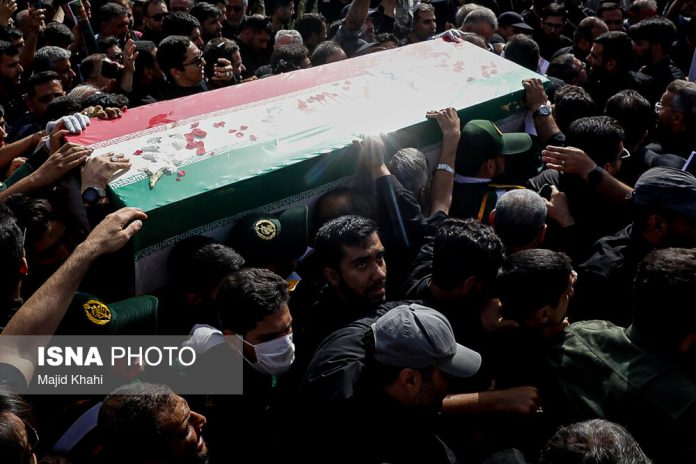
Major General Hajizadeh, who was critically wounded during an Israeli attack on an IRGC command center in the early hours of Friday, June 13, succumbed to his injuries and was martyred later in the day.

Chief of Staff of the Iranian Armed Forces Major General Mohammad Hossein Bagheri, IRGC Commander Major General Hossein Salami, Commander of Iran’s Khatam al-Anbia Central Headquarters Major General Gholam Ali Rashid, and six nuclear scientists, including Mohammad Mahdi Tehranchi and Fereydoon Abbasi, have also been martyred in the Israeli strikes.

Ayatollah Khamenei has warned the Zionist regime that it will receive a severe punishment for the strike, saying, “With this crime, the Zionist regime has prepared for itself a bitter, painful fate, which it will definitely see.”

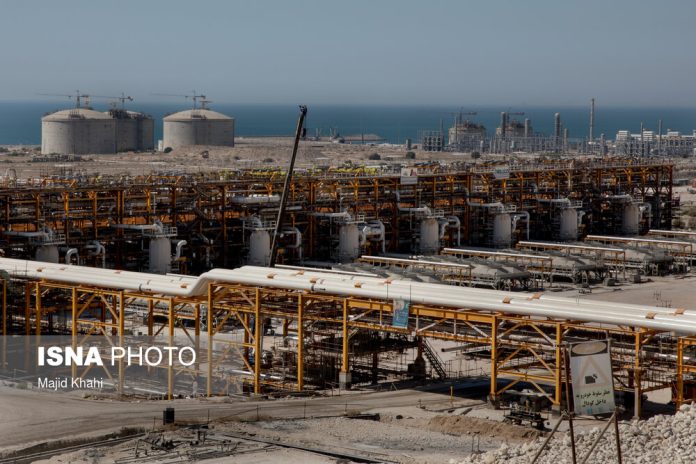
Damage to nuclear facilities in Fordow and Isfahan limited: Iran

IAEA’s Access to Iran Sites, Materials Subject to Legal Considerations: Tehran

Equipment at the two facilities was moved in anticipation of the strikes, Behrouz Kamalvandi said.

A shed at the Isfahan facility caught fire, Kamalvandi stated, without clarifying the extent of damage to the Fordow site.

There is no risk of contamination, he added.

The Fordow Fuel Enrichment Plant is buried deep in the mountains near Qom in northern Iran and houses advanced centrifuges used to enrich uranium up to high grades of purity.

On Friday, Kamalvandi played down the extent of damage inflicted on Iran’s primary nuclear enrichment plant in Natanz, noting the facility “did not encounter serious damage.”

The head of the United Nations nuclear watchdog however said during a UN Security Council meeting on Friday that the above-ground area of the facility was destroyed.

Iran notifies US, France, UK of imminent large-scale attack on Israel

The warning comes amid heightened regional tensions following recent deadly incidents, including Israeli strikes on Iranian territory.

According to media reports, Iran has explicitly communicated that any country aiding Israel in intercepting or responding to Iranian strikes will be considered a direct participant in hostilities.

This includes military bases and assets of those countries in the region, specifically in Persian Gulf nations, as well as naval vessels in the Persian Gulf and Red Sea.

The UK government has denied providing any military assistance to Israel’s aggression against Iran or aiding it in the interception of Iranian drones.

Meanwhile, French President Emmanuel Macron stated on Friday that while France would defend Israel if attacked by Iran, it would not participate in any offensive operations against Tehran.

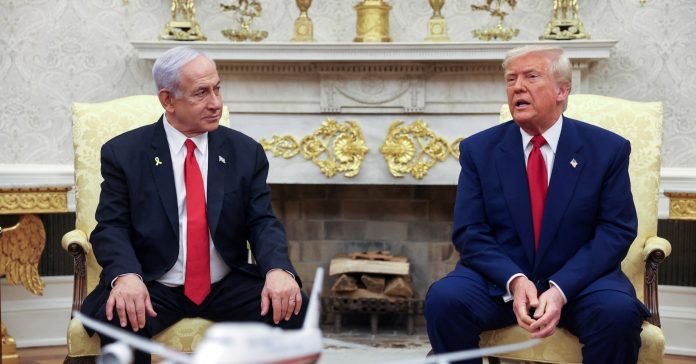
US President Donald Trump described Israel’s attacks on Iran as “excellent,” despite having previously warned Israeli prime minister Benjamin Netanyahu against actions that could disrupt nuclear negotiations.

Trump portrayed the escalating tensions as a potential opportunity for Iran to reconsider its stance, stating they now have a “second chance” to avoid further devastation.

Report: 20 children among victims in Israeli strike on residential building in Iran

The 14-story building was hit early Saturday morning, according to IRIB footage showing ongoing rescue operations at the site.

Emergency teams continue to remove debris in search of bodies believed to be buried under the rubble.

Local officials stated that approximately 60 residents were killed in the strike, and the bodies of 38 victims have so far been recovered. The remains of at least 10 children are still believed to be under the collapsed structure.

Footage from the scene displayed blood-stained baby clothes, children’s bicycles, toys, and schoolbooks retrieved from the wreckage. Personal photographs of young victims were also shown by the reporter on the ground, who described the situation as “devastating.”

The attack has drawn strong condemnation worldwide.

Two more Iranian generals killed in Israeli attack

Deputy Chief of Staff of the Iranian Armed Forces for Operation, Brigadier General Mahdi Rabbani, and Deputy Chief of Staff of the Iranian Armed Forces for Intelligence, Brigadier General Gholamreza Mehrabi were declared on Saturday to have been martyred in the Israeli strikes.

The Israeli regime attacked a number of residential neighborhoods of Tehran as well as military and nuclear sites in other parts of Iran in the early hours of June 13.

Chief of Staff of the Iranian Armed Forces Major General Mohammad Hossein Baqeri, Commander of the Islamic Revolution Guards Corps Major General Hossein Salami, Commander of Iran’s Khatam al-Anbia Central Headquarters Major General Gholam Ali Rashid, Commander of the IRGC Aerospace Force Major General Amir Ali Hajizadeh, and at least six Iranian nuclear scientists have been martyred in the strikes.

Leader of the Islamic Revolution Ayatollah Seyed Ali Khamenei has warned the Zionist regime that it will receive a severe punishment for the strike, saying, “With this crime, the Zionist regime has prepared for itself a bitter, painful fate, which it will definitely see.”

No damage to runways and main buildings at Tehran’s airport: IRNA

Mehrabad Airport

A video published overnight showed smoke rising over the airport.

Flights have been canceled in Iran until further notice, Iran civil aviation announced, according to state-run IRNA news agency.

The Israeli Air Force has announced it carried out a wave of strikes hitting defense arrays in Tehran overnight into Saturday.

“These strikes carry operational and national significance. We damaged – and will continue to damage – strategic sites and enemy sources of knowledge,” commanding officer of the Israeli Air Force MG Tomer Bar said in a situational assessment.

Israeli Air Force planes struck dozens of targets, including surface-to-air missile infrastructure, Bar said.

“For the first time since the beginning of the war, over 1,500 kilometers (932 miles) from Israeli territory, the IAF struck defense arrays in the area of Tehran,” he added.

Iran urges UN Security Council to hold Israel accountable for its crimes

He called on the UN Security Council to “strongly condemn” the “illegal aggression” by the Israeli regime and demanded urgent and concrete measures by the world body to hold the regime accountable and prevent further destabilization of international peace and security.

Israel launched a series of premeditated and coordinated attacks early on Friday, targeting multiple Iranian cities, including nuclear facilities and vital civilian infrastructure.

The envoy described the Natanz nuclear site in central Iran’s Isfahan province – under full International Atomic Energy Agency (IAEA) safeguards – as a primary target.

“These criminal and savage attacks have killed at least 78 people, including senior military officials and innocent civilians, among them women and children, with over 320 wounded,” he told the gathering.

Iravani described the latest strikes as deliberate massacres and acts of terrorism, violating international law and human conscience.

The ambassador criticized the UN Security Council and UN nuclear agency for their inaction in response to Iran’s repeated warnings about Israeli threats to its nuclear facilities, accusing them of emboldening the regime to escalate aggression and cross red lines.

Iravani emphasized the potential catastrophic radiological consequences of attacks on safeguarded nuclear sites, warning that the effects could extend far beyond Iran’s borders.

He said Israel’s aggression also violated the sovereignty of Iraq, whose airspace was used for the aggression, with the Iraqi permanent mission to the UN formally protesting the breach.

The ambassador held the United States responsible for enabling the Israeli strikes, citing Washington’s intelligence, political support, and weapons transfers.

“The complicity of the United States in these terrorist acts is undeniable,” he said.

Iran reaffirmed its inherent right to self-defense under Article 51 of the UN Charter.

Recalling Security Council Resolution 487 (1981), which condemned Israel’s previous attack on Iraq’s Osirak nuclear reactor, Iravani called on the council to enforce international law and hold Israel accountable. He stressed that decades of inaction and double standards have emboldened Israel’s aggressive conduct.

“Any failure to act now,” he warned, “would signify the collapse of the international system and invite chaos.”

Iran says nuclear negotiations with US ‘meaningless’ after Israel attack

Araghchi Witkoff

“The other side [the US] acted in a way that makes dialogue meaningless,” Baqaei said of talks Washington has held with Tehran in recent months over Iran’s nuclear program.

“You cannot claim to negotiate and at the same time divide work by allowing the Zionist regime [Israel] to target Iran’s territory,” he added.

The sixth round of US-Iran nuclear talks was set to be held on Sunday in Muscat, the Omani foreign minister announced on Thursday.

Iran and the US have held five rounds of such diplomatic process with Omani mediation since April.

Iran long-range Arash drones hit targets in Israeli-occupied areas

Iran Drone

According to Iran’s news agencies, the drone operation was conducted in response to the Israeli aggression against Iran.

The report states that several types of Arash drones hit their intended targets deep inside the occupied territories, causing destruction.

The Arash drone is a domestically designed and manufactured Iranian unmanned aerial vehicle (UAV) with an estimated range of 2,000 kilometers. It features a cylindrical body, a vertical tail, and dual wings positioned at the rear.
Powered by a piston engine, the drone is designed for long-range kamikaze missions.

Significantly, the Arash UAV uses a jet-assisted takeoff (JATO) system, eliminating the need for a runway. This capability allows the drone to be launched from mobile platforms, increasing its tactical flexibility and suitability for varied geographic conditions.

IRGC says its missiles struck ‘sources of Israeli onslaught’ in retaliatory military operation

In a new statement early Saturday, the IRGC said the response, codenamed Operation True Promise III, involved the aerospace division firing a wave of missiles and deploying armed drones against “strategic” Israeli targets.

The operation, the statement noted, used a “combination of precision and smart weapon systems,” specifically targeting the Israeli military centers and airbases from which the regime had initiated its “criminal aggression.”

The target list also included Israeli military-industrial centers used by the regime to manufacture missiles and other military hardware intended for “committing crimes against the region’s resisting nations, including the oppressed Palestinian people,” the statement read.

In addition, projectiles and drones were launched at other military sites, the IRGC noted.

“Field reports, satellite imagery, and intercepted intelligence indicate that dozens of ballistic missiles have effectively struck strategic targets,” the IRGC statement noted.

Meanwhile, the force rejected the regime’s claims of intercepting the incoming fire, asserting that “the enemy failed to counter the waves of missile strikes launched by the Islamic Republic.”

It emphasized that the retaliation was carried out in fulfillment of a promise by the Leader of the Islamic Revolution, Ayatollah Seyyed Ali Khamenei, to avenge the blood of the victims of Israeli aggression.

The reprisal also came in response to the Iranian nation’s demands for “avenging the pure blood that has been spilled.”

The IRGC finally described the retaliation as a “powerful and offensive” response, and asserted that the country’s security was the Armed Forces’ “red line.”