Monday, December 22, 2025
Home Blog Page 3016

Economist Explains Reasons for Advocating Fuel Rationing in Iran

In an interview with Jamaran, Iranian economist Saeed Laylaz described the recent hike in the fuel price in Iran as a “pricing reform”, but also leveled heavy criticism at the management strategies of the government.

The following is the text of his interview:

Q: Mr. Laylaz, you had already announced that you were one of the architects of the fuel consumption management plan.

Laylaz: That’s right. I was a strong supporter of an increase in the price of energy carriers, not gasoline alone. But the plan that I had put forward in early 1397 (March 2018) at the outset of new sanctions had three parts.

The first part entailed reform policies, including a rise in the price of energy carriers. The second part involved policies to offer support and compensation in the face of such price reform: to double or triple the subsidies, and to guarantee a daily supply of 2,000 calories with the distribution of coupons among all 83 million people (in Iran); Thirdly, under no circumstance should a patient be deprived of medicine or treatment. We must also make the public transportation almost free, and guarantee free education up to the degree of diploma.

The principle of my theory, in theoretical or ideological terms, is that I believe that no revolution or unrest would take place without three or four deciles of a society. Those three deciles include the lowest income population. Also without the three or four middle deciles, there would be no stability. And without the one or two top deciles, no progress would be made.

After all, let’s see which issues in Iran do not have domestic roots. For instance, we face an environmental crisis. Do Iraq, Afghanistan, Pakistan, Saudi Arabia and Turkey not face it? We have a gap between the rich and the poor. Do not the other regional countries have it? All are the same.

If I’m not mistaken, the volume of liquidity in Iran stood at 200 billion tomans at the time of the (1979) Revolution. It now stands at above 2,200 trillion tomans. It’s incredible how high it is. It has risen by around 10,000 times within 40 years. This would create inflation. Inflation is the root cause of all problems.

On the other hand, we were plagued by organized corruption in Iran over the past 15 years. I believe that all of our problems have internal roots. Trump, or friendship with or hostility towards the United States would not determine Iran’s issues and problems.

Hard work in countries like Malaysia, South Korea, China and Japan has nothing to do with friendship with or hostility against the US. What does it have to do with the United States if the input of resources in Iran is 100 and the output is 40. We must combat domestic corruption, and the genuine combat is as follows:

  1. Tackling corruption should not be confined to a specific party.
  2. The advertisement should be proportional (to combatting corruption).
  3. You must eliminate the grounds for corruption, which means economic liberalization. Wherever there is economic rent and privilege, there would be embezzlement.
  4. The basic principle of combatting corruption is democracy. Why are the reformists generally healthier than non-reformists in financial issues? Why was Seyyed Mohammad Khatami’s administration the best, healthiest and the most well-functioning administration in the history of Iran after the Revolution? Because that administration was the target of the heaviest propaganda and political criticism, and the tiniest case of corruption in it was being exaggerated ten times stronger.

Do you believe that Mr. Trump has determined such four-dimension situation? Please specify the role of the United States in such state of corruption. You can mention a hundred other basic issues of Iran, and I’ll prove that the sanctions have had not the merest impact on those matters.

We have overcome and bypassed most of the harmful effects of the sanctions, and are doing our job. The issue of sanctions is not a long-term issue. The Supreme Leader himself has announced (that sanctions would last for) two or three years. I suppose that we may get somewhere within the next six or seven months, because Americans have also many restrictions in this approach.

However, we just wrangled with each other inside the country during the two or three years when we were not slapped with sanctions. Are sanctions to blame? Everybody could have been given the opportunity to work and have imported technologies. Iran will grow beyond the size of a regional power if it gets out of this crisis. Iran’s current problem is the crisis of incompetence. It will be fixed if someone makes that competent.

An era will come that Iran’s economic growth would become a two-digit number. This, however, would not happen overnight. A scientific process is underway.

In historical terms, a (Napoleon) Bonaparte will emerge in Iran and will carry out the process of transition to a pragmatic government whose pillars are based on Iranian nationalism, but would be Muslim. This would happen in the form of a transformation, not a revolution. I considered the very same developments in the past recent decade as a step in this path.

But what is the objective meaning of such deficient scheme passed by Mr. Rouhani? I invite my principlist friends to exercise such reasoning. We would get 30,000 billion tomans from the top social classes of Iran every year and inject it into the poorest classes of the society. This would increase the Gini Coefficient in Iran overnight. So why shouldn’t we do that?

Didn’t we experience a reform of fuel price during Mr. Khatami’s term? Didn’t we have fuel price reform at the beginning of Mr. Rouhani’s administration? Didn’t it take place to the highest degree during martyr Rajaee’s administration? From who or where did it meet opposition?

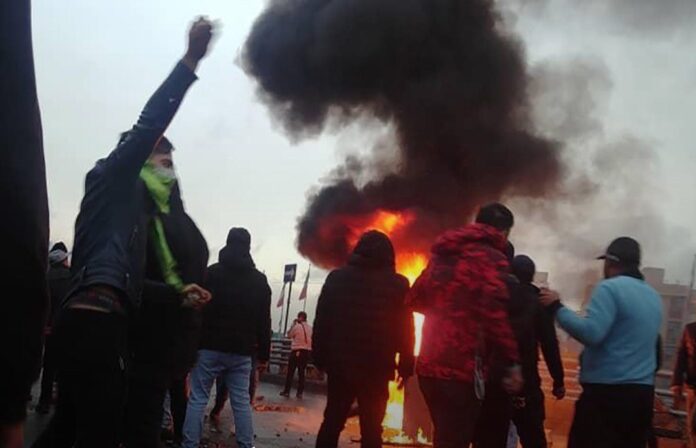
I do not see gasoline as the primary and final purpose behind the protests by any means. When the reforms that should have been implemented step by step are not carried out, they turn into a painful surgery. Every reform is painful. The more it is delayed, the worse it would become.

Everywhere in the world, either in the poor or rich countries, where there is no oil, the government revenues for running the society are based upon the taxation of alcoholic beverages, tobacco and fuel. All governments in the world levy very high taxes on these three items to generate revenue. We are not allowed to have alcoholic beverages for religious reasons.

Although it is said that alcohol consumption in our country is not lower than the other countries, the government in Iran has deprived itself of such taxation, and this has increased the per-capita consumption (of alcohol) in Iran. That’s because premium, pure and original alcohol reaches the consumers in Iran at a lower cost than Europe. Because they levy tax (on liquor) there (in Europe), but not in here.

Moreover, we are technically unable to levy a tax on tobacco. In addition, we cannot increase the fuel price for social reasons.

The price of gasoline in our country should not be lower than such a limit that smuggling gasoline out of the country would be economically feasible. In that case, those income resources must be spent on the people, which is exactly the example of social justice. I wonder why the opponents oppose this plan.

Q: Why doesn’t the income of people rise with a hike in the fuel prices? Because a series of charts have made a comparison between Iran and the other countries.

Laylaz: Such comparisons are so weird. According to the scheme introduced by Mr. Rouhani, a four-member family, for instance, would receive at least 200,000 tomans in cash handout. Well, such sum of money is equivalent to the difference in the cost of 100 liters of gasoline with new prices. Another 60 liters is also received under the rationing system, making a total of 160 liters per month. Accordingly, the families would by no means be affected by the rise in the gasoline price. The administration has given every family the freedom of choice with such scheme.

The true winners in this scheme would be the seven lowest deciles of the society. Because it is totally clear that we get 30,000 billion tomans from the main consumers of gasoline in the country and give it to the poorest social classes.

Q: Don’t you think that the administration would enlarge liquidity with this plan?

Laylaz: The rise of liquidity has nothing to do with this issue. Under such scheme, the administration gets money from one person and gives it to another individual. Since the scheme has not created any new liquidity in the society, it would not lead to inflation either.

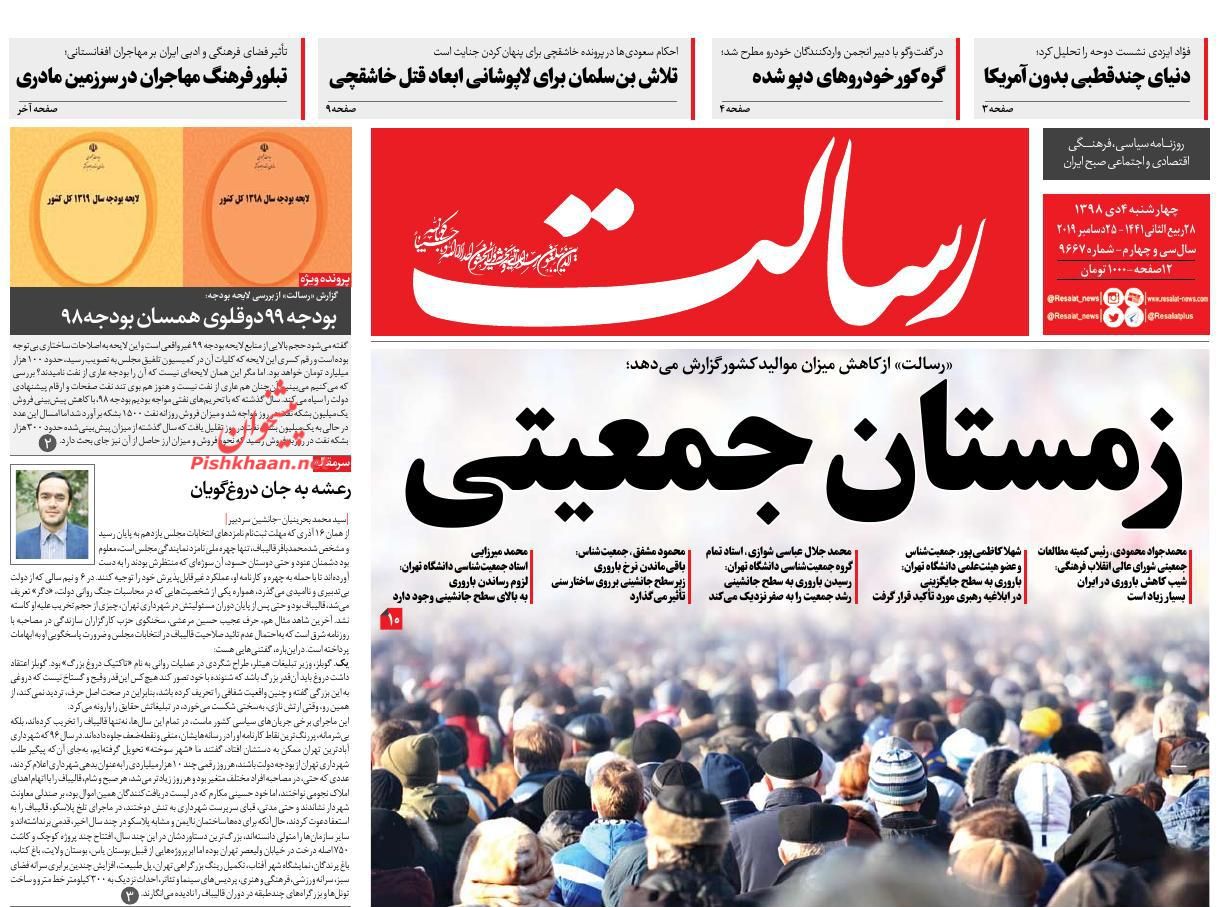
A Look at Iranian Newspaper Front Pages on November 30

A Look at Iranian Newspaper Front Pages on November 19

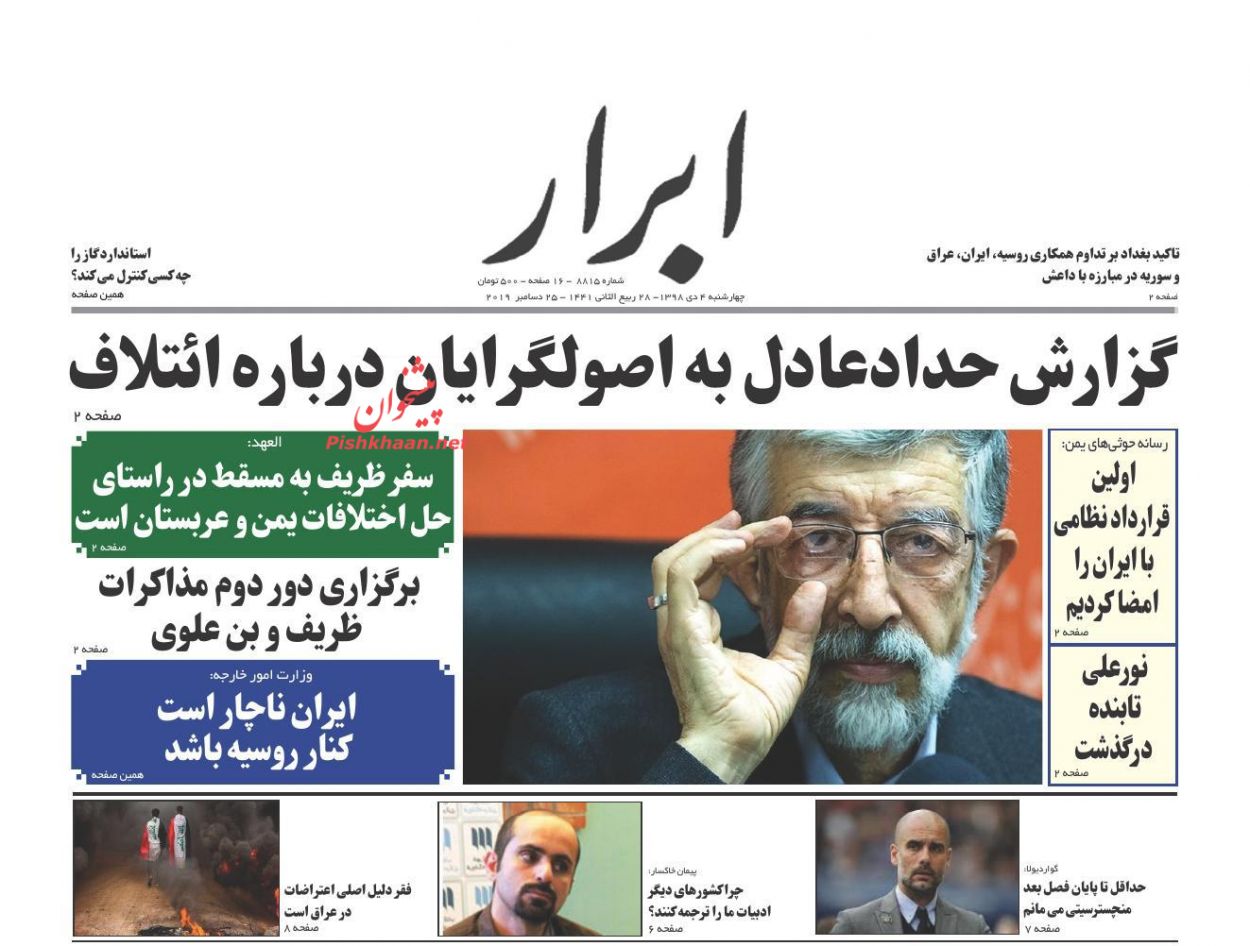
Abrar:
1- Some Iraqi Parties: Top Cleric’s Statement Shows Gov’t No Longer Trusted
2- Six More European States to Join INSTEX
3- Araqchi: We Don’t Intend to Hold Talks on Our Missile, JCPOA Program

A Look at Iranian Newspaper Front Pages on November 30


Aftab-e Yazd:
1- Tehran Air Heavily Polluted
2- Tehran Lawmaker: We Are Ashamed of People
3- Return of ISIS: Most Dangerous Consequence of Iraq Crisis
4- Mousavian: US Will Finally Have to Leave Region

A Look at Iranian Newspaper Front Pages on November 30


Donya-ye Eqtesad:
1- Red Condition in Tehran Sky

A Look at Iranian Newspaper Front Pages on November 30


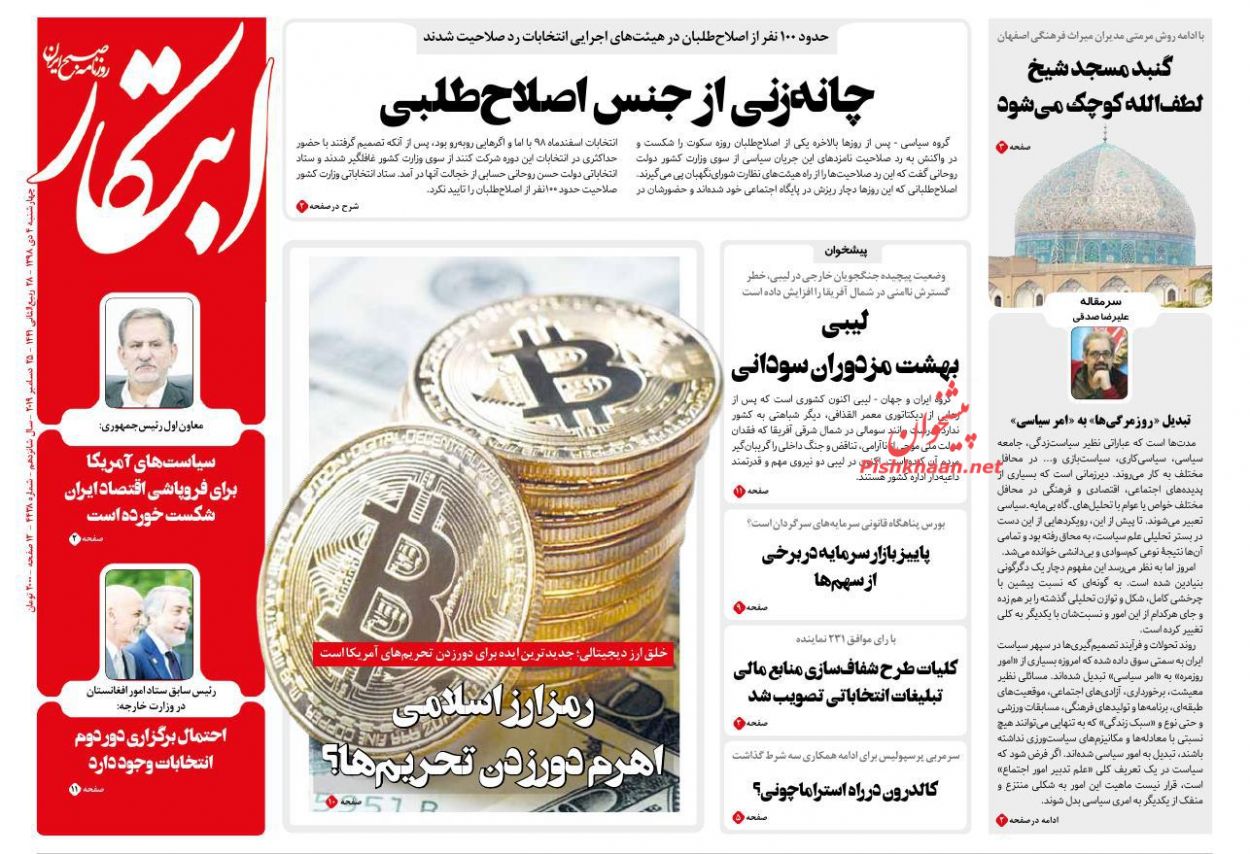
Ebtekar:
1- Hardliners Trying to Overthrow Rouhani Government
2- What Trump Looked for in Kabul
3- Iraq FM Apologizes to Iran after Attack on Iranian Consulate in Najaf

A Look at Iranian Newspaper Front Pages on November 30


Etemad:
1- Tehran Citizens No Longer Stand Air Pollution
2- End of Abdul Mahdi
3- Everyone against President, President against Himself

A Look at Iranian Newspaper Front Pages on November 30


Ettela’at:
1- Iraq PM Resigns after Call by Top Cleric
2- Iran Leader: Americans Insulting Independence of Nations

A Look at Iranian Newspaper Front Pages on November 30


Jame Jam:
1- Severe Air Pollution Despite 60 Bills on Tackling It

A Look at Iranian Newspaper Front Pages on November 30


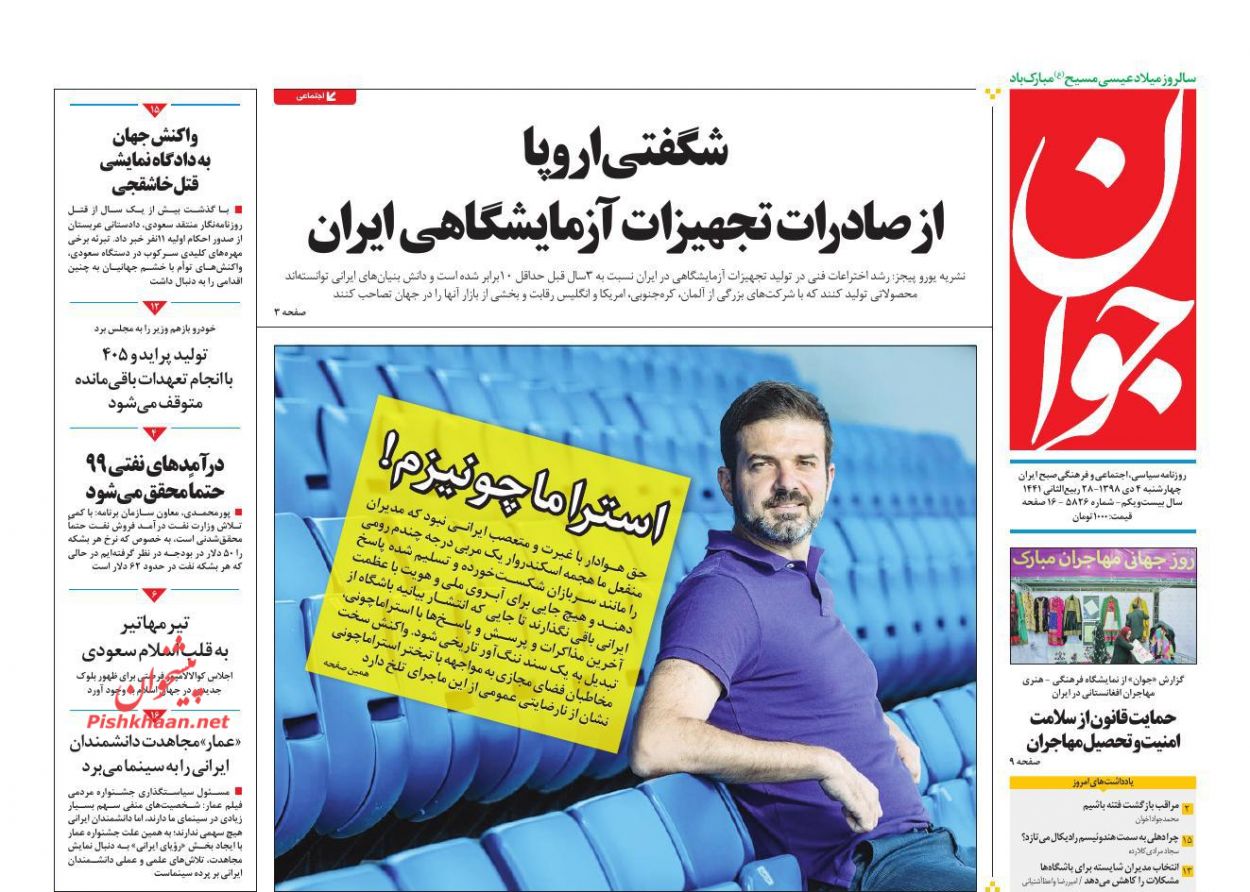
Javan:
1- IRGC Chief: We Sacrifice Our Lives for Nation
2- Araqchi: We Learned from JCPOA Resistance Works Better than Cooperation
3- Mr Trump! Afghanistan Not 51st State of US

A Look at Iranian Newspaper Front Pages on November 30


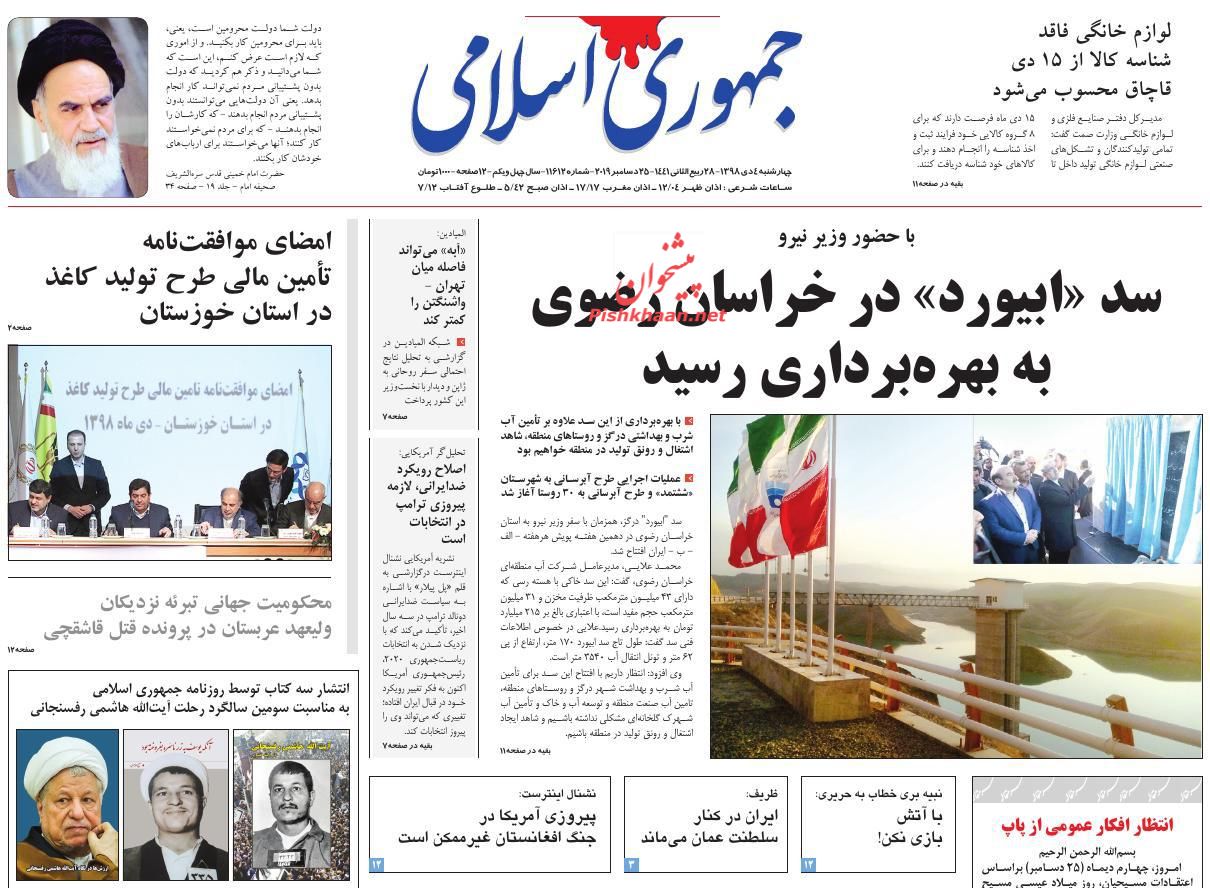
Jomhouri Eslami:
1- Ayatollah Sistani’s Important Warning on Rioters’ Efforts to Create Civil War
2- Tehran Air in Emergency Situation

A Look at Iranian Newspaper Front Pages on November 30


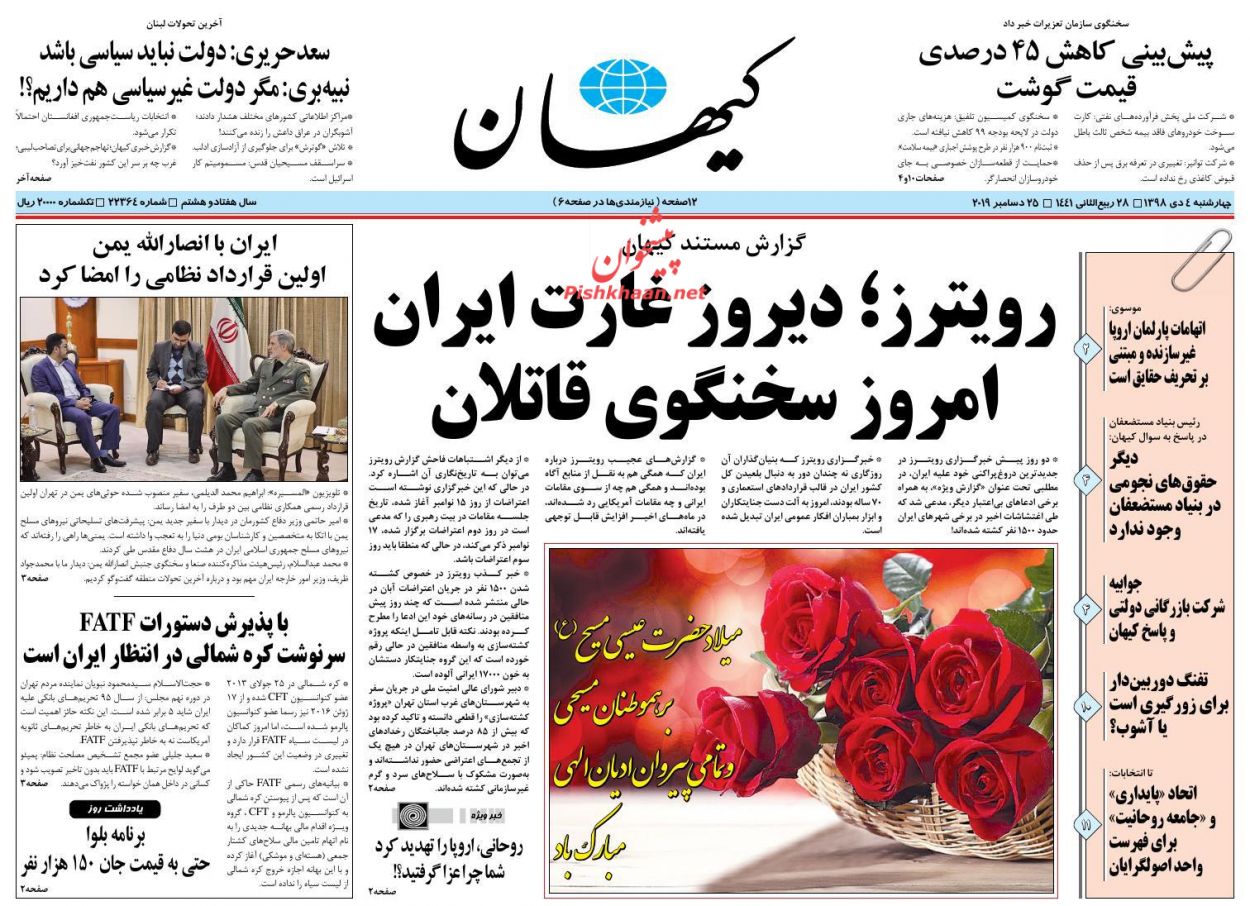
Kayhan:
1- Araqchi: Result of JCPOA Was Just More Sanctions
2- Trump Visits Afghanistan Like Thieves

A Look at Iranian Newspaper Front Pages on November 30


Setareh Sobh:
1- Tehran under Boots of Air Pollutants
* Universities, Schools Shut Down
* Clean Air Law Not Being Implemented; People’s Lives Targeted

A Look at Iranian Newspaper Front Pages on November 30


Shargh:

1- 2019 Protests Not Comparable to Those of 2017, 2009

2- Has Araqchi Joined Hardliners?

A Look at Iranian Newspaper Front Pages on November 30

Chinese Firms Invited to Invest in Iran’s Tourism Sector

Chinese Firms Invited to Invest in Iran’s Tourism Sector

Ali-Asghar Mounesan says Tehran is ready to work closely with Beijing in tourism and cultural areas within the framework of the Chinese initiative “One Belt, One Road.”

“If Chinese investors are interested, we can offer them land in order to invest in the construction of tourism sites and facilities,” he said in a meeting with Chinese Minister of Culture and Tourism ‎Luo Shugang in Beijing.

The Iranian minister also expressed readiness boost cooperation with Beijing in the field of cultural activities, especially research and the restoration of ancient monuments.

“We have good cooperation with European countries such as Germany, France and Italy in this filed, and we can work with China, too, in this area, especially with regards to the exchange of researchers and experts,” Mounesan added.

He noted Iran and China enjoy very good political and economic ties, adding the two sides can forge closer cooperation on cultural and tourism fronts as well.

He said high on Iran’s agenda is to train Chinese-speaking tourists, calling on the Chinese Embassy to help in that regard.

The Chinese official, in turn, thanked Mounesan and said he would like to see a rise in the number of tourists of both countries. He expressed readiness to help train Chinese-speaking tour guides.

Iranian Diplomat in China for Key Talks on JCPOA

Iranian Diplomat in China for Key Talks on JCPOA

His trip comes at the invitation of his Chinese opposite number in order to continue political consultations between the two countries.

Upon arrival at the Beijing International Airport, Araqchi was welcomed by Chinese authorities as well as Iranian Ambassador to China Mohammad Keshavarz Zadeh.

Araqchi is to sit down with his Chinese Counterpart, too.

The two countries are to attend a bilateral consultative meeting on the Joint Comprehensive Plan of Action (JCPOA) in coming days.

During Araqchi’s trip, mutual issues will be discussed as well.

‘Iran Has Evidence IAEA Inspector Carried Suspicious Materials’

Salehi

Head of the Atomic Energy Organization of Iran (AEOI) Ali-Akbar Salehi said on Saturday the inspector failed to give convincing explanation for carrying the substances.

“Generally, inspectors enjoy diplomatic immunity as ambassadors do while on a mission, and such issues have been stipulated in international laws and regulations,” he said.

“For example, if an Iranian AEOI inspector faces an issue in another country, he or she will enjoy diplomatic immunity,” Salehi added.

“Of course, IAEA inspectors must be checked when they enter Iranian sites. This is naturally done while inspecting nuclear facilities all around the world, and this law is not only related to Iran,” he said.

“During the check that was run by machines, one of the inspectors found the inspector to be carrying suspicious materials,” he added.

“When she was asked about it, she failed to give convincing and acceptable answers,” he said.

“At the end, all the events were documented and filmed, but we could not keep the inspector as she had diplomatic immunity,” Salehi added.

He said Iran sent a written objection to the IAEA in that regard and announced the country will follow up on the issue.

He said the inspectors carrying suspicious materials is seen by Iran as a move in connection with the malware Stuxnet.

“We have a site in Iran where we keep faulty machinery. And we buy many of the devices (spare parts) from abroad. But they sabotage these devices, so that we would face problems when operating our machinery,” he noted.

“They used the malware Stuxnet against us. They committed industrial sabotage against us and sold faulty equipment to us, but we were vigilant in that regard,” said Salehi.

Elsewhere in his remarks, he touched upon Iran’s enrichment activity.

He said enrichment work is underway at Fordo facility due to a breach of commitments by the European parties to the Iran nuclear deal known as the Joint Comprehensive Plan of Action (JCPOA).

“As long as they fail to live up to their obligations, we will continue enrichment at Fordo,” he said.

Salehi said Iran’s objective is to maintain the JCPOA.

Air Pollution Shuts Down Schools, Universities in Tehran

Air Pollution Shuts Down Schools, Universities in Tehran (5)

According to the latest data, the air pollution index in Tehran has approached the hazardous level of 150.

A hazardous level is an alert in which everyone may experience ill effects and are advised to stay indoors.

The decision was made a day earlier by the Air Pollution Exigency Committee, according to Tehran Province Deputy Governor Mohammad Taqizadeh.

The odd-even traffic scheme will be applied all across the capital and that the ban on the movement of trucks as well as the activity of sand mines and concrete industries would remain in place, the official said.

The ban is also extended on holding outdoor sports matches until further notice. As a result, the football match between Tehran giants Persepolis FC and Nassaji of Mazandaran, which was due to be held Saturday afternoon, has been called off.

Over the past few days, Tehran has been blanketed by heavy smug, with the air pollution reaching the level considered unsafe for all groups of people.

Authorities have urged citizens, especially children, pregnant women and the elderly, to stay indoors.

Each winter, Tehran, a metropolitan city surrounded by mountains, suffers some of the worst air pollution in the world through thermal inversion — a phenomenon that traps hazardous air over the city.

Other industrial Iranian cities also experience similar periodic heavy air pollution.

Iraqi PM Vows to Resign after Top Cleric’s Call

Iraqi PM Vows to Resign after Top Cleric’s Call

“I will submit to parliament an official memorandum resigning from the current prime ministry so that the parliament can review its choices,” Abdul Mahdi said Friday.

Earlier in the day, Ayatollah al-Sistani said that parliament, which elected the year-old government of Abdul Mahdi, should “reconsider its options”.

“We call upon the House of Representatives from which this current government emerged to reconsider its options in that regard,” Ayatollah al-Sistani said in his weekly sermon delivered in the holy city of Najaf via a representative.

Abdul Mahdi said he “listened with great concern” to the top cleric’s sermon and made his decision in response to his call and in order to “facilitate and hasten its fulfillment as soon as possible”.

The developments came a day after more than 50 people were killed by security forces in one of the bloodiest days of violence since the anti-government protests erupted in early October.

Gamaj Kebab Luxury Food of Northern Iran

Gamaj Kebab Luxury Food of Northern Iran (2)

The food is named after a local clay cauldron known as Gamaj in the local vernacular.

Gamaj kebab is usually cooked with red meat, but white meat such as chicken and turkey can also be used. Interesting enough, when this food is made with chicken, it is known as the Tala-Kooleh-Ghoorabe stew in the local language. This stew is not only very delicious, but also very useful for the body thanks to the nutritious herbs used in it.

Gamaj Kebab Luxury Food of Northern Iran (1)Ingredients:

Walnut kernel: 300gr

Onions: An average-sized onion

Pomegranate paste: 2 spoonfuls

Pomegranate juice: 2 spoonfuls

Stew herbs: 400gr (the local Choochaq herb, or chives, parsley and coriander instead)

Liquid oil: As much as necessary

Meat: 600gr

Tomato paste: 2 spoonfuls

Salt, black pepper and turmeric: As much as necessary

Recipe:

First, shred the onion and sauté it until it gets soft and transparent.

After the onion gets soft, add some turmeric and keep sautéing the mixture until you get a consistent mix of onion and turmeric. Then chop the meat and add it to the ingredients. After you sauté the meat, add tomato paste along with pomegranate paste and pomegranate juice. Then sauté them all together until the tomato paste and pomegranate paste get fried a little. Then chop the herbs and add them to the ingredients together with ground walnut. Sauté all the ingredients for a few more minutes until you get a consistent mixture. Then add a few glasses of boiling water and allow the stew to be cooked through on low heat. If you use the Gamaj cauldron, the food will become tastier.

In the last 30 minutes when the food is being cooked, taste it, and add some salt and black pepper if needed. This stew is served with little stock (water), so do not serve it until it loses quite some water and only oil is left behind. Finally, you may serve the stew with rice.

Mesr Desert; A Gem in Central Iran

The desert has good recreational facilities including safari, motorbikes and camels that give you a different experience. The desert is located 55 kilometres from the city of Khor of Isfahan province next to a village bearing the same name. The village along with its desert has a warm and dry climate.

In the summer, the climate is warm and during the cold seasons the weather is moderate. The desert is hot and sunny during the day, but it gets cold at night with the fall of temperatures.

Alongside the Mesr village, there are many other small villages in the desert; to name Amirabad, Farahzad and Garmeh.

The beautiful palm trees, bushes and sand hills have created spectacular scenery in these villages. But Garmeh is different. The presence of Dr Fish springs with therapeutic fish has attracted more tourists to this desert village.

There is also an interesting palm tree field called Burned Palm Field; which came into being during winter 40 years ago. While travelling to Mesr desert, you can stay at Maziar Al Davoud House there. Maziar Al Davood is an architect who, along with his French wife, has renovated his ancestral home and converted it into a residence.

Beyazeh is a 110-kilometre village in the countryside that attract many desert tourists due to its ancient citadel, aqueducts, the Old Jame Mosque, and the dense palm trees. Beyazeh Castle is located in this village. It is a Sassanid-era structure that has been used for centuries for housing and defense and has become a base for the followers of Hassan-i Sabbāh in the Ismaili state.

Following you can find photos of Mesr desert retrieved from different sources: