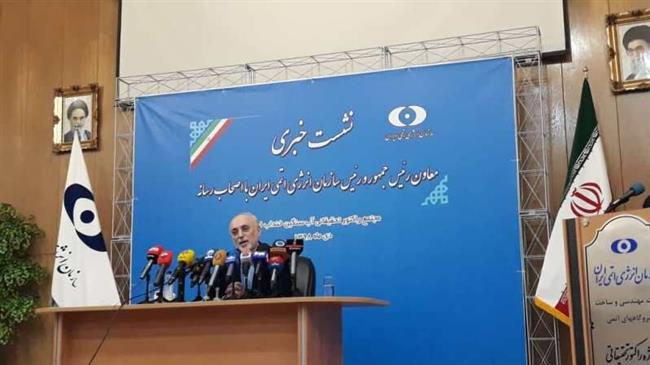
Ali Akbar Salehi made the remarks in a press conference on the sidelines of a ceremony on Monday, held to launch the second circuit of Iran’s Arak heavy water reactor, which is located near the central Iranian city of Khondab.
Under the nuclear deal, signed between Iran and the P5+1 countries (the United States, Britain, France, China, Russia and Germany), Tehran agreed to remove the core of the Arak reactor and fill it with concrete provided that the other parties to the accord redesign it for the production of medical isotopes, which they did not.
The reactor consists of two circuits, with the first one tasked with removing heat from the heart of the reactor, and the secondary circuit responsible for transferring heat from the first circuit to cooling towers and finally to the outside environment.
“Europe wants the JCPOA to survive. The JCPOA is of security importance to them, but whether this demand is commensurate with their ability [to resist US pressures] is a different issue. The ability of Europe depends on its resistance against the United States, but unfortunately they have proven that the 28 [member] states [of the European Union] are less resistant and independent than a single [US] state like California,” Iran’s nuclear chief said.
Salehi added that if European countries seek to activate the trigger mechanism, it would be against their will, adding, “If the trigger mechanism is activated, nothing will be left of the JCPOA. This is a contradiction in the Europeans’ discourse.”
Expressing hope that Europe would amend this discourse, Salehi said, “We hope that this European discourse is rectified, because this discourse will put Europe on the same level with an untrustworthy America.”
“Europe’s prestige has been tarnished before the world’s public opinion and they must not do more damage to this prestige. All parties must try to help the JCPOA survive,” Iran’s nuclear chief said.
In May 2018, US President Donald Trump unilaterally pulled his country out of the JCPOA in defiance of global criticism, and later re-imposed the sanctions that had been lifted against Tehran as part of the agreement.
European members since last month have begun raising the possibility of triggering the JCPOA’s “dispute resolution mechanism,” which is also known as the trigger mechanism, and whose activation can lead to the return of the UN sanctions on Iran.
Recent threats to activate the trigger mechanism envisaged in the JCPOA were brought up after the Iranian government took a series of steps in reducing its commitments under the deal in response to the US measures and the Europeans’ failure to keep their end of the bargain in protecting Iran’s economic benefits in the agreement.
Iran has so far rowed back on its nuclear commitments four times in compliance with Articles 26 and 36 of the JCPOA, but stressed that its retaliatory measures will be reversible as soon as the European signatories — France, Britain and Germany — find practical ways to shield mutual trade from the US sanctions.
As a first step, Iran increased its enriched uranium stockpile to beyond the 300 kilograms set by the JCPOA.
In the second step, Tehran began enriching uranium to purity rates beyond the JCPOA limit of 3.76 percent.
In the third phase, after the Europeans failed to meet a 60-day deadline to meet Iran’s demands and fulfill their commitments under the deal, Iran started up advanced centrifuges to boost the country’s stockpile of enriched uranium and activated 20 IR-4 and 20 IR-6 centrifuges for research and development purposes.
In November, Iran began injecting gas into centrifuges at the Fordow plant as part of its fourth step away from the JCPOA under the supervision of the International Atomic Energy Agency (IAEA).
Iran’s Deputy Foreign Minister for Political Affairs Abbas Araqchi said on December 9 that despite their recent threat to activate the trigger mechanism envisaged in the nuclear accord, the European signatories to the deal will not do so for the time being.
“During the recent meeting with the 4+1 group, the trigger mechanism was never brought up and all remarks to this effect have no other goal, but to create a negative atmosphere against our country,” Araqchi said.
Sending Iran to UNSC benefits no one
Elsewhere in his interview, Salehi said that a possible reporting of Iran’s nuclear case to the United Nations Security Council would not serve the interests of anyone, warning that in that case, regional and international relations would change, leading to unpredictable repercussions.
He added that if the three European parties to the JCPOA fail to fulfill their obligations under the deal, Iran will make a proportionate decision, but “we hope that the opposite side will make a decision and carry out a measure that will prevent further complication of the issue.”
Too early to talk about Iran’s 5th JCPOA step
The Iranian nuclear chief noted that it is still too early to talk about Tehran’s fifth step in scaling back its commitments under the JCPOA if the European signatories did not take practical measures to salvage it.
Iranian President Hassan Rouhani is in charge of announcing the country’s steps to reduce its JCPOA commitments, but he has made no serious remarks in this regard yet, he said, adding that the president would make the necessary decisions and order the AEOI to implement them in due time.
He said Iran may accelerate certain measures or increase production.
Secretary of Iran’s Supreme National Security Council Ali Shamkhani said on Sunday that the Islamic Republic would take the fifth step of scaling back its JCPOA commitments if the European signatories take no practical measures to save it.
“Tehran has started different steps to reduce its peaceful nuclear commitments in order to maintain and balance its commitments under the JCPOA and if the Europeans fail to fulfill their obligations, we will take the fifth step,” Shamkhani said.
Arak heavy water cold tests within next two years
In response to a question about new Khondab reactor’s cold tests, the AEOI chief said Iran has previously announced that the modeling of a new reactor would take at least five years since the conclusion of the JCPOA.
He expressed hope that all the necessary measures would be completed within the next two years.
New IAEA head not influenced by any country
Asked about the possibility of the new IAEA Director General Rafael Mariano Grossi be swayed by certain countries to take positions against Iran, Salehi said Grossi is fully aware of the agency’s matters and has vowed to be fair and not to be affected by influential countries in dealing with the Iranian nuclear case.
He added that Iran cooperates with the IAEA in line with the agency’s Safeguards Agreement, the Additional Protocol and the JCPOA, emphasizing that Tehran has no commitment outside such purview.
Speaking in an interview with Ria Novosti earlier this month, Grossi promised he would act fairly and independently towards Iran, saying he would not allow discrimination in any case and would like to rely on cooperation with Iran.
“We will not allow discrimination and bias against Iran,” he said, emphasizing that as the new IAEA head, he wants to advance his own approach towards relations with Tehran.