Tuesday, April 28, 2026
Home Blog Page 292

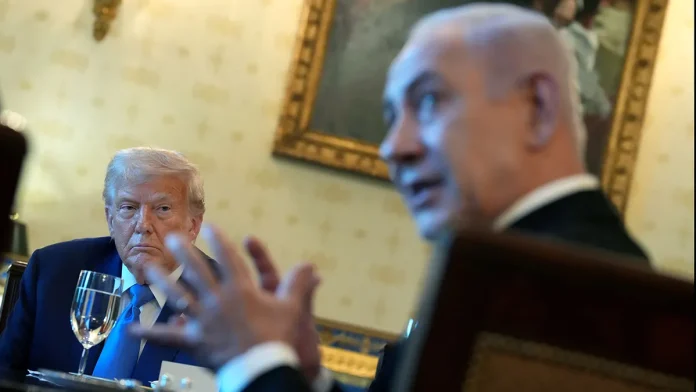
Netanyahu meets Trump at White House as Israel, Hamas discuss Gaza ceasefire

Speaking to reporters at the beginning of a dinner between U.S. and Israeli officials, Netanyahu said the United States and Israel were working with other countries who would give Palestinians a “better future,” suggesting that the residents of Gaza could move to neighboring nations.

“If people want to stay, they can stay, but if they want to leave, they should be able to leave,” Netanyahu added.

“We’re working with the United States very closely about finding countries that will seek to realize what they always say, that they wanted to give the Palestinians a better future. I think we’re getting close to finding several countries.”

Trump, who initially demurred to Netanyahu when asked about the relocating of Palestinians, said the countries around Israel were helping out.

“We’ve had great cooperation from … surrounding countries, great cooperation from every single one of them. So something good will happen,” Trump added.

The president earlier this year floated relocating Palestinians and taking over the Gaza Strip to turn it into the “Riviera of the Middle East”. Gazans criticized the proposal and vowed never to leave their homes in the coastal enclave. Human rights groups condemned the plan as ethnic cleansing.

Trump and Netanyahu met in Washington while Israeli officials continued indirect negotiations with Hamas aimed at securing a U.S.-brokered Gaza ceasefire and hostage-release deal.

Netanyahu’s visit follows Trump’s prediction, on the eve of their meeting, that such an agreement could be reached this week.

It was Trump’s third face-to-face encounter with Netanyahu since returning to office in January, and came just over two weeks after the president ordered the bombing of Iranian nuclear sites in support of Israeli air attacks. Trump then helped arrange a ceasefire in the 12-day Israel-Iran war.

Outside, hundreds of protesters, many wearing Palestinian keffiyeh scarves and waving Palestinian flags, gathered near the White House, waving banners that read “Stop Arming Israel” and “Say No to Genocide”. They also called for Netanyahu’s arrest, referring to the International Criminal Court’s arrest warrant against the Israeli leader over alleged war crimes in Gaza.

Trump’s Middle East envoy Steve Witkoff, who played a major role in crafting the 60-day ceasefire proposal at the center of the Qatar negotiations, will travel to Doha this week to join discussions there, White House press secretary Karoline Leavitt told reporters earlier on Monday.

In a sign of continued gaps between the two sides, Palestinian sources stated that Israel’s refusal to allow the free and safe entry of humanitarian aid into Gaza remains the main obstacle to progress in the indirect talks.

The U.S.-backed proposal envisages a phased release of hostages, Israeli troop withdrawals from parts of Gaza and discussions on ending the war entirely.

Hamas has long demanded a final end to the war before it would free remaining hostages; Israel has insisted it would not agree to halt fighting until all hostages are released and Hamas dismantled.

Israel’s war in Gaza has killed over 57,000 Palestinians, according to the enclave’s health ministry. Most of Gaza’s population has been displaced by the war and nearly half a million people are facing famine within months, according to United Nations estimates.
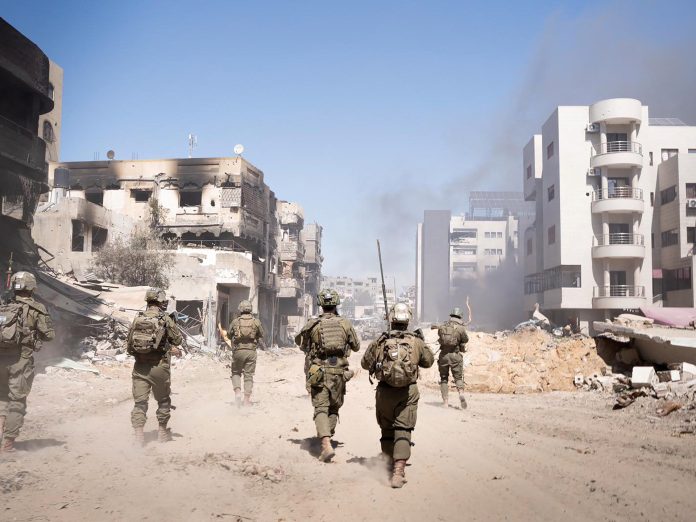
Israel confirms five soldiers killed in Gaza

Israel Army

Two of the soldiers “fell during combat in the northern Gaza Strip,” the Israeli military said in a statement,

It added that three others were killed and two severely wounded in the same incident.

The Israeli army also confirmed that 14 soldiers were wounded during clashes with Palestinian resistance forces.

According to official Israeli army figures, nearly 890 soldiers have been killed and almost 5,860 others injured in Gaza since October 2023.

Since Israel’s war on Gaza began in October 2023, more than 57,500 Palestinians — mostly women and children — have been killed, according to the Gaza Health Ministry.

The International Criminal Court (ICC) issued arrest warrants last November for Netanyahu and his former Defense Minister Yoav Gallant for war crimes and crimes against humanity in the besieged enclave.

Salehiyeh wetland identified as main source of Tehran’s dust pollution crisis

Reza Shahbazi attributed the persistent air pollution to intensifying drought, regional winds, and the activation of domestic dust hotspots.

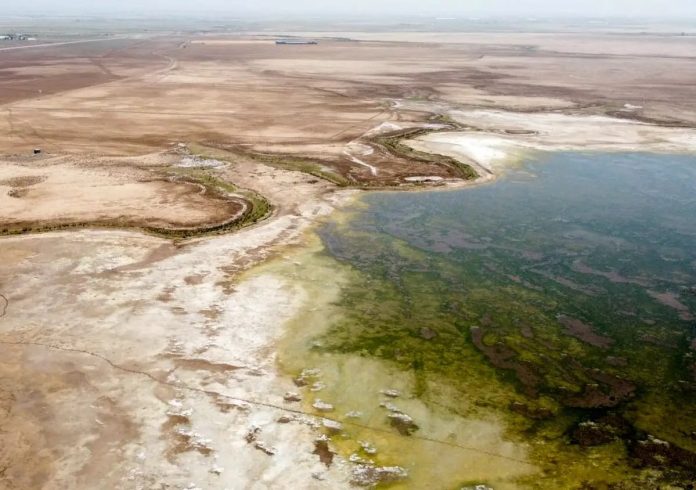
Salehiyeh Wetland, located southwest of Tehran near the borders of Alborz and Qazvin provinces, was once a seasonal wetland supporting wildlife and migratory birds. It has now dried up due to declining rainfall, excessive groundwater extraction, dam construction, and agricultural expansion, transforming into an active dust emission zone during southern and southwestern winds.

Dust storms in Iran are not new, but their frequency, severity, and geographical spread have significantly increased over the past two decades.

External sources of dust include Iraq, Syria, and Saudi Arabia, while internal sources span regions like Khuzestan, Sistan and Baluchestan, and now areas near Tehran.

Experts warn that ongoing climate change, poor water management, and shrinking wetlands continue to fuel this growing environmental and public health crisis.

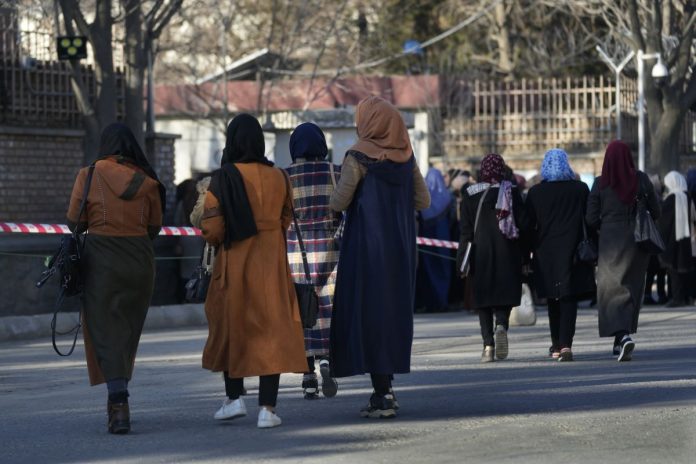
UN General Assembly condemns ‘systematic oppression’ of Afghan women

Afghan Women School

The resolution was adopted by 116 votes in favor versus the United States and Israel against, with 12 abstentions.

The text “expresses its serious concern about the grave, worsening, widespread and systematic oppression of all women and girls in Afghanistan by the Taliban.”

It said the Taliban, an armed group that took control of the country in 2021, “has put in place an institutionalized system of discrimination, segregation, disrespect for human dignity and the exclusion of women and girls.”

Since taking power, Taliban authorities, who also ruled the country between 1996 and 2001, have restricted women’s education and ability to work, and barred them from participation in many forms of public life.

Member states called on the Taliban “to swiftly reverse contradictory policies and practices,” including laws that “extend the already intolerable restrictions on the human rights of women and girls and on basic personal freedoms for all Afghans.”

The resolution welcomed the Doha talks, initiated in 2023 by the UN to coordinate the international community’s approach to the Taliban authorities, and called on UN Secretary General Antonio Guterres to appoint a coordinator to facilitate that process.

The United States opposed the resolution and rejected engagement with the Taliban government.

“Nearly four years following the Taliban takeover, we continue the same conversations and engage with the same so-called Taliban officials about improving the situation in Afghanistan without demanding results from them,” stated US representative Jonathan Shrier.

“The United States will no longer enable their heinous behavior.”

The Taliban returned to power after reaching a peace agreement with the United States during President Donald Trump’s first term, overthrowing the country’s government after foreign forces withdrew under the deal.

Russia officially became the first country to recognize the Taliban government last week.

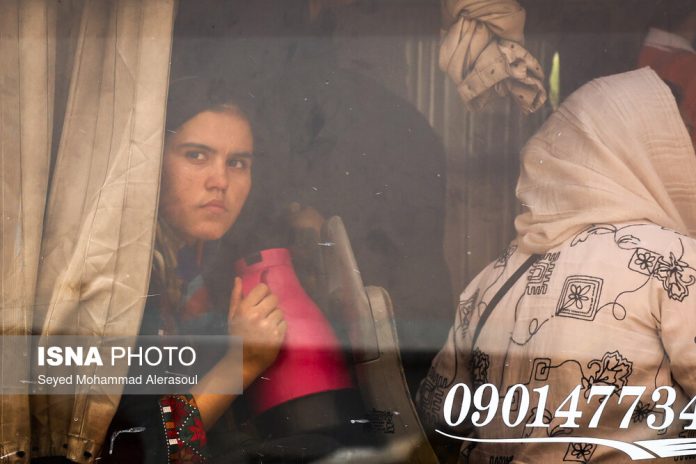
Nearly half a million undocumented Afghans exit Iran via Dogharoun border

The figures, released by the deputy for security and law enforcement at Khorasan Razavi Governorate, show that approximately 180,000 of these individuals were from Khorasan Razavi Province, bordering Afghanistan, alone.

The official added that 80% of those departing from Khorasan Razavi had come forward voluntarily, registering themselves for repatriation.

Afghan migration to Iran has a long history, stretching back to before the 1979 Islamic Revolution. Major influxes have typically aligned with internal unrest in Afghanistan, including the civil wars, the Soviet invasion in 1980, and more recently, the Taliban’s return to power.

The latest wave has been the largest to date, leading to intensified movement across Iran’s eastern borders.

Shared cultural, linguistic, and geographical ties have made Iran a natural destination for Afghan refugees over the decades. However, Iranian authorities have increasingly sought to regulate undocumented migration, citing economic and security concerns.
Efforts to repatriate unauthorized residents have accelerated in recent months.

US will send more weapons to Ukraine: Trump

Speaking to reporters at the White House, Trump said Ukraine was getting hit very hard by Russia and needed to be able to defend itself. The United States would be sending primarily defensive weapons, he added.

Trump on Friday told reporters that Ukraine would need Patriot missiles to defend itself, but did not mention them again specifically on Monday.

“We’re going to send some more weapons. We have to. They have to be able to defend themselves. They’re getting hit very hard, now. They’re getting hit very hard. We’re going to have to send more weapons, defensive weapons, primarily,” he stated at the start of a dinner with Israeli Prime Minister Benjamin Netanyahu.

After a call with Trump on Friday, Ukrainian President Volodymyr Zelensky said he had agreed to work on increasing Kyiv’s capability to “defend the sky” as Russian attacks escalated. He added he discussed joint defense production, purchases and investments with Trump.

Ukraine has been asking Washington to sell it more Patriot missiles and systems that it sees as key to defending its cities from intensifying Russian air strikes.

A decision by Washington to halt some shipments of weapons to Ukraine prompted warnings by Kyiv that the move would weaken its ability to defend against Russia’s air strikes and battlefield advances.

“It’s a horrible thing, and I’m not happy with President Putin at all,” Trump stated Monday, adding, “I’m disappointed frankly that President Putin hasn’t stopped.”

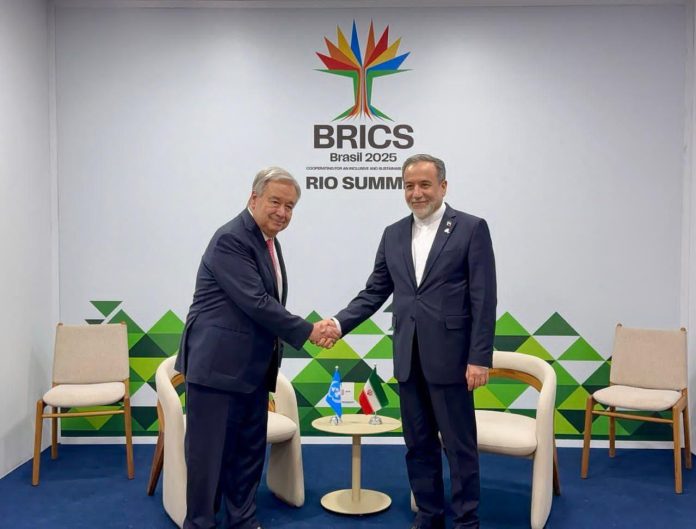
FM condemns US-Israeli attacks against Iran as violation of international law

Speaking on the sidelines of the 17th BRICS Summit in Brazil during a meeting with UN Secretary-General António Guterres on Monday, Araghchi denounced the attacks on residential areas, which resulted in the deaths of civilians, including university professors and other prominent figures.

He further criticized the targeted assassinations of military officials and strikes on Iran’s peaceful nuclear facilities.

Araghchi highlighted that these actions, carried out by Israel with US support, violate international law, the UN Charter, and the Statute of the International Atomic Energy Agency.

“It is deeply concerning that two nuclear-armed states would target a non-nuclear weapon state that is a member of the Non-Proliferation Treaty, whose nuclear activities are under comprehensive safeguards of the International Atomic Energy Agency,” he remarked.

“These reckless and aggressive actions not only pose severe human and environmental risks but also result in irreparable ecological damage,” he added.

Araghchi strongly criticized the UN Security Council’s inaction in the face of these blatant aggressions.

He called the US-Israeli cooperation in targeting Iran’s nuclear sites a deadly blow to non-proliferation efforts.

Araghchi emphasized the need for compensation for damages and losses incurred in Iran and also the punishment of the aggressors.

Araghchi further remarked that sanctions and geopolitical tensions undermine climate cooperation and hinder collective efforts, stating, “The harsh sanctions and unilateral coercive measures imposed by some developed nations against developing countries, including the Islamic Republic of Iran, under political pretenses, pose a serious obstacle to these countries’ efforts.”

“Such actions contradict the international community’s goals of collaborating to combat the destructive effects of climate change and achieving sustainable development objectives, particularly the eradication of poverty and hunger,” he said.

In conclusion, the Iranian foreign minister stated, “The Islamic Republic of Iran, with its vast natural resources, human capacities, and strategic geopolitical location, insists that decision-making processes must be participatory, equitable, and grounded in the principle of ‘common but differentiated responsibilities.’ Accordingly, we urge BRICS to emerge as a unified voice of the global South on climate and environmental concerns.”

The UN chief for his part expressed deep concern over recent developments and their serious risks to global peace and security.

Guterres underscored his readiness to help reduce tensions following military attacks against Iran.

On June 13, Israel launched a blatant and unprovoked act of aggression against Iran, assassinating many high-ranking military commanders, nuclear scientists, and ordinary civilians.

More than a week later, the United States also entered the war by bombing three Iranian nuclear sites in a grave violation of the United Nations Charter, international law, and the NPT.

In response, the Iranian Armed Forces targeted strategic sites across the occupied territories as well as the al-Udeid air base in Qatar, the largest American military base in West Asia.

On June 24, Iran, through its successful retaliatory operations against both the Israeli regime and the US, managed to impose a halt to the illegal assault.

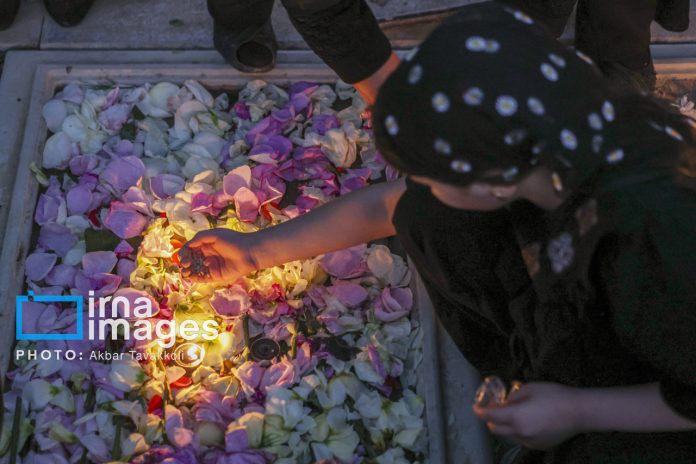
Head of Iran’s Martyrs Foundation reports over 1,060 martyrs from Zionist regime’s attacks

Speaking on the TV program “Tehran 20”, Ohadi said as of Monday evening, 1,060 martyrs have been buried across the country.

Ohadi further explained that, considering the number of injured people currently in intensive care units whose identities may not yet be fully confirmed, the total number of martyrs could approach 1,100.

The Zionist regime waged war on Iran on June 13. Soon after the war started, Iran began fighting back fiercely, firing large numbers of missiles at cities across occupied Palestine, notably Tel Aviv and Haifa.

Iran’s retaliatory strikes caused casualties among Israeli and heavy material damage including to military sites.

Thousands of babies in Gaza lack proper nutrition: UNICEF

Gaza War

“Thousands of babies in Gaza lack proper nutrition as aid access remains severely hampered,” Russell wrote on X.

Highlighting the impact of Israel’s ongoing attacks on women and children, she said: “Many mothers have been killed or are too malnourished to breastfeed, leaving infants at risk of dying or with permanent health damage.”

“Every minute counts in saving their lives,” she added.

Despite international calls for a ceasefire, Israel has pursued a genocidal war on Gaza, killing more than 57,500 Palestinians, most of them women and children, since October 2023.

The International Criminal Court issued arrest warrants last November for Netanyahu and his former Defense Minister Yoav Gallant for war crimes and crimes against humanity in Gaza.

Israel also faces a genocide case at the International Court of Justice for its war on the enclave.

US revokes foreign terrorist designation for Syria’s Hay’at Tahrir al-Sham group

A State Department memo signed by Secretary of State Marco Rubio read: “In consultation with the Attorney General and the Secretary of the Treasury, I hereby revoke the designation of al-Nusra Front, also known as Hay’at Tahrir al-Sham.”

The memo was dated 23 June but went into effect at the time of publication.

Syrian President Ahmed al-Sharaa commanded HTS, a Syrian militant rebel group that overthrew the government of former strongman Bashar al-Assad in late 2024.

Born out of al-Qaeda’s Syria branch, the al-Nusra Front, HTS has since rejected transnational jihad, and Sharaa has stated he aims to rule for all Syrians.

However, earlier this year, some 1500 people from the Alawite minority were killed after pro-Assad militias launched attacks on government forces. A Reuters investigation revealed 40 sites of revenge killings, massacres and looting against the religious minority.

Since assuming power, Sharaa has admitted that his government is holding “indirect talks” with Israel, and last week, Syrian authorities announced they were willing to cooperate with Washington on reimplementing a 1974 disengagement agreement with Israel.

Speaking earlier on Monday, the US special envoy to Syria and Lebanon, Tom Barrack, said “dialogue has started” between the two sides.

Sharaa is likely to face opposition from his base and the broader Syrian population over a possible normalisation deal, as Israel continues to wage war on hungry and besieged Palestinians in the Gaza Strip.

Moreover, anger has also been steadily growing over Israel’s invasion of Syria’s southwest and occupying a UN buffer zone between the two sides, and bombing Syria’s military installations.

Earlier this year, US President Donald Trump met Sharaa during a trip to Saudi Arabia, where he called him an “attractive” and “tough guy”.

The Trump administration has also vowed to terminate four decades of US sanctions on Syria but has struggled to navigate multiple layers of restrictions.

Trump signed an executive order last week to end the US sanctions programme. It permitted the relaxation of export controls on certain goods to Syria and waived restrictions on certain foreign assistance.

The decision to lift sanctions on HTS underscores how quickly the US is moving on the executive order signed on 30 June.

It called on the secretary of state to review the sanctions designation on HTS and Sharaa along with Syria’s designation as a state sponsor of terror, which was imposed in 1979 when the country was ruled by Hafez al-Assad.

The order also instructed the secretary of state to review suspending the Caesar Act.

Signed into law in 2019, the Caesar Syria Civilian Protection Act allowed the US to punish companies in other countries if they engaged in transactions with sanctioned Syrian companies and entities, a mechanism called secondary sanctions.

Although the Assad dynasty was toppled in December by Sharaa’s forces, the Caesar sanctions were passed by Congress. Some experts have said they might take longer to undue than the foreign terrorist designations.

Rubio told lawmakers in May that in order to attract much-needed foreign investment in Syria, the US will begin by issuing waivers under the Caesar Act.

Since entering office, Trump has approved efforts by Persian Gulf allies Qatar and Saudi Arabia to bring Syria back into the regional fold. The two Persian Gulf states also repaid Syria’s $15m debt to the World Bank.

The Persian Gulf states are also paying the salaries of Syrian government employees. In March, Qatar began supplying gas to Syria via Jordan.