Friday, December 26, 2025
Home Blog Page 2536

Iranian High-Tech Firms Due in Armenia to Discuss Further Cooperation

Supported by the Science and Technology Department of the Iranian President’s Office, the visit will be made on February 9-12, 2021.

Delegates from the Iranian companies are slated to discuss trade and technological cooperation with Armenian firms in Yerevan.

Part of the itinerary includes visits to a permanent exhibition of products made by knowledge-based companies as well as sci-tech parks of Armenia.
Eurasia is a major market for Iranian products, especially knowledge-based and technological products.

Political, economic and cultural relations between Iran and Armenia in the post-war era (the conflict between Armenia and the Azerbaijan Republic) are an opportunity to enhance exports to Armenia as a gateway to the Eurasian market.

Historical Edifice in Tehran Turned into Public Garden

Measuring around 2 hectares, the 150-year-old garden was known as the “Pomegranate Garden” because of its pomegranate trees.

The mirror work, flower and bird paintings, and ornamented vaulting on the walls and ceiling of the mansion are unique.

The rooms have sash windows embellished with delicate wooden decorations and coloured glass.

The garden used to belong to one of the government bodies. But as there was a shortage of green space in that district of Tehran, the Tehran Municipality took over it.

What is noteworthy is that the old texture and trees of the garden has been preserved, and the Iranian-Islamic style of garden construction has been used while turning the historical structure into a public park.

The garden has been inaugurated as a public garden after being refurbished.

Iran Develops Software to Process Geotechnical Data

The “Chidasoft” software was designed and installed on a dam and its power station for the first time in the country.

“When dams become operational, one of the most important issues is to control the stability and safety of such colossal structures,” said Qassem Basereh, the developer of the software.

“The present software has been designed to meet this ever-growing need in order to process data provided by precise geotechnical instruments and standardizing monitoring reports, and can turn into a single trend in drawing up such reports, which are the result of years of experience by engineers and top stability control experts,” he said.

He said only a handful of foreign companies possess the knowhow to develop such software, which is offered in an extremely protected manner.
He noted receiving any support for the software costs a lot, too.

“Moreover, given the existing sanctions, many of these companies are not ready to offer services and solve the existing problems,” said Basereh.

Iranian Company Develops Advanced Air Pollution Monitoring Devices

CEO of the Iranian company said it has manufactured several knowledge-based products, including a chimney particle counter used for monitoring industrial air pollution levels at the factories.

Alireza Noorpoor said the homegrown device makes accurate and online measurement of the emission and particulate matter, fulfills the needs of many industries, laboratories and research centers, and contributes to the strategies to reduce air pollution.

He said the company has also manufactured the portable and stationary versions of a particulate matter measurement device that works with two methods to monitor air pollution and analyze the environmental hazards.

The new monitoring device, manufactured at a much lower cost than the foreign machines, is an ideal substitute for the costly air pollution monitoring stations in the cities, the CEO added.

Another products developed by the Iranian knowledge-based company include air purifiers for home and industrial purposes.

The air cleaning and purifying devices utilize nanomaterial filters and are widely used by the universities, factories, research centers, municipalities, environmental organizations, and the gas and petrochemical industries, he said.

Noorpoor finally pointed to the distinguishing features of a filtration device installed on the industrial fume extraction hoods, saying the gear can absorb gas emission at municipal factories with an efficacy rate of above 90 percent.

Trump’s Downfall Prompted by His Populistic Approach: Iran

Vice President for Economic Affairs Mohammad Nahavandian lashed out at Trump’s demagoguery.

“One of the everlasting, eye-opening lessons of our era is the downfall of the cruel and promiscuous US president who, despite all populistic ploys as well as political and media deception, was not toppled by the millions of people who fell victim to his merciless economic war, or [was not toppled] as punishment for the murder of people like General Soleimani, who were killed upon his orders; rather, he (Trump) is being toppled by American people’s vote and after global embarrassment as a person who instigated violence and terrorism,” said Nahavandian.

“This proves that the result of deceptive populism is embarrassment, and that the era of deceptive domination in the age of communications is shorter than any other period,” he added.

Iranian, South Korean Diplomats Discuss Tanker Seizure, Frozen Assets

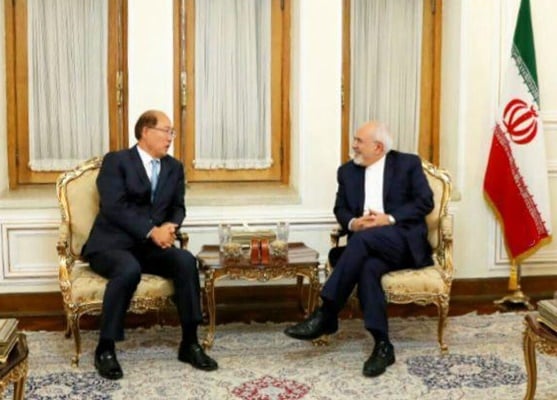
Choi Jong Kun, who is leading a delegation of South Korean political and financial officials in a trip to Tehran, held a meeting with Deputy Foreign Minister Araqchi on Sunday evening, January 10.

The visiting diplomat described his visit to Tehran as a sign of the importance that South Korea attaches to the expansion of relations with Iran, stressing that Seoul is resolved to rebuild trust in the bilateral ties in the new year by addressing the problems in the relations with Tehran.

For his part, Araqchi pointed to Iranian financial assets frozen in South Korea, saying the Korean banks have illegally blocked Iran’s currency resources for nearly two years and a half citing a fear of US sanctions.

“This action (by South Korea), which is only surrender to ransom demand from the US, is not acceptable, and naturally the expansion of relations (between Tehran and Seoul) would be meaningful only when this problem is solved,” the Iranian deputy minister added.

Pointing to the failure of negotiations that Iran, particularly the country’s Central Bank, has held with the South Korean officials about the problem, Araqchi said Iran believes that the freezing of its financial assets in South Korea results from the Seoul government’s lack of political will rather than the cruel sanctions imposed by the US.

He further called on South Korea to make serious efforts to find the necessary mechanism for resolving the issue as a top priority in the relations with Iran.

In response, Choi Jong Kun underlined that allowing Iran’s access to its currency assets in South Korea is one of the Seoul government’s main priorities, saying his country is determined to pursue the case until ultimate settlement of the problem.

In reaction to a call from the first vice minister of foreign affairs of South Korea for the settlement of issues relating to the seizure of a South Korean oil tanker, Araqchi said the vessel has been captured in the Persian Gulf and the Iranian territorial waters only because of technical considerations and environmental pollution hazards, adding that the Iranian Judiciary has begun dealing with the case.

Araqchi finally advised South Korea to avoid politicizing the issue and stay away from futile propaganda, and to allow the case to be addressed through legal procedures by the court in calm.

Single-Day Rise in Iran’s COVID-19 Fatalities Down to Lowest in Seven Months

In a press briefing on Sunday, Health Ministry spokeswoman Sima-Sadat Lari reported 5,968 new cases of COVID-19 infection, raising the total number of cases to 1,286,406.
So far, Lari added, 1,074,887 patients have recovered from the disease or been discharged from the hospital.

Lari said 4,664 patients are also in critical conditions caused by more severe infection.
The spokeswoman noted that 8,153,264 COVID-19 tests have been taken across the country so far.

She said currently the cities of Sari, Amol, Fereydounkenar, Qaemshahr, and Neka in Mazandaran province and Bandar Gaz and Kordkuy in Golestan province are in the “red” zone, 30 cities are in the “orange” zone, 219 are in the “yellow” zone, and 192 are in the “blue” zone in terms of coronavirus outbreak.

Severe Cold Hits Zahedan in Southeastern Iran

Photo retrieved from Twitter account @Navid_bhz

Iran Confirms Four More Cases of New Coronavirus Variant

Namaki said on Sunday the four people infected with the “English coronavirus” are members of a family who recently returned to Iran from Britain.

The Iranian Minister of Health had earlier confirmed the detection in Iran of the first case of the new strain of coronavirus a few days ago.

Last Tuesday, Namaki had said the presence of the new strain of the coronavirus in Iran does not mean any new panic, urging people to observe the health protocols more strictly.

The minister said the first carrier of the mutated coronavirus was an Iranian national who had returned home from the UK.

The new variant of coronavirus was detected after a long process of screening, he added, saying the patient had been admitted to a private hospital and was tested positive with the mutated strain after several procedures.

In his Sunday remarks, the Iranian health minister also defended Ayatollah Seyyed Ali Khamenei’s recent prohibition of the import of American-made vaccines, saying no one can believe that Americans would supply Iran with a reliable vaccine.

“The US didn’t allow us to import medicine for our sick people. How can one possibly believe they would supply vaccine for our healthy people?!” he noted.

Ayatollah Seyyed Ali Khamenei, the Leader of Iran’s Islamic Revolution, banned the import of American and British-made vaccines on Friday, saying the vaccines produced by these two countries cannot be trusted.

“The import of American and British vaccines is prohibited. If Americans had managed to produce a vaccine, they would not be facing such a fiasco today in their own country,” Ayatollah Khamenei said in a Friday speech.

He said some 4,000 people died of coronavirus in a single day in the US a few days ago, and if this Pfizer company had developed an effective vaccine, it would have prevented that from happening.

“I really don’t trust them. Sometimes they want to test the vaccine on other nations,” he added.

Winter Snow in Hyrcanian Forests of Northern Iran

The forests stretch 850 km along the southern coast of the Caspian Sea in northern Iran to southeast of Azerbaijan Republic.

What follows are ISNA’s photos of winter snow in these forests, which are globally registered as a natural heritage: