Thursday, December 25, 2025
Home Blog Page 2472

Over Three Million Iranian Patients Recover from COVID-19: Ministry

In a press briefing on Saturday, Sima-Sadat Lari said the virus has killed 151 patients since Friday noon, increasing the overall death toll to 85,694.

She said 3,355,786 patients have contracted the novel coronavirus so far, including 11,664 new cases identified in the past 24 hours.

Lari said 3,602 patients are also in critical conditions caused by more severe infection.
The spokeswoman noted that 24,437,503 COVID-19 tests have been taken across the country so far.

She said 4,592,139 people have so far received the first dose of COVID-19 vaccine, and 2,134,662 have received the second dose.

Rouhani Warns about Spread of Indian Variant of COVID-19

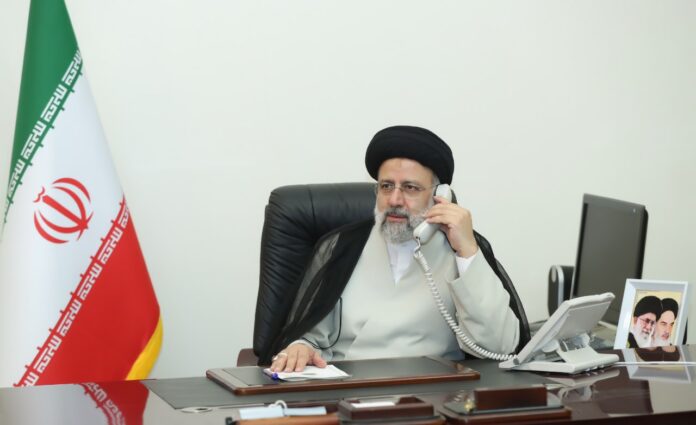
Rouhani said on Saturday the Indian variant did not stay in Iran’s southern and eastern provinces and is now spreading in central regions of the country.

Referring to the report of the Health Committee on the special conditions and the fact that the fifth wave of the disease is more dangerous than the previous waves, the President emphasised, “Necessary measures should be taken to increase monitoring by different agencies and institutions and also to inform people more about the consequences of the new outbreak of the disease and its spread.”

Implementation of vaccination operations and its acceleration in recent days due to more imports of foreign vaccines and also the gradual entry of domestically produced vaccines into the consumption cycle was another issue raised by the Health Committee in this meeting.

It was announced that with the promises of vaccine manufacturers fulfilled, the production would be facilitated, and with the efforts of agencies such as the Ministry of Foreign Affairs and the Central Bank to provide foreign vaccines, vaccination of target groups will be realised by August according to the national document.

Referring to the plans and measures taken in the field of supply and production of vaccines, the President expressed hope that despite the existing problems and obstacles, vaccination operations would be carried out more quickly by increasing the import of foreign vaccines and strengthening the production of domestic vaccines.

Iranian Works on Display at World’s Most Prestigious Graphic Event

Designs by 80 Iranian artists containing works that have been created from 1975 to 2021 are on display. The event has been organized by Laden Rezaei and Iraj Mirza Alikhani, and Iran is the first country whose designers’ works have been exhibited at the Warsaw Biennial. 

Mirza Alikhani told Honar Online the Iranian late famous graphist Morteza Momayez always had a lot of emphasis on two issues for graphic designers. One is to introduce Iranian graphics abroad and the other is to introduce Iranian graphics to the Iranian people themselves. Because even artists are uninformed about graphics, and managers and government officials are not familiar with graphics, and they turn to anyone but graphic designers for design works.

“In 2010, I was the judge at an international event in Peru, and there I suggested to a friend that we hold an exhibition of works by Iranian designers. This was very welcomed and I started collecting works by graphic designers. The Iranian Look exhibition was held there and was received warmly, and later a book was published about it. There, other people suggested that the exhibition be held in their countries as well, and thus the Iranian exhibition was held in three countries,” Alikhani added. 

He further said the Warsaw Biennial is the largest and most important graphic event in the world. 

“My works have been exhibited in several editions, and the works of my wife Laden Rezaei have been accepted and exhibited at the Biennial for several consecutive years. A few years ago, we were invited to give a lecture at a workshop at the Warsaw Biennial, and this was a very big and honorable event for Iranian graphics. We had a lecture on the capabilities of Persian calligraphy in symbol designing, which was very well received. In this way, our relationship with the biennial improved until we were invited to the Warsaw Biennial as honorary guests during this edition.”

I would have liked to hold Iranian Look exhibition in Warsaw as well, and this happened thanks to the efforts of a colleague. Iran is the first country whose works have been exhibited at the Warsaw Biennial, and it is a great honor. This has never happened before at the Warsaw Biennial and has never happened in any other country, underlined Alikhani. 

“There are three groups of works in this event, all of which have already been successful or selected in an event. The first group are artists who live outside Tehran. The second group are young people who have just entered the field or are currently working. The third group that is more important to me are the masters of Iranian graphics, who are either deceased or perhaps do not have the ability and interest to work,” he stressed. 

The “Iranian Look” exhibition along with the 27th International Biennial of Warsaw Poster will continue until August 12 at the Gallery of the Polish-Japanese Academy of Information Technology.

Iran Says No Insecurity Along Its Border with Afghanistan Despite Taliban Offensive

“Thanks to the efforts of our zealous border guards, the borders of the Islamic Republic of Iran are secure and peaceful, and there is no insecurity along our country’s borders with Afghanistan,” Khatibzadeh said in response to a question about the situation of Iran’s borders and border crossings with Afghanistan following the recent developments along the borders.

“Considering the clashes that erupted at Islam-Qala and Abu Nasr Farahi customs facilities inside the Afghan territory, a number of Afghan staff members entered into the Iranian soil,” the spokesman said.

“The Islamic Republic of Iran will take the necessary measures according to the rules and regulations and based on its border agreements with Afghanistan and within the framework of good neighbourliness principle,” he added.

The Taliban, which control eighty-five percent of the territory in Afghanistan, say they have captured the war-torn country’s main conduit for trade with Iran.

The militant group said it will try to shortly put back into operation the Islam-Qala border crossing in Herat province.

An Afghan government official said efforts are underway to recapture the border crossing.

Islam-Qala is the second key border crossing the Taliban have captured since they launched a sweeping offensive in early May.

Brigadier General Farhad Arianfar, deputy chief of the Iranian Army Ground Force’s Operations, said Friday full security is preserved at Iran’s eastern borders.

Possible Cyber-Attack Hits Iran’s Railway Network

A picture taken at Tehran’s train station, released by the IRGC-affiliated Fars news agency, shows the electronic boards which show all the trips have been cancelled.

On the board, the hackers have posted the phone number of the office of Iran’s Supreme Leader as the number to call for more information.

The apparent cyber-attack disrupted the operation of ticket offices, the national railway’s website and cargo services.

Hundreds of trains have been delayed or cancelled, and luggage control systems were shut down.

However, railway officials say the problem has only affected the electronic system, and the trains are resuming their trips in a slower pace using a manual system.

‘Afghan People Wish to See Ghani’s Ouster, Even If He’s Replaced by Taliban’

In an interview with Khabar Online, Mohsen Pak Aeen, the former head of the Afghanistan Desk at Iran’s Ministry of Foreign Affairs, highlighted the Afghan people’s frustration with the policies of the Afghan government, and said Ashraf Ghani, does not have an acceptable popular base inside the country.

He said the people of Afghanistan will not forget the presence of Ashraf Ghani at the Bagram base and the meeting with Donald Trump which ended at the cost of his humiliation; a similar trip that took place during the time of Barack Obama, but Hamid Karzai refused to meet with him. The honourable people of Afghanistan, who have always sought independence, do not like Ashraf Ghani’s policies.

“Ghani has differences even with his cabinet members, including his deputy Abdullah Abdullah, which together have led to a weak government in Afghanistan. Such a situation has also caused people to not pin any hope on this government wishing to witness its downfall, even if it falls into the hands of the Taliban.”

He also elaborated on the position of the regional countries and the main actors in Afghanistan including Iran, Pakistan, Russia, China and India. The silence of these countries in the face of developments in Afghanistan may be due to their dissatisfaction with the pro-Western policies of the Ashraf Ghani government. Of course, India was less dissatisfied with Ghani’s government, but the three countries of Iran, Pakistan, and Russia next to China are the most critical of the performance of the Afghan central government, especially Pakistan, which is the main supporter of the Taliban. As a result, it should be said that the situation is not like that of Hamid Karzai’s time, when neighboring countries felt responsible and took steps to bring peace and stability to Afghanistan.

“Although the neighbouring countries are opposed to the Taliban’s complete domination of Afghanistan, they are now pursuing a policy of patience and waiting to see how the internal situation in Afghanistan will develop. At the same time they are announcing political positions and just expressing hope for the establishment of a legitimate government in this country.”

Pak Aeen noted that there is no military solution for this country and the best course of action is to hold negotiations between the Afghan groups and the government to achieve a government of national reconciliation based on population and ethnicity.

He further stated that the difference between this war and previous wars is that there will be no winner and that the final solution will be reached at the negotiating table without foreign intervention.

Afghanistan is still going through bitter and difficult days. The United States, which once invaded the country under the pretext of fighting terrorism and toppling the Taliban, now prefers to flee after two decades following countless failures and expenditures. It is also vacating its key base in Bagram to tie everything to the outcome of the battle between the Afghan army and the Taliban in the wake of the failure of the Doha talks.

The recent battles in Afghanistan show its ineffectiveness, and it remains to be seen to what extent the two sides are willing to spend to achieve their aspirations.

Pak Aeen stated that following the withdrawal of US troops from Afghanistan and the military invasion of the Taliban in different parts, several points should be taken into consideration.

“There is a major question among the media elite community in the United States. It is said that if the Taliban is a terrorist group and the United States invaded Afghanistan with the help of NATO 20 years ago, why did it enter into negotiations with this group? They say why Washington has complied with the demands of the Taliban, especially the withdrawal of US troops, and paved the way for the Taliban to easily continue their military operations in Afghanistan?”

Another question posed by the elite is why more than $3 trillion of the US money was spent during this time in Afghanistan without any gains, and not only did terrorism end during this period, but the ISIS terrorist group was added. All these well illustrate how the US policies in the region have failed, underpinned this Iranian political expert.

Regarding the change in the Taliban group’s approach to revive the Islamic Emirate, he said, the next issue is about the Taliban group, which seems to have achieved some of its goals so far.

“One of the main demands of this group was the withdrawal of foreign troops from Afghanistan, and now the United States is leaving Bagram which is one of its most important bases. The Taliban, with its totalitarianism, has always sought to gain the most points inside Afghanistan, and today it is trying to revitalize the Islamic Emirate. However, the behavior of this group is different now. It tries to show a political policy without clashing with other groups and insinuate that it is looking for a political solution. That is why the Taliban sees military movements as an important step for political gains. The Taliban appears to have adopted a more moderate approach than in previous years.”

Pak Aeen went on to express that evidence shows the Taliban has so far failed to achieve all of its military objectives, and has reportedly failed to occupy a single province despite occupying some areas; meanwhile, the Afghan army continues to rebuild and reorganize. Many Afghans, even Pashtuns, disagree with the Taliban’s military practices and are fighting them in some areas.

This Iranian expert went on to explain the lack of support from tribes and groups in Afghanistan for the government saying that there are non-Pashtun groups in Afghanistan, such as Tajiks, Uzbeks, Turkmens and Shiites, who have fought and achieved success since the Soviet occupation of Afghanistan, as well as the Taliban, and have not allowed the Taliban to rule over all of Afghanistan. However, at this point, these groups do not seem to have any motivation to confront the Taliban, the most important of which could be widespread dissatisfaction with the current government’s performance. Thus, we see that the Mujahideen and former tribesmen are not paying attention to the Taliban attacks at the moment, and it seems that an unwritten agreement has been reached between them and the Taliban to avoid ethnic clashes.

In the end, Pak Aeen stressed that there is no military solution to the Afghan crisis stressing that the Taliban group, no matter how strong it is, will not be able to establish its rule in all parts of Afghanistan and may not even succeed in overthrowing Ashraf Ghani’s government.

“On the other hand, the Afghan security and government forces are not able to fight the Taliban in full force due to their limited capabilities. Considering the indifference of the ethnic groups in Afghanistan, it seems that the best course of action is to hold negotiation between the intra-Afghan groups and the government in order to achieve a national reconciliation government based on the population and the number of ethnic groups in a way that the power would be divided fairly and without the interference of other countries,” underscored Pak Aeen.

One of the reasons for the situation in Afghanistan was the interference of the United States and Saudi Arabia in the peace process in Doha. In these negotiations, Riyadh and Washington only sought to secure their own interests; an issue that caused the Afghan government to never negotiate with the Taliban, while groups and tribes were absent from the talks.

“However, the revival of the dialogues must be pursued in any way, through the Loya Jirga and the elders, or other ethnic groups. Different groups must negotiate in order to reach a solution. The continuation of the conflict will lead to the loss of human and material resources in Afghanistan, it will lead to further destruction of this country and the killing of the defenseless and oppressed people of Afghanistan,” he concluded.

Iran Calls for Lifting of US Sanctions against Syria

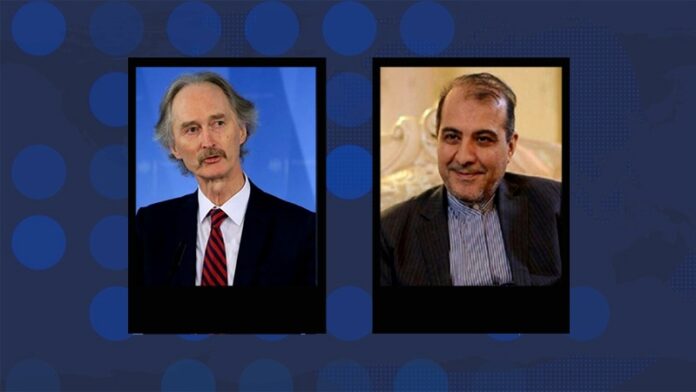
On the second day of the 16th round of Astana talks in Nur-Sultan, Kazakhstan, the delegation of the Islamic Republic of Iran, headed by Ali Asghar Khaji, a senior advisor to the Minister of Foreign Affairs, held meetings with the Lebanese and Iraqi delegations, the United Nations High Commissioner for Refugees (UNHCR), the representative of International Committee of the Red Cross.

In these meetings, the delegation of the Islamic Republic of Iran discussed the latest situation and conditions in Syria, including holding the country’s elections, Syrian refugees and the situation of refugees in this country, as well as sanctions and other issues.

The meeting of the working group on the exchange of prisoners, missing persons and detainees was also held with the participation of the guarantor states in the Astana process. In this meeting, Mir-Massoud Hosseinian, Director General of the Middle East and North Africa of the Iranian Ministry of Foreign Affairs, expressed the views of the Islamic Republic of Iran in this regard and emphasised ethical-human principles and called for speeding up these efforts.

The delegations of Turkey, Russia, the United Nations and the Red Cross also presented proposals on the progress of the process and their latest performance reports.

At the end of the bilateral and multilateral talks, the final meeting of the Astana process was held and the participants agreed on and approved the communique of the summit.

Speaking to different news agencies, including Russia’s Tass news agency, and Russian and Syrian journalists, the senior adviser to Iran’s foreign minister talked about the recent successful presidential election in Syria and stressed the people’s right to sovereignty.

In this press conference, Khaji elaborated on the issue of the return of internally displaced persons to their homes and stressed the need to confront any separatist and terrorist moves in Syria.

Iran Needs 120 Million Doses of Vaccine to Acquire Immunity against COVID-19: MP

The first deputy chairman of the Health Commission of Iran’s Parliament, Jalil Mirmohammadi Meibodi has told ILNA news agency it is true to say that six vaccines are being produced in the country.

“Two vaccines have been mass-produced with emergency permission; that is, while they were in the third phase of the clinical study, they were allowed to be mass produced. Given that about 20,000 people received these vaccines without showing any side effects, COVIran Barekat and Pasteur jabs received mass production permission,” he noted.

Mirmohammadi went on to say that the four or five other companies, such as Noura, Fakhra, etc., are still in the first phase of human studies and experimental phases and are not yet allowed to produce vaccines to meet our needs.

“On the other hand, the COVIran Barekat vaccine, which has been licensed for production, can now be produced at a maximum capacity of 3 million doses per month. It is also announced that by the end of September, our capacity will reach a level where we can produce 10 million doses per month.”

This member of the parliamentary health commission stated that despite providing foreign currency and paying for the vaccine, the total vaccines that Iran could import is about 5.7 million doses, which is due to to the sanctions that keep Iran from importing the vaccines.

“For example, we bought a significant amount of vaccine from India, but the country’s prosecutor prevented it from leaving the airport because according to him his own country had faced a corona peak and his own country’s needs were more acute.”

He reiterated that so far, Iran has been able to vaccinate about 5,660,000 people in the country, and hopefully about 15 to 20 million people will be vaccinated by the end of October.

“We need to vaccinate 60 million people, so we need 120 million doses of vaccine at present,” underscored Mirmohammadi.

“Three million doses of Barekat vaccine and about one and a half million doses of Pasteur vaccine per month is not a significant number. All in all, the Islamic Republic supports the production of the Barekat and Pasteur vaccines, but it is doing its best to provide the currency to import the vaccine.”

The import of vaccines and the arrival of Iranian vaccines on the market will enable us to vaccinate a significant number of people who are top on the list in the next two to three months, he added.

Mirmohammadi also emphasized that the vaccination process will speed up in the coming days, noting that the Iranian vaccines will enter into the market very soon.

Regarding the export of Iranian vaccines to other countries, he said there is no reason for the Iranian vaccine to be exported before people are fully inoculated.

Iran Offers Condolences over Demise of Ahmad Jibril

“The demise of an untiring fighter, Mr Ahmad Jibril, the Secretary General of the Popular Front for the Liberation of Palestine (PFLP), caused regret and suffering for me and his friends as well as devotees of the resistance,” reads Foreign Minister Zarif’s message.

“The oppressed nation of Palestine lost a great fighter who spent his life fighting for the liberation of the Holy Quds. I offer my condolences to his family, the leaders and members of the PFLP and all the friends of the late figure. May God Almighty bestow divine mercy and forgiveness upon the deceased and patience and reward on the survivors,” added Zarif.

Ahmed Jibril, whose Popular Front for the Liberation of Palestine was one of the main groups fighting against Israel in the 1970s and 1980s, died in Damascus on Wednesday at the age of 83.

Iran Slams Saudi Arabia’s ‘Baseless’ Claims about Its Uranium Enrichment

Kazem Gharibabadi said in tweet on Thursday, “For the Kingdom of the Saudi Arabia, the International Atomic Energy Agency is not being provided with even minimum necessary verification authorities. A failure to implement the safeguards by rescinding the Small Quantities Protocols, could allow them to hide certain nuclear activities without them being subject to the IAEA inspections.”

Earlier, the Saudi representative to Vienna accused Tehran of trying to acquire a nuclear weapon, claiming that the Islamic Republic’s moves do not match statements about the peaceful nature of its nuclear program.