Monday, April 13, 2026
Home Blog Page 2332

Biden concerned over Turkey’s possession of Russian S-400

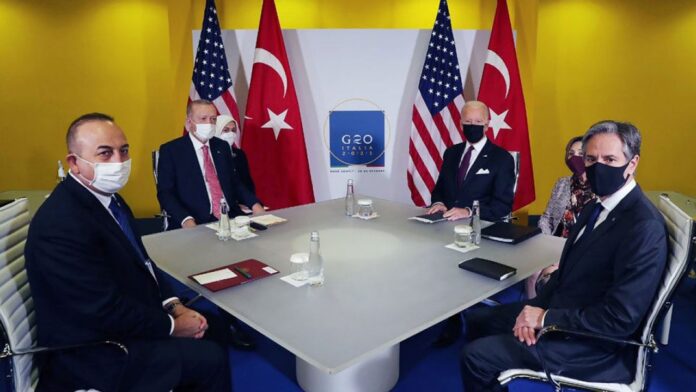
US President Joe Biden held a meeting with his Turkish counterpart Recep Tayyip Erdogan on the sidelines of the G20 meeting in Italy’s Rome on Sunday. Biden has told Erdogan the United States is concerns about Turkey’s possession of the Russian S-400 defense system.

Biden and Erdogan have agreed to establish a mechanism to strengthen and improve bilateral ties between the NATO allies, Anadolu Agency reported.

The leaders held talks Sunday on the sidelines of the G20 summit in Rome, where they were said to have discussed a range of issues, including trade, climate change, and the strategic partnership between the two countries and within NATO.

The meeting was said to have lasted for an hour and ten minutes, with US Secretary of State Antony Blinken and Turkish Foreign Minister Mevlut Cavusoglu also present.

The White House issued a readout summary of the conversation, indicating that “President Biden underscored his desire to maintain constructive relations, expand areas of cooperation, and manage our disagreements effectively.”

“[Biden] expressed appreciation for Turkey’s nearly two decades of contributions to the NATO mission in Afghanistan. The leaders discussed the political process in Syria, the delivery of humanitarian assistance to Afghans in need, elections in Libya, the situation in the Eastern Mediterranean, and diplomatic efforts in the South Caucasus,” the readout added.

Turkey has been involved in all of the aforementioned conflicts, joining the US and other NATO states in the 19+ year war and occupation of Afghanistan, occupying areas of northern Syria, providing diplomatic and military support to the Tripoli-based government during Libya’s civil war, engaging in a diplomatic spat with Greece and Egypt involving the use of warships and military aircraft in the Med, and providing military support to Azerbaijan in last year’s war in Nagorno-Karabakh between Baku and Armenian militias in the breakaway region.

The White House readout noted that Biden had “reaffirmed” Washington’s defense partnership with Ankara, and Turkey’s “importance as a NATO ally”, but also voiced “US concerns over Turkey’s possession of the Russian S-400 missile system”, and “emphasized the importance of strong democratic institutions, respect for human rights, and the rule of law for peace and prosperity”.

An unnamed Turkish official noted the talks between Erdogan and Biden took place in a “very positive” atmosphere.

On Saturday, a US official told reporters that Biden would convey to Erdogan the need to avoid “precipitous action” that could damage relations further.

Sunday’s meeting comes after the two countries narrowly avoided sparking off a new crisis in relations after Erdogan threatened to boot out ten foreign diplomats – including the US ambassador, after they demanded the release of Turkish businessman and activist Osman Kavala, who has been under arrest and facing trial for most of the past four years on charges of fomenting unrest and related to the 2016 Turkish coup attempt.

On Monday, Erdogan announced that the spat over the ambassadors had been “resolved” after the affected countries’ embassies promised not to interfere in the Turkish legal system’s proceedings.

On Saturday, an unnamed US official told reporters that Biden would warn his Turkish counterpart at their Sunday meeting not to take any more steps like those related to the Kavala incident that might further damage ties between the allies.

US demands for Kavala’s release are the latest chapter in a years’ long saga of deteriorating ties between Ankara and Washington.
‘Preliminary agreements reached between Iran and Saudi Arabia’

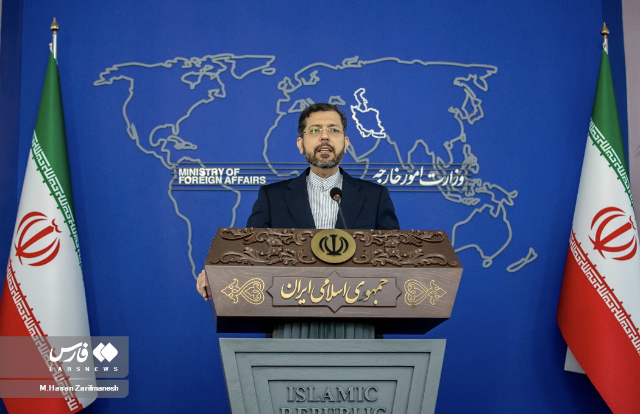
Four rounds of talks have taken place between Iran and Saudi Arabia, but contacts between the two countries have never been stopped, Khatibzadeh said in an interview with Mehr News Agency.

Stating that the two sides had initial agreements during the four rounds of talks, he added that preliminary agreements in negotiations between Iran and Saudi Arabia have been reached and the two countries are waiting for the finalization of talks.

Regarding the reopening of the embassies of the two countries, Khatibzadeh noted that still, it will take some time for the two countries to resume their activities in Tehran and Riyadh, however, it is possible to start the process of reopening the embassies soon.

Speaking in an interview with Reuters on Saturday night on the sideline of the G20 Rome Summit, Saudi Arabian Foreign Minister Faisal bin Farhan said that bilateral talks between Riyadh and Tehran have not progressed tangibly.

“We’ve had four rounds of talks so far. The talks are cordial but remain in an exploratory vein. We continue to hope that they will produce tangible progress … but so far, we have not made sufficient progress to be optimistic,” he added.

Asked if there will be another round of talks, the minister noted nothing had been scheduled, “but we are open to continue”.

Iran FM: We have doubts about Americans’ true intentions

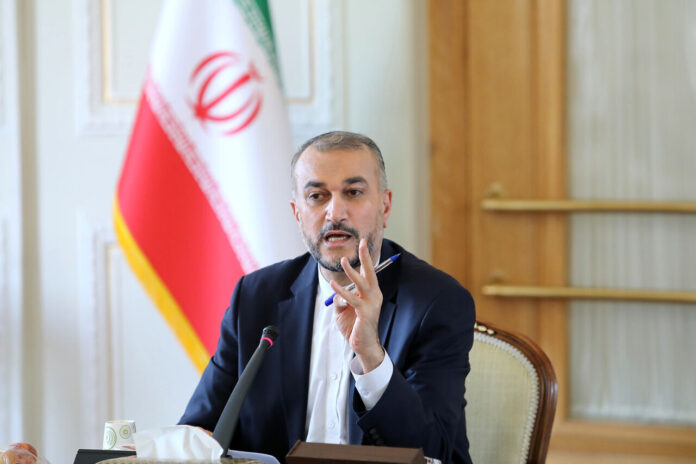
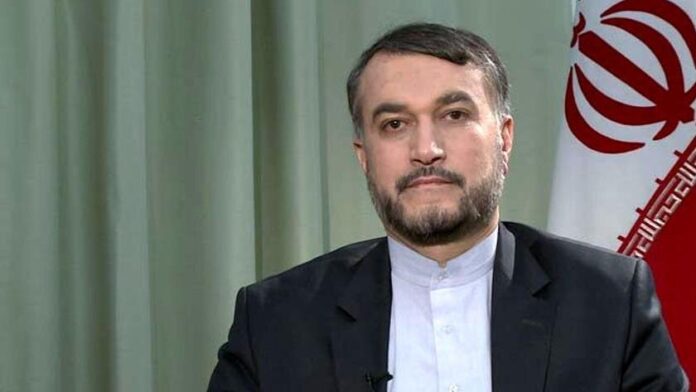
Foreign Minister Hossein Amir Abdolahian, in an exclusive interview with Iran Newspaper, said when Biden talks about Iran, he has with him the same sanctions policy that Trump had, and has failed to take any action to lift the sanctions so far.

The foreign minister referred to Washington’s breach of the Iran nuclear deal, known as the Joint Comprehensive Plan of Action (JCPOA) over the past years as well as Europe’s simply talking the talk rather than walking the walk when it comes to fulfilling their commitments.

Amir Abdollahian added even the previous Iranian administration believed that neither Washington nor the three European countries are reliable.

“We should see the three European making moves to pressure the US. They should try to revive and reinforce this trust,” he explained.

He said former US President Barack Obama was the first one to violate the nuclear deal, not to mention the approach adopted by his successor Donald Trump, who unilaterally withdrew from the agreement.

“Theoretically and legally speaking, one may be able to say that we were in a special situation before the conclusion of the JCPOA and were under Article 7 of the UN Security Council,” he said.

“But under the current circumstances and in practice, nothing has happened which has benefited Iran, and the JCPOA has failed to ensure our economic benefits so far and has failed to work in our favor,” said the top diplomat.

He urged the US to return to the point where Trump pulled out of the JCPOA and to show serious will to reach a deal with regards to the nuclear deal.

“We will not entirely link the destiny of the people and country to the JCPOA or any certain country,” including Russia and China, he said.

“Our decision is to return to the negotiating table. … We should see how to act to ensure the rights and interests of our people as much as possible,” said the foreign minister.

He said there is consensus that the nuclear agreement should be dealt with “within its own framework.”

He reiterated Iran’s stance that the talks should lead to the lifting of US sanctions.

He also rejected “excessive demands” by the US and some European countries that the negotiations should also include regional issues.

“We have no plans to hold talks with them on regional issues,” he said.

“Our talks will be limited to the nuclear issue and the JCPOA,” the foreign minister said.

The foreign minister said regional talks should be held “within the framework of the region” and have nothing to do with nuclear negotiations.

He also added Iran pursues a balanced foreign policy, meaning it seeks interaction with both neighboring states and other nations elsewhere.

“What we mean by a balanced foreign policy means while neighboring countries and Asia are the priority of the 13th administration (that of President Ebrahim Raeisi), we will follow a dynamic and smart diplomacy vis-à-vis Europe as well; moreover, we will not forget Latin America and Africa, either,” the top diplomat explained.

“An important point that I must emphasize is that in an Asia-oriented approach, we are not supposed to focus the entirety of our foreign policy on China and Russia,” said Amir Abdollahian.

 “However, we believe China and Russia today are different from in the past, and our having relations with the two countries has been in our interest, so far. Still, there are some West-leaning individuals in Iran who are against both China and Russia,” he added.

He also touched upon Tehran’s negotiations with Riyadh.

“Baghdad-mediated talks underway between Tehran and Riyadh follow a decision made by Iran at the national level,” he said.

“We believe the Saudis still need more time and preparedness, and we have left the way open for them, so that they will return to their normal relations with Iran,” he added

Iran FM: US can rejoin JCPOA through Biden executive order

On Sunday, Iran Newspaper interviewed Amir Abdollahian on the nuclear talks following his return to Tehran from his regional trips to Russia, Lebanon, and Syria. 

The foreign minister underlined that the diplomatic apparatus of the Islamic Republic will not tie the fate of the country and the Iranian people to the 2015 nuclear deal or any foreign state, because common interests are considered as criteria of interactions.

The Iranian top diplomat stated that Tehran has drawn a sublime mechanism to pursue implementation of the regional cooperation motto, adding that the Islamic Republic will stand against the United States’ Iranophobic propaganda campaign.

According to the foreign minister, the lifting of anti-Iran sanctions will bring about positive impacts, so the speculations that the new Iranian negotiating team would follow up a way that would lead to a standstill have nothing to do with realities on the ground.

He went on to say that the administration of President Ebrahim Raisi outlined some keywords for its foreign policy, including a balanced foreign policy as well as an active, intelligent and dynamic diplomacy.

The Islamic Republic attaches importance to relations with neighboring states and countries in Asia, he underscored, noting that Tehran will pursue a dynamic diplomacy, when it comes to Europe. He stressed that Latin America and Africa will not be forgotten.

The Ministry of Foreign Affairs prioritizes cultural interactions with other nations, Amir Abdollahian noted.

Cooperation with international organizations is very important to Iran, he said, adding that regional and international organizations can help Iran pursue its own interests.

As to balance, he mentioned that the 13th administration in Tehran is keen on maintaining balance in its relations with the East and the West, emphasizing that the Islamic Republic will not tie all of its foreign policy issues to China and Russia, while it will prioritize Asia-oriented foreign policy.

The Islamic Republic is committed to its slogan of “No East, No West” to maintain independence, when it comes to dealing with foreign powers, he noted.

The top diplomat also said that returning to the nuclear deal needs serious determination among American authorities; President Biden can issue an executive order to return to the point that his predecessor Donald Trump withdrew from the international agreement.

The problem here is that Biden pretends that he is against his predecessor’s foreign policies, because when it comes to Iran the US president pursues the same policies that Trump had, the Iranian foreign minister argued.

Iran plans to come back to the negotiating table, but the Iranian officials are weighing the ways they can restart talks on the revival of the nuclear accord, he continued.

Amir Abdollahian further noted that Iran’s economic development should not be tied to nuclear negotiations and the JCPOA, so the country requires other channels to nullify negative impacts of the US’s sanctions.

Taliban leader makes first public appearance amid death rumours

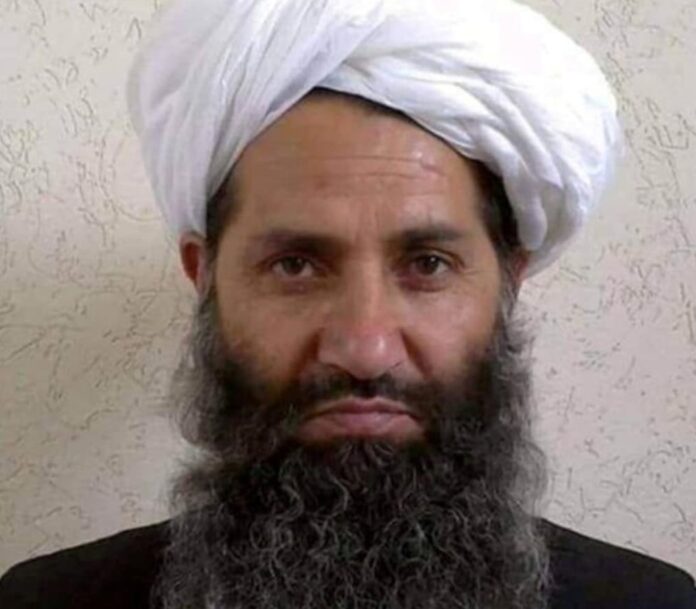
Akhundzada has been the spiritual chief of the movement since 2016 but has remained a reclusive figure, even after the Taliban seized power in Afghanistan.

His low profile has fed speculation about his role in the new Taliban government, formed after the group took control of Kabul in mid-August — and even rumours of his death.

On Saturday, he visited the Darul Uloom Hakimah madrassa to “speak to his brave soldiers and disciples”, according to the introduction to an audio recording circulated by Taliban social media accounts.

“May God reward the oppressed people of Afghanistan who fought the infidels and the oppressors for 20 years,” Akhundzada said, in the recording.

“My intention here is to pray for you and you pray for me,” he added.

In the 10-minute recording, he prays for the Taliban martyrs, wounded fighters and the success of officials involved in the “big test” of rebuilding what they call the Islamic Emirate of Afghanistan.

“Let’s pray that we come out of this big test successfully. May Allah help us stay strong,” he continued.

Akhundzada is thought to have been selected to serve more as a spiritual figurehead than a military commander, but his unusually public statements will fuel speculation that he now plans to take a more central role in leading the new government.

Akhundzada rose from low-profile religious figure to leader of the Taliban in a swift transition of power after a 2016 US drone strike killed his predecessor, Mullah Akhtar Mansour.

After being appointed leader, he secured the backing of Al-Qaeda chief Ayman al-Zawahiri, who showered the cleric with praise — calling him “the emir of the faithful”.

This endorsement by Osama bin Laden’s heir helped seal his jihadist credentials with the Taliban’s long-time allies.

Akhundzada was tasked with unifying a Taliban movement that briefly fractured during the bitter power struggle after Akhtar’s assassination, and the revelation that the leadership had hidden the death of their founder Mullah Omar for years.

His public profile has largely been limited to the release of messages during Islamic holidays, and Akhundzada is believed to spend most of his time in Kandahar, the main city in the Taliban’s southern Afghan heartland.

His last message was on September 7, when he told the newly appointed Taliban government in Kabul to uphold sharia law as they govern Afghanistan.

Last week, Mullah Yussef Wafa, the Taliban governor of Kandahar and a close ally of Akhundzada, told AFP he was in regular contact with his mysterious chief.

“We have regular meetings with him about the control of the situation in Afghanistan and how to make a good government,” he said in an interview, adding, “As he is our teacher, and everyone’s teacher, we are trying to learn something from him.”

“He gives advice to every leader of Islamic Emirate of Afghanistan and we are following his rules, advice, and if we have a progressive government in the future it’s because of his advice,” he noted.

Yemen’s Houthi threatens to ban Saudi products

“If Saudi Arabia bans the products of Lebanon for the position taken by the Minister of Information George Kordahi, then I call on the (Houthi) Yemeni government to hold an emergency meeting to take a decision of banning Saudi products,” the al-Masirah TV cited a tweet by Mohammed Ali al-Houthi, the Houthi head of the revolutionary committee, as saying.

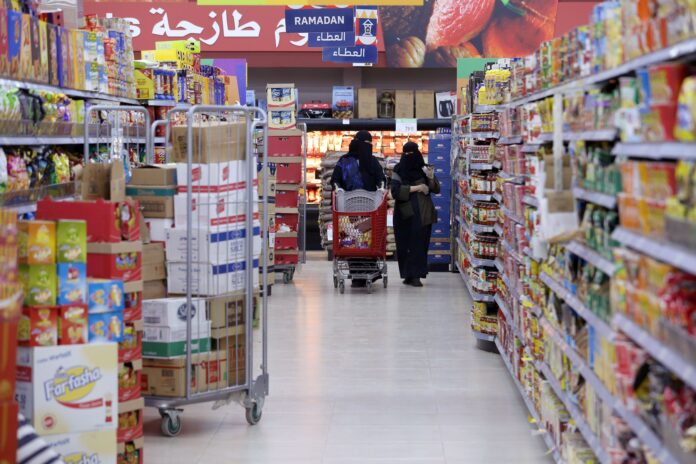
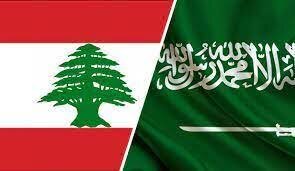
Saudi Arabia has recalled its ambassador to Lebanon, asked Lebanese ambassador in the kingdom to leave within 48 hours and banned Lebanese products as a protest to Kordahi’s remarks that described the Saudi-led coalition war on the Houthi militia in Yemen as “absurd.”

Other coalition countries, including the United Arab Emirates, Bahrain and Kuwait, also adopted similar measures.

Kordahi’s remarks were broadcasted earlier this week on an Arab media network. However, the Lebanese government said Kordahi’s remarks were made months before his appointment as the information minister.

The Iran-backed Lebanese Hezbollah has shown support to Kordahi’s remarks, according to Lebanese media.

Saudi Arabia seeking to instigate chaos in Lebanon: Ex-diplomat

“Such moves come to create instability and unrest in Lebanon as they do not want an established government rule Lebanon,” said Ahmad Dastmalchian in an exclusive interview with ISNA.

He was speaking about the recent tensions which emerged between Saudi Arabia along with several other Arab countries and Lebanon after the Lebanese information minister made comments about Saudi Arabia’s role in Yemen’s crisis and the problems created for the people of that country due to Saudi attacks on Yemen.

“Unfortunately, Saudi Arabia maintains its unwise policies in the region, which have led to the country’s failure in developments in Syria, Iraq, Yemen, etc.,” Dastmalchian said.

“Saudi Arabia has not stopped interfering in the internal affairs of the regional countries,” said the former diplomat.

He then touched upon Saudi Arabia’s backing for Takfiri groups in Iraq and Syria.

“By supporting these groups, Saudi Arabia created numerous problems for Iraq and Syria, so much so that the current problems of these two countries which emerged following moves by the ISIS terrorist group have spilled over to other regional countries, including Saudi Arabia itself,” he said.

“On the other hand, the Saudis still would like to use the logic of force and violence in regional equations, but such polices have been a failure for years,” he explained.

“Saudi Arabia, the United States and the Israeli regime as well as some other Arab and Western countries wouldn’t like to see tranquility in Lebanon, and the recent developments in Lebanon unfolded in line with this very policy, from the blast in Beirut port to the suppression of peaceful demonstrations staged by Lebanese people and the imposition of sanctions. And now, they have decided to expel Lebanon’s ambassador from Saudi Arabia and some Western countries,” he said.

New batch of Covid vaccines arrives in Iran

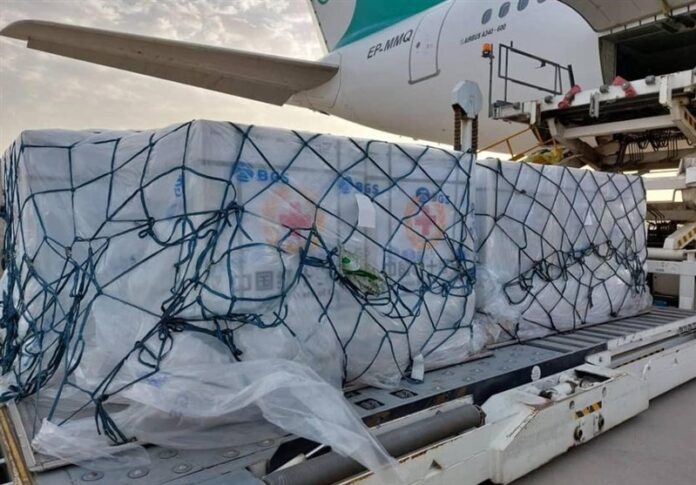
IRCS Director Karim Hemmati noted it has imported more than 112 million doses of COVID-19 vaccines so far, adding the last cargo containing some 6 million doses was imported to see the IRCS fully live up to its commitments concerning vaccine imports.

He said the IRCS imported 112 million 390 thousand doses of Covid vaccines in the eight months to late October, 2021.

He added the IRCS also launched a major campaign in early 2021 to control the country’s borders where over 750 thousand incoming passengers were checked for the virus over a period of several months.

According to the health ministry, nearly 52 million 380 thousand first doses of Covid vaccines have been administered nationwide so far.

Over 33 million 674 thousand people have received their second jab as well.

Hence, the total number of coronavirus vaccine doses administered in Iran so far stands at more than 86 million 137 thousand.

Iran slams Switzerland over rights claim

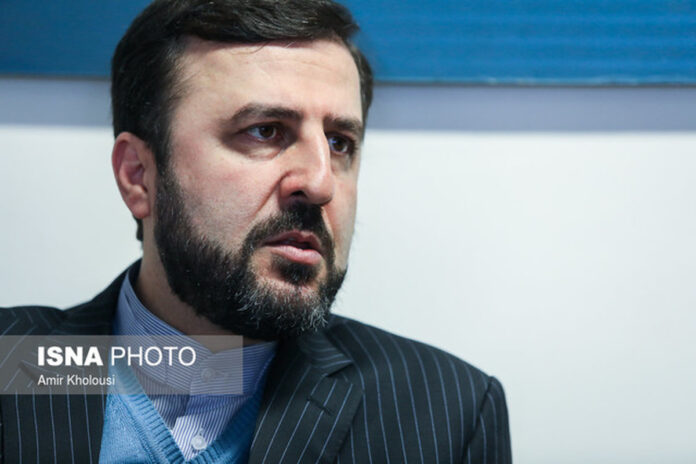
“I draw the attention of Sweden FM on Oct 19 statement of several UN Human Rights Experts titled ‘Sweden Over-compliance with US sanctions harms Iranians’ right to health’,” Kazem Gharibabadi, the secretary-general of Iran’s Human Rights Office, said in a tweet on Saturday.

“A Swedish bandage maker’s decision to halt shipments to Iran shows how over-compliance with US sanctions harms the ability of Iranian patients to enjoy their human rights, particularly the rights to health, to be free from physical and psychological pain, inhuman treatment and the right to life,” he added.

Gharibabadi also included parts of the UN statement in his tweet.

In her tweet on Friday, the Swedish foreign minister claimed that the situation of human rights in Iran is very serious, saying she and the Swiss government have continuously brought up the issue in talks with Iranian representatives.

A group of UN experts warned on October 19 that over-compliance with the US sanctions could strip Iranian patients of their human rights, particularly the right to health.

The experts raised the alarm, in the wake of a decision by a Swedish company to halt shipments to Iranian patients suffering from a severe and life-threatening rare skin condition – epidermolysis bullosa (EB) – which causes extremely painful wounds. The firm’s produced bandage reportedly offers the most effective treatment to alleviate pain and prevent life-threatening infections.

They emphasized that the Swedish company’s decision, along with the actions of the country’s government, violates their international responsibility to ensure the entire range of human rights.

Iran’s EB Home and several lawyers have filed a complaint against Mölnlycke Health Care, a Swedish medical device company, over its refusal to sell medical products to Tehran under US pressures.

Damascus condemns Turkish extension of troops deployment in Syria

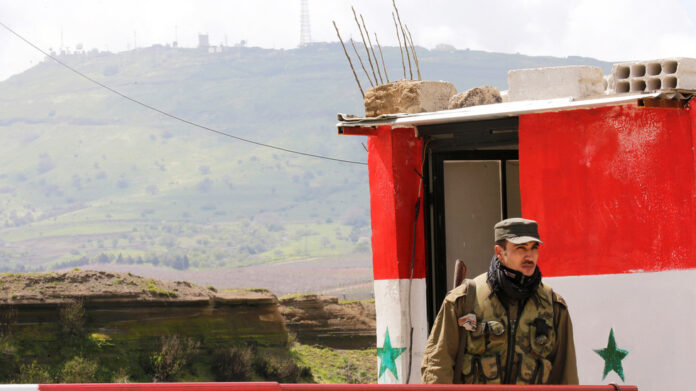
Syria condemned in the strongest terms the decision approved by the Turkish Parliament to renew for two years the so-called “authorization given” to head of the Turkish regime to send military forces to Iraq and Syria.

An official source at the Foreign and Expatriates Ministry said in a statement to SANA on Saturday that the policies of the head of the Turkish regime have become a direct threat to peace and security in the region and the world as he continues to launch military attacks on the Syrian territories, in violation of the UN Security Council’s resolutions related to the situation in Syria.

The source went on to say that inaction of the Security Council in the face of the continued Turkish occupation of the Syrian territories makes the head of the Turkish regime persists his crimes and aggressions against Syria, continues to occupy Syrian lands and impose demographic change, and Turkification, in addition to cutting off water of the Euphrates River to deprive the civilians from it, and supporting the armed terrorist groups which were designated by the UNSC as terrorist entities.

The source added that Syria reserves its absolute right ,based on the Charter and the international law, to defend its independence, territorial integrity and sovereignty over all of its land ,and take all practical and legal measures guaranteed by international legitimacy in order to repel the Turkish aggression.

The source called on the international community to hold this regime accountable for the war crimes and aggression it committed against Syria and that it compensates the Syrian state for all the losses it caused against the Syrian civilians, the country’s infrastructures, private and public properties, natural resources and its historical heritage.