Monday, December 22, 2025
Home Blog Page 2301

FM: Lebanon, Saudi crisis not to be resolved through negotiation

“There exists a kind of oppression on the part of Saudi Arabia, which we do not understand. Countries’ problems are [usually] resolved through negotiation, something that did not happened in this case (Lebanon and Saudi Arabia’s crisis),” Foreign Minister Abdallah Bou Habib told Lebanon’s al-Jadeed television station on Sunday.

The row began after George Kordahi, currently Lebanon’s information minister, stated during a television program, which was aired last Monday, that the 2015-present Saudi Arabia-led war on Yemen was an act of aggression by Riyadh and the United Arab Emirates (UAE), the kingdom’s most significant ally in the military campaign.

He called the war “absurd”, adding it had to stop because he was opposed to wars between Arabs. The minister also noted the Yemeni army forces and their allied fighters from the Popular Committees were “defending themselves … against an external aggression”.

The Saudi kingdom subsequently recalled its ambassador from Beirut and expelled the Lebanese envoy from the Saudi capital.

Bou Habib also roundly rejected earlier remarks made by his Saudi counterpart Faisal bin Farhan Al Saud. Speaking to the Reuters news agency on Saturday, the Saudi foreign minister had alleged that the diplomatic crisis was rooted in a Lebanese political setup that reinforced the dominance of the resistance movement of Hezbollah.

“We do not accept resolution of the crisis through the language that Saudi Arabia has adopted towards Lebanon,” Bou Habib stated, and urged mediation by the Arab League.

Iran announces huge rise in exports from Chabahar Port

The Customs office said figures also show a 500% rise in exports during the same period compared with the period starting on March 21, 2018. 

The exports from March 21, 2021 hit 19.2 million dollars in terms of value. According to this report, Iranian goods were mostly exported to Pakistan, India, Oman, the United Arab Emirates, Thailand, Iraq, Malaysia, Somalia, Armenia and China. 

The jump in exports comes at a time when Iran is under the harshest sanctions ever imposed by the United States. 

Experts say the rise in exports is due to the capacity of Iran’s only oceanic port.   

Chabahar is located in such a strategic location that it serves as a bridge between the east and west of the world. It is because of these intrinsic capacities that the port city has not been and will not be sanctioned. 

The other key factor in making Chabahar an attractive port city is the expansion of its infrastructure that paves the way for development.     

With Chabahar Free Zone developed, the free zone and the port are now integrated. Iran’s nationwide railway is close to reaching Chabahar and Chabahar International Airport is under construction. 

The construction of these infrastructure installations helps realize a free zone in real terms and creates a suitable hub and transit network for global trade.

Iran seeks resumption of oil sales to India

Iran’s ambassador to India Ali Chegeni told ThePrint in an interview that bilateral ties are poised to reach the next level under Iran’s new President Ebrahim Raisi.

The envoy said the country’s Foreign Minister Hossein Amir Abdollahian plans to visit New Delhi later this month for the India-Iran Joint Economic Commission, which will “herald a new era” for the countries.

“We have no limit, no ban, no barrier in developing our relationship with India … India used to be our big customer of oil, and we were the first country to export oil to India based on the rupee. It was recognition of the rupee as international money, instead of using the dollar or some other currency. We did that also to buy commodities from India,” Chegeni stated.

“For oil, we expect India to begin (purchases). Of course, we are not deciding on behalf of our Indian friends; Indian authorities should do that. But from our side, there is no problem in exporting oil and gas, petrochemical and even non-oil goods. There is a big capacity,” the ambassador added.

According to Chegeni, two-way trade between India and Iran, which had exceeded $17 billion in 2018-19, had the potential to reach $30-35 billion by this fiscal had the oil imports not been stopped by India.

“If India starts taking oil, gas and other items from Iran, then both sides can have balanced trade,” he continued.

In May 2019, under pressure of stringent economic sanctions from the US administration, New Delhi had brought oil imports from Tehran down to zero.

The development of the Farzad B gas field, negotiations for which had been going on for over a decade, is another part of the bilateral ties that has suffered a setback.

In 2008, ONGC Videsh Ltd (OVL), the Indian public sector oil and gas corporation, had discovered the gigantic gas field spread across the maritime boundary of Iran and Saudi Arabia in the Persian Gulf.

In February 2018, on then-Iranian President Hassan Rouhani’s visit to India, New Delhi and Tehran had decided to move beyond the traditional buyer-seller relationship in their energy partnership, and expediting negotiations on Farzad B. But in May this year, Iran decided to go ahead with the project on its own, without India’s cooperation, giving the contract to a local company.

However, according to Chegeni, “the door is still open for India for Farzad B”.

“But how to go about it will be decided between the oil ministries of both sides. This block is common between us and some neighbouring countries. Since 2006, they are taking their share and we are losing out. We have lost more than 15 years because of the slow reply and activity from our Indian friends. It is now up to India to decide how they want to come (join the project),” Chegeni noted.

According to Chegeni, although India considers the Chabahar Port project as the ‘Golden Gateway’ to Afghanistan, Central Asia and Eastern Europe, there is “not enough activity” taking place from India’s side.

“Chabahar, on paper, is not covered by the US’ illegal sanctions,” he said, adding that there is still some fear on India’s part, and maybe some “scare” from “third parties” in investing and working in Chabahar.

While India has been focusing on developing Chabahar to enhance trade with the landlocked Afghanistan and the countries beyond it by bypassing Pakistan, it has not moved on the next phase of the project, which involves building a rail-link from Chabahar to Zahedan, near the Afghanistan border. India was also expected to invest in setting up plants in sectors such as fertilisers, petrochemicals and metallurgy in the Chabahar Free Trade Zone, but nothing happened.

Last year, seeing a delay from India’s side, Iran decided to develop the rail link on its own.

“We have completed more than 70 per cent of the rail network between Chabahar and Zahedan… We now expect India to come for signalling and other infra development,” the envoy said.

“Chabahar is a very big area for investments and there is a free trade zone area … (There are a) lot of opportunities for India to come and invest. Unfortunately, the private sector from India is still hesitant because of some fear regarding the sanctions. I am sure the (Indian) government wants that, but the speed is not there,” he commented.

Chegeni also confirmed Amir Abdollahian’s upcoming visit to India in November.

Amir Abdollahian was scheduled to visit earlier, but due to the rapid changes in Afghanistan under the Taliban regime, the trip got postponed.

“We are strategic partners, we are in the same geography, we are in the same history,” the ambassador continued, adding, “I now see goodwill and the potential of a high-profile relationship under our new President.”

“My minister will be coming; we will have an exchange of visits … A new chapter will be opened. Both countries have a lot of potential to improve the relationship … We are going to have a very good relationship, promoting economic, political and other aspects of the relationship,” he added.

Chegeni further said for the first time in the history of India-Iran bilateral ties, a special representative for India has been appointed by his country’s President. Earlier this year, External Affairs Minister S. Jaishankar visited Iran twice as President Raisi came to power.

Chegeni stated Iran will also participate in the NSA-level talks on Afghanistan in New Delhi, which will be hosted by National Security Advisor Ajit Doval.

Tehran last month hosted a meeting of Afghanistan’s neighbouring and regional countries, to which India was not invited. The meeting was aimed at pushing the Taliban regime in Afghanistan to establish an inclusive government.

Chegeni said this was an initiative of Pakistan, and inviting India depended on the entire group. Apart from Iran, the meeting in Tehran was attended by Pakistan, Tajikistan, Uzbekistan, Turkmenistan, China and Russia. The next round, which is going to be the third of this format of talks, is expected to be held in Beijing.

However, on the NSA talks, the ambassador noted, “We see Indian participation in different formats as pushing our ideas, strengthening our ideas. So, we welcome Indian presence in all different formats. We share similar views and we see India’s presence in Afghanistan can solve the problem and that will bring peace and prosperity in Afghanistan.”

He also added Afghanistan should not become a place from where terrorists are to be used against neighbouring and regional countries.

“People of Afghanistan have the right to enjoy a good life. We feel the fire in our neighbouring country will bring the fire at home. Instability in Afghanistan will also affect the neighbouring countries,” he stated.

Iran says expects actions from Washington on JCPOA, words are enough


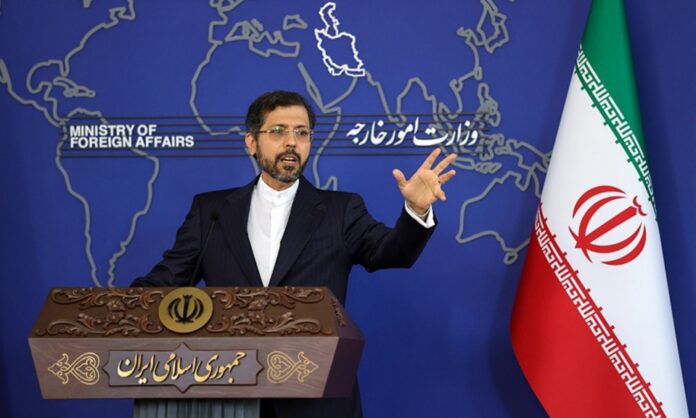
Saeed Khatibzadeh also referred to latest comments from US National Security Advisor about President Joe Biden’s readiness to return to the nuclear deal, also known as the Joint Comprehensive Plan of Action, JCPOA. 

He said what Sullivan says contradicts the actions Biden administration has taken so far. 

The Iranian Foreign Ministry spokesman said the US violated UN Security Council Resolution 2231, left the JCPOA illegally and did all it could to scrap the agreement. 

Khatibzadeh added that the US imposed oppressive and illegal sanctions on Iran and did all in its power to prevent Iran from doing business with other nations. 

According to the Iranian Foreign Ministry spokesperson, the Vienna talks aim to pave the way for the US return to the JCPOA and that Tehran held talks with the other members of the 4+1 group of countries to make sure Washington will get back to the deal in a committed way. The JCPOA unraveled in 2018 when former US president left the deal and reinstated sanctions on Iran.

In response to a question about some Western media reports of a U.S. offer to Iran to hold bilateral talks in Baghdad, Khatibzadeh said there has been no dialogue between the Islamic Republic of Iran and the American side for a long time.

The Foreign Ministry spokesman also stressed that the South Korean government needs to take action to return Iranian blocked funds.

“Our blocked money in South Korea must be returned. Of course, efforts have been made in this regard, but it is not enough,” he stated.

Khatibzadeh noted that the South Korean government’s seizure of Iranian money is separate from other bilateral issues, and that the two sides try to make sure that this problem will have the least possible impact on bilateral relations.

He also dismissed as a joke South Korea’s recent donation of a limited number of face masks to Iran, stressing that the South Korean people have shown that they are dissatisfied with what their government has done regarding Iran.

Iran’s Navy foils pirate attack near Bab al-Mandab

The Iranian naval forces repelled the pirate attack. Reports say the attackers were boarding four boats and tried to approach the Iranian oil tanker Monday morning. But they were forced to flee after the Iranian forces fired warning shots. 

Iran has deployed warships to international waters to protect naval routes and maintain security for Iranian cargo ships. 

In line with international efforts against piracy, the Iranian Navy has also been conducting patrols in the Gulf of Aden since 2008. The mission is aimed at safeguarding merchant containers and oil tankers owned or leased by Iran or other countries. 

Iran’s Navy has managed to foil several attacks on both Iranian and foreign tankers during its missions in international waters over the past 14 years.

Hezbollah official: MbS lives in “dilemma and anxiety”

Hashim Safi al-Din, head of the Executive Council of Hezbollah, said the diplomatic crisis between Lebanon and Saudi Arabia is rooted in MbS “fear” of the liberation of the Yemeni strategic city of Ma’rib amid Beirut’s support for Yemenis during the Saudi war.

He announced in a statement that it is not “reasonable” to think that the diplomatic crisis is related to remarks made by the Lebanese information minister “but rather it is greater than that.”

“What is happening in Saudi Arabia is a major thing, as the Saudis and the [Persian] Gulf [countries] in general, who have followed the path of forming relations with Israel, cannot bear a voice from Lebanon and others who will criticize them in the future over the Saudi-Israeli relations, which will be made public in the coming days,” he added.

The senior Hezbollah official noted that the Saudi Crown Prince lives in a state of “dilemma and anxiety” and will have to face a great situation after the fall of Ma’rib, emphasizing that MbS is fearful of losing all his illusions.

He warned that all those who work to interrupt the Lebanese government, undermine the country’s stability, and mount US and Saudi sanctions to destroy Lebanon, highlighting Hezbollah’s sacrifices “in order not to lead our country to internal clashes, and for this, we [have striven to] resolve the economic and internal problems of the Lebanese people.”

Safi al-Din emphasized that those who are pushing to fabricate security, diplomatic and political crises in Lebanon are the ones that are working to sabotage the country.

He stated that the future of Lebanon is not in the hands of the Saudis “but in the hands of God and thanks to those who sacrificed for the dignity of the country.”

Saudi Arabia will not tolerate any criticism in the future, especially after its relations with the Israeli regime will be public in the coming days, he noted.

The Saudi-Lebanon row began after George Kordahi, who currently serves as Lebanon’s information minister, said during a television program, which was aired last Monday, that the 2015-present Saudi Arabia-led war on Yemen was an act of aggression by Riyadh and the United Arab Emirates (UAE), the kingdom’s most significant ally in the military campaign.

He called the war “absurd,” adding it had to stop because he was opposed to wars between Arabs. The minister also said the Yemeni army forces and their allied fighters from the Popular Committees were “defending themselves … against an external aggression.”

The Saudi kingdom subsequently recalled its ambassador from Beirut and expelled the Lebanese envoy from the Saudi capital.

As tensions have been running high between Beirut and Persian Gulf states over the Saudi war on Yemen, Mohammed Abdul-Salam, Yemeni popular Ansarullah movement’s spokesman, said on Sunday that Lebanon, its people, and the resistance movement are capable of facing challenges, no matter what they are.

In a post on his Twitter account, Abdul-Salam added that the Lebanese people were the ones who inflicted the first crushing defeat on the Israeli enemy.

True Arabs “are those who confront America and Israel, not those who join them as a tail, and target the nation under the pretext of Arabism,” he tweeted.

Saudi Arabia, backed by the US and regional allies, launched the war on Yemen in March 2015, with the goal of bringing the government of former president Abd Rabbuh Mansur Hadi back to power and crushing the popular Ansarullah movement, which had overthrown the previous Saudi-backed Yemeni government. The Saudi war has left hundreds of thousands of Yemenis dead, and displaced millions more. It has also destroyed Yemen’s infrastructure and spread famine and infectious diseases.

Blinken says diplomacy ‘best path forward’ on Iran nuclear deal

Blinken said on Sunday that the US is “absolutely in lockstep together” with Germany, France, and the United Kingdom on coordinating a plan to get Iran back into a nuclear agreement.

“We continue to believe that diplomacy is the best way to deal with the challenges, the threat posed by Iran’s nuclear program,” Blinken stated on CNN’s “State of the Union”.

Speaking from Rome at the tail end of the G-20 conference, Blinken noted President Joe Biden has met with his German, French and British counterparts to discuss dealing with the threat of Iran’s nuclear program. The new coordination represents a shift in tone for the US, which was part of the international deal negotiated with Iran in 2015 but which, during President Donald Trump’s presidency, withdrew from the agreement. The Biden administration has announced it wants to be part of an agreement with Iran, but talks in Vienna have not resolved the outstanding issues.

The US has urged Iran to come back to nuclear talks in recent weeks following a hiatus caused by its government transition. While Tehran has indicated it will return to talks in Vienna before the end of November, the Biden administration has remained skeptical of Iran’s intentions.

“There’s still a window through which Iran can come back to the talks, and we can come back to mutual compliance with the agreement, and that would be the best result. But it really depends on whether Iran is serious about doing that,” Blinken added.

Blinken added that if Iran chooses not to “engage in a meaningful way and get back into compliance”, then the US and the other countries in the agreement — Russia and China were also part of the 2015 deal — will look “at all of the options necessary to deal with this problem”.

Asked in another Sunday interview — on CBS News’ “Face the Nation” — about what those other options might be and whether they could include military intervention, Blinken said “every option is on the table”.

“Iran, unfortunately, is moving forward aggressively with its program,” Blinken stated.

He added, “And that’s why it was so important that we get together with our close partners in this effort. We are all very much on the same page in terms of the path forward. And we’ll see if Iran is serious.”

Tehran has stated it’s ready to restart talks to save the landmark agreement, but not under western pressure, and that talks should realize the rights of the Iranian people. Iran has stressed the United States must be first to return to its commitments under the nuclear deal and Washington must completely lift sanctions.

Iran has agreed to resume negotiations over the nuclear deal before the end of November, but the United States continues to put pressure on Tehran.

On Friday, the US Treasury Department imposed sanctions on four Iranian individuals and two entities, for their involvement in promoting the Unmanned Aerial Vehicle (UAV) programs of Iran’s Islamic Revolution Guards Corps (IRGC).

Tehran has stressed the sanctions send the message that the Biden administration that talks of returning to the nuclear deal, is not trustworthy. Iran has announced the imposition of new sanctions on the Islamic Republic shows a contradictory behavior on the part of the White House.

Biden says US suffering from Trump’s withdrawal from Iran nuclear deal

President Joe Biden speaks during a news conference at the conclusion of the G20 leaders summit, Sunday, Oct. 31, 2021, in Rome. (AP Photo/Evan Vucci)

“We’re continuing to suffer from the very bad decisions President Trump made to pull out of the JCPOA,” Biden told reporters at a press conference at the G20 in Rome, using the acronym for the formal name of the nuclear agreement – the Joint Comprehensive Plan of Action.

The Iran nuclear deal was abandoned by the US under the Trump administration and talks to resurrect the deal in Vienna were suspended in late June after six rounds between Iran, China, Germany, France, Russia, the United Kingdom and — indirectly — the United States. The Biden administration has pledged to reenter the deal, but the president’s negotiators have been faced with tough talks and decisions on how to do so. At the same time, Iran began enriching uranium again once the Trump administration pulled the US out of the deal.

Biden held a meeting three of the leaders of nations who are party to that deal — German Chancellor Angela Merkel, French President Emmanuel Macron and British Prime Minister Boris Johnson — on Saturday at the G20. The leaders announced afterward they are “convinced that it is possible to quickly reach and implement an understanding on return to full compliance” of the Iran nuclear deal.

The meeting came two days after the US imposed new sanctions on Iran related to its drone program and less than a week after Tehran announced it would return to nuclear talks in Vienna with following a four-month hiatus.

US officials are highly skeptical that renewed talks over how to handle Iran’s nuclear program will yield the desired results and are actively discussing imposing penalties on Tehran.

Sources in Washington told CNN there is an ongoing debate within the Biden administration about how to proceed and how much to increase the pressure on Iran, with some sources beleiving the US and its allies are now more willing to impose a higher cost on Iran for failing to come to an agreement if Tehran continues to take actions which are inconsistent with the 2015 nuclear deal.

Iran has condemned the US latest sanctions on real and legal Iranian persons, saying the sanctions send the message that the Biden administration that talks of returning to the nuclear deal, is not trustworthy.

Foreign Ministry Spokesman Saeed Khatibzadeh stated the imposition of new sanctions on the Islamic Republic shows a contradictory behavior on the part of the White House.

Iran produces copper nanoparticle mask

The company is based in the southern city of Rafsanjan. 

These copper nanoparticles are capable of clearing any biotic and non-biotic contamination that accumulates on their surface. 

If you do anti-viral and anti-bacterial tests on the copper nanoparticle masks after use, they are virus- and bacteria-free. As a result, their life is longer than ordinary masks and they will not spread viruses after being thrown out. 

Iran’s science-based companies have taken long strides in various fields particularly in nanotechnology.

World champion Yazdani wrestles with mentally disabled boy

Yazdani said on the sidelines of his visit to Shahid Beheshti Mental Care Home, “It was a great pleasure to be with these loved ones. I enjoyed it a lot. These kids are very talented in every field and they have professional teachers”.

The world wrestling champion and 2021 Olympic medalist was chosen as the sports ambassador of Shahid Beheshti Mental Care Home after the visit.

Yazdani also referred to his symbolic wrestling with the mentally handicapped boy, saying, “This was the least I could do to make these dear kids happy”.

Yazdani described the boy as “very talented”.

Yazdani is an Olympic and World Champion in freestyle wrestling in two weight categories.

He became Olympic champion in Men’s freestyle 74kg category at the 2016 Summer Olympics. The following year he became World Champion at the 2017 World Wrestling Championships in Men’s freestyle 86kg category. He won his second world title at the 2019 World Wrestling Championships in Kazakhstan and the third one at the 2021 World Wrestling Championships in Norway.