Monday, December 22, 2025
Home Blog Page 2300

Iranian FM tests positive for Covid

Amir Abdollahian is at home in quarantine.

Meanwhile, the Iranian Foreign Ministry spokesman confirmed the top diplomat has contracted the virus.

Saeed Khatibzadeh however described Amir Abdollahian’s general condition as good.

He said the foreign minister is performing his work-related duties from home.

Khatibzadeh also said Amir Abdollahian’s physician prescribed that he change his work schedule.

Iranian rights council chief slams Israel for tearing UNHRC report

Ghariabadi said in a tweet that the silence has emboldened the regime to make a mockery of the UN Human Rights Council by tearing a repirt by the head of the body to the UN General Assembly. Gharibabadi said the report reflects the findings of the UN Human Rights Council’s Commission of Inquiry, which mostly condemn or criticize the Zionist regime.

He added that Israel ‘s ambassador once tore the UN general Assembly’s resolution in 1975 that described Zionism as a form of racism.

Gharibabadi said this second move by the Zionist regime proves that the Commission of Inquiry must continue its investigations into Tel Aviv’s rights violations.

Khatibzadeh: Nukes have no place in Iran’s defense doctrine

khatibzadeh-Iran

He said the Islamic Republic of Iran has always emphasized at its highest levels that in accordance with the fatwa issued by the Leader of the Islamic Revolution Ayatollah Seyyed Ali Khamenei banning the production and use of nuclear weapons, it will not seek to build nuclear weapons and that these weapons have no place in the country’s defense doctrine.

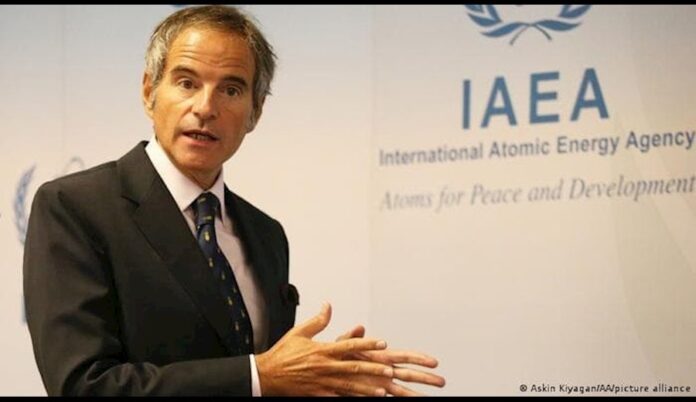
The Islamic Republic of Iran, as a responsible member of the Non-Proliferation Treaty and a member of the International Atomic Energy Agency, has always cooperated properly with this technical and specialized body within the framework of the Safeguards Agreement and has fully adhered to its obligations, and showed goodwill until one year after the illegal and irresponsible withdrawal of the United States from the JCPOA, he added.

Khatibzadeh stated that Iran welcomes the intention of the other parties to fully return to fulfilling their obligations, adding that the criterion for Iran is the action of the other party.

Contrary to its stated policy, the new U.S. administration continues to pursue a policy of maximum pressure that led to new sanctions or the re-imposition of previously lifted sanctions, he stated.

The Foreign Ministry spokesman further emphasized that after the necessary time for the formation of the new Iranian administration and conducting necessary reviews, and after consulting with partners and consultations with the coordinator of the JCPOA Joint Commission, it was announced that negotiations to remove sanctions will begin before the end of November.

Regarding what was announced in the statement of the leaders of the four countries about the production of enriched uranium metal and high-enriched uranium, Khatibzadeh clarified that contrary to the statement, production of uranium metal and high-enriched uranium, as previously stated, was for peaceful purposes and had civilian uses, including medical use and refueling of Tehran’s research reactor.

It should be noted that such positions that do not correspond with reality will not have constructive results, he said.

The foreign ministry spokesman said the so-called nuclear crisis, which is exaggerated in this statement, is no more than a fabricated and propaganda crisis.

Khatibzadeh stressed that the current situation is the result of irresponsibility and non-compliance with commitments by the governments issuing this statement, and the illegal withdrawal and violation of UN Security Council Resolution 2231 of 2015 by the U.S. government and inaction of the European parties in fulfilling their obligations.

China: US should correct policy of maximum pressure

Wang Wenbin

“Effective implementation of the JCPOA (Joint Comprehensive Plan of Action) is the only correct way to resolve the Iranian nuclear issue,” China’s Foreign Ministry Spokesperson Wang Wenbin stated during the regular press conference on Monday.

“China firmly supports efforts to bring the agreement back onto the right track at an early date,” he added.

“On this basis, Iran should resume full compliance. Other parties should all play a constructive role to this end,” he said.

“The six rounds of negotiation on resumption of compliance held during the first half of this year have made important headway. All parties should resume negotiation at an early date and look for flexible and pragmatic solutions to outstanding issues and work for new breakthroughs,” the spokesperson noted.

“China will continue its close communication with relevant parties and participate constructively in the negotiation. At the same time, we will also firmly safeguard our legitimate and lawful rights and interests,” Wenbin continued.

Iran, China: Unilateral U.S. sanctions illegal

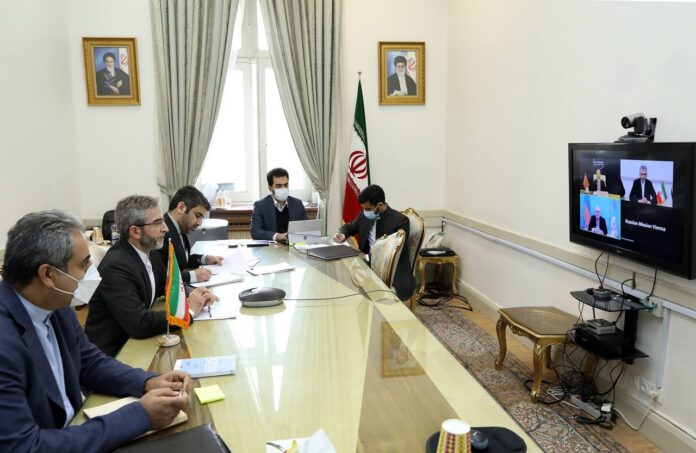
Iranian Deputy Foreign Minister Ali Bagheri Kani said in a twitter post on Monday that he and his Chinese counterpart Ma Zhaoxu stressed during a phone conversation that sanctions against Iranian individuals, entities and third parties should be removed, and that guarantees must be provided so that such illegal measures will not be repeated.

The Iranian and Chinese deputy foreign ministers emphasized the importance of the rule of law in international relations.

The phone conversation comes days after Bagheri Kani, who is Iran’s top negotiator, traveled to Brussels and Moscow, where he met with the European Union Deputy Foreign Policy Chief Enrique Mora and Russian Deputy Foreign Minister Sergei Ryabkov.

Bagheri and Mora agreed that talks between Iran and the P4+1 group in the Austrian capital Vienna will resume before the end of November on a possible return of the United States to the 2015 nuclear deal.

Former U.S. president Donald Trump withdrew America from the JCPOA and re-imposed unilateral sanctions against Iranians to force them to negotiate a new deal. Iran rejected this and rolled back some of its nuclear commitments in response. Trump’s successor Joe Biden says he wants to return to the deal, but has so far enforced Trump’s sanctions and failed to take concrete measures to build confidence.

Just days ago, in a move that was condemned by Iran, the US Treasury imposed new sanctions on real and legal Iranian individuals linked to the country’s unmanned aerial vehicle program.

South Korea ‘face mask donation’ triggers public backlash in Iran

The donation has outraged many Iranians, with some taking to twitter to express their anger.

Some social media users have responded to the move on the South Korean Embassy’s twitter page calling on Seoul to release Iranian funds immediately.

“Iranians are not in need of the small number of masks you have bothered to donate. And just for your information, Iran is now an exporter of masks,” a social media user wrote on the embassy’s page. “Release the Iranian nation’s funds if you are so determined to look civilized.”

Another user wrote that “Atieh Hospital should not have accepted such humiliation.”

Some others said the South Korean Embassy has insulted the Iranians rather than sending a friendly signal.

The angry reactions poured in after the Korean embassy in Tehran announced in a Twitter post that ambassador Yun Kanghyeon donated the face masks to Atieh Hospital on October 26 to “help the Iranian people overcome Covid-19.”

Iran has repeatedly called on Seoul to unfreeze nearly eight billion dollars in payment for crude imports seized because of American sanctions.

Before the re-imposition of US sanctions in 2018, the Islamic Republic was South Korea’s third-largest trade partner in West Asia.

Erdogan: US should not support terror groups

Turkey's President Tayyip Erdogan waves as he attends a bilateral meeting with U.S. President Joe Biden, on the sidelines of the G20 leaders' summit in Rome, Italy October 31, 2021. REUTERS/Kevin Lamarque

Turkey will conduct anti-terror cross-border operations ‘whenever necessary”, Erdogan stated.

“There is no stepping back from it,” he said in response to a question on a return flight from the G20 Leaders’ Summit held in Rome, Italy.
He called on NATO ally US that it “should not support terrorist organizations.”

On his meeting with US counterpart Joe Biden on the sidelines of the G20, Erdogan noted they discussed the procurement of F-16 fighter jets.

“I didn’t witness any negative approach,” he said of the meeting held on Sunday, adding that he hopes to conclude the “sensitive issue.”

He stated Turkey and the US agreed to focus “more intensely” on the economic ties, and discussed cooperation in Afghanistan, Syria, Libya, and the Eastern Mediterranean.

Erdogan added that he told the US and French presidents how establishment of a base in Alexandroupoli, Greece near Turkish border “seriously disturbs” Turkey.

Earlier, the Turkish president announced the US proposed the sale of F-16 fighter jets as compensation for Turkey’s payment for the F-35s.

In 2019, Washington announced that it was taking Turkey out of the F-35 stealth fighter jet program over Ankara’s purchase of the S-400, a Russian defense system it bought after its efforts to buy US Patriot missiles were rebuffed.

The US claimed the Russian system posed a safety risk. Turkey, however, stressed the S-400s would not be integrated into NATO systems, and thus pose no threat to the alliance or its armaments.

Ankara also repeatedly proposed setting up a commission to clarify the issue.

Russia: US likely to establish bases near Afghanistan

“Well aware of the Americans’ intrusiveness, I do not rule out that they will be pressing for the same aim from different sides. I’ve heard that they have been trying to persuade India to grant the Pentagon some opportunities on the Indian territory,” Russian Foreign Minister Sergey Lavrov told the Rossiya-24 round-the-clock television news channel in an interview.

Lavrov recalled that Russian President Vladimir Putin told his US counterpart Joe Biden at the Geneva summit in July “Russia is categorically against attempts to conclude agreements with the Central Asian countries on the deployment of US military infrastructure on their territory with the aim of delivering so-called over-the-horizon strikes against targets in Afghan territory.”

Lavrov stressed that such proposals from the United States had also been received by Pakistan, which rejected them, and by Uzbekistan, which stated in public that its Constitution left no room for any actions like the deployment of foreign bases in its territory.

“Kyrgyzstan, too, as represented by its president, said it does not wish this, either,” Lavrov added.

On October 27, Russia’s FM in a video message urged Afghanistan’s neighbors to prevent US and NATO military presence on their territories.

The Taliban movement, driven out of Kabul by the forces of the Northern Alliance with support from the US-led international coalition in November 2001, launched a large-scale operation twenty years later for control of Afghanistan after Washington in the spring of 2021 unveiled plans for curtailing its military mission. On August 15, the radicals entered Kabul without encountering any resistance. President Ashraf Ghani stepped down and left the country.

The Taliban on September 6 announced the whole territory of Afghanistan was under their control. On September 7, they unveiled the composition of an interim government.

Number of Covid-19 shots surpasses 88mn in Iran

Number of Covid-19 shots surpasses 88mn in Iran

The Iranian Health Ministry said on Monday that nearly 1,050,000 doses have been given to people across the country over the past twenty four hours.

According to the latest figures over 35 million people in Iran have been fully vaccinated.

The ministry also reported 153 new fatalities from the virus over the past twenty four hours taking the total death toll to 126,456.

The country has managed to bring the outbreak under control somehow and eased many restrictions, but authorities have been warning that a sixth wave could be looming on the horizon if protocols are not observed properly.

Report: Afghan soldiers and spies joining Daesh

The US spent a staggering $88 billion arming and training Afghanistan’s military, only for Afghan forces to crumble before the Taliban’s lightning fast reconquest of the country in August. Though the Taliban have promised amnesty to these personnel, stories of violent reprisals have circulated, and according to The Wall Street Journal, a “relatively small, but growing” number of former Afghan soldiers and spies are flocking to the only outfit currently resisting Taliban rule – Islamic State terrorist group.

Islamic State’s (IS, formerly ISIS, ISIL or Daesh) Afghan offshoot, IS-K, is eagerly absorbing these US-trained recruits. According to the former security officials and Taliban members the Wall Street Journal spoke to, some former government troops have joined for a paycheck, and others for lack of a better alternative to Taliban rule.

“If there were a resistance, they would have joined the resistance,” former spy chief Rahmatullah Nabil told the paper, adding, “For the time being, ISIS is the only other armed group.”

Though IS-K and the Taliban are both Islamic fundamentalist groups, their ideologies differ. The Taliban are a predominantly Punjabi nationalist organization with no stated goals beyond Afghanistan’s borders, and a tolerance for the country’s other Muslim sects. IS-K, by contrast, view Shiites and other Muslim sects as apostates and aim to establish a worldwide Islamic caliphate, as IS attempted to do several years ago in Iraq and Syria.

Initially suppressed by the Taliban, IS-K mounted a resurgence amid the chaos of the US withdrawal from Afghanistan, carrying out a suicide bombing outside Kabul Airport in August that killed around 200 Afghans and 13 US troops. For the US military, it was the deadliest day in Afghanistan since 2011.

It is unclear what “critical expertise in intelligence-gathering and warfare techniques” these new recruits will bring to IS-K, given that the supposedly 300,000-strong Afghan military they came from folded before the Taliban in a matter of weeks, with its members often fleeing or surrendering without firing a shot.

However, the fact that these US-funded fighters are signing up to a hardline terror group within months of the US leaving Afghanistan illustrates a problem that decision-makers in Washington evidently haven’t learned from in four decades of experience.

Just as the US-funded Afghan Mujahideen would eventually morph into the Taliban in the late 1980s and 1990s, and the Afghan military is on track to bolster ISIS-K’s ranks, the disaffected Iraqi soldiers left without a job following the US invasion in 2003 ended up providing a steady stream of recruits for ISIS several years later.

The US security establishment has already begun to sound the alarm about ISIS-K’s resurgence, with US Undersecretary of Defense Colin Kahl telling the Senate last week that the group could be in a position to attack the West from Afghanistan within six months.

The Taliban, at least publicly, are unperturbed. “We are not faced with a threat nor are we worried about them,” Mawlawi Zubair, a senior Taliban commander, told the newspaper, noting, “There is no need, not even a tiny need, for us to seek assistance from anyone against ISIS.”