Friday, January 2, 2026
Home Blog Page 2238

Three Hamas members killed in Lebanon camp shooting

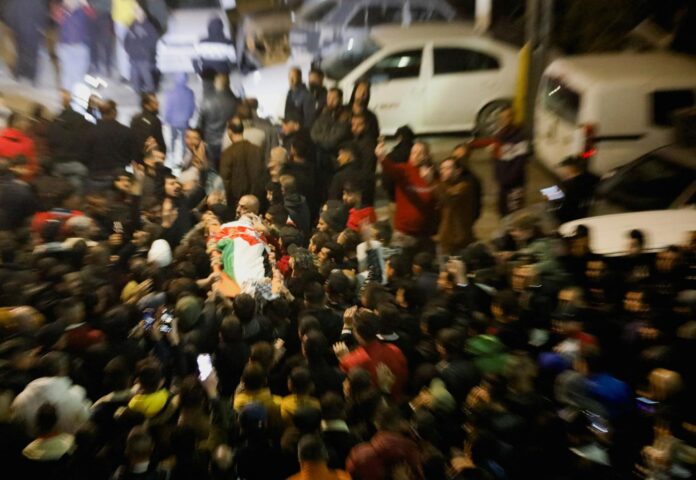
Hamas official Raafat al-Murra said people from the rival Fatah movement “shot at the funeral procession” of a Palestinian killed in a blast on Friday at the Burj al-Shemali camp, outside the port city of Tyre.

Six people were wounded, he added.

Hamas and Fatah have been at odds since 2007 when the former defeated party of Palestinian President Mahmoud Abbas in parliamentary elections in besieged Gaza Strip.

One camp resident told the AFP news agency that there was a dispute “when the funeral procession arrived at the camp cemetery and suddenly there was shooting towards the crowd”, adding that in the chaos it was unclear who was shooting at whom.

Another resident said that “when the shooting started, the funeral procession pulled back … and people fled.” The resident added that Fatah was on alert following the incident.

An electrical short circuit in a store containing oxygen supplies for COVID patients caused Friday’s blast, Hamas had claimed, denying reports that an arms depot blew up.

The explosion blackened the walls and shattered the windows of a nearby mosque.

“The fire caused damage to property but the impact was limited,” Hamas said.

According to a Palestinian official, one man died of his injuries from the explosion, which also left several people wounded.

On Sunday, mourners had been out on the streets of the Burj al-Shemali camp, shouting pro-Hamas slogans.

Armed elements of both Fatah and Hamas had been deployed before the funeral.

Lebanon is home to tens of thousands of Palestinian refugees and their descendants. Many live in the 12 refugee camps that are scattered across the small Mediterranean country.

A number of armed Palestinian factions, including those linked to Hamas and Fatah, hold effective control over the camps, which Lebanese authorities by custom do not enter.
‘Serious doubts about Canada’s goodwill over human rights

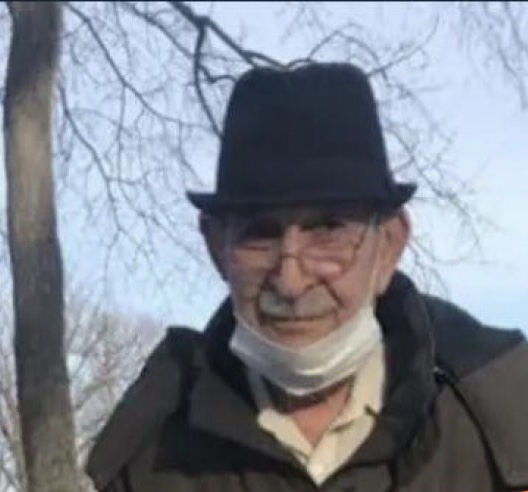
Mirza Ali Varzzadeh is accused of sending the cases of 8,000 people to higher echelons of SAVAK, which constitutes violation of human rights. 

The writer of the commentary says regardless of the value of the former SAVAK agent in terms of revealing the crimes of the Pahlavi regime, there are serious doubts about Canada’s goodwill in defending human rights. Hessameddin Ghamous Moghaddam also referred to the participation of Canada’s former prime minister Stephen Harper at an annual meeting of anti-Iran terrorist group, MKO and addressed other participants in the event. 

He added that this was a gathering organized by a terrorist cult that has the blood of 12,000 people on its hands. 

Ghamous Moghaddam asks, “Canada should name a member of the MKO it deported for the violation of human rights”. 

The MKO aside, the legal expert added, Canada has given refuge to the notorious suspect behind one of the biggest financial corruption cases in Iranian history, Mahmoudreza Khavari and it has refused to cooperate with the Interpol in extradition of the man. If Canada is worried about human rights, it must understand that the Iranian people have a right to put on trial those who plundered their wealth, he said. 

Ghamous Moghaddam added that extraditing the likes of Mirza Ali and giving refuge to people like Khavari and MKO terrorists only further expose Western double standards toward the issue of human rights.

Palestinian youth killed by Israeli troops in WB

The Palestinian Ma’an news agency reported the atrocity on Monday, identifying the victim as a young male, who lost his life during a raid by the forces at Nablus’ Old City.

Reuters reported Israel’s paramilitary border police said undercover forces opened fire at Palestinians in the West Bank city of Nablus.

The agency claimed that the fatality was caused, when the forces confronted Palestinians, who were “hurling explosive devices” at the forces.

It also alleged that the skirmish erupted after the forces hunted down a “wanted” Palestinian.

The Palestinian resistance movement of the Islamic Jihad mourned the youth’s martyrdom in a statement, but did not identify him as one of its members.

Also on Monday, Israeli forces assaulted the al-Ain refugee camp in Nablus as well as the city of Bethlehem in the west-central part of the West Bank.

Israeli forces fired teargas canisters to disperse the Palestinians during the latter raid.

The developments come only two days after Israeli troops killed a young Palestinian and injured as many as 68 others, attacking the southern part of Nablus.

The Israeli regime occupied the West Bank in 1967 before starting to dot the Palestinian territory with illegal settlements and severely restricting the Palestinians’ freedom of movement there.

The Palestinian Centre for Human Rights also said in a report that the murder of Palestinian youth Jamil Abu Ayyash, 31, in the occupied West Bank village of Beita on Friday was a result of the excessive use of force by the Israeli occupation army, amounting to a war crime, WAFA news agency reported.

According to PCHR’s investigations, the Israeli occupation army directly targeted the Abu Ayyash in the head at a close range of 50 meters, without any justification or posing threat to the soldiers’ lives, which, according to the report, proves unjustifiable lenient shooting standards in the Israeli army in disregard of Palestinian civilians’ lives.

“These crimes reflect the excessive use of force in circumstances where there was no imminent threat to the soldiers’ lives and prove Israeli lenient shooting standards against the Palestinian civilians,” the report added.

PCHR urged the international community to act immediately to stop the Israeli crimes, and renewed its call on the High Contracting Parties to the Fourth Geneva Convention to fulfill their obligations under Article 1; i.e. to prosecute persons alleged to commit grave breaches of the Fourth Geneva Convention and guarantee Palestinian civilians’ right to protection in the occupied Palestinian Territory.

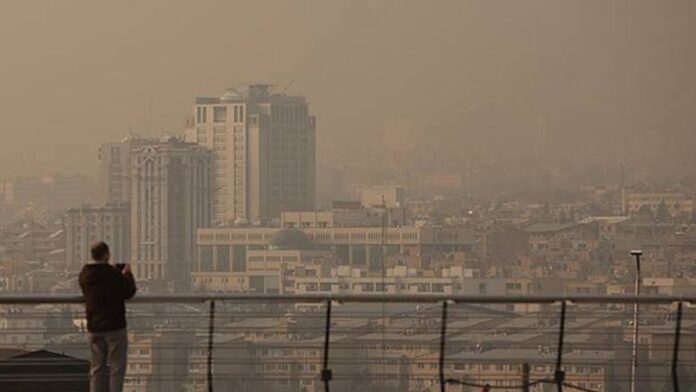
Air quality in Tehran remains unhealthy for sensitive groups

The Iranian capital city’s air quality index was at 145 in the late hours of Sunday. 

Tehran has had 195 days with acceptable air quality and 64 days with air quality unhealthy for sensitive groups as well as 6 days rated unhealthy for all since the beginning of the new Iranian calendar year, which began on March 21. 

High pollution rate during the cold seasons have turned into a major problem in large Iranian cities over the past years. 

Officials say fossil fuels used by millions of vehicles, power plants and factories are the main culprits for the air pollution.

Russia: Iran proposals show Tehran’s seriousness over restoring JCPOA

Russian Deputy Foreign Minister Sergey Ryabkov told Sputnik the chances of reaching an agreement on restoring the Joint Comprehensive Plan of Action (JCPOA) have increased.

“I think that now, the likelihood that we will come to an agreement has increased compared to what it was before the resumption of negotiations. I would rather say that there are reasons to expect some progress, not fast but at least clear, without any kickbacks and additional factors that can complicate [the situation]” Ryabkov said.

Besides, the proposals put forward by Iran at the Vienna-hosted talks on the JCPOA, according to Ryabkov, demonstrate Tehran’s utmost seriousness about restoring the nuclear deal.

“There are other proposals presented not only by Iran. Negotiations are for finding a common denominator. It is not hopeless. On the contrary, there is material for consideration. As for the Iranian proposals, I can only say one thing — they have demonstrated the utmost seriousness of their approach to the task,” Ryabkov added.

At the same time, the deputy foreign minister noted, that it is counterproductive to threaten Iran with sanctions against the background of the nuclear talks in Vienna – something the US does.

“This is their usual method — trying to drive someone to heaven with sticks. We constantly explain to the Americans the counterproductiveness of this approach,” Ryabkov stated.

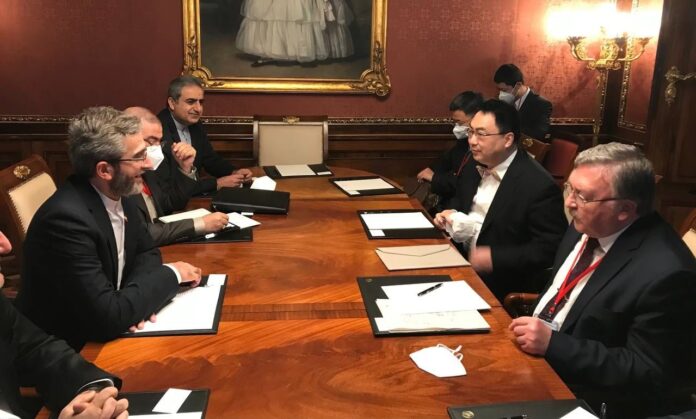
Iran’s top nuclear negotiator confers with Chinese, Russian counterparts

According to the IRNA correspondent, the three top negotiators met amid promising news about the course of the nuclear talks which is underway with the objective of removal of sanctions against Iran.

Earlier, Bagheri told IRNA that differences among participating countries in the talks known as G4+1, were narrowing.

The positions of the two sides are different from each other and their distance is different on different issues, he stated.

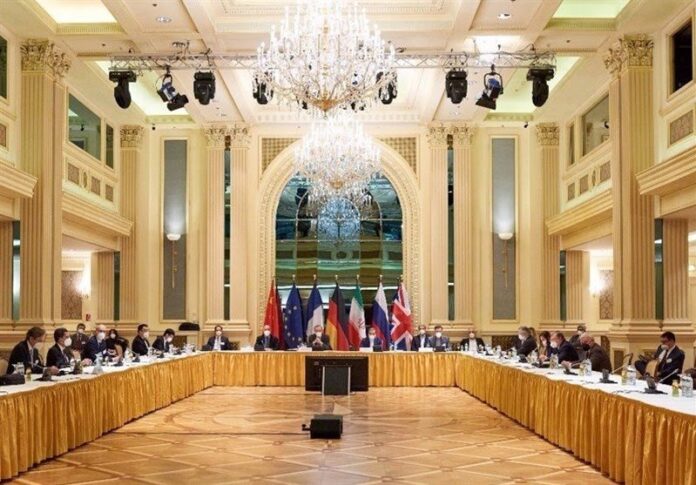
The latest round of talks of Joint Commission of the Joint Comprehensive Plan of Action (JCPOA) between Iran and China, Germany, France Britain and Russia started December 8 in Vienna, Australia.

Iran’s focus in the talks is the removal of sanctions against the country.

“Govt. budget pushes economy to brink, raises pressure on people”

The government’s official paper, the Iran Newspaper, issued the warning in an article on the budget bill the government presented to the parliament on Sunday. 

The paper said recession is in the cards unless new tax bases that limit tax evasion are found.

“The reduction in the salary and payment raise of the government employees, and adjusting it below the inflation rate, not only increases the pressure on government employees’ livelihoods, but also has a secondary impact on the private sector’s turnover unless this reduction is targeted at higher salaries,” the paper said.

The article called for short-term compensatory policies and focus on infrastructure for production as key means to take the economy out of recession and improve people’s livelihood.

Iran’s economy is under huge pressure due to the US sanctions with official figures putting the inflation rate at around 40%.

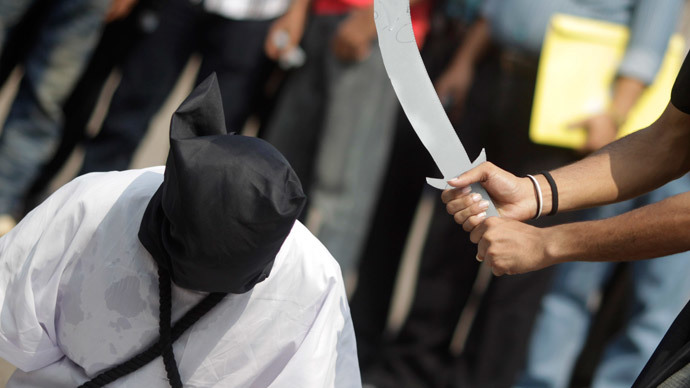
‘Saudi Arabia executed 886 inmates since 2015, including minors, women’

Since 2015, Saudi Arabia has executed 886 prisoners, including 12 minors and 20 women, in an increasing rate, the Arabic-language Mirat al-Jazeera news website reported on Sunday, citing figures provided by the second conference on victims of Saudi government’s rights violations.

In the virtual conference, which was held by the European Saudi Organization for Human Rights (ESOHR), it was revealed that 41 of the executed were foreign nationals who had been behind bars in Saudi Arabia.

The conference, which was held online on December 10, on the occasion of World Human Rights Day, was attended by a number of activists and opponents of the Saudi regime in an attempt to shed light on the extent of the repression practiced by Riyadh against dissidents, including arrests and executions, which threatens the lives of human rights defenders in the Arab kingdom.

In 2019 alone, Saudi Arabia set a record number of executions after Saudi authorities executed 184 people, despite the general decrease of executions around the world.

According to rights activists, Riyadh’s growing use of the death penalty, mostly as a political weapon against dissidents, is alarming.

In the latest executions carried out by Saudi authorities against Shia detainees in Qatif and al-Ahsa in the kingdom’s Eastern Province, Muslin bin Mohammad al-Mohsen was executed after he was accused of allegedly participating in a cell aimed at destabilizing the internal security of Saudi Arabia.  

The Shia-majority Eastern Province has been the scene of peaceful demonstrations since February 2011. Protesters have been demanding reforms, freedom of expression, the release of political prisoners, and an end to economic and religious discrimination against the oil-rich region.

The protests have been met with a heavy-handed crackdown by the regime. Security forces have increased security measures across the province.

Earlier this year, Saudi authorities also executed Mustafa al-Darwish for alleged crimes he committed when he was seventeen years old. The ministry of interior claimed that the young citizen attempted to destabilize the internal security of the country through spreading sedition.

The regime’s virtual and non-virtual media distort the facts through deceptive means, and the ministry of interior does not talk about how people are sentenced and such lies, stated human rights activist Taha al-Hajji.

In April 2019, Saudi officials announced the mass execution of 37 men, 33 of whom were citizens who had been executed on cruel trials on charges such as alleged espionage, terrorist acts, and inciting insecurity.

It was the largest mass execution in Saudi Arabia since January 2016, when Saudi authorities executed 44 people on terrorism charges.

Ever since Mohammed bin Salman became Saudi Arabia’s de facto leader in 2017, the kingdom has ramped up arrests of activists, bloggers, intellectuals, and others perceived as political opponents, showing almost zero tolerance toward dissent.

Muslim scholars have been executed, women’s rights campaigners put behind bars and tortured, and freedom of expression, association, and belief continue to be denied.

Saudi Arabia executed more than 2,000 people between 1985 and 2016. Rights groups have cited rampant cases of torture and unfair trials.

Iran negotiator optimistic about reaching a deal in foreseeable future

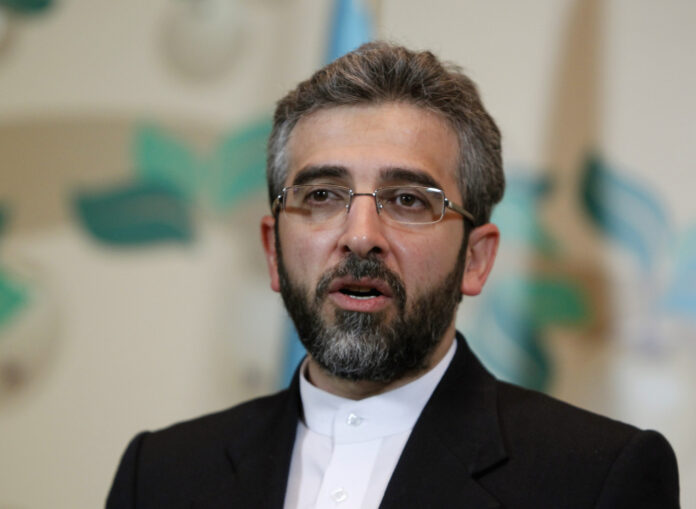
Iran's deputy negotiator Ali Bagheri speaks during a news conference in Almaty April 5, 2013. REUTERS/Shamil Zhumatov

Ali Bagheri Kani touched on the latest situation of the Vienna talks, saying two main issues should be separated. One thing, he added, is the existence of differences between the parties on issues being negotiated, and another issue is about one-on-one differences between Iran and each of the parties to the talks.

Bagheri Kani said over the past few days, the parties to the talks have been reaching a clear conclusion on the scope of the issues that must be on the agenda of negotiations.

The Iranian deputy foreign minister continued, “I think this is a very good progress, and if we can reach a conclusion on negotiable issues, it will be an important step because at first the parties were divided over the matter.”

Bagheri Kani referred to outside attempt to derail the negotiations through propaganda. He said it’s highly unlikely such attempts will be fruitful for Iran’s adversaries.

The Iranian deputy foreign minister also spoke of the US’s return to the JCPOA. He said the key condition for Washington to return to the deal is the removal of anti-Iran sanctions.

Bagheri expressed optimism about the outcome of the Vienna talks. He however said Iran will never forget the hostile moves against the country by the other sides.

Bagheri Kani added that despite this dark record, Iran is optimistic that it can reach a deal with them in the foreseeable future given the Islamic republic’s robust logic and stance.

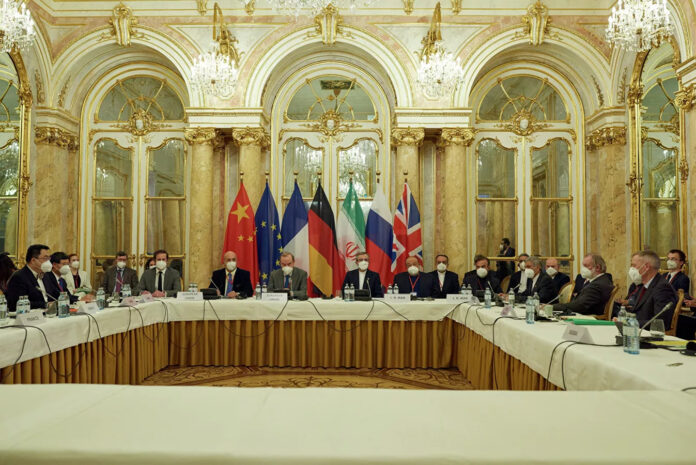
Iran-P4+1 talks continue in Vienna

Russia’s chief negotiator, Mikhail Ulyanov, tweeted the news, adding that this is the first time that a third working group meeting is held during the seventh round of the Vienna talks.
The new round of talks between Tehran and the P4+1 including Russia, China, Britain, France and Germanry resumed Thursday December 9 with a meeting of the Joint Commission of the JCPOA, Iran’s nuclear deal.
Immediately after the Joint Commission meeting, the delegations began working on texts with the aim of reducing differences.
In this round of talks the parties are working in different formats and levels on sanctions removal and nuclear issues.
Ali Bagheri Kani, Iran’s chief nuclear negotiator, said earlier on Sunday that as a result of interactions and meetings held over the past few days at the level of experts and senior negotiating officials, disagreements between the parties on the scope of negotiable issues are decreasing.