Friday, December 19, 2025
Home Blog Page 2

US Congress ends sanctions on Syria

President Donald Trump had already twice suspended the implementation of sanctions, in response to pleas from Saudi Arabia and Turkey, allies of the new government headed by former militant Ahmed al-Sharaa.

But Sharaa had sought a permanent end to the sanctions, fearing that so long as the measures remained on the books they would deter businesses wary of legal risks in the world’s largest economy.

The Senate passed the repeal of the 2019 Caesar Act as part of a sweeping annual defense package. The Senate voted 77 to 20 in favor of the legislation, which was already approved by the House of Representatives and is expected to be signed by Trump.

The repeal, broadly backed by lawmakers of both parties, “is a decisive step toward giving the Syrian people a real chance to rebuild after decades of unimaginable suffering”, stated Senator Jeanne Shaheen, the top Democrat on the Senate Foreign Relations Committee.

The Caesar Act, named after an anonymous photographer who documented atrocities in Assad’s prisons, severely restricted investment and cut off Syria from the international banking system.

The law was intended to prevent the influx of foreign businesses to rebuild Syria at a time when it had seemed that Assad had triumphed following more than a decade of war that triggered a massive flow of refugees toward Europe and helped spawn the birth of the Islamic State terror group.

Sharaa’s fighters seized Damascus a year ago in a lightning offensive.

Sharaa — now dressed in a business suit and seeking better relations with the West — has impressed Trump, including when they first met during the US leader’s May trip to Riyadh.


Russia preparing for new ‘year of war’: Zelensky

Russia Ukraine War
A boy helps salvage items at the Odesa Transfiguration Cathedral after it was heavily damaged in Russian missile attacks in Odesa, Ukraine, Sunday, July 23, 2023.

“Today, we heard yet another signal from Moscow that they are preparing to make next year a year of war,” Zelensky stressed in his regular evening address, after Putin stated Russia would achieve its goals in its Ukraine offensive, including seizing Ukrainian territories it claims as its own.

A White House official told AFP Wednesday that US and Russian officials will meet in Miami this weekend for new talks on President Donald Trump’s plan for ending the Ukraine war.

The talks come after Zelensky hailed progress during two days of meetings in Berlin between Kyiv and Trump’s envoys.

Trump’s roving envoy Steve Witkoff and son-in-law Jared Kushner are expected to take part on the US side, while Putin’s economic envoy Kirill Dmitriev is set to be in the Russian delegation, Politico reported.

The White House official did not give details of the US and Russian teams.

There has been a flurry of international diplomacy in recent weeks to end Russia’s nearly four-year-old invasion, with Witkoff and Kushner having met Putin in the Kremlin in November and the Ukrainians and European leaders in Berlin.

But large differences remain all around.

Ukraine and the United States say there has been progress on the question of future security guarantees for Kyiv, but there are disagreements on what territory Ukraine would have to cede.

Israel’s PM says approved $35bn gas deal with Egypt

“Today, I approved the largest gas deal in Israel’s history. The deal is worth 112 billion shekels ($34.7 billion). Of this total, 58 billion shekels ($18 billion) will go to the state coffers,” Netanyahu said during a televised address.

“The agreement is with the American company Chevron, with Israeli partners who will supply gas to Egypt,” Netanyahu added.

Energy Minister Eli Cohen, who was present during the address, stated it was the “largest export deal in the state’s history”.

Netanyahu noted that the money would “strengthen education, healthcare, infrastructure, security, and the future of the next generations”, as well as bolster “Israel’s status as a regional energy power”.

Israeli firm NewMed Energy announced in August the signing of a $35 billion deal to provide Egypt with natural gas.

The agreement would increase the total volume of gas supplied to Egypt to 130 billion cubic metres, according to a report published by the firm.

In a statement issued late on Wednesday, NewMed CEO Yossi Abu said it was “a historic day for the natural gas sector, one that guarantees continued investment in Israel and creates regulatory stability for years to come”.

But Israeli NGO Movement for Quality Government announced it was “deeply concerned about how the largest gas deal in the country’s history was approved”.

It called on the government to make the details of the agreement public, and to explain its implications for long-term reserves and consumer prices.

US approves $11bn in weapons sales to Taiwan in deal likely to anger China

The US State Department announced the deal late on Wednesday during a nationally televised address by President Donald Trump.

Weapons in the proposed sale include 82 High Mobility Artillery Rocket Systems, or HIMARS, and 420 Army Tactical Missile Systems, or ATACMS – worth more than $4bn – defence systems that are similar to what the US had been providing Ukraine to defend against Russian aerial attacks.

The deal also includes 60 self-propelled howitzer artillery systems and related equipment worth more than $4bn and drones valued at more than $1bn.

Other sales in the package include military software valued at more than $1bn, Javelin and TOW missiles worth more than $700m, helicopter spare parts worth $96m and refurbishment kits for Harpoon missiles worth $91m.

In a series of separate statements announcing details of the weapons deal, the Pentagon said the sales served US national, economic and security interests by supporting Taiwan’s continuing efforts to modernise its armed forces and to maintain a “credible defensive capability”.

Taiwan’s defence ministry and presidential office welcomed the news while China’s foreign ministry did not immediately respond to a request for comment from the Reuters news agency.

Washington’s huge sale of arms to Taiwan will likely infuriate China, which claims Taiwan is part of its territory and has threatened to use force to bring it under its control.

“The United States continues to assist Taiwan in maintaining sufficient self-defence capabilities and in rapidly building strong deterrent power,” Taiwan’s defence ministry announced in a statement.

Taiwan presidential office spokesperson Karen Kuo said Taiwan would continue to reform its defence sector and “strengthen whole-of-society defence resilience” to “demonstrate our determination to defend ourselves, and safeguard peace through strength”.

China’s Taiwan Affairs Office announced on Wednesday that it opposed efforts by the US Congress to pass bills “related to Taiwan and firmly opposes any form of military contact between the US and Taiwan”.

“We urge the US to abide by the one China principle and the provisions of the three Sino-US joint communiques : Stop ‘arming Taiwan’, stop reviewing relevant bills, and stop interfering in China’s internal affairs,” the office’s spokesperson Zhu Fenglian said in a statement.

Zhu added Taiwan’s political leaders were pursuing “independence”, and were “willing to let external forces turn the island into a ‘war porcupine’,” which could result in the population becoming “cannon fodder” and “slaughtered at will, which is despicable”.

Taiwan’s President William Lai Ching-te last month announced a $40bn supplementary defence budget, to run from 2026 to 2033, saying there was “no room for compromise on national security”.

Russia claims Ukraine lost almost 500,000 soldiers in 2025

Russia Ukraine War

Speaking at a Defense Ministry Board meeting attended by President Vladimir Putin on Wednesday, Belousov said Ukraine’s combat capability had been reduced by about a third over the past year, stripping Kiev of the ability to replenish its forces through forced mobilization of civilians.

“Ukraine’s forces have lost nearly 500,000 servicemen, as a result of which Kiev has lost the ability to replenish its groupings through the compulsory mobilization of civilians,” Belousov said.

According to the minister, Ukraine has lost more than 103,000 weapons and pieces of military equipment this year, including about 5,500 of Western manufacture – almost double the total recorded the previous year.

Ukraine announced general mobilization shortly after the escalation of the conflict with Russia in 2022, barring men between the ages of 18 and 60 from leaving the country. Last year, it lowered the draft age from 27 to 25 while tightening mobilization rules.

The forced conscription campaign has triggered repeated violent clashes between reluctant recruits and draft officers.

Kiev’s recruitment drive has grown increasingly brutal as Ukrainian forces confront setbacks and manpower shortages. Hundreds of incidents have been documented online in which enlistment officers assaulted potential conscripts, chased them through the streets, and threatened bystanders who tried to intervene.

Even with increasingly harsh measures, Ukrainian officials and frontline commanders have complained that the mobilization campaign is falling short of targets, contributing to the continuous Russian advance.

Western claims of Russian threat ‘lies and nonsense’: Putin

Speaking at an expanded Defense Ministry Board meeting on Wednesday, Putin noted that the global geopolitical situation remains “tense” and “downright critical” in some regions. He accused NATO countries of “preparing for a major war” by building up and modernizing their offensive forces while “brainwashing” their population with claims of an inevitable clash with Russia.

“I have repeatedly stated that this is a lie, nonsense, pure nonsense about some imaginary Russian threat to European countries. But this is being done quite deliberately,” Putin said, adding that EU officials have “forgotten their responsibility” and are being guided by short-term personal or shared political interests.

He went on to stress that throughout its history, even in the most difficult circumstances, Russia has always strived to find diplomatic solutions to conflicts and contradictions, so long as there was even a slight chance.

“The responsibility for not seizing these opportunities lies entirely with those who believed they could speak to us through force,” Putin emphasized.

The president stated that Russia supports “mutually beneficial and equal cooperation” with the US and European states, as well as the formation of a unified security system across the Eurasian region. He separately noted the progress that has been made in bilateral talks with Washington.

‘Unfortunately, this cannot be said about the current leadership of most European countries,” he continued.

Putin went on to state that Moscow recognizes that in any international situation, its armed forces remain the key guarantor of Russia’s sovereignty, independence, security, future, and strategic parity.

Iranian president: US sets humiliating conditions for talks

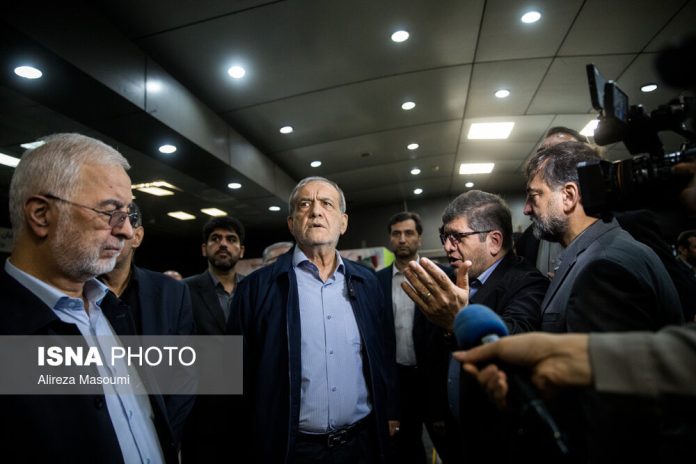
Pezeshkian said while Iran had engaged in talks with the US and was prepared for an agreement, the other side disrupted the negotiations through confrontation.

“Now, they are presenting humiliating conditions for further negotiations, which I am unwilling to accept”, Pezehskian noted.

“We will not give in to humiliation, nor will we accept a weak and fragmented Iran”.

Meanwhile, Pezeshkian underlined that the Islamic Republic is not seeking conflict.

He said, “We have repeatedly stated that we are not pursuing nuclear weapons and are ready for any verification measures, but, the other side seeks to seize all elements of Iran’s power and weaken the country vis-à-vis the Israeli regime”.

The Iranian president reiterated that Tehran pursues peace, but it will not tolerate bullying.

Iranian actor Hamid Taleghani passes away at 59

In a statement, Iran’s House of Cinema expressed condolences over his death and announced that his funeral will be held on Thursday.

Taleghani will be laid to rest at the Artists’ Section of Behesht Zahra cemetery in Tehran.

Born in Tehran in 1966, Taleghani rose to prominence with his role in the film High School and went on to build a long career in Iranian cinema and television.

He appeared in numerous films, including Wild Jasmines, Without Permission, A Man Like Rain, The Final Stage, Seven Passages, Line of Fire, White Dial, Come With Me, The Victim, Thus It Was, Chrysanthemum Flowers, Tell Her I Love Her, The Bearers of Life and The Necklace.

Taleghani was also active in television, starring in series such as A Nest for Life, Tell Her I Love Her, The Bearers of Life and The Necklace.

In addition to acting, he directed two works, Freer Than the Sea and A Nest for Life, contributing to Iranian cinema both in front of and behind the camera.

Iran, Russia sign foreign ministry cooperation program in Moscow

The document was signed on Wednesday by Iranian Foreign Minister Seyed Abbas Araghchi and his Russian counterpart Sergei Lavrov at the conclusion of their negotiations and comes after the implementation of the Comprehensive Iran-Russia Strategic Treaty.

Talks between the two foreign ministers focused on bilateral relations as well as regional and international issues.

Lavrov welcomed Araghchi and the accompanying Iranian delegation at the Russian Foreign Ministry before discussions commenced.

During the meeting, Araghchi said consultations between Tehran and Moscow have continued on a close and regular basis at all levels.

He described relations between the two countries as comprehensive and multidimensional, encompassing political, economic, cultural, defense, and security cooperation.

He also noted that the presidents of Iran and Russia have met five times over the past 18 months, reflecting the intensity of high-level contacts.

Referring to the recent meeting between Iranian President Massoud Pezeshkian and Russian President Vladimir Putin in Ashgabat, Araghchi said the current talks offered an opportunity to review bilateral ties in greater detail and enhance coordination on regional and international developments.

Lavrov described the comprehensive strategic treaty as the most significant development in bilateral relations this year, saying it sets a long-term, 20-year direction for cooperation.

FM: Iran not to renounce nuclear rights, including uranium enrichment

Speaking on Wednesday at a joint press conference in Moscow following talks with his Russian counterpart Sergey Lavrov, Seyed Abbas Araqchi said that Iran is a committed member of the Nuclear Non-Proliferation Treaty (NPT) and will not forgo its rights under the treaty, including the peaceful use of nuclear energy and enrichment activities.

Araqchi noted that Russia has consistently recognized and supported Iran’s right to uranium enrichment, adding that Moscow has maintained nuclear cooperation with Tehran and played a very positive and constructive role in the Joint Comprehensive Plan of Action (JCPOA).

Addressing cooperation between Iran and the International Atomic Energy Agency (IAEA), the Iranian foreign minister said Iran remains an NPT member and is committed to its obligations.

However, he emphasized that on-the-ground realities must be taken into account, noting that following attacks on Iran’s nuclear facilities, the situation has fundamentally changed.

He said that until a clear framework is established for inspections of Iran’s nuclear sites, and until the new realities on the ground are acknowledged, inspections cannot take place due to existing security and safety threats.

In response to a question about negotiations with the three European countries (the UK, France, and Germany) Araqchi said the European trio no longer have any capacity for talks, having unlawfully used the only mechanism available to them.

He added that there is no reason, subject, or capacity for dialogue with the three European countries regarding Iran’s nuclear program.

Commenting on developments in the Caucasus, Araqchi said the Caucasus and Central Asia are regions where security and stability must be ensured by regional countries themselves.

He stressed that no country outside the region should have a presence there or interfere in its affairs.

Russian Foreign Minister Sergey Lavrov, speaking at the same press conference, said Russia, like Iran, seeks the normalization of the situation surrounding Iran’s nuclear program.

He noted that Russia cooperates with Iran in the nuclear field, having built the Bushehr nuclear power plant and currently expanding it.

On cooperation between Iran and the IAEA, Lavrov said Araqchi had provided explanations on the matter, adding that what is needed is political will and goodwill—qualities he said Iran possesses.