Monday, December 29, 2025
Home Blog Page 175

UN warns catastrophic rains, floods to trigger food shortages in Pakistan

The raging floods struck the northeastern Punjab, the country’s largest province and food basket, last week, submerging hundreds of villages, schools and health centers, washing away livestock and destroying crops, aside from killing around 50 people and triggering evacuations.

The surging floods have so far affected more than 2 million people, in addition to evacuation of more than 700,000 people, according to official statistics.

The water is flowing further south to fall into the mighty Indus River and is feared to wreak havoc on southern Sindh province in coming days.

“This isn’t normal—yet it’s becoming the new normal. Monsoons, driven by climate change, now bring fear and devastation to communities across Pakistan,” Mo Yahya, the UN resident and humanitarian coordinator, said in a post on US social media company X, after visiting the flood-hit areas.

“Flooded rice fields stretch as far as the eye can see. Farmers now face months without crops or income until the next planting season,” he stated, while posting a video of flooded farmlands in Hafizabad district.

“This is only the beginning — more intense rains are expected in the coming weeks. As the water flows further south, it will threaten more families with displacement and destruction,” Yahya added.

“This is not just another natural disaster; this is #ClimateChange.”

Endorsing the warning, Waqar Ahmad, the secretary general of Kisan Board of Pakistan, a nationwide farmers body, said that the catastrophic floods have destroyed the three main crops of rice, sugarcane and sesame (oil-rich seeds) across Punjab.

“Rice crop has particularly taken a toll as the floods have hit the major rice-producing districts,” Rizvi told Anadolu.

According to him, 70% of the standing rice crop has been destroyed by the latest floods.

He cautioned that if neighboring India releases another deluge of floodwaters towards Pakistan, the remaining amounts of the standing crops will be badly affected.

Waheed Ahmad, the head of Pakistan Fruit and Vegetable Exports Association, fears that the latest floods would likely to cause food inflation as massive deluges have destroyed huge amounts of crops, and vegetables across Punjab and northwestern Khyber Pakhtunkhwa provinces.

He urged the government to lift the levy on vegetable and fruit imports from neighboring Afghanistan and Iran to cope with the looming food shortages.

At least 800 killed as powerful quake rattles Afghanistan

The 6.0 magnitude quake struck at 11:47pm local time (19:17 GMT) on Sunday in the province of Kunar near the city of Jalalabad in neighbouring Nangarhar province, destroying numerous villages and causing extensive damage.

The quake, centred 27km (17 miles) east of Jalalabad, was just 8km (5 miles) deep. Shallower quakes tend to cause more damage.

A short while later, another 4.5 magnitude tremor occurred near Basawul in Nangahar.

The effect of the quake was felt in neighbouring Pakistan, too.

In October 2023, an earthquake struck western Afghanistan, killing at least 2,400 people, according to the government there.

Putin defends Ukraine invasion at SCO, slams West

“This crisis was not triggered by Russia’s attack on Ukraine, but was a result of a coup in Ukraine, which was supported and provoked by the West,” Putin said at a summit of the the Shanghai Cooperation Organisation in the Chinese city of Tianjin.

That is a reference to Ukraine’s 2013-2014 pro-European revolution, which ousted a pro-Russian president.

Moscow responded by annexing the Crimean peninsula and backing pro-Russian separatists in the east, triggering a civil war.

“The second reason for the crisis is the West’s constant attempts to drag Ukraine into NATO,” the Russian president added.
Putin was speaking at the SCO summit, attended by Russian allies, including Chinese President Xi Jinping, Indian Prime Minister Narendra Modi and Iranian President Masoud Pezeshkian.

Moscow and Beijing have touted the Shanghai Cooperation Organisation as an alternative to Western-led political and security blocs, including NATO.

Putin said the world needed a “system that would replace outdated Eurocentric and Euro-Atlantic models, and take into account the interests of the widest circle of countries”.

“We highly value the efforts and proposals of China, India and our other strategic partners, aimed at contributing to resolving the Ukrainian crisis,” he added.
Despite US President Donald Trump urging both Moscow and Kyiv to strike an agreement to end the war, peace proposals have stuttered.

Putin has rejected calls for a ceasefire and tabled hardline territorial and political demands — calling for Ukraine to cede more territory and renounce Western backing — as preconditions for peace.

Kyiv has ruled them out as non-starters.

The Russian leader stated he would discuss the diplomacy to end the conflict and his latest talks with Trump in a series of bilateral meetings.

He is set to meet Modi, Pezeshkian and Turkey’s Recep Tayyip Erdogan for separate talks later Monday.

Yemen’s Houthi leader condemns Israel’s ‘record of terror’ after deadly bombing

Yemen Houthi

“The Israeli enemy, with its crimes and savagery, does not spare even children, women and defenceless civilians,” he said during his first speech on Sunday since the Israeli strikes, according to Houthi media.

“The crime of targeting ministers and civilian officials is added to the criminal record of the Israeli enemy in the region.”

The prime minister of the Houthis’ government in the capital, Sanaa, Ahmed Ghaleb al-Rahawi, was killed in a Thursday Israeli strike on Sanaa along with “several” other ministers, the Houthis said in a statement on Saturday.

Al-Rahawi, who served as prime minister in areas of the divided country that the group controls, was targeted along with other members of the Houthi-led government during a workshop, the statement said.

Al-Houthi added that the “record of the Israeli enemy is one of horrific terror” as it kills people in Palestinian territory, Lebanon, Syria, Iraq and Iran. He called Israel “a criminal foe that demonstrates its savagery, criminality and aggression through practices that know no rules, no commitments, no charters and no considerations”.

The Houthi commander stated the group will keep acting against Israel in opposition to the war on Gaza in solidarity with Palestinians suffering, adding that “our people will not be weakened by the aggression they are facing”.

Israel has repeatedly targeted Houthi positions in recent months as the Yemeni group has launched attacks on Israel and on Western vessels in the Red Sea and Gulf of Aden.

Quoting unnamed sources, Israeli media reported on Friday that the Israeli army attacked the entire Houthi cabinet, including the prime minister and 12 other ministers, on Thursday.

The attack came four days after Israeli strikes on the Yemeni capital on August 24 killed 10 people and wounded more than 90, according to health officials.

Iran urges stronger financial, peace initiatives at SCO Summit

Pezeshkian said the SCO, as a key pillar of the emerging multipolar world, should take “clear and practical steps” to create a more peaceful global environment while expanding economic partnerships.

Highlighting the negative impact of “illegal unilateral sanctions,” Pezeshkian proposed a “special SCO accounts and settlements mechanism” to reduce reliance on the US dollar.

The initiative includes conducting transactions in national currencies, developing joint digital payment systems, and establishing a multilateral currency swap fund to support members facing sanctions or liquidity crises.

The Iranian president also recommended forming a committee of foreign ministers to respond swiftly to regional crises, particularly in situations involving violations of member states’ sovereignty.

Pezeshkian noted Iran’s strategic role in regional trade, highlighting the upcoming integration of the port of Chabahar, southern Iran, into the national rail network, which would enhance connectivity between China, Central Asia, Afghanistan, and the Indian Ocean.

Iran confirms visit of two IAEA inspectors amid nuclear oversight talks

IAEA Team

Speaking to state media during President Massoud Pezeshkian’s visit to China for the Shanghai Cooperation Organization summit, AEOI chief Mohammad Eslami said the inspectors monitored the fuel replacement process at the Bushehr nuclear power plant.

“This inspection was part of ongoing cooperation with the IAEA, carried out within the framework of parliamentary law and with the council’s approval,” Eslami said, adding that the inspectors “came, supervised the process, and left.”

Eslami noted that negotiations with the IAEA remain ongoing, with two meetings held so far and a third planned.

He criticized the agency’s leadership, saying its governance is “influenced by global powers” and applies “double standards” in monitoring member states.

Ties between Iran and the IAEA deteriorated even further after Iranian officials slammed the atomic agency’s chief, Rafael Grossi, for its “biased stance” following the US-Israel alliance’s strike on Iran’s peaceful nuclear facilities earlier this year.

Addressing renewed discussions over the activation of the “snapback” sanctions mechanism by the European parties to the JCPOA nuclear deal, Eslami said the issue is “not new,” saying Iran’s adversaries are using pressure tactics to force concessions.

Xi calls on regional leaders to oppose ‘Cold War mentality’ at SCO

In a speech to attendees of the Shanghai Cooperation Organisation (SCO) summit, Xi said that member states are facing increasingly complicated security and development challenges as the world becomes “chaotic and intertwined”.

“Looking back, despite tumultuous times, we have achieved success by practising the Shanghai spirit,” Xi stated.

“Looking to the future, with the world undergoing turbulence and transformation, we must continue to follow the Shanghai spirit, keep our feet on the ground, forge ahead, and better perform the functions of the organisation.”

Calling for an “equal and orderly multipolarisation” of the world, Xi added the bloc should work towards the creation of a “more just and equitable global governance system”.

The Chinese leader said Beijing would provide 2 billion yuan ($280m) in aid to member states this year and a further 10 billion yuan ($1.4bn) of loans to an SCO banking consortium.

“We must take advantage of the mega-scale market… to improve the level of trade and investment facilitation,” Xi added.
Russian President Vladimir Putin, Indian Prime Minister Narendra Modi, Iranian President Masoud Pezeshkian and Belarusian President Alexander Lukashenko are among the more than 20 world readers attending the two-day SCO summit, which opened on Sunday in China’s northern city of Tianjin.

Established in 2001, the Shanghai Cooperation Organisation began as a grouping of six Eurasian nations – China, Kazakhstan, Kyrgyzstan, Russia, Tajikistan and Uzbekistan – but has since expanded to comprise 10 permanent members and 16 dialogue and observer countries.

Analysts say that China intends to use the gathering to promote an alternative to the United States-led global order and repair ties with India amid a shifting geopolitical environment under US President Donald Trump.

Europe drafting ‘precise plans’ for troop deployments to Ukraine with US backing: Top diplomat

Russia Ukraine War

There was “a clear road map” for possible deployments, von der Leyen said in the interview.

“Security guarantees are paramount and absolutely crucial. We have a clear road map and we had an agreement in the White House . . . and this work is going forward very well.”

Von der Leyen made the remarks during a tour of eastern EU states near Russia, where she focused on defense spending and military readiness. She said governments were working on plans for “a multinational troop [deployment] and the backstop of the Americans.”

“President Donald Trump reassured us that there will be (an) American presence as part of the backstop,” she continued, adding, “That was very clear and repeatedly affirmed.”

Ukraine has demanded concrete security guarantees, including foreign troop deployments, as part of any peace settlement with Moscow.

Von der Leyen confirmed that the plan under discussion could involve tens of thousands of European-led personnel, supported by U.S. command-and-control systems, intelligence, and surveillance assets. She said those arrangements were agreed at last month’s meeting in Washington between Trump, President Volodymyr Zelensky, and senior European leaders.

The same group of leaders is expected to meet again in Paris at the invitation of French President Emmanuel Macron, diplomats told the FT. Attendees include German Chancellor Friedrich Merz, U.K. Prime Minister Keir Starmer, NATO Secretary-General Mark Rutte, and von der Leyen.

Von der Leyen noted that defense chiefs from the coalition of the willing met last week and “worked out pretty precise plans,” including discussions on the “necessary items for a functioning build-up of troops.” She emphasized that “deploying troops is one of the most important sovereign decisions of a nation,” but stated “the sense of urgency is very high… it’s moving forward. It’s really taking shape.”

She praised Trump’s role in supporting the effort after months of uncertainty in European capitals about his stance on Ukraine.

“Russian President Vladimir Putin has not changed, he is a predator,” von der Leyen noted, adding, “(Trump) wants peace and Putin is not coming to the negotiation table . . . He has a negative experience with Putin, more and more Putin does not do what he says.”

She added that Europeans have demonstrated credibility: “We have had in the last months several encounters where it was obvious that one can rely on the Europeans. It is clear that when we say something, we do it.”

Von der Leyen said any Western troop deployment would reinforce a strengthened Ukrainian army, which would form the core of the deterrence force. She also said the Commission would explore new funding streams to provide “sustainable financing of the Ukrainian armed forces as . . . a security guarantee.”

“After any peace deal, Kyiv would need quite a sizeable number of soldiers and they need good salaries and of course, modern equipment . . . it’s for sure the EU that will have to chip in,” she continued.
Von der Leyen added that existing EU funding to Ukraine must continue after the war and that “an extra payment… has to be provided for the Ukrainian armed forces.” She said the EU will maintain funding for the training of Ukrainian soldiers, while also encouraging member states to use a 150 billion euro loans-for-arms fund to partner with Ukraine’s defense industry or purchase weapons for Kyiv.
“The role of the Commission is paramount in enabling the member states to finance a surge in defence,” von der Leyen said, adding, “The character of warfare has completely changed,” she added, highlighting the need for investment in drones, missile defense, space, and cyber capabilities.

Iran’s leader, president congratulate natl. Junior volleyball team on world championship victory

In a message, the Leader of the Islamic Revolution, Ayatollah Seyyed Ali Khamenei, praised the young champions, stating:
“Young champions of volleyball, with your fine play you brought joy to the hearts of the Iranian nation. I thank you all.”

President Masoud Pezeshkian also issued a congratulatory message to the nation, the coaching staff, and the players of the team.

He emphasized that the victory demonstrated how the determination and willpower of Iran’s youth can lead the country to reach peaks of success on the global stage.

The Iranian junior volleyball team secured the world title after defeating Italy 3–1 in the final, marking the country’s third championship win in the FIVB U21 Men’s Volleyball World Championship.

The squad advanced to the final following eight consecutive victories in both group and knockout stages.

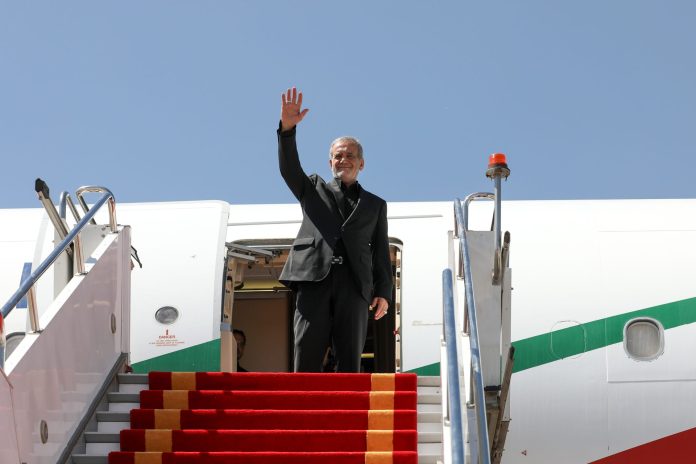
Iran president arrives in China for SCO summit