Monday, December 29, 2025
Home Blog Page 164

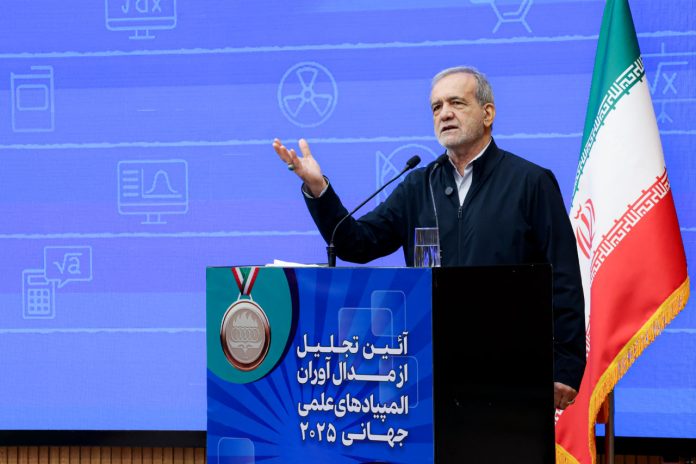
Iran’s President stresses BRICS’ role in countering unilateralism

In the extraordinary meeting of BRICS leaders, which was held on Monday virtually, the Iranian president argued that unilateral policies not only jeopardize the national interests of independent nations but also disrupt global cooperation and hinder sustainable development.

Pezeshkian stressed the urgent need for a serious overhaul of global governance structures. He called for a reevaluation of the United Nations Security Council’s composition and functionality, as well as reforms in the international financial system.

He emphasized that groups like BRICS and other Global South institutions bear a special responsibility in guiding the transition to a multipolar, democratic, and equitable order where the voices of developing countries are heard.

Pezeshkian pointed out the recent geopolitical tensions and the growing impact of climate change as factors threatening economic growth and international peace.

He criticized the disproportionate influence of a few powerful nations and the politicization of economic tools, which erode trust among countries and undermine effective global governance.

The president proposed several initiatives for BRICS during his virtual speech. The initiatives include reforming international financial structure, promoting inclusive multilateralism by strengthening the UN to amplify the voices of developing nations, ensuring equitable access to essential resources through global public goods cooperation, establishing a support mechanism for members facing illegal sanctions, and fostering sustainable development by encouraging innovation and cooperation in green and digital economies.

Pezeshkian reaffirmed Iran’s commitment to active collaboration within BRICS, emphasizing that effective countermeasures against unilateralism would benefit not only member nations but the entire international community.

He concluded by stressing the importance of strengthening multilateralism and adhering to sustainable development principles for a better future.

New sanctions won’t force Russia to change course: Moscow

Kremlin

“No sanctions will be able to force the Russian Federation to change the consistent position that our president has repeatedly spoken about,” Kremlin spokesperson Dmitry Peskov told a Russian state media reporter.

The comments come as the European Union is preparing a 19th package of sanctions targeting Russian banks and the energy sector, Bloomberg reported. U.S. President Donald Trump has also repeatedly threatened to implement secondary sanction on Russian oil if Moscow’s invasion continues, although he has yet to do so.

Peskov further claimed that sanction “turned out to be absolutely useless in terms of exerting pressure on Russia.”

Despite Peskov’s claims, sanction have undeniably played an impact on Russia’s economic fortunes, vastly limiting the country’s trade with international partners, and weakening the country’s ability to sell oil to fuel the country’s war machine.

Following an initial economic surge led by the country’s defense industry following the start of Russia’s full-scale invasion, Russia’s economy has continued to face uncertainty amid high inflation, slowed economic growth, and near-record interest rates.

Despite the challenges faced by Russia’s economy, Moscow has shown no indication it is ready to halt its war in Ukraine. Russian President Vladimir Putin has repeatedly repeatedly refused to attend an in-person meeting with President Volodymyr Zelensky, brokered by U.S. President Donald Trump.

4 Israeli soldiers killed in fighting in Gaza

Israeli Army

The four dead soldiers served in the 401st Armored Brigade’s 52nd Battalion, a military statement read.

According to the Yedioth Ahronoth daily newspaper, the four were killed in a Hamas attack on a fortified position in Gaza City.

The new deaths brought the number of Israeli soldiers killed in Gaza since October 2023 to 904, military figures showed.

Authorities responsible for Iran’s Shahid Rajaee Port explosion declared

Gholamhossein Mohseni Ejei described the incident as tragic, adding that significant progress has been made over the past four months in dealing with the aftermath.

He said measures include crisis management, reopening the port, judicial investigation, support for victims’ families, and compensation for injuries.

Following the incident, 5 certified experts launched an investigation and issued a report on the explosion.

The report cites multiple contributing factors, including improper storage of hazardous materials, insufficient environmental controls, and putting economic considerations above safety requirements. It also identified 21 responsible entities.

They include the Ports and Maritime Organization of Hormozgan Province, importers and exporters, Iran Customs, the Central Bank, Ministry of Health, and Ministry of Roads and Urban Development.

The report underlined the need for strict international regulation compliance and a proactive safety culture to prevent future disasters. The May 31, 2024 explosion at Shahid Rajaee Port killed some 60 people and injured 1,000.

Shooting in East Jerusalem kills at least six

Paramedics said at least 12 people were injured and six were in “serious condition” after the shooting on Monday morning at Ramot Junction. Several others were “lightly injured by glass” and treated at the scene, Israel’s paramedic service, Magen David Adom, added.

Israeli police described the shooting as a suspected “terror attack”.

“A security officer and a civilian” shot and killed the perpetrators soon after the shooting began, police confirmed.

The police said the perpetrators arrived in a vehicle and opened fire at a bus station.

Israeli forces closed all checkpoints between East Jerusalem and the occupied West Bank after the attack.

The Israeli military said it had reinforced its forces in the wider Jerusalem area and was conducting a wide-ranging search for what it described as “accomplices” in the shooting.

In reaction to the shooting, the Palestinian Authority (PA) has “reiterated its firm position of rejecting and condemning any targeting of Palestinian and Israeli civilians”. Its presidential office said in a statement from Ramallah in the occupied West Bank that the PA denounces “all forms of violence and terrorism regardless of their source”.

Neither Hamas nor the Palestinian Islamic Jihad has claimed responsibility for the shooting but have expressed “congratulations” for the attack.

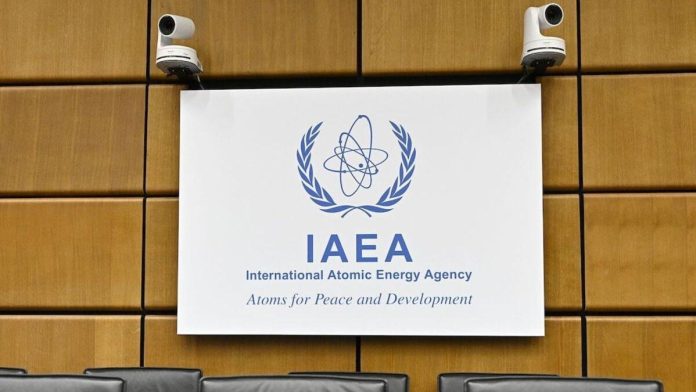
IAEA head notes progress in Iran talks over nuclear site inspections

On Monday, the director general of the United Nations nuclear watchdog, Rafael Grossi, told the 35-nation IAEA Board of Governors in Vienna, Austria, that “Progress has been made”.

“It is my sincere hope that within the next few days it will be possible to come to a successful conclusion of these discussions,” Grossi said, adding: “There is still time, but not much.”

He did not elaborate on what the timeframe meant exactly.

While Tehran allowed inspectors from the IAEA into Iran at the end of August, the Ministry of Foreign Affairs announced no agreement had been reached on the resumption of full cooperation with the watchdog.

Following a 12-day war, which saw Israel and the United States bomb cities across Iran, as well as Fordo, Natanz and Isfahan nuclear facilities, in June, Tehran decided to change its collaboration with the IAEA.

Iran expressed anger at the IAEA for paving the way for Israel’s attack by censuring the country the day before Israel struck with a damning report in May that declared that Tehran was in breach of the Treaty on the Non-Proliferation of Nuclear Weapons (NPT).

Fury then followed when the watchdog did not condemn Israeli or US attacks. In July, Iran passed a law suspending cooperation with the agency.

Within the law, any future inspection of its nuclear sites needs approval by Iran’s Supreme National Security Council.

However, last week, Grossi told the Reuters news agency in an interview that the board was pushing for a deal to inspect Iranian sites, including those targeted by Israel and the US.

Grossi confirmed that the IAEA had no information from Iran on the status or whereabouts of its stock of highly enriched uranium since Israel’s attacks on June 13.

“I believe there is a general understanding that by and large, the material is still there. But, of course, it needs to be verified. Some could have been lost,” he stated.

“We don’t have indications that would lead us to believe that there has been major movement of material,” Grossi added.

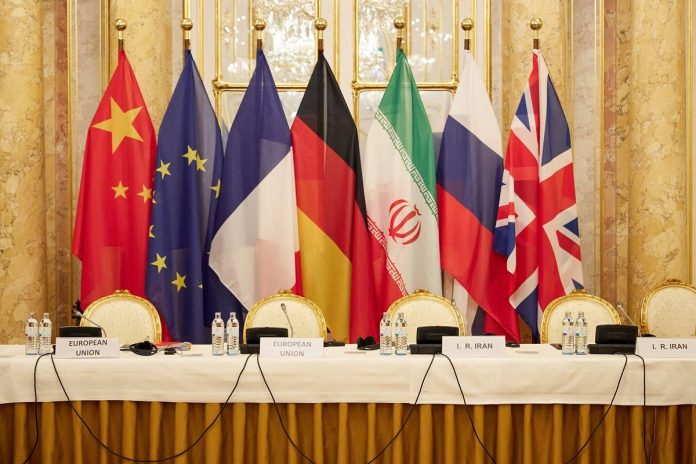
Late last month, France, Germany and the United Kingdom triggered a mechanism to reimpose sanctions on Iran after a series of meetings failed to reach an agreement on the Iranian nuclear programme.

The three European countries, known as the E3, had been warning Tehran for weeks that UN sanctions could be reimposed by October when a 2015 nuclear agreement between Tehran and major powers expires.

Iran signals change in IAEA safeguards commitment after war: Spokesman

Speaking at a weekly press conference on Monday, Esmaeil Baqaei commented on a recent IAEA report and claims made by Director General Rafael Grossi.

“We have reviewed the report and will communicate our positions to the IAEA and its Board of Governors through an official note,” he said, noting that Iran expected a fair assessment taking into account the June attacks on its nuclear sites.

Baqaei described the Israeli strikes as severe enough to warrant detailed coverage from the International Atomic Energy Agency to prevent future repetitions.

He stressed that the IAEA has now recognized that Iran’s safeguards obligations cannot be implemented in the same way as before the Israeli and US military attacks.

“This is a unique situation, and no inspection protocols existed for these circumstances. The Agency understands that Iran’s perspectives must be taken into account,” he added.

The spokesperson said that this understanding has been discussed during three rounds of negotiations in Tehran and Vienna. While final conclusions have not yet been reached, he described the process as positive, emphasizing that Iranian negotiators have considered field realities, parliamentary law, and guidance from the Supreme National Security Council.

He added that Iran is now awaiting the finalization of the new framework for its cooperation with the IAEA.

On September 3, Iranian Foreign Minister Abbas Araqchi said Tehran will not provide any new cooperation with the IAEA before the conclusion of negotiations.

“In view of these developments, how and under what framework Iran and the IAEA should cooperate is a matter under negotiation, and in fact, the Agency itself has agreed that new developments require a new framework of cooperation,” Araqchi said.

“No new cooperation will be there until the negotiations are concluded,” he stressed.

The foreign minister added that Iran “will do everything” to prevent the re-imposition of UN sanctions under the snapback mechanism.

EU asylum applications decrease 23% with huge drop in Syrian requests in 2025

Migrants

Syrians, who had been the largest group of asylum seekers in the past decade, sharply dropped to fourth place in May, the EUAA found.

“Monthly Syrian asylum applications fell from roughly 16,000 in October 2024 to just 3,100 in May 2025, a steep fivefold decrease in just seven months,” the agency said on Monday.

“This downturn, the like of which has not been seen since the initial wave of COVID-19 … is likely not due to any asylum policy changes in the EU+,” it added, referring to all 27 members of the bloc, as well as Switzerland and Norway.

Since al-Assad’s ouster, the interim Syrian authorities have pushed a platform of stability and reconstruction for the war-ravaged society.

Though the fledgling government of President Ahmed al-Sharaa has contended with eruptions of violence in Suwayda in southern Syria and Israeli attacks, there is newfound hope, leading to an increasing number of Syrians making the journey to return to their country.

According to the United Nations Refugee Agency (UNHCR), as of mid-May, “more than 500,000 Syrians are estimated to have crossed back into Syria since the fall of the Assad government”.

At the height of the ruinous civil war, an exodus of millions of Syrians fled to neighbouring countries and more than a million to Europe.

With Syrians no longer being the largest application group for the EU, Venezuelans have now emerged as the largest asylum seekers.

According to the report, the rise of applications from Venezuela is driven by multiple factors, including a “severe economic and political crisis” and evolving United States immigration policies, which could change migration movements.

In the first six months of the year, the second-highest applicant group was asylum seekers from Afghanistan.

For applications to specific destinations, Germany, which had once been the leading destination for asylum seekers, has been receiving fewer applications than Spain, Italy and France.

Overall, EU+ countries received 399,000 asylum applications in the first six months of this year.

Israel depriving Palestinian prisoners of food: Supreme Court

Israel Prison

The three-judge panel, which has so far mostly refrained from taking any action against the government or military during 23 months of war on besieged and relentlessly bombarded Gaza, deliberated on the issue based on a request from two Israeli rights groups.

It ruled unanimously on Sunday that the Israeli government had a legal duty to provide Palestinian prisoners with three meals a day to ensure “a basic level of existence” and ordered authorities to fulfil that obligation.

In a two-to-one decision, the court furthermore accepted the petition filed last year by the Association for Civil Rights in Israel (ACRI) and Gisha, siding with their allegations that the government’s deliberate restriction of prisoners’ food in Israeli detention facilities has caused Palestinians to suffer malnutrition and starvation.

Palestinians in Gaza are meanwhile suffering an Israeli-induced famine, with daily deaths from malnutrition.

“We are not speaking here of comfortable living or luxury, but of the basic conditions of survival as required by law,” the ruling said.

“Let us not share in the ways of our worst enemies.”

The Israeli army has taken thousands of Palestinians from Gaza and the occupied West Bank since the start of the nearly two-year war, significantly ramping up its arbitrary detention of people based on suspicions of “terrorism”.

Countless prisoners who have been released have described brutal conditions in Israeli military detention, including torture and abuse, starvation, lack of medical attention, overcrowding, and diseases.

ACRI, one of the two organisations that brought the case forward, announced its staff were subjected to “a barrage of harassment, verbal abuse and intimidation” from senior members of the Israeli government and far-right Knesset members during the Supreme Court hearings.

“The outbursts began to seem less like a show of power and intimidation and more like lashing out in desperation,” it said in a statement in late July, when the hearings began.

A main figure fighting their case was Itamar Ben-Gvir, the far-right national security minister of Prime Minister Benjamin Netanyahu, who leads a small religion-based party and heads the police and other armed forces.

Ben-Gvir attacked the Supreme Court judges following the ruling, saying they are not favouring Israel.

“Our hostages in Gaza have no Supreme Court to protect them,” he wrote in a post on X, suggesting that Palestinians now have a Supreme Court that protects them, which they do not.

“We will continue to provide the imprisoned terrorists in jails with the minimum conditions required by law,” he continued.

Last month, Ben-Gvir visited the jail cell of long-imprisoned Fatah leader Marwan Barghouti and was filmed taunting him in an effort to further dishearten thousands held in Israeli prisons, drawing condemnation from Palestinians and rights groups.

Trump says an agreement on Gaza could come soon, issues ‘last warning’ to Hamas

Gaza War

Trump made the comments to reporters on Sunday after arriving in Washington, DC, following a brief trip to New York.

“We’re working on a solution that may be very good,” he said, describing Israel’s ongoing war on Gaza and Hamas’s holding of dozens of Israeli captives as a “hell of a problem”.

“It’s a problem we want to solve for the Middle East, for Israel, for everybody. But it’s a problem we’re going to get done,” he stated.

“You’ll be hearing about it pretty soon. We’re trying to get it ended, get the hostages back,” he added.

Earlier on Sunday, Trump said he had put forward a new proposal to end the war in Gaza, saying that Israel had accepted his terms. He went on to warn Hamas to accept his conditions, saying that he informed the group about the “consequences” of turning down the offer.

Throughout the 23-month war, US officials have repeatedly claimed that Israel has accepted ceasefire efforts, even as Israeli leaders continued to publicly pledge to intensify their offensive, which leading rights groups and scholars have described as a genocide.

“Everyone wants the Hostages HOME. Everyone wants this War to end!” Trump wrote on his Truth Social platform.

“The Israelis have accepted my Terms. It is time for Hamas to accept as well. I have warned Hamas about the consequences of not accepting. This is my last warning, there will not be another one!” he added.

It remains unclear what Trump’s terms entail.

The US president has previously issued similar verbal warnings to Hamas and predicted that the war would end soon. Most recently, on August 25, Trump stated he thought the war would come to a “conclusive ending” within three weeks.

There was no immediate comment from Israel on Trump’s latest offer.

But The Times of Israel, citing a source close to Israeli Prime Minister Benjamin Netanyahu, said the Israeli government was “seriously considering” the proposal.

For its part, Hamas confirmed receiving “ideas” from the US for ending the war.

“Hamas welcomes any initiative that helps in the efforts to stop the aggression against our people,” the group said.

“We affirm our immediate readiness to sit at the negotiation table to discuss the release of all prisoners in exchange for a clear declaration to end the war, the full withdrawal from Gaza, and the formation of a committee to manage Gaza from Palestinian independents, who will immediately begin their work,” it added.

The Palestinian group is thought to be holding some 50 captives, of whom 20 are still believed to be alive.

Trump told reporters on Sunday that he thought all the captives would be returned, saying, “I think we’re going to get them all.”

He noted that some may already have died, but the aim would be to have their bodies returned.

Hamas has previously announced it was willing to release all of the captives in one go in exchange for an end to the war and the withdrawal of Israeli troops from Gaza.

According to Israeli media, Trump’s latest offer requires Hamas to free all the remaining captives on the first day of the truce in exchange for thousands of Palestinian prisoners jailed in Israel.

Israel would also call off its large-scale offensive in Gaza City, while negotiations to end the war would begin under the personal oversight of Trump, The Times of Israel reported.

Trump’s proposal comes as Israel steps up its campaign to capture Gaza City against the pleas of rights groups and Western officials.

The US president has been a staunch supporter of Israel. Last week, his administration imposed sanctions on Palestinian rights groups for cooperating with the International Criminal Court’s investigation into Israeli abuses.

Trump also previously called for removing all Palestinians from Gaza and turning the enclave into a US-owned “Riviera of the Middle East” – a plan that rights advocates decried as an ethnic cleansing push.

Netanyahu has embraced Trump’s mass displacement proposal, presenting the push to ethnically cleanse Gaza as an effort to allow Palestinians to voluntarily leave the territory.

But legal scholars say that people have no real choice when they are under the threat of constant Israeli bombardment.

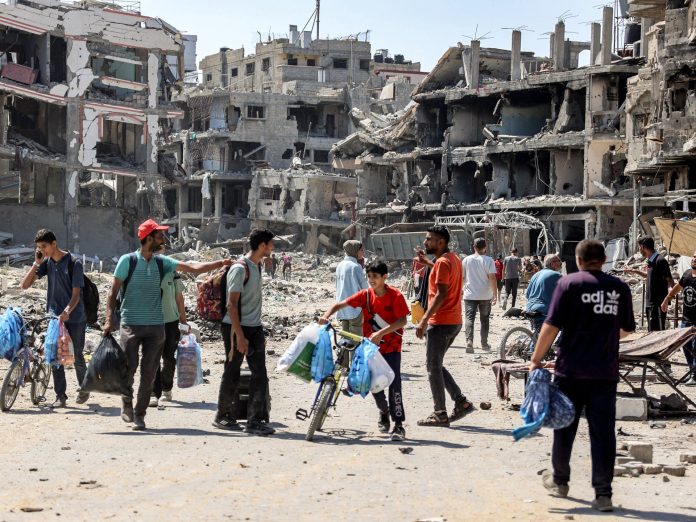
The Israeli campaign has killed more than 64,000 Palestinians, triggered a man-made famine and levelled most of the territory to the ground.