G7 to hold $60 price cap on Russian oil
The Group of Seven (G7) coalition will keep a $60 per barrel price cap on seaborne Russian oil, despite calls to lower the amount, a coalition official said.
The G7 and Australia made the decision to maintain the cap over the past few weeks after a review of the $60 price, the official told the Reuters news agency anonymously.
The decision comes after four weeks of gains in benchmark oil prices, helped by an output cut announced by OPEC+.
On Monday, the market consolidated, with Brent and US crude futures holding above $80 per barrel.
Russian crude has been selling at a discount of around $30 to Brent, the official stated.
Foreign ministers from Iraq and Ukraine discuss war and trade
Iraqi Foreign Minister Fuad Hussein has discussed the latest developments in Ukraine with his Ukrainian counterpart, Dmytro Kuleba, who is visiting Baghdad.
The diplomats reviewed issues related to the region, the economic dimensions of the war and how to continue trade relations.
Hussein also stated that Iraq wants to be part of the solution to the conflict through dialogue.
Ukraine says Black Sea grain initiative ‘at risk of being shut down’
Ukraine’s restoration ministry announced that the Black Sea grain initiative was in danger of being shut down after Russia again blocked inspections of ships under the deal in Turkish waters.
The initiative allows the safe export of grain from some Ukrainian Black Sea ports following Russia’s invasion of Ukraine.
“For the second time in 9 months of operation of the Grain Initiative, an inspection plan has not been drawn up, and not a single vessel has been inspected. This threatens the functioning of the Grain Initiative,” the restoration ministry said on Facebook.
Russia claims Ukrainian forces struck Belgorod region
A village in Russia’s Belgorod region, on the border with Ukraine, was struck by Kyiv’s forces overnight, the regional governor has claimed.
“The village of Krasnoye, Shebekinsky urban district [of the Belgorod region], came under the fire by the Armed Forces of Ukraine,” Vyacheslav Gladkov said in a Telegram post Monday.
Local media reported that two drones dropped improvised explosive devices at the local thermal power plants, citing an anonymous source.
Gladkov added that there were no casualties, but that a hay store caught fire when a farm was hit.
Ukraine would not confirm its involvement in the incident.
“We will not confirm or deny [Ukraine’s involvement],” a representative of the Defense Intelligence of Ukraine, Andrii Yusov, said in comments broadcast on Ukrainian national television on Monday.
“I think that Russians should get used to the fact that while they are waging an unjust war of aggression, there are no safe places on their territory,” he added.
“The war has already come to the home of every Russo-fascist and every subject of the Russian regime,” he continued.
Kremlin says prospects for Black Sea grain deal ‘not bright’
The Kremlin has said that prospects for a renewal of the the Black Sea grain deal, in which Russia allows Ukraine to ship agricultural exports from its Black Sea ports via Turkey, were “not so bright”.
G7 foreign ministers “remain committed” to sanctions against Russia
Foreign ministers of the G7 nations “remain committed to intensifying, fully coordinating and enforcing sanctions against Russia,” as well as providing support for Ukraine, according to Japan’s foreign ministry.
G7 foreign ministers gathered Monday in the Japanese town of Karuizawa for three days of meetings ahead of next month’s summit in Hiroshima.
The group of ministers underscored that Russia “must withdraw all forces and equipment from Ukraine immediately and unconditionally,” according to a statement published Monday.
It also condemned Russian President Vladimir Putin’s announcement to deploy tactical nuclear weapons in Belarus, calling Russia’s “irresponsible” nuclear rhetoric “unacceptable.”
Russia attacks Bakhmut suburbs, heavy fighting continues inside city: Ukrainian military
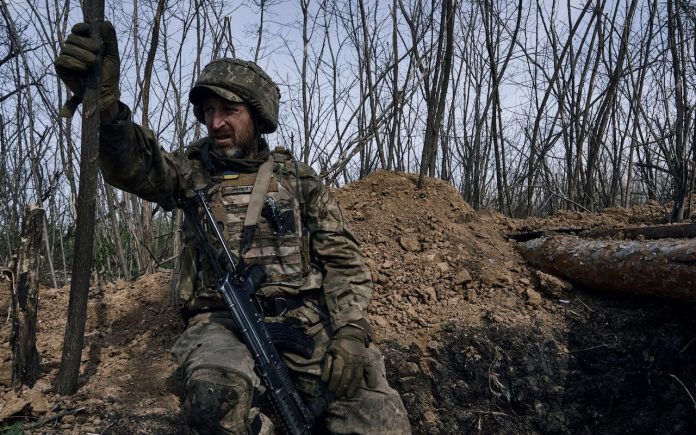
Russian forces have launched what the Ukrainian military said were “unsuccessful attacks” against the Bakhmut suburbs, as heavy fighting continues inside the embattled city.
“Heavy fighting is ongoing in Bakhmut,” the Ukrainian military’s General Staff said in an update on Monday morning.
“The enemy launched unsuccessful attacks in the vicinities of Khromove and Ivanivs’ke,” it added, referring to the suburbs around the outskirts of Bakhmut.
The move suggests an attempt by Moscow to encircle Ukrainian soldiers within Bakhmut. Despite claims Russian forces are advancing inside the city, footage geolocated by CNN on Monday shows Ukrainian fighters holding positions in central Bakhmut.
“Despite heavy losses the Russian Federation does not give up on plans to occupy our territory,” the General Staff said, adding, “The adversary continues to focus its main efforts on offensive actions on Lyman, Bakhmut, Avdiivka, and Mar’yinka axes.”
The eastern city of Bakhmut is currently the scene of the fiercest fighting between Russia and Ukraine’s troops. It has been rocked by heavy shelling and dozens of firefights in recent days as both militaries wage street-by-street — and even house-by-house — battle for control of the city, according to Serhii Cherevatyi, of the Eastern Grouping of the Ukrainian Armed Forces.
Slovakia sends 13 MiG-29 fighter jets to Ukraine
Slovakia has completed the transfer of its 13 MiG-29 fighter jets to Ukraine, the country’s Defense Minister, Jaroslav Nad’ stated on Monday.
Slovakia had already announced the transfer of four of the 13 aircraft back in March, after Ukrainian pilots traveled to the country and flew them into Ukraine. The remaining nine aircraft were shipped over land.
“This transfer was carried out by land, in order to maintain the highest levels of security,” Nad’ said on his official Facebook account, adding, “Huge thanks to all the forces involved in this important and demanding logistical operation.”
Nad’ went on to say the MiG-29 aircraft will be a significant support for Ukraine in its defense against Russia’s military aggression.
“We are doing the right thing,” he continued.
Death toll rises to 15 in Russian strikes on Sloviansk: Ukrainian official
The death toll from Friday’s Russian missile barrage on residential buildings in Sloviansk, Ukraine, has reached 15, according to a regional Ukrainian official.
A further 24 people were wounded in the strikes, up from the previously reported total of 22, Pavlo Kyrylenko, the head of the Donetsk region’s military administration, said in a Telegram post Sunday.
Kyrylenko added rescuers pulled five people, including a 14-year-old girl, from under the rubble. The bodies of 10 of the victims were recovered.
The strikes, which killed a 2-year-old boy, are among the worst attacks on Sloviansk since the year began.
At least eight explosions rocked the city Friday afternoon local time, as Russian forces targeted it with S-300 rockets, according to Sloviansk Mayor Vadym Liakh. The strikes hit apartment buildings, houses, administrative buildings and a schoolyard.
Russia is trying to deport Ukrainian children in occupied Zaporizhzhia region: Official
Russian forces are trying to remove children from their families in occupied southeast Ukraine in an effort to “intimidate people,” a Ukrainian military spokesperson claimed Sunday.
The warning from the official, Oleksii Dmytrashkivskyi, on Ukrainian national TV echoed claims from local Telegram groups in Enerhodar, a city in the occupied Zaporizhzhia region.
Users have shared unverified reports about children getting deported to Russian-occupied Crimea, using Zaporizhzhia nuclear power plant buses as transport.
The International Criminal Court (ICC) last month issued an arrest warrant for Russian official Maria Lvova-Belova and Russian President Vladimir Putin over an alleged scheme to deport Ukrainian children to Russia.
The Ukrainian presidential office recently estimated the total number of Ukrainian children forcibly removed from their homes is at least 20,000. Thousands of cases are already under investigation, Kyiv has announced.
On Monday, authorities in Ukraine’s southern Kherson region said 24 more children have returned home after being taken to Russian territory. Others have recently returned to parents in the Kharkiv and Zaporizhzhia regions.
Putin met with Chinese DM in Moscow
Russian President Vladimir Putin met with Chinese Defense Minister Li Shangfu in Moscow on Sunday, with both sides hailing their close military cooperation, according to the Kremlin.
Putin stated that Chinese President Xi Jinping’s recent visit to Russia was “very productive,” and relations between Russia and China are developing well in all areas, the Kremlin announced.
️Russia said Putin used the meeting to highlight military cooperation as a key area of strength between the two countries.
In his first overseas trip since becoming defense minister, Li said Moscow and Beijing “have very strong relations, that far surpass the military-political alliances of the Cold War,” according to the Kremlin statement.
Russian Defense Minister Sergei Shoigu was also present at the meeting.
The latest diplomatic sit-down between Russian and Chinese officials comes at a time of increased Western scrutiny about the two governments’ relationship — and how it plays into the war in Ukraine.
Putin and Xi posed as peacebrokers during a friendly visit in Moscow last month, but the Chinese leader’s proposals on ending the conflict in Ukraine include no provision that Moscow withdraw its troops from Ukrainian land, and was drawn up without any involvement from Kyiv.
While China and Russia have strengthened ties in recent months, the US has not seen evidence that China has provided systemic material support to the Kremlin, as Putin looks for avenues to evade Western sanctions and backfill its military, according to senior US Treasury officials.
Ukraine FM to visit Iraq on Monday
Ukraine’s Foreign Minister Dmytro Kuleba is expected in Baghdad on Monday on his first visit to Iraq since Russia invaded his country, the foreign ministry said.
Kuleba is due to hold talks with Iraqi Foreign Minister Fuad Hussein as well as Prime Minister Mohamed Shia al-Sudani, the ministry added.
They will discuss “bolstering bilateral ties, as well as regional and international” issues, said the statement quoting foreign ministry spokesman Ahmed al-Sahhaf.
Kuleba’s visit comes less than a week after Sudani received a phone call from Ukrainian President Volodymyr Zelensky.
Hungary and Poland’s bans on Ukrainian grain are unacceptable: EU Commission
The European Commission denounced a decision by Poland and Hungary to ban imports of grain and other agricultural products from Ukraine.
“Unilateral actions are not acceptable. In such challenging times, it is crucial to coordinate and align all decisions within the EU,” EU Commission spokesperson Arianna Podestà told CNN in a statement Sunday.
Podestà stated that trade policy is an “exclusive competence” issue, referring to the alliance’s policies around decisions that must be made as a group, and not by individual member states.
The commission is requesting more information from the involved countries to assess the measures, the spokesperson added.
On Saturday, Poland banned imports of grain and other food products from Ukraine “to protect the Polish agricultural market against destabilization,” the Polish prime minister’s office said in a statement.
Hungarian Agriculture Minister István Nagy announced Sunday that Budapest would take similar steps, temporarily banning the import of grain, oil seeds and other agricultural products from Ukraine.
“The government is committed to representing the interests of the Hungarian economic society,” Nagy said in a Facebook post Sunday, adding he was taking the step “in the absence of meaningful EU measures.”
When Russia invaded Ukraine, it blocked ports and sea routes used to export Ukrainian grain to Africa and the Middle East. Fearing widespread famine, the European Union lifted duties on grain from Ukraine to ease distribution to those global markets.
Ukrainian grain has since flowed into Poland, but much of it has remained in the country, bringing down the price and causing Polish farmers to suffer significant financial losses.
That’s spurred protests and calls for the European Commission — effectively the EU’s cabinet government — to intervene. But the international body only spurred further anger when it announced a draft decision to extend duty-free and quota-free imports of Ukrainian grain until June 2024.
Russia should pay for Ukraine’s reconstruction: US
Washington believes Russia should cover the cost of Ukraine’s reconstruction, US Treasury Secretary Janet Yellen told CNN on Saturday.
The US is discussing potential ways to use Russian assets frozen in the West but still admits there are certain legal restrictions on what can be done with them, she admitted.
When asked about whether Russia should pay for the “damage” done to Ukraine over the course of the ongoing conflict between Kiev and Moscow, Yellen replied that it was “a responsibility that I think the global community expects Russia to bear.”
“This is something we’re discussing with our partners,” she added, pointing out that “there are legal constraints on what we can do with frozen Russian assets.”
The treasury secretary did not elaborate on what the US or its allies could potentially do to Moscow’s assets while remaining within those constraints.
Yellen’s comment came just days after Victoria Nuland, the US Under Secretary of State for Political Affairs, said that Washington was working on making Moscow help pay for “all that it has broken.”
According to Nuland, the US Congress granted the Justice Department authority to use “illicit assets seized from Russian oligarchs” to help rebuild Ukraine.
“Discussions” were ongoing between Washington and its allies about the Russian central-bank assets as well, she stated at that time.
Western nations have frozen an estimated total of $300 billion of these assets since the start of the conflict between Moscow and Kiev.