Thursday, December 25, 2025
Home Blog Page 1440

Iran says necessary preparations made for re-opening of missions in Saudi Arabia

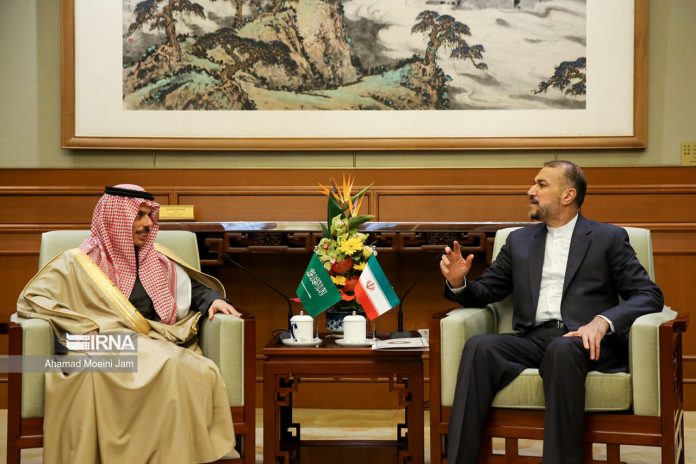
Hossein Amirabdollahian and Prince Faisal bin Farhan Al Saud

Hossein Amirabdollahian made the comments in a phone conversation with his Saudi counterpart Faisal bin Farhan Al Saud.

The two top diplomats exchanged views on the latest situation of the agreements reached between the two states in Beijing, China.

Amirabdollahian expressed satisfaction with the progress of the agreements between Iran and Saudi Arabia, including the meeting of the foreign ministers of the two countries, the announcement of the resumption of relations, the dispatch of technical teams to reopen the embassies and consulates of the two countries, and also the introduction of ambassadors.

The Islamic republic of Iran, he added, has made the necessary preparations for the official opening of its political and consular mission in Saudi Arabia.

He said the schedule of the visit of officials and foreign ministers of the two countries to each other’s capitals is a sign of the determination of the parties to cooperate and forge appropriate relations.

For his part, the top Saudi diplomat stressed Riyadh’s positive view on the future of relations between the two countries and efforts to develop and strengthen bilateral sides.

He said: In the past two months we have taken good steps, and our adherence to the agreements shows our serious determination.

He expressed hope that the ambassadors of the two countries will be able to facilitate cooperation between the two countries when they are settled in the locations of their diplomatic posting.

Live Update: Russia’s “Special Operation” in Ukraine; Day 444

Russia Ukraine War

Zelensky arrives in Rome for meetings with Italian PM and Pope Francis

Ukrainian President Volodymyr Zelensky has arrived in Rome on Saturday, where he is expected to meet with his Italian counterpart, Italy’s PM and Pope Francis, his Chief of Staff Andriy Yermak said on Telegram.

“Together with President Volodymyr Zelensky and his team, we are now in Rome,” Yermak said.

Zelensky also posted on Telegram on Saturday, “Rome. Meetings with Italian President Sergio Mattarella, Prime Minister Giorgia Meloni, and Pope Francis. An important visit for Ukraine’s victory.”

Zelensky is expected to meet with Italian President Sergio Mattarella, as well as Prime Minister Giorgia Meloni and Pope Francis on Saturday.


Germany to supply Ukraine with aid package worth nearly $3 billion

Germany announced on Saturday that it would supply Ukraine with an aid package worth nearly $3 billion (2.7 million euros) to strengthen the country’s defense.

It marks the largest German military aid package to Ukraine since the start of the war.

The German Ministry of Defence said in a statement that the package may include a variety of military hardware, such as 20 Marder armoured personnel carriers, 30 Leopard tanks, 4 IRIS-T-SLM firing units, over 200 reconnaissance drones and ammunition.

“With this valuable contribution of urgently needed military material, we are once again showing that Germany is serious about its support,” Germany’s Defense Minister Boris Pistorius was quoted saying in the statement.

“We all wish for a speedy end to this terrible war waged by Russia against the Ukrainian people, which is contrary to international law. Unfortunately, this is not yet in sight. Germany will therefore provide all the help it can – as long as it takes,” Pistorius added.

Ukraine President’s Chief of Staff, Andriy Yermak, confirmed Germany’s support on Saturday via his Telegram account while thanking them for their aid.

“We thank our allies. Working more,” Yermak stated.

Germany’s announcement comes after the US on Tuesday announced a $1.2 billion aid package to Ukraine intended to “bolster its air defenses” and “sustain its artillery ammunition needs,” with Ukraine’s counteroffensive against Russian forces looming.

Germany’s military support for Ukraine has evolved over time. The country initially resisted calls to provide weaponry to Kyiv, agreeing only to provide humanitarian help and medical equipment. That approach was in line with Germany’s decades-long policy of not supplying lethal weapons to crisis zone.

In a major policy U-turn earlier this year, Berlin announced it would provide Kyiv with Leopard 2 battle tanks. Then in April, Berlin also committed to sending Gepard anti-aircraft systems.


G7 to counter Russia’s attempts to evade sanctions, support Ukraine “as long as it takes”

G7 countries intend to counter any attempts by Russia to evade sanctions imposed over the situation around Ukraine, as well as to support Ukraine as long as it is necessary, according to a joint statement adopted on Saturday following the meeting of member states’ finance ministers and central bank governors in the Japanese city of Niigata.

“We remain committed to countering any attempts to evade and undermine our sanction measures. <…> Going forward, we will continue to strengthen coordination in monitoring cross-border transactions between Russia and other countries, take further action directed at the Russian financial sector as necessary, and closely monitor the effectiveness of the price caps on Russian crude oil and petroleum products to ensure the measure delivers on its objectives, and take any necessary and appropriate enforcement actions required,” the statement reads.

“We reiterate our unwavering support for Ukraine for as long as it takes,” according to the statement.

G7 nations called on other countries to join measures against Russia and efforts to bolster their enforcement, adding that they will also ensure Russia’s sovereign assets in their jurisdictions remain immobilized until the Ukrainian conflict is resolved.


Zelensky introduces new package of sanctions against Russian companies, including airlines

Ukrainian President Volodymyr Zelensky imposed new sanctions against Russian enterprises on Friday, he wrote in his Telegram channel.

“Today brings another round of sanctions. With my decree, I put restrictive measures on the property of Russian companies in Ukraine, as well as the property of Ukrainian economic entities affiliated with them,” he wrote.

At the same time, he underlined that the package of sanctions included companies linked to Ukrainian opposition figure Viktor Medvedchuk as well as other sanctioned individuals – “founders, managers, and beneficiaries of pro-Russian companies with significant assets in Ukraine.”

According to Zelensky’s decree, which was published on the official website, sanctions were imposed for a term of ten years on 212 legal entities and 37 individuals – nationals of the Russian Federation, Ukraine, the United Kingdom, Germany, Cyprus, and Latvia.


Russian forces trying to regain lost ground in Bakhmut: Ukrainian officer

Battles are continuing in and around Bakhmut, the Ukrainian military stated Friday, with Russian forces apparently trying to regain some of the ground they lost this week.

“The enemy is trying to regain the positions lost during our assault,” Maksym Zhorin, a Ukrainian officer in Bakhmut, said in a video.

“Day and night, we have to consolidate and hold new positions in intense fighting,” Zhorin continued, adding, “There is still a very long way to go to victory.”

As for ground assaults, the military reported 36 Russian attacks concentrated on areas of the front lines in the Donetsk region. The attacks were repelled, and there is little evidence of any ground changing hands outside of Bakhmut, it announced.

“Incessant fighting continues in the town of Bakhmut,” the General Staff said, adding, “In addition, during the day, the enemy conducted unsuccessful offensive actions in the direction of Orikhovo-Vasylivka, Hryhorivka and Stupochki.”

The General Staff did not provide details on reports that Russia withdrew from some positions north of Bakhmut, as reported by Yevgeny Prigozhin, the head of the Wagner mercenary group.

Social media video appeared to show Russian soldiers retreating in the face of Ukrainian shelling in the area, some 5 kilometers north of the city.

Prigozhin stated later on Friday that his fighters had taken some ground in the city itself, where most Wagner fighters now appear to be concentrated.

Top Palestinian commander killed in Israeli strike on Gaza

Israel Gaza

One of the people killed in Friday’s air raid on an apartment was a senior leader of the Palestinian Islamic Jihad group (PIJ), identified as Iyad al-Hassani, local media reported.

It brought the total number of Palestinians killed in this week’s bombardment to at least 33, including several children, with more than 110 also wounded.

The latest strike targeted a six-storey building in the densely populated al-Nasr neighbourhood. Israel targeted a residential apartment which destroyed at least three floors of the building. Civil defence teams evacuated at least 10 people who have been critically injured.

Hundreds of rockets have also been launched from the besieged enclave towards Israel, with a 70-year-old killed in central Israel. The Israeli Army has announced so far nearly 1,000 rockets have been fired from the Gaza Strip.

Jennifer Austin, director of operations in the Gaza field office for the UN refugee agency (UNRWA), said the humanitarian situation is “already dire”.

“It’s a really bad situation coming off of 15 years of … an economic and social blockade,” Austin told Al Jazeera.

“The people here are not very hopeful … they’re at the end of their coping mechanisms,” she added.

Despite days of bombardment, UNRWA has been continuing their food distribution programme, as well as sanitation in the camps, Austin said. The agency’s 22 health centres are also till operating.

Israeli Prime Minister Benjamin Netanyahu met army and intelligence officials early on Friday.

The cross-border exchanges this week have pitted Israel against Islamic Jihad, the second-largest armed group in Gaza after the territory’s Hamas rulers.

Meanwhile, Egypt, Qatar and the United Nations have been working to broker a ceasefire.

Hamas officials told local media on Friday that Egypt was ramping up its diplomatic efforts to stop the fighting through “intensive contacts” with both Hamas and Islamic Jihad.

Senior official Ihasan Attaya complained on Friday that the mediators “have been unable to provide us with any guarantees”. A sticking point has been Islamic Jihad’s demands that Israel cease its policy of targeted killings, Attaya said.

This week’s battles began on Tuesday when Israel launched simultaneous air raids that killed three Islamic Jihad commanders along with at least 10 civilians – some of their wives, children and neighbours – as they slept in their homes.

Ankara accuses US of meddling in Turkey’s presidential vote

Turkey’s presidential Election
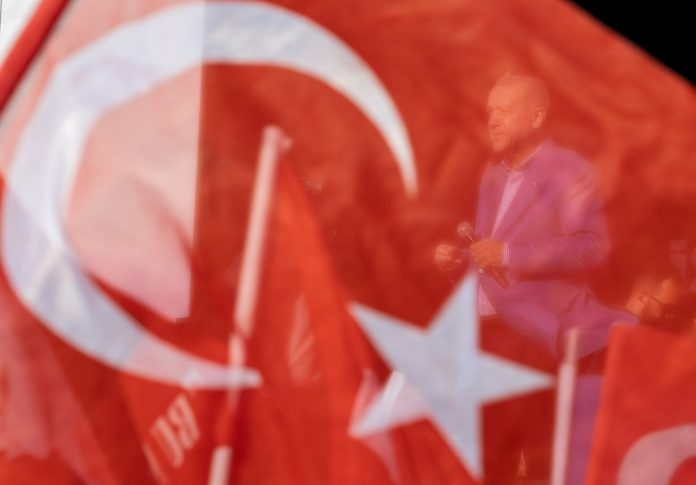
Turkish President Tayyip Erdogan addresses his supporters during a rally ahead of the May 14 presidential and parliamentary elections in Istanbul, Turkey, May 7, 2023.

According to Star daily, the statement by Turkey’s top cop followed the announcement that Homeland Party leader Muharrem Ince would be dropping out of the country’s tightly contested presidential race.

“The United States regularly interferes in elections in Turkey, resorting to various methods, including through the use of so-called tape conspiracies [fabricated videos]. What has Muharrem Ince done to them? They have no shame at all,” the newspaper quoted Soylu as saying.

According to Soylu, “US President Joe Biden stands” behind all such actions aimed against Turkey.

“It’s he who claims that if they failed [to oust President Recep Tayyip Erdogan] by means of a coup, then they will do it by meddling in the electoral process,” the Turkish minister emphasized.

Ince, head of the Homeland Party, said on May 11 that he was withdrawing from the race. Ince cited inappropriate and unnecessary pressure that was being put on him through various provocations, accusations and disinformation as the reason behind his decision to withdraw his candidacy.

Soylu announced earlier this month that the United States was carrying out a plan to oust incumbent President Erdogan during the upcoming May 14 presidential election as an act of revenge for the failure of the coup attempt against Erdogan in 2016.

In an interview with Turkish daily Haberturk on May 3, Soylu stated: “We know that the United States was behind the coup attempt in Turkey and they want revenge for the failure of the coup. We also know that they want to take revenge on Erdogan for destroying the system of power that the US had built [in Turkey] since the 1960s.”

Three candidates are currently vying for the top office in Turkey’s first round presidential vote to take place this Sunday. They are Erdogan, his main rival Kemal Kilicdaroglu, who leads the Republican People’s Party, and ATA Alliance candidate Sinan Ogan. Turkey’s combined presidential and parliamentary elections will be held on Sunday, May 14.

Pakistani court grants 2-week bail to ex-PM Imran Khan

Imran Khan

A two-member bench of the Islamabad High Court on Friday granted bail to the country’s main opposition leader after his arrest by the National Accountability Bureau (NAB), an anti-corruption agency.

The chief of the Pakistan Tehreek-e-Insaf (PTI) party was arrested on Tuesday from the premises of the same court.

On Thursday evening, the Supreme Court declared Khan’s arrest “unlawful” and instructed authorities to present Khan before the Islamabad High Court on Friday.

Khan’s bail plea in the al-Qadir Trust case was scheduled to be heard on Friday morning, but it was delayed for nearly four hours with a prayer break in between.

The cricketer-turned-politician has been charged in more than 100 cases – including corruption, “terrorism” and blasphemy – since his removal from power last year in a parliamentary no-confidence vote.

The Al-Qadir Trust case concerns land that Khan and his wife Bushra Bibi bought from property tycoon Malik Riaz for their Al-Qadir University Trust to build an educational institute. The NAB has alleged that Khan’s PTI government struck a deal with Riaz in a quid pro quid arrangement in which it is accused of helping Riaz launder more than $239m while causing a loss to the national exchequer.

While waiting for the resumption of his high court hearing, Khan told reporters he had been “abducted” from the court premises on Tuesday.

“I was sitting in the high court. They had no reason to arrest me. I was abducted from here. And when I was taken away, only then I was shown the warrant for arrest,” the 70-year-old stated.

“Is this the rule of jungle? And the military abducted me. Where is the police? Where is the law? It almost seems like martial law has been declared here,” Khan added.

The PTI says peaceful protests will continue until its leader Khan reaches a safe place shortly after he was granted bail.

“All party organisations will offer funeral prayers in absentia for the martyrs in their respective areas this evening,” the PTI posted on Twitter.

Prime Minister Shehbaz Sharif has stated that the PTI leadership is trying to push the country, which is already facing a myriad of challenges, towards destruction.

“The horrible role PTI leadership has played in bringing Pakistan to the brink of destruction, it has become a big question mark for the country,” the PM remarked during a cabinet meeting.

Sharif added the protests over the past couple of days could not be called “constitutional and democratic”.

“This is terrorism and anti-nationalism which cannot be accepted under any circumstances,” he continued.

Sharif has criticised what it called an “extraordinary intervention” of the country’s Supreme Court chief justice in the matter of Khan’s arrest on Tuesday – which the court declared illegal on Thursday.

“This is a shameful stain on the forehead of justice,” Sharif said, calling the top court for its “double standards.”

Reacting to the Islamabad High Court’s decision to grant bail to Khan, Federal Interior Minister Rana Sanaullah says such a ruling had never been issued before.

“There is no precedent of such a verdict given to anybody. However, court orders will not be violated,” he stated, while speaking to a private news channel.

Sanaullah added the government will appeal to cancel Khan’s bail will give him no concessions.

Moreover, he said on the issue of internet restrictions in the country, saying the government had planned to shut it off for two to three days – but will consult Sharif on future steps to potentially restore it.

Khan’s arrest sparked deadly countrywide protests, which saw his supporters fight with police and paramilitary forces. Angry crowds in several cities stormed public and private buildings, including military installations, and set many of them on fire.

At least 11 people are reported to have been killed in this week’s protests and dozens injured. Authorities said they have made more than 2,500 arrests, including top PTI leaders.

To restore order, the government deployed the military in Islamabad as well as in Punjab and Khyber Pakhtunkhwa provinces – both strongholds of Khan’s party.

Mobile internet access has been down for days across the country to curb the protests while social media platforms such as YouTube, Facebook, Twitter and Instagram have been blocked on government orders.

The government on Thursday promised to rearrest Khan if he was provided relief by the Islamabad court.

“We will arrest him again. If he gets bail from the high court tomorrow [Friday], we will wait for the cancellation of bail and arrest him again,” Interior Minister Rana Sanaullah told a private TV channel.

French says gravely concerned over developments in Gaza

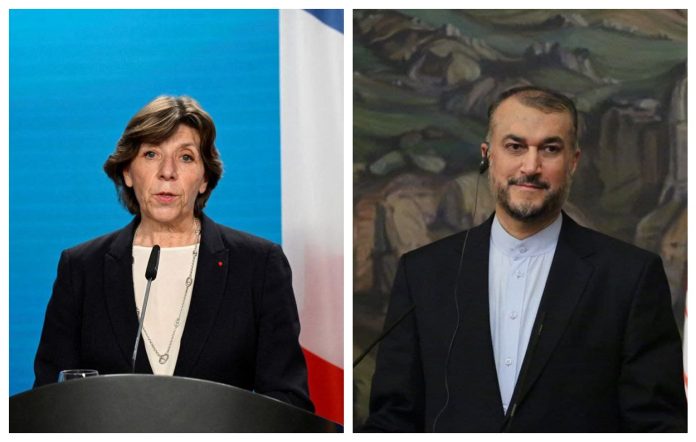
Iran and French FMs Hossein Amirabdollahian and Catherine Colonna

Catherine Colonna, in a phone conversation with her Iranian counterpart Hossein Amirabdollahian added France pursues the acceleration of efforts to decrease the tensions and stop the military conflict in Palestine.

Over the past few days, at least 30 Palestinians including women and children have been killed in Israeli air raids on the Gaza Strip
Colonna also expressed gratitude for Iran’s humanitarian move to free two French nationals and described it as an effective and trust-building step.

She expressed satisfaction with the fact that Iran pays attention to France’s desired policy of strategic autonomy and said constructive dialog is the best way to help resolve the problems.

In that regard, she added, France welcomes the continuation of constructive and deep talks between the two countries.

For his part, Iranian Minister of Foreign Affairs Hossein Amirabdollahian condemned the crimes of the Zionist regime in the Gaza Strip and said, “During my visit to Lebanon, I realized that the Palestinian resistance stands ready and determined to defend the rights of the Palestinian nation, and the developments in Palestine will definitely not be in the interest of the warmongering Zionist rulers.”

Commenting on Iran’s Islamic Revolution Guards Corps (IRGC), Amirabdollahian said, “The IRGC has an unrivaled role in safeguarding national security and countering Takfiri terrorism in the region. As the guardian of the country’s security, the IRGC is our red line.”

The top Iranian diplomat described France’s recourse to a realistic approach toward the Islamic Republic of Iran as a positive step.

Amirabdollahian referred to recent comments by the French president on the policy of strategic autonomy, saying practical efforts to realize such a strategy will be an effective step in today’s changing world.

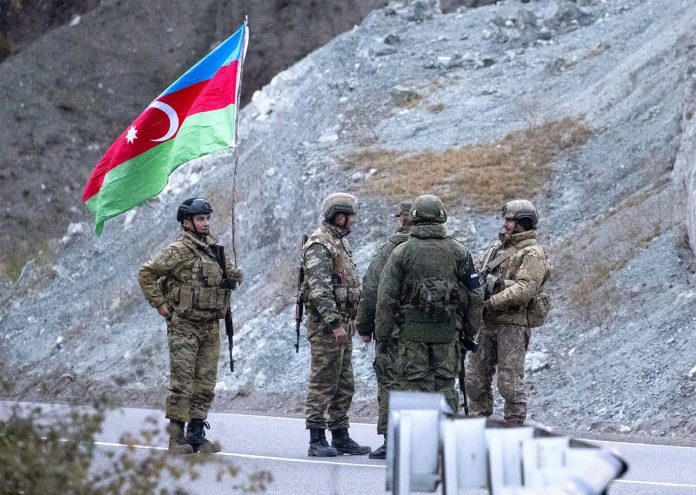
Azerbaijan conducts drone attack on Armenian positions, wounding two servicemen: Yerevan

Azerbaijani Forces Nagorno-Karabkh

Renewed border clashes have erupted between Armenian and Azerbaijani forces, according to Yerevan, a day after deadly fighting threatened to derail European Union-led weekend peace talks between the Caucasus arch-foes.

Border clashes on Thursday left an Azerbaijani serviceman dead and four Armenian troops injured.

“On May 12, at around 10am, the Azerbaijani Armed Forces violated the ceasefire in the direction of Sotk using UAVs. Two servicemen of the Armenian Armed Forces were wounded. The health condition of one serviceman is assessed as satisfactory and [that of] the other one is critical,” the statement said.

The ministry also reported that as of 10:30am, the situation at the front line is relatively stable.

Baku and Yerevan are locked in a decades-long territorial dispute over Azerbaijan’s Armenian-populated region of Nagorno-Karabakh, over which they have fought two wars.

Armenian Prime Minister Nikol Pashinyan and Azerbaijani President Ilham Aliyev are scheduled to meet on Sunday in Brussels for talks led by European Council President Charles Michel.

The rival leaders had also agreed to jointly meet the leaders of France and Germany on the sidelines of a European summit in Moldova on June 1, according to the EU.

Pashinyan on Thursday accused Azerbaijan of looking to “undermine the talks” in Brussels.

He warned there was “very little” chance of signing a peace deal with Azerbaijan at the meeting.

A draft agreement “is still at a very preliminary stage and it is too early to speak of an eventual signature”, Pashinyan continued.

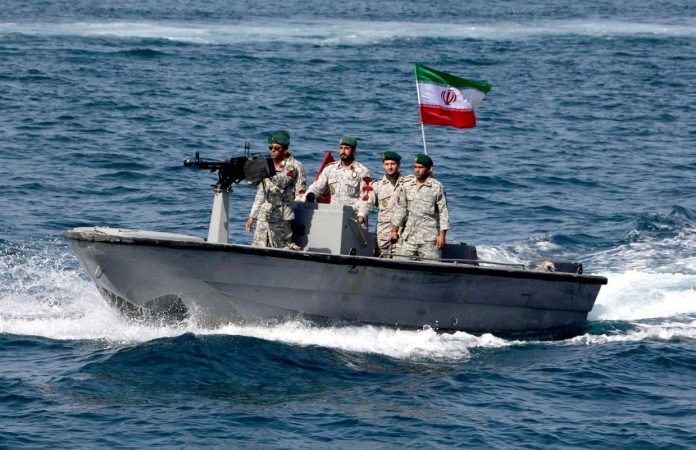
IRGC Navy in full command of Persian Gulf: Commander

IRGC Boat Persian Gulf

“With reliance on domestic capabilities, the force (IRGC Navy) is at the height of preparedness and is in full command of the Persian Gulf in aerial, surface, and subsurface levels,” Tangsiri told reporters in Iran’s southern city of Bushehr on Friday.

“The movement of enemy vessels in the Persian Gulf is under constant and 24/7 monitoring of the IRGC Navy,” he added.

Tangsiri said he assessed the security of the Persian Gulf positively. “This strategic waterway has full security,” he said.

The commander said advanced important military equipment were today being developed at the Iranian Defense Ministry by Iranian youths and being handed over to the armed forces.

He added great advancements had occurred in the development of such equipment. “With these powerful equipment and capable personnel, the level of preparedness in the Islamic Republic of Iran Armed Forces increases by the day,” Tangsiri said.

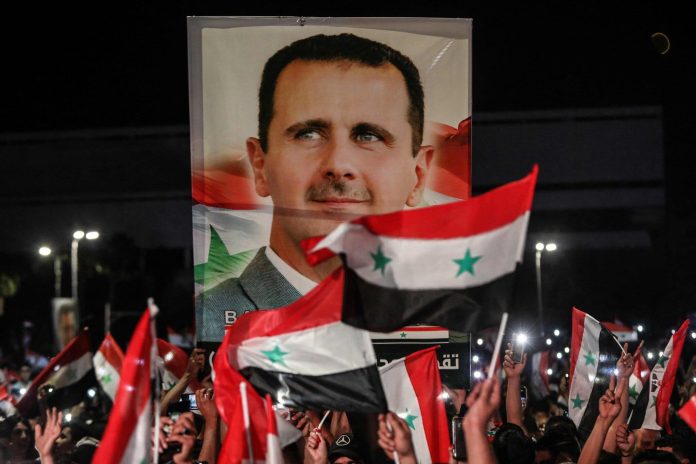
US lawmakers introduce bill targeting normalization with Syria

Syria Bashar Assad

The bill, first reported by Reuters, would prohibit the government from recognizing or normalizing relations with any Syrian government led by Assad, who is under US sanctions, and expands on the Caesar Act, which imposed a tough round of sanctions on Syria in 2020.

The proposed legislation comes after Arab states turned the page on years of confrontation with Assad on Sunday by allowing Syria back into the Arab League, a milestone in his regional rehabilitation even as the West continues shunning him after years of war.

Regional countries, including Saudi Arabia, Qatar and others, had for years supported anti-Assad rebels, but Syria’s army – backed by Iran, Russia and allied paramilitary groups – regained most of the country.

“Countries choosing to normalize with (the) unrepentant mass murderer and drug trafficker, Bashar al-Assad, are headed down the wrong path,” US Representative Joe Wilson, the chair of the Subcommittee on the Middle East, North Africa, and Central Asia, said in a statement.

The bill was introduced by Wilson, House of Representatives Foreign Affairs Committee Chairman Michael McCaul, a fellow Republican; Republican French Hill and Democrat Brendan Boyle, who co-chair the Free, Democratic and Stable Syria Caucus; and others.

The legislation is a warning to Turkey and Arab countries that if they engage with Assad’s government, they could face severe consequences, a senior congressional staffer who worked on the bill told Reuters.

“The readmission of Syria to the Arab League really infuriated (Congress) members and made clear the need to quickly act to send a signal,” the staffer said.

The staffer added the State Department was consulted in the drafting of the bill.

Asked about the measure at a regular news briefing, State Department deputy spokesperson Vedant Patel declined to comment on pending legislation. But he said Washington has been very clear it does not seek to normalize relations with Assad’s government and would not support its allies and other partners doing so either.

The bill’s provisions include a requirement that the secretary of state provide Congress with a strategy for countering normalization with Assad’s government – including a list of diplomatic meetings between Syria’s government and Turkey, the United Arab Emirates, Egypt and others – every year for five years.

The legislation would also pave the way for sanctions to be imposed on airports that allow landings by Syrian Arab Airlines and another carrier, Cham Wings, the staffer added.

If passed, the bill would also require a review of transactions, including donations over $50,000 in areas of Syria held by Assad’s government by anyone in Turkey, the UAE, Egypt and several other countries.

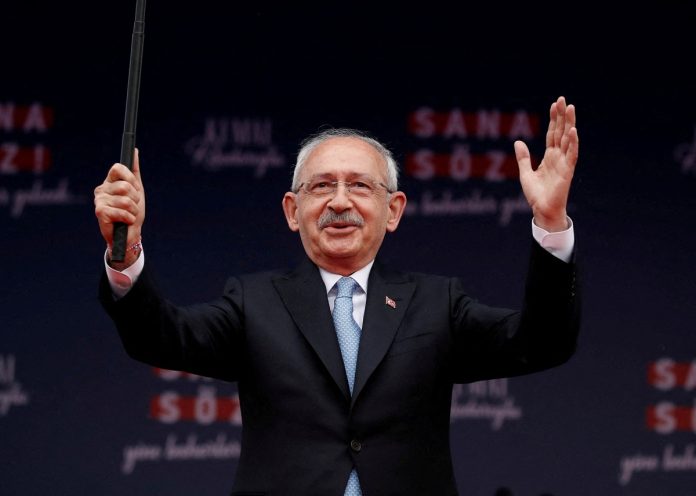
Erdogan’s rival accuses Russia of election ‘deep fake’

Kemal Kilicdaroglu

Kilicdaroglu, who has a slight lead over long-time leader Erdogan according to opinion polls, did not specify to which material he referred.

A third presidential candidate, Muharrem Ince, withdrew from the race on Thursday citing a faked “character assassination” carried out online. He gave few details.

Kilicdaroglu accused Turkey’s “Russian friends” of responsibility for “the release in this country yesterday of montages, plots, deep fake content…”

“If you want to continue our friendship after May 15, withdraw your hand from the Turkish state. We are still in favour of cooperation and friendship,” he said on Twitter on Thursday in both Turkish and Russian.

Kremlin Spokesman Dmitry Peskov denied rumors about Russia interfering in the presidential and parliamentary elections in Turkey, calling anyone who spreads such information a liar.

“We strongly reject such statements, we officially declare that there is no interference. If someone provided such information to Mr. Kilicdaroglu, then they are liars, that’s all I can say,” Peskov told reporters on Friday.

In general, according to the spokesman, Russia “very, very much values bilateral relations with the Republic of Turkey.”

“Because it [Turkey] has so far taken a very responsible, sovereign and thoughtful position on a whole range of regional and global problems that we face,” the official added.

“And this position is very much to our liking,” he pointed out.

“As a country that values bilateral relations, it will especially make sure not do anything against its partner,” Peskov concluded.

“We have repeatedly said and continue to insist that we do not interfere in the domestic affairs and electoral processes of other countries,” he stressed.

According to Peskov, Kilicdaroglu “should recall what the Americans have done.”

“They spent tens of millions of dollars on investigations and then came to the conclusion that there was no interference,” the Kremlin spokesman emphasized.

Asked about the upcoming election in Turkey last month, Russian Foreign Minister Sergey Lavrov stated that Moscow “never interferes in the domestic affairs” of other countries.