US says it is a new thing to see Putin’s leadership directly challenged
The US State Department said the situation in Russia remains dynamic days after an aborted mutiny, adding it does not have any assessment about the whereabouts of the boss of Russia’s Wagner mercenary group, Yevgeny Prigozhin.
“It is a certainly a new thing to see President [Vladimir] Putin’s leadership directly challenged. It is a new thing to see Yevgeny Prigozhin directly questioning the rationale for this war and calling out that the war has been conducted essentially based on a lie,” State Department spokesperson Matthew Miller told reporters.
“Those are all significant steps and what the implications of thoseare, I think, remains to be seen,” Miller added.
Biden says West ‘had nothing to do’ with Russia’s Wagner revolt
US President Joe Biden stated the brief revolt by Russian mercenaries against the Kremlin is part of a struggle within the Russian system and the United States and its allies were not involved in it.
“We made clear we were not involved, we had nothing to do with this,” Biden said in his first comments, adding, “This was part of a struggle within the Russian system.”
“We’re going to keep assessing the fallout of this weekend’s events and the implications for Russia and Ukraine. But it’s still too early to reach a definitive conclusion about where this is going,” he continued.
Biden also said he “talked at length with President Zelenskyy” and told him that “we would continue to continue to support Ukraine’s defence and its sovereignty and its territorial integrity”.
US was not involved in rebellion in Russia: White House
The White House announced the US was not involved in the rebellion in Russia after Russian Foreign Minister Sergey Lavrov said the country’s special services are investigating whether Western intelligence services were engaged in the events that unfolded this weekend.
“The United States was not involved and will not get involved in this situation. This was an internal Russian matter,” National Security Council spokesperson Adam Hodge stated.
Earlier Monday, Lavrov told Russia Today that while his department was not involved in evidence gathering of illegal activities, Russian services were looking at possible foreign intervention.
He was asked: “Do you have proof that neither Ukraine nor the West was involved in the mutiny?”
Lavrov answered: “I’m working in a department that is not engaged in gathering evidence of committed illegal actions. But we have such services and I assure you, they are already looking into that.”
He also added the US ambassador to Russia signaled the US had “nothing to do” with events this weekend
Prigozhin claims Russian defense ministry wanted Wagner to “cease to exist” starting on July 1
Wagner boss Yevgeny Prigozhin released new audio Monday explaining his decision to turn around his march on Moscow.
The Russian Defense Ministry had planned for Wagner private military group to “cease to exist” starting on July 1, he claimed
“No one agreed to sign a contract with the Defense Ministry, since everyone knows very well from the current situation and their experience during the special military operation that this will lead to a complete loss of combat capability,” Prigozhin said in the audio message.
But then he proceeded to say that some fighters did sign contracts with the Ministry of Defense, but claimed that it was only a minimal number.
“Those fighters who decided that they were ready to move to the Ministry of Defense did so. But this is the minimum number, estimated at 1-2%. All the arguments to keep PMC Wagner were presented, but none were implemented,” he added.
Prigozhin said he wanted to avoid Russian bloodshed and also said the march was a demonstration of protest and not intended to overturn power in the country.
“Overnight, we have walked 780 kilometers (about 484 miles). Two hundred-something kilometers (about 125 miles) were left to Moscow,” Prigozhin claimed in the latest audio message, despite no evidence that his Wagner forces made it that close to the Russian capital.
“Not a single soldier on the ground was killed,” he added.
“We regret that we were forced to strikes on aircraft,” he continued, noting, “…but these aircraft dropped bombs and launched missile strikes.”
The Wagner boss also claimed in the audio message that about 30 of his fighters died in the Russian military’s attack on the mercenary group on Friday. Prigozhin said the attack came days before Wagner was due to leave its positions on June 30 hand over equipment to the Southern Military District in Rostov, Russia.
The purpose of his forces’ march toward Moscow, the Wagner boss stated, was to prevent the “destruction” of Wagner private military company, and “to bring to justice those who, through their unprofessional actions, made a huge number of mistakes during the special military operation.”
Prigozhin added the march stopped when the detachment “made a reconnaissance of the area, and it was obvious that at that moment a lot of blood would be shed. We felt that demonstrating what we were going to do was sufficient.”
“At this time, Alexander Lukashenko extended his hand and offered to find solutions for the further work of Wagner PMC in legal jurisdiction,” he continued.
Russia investigating whether Western intelligence was involved in rebellion: FM
Russian special services are investigating whether Western intelligence services were involved in the events which unfolded in Russia Saturday, Russian Foreign Minister Sergey Lavrov said in video comments to Russia Today.
Russia often alleges foreign interference in domestic ongoings. Lavrov did not immediately present evidence or further information of that alleged investigation.
However, he noted that the US ambassador to Russia signaled that the US had “nothing to do” with the events.
“And it was especially emphasized: the United States proceeds from the fact that everything that happens is an internal affair of the Russian Federation,” he added in a video that was seemingly taped Sunday and released on state-controlled broadcaster Russia Today Monday.
This comes after Wagner founder Yevgeny Prigozhin allegedly incited an armed rebellion, but then stood down and accepted a deal to leave Russia for Belarus, according to the Kremlin.
Wagner developments show “weakness of Russian regime”: NATO chief
The developments in Russia over the weekend show the “weakness” and “fragility” of the Russian leadership, NATO Secretary-General Jens Stoltenberg stated Monday.
Wagner boss Yevgeny Prigozhin’s armed insurrection “demonstrated how difficult and dangerous it is for President [Vladimir] Putin to be relying on mercenaries that have actually turned against him,” Stoltenberg said.
Stoltenberg went on to say that it is unclear what will happen in Russia over the next days and weeks. He added that NATO allies should not make the mistake of “underestimating” Moscow.
“So we need to continue to provide support to Ukraine, that’s exactly what NATO and NATO allies are doing with military support but also support for the long term. And that’s in a way what we can say today about the effects on the battlefield in Ukraine,” he stated during a news conference in Lithuania, alongside German Defense Minister Boris Pistorius and Lithuania’s President Gitanas Nauseda.
Ukraine says forces have retaken village of Rivnopil
Ukrainian Deputy Defence Minister Hanna Maliar says forces have liberated the southeastern village of Rivnopil from Russian control.
Earlier on Monday, Maliar stated Ukrainian forces had liberated about 130 square km (50 square miles) in the south of Ukraine since the counterattack began.
Rivnopil is west of a cluster of settlements that Ukraine says it recaptured this month after launching a counteroffensive.
EU agrees to $3.8 billion top up of Ukraine military aid fund
European Union member states agreed on Monday to a $3.8 billion (€3.5 billion) top up to the European Peace Facility, as Ukraine’s foreign minister called on the bloc to “accelerate” Russia’s defeat.
The fund has been used by EU member states to finance military aid for Ukraine.
It comes after Ukraine’s foreign minister Dmytro Kuleba called on EU foreign ministers attending the Foreign Affairs Council on Monday to “accelerate Russia’s defeat by stepping up support for Ukraine.”
The further support committed by the EU for Ukraine follows the bloc’s announcement last week of the 11th round of sanctions against Russia.
“The package includes measures aimed at countering sanctions circumvention and individual listings,” the Swedish Presidency of the EU Council said Wednesday.
President of the EU Commission Ursula von der Leyen welcomed the sanctions package, saying “it will deal a further blow to Putin’s war machine with tightened export restrictions, targeting entities supporting the Kremlin.”
“Our anti-circumvention tool will prevent Russia from getting its hands on sanctioned goods,” she tweeted.
UK prepared for ‘a range of scenarios in Russia’: PM
British Prime Minister Rishi Sunak says the United Kingdom is prepared for a range of scenarios in Russia following the potentially destabilising impact of the tensions between the Wagner Group and President Vladimir Putin.
“It’s too early to predict with certainty what the consequences of this might be, but of course we are prepared as we always would be for a range of scenarios,” Sunak told reporters.
“It’s a situation that we’ve been analysing and monitoring for some time because we’re aware of the potentially destabilising impact of Russia’s illegal war in Ukraine and indeed, the tensions between the Wagner Group and the Putin regime,” he added.
Raisi backs Putin over armed mutiny: Kremlin
Russian President Vladimir Putin held a telephone conversation with his Iranian counterpart Ebrahim Raisi, the Kremlin press service reported.
“The Iranian president expressed his full support for the Russian leadership in connection with the events of June 24,” the statement said.
Russia faced a ‘challenge to its stability’: PM
Russian Prime Minister Mikhail Mishustin says the country faced “a challenge to its stability” and must remain united behind President Vladimir Putin following the Wagner mutiny.
In what appears to be the first public comments by a senior Russian official, Mishustin appealed at a televised government meeting for national unity.
“The main thing in these conditions is to ensure the sovereignty and independence of our country, the security and well-being of citizens,” stated Mishustin.
“For this, the consolidation of the whole of society is especially important; we need to act together, as one team, and maintain the unity of all forces, rallying around the president,” he continued.
Mishustin added that “virtually the entire military, economic, information machine of the West is directed against us.”
Ukraine reiterates call for simplified NATO accession
The head of Ukraine’s presidential staff reiterated that Kyiv expects an invitation for a simplified accession to NATO when the alliance meets next month.
Andriy Yermak told a briefing for German media, “Ukraine’s position: the expected result is to receive an invitation for simplified accession at the summit in July.”
“But, importantly, we would like to receive an absolutely clear signal that would establish Ukraine’s path to NATO membership,” he added.
‘Russia’s internal affair’: China on Wagner revolt
China’s foreign ministry says it has nothing to add about a possible phone call between Putin and Xi Jinping on the Wagner rebellion, Russian news agency TASS cited Chinese foreign ministry spokesperson Mao Ning as saying.
“The Wagner incident is Russia’s internal affair. As a friendly neighbour and comprehensive strategic partnership partner in the new era, China believes and supports Russia in maintaining national stability as well as achieving development and prosperity,” Mao stated.
In response to a question about a call between the two leaders, Ning added, “I have no information to disseminate.”
Ukrainian foreign minister urges EU to ‘accelerate Russia’s defeat’
Ukrainian foreign minister Dmytro Kuleba urged the European Union to “accelerate Russia’s defeat” by stepping up support for Ukraine.
On Twitter, Kuleba wrote: “Two events proved Ukraine will win. In Berdyansk, Ukrainian teenagers Tigran and Mykyta sacrificed their lives to resist occupation. In Russia, tanks rolled on Moscow with little resistance. At FAC [Foreign Affairs Council], I urged the EU to accelerate Russia’s defeat by stepping up support for Ukraine.”
Prigozhin remains under investigation for inciting armed rebellion: Source at Russia’s Prosecutor General’s Office
The investigation into the criminal case involving Yevgeny Prigozhin and his alleged involvement in organizing an armed mutiny is still active, Russian state news agency TASS said Monday, citing a source close to the Prosecutor General’s Office.
“The criminal case against Prigozhin did not stop. The investigation continues,” the source said about the Wagner founder, according to TASS.
On Saturday, Kremlin spokesman Dmitry Peskov told journalists a deal had been reached with Prigozhin and the charges against him for calling for “an armed rebellion” would be dropped, without providing a time frame.
Belarusian President Alexander Lukashenko also claimed Saturday that the criminal case against Prigozhin would be dropped. With Prigozhin’s Wagner forces just hours away from reaching Moscow, Lukashenko said he had brokered a deal with Prigozhin, allowing him to go to Belarus and not face charges.
However, neither Prigozhin nor his press service have confirmed a deal. Prigozhin has not been seen in public since his departure from Rostov-on-Don Saturday night.
Ukrainian army enjoyed “tactical success” in heavy fighting over the last week: Deputy DM
Ukrainian forces have been engaged in heavy fighting over the last week “with tactical success,” the deputy defense minister has said.
The much-discussed start of the Ukrainian counteroffensive is now underway, and deputy defense minister Hanna Maliar says Ukrainian forces have carried out defensive and offensive operations in the east of the country.
Meanwhile, the situation in the southern part of Ukraine has not changed significantly over the past week, according to Maliar. Ukrainian forces were pushing offensive operations near Melitopol and Berdiansk.
In the east, heavy fighting has continued around Lyman, Bakhmut and areas in the Donetsk region, she added.
Ukrainian troops made slight advances north, south and west of the embattled city of Bakhmut, according to Maliar.
Attempted insurrection demonstrates Putin made “big strategic mistake”: NATO chief
The events that unfolded in Russia over the weekend demonstrate that President Vladimir Putin made a “big strategic mistake” by launching a full-scale invasion of Ukraine, NATO Secretary-General Jens Stoltenberg said Monday during a visit to Lithuania’s capital Vilnius.
“The events over the weekend are an internal Russian matter, and yet another demonstration of the big strategic mistake that President [Vladimir] Putin made with his illegal annexation of Crimea and the war against Ukraine,” he stated.
“As Russia continues its assault, it is even more important to continue our support to Ukraine,” Stoltenberg continued, adding, “Ukrainians have launched a counteroffensive to retake occupied land. The more land they are able to retake, the stronger their hand will be at the negotiating table to achieve a just and lasting peace.”
Stoltenberg added that “once the war ends, we must put arrangements in place for Ukraine’s security so that history does not repeat itself.”
Stoltenberg said allies are monitoring the situation in Belarus.
“We condemn Russia’s announcement about deploying nuclear weapons. This is reckless and irresponsible. We don’t see an indication that Russia is preparing to use nuclear weapons, but NATO remains vigilant,” he stated.
“If Russia thinks it can intimidate us from supporting Ukraine, it will fail. We stand with Ukraine for as long as it takes,” he added.
Belarus is playing an increasingly prominent role during Russia’s invasion of Ukraine, with President Alexander Lukashenko providing support to his Russian counterpart.
After weeks of speculation, Putin confirmed earlier this month that he has tactical weapons on standby in Belarus — causing alarm among many in the West.
Belarus may also have come to Russia’s aid on Saturday during an armed insurrection, apparently brokering a deal with Wagner chief Yevgeny Prigozhin. Lukashenko claimed “the criminal case will be dropped” against Prigozhin and that he “will go to Belarus.”
Wagner insurrection shows military power in Russia is “cracking”: EU’s foreign policy chief
The armed rebellion attempted by the Wagner Group at the weekend shows military power in Russia is “cracking,” according to European Union foreign affairs chief, Josep Borrell.
Speaking to journalists on his way into a Foreign Affairs Council meeting in Luxembourg on Monday, the EU’s high representative for foreign affairs and security policy said the bloc is “closely following” developments in Russia.
He added recent events show Russia’s military power “is cracking,” adding that the instability is also “affecting [Russia’s] political system.”
The foreign affairs chief warned that it is “not a good thing” when a “nuclear power” such as Russia encounters “political instability,” calling the nuclear threat “something that has to be taken into account.”
Russian President Vladimir Putin faced the gravest threat to his authority in decades at the weekend when Wagner forces marched toward Moscow. Wagner boss Yevgeny Prigozhin later turned his troops around and agreed to leave Russia for Belarus, the Kremlin said, in a deal apparently brokered by Belarusian President Alexander Lukashenko. Belarusian officials said they cannot confirm if Prigozhin — whose whereabouts are currently unknown — has arrived in the country or what his status will be.
Russia’s war on Ukraine having “devastating consequences” on leadership: German FM
Russia’s invasion of Ukraine is having “devastating consequences” on Russian leadership, Germany’s foreign minister Annalena Baerbock said as she arrived at a European Union meeting in Luxembourg Monday.
“We see the devastating consequences of the Russian war of aggression also on Putin’s system of power,” Baerbock stated, adding that Russia’s leadership was “increasingly striking back at itself.”
“We are seeing massive cracks in Russia’s propaganda,” Baerbock said, adding that Berlin is closely watching events in Russia.
She said an “internal power struggle” is going on in Russia and that Germany is “not getting involved.”
The power struggle between Russian President Vladimir Putin and Yevgeny Prigozhin, chief of the Wagner private military group, was “just one act in this Russian spectacle,” Baerbock continued, adding that it remained “unclear what is happening with the different actors in Russia.”
“We obviously see that this has also led to a power struggle within Russia. And therefore it is unclear what other acts will follow in this spectacle,” she added.
Moscow ends security restrictions: Mayor
All security restrictions imposed in Moscow following Wagner’s insurrection have ended, the capital’s mayor said Monday.
“We are lifting all restrictions connected to the introduction of the regime of a counter-terrorism operation,” Mayor Sergei Sobyanin wrote on Telegram.
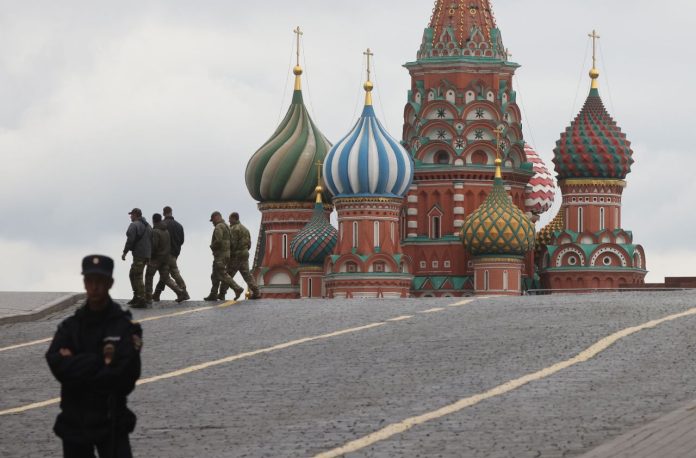
Witnesses observed Red Square blocked off on Sunday, a day after Wagner boss Yevgeny Prigozhin called off his short-lived mutiny. Metal partitions were seen blocking access to the city center and a few security officers were present.
As events unfolded over the weekend, authorities declared Monday a non-work day, with the “exception of authorities and enterprises of a continuous cycle, the military-industrial complex, and city services,” Sobyanin stated earlier.
On Monday, the mayor thanked Muscovites for their “calm and understanding,” adding that high school graduations will be held on July 1 after many events were cancelled Saturday.
Russia says DM visited troops involved in Ukraine conflict
Russian Defense Minister Sergei Shoigu has visited Russian troops involved in the military operation in Ukraine, the Russian Defense Ministry announced Monday.
Neither the ministry nor state media said when the visit took place.
The announcement of the rare visit comes after Wagner mercenary boss Yevgeny Prigozhin launched a brief insurrection on Saturday that ended abruptly after a supposed deal was struck that would see him leave for Belarus.
On Monday, the defense ministry noted Shoigu visited a frontline command post of one of the western group of troops in the special military operation, the term President Vladimir Putin uses for the war in Ukraine.
Shoigu listened to a report by commander of the western military district, Col. Gen. Yevgeny Nikiforov, “on the current situation, the nature of enemy actions and the performance of combat tasks by the Russian Armed Forces,” the ministry said in a statement.
Ukraine’s DM on Russia: Things ‘moving in right direction’
Ukrainian Defence Minister Oleksii Reznikov says he has discussed the turmoil in Russia in a phone call with his US counterpart, describing the Russian authorities as “weak” and saying things were “moving in the right direction”.
In a brief readout of the call with US Secretary of Defense Lloyd Austin, Reznikov stated they also discussed Ukraine’s counteroffensive and steps to strengthen Ukraine’s armed forces.
“We agree that the Russian authorities are weak and that withdrawing Russian troops from Ukraine is the best choice for the Kremlin,” Reznikov wrote on Twitter.
Ukraine claims it made gains around Bakhmut
Frontlines across Ukraine have seen heavy combat over the past two days, with more than 20 engagements occurring in areas in the Donetsk region – chiefly Lyman, Marinka and Bakhmut, according to the Ukrainian military.
In its operational update, the General Staff said the Russians also carried out 25 air strikes over the past day.
There had been heavy Russian artillery and mortar fire in the Kupyansk area of Kharkiv, where the Russians have been trying to break through for over a month, the Ukrainians said.
The General Staff insisted all Russian efforts to take territory had been foiled. Across the Donetsk frontlines, the fighting was characterized by exchanges of indirect fire, but with little movement.
However, the Ukrainians say they are on the front foot around Bakhmut.
“(Troops) hold the initiative, continue assault operations and push the enemy back. Over the last day, the Ukrainian forces advanced 600 to 1,000 meters on the southern and northern flanks around Bakhmut,” said Serhii Cherevatyi, spokesperson for the Eastern Grouping of the Armed Forces.
Nearly 200 Russian soldiers had been killed in the last day, and a variety of Russian equipment had been destroyed, according to Cherevatyi.
In the south, where Ukrainian forces have attempted to break through Russian lines, the General Staff said a Russian effort to regain lost positions in the area of Novodarivka had also failed.
Russian artillery continued to strike about 30 settlements along the frontlines in the Zaporizhzhia region, it added.
In Kherson, Nataliya Humenyuk, a spokesperson for Ukrainian forces in the south, said the Russians struggled to regain positions on the east bank of the river Dnipro, which was flooded by the recent damage to the dam at Nova Kakhovka.
“Their work is complicated by the spread of intestinal infections,” Humenyuk added.
Ukraine counteroffensive expectations ‘overestimated’: Kiev
Expected results from Kiev’s ongoing counteroffensive against Russia have been “overestimated,” Ukraine’s Defense Minister Alexey Reznikov has claimed.
The offensive by Ukrainian forces should be treated as “some kind of preparatory operation” rather than a decisive battle, he added.
Reznikov gave an interview to Fox News which was published on Sunday, in which he insisted Kiev had never planned the offensive to be a “blitzkrieg.” The minister admitted that the Russians had erected “very strong defensive lines” all along the frontline.
“It’s some kind of preparatory operation, shape operation certainly. And we understand that they use very strong defense lines, especially minefields,” Reznikov said, adding that the “expectation was overestimated” for the Ukrainian “counteroffensive plan.”
At the same time, the minister insisted the stalled effort was the “next step to victory.” Reznikov also claimed that Kiev has been very careful in deploying its troops onto the battlefield and has been doing its best to “save their lives,” alleging that Moscow has been using its forces as a “meat grinder.” The minister also expressed confidence this year will be a “game changer” in the ongoing conflict, yet urged the public not to expect a decisive victory stemming from the ongoing push.
Ukraine launched its long-heralded counteroffensive in early June, repeatedly attacking Russian positions at different points across the frontlines. Thus far, the push has failed to produce any tangible results, with the Kiev forces sustaining heavy casualties.
The stalled effort has already cost Kiev thousands of servicemen and hundreds of pieces of Western-supplied military hardware, including multiple German-made Leopard 2 tanks and US-made Bradley infantry fighting vehicles.
Beijing throws support behind “strategic partner” Moscow after Wagner insurrection
China has voiced support for Russia after a short-lived insurrection posed the gravest challenge to the 23-year rule of Vladimir Putin, a close partner of Chinese leader Xi Jinping in his push for a new world order and strategic alignment against the US.
A day after Wagner mercenary fighters turned back from their march toward Moscow, ending a brief and chaotic uprising by warlord Yevgeny Prigozhin, Beijing released its first comment on what Putin had called an “armed rebellion.”
“This is Russia’s internal affair,” a Chinese Foreign Ministry spokesperson said in a terse statement posted online late on Sunday night.
“As Russia’s friendly neighbor and comprehensive strategic partner of coordination for the new era, China supports Russia in maintaining national stability and achieving development and prosperity,” it added.
Beijing’s carefully crafted public comment came well after the brief mutiny had dissipated, with Prigozhin agreeing on Saturday to pull back his fighters in a deal with the Kremlin that would reportedly see him enter into exile in Belarus.
It also came after Russian Deputy Foreign Minister Andrey Rudenko flew to Beijing to meet with Chinese officials on Sunday, where the two sides reaffirmed their close partnership and political trust.
China’s Foreign Minister Qin Gang and Rudenko exchanged views on “Sino-Russian relations and international and regional issues of common concern,” the Chinese Foreign Ministry said in a one-line statement posted on its website, with a photo showing the pair walking side by side while smiling.
Russia’s Foreign Ministry announced Rudenko also held “scheduled consultations” with China’s Deputy Foreign Minister Ma Zhaoxu.
Wagner insurrection shows “cracks” emerging in Putin’s rule: Blinken
US Secretary of State Antony Blinken said Sunday that the brief and chaotic insurrection in Russia led by the Wagner paramilitary group shows “cracks” in Russian President Vladimir Putin’s role as a leader of the country.
“This is just an added chapter to a very, very bad book that Putin has written for Russia. But what’s so striking about it is, it’s internal,” Blinken told CNN’s Dana Bash on “State of the Union,” describing the situation as “extraordinary.”
“The fact that you have from within someone directly questioning Putin’s authority, directly questioning the premises that — upon which he launched this aggression against Ukraine. That, in and of itself, is something very, very powerful. It adds cracks. Where those go, when they get there, too soon to say, but it clearly raises new questions that Putin has to deal with,” he added.
The comments from the nation’s top diplomat underscore the short-lived intensity of a crisis that started when Yevegeny Prigozhin, the head of the Wagner Group, marched his fighters toward Moscow, taking control of Russian military facilities along the way.
Prigozhin on Friday openly accused Russia’s military of attacking a Wagner camp and killing a “huge amount” of his men. For months, he had railed against Russian Defense Minister Sergei Shoigu and the country’s top general, Valery Gerasimov, whom he blames for Moscow’s faltering invasion of Ukraine.
The Kremlin responded to the show of force from the Wagner Group by deploying heavily armed troops to the streets of Moscow and warning residents to stay indoors.
By Saturday afternoon, the Kremlin said a deal had been reached to end the insurrection, with Prigozhin heading to neighboring Belarus and Wagner fighters turning back from their march.
US intelligence had painted a grim picture, with the expectation that Prigozhin’s march toward Moscow would encounter much more resistance and be “a lot more bloody than it was,” according to one US official.
Blinken says situation in Russia is extraordinary: “You’ve seen cracks emerge that weren’t there before”
US Secretary of State Antony Blinken called the developing situation in Russia “extraordinary” in an interview with CNN’s Dana Bash Sunday, but said “it’s too soon to tell where this is going to go,” after Russia stepped back from the brink of an apparent civil war with the mercenary Wagner group.
“But we can say this: First of all, what we’ve seen is extraordinary. And I think you’ve seen cracks emerge that weren’t there before,” Blinken said, citing in part Wagner boss Yevgeny Prigozhin questioning the premise of Russia’s war in Ukraine.
CNN previously reported that US intelligence officials believe that Prigozhin, chief of the private Wagner military group, had been planning a major challenge to Russia’s military leadership for quite some time, but it was unclear what the ultimate aim would be.
Blinken, who has been making a round of calls to allies and partners over the weekend, refused to say Sunday whether the incident could be the unraveling of Russian President Vladimir Putin’s leadership.
“This is just an added chapter to a very, very bad book that Putin has written for Russia. But what’s so striking about it is it’s internal,” he added.
“The fact that you have from within someone directly questioning whose authority, directly questioning the premises that upon which he launched this aggression against Ukraine. That in and of itself is something very, very powerful. It adds cracks. Where those go, when they get there, too soon to say but it clearly raises new questions that Putin has to deal with,” he continued.
Prigozhin had vowed Friday to retaliate against Russian military leadership over an alleged strike on a Wagner military camp and claimed control of military facilities in two Russian cities. Yet by Saturday afternoon, he published an audio recording claiming he was turning his forces around from a march toward Moscow, just hours after launching an insurrection that posed the greatest threat to Putin’s authority in decades.
Blinken said the US hasn’t seen any Russia military officials ousted, maintaining that that “remains to be seen.”
“There’s no secret to the fact that Prigozhin was very much a critic of the military leadership, the Minister of Defense, the head of the armed forces. So how this now unfolds in terms of personnel? All of that remains to be seen,” he stated.
Blinken added that the situation could serve as an advantage to Ukraine as it executes a counteroffensive.
“To the extent that Russia is now distracted that Putin has to worry about what’s going on inside of Russia as much as he has to worry about what he’s trying to do not successfully in Ukraine. I think that creates an additional advantage for the Ukrainians to take advantage of,” he said.
But any instability in Russia is also of concern to US officials as well, given its status as a nuclear power.
“Any time you have a major country, like Russia, that has signs of instability, that’s something of concern. That’s something that we’re very focused on. When it comes to their nuclear weapons, we’ve seen no change in their posture and we’ve made no change in our own posture,” Blinken added.
Wagner revolt shows ‘divisions’ in Russian camp: Macron
The Wagner mercenary group’s revolt against Putin has revealed “divisions” within the Russian leadership, French President Emmanuel Macron has said.
The abandoned march on Moscow “shows the divisions that exist within the Russian camp, and the fragility of both its military and its auxiliary forces”, Macron told the Provence newspaper.
“The situation is still developing” and he was “following the events hour by hour”, he added.
Biden spoke to Zelensky and reaffirmed US support for Ukraine Sunday: White House
US President Joe Biden spoke with Ukrainian President Volodymyr Zelensky Sunday, a White House official said.
They discussed Ukraine’s ongoing counter-offensive, and President Biden reaffirmed unwavering US support, including through continued security, economic and humanitarian aid. The leaders also discussed recent events in Russia.
Zelensky also tweeted about the call earlier, saying the two leaders “discussed the course of hostilities and the processes taking place in Russia.”
“The world must put pressure on Russia until international order is restored,” Zelensky wrote.
Turkish president, NATO chief discuss Russia events over phone
Turkish President Recep Tayyip Erdogan and NATO chief Jens Stoltenberg have discussed the latest developments in Russia in a phone call, according to a statement by Turkey’s Communications Directorate.
During the call, it was pointed out that the end of tensions in Russia “prevented the occurrence of irrevocable humanitarian tragedies in the Ukrainian field”, the statement said.
Erdogan conveyed to Stoltenberg that Turkey hopes recent developments in Russia will be “a new milestone in the path to a just peace in Ukraine”, it added.
Zelensky demands more ‘pressure’ on Moscow
Ukrainian President Vladimir Zelensky has called for more pressure on Moscow following his phone call with US President Joe Biden. According to the Ukrainian leader, they spoke about additional deliveries of heavy weapons.
“We discussed the course of hostilities and the processes taking place in Russia,” Zelensky said on Sunday evening.
“The world must put pressure on Russia until international order is restored,” he continued
UN secretary-general urges all parties involved in insurrection in Russia to avoid furthering tensions
UN Secretary-General António Guterres on Sunday urged all parties involved “to act responsibly and with a view to avoid further tensions” in a statement released In response to recent events in Russia.
“The Secretary-General has been following with concern the developments in the Russian Federation. He is aware of the latest reports regarding steps to de-escalate tensions. He urges all concerned to continue to act responsibly and with a view to avoid further tensions,” the statement read.
US expected “a lot more bloodshed” in Russia: Official
As the picture became more clear to US intelligence analysts that Yevgeny Prigozhin was about to mobilize his Wagner troops inside Russia, the expectation was that his march toward Moscow would encounter much more resistance and be “a lot more bloody than it was.”
There was surprise, a US official said, that Russia’s professional military didn’t do a better job of confronting Wagner troops as they moved into Rostov and up toward Moscow.
Compounding that surprise, a US official said, was the swiftness of the deal that was struck on Saturday, which the Kremlin said was brokered by Belarus.
“I do know that we assessed it was going to be a great deal more violent and bloody,” the official told CNN.
In the end there was no fight for Moscow, where fierce resistance would have been expected. Prigozhin’s stated reason for ending Wagner’s march was a desire to avoid bloodshed, he said.
“Now is the moment when blood can be shed. Therefore, realizing all the responsibility for the fact that Russian blood will be shed from one of the sides, we turn our columns around and leave in the opposite direction,” Prigozhin said.
What Prigozhin’s ultimate aim was in his short-lived campaign remains uncertain.
In the days leading up to Wagner’s march, US intelligence assessed that he was going to challenge Russian leadership, multiple sources said, but whether that was to Putin himself or the military leadership he had long railed against is unclear.
Prigozhin’s status in Belarus uncertain and his press service says he will answer questions when he can
The press service of Yevgeny Prigozhin’s Concord management company has responded to an email inquiry from CNN about the Wagner chief’s whereabouts.
CNN asked: “There have been no messages from Yevgeny Viktorovich Prigozhin since yesterday evening. Could you clarify where he is now and whether he indeed accepted the conditions proposed by the President of Belarus Alexander Lukashenko?”
The response read: “All your questions have been forwarded to Yevgeny Viktorovich [Prigozhin]. He sends his regards to everyone and will answer questions when he has proper communication.”
Prigozhin was last seen leaving Rostov-on-Don late on Saturday in a black SUV after the Kremlin said a deal had been brokered by Lukashenko in which Prigozhin had agreed to go to Belarus and end his rebellion.
Prigozhin himself has not confirmed the deal.
The official Belarus news agency reported Sunday that Lukashenko spoke on the phone with Russian President Vladimir Putin again on Sunday morning.
Belarusian officials tell CNN they have no details on what Prigozhin’s status will be in Belarus and could not confirm whether Prigozhin had already arrived in the country.
Biden urges allies to not give credibility to Putin’s claims of Western interference in Wagner insurrection
As US President Joe Biden was walking from the White House residence to a briefing on the unfolding crisis in Russia, not much was certain.
It wasn’t obvious, for example, how a column of Wagner group mercenaries rapidly advancing toward Moscow might affect the war in Ukraine. Nor was it clear whether Russian troops under the command of President Vladimir Putin had the will to fight them.
One thing, however, did seem apparent: whatever was happening on the M-4 highway in southern Russia had the potential to change the course of what has become a presidency-defining conflict.
Never in the 16 months since Russia invaded Ukraine has Putin’s grip on power appeared as unsteady as it did this weekend. For Biden, the moment was a reminder of how unpredictable the crisis remains, even as American officials pore over intelligence for signs that Putin’s power is slipping.
A primary objective has been denying Putin a pretext for accusing the West of wanting him dead.
In a phone call with French President Emmanuel Macron, German Chancellor Olaf Scholz and British Prime Minister Rishi Sunak, Biden emphasized the imperative in not lending any credibility to expected claims from Putin of Western interference.
The message, according to people familiar with the call, was to keep the temperature low and allow whatever was happening on the ground in Russia to play out. As Biden has told his team for months, his goal is to prevent “World War III.”
A similar message went out from Washington to American embassies, who were told, if asked by their host governments, to convey “the United States has no intention of involving itself in this matter.”
Otherwise, the diplomatic outposts were instructed to “not pro-actively engage host government officials” on the matter, according to a person familiar with the message.
A message was also sent to the Russian government from the administration reinforcing that the US would not get involved, according to people familiar with the matter.
Now, Biden and his team are working to make sense of the past days’ events and determine what is next. The abrupt agreement brokered by Belarus to end the crisis has hardly given American officials confidence that the situation is entirely defused. If anything, it could reinforce existing doubts inside Russia about Putin’s leadership, according to US officials.
Ukraine claims partial success in southern front against Russia
Ukraine claimed Sunday it has improved its “tactical position” in its defense against Russia in the south and has achieved “partial success” in its counteroffensive in the Tavria area.
“Over the past day, the nature of hostilities has not changed in the Tavria direction. We hold our positions in defense and take measures, including measures to improve the tactical position. On the other hand, we have partial success in conducting offensive actions in the indicated direction. The enemy is making significant efforts to stop our advance, and is also suffering heavy losses in manpower, weapons and equipment,” a spokesperson for Ukrainian forces in Tavria said.
In the past 24 hours, Russian troops shelled nine regions of Ukraine, with “various types of weapons — grenade launchers, mortars, tanks, artillery, MLRS, SAMs, and tactical aircraft — attacking 40 villages and hitting infrastructure, according to military leaders.”
“In the Zaporizhzhia direction, the enemy continues to focus its main efforts on preventing the advance of our troops. They carried out air strikes in the areas of Orikhiv, Novodanylivka, Robotyne in Zaporizhzhia region. They shelled the settlements of Novodarivka, Levadne, Poltavka, Zaliznychne, Huliaipole, Huliaipilske, Charivne, Bilohirya, Orikhiv, Prymorske in Zaporizhzhia region with artillery,” the spokesperson added.
There is ongoing fighting in the Mariinka area of Donetsk on Sunday.
Wagner insurrection is the “first stage” toward ending Putin regime: Ukrainian officials
The short-lived Wagner mercenary group uprising against the Kremlin is the “first stage of dismantling” Russian President Vladimir Putin’s regime, Ukrainian officials declared Sunday.
Wagner head Yevgeny Prigozhin, who orchestrated the rebellion, is “only a part of the group and part of the plan, the tip of the iceberg in the destabilization process,” according to Oleksii Danilov, secretary of the National Security and Defense Council of Ukraine. “Putin’s regime has been stabbed in the back with a knife, if not instantly fatal, but certainly inevitable, although delayed in time,” he said, adding, “The countdown has begun.”
Armed anti-Putin rebels urged supporters on Saturday to rise up and take advantage of the Wagner situation to seize power.
“A group of discontented people has formed in Russia — security forces, officials as well as oligarchic capital — who consider Putin’s actions to be deadly for their interests and existence, a threat to Russia,” he stated.
Danilov added that he did not doubt that Wagner troops or other anti-Putin groups would eventually reach Red Square in the heart of Moscow.
“Prigozhin’s march-throw in Rostov is a demonstration of the seriousness of intentions, existing opportunities, and the creation of conditions for the beginning of the process of power transit — voluntary or forced,” he continued.
He claimed that in order for Putin to save himself he must “purge” his security forces, eliminate Wagner altogether, punish Prigozhin — who has reportedly left for Belarus — introduce martial law in Russia and subsequently the “start of mass repression.”