Tuesday, December 30, 2025
Home Blog Page 132

Iran’s military chief: Army, IRGC ready for any future confrontation

Abdulrahim Mousavi

During an inspection visit to naval units of both the Army and the IRGC in the Southern province of Hormozgan, Mousavi evaluated their offensive and defensive capabilities, praising their high level of readiness to carry out assigned missions.

“Our forces in the South are prepared to execute their missions, and all defensive and offensive plans to counter the enemy are being continuously updated and practiced,” he said.

Mousavi added that significant improvements have been made in the Navy based on experiences gained during the 12-day “Sacred Defense,” referring to a recent short-term conflict.

Visiting various IRGC naval sites in Hormozgan, he emphasized that the force is fully capable of both defensive and offensive operations against any adversary.

“What we witnessed today was an extraordinary level of readiness for a possible future confrontation,” Mousavi concluded.


US announces peace deal for Israel’s war on Gaza

In a press briefing with the two leaders at the White House that began more than an hour late, Trump said: “We’re at a minimum, very, very close. And I think we’re beyond, very close” to securing the proposed ceasefire deal for Gaza, calling it “one of the greatest days in civilization”.

Much of Trump’s speech was peppered with his assertions that the achievement was a “historic first” and that allies had commended his administration’s ability to reach a Middle East “peace” deal.

The US president added that there had been “extensive consultation with friends and partners across the region” and that the plan had the support of Arab and Muslim leaders and European allies.

He hailed it as a “new chapter of security, peace and prosperity for the entire region”, and heaped praise on the leaders of Saudi Arabia, Qatar, UAE, Jordan, Turkey, Indonesia, Pakistan and Egypt, whom he had met with last week at the United Nations General Assembly.

He stated in many cases there had been “great men” helping and “some great women too, but they tend to be mostly men however”.

If accepted by Hamas, Trump said the proposal called for the release of living Israeli captives within 72 hours, as well as the bodies of captives who had died, and the immediate end to the war itself.

He added that “Arab and Muslim” leaders had committed to “demilitarise Gaza” and “decommission” the military capabilities of Hamas.

Trump then said he had heard Hamas wanted the deal too, and that it would result in the destruction of “terror infrastructure” including “tunnels” and “production facilities”.

Trump added that a new transitional authority would agree on timelines for Israel to withdraw and that Israel would be withdrawing in phases.

Trump then thanked his son-in-law Jared Kushner and special envoy Steve Witkoff and commented that “no one else could have come close”, and that it was the first time in “thousands of years” such a feat had been achieved.

Trump then added that if Hamas chose to reject the 20-point proposal, which was released shortly before the press conference, then “Bibi”, referring to Netanyahu, would “have our full backing to do what you have to do”.

Qatar and Egypt announced shortly after that they had delivered the proposal to Hamas.

Trump said his plan called for an international oversight body to ensure the success of the plan, which he said would be called the Board of Peace, a name he went on to say was “beautiful” and would be headed by himself as chairman.

He announced that former British prime minister Tony Blair would be on the board along with several others, who would be revealed over the next few days.

Trump then proceeded to announce that Israelis seem to really “like me”. They say two things, he added: “Please get the hostages back and please end the war. They’ve had it.”

He praised Netanyahu as being a warrior.

“Israel is lucky to have him,” he continued.

“There are many Palestinians who wish to live in peace. Many, many, many. I’ve seen so many of them. They have support. I challenge Palestinians to take control of their destiny.”

“We’re giving them responsibility for their destiny”, he said, but they must “prohibit terrorism and earn their way to a brighter future”.

“They’ve had a rough life with Hamas,” Trump said, adding, “If the Palestinian Authority does not complete the reforms that I laid out in my vision for peace in 2020, they’ll have only themselves to blame. We’re giving them an amazing footprint.”

He did not state what the “footprint” was. His focus was primarily on returning the captives.

Trump called for Hamas to accept the deal, saying: “It’s a different Hamas we’re dealing with, as 20,000 people have been killed. Their leadership has been killed three times over.”

Netanyahu then took the stage, and announced he agreed to the peace deal and “supported” Trump’s plans to end the war in Gaza. But he also took a further step – in a disconnect with Trump – and indicated that he and Trump were working on a longterm strategy to change the face of the Middle East, rather than working with Arab and Muslim leaders on Gaza only.

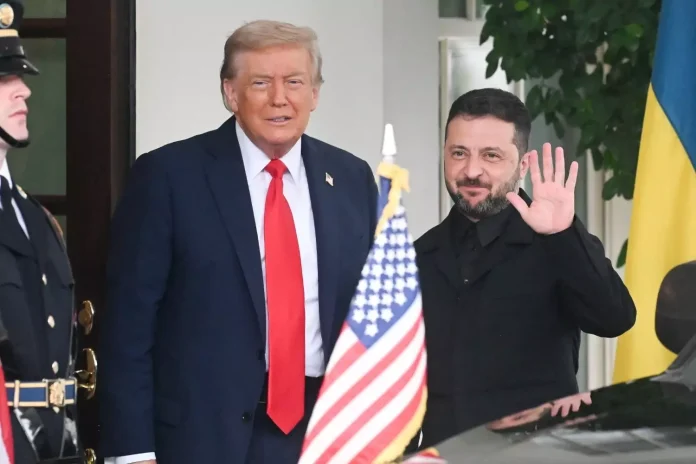
Netanyahu began by thanking and praising Trump, something that Ukrainian leader Volodymyr Zelenskyy famously failed to do on his first visit to the White House when Trump had tried to end the war between Russia and Ukraine.

Netanyahu called Trump the “greatest friend that Israel has ever had in the White House” and said that the competition wasn’t “even close”.

He then went on to say that Trump’s leadership was “changing the world for the better. Ending wars and advancing peace”.

“When our nations stand shoulder to shoulder, we achieve the impossible,” the Israeli prime minister stated referencing the US’s “bold decision” to help Israel in its 12-day war on Iran in June, adding it “made the region safer, and the world safer”.

He said that Israel would now take steps to “win the war and expand the peace” under Trump’s leadership.

He added Hamas would be disarmed, and that Gaza would have a civilian administration that would be run by neither Hamas nor the Palestinian Authority (PA).

Netanyahu’s plans go against European recognition of a Palestinian state where the PA would be the governing authority.

Netanyahu praised Trump for overseeing the body, despite his busy schedule, and added: “If Hamas rejects your plan, Mr President, or if they supposedly accept and then basically do everything to counter it, then Israel will finish the job by itself.”

“This can be done the easy way or the hard way,” Netanyahu continued, adding, “We prefer the easy way. But it has to be done.”

He rejected the recognition of a Palestinian state and said “it would endanger Israel’s very existence”.

“Under your leadership, we can re-energise the Abraham Accords” and expand them to more Arab and Muslim nations, he added.

He ended with declaring that “Israel and America can change the face of the Middle East”, and took a completely different direction from the one Trump had.

Netanyahu travelled to the White House to meet with Trump to discuss a ceasefire in Gaza following his appearance at the United Nations General Assembly on Friday.

The meeting is the fourth between the two leaders since Trump returned to the White House at the end of January.


UK Labour conference votes to sanction Israel and recognise Gaza genocide

The unprecedented move means that the Labour conference has officially accepted the findings of a recent UN Commission of Inquiry report, which found that Israel is committing genocide in Gaza, and has backed comprehensive sanctions on Israel and a full arms embargo.

Delegates from constituencies and affiliated organisations are voting on motions covering a range of topics at the governing party’s annual conference, which began in Liverpool on Sunday.

Palestine Solidarity Campaign director Ben Jamal said: “This is a huge defeat for the government, with the Labour Party finally accepting that Israel is committing genocide in Gaza.

“This historic vote must now become government policy: imposing comprehensive sanctions on Israel and a full arms embargo.”

Maryam Eslamdoust, general secretary of the Transport Salaried Union (TSSA), stated: “Today the Labour movement stood on the right side of history and in solidarity with the Palestinian people, sending a clear message to the Labour leadership: we will not remain silent on the crime of genocide.”

Delegates also voted on Monday evening against another motion understood to broadly support Labour policy on Israel.

On Sunday, Middle East Minister Hamish Falconer backed that motion, which falsely claimed a 16 September UN Commission of Inquiry report found “a risk of genocide against Palestinians in Gaza”.

In fact, the UN report concluded that Israel has committed genocide and is still committing genocide in Gaza.

By contrast, Middle East Eye understands the emergency motion – which Falconer spoke against on Sunday – received strong trade union support.

A copy of the motion seen by MEE notes: “Conference accepts the findings of the UN Commission of Inquiry and calls on the Labour government to… employ all means reasonably available to it to prevent the commission of genocide in Gaza.”

The motion further demands that the government “apply sanctions to put pressure on the Israeli government to respect international law” and “ensure individuals and corporations in the UK are not involved in aiding and assisting the genocide”.

Sara Husseini, Director of the British Palestinian Committee stressed: “The Labour leadership must now join their own party members, along with the UN, genocide scholars and countless human rights organisations in confirming Israel’s genocide against the Palestinian people, and end the UK’s complicity in it.”

The motion’s passing piles further pressure on the beleaguered Prime Minister Keir Starmer to cut political and military ties with Israel over its genocide in Gaza.

It signals significant discontent among the Labour rank and file with government policy. Britain recognised a Palestinian state last week but has rejected calls to denounce Israel’s actions in Gaza as genocide.

Last September, the government suspended 30 out of 350 arms export licences to Israel after a review found a clear risk that British-made weapons could be used in violation of international humanitarian law.

Licences for parts for F-35 fighter jets, which are directly used in Gaza, were among those exempted from the embargo.

Recent polling found that 72 percent of Labour’s 2024 voters back a full arms embargo on Israel.

Recent months have seen a series of diplomatic spats between the UK and Israel, two historical allies.

The UK government banned Israeli officials from Britain’s largest arms trade show earlier this month.

Israeli Prime Minister Benjamin Netanyahu denounced the UK’s move to recognise a Palestinian state last week as “rewarding Hamas”.

However, Israeli President Isaac Herzog visited Britain last week and met Starmer at Downing Street.

Herzog said afterwards that he both “argued” and had points of agreement with Starmer, whom he called Israel’s “ally”.

Israeli PM apologises to Qatar over Doha attack

Benjamin Netanyahu

Qatari Prime Minister Sheikh Mohammed bin Abdulrahman bin Jassim Al Thani received the apology on Monday in a joint call from United States President Donald Trump and Netanyahu during their meeting at the White House.

“As a first step, Prime Minister Netanyahu expressed his deep regret that Israel’s missile strike against Hamas targets in Qatar unintentionally killed a Qatari serviceman,” a White House statement said.

“He further expressed regret that, in targeting Hamas leadership during hostage negotiations, Israel violated Qatari sovereignty and affirmed that Israel will not conduct such an attack again in the future.”

At least five lower-ranking Hamas members and a Qatari security official were killed in the September 9 attack, which targeted senior Hamas leaders involved in negotiations on a US-backed ceasefire proposal. Hamas’s top leaders survived the assassination attempt.

It was the first Israeli attack on Qatar, a key mediator in ceasefire efforts and host of the US military’s largest base in the Middle East, Al Udeid.

Qatar’s Ministry of Foreign Affairs confirmed the call “as part of US efforts to address the repercussions of the Israeli aggression that targeted a residential neighbourhood in Doha city, which included housing for the Hamas negotiating delegation, resulting in a blatant violation of the sovereignty of the State of Qatar”.

“At the beginning of the call, the Prime Minister and Minister of Foreign Affairs expressed his gratitude to the US President for his efforts to achieve peace in the region, including guarantees to prevent a recurrence of aggression against the State of Qatar and the US commitment to its defense partnership with Qatar,” the ministry announced.

“For his part, the Israeli Prime Minister apologised during the call for the attack and the violation of Qatari sovereignty, which resulted in the martyrdom of Qatari citizen Badr Al-Dosari, pledging not to repeat any targeting of Qatari territory in the future,” it added.

Netanyahu’s official X account quoted him as telling the Qatari prime minister: “Mr Prime Minister, I want you to know that Israel regrets that one of your citizens was killed in our strike. I want to assure you that Israel was targeting Hamas, not Qataris.”

“I also want to assure you that Israel has no plan to violate your sovereignty again in the future, and I have made that commitment to the president.”

The prime minister then went on to claim: “Israel has grievances against Qatar, from support for the Muslim Brotherhood to how Israel is portrayed on Al Jazeera to support for anti-Israel sentiment on college campuses.”

After Netanyahu’s “deep regret” over attacking Qatar, the White House announced that Qatar’s prime minister “welcomed these assurances, emphasising Qatar’s readiness to continue contributing meaningfully to regional security and stability. Prime Minister Netanyahu expressed commitment to the same.”

Iran’s Leader offers condolences to Ayatollah Sistani over passing of his wife

Ayatollah Khamenei

In a message of condolence to Ayatollah Sistani on Monday, the Leader prayed to Almighty God to bestow divine forgiveness and mercy on her.

Separately, Iranian President Masoud Pezeshkian, First Vice President Mohammad Reza Aref, and Foreign Minister Abbas Araghchi also sent messages of condolences to Grand Ayatollah Sistani.

The late venerable lady passed away on Monday and was laid to rest at the holy shrine of Imam Hussein (peace be upon him) in the holy Iraqi city of Karbala with the participation of a large number of mourners and believers.


Bringing Iranians to their knees is a pipe dream: Pezeshkian

Masoud Pezeshkian

“They want to force us to submit to base and vile people, but even imagining that has no place in my mind,” Pezeshkian said.

“Bringing Iran and our people to their knees is a pipe dream.”

The UN Security Council restored the anti-Iran sanctions that had been lifted under the 2015 nuclear deal on Sunday at 0000 GMT. The sanctions will again freeze Iranian assets abroad, halt arms deals with the Islamic Republic and target the country’s defensive missile program.

The move came nearly two days after the United States and its allies vetoed a draft resolution submitted by China and Russia on delaying the so-called “snapback” mechanism inside the deal that would return the bans.

Pezeshkian added that the government will do everything for the nation’s dignity, striving to solve problems and use all resources for the people, who are targeted by revived economic sanctions.

The president recalled that adversaries never expected Iranians to unite during the twelve days of the US-Israel war in June.

“They assumed Iran had weakened, but the people’s steadfastness upset all their calculations.”

He criticized the American and European politicians who speak of human rights and democracy, adding, “Take a look at what they’re doing in Gaza. A regime that has sown chaos in the region has not once been sanctioned in the Security Council because the United States erases decisions with a veto.”

The notion of human rights, the United Nations and UNESCO are nothing but lies, the president said, “because innocents are being killed before their eyes and Israel attacks any country it wishes.”


Advisor to Iran’s leader: True security requires readiness for war

Yahya Rahim Safavi

Rahim Safavi said the attacks caused extensive damage to facilities in Haifa and other areas, including refineries, power plants, and research centers.

He added that at least 16 Israeli pilots were killed in strikes on a pilot training center, though the Israeli regime has reportedly suppressed details of casualties and damage. The adviser to Iran’s leader described some rocket impacts as so powerful that they caused destruction in a three-kilometer radius, akin to a small earthquake.

Rahim Safavi noted that the US and Israel failed to achieve their objectives in the war.

He underscored that Israel, seeking to continue the conflict, was ultimately forced to request a ceasefire through the US, signaling the regime’s strategic failure against the resistance.

Rahim Safavi also said that popular resistance and unity within the resistance front can disrupt global power calculations and protect Iran and oppressed peoples in the region.

In other comments, he called for strengthening national cohesion, enhancing defensive and offensive capabilities, and improving strategic intelligence.

Rahim Safavi noted that true security requires readiness for war and that the best defense is offense.

Iranian parliament considers proposals for withdrawal from NPT

Ebrahim Rezaei added that the proposals were presented in response to the European troika’s move to activate the so-called snapback mechanism.

He noted that the parliamentary commission had reached a conclusion on one of the drafts, though it has not yet been placed on parliament’s agenda.

“In the current circumstances, we must withdraw from the NPT, as there is no justification for Iran’s continued membership”, Rezaei said.

He underlined that while Iran accepted extensive inspections to prove its nuclear program was peaceful, the International Atomic Energy Agency (IAEA) failed to meet its commitments.

“The IAEA not only failed to assist in developing our nuclear industry but its inspections ultimately paved the way for hostile actions against our country”, the MP maintained.

Rezaei also responded to recent remarks by Iran’s president, who chairs the Supreme National Security Council, that Iran would not exit the treaty.

“Parliament is independent”, he underscored. “Withdrawal from the NPT requires national consensus, and the president cannot impose his personal views on parliament.”

The lawmaker also said maximum consensus, particularly among the three branches of government, is essential for such a decision.

According to Rezaei, the draft proposal under review says if the snapback mechanism is fully enforced, the government of the Islamic Republic will be required to submit its request for withdrawal from the NPT to the IAEA’s Board of Governors.

Women Firefighters of Iran

The twelve-member team of women firefighters in Shiraz, Iran, who work 24/7 in three shifts, rush to the aid of citizens from their station located at the beginning of Kholdbarin Street.

More in the following pictures:

UN Secretariat’s notice on resurrected sanctions against Iran goes beyond its power: Envoy

Amir Saeed Iravani

In a formal letter dated September 28, Iran’s ambassador and permanent representative to the United Nations, Amir Saeid Iravani, addressed UN Secretary General António Guterres and the president of the UN Security Council, expressing Iran’s strong objection to the Secretariat’s action.

He said Security Council Resolution 2231 does not provide any mandate whatsoever to the Secretary General or the Secretariat to “determine, declare, or notify” member states about the so-called reapplication of terminated resolutions.

“The resolution sets out a specific mechanism under operative paragraphs 11 and 12, placing the matter exclusively within the purview of the Security Council,” he added.

He emphasized that the Secretariat’s unilateral move exceeds its authority and trespasses into the domain of the Security Council.

He recalled October 2020, when the US similarly tried to trigger the “snapback” mechanism, but deep divisions within the Security Council over the validity of such action prevented the Secretariat from taking any unilateral or administrative steps to give effect to it.

“The restraint shown at that time reaffirmed the absence of any mandate under resolution 2231 for the Secretariat to act independently in this highly contested matter,” Iravani explained.

The Iranian envoy said the Secretariat has taken sides with the three European countries – Germany, Britain and France — and the United States by deliberately issuing this notification despite evident and fundamental disagreement among member states, and in the face of the lack of consensus at the Council’s meeting on September 19, 2025.

“This action constitutes a serious breach of Article 100 of the Charter, which obliges the Secretary General and the staff of the Secretariat to refrain from seeking or receiving instructions from any member or external authority, and to maintain the highest standard of independence and impartiality,” Iravani pointed out.

On September 19, the 15-member Security Council failed to adopt a resolution that would have prevented the re-imposition of UN sanctions on Iran after the E3 triggered the “snapback” mechanism and accused Tehran of failing to comply with the Joint Comprehensive Plan of Action (JCPOA).

A subsequent resolution, which sought to grant a six-month extension to both the JCPOA and Resolution 2231, also failed to pass at the UNSC on Friday.

The Council restored the bans on Sunday at 0000 GMT. They will again freeze Iranian assets abroad, halt arms deals with the Islamic Republic and target the country’s defensive missile program.

Iravani warned that the Secretariat’s partiality undermines its credibility as an international civil service.

He also cautioned that such conduct severely damages the members’ confidence in the Office of Secretariat and sets a dangerous precedent of politicization of the Secretariat’s role.

“The Islamic Republic of Iran firmly rejects the action taken by the Secretariat today as null and void, lacking any legal basis, and in direct contravention of the Charter,” the ambassador reiterated.

He stressed the importance of swift rectification of such grave breach, urging the Secretariat to give assurances that it will fully respect its obligations under Article 100 of the UN Charter, refraining from any further action or interference in matters.

Iravani’s letter came a day after Iranian Foreign Minister Abbas Araghchi wrote to his counterparts around the world, saying recent assertions by the United States and the European troika that terminated Security Council resolutions had been “restored” were “entirely unfounded, unlawful, and invalid.”

Last month, the E3 invoked the so-called snapback mechanism, a 30-day process to restore all anti-Iran sanctions.

Iran rejected the move as illegitimate, citing the US’ unilateral withdrawal from the JCPOA and the European trio’s decision to align with unlawful sanctions rather than fulfilling their JCPOA obligations.