Thursday, December 25, 2025
Home Blog Page 1244

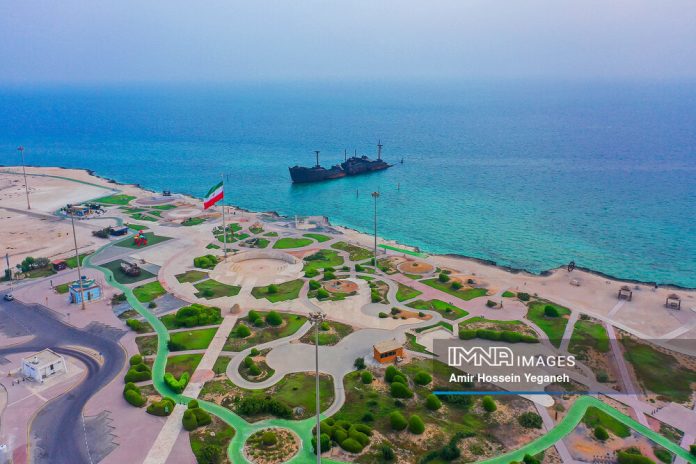
UAE claims on Persian Gulf trio islands flagrant violation of UN Charter: Iran mission

Persian Gulf

“Iran regards such groundless statements as violation of the sovereignty and territorial integrity of a member of the United Nations and a gross violation of international law and the United Nations Charter,” the mission said on Sunday.

The mission issued the statement in response to latest remarks by the UAE’s Minister of State for International Cooperation Reem Al Hashimy, who renewed her country’s demand that Iran should end “occupation” of the islands of Greater Tunb, Lesser Tunb, and Abu Musa.

Speaking at the 78th Session of the United Nations General Assembly, Hashimy stated the UAE will “continue to seek a resolution, either through direct negotiation or through the International Court of Justice. This has been our firm stance for decades.”

The Iranian diplomatic mission stressed it is regrettable that the Emirati representatives repeat such an unfounded claim about the three Iranian islands in the Persian Gulf in the General Assembly session every year.

It added that the three islands have always been an integral part of the Iranian territory and will remain so. “Any claim contrary to this fact is invalid.”

The mission reiterated Iran’s commitment to the policy of cordial relations with its neighbors, including the UAE, but said the Islamic Republic’s territorial integrity and sovereignty over the three islands will not be subject to negotiation.

The three Persian Gulf islands have historically been part of Iran, proof of which can be found and corroborated by countless historical, legal, and geographical documents in Iran and other parts of the world. However, the United Arab Emirates has repeatedly laid claim to the islands.

The three islands fell under British control in 1921 but on November 30, 1971, a day after British forces left the region and just two days before the UAE was to become an official federation, Iran’s sovereignty over the islands was restored.

Iran recognizes that Arabs ruled the islands for centuries, but all historical documents show that they did so from the Iranian port city of Lengheh and therefore as Iranian subjects.

Iran president: 60% uranium enrichment came after E3 trampled on nuclear deal commitments

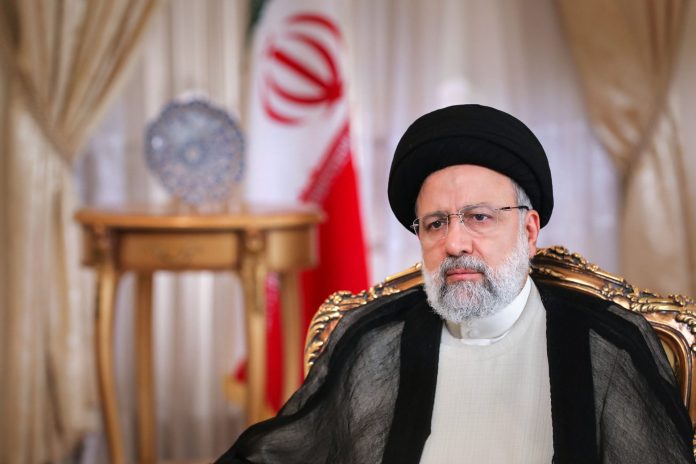
Ebrahim Raisi

Raisi made the statement in an interview with the CNN’s Fareed Zakaria on the sidelines of the 78th session of the United Nations General Assembly in New York.

“In the beginning, we were not seeking 60% levels of enrichment. They (European states) trampled upon their commitments,” the Iranian president said.

“What the Islamic Republic of Iran did was in response to a breaking of commitment of the signatories to the (2015) agreement.”

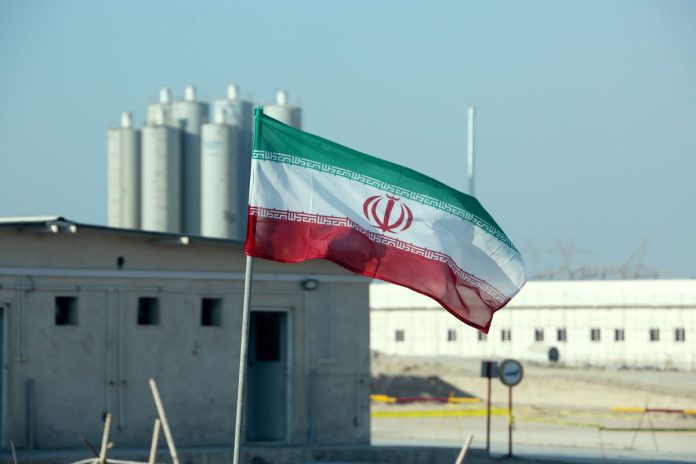
Head of the Atomic Energy Organization of Iran (AEOI) Mohammad Eslami announced in June that enriching uranium to the said purity level was in accordance with a December 2020 parliamentary law – the Strategic Action Plan to Counter Sanctions.

The law was passed with the purpose of removing anti-Iran sanctions as well as the production of radiopharmaceuticals and detectors, among other aims.

Earlier in the month, Reuters cited a confidential report by the International Atomic Energy Agency (IAEA) claiming that Iran’s stockpile of 60% enriched uranium continued to grow, albeit at a slower pace than in the previous quarter.

In the interview, Raisi categorically rejected the country’s enrichment of uranium to near weapons-grade levels, saying, “It was officially announced that the action that we intend to take is not intended to reach nuclear weapons of any type or a military dimension of any type, but it is… a response for the lack of commitment demonstrated by the Europeans.”

He also reiterated Tehran’s long-standing conviction that the Islamic Republic does not plan to acquire a nuclear bomb.

The United States, under former President Donald Trump, abandoned the Joint Comprehensive Plan of Action (JCPOA) in May 2018 and reinstated crippling sanctions that the agreement had lifted.

The talks to revive the 2015 deal kicked off in Vienna in April 2021, with the intention of removing anti-Iran sanctions and examining Washington’s seriousness in rejoining the JCPOA.

The discussions, however, have been at a standstill since August 2022 due to Washington’s refusal to remove all the sanctions imposed by the previous US administration.

The European Union, which acts as the coordinator of the talks, forwarded at the time a new proposal to the Islamic Republic in order to break the impasse. Iran submitted its response to the draft proposal on August 15, 2022, a week after the latest round of talks wrapped up in Vienna.

After submitting its response to the EU proposal, Tehran urged Washington to show “realism and flexibility” in order to reach an agreement. However, it took almost ten days for the administration of President Joe Biden to submit its response to Iran’s comments on the EU draft.

Iran blamed the failure of the JCPOA’s revival on the procrastination of the American side in providing an answer and said moving to the next stage would have been possible had the US government shown serious willpower and acted responsibly in its promises.

Live Update: Russia’s “Special Operation” in Ukraine; Day 578

Russia Ukraine War

Zelensky says US Abrams tanks have arrived in Ukraine

US Abrams tanks have arrived in Ukraine and are “getting prepared to reinforce our brigades,” Ukrainian President Volodymyr Zelensky stated Monday.

“Good news from Minister [of Defense Rustem] Umerov. ‘Abrams’ are already in Ukraine and are getting prepared to reinforce our brigades. I am grateful to our allies for fulfilling the agreements! We are looking for new contracts and expanding the geography of supply,” Zelensky said in a Telegram statement.

Zelensky also commented on Russia’s overnight attack on Odesa, saying “air defense coverage of Odesa region is a priority in all my negotiations concerning air defense.”


Ukraine claims Russian Black Sea Fleet’s commander killed in Sevastopol attack

Ukraine has claimed that the commander of Russia’s Black Sea Feet, Admiral Viktor Sokolov, has been killed in the Ukrainian attack in Sevastopol on Friday.

“After the hit of the headquarters of the Russian Black Sea Fleet, 34 officers were killed, including the commander of the Russian Black Sea Fleet,” the Ukrainian Special Operations Forces said in an update Monday, adding that more than 100 other Russian servicemen were wounded.

Sevastopol, home to Russia’s Black Sea Fleet headquarters, is one of the largest cities on the Crimean peninsula and was illegally annexed by Moscow’s forces in 2014.

Moscow has announced that one serviceman is missing as a result of Ukraine’s attack on Sevastopol.


2 people have now been confirmed dead in Odesa

Two people have been confirmed dead following Russia’s overnight attack on the southern Ukrainian port city of Odesa, according to Oleh Kiper, the head of the Odesa regional military administration.

One victim was found under the rubble of a warehouse where grain was stored, Kiper said in a social media post. The body of another individual working in the warehouse was found earlier.

Our sincere condolences to the families and friends,” Kiper added.

One injury has been reported so far.


Ukraine’s defense ministry says Russia’s attack on Odesa was “pathetic attempt at retaliation”

Russia’s overnight attack on the southern Ukrainian port city of Odesa was a “pathetic attempt at retaliation” the Ukraine Defense Ministry said Monday on social media.

The ministry contended that the Kremlin was responding to Ukrainian attack on Russia’s Black Sea Fleet headquarters in Sevastopol on Friday.

Ukraine’s military alleged that Russia’s attack on Odesa was a violation of international humanitarian law, as it targeted both troops and civilian infrastructure, including the power supply.

Ukraine’s energy minister announced Monday that about 1,000 consumers were without electricity. A “large-scale repair campaign” is under way, according to the ministry, and engineers continue to prepare the power system for the winter heating season.


Ukrainian drones attack border regions and Crimea: Russian officials

Ukrainian drones targeted Russian border regions and the occupied Crimean peninsula overnight, Russian officials said Monday.

Here’s where the attacks took place:

Bryansk: Alexander Bogomaz, governor of the region in western Russia, said air defenses “shot down two aircraft-type unmanned aerial vehicles,” over Surazhsky district. There were no casualties or damage, he added.

Kursk: Gov. Roman Starovoit said several homes and an administrative building were damaged in the western border region’s central district following Ukrainian drone attacks. No casualties were reported, he added.

Crimea and the Black Sea: Russia’s defense ministry announced it destroyed four drones over the northwestern part of the Black Sea and over Crimea overnight. It comes after Kyiv launched one of its most ambitious attacks yet on the peninsula Friday, targeting Russia’s Black Sea headquarters.


Russian strikes caused “significant damage” to Odesa port: Ukrainian military

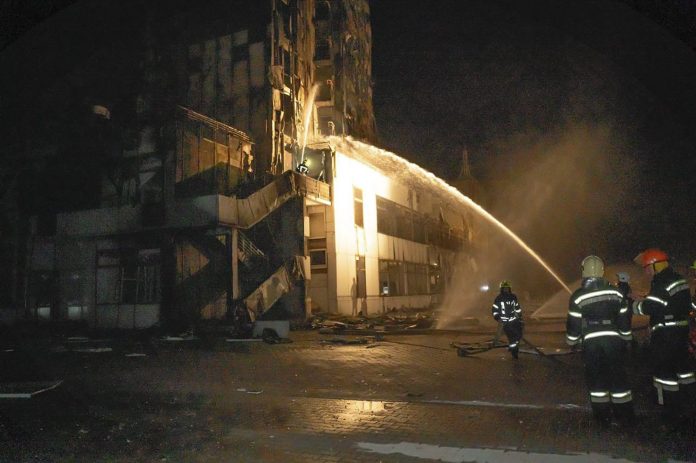
The southern port of Odesa sustained “significant damage” in Russian strikes overnight, Ukrainian military officials stated Monday, as more details emerged of Moscow’s latest attack on Ukraine’s grain export infrastructure.

In a Telegram post, the Defense Forces of the South of Ukraine said Russia launched two Oniks supersonic missiles, 12 Kalibr cruise missies and 19 attack drones at Odesa overnight.

Air defenses intercepted all of the drones and 11 of the Kalibr missiles, but “unfortunately, the enemy hit the port infrastructure,” it said.

The attacks also caused a fire at a defunct hotel, the post added.

Russia has repeatedly attacked Odesa in recent months, targeting Ukrainian grain infrastructure following the collapse of the Black Sea grain deal.

In a Telegram post earlier Monday, Oleh Kiper, head of the region’s military administration, stated at least one civilian was injured in the overnight attacks.


Poland is creating routes for Ukrainian grain to reach countries in need: President

Poland has prepared transit corridors that will allow Ukrainian grain shipments to move through its territory and reach the countries most in need, President Andrzej Duda said Sunday.

The comments are notable because the Polish government has joined Hungary and Slovakia in extending a ban on cheap Ukrainian grain imports, which they say have undercut local farmers.

Speaking Sunday, Duda stated Poland will however still help shipments reach their final destination.

During a speech at a Ukraine recovery summit on Friday, Duda said the grain dispute with Ukraine will not have a serious impact on the relations between the two countries, as they have a “historic dimension,” according to state news agency PAP.

“We are trying to help Ukraine and those countries that require this help. I believe that it is the right decision that the Polish government has maintained the ban on the sale of Ukrainian grain on the Polish market,” Duda said in an interview with Polish television channel TVP1 on Sunday.

“However, we must do everything to ensure that transit is as great as possible,” Duda added, according to a statement by his office.

Kyiv and Warsaw have publicly feuded this week over the grain issue and the question of supplying weapons.

In remarks on Thursday, Duda also tried to clarify statements by Prime Minister Mateusz Morawiecki, who had said that Poland will stop weapons deliveries to Ukraine, after President Volodymyr Zelensky said at the United Nations General Assembly on Tuesday that “some of our friends in Europe, play out solidarity in a political theater.”

After a week of tense back and forth between Kyiv and Warsaw, Morawiecki shot back at Zelensky on Friday, saying he should never “insult Poles again.”


Russian attacks kill at least 2 in Kherson

Russian attacks Sunday killed at least two people and wounded at least nine others in Ukraine’s southern Kherson region, Ukrainian authorities confirmed.

“The enemy dropped two aerial bombs on the city (of Kherson),” Oleksandr Prokudin, head of the region’s military administration, said in a Telegram post.

One strike hit an industrial area and the other hit civilian infrastructure, an official snoted.

A 49-year-old woman working as a security guard was among those wounded in the bombings, Prokudin continued.

A total of six people were injured in Kherson city, Roman Mrochko, the head of the Kherson city military administration, said in a Telegram post.

More have been wounded elsewhere in the region: Ukraine’s Prosecutor General’s Office said earlier Sunday that two people had been killed and three were injured in attacks near the city of Beryslav.

A 53-year-old man also died as a result of a Russian artillery strike on Zaporizhzhia on Sunday, according to Yurii Malashko, the head of the region’s military administration.

Iran says has thwarted major terror plot

Iran Security Forces

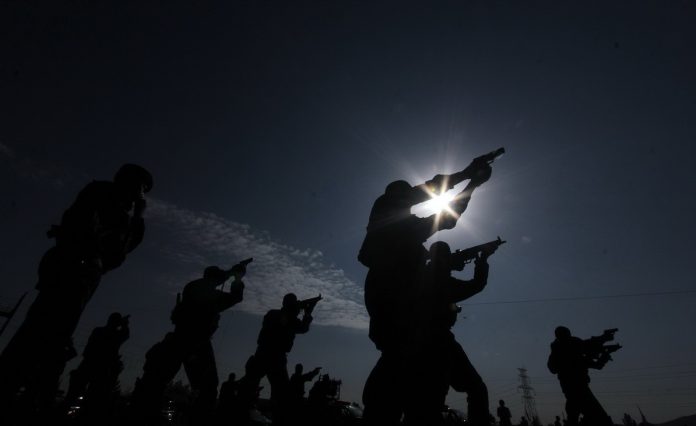
The intelligence ministry announced in a statement on Sunday that its forces have foiled a ferocious plot to carry out 30 simultaneous bombing attacks on populous areas of capital Tehran and have arrested all terrorists involved in the plot.

The statement said the bombing attacks had been planned with the purpose of undermining Iran’s security, displaying a false image of instability in Iran, fomenting disappointment and terror in the society, and provoking chaos and protests exactly on the anniversary of the last year’s riots.

The ministry noted that its forces have conducted a series of simultaneous operations during the recent days in the provinces of Tehran, Alborz and West Azarbaijan, raided the houses of terrorist teams, and arrested 28 members of the terrorist network.

The arrested elements are affiliated with the Daesh terrorist group, the statement added, saying a number of the arrestees used to fight alongside Takfiri terrorists in Syria or had been present in Afghanistan, Pakistan and the Kurdistan Region of Iraq.

Although the elements arrested in Iran belong to Daesh terrorist group, the design of their plot and their behavioral pattern are much more complicated in technical terms than those of the conventional Takfiri currents and significantly conform to the patterns and mechanisms of the Zionist regime, it added.

The statement also said weapons and equipment have been confiscated from the terrorists in the recent operations, including a huge amount of explosives, bombs, large amount of explosive device materials, a package of 100 explosive primers, electronic devices used in time bombs, 17 American handguns and bullets, diverse smart and satellite telecommunication devices, military outfits, suicide vests, modems used in the Kurdistan Region of Iraq, and foreign currencies.

The ministry added that during one of the operations at a house, the terrorists tried to carry out a suicide attack which could have harmed people in the nearby houses, but the intelligence forces acted bravely and swiftly and prevented the suicide explosion.

Unfortunately, two Iranian intelligence forces were injured in the operation, it concluded.

Iran says serious about returning to nuclear deal if US, E3 ready

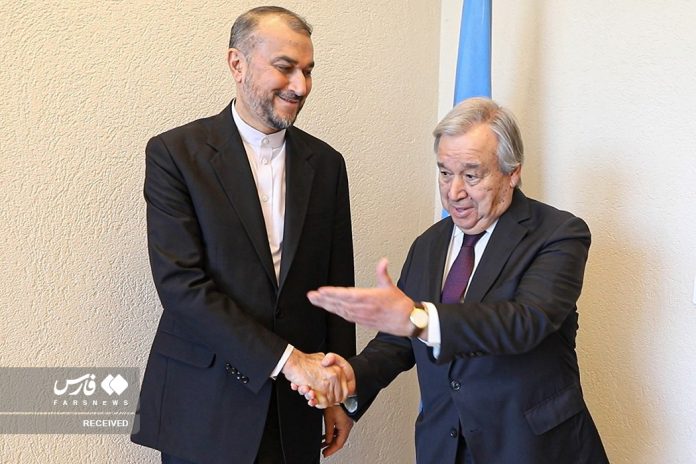
António Guterres and Amirabdollahian

Amirabdollahian sat down with UN Secretary General Antonio Guterres at the headquarters of the world body in New York.

In the meeting, Amirabdollahian briefed the UN chief on the trends of, and the good progress made in relations between Iran and its neighboring countries and some Arab and Islamic states.

Amirabdollahian touched upon a prisoner swap between Iran and the US and the release of Iran’s frozen assets in South Korea, saying Tehran has good consultations with the UN secretary general with regards to the Iran nuclear deal, the Joint Comprehensive Plan of Action (JCPOA).

“Exchange of messages with the United States continues and the sultan of Oman’s plan is still on the table, and if the other parties are ready, we are serious about returning to the JCPOA, so that all signatories will return to their commitments under the JCPOA within the framework of Oman’s initiative,” Amirabdollahian explained.

As for cooperation with the International Atomic Energy Agency (IAEA), the Iranian foreign minister said, “Things move on the right path whenever the IAEA acts within the technical framework, but things are messed up whenever others prefer their political viewpoints to the IAEA’s professional issues.”

Amirabdollahian said nuclear bombs have no place in Iran’s doctrine.

Elsewhere in his remarks, Amirabdollahian touched upon initiatives put forward by Iranian President Ebrahim Raisi in his address to the annual meeting of the UN General Assembly.

“An important part of his speech was related to the necessity of supporting the foundation of the family, and it is necessary that we have a mechanism within the framework of the UN to protect the foundation of the family,” the Iranian foreign minister noted.

Amirabdollahina also elaborated on Iran’s principled stance on the Ukraine crisis, adding, “We respect the territorial integrity of countries, including Ukraine, and believe war is not a solution.”

Guterres, in turn, said he was pleased with the meeting and expressed his gratitude for the Iranian foreign minister sharing his views on the issues brought up, saying he had a good meeting with President Raisi.

The UN chief thanked the Iranian side for the diplomatic initiatives to settle problems, remove obstacles and expand relations with countries.

2 Palestinians killed by Israel in WB amid surge in military raids

Israeli Forces

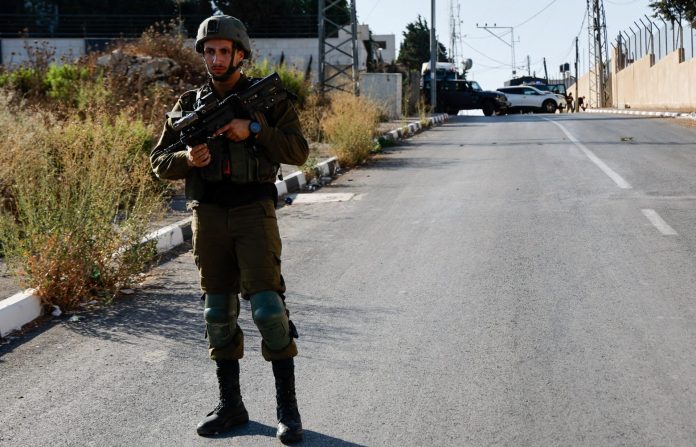
The Palestinian Ministry of Health said two men – Asid Abu Ali, 21, and Abdulrahman Abu Daghash, 32 – were killed by Israeli fire in Sunday’s raid, which caused heavy damage to camp infrastructure.

In its comment on the latest bloodshed, the Israeli military claimed it had gone into the Nour Shams refugee camp to destroy “a militant command centre and bomb-storage facility” in a building.

It said that engineering units detonated several bombs planted under roads and that armed Palestinian fighters opened fire and hurled explosives at the raiding army, causing Israeli troops to respond with live fire.

Earlier in the month, Israeli forces fatally shot 21-year-old Ayed Samih Khaled Abu Harb in the head during a raid on Nour Shams refugee camp.

Israel has been carrying out stepped-up military raids, primarily in the north of the occupied West Bank, for the past 18 months in what it says is a campaign to root out Palestinian resistance fighters and thwart future attacks.

The Israeli army has been militarily occupying the West Bank, where some three million Palestinians live, for 56 years.
In July, Israel launched one of its biggest attacks on the occupied West Bank, killing at least 12 Palestinians in the Jenin refugee camp and wounding about 100 others.

The raids have shown little sign of slowing the fighting and contributed to the weakening of the Palestinian Authority, the self-ruled administration over parts of the Israeli-occupied West Bank.

The United Nations has announced 2023 is the deadliest year for Palestinians since it started counting deaths in 2006.

More than 200 Palestinians have been killed by Israeli fire since the start of this year, according to the Health Ministry. At least 35 Israelis were also killed in Palestinian attacks during the same period.

Iran says no one takes Israel’s threats seriously

Netanyahu

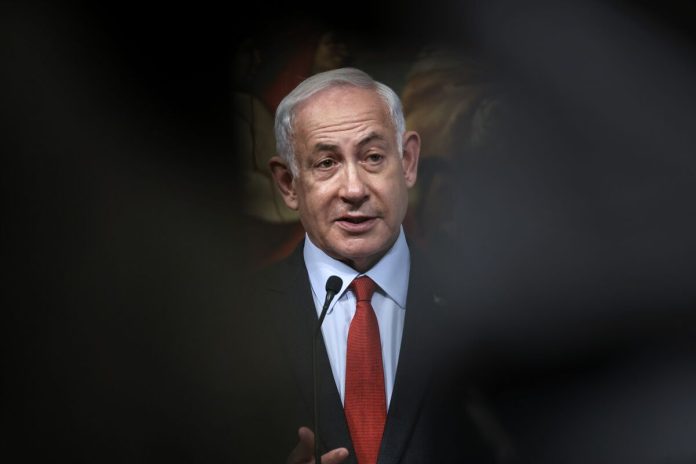
Amirabdollahian’s remarks came on Sunday, two days after Netanyahu called for a “credible nuclear threat” against Iran in an address to the 78th session of the United Nations General Assembly. However, the hawkish premier’s office later clarified that he misread the line and meant to say a “credible military threat.”

Amirabdollahian said that Tel Aviv is only capable of issuing threats but not acting upon them.

“Firstly, Netanyahu and the fake Israeli regime are only capable of making threats against the Islamic Republic. That is, if they were able to do something, they would not resort to such rhetoric. Today, they (the Israelis) are grappling with multi-layered crises inside the occupied territories,” he added.

“Secondly, the prime minister of a fake and occupying regime uses the language of threats from the UN podium disrespecting the world body rules; a fact that shows the Zionist regime is taking advantage of international tools.”

The top Iranian diplomat also noted that some officials from different countries, who had attended the General Assembly meeting, referred to Netanyahu’s behavior as a joke.

“The Zionists, who are themselves in possession of hundreds of nuclear warheads, brazenly continue their threatening programs,” he said, adding, “But basically, the fake Israeli regime is not in a position where people take its words and threats seriously. The Zionists are today in their weakest state.”

Israel, which pursues a policy of deliberate ambiguity about its nuclear weapons, is estimated to have 200 to 400 nuclear warheads in its arsenal, making it the Middle East’s sole possessor of non-conventional arms.

The usurping entity has, however, refused to either allow inspections of its military nuclear facilities or sign the Nuclear Non-Proliferation Treaty (NPT).

On the contrary, Iran has long been cooperating with the International Atomic Energy Agency (IAEA) as a signatory to the NPT.

Iran showed the world the peaceful nature of its nuclear program by signing the 2015 nuclear agreement with six world powers.

Saudi Arabia won’t be tempted to seek nuclear bombs since Iran does not have them: Russia

Iran nuclear programe

In response to a TASS request to comment on Saudi Crown Prince Mohammed bin Salman’s statement that the kingdom would seek nuclear weapons if Iran developed them, Lavrov noted that he took it as “a statement of fact.”

“No one wants more nuclear countries to emerge in the world. The Islamic Republic of Iran has repeatedly confirmed that it does not have such plans. Their spiritual leader even issued a fatwa on the matter,” the top Russian diplomat emphasized.

“This is why we believe that since they will not have a nuclear bomb, Iran’s neighbors will not be tempted to take that path,” he added.

The Saudi crown prince noted in an interview with the US TV channel Fox News that Riyadh was “concerned if any country getting a nuclear weapon: that’s a bad move.”

MbS has asked the Joe Biden administration “to help his country develop a civilian nuclear program, which some US officials fear could be cover for a nuclear weapons program to counter Iran”.

Tehran has repeatedly declared that its nuclear program remains purely peaceful as always and that the Islamic Republic had no intention of developing nuclear weapons as a matter of an Islamic and state principal.

Leader of the Islamic Revolution Ayatollah Seyyed Ali Khamenei issued an official fatwa (religious decree) clearly establishing that any form of acquisition, development, and use of nuclear weapons violate Islamic principles and are therefore forbidden.

Protests against Israeli PM’s judicial reform held for 38th week

Israel Protest

As was the case in previous weeks, the coastal city of Tel Aviv was the epicenter of Saturday protests in which demonstrators slammed the extremist policies of Prime Minister Benjamin Netanyahu’s cabinet, including the highly controversial judicial overhaul scheme.

According to organizers, demonstrations were held at approximately 150 locations across the occupied territories, including the city of Haifa.

This week’s protests came following Netanyahu’s speech at the 78th session of the United Nations General Assembly.

The protesters accused Netanyahu of fleeing to the United States to avoid a corruption cases against him as well as the mass protests that have been prompted by his so-called overhaul scheme.

In Tel Aviv, protesters wore shirts reading “Save us from Netanyahu” and held up signs reading “Crime Minister.”

“The world should know that whatever they hear from our prime minister … everything that he says is a lie. He’s trying to blind everyone else and when he comes back here, then he goes back to his try to save his skin and he’s … fighting … only for himself, and the world doesn’t know it,” a protester told AFP.

“We’re here together with tens of thousands … and we come here in the hope that we can make a difference. Each one of us being here, saying ‘we don’t approve’ … and we will be back here every week until there’s a change,” another protester said.

The protests have been a fixed weekly event since January, when Netanyahu announced the overhaul scheme, which seeks to rob the regime’s Supreme Court of the ability to invalidate the decisions made by the politicians.

The scheme has galvanized the largest protest movement the regime has faced in its history.

Despite overwhelming public pressure, including weekly protests, a wave of industrial actions, and rising opposition among the regime’s military ranks, Netanyahu’s cabinet has passed one of the scheme’s bills through the Knesset. The bill removed the Supreme Court’s power to strike down government decision’s or appointments on the basis of being “unreasonable.”

Netanyahu’s far-right cabinet has pledged to push ahead with the rest of the scheme.

Proponents of the overhaul say it helps redistribute the balance of power between the politicians and the judiciary. Its opponents, however, accuse Netanyahu of trying his hand at a power grab. They say the premier, who is on trial in three corruption cases for receiving bribe, fraud, and breach of trust, is also attempting to use the scheme to quash possible judgments against him.

The regime’s Supreme Court, for the first time in its history, convened its entire 15-judge bench earlier this month to hear an appeal against that bill, and is expected to issue its decision at a later date.

A key hearing on another portion of the overhaul, which pertains to Israeli justice minister’s refusal to convene the committee selecting the nation’s judges, is set for later this month.

The regime’s attorney general has said that Justice Minister Yariv Levin’s actions reflect an effort to politicize the judicial selection process.

Russia, Iran, Turkey FMs to keep trying to resolve Syria situation

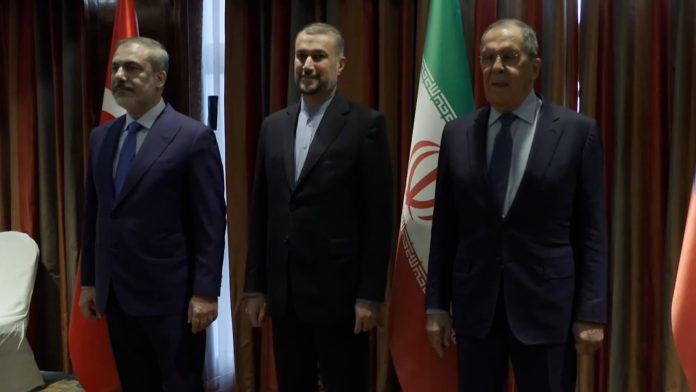
Sergey Lavrov, Hossein Amirabdollahian and Hakan Fidan

“The parties had a thorough exchange of views on the situation in the Syrian Arab Republic and around it with a focus on the need to ensure lasting stability in the country. In this regard, the key role of the Astana group was highlighted and the three countries’ determination was reaffirmed to continue joint efforts to contribute to resolving the situation in Syria based on strict compliance with the principles of respect for its sovereignty, unity and territorial integrity,” the Russian Foreign Ministry said in a statement.

The parties also highlighted “the need to mobilize foreign aid to Syria, particularly to ensure its post-conflict reconstruction and promote the return of Syrian refugees to their home country”, it added.

The ministry noted that the three foreign ministers had also held consultations with the UN secretary general’s Special Envoy For Syria Geir Pedersen.

“They discussed ways to promote the political process led and owned by the Syrian people with the assistance of the United Nations. The parties paid attention to the need to ensure the effective activities of the intra-Syrian Constitutional Committee, and considered issues related to the provision of humanitarian assistance to all Syrians in need in accordance with the norms and principles of international law,” the foreign ministry concluded.

Iran and Russia, as the allies of the Syrian government, as well as Turkey, which sides with the opposition, set up the Astana peace process in January 2017 intending to put an end to the Syrian conflict through the involvement of the Syrian government and the opposition.