Thursday, December 25, 2025
Home Blog Page 1245

Regional security and stability hinge on Palestinian issue: Saudi Arabia

Faisal bin Farhan

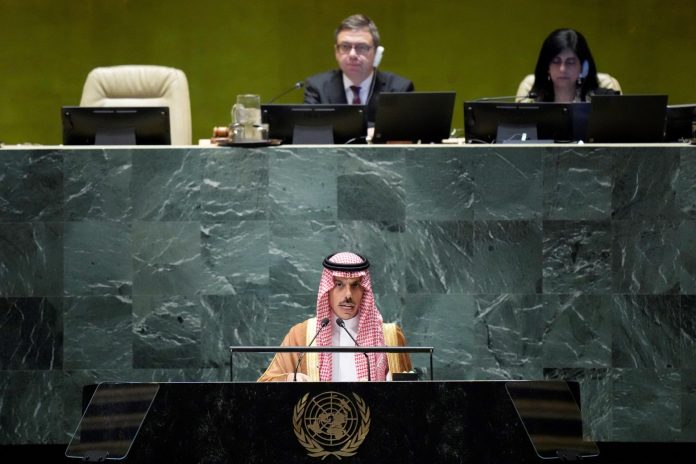
“Security in the Middle East requires an acceleration in the search for a just and comprehensive solution to the Palestinian problem based on international law and the Arab peace initiative, guaranteeing the right of the Palestinian people to create an independent state within the 1967 borders,” the Saudi minister said at the United Nations General Assembly, adding that his country rejects any actions that impede the resolution of the Palestinian issue.

Bin Farhan Al Saud also noted the need for de-escalation in Sudan, called for a solution to the Syrian crisis and declared the country’s interest in security and stability in Yemen.

In addition, the minister added that Riyadh is striving to stabilize energy prices.

On Wednesday, Saudi Crown Prince Mohammed bin Salman Al Saud said that the country is “getting closer every day” to normalizing relations with Israel. On Friday, Israeli Prime Minister Benjamin Netanyahu said that Israel is on the verge of a historic peace agreement with Saudi Arabia, which will change the face of the Middle East.

Relations between Palestine and Israel have been adversarial since the latter’s founding in 1948. Palestinians seek diplomatic recognition of their independent state on the territories of the West Bank, including East Jerusalem, which is partially occupied by Israel, and the Gaza Strip. The Israeli government refuses to recognize Palestine as an independent political and diplomatic entity and continues to build settlements in the occupied areas despite objections from the United Nations.

First convoy of humanitarian aid enters Nagorno-Karabakh

Convoy of humanitarian aid Nagorno-Karabakh

“We are in close cooperation with the Russian peacekeepers, conducting the demilitarisation” of the separatists, Azerbaijan Ministry of Defence spokesman Anar Eyvazov told reporters in Shusha on Saturday, a district on the edge of the rebel stronghold of Stepanakert.

“We have already seized weapons and ammunition,” Eyvazov said, adding that its soldiers along with Russian peacekeepers are working jointly to disarm separatist fighters in the Nagorno-Karabakh region – home to more than 100,000 ethnic Armenians.

Karabakh is recognised internationally as part of Azerbaijan.

Azerbaijan launched a lightning offensive on Tuesday on ethnic Armenian rebel positions in what it called an “anti-terrorist operation“. It demanded they lay down their arms and the separatist government disband.

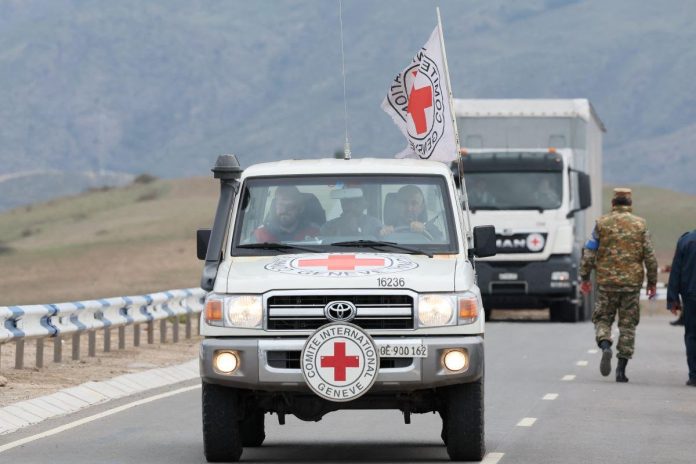
With Armenians suffering serious shortages of food and fuel after a months-long de facto Azerbaijani blockade, an aid convoy of the International Committee of the Red Cross (ICRC) headed into Karabakh on Saturday, the first since Azerbaijan’s military operation.

The ICRC said in a later statement that the convoy had transported nearly 70 tonnes of humanitarian supplies, including wheat flour, salt and sunflower oil, along the Lachin corridor, the only highway connecting Armenia and the mountainous Nagorno-Karabakh region.

An ICRC team also carried out the medical evacuation of 17 people wounded during the fighting, it added.

Separately, Russia announced it had delivered more than 50 tonnes of food and other aid to Karabakh.

More than 20 other aid trucks, bearing Armenian number plates, have been lined up along a nearby roadside since July. Azerbaijan said at the time that this convoy amounted to a “provocation” and an attack on its territorial integrity.

The ethnic Armenian leadership said that the terms of their ceasefire with Azerbaijan were being implemented, with work proceeding on the delivery of humanitarian aid and evacuation of the wounded.

Work was under way to restore the electricity supply by September 24, it announced in a statement.

Russia’s defence ministry said that, under the terms of the ceasefire, the Armenian separatists had begun handing over their weapons to Azerbaijan, including more than 800 guns and six armoured vehicles. Moscow has 2,000 peacekeepers in the area.

Russia deployed several thousand peacekeepers to the region in the wake of a brief but brutal 2020 war in which Azerbaijan reclaimed large parts of the territory and its surroundings from the separatists.

Azerbaijan intends to integrate the long-contested region, but ethnic Armenians have said they feared they will be persecuted and have accused the world of abandoning them.

But Azerbaijan’s foreign minister in his UN General Assembly address on Saturday said his country wants to integrate ethnic Armenians as “equal citizens”.

“I wish to reiterate that Azerbaijan is determined to reintegrate ethnic Armenian residents of the Karabakh region of Azerbaijan as equal citizens,” Jeyhun Bayramov stated.

He added that Azerbaijan and Armenia have a “historic opportunity” to establish good neighbourly relations and co-exist side by side in peace. It is high time to seize this opportunity.”

Backing the ceasefire in Nagorno-Karabakh, Russia’s Foreign Minister Sergei Lavrov said that time was ripe for trust-building measures between Armenia and Azerbaijan, adding that Moscow’s troops would help that.

In his address at the UN, Lavrov accused the West of trying to force themselves as mediators between the two countries, which he said was not needed.

Israel, Lebanon forces fire tear gas along tense border in disputed area

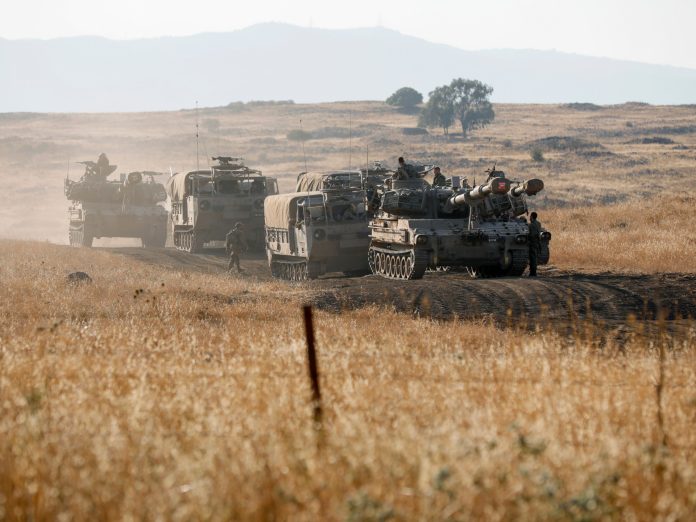
Israeli Tanks

Tensions have flared along the frontier for the past several months, with rockets fired at Israel during flare-ups of Israeli-Palestinian violence and members of the heavily armed Lebanese group Hezbollah or its supporters facing off with Israeli forces.

“Elements of the Israeli enemy violated the withdrawal line and fired smoke bombs at a Lebanese army patrol that was accompanying a bulldozer removing an earthen berm erected by the Israeli enemy north of the withdrawal line, the blue line, in the Bastra area,” the Lebanese army said in a statement on Saturday.

The area where the incident occurred is in Chebaa Farms and the Kfar Chouba hills, which were captured by Israel from Syria during the 1967 Middle East war and are part of Syria’s Golan Heights that Israel annexed in 1981.

That unilateral annexation was not recognised internationally, except by the administration of former US president Donald Trump, and Syria demands the return of the territory. The Lebanese government has said the area belongs to Lebanon.

The Israeli military announced it was Lebanon that started the violence.

“A short while ago, [Israeli] soldiers spotted an engineering vehicle’s shovel crossing the Blue Line from Lebanon into Israeli territory in the area of Mount Dov,” a statement from the Israeli military said.

“In response, [Israeli] soldiers used riot dispersal means.”

“The vehicle returned to Lebanese territory,” the military added.

The Lebanon-Israel border has been relatively calm since Israel and Hezbollah fought a 34-day war in 2006. Despite that, there have been tensions.

In April, Israel launched rare air raids in southern Lebanon after fighters fired nearly three dozen rockets from Lebanon at Israel, wounding two people and causing property damage.

In July, Israeli forces shelled a southern Lebanese border village after several explosions were heard in a disputed area where the borders of Syria, Lebanon and Israel meet.

Russia FM to visit North Korea in October for further negotiations

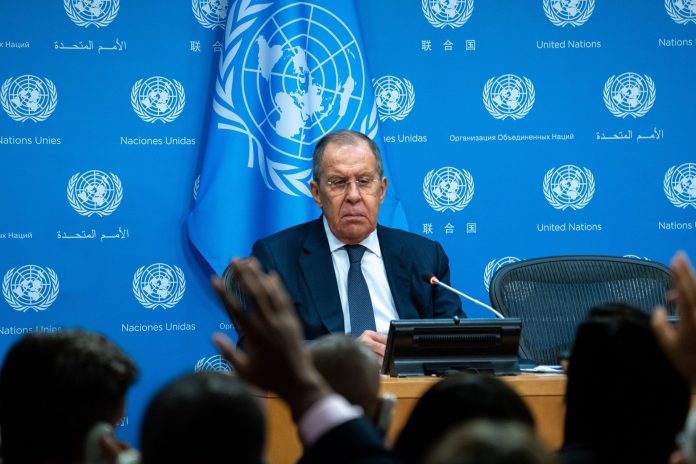
Sergei Lavrov

Putin accepted an invitation to visit North Korea earlier this month after the two leaders held their first face-to-face summit in four years.

The talks in Russia have raised concern in the United States and elsewhere that Kim might be prepared to sell weapons to Moscow for its war in Ukraine, perhaps in exchange for technology that would further his military ambitions.

South Korea’s Foreign Ministry announced on Saturday that US Secretary of State Antony Blinken and South Korean, Japanese counterparts expressed “serious concern” over the discussion of military cooperation between Russia and North Korea, including possible arms trade.

Blinken, South Korea’s Foreign Minister Park Jin and Japan’s Foreign Minister Yoko Kamikawa agreed to respond firmly to any acts that threaten regional security in violation of United Nations Security Council resolution in a brief meeting on Friday, the statement read.

Campaigners warn Israel’s facial recognition bill a threat to Palestinians

Israel Palestine

Israel’s Ministerial Committee on Legislation has voted to approve the bill, which privacy rights campaigners have warned would lead to “more violations” against Palestinians by the ultranationalist right-wing government.

Submitted by the country’s far-right national security minister, Itamar Ben Gvir, and justice minister, Yariv Levin, the bill is being described as a government effort to tackle crime in Arab communities.

If passed, it would allow Israeli police to install facial recognition cameras and collect biometric data from individuals in public spaces across the country, particularly in Palestinian towns and cities in Israel.

It would grant police the right to activate the cameras without judicial warrants or oversight, according to 7amleh (The Arab Centre for the Advancement of Social Media).

The surveillance system, according to 7amleh: “Would therefore pave the way for the exploitation of personal information for the purpose of blackmailing citizens and violating their privacy.”

Likewise, Adi Mansour, a lawyer at a Palestinian-run legal centre in Israel, described the bill as an attempt to: “Grant abusive powers to law enforcement bodies under the false pretext of fighting crime.”

“Instead of permitting more violations of privacy and other rights through means of surveillance that also encompass a threat of further deepening a culture of racial profiling, Israeli authorities should consider trying to solve crimes with the extensive powers they already hold,” Mansour told MEE.

Meanwhile, Anna Bacciarelli, associate tech director at Human Rights Watch, stated the bill should be thrown out.

“It is a significant threat to human rights and gifts the Israeli government unprecedented powers to surveil and profile absolutely everybody who walks down the street,” Bacciarelli said, speaking to MEE.

“The government is right that facial recognition tech should be regulated, but this powerful technology should be banned from public spaces, rather than green-lighted for widespread use,” she pointed out.

“Facial recognition tech poses a huge risk to privacy, non-discrimination, and assembly rights, and is only likely to supercharge existing structural discrimination, particularly against Palestinians in Israel,” she added.

In a statement, Al-Meezan, an independent, non-partisan Palestinian human rights organisation based in the Gaza Strip, said the approval of the bill would lead to further infringement of the privacy of Palestinians under the pretext of preventing crime.

“Operating biometric cameras to recognise the faces of people in public places is not only to fight crime, but the danger here is that everyone becomes monitored in all their movements and residences by the security services,” al-Meezan added.

On the other hand, the approval of the bill was welcomed by Israel’s police commissioner, Kobi Shabtai, who described it as: “A life-saving tool, without which the Israel Police would not be able to deal with criminal terrorism, murder incidents, and assassination attempts in the Arab sector.”

Shabtai also said to his senior command staff at their weekly meeting that the bill represents: “A balance between the need to preserve human life and the importance of protecting individual rights.”

Following the bill’s approval, Ben Gvir described it as “accurate and balanced”.

“At a time when the number of murders in Arab society is rising… cameras that recognise faces are very important,” Ben Gvir stated, adding, “We will do everything to prevent the improper use of cameras, and for this, we have established a prison sentence, and limited use to serious cases.

The controversial national security minister has a history of controversial remarks about Palestinians, most recently in August when the US State Department condemned remarks in which he suggested that some of his rights were more important than those of Palestinians.

“My right, and my wife’s and my children’s right to get around on the roads in Judea and Samaria, is more important than the right to movement for Arabs,” noted Ben Gvir, using Jewish nationalist terms for areas of the occupied West Bank, in an interview with Israel’s Channel 12 after he was asked about the increasing tensions in the West Bank.

But the bill has not been without its critics in Israel.

Writing for the non-partisan, independent Israel Democracy Institute, Tehilla Shwartz Altshuler, a senior fellow at the Jerusalem-based think-tank, wrote that the use of AI-driven facial recognition technology would equip Israeli police with “military tools”.

They added that existing biases meant the technology could disproportionately target minority groups and that it could cast a “chilling effect,” including among those “exercising their political rights—out of fear of surveillance”.

In the Israeli parliament, Labor MK Gilad Kariv described the new bill as “extreme,” and unsuitable for any “progressive democracy”.

“This is doubly true in relation to a country that has not updated its privacy protection laws in 40 years, and whose police is undergoing a political takeover by nationalist forces,” Kariv said, adding, “This bill cannot be separated from the judicial coup, and we will oppose it with the same strength we oppose the other laws of the coup.”

Rights groups have already warned about the use of existing facial recognition technology by Israeli authorities to target Palestinians.

According to a recent report by Amnesty International, Israel is intensifying the utilisation of facial recognition technology in the occupied West Bank as a means to monitor Palestinians and restrict their mobility, a development that Amnesty has referred to as “automated apartheid”.

In occupied East Jerusalem, Israeli authorities are expanding a comprehensive surveillance network across the city, employing an extensive facial recognition system known as Mabat 2000.

This system enables Israeli authorities to closely monitor protesters and maintain constant surveillance of Palestinians as they carry out their daily routines.

The rights group stressed that the Israeli military employs the “Wolf Pack” system, aimed at creating a database containing profiles of every Palestinian residing in the West Bank.

Simultaneously, in Hebron, Palestinians are compelled to stand in front of fenced checkpoints where cameras scan their faces.

A software program called “Red Wolf” utilises a color-coded system to provide Israeli soldiers with information on whether Palestinians should be allowed to pass, subjected to interrogation, or detained.

Iraq says has implemented all clauses of security agreement with Iran

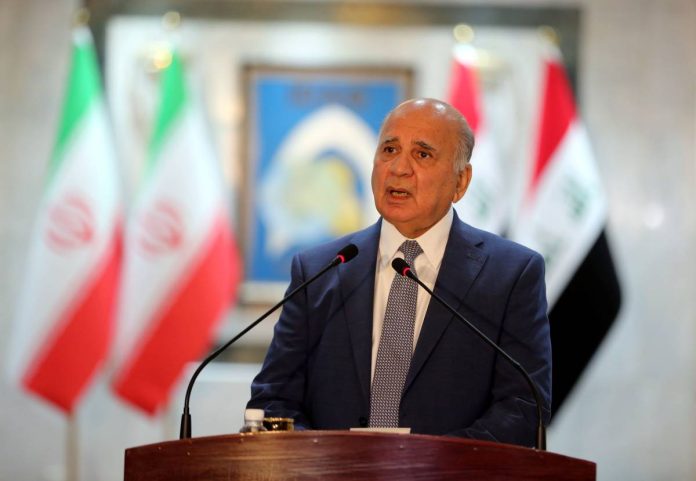
Fuad Hussein

The minister made the remarks in an exclusive interview with Alhurra satellite TV channel on the sidelines of the 78th session of the United Nations General Assembly in New York.

The top Iraqi diplomat went on to highlight the political and security aspects of the pact, stating that Iran’s cessation of artillery bombardments on the positions of secessionist groups in the Kurdistan region was among the conditions of the agreement.

Iraq, in return, is obligated to remove armed elements from border areas. The central government in Baghdad and the Kurdistan Regional Government (KRG) have managed to successfully undertake the task, Hussein noted.

Chief of General Staff of Iran’s Armed Forces, Major General Mohammad Hossein Baqeri, has said Tehran has given Iraq several more days to fully implement the March agreement to relocate and disarm anti-Iran groups.

He added that the agreement stipulated that such groups be disarmed by September 19, but this has not happened yet.

“What happened during this six-month respite was that [they] just distanced a bit from the borders of our country,” he stated while thanking the Iraqi government for its efforts to disarm the separatists.

The presence of Kurdish terrorist groups, including the Kurdistan Democratic Party, Komala, Kurdistan Free Life Party, and the Kurdistan Freedom Party, has been a source of tension between Iran and Iraq for years, with these groups often carrying out terrorist attacks on Iranian soil.

Following last year’s riots, triggered by the death of Iranian woman Mahsa Amini, these groups intensified their subversive operations against Iran and smuggled weapons to their local agents.

That prompted Iran to push Iraq to put an end to terrorist activities of the anti-Iran groups, leading to the March agreement.

Saudi Arabia sentences schoolgirl to 18 years in prison over tweets

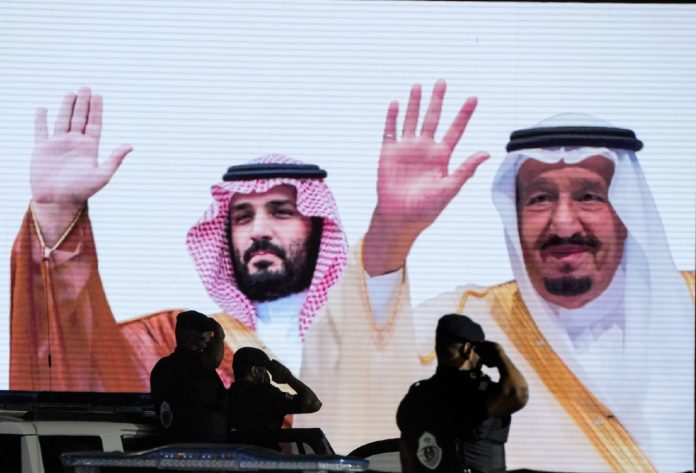
MbS King Salman

ALQST rights group, which documents human rights abuses in Saudi Arabia, has revealed that the Saudi Specialised Criminal Court handed out the sentence in August to 18-year-old Manal al-Gafiri, who was only 17 at the time of her arrest.

The Saudi judiciary, under the de facto rule of MbS, has issued several extreme prison sentences over cyber activism and the use of social media for criticising the government.

They include the recent death penalty against Mohammed al-Ghamdi, a retired teacher, for comments made on Twitter and YouTube, and the 34-year sentence of Leeds University doctoral candidate Salma al-Shehab over tweets last year.

The crown prince confirmed Ghamdi’s sentence during a wide-ranging interview with Fox News on Wednesday. He blamed it on “bad laws” that he cannot change.

“We are not happy with that. We are ashamed of that. But [under] the jury system, you have to follow the laws, and I cannot tell a judge [to] do that and ignore the law, because… that’s against the rule of law,” he said.

Saudi human rights defenders and lawyers, however, disputed bin Salman’s allegations and stated the crackdown on social media users is correlated with his ascent to power and the introduction of new judicial bodies that have since overseen a crackdown on his critics.

“He is able, with one word or the stroke of a pen, in seconds, to change the laws if he wants,” Taha al-Hajji, a Saudi lawyer and legal consultant with the European Saudi Organisation for Human Rights, told Middle East Eye.

According to Joey Shea, Saudi Arabia researcher at Human Rights Watch, Ghamdi was sentenced under a counterterrorism law passed in 2017, shortly after MbS became crown prince. The law has been criticised for its broad definition of terrorism.

Similarly, two new bodies – the Presidency of State Security and the Public Prosecution Office – were established by royal decrees in the same year.

Rights groups have said that the 2017 overhaul of the kingdom’s security apparatus has significantly enabled the repression of Saudi opposition voices, including those of women rights defenders and opposition activists.

“These violations are new under MbS, and it’s ridiculous that he is blaming this on the prosecution when he and senior Saudi authorities wield so much power over the prosecution services and the political apparatus more broadly,” Shea noted.

Ex-Wagner commander detained in Norway after attempting to return to Russia

Andrei Medvedev

Andrei Medvedev, who escaped Russia in January via its Arctic border with Norway, has described running as Russian guards fired shots at him. He has spoken about his time fighting in Ukraine as part of the Wagner group.

Police said in a statement late on Friday that a man in his 20s had been taken into custody for attempting to illegally cross the Russian border, but did not name him. An officer with the Finnmark local police declined to give the arrested man’s identity.

Crossing the border to Russia is only allowed at designated points.

But Medvedev’s arrest was due to a misunderstanding, his Norwegian lawyer Brynjulf Risnes told Reuters.

“He was up there to see if he could find the place where he crossed (into Norway in January). He was stopped when he was in a taxi. He was never near the border … It was never his intention to cross the border (into Russia),” Risnes said.

At the time of his arrival in Norway, Medvedev stated he was seeking asylum because he feared for his life after witnessing the killing and mistreatment of Russian prisoners brought to the frontline in Ukraine.

His escape in January made headlines around the world as a rare example at the time of someone defecting to a Western country while claiming to have fought for Russia as a mercenary in the Ukraine war.

But in May, he said in a video posted on YouTube he wanted to return to Russia even though he believed this could pose a risk to his life, describing himself as “some kind of a boy in a big game” that he no longer wanted to be part of.

Risnes noted Medvedev had the right to return to Russia if he wanted to, but that “a lot of changes need to happen” in order to make a safe return.

In April, Medvedev was convicted in Norway of involvement in a bar fight and of carrying an air gun but was acquitted of committing violence against police. He said then he was looking to the future and hoped for asylum.

Wagner founder Yevgeny Prigozhin was killed on August 23 when a private jet he used crashed in unexplained circumstances, just two months after he briefly sent his mercenaries advancing on Moscow in a direct challenge to the Russian establishment.

Live Update: Russia’s “Special Operation” in Ukraine; Day 577

US is “directly at war” with Russia: FM

Russian Foreign Minister Sergey Lavrov stated that the United States and other allies of Ukraine are “directly at war” with Moscow.

Lavrov had been asked by a journalist at what point the US becomes directly involved in war against Russia, as opposed to engaged in a proxy conflict.

“You can call this whatever you want to call this, but they are directly at war with us. We can call this a hybrid war, but that doesn’t change the reality,” Lavrov said.

“They are effectively engaged in hostilities with us, using the Ukrainians as fodder,” he continued.

The foreign minister added the US, the United Kingdom and many others are “waging war” against Russia and are engaged in hostilities against the country.

Lavrov said the US and other countries are delivering greater and greater quantities of weapons to Kyiv, while military satellites and intelligence aircraft from the countries are also used against Moscow.

Moscow has often framed its invasion of Ukraine, which it usually refers to as a “special military operation,” as a struggle against attempts by Western powers to dominate on a global stage.

Kyiv’s allies and international bodies have dismissed this characterization, saying they are helping defend Ukraine from an unprovoked invasion and attempt to seize territory.


Russia blames UN and Ukraine for grain deal’s collapse

Speaking Saturday, Russian Foreign Minister Sergey Lavrov blamed the collapse of the Black Sea grain deal on what he described as broken promises by Ukraine and the United Nations.

In remarks after his speech at the United Nations General Assembly in New York, Lavrov said Russia left the crucial deal because “everything that was promised to us turned out to be a deception.”

Lavrov stated the deal — which was brokered by Turkey and the United Nations in July 2022, but fell apart a year later — rested on guarantees to both Kyiv and Moscow.

“If the Ukrainian part of the package was carried out quite efficiently and quickly, then the Russian part was not carried out at all,” Lavrov continued.

As grain began to flow through reopened Black Sea corridors, Ukraine used those same passages to launch drone attacks on Russian ships, the foreign minister claimed.

“We warned several times. This also did not stop,” he added.

The deal became necessary after Russia invaded Ukraine and placed a blockade on its Black Sea ports. The pact had allowed Ukraine to once again export grain by sea, with ships bypassing the blockade and navigating safe passage through the waterway to Turkey’s Bosphorus Strait in order to reach global markets.

Moscow complained throughout the deal that while Ukrainian grain was allowed to flow, Russia was prevented by various sanctions from adequately exporting its own foodstuffs. Russian President Vladimir Putin said the stated objective of the deal – supplying grain to countries in need – had “not been realized,” because of Russia’s export obstacles.

Ukraine has launched numerous attacks on targets in the Black Sea, including Russian ships and naval bases. Russia’s Black Sea Fleet headquarters was targeted in a major strike on Friday.

Ukrainian officials say attacks on Russian targets in the Black Sea are justified because Moscow is occupying Kyiv’s territorial waters.


3 more ships pass through designated Black Sea corridors to load at Ukrainian ports

Three more ships passed through humanitarian corridors in the Black Sea to load at Ukrainian ports this week, US Ambassador to Ukraine Bridget A. Brink said Saturday.

“Two outbound ships carrying grain destined for ports in Africa, Asia and the Middle East are now on their way to the Bosphorus,” Brink added in a post on X, formally known as Twitter.

“Despite Russia’s withdrawal from the Black Sea Grain Initiative, Ukraine continues its efforts to feed the world.”

Russia pulled out of a UN and Turkish brokered deal in July that had allowed Ukraine to export grain via Black Sea shipments. Moscow warned that any ships headed to Ukraine would be treated as potentially carrying weapons.

Last month, the Ukrainian navy issued an order declaring “temporary corridors” for merchant ships sailing to and from Ukrainian ports, though it admitted there was still a threat of encountering mines or attacks by Russia along all routes.


NATO looks to bolster drone-tackling expertise

Representatives from 57 companies have visited a military base in the Dutch town of Vredepeel to present their systems to the NATO brass.

The systems they offer are designed to counter threats ranging from off-the-shelf drones available to the public to the Iranian Shahed drones used by Russia’s forces.

“The best way to kill a Shahed is a jet”, meaning a jet-propelled drone, according to Ludwig Fruhauf, head of DDTS, a German firm specialised in anti-drone defences.

Fruhauf told AFP that signal “jamming” would be a solution, sending the device off-course rather than capturing it.

In some cases, the best method is to catch or redirect the drone. Argus Interception, another German company, has developed a sort of “fishing net” to be used against enemy devices.


Ukrainian peace plan isn’t “realistic”: Moscow

Ukraine’s blueprint for peace is not “feasible” or “realistic,” Russian Foreign Minister Sergey Lavrov said Saturday in a news conference at the United Nations General Assembly in New York.

Lavrov stated everyone understands that Ukrainian President Volodymyr Zelensky’s peace formula — which he has said cannot include ceding any territory to Russia — is not feasible.

But “at the same time, everyone says this is only conditions for negotiation,” Lavrov added.

The foreign minister was asked if Moscow would hold talks with the Ukrainian government if Zelensky withdrew his decree preventing negotiations with Russia. He responded by saying that’s not what Ukraine is doing, saying Zelensky is instead “going throughout the world asking for money” and weapons and attention.

Zelensky presented Ukraine’s 10-point peace formula to world leaders at the Group of 20 summit in Bali, Indonesia, last year.

The steps include a path to nuclear safety and food security, a special tribunal for alleged Russian war crimes, and a final peace treaty with Moscow.

Zelensky — who initially proposed meeting with Russian President Vladimir Putin in the early days of Moscow’s invasion — has expressed concerns about negotiating with Russia, pointing to its past record of reneging on agreements.

In an earlier speech at the UNGA Saturday, Lavrov also slammed the US, European Union and NATO military alliance for their support of Ukraine, calling the West an “empire of lies.”

The foreign minister stressed governments supporting Ukraine were part of an effort to “divide the world into democracies and autocracies and dictate only their own neocolonial rules to everyone.”

Moscow has justified its invasion of Ukraine, which it usually refers to as a “special military operation,” by framing it as a campaign of “denazification” — a description dismissed by historians and political observers — and as a struggle against Western powers who want to destroy Russia.

The two-week UNGA summit has brought together 140 heads of state and government, and featured addresses from US President Joe Biden and Ukraine’sZelensky.

Putin, who now risks arrest when he travels, is not expected to attend any portion of the gathering.

Russia remains a member of the UN Security Council, despite multiple demands from the council to end the war in Ukraine. Zelensky called this week for the Security Council to remove Russia’s veto power, arguing “this will be the first necessary step.”


Russian FM calls West ’empire of lies’, accuses it of colonialism

In his address to the United Nation’s General Assembly, Russian Foreign Minister Sergei Lavrov accused Americans and Europeans of failing to keep “all sorts of promises”, including legally binding ones, and of exercising “quasi-colonial methods of subjugation.”

“Our future is being shaped by a struggle, a struggle between the global majority, in favour of a fair distribution of global benefits… and the few who wield near-colonial methods of subjugation in order to maintain their dominance, which is slipping through their fingers,” Russia’s foreign minister said.

“The collective West has … long rejected the principle of equality, looking down to the rest of the world,” he stated, adding that Western countries did not keep their promises, including a NATO pledge not to expand eastwards towards Russia.

“As [Russian President Vladimir] Putin pointed out, the West is the one who is truly an empire of lies,” he continued.

Lavrov has also taken aim at the United States during his speech at the UN General Assembly, saying Washington and its allies are “doing everything they can to prevent the formation of a genuine multipolar world order”.

“The US and its subordinated collective continue to fuel conflicts which artificially divide humanity into hostile blocks and hamper the achievement of overall aims,” Lavrov stated.

“They are trying to force the world to play according to their own self-centred rules.”

He urged Western leaders to re-read the UN charter, which underscores the “sovereign equality of states large and small irrespective of their form of government”.

Iran says ready for partnership agreement with Saudi Arabia

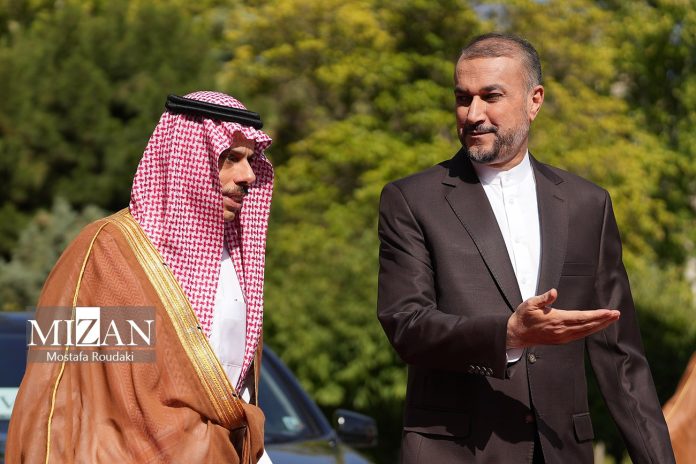
Hossein Amirabdollahian and Faisal bin Farhan Al-Saud

The meeting between Hossein Amirabdollahian and his Saudi opposite number, Faisal bin Farhan, was held on the sidelines of the UN General Assembly summit in New York.

In the meeting, the two top diplomats discussed bilateral and regional issues of mutual interests between Tehran and Riyadh.

Amirabdollahian and bin Farhan referred to the firm resolve of the two countries to enter a new phase in their relations and expressed pleasure with the reopening of their embassies in Tehran and Riyadh and the exchange of ambassadors by the two countries.

The Iranian foreign minister said based on an idea put forth during his meeting with Saudi Crown Prince Mohammad bin Salman, Iran is ready to sign a comprehensive partnership agreement with the kingdom.

He said it is also necessary that Tehran and Riyadh launch a joint economic commission to expand their ties in different areas.

Amirabdollahian further stressed the need to activate the air and shipping routes in order to facilitate travelling and trade between the two sides.

The Saudi foreign minister for his part described as satisfactory, the pace of progress in bilateral affairs since Iran and Saudi Arabia announced their rapprochement.

Bin Farhan said in addition to restoration of their diplomatic relations, Iran and Saudi Arabia have opened new horizons too.

He said Riyadh is willing to strengthen bilateral cooperation and put into action their proposed ideas, adding that a meeting between the heads of state of Iran and Saudi Arabia will accelerate the pace of cooperation.

The two top diplomats then agreed on the need to speed up the formation of the Tehran-Riyadh joint economic commission, form a coordinating committee, launch air and shipping lines, provide consular services for the citizens of the two countries and strengthen athletic cooperation.

Amirabdollahian and bin Farhan also expressed pleasure with the holding of sports events in the two countries.