Sunday, December 28, 2025
Home Blog Page 117

French national Lennart Monterlos acquitted, released by Iranian court

Iran Prison

Mojtaba Shasti Karimi, Director General of Consular Affairs at the Ministry of Foreign Affairs, confirmed that Monterlos was freed after the completion of judicial proceedings and has since departed for his home country.

According to the Hormozgan Province Judiciary, Monterlos, who is a dual French-German national, had been arrested during the 12-day conflict between Iran and the US-Israeli alliance earlier this year on charges of involvement in activities deemed against Iran’s national security. The judiciary stated that after thorough investigation, the competent court ruled him not guilty.

Earlier in July, Iranian Foreign Minister Seyed Abbas Araghchi told Le Monde newspaper that Monterlos had been detained for a “violation” and that France’s embassy had been officially informed of his status.

Iranian officials emphasized that the acquittal and release were carried out in accordance with domestic legal procedures and judicial independence.

Tehran, Moscow hold talks on development of small-scale reactors

A delegation from Russia’s state nuclear corporation Rosatom, led by Deputy Director General for International Affairs Nikolay Spassky, visited Tehran on Wednesday for comprehensive talks with officials from the Atomic Energy Organization of Iran (AEOI).

The two sides discussed plans to advance collaboration on SMRs as well as 1,250-megawatt power reactors.

The talks follow AEOI head and Vice President Mohammad Eslami’s recent visit to Russia, during which two major agreements were signed on SMR cooperation and the Iran-Hormoz Nuclear Power Plant project. The latter includes four 1,250-megawatt reactors valued at more than $25 billion.

During the Tehran meetings, both parties emphasized the need to accelerate ongoing projects and strengthen joint efforts in nuclear technology design and construction.
Spassky also met with Eslami to review progress and discuss next steps.

Rosatom’s CEO Alexey Likhachev is expected to visit Iran soon to oversee developments at the Bushehr Nuclear Power Plant units two and three, as part of the countries’ expanding strategic partnership under a recently ratified comprehensive cooperation agreement.

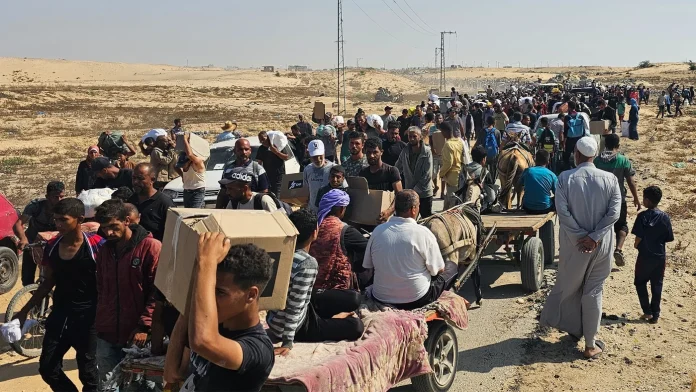
Almost 55,000 children under five suffering acute malnutrition in Gaza: Lancet

Acute malnutrition (or wasting) is a life-threatening condition and is defined as a child being too thin for their height, indicating rapid weight loss and a severe lack of energy, protein and other nutrients.

It can also be assessed by measuring the circumference of a child’s upper arm with a calibrated tape, as was done in the UNRWA study.

Children suffering from wasting require regular treatment with therapeutic food over several weeks, or in extreme cases and when possible, hospitalisation. In Gaza, few therapeutic options are available to impacted children.

UNRWA nutrition epidemiologist Dr Masako Horino, who was the lead scientist for the study, said: “Evidence prior to Oct 2023 indicated that children in Palestine refugee families in the Gaza Strip were food insecure and had poor dietary diversity.

“Yet, they were only marginally underweight. This paradox was likely explained by these families’ regular access to food aid. Following two years of war and severe restrictions in humanitarian aid, tens of thousands of pre-school aged children in the Gaza Strip are now suffering from preventable acute malnutrition and face an increased risk of mortality,” Horino added.

In addition, experts say that children’s future health outcomes and subsequent future generations will also be adversely impacted.

“There should also be serious concern for the well documented long-term effects, such as intergenerational consequences of starvation and food restriction in children, including inordinately high risks of non-communicable diseases and reduced life expectancy,” Zulfiqar Bhutta, of Aga Khan University; Jessica Fanzo, of Columbia University; and Paul Wise, of Stanford University School of Medicine, announced in a combined statement. Neither of the three experts quoted is linked to the study.

UNRWA staff screened 219,783 children aged between 6 months and five years between January 2024 and mid-August 2025.

They measured mid-upper arm circumference (MUAC) at 16 functioning health centres and 78 medical points in shelters and tented encampments across five governorates in the Gaza Strip.

The researchers then estimated the prevalence of acute malnutrition, based on the total estimated number of children in that age group in the territory (346,000).

The study tracked wasting among children, estimated population prevalence and highlighted unprecedented increases in child malnutrition following periods of blockades and severe aid restrictions.

Researchers found that during a six-week ceasefire, which allowed increased aid to enter the Gaza Strip from January 2025, wasting declined by March 2025.

The UN Integrated Food Security Phase Classification (IPC) confirmed famine in the governorate of Gaza City on 15 August, with the rest of the Gaza Strip facing critical conditions or the prospect of famine.

UNRWA’s director of health and a senior author of the paper, Dr Akihiro Seita, said things would continue to deteriorate if Israel’s war did not stop.

“Given the long failure to stop the war and prevent encroaching famine despite a global capacity to do so, unless there is a lasting cessation of the conflict coupled with unimpeded, competent, international humanitarian nutritional, medical, economic and social services, a further deterioration in early childhood nutrition with increased mortality are inevitable in the Gaza Strip,” he added.


37th International Children and Youth Film Festival concludes in Isfahan

The event took place at the Isfahan International Conference Center and brought together government officials, filmmakers, and artists active in the field of children’s cinema.

Among the distinguished guests were Minister of Culture and Islamic Guidance, Seyed Abbas Salehi, and Governor of Isfahan Mehdi Jamalinejad.

The ceremony marked the conclusion of a weeklong celebration of creativity and storytelling dedicated to young audiences.

During the closing night, the winners of various competitive sections were announced and honored for their artistic achievements.

The festival, recognized as one of the most prominent cultural events in Iran, provides a platform for promoting films that reflect the values, dreams, and challenges of children and teenagers.

More in pictures:

Israel and Hamas sign off on first phase of Gaza ceasefire plan: US

“I am very proud to announce that Israel and Hamas have both signed off on the first Phase of our Peace Plan,” the US president wrote on his Truth Social platform on Wednesday.

“ALL the hostages will be released very soon, and Israel withdraw their troops to an agreed upon line,” he added.

Mediator Qatar said that more details of the agreement would be announced at a later date.

“The mediators announce that tonight an agreement was reached on all the provisions and implementation mechanisms of the first phase of the Gaza ceasefire agreement, which will lead to ending the war, the release of Israeli hostages and Palestinian prisoners, and the entry of aid. The details will be announced later,” Qatar’s Ministry of Foreign Affairs spokesperson Majed al-Ansari wrote on X.

Senior officials from Qatar, Turkiye, Egypt and the US joined the delegations in Egypt’s Red Sea resort of Sharm el-Sheikh on Wednesday, the third day of the talks, as the mediators pressed the two sides to resolve their differences over Trump’s 20-point proposal.

The first phase of the plan calls for a ceasefire and the release of 48 Israeli captives held in Gaza, including 20 who are believed to be alive, and the release of Palestinian prisoners held in Israeli jails.

Hamas has submitted its list of detainees to be freed as part of the proposed swap.

Trump’s son-in-law, Jared Kushner, and special envoy Steve Witkoff, as well as Israeli Strategic Affairs Minister Ron Dermer – a close aide of Prime Minister Benjamin Netanyahu – were participating in the negotiations on Wednesday, Israeli and Palestinian sources said.

Also joining the discussions was the prime minister of longstanding key mediator Qatar, Sheikh Mohammed bin Abdulrahman bin Jassim Al Thani.

The Hamas delegation includes leaders Khalil al-Hayya and Zaher Jabarin, two negotiators who survived an Israeli assassination attempt in Qatar’s capital Doha that killed five people last month.

A delegation from the Palestinian Islamic Jihad (PIJ) armed group is also set to arrive in Egypt to participate in the indirect talks, according to a statement from the group.

The PIJ is the smaller of the two main Palestinian groups in the Gaza Strip and is currently holding some Israeli captives.

Even as the talks progressed on Wednesday, Israel continued its attacks on Gaza

Israel’s genocide in Gaza has killed more than 67,000 people, according to health authorities, and has destroyed large swaths of land in the enclave where almost all two million residents have been forcibly displaced.

Spanish parliament approves arms embargo against Israel

The parliament backed the decree announced in September by Sanchez with 178 votes for to 169 against.

Spain’s socialist prime minister banned buying or selling weapons to Israel shortly after Israel’s assault on Gaza began following the Hamas-led 7 October attack on southern Israel.

A growing chorus of historians, legal experts and scholars has labelled Israel’s war a genocide. Sanchez has become one of the most virulent critics among world leaders of Israel’s devastating two-year-old war in the Palestinian territory.

In September, he announced a decree to “consolidate in law” the embargo he imposed as part of a series of measures against Israel’s genocide.

“Israel’s response to the terrible attacks committed by terrorist group Hamas on October 7, 2023 has ended up becoming an indiscriminate attack against the Palestinian population that the majority of experts have called genocide,” reads the preamble of the law.

It bans all exports of defence equipment, products or technology to Israel and imports of such goods from Tel Aviv.

The decree also outlaws the transit of aviation fuel with potential military use and bans the advertising of products “coming from illegal colonies in Gaza and the West Bank”.

The text allows the government to make exceptions for dual-use defence equipment, “if the application of the ban harmed general national interests”.

Spain’s leftwing Podemos party, which has four MPs and had criticised the decree for not going far enough, eventually joined other parties that comprise Sanchez’s leftist minority coalition.

Sanchez has criticised the international community for failing to halt Israel’s genocide, accusing major powers of being mired between “indifference” and “complicity” with Israeli Prime Minister Benjamin Netanyahu.

Spain was one of the first European countries to recognise the state of Palestine last year. Several other major Western countries, including Canada, the UK and France, took the step last month.

UK court ruling on Iranian oil firm building was biased, unfair: NIOC

The National Iranian Oil Company announced in a statement on Wednesday that a ruling issued by the UK Court of Appeal earlier this week, upholding an earlier verdict that had ordered the seizure of the NIOC House in London, was “unfair and biased”.

The NIOC said that it would use “all the existing legal and judicial capacities” to appeal the ruling, including the services of the Iranian Presidency’s Center for International Legal Affairs.

It added its building in London is considered an asset of NIOC staff and workers, adding that it would seek to overturn the ruling to protect their rights.

The statement comes two days after the UK Court of Appeal dismissed objections raised against the initial court ruling, including the fact that the NIOC House in London was a property of its pension fund. The court thereby allowed the building to be seized to satisfy a $2.4 billion arbitration award.

The arbitration case is related to Crescent Petroleum, a company based in the United Arab Emirates, which claims the Iranian company has failed to comply with the terms of a 2001 contract for the supply of natural gas from Iran’s Salman gas field.

Reports published in the Iranian media in the past few days have estimated that the NIOC House in London is worth £100 million ($125 million).

Iran’s official IRNA news agency reported on Monday that NIOC lawyers plan to ask the UK Supreme Court to review the building seizure case if their appeal against the latest ruling is rejected.


Tomahawk deliveries could force Russia to ‘sober up’ and negotiate: Ukraine

During a meeting with journalists, Zelensky said that U.S. President Donald Trump “can give Ukraine some far-reaching things” that will significantly strengthen Kyiv’s position in any future talks.

“Right now, it is important to send a signal that Ukraine will be strengthened by all means possible. And this is one of those means that is important to me — Tomahawks,” he stated.

“All such things can strengthen Ukraine and force the Russians to sober up a little, sit down at the negotiating table.”

The president added he first raised the issue with Trump last fall in New York, when Trump was still a presidential candidate.

During their latest meeting on the sidelines of the United Nations General Assembly, Zelensky said Trump did not rule it out and “promised to work on a technical level and consider such a possibility.”

The Ukrainian president noted that Kyiv had previously requested the long-range cruise missiles during former U.S. President Joe Biden’s term, but the appeal was rejected.

The Tomahawk is a subsonic, long-range cruise missile designed for precision strikes. With a range of 1,600 to 2,500 kilometers (995 to 1,550 miles), it would allow Kyiv to reach targets as far as Siberia.

Ukraine currently depends largely on domestically produced long-range drones to strike deep inside Russia, weapons that carry tens rather than hundreds of kilograms of explosives.

The Kremlin has warned that any Tomahawk deliveries to Ukraine would sharply escalate the war.

Speaking at the Valdai Forum, Russian President Vladimir Putin said such a move would mark a “new stage of escalation” and could undermine any progress in U.S.-Russia relations.

The U.S. president has stated that he has “sort of made a decision” on whether to supply Ukraine with Tomahawk long-range missiles, but wants “to find out what they’re doing with them.”

The discussion over Tomahawk deliveries comes as Trump’s administration begins supplying weapons to Ukraine through a NATO-supported framework.

The first aid package, approved in mid-September, included Patriot and HIMARS missiles.

Iran among top 10 countries with full satellite manufacturing and launch capabilities

Iran satellite

That’s according to Director of the Iranian Space Agency Hassan Salarieh.

Salarieh told Tasnim News agency that out of more than 200 countries, only a handful, including Russia, China, the US, Japan, and some European nations with long-standing space industries, have achieved complete satellite and launch vehicle capabilities.

He noted that Iran has developed its satellite and launcher programs simultaneously using domestic expertise.

Salarieh added that while satellite production in Iran was traditionally carried out individually, the launch of the General Soleimani satellite constellation project marked a shift toward multi-satellite production.

He underlined that Iran’s human resources wave began in the mid-2000s with satellite programs at top universities, including Sharif, Amirkabir, Iran University of Science and Technology, and Malek Ashtar University.

Salarieh also said a milestone in Iran’s space journey was the successful launch of the Omid satellite in 2008, which established national confidence in the country’s ability to place payloads into orbit.

Iran’s Navy signs strategic cooperation document with Caspian littoral countries

The agreement was signed on Wednesday during a meeting of the four Caspian littoral states in the Russian city of St. Petersburg.

Rear Admiral Shahram Irani, Commander of the Iranian Navy, represented Tehran at the summit and signed the document on behalf of the country.

The agreement aims to strengthen comprehensive cooperation among the Caspian littoral states, particularly in ensuring sustainable security in the shared waters.

According to the provisions of this document, no foreign country or extra-regional power will be allowed to interfere in the internal affairs of the Caspian Sea.

“This sea belongs to five littoral countries, and accordingly, ensuring security and issues related to the Caspian Sea can only be done by the decision of the littoral countries,” the navy commanders stated.

Admiral Irani, who arrived in St. Petersburg on Sunday evening, delivered a speech on Tuesday at a meeting of naval commanders of the Caspian littoral countries, where he noted that the Caspian Sea “is not a place where there is room for maneuvering by extra-regional powers.”

The Iranian commander said all the Caspian Sea states share the objective of maintaining regional maritime security.

The Caspian, vital for its $3 trillion energy reserves, remains a strategic hub as Iran and Russia expand military partnership.

In July, the naval forces of Iran and Russia staged a major three-day joint search-and-rescue drill in the Caspian Sea.

The CASAREX 2025 was held under the banner “Together for a Safe and Secure Caspian Sea.”