Saturday, December 27, 2025
Home Blog Page 103

China defends buying Russian oil

Putin and Xi

Trump said Wednesday that Indian Prime Minister Narendra Modi had promised him New Delhi would stop buying Russian oil, adding that he will get China to follow suit.

India neither confirmed or denied it was shifting its policy.

Trump has accused both China and India of funding the Ukraine war through the purchases, and has also demanded that European allies immediately stop buying oil from Russia.

Asked on Thursday about Trump’s intention to pressure China further, Beijing’s foreign ministry defended its “normal, legitimate economic, trade, and energy cooperation with countries around the world, including Russia”.

“The actions of the United States are a typical example of unilateral bullying and economic coercion,” ministry spokesman Lin Jian stated at a press briefing.

If China’s interests are harmed, it will “take firm countermeasures and resolutely safeguard its sovereignty”, he warned.

China has maintained that it is not a party to the Ukraine conflict, but Kyiv and Western governments have long accused Beijing of providing political and economic support for Moscow.


India says priority is consumers after Trump comments On halting Russian oil

Russia Oil

New Delhi neither confirmed nor denied it was shifting policy towards Russia.

“It has been our consistent priority to safeguard the interests of the Indian consumer in a volatile energy scenario,” Indian Foreign Ministry spokesman Randhir Jaiswal said in a statement.

“Our import policies are guided entirely by this objective.”

Indian Prime Minister Narendra Modi has previously defended buying oil from Russia, a historic partner of India, despite Moscow’s invasion of Ukraine.

Trump in August raised tariffs on Indian exports to the United States to 50 percent, with Trump’s aides accusing India of fueling Russia’s war in Ukraine.

“Ensuring stable energy prices and secured supplies have been the twin goals of our energy policy,” Jaiswal added.

“This includes broad-basing our energy sourcing and diversifying as appropriate to meet market conditions.”

India, one of the world’s largest crude oil importers, relies on foreign suppliers for more than 85 percent of its oil needs.

New Delhi traditionally relied on Middle East nations.

But since 2022, it shifted sharply toward discounted Russian crude, taking advantage of a buyer’s market created by Western bans on Moscow’s exports.

“Where the US is concerned, we have for many years sought to expand our energy procurement,” Jaiswal stated.

“This has steadily progressed in the last decade. The current administration has shown interest in deepening energy cooperation with India. Discussions are ongoing.”


Israel could resume Gaza military operations if Hamas fails to implement ceasefire terms: US

Israel Army

“What’s going on with Hamas – that’ll be straightened out quickly,” Trump told CNN in a phone interview.

“Israel will return to those streets as soon as I say the word. If Israel could go in and knock the crap out of them, they’d do that,” Trump responded when asked what would happen if Hamas refused to disarm.

“I had to hold them back,” he added.

Trump stated that the release of 20 living Israeli hostages was “paramount,” but Hamas must now fulfill its commitment to return the remains of others and disarm.

Last week, Trump announced that Israel and Hamas agreed to the first phase of a plan he laid out Sept. 29 to bring a ceasefire to Gaza, release all Israeli captives in exchange for Palestinian prisoners and a gradual withdrawal of Israeli forces from the entire Gaza Strip. The first phase of the deal came into force on Friday.

Under the deal, Hamas released 20 living Israeli hostages and handed over the remains of eight captives in exchange for nearly 2,000 Palestinian prisoners.

Phase two of the plan calls for the establishment of a new governing mechanism in Gaza, without Hamas’ participation, the formation of a multinational force and the disarmament of Hamas.

Since October 2023, Israeli attacks have killed over 67,900 Palestinians in the enclave, most of them women and children, and rendered it largely uninhabitable.


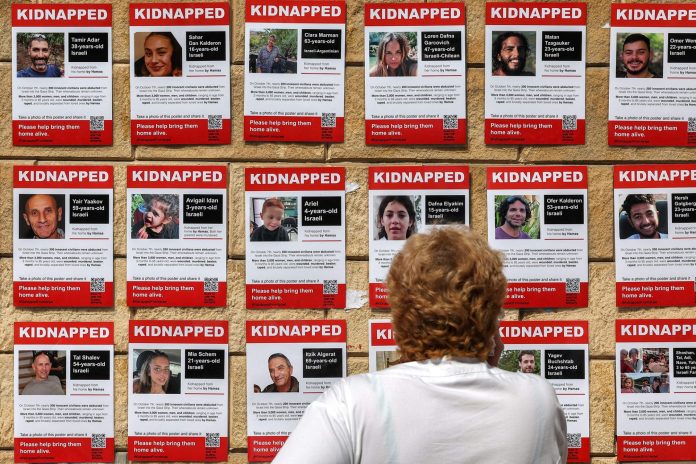
Israel confirms it received bodies of 2 more hostages from Red Cross in Gaza

A statement by Prime Minister Benjamin Netanyahu’s office said that “Israel has received, through the Red Cross, two coffins of deceased hostages that were delivered to IDF (army) and Shin Bet forces inside the Gaza Strip”.

The Israeli military announced in a statement that “two coffins of deceased hostages have been transferred into their custody and are on their way to IDF (army) and ISA (security agency) forces in the Gaza Strip.”

Hamas earlier confirmed that it would hand over the remains of two more Israeli captives in Gaza on Wednesday night at 10 pm local time (1900GMT) under the new ceasefire agreement with Israel.

Last week, US President Donald Trump announced that Israel and Hamas had agreed to the first phase of a plan he laid out on Sept. 29 to bring a ceasefire to Gaza, release all Israeli captives in exchange for Palestinian prisoners, and a gradual withdrawal of Israeli forces from the entire Gaza Strip. Phase one of the deal came into force last Friday.

Under the deal, Hamas released 20 living Israeli hostages and handed over the remains of 10 captives in exchange for nearly 2,000 Palestinian prisoners.

Phase two of the plan calls for the establishment of a new governing mechanism in Gaza without Hamas’ participation, the formation of a multinational force and the disarmament of Hamas.

Since October 2023, Israeli attacks have killed nearly 68,000 Palestinians in the enclave, most of them women and children, and rendered it largely uninhabitable.


European NATO allies pledge to buy more US arms for Ukraine

Russia Ukraine War

The new financial arrangement sees European allies buy US-made weapons which are then transferred to Ukraine.

New data on Western military aid to Ukraine shows that it plunged by 43% in July and August compared to the first half of the year, according to Germany’s Kiel Institute, which tracks defence and financial support to Kyiv.

PURL is key to enacting Europe and Canada’s commitment to taking on the majority share of the burden for Ukraine’s security as it continues to defend itself from the Russia’s full-scale invasion.

“We know what Ukraine needs to stay strong in the fight and some of that stuff only the US can provide, for example, these interceptors for Patriot systems,” NATO Secretary General Mark Rutte told reporters.

“It’s unique military support which only the US can provide. And that’s why we need that PURL initiative. This list of what Ukraine needs, which only the US can provide, paid for by Allies.”

Ahead of the meeting, just six countries, the Netherlands, Denmark, Norway, Sweden, Canada and Germany, had joined the PURL scheme but Wednesday’s meeting saw 10 more join up following pressure from the NATO chief and the US.

“The expectation today is that more countries donate even more, that they purchase even more to provide for Ukraine, to bring that conflict to a peaceful conclusion,” US Secretary of War, Pete Hegseth, told reporters.

The PURL facility aims to ensure a predictable flow of lethal and non-lethal support for Ukraine which also includes air defences.

Following a meeting of the Ukraine Defense Contact Group, alongside Ukrainian defence minister Denis Shmyhal, Germany also announced a commitment of €2 billion including anti-tanks weapons and money for Patriot air defence systems.

At the meeting on Wednesday, NATO allies also agreed to significantly raise the alliance’s deterrence capabilities to more effectively respond to a recent surge of drone incursions and Russian jets violating airspace across several NATO countries.

Earlier in the day, defence ministers from the 32-nation alliance discussed counter-drone measures following the spate of airspace violations which occurred in Poland, Estonia, Romania and Denmark.

The incursions, some of which have been blamed on Russia, accelerated discussions over how to integrate the technology in the alliance’s defence and deterrence posture.

The issue was then also catapulted to the top of the EU’s defence agenda with the European Commission calling for a so-called drone wall to be funded as a priority.

In its Defence Readiness Roadmap set to be officially presented on Thursday, the EU’s executive estimated the wall could be “fully functional” by the end of 2027.

Both NATO and the EU insist however that they are not doubling up on the work and that there is a clear division of labour despite 23 of the EU’s 27 member states also being NATO allies.

Rutte told reporters that instead the two organisations are “making use of each other’s strengths.”

“We have enough on our plates, we don’t want to do anything the other is better at doing it. I can really assure you,” he stated, touting close cooperation with EU officials including Commission President Ursula von der Leyen, foreign policy chief Kaja Kallas and Defence Commissioner Andrius Kubilius.

Kallas, who chaired a meeting of EU defence ministers on Wednesday evening to present the roadmap, also insisted that NATO and EU are “complementing each other” in this regard.

“Of course the military plans come from NATO, that’s very clear. But the procurement has to be done by the member states. So member states need to buy these things to fill also the capability targets of NATO,” she continued, adding, “This is what we are trying to help them with.”

EU leaders, who will gather for a summit in Brussels next week, are set to stress that the bloc needs “to develop, as a matter of urgency, anti-drone and air defence capabilities,” according to draft conclusions seen by Euronews.

IMF revises up Iran’s economic growth projections for 2025

International Monetary Fund (IMF)

Latest IMF forecasts cited in a Wednesday report by the Fars news agency showed that Iran’s economy would expand by 0.6% in 2025, up from a 0.3% forecast announced in April.

The figure was lower than a regional average growth rate of 3.5%, the data showed.

IMF forecast showed that the inflation rate in Iran would reach 42.4% this year, up from 32.5% reported in 2024.

The global lender expected that Iran’s jobless rate would also increase by 1.6% year on year to reach 9.2% in 2025.

Iran has reported positive economic growth rates since the second half of 2020, two years after the United States announced sweeping sanctions on the country.

However, Iran’s official statistics agency (SCI) reported a negative growth rate for the country’s economy for the first time in four years in the quarter to June 21.

SCI’s data released in late September showed that Iran’s gross domestic product (GDP) had reached 24,270 trillion rials (over $22.26 billion on free market prices) in the June quarter, down 0.1% from the same period last year.

IMF’s projections on Iran are mostly based on economic data released by the SCI and the Central Bank of Iran (CBI).

SCI had reported an economic growth rate of 3% for the Iranian economy in the calendar year to late March, while the CBI had put the rate at 3.1%.


Widely acclaimed Iranian filmmaker Nasser Taghvai laid to rest in Tehran

The ceremony was attended by a large number of artists, colleagues, and cultural figures who gathered to pay their final respects to one of Iran’s most influential film directors.

Taghvai passed away on Tuesday at the age of 84. Born in 1941 in Abadan, he was regarded as one of the pioneers of a movement in Iranian cinema that later came to be known as the “Iranian New Wave.”

His works were known for their distinctive style, strong storytelling, and deep engagement with social and cultural themes.

Throughout his career, Taghvai directed several acclaimed films and television series that helped shape modern Iranian cinema.

He was often described as an auteur, a filmmaker whose personal vision and artistic identity were evident in every work he created.

More in pictures:

FM Araghchi: NAM members reject ‘snapback’ mechanism, support Iran’s position

Abbas Araghchi

Speaking to state media following the NAM Foreign Ministers’ Meeting in Kampala, Uganda, Araghchi said the final communiqué of the summit emphasized that Resolution 2231 remains valid and must be implemented according to its timetable.
He noted that under Article 8, the resolution is due to expire on October 18.

Araghchi explained that the final document, which includes more than 1,500 clauses, incorporated several proposals from Iran. Among them were strong condemnations of US and Israeli attacks against Iran, slamming them as “heinous and unacceptable.”

The statement also expressed solidarity with the Iranian people and separately condemned attacks on Iran’s nuclear facilities and recent terrorist operations in Lebanon.

He added that the declaration of support for Iran’s stance on the “snapback” issue represents a major diplomatic achievement, noting that most NAM members, which amount to over 100 countries, sided with Iran, Russia, and China in rejecting the US and European interpretation of the mechanism.

Top Iranian lawmaker defends decision to skip Sharm el-Sheikh summit

Speaking on a live political talk show on Wednesday evening, Ebrahim Azizi stated that attending the summit would have required Iranian officials to engage in dialogue, or even pose for a photograph, with the US president, whom he castigated for waging war along with Israel against Iran.

“Those who say we should have been there do not understand America,” he said.

Azizi criticized the notion of “peace” promoted by Washington, describing it as “arrogant and humiliating.”

He emphasized that Iran’s absence from the gathering was the best course of action, as taking part would not have advanced the country’s interests.

The summit in Sharm el-Sheikh brought together regional and international leaders to discuss developments in the Middle East.

Iran’s decision not to participate has drawn mixed reactions domestically, but Azizi insisted that avoiding engagement with the US was consistent with Tehran’s principles and strategic considerations.

Gaza health ministry finds signs of torture on Palestinian bodies returned by Israel

Medical teams are continuing to examine, document and prepare the bodies for delivery to families “in line with approved medical procedures and protocols”, the Health Ministry said in a statement on Wednesday.

Under a ceasefire deal backed by US President Donald Trump and aimed at ending the two-year Gaza war, Israel was to turn over the bodies of 15 Palestinians for every deceased Israeli returned. The remains of 45 people were returned on Monday.

Palestinians awaited information about the bodies that arrived at Nasser Hospital on Tuesday and Wednesday. The forensics team described disturbing conditions, bearing signs of physical abuse.

Some of the Palestinian bodies were blindfolded and handcuffed, indicating “field executions” may have taken place, medical sources told Al Jazeera.

Israel is expected to hand over more bodies, though officials have not said how many are in its custody or how many will be returned. It remains unclear whether the bodies were dug up from cemeteries by the Israeli army during its ground offensive or if they belong to detainees who were killed during the Israeli assault. Throughout the war, Israel’s military has exhumed bodies as part of its search for the remains of captives.

As forensic teams examined the first remains returned, the Health Ministry on Wednesday released images of 32 unidentified bodies to help families recognise missing relatives.

Many appeared decomposed or burned. Some were missing limbs or teeth, while others were coated in sand and dust. Health officials have said Israeli restrictions on allowing DNA testing equipment into Gaza have often forced morgues to rely on physical features and clothing for identification.

The forensics team that received the bodies said some arrived still shackled or bearing signs of physical abuse.

“There are signs of torture and executions,” Sameh Hamad, a member of a commission tasked with receiving the bodies at Nasser Hospital, said.

The bodies belonged to men aged 25 to 70. Most had bands on their necks, including one who had a rope around his neck. Most of the bodies wore civilian clothing, but some were in uniforms, suggesting they were Palestinian fighters.

Hamad added the Red Cross provided names for only three of the dead, leaving many families uncertain of their relatives’ fate.

Israel’s war on Gaza has killed nearly 68,000 Palestinians since October 2023, according to the Health Ministry. Palestinian officials say the true toll could be far higher, with tens of thousands of bodies believed to be under the rubble.

Thousands more people are missing, according to the Red Cross and Palestinian Central Bureau of Statistics.

The Health Ministry released a video showing medical workers examining the bodies, saying the remains would be returned to families or buried if left unidentified.

Rights groups and a United Nations Commission of Inquiry have accused Israel of committing genocide in Gaza, and South Africa has filed a case alleging Israel committed genocide at the International Court of Justice. Israel denies the accusations.