Tuesday, December 30, 2025
Home Blog Page 97

Zarif refuses to publish statement after Lavrov claims over snapback mechanism

Javad Zarif

Zarif revealed that he had drafted a full statement correcting what he called “a malicious misuse of my old colleague’s remarks,” but withdrew it at the request of senior figures. He had intended to release the text after the activation of Clause 8 of Resolution 2231.

Zarif accused Russia and France of presenting Iran with an unacceptable proposal in the 2015 negotiations — a plan to suspend U.N. resolutions every six months which would have significantly weakened Iran’s position. He said he challenged the idea directly and attributed it to Lavrov.

According to Zarif: “Lavrov and the French proposed a very bad plan regarding the status of past resolutions, and we worked hard to eliminate it,” he said during a recent private session.

Over 1.4 million undocumented foreign nationals leave Iran in 6 months

Afghan Refugee in Iran

Nader Yar-Ahmadi, head of the Bureau for Aliens and Foreign Immigrants Affairs at the Ministry of Interior, said the process is proceeding “naturally and legally” and that the government intends to facilitate the exit of a similar number in the near future.

Yar-Ahmadi explained that regular coordination meetings are held to implement policies aimed at regulating the status of immigrants and refugees in the country.

He added that a significant portion of Afghan nationals residing illegally in Iran were repatriated during the first six months of the year, in accordance with state policy.

Yar-Ahmadi also said that the Ministry plans to introduce a new framework for providing services to those who remain in Iran legally. The initiative, he explained, will bring together all relevant governmental and service agencies to ensure a more coordinated and organized approach to managing foreign residents.

According to the official, the registration documents of undocumented migrants are being annulled as part of the exit process, and the government’s goal—in line with international standards—is to limit the proportion of the foreign migrant population to about three percent of Iran’s total population.

He further referred to a new legislative initiative under Article 85 of the Constitution, being jointly developed by the government and parliament, which combines the administration’s draft bill on migration management with a parliamentary plan. The joint working group, he said, is expected to conclude its work early next week before sending the proposal to the Guardian Council for final approval.

Yar-Ahmadi also revealed that the total number of foreign nationals residing in Iran has decreased from six million to 4.5 million as a result of the repatriation program.

He added that there are currently around 80,000 registered marriages between Iranian citizens and foreign nationals—half involving Afghan men and Iranian women and vice versa—accounting, together with their children, for an estimated population of 250,000.

Haniyeh family refutes reports relatives left Gaza after Turkish request

Hamas Ismail Haniyeh

“Absolutely no one from the Haniyeh family has left,” said Abdul Salam Haniyeh, the late leader’s eldest son, in a statement to Middle East Eye.

“No one has left yet, and there are no arrangements in place for that or even a discussion about it.”

Middle East Eye reported on Monday that Israel had permitted at least 66 Palestinians and Turkish citizens to leave Gaza earlier this month following a request from the Turkish government.

While some of them were cited by sources as sharing the same family name, Abdul Salam Haniyeh stated that none of the late Hamas leader’s relatives had left, or intend to leave.

“The news is incorrect and is intended to cause confusion,” he added.

Fourteen Turkish citizens and 40 close relatives of Turkish nationals, including spouses, children, parents, and other immediate family members, were allowed to leave under a bilateral arrangement between Israel and Turkey, the sources noted.

The reported deal followed a Gaza ceasefire agreement between Israel and Hamas in early October, facilitated in part by Turkey.

Turkey maintained longstanding contact with Ismail Haniyeh, who led Hamas’s political bureau until he was assassinated by Israel in Tehran in July 2024.

An Israeli decision to allow Haniyeh’s relatives to leave Gaza would be particularly surprising, given that the Israeli military killed three of his sons and four of his grandchildren in an April 2024 air strike on their car in Gaza.

Around the same time, Israel also arrested Haniyeh’s sister, Sabah al-Salem Haniyeh, who was living in the southern Israeli town of Tel Sheva.

Saudi Arabia appoints conservative Grand Mufti

Sheikh Saleh bin Fawzan bin Abdullah Al-Fawzan was named the grand mufti of Saudi Arabia by royal decree, the official SPA news agency reported late on Wednesday.

Fawzan, who has made controversial comments on child marriage and minority Shiite Muslims, succeeds the conservative Abdulaziz al-Sheikh, who died in September after more than 20 years in the role.

In 2011, Fawzan publicly opposed a minimum age for marriage, after the justice ministry moved to stamp out the practice of marrying off pre-pubescent girls.

In 2017, Human Rights Watch cited the Sunni cleric as calling Shiite Muslims “brothers of Satan” in a recorded question-and-answer session.

He was appointed on the recommendation of Crown Prince Mohammed bin Salman, the de facto Saudi ruler who has ushered in sweeping reforms in a bid to diversify the economy of the world’s biggest oil exporter.

Saudi Arabia is the birthplace of Islam and is home to its holiest sites, including the Kaaba at Mecca’s Grand Mosque.

However, the deeply conservative kingdom has sought to modernise since Prince Mohammed was appointed heir to the throne by his father King Salman, now 89, in 2017.

Under his direction, the power of Saudi Arabia’s influential clerics has diminished and the once-feared morality police have been muzzled.

Many women now forgo veils and head-coverings in urban centres, non-Muslim tourists are allowed, and since 2018, women can legally drive.

Russia says immune to US oil sanctions

Iran Oil Tanker

US President Donald Trump announced new sanctions on Russia’s two largest oil companies on Wednesday, complaining that his peace talks with Russia’s Vladimir Putin were not going “anywhere”.

Trump held off introducing new restrictions against Russia for months, but his patience snapped after plans for a fresh summit with Putin in Budapest collapsed.

“We view this step as being entirely counterproductive, including in terms of signalling the need to achieve meaningful negotiated solutions to the Ukrainian conflict,” Russian foreign ministry spokeswoman Maria Zakharova told a weekly briefing.

“Our country has developed a strong immunity to Western restrictions and will continue to confidently develop its economic potential, including its energy potential,” she added.

South Korean ambassador performs with Iranian vocalist at joint art exhibition

The ambassador, known for his affection for Persian music, had earlier this month performed the iconic song “Jan-e Maryam”, originally sung by the late Iranian maestro Mohammad Nouri.

The performance marked 63 years of diplomatic relations between South Korea and Iran, highlighting the growing cultural and artistic ties between the two nations.

The collaboration was part of a broader cultural exchange initiative and was featured on the official social media platforms of the South Korean Embassy in Tehran.

Ambassador Kim, who previously drew attention for performing the Persian folk song “Porsoon Porsoon”, impressed audiences once again with his fluent Persian pronunciation and emotional delivery.

EU squabbling over frozen Russian funds: Politico

EU officials are debating the so-called “reparations loan” of about €140 billion ($162 billion) to Ukraine that would be guaranteed by Russian assets immobilized by the West after the escalation of the Ukraine conflict in 2022.

According to the proposal, Kiev would repay only if Moscow covers damages incurred by the conflict. Moscow has repeatedly condemned Western efforts to use its frozen funds to aid Ukraine, calling the move “theft.”

Although the EU has not yet agreed on the plan, Politico said “friction is already growing over whether to attach conditions to the loan”. One idea – which is being pushed by France and, to a lesser extent, Germany and Italy – is to ensure money “flows back as much as possible into the EU’s defense sector — and not across the Atlantic.”

According to Politico, this pressure led to draft summit conclusions emphasizing “the importance of reinforcing the European defense industry” with the loan. However, tensions are expected to sharpen at an EU leaders’ meeting in Brussels on Thursday, the report added.

Critics quoted by Politico argue that such limits “smack of hypocrisy.”

“If the aim is to keep Ukraine in the fight, you need to keep the criteria open,” a senior EU diplomat told the paper.

One particular concern is that the “Buy European clause” could block Kiev from buying crucial American weapons, including US-made Patriot air defense systems that the bloc does not produce.

Bloomberg reported this week that Washington will not join the EU-led initiative, citing concerns the move could unsettle global markets. Western officials have also for months warned that outright confiscation of frozen Russian assets – estimated at around $300 billion – would be illegal and undermine the West’s credibility.

Russian President Vladimir Putin has stated that “those who are smarter” in the West oppose seizing Russian assets while warning that Western moves to confiscate the funds would not go unpunished.

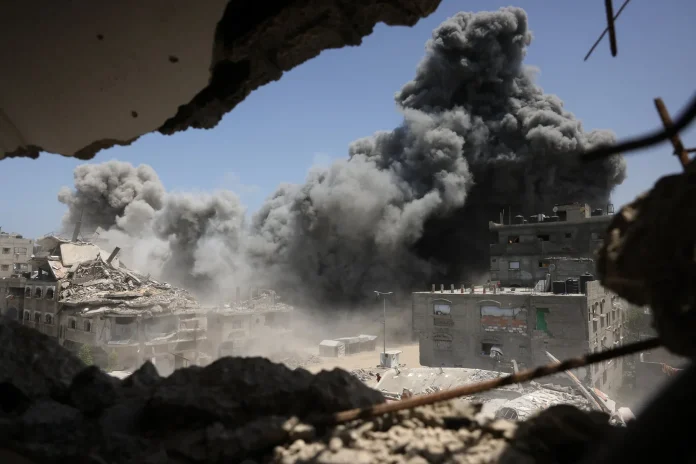
Over 61mn tons of debris left by 2 years of Israeli war on Gaza: UN

“Entire neighborhoods have been erased, and families search the ruins for water, for shelter,” the UNRWA wrote X.

The agency stressed that its humanitarian mission and lifesaving assistance for Palestinian people continue in Gaza despite the ongoing Israeli blockade and restrictions on UNRWA aid stocks.

According to UNRWA Commissioner-General Philippe Lazzarini, the agency has medicine, essential supplies, and a sufficient amount of food for the coming three months for the entire Gaza population.

In October 2024, the Israeli parliament, the Knesset, voted in favor of blocking UNRWA operations in the occupied West Bank and Gaza due to the alleged involvement of its staff in attacks by Palestinian group Hamas on Oct. 7, 2023.

But on Wednesday, the International Court of Justice rejected Israel’s claims, saying that “Israel has not substantiated its allegations that a significant part of UNRWA employees are members of Hamas” or were involved in the attacks.

The court also ruled that Israel is obliged under the Geneva Convention to agree to and facilitate relief schemes provided by third states and impartial humanitarian groups, including the UNRWA and the International Committee of the Red Cross (ICRC), to ensure that sufficient aid reaches the Gaza Strip.

Since October 2023, Israel’s genocidal war has killed over 68,000 people and injured more than 170,000, according to the Gaza Health Ministry.
A ceasefire deal took effect on Oct. 10 in Gaza, based on a phased plan presented by US President Donald Trump.

Iran’s foreign minister warns against “failed repetition” after IAEA chief’s remarks

Abbas Araghchi

Speaking on the sidelines of a regional diplomacy conference in Mashhad, Araghchi said, “I don’t know whether his remarks came from concern or from a threat, but in any case, those making such threats should remember that repeating past mistakes yields nothing but renewed defeat.”

Grossi had said on Wednesday that recent US and Israeli attacks had caused significant damage to Iran’s nuclear facilities in Isfahan, Natanz, and Fordow, but emphasized that Iran’s nuclear know-how remained intact.

He added that Tehran currently allows IAEA inspectors to enter the country only “on a drip-feed basis.”

Grossi said Iran imposes restrictions for security reasons, pointing out, “I understand that, but if diplomacy fails, I fear a return to the use of force,” referring to the aggression by the US-Israeli alliance against Iran in June.

He also stated that the IAEA had found no evidence suggesting Tehran was seeking to build a nuclear weapon.

Grossi earlier confirmed that the agency had inspected the Iranian sites just before the attacks and continues to monitor them via satellite imagery, maintaining oversight of Iran’s nuclear program.

Iran’s Central Bank transfers Ayandeh Bank deposits to Bank Melli

CBI Governor Mohammadreza Farzin said the move follows two decades of “structural deficiencies and unhealthy performance” by Ayandeh Bank, which failed to meet the central bank’s reform standards. He emphasized that this action, known as the “resolution process,” is designed to protect depositors and stabilize the banking system.

“All Ayandeh Bank branches will operate under Bank Melli from Saturday, and customers can continue using their cards and accounts without disruption,” Farzin assured.

He stressed that no financial imbalance or deficit from Ayandeh Bank will be transferred to Bank Melli, as all assets of Ayandeh Bank will be taken over by the Deposit Guarantee Fund.

Farzin also announced that Ayandeh’s employees will become Bank Melli staff, and small shareholders will have the option to sell their shares to the Deposit Guarantee Fund at the highest price of the past year.

He described the decision as part of broader reforms to improve transparency, stability, and health in Iran’s banking system.