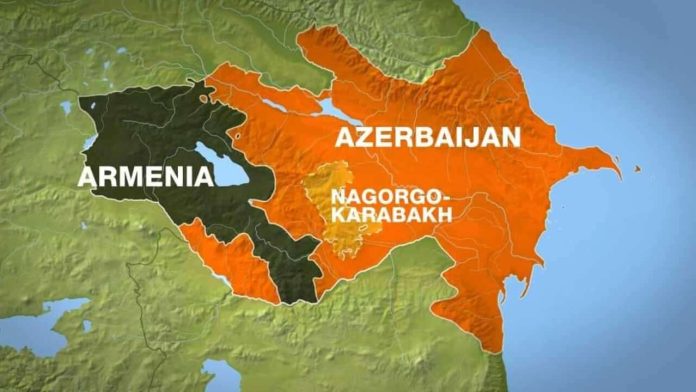
“Armenian Deputy Foreign Minister Vahan Kostanyan took part in the Armenia and the EU conference which was held in the sidelines of the GLOBSEC conference. In his speech, Kostanyan touched upon Armenia’s foreign policy and stressed the importance of its diversification to defend the republic’s sovereignty, international borders and democracy. Touching upon the process of the settlement of the Armenian-Azerbaijani relations, Vahan Kostanyan noted that Armenia had handed over to the Azerbaijani side the 10th package of a peace treaty between Armenia and Azerbaijan. The deputy foreign minister reiterated Yerevan’s readiness to establish peace in the South Caucasus and in the region,” it said.
The senior Armenian diplomat also hailed the active political dialogue and the solid basis for cooperation between Armenia and the European Union countries, the ministry added.
Armenia and Azerbaijan have engaged in a series of bloody confrontations since both republics declared independence from the Soviet Union in 1991. The two countries fought a war over the self-proclaimed republic of Nagorno-Karabakh in 2020, and Azerbaijani forces clashed with the province’s separatist forces in 2023. The conflict ended with the dissolution of Nagorno-Karabakh’s government and the return of the province to Azerbaijani control.
Although situated inside Azerbaijani territory, Nagorno-Karabakh was governed by ethnic Armenian separatists until last year. Before the fall of the USSR, the province had ruled itself as an autonomous region within the Azerbaijan SSR.
Al-Risheq also blamed the United States for its “bias, support and partnership” in the 11-month war on the besieged territory.
The official stated that Hamas cares more about the lives of its prisoners than President Joe Biden does, emphasising that the group had accepted his proposal and the United Nations Security Council resolution.
Prime Minister Benjamin Netanyahu rejected the proposal and the resolution and his administration conceded to the PM’s demands, which were intended to obstruct reaching an agreement to maintain his power, al-Risheq added.
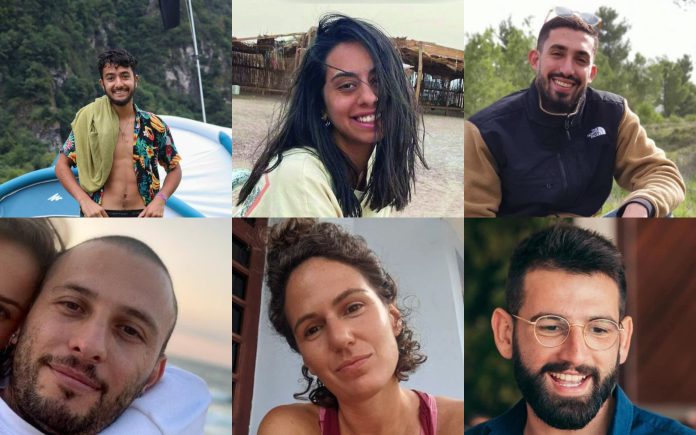
Senior Hamas official Khalil Al-Hayya has also blamed Netanyahu for the deaths of six Israeli hostages.
Al-Hayya added that dozens of hostages in Gaza had been killed by Israeli “strikes along with those who were sitting, guarding, and living with them”.
Israel’s military has announced that its troops have recovered the bodies of six captives, including a dual US national, from a tunnel in southern Gaza, as it continued its 11-month long military onslaught on the Palestinian enclave. It claimed that the captives were killed not long before their bodies were recovered.
Netanyahu has pledged to “settle the score” with Hamas, saying “we will hunt you down”. “Those who kill hostages do not want an agreement” for a Gaza truce, Netanyahu added.
But a forum of captives’ families, who have been critical of Netanyahu’s handling of the issue, called for a massive protest later on Sunday, demanding a “complete halt of the country” to push for the implementation of a ceasefire and release of the remaining captives.
“A deal for the return of the hostages has been on the table for over two months. Were it not for the delays, sabotage, and excuses those whose deaths we learned about this morning would likely still be alive. It’s time to bring our hostages home,” the Hostages and Missing Families Forum announced in a statement.
In a statement, Biden said he was “devastated and outraged” of the death of the six captives, including Israeli-American Goldberg-Polin.
Biden, whose administration has has backed and funded Israeli bombardment of Gaza, pledged that “Hamas leaders will pay for these crimes. And we will keep working around the clock for a deal to secure the release of the remaining hostages”.
A ceasefire deal put forth by Biden in May, which called for release of captives, was rejected by Netanyahu.
About 100 captives still remain in Gaza while 105 were released in a deal with Hamas, which has set ceasefire as a condition to release the remaining captives.
But Israel has been accused of war crimes and atrocities against Palestinians. The International Criminal Court persecutor has sought arrest warrants against Netanyahu and his Defence Minister Yoav Gallant for war crimes. Warrants were also requested for two Hamas leaders.
More than 40,000 Palestinians have been killed since Israel launched war on Gaza on October 7 following an attack led by Palestinian group Hamas that left more than 1,200 people dead. The Palestinian fighters took about 250 captives in the wake of the attack.
The coastal enclave has since been turned into rubble amid non-stop bombardment as Israel has been accused of stalling a ceasefire deal to free the captives.
Ukrainian Defense Minister Rustem Umerov met with US Secretary of Defense Lloyd Austin at the Pentagon this week to discuss additional military aid. During the meeting he reportedly presented him with a list of “high-value” targets that Kiev would like to strike, deep inside Russia, using American-made weapons.
In an interview with CNN after the meeting, Umerov claimed that Ukraine is pushing to lift the ATACMS restrictions for “self-defense”, arguing that “the airfields being used to hit our cities are within the range of deep strikes”.
However, a US defense official told the channel that many of the targets on Ukraine’s wish list are in fact outside the missile’s range, as Moscow has relocated its high-value assets away from the front.
The US has also “made it clear that Kiev should not expect another significant delivery of ATACMS due to the finite number in US inventories and the long production time of the weapon”, CNN wrote, citing the source. The official noted that Ukraine has so far received a very “limited” supply of these missiles.
The US government seemingly drew the line on deep strikes into Russia after one of its ATACMS rockets, armed with a cluster warhead, struck a Crimean beach in early June. Moscow accused Washington of enabling that and other acts of “terrorism” against civilians, and suggested it might arm “states and entities” around the world that are hostile to the US in response.
Pentagon spokesman Major General Patrick Ryder clarified on Tuesday that Washington’s “policy has not changed,” meaning that Ukraine is allowed to use US-supplied weapons to defend against cross-border attacks but not for “deep strikes” into what the US recognizes as Russian territory. However, White House National Security Council spokesman John Kirby told reporters on Monday that Washington “will keep the conversations with the Ukrainians going”.
Moscow has warned that any talk of using long-range missiles to strike Russian territory is highly dangerous.
“This is blackmail, it is an attempt to create an impression that the West wants to avoid excessive escalation, but in fact this is a ruse,” Russian Foreign Minister Sergey Lavrov told a press conference on Tuesday.
“The West does not want to avoid escalation. The West is asking for trouble, to put it bluntly. I reckon that this is already obvious to everyone.”
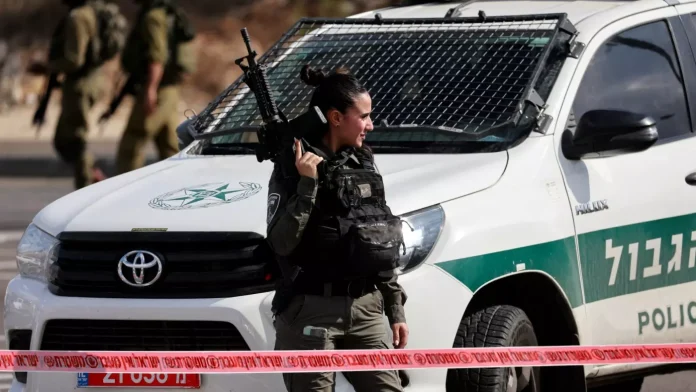
Israeli police have confirmed that the three people killed in Sunday’s shooting attack in the occupied West Bank were members of their police force.
“Three members of the police force were killed this morning in a shooting attack,” Ouzi Levy, chief of the Israeli police in the West Bank, told reporters at the scene of the attack near the Tarqumiya checkpoint near the city of Hebron.
Two of the officers were declared dead at the scene, while the third officer was taken to hospital by helicopter but later died.
The shooting comes amid heightened tensions in the West Bank caused by an ongoing Israeli aggression in the occupied territory.
In the early hours of Wednesday, the Israeli army conducted its biggest operation – dubbed “Camps of Summer” – in the West Bank in over 20 years, deploying hundreds of troops and airstrikes on Jenin, Tulkarem, and Tubas, which are major centers of Palestinian resistance against the usurping entity.
So far, at least 25 Palestinians have been killed in Israeli raids and strikes in several West Bank towns, and many more sustained injuries.
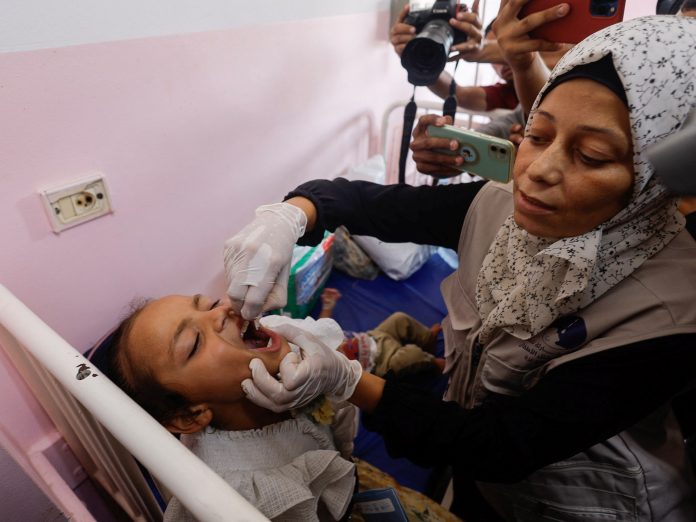
A small number of children in Gaza received vaccine doses a day before the large-scale rollout and limited pauses in the fighting agreed to by Israel and the U.N. World Health Organization.
“There must be a cease-fire so that the teams can reach everyone targeted by this campaign,” said Dr. Yousef Abu Al-Rish, Gaza’s deputy health minister, describing scenes of sewage running through crowded tent camps.
Polio is spread through fecal matter.
But Israeli Prime Minister Benjamin Netanyahu’s office in a statement announced “Israel will allow a humanitarian corridor only” and “areas will be established that will be safe for administering the vaccines for a few hours”.
Israel noted the vaccination program would continue through Sept. 9 and last eight hours a day. It will allow health workers to administer vaccines with the aim of reaching some 640,000 Palestinian children.
The vaccination campaign comes after the first polio case in 25 years in Gaza was discovered this month. Doctors concluded a 10-month-old had been partially paralyzed by a mutated strain of the virus after not being vaccinated due to fighting. Most people who contract the disease do not experience symptoms, and those who do usually recover in a week or so. But there is no cure.
Healthcare workers in Gaza have warned of the potential for a polio outbreak for months.
The territory’s humanitarian crisis has deepened during the war that broke out after Hamas-led fighters stormed into southern Israel on Oct. 7, killing some 1,200 people and abducting around 250.
Israel’s offensive has killed more than 40,700 Palestinians, according to Gaza’s Health Ministry.
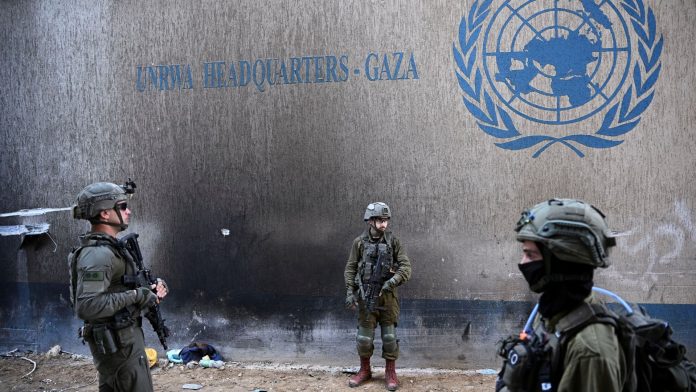
Philippe Lazzarini, the UNRWA commissioner-general, took to X (formerly Twitter) to denounce what he described as a “misinformation campaign” by Israel amidst the ongoing conflict in Gaza.
“The spread of misinformation and disinformation continues to be used as a weapon in the war in Gaza,” Lazzarini stated.
He accused the Israeli government of buying Google ads in an effort to block users from donating to the agency and to carry out a defamation campaign against UNRWA.
“UNRWA is the largest humanitarian organization responding to the crisis in Gaza,” Lazzarini noted, stressing that the campaign not only damages the agency’s reputation but also endangers the lives of its staff.
Lazzarini called for an end to these “deliberate efforts” to spread misinformation and urged for an investigation into the matter. He also criticized companies, including social media platforms, for profiting from the dissemination of disinformation, stressing the need for stronger regulations to combat these practices.
Israel has long sought the closure of UNRWA, which is the only UN agency specifically mandated to address the basic needs of Palestinian refugees. Established by a UN resolution in 1949, UNRWA provides assistance and protection to refugees in Jordan, Syria, Lebanon, the occupied West Bank, and the Gaza Strip.
Earlier this year, Israel alleged that some of the agency’s staff participated in the Hamas-led October 7 attacks on Israel, leading more than a dozen international donors to suspend support.
A UN-authorised independent review found that Israel had not provided credible evidence for its accusations and most donors have since reinstated funding.
Israeli attacks in Gaza have frequently targeted UNRWA facilities, killing 212 of its staff members and hitting at least 70 percent of its schools, according to the organisation.
In an editorial on Sunday, Jomhuri-e Eslami blamed the former administration of late Ebrahim Raisi for providing the Taliban with various kinds of facilities, and advised the newly-inaugurated cabinet of President Massoud Pezeshkian not to follow suit.
“For those who feel the danger of the presence of millions of illegal Afghan nationals in our country, it is very strange that President Pezeshkian has not said anything about this issue and has not clarified his stance,” it wrote.
The daily also argues that after the 2021 takeover of Afghanistan, the Taliban managed to take advantage of the existing facilities and send tens of thousands of its trained forces into Iran and settle them in different parts of the country, adding the armed militants have committed many crimes in Iranian cities and even villages.
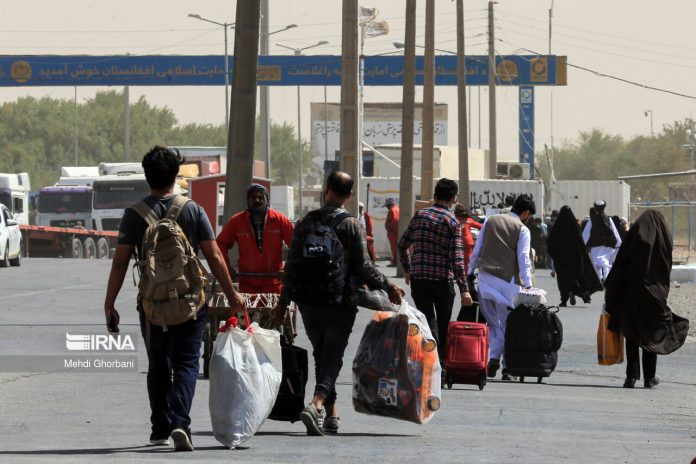
Many Iranian citizens, media, and authorities have raised the alarm over the influx of undocumented Afghan migrants in Iran who have put an extra strain on the country’s resources and facilities.
Unofficial estimates put the number of Afghan migrants in Iran at over 8 million. Iranian officials have set March 20 as the deadline for the illegal migrants to leave the country.
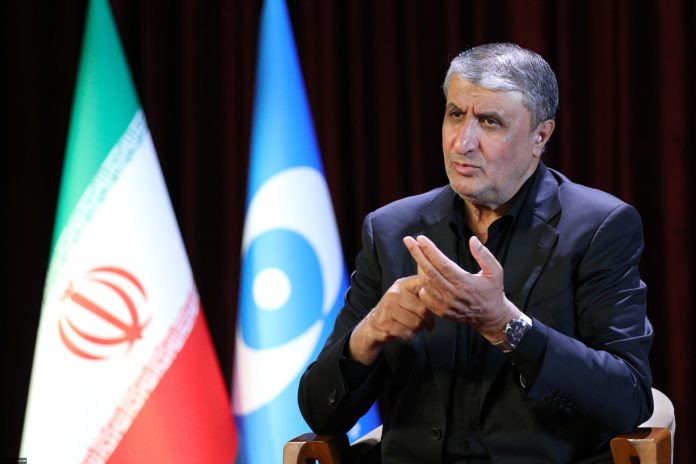
In an interview with Iran’s state-run IRIB Television on Saturday, the head of the Atomic Energy Organization of Iran (AEOI) Mohammad Eslami, who has been reinstated by President Pezeshkian in his post, highlighted the country’s plans and agendas in the new administration.
Noting that Iran is among the top three countries in the world in terms of producing radiopharmaceuticals and exports them to five continents in the world, Eslami explained, “Increasing the accuracy rate in diagnostic radiopharmaceuticals, as well as their effectiveness and making the capacity more stable were among our goals.”
“The second and third units of Bushehr, which are half finished, are more active,” the nuclear chief said about the nuclear power plant in southern Iran and added the Karun power plant is also under construction in its vicinity in Khuzestan province.
He stressed that the organization has been instructed by the president to move forward according to the plans and time-frames and would be held answerable regarding its responsibilities.
Irradiation center, training human resources, plasma therapy, detoxification industry, and increasing nuclear-generated electricity to 3,000 megawatts are among other projects the atomic organization will seriously pursue in the new administration, Eslami explained.
The AEOI head also said Iran is ready to welcome the Director General of the International Atomic Energy Agency (IAEA) Rafael Grossi in Iran according to an arranged schedule.
On Saturday, the 39-year-old Tokyo 2020 Paralympic Games gold medalist scored 236.8 points to finish in first place and win the gold medal.
Her Turkish opponent Aysel Ozgan earned 231.1 points to land in the second spot and scoop up the silver medal. Indian female athlete Rubina Francis collected 211.1 points altogether and received the bronze.
Fatemeh Hemmati of Iran has also claimed a silver medal in the Women’s Individual Compound Open of the 2024 Paralympic Games on Saturday.
Alireza Bakht and Hamed Haghshenas have also claimed two bronze medals in the 2024 Paralympic Games on Saturday.
Iranian athletes have already taken home seven medals – one gold, four silvers and two bronzes – and the Islamic Republic is in the 21th slot of the medal count table.
The Islamic Republic of Iran National Paralympic Committee has dispatched a 65-strong delegation to the Paris 2024 Paralympics. Iranian sportsmen and women are in action in 10 different sports.
The arrest took place in the Pishin District of the province’s Rask County, the Corps reported on Saturday.
It followed intelligence surveillance operation and prompt action by the forces of the Quds Headquarters of the IRGC’s Ground Force in the province, the report added.
Upon facing imminent arrest, the terrorist wounded himself with a self-inflicted gunshot, but was transferred to the hospital, where he is receiving treatment, it noted.
According to the report, the arrested person had in the past engaged in armed attack against the headquarters of the Basij volunteer force and the police station in Pishin.
In May, the Corps’ Ground Force captured primary sponsors of the terrorist group in Sistan and Baluchestan during two separate joint operations conducted by intelligence and security forces.
Jaish al-Adl is a notorious terrorist group with headquarters in Pakistan, and has been involved in numerous terror attacks against Iran.
The latest of the attacks took place in April, when at least five police officers were killed in an attack staged by members of the group in the province.
On January 16, two major strongholds of the group in Pakistan’s southwestern province of Balochistan were precisely struck and completely wiped out by a salvo of missiles as well as a squadron of combat drones.
That occurred after the group claimed responsibility for an assault on Rask County’s police headquarters on December 15 last year that had claimed the lives of 11 police forces and injured at least six others.