Sunday, December 21, 2025
Home Blog Page 5106

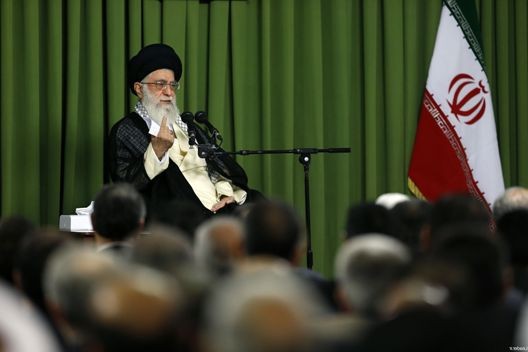
Leader: Iranian Nation Will Never Bow to Foreign Pressures

Supreme Leader of the Islamic Revolution Ayatollah Seyed Ali Khamenei


“The (world) powers should know that the Iranian nation will not be brought to its knees, because it is a lively nation, and the youth of the country are moving ahead in the right direction,” Ayatollah Khamenei said in an address to a large gathering of Iranian people here in Tehran on Tuesday.

The Leader said reliance on domestic potentials to achieve scientific progress is key to withstanding the foreign pressures.

“If we develop the domestic capacities and focus on the indigenous capabilities, the US and the other powers will not be able to do a damn thing, either military or non-military (measures), and will not be able to defeat the Iranian nation by (mounting) pressure,” Imam Khamenei explained.

In relevant comments on April 30, Ayatollah Khamenei had underscored the importance of Iran’s progress in all fields, stressing that enhanced domestic capabilities will strengthen the country’s international position.

The Leader had also made it clear that the world bullies’ illogical behavior towards the Islamic Republic is a function of Iran’s power or weakness, and underlined, “Wherever we stand on our own feet and become strong, they (world powers) have to behave politely and logically.”

Referring to the country’s success to achieve the nuclear know-how by relying on the indigenous capabilities, Ayatollah Khamenei had announced that Iranian young scientists managed to produce 20-percent enriched uranium and manufacture nuclear fuel plates and rods after the “world’s bullies” tried to obstruct Iran’s peaceful nuclear activities.


by Tasnim News Agency

No written invitation yet been received from Saudi FM

Hossein-Amir-Abdollahian


Speaking to IRNA, the diplomat said Tehran has yet received no written invitation from Saudi Arabian Foreign Minister Prince Saud al-Faisal for his Iranian counterpartˈs visit to Riyadh, but the visit is on Iranˈs agenda.

Referring to the significant status of Iran and Saudi Arabia in the region, Amir-Abdollahian said Tehran welcomes holding talks with Riyadh to resolve regional problems, remove misunderstandings and promote bilateral relations.

On Tuesday, the Saudi foreign minister told reporters that Riyadh had invited Iranˈs foreign minister to visit the kingdom.

ˈWe sent an invitation to the foreign minister to visit Saudi Arabia,ˈ Prince Saud al-Faisal said.


by Khabar Online

Photos: Iranian Football Team’s Training Session

Iran football team - 2014 worldcup


US must make tough decisions in N-talks: Iran

Iranian Deputy Foreign Minister Abbas Araqchi


Araqchi made the statement in reaction to remarks by US Secretary of State John Kerry who said on May 6 that Iran must make very tough decisions over its nuclear energy program.

“We … advise the American side to stop making decisions based on illusions and in fact it is the Americans that must make tough decisions in negotiations and stop threats and sanctions because this will be a historic decision for American officials,” Araqchi told reporters on Tuesday night.

He said that all P5+1 countries, especially the US, have come to the conclusion that threats and sanctions are “ineffective” tools in the course of negotiations.

The Iranian official made the remarks after Iranian Foreign Minister Mohammad Javad Zarif and European Union foreign policy chief Catherine Ashton met on Tuesday night ahead of the next round of high-level nuclear talks between the Islamic Republic and the P5+1 – the United States, China, Russia, France and Britain – plus Germany in the Austrian city of Vienna on Wednesday.

Araqchi, who is a member of the Iranian negotiating team, said that in addition to the Wednesday talks Iran and the six countries will hold three more rounds of negotiations within the six-month period, which he said would be “highly intensive”.

Iran and the P5+1 are working to hammer out a comprehensive deal following the interim accord that was reached in the Swiss city of Geneva on November 24, 2013 and went into force on January 20 this year.

Under the Geneva deal, the six countries pledged to provide Iran with some sanctions relief in exchange for the Islamic Republic agreeing to scale down certain aspects of its nuclear activities during a six-month period.

by Presstv

Palestine,Waiting for Liberation

palestine flags

Kayhan Int’l Political Desk

Today is the anniversary of one of the most sanguine crimes in modern history. The 14th of May is that bleak, black and bloody day when in 1948, following three decades of the rape of Palestine by the British, the illegitimate entity called Israel was born in the most unnatural way.

Immediately, the East European Jews, of Khazar origin who had been illegally settled in Palestine brutally attacked the sons of the soil, the Palestinians, killing many of them and driving out over seven hundred thousand men, women, and children to neighbouring lands.

This was the real holocaust that was carried out on the flimsy basis of the myth of the holocaust in Europe, allegedly perpetrated by the Nazis during World War 2.

If Hitler was the culprit of the supposed holocaust, then why was the Zionist entity set up somewhere in Germany, or Eastern Europe? Why were the peaceful Muslims of Palestinian made to pay with their homeland and life for an imaginary bloodbath?

The answers are obvious in view of the stifling of voices by the Western media and politicians to the demands for an academic and scholarly research on the supposed holocaust.

Moreover, there is no connection between the Zionists of East European Khazar origin and the ancient Israelite tribes, the overwhelming majority of whose members have long ceased to practice Judaism, and are mostly Muslim or Christian today.

Today the world is crying for justice. Today the Palestinians continue to reel under the jackboots of the Zionists with no end in sight for their plight of the past 66 years.

There is no one to redress their wrong. The UN has been powerless, while the US and the West European regimes that run it, on the spurious entity called Israel, indulge in all sorts of gimmicks in the name of peace, in order to deprive the Palestinians of peace of mind and tranquility of heart.

Ironically, the so-called Arabs, or more properly the Wahhabis, the Salafis, and the Takfiris, are openly prostrating at the altar of Zionism, in order to created disability in Muslim lands, and thus cast into oblivion the chronic case of the usurped land of Palestine.

In such a pathetic situation, it is only the awakening of Muslim consciences vis-à-vis the Takfiri terror and subsequently the Zionist zombies that will rescue Palestine and the Palestinians from the jaws of Israel.

It is Islamic unity of which the Zionists, the Takfiris, and the Godless West are afraid of. If Muslims overcome their narrow differences to solidify ranks, it will be impossible for Israel to exist on the map of Palestine.

Where there is a will there is a way. The resolve for weeding out Israel is there in the heart of every true Muslim, and this should be given practical shape.

Let us recall the words of the Father of the Islamic Revolution, Imam Khomeini (RA), who had called Israel “a cancerous tumour”. He had said that if every Muslim in the world were to pour a bucket of water then Israel would be drowned and erased from the world map.

The present Leader of the Islamic Revolution, Ayatollah Seyyed Ali Khamenei, has proposed a very democratic solution to end this chronic question. He has suggested a referendum involving all original inhabitants of Palestine, whether Muslims, Christian, or the original Jews (but not the illegal Zionist migrants) to determine the fate of Palestine, stretching from the Mediterranean Sea in the west to the banks of the River Jordan in the east, and from the borders of Lebanon in the north to the borders of Sinai in the south.

If the so-called democratic West does not agree to this democratic solution, then we should be ready for arming the Palestinians.

Remember, over 8 centuries ago in 1187 AD, it was a united Muslim army made up Turks, Kurds, Iranians and Arabs that had liberated Palestine and Bayt al-Moqaddas by ending the 88-year long illegal existence of the Latin Kingdom of Jerusalem of the European Crusaders.

This is possible today, if Muslim regimes, instead of dancing to the devilish tunes of the West by supporting the Takfiris, knit ranks to seriously work towards the salvation of the Palestinian people by deciding once and for all, to end the illegal existence of Israel.


FM: Iran’s Defensive Capabilities No Subject for Talks with Powers

Zarif in Vienna
Zarif in Vienna


“Iran’s defensive issues and our defensive capabilities will not be an issue for negotiations,” Zarif told reporters after meeting EU foreign policy chief Catherine Ashton for a working dinner in Vienna on Tuesday night and before the start of a new round of talks between representatives of Iran and the Group 5+1 (the US, Russia, China, Britain and France plus Germany) in the Austrian capital.

He described his talks with Ashton as good, and said, “This round of negotiations is more sensitive since we will start writing (a comprehensive deal between the two sides).”

Asked if the negotiations will yield results by the end of the stated 6-month period (which ends on July 20), Zarif said, “I believe it is possible but it depends on how much good will and pragmatism the other side shows in the negotiations.”

Stressing that Iran seeks to materialize its rights of access and use of the peaceful nuclear technology and is not after the proliferation of atomic weapons, he said, “We believe atomic weapons are not beneficial to our country and we don’t have any problem if this is clearly shown to the world.”

The Iranian top diplomat underlined that the Iranian delegation has come to Vienna with a firm will to settle the differences with the world powers, but meantime, said if the two sides cannot reach an agreement by July 20, the time for implementing the interim agreement will not be extended automatically and it will need further negotiations.

The Iranian team of negotiators, accompanied by a team of legal advisors and experts, arrived in Vienna on Tuesday.

Representatives of Iran and the G5+1 are due to start compiling and drafting a comprehensive deal in their today meeting in Vienna.

The last round of negotiations took place in Vienna on April 8 and 9.
The Iranian Foreign Ministry in a statement on April 8 reiterated that its team of negotiators would not discuss any topic but the country’s nuclear standoff with the West in its talks with the six world powers.

The talks between Tehran and the G5+1 are part of efforts to seal a final deal on Iran’s nuclear energy program.

Iran and the Group 5+1 representatives had several sessions of talks in Vienna on March 18-19 too. Following the breakthrough interim agreement between Iran and the six powers, the two sides accepted to send their senior negotiating teams to monthly meetings to discuss a final and comprehensive deal until July. If the seven nations fail to agree on a final deal by then, the Geneva interim agreement will be extended for another 6 months.

On November 24, Iran and the Group 5+1 sealed a six-month Joint Plan of Action to lay the groundwork for the full resolution of the West’s decade-old dispute with Iran over the latter’s nuclear energy program.

In exchange for Tehran’s confidence-building bid to limit certain aspects of its nuclear activities, the sextet of the world powers agreed to lift some of the existing sanctions against Tehran and impose no nuclear-related sanctions on Iran during the six-month period.

by Fars News Agency

US Hints at Longer Military Presence in Afghanistan

US military in Afghanistan


James Dobbins, the US special envoy for Afghanistan, told reporters in Tokyo on Tuesday that Washington was considering the details of the withdrawal plan.
“We and our allies, I think, will be prepared for a continuing advisory mission, much smaller numbers than we have there today but still significant in terms of its ability to continue to improve the quality of the Afghan security forces,” Dobbins said  in the Japanese capital, where he is attending talks on supporting Afghanistan.
Dobbins says the exact size of the remaining troops will be decided in the next couple of months.

Iran President Stresses Promotion of Ties With World

Iran president - rouhani


In a meeting with Iran’s new ambassadors to Lebanon, Croatia, Kuwait, Cyprus, Poland, Lithuania and Tehran’s permanent envoy to the Organization of Islamic Cooperation before their departure for their countries of mission, the Iranian chief executive called on the envoys to make efforts to improve the Islamic Republic’s ties with other countries.
Pointing to the adoption of a UN resolution based on Iran’s World Against Violence and Extremism (WAVE) proposal, Rouhani said the ratification of the proposal indicates that there are opportunities and grounds for cooperation between world countries.
On December 18, 2013, the UN General Assembly overwhelmingly voted to approve Rouhani’s WAVE proposal, which calls on all nations across the globe to denounce violence and extremism. The Iranian president made the proposal in his address to the UN Disarmament Conference in New York on September 25.

‘Takfiri Groups Pose Threat to All Muslims’

Iran supreme leader
Iran supreme leader


“If Takfiri groups are not confronted, they will inflict more damage and blows on the Muslim world,” Ayatollah Khamenei said in a meeting with Pakistani Prime Minister Nawaz Sharif in Tehran on Monday.
The Leader also stated that certain countries are making efforts to deliberately cause insecurity along Iran-Pakistan common border.
“There are hands at work to create division between the two friendly and sincere people of Iran and Pakistan through different methods including causing insecurity along [the two countries’] long common border, but the great opportunity for the expansion of ties between the two countries should not be allowed to be missed,” Ayatollah Khamenei stated.
The Leader emphasized that the US seeks to foment division between Iran and Pakistan, saying there are also other governments which are active in this regard.
Ayatollah Khamenei further pointed to the broad cultural and religious commonalities between the Iranian and Pakistani people and expressed regret over the decrease in the level of bilateral economic cooperation.
The Leader expressed hope that Tehran and Islamabad would further improve bilateral relations.
The Pakistani premier, for his part, expressed regret over the recent insecurity in the two countries’ border areas, saying that the Pakistani government will spare no effort to counter elements behind such incidents and will welcome Iran’s measures over the issue.
Sharif also pledged to make every effort to help restore the two countries’ trade ties to its previous level of three billion dollars and even improve on that figure.
Heading a high-ranking delegation, Sharif arrived in Tehran on Sunday for an official two-day visit to hold talks with senior Iranian officials.
Meanwhile, the plots hatched by the West, the Zionist regime and their Arab allies against the region have failed due to the influence of the Iranian Supreme Leader’s thoughts, on the regional nations, Ayatollah Khamenei’s top military aide said.
“The (reason behind the) failure of the western, Arab and Zionist regime’s strategies in the current developments in western Asia, specially Syria, Lebanon and Iraq, should be sought in the reflection of the leader’s thoughts,” senior Military Aide to the Iranian Supreme Leader Major General Yahya Rahim Safavi said, addressing a forum in Tehran on Monday.
Noting that the defensive guidelines and measures of Ayatollah Khamenei which have empowered Iran in the region can be considered as international defensive strategies to defend the Islamic Ummah in the world, he said, “Iran’s power guarantees the Persian Gulf’s security and plays an influential role in the establishment of global security.”
He stressed that Iran seeks establishment of justice-based peace in the world, and said, “The powerful Islamic Iran and its defensive power are at the service of defending the Islamic Ummah and the Muslim territories and Iran’s defensive power relies on the Iranian nation’s will and our country’s geopolitical situation.”
In relevant remarks in July, Vice-Speaker of the Iranian Parliament Mohammad Hassan Aboutorabi-Fard said in a meeting with envoys of the Muslim countries in Tehran that “the Islamic Republic of Iran’s defensive power belongs to all Muslim nations”.

Leader Warns of Attempts to Damage Iran-Pakistan Ties

Ayatollah Seyed Ali Khamenei - Nawaz Sharif


Ayatollah Khamenei, in a Monday meeting with Pakistan’s visiting prime minister in Tehran, underlined that certain foreign elements, including the US administration, seek to “create a rift” between the two friendly and cordial nations of Iran and Pakistan.

Among the plots hatched by the ill-wishers are “fomenting insecurity on the long shared border” between Iran and neighboring Pakistan, the Leader explained.

Ayatollah Khamenei further noted that “the great opportunity for the expansion of relations between the two countries should not be missed.”

Imam Khamenei underscored that enhancement of Tehran-Islamabad ties should not be subject to permission from others, and added, “Among the governments that are trying to create rift between Iran and Pakistan is the US, whose wickedness is publicly clear.”

The Supreme Leader then made a reference to the deliberate attempts to incite insecurity along Iran-Pakistan common borders, and said, “We cannot believe that such events are natural and unintentional.”

Ayatollah Khamenei said Iran has some information that activities are underway in Pakistan’s Balouchestan region to destabilize the shared borders.

Pakistani Prime Minister Nawaz Sharif, for his part, deplored the recent terrorist incidents along his country’s borders with Iran, and admitted that certain hands are behind instigating strife between the two neighbors.

Sharif also assured Ayatollah Khamenei that his administration will spare no efforts to confront those behind border insecurity, and pledged that Islamabad will support Tehran’s measures to establish border security.

The Pakistani premier arrived in Iran on Sunday for a two-day official tour.

This is the first time Sharif visits Iran as prime minister.


by Tasnim News Agency