Friday, April 10, 2026
Home Blog Page 5085

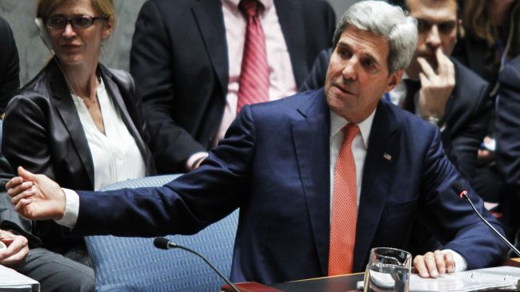
Kerry: Iran has ‘a role’ in campaign against ISIL

Kerry-US-iran-iraq
Kerry-US-iran-iraq

The United States says it is assembling a broad and international coalition to “degrade and ultimately defeat ISIL.”

“The coalition required to eliminate ISIL is not only, or even primarily, military in nature,” Kerry said on Friday at a United Nations Security Council meeting on Iraq. “It must be comprehensive and include close collaboration across multiple lines of effort.”

“There is a role for nearly every country in the world to play, including Iran,” he added.

Earlier in the day, the US State Department said that American and Iranian officials held discussions on the issue on the sidelines of the nuclear talks.

On Monday, Leader of the Islamic Revolution Ayatollah Seyyed Ali Khamenei said Washington only established the US-led coalition against ISIL in order to attempt to expand its military presence in the Middle East region.

In an interview with NBC News on Wednesday, Iranian President Hassan Rouhani called the coalition against the ISIL terrorists “ridiculous”, saying the coalition members include those who provided ISIL with weapons and training.

The ISIL terrorists, who were initially trained by the CIA in Jordan in 2012 to destabilize the Syrian government, control large parts of Syria’s northern territory. ISIL sent its fighters into Iraq in June, quickly seizing vast expanse of land straddling the border between the two countries.

Tehran has repeatedly expressed support for the Iraqi government in its campaign against the Takfiri militants and was the first country to provide military assistance to Iraqi Kurdish forces fighting ISIL.


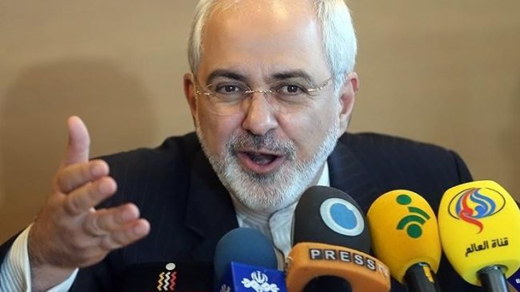
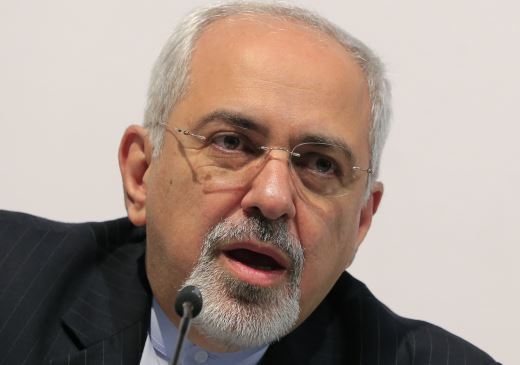
Iran’s Zarif slams US-led sanctions against Tehran

Iran's FM Mohammad Javad Zarif

Speaking in New York on Wednesday, Mohammad Javad Zarif said the United States is “infatuated” and “obsessed” with sanctions and such measures will get nowhere.

The Iranian foreign minister argued that the US Congress wants the anti-Iran sanctions to remain in place amid negotiations aimed at reaching a final nuclear deal between Iran and the five permanent members of the UN Security Council plus Germany.

“The US is obsessed with sanctions, because this deal would require the US to lift the sanctions and now the reason Congress is objecting to this is that it wants to keep these sanctions…. Yes, sanctions have become an end in themselves, sanctions do not serve any purpose,” Zarif stated.

The Iranian foreign minister also stated that the sanctions have failed to put limits on Iran’s nuclear energy program and Tehran has increased the number of its centrifuges, adding, “So sanctions have produced, just in normal calculus, 18,800 centrifuges.”

The remarks come ahead of a new round of nuclear talks between Iran and the five permanent members of the UN Security Council – the United States, China, Russia, France and Britain – plus Germany in New York.

The two sides have agreed on the extension of the talks until November due to disagreements on key issues.


Iran holds bilateral N-talks with Russia, US in New York

Iran-Deputy-FM-Abbas Araqchi

On Thursday, Iranian Deputy Foreign Minister for Legal and International Affairs Abbas Araqchi and Deputy Foreign Minister for Europe and the Americas Majid Takht-e Ravanchi held two hours of nuclear talks with their Russian counterpart Sergei Ryabkov in New York.

The two Iranian diplomats also sat down with US Undersecretary of State Wendy Sherman and Deputy Secretary of State William Burns to exchange views on the progress of nuclear discussions between Iran and the P5+1 – the US, Russia, China, France, Britain and Germany.

The preparatory meetings come as Iran and the six states are set to officially kick off their seventh round of negotiations this year on the country’s nuclear energy program. The plenary talks will be held on Friday on the sidelines of the 69th session of the UN General Assembly in New York.

On Wednesday, Iran’s Foreign Minister Mohammad Javad Zarif attended a working lunch session with EU foreign policy chief Catherine Ashton in New York to review the latest on the talks aimed at reaching a final accord on Tehran’s civilian nuclear work by the November 24 deadline.

Zarif leads the Iranian delegation and Ashton represents the P5+1 states in the ongoing nuclear negotiations.

Last November, Tehran and its negotiating partners signed an interim deal in Geneva, which took effect on January 20 and expired six months later.

In July, the two sides agreed to extend the negotiations until November 24 this year after they failed to reach common ground on a number of key issues.


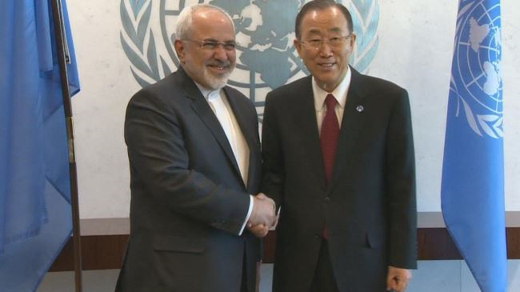
Iran plays constructive role in Mideast, says UN chief

zarif-ban ki-moon
zarif-ban ki-moon

The Islamic Republic of Iran has a constructive and instrumental role in settling conflicts in the region and Iran’s potentialities should be utilized to resolve the current regional crises, Ban said in a meeting with Iranian Foreign Minister Mohammad Javad Zarif at the United Nations Headquarters in New York on Thursday.

He also described Iran as a key player in the Persian Gulf region.

Iran has repeatedly voiced readiness to further contribute to the establishment of peace and security in the region.

The Islamic Republic has on several occasions voiced support for the Iraqi government since it began fighting against the ISIL Takfiri terrorists in June. The ISIL terrorists are in control of some areas in Syria and have captured large swathes of land in neighboring Iraq.

Zarif, for his part, said that Iran remains committed to working towards reinforcing regional security and maintaining good relations with its neighbors.

He also said that Iran is dedicated to fighting extremism and terrorism.

The senior visiting Iranian diplomat noted that Tehran was determined to reach a final nuclear deal with the P5+1 countries and added, “We are optimistic about the conclusion of an agreement and believe that it is possible.”

He also pointed to a recent report by the UN chief about the rights situation in Iran and said it contradicts the realities on the ground in the country.

Referring to the alarming human rights situation in the region, Zarif said the report is politically-motivated and bears testimony to the double standards adopted on the issue of human rights.

Zarif is in New York for a new round of talks between Iran and the five permanent members of the UN Security Council – the United States, Russia, China, France and Britain – plus Germany over Tehran’s nuclear work, scheduled to start officially on Friday.


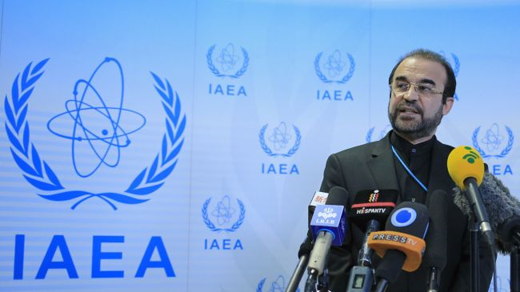
IAEA report confirms Iran commitment: Najafi

Iran-Ambassador-Najafi

“The recent report by the IAEA Director General (Yukiya Amano) which confirmed no violations in Iran’s nuclear energy program is a clear evidence for Iran’s cooperation and fulfillment of its commitments,” Reza Najafi said on Thursday.

The Iranian official further refuted allegations that Iran’s nuclear energy program “has military dimensions,” saying the Islamic Republic of Iran does not consider such claims valid.

Najafi made the remarks after Laura Kennedy, the US representative at the IAEA, claimed, “Concerns about the possible military dimensions of Iran’s nuclear program must be addressed as part of any comprehensive” deal between Iran and the six powers.

Iran and the IAEA signed a joint statement on November 11, 2013, to outline a roadmap for mutual cooperation on certain outstanding nuclear issues.

On May 21, the two sides held a technical meeting within the Framework for Cooperation agreed in November 2013. During the meeting, they agreed to five practical measures which were to be implemented by August 25.

On September 15, Amano confirmed that Iran had enforced three of the five transparency measures it had previously agreed to, and said Tehran and the IAEA had begun talks on the implementation of the two remaining measures.

Earlier this month, Najafi said given the complexity of the issues, Iran and the agency had already predicted it might not be possible to finish their reviews of the remaining issues by August 25.

Last November, Iran and the five permanent members of the UN Security Council – the United States, Russia, China, France and Britain – plus Germany signed an interim deal in Geneva, which took effect on January 20 and expired six months later. In July, Iran and the six countries agreed to extend negotiations until November 24 this year after they failed to reach common ground on a number of key issues.


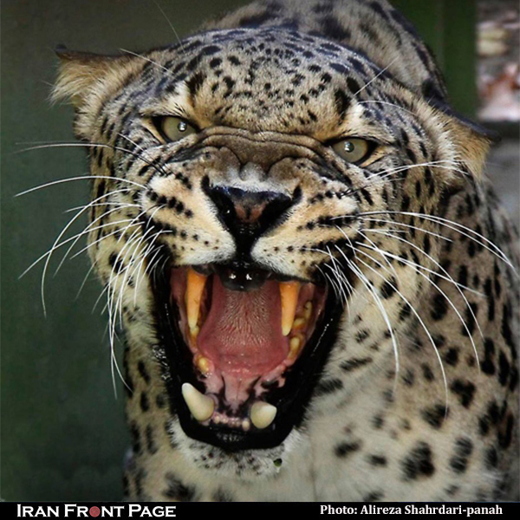
Rica is doing well and his teeth are shining brightly

Persian leopard-Rica
Rica

IFP has recently reached out to Alireza Shahrdari-Panah, a photojournalist who served as an assistant to Dr. Memarian, to get the latest on Rica – the male leopard who underwent dental surgery to have his lower fangs implanted with gold crowns – and to find out if the surgery has been successful in lifting the big cat out of pain.

Mr. Shahrdari-Panah told us that Rica couldn’t be better and invited us to pay a visit to him in order to see his great implanted fangs in person.

Shahrdari-Panah, who is a wildlife enthusiast, has sent the latest photo of Rica to us along with a humorous note: “These are brushed, white teeth of Rica. He has asked us to have his upper fangs implanted, too!!!!!”

Upon a flow of demands by numerous visitors interested in wildlife we decided to post the latest on Rica.

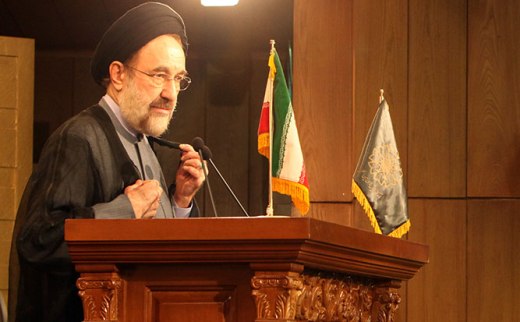
IS, Zionists and Western neo-cons do not represent faith

Mohammad Khatami
Mohammad Khatami

When violence takes center stage in relations, the world turns into hell. That is the case today. Those who view the world as their personal possession take advantage of faith, art, thoughts and all major human and divine achievements to drive their illusions and serve their own interests. Today when the question of dialog among civilizations, cultures and faith is raised, one needs to ask who represents faith, civilizations and cultures; who can be a good representative; and who can get involved in dialog.

According to Jamaran.ir, former president Mohammad Khatami, who was speaking at a monthly meeting of Baran Foundation Tuesday (September 16), further said the sense of speech is what gives an edge to humans over other creatures of God. […] So when a person speaks, they do believe in the importance of discourse. […] Dialog becomes possible only when those engaged in it are willing to open their worlds to others.

Mr. Khatami, who was speaking at the Center for the Great Islamic Encyclopedia on the anniversary of floating the idea of dialog among civilizations, said those who think they possess the world and those with closed identities cannot establish contact with others. Even if they are engaged in dialog, either they do not understand others, or they interpret the words of others the way they wish. Dialog belongs to those who are willing to open the doors of their worlds to others.

He stated those who do not welcome others in their worlds like to be sole speakers, because they just negate and eliminate others. What they see and know are their fossilized illusions and interests which are at odds with those of others. They don’t engage in dialog. Instead they eliminate others. The ones who are very powerful crack down on others and enslave them; those who are less powerful assassinate others. That is how the cycle of violence starts.

The former president said IS, Zionists and Western neo-cons are not interested in dialog and do not deserve to represent their faith. “Zionism is not a representative of Judaism; IS does not speak for Muslims, nor does it represent the Islamic civilization; similarly, neo-cons do not represent the Western civilization, or Christianity for that matter.

Khatami went on to say, “Naturally, artists, thinkers, and scholars who are not narrow-minded can represent cultures and faith. They were the ones who embraced the idea of dialog among civilizations. Of course, many politicians who were not interested in dialog had to embrace the idea of dialog among civilizations, but others continued to fuel war and violence. What transpired in the wake of 9/11 put a seal of approval on the veracity of dialog and the fact that communities needed it to carry on.”

In conclusion, he said, “Today humans need dialog more than ever before to get rid of the problems the international community is grappling with. I believe the human conscience which is sick and tired of violence, insecurity and humiliation is interested in dialog more than before. […] A closer look at what is happening now shows that humans have concluded that they need the kind of dialog that results in understanding; that they need to tamp down violence; and that they need dialog to either sideline bullying politicians or force them to embrace beauty and the truth.”


ISIL product of foreign invasion in ME: Zarif

Iran-FM-Mohammad Javad Zarif

Zarif made the remarks during a speech at the Council on Foreign Relations in New York on Wednesday.

He said the states that took part in a Paris conference on the US-led coalition against the ISIL earlier this week, had supported the Takfiris in the past.

“We do not support foreign military involvement in the region,” Zarif said, adding, “As a principle, we don’t believe that injection of foreign forces – either air or ground – solves our problem.”

The Iranian foreign minister noted that Iran was the first country to take measures to help Iraq in the face of the Takfiri threat.

He called for a Syrian-led solution to the crisis in Iraq’s neighboring country.

The Takfiri terrorists currently control parts of Syria and Iraq. They have threatened all communities, including Shias, Sunnis, Kurds, Christians, Izadi Kurds and others, as they continue their atrocities in Iraq.

Zarif also commented about Iran’s nuclear energy program, slamming the United States for its obsession with sanctions against Tehran.

Iran has lived up to its obligations regarding the nuclear program and is determined to resolve the issue, he stated.

Last November, Tehran and the six countries signed an interim deal in Geneva, which took effect on January 20 and expired six months later. In July, Iran and the six countries agreed to extend negotiations until November 24 this year after they failed to reach common ground on a number of key issues.

Iran has planned bilateral meetings with the six major world powers on Tehran’s nuclear energy program. Zarif said earlier that the meetings would take place before Iranian President Hassan Rouhani arrives in New York next week to attend the UN General Assembly.


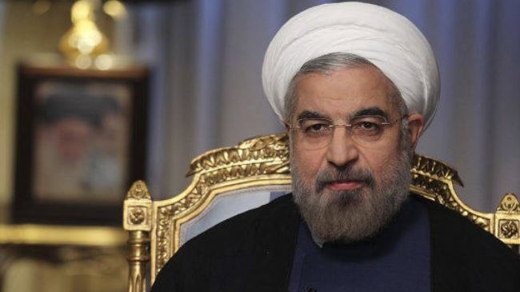
President Rouhani slams US-led coalition against ISIL

Iranian-President-Rouhani

Rouhani made the remarks in an exclusive interview with NBC News in Tehran on Wednesday, saying the coalition members include those who provided the ISIL with weapons and training.

President Rouhani reiterated that Iran will not allow terrorists to occupy the Iraqi capital Baghdad or the holy cities of Najaf and Karbala, calling it a “red line” for the Islamic Republic.

“We will not allow Baghdad… or the religious sites such as Karbala or Najaf to be occupied by the terrorists,” he said.

Rouhani also said Iran will provide Iraq with any support Baghdad asks for to fight the terror group.

The Iranian president went on to say that any airstrikes against the Takfiris must be conducted with permission from the government and people of that country.

Rouhani also slammed the ISIL for atrocities it commits in Iraq and Syria, saying, “The killing and beheading of innocent people is in fact a matter of shame for them and it’s a matter of concern and sorrow for all the human and all the mankind.”

The Takfiri terrorists currently control parts of Syria and Iraq. They have threatened all communities, including Shias, Sunnis, Kurds, Christians, Izadi Kurds and others, as they continue their atrocities in Iraq.

Senior Iraqi officials have blamed Saudi Arabia, Qatar, and some Persian Gulf Arab states for the growing terrorism in their country.

The terrorist group has links with Saudi intelligence and is believed to be indirectly supported by the Israeli regime.


A look at Iranian newspaper front pages on Sept. 18

Iranian Newspapers headlines
Iranian Newspapers Headlines

On Thursday several Iranian newspapers led on nuclear talks between Iran and P5+1 which open in New York later today. Confirmation by the government spokesman of the news that President Rouhani will attend the upcoming UN General Assembly also drew a lot of front-page attention. Comments by former President Mohammad Khatami that IS does not represent Islam were also highlighted by several reformist dailies on their front pages.

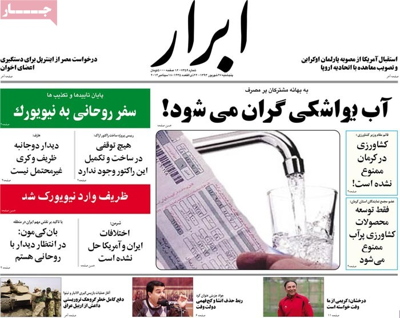
Abrar: UN Secretary-General Ban Ki-moon on Tuesday underlined Iran’s important role in the region and said he looked forward to meeting with President Rouhani.
 

Abrar newspaper-09-18


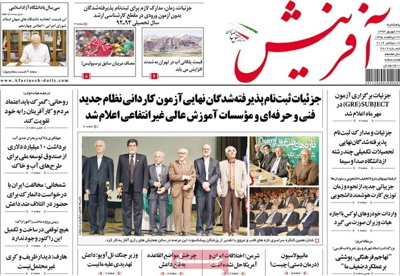
Afarinesh: The secretary of the Supreme National Security Council said, “Iran has turned down a Danish demand that Tehran be part of a Western-led coalition against IS militants.”

Afarinesh: A 16th national Congress on Cardiovascular Diseases has closed in Tehran. In the event the services of veteran specialists in the field were praised.
 

Afarinesh Newspaper-09-18


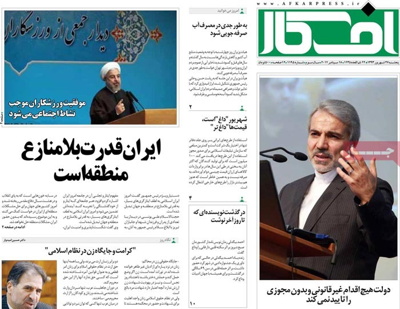
Afkar: Iranian novelist Ahmad Bigdeli, who did not stop putting pen to paper until his final days, has passed away.
 

Afkar  Newspaper-09-18


Aftab-e Yazd: “ISIL does not represent the Islamic civilization,” former President Mohammad Khatami said.

Aftab-e Yazd: The wrangling between the government and Ansar Hezbollah who are bent on hitting the streets as of next week to enforce morality laws rages on. The government spokesman said Wednesday “Violent tactics are bound to prompt some to show more disregard for the [Islamic] dress code…. Any disregard for women is unacceptable to the government…. It is Islam that pays a price for such measures, not Ansar Hezbollah…. Government does not approve of any measure which does not have the go-ahead of appropriate authorities.” Mohammad Bagher Nobakht’s comments came after the executive headquarters of the hard-line group said Ansar does not need permission to do what it is bent on doing. Meanwhile, a parliament deputy warned the grouping not to make the national atmosphere tense.
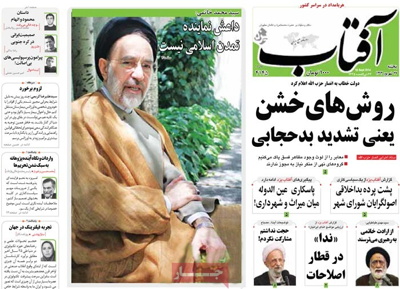
 

Aftabe Yazd Newspaper-09-18


Arman-e Emrooz: “We’re ready for talks to strike a deal,” Iranian Foreign Minister Mohammad Javad Zarif said ahead of talks with P5+1 in New York.
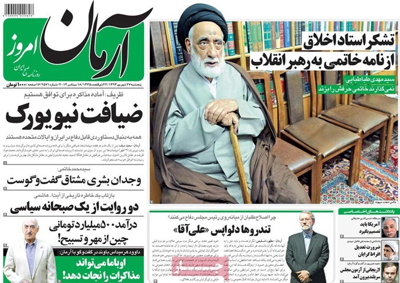
 

Arman  Newspaper-09-18


Asrar: “There has been no halt in construction of Arak reactor,” a senior project manager said.

Asrar: “Iranian tea growers are in a bad condition,” the head of the State Tea Organization said.

Asrar: “Terrorism lies in wait outside the borders of countries,” President Rouhani tells the Azeri minister of economy and industry.
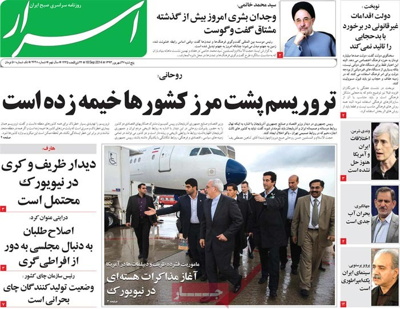
 

Asrar Newspaper-09-18


Ebtekar: Recent recollections by the Chairman of the Expediency Council of a meeting that dated back to before the victory of the Islamic Revolution have stirred up a controversy. In his comments, Hashemi took a jab at a person, he did not name, for his failure to support the revolutionary struggle against the Shah. Now Ayatollah Mesbah Yazdi and one of his students say those comments are not true.

Ebtekar: The government spokesman has put an end to speculations that the president might opt not to attend the General Assembly of the United Nations in New York. “Details of the president’s trip to New York will be released shortly.”
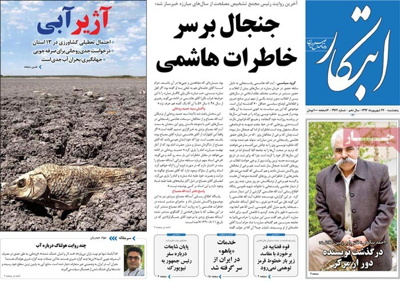
 

Ebtekar Newspaper-09-18


Etemad: “President Rouhani will travel to New York, but there are no plans for a meeting between him and President Obama,” the Iranian government spokesman said.
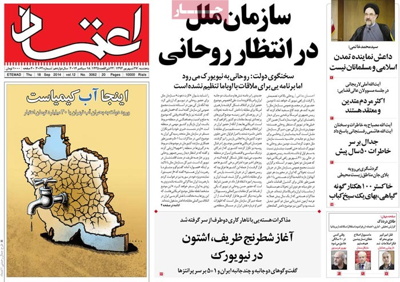
 

Etemad newspaper-09-18


Ettela’at: “The president and his cabinet urge the public to consume less water.”
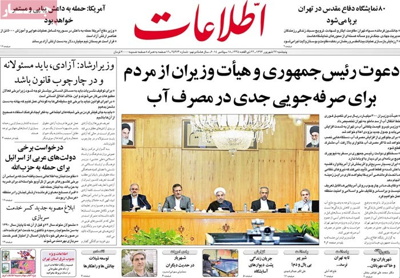
 

Ettelaat Newspaper-09-18


Farhikhtegan: “Islamic Azad University has suffered almost $250 million in losses as a result of stalled projects under the previous management,” Mohsen Hashemi said.
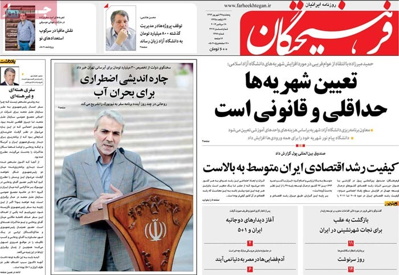

 

Farhikhtegan Newspaper-09-18