Fararu.com, a news website, on September 15 released a story on what partially lies at the center of a new Cold War-style showdown between Russia and the West: Novorossiya. The following is the translation of the report in its entirety:
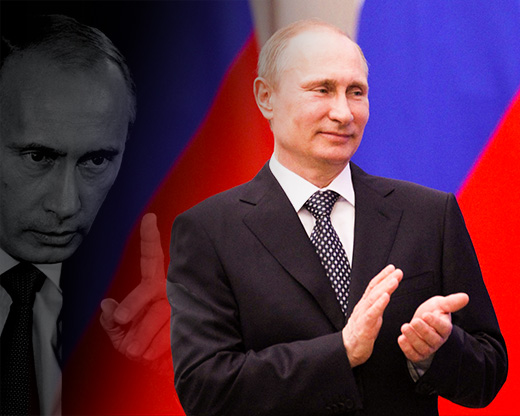
In the state-of-the-nation address on December 12, 2013 Russian President Vladimir Putin took a swipe at Western cultural policies. He lashed out at Western non-traditional values and said that the West treats good and evil equally.
Also, he cast Russia as a defender of traditional family values which from his perspective contribute to Russia’s greatness and act as a bulwark against the onslaught of “genderless and infertile so-called tolerance”.
He denounced what he called the “review of norms of morality” in so many countries and said the destruction of traditional values from above not only entails negative consequences for society, but is also inherently anti-democratic because it is based on an abstract notion and runs counter to the will of the majority of people.
In his speech, Putin openly targeted Western cultural policies. His annual address came at a time after his administration had launched a campaign against the spread of homosexuality which drew criticism from some Western governments and institutions and even prompted activists to demand a boycott of the Sochi 2014 Winter Olympics.
With his new approach, Putin has taken Russia to a new political era. During this period, the Russian president pursues a more confrontational policy toward the West in a more open and radical manner.
The Russian new policy came into sharper focus in the developments of the last year, including Moscow’s stance on the crises of Syria and Ukraine and even on Iran’s nuclear dossier. In the new era, President Putin and his government welcome any standoff with the West, an approach which has been unprecedented since the collapse of the Soviet Union.
Such an approach was perceived as extremist in Russia a few years ago. Now, however, it’s said to be greeted by a majority of the Russian people. In this new era, President Putin follows the doctrine of a famous Russian theorist and it seems he will forge ahead with it. Directly or indirectly, his policies have been influenced by the theories of Aleksandr Gelyevich Dugin, an ideologist and a political theorist.
Who is Dugin?
Aleksandr Gelyevich Dugin is a Russian philosopher and the father of neo-Eurasianism theory, aka the Eurasian Movement, which came into being after the collapse of the Soviet Union in Russia. He was born on January 7 in 1962 into a family of a colonel-general of the Soviet military intelligence and candidate of law Gelij Alexandrovich Dugin and his wife, a doctor and candidate of medicine.
In 1979, he entered the Moscow Aviation Institute, but couldn’t finish his course. Later, he got in through the backdoor and secured a job in the KGB [security police organization of Soviet Russia] archives. In fact, his father arranged the position for him. In his new job, he identified his main ambitions.
Reading documents that were inaccessible to many, he started doing research into fascism, Eurasianism and different religions. After the fall of the Soviet Union, he was amongst the earliest members of the National Bolshevik Party [NBP].
However, later a part of hard-line nationalist NBP members, supported by Dugin split off to form a right-wing, anti-liberal, anti-left nationalist organization: the National Bolshevik Front. Also, Dugin published his own journal entitled Elementary and collaborated with weekly journal Den [The Day].
In his journals, Dugin admired Nicolae Ceauṣescu, a communist politician and a hard-line Romanian nationalist who sympathized with Joseph Stalin [Russian leader who succeeded Lenin as head of the Communist Party] and was impressed by China’s ruling system – in fact, by the highly personal way that China’s Mao Zedong ruled his country.
The Eurasia Party was registered by the Ministry of Justice of Russia on June 21, 2002, before the Pan-Russian Eurasia Movement was founded by Aleksandr Dugin. The movement has the backing of some Russian military circles, and a number of Russian Muslim, Orthodox Christian, Buddhist leaders. It’s believed by some President Putin directly supports the movement with financial aid.
Dugin is of the opinion that in terms of culture, Russia belongs to the East and has to stand up to the West. Dugin also believes that a unipolar Western-American world should be confronted, views Russia as the torchbearer for the confrontation and accordingly defines allies for Russia. That’s why he floated the alternative of Eurasianism which defines Russia as Eurasia and its allies are Iran, Turkey, China, India, and some Eastern European countries like Bulgaria and Serbia.
Dugin’s Russia is Great Russia. Perhaps, he seeks to revive Tsarist Russia. His theories seemed to be far-fetched until a few years ago and described as so radical. Nonetheless, over the last year some developments have been in line with his line of thinking.
From Dugin’s perspective, Eurasianism is a political philosophy comprised of three levels: External, middle and internal. At the external level, it says the world is multipolar, meaning that there are some global decision-making centers one of which is Eurasia. Eurasia is not confined to Russia. In fact, it is made up of Russia along with the former Soviet Republics. At the middle level, there is convergence among former Soviet states to form a transnational model. At the internal level, it seeks to construct a political community which is studied in terms of its relation with civic rights as well as liberal and nationalist models.
These three levels define Eurasianism based on which only one foreign policy can exist. This foreign policy is different from globalization, the unipolar world, nationalism, imperialism, and liberalism. Therefore, Eurasianism offers an exclusive model of foreign policy.
Dugin is a professor of philosophy and political sciences at Moscow State University. On the fourth floor of the Sociology Department of the university, he has an office on whose door it’s written “The Center for Conservative Research”, a phrase which reflects his approach.
Vladimir Putin admired such an approach in his annual address in December 2013 and said, “The meaning of conservatism is not that it prevents moving forward and upward. It prevents moving back and down to the chaotic darkness, a return to the primitive state.”
Dugin, who used to be an obscure figure, is now known as an ideologist in the new framework of Russian leanings. His long grey beard reminds one of the characters of Russian classic story books. He loves Russia and favors the union of Slavic-speaking nations.
Dugin believed the “Russian spirit” has been re-awakened by Igor Strelkov, a Russian rebel military commander in Eastern Ukraine. Dugin is in pursuit of “New Russia”, an exact phrase that a while ago President Putin used to admire the separatists during the raging crisis of Ukraine.
When the question of annexing Crimea was raised, Putin adopted such a phrase. One more time, the president used it on Sunday August 31 when he talked about eastern Ukraine. By repeating the term “Novorossiya” [“New Russia”] he dropped hints about the annexation of Donetsk and Luhansk – two disputed cities in eastern Ukraine.
His comment might go even beyond that and refer to the annexation of Transnistria in Moldova for Russia. The use of the term “New Russia” – used at least twice by Putin – stems from the ideologies put forth by Dugin.
For a few years, Dugin held the idea that Crimea should be handed back to Russia, a development which took place in March, 2014 when President Putin’s resistance against the West paid off. Dugin does not stop at this point and wants eastern Ukraine to be annexed by Russia.
Some speculated that Dugin was the one who put the idea of splitting off from Ukraine in pro-Russian separatists’ heads. While others said that he provided President Putin with advice about the recent developments in Ukraine. When asked as to whether he is in touch with separatists, Dugin said they are his friends and in response to a question as to whether the Kremlin consulted with him and whether he had met with the president, he said that it was a personal matter and he would rather not answer it.
It’s said that on his desk along with books, half empty coffee cups, there is a spool of black and orange striped ribbon – a symbol of loyalty to Russia which is tied around rifles by pro-Russian separatists.
Dugin believes the “Russian spirit” has been re-awakened by the separatist struggle, which he calls the “Russian Spring”. From his perspective the symbol of that spirit is rebel commander Igor Strelkov.
In July 2014, Dugin called on President Putin to intervene militarily in eastern Ukraine “to save Russia’s moral authority”. His appeals for the annexation of Crimea went as far back as 2008, during Russia’s war with Georgia. Back then, he travelled to the disputed region of South Ossetia, where he was photographed with a rocket launcher.
Dugin’s Eurasianism lends a significant position to Iran. He views Iran as one of key Russian allies in the standoff with the unipolar Western-American world.
As for Iran’s role in his theory he said, “Iran plays a key role in Eurasianism theory which views the world as a multipolar system. Iran is not included in Eurasian convergence, because only former Soviet Republics fall into that category. Iran has the great civilization; it’s a powerful and independent country which should be respected. This alliance [Tehran-Moscow] should be maintained.
“We should not consider convergence with Iran. Iran is not part of the convergence model of Eurasianism. Rather, it is a partner of Russia in a multipolar world. Our strategic interests in Central Asia and in the region at large overlap. Thus, Iran serves a major role in the model of multipolar Eurasianism, and accordingly Tehran is the closest ally of Moscow. Of course, partnership with Turkey, China, and India has been considered as well.”
Dugin paid a visit to Iran in 2012 and held talks with some Iranian scholars, including Prof. Seyyed Mostafa Mohaghegh-Damad, Prof. Gholamreza Aavani, and Prof. Gholamhossein Ebrahimi Dinani. Also, he attended some meetings and lectures.
He is of the conviction that Russia will vehemently oppose any Western military action against Iran, and based on the very policy, Russia will lend support to Syria. Moscow will safeguard Iran’s strategic interests to the very end. This matter is of great importance because military action against Iran will pose a threat to security of Russian borders.