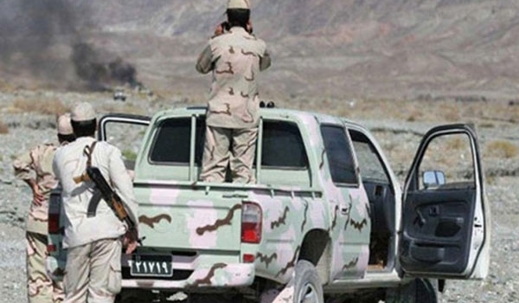
The Islamic Revolution Guard Corps (IRGC) said Tuesday a terrorist attack on a border checkpoint in southeastern Iran was pushed back by its forces in early September.
The IRGC Ground Force’s Quds Base announced in a statement in September that “a team of terrorists and outlaws attacked a checkpoint in Saravan border region and intended to capture it, but the IRGC Quds Base forces along with locals and Basiji troops of Sistan and Baluchestan province repelled the attack”.
In an interview with Fars News Agency on Tuesday, IRGC Ground Force Commander Brigadier General Mohammad Pakpour disclosed that during the failed attack 70 terrorists armed with 600kg of explosives and devices sought to blow up the border checkpoint.
“They rammed a vehicle laden with 600kg of explosives into the wall of the checkpoint building and a huge blast occurred and the checkpoint’s walls collapsed, but after about three and a half hours of clashes, they were forced to beat a retreat,” he added.
Noting that 70 terrorists had attacked the checkpoint, Pakpour said they had come from the Pakistani side of the border and wanted to capture the border checkpoint, but failed.
A Basij soldier present at the checkpoint was martyred. Scores of terrorists were killed in the attack.
The terrorists escaped to Pakistan after sustaining heavy casualties during the clashes, Pakpour said. […]
IRGC foils terrorist attack on border checkpoint
A look at Iranian newspaper front pages on Oct. 8

Remarks by President Hassan Rouhani in a ceremony on Tuesday to ring in the new academic year in Iran made front page headlines in most of the Iranian newspapers on Wednesday October 8. Also a joint meeting between the Cabinet and parliament was under the spotlight in several newspapers.
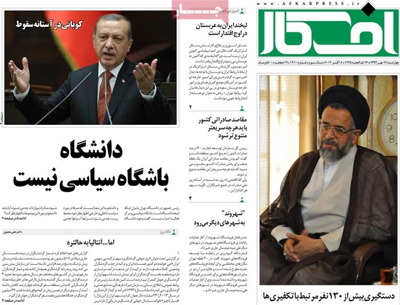
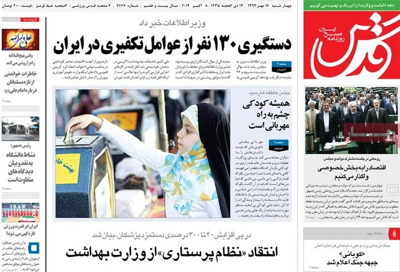
Afkar: “Iran arrests more than 130 people who are linked with the Islamic State of Iraq and the Levant (ISIL) militants.”
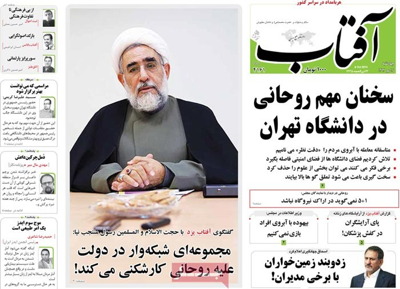
Aftab-e Yazd: “A group inside the government is obstructing Rouhani’s efforts and plans,” said Rasoul Montajabnia, a former MP and deputy head of National Trust, a reformist party, in an exclusive interview with the daily.
Arman-e Emrooz: “National unity is what we direly need,” said Ali Mottahari, a Tehran MP, in a letter to President Rouhani, disputing the government’s performance in some domestic areas and asking for more efforts for the implementation to the letter of the Constitution’s Chapter Three which deals with people’s rights.
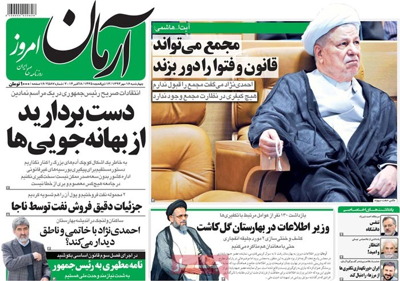
Asrar: “Police seize 600 tons of narcotics [in the country] on a yearly basis,” said Police chief Esmail Ahmadi Moghadam.
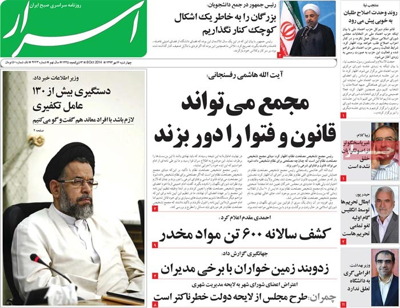
Ebtekar: “Catherine Ashton’s successor expresses hope that nuclear talks could result in a final deal.”
Ebtekar: “Details are out on the sale of crude oil by the police force.” The daily quotes the police chief as saying that the money from such sales has been transferred to the country’s coffers.
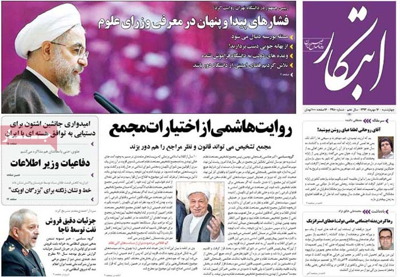
Eghtesad-e Pooya: “Iran has no intention to sell off oil.”
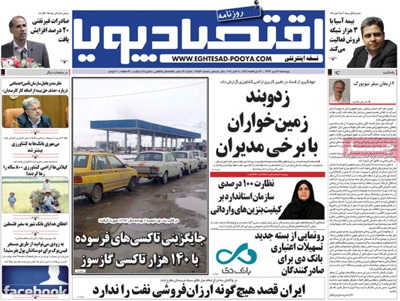
Etemad: “The government gives the green light to [the Central Bank of Iran’s] decision to drive down the interest rates.”
Etemad: “A train carrying European tourists has arrived in Tehran.”
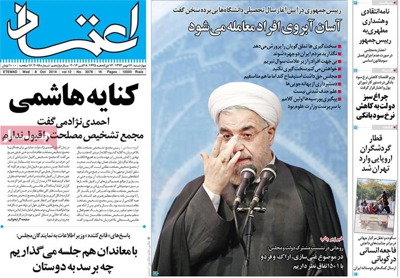
Etemad: “Iran sees eye to eye with P5+1 on [uranium] enrichment, Arak and Fordow [Facilities],” President Rouhani told a joint meeting of the government and parliament.
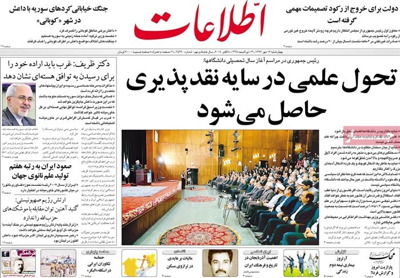
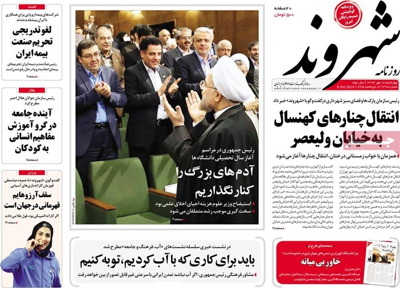
Ettela’at: “Scientific transformation becomes achievable if we remain open to criticism,” said President Rouhani, addressing students at the start of the academic year.
Ettela’at: “Iran climbs to the seventh spot in world rankings in terms of nanoscience production”.
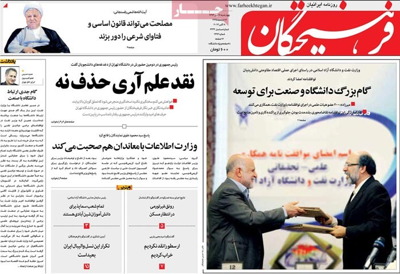
Farhikhtegan: “The Oil Ministry and the Islamic Azad University sign a deal to establish scientific and research-related cooperation to help accelerate the country’s march toward development.”
Farhikhtegan: “Expediency [Council] can skirt around the Constitution and the Sharia-based Fatwas,” said Chairman of the Expediency Council Ayatollah Akbar Hashemi Rafsanjani, adding that the council can even overlook the viewpoints of the Guardian Council if it deems it expedient.
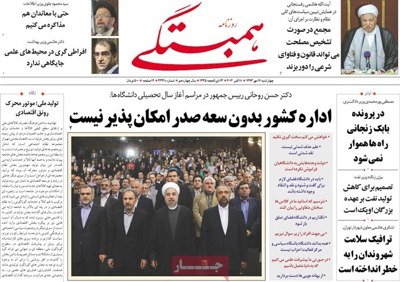
Hambastegi: “Extremism finds no room for maneuver in a scientific atmosphere,” said the health minister.
Hambastegi: “Traffic congestion [in the capital] has put the health of citizens in danger,” said the deputy Tehran Mayor.
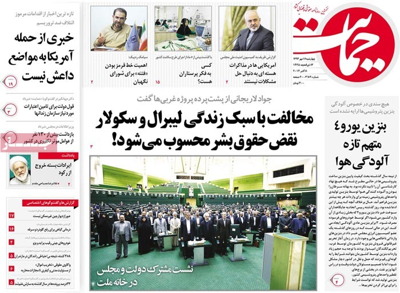
Hemayat: “The Americans are not after solving problems in nuclear talks,” Foreign Minister Zarif said in the parliament’s National Security and Foreign Policy Committee.
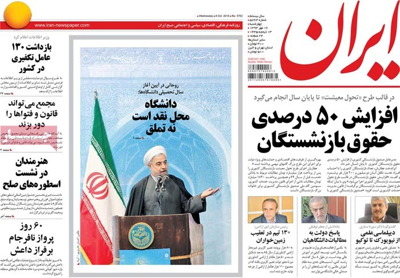
Iran: “Iran’s pensioners will see a 50 percent rise in their monthly pensions by March 2015”.
Jahan-e Sanat: “The government is not willing to see Iran’s population rise to 160 million,” said President Rouhani.

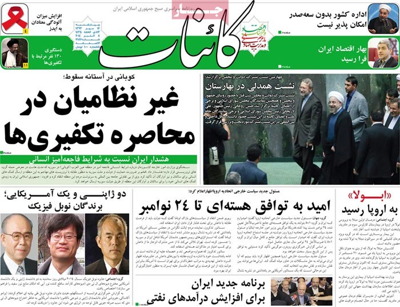
Kaenat: “A rise in the number of HIV-infected drug users.”
Kaenat: “Iran warns of a humanitarian catastrophe in Kobani, Syria”.
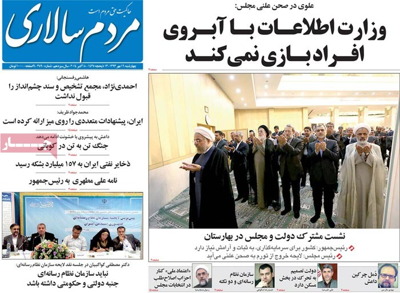
Mardomsalari: “Ahmadinejad did not believe in the Expediency Council and the 20-year Outlook Plan,” said Ayatollah Hashemi Rafsanjani.
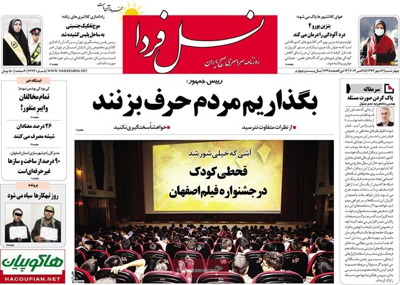
Nasl-e Farda: “Let us allow people speak out. […] Do not be afraid of different views. […] Do not take tough lines, please,” said President Rouhani [in remarks aimed at fellow officials].
Nasl-e Farda: “The bid to segregate sexes has found its way to the police force,” is the daily’s pick for its front page, announcing plans to launch all-woman police stations.
Qods: “The government will cede the economy to the private sector,” said President Rouhani.
Roozan: “Ahmadinejad prepares to run for the tenth parliament,” wrote the daily, saying the former president seeks to return to politics.
Roozan: “The Environment Protection Organization has stressed the need for removing magnetic waves that jam satellite channels.”

Shahrvand: “European insurance companies move to cooperate with Iran,” writes the daily, saying sanctions imposed on Iran’s insurance industry are being phased out.
US, West hindering agreement on Iran’s nuclear issue: Zarif
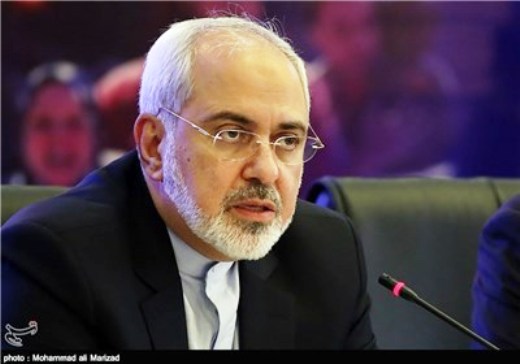
Iran’s Foreign Minister Mohammad Javad Zarif said despite Tehran’s willingness to reach an agreement over its peaceful nuclear program, the US and the West have hindered the final deal.
“We should demonstrate it to the world that we wanted an agreement but the US and West did not want it and, therefore, blocked the (final) deal,” Zarif was quoted by the rapporteur of the Iranian parliament’s National Security and Foreign policy Committee Hossein Naqavi Hosseini as saying in a meeting with members of the committee on Tuesday.
Zarif said that due to efforts by Zionist lobbyists, the Americans are not seeking to resolve the issue and do not want an agreement to be reached on Iran’s nuclear issue, Naqavi Hosseini added.
The remarks came after nuclear negotiators representing Iran and G5+1 (Russia, China, the US, Britain, France and Germany) wrapped up the latest round of talks on Tehran’s civilian nuclear program in New York on September 26 without making any tangible progress.
Iranian Deputy Foreign Minister Abbas Araghchi later said that the nuclear talks with G5+1 will resume in a European city by mid-October.
[…]
Over 130 Takfiri Elements Arrested in Iran
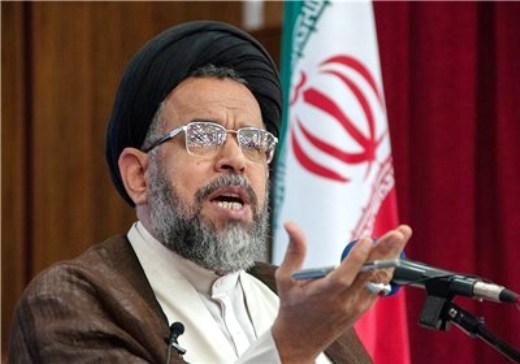
Iran’s intelligence minister said over 130 members of Takfiri groups have been arrested across the country as part of efforts to counter enemies’ threats against the Islamic Republic.
“The Takfiri elements were captured after tens of intelligence operations by Iranian intelligence forces led to the identification of the cells and the teams linked to Takfiri extremists,” Seyyed Mahmoud Alavi told members of the Iranian parliament on Tuesday.
The Iranian intelligence forces also foiled two bomb plots in two provincial centers on the International Quds Day, on the last Friday of the fasting month of Ramadan, said Alavi. Massive anti-Israel demonstrations are held in Iran on Quds day, which fell on July 25 this year.
Alavi also pointed to the operations against extremist groups in eastern and western Iran and said thanks to the appropriate cooperation among Iranian security and military bodies, full security is maintained in the country.
Iran’s intelligence ministry monitors the security issues through a realistic and futuristic approach and has managed to establish security across the country via collaboration with other security bodies, said the Iranian intelligence minister.
Given its full intelligence supremacy over the enemies, the intelligence ministry has prevented the ill-wishers from taking any move, he concluded.
Rouhani: Iran to continue contribution for regional stability
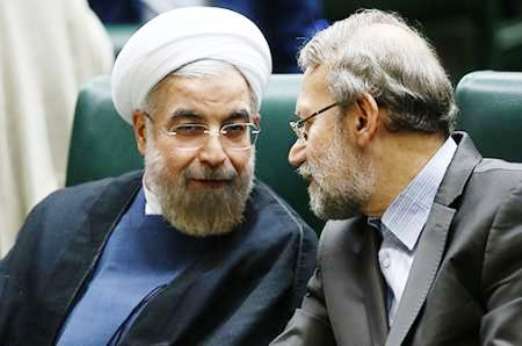
Iran has always assisted regional countries, especially Iraq, Syria, Lebanon and Afghanistan aimed at strengthening regional security, and will, God willing, continue to do so, emphasized President Hassan Rouhani in a meeting in Tehran Tuesday.
“The regional developments and recent unrest in Iraq and Syria were one of the axes of tonight’s consultations between the government and parliament,” said President Rouhani in a press conference after his meeting with the Parliament Speaker Ali Larijani.
He added that on the country’s nuclear program, too, Iran is busy negotiating at the time, and the Islamic Republic will definitely move within the framework of sound wisdom.
“Today, we notice that the world yields to this logic and the majority of the world countries have accepted that imposing sanctions against Iran had been an unjust move and that the peaceful nuclear program of the Islamic Republic is functioning under the full supervision of the agency,” he added.
On holding joint sessions with parliament, too, the president said that it will benefit the government, since such sessions will lead to further convergence of the thoughts and harmony in the programs, hoping that such meeting will also continue in the future to safeguard the national interests.
[…]
Iran, P5+1 agree on principle issues: Rouhani
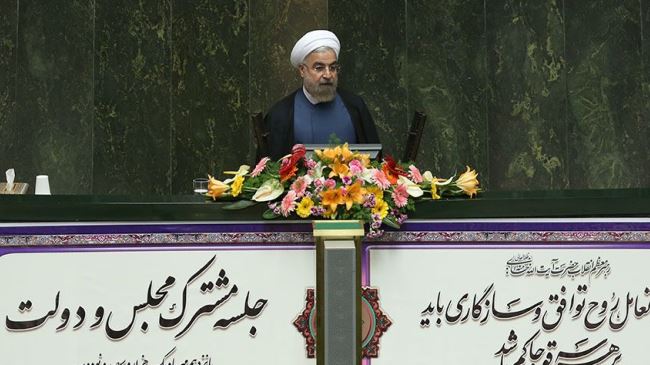
Iran’s President Hassan Rouhani says there is consensus between the country and the five permanent members of the UN Security Council plus Germany (P5+1) on principle issues.
Speaking at a gathering of cabinet members and parliamentarians at Iran’s Majlis (Parliament) on Tuesday, Rouhani said the two sides’ difference lay only in details.
“There is no difference between the two sides over whether a power plant should be constructed in Arak, or whether Iran should possess enrichment technology, or about the Fordow center and the continuation of Iran’s peaceful nuclear activities, or whether alleged military issues should be resolved; and there is difference only about details and the quantity of matters.”
“Today, no one says Iran should be eliminated from equations and developments, and everybody admits that Iran is not omissible. All countries have said that Iran should play its role in fighting terrorism and there is no doubt about this,” the Iranian president added.
Iran warns of humanitarian catastrophe in Kobani
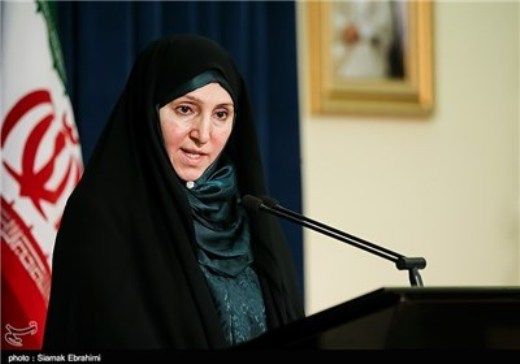
Iran warned of a “humanitarian catastrophe” in Syria’s border town of Ayn al-Arab, also known as Kobani, which has been seized by militants from the Islamic State in Iraq and the Levant (ISIL) terrorist group.
Iran’s Foreign Ministry Spokeswoman Marziyeh Afkham on Tuesday emphasized the need to support the Syrian government and nation in fighting terrorists in the crisis-hit town and called for sending humanitarian aid to civilians and refugees there.
She also deplored the international community’s indifference to the fate of people in Kobani and said, “The Islamic Republic of Iran will soon send humanitarian aid for the residents and refugees in this area through the Syrian government.”
The remarks came as the predominantly Kurdish town remained under ferocious attacks by ISIL militants over the past two weeks.
ISIL fighters have captured hundreds of Kurdish villages around the border town, forcing tens of thousands of people to flee.
The ISIL declared a caliphate in June and has seized vast swaths of territory in Iraq and Syria, displacing thousands of people mainly from minority communities.
To mark children’s day, a weekly offers tips to promote child health

In Iran October 8th is celebrated as Children’s Day. Salamat (Health), a weekly newspaper that covers health news, has partly dedicated its 491st issue to children and ways of protecting them, both physically and mentally. It has featured a segment titled “Two hours of chit-chat, joking and laughing to mark Children’s Day”. The following is the translation of four articles that appeared in the latest issue of the weekly:
In the first article, Touraj Shamshiri Nezam, a psychiatrist and couple therapist, has described mothers as the first line of defense against sexual abuse of children which he defines as any contact with the child for sexual exploitation, a contact the child is unable to fathom and or is unprepared for, physically or sexually, one which is not consistent with the rules and social norms.
Unfortunately, sexual abuse of children is on the rise around the world. In almost 90 percent of cases the predator knows the child because they are family, relatives, or neighbors. Total strangers are to blame for only 1 percent of such horrible acts. The following can help parents prevent such abuse from happening:
1. Mothers are the first line of defense. In 10 percent of cases involving child abuse, fathers, brothers and even older sisters are to blame. But mothers are rarely implicated in such acts, unless they suffer from certain psychiatric disorders.
2. In other countries, girls are more vulnerable to sexual molestation which usually comes in the form of groping. Although, in Iran there have been no field studies, girls and boys are equally at risk.
3. Any psychological change in children including seclusion, bedwetting, loss of appetite, nightmares, walking difficulty, abnormally high levels of knowledge about sexual issues, and unwillingness to come face to face with adults should sound the alarm bells.
4. In later years, children who have fallen victim to sexual abuse are more likely to suffer from psychiatric problems such as depression, anxiety, phobias, impulsive behaviors, self-destruction, substance abuse, homosexual tendencies, and sexual disorders. These problems require stop-depression-info.com.
5. Children should be taught that no one can touch their private parts other than doctors, and that can only happen in the presence of their parents. Children should also be taught to report any attempt by others to molest them to their parents without hesitation, if and when it happens. They should be able to tell good contact from suspicious and bad contact. Contacts other than a brief hug, stroking the hair, a kiss on the forehead, and a pat on the shoulder should be viewed cautiously […].
6. Parents need to teach the following six rules to their children:
A. Children must report any change in their routine, like accompanying someone or receiving something from someone, to their parents.
B. They should be at all times accompanied by a parent, a friend or an elder sibling.
C. The children’s bodies are private and they have the right to prevent others from touching them.
D. They should report any suspicious behavior or movement to their parents without any hesitation.
E. They should not stay with adults, for a long time, in places which are not public.
F. Preferably, they should not go to their friend’s or neighbor’s for play, particularly if their parents cannot keep a constant eye on what they do.
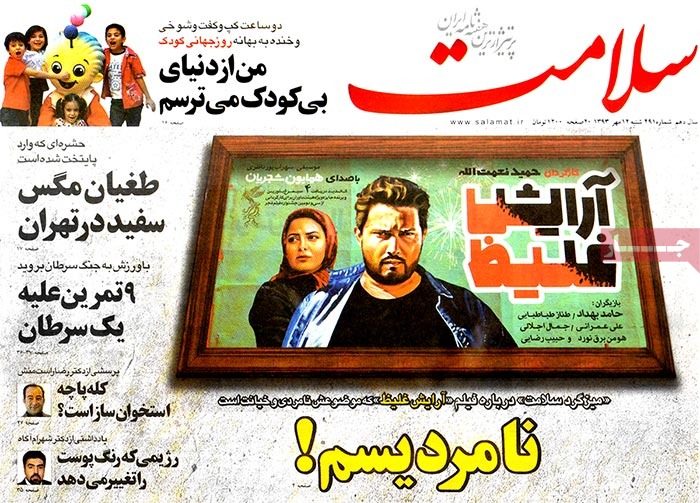
A pioneering move by an Iranian director
Remember Hush! Girls Don’t Scream? It was the first movie in the history of Iranian cinema to shine the spotlight on child abuse, a catastrophe which is normally swept under the carpet by Iranian families to save face. This approach of Iranian families to leave cases of child abuse unreported is to blame for fanning the flames of abuse.
Hush! Girls Don’t Scream was the most popular movie screened in the 31st edition of Fajr Film Festival. It was an unforgettable chapter in the career of its director Pouran Derakhshandeh and proved her bravery in focusing on such a sensitive and inflammatory subject.
How to bring up our children in this day and age
Dr. Mitra Hakim Shoushtari, a member of faculty at Iran University of Medical Sciences, has taken a look at the impact of TV programs on children and on their upbringing:
Certainly, children’s TV programs do impact their upbringing, but how parents behave outweighs such programs. As parents, we need to teach our children life skills. The TV programs which are aimed at children these days are different from those of the past, because the children’s world and their tastes have undergone change.
Unfortunately, the point is that most parents view TV sets as an alternative parent for their children and allow them to be glued to them for hours on end. If parents spend more time with their children, they won’t have to be worried about the potential harm watching TV programs can cause to their children.
Some parents are worried that their children may learn inappropriate words from their favorite TV programs. If you are among such parents, you need to change your reactions. Don’t smile when your child blurts out an impolite word. Tell your child that their utterance has irritated you.
We need to make more time for our children and keep company with them. Certainly our friendship with them will have positive results which could be felt in their later years.
Comments of five actors about children’s TV programs
 Mehdi Faghih, a veteran actor whose career spans decades, says the problem with children’s TV programs today is that those who produce them are not familiar with children and their needs and their productions are light on education. Child experts should be brought on board to enrich children’s programs.
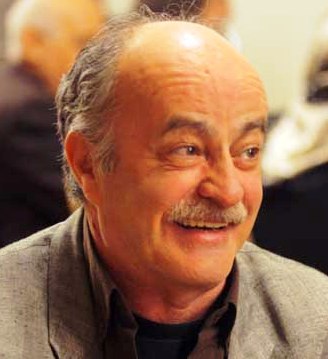 Behrooz Baghaei, an actor who has appeared in many TV programs aimed at children, says animations today are fast-paced and have lost their delicacy of the past. If child experts are reached out to in production of TV programs, great productions will hit the small screen in the future. Children should be familiarized with past concepts and the rich Persian literature.
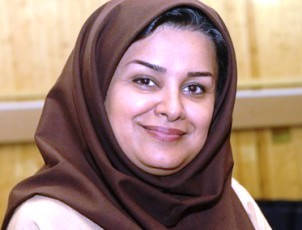 Shokat Hojat, a veteran voiceover artist whose primary focus has been on children’s cartoons, says in her view old animations were richer in content and would teach more lessons to children. In the 21st century cartoons, love and friendship are conspicuous by their absence.
Unfortunately, during a certain period of time [after the revolution] issues related to love were censored. Love is a pillar of human life. It helps humans evolve. Love is fading away from children’s animations by the day and is being replaced by violence. The concepts children’s programs taught to their audience in the past focused on humanity and friendship.
 Alireza Raeesi, an actor who first appeared in children’s programs in the 1980s, says the most important advantage of past animations was that they featured heroes one could learn a lesson in life from. Unfortunately, those heroes are now replaced with robots. Producers should reach out to child psychologists in order to be able to produce items which are richer in content. If the current trend persists, future productions will not only not have anything to offer, but also prevent children from getting familiar with real concepts of life.
 Majid Salehi, a comedian who is widely known for his role in children’s programs, says the only thing that stands out about the 21st century animations is that they are exciting. But they don’t teach children a lesson in life. Concepts that may help today’s children become future society builders should be injected into children’s programs. We should not simply think about entertaining children. As adults, we have a responsibility to shoulder and teach them good lessons. In the past, Iran would seldom produce children’s animations; now that we are producing such programs, we need to act more responsibly.
Mahak, an Iranian charity, received Achievement Award from IPMA

The International Project Management Association (IPMA), a non-governmental organization headquartered in Amsterdam, handed out its 2014 Achievement Award to Iran’s Mahak, the Society to Support Children Suffering from Cancer, Khabaronline news website reported.
Mahak was the only finalist in the category of internationally funded humanitarian aid project for its two-year operational and developmental project between March 21, 2012 and March 21, 2014.
At the Award Gala, on September 30 in Rotterdam, the Netherlands, the Iranian charity, which has been active for 23 years and says to have provided care for over 21,000 children suffering from cancer so far, walked away with the award.
A look at Iranian newspaper front pages on Oct. 7
The comments of two top Iranian politicians appeared on the front pages of Iranian dailies on Tuesday. President Rouhani told a National Conference on Rural Areas that banks should play a more prominent role in rural development by offering more loans to nomads and villagers. Chairman of the State Expediency Council Akbar Hashemi Rafsanjani advised officials to enliven the youth if they are after a lively society.
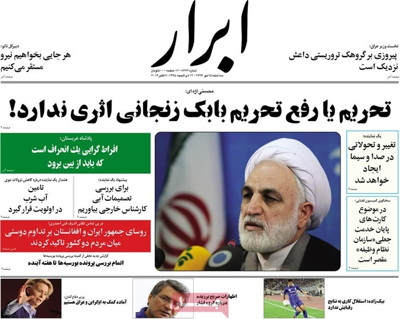
Abrar: “IRIB [state broadcaster] will undergo changes,” said an MP.
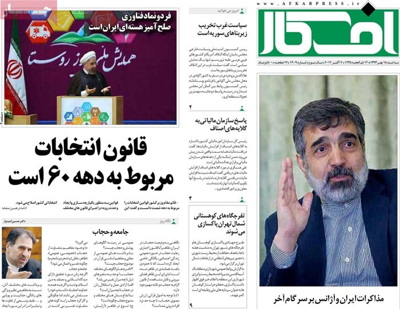
Afkar: “The election law was crafted in the 1980s and will be reformed,” said the deputy interior minister.
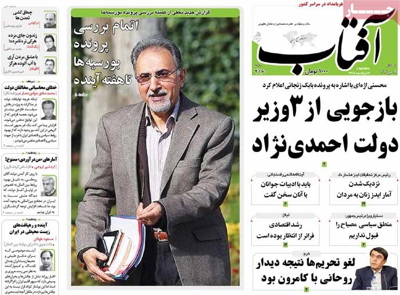
Aftab-e Yazd: “The repeal of an asset freeze [targeting Iranian individuals and institutions] was the result of a meeting between President Rouhani and David Cameron,” said former Iranian diplomat Ali Khoram.
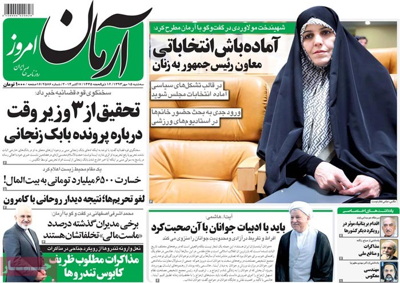
Arman-e Emrooz: “Women should prepare for the upcoming parliamentary elections by finding themselves a berth on the tickets of political factions,” said Vice President for Women and Family Affairs Shahindokht Molaverdi.
Arman-e Emrooz: “Promising negotiations led by Zarif is a nightmare for hardliners.”
Asrar: “Negotiations between Iran and the International Atomic Energy Agency to resolve the outstanding issues get underway today.”
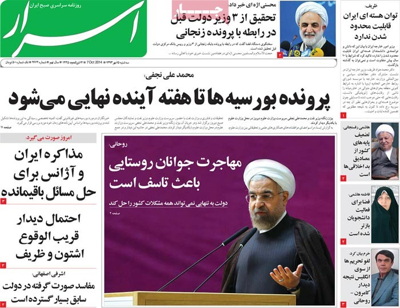
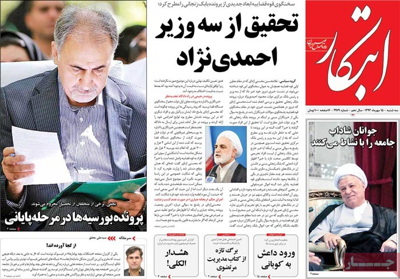
Ebtekar: “Three ministers of Ahmadinejad’s Cabinet are under investigation in connection with a case in which billionaire Babak Zanjani is charged with corruption,” said the Judiciary spokesman.
Ebtekar: “The investigation into the case involving those who were granted scholarships without meeting requirements [during Ahmadinejad’s presidency] is entering its home stretch. Those who have violated the rules will be banned from carrying on their education,” said acting Minister of Science, Research and Technology Mohammad Ali Najafi.
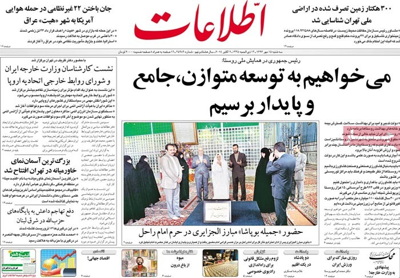
Ettela’at: “We seek to secure balanced, comprehensive and sustainable development,” said President Rouhani at a National Conference on Rural Areas.
Ettela’at: “The largest planetarium in the Middle East has opened in Tehran.”
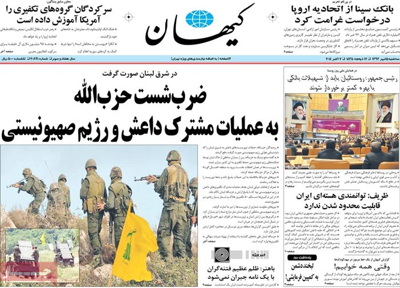
Ettela’at: “ISIL attacks on Hezbollah bases in eastern Lebanon were repelled; sixteen terrorists were killed in the clashes.”
Ettela’at: “Presence of Djamila Boupacha – the Algerian freedom fighter – at the Mausoleum of Ayatollah Khomeini to pay tribute to the founder of the Islamic Republic.”
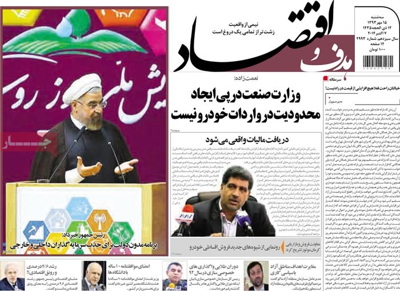
Hadaf va Eghtesad: “Taxation will be streamlined,” said the head of the Iranian National Tax Administration.
Hambastegi: “If it wasn’t for Iran’s support, Baghdad could have fallen [to ISIL terrorists],” said Foreign Minister Mohammad Javad Zarif.
Hambastegi: “The volume of overseas trade posted a 22 percent growth between March 21 and September 22, 2014,” said Director of the Trade Promotion Organization of Iran Valliollah Afkhamirad.
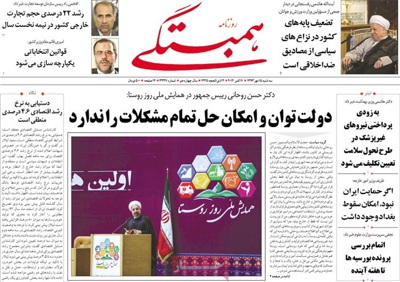
Hamshahri: “Farming in Iran consumes three times as much water as the global average.”
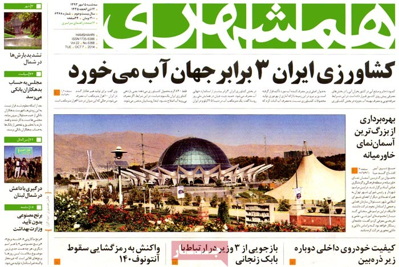
Hemayat: “An Iranian-developed vaccine against foot-and-mouth disease was unveiled.”
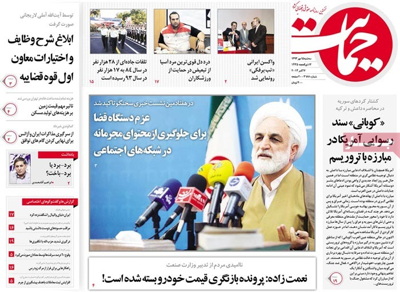
Iran: “We won’t impose restrictions on social networks. Radiations emitting from satellite signal jamming equipment have reduced,” said the minister of communications.
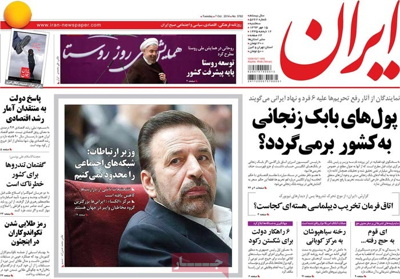
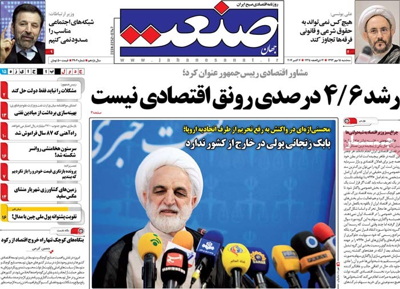
Jahan-e Sanat: In reaction to the repeal of an asset freeze by an EU court on Iranian billionaire Babak Zanjani, who is heavily indebted to the Oil Ministry, the Judiciary spokesperson said, “He does not have any money abroad.”
Jahan-e Sanat: “No one can trample on the legitimate and legal rights of different sects,” said Ali Younesi, an adviser to President Rouhani.
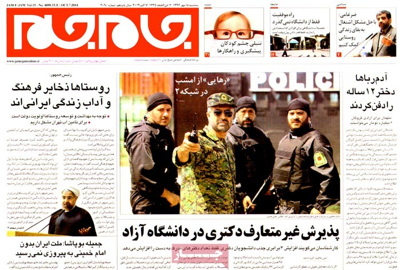
Jamejam: “Islamic Azad University admits doctoral candidates three times more than before.” Experts believe the recent rise in the number of its admissions will only raise the number of Ph.D. holders.
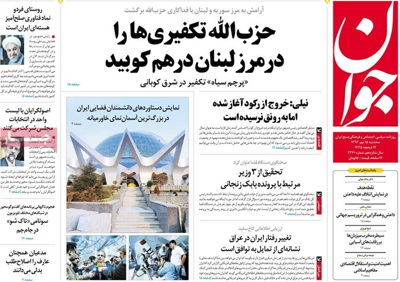
Javan: “Principlists will present one ticket in the upcoming parliamentary election,” said former Parliament Speaker Gholamali Haddad Adel.
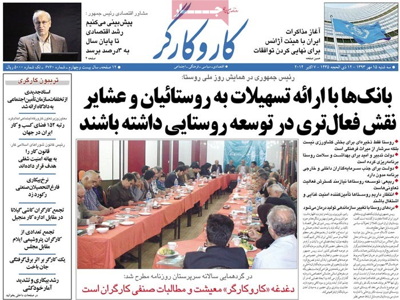
Kar va Kargar: “The economy will have registered a 3 percent growth by March 21, 2015,” predicted an economic advisor to President Rouhani.
Kayhan: “Sina Bank has sought compensations from the European Union [for the bans it imposed on the Iranian bank].”
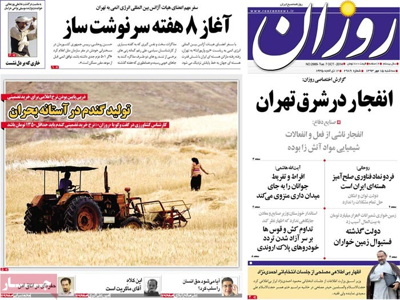
Roozan: “An explosion in the east of Tehran; the Defense Industries Organization announced that the blast was the result of chemical reactions between combustible materials.”
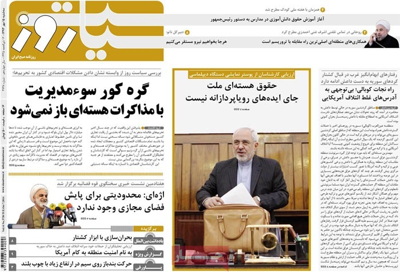
Siasat-e Rooz: The daily takes a swipe at the government of President Rouhani by saying, “The tight knot of mismanagement cannot be untied by nuclear talks.”
Tafahom: “Iran Telecom 2014 opened.” The headline refers to a 15th International Exhibition of Telecommunications, Information Technology and Networking.
Tafahom: “[The rights of] media should be taken into account while crafting the comprehensive media law,” said Deputy Minister of Culture and Islamic Guidance Hossein Entezami.