Wednesday, December 24, 2025
Home Blog Page 5070

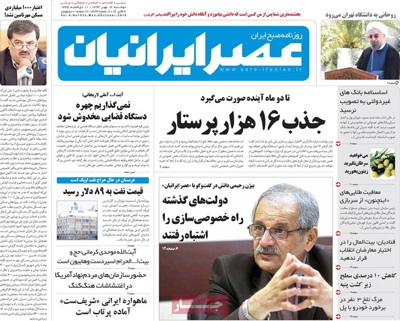
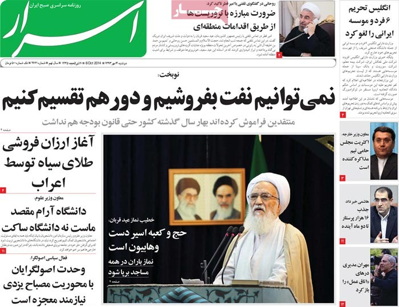
A look at newspaper headlines across the country on September 1

Iranian Newspapers

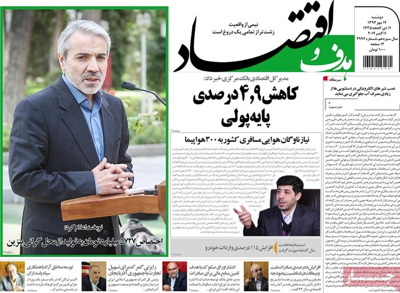
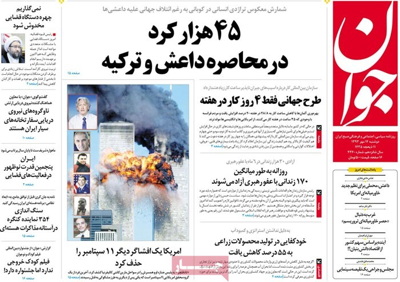
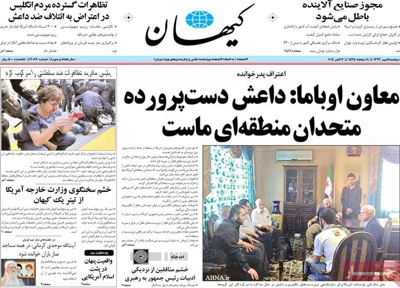
A majority of Iranian newspapers on September 1, 2014 put the recent victory the Iraqi military has scored in cooperation with local militias against Islamic State terrorists on their front pages. Some Iranian analysts have credited solid military command and coordination between the Iraqi armed forces and volunteers for the achievement and suggested the role American air cover has played in ending the siege of Amerli is negligible. Here is a review of the newspaper headlines:

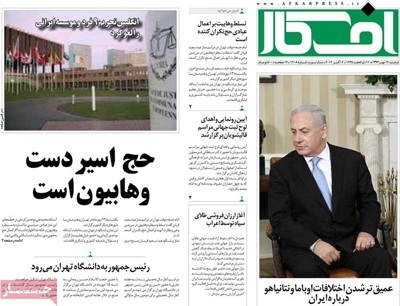
Kayhan: “Amerli has been liberated; IS terrorists have suffered a heavy defeat.” The cover story features a photo of Iraqi army vehicles advancing on the positions of the terrorist grouping as part of a “lightning offensive which broke the siege of Amerli”.


Kayhan Newspaper-09-01


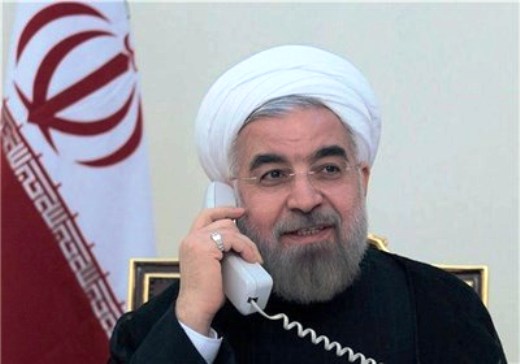
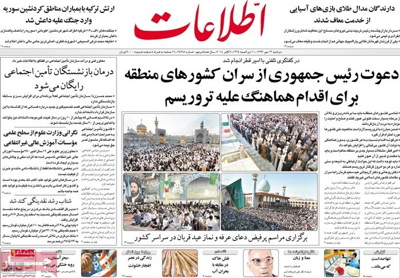
Ettela’at quoted President Hassan Rouhani as telling the visiting Finnish foreign minister that, “Throwing an obstacle in the way of the peaceful nuclear technology is our red line. If P5+1 do not seek to stifle Iran’s advances in science and technology, there will be room for an accord.” At the meeting, the Finnish top diplomat said, “Normalization of EU-Iran ties at a time when the world is grappling with grave and complicated issues is a must.”

Ettela’at: “P5+1 should not take advantage of Iran’s restraint. Unfortunately, there exists a mindset among American politicians that makes them think by imposing sanctions and shouting threats they can get what they want,” Foreign Minister Mohammad Javad Zarif says.

Ettela’at:Vice-President for Religious and Ethnic MinoritiesHojatoleslam Ali Younesi says, “Efforts to promote tourism do not run counter to Islam. Those who incite opposition to the tourism industry seek to channel its profits to other countries.”


Etelaat Newspaper-09-01


Javan, which unofficially reflects the viewpoints of Islamic Revolution Guard Corps strategists, has highlighted the rather harsh reaction of the Iranian foreign minister to imposition of a new round of sanctions by the US on Iran. It features an analytical report headlined “The wall of mistrust in America rises further” which deals with the potential impact of new sanctions on nuclear talks between Iran and P5+1. It quotes the foreign minister as saying, “Tehran will act in kind in reaction to US sanctions.”

Javan: “With Yemen no longer within Saudi orbit, the fall of Al-Saud dynasty is precipitated.”


Javan Newspaper-09-01


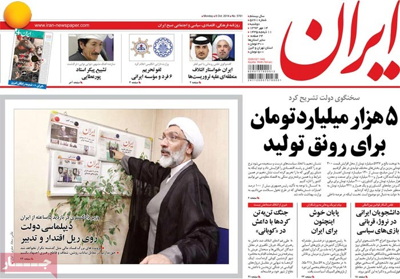
Iran: “The West needs to have the UN Security Council approve the deal with Iran,” Iranian Deputy Foreign Minister Seyyed Abbas Araghchi said.

Iran: “An online movement has been formed to say ‘Yes to National Production’”.


Iran Newspaper-09-01


Resalat, a newspaper run by traditional conservatives, leads on an interview with Dr. Seyyed Abdollah Motevalian, a university professor and Middle East expert, which is entitled “An assessment of 40 achievements the [Palestinian] resistance secured in the war with the Zionists”.

Resalat: “The Islamic State has been created to give the US an excuse to interfere in Islamic countries,” said [Former Foreign Minister] Ali Akbar Velayati [who now serves as an adviser to the Supreme Leader for international affairs].


Resalat Newspaper-09-01


Siasat-e Rooz,whichreflects the views of principlists,leads on new sanctions the US has slapped on Iran in a piece headed “Rusty Options” which tries to suggest Washington wants nuclear talks between Iran and P5+1 to fail. It claims that through sanctions the United States wants to force Iran to leave the negotiating table and then point a finger of blame at Iran for being non-cooperative.

Siasat-e Rooz asks the Iranian diplomacy machine why it is so eager to promote ties with Saudi Arabia in an article entitled, “Riyadh is not reliable”.


SiIasate Rooz Newspaper-09-01


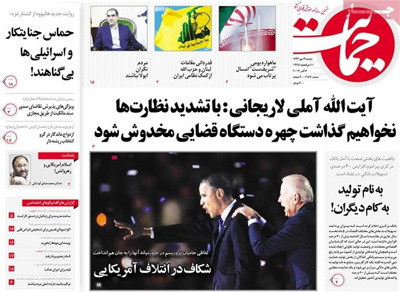
Hemayat: “US plans to build consensus against Russia tumble as cracks appear in the European Union over Russia sanctions”.

Hemayat: “There are not enough judges in the Iranian judiciary,” says the head of the Supreme Administrative Court.


Hemayat Newspaper-09-01


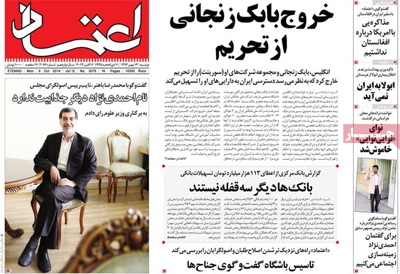
Etemad: “President Rouhani’s strategy is to liberalize the economy,” Economist Saeed Laylaz says.

Etemad: Rasoul Montajabnia, a clergyman close to Mehdi Karoubi, has proposed the formation of a single reformist party to replace small groupings.


Etemad Newspaper-09-01


Travelogues Can Boost Tourism

Iran-Naser Khosro Travelogues

Sarzamin-e Man [My Land], an Iranian journal dedicated to cultural and geographical studies, in its August issue ran a report on Nasir Khusraw and his travelogue. What comes below is a translation of the article the monthly magazine carried:

“How long are you going to drink wine which takes a toll on your mental health? You should be sober […] What you do should enrich your wisdom.”

“Where can I find wisdom?”

“A seeker will be finally a treasure finder,” said the wise man, pointing at the Qibla [the direction of the Kaaba in Mecca which a Muslim needs to face while praying]

Nasir Khusraw [a Persian poet, philosopher, scholar, traveler and one of the greatest writer in Persian literature (1004 – l088 C.E.)] has stated the dream he had one night when he was 40 years old transformed his life drastically, sending him on a years-long trip which took him from Asia Minor,Aleppo, Tripoli, and Palestine to Tunisia, Sudan and Egypt, a journey which produced an invaluable travelogue consisting of meticulous details about the history and culture of these regions.

His travelogue is a treasure trove of information for today’s researcher, a travelogue which underlines the fact that a journey is not just moving from point A to point B. Rather, it is a process of observing, recording, exploring and extracting something good by which you can be remembered. From the perspective of Iranian history a journey amounts to an opportunity to experience and broaden one’s knowledge.

During the 3rd Nasir Khusraw Festival which closed on August 8, 2014, the secretary of the festival Reza Dabirinejad touched on the importance of travel, and said, “Writing a travelogue offers an opportunity to boost tourism, because a matter cannot be palpable unless it is recorded. It’s the vehicle of expression that turns travel into a cognitive, expressive, and communicative concept and lends it cultural and scientific value. Such a process will take travel up to a high level.”


Civic rights, an unfinished dream

happiness after rouhani elected

When Hassan Rouhani launched his campaign nobody believed he could be a force to be reckoned with in the 2013 presidential race. In a speech on campaign trail he hailed “freedom”, and promised to save the country’s economy and ride out the storm Iran’s diplomacy was experiencing.

In the 50th issue of the Nasim-e Bidari (The Breeze of Awakening) Weekly out in August 2014, Mehdi Ghadimi has examined the performance of the government of Hope and Prudence and how committed it has been to the promises made by candidate Rouhani. To begin with, he praises the stress Rouhani has repeatedly placed on his promises on different occasions and ceremonies, and assesses the government’s performance in the areas of economy and diplomacy, healthcare and social wellbeing, and civic rights.

He says failure of the business index to grow in the short term is the main negative score on the government’s one-year report card, but, he adds, a drop in inflation and foreign exchange rates is among the upsides of the cabinet’s economic team. As for diplomacy, he describes as positive the country’s handling of the deadlocked nuclear dispute [with the West] and the subsequent steps toward the lifting of international sanctions.

Another campaign pledge of the president focused on the state of healthcare. The author believes the government has fared well on that front. Its good performance has been so compelling that even the cabinet’s outspoken critics have expressed satisfaction with the measures that, among other things, are aimed at universal insurance coverage and a tangible decline in the expenses associated with treatment.

But when it comes to social welfare, the demands of many workers in factories that were totally or partially shut down as a result of mismanagement in the previous government have yet to be met and failure to reactivate the guilds is indicative of low efficiency in the Ministry of Cooperatives, Labor and Social Welfare.

Ghadimi finally points to efforts to lay the foundation of a civic rights organization which will not be run by any three branches of government, saying for the bulk of the middle class, the elite and political activists this issue outweighs the government’s economic pledges. The organization in question can pursue its duties even after the rise to power of a new government. If materialized, it could be the most enduring legacy of the eleventh government. The following is the translation of an excerpt of the article:

President Hassan Rouhani’s push for a civic rights bill to be sent to the Islamic Consultative Assembly seems to be one of his key election promises, a campaign pledge which resonated with the bulk of the middle class, the elite and political activists more than the government’s economic vows. Elaborating on the major principles of civic rights, Rouhani touched on such issues as the rights of religious minorities and tribes, women’s rights and freedom of speech, as well as academic issues at a university level.

A look at the yearlong performance of the [eleventh] government reveals that it has taken acceptable steps in the right direction to fulfil its election promises. The fact that Hassan Rouhani during his first year in office named individuals such as Shahindokht Molaverdi as vice-president for women and family affairs, Elham Aminzadeh as vice-president for legal affairs, and Ali Younesi as his adviser on issues related to ethnic and religious minorities bodes a new and forward-moving attitude toward all these areas.

What Molaverdi did to pursue her responsibilities was not confined to following up the deliberations of MPs on laws concerning women; rather, she adopted a hands-on policy on the question of women’s presence in stadiums. Ali Younesi, for his part, visited border towns and the holy sites of different faiths in a bid to ease religious and tribal discriminations.

Nonetheless, what stands out about President Rouhani’s civic rights record is the formulation of a civic rights charter, the first edition of which came out last winter. Reports from the Legal Department of the presidential office suggests all problems with the first edition have been addressed and a second edition is set to be released.

When efforts were underway to put together the civic rights charter [Hamidreza] Olumi-Yazdi, the dean of the Faculty of Law and Political Science at Tehran’s Allameh Tabatabaei University, who is Aminzadeh’s deputy, said the charter was not supposed to be sent as a bill to the [Islamic Consultative] Assembly for now, because of the possible opposition it might draw in the chamber.

After securing the Cabinet’s approval, a civic rights department is to be set up in the presidential office. That would be followed by efforts to set the stage for the establishment of a civic rights organization which will not be run by any three branches of government. The organization, he added, is expected to forge ahead with its undertakings concerning different articles of the civic rights charter even after a new government takes office. If it proceeds according to what the president and his legal deputy have planned for, it could be viewed as the most enduring legacy of the eleventh government.

However, the civic demands put forward by government supporters and those who are viewed as the support base of Rouhani’s government have gone unanswered. The camp backing Rouhani is demanding a wise approach to issues such as the house arrest of Mir-Hossein Mousavi and Mehdi Karoubi [the two presidential hopefuls in the 2009 election] and the changing of the security atmosphere in universities and media outlets into a political one.

The government argues that such things are not within its powers, and simply vows to pursue them through appropriate channels. But the truth is that as usual the patience of the public is wearing thin and it cannot make do with such reasoning one year into the presidency of the new government. Therefore, failure to satisfy the demands of Rouhani’s support base and the gap it might create between the government and members of the public are viewed as the government’s Achilles’ heel three years before its term comes to an end.

Launch of the first alcohol rehab center in Iran

Alcohol Rehab Center in Iran

The 484th issue of the Salamat [Health] Weekly featured an article on the launch of an alcohol rehabilitation center in Iran. The article brings together the views of Dr. Bahman Keshavarz, a well-known lawyer and head of the National Union at the Iranian Bar Association and those of Ebrahim Akhavi, a clinical psychologist at Qom Seminary School. Here is the translation of an excerpt of the article on alcohol addiction treatment and recovery in Iran:

Bahman Keshavarz: A first alcohol rehabilitation center has recently been launched in Iran. Clearly this seems somehow surprising because according to sharia consumption of alcoholic beverages is forbidden in Iran. And if the offense were repeated, it could even carry the death penalty.

In light of what was said, efforts by the Health Ministry to treat alcoholics may seem strange in the first place, but a thorough analysis of the move shows that not only is it not something odd, but it is a highly helpful and constructive measure which is hoped to produce effective results.

And even more to the point is that determining a proportionate punishment for crimes and offenses falls within the responsibility of government as part of its efforts to serve the public. When one commits an offense which incurs hadd [punishment which is not specifically determined by laws; rather, judges determine it on a case-by-case basis to prevent similar offenses in the future], they would be cleared of all charges and sins when the hadd punishment is administered. In other words, the offender would get even with society if and when they sustain their punishment.

That they may experience some trouble the government and society are obliged to solve is another case. Normally, the problems members of society grapple with are caused by reasons in which society and the government have a role or for which they are somehow to blame. So, the responsibility to rush to the help of the affected person lies with the government and society.

Establishment of a rehab center for alcoholics is one such responsibility. The important issue is that alcohol consumption does not divest the offender of the rights stipulated in The Universal Declaration of Human Rights, the International Covenant on Civil and Political Rights and chapter three of the Iranian Constitution.

The one who commits such an offense should suffer the punishment meted out based on religious and statutory laws, and at the same time remain entitled to her/his legal rights. To prevent people from committing such offenses – and other similar cases – training is needed. If people learn about the harms that come with alcohol consumption, they would build on conventional wisdom to avoid drinking alcohol.

Hojatoleslam Ebrahim Akhavi: In addition to the harms alcohol inflicts on the body, it would affect the consumer’s rationality as well. That’s why a religious ban has been placed on consumption of alcohol.

A glance at the rate of crimes committed under the influence and the physical and mental diseases caused by alcohol consumption proves drinking is harmful.

A careful study of divine orders […] reveals the stress God has put on red lines, and overstepping such red lines, regardless of frequency, would carry severe mental risks. […]

Iran experience their second defeat in FIBA World Cup

Iran vs Brazil Basketball Match FIBA WordCup SPAIN2014

Iran’s national basketball squad suffered another defeat in their second match against Brazil at the 2014 FIBA World Cup on Sunday August 31.

In the first quarter, Iran produced a stellar performance and managed to garner dominance over their powerful rivals. The score at the close of the first quarter stood at 18-17. However, there was a reversal of fortune in favor of Brazil in the following quarters and Brazil capitalized on their tall players to beat Iran. Final score was 79-50.

Earlier, hosts Spain defeated Iran 90-60 in their opener.

Iran are to take on Serbia at 13:30 GMT on September 1, 2014.

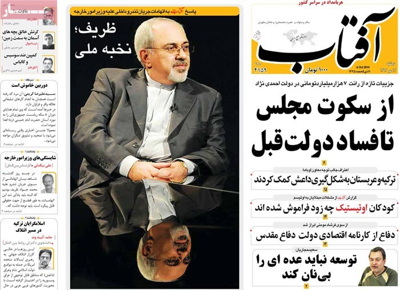
A look at newspaper headlines across the country on August 31, 2014

Iran newspapers
Iran newspapers

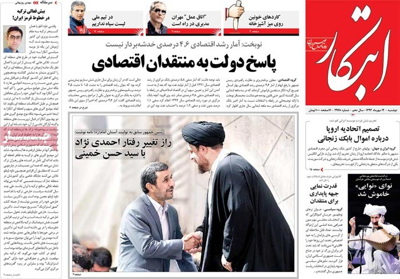
Ebtekar leads on the fourth news conference of President Hassan Rouhani since he took office more than a year ago and quotes the chief executive as saying, “As far as [nuclear] talks go, the buck stops here. […] Impeachment won’t change the course of my government. […] We act in keeping with the law in dealing with what happened [after the presidential elections] in 2009.”


Ebtekaar Newspaper


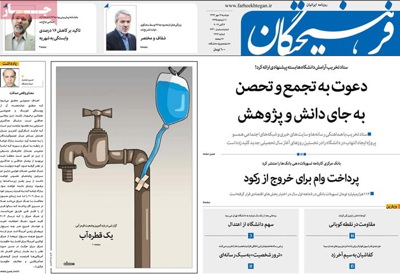
Farhikhtegan, another Tehran-based daily, gave extensive coverage to the comments of President Rouhani and cited him as telling the presser, “Some should not build on illusions to deprive others of their social rights. The law has the final say. […] We welcome the efforts of any country that wants to take on terrorism.”

Farhikhtegan: The vice-president of Islamic Azad University urges housewives to seize the opportunity and sign up for academic programs specially designed for them.


Farhikhtegan Newspaper


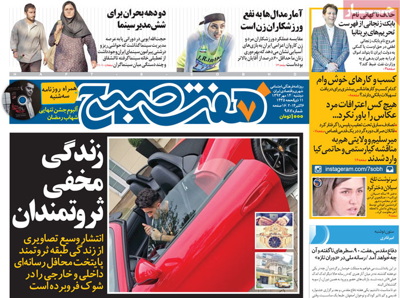
Haft-e Sobh, another mass circulation daily which focuses on social, economic, urban and cultural issues, describes Vice-President Mohammad Bagher Noubakht, who also serves as the government spokesman, and the president’s Chief of Staff Mohammad Nahavandian as the “new captains of the government” and says after tireless efforts of [Foreign Minister] Mohammad Javad Zarif which produced little result over the past year, now economic figures of the government lead the charge.


Hafte Sobh Newspaper


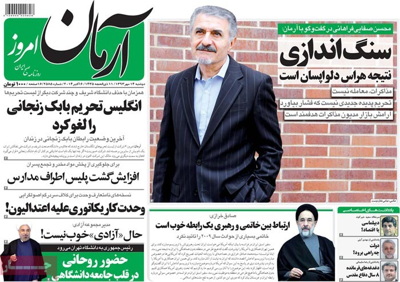
Arman-e Emrooz too puts the president on its front page and quotes him as saying, “Some live on division and discord. […] Trumped-up allegations are unacceptable. […] Those involved in smear campaigns should quit critiquing the government. […] No meeting with [President] Obama is scheduled.”


Armane Emrooz Newspaper


Aftab-e Yazd: MPs go into another recess. The annual break of parliament deputies is longer than that of school students.


Aftabe Yazd Newspaper


Abrar: “The death toll from drug addiction is greater than earthquakes’,” a member of the Social Committee of the Islamic Consultative Assembly said.

“The Islamic State is no match for Iran,” the deputy commander of the ground forces of the Iranian Army said.


Abrar Newspaper


Ettela’at quoted Deputy Minister of Culture and Islamic Guidance Abbas Salehi as saying that winning back the trust of the cultural community is a priority of the government. “We will try to use the notions of the cultural community as a revolutionary asset. The lifting of some arbitrary and illegal bans and suspensions has played a role in building trust.”


Ettelaat Newspaper


Etemad has a story headed “Reformist Seat, Principlist Plan” which poses a question as to where the rivalry of the two main political parties over the chairmanship of Tehran City Council leads to.

“Freedom is vital to thinking,” Siavash Jamadi, a translator of philosophical and literary books said in reaction to proposed changes to the philosophy program in universities.


Etemad Newspaper


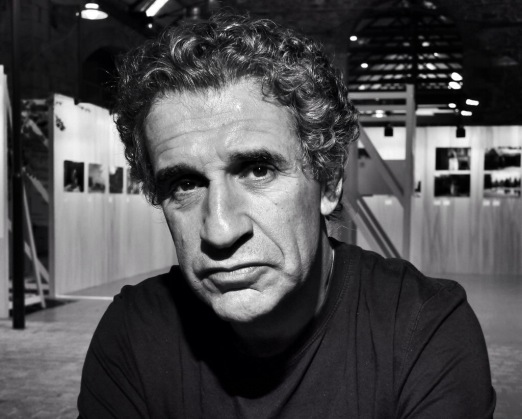
Iran too led on the president’s progress report which he released in a press conference on August 30 and cited Mr. Rouhani as saying, “I will live up to the promise I made to the public. […] The new sanctions the US has slapped on Iran are not in line with the Geneva Interim Agreement. […] The sanctions regime will never make a comeback. […] By yearend, Iran’s economic growth will land in positive territory. […] Countries claiming to fight terrorism should practice what they preach.”
 

Iran Newspaper


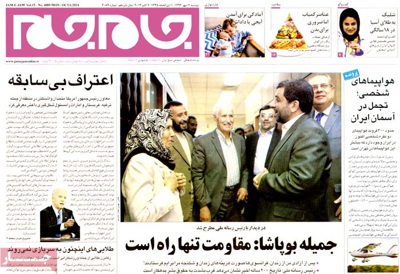
Jamejam: “New sanctions have led to more [Iranian] mistrust in America,” President Rouhani stated.


JaameJam Newspaper


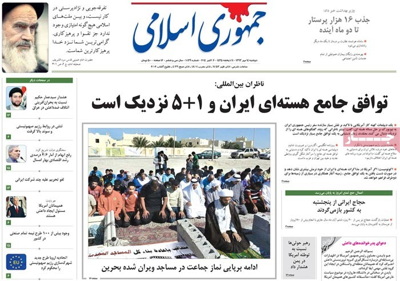
Jomhouri Islami: “New sanctions are unfair and contrary to the Geneva Agreement,” Foreign Ministry spokeswoman said.

“Top diplomats from P5+1 and Iran will meet in New York to work out a nuclear deal with Tehran,” EU foreign policy chief Catherine Ashton said.


Jomhouri Eslami Newspaper


Resalat: “Any deal that compromises the nuclear rights of the Iranian people is out of the question,” Deputy Foreign Minister Seyyed Abbas Araghchi said.


Resalat Newspaper


Kayhan: “A 10-year ban on exploitation of forests in the north [of Iran] has taken effect,” head of the Forestry Organization declared.


Kayhan Newspaper


Hamshahri: “The West is worried about homegrown terrorists” and “New defense products are in the pipeline.”


Hamshahri Newspaper


Hemayat: Health Ministry has been chosen as the top government institution.

Life expectancy [in Iran] is to increase by 10 years.


Hemayat Newspaper


Rah-e Mardom takes a look at the development projects [Tehran Mayor Mohammad Bagher Ghalibaf] has overseen before and after his failed bid to become president [in 2013].


Rahe mardom Newspaper


Mardomsalari: “We will proudly skirt the new sanctions,” President Rouhani says in reaction to a new set of sanctions imposed by the US.


Mardomsalari Newspaper.


Iran’s national volleyball team won the match against Italy in style

Iran-Itally-Volleyball-FIVB2014

Giving a drubbing to Italy, Iran appeared strong in their first match at the 2014 FIVB Men’s World Championship. The squad of Slobodan Kovac, Iran’s coach, took on Italy in Krakow, Poland on August 31 and emerged victorious in their opening match in Pool D, after beating Italy in four sets (25-16, 23-25, 25-21, 25-22). The sporting event got off to a good start for Iran after they scored 3 points in their opener. Securing a remarkable victory, Iran also made up for their loss against Italy in their last showdown in Florence, Islamic Republic News Agency (IRNA) reported on August 31.

Results are not predictable: Iran’s Head Coach

Coach and Marouf

FIVB Volleyball Men’s World Championship Poland 2014 got under way in Warsaw on August 30. In the opening match hosts Poland beat Serbia in straight sets (25 – 19, 25 – 18, 25 – 18). Iran are to line up against powerhouse Italy on Sunday August 31 (11:00 GMT). The Iranian Labor New Agency (ILNA) quoted the Serbian coach of the Iranian side before the much-awaited match as telling a news conference that results are “not predictable”. Here is what else Slobodan Kovac and his captain Saeed Marouf said at the news conference:

“The World Championship is a great competition. Iran are a force to be reckoned with. My team fared very well in the World League, but here in Poland results are unpredictable,” Iran’s coach said.

He went on to say that his team will try their best to showcase a great performance similar to that of the previous event. “We need to strategize from game to game. We want to play well and put great volleyball on display.”

When asked about Iran’s preparatory camp in the United States, he said that he was not a politician. “As far as volleyball goes, we prepared ourselves for the World Championship. […] We went to the US for warmup games and Iranians residing in the United States supported us during our stay there. I hope we will be able to perform well in Los Angeles when the American city plays host to the World League in 2015.”
The captain of the Iranian squad, meanwhile, said that participation in the World Championship is different from other games. “We want to repeat the World League. We will try to perform to the best of our ability and advance to the second round.”

Iran to Start with Italy in FIVB World Championship

Iran and Italy played against each other five times in the 2014 FIVB World League, in which the Iranian team won two matches and lost three times.

Once again, the two teams are scheduled to play on Sunday in Pool D of the 2014 FIVB Men’s World Championship in Krakow, Poland.

The Iranian team has been drawn along with the US, Belgium, France, Puerto Rico and Italy.

The team will play US, France, Belgium and Puerto Rico respectively.

The 24 teams are divided into four pools of six teams with the four best placed at the conclusion of the round-robin elimination process advancing to the next phase of four pools of four teams, fivb.com wrote.

Then, the best two of these pools will play in the semifinals and medal matches with the other four sides playing for the 5 to 8 positions.

Only Russia (6), Brazil (3), Italy (3), Czechoslovakia (2), Poland, the United States and East Germany have taken the honors of world champions since the inception of the competition in 1949.

The pool composition is as follows:

Pool A in Wroclaw: Argentina, Australia, Cameroon, Poland, Serbia and Venezuela.
Pool B in Katowice: Brazil, Cuba, Finland, Germany, Korea and Tunisia.
Pool C in Gdansk: Bulgaria, Canada, China, Egypt, Mexico and Russia.
Pool D in Krakow: Belgium, France, Iran, Italy, Puerto Rico and the United States.

Iran welcomes Saudi foreign minister: Zarif

Iran-Mohammad Javad Zarif

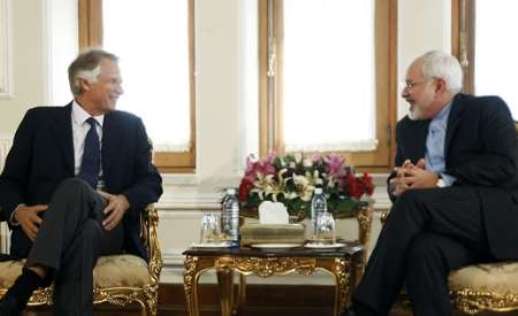
In a joint press conference with Finnish Foreign Minister Erkki Tuomioja on Sunday in Tehran, Mohammad Javad Zarif said he is also prepared to visit Saudi Arabia.

He added that Iranian Deputy Foreign Minister for Arab and African Affairs Hossein Amir-Abdollahian have had positive talks with Faisal during his recent visit to in the western Saudi city of Jeddah.

“I am also prepared to cooperate with him (Faisal) for boosting our relations and also improving the current situation in the region,” the Iranian foreign minister stated.

He added that Tehran and Riyadh have common interests and face common dangers including extremism and sectarianism in the region.

The meeting between Amir-Abdollahian and Faisal was the first in high-level bilateral talks between the two countries after Iranian President Hassan Rouhani took office last year.

In March, President Rouhani emphasized Tehran’s determination to improve ties with neighboring Muslim countries, saying cooperation between Iran and Saudi Arabia would be vital for regional security.

The two countries have remained divided on a number of key regional issues, including the Bahraini uprising and the crisis in Syria.