September 21st has been designated by the United Nations as the International Day of Peace. Coincidentally, on the same day 34 years ago, Iran was dragged into a devastating war when Saddam’s Iraq attacked the country. Each year the UN and its offices in different countries host ceremonies to mark the occasion. In Iran, the Center for the Great Islamic Encyclopedia organized a gathering in cooperation with the United Nations on sustainable global peace.
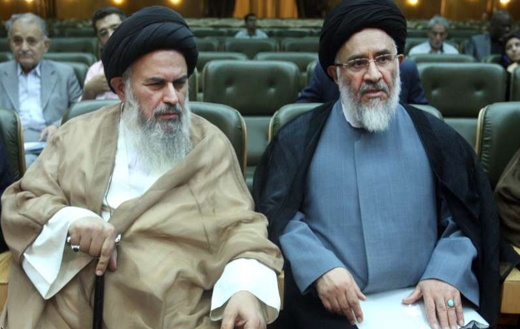
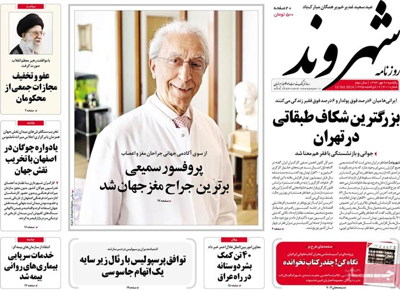
On September 29th, Shahrvand newspaper featured the transcript of the speeches of a number of participants in the gathering. Accompanying the detailed transcripts were the images of world-renowned individuals such as Mahatma Gandhi, Nelson Mandela, Aung San Suu Kyi, and Malala Yousafzai, who have contributed greatly to global peace. The following is the translation of two speeches in their entirety and the excerpt of a third one:
Ten vital principles to secure sustainable peace
Mohammad Mojtahed Shabestari: A few years ago, at the invitation of an Austrian university, a number of Muslim and Christian jurists, economists and theologians, me included, got together in Austria to look into national and international necessities to secure peace. The meeting produced a 10-point resolution in both English and German. Let’s review those 10 principles here.
1. Sustainable global peace is not achievable in the absence of justice. Similarly, justice remains elusive when sustainable global peace is non-existent. In other words, justice and peace are inseparable. You can’t ask a community or a nation to observe peace while denying its members justice. Likewise you can’t ask a group to advance the cause of justice without providing them with peace. Back then [when the meeting took place] Palestinians were a good example for this. They were being asked to commit themselves to the cause of peace, without enjoying the benefits of justice.
2. In a world fraught with social inequality, hunger and poverty, sustainable global peace remains elusive. You can’t expect members of a society to be exposed to enormous financial and economic disparity and at the same time live in peace with each other. You can’t have very rich countries and very poor nations on the world stage and ask them to coexist peacefully. Social inequalities and poverty should be eliminated to pave the way for closer cooperation between humans and for international cooperation to bridge the gaps.
When a nation enjoys welfare and is more powerful than others, and another is impoverished, the poor develop an instinctive negative attitude toward the rich and the powerful. […] The use of soothing words won’t do much. A negative attitude is bound to take shape. When that happens, peaceful coexistence between the rich and poor would become impossible.
Social inequalities are not just financial. Political inequalities are at play too. Instinctively, humans develop a negative attitude toward those who have political power and enjoy the right to self-determination. […] A while ago I read a book on democracy. It featured the viewpoints of a philosopher who believed humans are jealous. They can’t stand others having control over their political future, enjoying enormous powers and showing off their power all the time. They can’t step back and live in peace with such powerful figures.
3. Sustainable global peace would be unachievable unless violence is utterly rejected. Violence should be condemned in all forms, without any distinction between legal and illegal violence. Violence is defined as use of force to secure political goals which are achievable without recourse to force. Violence is in contrast with peace. The worst type of violence is the kind of violence which is committed in the name of religion and God. Of course, enforcement of laws and punitive measures such as imprisonment is not violence. […]
4. Sustainable global peace would not be a non-starter, if the dignity of humans is not respected and if there is no legal system to uphold human rights. […]
5. Sustainable global peace would not be achievable unless pillars of social pluralism are recognized. […] Pluralism should be upheld on all fronts, including in religion, customs, cultures, etc. No one should ever try to reject [the cultures and customs of] others and stick to what they find interesting. […]
Religious pluralism is often misunderstood. Some might assume that their freedom to choose religion amounts to pluralism. That is not true. Religious pluralism is to give individuals the right to be part of the political process and at the same time stick to their faith. Giving individuals the right to practice whatever faith they opt for, but taking away their right to political determination is not religious freedom. […]
6. Dialog is vital. Dialog should be aimed at pressing home the responsibility of all those involved in talks in settling the problems of humanity. […] The sixth principle is all about promoting dialog at the expense of monolog, bossiness, etc.
7. In the absence of willingness to peacefully settle disputes and prevent clashes in the future, sustainable global peace would be unachievable. In other words, those who sit at the negotiating table to settle disputes should be ready to settle their problems in a way that serves the interests of all. […]
8. Sustainable global peace would not be achievable unless education is based on lofty human and religious values not blind imitation and customs. […]
In bringing up their children, parents, particularly in our society, think they should cement the foundation of customs, beliefs and respect for authority in their children. One-sided upbringing as such chips away at the foundation of peace and gives rise to differences. Upbringing should be aimed at the future; children should be raised to be able to tackle future problems rather than simply comply with the past. […]
9. Unless women enjoy the same rights as men on all fronts of human life, sustainable global peace would remain elusive. Male superiority which fans the flames of the battle of sexes is still in place in various fields including in religion. […] The principle of equality should be upheld and anything that stands in the way of parity should be disposed of. Whatever remains of male superiority should be eliminated.
10. Sustainable global peace would not be achievable unless the rights of minorities, particularly religious minorities are respected. […] Recognition of minority rights means that, among other things, they should be allowed to evolve culturally, and form political parties to take on a more active role in society. […]
These rules are not carved in stone; one can add principles to the list or take some off it. Participants in the gathering in Austria were urged to promote these principles upon returning home. Now you decide how much importance Iranian society attaches to these principles, what people and authorities think about them, and how much focus is placed on them in general.
Pressing for global peace is mandatory from a Shiite perspective
Seyyed Mohammad Mousavi Bojnourdi: The true and pure Islam is a harbinger of mercy, so one has to weep bitter and painful tears for the crimes which are committed against humanity in the name of religion.
Islam describes peace as a blessing, characterizing it as a core principle. The Muslim Prophet (Peace Be upon Him) too openly invited the followers of Moses, Jesus and Abraham (Peace Be upon Them) to talk about their common ground and form a united front.
Peace, by nature, cannot be an indecent issue. Conflict is always an ugly phenomenon unless it is in self-defense. In other words, people resort to conflict only to defend their territorial integrity and independence.
Peace is what all divine faiths unanimously call for. The issue which I am raising today with a sunken heart is this: today some are playing the religion card to commit most heinous crimes against humanity.
In the name of the Muslim faith and under the fake name of the Islamic State, the Islamic State of Iraq and the Levant (ISIL) is acting against Muslims and Christians, killing both, whereas Islam steers clear of such acts.
When the Prophet Muhammad (PBUH) entered Mecca triumphantly 13 years after he emigrated from his homeland, he announced that the day was one of mercy, and those who embraced Islam would see their lives and property remain protected and untouched.
The true, pure Islam offers mercy wherever it goes. Muslims do not nurse grudges against or animosity toward Jews and Christians. Judaism shouldn’t be confused with Zionism and Israel.
[UN Secretary General] Ban Ki-Moon is pressing for the establishment of peace, but he should know that we are not at odds with Christianity or Judaism, since we view them as Abrahamic and monotheistic religions.
Unfortunately, certain Islamic nations use their petrodollars to lend support to the ISIL militants, a group which has done the gravest injustice to the Muslim faith just like al-Qaida.
We are ardent advocates of global peace and friendship with nations. We are among the followers of a prophet whose mindset heralded global peace. It is incumbent on Shiite people to do all they can to help establish global peace, because Sharia stresses anything wisdom deems obligatory.
We are opposed to war unless it is solely for the purpose of standing up to aggressors. Iran has not launched any attack on any nation. In the course of the Sacred Defense too, the Islamic Republic defended itself against the aggressions of Saddam’s Iraq. Without doubt, the Iraqis, back then, were not supporting Saddam.
If Iran has issues with Israel, it is because the Islamic Republic regards the regime as an invader. That’s why Iran cannot be on friendly terms with the occupying regime [of Israel].
To boost global peace, we should start from family
Mostafa Mohaghegh Damad: Immanuel Kant, the German philosopher who lived in the 18th century, is the father of global peace. He owes this title to his [1795] essay, Perpetual Peace, which he penned six years prior to his death.
He says in his book that he was inspired by “The land of eternal calm”, a phrase he saw years earlier in a Dutch inn under a photo of a graveyard.
As Kant puts it, “Whether this satirical inscription on a Dutch innkeeper’s sign upon which a burial ground was painted had for its object mankind in general, or the rulers of states in particular, who are insatiable of war, or merely the philosophers who dream this sweet dream, it is not for us to decide.”
Some are of the opinion that the perpetual peace or calm – the book’s title – is a sign of deep dismay Kant felt as a philosopher over establishment of peace and sought to ask if sustainable peace was just for the dead; an indirect suggestion that humans are after war as long as they are alive.
Although before Kant many philosophers and lawyers raised the issue of peace, why is that their works have failed to be given as much attention as Kant’s?
Perhaps the reason lies in the fact that none of them tried to foretell a system or mechanism for bringing about peace and maintaining it, whereas Kant suggested that a league of nations be formed so that it could prevent governments from waging war.
It is worth mentioning that the concept of forming such institutions as the community of nations and the United Nations was outlined by Kant. Nobody can deny what the United Nations has gone through to bring under control many wars and conflicts. But a question arises here: Has the UN been able to bring all aggressions and wars to an end and offer calm to humans?
As an Iranian scholar, I urge the UN envoy to convey our message to the UN secretary general and ask him to do what it takes to help peace take hold. You’d better know that education lies at the center of efforts to spread a mentality of peace and promote peace-seeking efforts.
Global peace and such institutions cannot get things down just through military power. We need to try our best to contribute to efforts to promote the culture of peace and this should be done within the family and inside the education system.