Thursday, December 25, 2025
Home Blog Page 5051

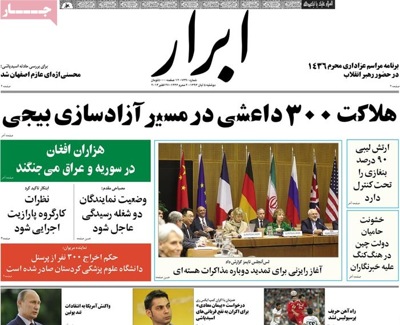
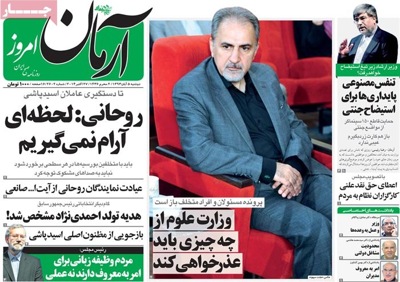
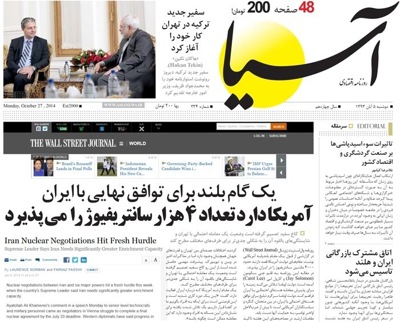
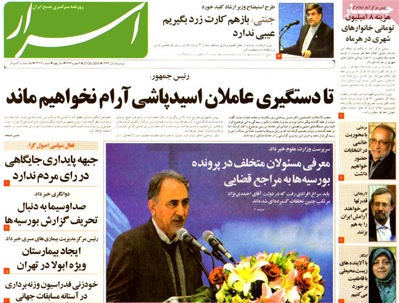
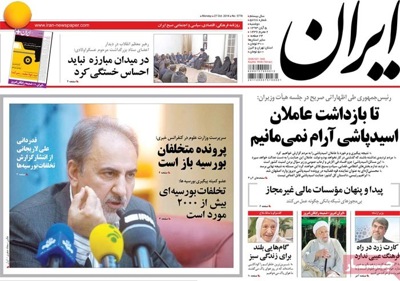
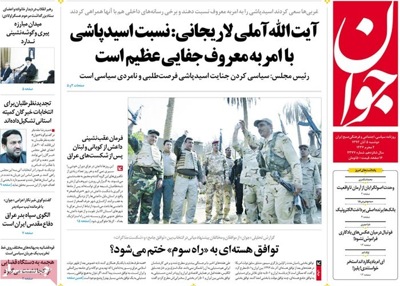
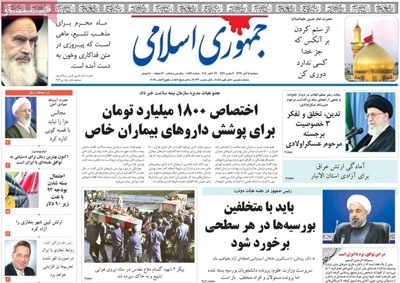
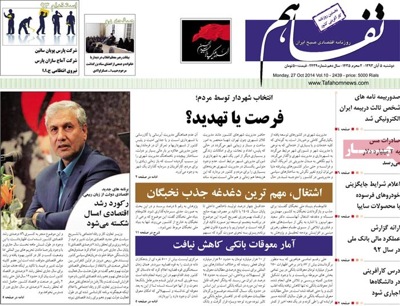
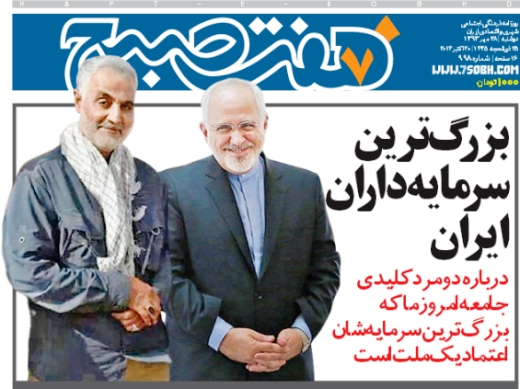
A look at Iranian newspaper front pages on Sept. 29

Iranian Newspapers headlines
Iranian Newspapers Headlines

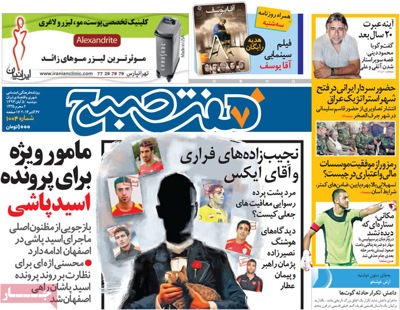
Several Iranian newspapers put the gold medal Iranian freestyle wrestler Reza Yazdani bagged for the country in the 2014 Asian Games on their front pages. Also drawing attention was the strong objection of Iranian MPs to unfounded remarks by the British prime minister against Iran.

Abrar:“The press remain exempt from paying taxes,” according to a draft bill approved in parliament.


Abrar nows paper_09_29


Afkar: “Lebanon’s Prime Minister, Tammam Salam, who met with Iranian President Hassan Rouhani on the sidelines of the 69th meeting of the UN General Assembly, has appealed to Tehran to help Lebanon solve its problems.”

Afkar: “The three Persian Gulf islands [of Abu Musa, the Greater and the Lesser Tunbs] are part and parcel of Iranian territory”, underscored Iran’s UN envoy in reaction to remarks Saturday by the UAE foreign minister who asked for the settlement of Iran-UAE dispute at the International Court of Justice.


Afkar nowspaper_09_29


Asr-e Iranian: “The next round of nuclear talks is to be held in Europe.”


Asre iranian nowspaper_09_29


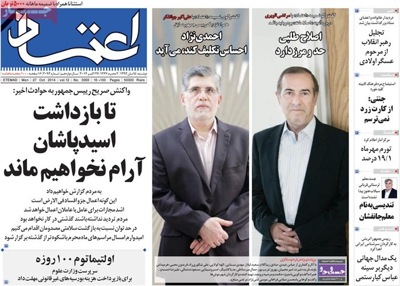
Ebtekar: “Parliament is not the place for clamor,” Parliament Vice-Speaker Mohammad Hassan Abou-Torabi tells Hamid Rasaei, a hardline MP and a member of the Islamic Revolution Stability Front known for his unwavering support for former President Mahmoud Ahmadinejad and his policies.

Ebtekar also takes a look at Babak Zanjani’s corruption case and reports that four ministers who served in Ahmadinejad’s administration have been implicated in the graft case involving the billionaire businessman.


Ebtekar nowspaper_09_29


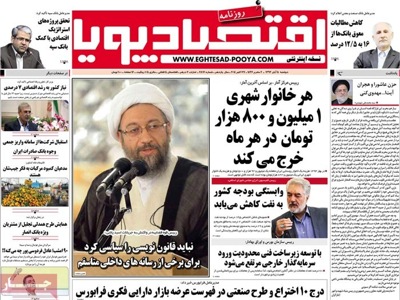
Eghtesad-e Pooyaquotes the managing director of Tehran Regional Electric Company as saying that plans have been drawn up to clear the capital of high-voltage electricity transmission towers, adding to that end Tehran’s electricity network will be transferred underground.


Eghtesade pouya nowspaper_09_29


Emtiaz highlights repeated warnings by the health minister on people’s rising intake of oil, sugar and salt which contribute to the leading causes of death in Iran.

Emtiaz:Plan to increase air fares have been put on hold for the time being,” the director of the Civil Aviation Organization said.


Emtiaz nowspaper_09_29


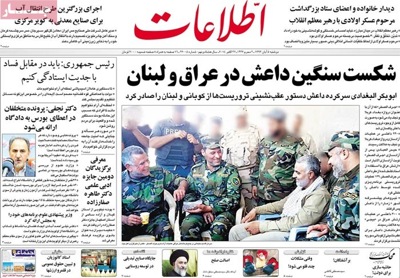
Ettela’at: Iran hasn’t had a hand in the AMIA bombing, said Argentina’s President Cristina Kirchner in reference to a 1994 attack on a Jewish center in Buenos Aires which killed 85 people and injured hundreds.

Ettela’at: Human error and technical glitch are to blame for the crash in early August of Iran-140 (Antonov-140) passenger plane in Tehran.

Ettela’at also reported that a park in Tehran hosted a conference Sunday on Iranian painting and the environment in the artistic works of Master Mahmoud Farshchian, a renowned painter.


Ettelaat nowspaper_09_29


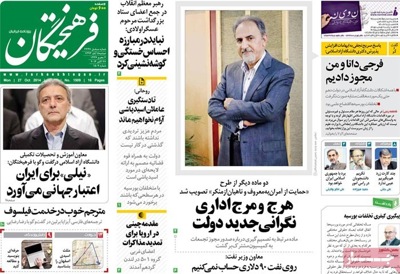
Farhikhtegan cites the first vice-president as saying in a meeting of the Supreme Article 44 Council [which deals with privatization of state companies] that the eleventh government has fared well in ceding state agencies to the private sector. He also said the 35 percent growth the Rouhani administration has posted in a year on privatization equals what previous governments did in 12 years.


Farhikhtegan nowspaper_09_29


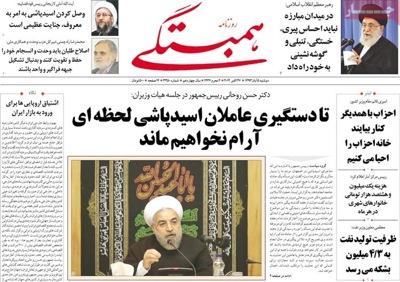
Hambastegi: “The eleventh government is determined to implement a plan on insurance coverage for the media” said the deputy minister of culture and Islamic guidance for media affairs.

Hambastegi: “The Americans have admitted that they cannot destroy ISIL without Iran’s help” Chairman of the Expediency Council Ayatollah Akbar Hashemi Rafsanjani said in an Islamic Azad University meeting.


Hambastegi nowspaper_09_29


Jahan-e Sanat: “The first tourism train is to cross the border into Iran Monday,” is a front-page headline that says the train with 130 tourists on board originates from Istanbul, Turkey and crosses the border into western Iran at Razi Border Crossing.

Jahan-e Sanat: Dick Costolo, the CEO of Twitter Inc., has said in a tweet that he has talked on the phone with Iran’s Foreign Minister Zarif to have the ban on the social networking service in Iran removed.


Jahane sanat nowspaper_09_29


Javan: “Shouts of ‘Down with Britain’ are echoed in the Islamic Consultative Assembly”, is the daily’s top pick for its front page.


Javan newspaper_09_29


Jomhouri Islami: Iran doubled the revenues it collects from gas condensates in the first half of the Iranian calendar year (starting March 21, 2014), according to an official report by the Pars Special Economic Energy Zone.

Jomhouri Islami: President Rouhani predicts upon arrival in Astrakhan that the 4th Summit of Caspian states will produce acceptable results.


Jomouri eslami newspaper_09_29


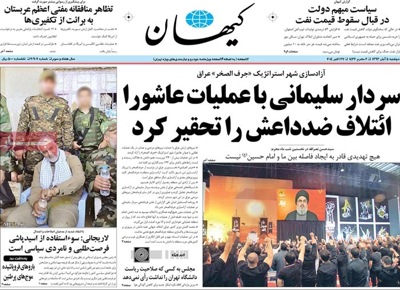
Kayhan: Separate operations by Peshmerga, local and volunteer forces, as well as the Iraqi army take back the control of 29 villages from ISIL militants in northern Iraq.


Keyhan newspaper_09_29


Nasl-e Farda: Foreign Minister Mohammad Javad Zarif is due to submit a report to the Iranian parliament on the UN General Assembly, New York nuclear talks, and the Caspian summit when he is back home from the Russian city of Astrakhan.


Nasle farda newspaper_09_29


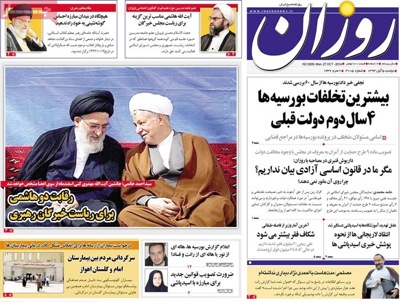
Roozan: “The upstarts are trying to use the [Iran-Iraq] war as a tool to eliminate others,” said former President Mohammad Khatami.

Roozan: “Clamor in the House of People”, is a front-page story on new demands by Hossein Allah Karam, a key member of Ansar-e Hezbollah, who calls for the ouster of President Hassan Rouhani and dismissal of Foreign Minister Mohammad Javad Zarif. It further quotes Hamid Rasaei as saying, “I will not stay in a place where I am called a clamorer.”


Rouzan newspaper_09_29


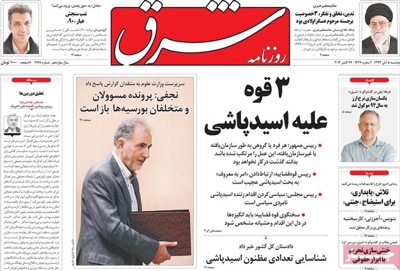
Sharq features an exclusive interview with Niels Annen, a member of the Social Democratic Party of Germany (SPD) in which he says his country shares security concerns with Iran.

Sharq: A member of the Iranian parliament’s presiding board says back in 2011 when the Iranian foreign currency market was undergoing sudden fluctuations some $11 billion was sold by brokers on the black market with the support of certain managers of the Central Bank of Iran.


Shargh newspaper_09_29


Iran, Azerbaijan call for closer bilateral relations

Rouhani and Aliyev-Iran-Azerbaijan

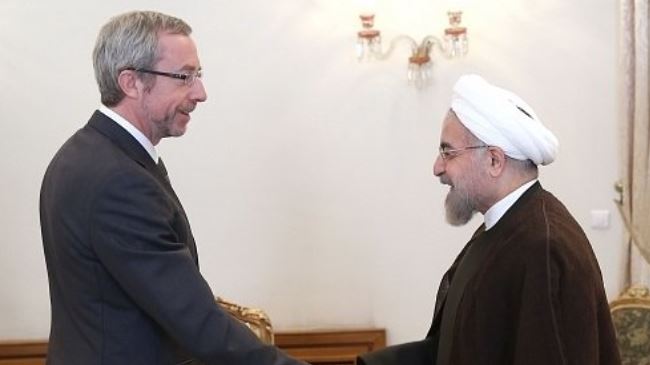
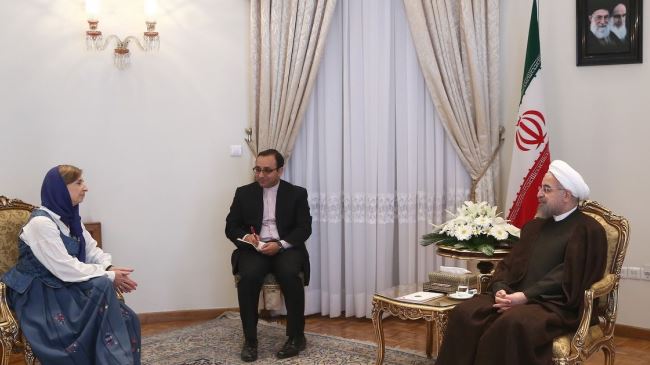
In a meeting with his Azerbaijani counterpart Ilham Aliyev in the Russian city of Astrakhan, Iranian President Hassan Rouhani underlined the strong determination of both neighboring states to bolster bilateral cooperation in all areas.

Tehran and Baku have great potential for the expansion of bilateral cooperation, particularly in the fields of energy, commerce, environment and tourism, Rouhani stated, saying the Iran-Azerbaijan Joint Economic Commission should play a more active role in this regard.

The Iranian chief executive also called for closer cooperation between Tehran and Baku on issues of regional and international importance, saying both countries should adopt coordinated stances in the global arena.

“The security and development of both countries are interrelated and we should not allow the states that are against the promotion of friendly relations between the two countries to hamper these ties,” Rouhani noted.

Aliyev, in turn, said his country was keen to broaden relations with the Islamic Republic in all domains, expressing hope that the two sides could reach good agreements in the areas of commerce and tourism during Rouhani’s upcoming visit to Baku.

The Iranian and Azerbaijani presidents are in Astrakhan to take part in the 4th summit of the Caspian Sea littoral states.

Iran, the Republic of Azerbaijan, Russia, Kazakhstan, and Turkmenistan are the five littoral states of the Caspian Sea.

S. Arabia FM urges peaceful solution to Iran N-issue

Saudi Arabia-FM
Saudi Arabia-FM

Addressing the 69th session of the UN General Assembly in New York on Sunday, Prince Saud al-Faisal said Riyadh is still attaching great importance to tackling the Iranian nuclear issue peacefully through the current nuclear negotiations between Tehran and the five permanent members of the UN Security Council plus Germany.

The Saudi foreign minister said that any peaceful solution to Iran’s nuclear issue should guarantee the Islamic Republic’s right to use civilian nuclear energy under international regulations.

Iran and its negotiating partners — the United States, France, Britain, Russia, China and Germany– have been holding talks to resolve the dispute over the Islamic Republic’s nuclear energy program.

The two sides held their latest round of talks in New York to work out a final agreement aimed at ending the longstanding dispute over Tehran’s civilian nuclear energy program within a November 24 deadline.

Last November, Iran and the six world powers clinched an interim nuclear accord, which took effect on January 20 and expired six months later. However, they agreed to extend their talks until November 24 as they remained divided on a number of key issues.

Iran, P5+1 to resume N-talks in two weeks: Araqchi

Abbas Araghchi-Iran-official

In an interview with Kyodo news agency on Sunday, Seyyed Abbas Araqchi, who is also Iran’s deputy foreign minister for legal and international affairs, said that the nuclear negotiations between Tehran and the five permanent members of the UN Security Council plus Germany will resume either in the Austrian capital of Vienna or in the Swiss city of Geneva.

Iran and its negotiating partners — the United States, France, Britain, Russia, China and Germany — held their latest round of talks in New York to work out a final agreement aimed at ending the longstanding dispute over Tehran’s civilian nuclear energy program within a November 24 deadline.

Last November, the two sides clinched an interim nuclear accord, which took effect on January 20 and expired six months later. However, they agreed to extend their talks until November 24 as they remained divided on a number of key issues.

Araqchi said the nuclear talks in New York were “constructive”, although differences on major issues still remain to reach a deal before the deadline.

“We have been able to have a much better understanding in a constructive atmosphere, but there are differences on major issues,” he said.

Araqchi referred to the anti-Iran sanctions and the country’s uranium enrichment centrifuges as the “two main key differences between Iran and the 5+1.”

Earlier on Saturday, Iran’s Foreign Minister Mohammad Javad Zarif reaffirmed Tehran’s determination to seize the existing opportunity till the expiration of Iran’s interim nuclear deal in November and noted that the existing issues are not too complicated to be resolved.


Talks on Iran N-issue at crucial stage: China FM

Wang-Yi

In his address to the 69th session of the United Nations General Assembly in New York, the top Chinese diplomat said any final deal aimed at ending the longstanding dispute over Iran’s civilian nuclear work should be “comprehensive,” “fair” and “balanced.”

Wang also called on all parties involved in the nuclear talks to show sincerity and make all efforts to iron out their differences and reach an “early” and “win-win” agreement.

Downed Hermes drone sent no data outside Iran: IRGC cmdr.

Israeli drone
Israeli drone

On Monday, Commander of the Aerospace Division of the Islamic Revolution Guards Corps (IRGC) Brigadier General Amirali Hajizadeh said the spy drone had been designed to store data on its system, not to send information online; therefore, it was unable to transmit any data.

Last month, the IRGC forces managed to intercept and shoot down an Israeli unmanned aerial vehicle (UAV) which was heading to the Natanz nuclear facility in the central Iranian province of Isfahan.

Referring to the domestically produced version of a sophisticated US drone captured by Iran in 2011, the top general announced that the “final version” of the RQ-170 drone will be put into operation by the end of the current Iranian calendar year (started March 21, 2014).

On December 4, 2011, the Iranian military’s electronic warfare unit announced that it had successfully downed the American RQ-170 reconnaissance and spy drone in the eastern part of Iran with minimal damage.

In May, the IRGC unveiled a domestically developed version of the sophisticated US drone it captured back in 2011. The US RQ-170 Sentinel was reverse-engineered by IRGC experts in about two years.

The drone was one of America’s most advanced spy aircraft and its loss was considered a major embarrassment for Washington.

Iran is set for economic leap

Morteza Nahavandian
Morteza Nahavandian

“Iran’s economy is getting itself prepared for a giant leap and Iranian expatriate students and elite should play a prominent role on this front,” President Rouhani’s Chief of Staff and head of the Presidential Office Mohammad Nahavandian said at a meeting with Iranian expatriate university professors and students in America.

“Bringing about stability and peace coupled with support for production is among serious policies of the government in the field of economy. This government is profoundly opposed to consumption-oriented economy,” he added.

Recalling the readiness of corporations from different countries to make it to Iran’s market and the promising reports released by international institutions about Iran’s economy, he underlined the opportunity to bolster the economy and develop the country.

“The government of Prudence and Hope is doggedly determined to clear all the hurdles and wants all scholars to enter the scene,” he concluded.

Iran foils BBC operation to steal Iranian documents

BBC-Logo-Media
BBC-Logo-Media

Iran’s Intelligence Ministry says it has thwarted attempts by the British Broadcasting Corporation (BBC) to steal Iran’s cultural, historical and art documents.

In line with efforts to make up for its failures, the Western media network has used its agents inside the country to pilfer historical documents from the country’s official archives, the ministry said on Sunday.

It added that the move, which was against media regulations and international law, has been monitored and nipped in the bud as a result of appropriate measures taken by the Iranian intelligence forces.

The ministry also noted that further information on the operation will be made public later.

Aviation official blames excessive load for Iran-140 crash

Iran-140 air plane
Iran-140 air plane

A senior Iranian aviation official said excessive load and a malfunctioning of the propeller caused the crash of Iran-140 (Antonov-140) passenger plane in Tehran in early August, while the head of Iran’s Civilian Aviation Organization blamed an engine failure for the accident.

On August 10, an Iranian airliner crashed in the vicinity of Tehran’s International Mehrabad Airport just outside the capital, leaving at least 39 dead.

“The plane should be loaded with standard load at the time of take-off and this weight should be reduced as the temperature goes up while investigations show that the plane was carrying an excessive load of cargo before taking off,” Head of Antonov-140 Crash Investigation Committee Mohammad Shahbazi told reporters on Sunday.

He reiterated that several other parameters such as technical faults and high temperature caused the plane to crash, and said, “The starboard engine of the plane which caused the crash has been taken to the laboratory (for further examination) and its parts have also been dismantled in front of the experts of the manufacturing company (Antonov).”

Shahbazi said that the airport’s altitude and high temperature also influenced the plane to crash.

Earlier today, Head of the Civil Aviation Organization of Iran Alireza Jahangirian announced that the data and information retrieved from the black-boxes of the Iran-140 revealed that the malfunctioning of the plane’s starboard engine has caused the incident.

“The initial information indicated that the pilot tried to keep the plane straight, but the aircraft fell down from a 45-meter height after he failed,” Jahangirian told reporters.

He noted that right after the plane crash a committee was set up to investigate the crash and 11 sub-committee groups also began probing the accident.

“Investigations by the committee show that the pilot tried hard to increase the altitude of the plane in order to prevent the crash, but the low speed and also because the plane was not in a straight position caused the plane to crash.

Earlier this month, Jahangirian said that the members of the committee had studied the results of eyewitness accounts and the (navigation) systems review of the Iran-140 plane and they had also studied the data of the FDR and CVR devices.

He noted that Iranian and foreign experts have obtained all the vital information of the Iranian passenger plane intact despite the heavy damage the plane sustained and the black box in the crash.

Yet, Jahangirian did not mention the details of the findings by the investigation committee then.

Jahangirian, who is also a deputy roads minister, said the parts and equipment of the plane were due to be sent to laboratories in Iran and abroad to go under metal fatigue and molecular tests.

He said the committee would have another session to study the findings and reports of other sub-committee groups as well.

The Iran-140 Sepahan Airliner had just taken off from Mehrabad Airport when it crashed on the outskirts of the capital at 09:20 (0450 GMT) on August 10.

The passenger plane, carrying 48 passengers and crew members, was bound for Tabas in Eastern Iran when it crashed in Azadi township just 5km to the West of Tehran.

Eye witness accounts said the pilot lost control at the end of the runway and crashed the plane into the ground although he managed to take off and fly for seconds.

Three of the victims died on the way to the hospital aboard a rescue helicopter. Nine of the passengers survived the incident, but were badly wounded.

Managing-Director of Iran’s Airport Company Mohammad Ilkhani said the plane was carrying 40 passengers and 8 crew (including the pilot, co-pilot, two flight technicians, two hostesses, and two flight security guards). Ilkhani confirmed that the pilot was about to take off at the end of the runway when he lost his starboard engine and crashed the plane a few seconds after take-off.

Ilkhani later informed FNA that the pilot had informed the control tower of an engine malfunction as he was taking off, but communication had been lost as the plane crashed.

The plane didn’t crash in residential areas of Azadi township instead it hit an open area in a military zone belonging to the Iranian Defense Industries 6km (4 miles) to the East of the airport and close to Tehran’s Azadi Sports Complex.

The fuselage had smashed into pieces during the incident with the tail landing into a street and the cockpit and front seats smashing into the concrete wall of a glass manufacturing factory.

Deputy Roads Minister Ahmad Majidi later said the Aviation Organization of Iran had sent a team to the crash scene immediately to study the possible cause of the incident, adding that the team found the black box.

On August 10, Iranian President Hassan Rouhani ordered the grounding of all Iran-140 passenger planes until a comprehensive investigation was carried out into the deadly crash.

On August 11, Iran banned all its Antonov-140 (which is known under the trademark Iran-140 as it is assembled in Iran) passenger planes from flying.

“President Hassan Rouhani has ordered a halt of Iran-140 flights until further notice,” Jahangirian said then.

Iranian Minister of Roads and Urban Development Abbas Ahmad Akhoundi was then tasked by the president to carry out a thorough investigation into the causes of the incident.

President Rouhani also ordered Health Minister Hassan Qazizadeh Hashemi to take all the necessary measures to provide the best medical care for those injured in the tragic accident.

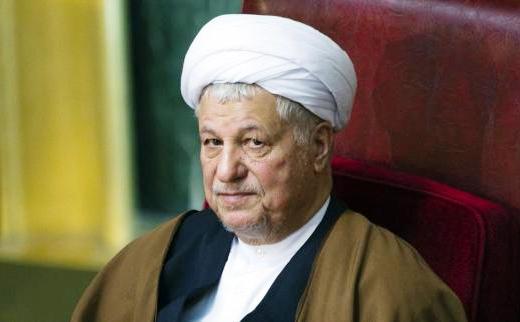
US admits impossibility of anti-ISIL fight without Iran: Rafsanjani

Hashemi-Rafsanjani
Hashemi-Rafsanjani

Chairman of Iran’s Expediency Council says the United States has admitted that the fight against the ISIL terrorist group will fail without Iran’s help.
“The US acknowledges that if Iran does not help, this [US-led] coalition cannot eliminate ISIL,” Ayatollah Akbar Hashemi Rafsanjani said on Sunday.
Airstrikes cannot destroy a terrorist group as in recent days we have been witnessing the ISIL attack on the key Kurdish town of Kobani in Syria near the Turkish border, Rafsanjani added.
Referring to Iran’s role in easing recent tensions in Iraq, he also stressed that the Islamic Republic helped solve the problem of forming a new government in the Arab country.
Rafsanjani added that Iranians will be the key force on any battlefield against ISIL, adding, “I am not saying that we have deployed troops [in Iraq], but it was the consultations [offered] by Iran that liberated the Mosul Dam and the town of Amerli and the Americans know well that they could not do this job with aerial bombardment.”