Thursday, December 25, 2025
Home Blog Page 5052

Iran MPs denounce UK Cameron’s allegations against Tehran

Iran-Majlis
Iran-Majlis

In his address to the UN General Assembly on Wednesday night, David Cameron claimed that “Iran’s support for terrorist organizations” needs to change.

“The absurd remarks by the British prime minister at the United Nations General Assembly showed that…Britain, which has been pursuing the will of the US and the Zionists for a long time, has not understood the reality of the Islamic Revolution,” a statement signed by 224 Iranian lawmakers read on Sunday.

The legislators denounced Cameron’s “vile, offensive and meddlesome” remarks and expressed confidence that the Iranian administration and nation would in unison continue the path of protecting the independence of Iran.

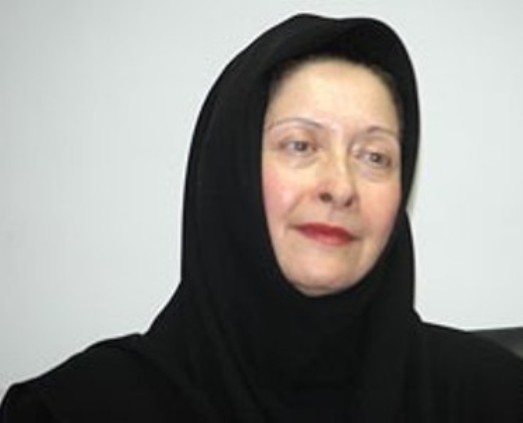
On September 25, Iran’s Foreign Ministry Spokeswoman Marzieh Afkham categorically rejected the British premier’s allegations and expressed regret that the UK government which has been supporting terrorist groups has passed an “inappropriate judgment” on Iran which has always been at the forefront of the campaign against the scourge of terrorism.

The Iranian lawmakers also hailed President Hassan Rouhani’s remarks at the UN General Assembly in support of the Iranian nation’s rights, particularly the country’s peaceful nuclear energy program.

“The president’s statements, which indicated the determination of the faithful and committed Iranian nation against the arrogant nature of hegemonic powers, conveyed this message that threats and sanctions have failed to affect…the resistance of this great nation,” the statement added.

Addressing the 69th annual session of the United Nations Assembly in New York on Thursday, President Rouhani said Iran’s nuclear case has no other solution but negotiation and “if there are parties that imagine other solutions to this issue,” they are greatly mistaken.

“Reaching a comprehensive nuclear deal with Iran is a historic opportunity for the West to prove that it is not against the progress and development of other [states],” said Rouhani, adding that a final agreement could convey a “message of peace” to the world.

US should come forward first for ties with Iran: Journalist

Abbas Salimi Namin
Abbas Salimi Namin

Arman-e Emrooz newspaper (in its 2,576th issue on September 24) ran an interview with Abbas Salimi Namin, [director of the Center for Contemporary History Studies, historian and a Principlist journalist] on Iran’s [direct] ties with the US, President Rouhani’s trip to New York and the conduct of hardliners. Here is the translation of the interview in its entirety:

Tehran-Washington ties are hot-button issues not only in Iran and the US, but also in other countries. How important would a likely resumption of ties be to the two nations and the international community?

What matters most for countries is to have interaction with other nations in order to pursue their stated objectives, but this does not mean they should close their eyes to realities on the ground and seek establishment of relations at any cost. As for ties with the United States, the Islamic Republic [of Iran] has always tried to see if such relations would be appropriate. That’s why the two nations still stay far from each other.

Well, the two nations have not had relations for years. Preparations should be in place if they possibly seek to hold ties. How do you view this?

If the status quo brings Iran to the conclusion that establishment of ties with the US does not harm its independence and dignity and that such relations come with some benefits, this would be seen as a politically correct decision.

Do such ties matter more for Tehran or Washington?

The Americans should come forward first because they are to blame for the bulk of problems between the two countries and the strained ties. They should show in practice that they have changed, something which seems highly unlikely [at the moment].

Ties between Iran and the US seem to have changed in one way or another.

The differences between the two nations are rooted in the historical animosity the US has borne against the Iranians. The fact that Washington has described the superiority of the Zionist regime as its top priority in the Middle East means it would not allow any other country to grow economically, politically and militarily and pursue its goals.

A question which arises here is: How can one accept that the US will seek to cooperate with Iran at a time when it intends to see all Islamic states in the region lag behind the Zionist regime? The Americans are struggling to strengthen the Zionists, whereas Zionism is the common enemy of all divine religions, Islam in particular. The terms for establishment of such ties have yet to change. Basically, we cannot wait for a change of heart in Washington in dealing with Iran.

They can begin to improve relations with Iran only when they drop their support for the Zionist regime. Of course there are some inside Iran who, intentionally or unintentionally, back the Americans, but it is not an orthodox move. They keep talking about establishment of ties or possible meetings between the two governments’ officials only to serve the US interests.

Are you saying ties with the US would bring no benefit for Iran?

Let me elaborate on the previous question a bit more. Why are some backing the Americans insistently trying to make the Iranian people believe the US has changed? If the Americans have changed, why don’t they admit the change themselves and only a group in Iran insists that they have?

They are saying that the atmosphere between the two nations has changed.

What kind of change? They hold up bilateral meetings between Iranian and US top diplomats, [President] Obama’s phone call with [President] Rouhani and the two sides’ more serious efforts toward arriving at a consensus in nuclear talks as the reason for what they claim.

To shed more light on the existing ballyhoo [on ties with the US] and prove that this America is the very America for which hostility toward Iran and its people is a top principle, the political system in Iran prepared for some meetings to practically test the Americans, trying to show that their words contradict their deeds. We can even say that they have openly and boldly said they take into account the interests of the Zionist regime. On what grounds do they say the Americans have changed for the better?

By better, they mean a relative improvement of atmosphere between the two countries.

It is not true at all. The atmosphere would get better when the Americans show more leniency toward the Iranian people. Following the talks, smiles, and so forth, the Iranian president himself said that the US insists on its enmity toward Iran. Despite the changes which are in place, they keep imposing sanctions on Iran, apply more pressure and try to aggravate the situation for Iran.

Some Principlists persistently want to see sanctions eased.

What matters is that something should be done in practice. One cannot only claim that the world has decided to recognize the rights of the Islamic Republic.

What is President Rouhani’s government expected to do when it comes to Iran-US relations?

Government officials, especially the president, do know that submission and compromise in dealing with the US are unjustifiable as long as Washington fails to correct its policies. If the eleventh government intends to seriously defend Iran’s national interests, it should stand up to the acquisitiveness of the West, the US included.

How was [President] Rouhani’s second New York trip different from his first?      

The big change was that optimism on the part of those close to Rouhani about a change of heart at the White House was less intense this time around, so unlike what happened last year, nothing was heard this year about a possible meeting between Rouhani and Obama. They used to think that a single meeting would be enough to solve all problems, but they have now understood they were wrong and learnt that they [the Americans] would do nothing to repair the [rocky] relations [between the two countries].

Despite what you think, the Democrats have openly taken a softer line as compared with the Republicans.

No. The White House, no matter whether a Republican is the boss or a Democrat like Obama, has always taken a specific line on the Middle East and that is defending Israel’s interests. That’s why although the US public opinion is seeking calm and détente, the US administration under pressure from the Israeli lobby puts Israel’s interests ahead of those of the US. As long as this trend persists, nothing will change.

Let’s talk about something other than the US. Do you see any logic in the eleventh government’s decision to give [top] priority to nuclear talks or …?

The prevailing mindset in the government was that they could reduce problems, especially economic restrictions, by easing sanctions, so they invested heavily in foreign policy.

One year on, they have learned that they should take everything into account. As a result, they seriously opted for the Resistance Economy and included interaction with non-Western countries in their plans. Now they are cooperating with such countries as India and China. They have also decided to tap into domestic potential and boost production.

Do you confirm that the current government began its tenure in tough times?

Severe sanctions were slapped on Iran to make it hard for the government to run the country, but it does not mean Iran cannot remove the problems. If we can stand the problems associated with production, we can have growth and progress as much as we need in order to stop relying on the West.

Another point is extremist measures by certain hardline groups who stand in the way of government and do not let it go ahead with its job. They are struggling to penetrate the government in order to find the opportunity to pursue their extremist agenda.

Who do you mean exactly?

I mean extremist members of the Reform Movement who thought the rise to power of the Rouhani administration could provide them with another opportunity to work toward their goals following eight years on the sidelines. I hope the government could act in a way not to let them obstruct the performance of the Cabinet.

Your words come at a time when concerns have been raised about those hardliners who are trying to vilify the government.

The truth is that the hardliners of rival factions have been reined in, and those who are seeking to paint a black picture of the Cabinet are not a headache for the government, so there is no need for any concern.

As for the hardliners in parliament, they are not strong enough to affect the Cabinet or the chamber through their words and deeds. For instance, when Ansar-e-Hezbollah decided to launch [motorbike] patrols to promote virtue, not only were they given no support by the Principlists, but also they came in for harsh criticism.

Concerns come with the territory given the behavior of the Principlists; for example, words spread on a nuclear agreement although everybody knows nuclear decisions are made by the high-ranking authorities and not the government alone, or a Cabinet minister was threatened with impeachment only because of his meeting with [former President] Khatami.

One should admit that some behaviors are not justifiable under any circumstances and failure to admit that is far from logical. But the words and deeds of some should not be regarded as what all Principlists stand for. The Principlist current is comprised of different groups. That’s why besides collective extremism over the past year we have also seen that logical-minded Principlists treat the government in a logical way. They have even tried to defend the government.

Anyway, you cannot turn a blind eye to some behaviors.

In a political atmosphere there are varying views and analyses. How they are managed is important. The onus to deal with obstructionists is on everybody. We need to carefully and properly distinguish between criticism and vilification. In conclusion, I should say we shouldn’t follow the US and this is our principle.

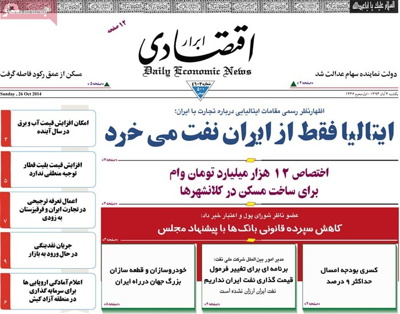
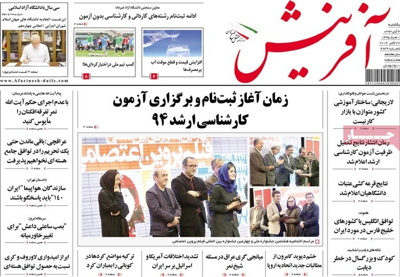
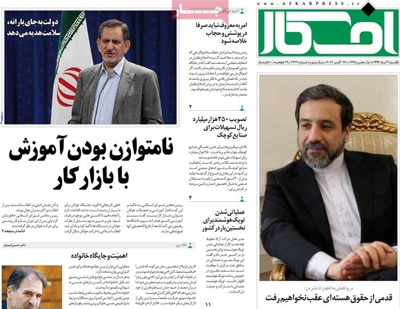
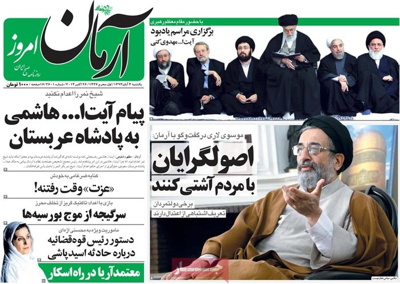
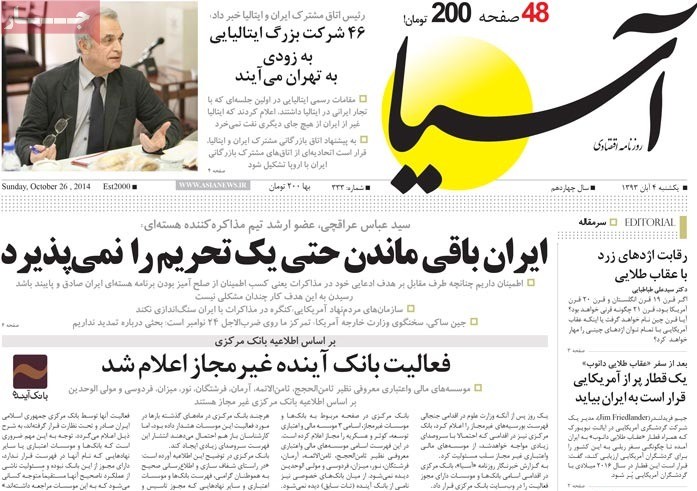
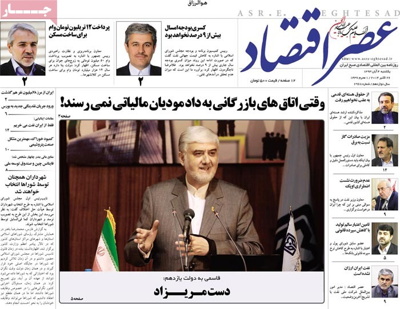
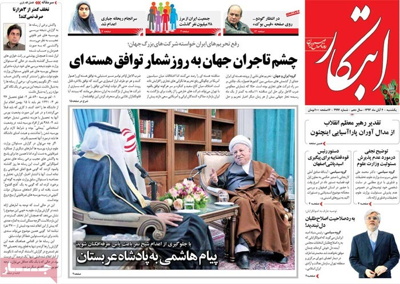
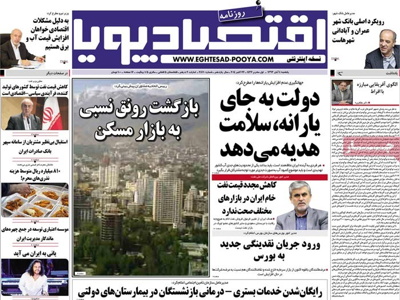
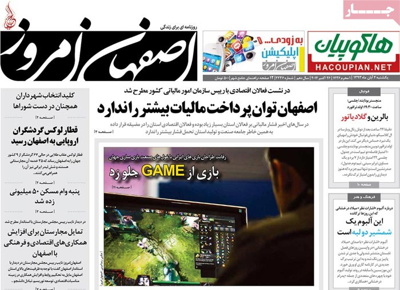
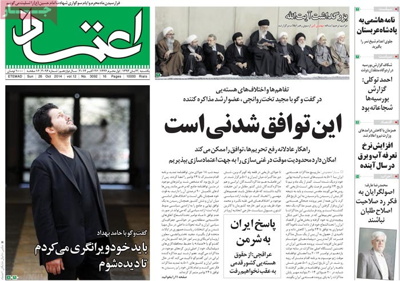
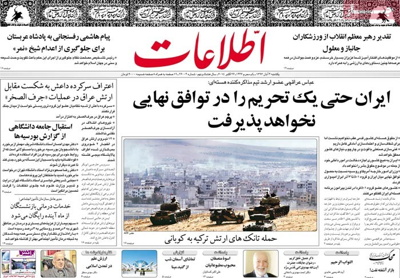
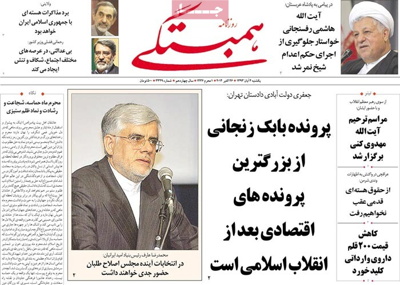
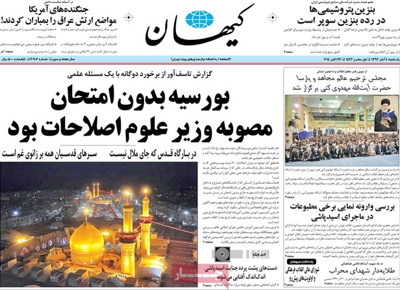
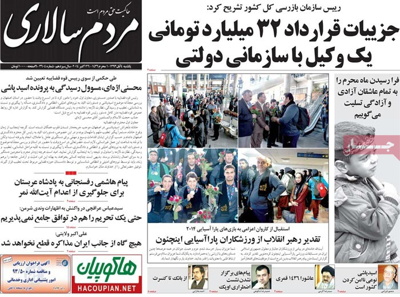
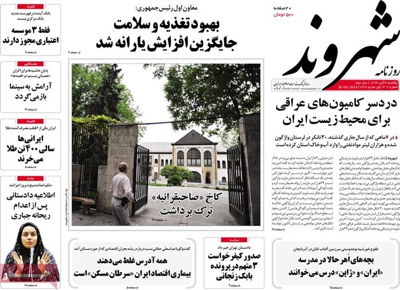
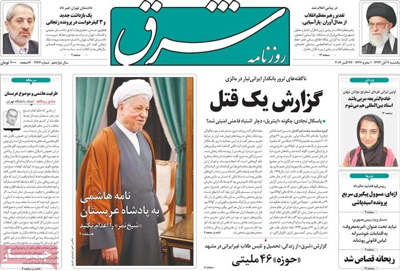
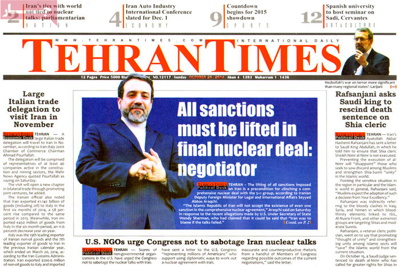
A look at Iranian newspaper front pages on Sept. 28

Iranian Newspapers headlines
Iranian Newspapers Headlines

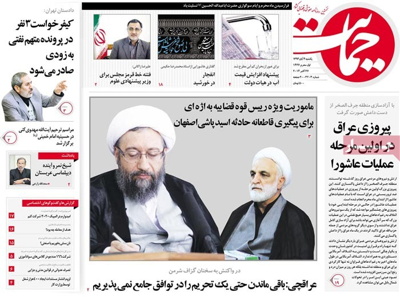
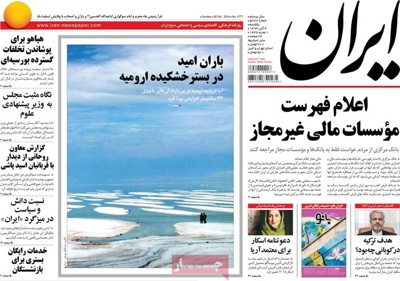
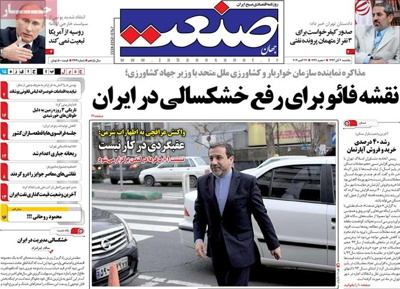
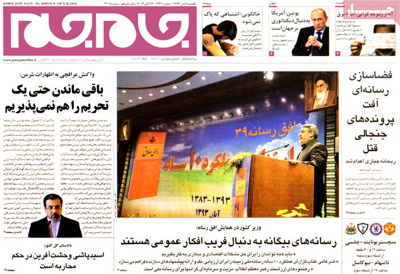
Front page headlines of Iranian dailies on Sunday mostly focused on the 7th round of nuclear talks in New York and their failure to produce the intended results. The inconclusive negotiations drew remarks from different politicians and prompted them to adopt a wait-and-see approach until the 8th round of the talks later this year. Comments by Parliament Speaker Ali Larijani in response to the speech by British Prime Minister David Cameron at the UN General Assembly were among top stories. Drawing as much attention was the silver medal that Iranian female shot-putter Leila Rajabi bagged for the first time in the Asian Games. Another headline-grabbing story of the day was a message by the Supreme Leader to Ayatollah Mahmoud Hashemi Shahroudi, a top member of the Assembly of Experts, in which the leader expressed his heartfelt condolences on the passing of Ayatollah Shahroudi’s mother.

Abrar: “We have neutralized the sanctions imposed on the military sector,” said the commander of Aerospace Force of the Islamic Revolution Guard Corps.

Abrar: “If ISIL militants dare to approach Iran’s borders, we will target [their positions] deep in Iraqi territory,” warned the commander of the Iranian Army’s Ground Forces.


Abrar newspaper spet. 28


Afkar: “Britain is in no position to lecture Iran,” the Iranian parliament speaker says.


Afkar newspaper spet. 28


Aftab-e Yazd: “Do not get tough on foreign tourists,” an MP has urged officials.


Aftabe yazd newspaper spet. 28


Arman-e Emrooz: “Seventy years behind bars for 13 convicted of corruption.” Thirteen people found guilty of a raft of charges including graft, bribery and forgery have been sentenced to 71 years in jail combined. According to the verdict, which is subject to appeal, the convicts will also have to pay hefty fines.


Arman newspaper spet. 28


Asia: “Mexican businessmen see Iran as a gate to the Middle East,” the Mexican ambassador to Iran said in an interview with the daily.

Asia: “It remains our fervent hope that Iran and six powers can in the next weeks come to an agreement, said US Secretary of State John Kerry.


Asia newspaper sept. 28


Donyay-e Eghtesad: “Different interpretations on New York nuclear talks” is the report in which the daily quotes different politicians involved in the negotiations after the talks failed.

Deputy Iranian Foreign Minister Seyyed Abbas Araghchi: “We are yet to reach a common understanding about fundamental matters.”

US Secretary of State John Kerry: “It remains our fervent hope that Iran and six powers can in the next weeks come to an agreement.”

French Foreign Minister Laurent Fabius: “[There has been] no significant progress in nuclear talks.”
German Foreign Minister Frank-Walter Steinmeier: “We have never been so close to a deal as now.”


Donyaye eghtesad newspaper sept. 28


Ebtekar: “The New York passengers [Iran’s nuclear negotiating team] come back home empty-handed; talks have stretched into an 8th round.”

Ebtekar: “The first historic medal in track and field for Iranian women in the 2014 Asian Games.”

Ebtekar says a plan to separate drinking water from water for other purposes including bathing is on the agenda.


Ebtekar newspaper sept. 28


Etemad: “Scholarships of 1,600 students do not meet the required standards,” a report by the acting minister of science, research and technology revealed.


Etemad newspaper sept. 28


Ettela’at: “The government to modify water consumption patterns,” said Director of the Environment Protection Organization Masoumeh Ebtekar.


Etelaat newspaper sept. 28


Farhikhtegan: “The government is responsible for keeping people’s hope alive,” President Rouhani said at a meeting with Iranian expatriate university professors and students in America. He further said that countering Iranophobia is incumbent on all Iranians within and beyond the country’s borders.


Farhikhtegan newspaper sept. 28


Hambastegi: “We won’t join hands with fake coalitions,” said Parliament Speaker Ali Larijani.


Hambastegi newspaper sept. 28


Javan: “Substantial and fundamental disagreements at the end of marathon New York talks” was the headline that the daily put on its front page after ten-day negotiations merely produced an agreement over technical details. Also, the daily quoted President Rouhani as saying, “[Uranium] enrichment in Iran and a total lifting of sanctions are the two conditions for a nuclear deal.”

Javan: “The domino effect of independence in Europe has been felt in Spain. Catalonia’s regional leader [Artur Mas] has scheduled an independence referendum for November 9.”


Javan newspaper sept. 28


Jomhouri Islami: “Saudi security forces open fire on protesters in Eastern Province.”


Jomhorie eslami newspaper sept. 28


Kayhan: “No sanction has been lifted as far as oil industry is concerned,” said the director of the National Iranian Oil Company for international affairs.


Kayhan newspaper sept.  28


Nasl-e Farda: “Presidents Putin and Rouhani are to meet in Astrakhan.”


Nsle farda newspaper sept.  28


Roozan: Sadegh Zibakalam [a university professor] says he does not want to be sent to Evin Prison. “I am no hero; I am an ordinary citizen.” His comments came after he was sentenced, in a court of first instance, to 18 months in jail for “disturbing the public opinion” and “insulting the judiciary”.


Ruzan newspaper sept.  28


Shahrvand: “The flow of hazardous substances to Caspian waters has tainted the catch of commercial fishermen in northern Iran.”


Shahrvand newspaper sept. 28


Sharq: “The Judiciary does not approve of filtering,” the deputy judiciary chief said on mobile applications mainly used for messaging and calling – Viber, WhatsApp and Tango.


Shargh newspaper sept. 28


Tafahom: “All sanctions against Iran must be lifted,” President Rouhani said in an international press conference in New York.


Tafahom newspaper sept.  28


Larijani raps British PM for anti-Iran remarks

Ali Larijani
Ali Larijani

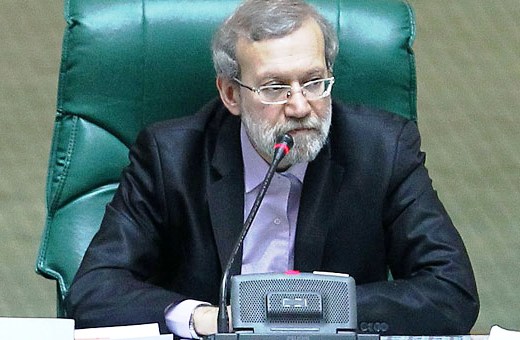
Iranian Parliament Speaker Ali Larijani lashed out at British Prime Minister David Cameron for his anti-Iran comments at the 69th annual meeting of the UN General Assembly in New York, and said such remarks are rooted in London’s intense fear of the terrorism which has been created by Britain.

In comments aimed at PM Cameron, Larijani said, “You shouldn’t speak like this; you are nervous and ISIL (the Islamic State of Iraq and the Levant) is its cause since you have helped it and now it has turned into a problem.”

Stressing that fearing a heinous group like ISIL is a true fear, he said the British officials who need Iran in their fight against the terrorist group shouldn’t speak like “Pharaohs” and use orders to meet their needs.

“Instead of admitting to your past mistakes in aiding the terrorists, you are now using a language which will not lead to meeting your needs,” Larijani said.

In relevant remarks on Thursday, Iranian Foreign Ministry Spokeswoman Marziyeh Afkham said that the recent statements by Cameron at his UN General Assembly speech indicated the continuation of London’s self-centered outlooks.

Afkham’s comments came after Cameron’s speech at the 69th session of the UN General Assembly on Wednesday about the fight against ISIL terrorist group in Iraq in which he raised anti-Iran allegations.

Iran will attack aggressive terrorist groups before reaching its borders

Iran-General Ahmad Reza Pourdastan

Iranian Ground Force Commander Brigadier General Ahmad Reza Pourdastan assured the nation that the country’s Armed Forces are ready to give a crushing response to the terrorist groups which dare to attack Iran.

“As a soldier, I assure the brave Iranian nation that the Armed Forces are at the service of the people with full preparedness and people shouldn’t be concerned,” Pourdastan told FNA in Rey city near Tehran on Friday.

Asked about Iran’s reaction to any possible aggression of the terrorist groups, including the Islamic State of Iraq and the Levant (ISIL), against the country, he said, “All moves of these groupings are monitored and we have very good capacities for confronting them and if they move to approach us, they should rest assured that we will target them on the soil of the same neighboring country (that is used as their platform) and will not allow them to approach our borders at all.”

[…]

95% of Iran nuclear deal agreed

Russia FM-Lavrov
Russia FM-Lavrov

Russia says nuclear talks between Iran and P5+1 are going ahead on the right track and that both sides have agreed on “some 95 percent” of a final deal.

“Some 95 percent of the deal is agreed,” Russian Foreign Minister Sergei Lavrov told Bloomberg Television on the sidelines of the 69th annual session of the United Nations General Assembly in New York on Saturday.

The Russian top diplomat noted that the remaining five percent consists of “two or three very difficult issues” that are to be settled in the coming months.

Iranian Foreign Minister Mohammad Javad Zarif described the talks as “serious, intense and very frank.”

“Time is short, but issues are not that difficult to resolve,” Zarif told reporters in New York on Friday. “Everything is very far and very close, it depends on how you look at it and what time of the day you start looking at this question. We are still apart, there are still quite a bit of differences on all these issues.”

I am extremely proud to have my book published in Iran

Gareth Porter
Gareth Porter

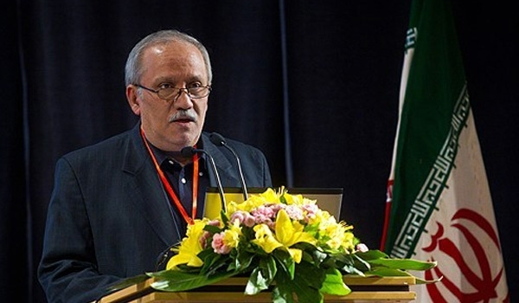
Gareth Porter, the award-winning American historian and investigative journalist, says he is proud and happy to have his book “Manufactured Crisis: The Untold Story of the Iran Nuclear Scare” rendered into Persian language and published in Iran as the first foreign language edition.

“I am extremely proud to have my book published in Iran as the first foreign language edition,”Dr. Porter said in an exclusive interview with Fars News Agency.

Gareth Porter is a leading American journalist, historian, anti-war activist and correspondent of the Vietnam War. Porter’s writings have appeared on such publications as The Nation, Inter Press Service, The Huffington Post, Truthout, Al-Jazeera, Press TV, Antiwar.com and Common Dreams. Porter is the 2012 winner of Martha Gellhorn Prize for Journalism, which is awarded annually to a journalist who exposes media propaganda.

Gareth Porter has recently published a book titled “Manufactured Crisis: The Untold Story of the Iran Nuclear Scare” which discloses the unseen and masked truths behind the decade-long standoff over Iran’s nuclear program.

In this book, Porter endeavors to reveal the destructive role Israel has played in the exacerbation of Iran’s relations with the West over the former’s nuclear activities. Porter maintains that Iran’s nuclear program is completely legal and regularly inspected, abused by the United States and Israel as a pretext for pressuring Iran.

Porter was due to arrive in Tehran on Saturday, September 27, to participate in the releasing ceremony of the Persian edition of his book which has been translated by Fars News Agency and will go on display during a launching and signing ceremony at the venue of FNA in Tehran later on Saturday.

Fars News Agency’s Javad Arab Shirazi has conducted an interview with Dr. Porter. What follows is the full text of the interview:

Q. Dr. Porter, what inspired you to author “Manufactured Crisis”?

A. What inspired me was the realization that there was a major story here going to the very core of US national security policy that involved a series of blatant falsehoods. It began with my realization that the “laptop documents” were certainly fraudulent, as indicated by multiple types of evidence. The more deeply I got into the story, the more I realized that it could be covered in a book, not in a series of articles.

Q. The title of your book is “Manufactured Crisis: The Untold Story of the Iran Nuclear Scare”. Would you be kind enough to let us know why you picked up this title for your book?

A. I thought it was important to find a phrase to describe the whole political process that has taken place over the years surrounding the Iranian nuclear case that would be dramatic enough to convey the deceptive nature of the charges of a covert nuclear program as well as the hyping of the “crisis” as involving the threat of war. In essence it conveys the idea that a completely false picture of issue has been foisted on the public.

The “untold” part of the title is also a reflection of the reality that no one else has come anywhere close to telling the real story of the politics surrounding the Iran nuclear issue, and that instead a false narrative has been created and constantly developed further over the years.

Q. The front cover of your book depicts Netanyahu’s cartoon bomb he showed during his UN speech last year. Would you please tell us whether you suggested the image or you were proposed choices?

A. The cartoon bomb picture was my idea, after exploring the possibility of a cover that would have both Netanyahu and Obama on it. No pictures that could be found seemed to convey the essence of the subject matter the way the Netanyahu picture does. It seemed the logical choice.

Q. Dr. Porter, in one of your latest interviews you mentioned, “If we go back in time until the 1990s, the first time the US talked about Iran as a threat for the development of Weapons of Mass Destruction (WMD) and nuclear power was at the end of the Cold War.” Would you please elaborate on this?

A. The end of the Cold War is a key turning point in US policy toward Iran, because the logic of the situation prior to that event was that there would be relaxation of tension between the US and Iran after the freeing of US hostages from Lebanon thanks to Iranian diplomatic intervention. That was indeed the intention of President George H. W. Bush. But instead the conflict was kicked into a higher gear by the bureaucratic interests in the Pentagon and the CIA, who saw the need for a new enemy to replace the Soviet Union and who now saw no need to come to terms with Iran in the regional context, because they perceived the United States as now the unipolar hegemon with unchallenged power. I view the origin of the charge of an Iranian desire for nuclear weapons as emerging out of those two closely linked consequences of the end of the Cold War.

First e-confab on environment, agroecosystem to be held in December

environment
environment

A first electronic conference on new findings on the environment and agricultural ecosystem will convene in December in Tehran, according to a research center at University of Tehran.

The Renewable Energies and Environment Research Center at the University of Tehran will hold an electronic conference in December focusing on new findings on the environment and agroecosystem (agricultural ecosystem).

Tabnak news website reported on September 27 that the e-conference intends to concentrate on the exchange, synergy and introduction of scientific and research-related findings in the areas of environment, agriculture and natural resources.

The conference will be held in cooperation with several state and non-state universities and institutions, and more than 250 faculty members from across the nation will sit on the conference’s jury.

According to an agreement inked between the University of Tehran and some international scientific institutions, the applicants can get related certificates after paying the required fees.

The certificates would bear specific identification codes, security holograms and embossed seals, and it could be accessible through a user identification authentication system at any time.

Top papers will be released in international journals. The admitted articles will be indexed free of charge in various websites and databases among them, www.civilica.com, www.callforpapers.ir and www.magrica.ir.

Those interested in participating in the conference can send their papers to www.agrocongress.ir.

Appointment of Iran’s new ambassador to Berlin signals a clear message to Washington

Ali Majedi-Iran's ambassador to Germany

Settlement of Iran’s nuclear case would be far from possible with no US approval, but all parties to the talks should play an active role in solving the dispute. […]

Recently, in a statement, the Europeans expressed dissatisfaction with the glacial pace of cooperation between Iran and the IAEA prior to the release of the official report of the International Atomic Energy Agency. In fact, that seemed to be a complaint [on their part] about what Washington has done to diminish Europe’s clout in P5+1.

Although Europe’s Big Three (namely Germany, France and Britain) are pursuing the nuclear talks through [EU’s] Catherine Ashton and have been kept posted on everything including trilateral negotiations between Iran, the US and Russia, Tehran needs to enter separate talks with all parties involved as it follows nuclear negotiations with P5+1.

What you just went through was part of Ali Majedi’s views in response to questions raised by Sharq Newspaper (2,120th issue). Majedi, who has majored in economics, served as a diplomat in the UAE, Brazil, Commonwealth States and Japan back in the 1980s.

Following the appointment of Bijan Namdar Zanganeh as oil minister in the reformist government of Mohammad Khatami, Majedi became deputy oil minister for international affairs and built on an “energy-diplomacy” mix to shine in talks with the Russians.

As a member of Iran’s nuclear negotiating team chaired by Hassan Rouhani [2003-5], Majedi was the head of the economic working group in nuclear talks with Germany, Britain and France which resulted in an agreement in Sa’adabad, Tehran.

He is expected to leave for Berlin shortly to serve as Iran’s ambassador to Germany. His appointment would get the following message across: Western countries are reclaiming their main place in diplomatic and economic relations with Iran.

The train of normalization of ties between Iran and the international community is on the move. Some have missed the global peace-destined train because of their failure to appreciate the concept of compromise and because of a Netanyahu-like mentality manifested in the childish graph he showed the world two years ago. The following is the translation of the interview:

Before a recent round of nuclear talks in New York, the European Union released a statement to signal dismay over the sluggish pace of cooperation between Tehran and the IAEA. What do you think the overall reaction of Iran’s foreign diplomacy should be?

The latest report by the IAEA suggests that Iran has fully implemented its voluntary measures. […] The EU is doing so to complain about their less active role in nuclear talks, for which they blame Washington. […] Europeans know what has happened in talks between Iran, the US and Russia. I believe that Iran should enter separate talks with Europe’s Big Three, although any solution would be a remote possibility without US approval. […]

I think we should give more weight to talks with each European country; this has been also echoed by the Europeans. The statement which is attributed to the UN nuclear watchdog seems like a diversion; perhaps the Europeans want to imply that they are seeking a bigger share and a more significant role in nuclear talks with Iran.

What do you plan to do in this regard as Iran’s new ambassador to Germany?

I had a meeting with Foreign Minister Zarif who asked me to be in touch with the Germans given their growing role in nuclear talks as soon as I get there. With the extensive international media coverage given to Iran-US talks and marginalization of Europe in such talks, the Americans seem to have been given a more active role. This comes as the Europeans have always been a weighty factor in the talks.

Given your previous post as deputy oil minister, do you think diplomacy can help solve economic problems?

The country’s diplomacy for which the Foreign Ministry is mainly responsible also covers economic issues. In today’s world where Iran is a key oil and gas producer, the Oil Ministry can be instrumental in economic diplomacy.

The ministry’s role can be activated through its Department of International Affairs and it can be a big help for the foreign policy machine. Cooperation between these two ministries could create valuable opportunities for Iran’s economy and in some cases it could reduce the threats. […] I hope my successors help the country in its march toward progress.

You mean reclaiming the oil markers Iran has already lost is a secondary goal of nuclear talks?

The onus is on the National Iranian Oil Company to sell Iran’s crude. But the oil ministry’s policies and the country’s diplomatic decisions could spark a rise in oil sales. […]

Iran’s gas is a major issue too. […] The gas and oil fields Iran shares with other countries have yet to get due attention so much so that one can say the previous government lacked a distinct plan for tapping into these fields’ potential.

Reports have disclosed multifold exploitation by certain Persian Gulf countries of these joint fields. Do you substantiate such reports?

Unfortunately they are true. Worse than that, in some cases no talks have been held with these countries. As for the use of the joint fields, a new attitude is needed and this question should be put forward: If a country uses a joint field double as much without the prior knowledge of the other country what can be done in terms of international law to challenge them in international circles?

This brings to the fore the role of economic diplomacy. I think we should enter serious talks with countries with which we share over 20 oil and gas fields. The oil ministry’s international department can play an earnest role in this.

How willing have foreign firms been to cooperate with Iran ever since the eleventh government has taken office? Is Iran ready to change the format of its oil contracts? How do you think this [possible] change of format can affect the lifting of sanctions and increasing oil sales?

International sanctions against Iran have nothing to do with the format of contracts. I think many Western countries and companies will return to Iran once the sanctions are lifted. They don’t think the previous contracts are satisfactory. For instance, they are not interested in buyback agreements and Iran has yet to put forward new contracts.

First of all, sanctions should be lifted, and then the contracts should be attractive enough. Foreign firms would choose from attractive options in Iran. […] For oil companies, the security of target countries comes first. Currently Iran is enjoying relative stability.

Recently I had a meeting with Russia’s Energy Minister Alexander Novak, who voiced his country’s willingness to invest in oil and gas projects in northern Iran. The question is: Why don’t other countries and multinationals follow suit?

Let’s go back to Germany and its role in nuclear talks. How much do you think Berlin can help the talks end conclusively?

Germany is an important European player, both politically and economically. I would do my best to contribute to the advancement of the talks. But we shouldn’t forget the fact that sanctions are not a proper tool for advancing international policies in today’s world. The continued use of economic sanctions could push the world back to the brink of bipolarization and the Cold War.

The economic sanctions against Iran are unjust. All in all, international sanctions are not in the interests of peace and stability as well as free trade in the world.

Some observers hold that nuclear talks are more of a one-on-one between Iran and the US than talks between Iran and P5+1 and that other countries have a ceremonial role. How far does a louder voice of Europe in the talks can help Iran serve its own national interests?

We need to work on this more. Back in 2003-05 as the US applied pressures, the European Three took on a moderating role. We also need to make the Americans play their own share in the talks and help Europe get rid of US pressures.

I would try to remind the Germans of Iran’s peaceful intentions and its role in stabilizing the world, and stress that Iran could be a safe trade partner for the Germans.

How much do you think the New York trip by the Iranian president for the UN General Assembly affected nuclear talks?

Such talks are time-consuming and we shouldn’t wait for immediate results. As a weighty figure, President Rouhani lent added weight to Iran’s team in the talks. […]

Rouhani heads to Russia for Caspian summit

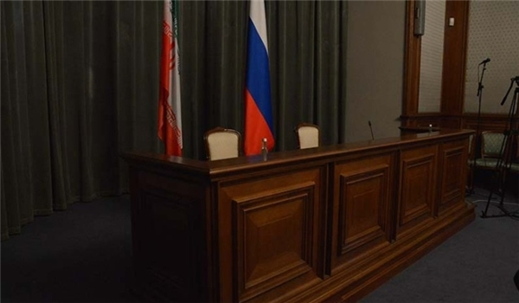
Rouhani-Visit russia

Rouhani headed to the Russian city of Astrakhan on Sunday to participate in the summit set to be held on Monday after he wrapped up his visit to New York where he attended the 69th annual session of the United Nations General Assembly.

Iran, Russia, Kazakhstan, the Republic of Azerbaijan and Turkmenistan are the five littoral states of the Caspian Sea.

The last meeting of the Caspian Sea littoral states was held in the Azeri capital of Baku in November 2010.

The Caspian Sea is the largest enclosed body of water by area, and is variously classed as the world’s largest lake or a full-fledged sea.

The issue of the Caspian Sea’s legal regime gained importance following the breakup of the Union of Soviet Socialist Republics (USSR) and the emergence of independent states.