Friday, December 26, 2025
Home Blog Page 5044

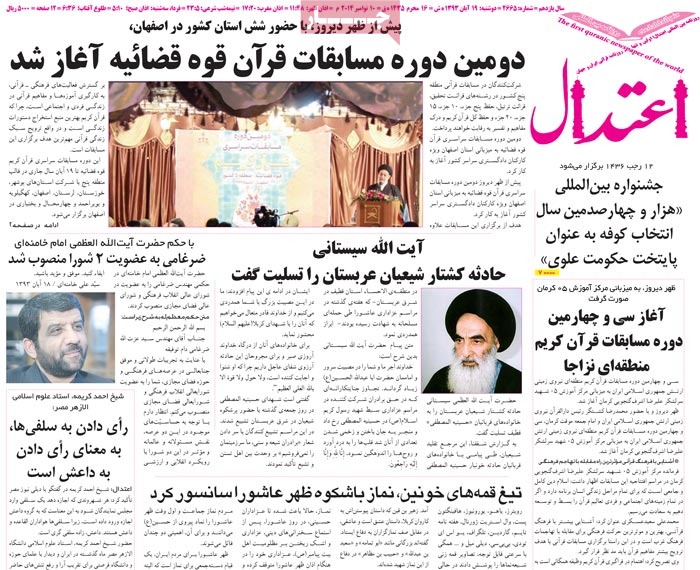
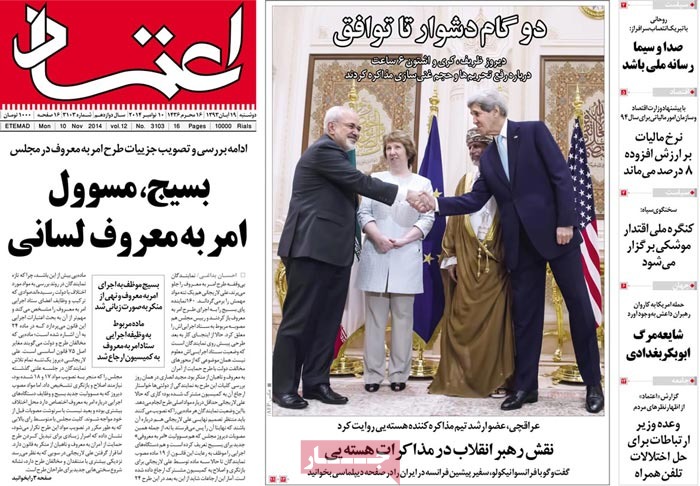
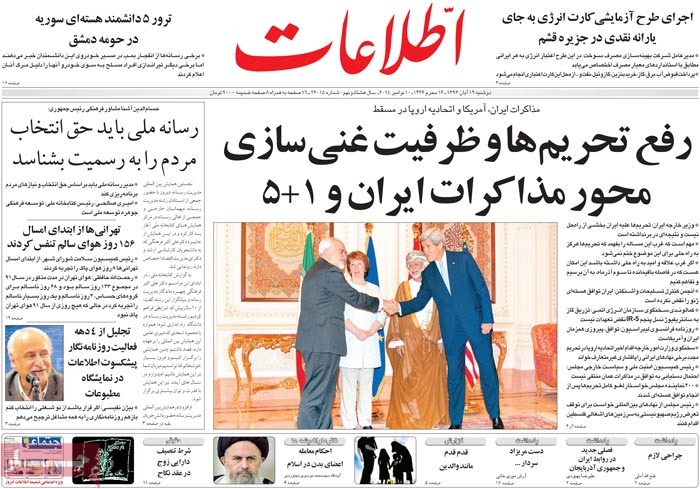
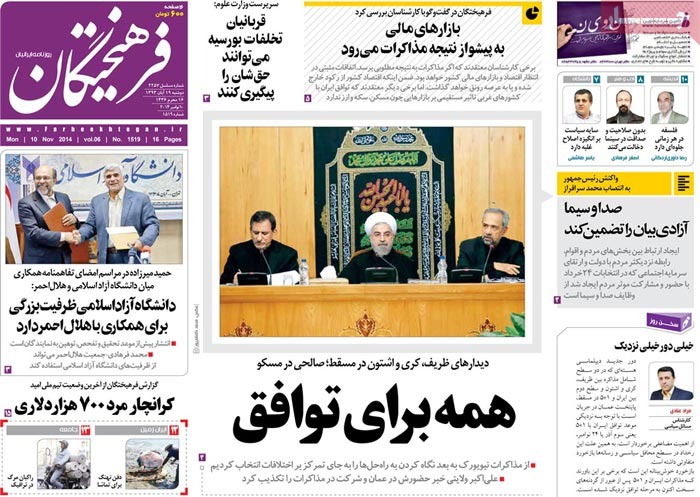
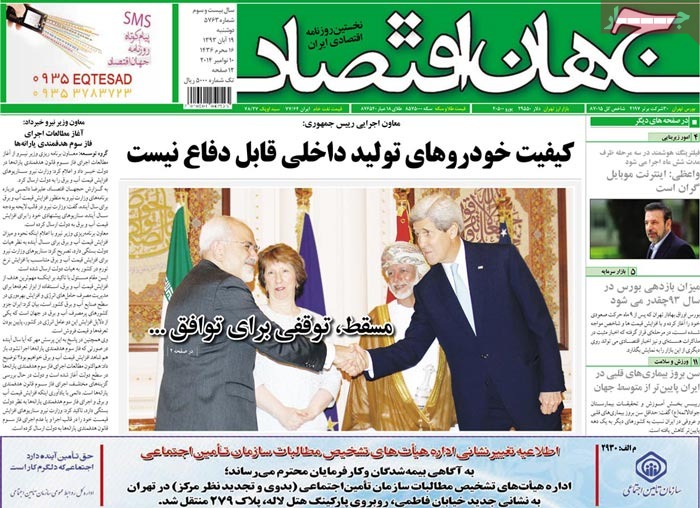
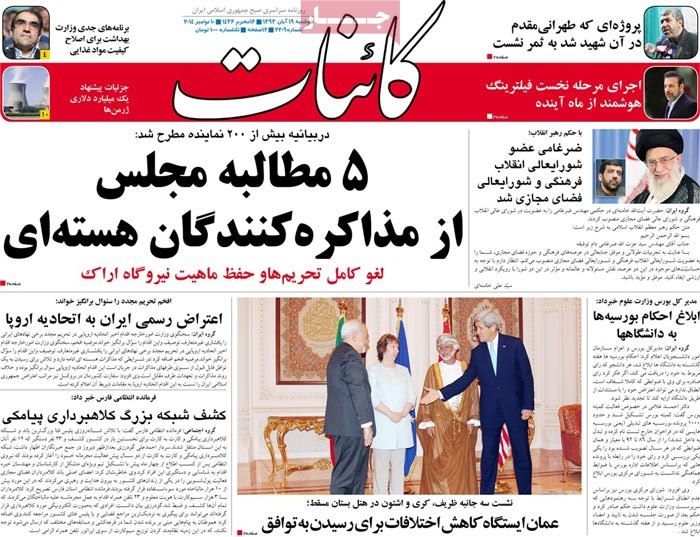
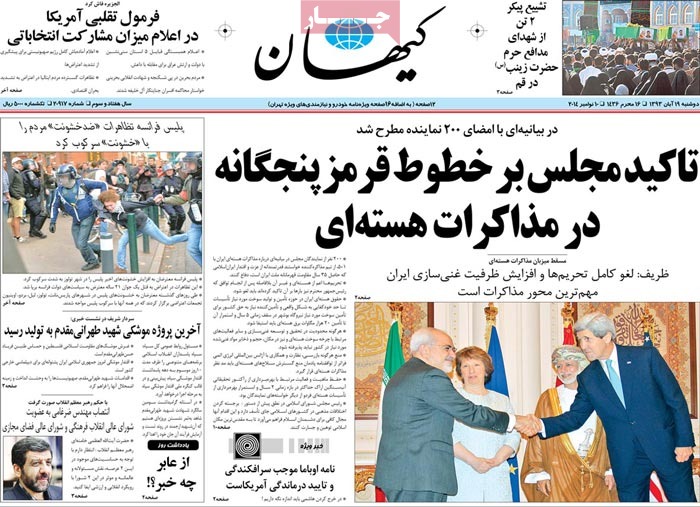
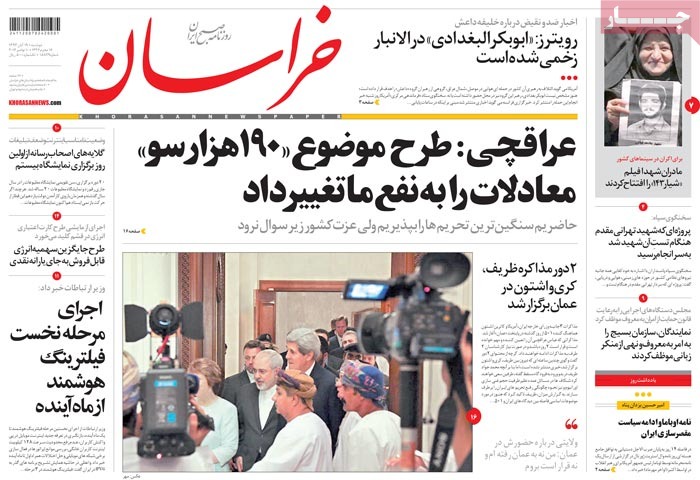
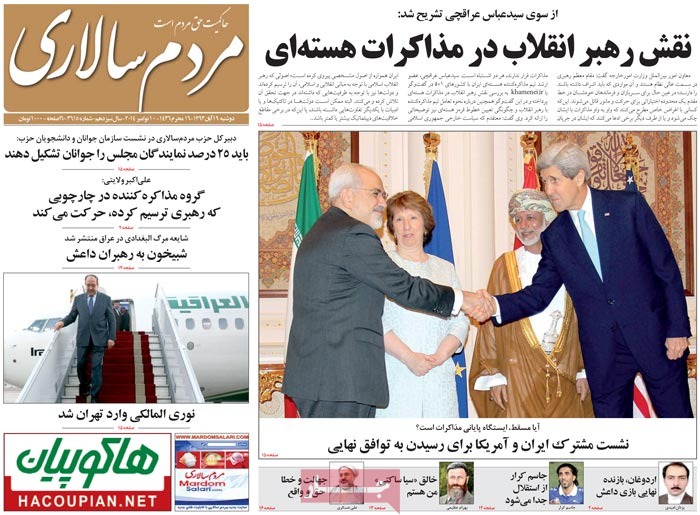
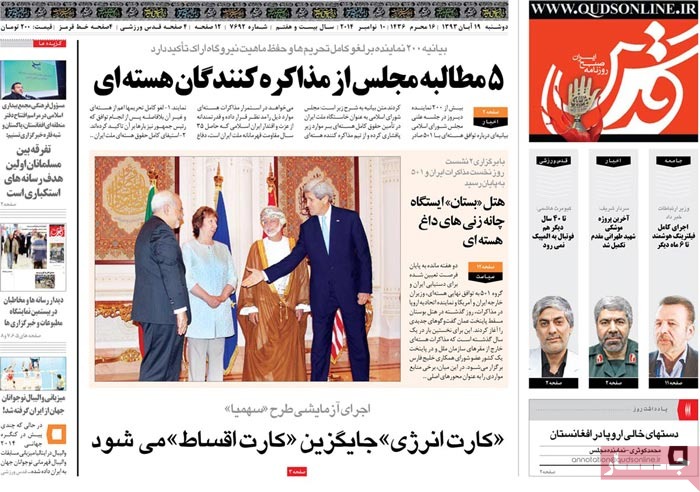
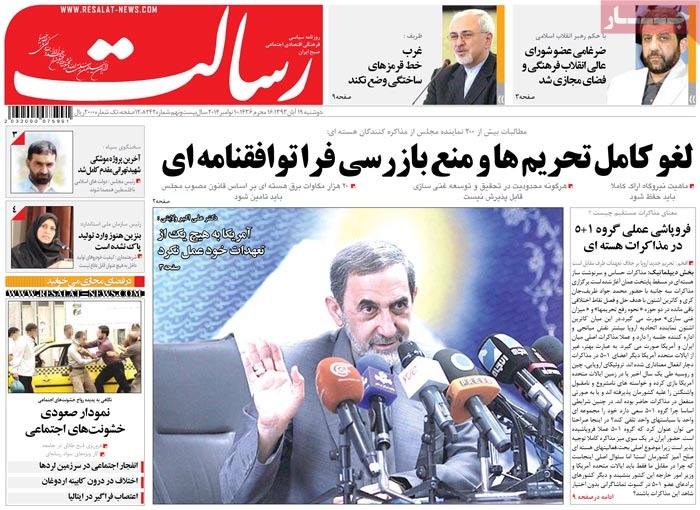
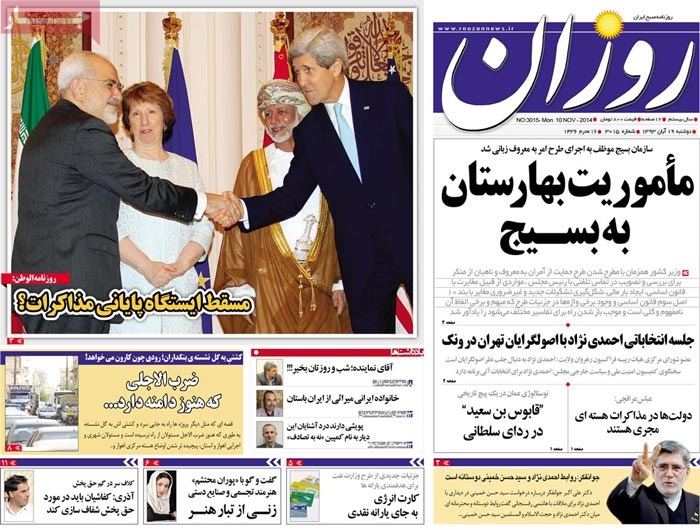
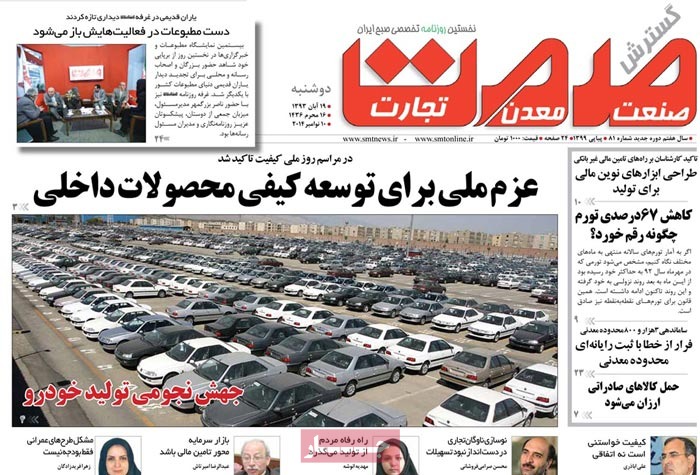
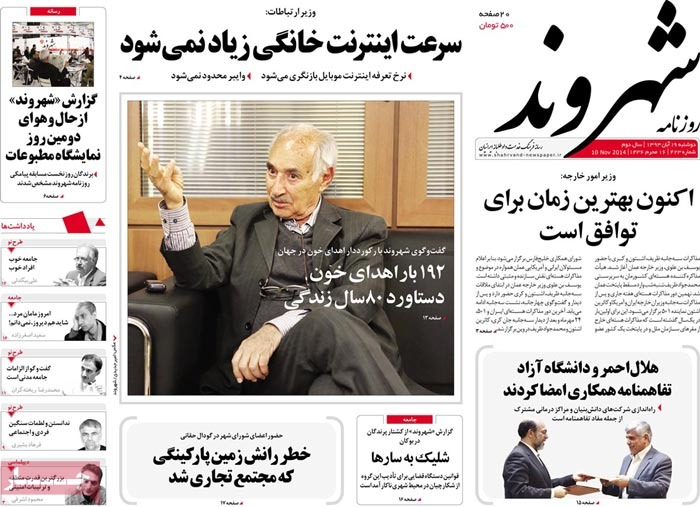
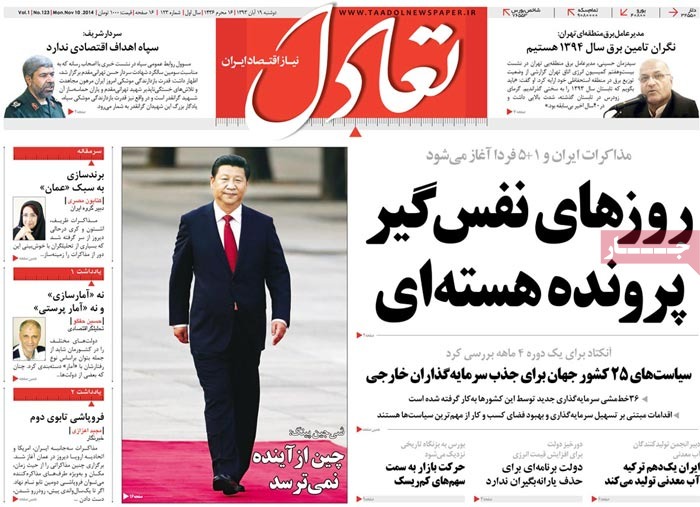
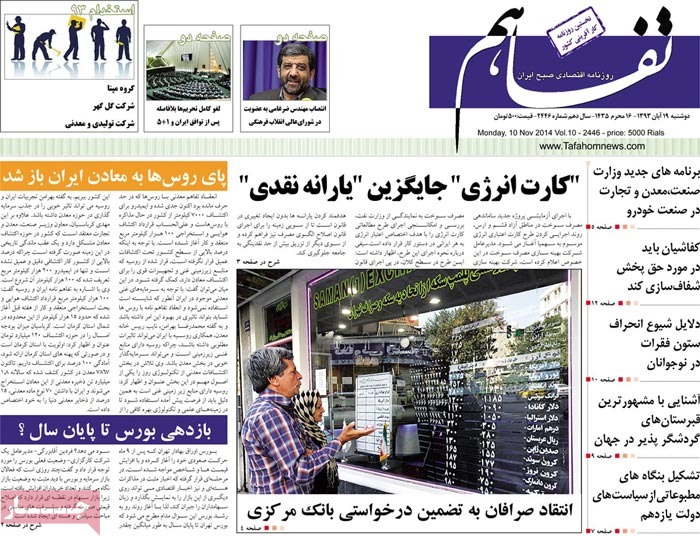
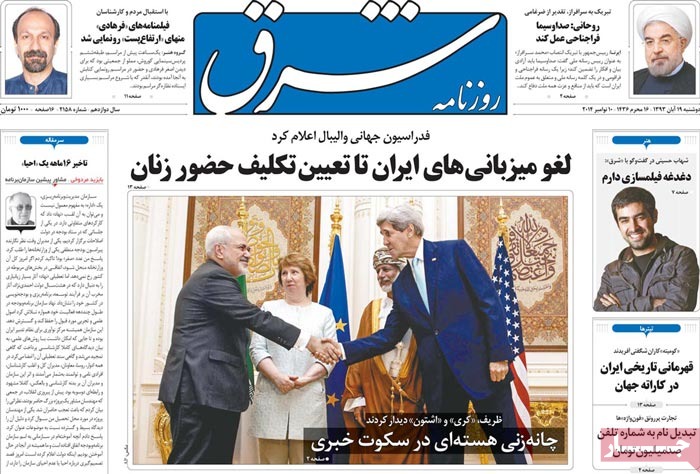
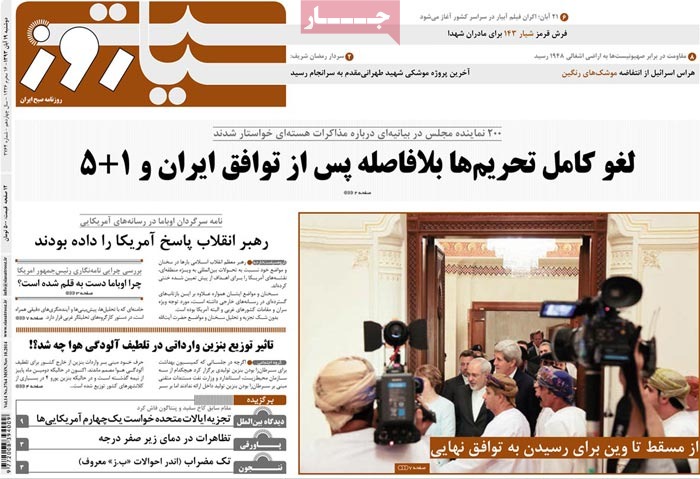
A look at Iranian newspaper front pages on Oct. 11

Iranian Newspapers Headlines

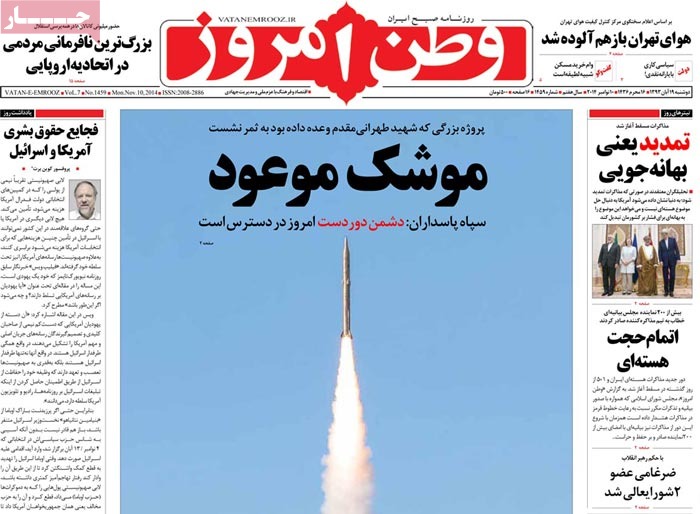
The front pages of Iranian dailies were dominated by a number of stories such as the first hiking of the Supreme Leader in the heights of Tehran since his prostate surgery last month. On the international front, the winning of the 2014 Nobel Peace Prize by Kailash Satyarthi, an Indian children’s rights activist, and Malala Yousafzai, a Pakistani female education activist, grabbed a lot of attention. Also drawing attention was news about relentless ISIL attacks on the predominantly Kurdish town of Kobani in Syria. A decline in Iran’s unemployment rate also appeared on the front pages of several dailies.

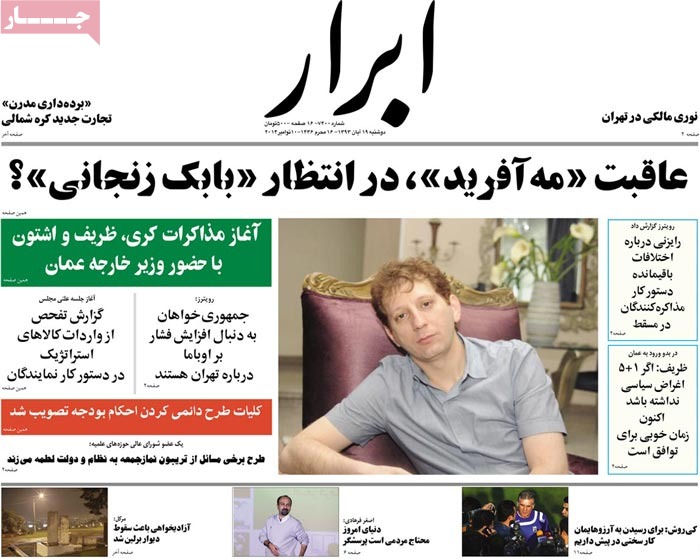
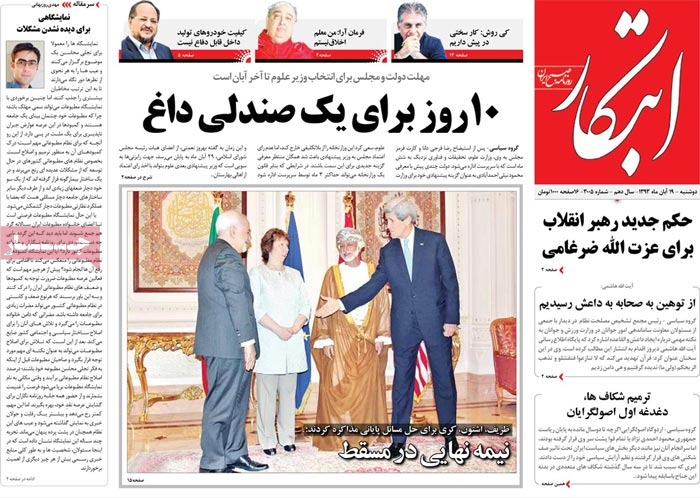
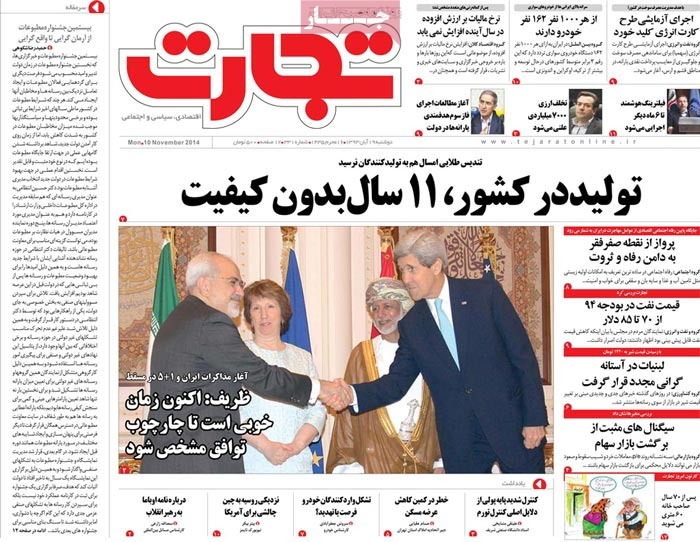
Abrar: “There is still enough time for the international mediators and Iran to reach an agreement on the Iranian nuclear program within the previously set time limits,” said the spokeswoman of the US State Department.

Abrar: “Talks between Iran and the International Atomic Energy Agency have been so constructive,” said Iran’s representative to the IAEA.


Abrar newspaper 10 - 11


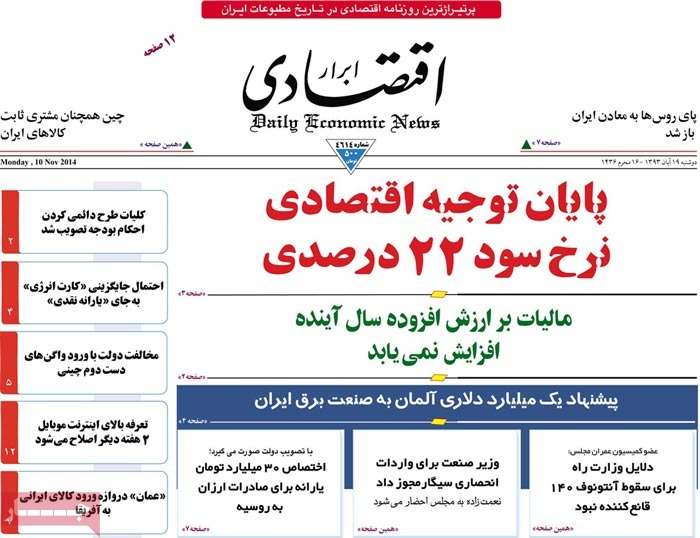
Abrar-e Eghtesadi: “Iran’s trade balance with four of its top seven trading partners is negative; the nightmare of the return of a negative balance to foreign trade.”

Abrar-e Eghtesadi: “Iran’s oil prices are down five dollars.”

Abrar-e Eghtesadi: “Land prices in Tehran have registered a 10 percent fall,” the Statistical Center of Iran reported.


Abrare eghtesadi newspaper 10 - 11


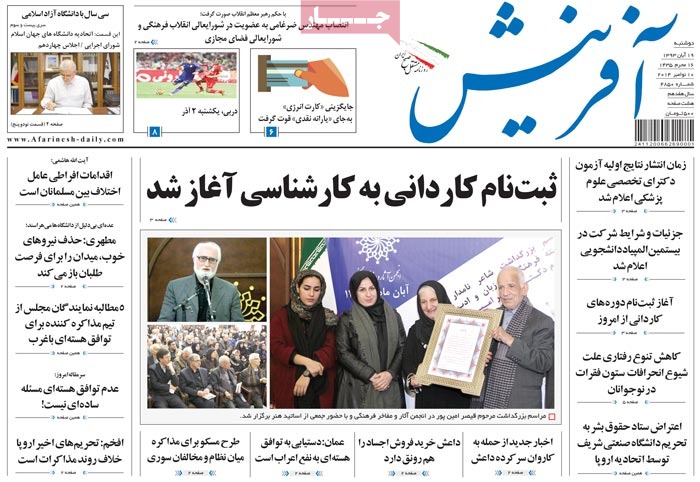
Afarinesh: “Services of top medical researchers have been praised at a 5th gathering of the International Academic Foundation of Professor Alireza Yalda.”

Afarinesh: “The [prolonged] absence of the North Korean leader has sent rumors flying about his condition.”


Afarinesh newspaper 10 - 11


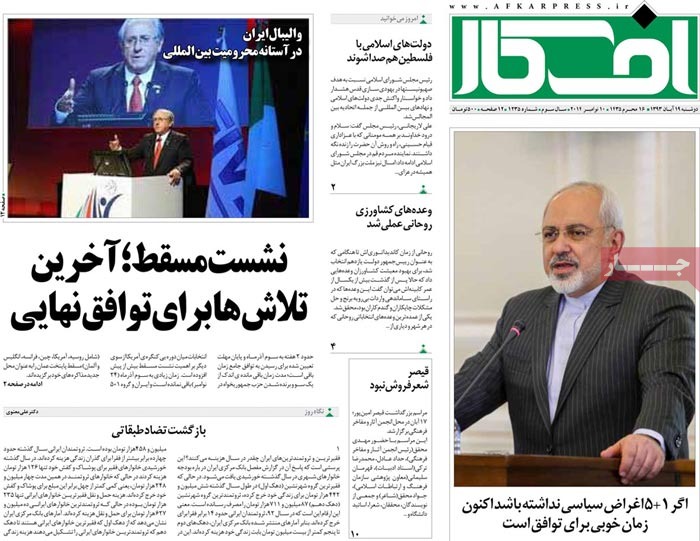
Afkar: “Iran’s oil tankers are poised to set out for Europe,” said the CEO of the National Iranian Tanker Co.


Afkar newspaper 10 - 11


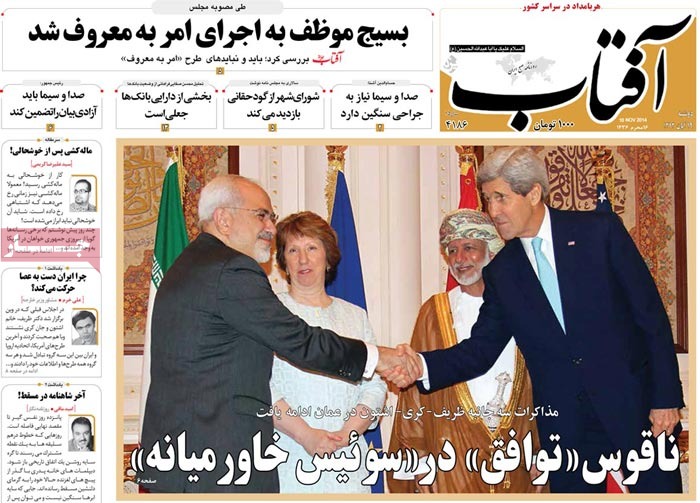
Aftab-e Yazd: “There is no need for clamor in criticizing us, our ears are wide open,” said the health minister.


Aftabe yazd newspaper 10 - 11


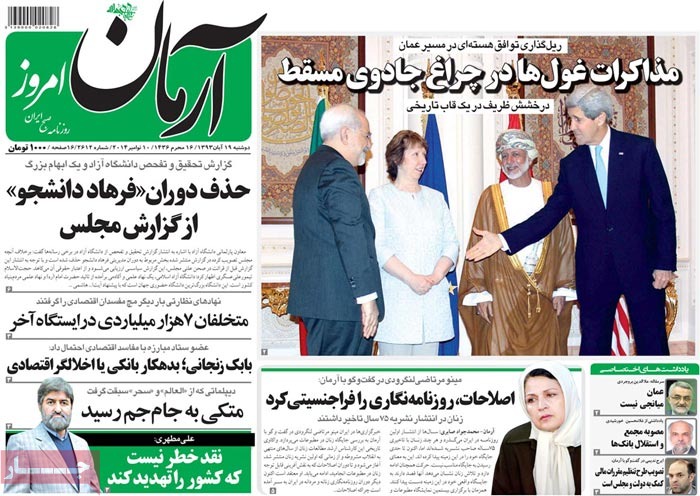
Arman-e Emrooz: “In a society where discrimination exists, calm will be non-existent,” said Seyyed Hassan Khomeini.

Arman-e Emrooz: “[Nuclear] talks are likely to be extended,” said Deputy Foreign Minister Seyyed Abbas Araghchi.

Arman-e Emrooz: “The case of Mohammad Reza Rahimi [former vice president under Ahmadinejad] is being heard by the Supreme Court. Reports that the former veep has received a 14-year jail term are not true.”


Arman newspaper 10 - 11


Ebtekar: “The country has a long way ahead to arrive at a satisfactory level of political security,” said Seyyed Hassan Khomeini, the grandson of the founder of the Islamic Republic.

Ebtekar: The Police Chief said he supports those who promote virtue in society, however, he added, “The responsibility to confront those who violate the Islamic morality code lies with the government.”


Ebtekar newspaper 10 - 11


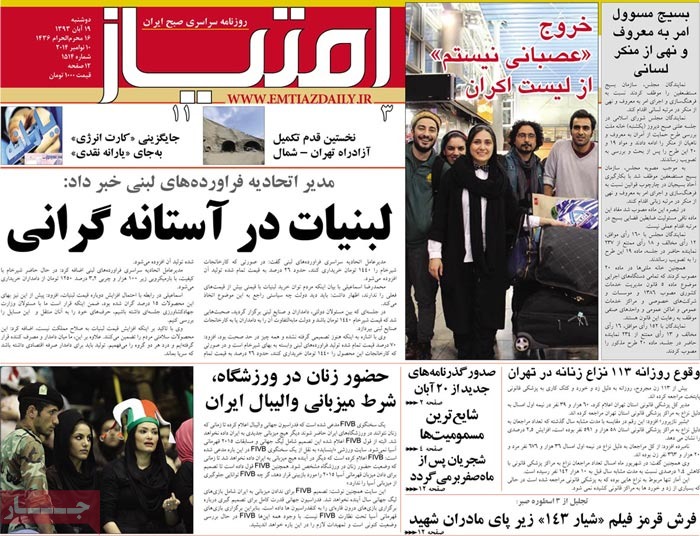
Emtiaz: “Services of Iranian composer [Loris Checknavarian] who spared no effort to promote Ferdowsi [a highly-revered Persian poet] have been praised.”

Emtiaz: “Iran’s historical sites were visited 4.5 million times by foreign tourists between March 21 and September 22, 2014.”


Emtiaz newspaper 10 - 11


Ettela’at: “A society in which human dignity is dented is not Islamic,” said Seyyed Hassan Khomeini.


Etelaat newspaper 10 - 11


Hadaf va Eghtesad: “Cars with engine displacement of 2,500 cc and above have not been cleared from the Customs,” said the president of Iran’s Customs Administration.


Hadafo eghtesad newspaper 10 - 11


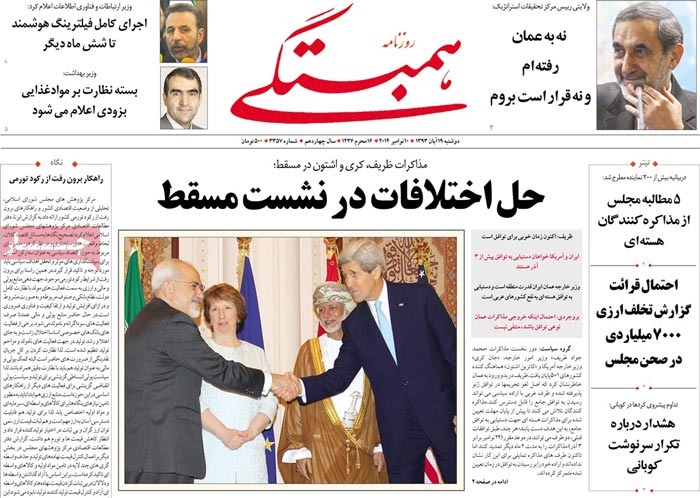
Hambastegi: “Unemployment has slipped below 10 percent,” reported the Statistical Center of Iran.


Hambastegi newspaper 10 - 11


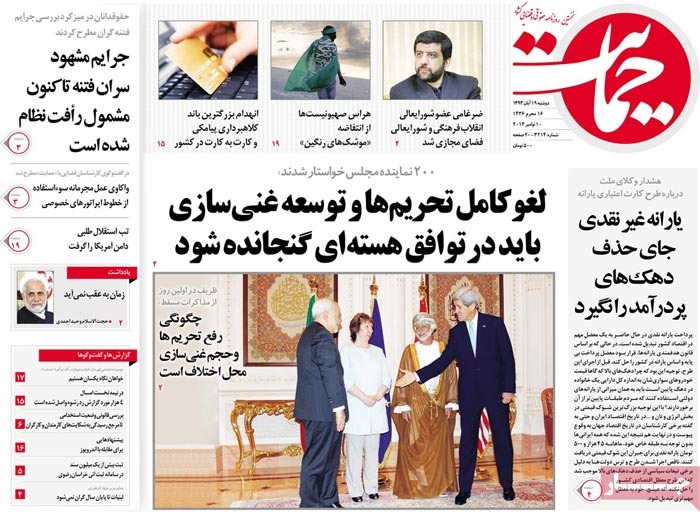
Hemayat: “Pakistan becoming a safe haven for terrorists is unacceptable,” said Police Chief Brigadier General Esmail Ahmadi Moghaddam.


Hemayat newspaper 10 - 11


Jamejam: “Children’s dental care is to be given insurance coverage as of October 11; Iran’s Health Insurance Organization pays 70 percent of prevention costs.”


Jame jam newspaper 10 - 11


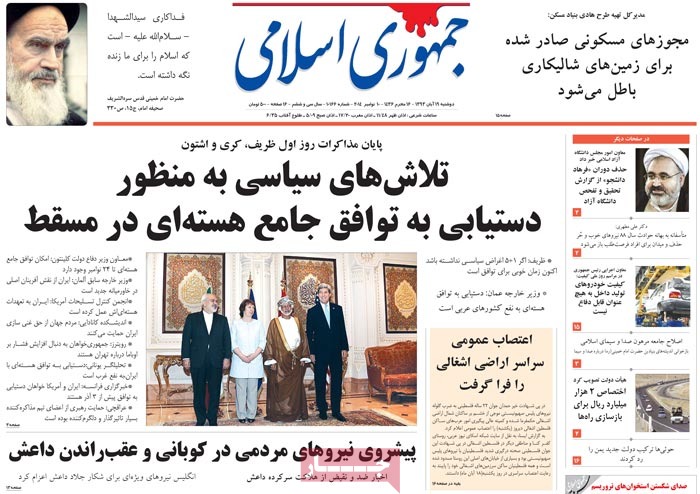
Jomhouri Islami: “Five hundred expensive drugs for difficult-to-treat diseases have been given insurance coverage,” said the CEO of Iran’s Health Insurance Organization.

Jomhouri Islami: “Wheat production in Iran has risen by 10 percent.”


Jomhorie eslami newspaper 10 - 11


Kaenat: “People of Sanandaj [a city in Kurdistan Province] threw their weight behind fellow Kurds in Kobani, Syria.”

Kaenat: TheUS blatantly interferes in Lebanese affairs: “Do not accept Iran’s military aid.”


Kaenat newspaper 10 - 11


Kar va Kargar: “When the economy is in recession, draconian tax rules are a poor strategy,” said Parliament Speaker Ali Larijani.

Kar va Kargar: “We won’t let the legitimate Syrian government be toppled by terrorists,” said deputy foreign minister for Arab and African affairs.


Karo kargar newspaper 10 - 11


Nasl-e Farda: “The abduction of Iranian women by ISIL is a lie,” said a senior official with the Intelligence Ministry.


Nasle farda newspaper 10 - 11


Shahrvand: “The Red Crescent Society of the Islamic Republic of Iran is to educate people as part of its plans to promote efficiency in the event of natural disasters.”


Shahr vand newspaper 10 - 11


Sharq: “Another attack on a border base in southeastern city of Saravan killed four border guards and left another three wounded. During the assault, 14 terrorists were arrested.”


Shargh newspaper 10 - 11


Shahnaz music ensemble to go on stage in Germany

Mohammad Reza Shajarian

The ensemble is scheduled to perform at Kolner Philharmonie, in the German city of Cologne on October 12.

The group will also represent traditional Iranian music in several other cities such as Audimax in Hamburg and Kurhaus Wiesbaden GmBH in Wiesbaden on October 18 and 19.

The world-renowned musician ensemble, Shahnaz, started its music tour at the Malmo Arena in Sweden on September 27. The band is to give concert at the Austria Center in Vienna today on October 11.

The group’s next stop will be in Edinburgh, Scotland on October 22, thereafter Foliese Bergere Hall in Paris will host the ensemble.

Composer and tar virtuoso Majid Derakhshani, kamancheh virtuoso Saeed Farajpouri and several other musicians are accompanying Shajarian on this tour.

The tour will come to an end at London’s Appolo Hammersmith on October 26.

Shajarian is known as Iran’s contemporary traditional music legendary who has invented new string instruments dubbed Bam Sorahi, Saghar and Kereshmeh, designed for traditional Persian music.

The maestro, Shajarian, was honored with UNESCO’s Mozart Medal in 2006 and the 1999 prestigious Golden Picasso Medal.

Supreme Leader pardons over 1,200 Iranian prisoners

supreme leader
supreme leader

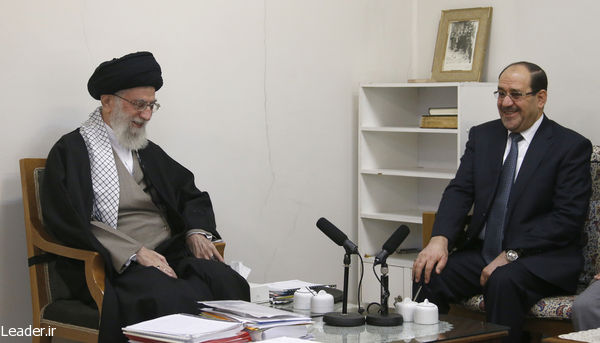
Supreme Leader of the Islamic Revolution Ayatollah Seyyed Ali Khamenei on Saturday pardoned or commuted prison terms of 1,256 convicts sentenced by various Iranian courts.

The pardon was granted at the request of the country’s Judiciary Chief Ayatollah Sadeq Amoli Larijani on the occasion of great Muslim festivals of Eid al-Adha and Eid al-Ghadeer.

Eid al-Adha marks the end of the hajj pilgrimage and is one of the most significant holidays in the Muslim calendar.

Eid al-Ghadeer is a festive day observed by Shiite Muslims on the 18th of Dhu al-Hijjah in the Islamic calendar to commemorate the appointment of Ali ibn Abi Talib by the Prophet Mohammad (PUBH) as his immediate successor.

Article 110 of the Constitution grants the Supreme Leader the right to pardon or reduce the sentences of convicts upon a recommendation from the head of the Judiciary.

The clemency, however, does not apply to all types of convicts, including those who have been sentenced for their role in armed struggle against the country, armed or organized drug trafficking, rape, armed robbery, arms smuggling, abduction, bribery and embezzlement.

There are opportunities for interaction with Iran

Frankfurt Book Fair chief

Juergen Boos, in an interview with Tasnim News Agency, described Iran as a great country with very good literature and said there are opportunities for interactions.

Boos further referred to the problems facing Iranian publishers in Germany and said one of the problems pertains to the distribution of their works. He added that in a meeting planned with Iranian officials in a few days, talks will be held for expansion of relations between Tehran and Frankfurt book fairs.

The 66th Frankfurt Book Fair was inaugurated on Tuesday, October 7 and will run until Sunday, October 12.

Organizers say they expect more than 300,000 visitors to browse the shelves and digital titles of 7,000 exhibitors from 100 countries.

A number of Iranian publishers and literary associations are also attending the fair.

Secretary of Tehran Publishers and Booksellers Association (TPBA) Mahmoud Amouzegar had previously said that nearly 200 titles in diverse sections would be exhibited in this year’s Frankfurt fair.

The books cover different subjects including history, religion, poetry, art, literature, Sacred Defense, wisdom, and philosophy.

Iran hopes for new path in nuclear talks

Araghchi

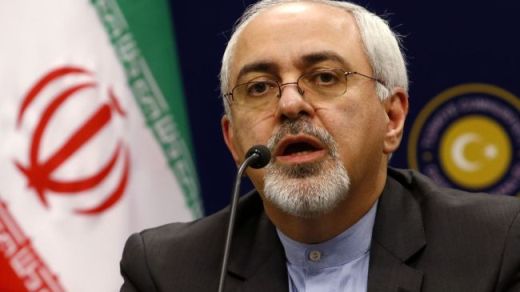
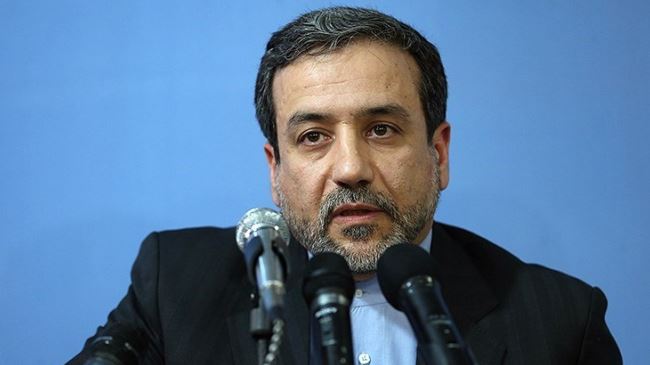
Iran’s deputy foreign minister, Abbas Araghchi, on Friday expressed hope that a new path will be opened in next week’s nuclear talks in Vienna.

“In next week’s negotiations in Vienna we will discuss key issues like the (anti-Iran) sanctions and ways for lifting them as well as the dimensions of (nuclear) enrichment,” Araghchi, who is also one of Iran’s top nuclear negotiators told reporters in northeastern holy city of Mashhad, adding, “We hope we can open a new path (in the nuclear talks)”.

“The talks have reached sensitive stages,” he said.

He also noted that Iran expected progress in New York talks but it did not happen.

“Nonetheless,” Araghchi underlined, “the (negotiating) sides are very serious and we hope to make the most of the negotiation time.”

He further announced that negotiations on Iran’s civilian nuclear activity will resume in the Austrian capital of Vienna on Tuesday, October 14 and run until Wednesday, October 15.

Nuclear negotiators representing Iran and the Group 5+1 (Russia, China, US, France, Britain and Germany) wrapped up the latest round of talks on Tehran’s civilian nuclear program in New York on September 26 without making any tangible progress.

Earlier this week, Michael Mann, the spokesman for the European Union Foreign Policy Chief Catherine Ashton, said Ashton, Iran’s foreign minister and US secretary of state are scheduled to hold a trilateral meeting in Vienna.

“In the framework of the E3/EU+3 (G 5+1) negotiations with Iran on its nuclear program, which she leads, High Representative Ashton will on Tuesday October 14 hold bilateral talks in Vienna with Iranian Foreign Minister Mohammad Javad Zarif. Following the bilateral meeting, they will be joined by US Secretary of State John Kerry for a trilateral meeting on Wednesday, October 15,” Michael Mann said on Wednesday.

How humans react to art has nothing to do with nationality

Master Mahmoud Farshchian, a world-famous Iranian painter

Ettelaat Haftegi, a weekly magazine, dedicated part of its 3,623rd issue in late September to Master Mahmoud Farshchian, a world-famous Iranian painter and miniaturist, and his masterpieces. The following is the translation of an excerpt of the interview:

You are among the most popular artists in Iran and well-known in the world. For years, people of all ages, from children to the elderly, have related to your works, no matter in which divine faith they believe, from Abrahamic religions to Zoroastrianism to Buddhism. The spiritual chemistry and strong mental bond between people and your works is the reason why your paintings have been put on display in special places such as the International Space Station (ISS). Don’t you think you works are inspirational?

[…] Yes, man gets inspirations. I have always sought to prepare myself in a way that I could be gifted with God’s blessings. I thank God for the blessings He has bestowed upon me. […]

What about death? Does Master Farshchian think about death?

Why not? […] Swear to God, I frequently think about death. I have never forgotten it. I have even pointed out death in my works. That should be always alive in our minds. […]

Have you completed any new work of arts?

Yes. My latest works are “Adam and Eve” and “Guidance”. To create the former, I studied the holy Koran, the Torah and the Bible. I have talked to some of my friends who are Zoroastrian priests, read the Old and New Testament, and reviewed the beliefs of Buddhists. They all agree on this: Satan gives the Forbidden Fruit to Eve who makes Adam eat it. Islam is the only religion which believes Adam and Eve have done it together. Never does Islam put man before woman or the reverse, rather, the Muslim faith views the two as equals.

Have you ever sold your works in auctions?

No. I don’t need to sell my works. Thank God there is no need for this. Material issues are of little consequence to me. Well, one of my works may have ended up in an auction, but I have never sold any of my works for the sake of money. […]

Do you follow Iran’s news when you are not in Iran?

When I am not in Iran in flesh, my heart, my soul and my thoughts are here in my homeland. I follow what is happening in Iran. I love hearing good news about Iran and the happiness of Iranians, especially successful youngsters. […]

Has any research institute or laboratory tried to carry out tests on your works, in terms of their durability, to preserve them for posterity? Have you been given any estimates on that?

Yes. That is a very good question. I was recently contacted by researchers from the US. I was let in on the research results on my paintings. I was told their equipment has estimated that my works would stay intact for 600 years. It can be longer than that, but they can’t estimate beyond 600 years because that’s the maximum their machinery can estimate.

Today traditional arts are being taught in Iran’s universities, but it is unclear whether those programs are intended to train artists or theoreticians. Where do you stand on that? Are you satisfied with the trend of training in Iran’s universities? Many of these programs can be pursued in postgraduate levels but the graduates are unable to even draw a line!

I want to give a piece of good news to the art community. Since the pre-revolution period, […] I have asked all those who could do something to help set up an Iranian art university, I mean a university which could train real masters.

Fortunately, the Cultural Heritage Organization […] has set the stage for this. God willing, we will shortly have a university focusing on noble Iranian art. This university is expected to train professionals, not doling out academic degrees haphazardly. I hope the administration of Dr. Rouhani, for whom I feel deep respect, can help this dream come true. […]

Let’s rekindle past memories. Tell us about how “The Evening of Ashura” was created.

Three years before the revolution, my mother told me on Ashura to go listen to Rowzeh-Khani [eulogies in honor of Imam Hussein, Prophet Muhammad’s grandson]. I said I had something else to do and I would go there later. I went to my room, but had a sad feeling. I felt a strange feeling. I took the paintbrush and started to paint “The Evening of Ashura”.

Now when I look back at it after thirty-something years, I admit that the result would be the same if I wanted to do it today. There is something in this painting which brings tears to my eyes. Imagism is not part of the painting. Imam Hussein (Peace Be upon Him), who is the main theme of the painting, is not seen in it.

As for the content, I should say that this image owes its attraction to the absence of the leading character, Imam Hossein (PBUH). Looking at this picture, viewers look for the main character who has been central to the event – Ashura – as it unfolded.

Tears welled up in the horse’s eye, the mortification the animal is filled with for carrying bad news, and the birds which have the blood of the martyr on their feathers are in fact messengers of a real tragedy.

The presence of Hazrat Zeinab (Peace Be upon Her) and a few other people at the heart of this painting has given added attraction to it. Technically, the illustration couldn’t have properly shown the nostalgic feeling, if it had been more crowded. […]

You’ve been living abroad for a while. How do you assess the take of people around the world on Iran’s national and Islamic art?

The appearances of people are different all over the world, so are their ethical norms and tastes. An Iranian may be unfamiliar with our own paintings, but a foreigner may welcome Iranian artworks with open arms. Generally, Iran’s noble art is given special respect across the world. People everywhere are influenced by it, especially when it comes to Iran’s paintings which stem from mysticism, something which takes the viewers to the depths of emotionality. […] The key point is an association between the work and its viewers. If an artistic work can establish close rapport with its viewers, no matter where they are, people who are interested could easily accept it. […]

Efforts should be made to familiarize people around the world with Iranian paintings. In that case, those paintings could be attractive enough to be watched by people, and when reviewed, their content would stay in people’s minds.

In the style I follow such association could be developed between my works and the viewers, whether in Iran or elsewhere in the world. I have so far gained useful results. My style has Iranian nobility in it and does not come across as strange to people of other nations. […]


Evening-of-ashoora Paint by Master Mahmoud Farshchian

Germany shares security concerns with Iran

annen niels the spokesman of Germany’s SPD

On September 29, Sharq newspaper in its 2,126th issue published an exclusive interview with Niels Annen, the spokesman on foreign affairs of the Social Democratic Party of Germany (SPD) Parliamentary Group in the German Bundestag and a member of the SPD’s Executive Committee.

Previously Annen served as an analyst of international policy in German think tanks and for years chaired the Federal Executive Board of the German Social Democratic youth organization. He has contributed extensively to Europe’s socialist publications. He is favored to be a key figure in Germany’s foreign policy in the future.

IFP has decided to publish this interview only to focus on its strategic points, including the opportunity that has been created for Germany, thanks to nuclear talks between Iran and P5+1, to press its bid for a permanent seat on the UN Security Council, something Annen fails to elaborate on. Instead his emphasis remains on the revival of The Weimar Triangle and on the fact that time is ripe to make a final decision on Iran’s atomic case.

The interview could be viewed as an indication of the revival of Germany’s power which is floated based on a “Never go it alone” approach. What you will read below is the translation of the interview in its entirety:

Germany is the strongest and most populous country in Europe. It is common knowledge that Germany is not after political ambitions, although it is very close to being accepted as a member of the UN Security Council and seems likely to become the sixth veto holder in the UN in the near future. How important the Iranian nuclear case is for the Germans at this point in time? Is it a new opportunity for them or will we continue to see a Germany that keeps abstaining from playing a more active role on the world stage? Why is it that your party has bucked the trend and has taken a special and serious look at an active foreign policy? Where do Iran and the Middle East stand in such an attitude?

What you asked is a hot-button issue these days. Various groups and people are trying to carry out more reviews of Germany’s foreign policy. I cannot give meticulous details of all aspects of the issue because we do not have an active foreign policy, but it is no secret that a country’s history and the ties it holds with neighbors influence – and will influence – the formation of foreign policy, one way or another. As for Iran, it has experiences of its own. This is normal for all countries.

Personally, I hail from a younger generation of foreign policy officials. The experience of war in Europe has left an impact on Germany. Without taking account of such impact it would be impossible to appreciate the fact that we are a mighty economic power at the heart of Europe, but have such a [dormant] foreign policy.

Given such an historic experience, Germany cannot go it alone when it comes to political issues. After all, Germany’s foreign policy is not comparable to that of the US where the president makes a speech calling on all people [at home and abroad] to form a coalition. That who joins the coalition is of little importance.

Germany is not seeking to establish its domination in Europe or something like that. Germany played an active role in recent crises – in Ukraine for instance – but its role is a far cry from the US stewardship. We want to see all parties to a crisis get engaged.

Actually, the model the European Union has provided calls for such an approach: more convergence inside Europe and with our neighbors. The bottom line here is “Never go it alone”. Perhaps all our friends do not see eye to eye on such things; for example, Balkan governments may have certain considerations about their ties with Russia. All their efforts are not done out in the open, of course. Many backstage efforts are made for persuasion to eventually arrive at an agreement. They are all done behind the scenes.

This policy could be powerful as well. This could show our power, but it shouldn’t be a show of force on our part. What Foreign Minister Frank-Walter Steinmeier is trying to do is activating such a policy. On the other hand, the Germans see that they have over time secured economic growth and welfare thanks to the presence of a united Army and NATO’s security umbrella, so why should they change course?

Recently, the question of Iraq and a more active role of Germany have been brought up in the German foreign policy organization. That’s why we need to lay out new policies and display new capabilities.

In a democracy, you need both consultation and public support. We need to involve people in these debates and secure their backing for parliament. In fact a kind of public debate has got underway. We need to listen to people. If they do not want us to play a more active role internationally, we have to put their demand at the core of our policies.

How significant is Iran’s nuclear case to Germany’s foreign policy, especially for your party? What is the weight of this case and what opportunities does it offer Germany in general and your party in particular?

Iran is a key regional player. A number of countries are now engaged in the Iraqi question. Even in Iraq, the transfer of power from Nouri al-Maliki to Haider al-Abadi was all but impossible without Tehran’s de facto approval, to say the least. Insecurity in the Middle East takes on new dimensions by the day and certainly Iran is not immune to its ramifications.

Iran too is concerned about this crisis, seeking to see a satisfactory and stable situation prevail in the region. One can say that Germany and Iran share security concerns; in foreign policy we talk about tension, but ties between Tehran and Berlin are exemplary. The translated versions of Germany’s cultural and literary works into Farsi are invaluable. The two countries’ bilateral trade is satisfactory as well.

As for Germany’s foreign policy, our party has taken the control of the Foreign Ministry in its own hands, but that does not mean that the current foreign policy differs from that of our predecessors. The principles are the same, but new steps are taken and activities are gathering pace. All parties in Germany have reached a consensus that they don’t want to see the rise of another nuclear power. Such a thing is cause for concern, not only for Germany and its neighbors but also for far-off areas.

Ties between Germany and France inside the EU have expanded into very strong and close cooperation, as a result of which France coordinated the presence of German forces in Africa. Mass media are talking about the revival of a unity triangle among France, Germany and Poland. Are we going to see strong cooperation in Europe on Iran’s nuclear case? I mean something like Europe’s Troika in nuclear talks one decade ago.

Well, efforts to boost the Weimar Triangle are in fact in parallel with measures to activate foreign policy. This is a good idea for a stronger role of the Europeans. France is Germany’s top political partner. Poland is of extraordinary significance too. It had a key role in Ukraine’s developments. This country has a very special place among countries in Eastern Europe.

All in all, the reactivation of the Weimar Triangle would produce good results. But if you ask how much such political cooperation could advance Iran’s nuclear case, I should say the fact that we have constant consultations within the framework of P5+1 is constructive. This could have been non-existent or the European sides could have been divided, but that is not the case at the moment.

Personally I believe a breakthrough in this case does not hinge on the political leanings of the Europeans, rather it relies on the decisions of Iranian political leaders. If this case has moved forward, it’s because of such decision making, and the actual breakthrough down the road lies in Iran’s hands.

Iran’s president is fully ready; his opponents too are speaking loud and long [about the nuclear dossier]. Everybody admits that Rouhani has personally put in so much energy into settling the nuclear case. The final step is taken when Iran’s leaders make the [final] decision, and this guarantees the talks. For years, we had tough talks and now the time has come for making a crucial decision.

Currently the situation is good in the US, but it’s unclear who will adopt what policies in a year and a half – after Obama. I hope Iran, like other nations, can successfully manage its nuclear case in order to access peaceful nuclear energy.

And finally, how are [Iran’s] nuclear case and Germany’s strategic position related? Martin Kontez, a German author, has recently said Iran’s nuclear case has been a [good] opportunity for Germany to improve its global status as it is vying for a permanent seat on the UN Security Council. Don’t you think that the nuclear case has been a launching pad? Is the nuclear case important to German aspirations?

You related these two points from an interesting aspect. Germany has been part of P5+1, because it has regional and global security concerns. However, the foreign policy in Germany is seriously different from that in other countries. We have never thought that Iran’s nuclear case can help us have a stronger presence on the world stage. What you said is interesting, but that has never been what we have in mind. Germany is in the talks to serve the cause of security; it is not a show of force or a power-seeking attempt.

We thought talks with Iran, as a security partner in the region, could be stabilizing. Germany’s presence in the talks is intended to help establish collective security of which Iran is a good regional partner. The nuclear question is a key obstacle in the way of such a goal, something which should be cleared.

Iran, Portugal Vow to Broaden Cultural Relations

Iran-Portugal-Ali Janati

High-ranking Iranian and Portuguese officials in a meeting in Tehran emphasized the need for the further development of cultural ties between the two countries.

Iranian Culture Minister Ali Jannati in a meeting with Portuguese Secretary of State for Culture Jorge Barreto Xavier underlined that Tehran and Lisbon are determined to boost their cultural cooperation.

He also called for mutual cooperation between the two countries in cultural, artistic and audio-visual media arenas.

Jannati voiced Tehran’s readiness to help translate Persian books into Portuguese language and vice versa.

Xavier, for his part, called for the expansion of all-out cooperation between the two countries, and said exchanging university students and professors and translating books into Persian and Portuguese languages will be a good start for the development of mutual cultural relations.

In June, Iran and Portugal signed two memoranda of understanding (MoU) in cultural areas in a bid to open a new chapter in their bilateral ties.

Also in September, Portugal’s Ambassador to Tehran Mario Damas Nunes voiced his country’s enthusiasm for expanding cooperation with Iran in different political, economic, scientific and tourism sectors.

Speaking in a meeting with Head of Iran’s Chamber of Commerce Gholam Hossein Shafiee in Tehran, the Portuguese envoy underlined the importance of exchanging delegations between the two nations, and called for future visits and meetings between the private sectors.

“Iran and Portugal can collaborate in various fields, including energy, agriculture, oil and gas,” the envoy pointed out.

Interests of the establishment are all that matters to the Expediency Council

Expediency Council-Hashemi Rafsanjani

The Expediency Council can override the existing laws and religious edicts and overlook the viewpoints of the Guardian Council if it deems it expedient, Chairman of the Expediency Council Ayatollah Akbar Hashemi Rafsanjani told a gathering on the macro-policies of the establishment and how their implementation should be supervised.

The Constitution of the Islamic Republic gives supervision powers to the Supreme Leader, he said, adding, “Had the leader decided to exercise those powers, the process could have been much stricter. But the leader has decided to delegate that authority to the Expediency Council.”

Mr. Rafsanjani went on to say, “Initially, the supervision in question was simply meant to make sure parliamentary acts did not run counter to the macro-policies of the establishment, but after a while the leader floated the idea of ensuring the compatibility of the decisions of the Islamic Consultative Assembly with the country’s macro-policies. The Supreme Leader believes those policies are crucial and serve as a link between the Constitution and the Executive Power.”

The following is the translation of the speech the top councilor made at the gathering on Tuesday. The text of the speech which drew widespread attention in the Iranian newspapers was taken from the official website of Ayatollah Hashemi Rafsanjani:
“The late Imam Khomeini personally appointed members of the Expediency Council and tasked them with drafting the council’s bylaws. In order not to interfere with the operations of other institutions, we [members of the council] limited the scope of the council’s powers. But Imam Khomeini did not approve of the bylaws we had developed and said the Expediency Council had to keep an eye on all aspects [of the administration of affairs].

“When the revolution was young and the Constitution was being drafted, there was no word of the Expediency Council, and no one ever expected it to emerge. But realities on the ground prompted Imam Khomeini and then others to conclude that there was a gap to be filled in the country given that a major change had taken place.

“When a draft Constitution was debated in the Revolution Council and handed over to Imam Khomeini, some experts weighed in on the charter, but there was no talk of the Expediency Council, or the rule of the religious jurisprudence for that matter.

“When the Constitutional Assembly first met, the powers of the religious jurisprudent were discussed. Still there was no talk of any institution called the Expediency Council. Ten years after the victory of the revolution, when several problems cropped up, the absence of an institution like the Expediency Council began to be felt.

“Back then the Guardian Council and the Islamic Consultative Assembly were at odds over a series of laws. Actually adoption of those laws had hit a snag. Eventually, Imam decided that there had to be an institution to settle those problems. That decision was communicated to the heads of government branches. In a letter, we asked Imam Khomeini to make his decision operational.

“The problem that was felt after the demise of Imam Khomeini was that [in the absence of macro-policies as we know them today] there was no certain direction for different sectors, something which was to blame for some inconsistencies. So, when the Constitution was to be amended, that question was raised too.

“Today in many institutions, managers are still unfamiliar with the macro-policies of the establishment and their content. Similarly, many in society do not know much about those policies.

“When a parliamentary act is sent to the Expediency Council, because of time constraint, we cannot assess every detail of the law, so we only let the Guardian Council know about the faults we have found with the parliamentary act. The Guardian Council, accordingly, informs the chamber about the problems of the law. But the parliament can opt not to accept the fault(s) we have found, because there is no arbiter in the chamber and MPs can opt not to vote for an amended version of the law.

“When we were drafting the supervision bylaws of the Council, we had some disagreements with the heads of the three branches of government who wanted to limit the supervisory role of the Expediency Council. We, on the other hand, believed things had to be the way the council wanted them to be.

“During the presidency of Mr. Khatami, we had long meetings with his representatives, but the supervision bylaws were slightly reformed. During the presidency of Mr. Ahmadinejad we had the same problem [of government not wanting any supervision by the Expediency Council]. Ahmadinejad had openly said he did not approve of the council. He made no secret of such disapproval. As for the Outlook Plan, he implemented the parts he approved of and brushed aside the provisions he did not like.

“The Fourth Development Plan was based on the [20-year] Outlook Plan. Since Ahmadinejad did not believe in the Outlook Plan, he oversaw the implementation of only 23 percent of its provisions.

“We sent an amended supervisory bylaw of the Expediency Council to the Supreme Leader. Four years later the leader communicated a more detailed bylaw to the council. In drafting the new bylaw, the leader did not make any consultation with us, because he knew we were considerate of the powers of other institutions. The Supreme Leader believes the macro-policies of the establishment are crucial and serve as a link between the Constitution and the Executive.

“The Expediency Council does not put any pressure on executive institutions; rather we have just asked them to send us progress reports. The reports are confirmed if there are no inconsistencies in them; if not, we’ll return them to the agency that has sent it to us. In case they fail to make the necessary amendments, we’ll report the case to the Leader who makes the necessary decisions.

“What we do at the Expediency Council is preventive in nature and entails no punitive measures. We just report the cases to the leader who makes the final decision. In fact, the leader is the main supervisor and we are just acting on his behalf.

“Although new regulations are devised in institutions such as the Judiciary on a daily basis, they do not report their decisions to the council. Other agencies such as IRIB (national broadcaster) and the Armed Forces Organization are under the direct supervision of the leader too.

“The Expediency Council has received no new funding for its supervisory role and taps into its limited budget to carry on its oversight.

“We hope the new trend [in which a large number of councilors regularly attend its meetings] will continue into the future because such arrangement serves everyone’s interests.”

War combatants have not been seen: War veteran

Iran-Sacred Defense
Iran-Sacred Defense

In a special addendum to Sharq newspaper published on September 22, the daily tried to bring back the memories of forgotten soldiers who played an important role in the course of the Iran-Iraq war. The following is the translation of some parts of the addendum titled “Unsung Heroes”:

Even if you think of the value of a pawn on a chessboard, you will know that if it fights bitterly to the end, it can promote and give the queen a second chance to be on the battlefield again. If you are born a boy, everybody knows that you are supposed to do military service, either for a few months or for a few years. Coincidentally, if there is war, your service is particularly counted on. In the Iran-Iraq war, we were not short of brave heroes; in fact, there were as many as three million Iranian soldiers who have now been long forgotten. They are now remembered as war veterans.

One of those veterans of the Iraq war is Mohammad Bodaghi, who turned 18 when the war was in its 5th year. He fought in the war during his military service as an outstanding radio operator. In his opinion, the best moment for a radio operator is when the mortar is ready to be launched. After serving out his military service, he set pen to paper to write about the war, its operations, commanders, privates and so on. He believes that the epic of war has thousands of unsung heroes.

When asked about his family’s reaction when he had been en route to the frontlines, he said, “There used to be a public sentiment that I think our country will never experience again. I remember back then those who were doing their military service insisted on being sent to the frontline. Nobody was willing to stay at training camps.

We think of defending our country as our duty. Perhaps, it was the will of God that we became part of this history-making chapter of our country. Likewise, my family had the same feeling. For instance, once I wrote a letter to my family to reassure them that there was nothing to be worried about. I told them that I had been working in the kitchen.
Later, when I was back and came across the same letter, I saw that my little brother had drawn a line across “I am working in the kitchen” because my family felt ashamed of even saying that one of their own was working in the kitchen. All families were proud to say that their sons were fighting in the frontline.

The era of “Sacred Defense” is a very frank period in our country’s history. People from all walks of life worked sincerely and wholeheartedly to fulfill their commitments. People, particularly parents, gave selflessly whatever they had to soldiers who were fighting in the frontline. My two brothers and I all fought in the war. It’s true that the war came to an end and there is no longer a foxhole, no loud bangs of tank and mortar shells, but even after the Sacred Defense, we are still involved in it; I have been writing about it for the past 23 years.”

The principle in the frontline was defending our homeland.

Rostam Khoramdin is a Zoroastrian war veteran. In response to the question as to whether he was treated differently by his fellow comrades in arms, who were mostly Muslim, he said, “They never addressed me as a non-Muslim. The core principle was the fact that we were all Iranian.

My commander would tell me that he had been ordered to give religious minorities leave to attend their religious rituals. However, when I was the secretary of an army company, I wouldn’t take leave because I knew that we were undermanned. Anyway, in the frontline our obligation was to defend Iranian soil. Our priority was friendship between people there. There was no distinction between Muslims and non-Muslims. […]”