Saturday, December 27, 2025
Home Blog Page 5027

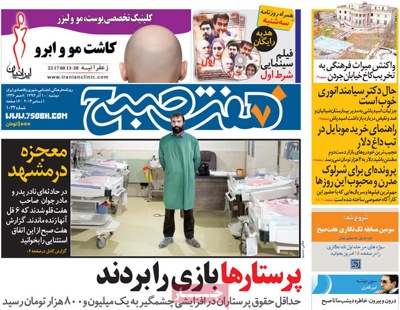
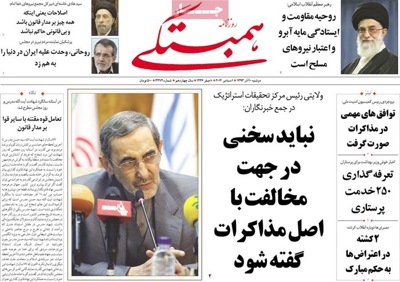
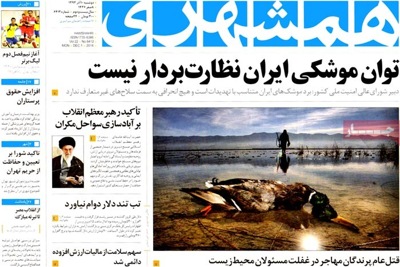
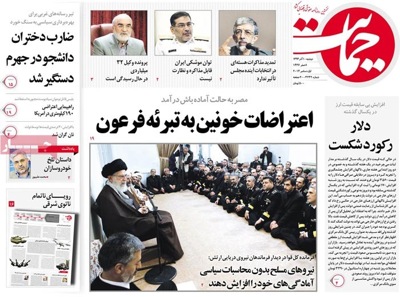
A look at Iranian newspaper front pages on Nov. 1

Iranian-Newspaper-Headlines-02

The countdown for a nuclear deal between Iran and P5+1; the aftershocks of parliament’s failure to endorse President Rouhani’s pick to head the Ministry of Science, Research and Technology; and unrest in Palestinian territories following Israel’s closure of the Al-Aqsa Mosque dominated the front pages of Iranian newspapers on Saturday.

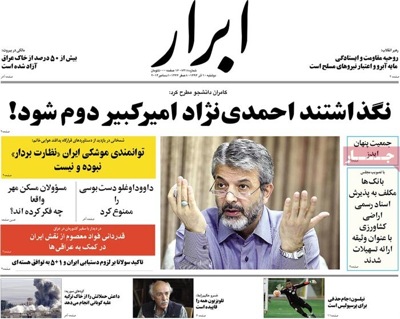
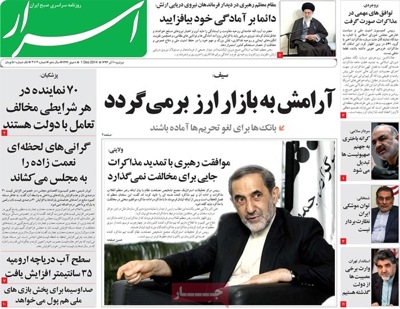
Abrar: “There is no formula to extend the nuclear talks,” said a member of parliament’s National Security and Foreign Policy Committee.

Abrar says the president has sent to parliament a bill that, among others things, lays out plans to create a free trade zone in Jask in southern Iran.

Abrar: “Iran does have good potential for exports of medicinal drugs to Austria,” said the Austrian ambassador to Tehran.


abrar newspaper-11-01


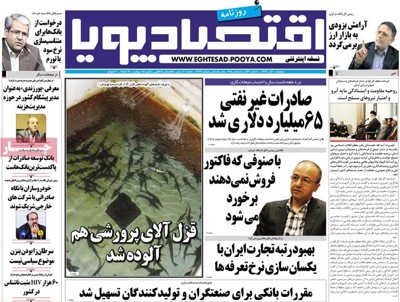
Abrar-e Eghtesadi: Iran has launched exports of petrochemicals to Italy.

Abrar-e Eghtesadi: Imports of crude oil from Iran by four Asian countries have increased.

Abrar-e Eghtesadi: President Rouhani has vowed to create 97,000 jobs by yearend [March 21, 2015].


abrar eghtesadi newspaper11-01


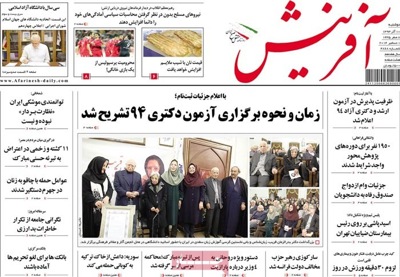
Afarinesh: Isfahan has played host to a festival of remote-controlled small-scale unmanned aircraft.

Afarinesh: “Terrorism and extremism have their roots beyond the region,” Iranian Foreign Minister Mohammad Javad Zarif said.

Afarinesh: President Obama’s National Security Advisor Susan Rice has said that a preliminary deal has been cut with Iran.


afarinesh newspaper-11-01


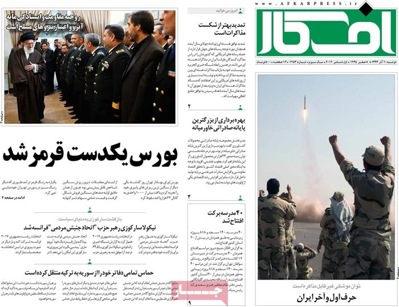
Afkar: Water is to be rechanneled to the Zayandehrood River in central Iran shortly.

Afkar: “Removal of sanctions is a prerequisite for conclusion of a nuclear deal,” said the chairman of parliament’s National Security and Foreign Policy Committee.


afkar newspaper 11-01


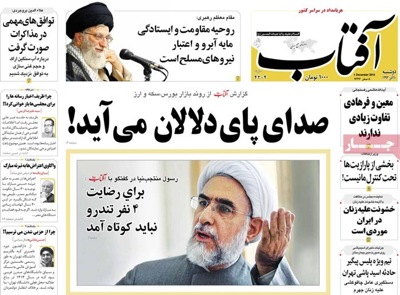
Aftab-e Yazd: “One should not expect anything more than this from this parliament,” Mostafa Moin, a former science minister [under President Khatami] said in a jab at parliament for its refusal to endorse President Rouhani’s pick for the top science post.

Aftab-e Yazd: “The government is determined to pursue the case involving satellite signal jamming,” said Director of the Environment Protection Organization Masoumeh Ebtekar.


Aftab Yazd-newspaper11-01


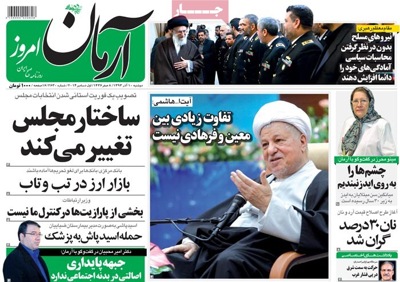
Arman-e Emrooz: Former Iranian Foreign Ministry Spokesman Hamidreza Asefi says he believes the message Ayatollah Rafsanjani has sent to the Saudi King is likely to produce the desired result: [a stay in the execution of senior Shiite cleric Sheikh Nimr al-Nimr]

Arman-e Emrooz: Mohammad Jahromi, [a former managing director of Saderat Bank and a labor minister under former President Mahmoud Ahmadinejad who is alleged to have played a role in a massive corruption case] says he is ready to stand trial, even if the hearings are public.


Arman newspaper-11-01


Asia: “Bitcoins are to be launched in Iran,” said the deputy director of the Cyberspace Research Institute.


Asia newspaper-11-01


Asr-e Iranian: Rain and snowfall sweep eight Iranian provinces.


Asre Iranian Newspaper11-01


Asr-e Rasaneh: “As many as 80 trains packed with European tourists are expected in Iran.”


ASr resaneh newspaper 11-01


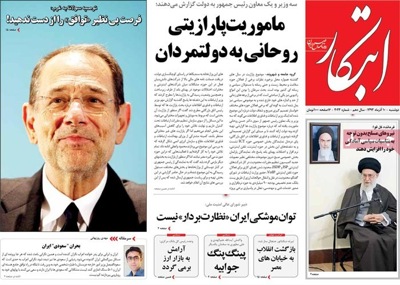
Ebtekar: “I have no idea why they [a reference to MPs] want to impeach me,” said Ali Jannati, the minister of culture and Islamic guidance.

Ebtekar: “Anyone who took on Ayatollah Rafsanjani in a race was defeated,” said Ayatollah Hayeri Shirazi, a member of the Assembly of Experts [in reference to an upcoming meeting of the assembly to replace Ayatollah Mahdavi Kani who passed away in October].


ebtekar newspaper11-01


Etemad: “Reformists seek to serve the interests of the establishment. [Former Vice President Mohammad Reza] Aref stands a good chance to lead the Reformist ticket [in the upcoming parliamentary elections],” said Hossein Marashi, a top Reformist figure.

Etemad: “The race is on to name a new science minister.” In a jab at principlists in parliament, the daily says that it seems MPs are ahead of the government in the race to choose a new science minister.


etemad newspaper 11-01


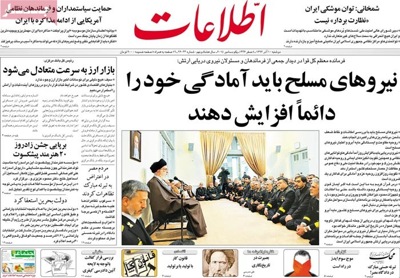
Ettela’at: “Apple seems willing to make its presence on Iran market official.”

Ettela’at: Indian Shiites stage a large rally to protest the death sentence issued against Saudi Shiite cleric Sheikh Nimr al-Nimr.

Ettela’at: American bishops have called on the White House to base its stance in nuclear talks with Iran on the fatwa [the Supreme Leader has issued] banning the development and use of nuclear arms.

Ettela’at: More than half a century of research by Dr. Yahya Dowlati [a renowned Iranian dermatologist] has been praised.


ettelaat newspaper 11-01


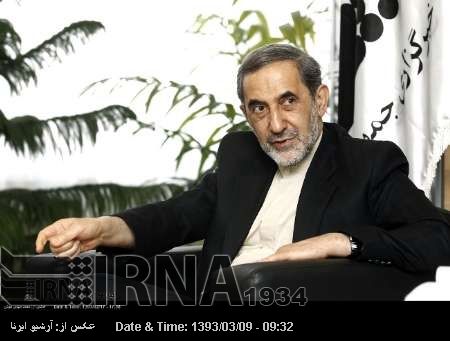
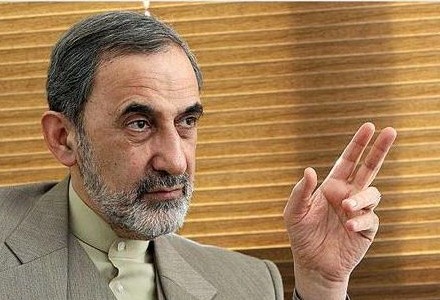
Iran: “The Iranian nuclear negotiators have not crossed the establishment’s red lines,” said Ali Akbar Velayati, an advisor to the Supreme Leader.

Iran: Iran-Europe trade ties are to peak.


Iran newspaper 11-01


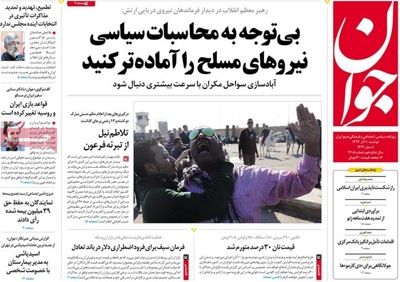
Javan: “The number of those who receive cash subsidies stands at 76 million; the governmentcontinues to avoid removing the rich from the list of those eligible to get the monthly handouts.


Javan newspaper 11-01


Kaenat: The Inspector General reports a land-grab worth around $160 million in the heart of the capital.


Kaenat newspaper 11-01


Kayhan International: “Iran foils sabotage amid nuclear talks.”


Kayhan international newspper 11-01


Rah-e Mardom: Tehran Friday Prayers Leader: “Acid attacks are certainly part of a plot.”


Rahe mardom


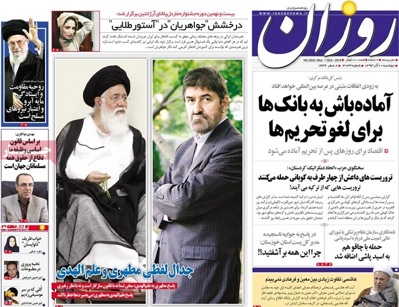
Roozan: “If Ayatollahs Mesbah Yazdi and Ahmad Jannati decide to run for the chairmanship of the Assembly of Experts, Ayatollah Rafsanjani will throw his hat in the ring. But if Ayatollahs Shahroodi and Tabasi run for the top post, Hashemi Rafsanjani will not contest the position,” said Teymour Ali-Asgari, a senior official with the Center for Strategic Research affiliated to the Expediency Council.


Rouzan newspaper 11-01


Sharq: “Sweden has recognized the Palestinian state. A global domino has started to fall.”

Sharq: Failure of the Iranian national broadcaster to pay for the rights to air the FIVB World Championships has resulted in a freeze of the prize money the Iranian national team was promised for participating in the event.


Shargh newspaper 11-01


Taadol: “A black Friday for gold and silver. Prices plunge to four-year lows.”


taadol newspaper 11-01


Mideast extremism rooted in foreign meddling

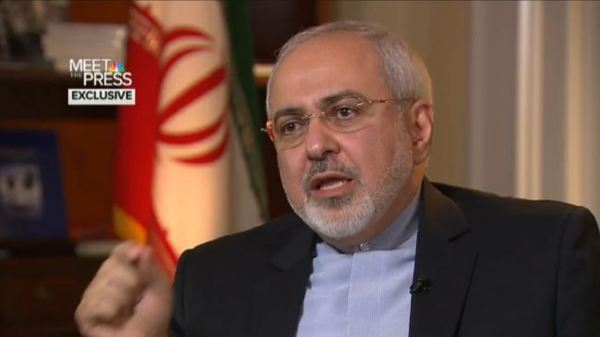
Mohammad Javad Zarif

Iran’s Foreign Minister Mohammad Javad Zarif says the rising threats of terrorism, extremism and narcotics across the Middle East are rooted in trans-regional interference.

Addressing the 4th Ministerial Conference of Istanbul Process on Afghanistan in the Chinese capital city of Beijing on Friday, Zarif pointed to the escalating threats of extremism and terrorism in the region and called for a global campaign to tackle the issue.

Extremism and violence have become a major challenge facing Muslim countries, with Pakistan, Afghanistan, Iraq, Syria, Lebanon, Yemen and other Middle Eastern nations becoming the scene of deadly terrorist operations almost on a daily basis.

Zarif argued that the withdrawal of foreign forces from Afghanistan will eliminate one of the major causes of extremism in the region, as many regional issues have resulted from the interference of certain countries.

The Iranian foreign minister called on all world countries to join efforts to help establish peace and security in Afghanistan.

The Conference of Istanbul Process on Afghanistan was first launched in 2011 to help promote coordination between Afghanistan and other regional countries to counter common threats, including terrorism and extremism. It is attended by 14 countries as its members and around 30 others as supporting countries.

The third Conference of Istanbul Process on Afghanistan was held in Almaty, Kazakhstan, on April 26.

Zarif, Kerry, Ashton to meet in Oman in early November

Zarif-Ashton-Kerry
Zarif-Ashton-Kerry

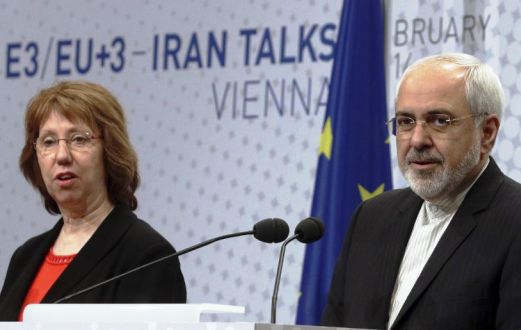
Iran’s Foreign Minister Mohammad Javad Zarif, US Secretary of State John Kerry and outgoing EU foreign policy chief Catherine Ashton will hold talks on Tehran’s nuclear issue in Oman early next month.

US State Department spokeswoman Jen Psaki said on Friday that Zarif, Kerry and Ashton are slated to meet in the Omani capital Muscat on November 9-10 to discuss steps toward a comprehensive final deal on Iran’s civilian nuclear work.

Iran and P5+1 — Russia, China, France, Britain, the US and Germany — are in talks to work out a final deal aimed at ending the longstanding standoff over the Islamic Republic’s nuclear energy program as a November 24 deadline draws near.

Sources close to the Iranian negotiating team say the main stumbling block in the way of resolving the Western dispute over Iran’s nuclear energy program remains to be the removal of all the bans imposed on the country, and not the number of centrifuges or the level of uranium enrichment.

Tehran wants the sanctions entirely lifted while Washington, under pressure from the pro-Israeli lobby, insists that at least the UN-imposed sanctions should remain in place.

On October 28, Iranian Deputy Foreign Minister for European and American Affairs Majid Takht-e-Ravanchi, a top nuclear negotiator, said the Iran-P5+1 talks should lead to the removal of sanctions against the Islamic Republic all at once, adding that Tehran is opposed to any gradual lifting of the bans.

Zarif and his nuclear team have not and will not cross the red lines

Ali Akbar Velayati
Ali Akbar Velayati

Rumors that the Iranian nuclear negotiating team has brushed aside the country’s red lines and clinched a final deal, on the sly, with P5+1 have drawn mixed reactions from Iranian political figures, with some condemning and some others denying the purported deal.

Tasnim News Agency on October 30 ran a brief interview with the head of the Expediency Council’s Center for Strategic Research Ali Akbar Velayati after his meeting with Deputy UN Secretary General Jan Eliasson. The following is the translation of what Velayati, who is also a foreign policy advisor to Supreme Leader Ayatollah Seyyed Ali Khamenei and a former foreign minister, had to tell Tasnim:

Velayati rejected reports on conclusion of a deal between Iran’s negotiators and P5+1 and said, “It is out of the question. We are sure that Mr. Zarif and the nuclear team will not cross the [country’s] red lines.”

He also dismissed speculations that the nuclear team has failed to take into consideration the Islamic establishment’s red lines before cutting the purported deal and said Iran’s negotiators abide by the establishment’s rules and do not overstep what the Supreme Leader has defined as red lines.

“We are sure that [Foreign Minister Mohammad Javad] Zarif and his nuclear team will not overstep the mark and will carry on advancing Iran’s objectives in line with what the Islamic establishment has endorsed,” said the advisor.

Iran, Turkmenistan, Kazakhstan are to be linked via rail in a month

Railway

Iran-Turkmenistan-Kazakhstan railway link is part of the North–South Transport Corridor. Over 910 kilometers of rail tracks are laid in three countries to connect Central Asia to the Persian Gulf via Iran. It links Uzen in Kazakhstan to Bereket-Etrek in Turkmenistan and ends at Gorgan in Iran’s Golestan province. Observers say when complete the railroad would be a major milestone in regional cargo transportation as it dramatically reduces freight transfer time and costs.

Mohammad Shariatmadari

Tasnim, an Iranian news agency, on October 30, featured a short interview with Vice-President for Executive Affairs, Mohammad Shariatmadari, in the northeastern city of Gorgan.

On an inspection tour in the capital of Golestan Province, the vice-president was seeking to get a full picture of what was going on in a place where a giant railway project was underway to link Iran with Central Asia. The following is the translation of the progress report Shariatmadari offered on the spot and a brief look at the giant project and its effects on rail travel in the region:

The vice-president said the railway linking Iran, Turkmenistan and Kazakhstan will be inaugurated in a month, adding the eleventh government gives top priority to the development of railroads.

Shariatmadari further said that the government attaches significance to expansion of rail routes across the country and is determined to complete what has remained unfinished from the time of previous governments.

He said the rail expansion will take place in two parts. One will be carried out in big cities which could bolster road security and urban development, and the other will be along Iran’s borders, something which would connect the trans-Iran railroad to those of neighboring countries.

Recalling his inspection of Gorgan-Incheborun railway, the vice-president said that the construction of Incheborun station is progressing at full speed, expressing hope the railway linking Iran, Turkmenistan and Kazakhstan could become operational in a month.

Iran_Turkmenistan-kazakhstan_railway-3

The 910-km railroad would see three million tons of cargo come into or out of Iran in the first phase, he said, adding that the figure will rise to ten million tons in the following phases.

As for a bogie* exchange point, Shariatmadari said it will be constructed across the border in the two countries based on what the two sides have agreed on.

Asked about the exact timing of the inauguration which is expected to be in the presence of the three countries’ presidents, he said the exact timing has yet to be fixed, but it would be made public soon.

International transportation experts say when inaugurated, the 910-km rail link, would cut short the international transit route from the Commonwealth nations to the Persian Gulf and to Europe by more than 600 kilometers.

More than 700 kilometers of rail tracks are laid inside Turkmenistan. The share of Iran and Kazakhstan stands at 82 and 120 kilometers respectively.

The cross-border railroad will also reduce the transportation and transit time by 48 hours, triggering a drop in transportation fees. All in all, 10 to 12 million tons of freight would be carried via the rail link.

*Bogie exchange is a system for operating railway wagons on two or more gauges to overcome difference in the track gauge. It is currently used for freight wagons. Prior to the emergence of variable gauge axles, it was used for passenger trains.

Iran urges joint efforts to fight terrorism, extremism

Zarif-UN official
Zarif-UN official

Iranian Foreign Minister Mohammad Javad Zarif has highlighted the significance of concerted efforts by all countries, especially those in the Persian Gulf region, to fight terrorism and extremism.

Zarif made the remarks in a Wednesday meeting with UN Deputy Secretary General Jan Eliasson in Tehran, where the top Iranian diplomat called on the world body and Western countries to take a firm stance against acts of terror.

He criticized the West’s double-standards regarding the ISIL militants in the Middle East region, underscoring the necessity for adopting a single approach in countering terrorism and extremism.

It is not acceptable to claim to be fighting ISIL terrorists in Iraq while supporting them in Syria, Zarif said.

The ISIL terrorists control large parts of Syria’s east and north. ISIL also sent its Takfiri militants into Iraq in June, seizing large swathes of land straddling the border between Syria and Iraq.

The terrorist group has committed heinous crimes, including the mass execution of people and beheading of their hostages.

Zarif also said that the Islamic Republic favors restoration of “peace and stability” in the region and “is fundamentally against terrorism and extremism.”

Eliasson, for his part, expressed regret over the incessant terrorist attacks in Iraq and Syria, saying that joint cooperation between regional countries can help settle the problems in the region.

The UN official further highlighted Iran’s role in the settlement of regional issues, calling for further consultations with the Islamic Republic in that regard.

Iran ask US to reconsider policy of arming Syrian opponents

Hossein Amir-Abdollahian

Iran has emphasized the need for respecting Syria’s territorial integrity, asking Washington to reconsider its policy of arming certain groups of opponents of the Syrian government.

Deputy Foreign Minister for Arab and African affairs Hossein Amir Abdollahian stressed the negative effects of forwarding arms and munitions for irresponsible terrorist groups in the region, including those in Syria, and its negative aftermaths for the regional and international security in his Wednesday evening meeting with visiting UN Deputy Secretary General Jan Elliason.

Amir Abdollahian expressed Iran’s readiness for cooperation with the UN in establishing peace and stability in the region, referring to the constructive cooperation that the two sides have already had in various fields.

The Iranian deputy foreign minister recalled the destructive policies pursued by some regional and some trans-regional countries aimed at achieving certain objectives, arguing that such policies are truly futile.

He criticized the useless US airstrikes against ISIS and Washington’s self-contradictory policies in dealing with the notorious terrorism phenomenon.

The UN deputy secretary general, for his part, evaluated Iran’s key role in the region as significant, saying that the UN attaches great importance to consultations with Iran in efforts to solve regional problems.

Elliason said that extremism is today the most important problem sweeping the region, adding that it is a must to address the root causes of extremism and to launch a collective campaign to solve the problem.

He said he sees eye to eye with Iranian officials about solving the Syrian crisis only through political initiatives and that efforts should be made to stop sending arms and ammunitions to the terrorists.

The two sides agreed during the meeting on the need for close cooperation between Iran and the UN for the establishment of peace and stability in the region.

Araghchi: Sanctions increasing Iranians’ hatred for West

Araghchi-UN
Araghchi-UN

Iran’s Deputy Foreign Minister and senior negotiator Seyyed Abbas Araghchi has played down the effectiveness of unilateral sanctions imposed by the West, especially the US, against Tehran, and said Western embargoes have only deteriorated the already unpopular image of the West to the Iranian nation.

“In fact, sanctions have targeted the Iranian citizens, especially from economic, health and educational aspects, but these sanctions have had no result but hatred of the Iranian nation for those who have imposed them,” Araghchi said, addressing a ceremony to commemorate the UN Day in Tehran on Wednesday.

He noted that it is an honor for the Iranian nation that it has achieved major development objectives in scientific and technological fields.

Araghchi reiterated that the unfair sanctions imposed by some big powers are cruel and oppressive, and said, “These bullying policies heighten (Iran-West) challenges and the UN should support the rights of the oppressed.”

He said that Iran as a victim of war, violence and terrorism has always asked for a world free from violence as well as restoration of peace and development on the basis of human dignity.

The diplomat recalled that Iran has been one of the founders of the United Nations, and said, “Restoration of peace is an inseparable part of the UN’s duties and this organization should create better conditions for the restoration of peace in the world today.

On Saturday, Araghchi described the removal of all sanctions against Tehran as a precondition for a comprehensive deal with world powers, and said Iran will not retreat even an iota from its nuclear rights.

“Iran’s negotiations with 5+1 is progressing on a hard path with ups and downs and there is no bright perspective envisaged for its ending by the deadline,” Araghchi said.

Stressing Iran’s full preparedness to take more actions for increased transparency in its nuclear program, he said, “We will not retreat even one step from the country’s nuclear rights; no machine or equipment will be dismantled, the country’s R&D will not be impaired and the most important of all, the industrial enrichment will be materialized powerfully and within the framework of the country’s needs.”

Araghchi underscored the necessity for the removal of all embargos against Iran and said, “The Islamic Republic of Iran will not accept the remaining of even one sanction in the comprehensive nuclear agreement.”

A look at Iranian newspaper front pages on Oct. 30

Iranian-Newspaper-Headlines-02

Failure of parliament to vote for President Hassan Rouhani’s proposed minister of science, research and technology dominated the front pages of Iranian newspapers on Thursday. Principlist papers rejoiced over the vote which dismayed moderate and reformist dailies on the other end of the political spectrum. News about an increase in tax revenues and improvement in business conditions also appeared on the front pages of newspapers.

Abrar: “The image of the suspected acid attacker released online is one of the leads police are following,” [Police Chief] Brigadier General Esmail Ahmadi Moghaddam said.


Abrar newspaper 10 - 30


Aftab-e Yazd: Once again parliament failed to vote for the government’s proposed minister of science, research and technology. “People do not approve of intransigence,” the president tweeted afterward.


Aftabe yazd newspaper 10 - 30


Arman-e Emrooz: “The public opinion will make a judgment,” Hassan Rouhani tweeted hours after the Iranian parliament refused to confirm his pick for the ministry of science.

Arman-e Emrooz: “Supporters of [former President] Ahmadinejad are bracing for parliamentary elections.”

Arman-e Emrooz: “[Nuclear] Talks will produce results,” renowned Iranian political scientist Davoud Hermidas-Bavand said.


Armane emruz newspaper 10 - 30


Asrar: “Reformists will certainly emerge victorious in parliamentary elections,” said Mohammad Reza Khatami, a top reformist figure and brother of former President Mohammad Khatami.

Asrar: “The director of the Atomic Energy Organization of Iran has reported progress in talks between Iran and the [UN nuclear] agency.”

Asrar: “In terms of brain drain, Iran is among the top three countries in the world,” said the deputy health minister for research and technology.


Asrar newspaper 10 - 30


Ebtekar: “Police are following new leads in the case of acid attacks in Isfahan,” the police chief said.


Ebtekar newspaper 10 - 30


Eghtesad-e Pooya: “Tax revenues in the first seven months of the year amounted to almost $11 billion,” said the director of the State Tax Organization.


Eghtesade pouya newspaper 10 - 30


Emtiaz: “Enforcement of morality laws should be in line with rules and regulations,” said the police chief.


Emtiaz newspaper 10 - 30


Etemad: “President Rouhani’s government has suffered an oil jolt; the country’s oil revenues are down by 30 percent.”

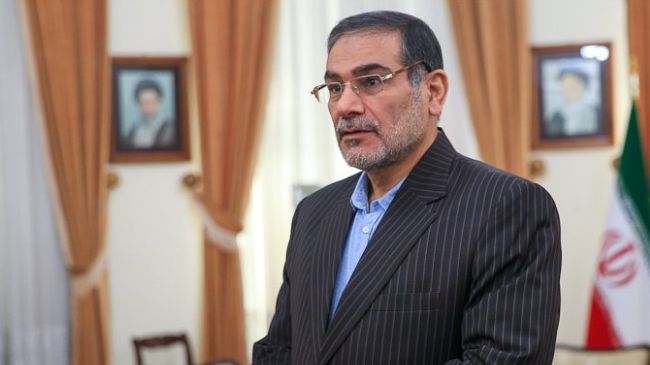
Etemad: “Iran believes in continued talks with P5+1,” the secretary of the Supreme National Security Council said.

Etemad: “I’m sorry, but I respect the views of MPs,” the president said after parliament did not give a vote of confidence to his pick for the minister of science.


Eemad newspaper 10 - 30


Ettela’at: The deputy health minister has criticized the lack of enough budget for medical research in the country.


Ettelaat newspaper 10 - 30


Hamshahri: With the launch of the Electricity Police, those who steal electricity will be arrested.


Hamshahri newspaper 10 - 30


Hemayat: “Do not politicize human rights,” Iran’s Mohammad Javad Larijani has told the head of the UN Human Rights Council.


Hemayat newspaper 10 - 30


Iran: “We’re gonna miss Iran,” say European tourists who are on a train tour of Iran.


Iran newspaper 10 - 30


Iran Daily: “[Deputy Secretary-General of the United Nations] Eliasson: Iran nuclear deal will benefit international community.”


Iran daily newspaper 10 - 30


Javan: “Talks are deadlocked as a result of sanctions.”


Javan newspaper 10 - 30


Jomhouri Islami: The World Bank’s Ease of Doing Business Report says that business environment in Iran has improved.


Jomhurie eslami newspaper 10 - 30


Kayhan: “Parliament insisted on protecting the rights of the people; the dream of radicals did not come true.” The daily said on its front page in reference to failure of MPs to vote for the president’s proposed minister of science, research and technology.


Kayhan newspaper 10 - 30


Roozan: Another MP has claimed that the Iranian nuclear negotiating team has crossed the red lines of the Islamic establishment.


Ruzan newspaper 10 - 30


Shahrvand: “Iran has 87 names on the list of the world’s top scientists,” the deputy health minister said.


Shahrvand newspaper 10 - 30


Sharq: “We seem to be in the habit of blaming media for anything [that goes wrong],” said Hossein Entezami, the deputy culture minister.


Shargh newspaper 10 - 30


Vatan-e Emrooz: “General [Ghasem] Soleimani is a source of pride for Kurds,” said the commander of Kurdish peshmerga fighters in Iraq.


Vatane emruz newspaper 10 - 30


Tehran, Munich planning to resume direct flights soon

Flight iran air
Flight iran air

Iran’s capital city, Tehran, and Munich in Southern Germany plan to resume direct flights next month after a decade-long halt.

Iran’s Mahan Air is slated to launch its first direct flight from Tehran’s International Imam Khomeini Airport to Franz Josef Straus Airport of Munich in the Bavarian state in Southern Germany on November 12.

The resumption of direct flights from Tehran to Munich comes after a 10-year halt since the German airline, Lufthansa, stopped its direct flights between the two major cities in 2004.

The Iranians can use Munich airport as a transit route to other parts of the world, especially the US and Canada.

Mahan Airlines, operating under the name Mahan Air, is a private Iranian airline.

The airline was established in 1991 and began operations in June 1992 as Iran’s first private airline. The name of Mahan is taken from Historical city of Mahan in Kerman Province.

It operates scheduled domestic services and international flights to the Far East, Middle East, Central Asia, and Europe. Its main hubs are Imam Khomeini International Airport and Mehrabad International Airport in Tehran.