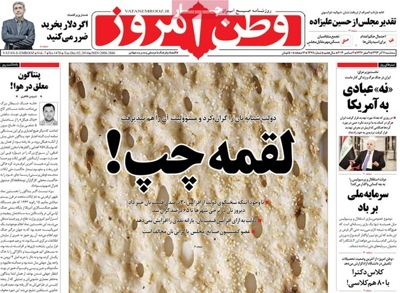
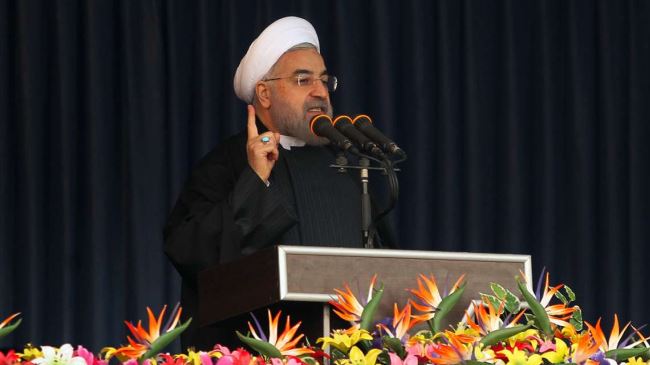
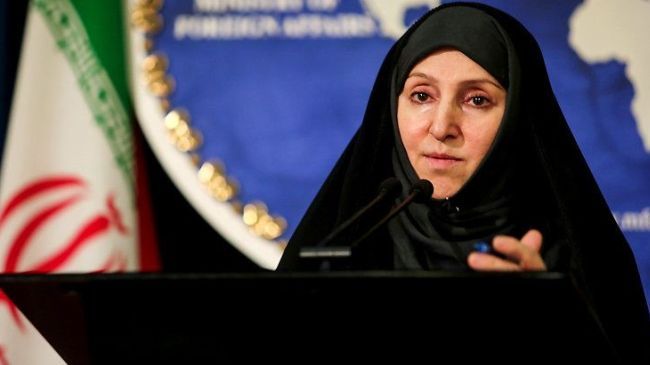
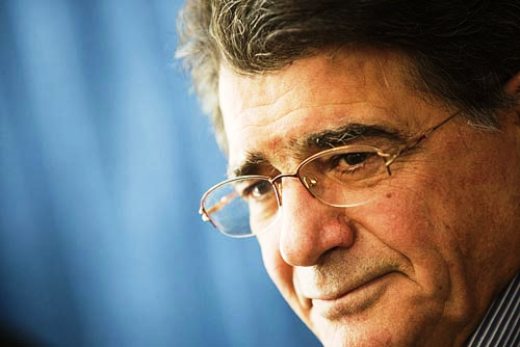
On Monday two newspaper editorials focused on Iran’s foreign relations and an opinion piece in a third focused on why famous composer and musician Hossein Alizadeh turned down the French title of Chevalier of Legion of Honor. The following is a partial translation of the three items:
Arman-e Emrooz: Eastward movement following pressures from the West
By Bahram Amir Ahmadian, expert in international relations
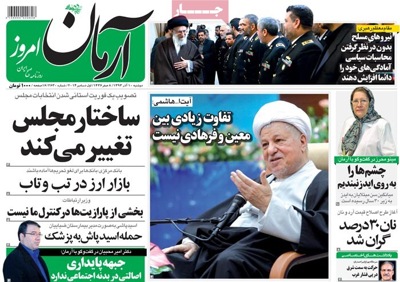 China and Russia – two veto-wielding powers at the UN Security Council which hold remarkable sway – have always supported Iran’s peaceful use of nuclear technology and have even given assurances that Iran’s nuclear program is geared toward civilian purposes.
So far the West’s claims that Iran is using its atomic program as a cover for a broader goal of developing a nuclear weapon have remained unsubstantiated. This comes as Iran has already shown that it is advancing its entire nuclear program under the supervision of the International Atomic Energy Agency (IAEA) and in line with the provisions of the nuclear Non-Proliferation Treaty (NPT).
In other words, as the West struggles to pitch its unproven charges that Iran’s nuclear plan is nowhere near peaceful, Iran tries its utmost to demonstrate that it is forthcoming and its peaceful program has no deviations.
In the interim, China and Russia have always sought to grab the attention of the international community and the court of public opinion. Thus, it comes as no surprise that these two powerful countries show interest in the removal of Iran’s sanctions so that Tehran could fully tap into its potential to forge closer cooperation with them.
On the other hand, pressures by the West against Iran will see the latter gradually move toward creation of a security and military bloc with Russia and China in defiance of US unilateralism. We should admit that this has somewhat shown itself in the framework of the Shanghai Cooperation Organization (SCO).
Whenever the West seeks to exert more pressure on nations, show its superiority and impose its hegemony on them, formation of regional treaties gains momentum.
Iran has a handful of reasons for its reluctance to march toward nuclear militarism, chief among them, the fact that militarism will result in bitter regional rivalry [arms race], something which will certainly destabilize the region. That’s why Iran is favoring the establishment of a security body in the Middle East in cooperation with regional states and without the interference of trans-regional countries.
However, the point is that certain countries, including Saudi Arabia, are not much interested in seeing Iran play a big role in the region. To prevent it from happening, they are more willing to expand their ties with the West. The West, too, is interested in attracting their attention through pushing its agenda of Iranophobia which would help it sign military contracts in the Middle East and consequently sell its weapons.
In the meantime, Iran tends to cooperate with Saudi Arabia to be given a bigger say in regional issues. It is hard to predict what happens next, so we should wait and see. Perhaps Saudi Arabia changes course and comes to the conclusion that cooperation with regional nations, and not alliance with trans-regional states, will earn countries and governments more benefits. […]
Ebtekar: “Saudi” crisis in Iran
By Mehdi Rouzbehani
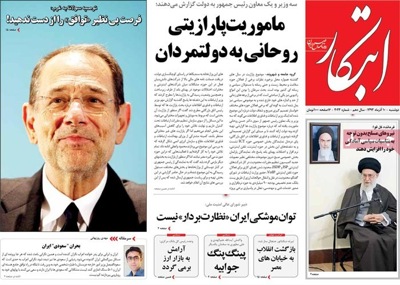 Iran and Iranians are a cause for concern for the godfather of Arabs and this is the very reason why Saudi footprints are seen whenever a case of Iran’s international questions opens.
The deep concerns of Arabs took Saudi Foreign Minister Saud al-Faisal onboard his jet to Vienna to obstruct the conclusion of a comprehensive nuclear deal between Iran and P5+1. The list of issues the Saudis have with Iran is by no means short, and they throw money at the problem.
Nuclear talks, the OPEC session, oil prices and other regional issues in which Iran is somehow involved (the crises in Bahrain, Syria, Lebanon and Yemen) are among the international questions over which Arabs have resolutely lined up against Tehran.
The strategic interests of the two powerful players – Iran and Saudi Arabia – have pushed them to the edge of direct confrontation on many issues. This has made Saudi officials base their regional planning on rivalry with Iran. The role the Saudis play when it comes to Iran’s interests is no secret. Clearly they try to increase their power and credibility on the one hand, and spare no effort to make Iran sustain loss and diminish the influence of Iran on the other. […]
Given the challenges Saudi Arabia has created for Iran on the international and regional stage, one can say that Iran is facing a diplomatic crisis masterminded by Riyadh. The measures Riyadh will take do not matter; what Iran plans to do to defuse the Saudi-provoked crisis and how logically it implements that plan is of importance.
The government of Mahmoud Ahmadinejad lacked basic logic to handle ties between Iran and Saudi Arabia. The former president would adopt repulsive policies which failed to serve Iran’s interests and soured mutual relations more than before. […]
The rise to power of the government of President Rouhani saw Iran try a different approach. Drawing on consultations with many experts, the government favored bilateral interaction as the first step the foreign policy machine was to take as it stuck to rivalry between the two neighbors.
Since the regional interests of Iran and Saudi Arabia are at times interlocked, it is hoped that constructive interaction is taken into account as far as ties with Saudi Arabia go. A win-win attitude can benefit the two countries more than destructive rivalry.
Reports of a trip by Iran’s Foreign Minister Mohammad Javad Zarif to Saudi Arabia helped raise hopes that the two sides might try to ease tensions, sit around the negotiating table to patch up differences, and as a result, the power of the two neighbors would grow in the whole region giving foreign players fewer opportunities to intervene in the region. But the developments of the past month and the cancellation of the Iranian top diplomat’s trip have nourished the theory of a Saudi crisis.
Proposals inside Iran that Akbar Hashemi Rafsanjani play as a go-between thanks to his amicable ties with Islamic heads of state show that diplomatic potential to solve this crisis is losing momentum and that the two countries need to tap into their potential outside the government – public diplomacy – to make the existing differences a thing of the past.
What matters here is that efforts to set a framework for ties with Saudi Arabia are hitting a snag. Extremists on both sides see religious divisions as a serious obstacle in the way of expanded Tehran-Riyadh interaction, but strategic interests need more conditions to be met.
Therefore, the first priority for Iran’s foreign diplomacy should come in the form of striking a balance between these two groups. The bottom line: as long as Iran fails to devise a long-term plan for its interaction with the kingdom, which has currently created a crisis for Tehran, the crisis would deepen.
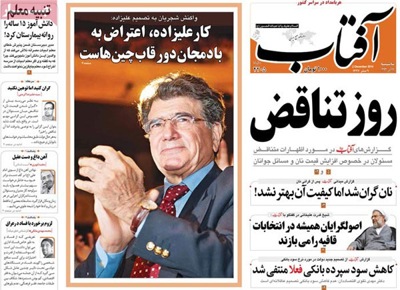
Aftab-e Yazd: Let’s not give wrong directions
By Mehrdad Khadir, journalist
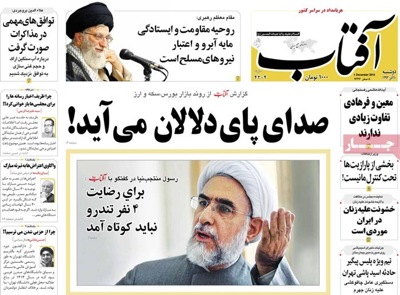 Reports that Hossein Alizadeh, a leading Iranian composer and musician, has turned down France’s Chevalier of Legion of Honor have been met with mixed reactions.
Those reactions have come from two groups: those who expected him – like his fellow artists – to accept the Honor and be named a Chevalier but got surprised by his refusal; and certain media which praised him only to criticize the artists who had previously been given the same honor, vowing to reveal “the hidden part” of the Chevalier of Legion of Honor, and consequently tarnish the image of big names who accepted the award.
On the list of the recipients of the Chevalier award, the following names are conspicuous: Mohammad Reza Shajarian and Shahram Nazeri, vocalists; Jalal Sattari, mythologist; Abbas Kia-Rostami and Asghar Farhadi, filmmakers; Leila Hatami, actress; Mohammad Ali Sepanlou, poet and writer; Reza Seyyed Hosseini, translator; and Pari Saberi, drama and theater director.
Several private gatherings in the residence of the French ambassador to Tehran have made new additions to the list in recent weeks: Kambiz Derambakhsh, cartoonist; Dariush Mehrjui, filmmaker; Madmoud Dowlatabadi, writer; and Lili Golestan, translator and gallery owner.
Although the question [of whether to accept the Chevalier or not] was first raised by Ali Rahbari, a Vienna-based composer and conductor of Orchestra, the reason as to why Alizadeh turned down the award is none of the four reasons Mr. Rahbari has explained:
1. Formerly a number of French figures such as Maurice Ravel, composer, Jean-Paul Sartre and Albert Camus, Nobel laureates, and Catherine Deneuve, actress, have refused to accept the award.
2. The French mission in Tehran is distributing this prize among Iranians extremely fast. That is likely to dent the greatness of Hossein Alizadeh’s name.
3. It defies common sense to see that a singer in Iran is named “the Chevalier of Iranian music”. The title stands in stark contrast with the nobility of the Iranian music.
4. How come dozens of world-famous French musicians and master music players from countries like China, India and Russia have yet to be granted this honor?
However, Hossein Alizadeh, has other reasons for his refusal:
“If official attention to and understanding of music, a noble art, had been like those of the public, a single gift and a foreign title would have not been given so much coverage. In the absence of enough light in an artistic climate, a small lamp is like the sun.”
[…]
What comes into focus here is that the Iranian singer wants to draw the attention of office holders to music. A case in point is his interview back in February 2014 with Tajrobeh (Experience), a monthly magazine, in which he expressed his grievances about the state of music in Iran, saying, “Music has yet to be given recognition.”
In so saying, the best reward to appreciate his move would be official recognition of music in the real sense of the word and attachment of profound significance to it.
That some try to use Alizadeh’s decision as a pretext to lash out at those who received the French award is not a reward. Other Chevaliers of music share Alizadeh’s concerns when it comes to the standing of music in Iran.
Put simply, if Mohammad Reza Shajarian and Shahram Nazeri accepted the Chevalier of Legion of Honor to help Iran’s national music capture the attention of the outside world, Alizadeh finds it more appropriate to draw the attention of “officials” inside Iran to the same topic through turning down the honor.
[…]
The message Hossein Alizadeh seeks to convey [to arts and culture officials within the government] is quite clear: “Be kinder to music.” This is what Shajarian and Nazeri said and still say; one relays the message by accepting the Chevalier title and the other by rejecting it. They have one goal: to raise an issue to prod those inside Iran.
[…]