Sunday, December 28, 2025
Home Blog Page 5006

Iranian physicist wins German Alexander Von Humboldt fellowship

Akbar Jafari
Akbar Jafari

An Iranian physicist Akbar Jafari at Sharif Poly Technique University won German Alexander Von Humboldt Fellowship for Experienced Researchers.

The fellowship is given by Von Humboldt Foundation to foreign associate professors and assistant professors who have graduated over the past decade.

Von Humboldt Foundation awards research fellowships at different levels to foreign researchers and professors. Alexander von Humboldt Fellowship for Experienced Researchers is given to young associate professors and assistant professors who graduated less than 10 years ago.

The individuals receiving the fellowship should present a proposal about a certain topic and carry out it along with a German professor.

[…]

Dr. Jafari is mainly working on condensed matter, and his research focuses on investigating the electronic structures of advanced materials and strong and irregular electronic systems.

He received his B.Sc. in physics from Sharif Poly Technique University in 1999, and received a Condensed Matter Diploma from the International Center for Theoretical Physics in Italy.

He received a PhD from Sharif Poly Technique University in the same field in 2004. He also completed his post-doctoral studies in Japan in 2006.

Iran denounces IAEA’s PMD claims as ‘forged’

IAEA-Inspectors

Iran has denounced as “forged” the International Atomic Energy Agency’s (IAEA) claims about the possible military dimensions of Tehran’s nuclear energy program.

In a statement issued by Iran’s permanent mission to the IAEA on Tuesday, Tehran dismissed the allegations made by the UN watchdog over the possible military dimensions (PMD) of its nuclear energy program.

The IAEA has never provided “any authenticated documents for PMD claims,” said Iran’s explanatory note.

This is while Tehran has offered “pieces of evidence” during meetings with IAEA officials in October and November, proving that the agency’s accusations are fabricated, added the statement.

The IAEA’s documents “are full of mistakes and contain fake names with specific pronunciations [spellings], which only point toward a certain member of the IAEA as their forger,” read the statement.

The statement came in reaction to a report released by IAEA last month that called on Tehran to step up cooperation with the agency’s investigation in order to address moot points regarding Iran’s nuclear energy program.

In their last round of talks, Iran and P5+1 – Russia, China, Britain, the US, France plus Germany – wrapped up a week of intense closed-door nuclear negotiations in Vienna on November 24. The talks aimed to tackle the remaining obstacles that exist in the way of reaching a final agreement.

At the end of the talks, the two sides decided to extend their discussions for seven more months. They also agreed that the interim deal they had signed in the Swiss city of Geneva last November should remain in place during the remainder of the negotiations until July 1, 2015.

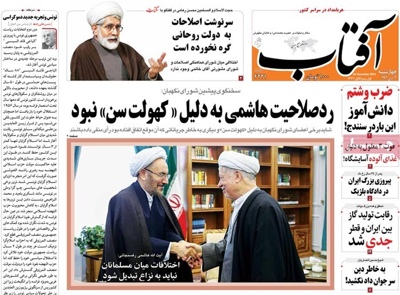
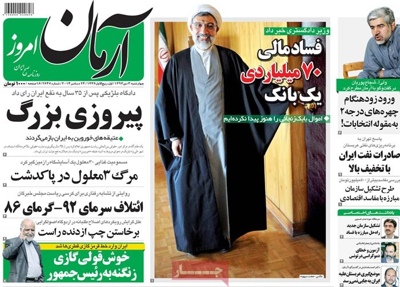
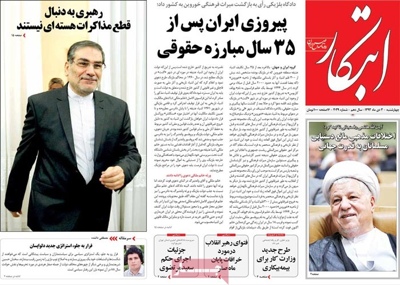
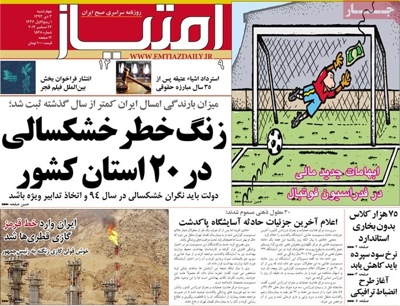
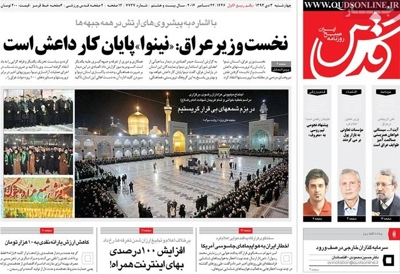
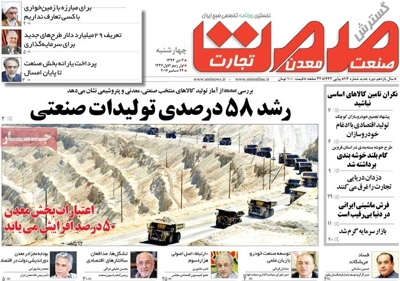
A look at Iranian newspaper front pages on Dec. 2

Iranian Newspapers Headlines

Iranian dailies gave extensive coverage Tuesday to a press conference of Deputy Judiciary Chief Gholamhossein Mohseni Ejei in which he touched on a wide range of issues including cases involving former President Ahmadinejad, former Vice-President Mohammad Reza Rahimi, those behind recent acid attacks, and the battle against drug traffickers. A rise in bread prices also made front-page headlines. The fluctuations of the foreign currency market which have seen the rial lose its value against major foreign currencies were at the center of another top story of the day.

Afarinesh: “Babak Zanjani [anIranian tycoon charged with corruption] is not cooperative enough in locating his assets at home and abroad,” said Judiciary Spokesman Gholamhossein Mohseni Ejei.

Afarinesh: “Those behind the acid attack on Dr. Siamand Anvari, the director of the capital’s Ziaeian Hospital have been taken to police custody,” said Gholamhossein Mohseni Ejei.

Afarinesh: “Air strikes [against IS] without a political plan behind them won’t help Iraq,” said Parliament Speaker Ali Larijani.


Afarinesh newspaper 12 - 2


Afkar: “[Persian] Gulf states launch joint command to counter ISIS and Iran,” said Bahraini Foreign Minister Sheikh Khalid al-Khalifa.


Afkar newspaper 12 - 2


Aftab-e Yazd: “The decision to lower interest rates has been shelved for the time being.”

Aftab-e Yazd: “Reaction of Mohammad-Reza Shajarian to the decision by Hossein Alizadeh” is the headline of a story about the comments of Shajarian, an internationally-acclaimed vocalist, after Hossein Alizadeh, a leading Iranian classical composer and musician, declined to receive France’s Chevalier of Legion of Honor. Shajarian described his refusal as an act of protest against sycophants who take advantage of such titles.


Aftabe yazd newspaper 12 - 2


Arman-e Emrooz: “A manager at Tehran Municipality has been arrested on security charges,” said Judiciary Spokesman Gholamhossein Mohseni Ejei.


Armane emruz  newspaper 12 - 2


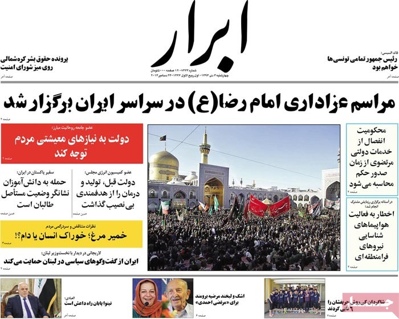
Asrar: “The previous government has left a legacy of thousands of problems,” said Vice-President for Parliamentary Affairs Majid Ansari.

Asrar: “If people act impulsively [in buying and selling foreign currencies], they will incur losses,” said Economy Minister Ali Tayebnia after recent fluctuations on the foreign currency market where the rial has lost value against the dollar.


Asrar newspaper 12 - 2


Emtiaz: “Two thousand marriages and 400 divorces are registered on a daily basis in Iran.”

Emtiaz: “Foreigners should be prepared for a return [to Iran for investment],” said Oil Minister Bijan Namdar Zanganeh.


Emtiaz newspaper 12 - 2


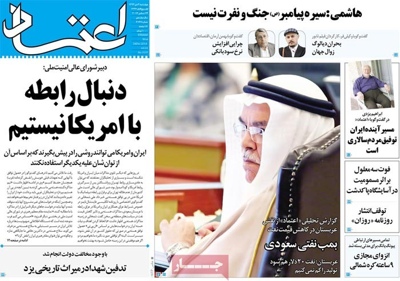
Etemad: “The case involving the Former President Ahmadinejad is still open and an investigation is underway,” said Judiciary Spokesman Gholamhossein Mohseni Ejei.


Etemad newspaper 12 - 2


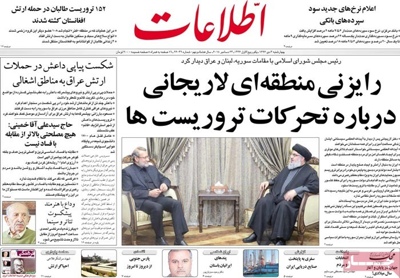
Ettela’at: “The East Caspian Sea railway project between Iran, Turkmenistan and Kazakhstan will become operational on December 3 with the presidents of the three nations in attendance.”


Ettelaat newspaper 12 - 2


Hadaf va Eghtesad: “Inflation will plunge below 17 percent by March 21, 2015,” Governor of the Central Bank of Iran Valiollah Seif vowed.


Hadafo eghtesad newspaper 12 - 2


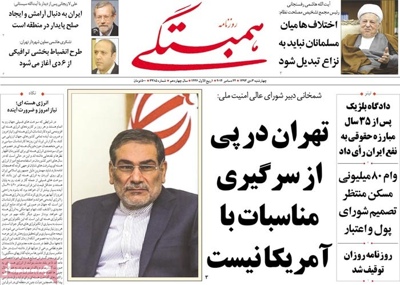
Hambastegi: “Fanning the flames of dissent is a plot by colonial and hegemonic powers to shore up extremist groups,” said Chairman of the Expediency Council Hashemi Rafsanjani in a meeting withthe UN Secretary General’s Iraq envoy Nikolai Miladinov.


Hambastegi newspaper 12 - 2


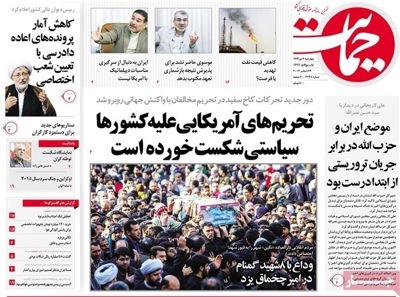
Hemayat: “Within a month, 15 tons of narcotics has been seized and 50 top drug traffickers have been taken into custody,” said Gholamhossein Mohseni Ejei.


Hemayat newspaper 12 - 2


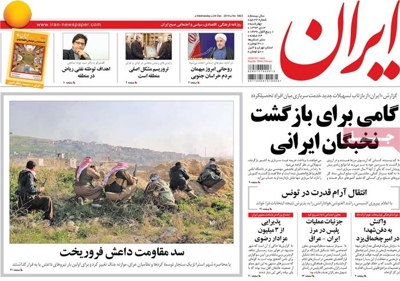
Iran: “World auto-making giants in Tehran” is the paper’s headline referring to a second International Conference on Auto Industry which opened on December 1.”


Iran newspaper 12 - 2


Iran Daily: “Poll: Majority of Iranians support nuclear talks extension.”

Iran Daily: “Iran, Russia set to bolster economic ties.”


Iran daily newspaper 12 - 2'


Javan: “Acid attacks can be deemed as waging war against God,” said Judiciary Spokesman Gholamhossein Mohseni Ejei.


Javan newspaper 12 - 2


Jomhouri Islami: “The fight against terrorism requires attention to all political and social tastes,” said Chairman of the State Expediency Council Hashemi Rafsanjani.

Jomhouri Islami: “Protests against the acquittal of former Egyptian President Hosni Mubarak’s continue in Egypt.”


Jomhurie eslami newspaper 12 - 2


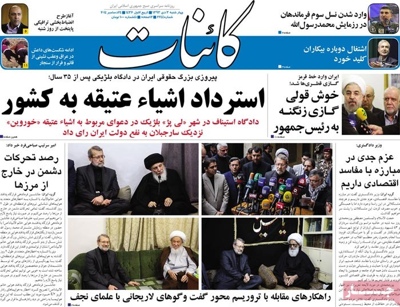
Kaenat: “Renault and Peugeot are vying for presence in Iran.”


Karnaat newspaper 12 - 2


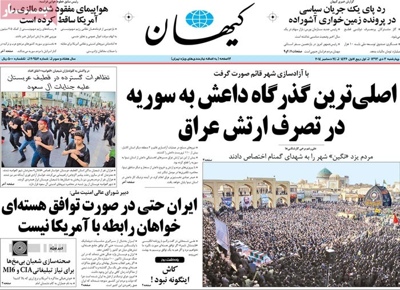
Kayhan: “Iran stood by Iraq through its life-and-death war,” said Iraqi Prime Minister Haider al-Abadi.

Kayhan: “The start of a week of revolution in protest at the exoneration of the pharaoh [a reference to former Egyptian Leader Hosni Mubarak].”

Kayhan: “Economic issues have nothing to do with sanctions,” said Parliament Speaker Ali Larijani.


Kayhan newspaper 12 - 2


Resalat: “Four frigates and two cruisers have joined Iran’s Navy.”

Resalat: “The structural problems of parliament have to do with the absence of a partisan system,” said Ahmad Tavakoli, a Tehran MP.


Resalat newspaper 12 - 2


Sepid: “Despite the beginning of the end of the AIDS pandemic, contraction of the infection in Iran is on the rise,” said the deputy health minister.


Sepid newspaper 12 - 2


Sharq: “Concerns about an earthquake rocking the city were the reason behind the closure of the Canadian embassy in Tehran.”

Sharq: “ISIS has threatened to attack London with a dirty bomb [a weapon that combines radioactive material with conventional explosives].


Shargh newspaper 12 - 2


Vatan-e Emrooz: “The government raised bread prices overnight.”


Vatane emruz newspaper 12 - 2'


Iran will settle nuclear issue: Rouhani

President-Rouhani
President-Rouhani

Iran’s President Hassan Rouhani says the Islamic Republic will resolve the dispute over its nuclear program through constructive interaction with the world.

“In the path of constructive interaction with the world, we will get the nuclear issue to a conclusion,” President Rouhani said in an address to people in the northern Iranian Golestan Province on Tuesday.

“Do not doubt that the P5+1 countries, the Western world, the Eastern world and the region all need to have constructive interaction with Iran,” he said.

Pointing to Iran’s crucial steps to reach a deal with P5+1, he noted that world countries have recognized and accepted the main aspects of the country’s nuclear program.

“Today, the world accepts that enrichment will be carried out on Iranian soil; the world accepts that we will have a heavy water reactor in Arak; the world accepts that we will continue research and development (R&D) work; the world accepts that we will proceed with our activities at Fordow [nuclear facility],” Rouhani said.

The Iranian president noted that the world has realized that it is time to end the cruel sanctions against the country.

He expressed confidence that the Iranian nation would achieve the final victory in the nuclear issue.

He also added that the world needs Iran to improve global security and economic situation and noted that a large number of foreign companies are preparing for business with Iran in the coming months.

In their last round of talks, Iran and P5+1 – Russia, China, Britain, the US, France plus Germany – wrapped up a week of intense closed-door nuclear negotiations in Vienna on November 24.

At the end of the talks, the two sides decided to extend their discussions for seven more months. They also agreed that the interim deal they had signed in the Swiss city of Geneva last November should remain in place during the remainder of the negotiations until July 1, 2015.

Iran’s reaction to the US-Afghan security agreement

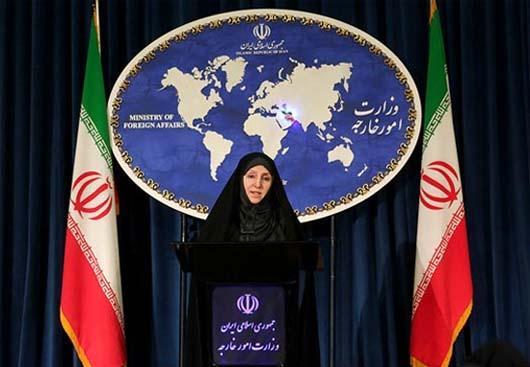
Marzieh Afkham
Marzieh Afkham

On December 1, Aftab-e Yazd, a daily, ran a piece about the comments of Iran’s Foreign Ministry Spokeswoman Marzieh Afkham in reaction to a security agreement signed between the US and Afghanistan. The following is the translation of her comments:

Given the poor record of US forces, we are skeptical about their continued presence in the region, particularly in Afghanistan, because we are of the opinion that the continued presence of American troops there won’t help stability and security return to the country.

The Islamic Republic of Iran is of the opinion that aid from countries both within and beyond the region, which is in line with international commitments and aimed at reconstructing the country and restoring stability and security to Afghanistan, should not come in return for benefits or the use of military bases in Afghanistan.

The Islamic Republic of Iran respects Afghanistan’s independence and sovereignty. However, it views the establishment of American and NATO bases in the region as a threat to regional stability and wants to draw the Afghan government’s attention to the bilateral, regional and international commitments it has to Iran.

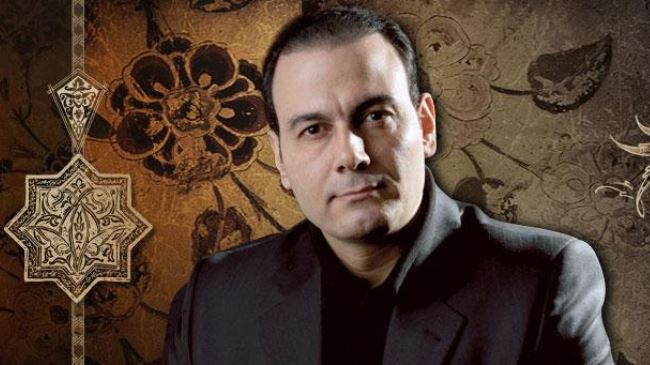
Why a top Iranian musician turned down prestigious French award, fellow musician answers

Mohammadreza Shajarian

Iran Student Correspondents Association (ISCA), a news agency, filed a brief report on December 1 on the comments of Mohammad-Reza Shajarian, an internationally-acclaimed vocalist known as Iran’s greatest living master of traditional Persian music, about Hossein Alizadeh’s refusal to receive France’s Chevalier of Legion of Honor. What appears below is the translation of Shajarian’s view posted on his page about the story:

“The refusal by Hossein Alizadeh [a leading classical composer] to get the award was done in protest at those sycophants who use such titles for their favorite artist.

“With pleasure, I congratulate Hossein Alizadeh, who turned down Chevalier of Legion of Honor after expressing his gratitude to the French government and officially offering apologies for turning down the award.

“His apology was not in protest at the French government; rather it was an objection to those among us who have taken and still take advantage of such awards. By ‘those’ I do not mean figures who hold such titles; rather I mean sycophants who put such titles before the names of their favorite artists. Some advertising and marketing companies, too, add titles to the names of artists or bands. Such titles are irrelevant to the type of art those artists preform and at time even sound funny. These measures are designed to make more profits for a special record label or get their concert halls packed. This misuse of titles will take a toll on the cachet of such awards.

“Hossein Alizadeh wanted to stop them from taking advantage of this and did not allow them to add irrelevant titles to his art and name.

“Extending my gratitude to French politicians who pay special attention to Iranian authors, scientists, artists and cultural and literary figures, [I must say] Hossein Alizadeh does not need any title before or after his name.”

FM: Iran-G5+1 nuclear talks, key issue in post-Cold War era

Zarif_Iran-FM
Zarif_Iran-FM

Foreign Minister Mohammad Javad Zarif said on Tuesday that nuclear talks between Iran and the six world powers are one of the most important issues in the post-Cold War era.

Zarif, who also heads Iran’s nuclear negotiating team, made the remarks while addressing a meeting of university students hosted by Tehran’s Allameh Tabatabaei University. The meeting was dubbed the ‘Nuclear Diplomacy’.

‘We are very close to the framework of a final deal,’ Zarif told the audience in his first speech after the Vienna 8 nuclear talks which ended on November 24 in the Austrian capital with an agreement for extending the talks for another seven months (July 1, 2015).

Anti-ISIL campaign needs political plan: Larijani

Larijani-Mladenov
Larijani-Mladenov

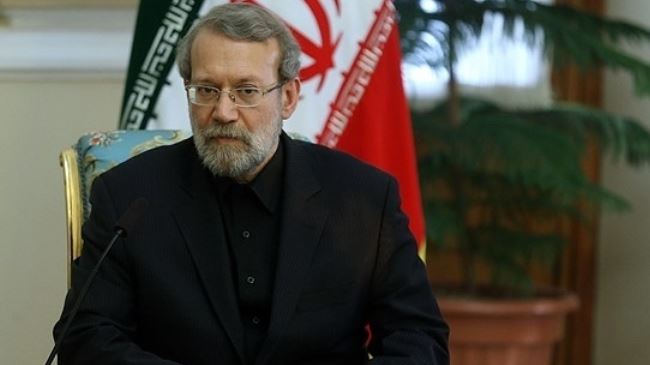
Iran’s Parliament (Majlis) Speaker Ali Larijani has underscored the need for a political roadmap in any campaign against ISIL Takfiri terrorists.

At a meeting Monday with UN special envoy to Iraq Nikolay Mladenov, in Tehran, Larijani pointed to the so-called US-led coalition formed to fight against ISIL in Iraq and Syria and noted, “In the absence of a definite political plan against ISIL, military operations and airstrikes will not help establish security in Iraq and, in practice, will strengthen the terrorist group.”

Larijani pointed to economic and social problems as key elements leading to insecurity in Iraq, saying, “Eradication of poverty and unemployment and participation of all Iraqi political factions in the country’s new government can contribute to security and progress in Iraq and the UN shoulders a heavy and difficult responsibility in this respect.”

He warned of the spillover of the Iraqi crisis to the entire Middle East and reaffirmed Iran’s determination to devote every effort to help restore calm to Iraq.

Mladenov, for his part, praised Iran’s assistance to the Iraqi nation and government in different areas, particularly against the backdrop of the recent developments in the country, and stressed that Tehran’s measures have always been aimed at creating stability in Iraq and resolving the economic problems of Iraqi people.

[…]

Peugeot holding ‘intense’ talks to return to Iran

Peugeot-Citroen
Peugeot-Citroen

French automaker PSA Peugeot-Citroen is holding negotiations to resume its activities in Iran, two years after they were halted due to the West’s illegal sanctions against Tehran.

A top representative of the giant carmaker said in Tehran on Monday that the company is holding “intense” talks about the issue.

In late July, Iran’s leading auto manufacturer, Iran Khodro Company (IKCO), announced plans to cooperate with French automakers, Renault and PSA Peugeot Citroen, to produce four new vehicles in Iran.

IKCO Chief Executive Officer Hashem Yekkeh-Zare said the Iranian carmaker will produce Peugeot 301 and Peugeot 2008 as part of its mutual cooperation with PSA Peugeot Citroen.

He added that Iran Khodro and Peugeot will establish a joint venture with equal shares for car manufacturing.

IKCO will also manufacture Clio4 and Capture under an agreement with Renault, he said.

The developments came after the two French automakers showed interest in taking back the significant market position they enjoyed before the US-led sanctions on Iran were toughened in 2012 over the country’s nuclear program.

In February 2012, PSA Peugeot Citroën stopped its trade with Iran when the sanctions against the Islamic Republic were extended to the automobile sector. It also halted its exports of vehicles to Iran, which accounted for around 13 percent of the firm’s global deliveries in 2011. It cost the automaker an annual sales loss of half a million car and an estimated 1.5 billion euros in lost revenue last year.

Renault was forced in July 2013 to halt completely-knocked-down (CKD) shipments to Iran. It reported a huge fall in profits for the first half of 2013 after writing off the entire value of its business in Iran. The firm suffered a loss of 512 million euros (USD 680 million) after halting its activities in the Islamic Republic.

The automakers hope to return to Iranian market as Iran and the five permanent members of the UN Security Council – China, Russia, Britain, France, and the United States – plus Germany are drafting a final deal on the Islamic Republic’s nuclear program with a view to easing sanctions against Tehran.

Sectarian rifts colonial means of fomenting insecurity: Rafsanjani

Rafsanjani-Mladenov

Chairman of Iran’s Expediency Council Akbar Hashemi Rafsanjani has warned about plots by colonial powers and authoritarian regimes to use sectarian rifts as a means of creating insecurity.

In a meeting Monday with UN Special Envoy to Iraq Nikolay Mladenov, Mr. Rafsanjani said, “Unfortunately, dictatorships, colonialism and terrorism provoke the people to create insecurity by capitalizing on [their] sectarian and religious differences.”

He pointed to the role of authoritarianism and colonialism in the creation of terrorism and noted, “As long as these two factors exit, terrorists will be around and they even grow more in such an environment.”

The veteran politician argued that countering terrorism requires a comprehensive plan and taking heed of all political and social strata, adding, “The presence of ISIL in Iraq is not permanent, but planning is needed to prevent the infiltration of this ideology and similar deviant thoughts.”

Rafsanjani underlined the need for tackling terrorism at its root as an intrinsic responsibility of the UN and pointed out that the aim can be achieved by showing real respect for human rights and avoiding discrimination and politicization of issues.

Mladenov, for his part, noted that, contrary to the existing claims, ISIL can be defeated very easily through military means, as the group has no popularity among the public.

He called for efforts to bridge the sectarian and religious rifts in Iraq and noted that the Iraqi National Guard should be deployed across the country’s provinces and borders to tighten the noose on terrorists.

The ISIL terrorists launched an offensive in Iraq in June and took control of the country’s second largest city, Mosul, before sweeping through parts of the country’s Sunni Arab heartland.

The extremist group has threatened all communities, including Shias, Sunnis, Kurds and Christians, during its advances in the violence-torn state.